What we still don't know
What is still not known about Private Thomas Murphy's war, from Arnhem to his liberation in 1945, and where the answers might be: the archives to search, and the records to ask for.
Archive shopping list
Link to the section Archive shopping listThe National Archives, Kew: and what is already known to exist
Link to the section The National Archives, Kew: and what is already known to exist| Series | Content | Status |
|---|---|---|
| WO 344/229/2 | Liberated POW questionnaires, MUNRO-KERR to MURPHY, 1945–46 (catalogue entry) | The piece his form is in, if he completed one. On Ancestry (collection 62114), a search on 5 Sep 2026 found three "Thomas Murphy" questionnaires (record ids 64507, 64508, 125742); two show a two-digit birth day, one a nine-letter capture place. Details are behind the paywall. Also orderable at item level from Kew. Haller's questionnaire is there (one record, six-letter capture place); Banwell's is not indexed. This is the one document still to get that is in his own words |
| WO 171/1247 | 156 Bn war diary, March–October 1944: Discovery id C4441356 | Found. Order it. Should settle the drop date, the platoon, and whether he was on Paul Krugerstraat |
| WO 373/64/316 | Hardy's Military Medal recommendation, "Escape and Evasion and Special Operations", gazetted 20 September 1945 (Discovery; the Gazette page) | ✓ Downloaded and read, 7 October 2026: he went back onto the ice alone for the scattered men and could not find them (the citation; The crossing) |
| WO 361/633 | Casualty branch's missing-men file, "Airborne operations, North West Europe, Arnhem: 156th Battalion, Parachute Regiment", Sep 1944 – Oct 1945 (C11483692) | Found. This is the file in which a man reported dead and then found alive is worked out on paper. The false death notice of 20 Nov 1944 and its withdrawal (Killed on paper) should be in it. Not digitised; Kew |
| WO 309/2035 · WO 311/884 · WO 309/848 | War-crimes investigations: "Alleged murder of British prisoners of war at Arnhem, September 1944" (1945–47), "Murder of British prisoners of war, Arnhem, September 1944" (1945–47), "Arnhem: killing of British soldiers" (1945–47) | ⚠︎ Leads, not findings. None names Donaldson in the catalogue, which describes files only at one line. They are the right series and the right dates for an investigation into an officer shot in a house, and for whatever the MI6 questioning after demob was about (After the war). Not digitised; Kew |
| WO 311/1297 | "Medical neglect of wounded British prisoners of war at Apeldoorn barracks, Netherlands, September 1944", a Judge Advocate General's file (the catalogue entries) | ⚠︎ Lead, catalogue only. The barracks he lay wounded in until he escaped on 6 October (Apeldoorn); statements in such a file often name witnesses. Not digitised |
| WO 309/154 · WO 309/810 · WO 309/811 · WO 309/1579 · WO 311/190 | Five war-crimes files on Stalag XI-B, Fallingbostel: the ill-treatment and killing of British and Allied prisoners, 1945–47 (the catalogue entries) | ⚠︎ Leads, catalogue only. The camp he was liberated from; witness statements may name him or his hut. Not digitised |
| WO 309/1026 | "Amerongen, Holland: death of British Officer", 1946–47 (the catalogue entries) | ⚠︎ Not shown to be connected: no officer of the 2 January party died at Amerongen |
| WO 417 | Casualty lists, the weekly War Office lists that carried a man from "missing" to "prisoner of war" | Findmypast, indexed (pieces 1–102). The sequence for 2756457 would show the paper trail of Killed on paper: missing, then died, then alive. ✓ Found: lists 1585, 1687, 1707, 1746 and 1753, from wounded and missing to died as a POW to "Not Missing", read as Forces War Records' index transcriptions (the five records; Killed on paper). The list images themselves are unseen |
| WO 361/1797/1 and /2 | Stalag XIB Fallingbostel nominal rolls, two parts (catalogue entries) | Part 1 is indexed on Findmypast (their piece list), with WO 392/1 and 392/10–15, the 1945 alphabetical POW lists. If he is on the roll it carries his POW number, open question 1. Part 2 is Kew only |
| WO 171/4234 | 49 Infantry Division, Reconnaissance Regiment, war diary 1945 (Discovery) | The unit that received Schjelderup, Gri and Hardy near Dodewaard on 3 January. Would show whether a patrol went out to the Rhenen bridge that night and what it lost, open question 20. Not digitised; a copy can be ordered by post |
| WO 416 | German POW record cards | ⚠︎ Not in the index. All 232 Murphy cards checked (the WO 416 search); none is his. For contrast, Noble, who reached Stalag XI-B within weeks of him, has one: WO 416/273/71, "Charles Noble, date of birth 07/10/1919" (Discovery, checked 13 Sep 2026); Banwell has nothing under 5498293 in WO 416 or WO 208. What WO 416 is, since the absence only means something if the series is understood: about 200,000 German-printed record cards on prisoners held by the German authorities, taken by the British Army in 1945 and passed to the War Office. They record capture, transfers, escapes and deaths, and some carry photographs, fingerprints and x-rays (TNA's series description). ◐ What the gap does and does not show. Of the party taken on 2/3 January only two have cards: CSM Wilf Berry, whose card is from his capture on 7 Oct 1944, Dulag XI-B, POW no. 201375 (his first capture, at the Leopold Canal, before he escaped from a prisoner train as it left Utrecht on 23 October: Before Amerongen; the card itself not yet seen) (WO 416/28/266; the record), and Noble, whose card was made at Stalag XI-B (POW no. 1781) and gives no date of capture. Murphy, Banwell and Porter (nothing under R.133074) have none, and nor, under those spellings, do the three Canadian privates, Trainor, Swartz and Briere (the searches). Nothing on record divides the two groups. It is not an earlier capture, since Murphy and Banwell had both been taken at Arnhem and escaped; and it is not clothes, since Noble, by his own report, was "captured in civilian clothes". So the absence says nothing on its own about his being held as a spy. ⚠︎ And cards were also pulled from the series after the war as evidence for ex-prisoners' compensation claims and often never refiled, so a missing card can be an administrative accident. In person, or Fold3 |
| WO 422/38420 | His service record, "T Murphy. Service number: 2756457. Date of birth: 11 November 1920" | Closed until 1 Jan 2036, but requestable now: TNA's "request a military service record" service takes a request for a person born before 1940 with proof of death; standard copy £42.25, full record check £48.87 plus £1.04 a page (their fees page); medical and disciplinary detail is withheld. The one document that settles the enlistment date and place, the wound, and every posting |
| WO 208 | MI9 reports. The Discovery catalogue indexes them by name and number (checked 13 Sep 2026: Walsh WO 208/3352/2386, WO 208/5433/14, WO 208/5275/1060; Haller WO 208/3326/2991, WO 208/3352/3047). Murphy has none, as expected for a man recaptured; his own words are the WO 344 questionnaire above | Hardy IS9/WEA/1/270/2351 · Schjelderup IS9/WEA/1/271 · Moore /262 · Davison /263 · McNaught /290/2385 · Warrack /275 · Noble MI9/Gen/22426. Unread, and may name him: Gri's own report, IS9/WEA/1/272 (WO 208/3351/2350, with a second copy catalogued under the wrong name, "A Griffiths", WO 208/5413/49), and the liberation questionnaires, with their appendices, of three men taken in the same net: Swartz (WO 208/3332/1078 and 3339/1078), Briere (3332/1154 and 3339/1154) and Berry (3331/751 and 3338/751). Not digitised: order them at Kew (the catalogue entries) |
The Arolsen Archives
Link to the section The Arolsen ArchivesThe Arolsen Archives (the International Tracing Service) hold Nazi camp records and are free online. Searched, 18 September 2026 (what the index holds). The name index was gone through for everyone in this site, and what it gives is the Dutch side of the December round-up, not him. The Canadians in his party were searched on 4 October 2026 (Briere, Trainor, Swartz, Berry, Porter): none of them is there, though Berry's search stops at the index's 5,000-row limit:
- ✓ Pieter Veenendaal, born 20 December 1908 at Leusden, has a personal file in the Neuengamme records. That is the Scherpenzeel farmer beaten into giving up the next address (Piet Veenendaal), and it is German paperwork for where it ended.
- ✓ Three Verhoefs, born at Barneveld 1916, at Achterveld 1919 and at Barneveld 1879, all with Neuengamme personal files. The first two are the Klettersteeg brothers, who died at Wöbbelin three days apart. The third is a different family and an earlier arrest: a 65-year-old farmer taken in October 1944 as a "Terrorist", dead at Neuengamme on Christmas Day (Jan; Johan; Wouterus).
- ✓ Fokke Dijkstra, born 25 January 1927, prisoner number 9607, personal file of five documents at Amersfoort, with an ITS tracing case under his name as well.
- ✓ Albert van Meerveld, born 1 October 1909 at Nijkerk, personal file of four documents at Amersfoort: Noble's "Ape" (Albert van Meerveld).
- Why was Dirk van Eysinga in Vught? His card there, prisoner B.V. 6993, born at Leiden on 7 November 1916, is his: the same birth date as his helper file and his Leiden birth record (Dirk van Eysinga). He went in on 12 August 1943 and was moved on 27 October, with his elder brother Tjalling A. J. van Eysinga, born at Den Haag, as 6994 (Nederland's Adelsboek, 1941 has the brothers). The cards do not say why he was held; anyone who knows is asked to say.
- ✗ Cornelis Lagerweij, born 15 December 1923 at Ede, a Neuengamme file. Not one of the round-up: no Lagerweij was taken at Hardeveld, whose owners were in hiding (Wuf Lagerweij; the December round-up).
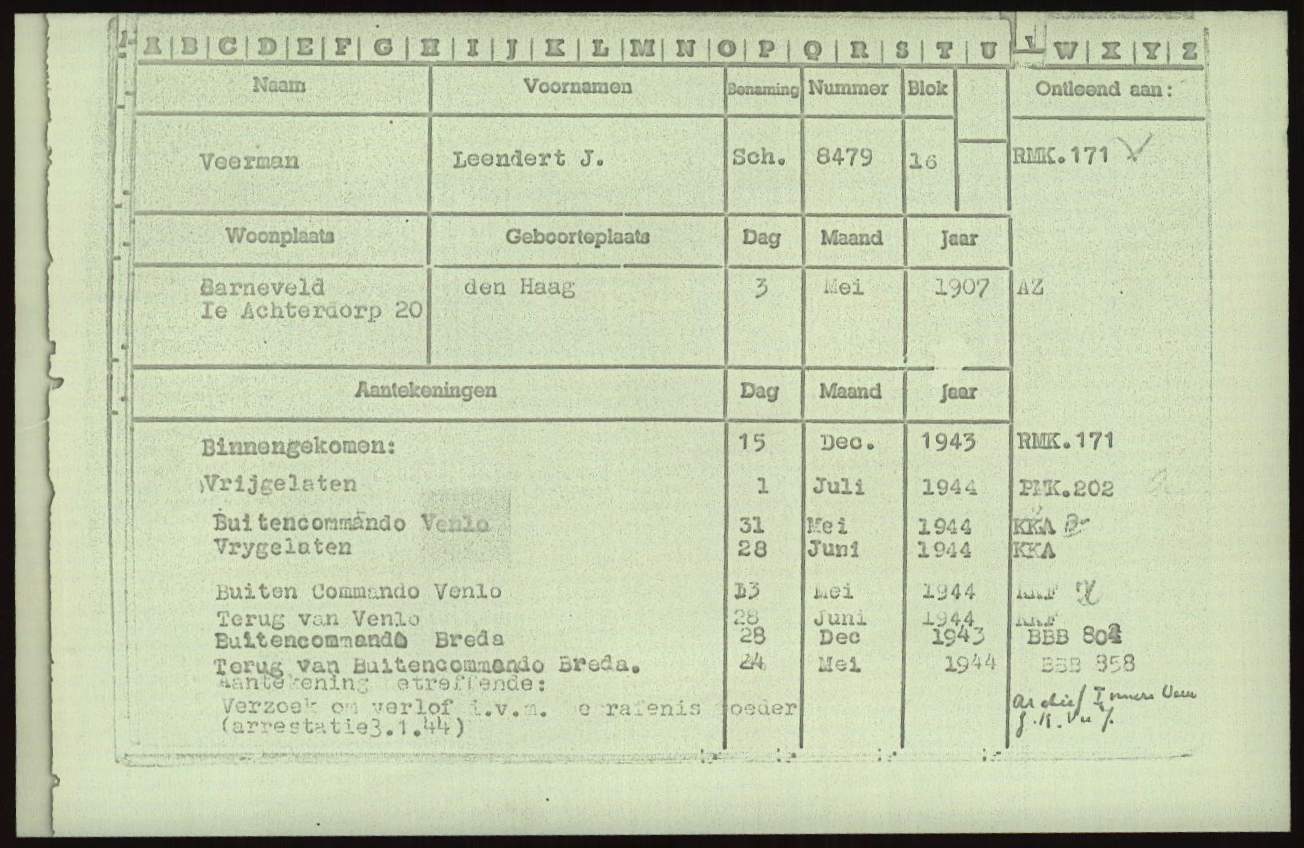
- ✗ Nothing for Jacob Veerman. Twenty-five Veerman personal files are indexed, most at Amersfoort and Vught, and not one is the man born at Den Haag on 3 August 1900. ✓ One is his brother: Leendert J. Veerman, born 3 May 1907, prisoner 8479 at Vught, whose file is now held (Leendert Jan Veerman). Jacob's own Amersfoort registration of 6 March 1945 and his Neuengamme record are not in the indexed holdings. Nothing for Jopie either, so her Westerbork months are not there.
- ✗ Nothing for Murphy.
- Every one of the 248 rows the index holds under the surname was read, and the search allowed for every way he wrote his own name, Thomas, Thos, Tom, T., and for rows with no forename at all.
- The Murphys in the index sit in the post-war district files on foreigners, not in camp or POW records; the nearest, a Thomas Murphy born 24 November 1920, belongs to the Obertaunuskreis papers near Frankfurt. This is the same silence as WO 416 (above), from the other archive.
- Names were searched the same way throughout: surname alone, then every row read, because the index carries initials and short forms as the clerk wrote them (1,026 rows under Veerman, 904 under Noble, 1,734 under Hardy). Fifty-seven surnames were put through it, 120,419 rows in all, which is every person named in People.
- ✗ Nothing for Banwell, Noble, Hardy, Maljers, Kruimel or Dries Klooster.
The files above are not just index entries now: the scans were downloaded, read and archived here, which is where the dates and causes of death of the December round-up come from. ⚠︎ The forms are faint carbon typing over German printed headings, so each was read as an image and not trusted to OCR.
⚠︎ A British prisoner would not be in this archive anyway, which is what the silence around Murphy, Banwell, Noble and Hardy actually means. Arolsen indexes Nazi persecution — camps, forced labour, the post-war tracing of displaced people. A soldier held under the Geneva Convention was the Wehrmacht's paperwork, and that is WO 416 at Kew. The search was still worth running, because a man held as a spy rather than a prisoner could have ended up in exactly these records, and the answer is that he did not.
Not Berlin. The old Deutsche Dienststelle, now the Bundesarchiv's Abteilung Deutsches Reich at Berlin-Tegel, answers on German personnel only, "German prisoners of war in Western custody" among them, and refers camp-prisoner enquiries to Arolsen (their page). The German cards on British prisoners are the ones the British Army took in 1945, WO 416 above, and there is no second copy. So a search of German records for a British soldier comes up empty.
Every Kew item above that is "not digitised" can still be had without a visit: each Discovery page has a "request a copy" button that returns a quotation for a scanned copy by email. The war diary, the missing-men file, Walsh's original and Joyce's cards are all in that category.
Regimental and published
Link to the section Regimental and published| Source | Status |
|---|---|
| John O'Reilly, From Delhi to Arnhem, the 156 Bn history (Thoroton) | ⚠︎ Not yet checked for Murphy. Not online anywhere. The Association describes it as built on "extensive discussions with men who served in the 156 Parachute Battalion, their families and members of the Dutch Resistance", and O'Reilly produces the Association's newsletter, so he is reachable ⚠︎ A relative who has researched him wrote in 2018 that it records some of his details (family word; not yet seen). Noordman corresponded with the author in 2017–18 (Noordman, p. 336) |
| 151–156 Parachute Battalion Association (156para.co.uk; contact) | ⚠︎ Not yet approached. No roll online. A contact form "for next of kin of a former member of the battalion", and will@156para.co.uk. The people to ask about the platoon, and about Shepley's |
| Lipmann Kessel, Surgeon at Arms (1958; US edition 1959 as "Daniel Paul") | ✓ The 1959 US text read in full on the Internet Archive (extracts; further extracts); the Archive's second copy, listed as 1958, is the same printing, and the 1958 Heinemann edition is not online. No Murphy or Walsh. Under first names and cover names it has "Tex" at De Ruif with a radio of his own, "Ham" and "Bacon", the burgomaster and his wife, the fork on the Pegasus II night, Kirschen met in person, and the February crossing from Amerongen, Garderen, Operation Pegasus II, Amerongen, Tex Banwell |
| Leo Heaps, The Grey Goose of Arnhem (1976) | ✓ Read as an Internet Archive lending copy (extracts). No Murphy. Banwell throughout: the train jump, Putten, the ambush, and the Berlin–Auschwitz ending with its 21 November capture date, Tex Banwell |
| Graeme Warrack, Travel by Dark (1963) | ✓ Read as an Internet Archive lending copy (extracts). No Murphy, Hardy, Walsh or Noble. Banwell's name current among the Dutch at Barneveld at Christmas 1944; Kirschen as "Fabian King", Kirschen's page |
| Geoffrey Powell, Men at Arnhem (1976) | ✓ Searched as an Internet Archive lending copy (note). Written under the name "Tom Angus" with every person renamed, so it names nobody; nothing in it can be tied to Murphy or Donaldson |
| Imperial War Museum sound archive | Three reels with Maj. Geoffrey Powell, OC C Company, India to Oosterbeek, free to stream (IWM 80011642). Searches for Banwell, Hardy, Walsh, Noble, Kessel, Longland and Warrack found nothing of theirs there |
| Wolter Noordman, Schuilplaats de Veluwe: De vluchtlijnen voor geallieerde piloten 1942-1945 (Omniboek, 2019, ISBN 9789401916301; e-book 9789401916318) | ✓ Bought as the e-book and read in full, text and all 207 pictures (Noordman; buy it). Chapter 22, "Samuel Pete Walsh en Thomas Murphy" (pp. 296–306), is Walsh's report with Liesbeth Verweij's account of Sterrehoveke; Murphy is also in the chapters on Haller, Hardy and Banwell and in the foreword. It gave: his own entry in the De Ruif guestbook (Garderen), a photograph of him (Subject), the deaf farmer who hid him his first week (On the run), Verweij's description of him (Elspeet), the tin of dubbin (On the run), and the leads in Dutch. Sold as an e-book in the Netherlands and Belgium only |
| Wolter Noordman, Ondergedoken op de Veluwe (2009) | ⚠︎ Not yet seen. His earlier book; he cites it for the 2 January Amerongen party ("p. 351 e.v.") and for Noble's story, and it tries to list the Pegasus II participants (Noordman, pp. 198, 287, 295) |
| Jeanne Dijkstra, Elspeet, baken van verzet (Regioboek/BDU, Barneveld, ISBN 9789087881771) | Sterrehoveke, Van Eysinga, Kruimel |
| Loek Caspers, Vechten voor vrijheid: oorlog en verzet op de Utrechtse Heuvelrug (Verloren, 2007) | ◐ Searched through Google Books, snippets only (extracts). No Murphy, Banwell, Noble or Veerman by name. The 2 January crossing on p. 175, with Coen Esveld and "Dirk" Maljers (Adriaan) as guides and nineteen people; the Esveld garage (p. 64). The full p. 175 is worth buying the book for |
| Bob Porter, The Long Return (1997), chapters 1 to 13 online at AFEES | Chapters 5 to 8 read and transcribed (chapter 5; chapters 6 to 8); chapter 5 has the paratroopers at Amerongen, Amerongen. Chapters 1 to 4 and 9 to 13 searched: nothing on Murphy or the party |
| R. H. Roy, Ready for the Fray, the Canadian Scottish regimental history (2002 reprint, pp. 371–373) | ✓ Read as an Internet Archive lending copy (extracts). The crossing from the regiment's side: six Canadians and four British paratroops over the ferry on 2 January for ten cents; Schjelderup, Gri and "Pte. 'Scotty' Hardy" reaching the 49th Division on 5 January, The crossing and recapture. Footnoted to the war diary appendix "Two Came Back", January 1945, Appx. 23, at Library and Archives Canada: the primary document, not yet obtained |
| "Two Came Back!", R.F. Bradley, Appendix 23 to the January 1945 war diary of 1st Bn The Canadian Scottish Regiment | ✓ Found and read (the regiment's copy, UVic; LAC). Roy's source. Names none of Murphy, Banwell or Noble; the night of 2/3 January from Schjelderup and Gri, The crossing and recapture. Noordman lists it as held by the Canadian Scottish Regimental Museum, Victoria BC. Appendix 24, "Six Days a Prisoner", is the capture of a Canadian platoon at Cadzand in October 1944; its "paratroopers" are German, and it has nothing on Murphy |
| José Huurdeman, Ondergronds in de Tweede Wereldoorlog (Historische Kring Leusden, 2019) | The Veerman account |
| Airborne Assault / ParaData, Duxford | Entry needs correcting on the date of birth; enlistment place and medals once the service record settles them |
| Airborne Museum Hartenstein, Oosterbeek | Banwell's jacket and medals; Pegasus material. Its archive is listed at the Gelders Archief, toegang 1604, and has been searched (below) |
| Black Watch Castle & Museum, Perth, research@theblackwatch.co.uk | £30 non-refundable donation per research enquiry, and their own page says "For men who served after WW1 we have very little or no information" and to ask the archivist first, free (their page). Email before paying: 2nd Bn Palestine/Somaliland/Crete/Tobruk context, and Michael |
| Body | Purpose |
|---|---|
| Het Utrechts Archief, Collectie Utrechts verzet (toegang 650), inv. 113 and 114 | The NBS intelligence service's lists of prisoners in the Wolvenplein prison, Utrecht: inv. 113, January–April 1945; inv. 114, September–October 1944 and February–April 1945 (the catalogue). ✓ Found: scanned, but shown only by arrangement with the reading room. Would show whether Murphy was among the seven Allied men moved there from Velp (open question 3) |
| Historische Kring Leusden | Publisher of Huurdeman; the local society for Achterveld. First approach on the Veermans |
| Wolter Noordman | ⚠︎ Dead. His publisher, Uitgeverij Omniboek, answered an enquiry on 18 September 2026 to say so; no date, and no notice found online. Omniboek have answered and can do no more, so don't write to them again. His book is read (Regimental and published), and its lists say where his material came from; the rows below are the leads it gives. For where his own research went, not yet asked: the Airborne Museum at Oosterbeek (info@airbornemuseum.nl), the natural home for a Veluwe pilot-line collection; the Vereniging Vrienden van het Airborne Museum (info@vriendenairbornemuseum.nl), whose Airborne Magazine printed his guestbook images in 2023; and the Heerder Historische Vereniging (info@heerderhistorischevereniging.nl, Villa Jacoba, Dorpsstraat 55, Heerde), the local society where he lived. The guestbook itself was the Kruimel family's, not his |
| Gemeentearchief Ede | "Kaartsysteem deelnemers 'Pegasus II' – onvoltooid", an unfinished card index of the Pegasus II participants compiled by G.H. Plekkingra, formerly head of Ede's archives (Noordman, p. 344). ✓ Found: the archive spells him Plekkringa, and the card box is Collectie "Gemeente Ede 1940-1945" (toegang 1006), inv. 1141, "Kaarten met informatie over personen en hun rol in Pegasus I en Pegasus II in 1944, geordend op achternaam" (cards on people and their part in Pegasus I and II, by surname); not digitised (finding aid). Two items from the same collection are online and read: the notes on Dick Kragt (1006/493) and the manuscript of the war history (1006/1160, Operation Pegasus II). ⚠︎ The card box is the one list that might have a card for Murphy; a scan is to be asked for (Prioritised actions) |
| The Van Eysinga papers, lent to Noordman by jhr. C. van Eysinga, Sint Nicolaasga | Liesbeth Verweij's unpublished manuscript on Sterrehoveke; ◐ perhaps the "indringende gedichten en een langere lijst met namen" (moving poems and a longer list of names) that Noordman found among the papers he worked from, though his foreword does not say which archive held them; and the house's own guestbook, which Kruimel wrote in (Noordman, pp. 8, 301, 346). ⚠︎ Not yet approached. A second entry in Murphy's hand may be here. ◐ Placed: the family's archive is now at Tresoar, Leeuwarden (toegang 323, Familie Van Eysinga-Vegelin van Claerbergen), and inv. 7665 is "Typoscript van 'De Pilotenlijn', door Liesbeth Verweij" with letters from Noordman of 1990–91, closed to the public until 2067 (catalogue entries). Access needs the archive's or the family's permission |
| The De Ruif guestbook | Noordman lists only "Kopieën gastenboek van 'De Ruif', 1940-1945" (copies) and credits the pictures "Gastenboek Kruimel" (Noordman, pp. 344, 347–351). ⚠︎ Who holds the original, and so the rest of Murphy's pages at full size, is not known. Dr. Kruimelstaete in Garderen, named for him, has his painted portrait (p. 15) |
| The Eskes family archive | The papers of Dirk Eskes ("Alex"), Kruimel's partner in the line, with a longer list of the Allied men helped than Kruimel's; opened to Noordman by the family (Noordman, pp. 7, 333). ⚠︎ Not yet asked |
| Gerrit van Ee's pocket diary | The Kootwijkerbroek guide kept the zakboekje in which he noted his birthday of 7 February 1945 with Walsh there (Noordman, p. 304). ⚠︎ Whether it survives is not known |
| Berry Melis, Tilburg | The guide who got away from the 2 January ambush (his page). Regionaal Archief Tilburg and oorlogsbronnen.nl for his own account; Noordman's earlier book, which covers that crossing, may quote him. ⚠︎ Not yet searched |
| Gelders Archief, toegang 2171, Collectie Boeree | Th. A. Boeree's papers on the Veluwe in 1944–45, one of the sources of the Ede card index, with a December 1947 letter from Henk Baud on the Pegasus II parties (Noordman, pp. 249, 343). ✓ Searched: inv. 60 is Boeree's unpublished Kroniek van Ede of 1946, 534 leaves, written "NIET voor publicatie" so that "alle persoonsnamen erin zijn vermeld" (all the names are in it) (catalogue entry); not digitised. Its index, which Ede holds online, gives Kruimel (pp. 161–163), Van Nispen (162–163), Mackay (199–200, and the notes at 249), Kauffeld (188, 201, 203) and the night of Pegasus II (198–203) (index). ✓ The printed Kroniek van Ede (Frouws, Ede, 320 pages) is a shorter book than that manuscript and is held in full, from the Koninklijke Bibliotheek on Delpher (the book); its pages on De Ruif, the night of Pegasus II, Mackay, the forester Van de Brink and Kauffeld are read on the page images and cited on the people pages, so they need no request. ⚠︎ Still unseen: the 534-leaf manuscript, which Boeree says carries all the names |
| Harderwijker Courant, December 1945 – January 1946 | Articles by "FOX" (Rev. C.A. Korndorffer) on the help given to airmen round Harderwijk and Hierden in 1944, which may cover the Migchelsen group at Kijkuit (Noordman, p. 344). ◐ Found, not read through: the instalments ran in Schilder's nieuws- en advertentieblad of Harderwijk, signed "FOX", into January 1946, in the Noord-Veluws Archief's online newspapers; a word search of 1945–46 finds no Kijkuit, Leuvenum or Murphy |
| US National Archives, Record Group 498 | The escape and evasion reports of the four Americans in the barn of 24–25 November with Murphy (Van Essen's barn; ◐ Van Essen's, Noordman alone). ✓ Searched: Willig's, Bonekat's and Haydel's reports are held (E&E 2976, 2977, 3057) and mention neither the barn nor the British paratroopers; no report was found for Blackburn |
| US National Archives, Record Group 498, series 5709392 | The MIS-X files on Dutch helpers, 1945–47: each helper's questionnaire, with the Allied men they hid. ✓ Searched in October 2026, through a tip from a Dutch researcher; the catalogue's search covers the typed page text, and the files it found for the party's names were read: 13 record Tom or his party (What the helpers told the Americans). Each page is linked where it is cited; the series at the archive |
| Stichting Vrouwenmars 1945, vrouwenmars1945.nl | Jopie's story; whether she came via Apeldoorn |
| Elspeet historical society, elspeethistorie.nl | Sterrehoveke, Van Eysinga |
| Digitaal Monument Neuengamme | Jacob Veerman |
| Gelders Archief / Het Utrechts Archief | Civil registration. Achterveld straddles Leusden (Utrecht) and Barneveld (Gelderland). ✓ Searched through Open Archieven, which serves both as open data: the Veerman births, marriages and deaths, Jacob Veerman |
What works from a desk, tested 13 September 2026. The Dutch side turned out to be far more searchable than the file assumed:
| Tool | What it is | State |
|---|---|---|
| archieval.nl | The shared newspaper viewer of the Barneveld, Ede and Scherpenzeel archives: Barneveldse Krant 1871–1980 and Edesche Courant, word-searchable, with the OCR and full-resolution scans open | ✓ Found Jopie's and Kruimel's death notices. ⚠︎ No 1945 issues at all (11 pages for 1944, none for 1945, 96 for 1946): Jacob's memorial notice cannot be there. Nothing on the visit, searched before the Express dated it to July 1974; that month is not yet read. "Mackay" and "Harskamp" give only local gentry, no estate |
| Open Archieven, api.openarch.nl | Civil registration of most Dutch archives, free, open data | ✓ The Veerman family, Jacob Veerman |
| erelijst.nl | The state roll of honour, with page scans | ✓ Jacob Veerman, his page. Nothing for a guide "Jan" without a surname |
| Oorlogsgravenstichting | Dutch war graves, with contributed biographies | ✓ Klooster and Van Meerveld, Dries Klooster; Albert van Meerveld |
| geefgevangeneneengezicht.nl | Kamp Amersfoort's prisoner register | ✓ Jacob Veerman listed; the detail needs a browser |
| Delpher, via the KB's SRU API | The national newspaper archive; the website needs a browser but the API does not | ✓ The Achterveld food talks; the Cap Arcona reports of June 1945. Nothing on the Veermans or the 1974 visit |
| Archief Eemland | Amersfoort and Leusden: the Amersfoortse Courant and Leusder Krant, and the Historische Kring Leusden | ✓ Reached and searched. Its newspapers are word-searchable online, but the local paper only begins about 1970, and the Soester Courant of 1945–46 has nothing on the Veermans; nothing found for the visit, searched before it was dated to July 1974. Found: the Leusder Krant of 2 April 1970 on Jacob Veerman and the baker Hein Schouten (Achterveld), and of 17 January 1973, naming him among Achterveld's resistance men and a sold-out village booklet, J.M. Schouten, Achterveld: oorlogsdagen 1940 en 1945 (1965), not yet seen (the pages) |
| oorlogsbronnen.nl | The national aggregator | ⚠︎ Unreached from a script; fine in a browser. Ede's material is in it, but reachable directly above |
| oorlogvoorderechter.nl | The CABR name index, the postwar collaboration trials | Names, birth dates and places only; a hit gives an archive reference for a reading-room visit in the Netherlands. No use to a family that cannot travel |
| Airborne Museum Hartenstein, collectie.airbornemuseum.nl | The museum's collection catalogue | ✓ Searched through its archive's listing at the Gelders Archief (toegang 1604): the banknote signed by the six (On the run) and Banwell's papers (the entries); nothing else under Murphy, Walsh, Kruimel, De Ruif or Kijkuit |
Living descendants, approach through an institution. Jacob Veerman's granddaughters Joke and Alie and great-granddaughter Aline visited Neuengamme in May 2024 to research him (RTV Utrecht). Jopie's photograph is credited to Jacques Vanhaelen.
The newspaper articles of 1972 and 1974
Link to the section The newspaper articles of 1972 and 1974Two are found, both through the families' own cuttings (After the war):
- 1972. "To think the secret was in the sideboard for 27 years", 23 January 1972, the Sunday Post by Liz Moore's account (a cutting she kept): Flip Esveld's letter, and "The two families are hoping to plan a get-together". Whether they met is not known; Flip was in England with the RAF Escaping Society in May 1974 (Flip Esveld).
- 1974. The Daily Express, 25 July 1974: Jo Veerman's reunion with him at Loch Lomond the day before (a cutting kept by the Veerman family). It dates the visit his notes put in 1975.
Still missing: the Sunday Post's "Together After 30 Years" (his notes, p.4), so the issue of 28 July or 4 August 1974. The family has always known of it, and a copy may still be with one of them; the "Get in touch" box at the foot of every page is where to send it.
What has been searched. The British Newspaper Archive (searched free, without an account) and Delpher, the Dutch newspaper archive:
| Paper | 1972 | 1974 |
|---|---|---|
| Sunday Post | Not in the archive: it holds 1914–1971 and 1973–2005 | Searched, below |
| Daily Record, Dundee Courier, Fife Free Press | In the archive; the 1972 words below found nothing (the log) | ⚠︎ Not yet searched |
| Glasgow Herald, Glasgow Evening Times | Not in the archive; free on Google News Archive as page images. 24 January 1972 read by headline: nothing (the log) | 15 July to 3 August 1974 read page by page: nothing in any headline or caption (checked 7 October 2026) |
| Dutch papers (Delpher) | 1972–1976, Esveld, Amerongen, Dwingeloo and the story's words: nothing (the log) | 1974–1977, "Veerman" with "Schotland" or "Murphy", "Achterveld" with "Murphy" or "Schotse": 5 hits, none relevant |
- For 1972 (15 October 2026, all papers in the archive, 1972–1976): "Esveld" found one hit, the RAF Odiham visit of May 1974; "Dwingeloo" none; "Amerongen" 15, none relevant; "sideboard" with Arnhem, Murphy, Kelty or Dutch only furniture adverts; Kelty, Drumchapel, Kinfauns and "town clerk" with Dutch, Holland or Arnhem nothing about him.
- For 1974 (5 and 26 September 2026, Sunday Post, 1974–1977 unless stated): "Arnhem" 14 articles, all read, nine of them A Bridge Too Far; "Veerman" none; "Balmaha" 9, "Drumchapel" and "traffic warden" 47 each, "Kelty" 43, "paratrooper" 28, none him; "Dutch" and "Holland" in 1975 (the year his notes gave), none him. In all papers, "Together after 30 years" 111 hits, none Scottish-Dutch, and "Veerman", 20 July to 31 December 1974, only a Cambridge wedding: the Express cutting is not in the archive's index either.
The OCR of this era is very poor. Next: the Sunday Post of 28 July and 4 August 1974 page by page, which the searches above did not do for those weeks; the Daily Record of late January 1972 by eye (a subscription); and, for 1945, the Fife Free Press, Dundee Courier and Daily Record of April to June 1945, which may have told the "back from the dead" story with more detail than the Sunday Post.
The paper itself is the better route. DC Thomson Group Archives, archives@dcthomson.co.uk, holds the Sunday Post run, but its external enquiry service is closed until January 2027 (their own help page, checked 13 September 2026). The newsdesk is open: news@sundaypost.com, or The Editor, The Sunday Post, Spiers View, 50 High Craighall Road, Glasgow G4 9UD, 01382 223131 (contact page). It was asked for the 1974 article by email on 13 September 2026; the 1972 one is a reason to ask again, since the paper ran this family's story in 1945 and 1972, and may want to a third time.
Scottish records · Red Cross
Link to the section Scottish records · Red CrossScotlandsPeople, birth entry Kelty 1920; John Murphy × Catherine Brannan; Michael. His sister, Mrs Lyons, of 12 Montague Street, Edinburgh, in 1944–45 (the appeal): her marriage, a Murphy to a Lyons, in Fife or Edinburgh before October 1944, would give her husband's name and the date. By family knowledge she was Catherine, and Cecilia was another sister. Family address 1945: 91 Centre Street, Kelty. ICRC: individual Second World War enquiries are closed until 25 January 2027; before then the only requests taken are from the person himself, for administrative or compensation claims, or to determine the identity of a natural parent or grandparent (the quota notice, checked 4 October 2026).
Prioritised actions
Link to the section Prioritised actionsWhat each one would prove is stated, so the list can be worked in any order. Banwell is left where On Tex Banwell leaves him; nothing below chases him.
Free, from a desk, in a browser:
- Gelders Archief, free scans on request (geldersarchief.nl): the banknote signed by the six, toegang 1604, item 350 (On the run), the museum's folder of reports on Pegasus II (1604, item 7559).
- Boeree's unpublished manuscript Kroniek van Ede (toegang 2171, item 60): the pages Ede's index gives for De Ruif (161–163), Kauffeld (188) and the night of Pegasus II, Mackay and the forester Van de Brink (198–203), and Boeree's notes at 249–251; the printed book already tells the same events in a shorter form (the printed book), and the note would put Murphy's own signature from the Veluwe on the page.
- British Newspaper Archive: Fife Free Press, Dundee Courier and Daily Record, "Murphy" and "Kelty", April–June 1945. The homecoming story with more than the Sunday Post gave. Not the Dunfermline Press, which is not there for 1945.
- Findmypast, signed in: then WO 361/1797/1, the Stalag XI-B roll, for his POW number.
- Discovery, digitised award recommendations, free with an account: ten downloaded and read on 7 October 2026, Hardy's among them (the files); the rest are on the working list. Also Fowler's 1996 Canadian Military History article on Schjelderup, now held (the article).
- Ancestry → WO 344: the three Thomas Murphy questionnaires (ids 64507, 64508, 125742). Ancestry Library Edition is free in Glasgow libraries; or the 14-day trial. His own account of capture and captivity, in his own words, in 1945.
- Arolsen: done, and the index gave the Dutch side of the round-up rather than him (The National Archives, Kew). What is left is the written enquiry, free: their online holdings are not the whole archive, and Jacob Veerman's Amersfoort registration of 6 March 1945 is exactly the kind of record that is held but not indexed. Ask for him, for Jopie at Westerbork, for why Jacob's brother Leendert Jan Veerman was held at Vught in 1943–44 (his card is held, Leendert Jan Veerman), and for anything on Dirk van Eysinga of Sterrehoveke.
- The ICRC in Geneva — the second copy of the card Kew has lost.
- The Central Agency for Prisoners of War took a copy of every name the Germans reported under the Geneva Convention, and its Second World War tracing archive runs to some 36 million index cards, with camp transfer lists, liberation lists and death certificates behind them.
- It is the natural place to look for a man whose WO 416 card is missing (The National Archives, Kew), and it would settle his POW number and the camps he was moved through.
- Not searchable online and not public. A Second World War request goes only through an online form, switched on when the service can take requests and off when its limit is reached, sometimes the same morning; one request per household, and requests sent any other way are not accepted. From 2026 a digitisation programme cuts some services for a while (their FAQ, 19 January 2026).
- The form reopens on 25 January 2027 at 8 a.m. Geneva time. Until then email to tracing.archives@icrc.org is only for the person himself, administrative or compensation claims, or finding a natural parent or grandparent, which a grandson's enquiry is not (the quota notice). So the ask goes in through the form that morning, with what we know.
- Internet Archive, free account: Roy, Heaps, Warrack and Powell are done (Regimental and published); the lending library is still the first place to try for any new title on the list.
- Gemeentearchief Ede, a scan of the Pegasus I and II card box (Collectie "Gemeente Ede 1940-1945", item 1141, by surname), through the archive's "Digitaliseren" request on archieval.nl, and of Plekkringa's lists of escaped soldiers (toegang 139, item 69). The one list that might have a card for Murphy (Dutch).
- ScotlandsPeople: the 1920 birth entry; the 1921 census for Millers Buildings, which would show Michael and his age.
- Google Books: Caspers is searched in snippets only (Regimental and published), so the book is still worth buying; Huurdeman and Dijkstra have no searchable text there, so they need buying or a library. Noordman is bought and read (Regimental and published).
- The war diaries of 49th Division and 146 Brigade, January 1945, at Kew (WO 171), besides 49 Recce's (WO 171/4234).
- The 49 Division sitrep in the Canadian brigade's log records "One offr and two OR evaders crossed from enemy territory to A Sqn 49 Recce Regt about 1700 hrs", which is Schjelderup, Gri and Hardy; the division's own diary for 2 to 5 January is where the ambush of the 3rd, and any patrol lost that night (open question 20), would be.
- The Canadian Scottish diary itself has nothing on the 2 January party beyond "Two Came Back!".
- References: 49 Division G, WO 171/4229 (January–March 1945); 146 Infantry Brigade HQ, WO 171/4396 (January–February 1945); none digitised.
Paid, still from a desk:
- His service record, WO 422/38420, through TNA's request service with proof of death: £42.25. Enlistment date and place, the wound, every posting. The single most valuable document left.
- Copies by post from Kew, each quoted for on its Discovery page:
- WO 171/1247 (the battalion war diary), WO 361/633 (the missing-men file), WO 208/5433/14 (Walsh's original), WO 416/203/272 and 365/298 (Joyce's seven cards), WO 171/4234 (49 Recce's diary for 3 January).
- James Branford's Stalag IVB escape questionnaire, WO 208/5406/7 (his page); his Holland report, which Noordman lists as 10 March 1945, has not survived.
- F/Lt John Craven's report, WO 208/5408/39 (in the barn of 24–25 November), and the reports of Pte J.P. Lynch and S/Sgt William Prince of 156 Bn, WO 208/5419/40 and 5426/19, who jumped the prisoner train on 23 November 1944 and had been guided earlier by Maljers (the catalogue entries).
- Buy Noordman's earlier book, Ondergedoken op de Veluwe (2009), which he cites for the 2 January Amerongen party and the Pegasus II participants; and O'Reilly, From Delhi to Arnhem, for his name (a relative says it records him). None of the three below has a preview on Google Books: also Noordman's Gevangen op de Veluwe (1998), on the evaders hidden in the north-east Veluwe; R. Brammall's The Tenth (1966), for its version of Banwell (On Tex Banwell); and J.M. Schouten's 32-page Achterveld: oorlogsdagen 1940 en 1945 (1965) (Dutch).
- The Sunday Post for the 1974 article (28 July or 4 August 1974): the newsdesk now (news@sundaypost.com), DC Thomson's archive service when it reopens in January 2027.
Outward, by email:
- The 151–156 Parachute Battalion Association, will@156para.co.uk: the platoon, Shepley's platoon, and whether John O'Reilly heard of Murphy from the Dutch side.
- Historische Kring Leusden: the Veermans, and whether Aaltje's or Jopie's descendants would like Hardy's report.
- The Dutch papers Noordman worked from (Dutch):
- where the original De Ruif guestbook is, for Murphy's pages at full size (Noordman worked from copies; ⚠︎ his niece Liz Moore has it that Noordman found a visitors' book at a car boot sale with Murphy's "Ladies from Hell" in Murphy's own hand (family account, October 2026); the municipality of Barneveld accepted Kruimel's estate after his death in 1976 (the catalogue), so the Gemeentearchief Barneveld is the first to ask);
- Tresoar in Leeuwarden, for permission to read Liesbeth Verweij's typescript, closed until 2067 (toegang 323, item 7665), or the Van Eysinga family through it;
- The Eskes family archive.
- For where Noordman's own research went: the Airborne Museum, the Vrienden, and the Heerder Historische Vereniging, Dutch.
- The Black Watch Museum archivist, free first: 2nd Bn context, and Michael.
- Correct ParaData (birth year; enlistment place and medals once the service record settles them) and deposit copies with Airborne Assault and Hartenstein.
- Gemeentearchief Barneveld, none of it digitised: a 2010 oral-history interview with a Kootwijkerbroek man, nineteen in 1945, on the people hidden there, Dick Kragt and Joop Piller among them (toegang 376, inv. 8); and photographs that are not online, of Jacob Veerman (GB00294), of Heimen van Esveld, his house and the haystack where Allied soldiers hid after Arnhem (GB00334, GB00341, GB00336), and of Dick Kragt (GB00270) (the catalogue entries).
- University of Victoria Special Collections: the Canadian Scottish Regiment's correspondence file for 1955–58, which has letters to and from Schjelderup (fonds SC021, file 15.6, not in the online Vault; finding aid). His own later account of the 2 January crossing may be in it.
- Kamp Amersfoort (Nationaal Monument Kamp Amersfoort), whose archive staff answer questions on the prisoners: Jacob Veerman, registered there on 6 March 1945, and the men of the December round-up who passed through it, Albert van Meerveld, Fokke Dijkstra and Wouterus Verhoef (the December round-up; Wouterus Verhoef).
- The Vriendenkring Neuengamme, the Dutch friends of the Neuengamme memorial, whose archive holds the Dutch prisoners: Jacob Veerman, Fokke Dijkstra, Albert van Meerveld, the Verhoef sons (Jan and Johan) and Wouterus Verhoef, and whichever of Jacob's brothers was held there (Achterveld).
- Het Utrechts Archief, the reading room: copies of the Wolvenplein prisoner lists, toegang 650, inv. 113 and 114, for January and February 1945, for whether Murphy, Banwell or Noble was held there (the catalogue).
Not worth more time: the Bundesarchiv (German personnel only); the IWM beyond the Powell interview; the Dunfermline Press and Glasgow Herald on the British Newspaper Archive; the CABR index; Delpher for the 1974 visit (searched 1974–1977).
Open questions
Link to the section Open questions- What is his POW number? No WO 416 card survives for him, nor for most of the party taken with him on 2/3 January, the Canadian privates included; only Noble and Berry have one (The National Archives, Kew). The Stalag XI-B roll or the ICRC's copy would give it.
- Which of the three Thomas Murphy questionnaires is his, and what does it say?
- How exactly was he recaptured, swimming, or taken in a house; and was he one of the seven Allied men moved from Velp to the Wolvenplein and De Kruisberg with Noble? ⚠︎ Noble's own later account (unpublished private papers, shared with us privately), told long after the war, has "about five" Canadians join him at Utrecht and names no British soldier with them (Captivity).
- How did Lt Donaldson die? ◐ Most CWGC records give 21 September and one adds "presumed died of wounds", against the 20th on their website, but both dates were added in red ink, on two different forms, and nothing held shows who wrote either, so the day is not closed (Arnhem). The manner is not settled either, and the three Arnhem war-crimes files at Kew are where to test it. Why was Shepley, a B Company man, beside him, and where did Sgt Joyce go after Stalag 357?
- Which group was he in on the night of 17 November? ◐ Either way, by the next evening he was with the party of about twenty latecomers from the north, hiding in the wood that Ede's history dates to the 18th and Hardy to the 19th, whose helpers at Roekel were arrested six days later (Operation Pegasus II).
- Is there a second entry in his hand in the Sterrehoveke guestbook or among the Van Eysinga papers? He signed the De Ruif guestbook (Garderen).
- Murphy says his revolver came from a brother of Jacob Veerman's in the Dutch police: was that brother a policeman in 1944, and what happened to him?
- ◐ The revolver was probably Leen's (Leendert Jan Veerman, Jacob's brother): Hardy, in January 1945, has Jacob give it; Murphy, about 1998, a brother of Jacob's in the Dutch police; a son of Jacob's, who is living, told Jacques Vanhaelen in October 2026 that he and his father fetched it from Leen, a bicycle repairer. Murphy and the son agree on a brother of Jacob's, but not independently: the son answered after our question to Jacques Vanhaelen of 16 October 2026 had put Murphy's version to him. Probable, not confirmed, only because no record of the time says so (Jacob Veerman).
- Neither brother was one at his marriage (Achterveld); a brother-in-law is possible, and the likeliest candidate for "oom Gerrit" (uncle Gerrit) of Ede is Gerrit Jan Broekhuis, the baker who married Jacob's sister.
- ⚠︎ A brother of Jacob's, and a nephew, were held at Neuengamme, by an RTV Utrecht report of 2024, and are not among its dead (Jacob Veerman): which brother, when, and why?
- ◐ After the war Leendert Jan worked for the Politieke Recherche Afdeling at Rotterdam, Apeldoorn and Den Haag (his page): police work, but nothing yet for 1944. Jacob's grandson Carel Plantagie knows of no policeman in the family, and has never heard of a brother, or anyone else in the family, coming back from Neuengamme (October 2026).
- The Vught file of Leendert Jan Veerman is held: in from 15 December 1943, released 1 July 1944 (Leendert Jan Veerman); ◐ Ede's notes put his arrest on 21 October 1943 (the arrest), so if he was at Neuengamme it was a second arrest.
- Arolsen, Huurdeman's book, and the 4-5 mei comité Achterveld are the places to ask.
- ✓ The card's own note agrees that the Vught prisoner was Jacob's brother: a faint note on his card reads "Verzoek om verlof i.v.m. begrafenis moeder" (a request for leave for his mother's funeral), and Jacob's mother died at Barneveld on 23 June 1944, a week before he was released (the card; her death).
- Did Jacob Veerman, Van Eysinga, or Baron Mackay receive the King's Medal?
- Was Jopie among the women brought to Westerbork via Apeldoorn? (The roll gives her a second surname, "Anwert", which no source held explains: Jopie Veerman.)
- Baron E.R.A. Mackay of Harskamp (his page): ◐ very probably Eric Rijnhard Alexander baron Mackay, married at Ede in 1943 (On the run); what is missing is a record that puts him at Harskamp in 1944.
- Who was "Emmy", nineteen, at Kijkuit? ◐ Very probably Emma Wilhelmina Vroege of Hulshorst: Joop Migchelsen listed her first among his helpers, for "food, clothing, comfort", and Hardy's Emmy saw to their food (Migchelsen's file, p. 2); Bram Baar's file names an "Emmy Vroege" among the witnesses to its claim (Baar's file, p. 5). Her age is not given in either.
- What became of "Jan (2)", arrested c.16 November 1944?
- Why was Banwell "sent back to Gestapo in Holland from Stalag XIB" (Noble), where was he held after that, and why is there no questionnaire for him? ⚠︎ Noble's own later account (unpublished private papers, shared with us privately), told long after the war, adds only that "a sergeant called Tex" "actually finished up in a concentration camp", without saying how he knew, which night or which camp (Tex Banwell).
- What became of Michael Murphy?
- Where is the Sunday Post article of 1974? The family has always known of it; a copy may still be with one of them.
- What did he see between 16 April and 25 April 1945?
- Who was the young soldier he met in Edinburgh after demob, and what was MI6 asking about Donaldson?
- Is the medical officer with identity card No. 11 Capt. Noble? His report and questionnaire survive and fit, but do not name Murphy. ◐ Porter saw "a Captain, (who was also a Medical Doctor Paratrooper,)" with a British private and a sergeant at Amerongen in the last week of December, and the party had only one such captain (Amerongen); which private and which sergeant is not certain. ⚠︎ Noble's own later account (unpublished private papers, shared with us privately) has him given "a card with ‘Spion van Dyk’ on it", a spy card like Murphy's, with no number (Captivity).
- "Captain King" is Kirschen (his page) and the December 1944 round-up is documented (Piet Veenendaal). Klooster and "Ape" are Dries Klooster and Albert "Ab Prins" van Meerveld (Albert van Meerveld). No Veerman was caught in it. Who is "the Uncle", and why does Noble call King "Michael"?
- Was there a British patrol at the Rhenen bridge before dawn on 3 January 1945 that lost eight killed and three captured, as Noble was told in captivity? Nothing found; 49th Division and Recce Regiment war diaries at Kew.
- ⚠︎ Noble's own later account (unpublished private papers, shared with us privately), told long after the war, has the party expecting that "we were to be met by fifteen Canadians. A platoon was coming from the Canadian line", and says nothing of a patrol lost at the bridge. It also has the party's second guide killed that night by a V1, where every 1945 account has him lost, not killed (The crossing and recapture).
- Why do Walsh's and Banwell's guestbook entries at De Ruif both say 8 October, when Walsh's report has them reach Garderen on the 14th, and Pieter Hoekstra's form has him bring "Spud" and "Tom" there at about the 16th (On the run)?
- Who kept the dug-out near Roekel? ◐ Very probably J. van Vemde(n) (Operation Pegasus II). Who the rest of the men in it were is still open.
- Was the barn of 24–25 November near Gerrit van Ee's? Noordman puts J. van Essen's barn on the Westerhuisweg at Harskamp (Operation Pegasus II); the British helper index has Van Ee at Westerhuisweg 8, Kootwijkerbroek (What the British recorded afterwards); and the road runs from one village into the other, with addresses in both today (PDOK). None of the five Van Essen files read among the American helper records is from Harskamp.
- Who did his sister Catherine marry? She was Mrs Lyons, of 12 Montague Street, Edinburgh, who with his parents asked for news of him in October 1944 and announced in February 1945 that he was a prisoner (the notices); her first name is family knowledge. Her marriage to a Lyons, in Fife or Edinburgh before October 1944, is not yet found. His other sister, Cecilia, married a Devine (⚠︎ the family's account).
- When were Hendrik van de Kuilen and Gerrit Kamphorst arrested, and is Leusden G.35 Hardeveld? Huurdeman has the SD take them on 31 December 1944 at Hardeveld, Lagerweij's farm at Postweg 8; a State Police report of 1957 has them taken on 5 January 1945 at W. Lagerweij's farm, Leusden G.35, Huurdeman's date for the next raid, on Bab van Garderen (his page; the report). ◐ The same farmer's name makes G.35 very probably Hardeveld; the Leusden population register or Archief Eemland could settle the address, and Huurdeman's book its source for the date.
- What do the citations for the Bronze Lions of Abraham du Bois, Raymond Holvoet and Dick Kragt say? The Dutch Chancery of Orders' cards give the decrees but no citation (du Bois, Holvoet, Kragt). Only Jan Thijssen's survives online. Nationaal Archief 2.02.32 inventory 496 (the Bronze Lion register) is not digitised, 497 to 505 are marked missing, and the Defence award databank is offline. Stichting Kroon's book list (cited as "BL/BK", du Bois on p. 220) probably prints them. ✗ Not found yet.
- Who was Father McCabe, the priest from Lochore who ran a Boys Town at Ranchi when Murphy's battalion came through India (his page)? Murphy is the only source. ⚠︎ Places that might know him: the Scottish Catholic Archives, which hold the papers of the parish of "Lochore, Fife, St Kenneth", at Glencraig (SCA/MP/189; ◐ the parish Murphy meant, by our reading of his "Lochore St Kenneths"); the clergy lists of the Archdiocese of St Andrews and Edinburgh; and the records of whichever mission ran Ranchi.