Jacob Veerman
Den Haag 3 Aug 1900 – Lübecker Bucht 3 May 1945
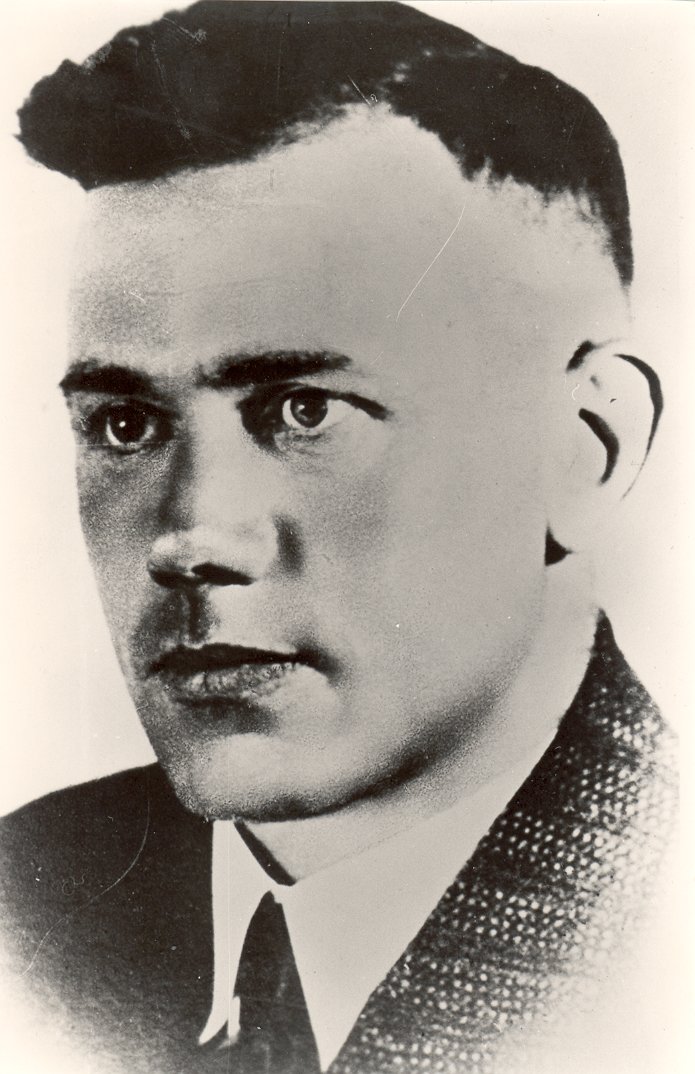
About: The farmer of Klein Achterveld, between Achterveld and Barneveld, who with his wife Aaltje hid Murphy and James Hardy for a month in November and December 1944, among other Allied men and people in hiding. The SD came for his daughter Jopie, a courier, on 24 February 1945 and took him instead; he died when the Cap Arcona was sunk in the Bay of Lübeck on 3 May 1945.
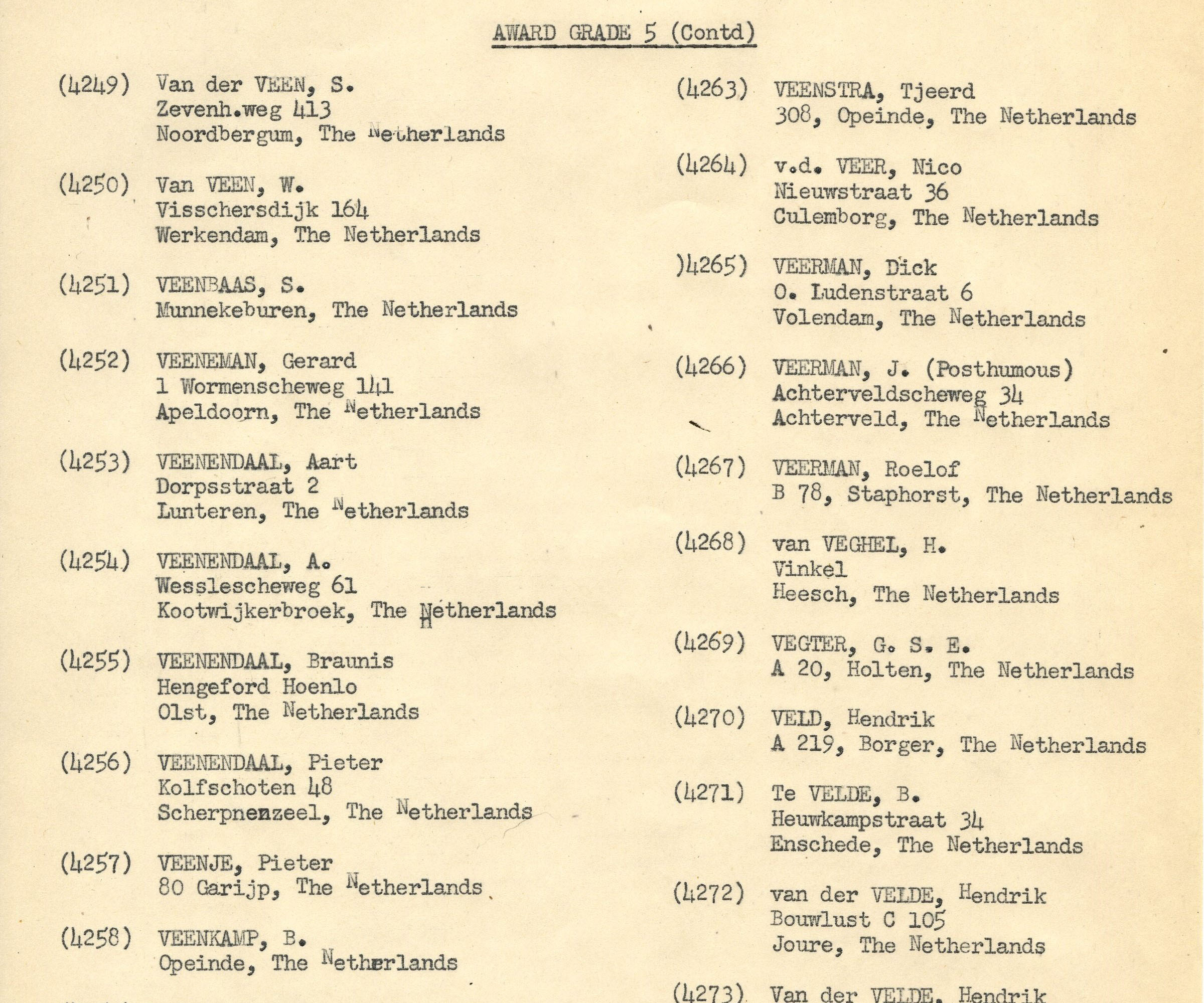
Unit or role: Farmer and resistance man: the L.O. (the national organisation that hid people) and the R.R., a group known as "Rolls Royce", whose courier address his house was, from the summer of 1943 (the form filled in for the L.O.-L.K.P. foundation's book of the fallen, now in the NIOD's archive, B.2; his family's form for the Americans, item 9; "Rolls Royce" on p. 6 and p. 8, item 12); one of the five fallen of the "LO-Barneveld", "Tevens: RR." (also the RR), in the resistance's memorial book of 1951 (Het grote gebod, p. 237); the OD of Barneveld in José Huurdeman's history of the local resistance, Ondergronds in de Tweede Wereldoorlog (2019) (Digitaal Monument Neuengamme, the Dutch Vriendenkring Neuengamme's online memorial); "(K.P.)" on a form his family filled in for the war graves foundation in 1955 (war graves file, scan 3). On the British index of Dutch helpers as certificate 15181, grade 5 (the index page), and on the Americans' list of Grade 5 certificates as "(4266) VEERMAN, J. (Posthumous)" (the list, p. 162).
Where: Born in Den Haag; at Lunteren, in Ede, with his parents from 1911; a farm servant at Veenhuizen, in Norg, Drenthe, from 1918 to 1922 (his Ede card; the Norg register). Then Klein Achterveld, Achterveldseweg 34: an Achterveld address in Barneveld municipality (his family's form; Barneveld claims list, 1947, p. 1). After his arrest, Apeldoorn, the Weteringschans prison in Amsterdam, Kamp Amersfoort and Neuengamme; he died aboard the Cap Arcona in the Bay of Lübeck, off Neustadt in Holstein (war graves file, scans 17–19; Neuengamme online memorial).
Evidence: ✓ his own Ede card and the Norg servants' register; ✓ his family's form for the Americans, 1946 (US National Archives 286713002); ✓ the L.O.-L.K.P. form filled in for his widow, 20 February 1946 (NIOD, via the Oorlogsgravenstichting); ✓ the war graves file on him, 1945–1992 (Nationaal Archief 2.19.255.01, 157653A); ✓ Hardy's MI9 report; ✓ the resistance's memorial book, Het grote gebod (1951), p. 237; Erelijst; Kamp Amersfoort register and photograph; Neuengamme online memorial; civil records; ✓ his death in Barneveld's register; the Studiegroep Luchtoorlog's evader register on the airmen hidden before Murphy (E0842); his daughter Alie's account in the Achterveld booklet, pp. 83–84 (Oorlogsverhalen om nooit te vergeten, the book the village made for its eightieth anniversary of liberation in 2025); his grandson Jacques Vanhaelen's account, October 2026 (family knowledge).
Family and forebears
Link to the section Family and forebearsHe was born in Den Haag on 3 August 1900, the son of Leendert Veerman, then a shopkeeper, and Johanna Maria Kok (the records); his father was born at Nieuwkoop in 1868 and his mother at Alphen in 1873, and the family left Den Haag for Barneveld on 21 September 1910 (war graves file, scans 1–2). ✓ The Nieuwkoop birth register has his father, Leendert, born on 26 July 1868, the son of Jacob Veerman, a merchant (koopman) of 32, and Johanna Catharina van der Neut, 28, so those were Jacob's paternal grandparents; the date and place are the ones on the Ede card for his brother Arie (the record, Erfgoed Leiden 162.1.09, deed 79).
◐ The grandfather at Bodegraven. The notarial index of Bodegraven has the will of 6 March 1900 of "Jacob Veerman, weduwnaar van Johanna Catharina van der Neut en van Cornelia Vos, gehuwd met Cornelia Meggelse, kaashandelaar te Bodegraven" (widower of Johanna Catharina van der Neut and of Cornelia Vos, married to Cornelia Meggelse, cheese merchant at Bodegraven), who names his sons Jan, Leendert and Jacobus Johannes (the will, RHC Rijnstreek en Lopikerwaard B066, deed 210; a second will of 1904 is beside it in the folder; index summaries, the deeds not read). The wife's name and the son Leendert make him very probably Jacob's grandfather: the civil records of the 1920s and 1950s give his children Aagje (died at Nieuwkoop in 1927, aged 62), Jacobus Johannes (married at Bodegraven in 1929, aged 54, born at Nieuwkoop) and Antoon (died at Ermelo in 1955, aged 76) as children of Jacob Veerman and Johanna Catharina van der Neut, the parents on Leendert's birth record (Aagje; Jacobus Johannes; Antoon). ◐ The "Leendert" of the will fits Jacob's father, born to the same parents in 1868, but no record held says they are the same man.
Jacob's parents lived at Lunteren, in Ede, from March 1911 to December 1918, where his sister Jansje Maria was born, and then at Barneveld again (Ede population card of his brother Arie). His brothers were Arie and Leendert Jan; his sisters were Johanna Catharina, who married at Barneveld in 1920, and Jansje Maria, who married Gerrit Jan Broekhuis in 1940 (the records); a genealogy site gives a third sister, Dirkje Clasina (BROBOL), and Leendert Jan's death notice of 1975 is signed by "D. C. Bosman-Veerman" of Zwolle (Trouw). The family was Gereformeerd (the L.O.-L.K.P. form). His grandson Jacques Vanhaelen's family genealogy calls him "Jacob (Jaap)", as it does his youngest son, and his mother "Johanna Maria (Annemie) Kok" (his account, October 2026).
Drenthe, 1918–1922
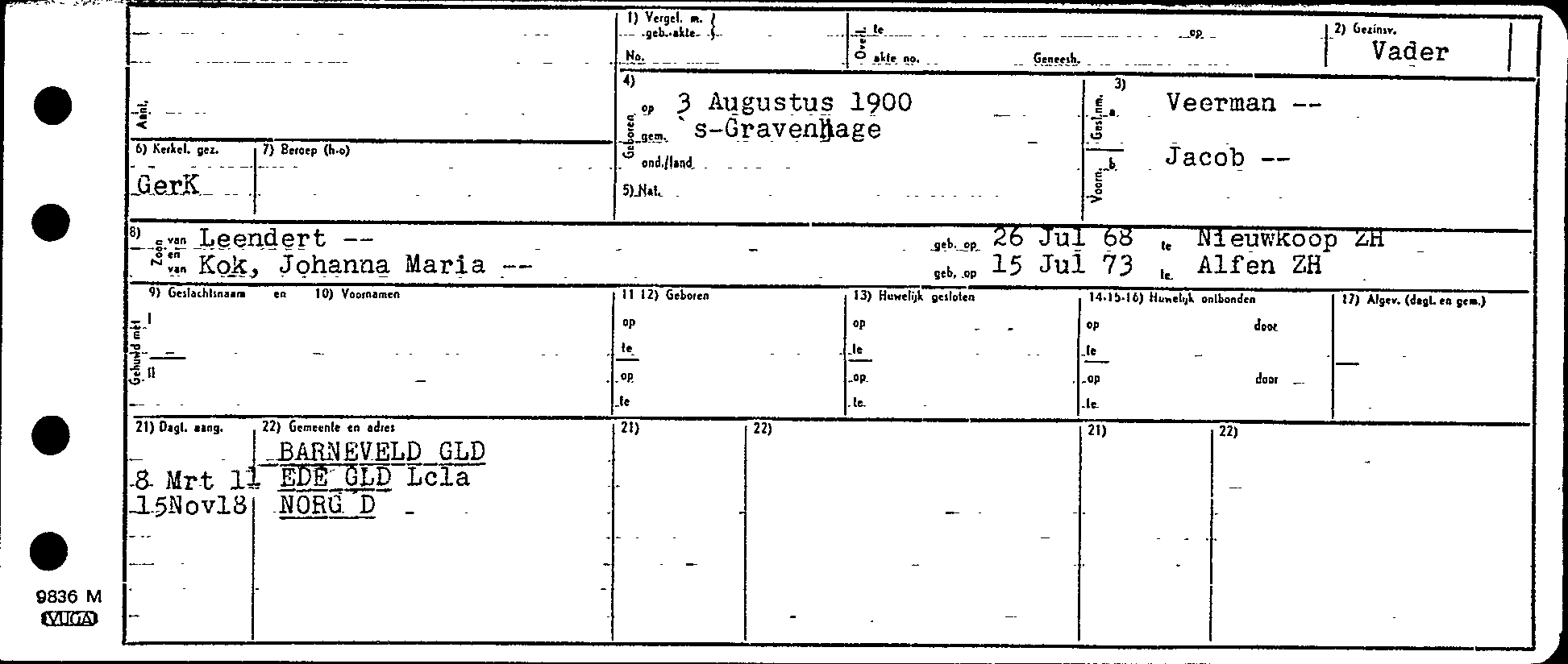
Link to the section Drenthe, 1918–1922✓ Jacob's own Ede personal card has him born on 3 August 1900 at 's-Gravenhage, Gereformeerd, the son of Leendert, born at Nieuwkoop on 26 July 1868, and Johanna Maria Kok, born at Alfen (Alphen) on 15 July 1873, with two addresses: Barneveld to Ede, in the Lunteren district, on 8 March 1911, and, on 15 November 1918, Norg, Drenthe (the card; Open Archieven; read from the image). His brother's card has the family leaving Lunteren for Barneveld on 4 December 1918, so Jacob, at 18, went to Drenthe three weeks before them.
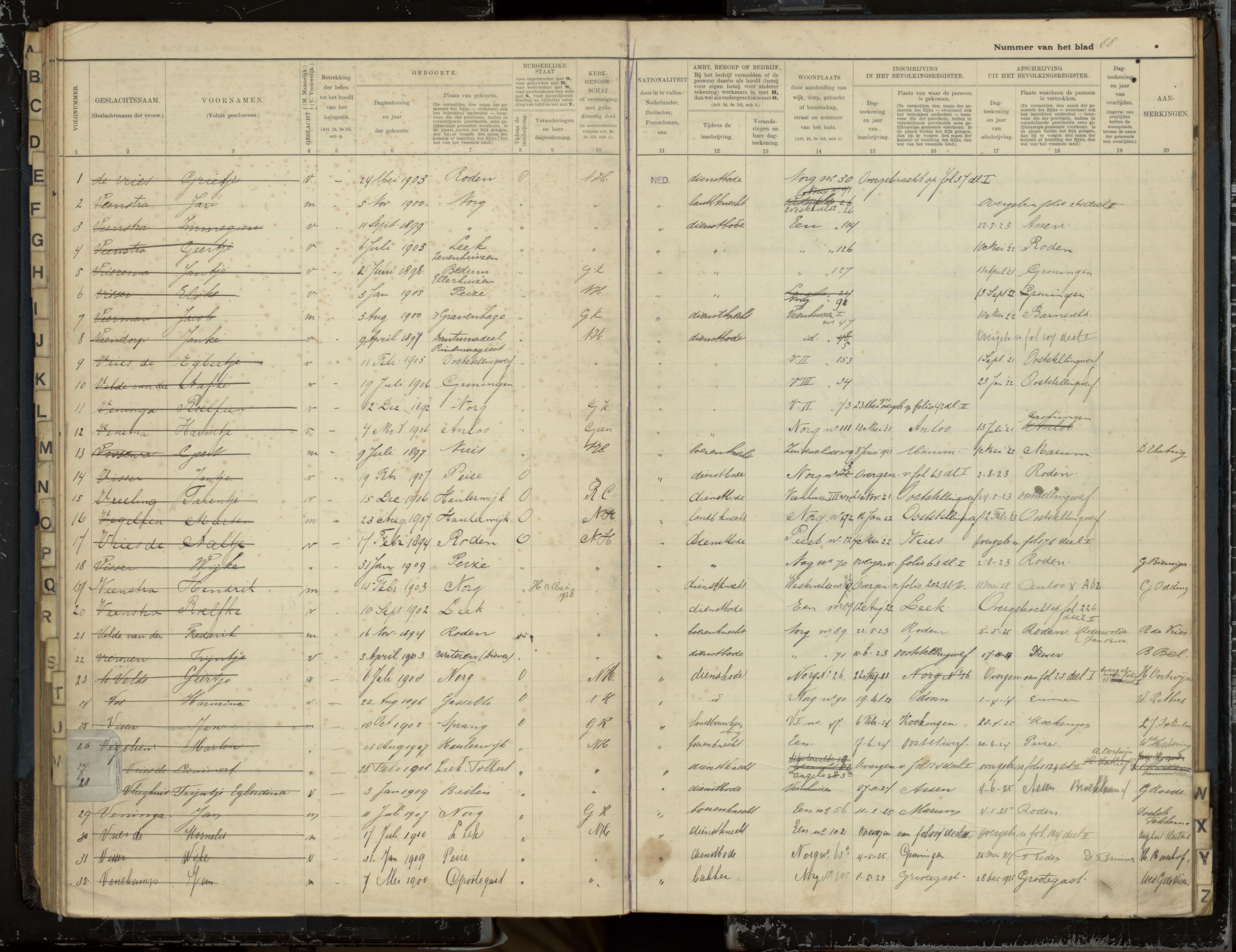
✓ The servants' register of Norg, Drenthe, for 1921–1937 has him on sheet 88, line 7, under the same birth date and place: a dienstknecht (farm servant), living at Veenhuizen I, no. 47, and written off the register on 10 May 1922 to Barneveld (the sheet; transcription; Drents Archief 2001.16, deel 23; read from the image). The register was begun in 1921 and shows no date of entry for him. ◐ So the two records put him in Drenthe as a farm servant from November 1918 to May 1922, with nothing for the years between; they do not say whom he worked for. The Purmerend farm of his grandson's account (below) is not in them.
Marriage and the farm
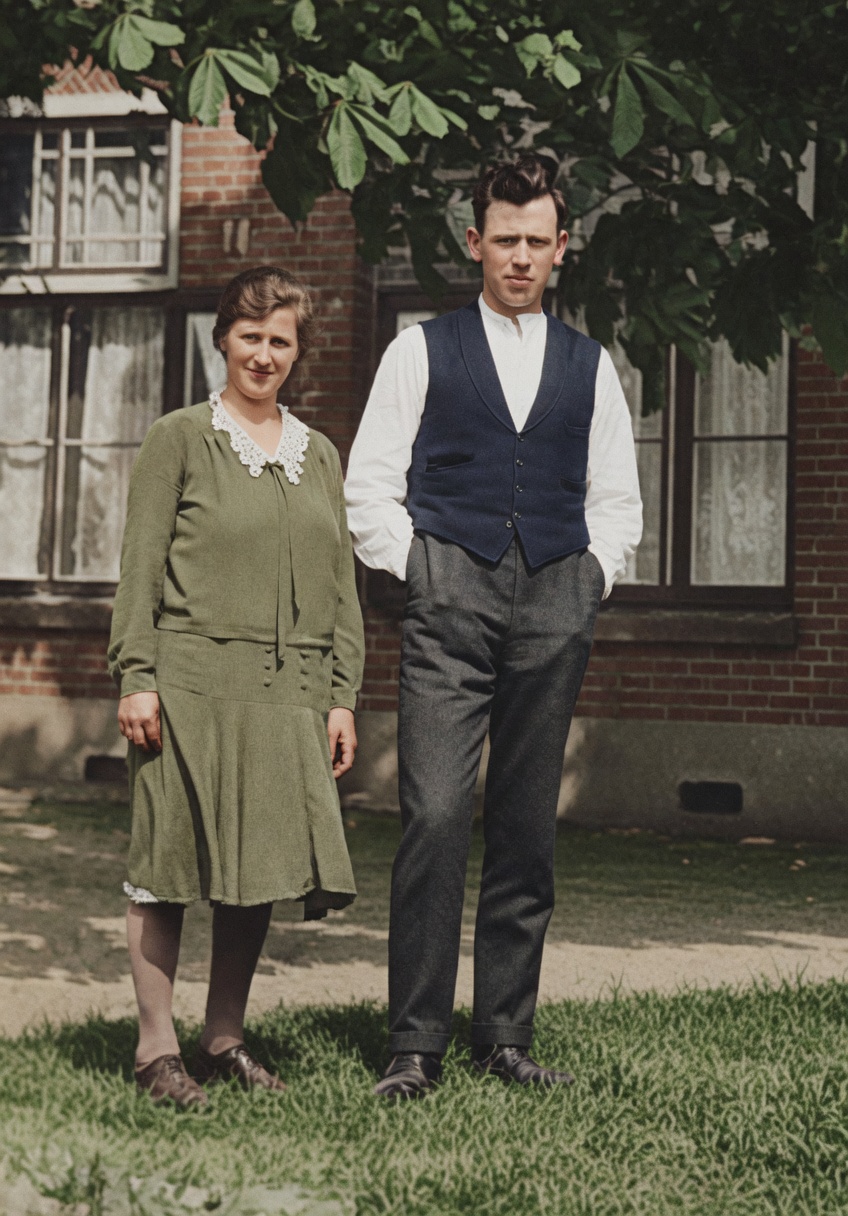
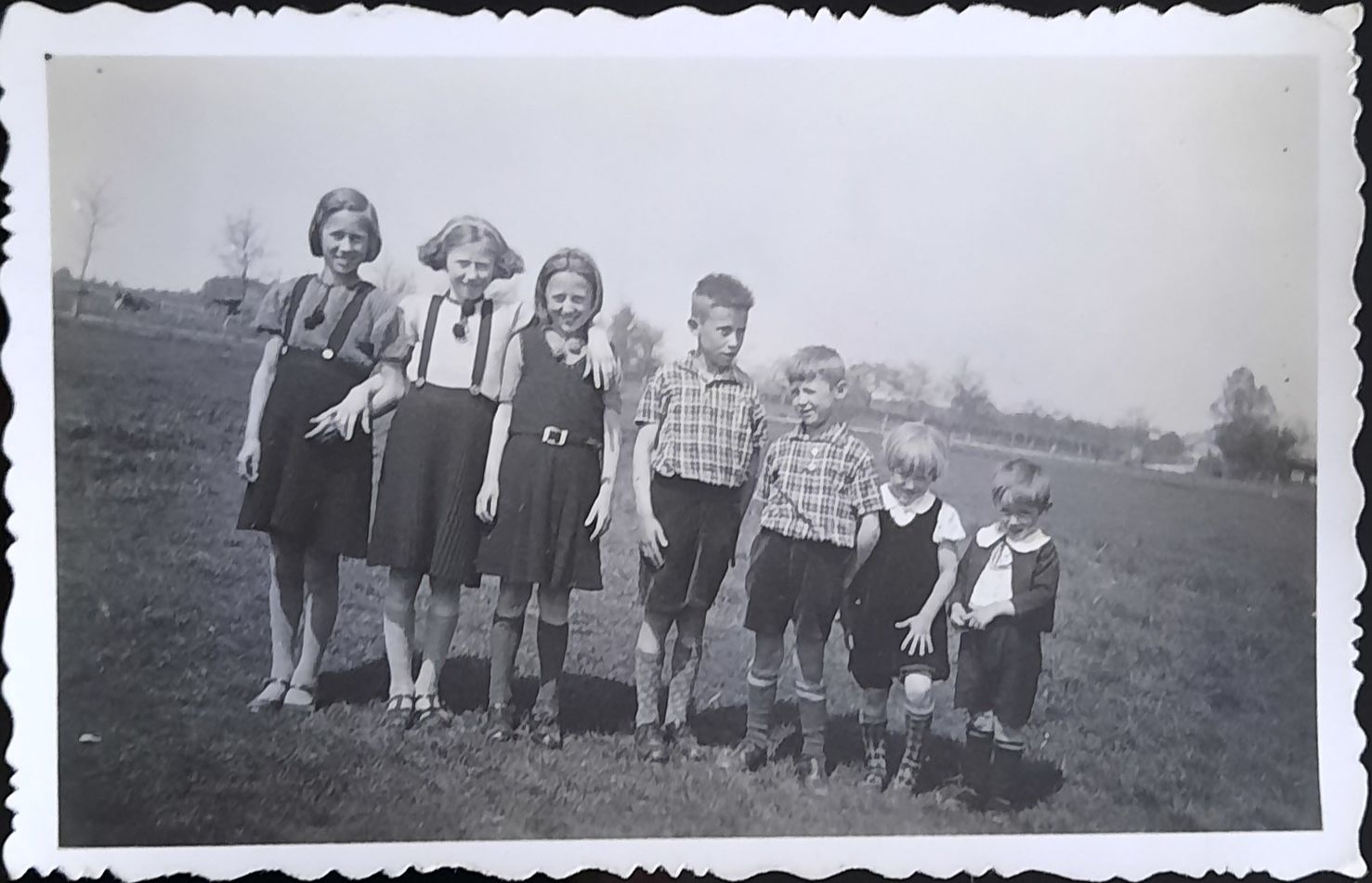
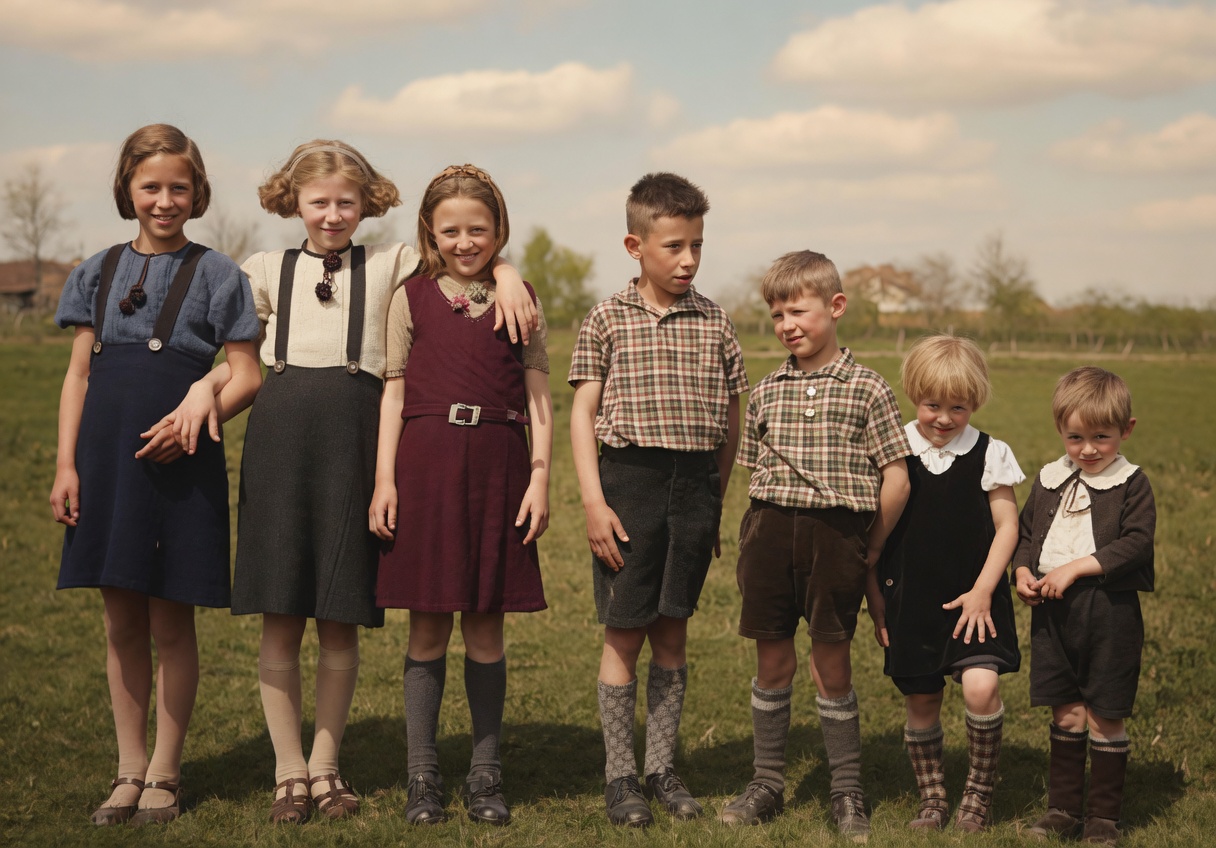
Link to the section Marriage and the farmHe met Aaltje Bakker on a farm at Purmerend, where he was a farmhand and she a maid (Jacques Vanhaelen's account, October 2026). She was the daughter of Jan Bakker, a cattle farmer of Landsmeer who had died in 1918, and Maretje de Vries, a shopkeeper (her father's death; the marriage; more on her page). They married at Barneveld on 2 February 1927, he a farmer of 26 (the marriage), and farmed Klein Achterveld; their eldest was born on the farm, by Jacques Vanhaelen's account. They had seven children, four daughters and three sons (Hardy), aged 18 down to 9 in May 1946 (his family's form): the eldest was Jopie, born on 1 December 1927, and the youngest Jacob, "Jaap", born on 18 August 1936 (Jacques Vanhaelen's account), Hardy's "YAP". His mother died at Barneveld on 23 June 1944 (the records).
The resistance
Link to the section The resistance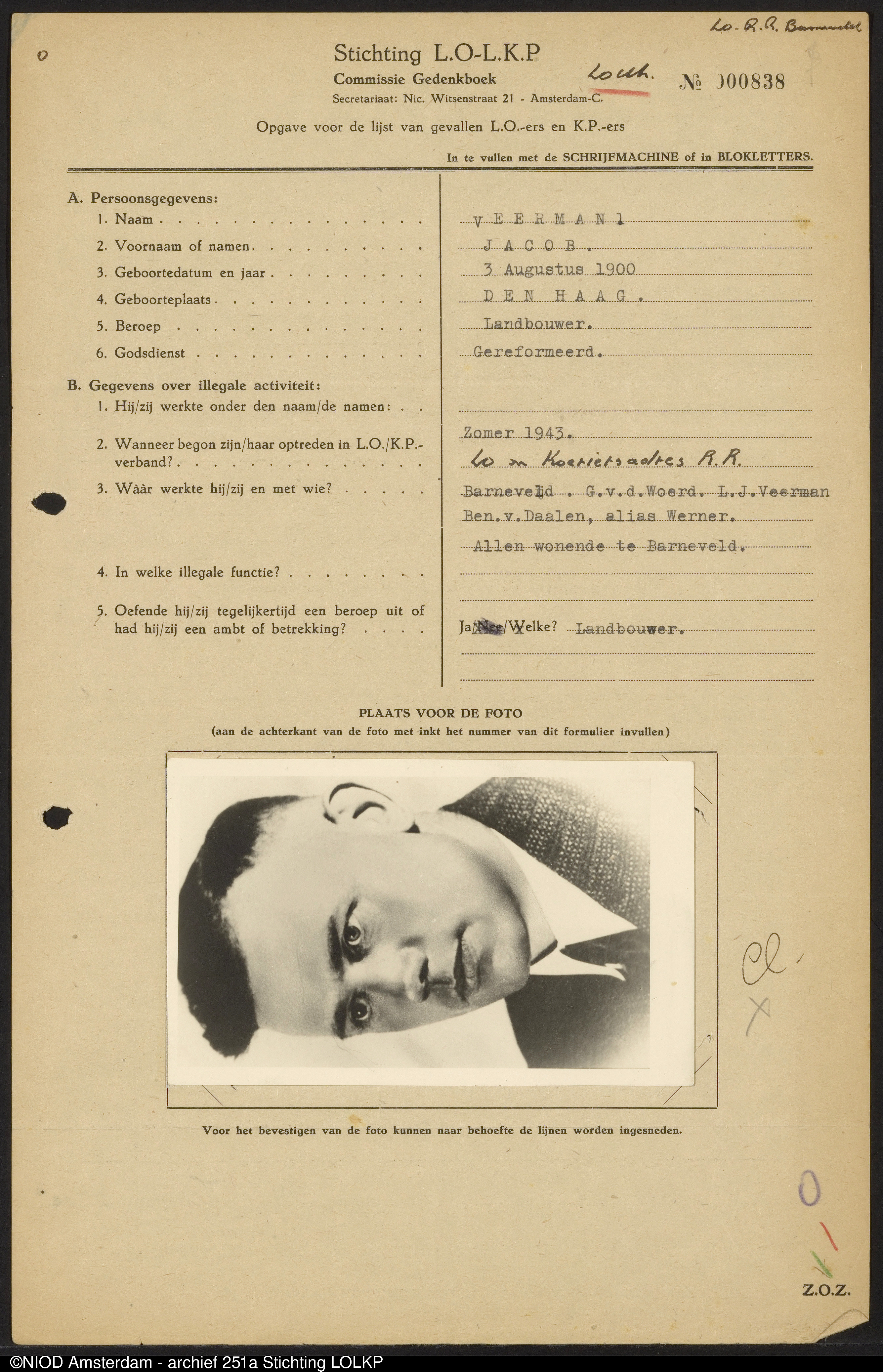
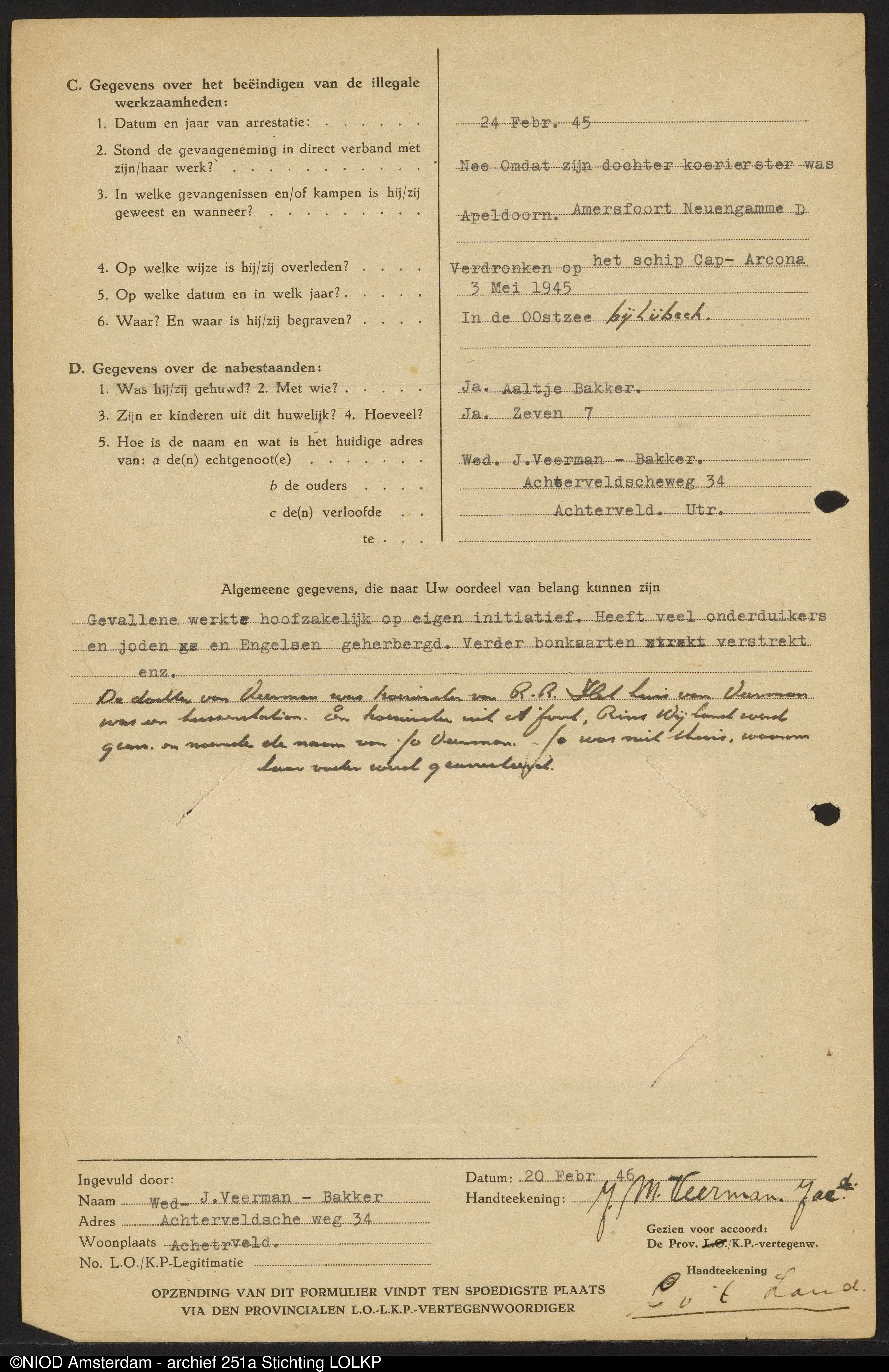
By the form the L.O.-L.K.P. foundation collected for its book of the fallen (its archive is now at the NIOD, 251a), filled in for his widow on 20 February 1946, he began in the summer of 1943, his house was the L.O.'s and the R.R.'s courier address, and he worked with G. v.d. Woerd, L.J. Veerman (◐ his brother Leendert Jan, who lived at Barneveld) and Ben v. Daalen, alias Werner, all of Barneveld (the form, B.2–B.3). Its general remarks:
The fallen man worked mainly on his own initiative. Sheltered many people in hiding, and Jews and Englishmen. Also handed out ration cards etc. … Veerman's daughter was a courier for the R.R. Veerman's house was a courier station.
Dutch originalGevallene werkte hoofzakelijk op eigen initiatief. Heeft veel onderduikers en joden en Engelsen geherbergd. Verder bonkaarten verstrekt enz. … De dochter van Veerman was koerierster v. R.R. Het huis van Veerman was een koeriersstation.
— Stichting L.O.-L.K.P., form no. 000838, 20 February 1946 · NIOD, archief 251a · via the Oorlogsgravenstichting
Who was hidden on the farm
Link to the section Who was hidden on the farmJan Dijkstra of De Glind brought airmen from 1943, three pairs of them for shorter or longer stays, and there were "various onderduikers, among them a Jewish woman and her daughter"; everyone hidden there survived the war. The account names none of the Allied evaders and calls them all "pilots" (Neuengamme online memorial, quoting Huurdeman). His daughter Alie remembered it from inside the house:
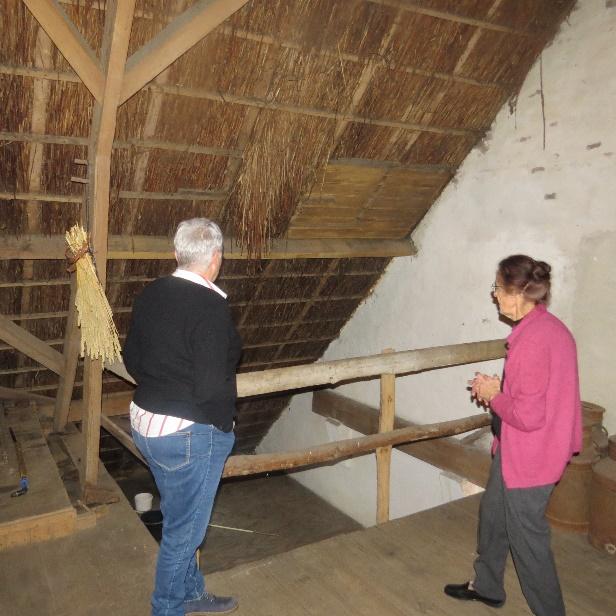
Father was very active in the resistance, and in 1943 we got 2 parachutists, one from England and one from Australia, who had been shot down, and one of them was even wounded. We kept in touch with them for a very long time. Father had made a hiding place in the hayloft behind the hay. The first two stayed a long time. We had 2 three times. Jan Dijkstra from De Glind fetched and brought them.
Dutch originalVader was erg actief in het verzet en in 1943 kregen wij 2 parachutisten, een uit Engeland en een uit Australië die waren neergeschoten en een ervan was zelfs gewond. We hebben nog heel lang contact met ze gehad. Vader had op de hooizolder achter het hooi een schuilplek gemaakt. De eerste twee zijn wel lang gebleven. We hebben er drie keer 2 gehad. Jan Dijkstra uit de Glind, die kwam ze halen en brengen.
— Alie Veerman, his daughter, in Oorlogsverhalen om nooit te vergeten (Achterveld, 2025), p. 83 · the booklet
There are three Alies on these pages: Jacob's wife Aaltje, also called Alie; their daughter Alie (1930–2017), the booklet's "Alie Veerman", whose account was written down before her death (◐ the booklet does not say when); and a granddaughter, Alie, who spoke to RTV Utrecht in 2024 (RTV Utrecht, which names her and calls her a granddaughter of Jacob).
The airmen
Link to the section The airmen◐ The Englishman and the Australian are very probably the RAF men the family listed in 1946, the bomb aimer R.D. Ward and the Australian navigator of his crew, W.Q. McGeachin, though the family's table puts them on the farm from 20 October to 20 November 1944, not in 1943 (p. 9). The Studiegroep Luchtoorlog's evader register, citing Wolter Noordman's book of 2010 and the American helper files, has the two come from the teacher Vlasman's house at Terschuur: "From here the two went to the farm of Jacob Veerman in Achterveld", and on 17 November they were taken to the starting point for the Pegasus II crossing (SGLO E0842; E0839), eight days before Murphy and Hardy came. Of the airmen, Alie adds, "Waar ze vandaan kwamen daar werd niet over gepraat" (where they came from was not talked about).
The hide
Link to the section The hideAlie also has two Jews from Germany, a mother and her son, for a long time; two boys from Amsterdam; and the farm's own hand, hiding from labour service in Germany, who with the Amsterdam boys had a hiding place in the earth bank in the field opposite the farm, where she often took them food (Alie, the booklet, p. 83).
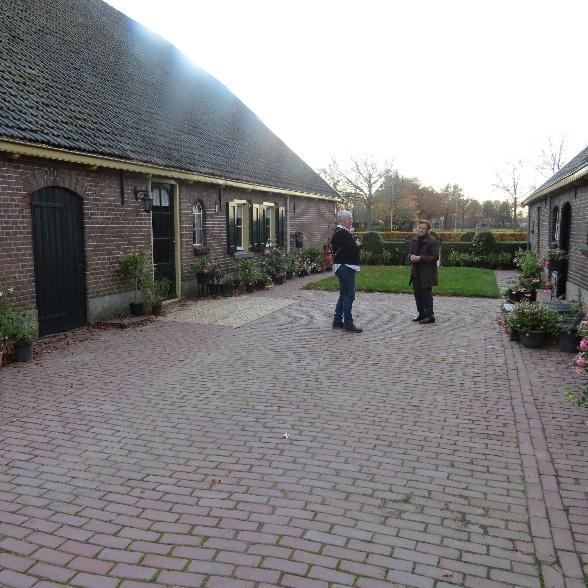
Jacques Vanhaelen's account has pilots and Jews hidden "in a special storage place behind bales of hay": in the barn's white wall a passage led to the room next to it, and on into a wardrobe, so that when the Germans came to search, the people in hiding went through the cupboard and down into "this lowered room"; the farm is still standing, much as it was (Jopie's son, Jacques Vanhaelen, and his own photographs of the farm, October 2026, family knowledge). His account names among Jacob's contacts Jan Dijkstra, "Gijs Sijkveld" (◐ Gijs van Zijtveld) and "Reverend Vogema (alias Dr. Brand), a mayor from Germany in hiding who spoke fluent English and regularly consulted with the hidden pilots" (so the account words it).
A son of Jacob's, who is living, remembers that the Veermans' neighbours, a family called Fokkema, also hid people (Jacques Vanhaelen's email, October 2026); nothing held names them or what they did. ⚠︎ The same son's first message had Murphy hidden at the neighbours' farm and coming often to the Veermans', where English was spoken (Jacques Vanhaelen's email, 16 October 2026); Hardy's report and the family's 1946 table put him in the Veerman farmhouse (Hardy; p. 3). The name is set beside Murphy's padre "Fokkemmal" on his page.
Bread at the door
Link to the section Bread at the doorHungry people came to the door as well, and Aaltje kept a bread tin of sandwiches ready for them, often empty before noon. When the baker Schouten (◐ Hein Schouten) warned him, "Jacob, je meel raakt op" (Jacob, your flour is running out), he told her to say no once the tin was empty, until he saw a family walk away with nothing, and quickly spread more bread and took it after them (Alie, the booklet, p. 83).
With Murphy
Link to the section With MurphyOn about 25 November 1944 Gijs van Zijtveld, Hardy's "Ghys", brought Murphy and James Hardy to "a farmhouse at approximately position 475955", in Hardy's words (Hardy; the family's table), and Hardy described the family he found there:
The owner of the farm was called Jacob VEERMAN, aged 43, married, with four daughters and three sons, the eldest a girl of 17 named JOANNA and the youngest a boy of 5 named YAP. We stayed here for a month during which time we were very well fed and cared for. They did everything possible to make us comfortable.
— MI9 · Pte J. Hardy, 16 Parachute Field Ambulance · IS9/WEA/1/270/2351 · 13 January 1945 · the report
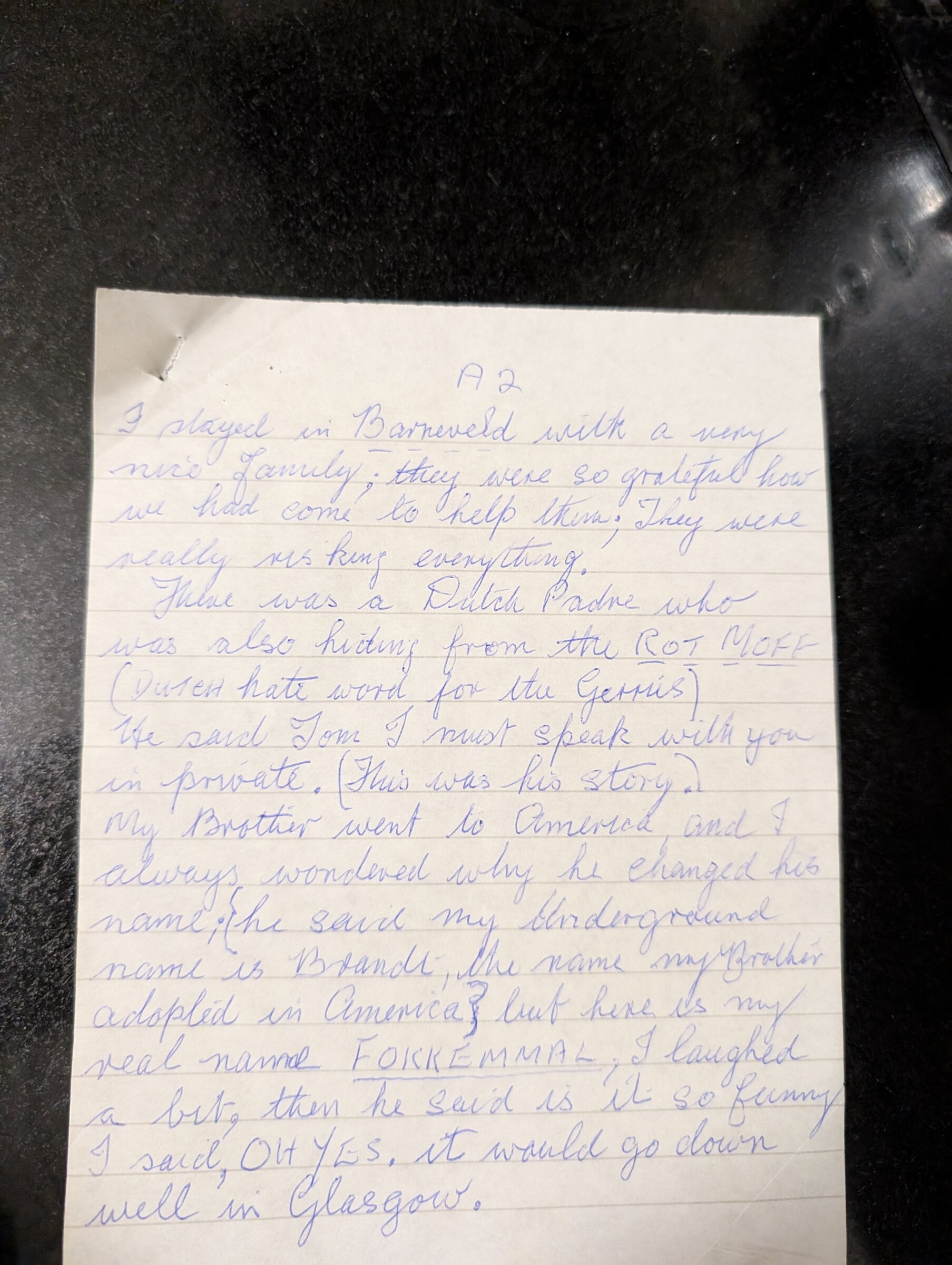
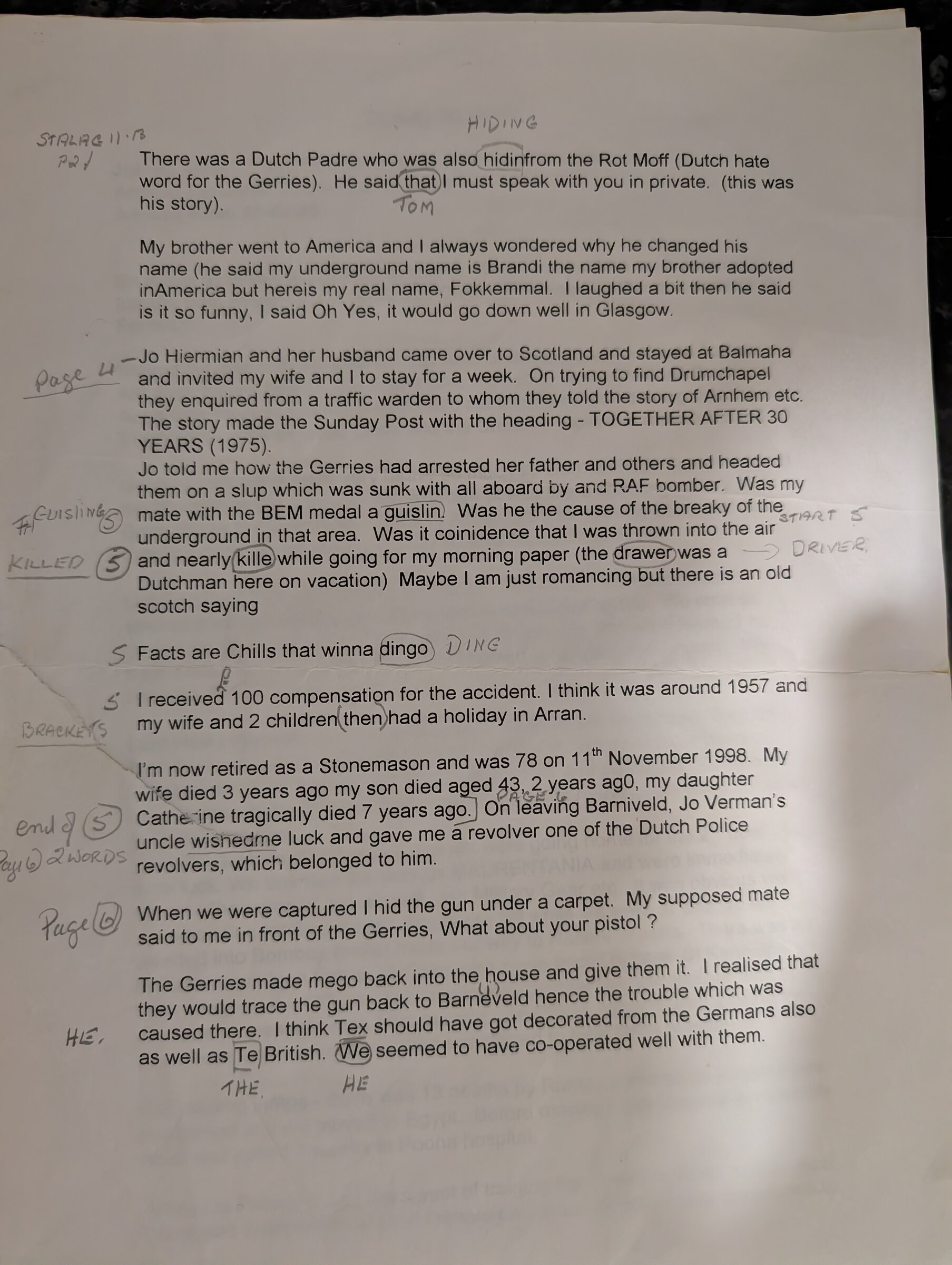
Hardy's "JOANNA" was Jopie, who turned seventeen on 1 December, while they were there (TracesOfWar); his ages for Jacob and for "YAP" are set out below. Murphy, writing about 1998, remembered the household in a line: "I stayed in Barneveld with a very nice Family; they were so grateful how we had come to help them; They were really risking everything" (page A2), ◐ very probably this family, since his typed notes go on to the revolver from "Jo Verman's uncle" on leaving Barneveld (typed pp. 4–6; Father Fokkemmal).
Gijs and Jan (◐ Jan Dijkstra) visited three times with soap, shaving things and the news, and on 23 December Jan walked the two men to Gijs's house, from where a guide Hardy calls Han took them to Amerongen (Hardy; Amerongen).
A son of Jacob's, who is living, remembers a doctor called Brand, who had been politically active in Germany before the war and had fled to the Netherlands, and who took the shrapnel out of Murphy's head and came often to the farm because he spoke good English (Jacques Vanhaelen's email, October 2026). It is his own memory, passed on by Jacques Vanhaelen, and no source outside the family names the doctor or dates the treatment; Jacques Vanhaelen's earlier written account (October 2026) has "Reverend Vogema (alias Dr. Brand), a mayor from Germany in hiding" who spoke fluent English, and Father Fokkemmal sets out the two accounts. Hardy, a medical orderly who was on the farm with Murphy, does not mention it (Hardy); Murphy's notebook says of his head wounds that he "got no treatment from the Germans" (the page), and says nothing there of who else treated them; his memoir has shrapnel in his head from an 88 mm round (p. 8; Arnhem). Whether this Brand is the "Brandt" of Murphy's padre is set out on Father Fokkemmal.
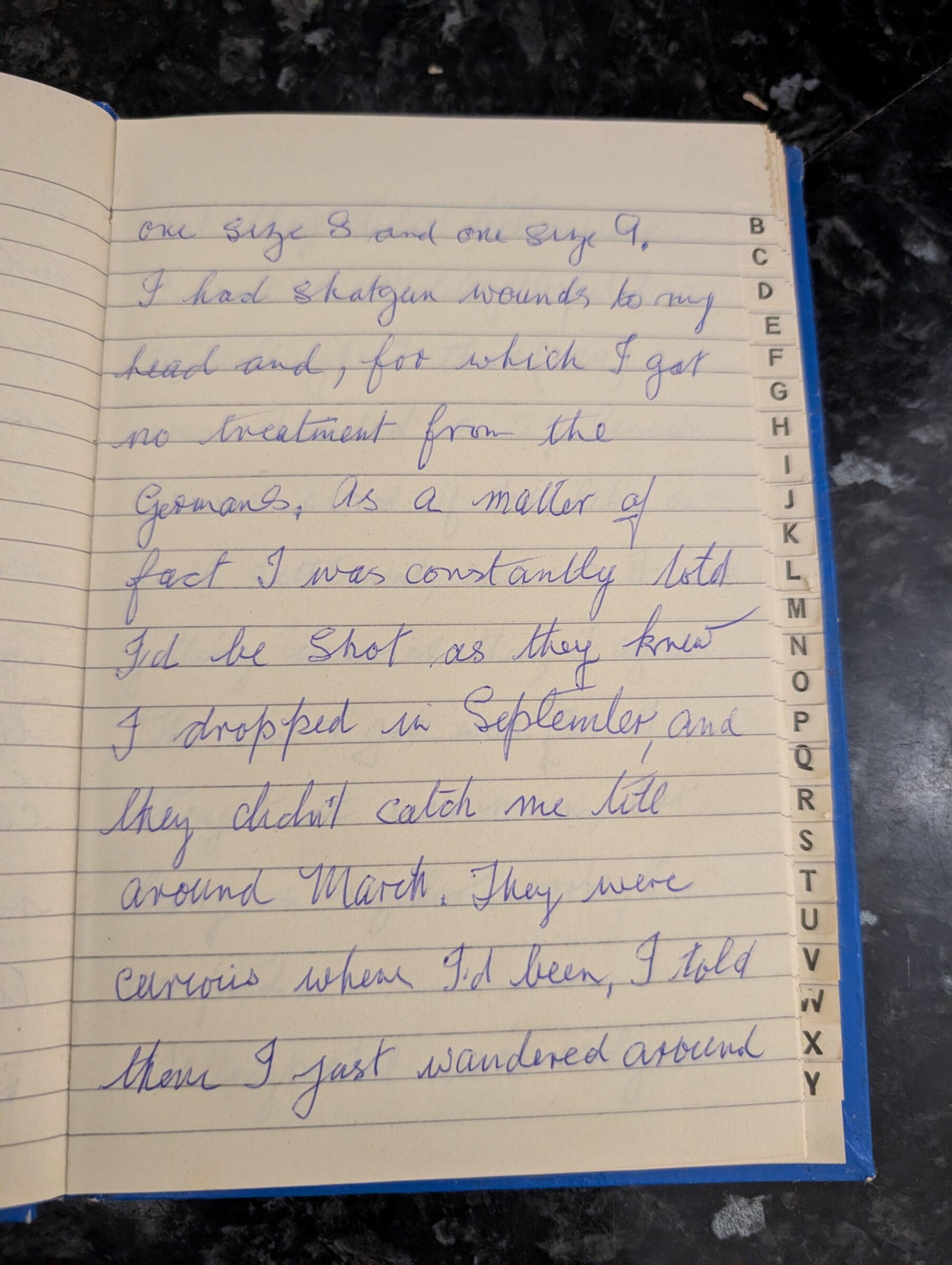
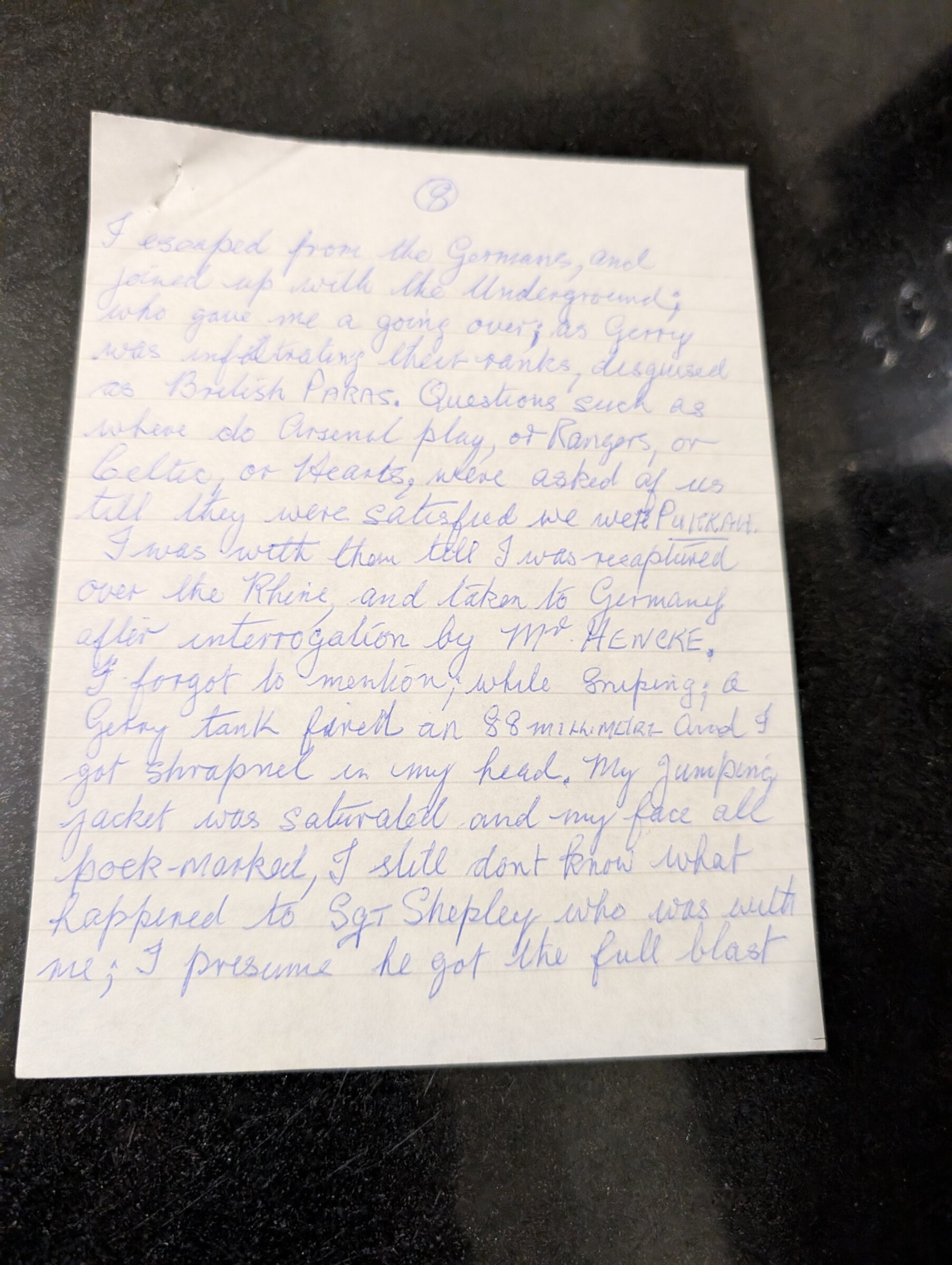
The round-up around the farm, December 1944
Link to the section The round-up around the farm, December 1944In the weeks Murphy was in the Veerman house, and the fortnight after he left, the SD were arresting their way through the villages around it. The Dutch record has them working back through the old billets of Kirschen's Belgian SAS team, "Captain King", after the arrest of the RVV leader Jan Thijssen (Huurdeman). On 15 December 1944 they raided Piet Veenendaal's farm at Scherpenzeel; on the 19th the Verhoef farm on the Klettersteeg at Achterveld, where they took every young man in the house; on 31 December (⚠︎ 5 January 1945 in three other records: Hendrik van de Kuilen) the farm Hardeveld at Leusden, the team's other billet, and on 5 January 1945 the gamekeeper's house next to it. No Veerman was taken in it (Huurdeman). Each raid, who was taken and the camp records are on Piet Veenendaal's page.
The revolver
Link to the section The revolverWhen Murphy and Hardy set out to cross the Rhine on 2 January 1945 both were armed:
Both MURPHY and I had revolvers by this time. Mine was given by KOEN and MURPHY's given him by Jacob VEERMAN.
— MI9 · Pte J. Hardy, 16 Parachute Field Ambulance · IS9/WEA/1/270/2351 · 13 January 1945 · the report
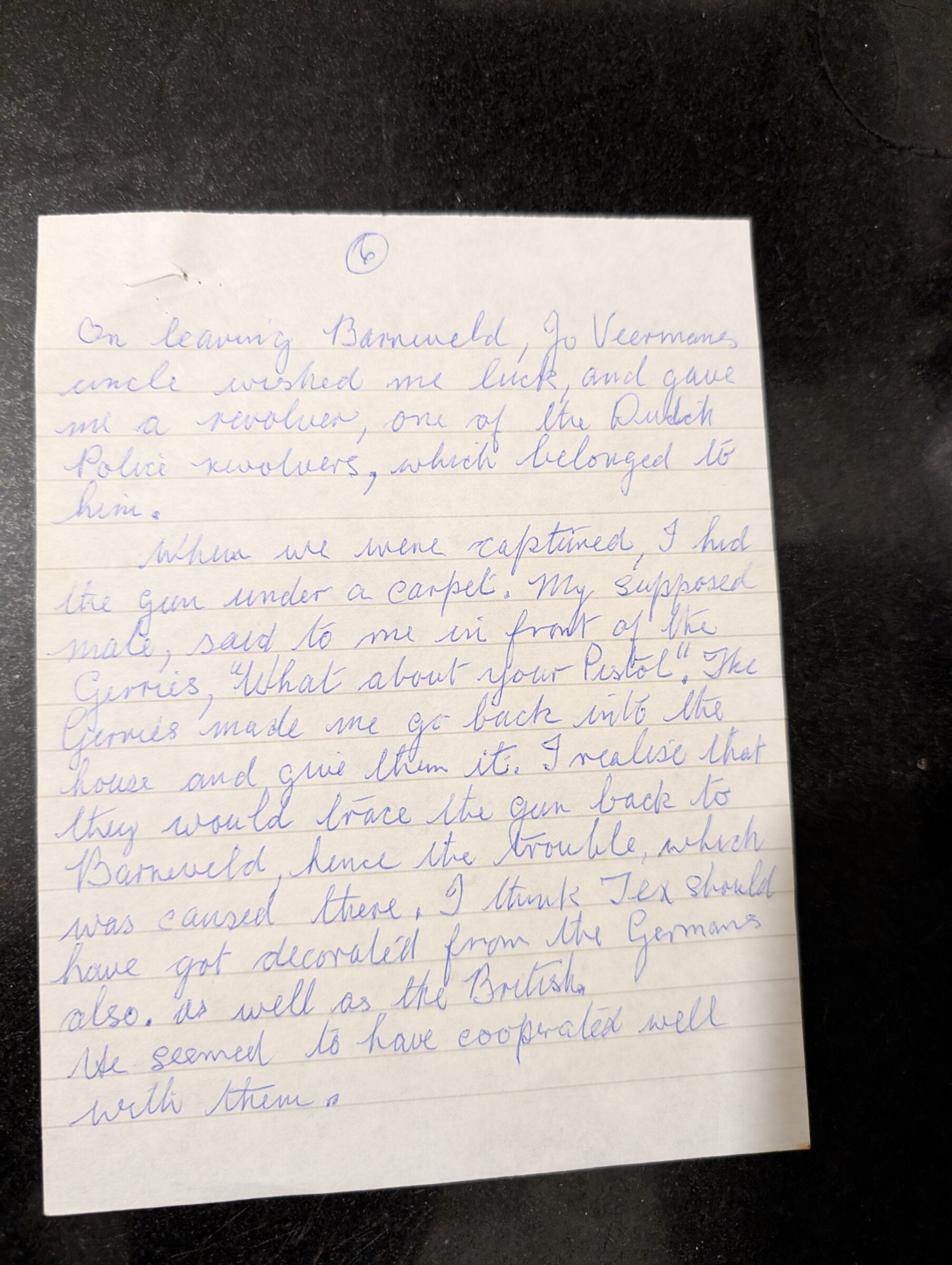
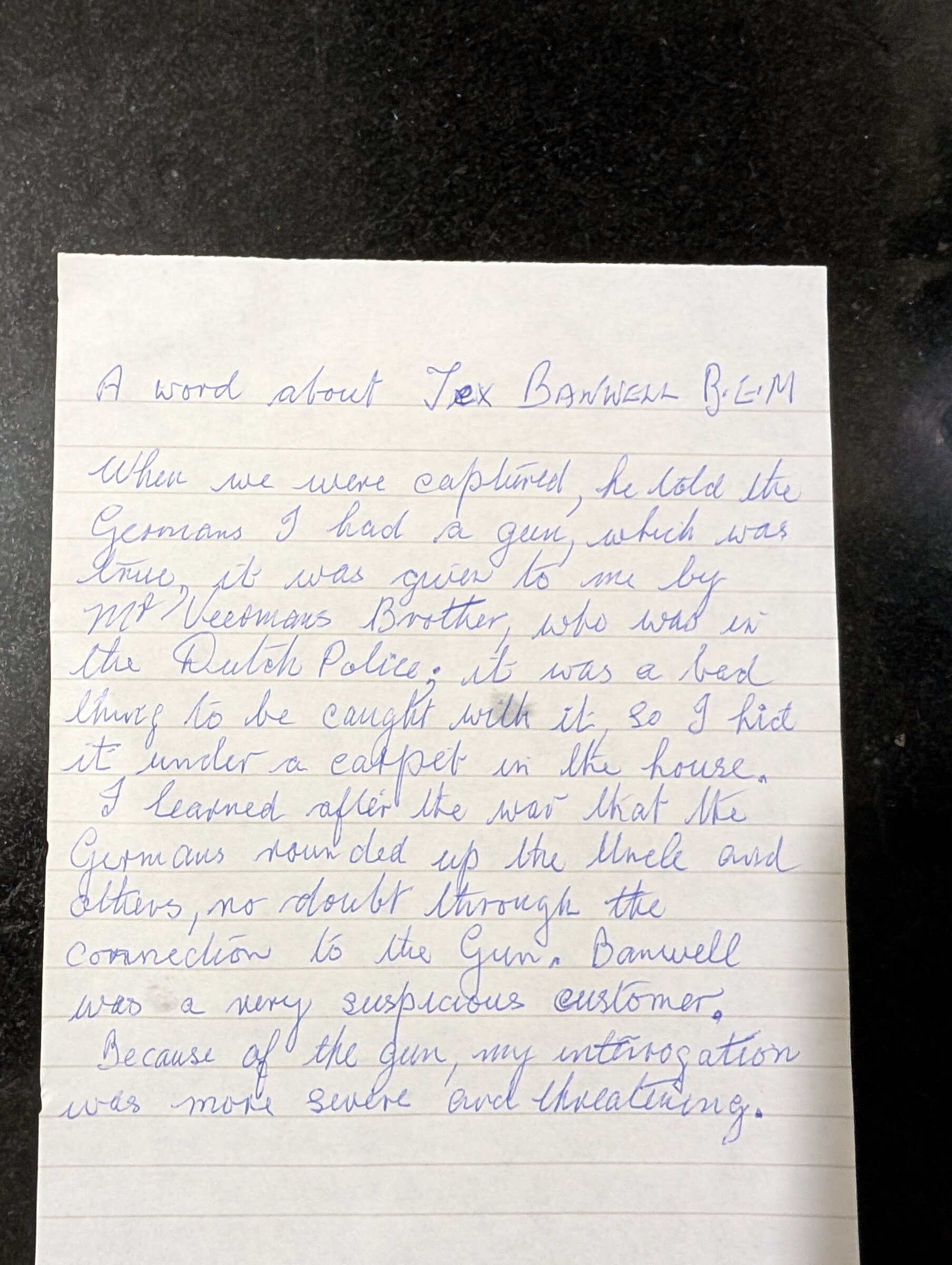
Murphy was carrying it when he was taken that night, 2/3 January (Crossing and recapture), and by his own account it made his interrogation "more severe and threatening", and he feared they would "trace the gun back to Barneveld" (p.6; his page about Tex Banwell). Who gave it to him is told three ways:
- ◐ Hardy, in his MI9 report of 13 January 1945 (above): Jacob gave it.
- ⚠︎ Murphy, in two passages of his notes of about 1998: a policeman in the family, who gave him his own revolver as they left. He has "Jo Veermans uncle" give him "a revolver, one of the Dutch Police revolvers, which belonged to him" (p.6; the typed copy), and names him "Mr Veermans Brother, who was in the Dutch Police" (his page about Tex Banwell).
- A son of Jacob's, who is living and was about eleven at the time, told Jacques Vanhaelen in October 2026 that he and his father fetched it from Jacob's brother Leen (Leendert Jan), a bicycle repairer who kept a number of pistols in a tool cabinet; Jacob hid it on the boy, and when Germans stopped them on the way back and searched Jacob, it was not found. It is his own memory as the boy who carried it; Jacques wrote that he "still remembers very clearly" the pistols in Leen's tool cabinet (Jacques Vanhaelen's email, 18 October 2026).
Neither of Jacob's brothers, Arie and Leendert Jan, was a policeman on paper, nor was his brother-in-law Gerrit Jan Broekhuis, a baker on every record found; the brothers' trades are those of their marriages, so neither brother is ruled out, while Broekhuis, not Jacob's brother, does not fit Murphy's "Mr Veermans Brother" (the records). Hardy separately mentions an unnamed Dutch policeman in that network (Hardy). ✓ After the war Leendert Jan worked for the Politieke Recherche Afdeling, the post-war political investigation service: police work, but after the war, and it says nothing of 1944 (Nationaal Archief, staff file; Leendert Jan Veerman). Jacob's grandson Carel Plantagie knows of no policeman in the family (his email, October 2026).
◐ The revolver was probably Leen's (Leendert Jan Veerman, Jacob's brother). Murphy and the son both put the revolver with Jacob's brother, but the son answered after our question to Jacques Vanhaelen of 16 October 2026 had put Murphy's policeman-uncle version to him, so the two are not independent; Hardy has Jacob himself give it. The rest of the son's account is his alone: by it he was there when it was fetched (the tool cabinet, the boy carrying it, the search), and he calls Leen a bicycle repairer then and a detective in The Hague after the war. Hardy's "given him by Jacob VEERMAN" fits if Jacob brought it home; Murphy has the uncle hand it over himself as they left. It is graded probable rather than confirmed only because no record of the time says so.
The family's own record
Link to the section The family's own record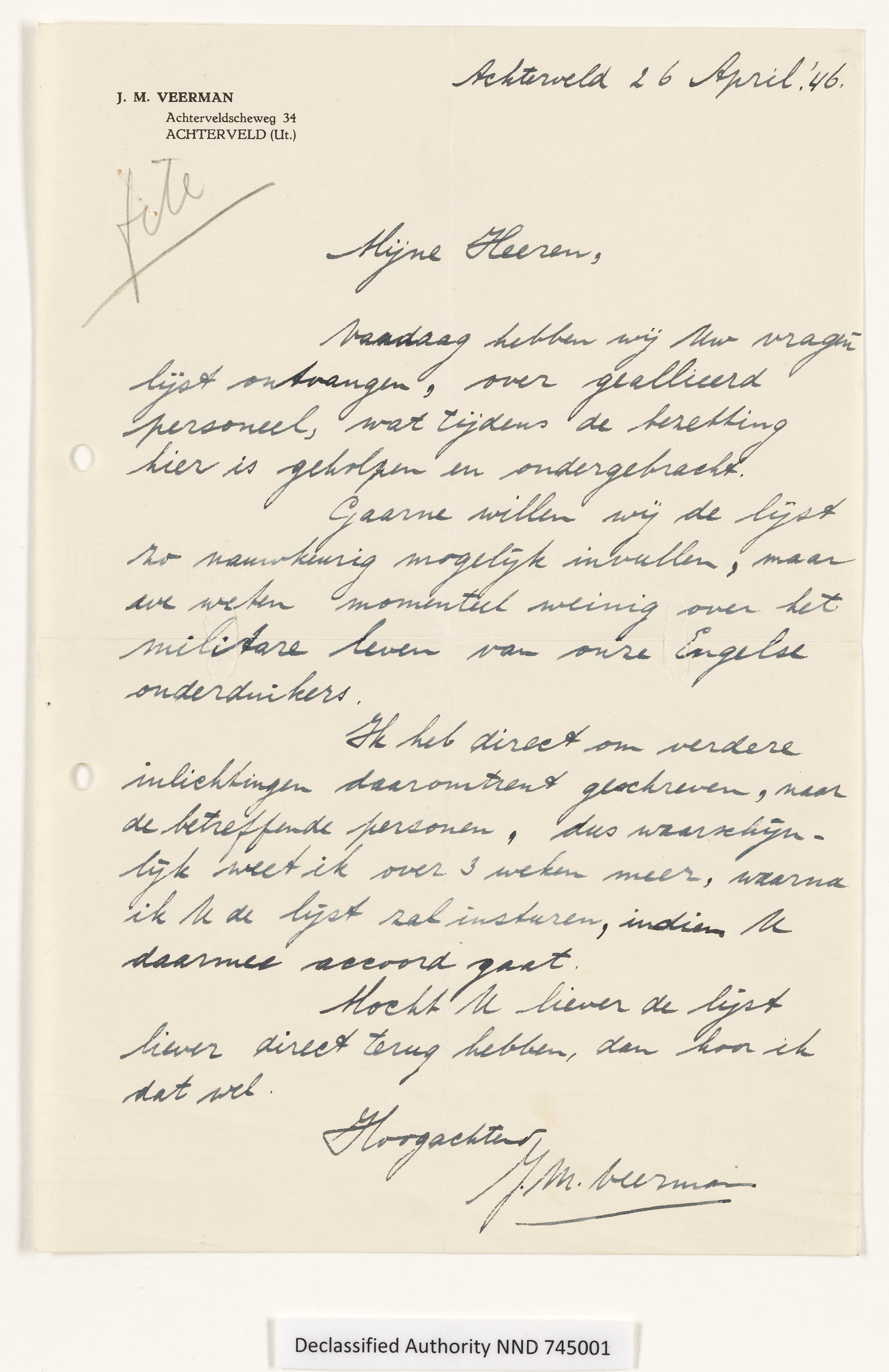
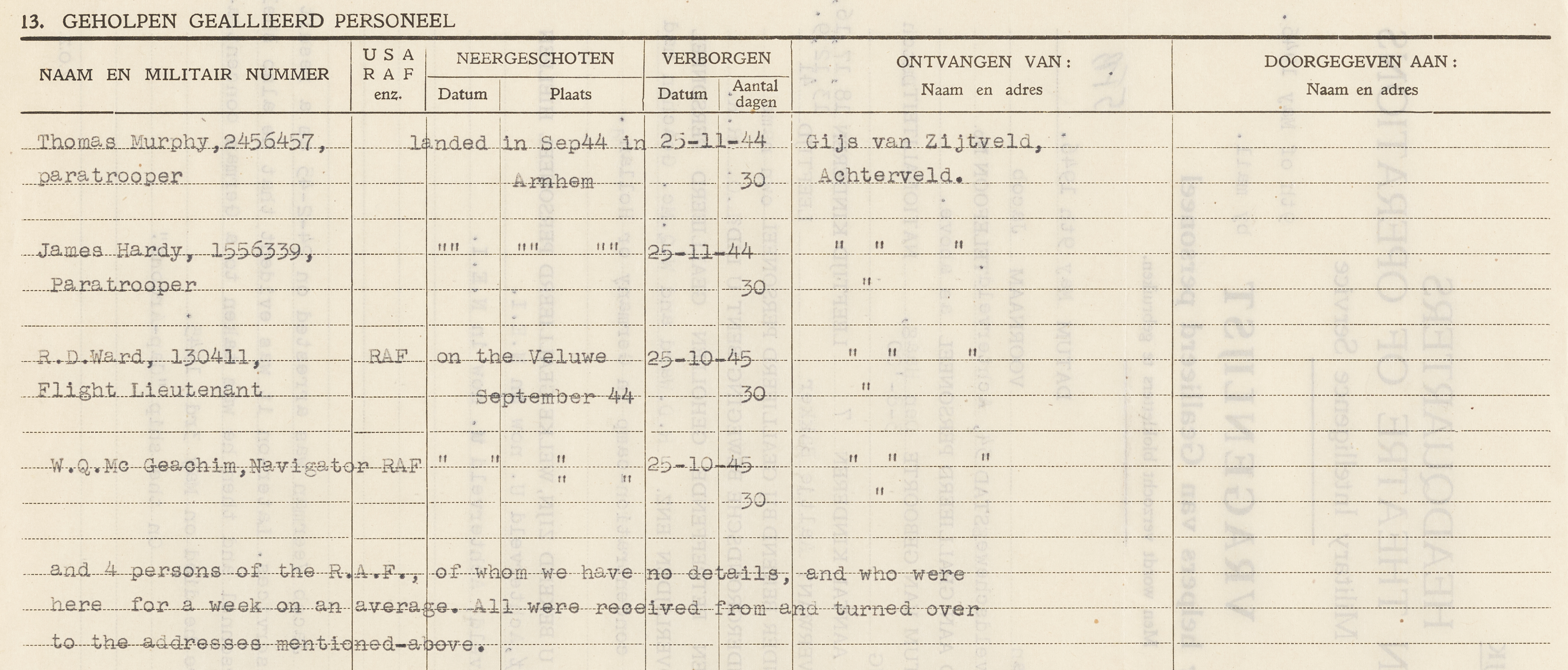
The Americans' questionnaire about the men hidden at the farm arrived in April 1946. The answer of 26 April, on paper headed "J. M. VEERMAN, Achterveldscheweg 34" and signed J.M. Veerman (◐ Johanna Maria, Jopie), says that they knew little of "het militaire leven van onze Engelse onderduikers" (the military life of our English onderduikers) and that she had written at once "naar de betreffende personen" (to the people concerned) for more (p. 10). The family set it down themselves in May 1946: "THOMAS MURPHY No 2456457. parachutist." and "JAMES. HARDY. No. 1556339. parachutist", hidden from 25 November for 30 days (the list writes the year as '45, a slip for 1944), received from Gijs van Zijtveld and passed on to Jan Dijkstra, both of Achterveld; a second copy gives "25 Nov. 25 Dec. '44 | 1 month" (p. 5; p. 7). Murphy's number was 2756457 (his page); the family's lists of 9 May give 2456457, and the copies of 24 May 2456454. Ward and McGeachin had been there the month before them by the copies of 24 May (20 October to 20 November 1944; p. 9), while the first list has them from "25. Oct '45" [sic] for 30 days (p. 5). Both versions add four more RAF men, of whom the family had no details and gave no dates: about ten days each by the copies of 24 May, which go on "Dezen zijn tot ongeveer half Januari geweest" (these were there until about the middle of January) without saying whether "these" means the four or all the men listed (p. 9; p. 7); the first list says "gemiddeld 1 week" (a week on average) (p. 5). By 1946 Gijs van Zijtveld and Jan Dijkstra were both in the Dutch East Indies, now Indonesia (p. 4). By the family's account Ward and McGeachin both ended up in a concentration camp (p. 4); ✗ neither did: Ward escaped from German military hospitals and McGeachin was a prisoner of war in Stalag Luft 7, a German camp for airmen (the searches; David Ward).
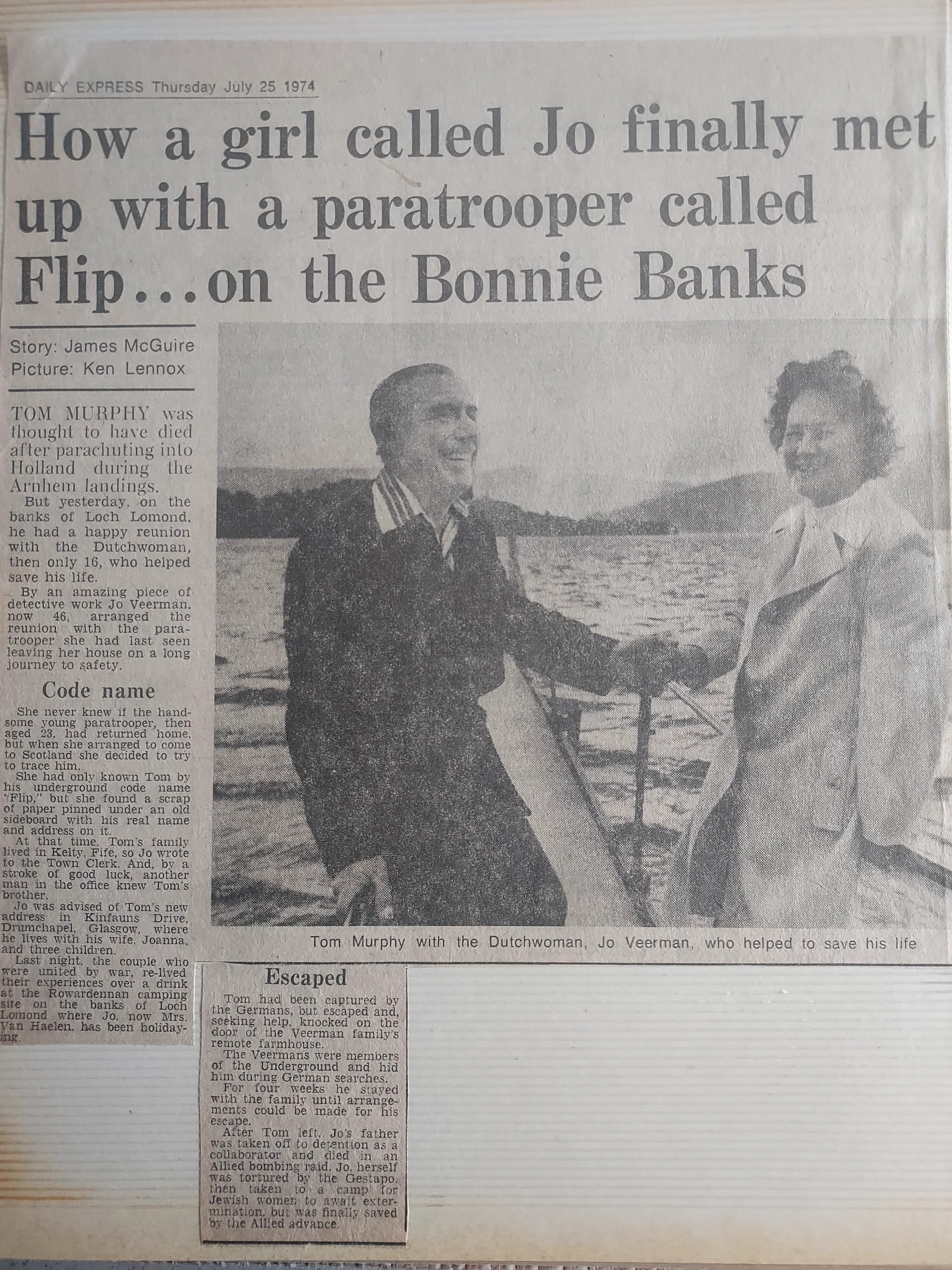
The Daily Express of 25 July 1974, ◐ very probably from Murphy and Jopie, whose reunion it reports, has the family hiding him "during German searches" for four weeks (the cutting, kept by the family; After the war).
His father Leendert died at Barneveld on 10 January 1945, a week after Murphy was recaptured and six weeks before the SD came for Jacob (the records).
The arrest, 24 February 1945
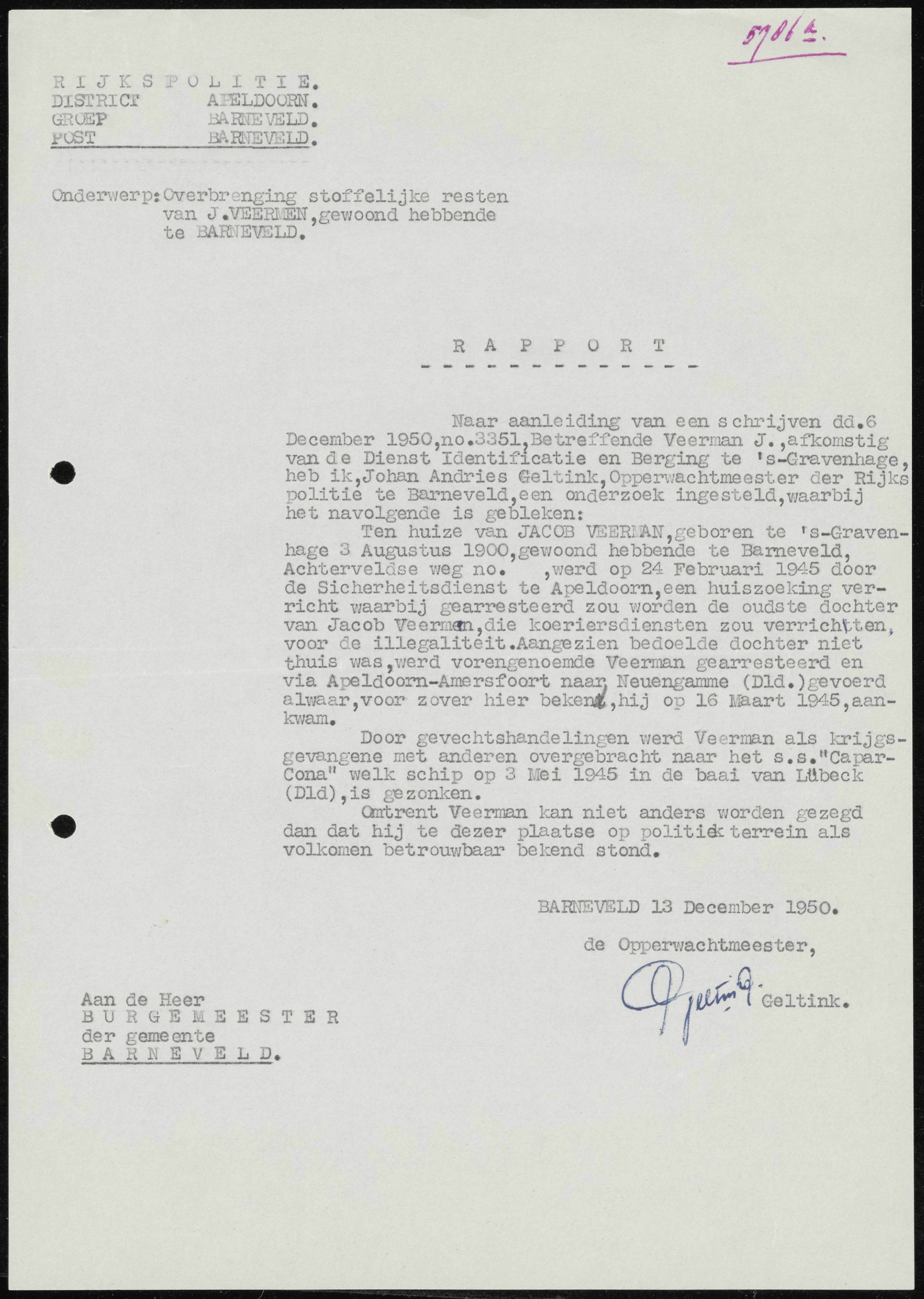
Link to the section The arrest, 24 February 1945The SD came to the farm for Jopie, who was a courier; she was hiding with her uncle Gerrit at Ede, so they took her father and put it about that he would be released if she gave herself up. She did, and he was not released (Neuengamme online memorial, quoting Huurdeman; TracesOfWar). ✓ The Rijkspolitie at Barneveld, asked about him in December 1950, reported that on 24 February 1945 the Sicherheitsdienst of Apeldoorn searched his house to arrest his eldest daughter, who was said to be doing courier work for the resistance, and "Aangezien bedoelde dochter niet thuis was,werd vorengenoemde Veerman gearresteerd" (as that daughter was not at home, the said Veerman was arrested) (the Rijkspolitie's report, 13 December 1950, Gemeentearchief Barneveld 002, inv. 1546, PDF p. 343). A son of Jacob's, who is living, remembers that she gave herself up that very same day (Jacques Vanhaelen's email, October 2026); no record held dates her surrender. ⚠︎ The L.O.-L.K.P. form of February 1946 says how they came to her: a courier from Amersfoort had been arrested and gave Jo Veerman's name, and "Jo was niet thuis, waarom haar vader werd gearresteerd" (Jo was not at home, so her father was arrested; the last word read with doubt) (the form, general remarks). It is a short handwritten note under the typed remarks on the back of the form; nothing else we hold records the courier's arrest or what the courier said.
The resistance's memorial book of 1951 has him "Gearr. 24-2-'45 t.g.v. arr. in RR." (arrested 24-2-'45 as a result of arrests in the RR) (Het grote gebod, p. 237), and the Neuengamme memorial's record has him arrested by the SIPO, for "verzet" (resistance) (Neuengamme online memorial). His daughter Alie, at home that day:
I think we had been betrayed. One day a lorry drove onto the yard. They were Dutch SS men. Father was not taken at once; he sat tied up on the floor for a good hour. We were all questioned separately. They wanted to know where my sister Jopie was.
Dutch originalIk denk dat wij verraden waren. Op een dag kwam er een vrachtwagen het erf opgereden. Het waren Nederlandse SS'ers. Vader is niet meteen meegenomen, hij heeft nog zeker een uur vastgebonden gezeten op de grond. Wij werden allemaal apart ondervraagd. Ze wilden weten waar mijn zus Jopie was.
— Alie Veerman, his daughter, in Oorlogsverhalen om nooit te vergeten (Achterveld, 2025), p. 83 · the booklet
Alie gives no date for the raid; the booklet is oral history and says so. He was taken in his clogs, cap and short jacket, and at Apeldoorn his ring and papers were taken from him (war graves file, scan 18).
The rifle and the radio
Link to the section The rifle and the radioIn the questioning a brother of hers, who is living, said there was a rifle; an SS man held his head down on the kitchen table and swung the butt at his neck, missing, and he showed them where it was hidden (Alie, the booklet, p. 83). Jacques Vanhaelen's account has Jacob, interrogated at Apeldoorn, admitting to a radio on the farm but never to the people hidden there; the same brother (both accounts give the same first name) had to show the Germans the radio's hiding place, where two guns were hidden too, and the German who went with him "pretended not to have seen him". Both are about a rifle ("buks") or guns kept on the farm. ⚠︎ Neither account connects these weapons with Murphy's revolver.
A visitor that day
Link to the section A visitor that dayMarie Visser-Derksen, an evacuee lodging at Terschuur, near Achterveld, puts herself at the farm that day by her own account, the only source that has her there: she heard on 24 February 1945 that the Germans were taking Jacob Veerman's horses (⚠︎ her account alone; no other source has the horses), cycled over to look, and was searched by the Germans as soon as she rode in; the woman of the house gave her a slice of rye bread, and what she heard afterwards was that they took Jacob and Jopie (the booklet, pp. 111–112) (Jopie was not at home by the other records: Jopie Veerman).
The camps and his last letter
Link to the section The camps and his last letterHe was taken first to Apeldoorn (war graves file, scans 17–18), where, by Jacques Vanhaelen's account (October 2026), he was interrogated; ⚠︎ a son of his, who is living, remembers him held in prison at Arnhem for a few days before he was deported (Jacques Vanhaelen's email, October 2026), which no record held bears out. The online Neuengamme memorial's record has him at the Sipo prison on the Weteringschans in Amsterdam until 6 March 1945, then at Kamp Amersfoort from 6 to 15 March (Neuengamme online memorial), whose online register has an entry for him with his photograph (entry; photograph). On 14 March he wrote home (the booklet, p. 84):
Dearest wife and children. So far I am well and hope with God's help to stay so. I have not much to write myself; the Lord is good to me and gives much spiritual blessing, but the thoughts and the worry about you all plague me constantly. Children, will you all obey and be good to mother, and resolve to see that nothing happens that father would not want to know of. Only now that I am away from you do I realise how much I love you and how good home really was. But let us pray and hope that we see each other again. And then, dear wife, you will not lose heart? And pray that we may soon be reunited? And think above all of what we agreed. About you I have not so much worry. I know that your thoughts, moment to moment, are with me, and I know that in hard days you will stay calm. Dear wife, how much too little I valued that we were always together, and how heavy the parting is. I have much to talk over with you later, when I am home again. God grant it is soon, and if not, may He give us acceptance, and know then that it is well with me. Greet the family and the household especially, and write back soon. Goodbye dearest wife, goodbye children, goodbye all.
Dutch originalLiefste vrouw en kinderen Tot nu toe ben ik gezond en hoop dat met Gods hulp te blijven. Zelf heb ik niet zoveel te schrijven de heer is goed voor mij en geeft veel geestelijke zegen maar de gedachten en de zorgen over jullie plagen mij voortdurend. Kinderen zullen jullie allen gehoorzamen en lief voor moeder zijn en nemen jullie voor om ervoor te zorgen dat er niets gebeurt wat vader niet weten mocht. Pas nu ik bij jullie vandaag [vandaan] ben, besef ik hoeveel ik van jullie houd en hoe fijn het thuis toch eigenlijk was. Maar laten we bidden en hopen dat wij elkaar weer terugzien. En dan lieve vrouw, zul je de moed niet verliezen? En bidden dat wij spoedig weer verenigd mogen worden? En denk vooral aan wat we afgesproken hebben. Over jou heb ik niet zoveel zorgen. Ik weet wel dat je gedachten, ogenblik tot ogenblik, bij mij zijn en ik weet dat je in moeilijke dagen kalm zult blijven. Lieve vrouw wat heb ik toch veel te weinig gewaardeerd dat wij altijd samen waren en hoe zwaar valt de scheiding. Veel heb ik met je te bepraten later wanneer ik weer thuis ben. Geef [Geve] God dat het spoedig is en zo niet; Hij geve ons berusting en weet dan dat het met mij goed is. Wil je vooral de familie en huisgenoten groeten en spoedig terugschrijven. Dag liefste vrouw, dag kinderen, dag allemaal.
— Jacob Veerman, Kamp Amersfoort, 14 March 1945, as printed in Oorlogsverhalen om nooit te vergeten (Achterveld, 2025), p. 84
On 16 March 1945 he was put on the train from Amersfoort to Neuengamme as a political prisoner (war graves file, scan 19), arriving on 18 March by the Neuengamme memorial's record (Neuengamme online memorial; ⚠︎ the Rijkspolitie's report of 1950 has 16 March: below). At Neuengamme, by his family's account, he cut peat for the brickworks for a while (Jacques Vanhaelen's account). ⚠︎ A son of his, who is living, remembers that a member of the NSB who had fled from the south of the Netherlands was also hiding at the farm, and that he tried to get Jacob released but came too late: Jacob had already been deported to Germany (Jacques Vanhaelen's email, October 2026).
Why he was sent on to Germany, as his family put it in May 1946:
Jacob Veerman was arrested by the S.D. on 24 February 1945 for intelligence work. Later it came to light that he had also sheltered Allied personnel, and then he was taken to a German concentration camp, where he died on 3 May 1945. On the ship "Cap-Arcona".
Dutch originalJacob Veerman is 24 Febr 1945 door de S.D. gearresteerd wegens spionage diensten Later kwam aan 't licht dat hij ook geallieerd personeel herbergde, en toen is hij naar een Duits consentratie gebracht, waar hij op 3 Mei 1945 overleed. Op het schip "Cap-Arcona"
— US National Archives · RG 498, helper file of Jacob Veerman · questionnaire of 9 May 1946, section 12 · the archive's copy
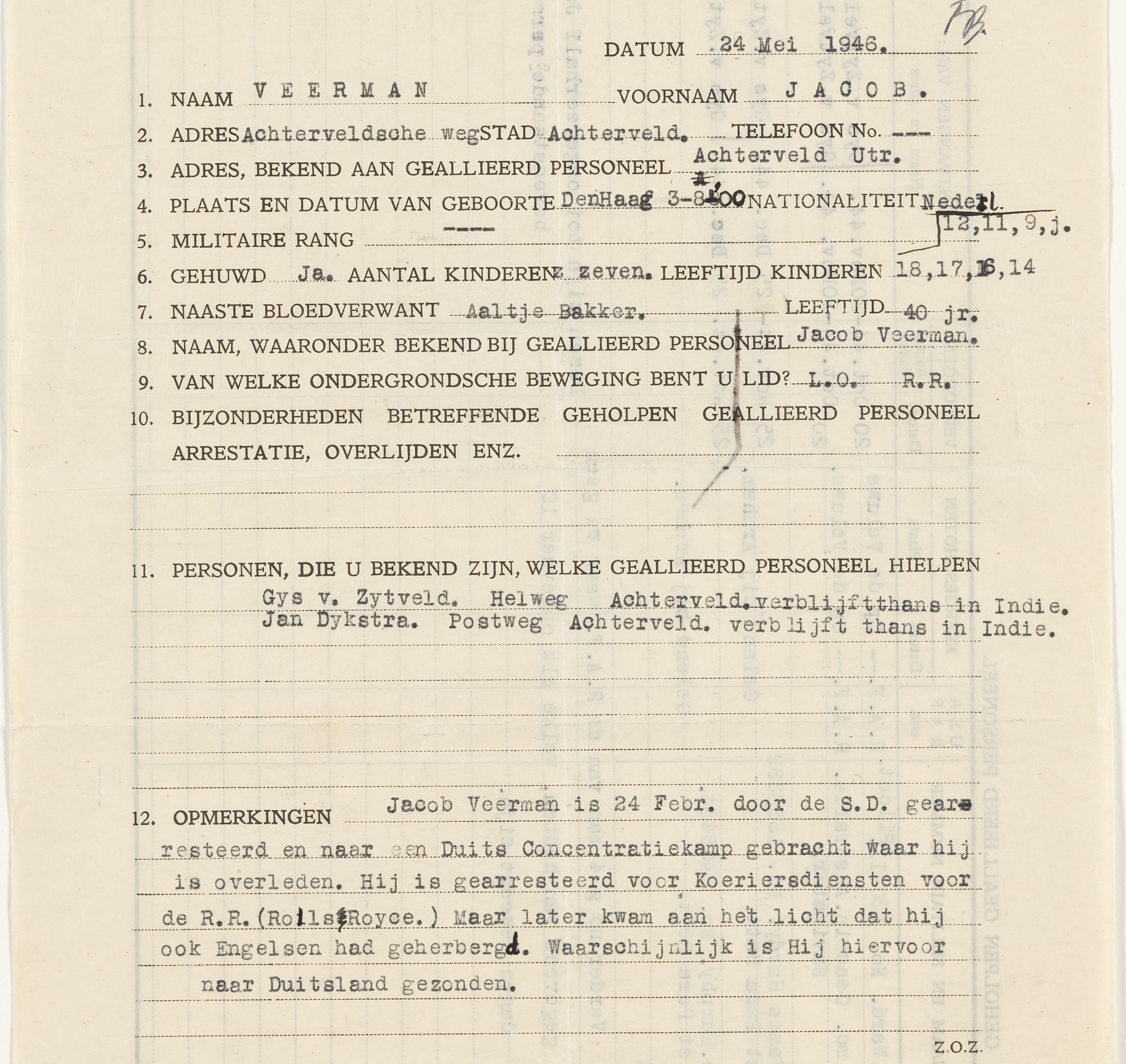
The typed Dutch copy of 24 May 1946 gives the work as "Koeriersdiensten voor de R.R. (Rolls Royce.)", courier work for a resistance group of that name, and ends "Waarschijnlijk is Hij hiervoor naar Duitsland gezonden" (probably that is why he was sent to Germany) (p. 8). So his family believed the Germans learned, after the arrest, that he had hidden Allied men; the statement does not say how, or when, or whether the Germans learned which men (Why he was arrested).
The farm in the last weeks of the war
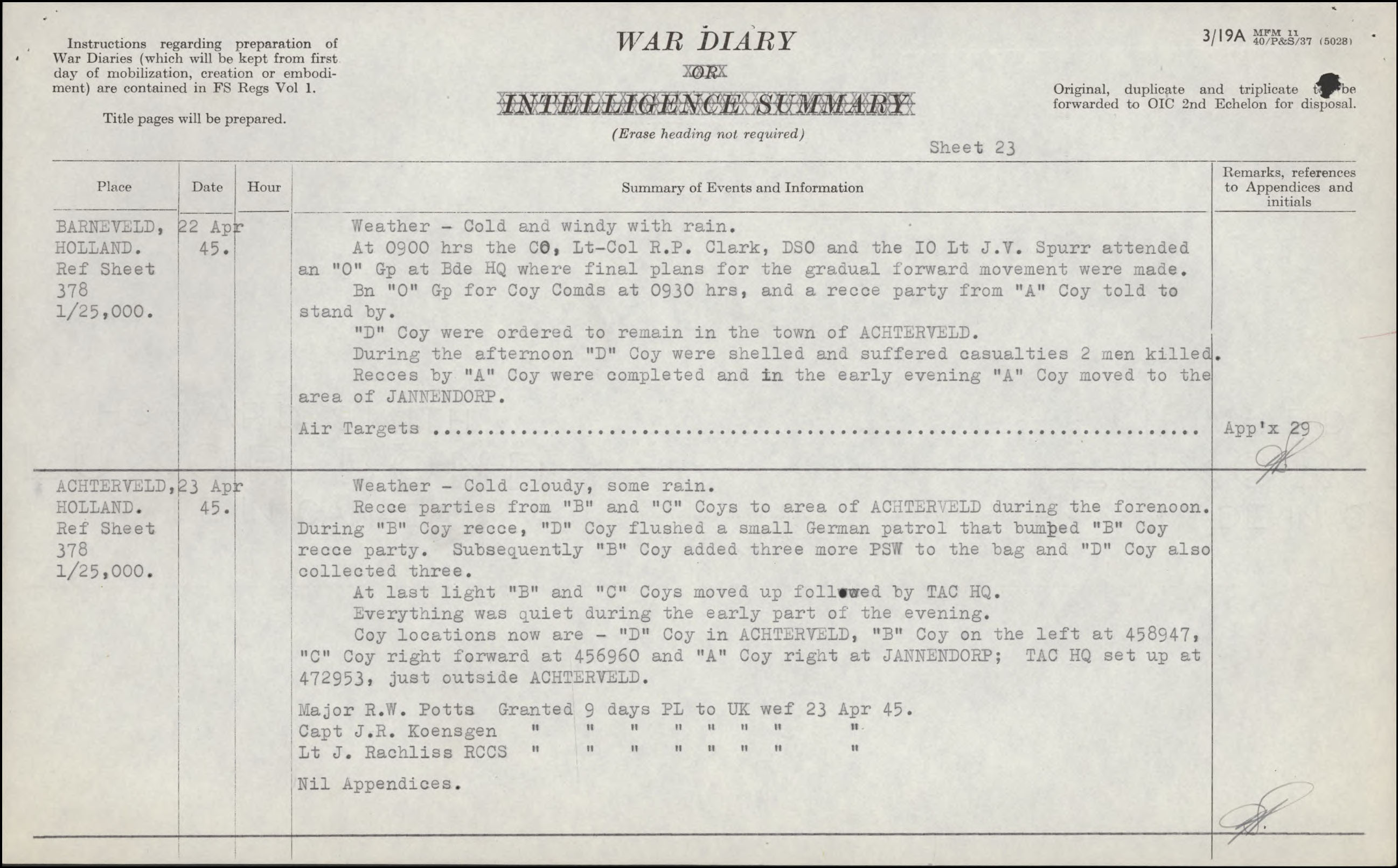
Link to the section The farm in the last weeks of the warIn the last weeks of the war, with Jacob gone, German soldiers were quartered on the farm, which by his daughter Alie's account had been requisitioned. They parked their lorries camouflaged all round it, set up a field kitchen outside and slept in the family's air-raid shelter; later Canadians slept in the same shelter. His widow took in several evacuees as well (Alie, the booklet, p. 84; Aaltje Veerman-Bakker). The Canadians reached Achterveld on 18 April 1945 by the village's accounts, on the 19th by their own war diary ⚠︎ (the booklet, pp. 11, 14; PPCLI war diary), and stopped there. From 23 April the tactical headquarters of Princess Patricia's Canadian Light Infantry stood "at 472953, just outside ACHTERVELD" ✓ (PPCLI war diary), ◐ about 900 metres west of Achterveldseweg 34, and 360 metres from the farmhouse Hardy put at "approximately position 475955" (Hardy); the battalion's forward companies were 2.4 km and more west of the farm (the conversions are ours). The Patricias' war diary names neither the farm nor the family ✓, and which Canadians slept in the shelter, or which Germans before them, is not known ⚠︎.
From 28 April the Allied and German delegations negotiating the food drops for the starving west met in a school at Achterveld, his own village, with Prince Bernhard on one side and Seyss-Inquart, who came on 30 April, on the other (Nederland Vrij, 5 May 1945; De Jong, deel 10b, p. 1352). A truce held from 8 a.m. that day, and the war there ended at 8 a.m. on 5 May ✓, two days after he drowned (Achterveld).
The Cap Arcona
Link to the section The Cap ArconaFrom 21 to 26 April the SS moved about 10,000 prisoners of Neuengamme to the Bay of Lübeck and put them aboard ships; on 3 May 1945 British aircraft attacked them, and over 7,000 of the 9,000 prisoners aboard three ships died (KZ-Gedenkstätte Neuengamme). The Cap Arcona was hit with rockets, caught fire and sank, and he drowned (Neuengamme online memorial), five days before VE Day. A man from home saw him that morning. The record of the Dienst Identificatie en Berging, the state office that traced the dead, November 1945:
Was later evacuated onto the CAP ARCONA, and on it, on the morning of 3 May 1945, was seen by a fellow villager, J.P. Lokker, the dentist there, and taken to the sick bay below in the ship. He then had dysentery and was very ill.
Dutch originalWerd later geëvacueerd op de CAP ARCONA en is daarop door een dorpsgenoot J.P. Lokker, tandarts aldaar, in de morgen van den 3e Mei 1945 gezien en overgebracht naar de ziekenafdeeling beneden in het schip. Hij had toen dysentrie en was hard ziek.
— Dienst Identificatie en Berging, Den Haag, 5 November 1945 · Nationaal Archief 2.19.255.01, 157653A, scan 19 · the file
◐ The dentist is very probably Johannes Paulus Lokker, born 25 September 1902, whom the Arolsen index has at Amersfoort as prisoner 9589 and at Neuengamme as 70782; he is not among the Dutch war dead, so he very probably came home (Arolsen index). ◐ Very probably the same witness, unnamed there, is behind Alie's "father had no chance at all; he lay deathly ill in the bottom of the boat" (the booklet, p. 84), and a form filled in for the war graves foundation in 1955 by one of his children (it calls him "vader") has him taken out to the ship by launch, with dysentery, an hour before (war graves file, scan 3).
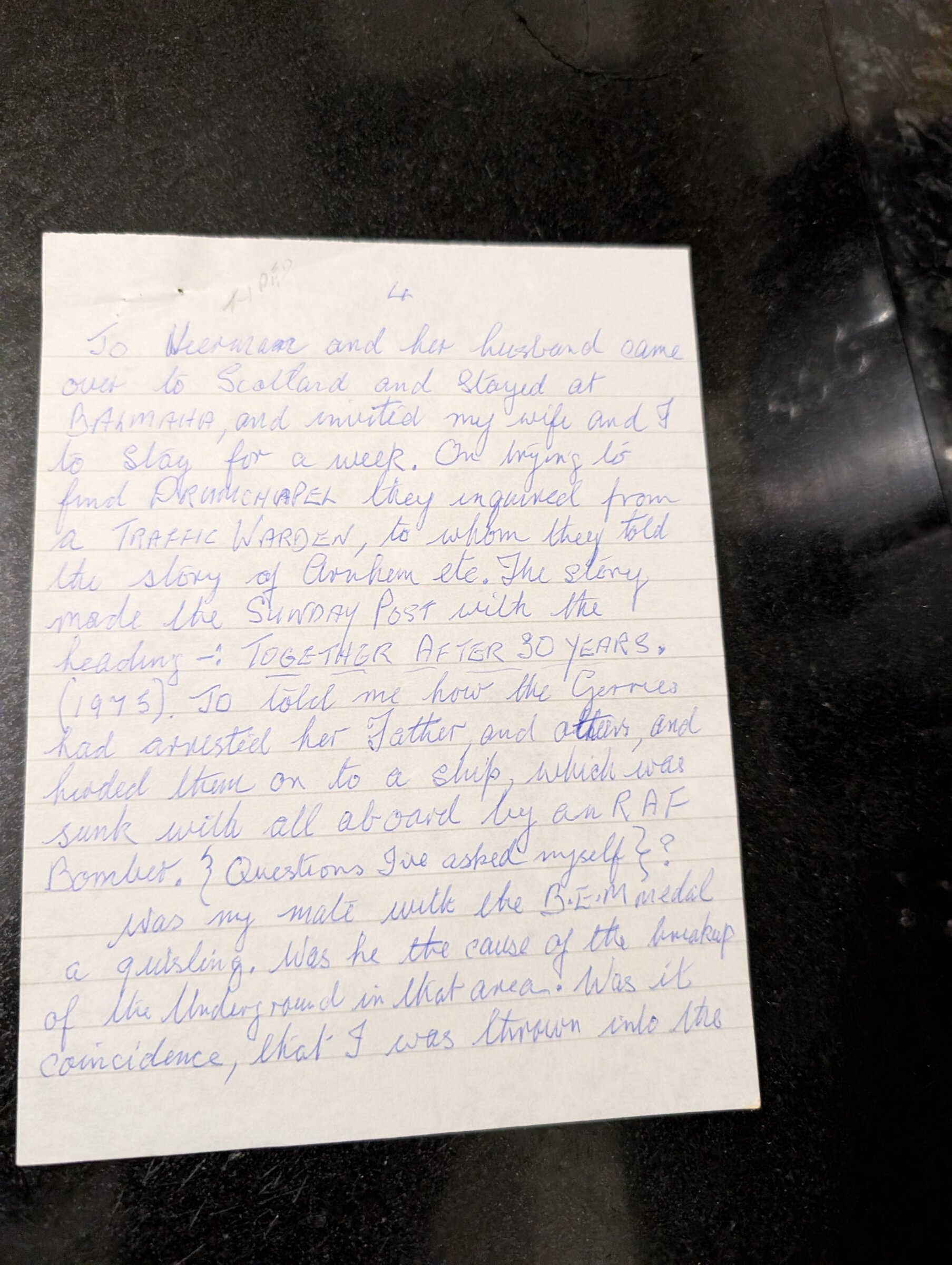
Murphy's notes, on the page about Jopie's visit to Scotland, have "Jo told me how the Gerries had arrested her Father, and others", and that they were put on a ship sunk with all aboard by an RAF bomber; he does not say when she told him, or name the ship (p.4; After the war).
No grave
Link to the section No graveHis body was never found. On 16 May 1946 the Dutch Red Cross's information bureau notified Barneveld of his presumed death, "bij het vergaan van de "Cap Arcona" verdronken op de Oostzee, op 3 Mei 1945" (drowned in the Baltic when the Cap Arcona went down, on 3 May 1945), adding that it could not fully vouch for the information, which had come through the Militair Gezag, the military authority (Gemeentearchief Barneveld 002, inv. 1546, PDF p. 339). The family asked, in an undated request signed by his widow, for his remains to be brought home at the state's cost. On 6 December 1950 the Dienst Identificatie en Berging asked the burgemeester whether his political past justified it, since only the remains of those who had not gone to Germany of their own will were brought home at the state's expense (PDF p. 341); the Rijkspolitie's report of the 13th ends "Omtrent Veerman kan niet anders worden gezegd dan dat hij te dezer plaatse op politiek terrein als volkomen betrouwbaar bekend stond" (of Veerman nothing else can be said than that he was known here as entirely reliable politically) (PDF p. 343), and the mayor (burgemeester) of Barneveld certified on the 15th that his record entitled him to it: "Veerman is niet vrijwillig naar Duitsland gegaan. Op 24 Februari 1945 werd hij door de Sicherheitsdienst uit Apeldoorn gearresteerd" (Veerman did not go to Germany of his own will. On 24 February 1945 he was arrested by the Sicherheitsdienst from Apeldoorn). The Dienst wrote to his widow that, since he had died with so many others, the chance of finding his remains was extremely small, and in 1955 the registrar at Neustadt in Holstein had no record of his death or grave (war graves file, scans 10–13, 16, 20–21). The war graves foundation records him as having a seaman's grave, lost at sea with no grave on land (Oorlogsgravenstichting). ✓ The Dutch civil register nonetheless has him: Barneveld's death register for 1945–1950 holds his death as deed 108: died 3 May 1945 at "Neustadt (Duitsland)" (Neustadt, Germany), son of Leendert Veerman and Johanna Maria Kok, with Aaltje Bakker named as his partner (Gelders Archief, 0207A, the index entry; the register scan has not been opened, and the index does not say when the deed was drawn). Neustadt in Holstein is the town on the Bay of Lübeck, off which the Cap Arcona lay, and its registrar had no entry for him in 1955 (above), so the Barneveld deed is a Dutch registration of a death abroad, not a German one.
In November 1947 Barneveld listed two war-damage bills from "Wed. J. Veerman, Achterveldsew. 34", his widow, at the address the British helper index and the family's form give for him, for 60.90 guilders (Barneveld claims list, 18 November 1947, p. 1; Aaltje Veerman-Bakker).
The Americans' certificate
Link to the section The Americans' certificate✓ The Americans' list of Grade 5 (Eisenhower) certificates has "(4266) VEERMAN, J. (Posthumous), Achterveldscheweg 34, Achterveld", the farm's address, marked Posthumous (the list, p. 162, image-checked). It is the grade the British index gives him, and the folder cover of his file for the Americans has "graded 5 [?] posth. / Conf 54 31/5/46" (read as best it can be; p. 1).
His brothers
Link to the section His brothers✓ His brother Leendert Jan was held at Kamp Vught from December 1943 to July 1944 (camp card; his page); why is not on the card. ◐ Ede's notes made for the book Ede 1940–1945 put his arrest on 21 October 1943, "ter beschikking SD Arnhem", the same day as G. W. van de Woerd of Barneveld, very probably the G. v.d. Woerd whom Jacob's L.O.-L.K.P. form names beside him; one unsigned note, and no source says why (his page).
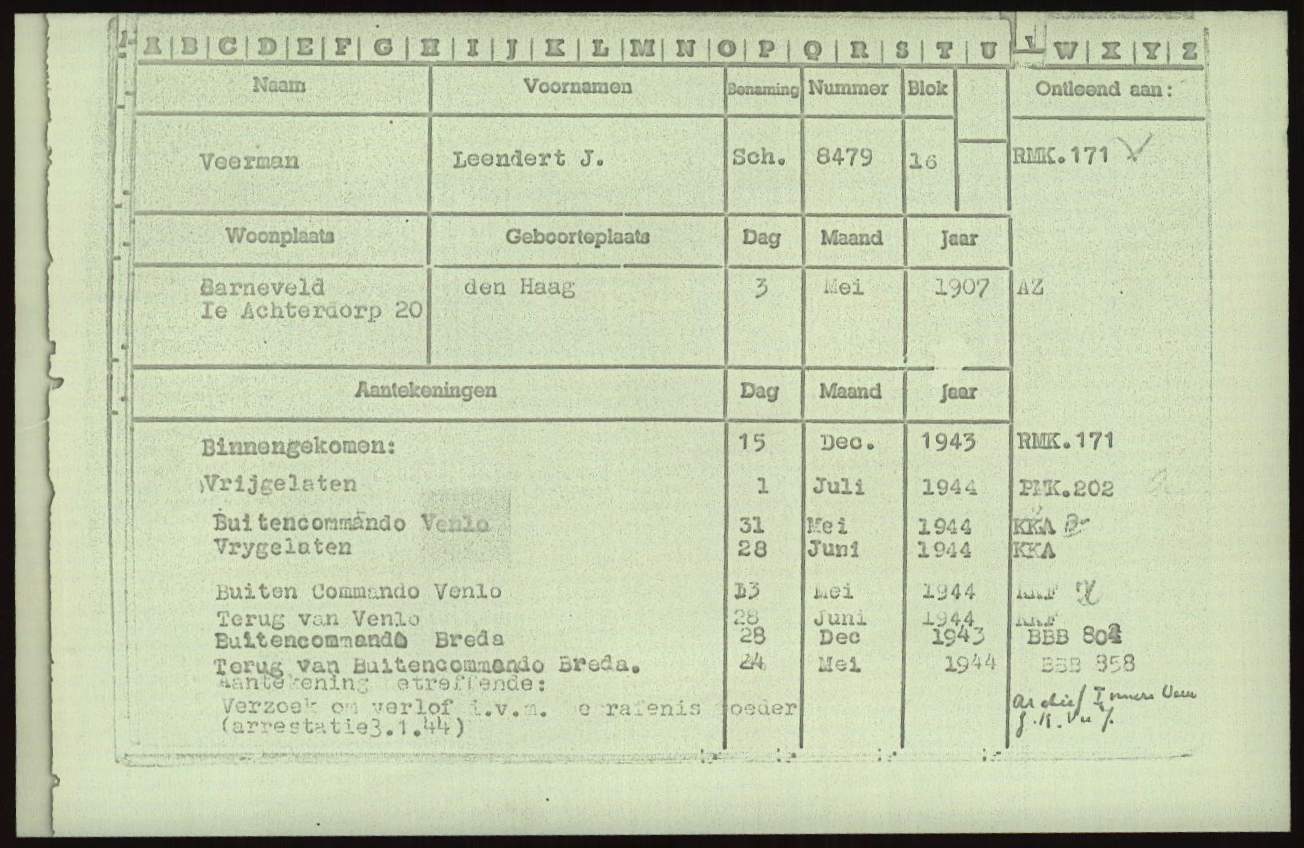
⚠︎ By an RTV Utrecht report from Neuengamme in May 2024, two other members of the family were imprisoned there and, like Jacob, had to work in the camp; his granddaughter Alie says they were also commemorating "my grandfather's brother and his nephew" there (RTV Utrecht). Nothing else found says so, and which brother is not said. The online Neuengamme memorial, which lists the camp's dead, has Jacob as its only Veerman (the search), so a Veerman brother held there came home; the nephew need not have been a Veerman. Jacob's grandson Carel Plantagie has never heard of a brother, or anyone else in the family, coming back from Neuengamme (his email, October 2026). Kamp Amersfoort's online register lists only Jacob among the Veermans (the search), though the Arolsen index holds six other Veerman files from that camp (the search), so the register is not complete. Whether Leendert Jan was the brother at Neuengamme, taken a second time, is not known.
Murphy wrote: "I learned after the war that the Germans rounded up the Uncle and others, no doubt through the connection to the Gun" (On Tex Banwell). His "Uncle" is the policeman he says gave him the revolver. No Veerman was taken in the December round-up (Huurdeman; the December round-up), and nothing found ties any arrest to the revolver. ⚠︎ A son of Jacob's, who is living, remembers Leen arrested by the Germans near the end of the war, held at Eindhoven and released fairly quickly (Jacques Vanhaelen's email, October 2026); no record held bears it out, and the place and timing do not fit (Leendert Jan Veerman).
How he is remembered
Link to the section How he is remembered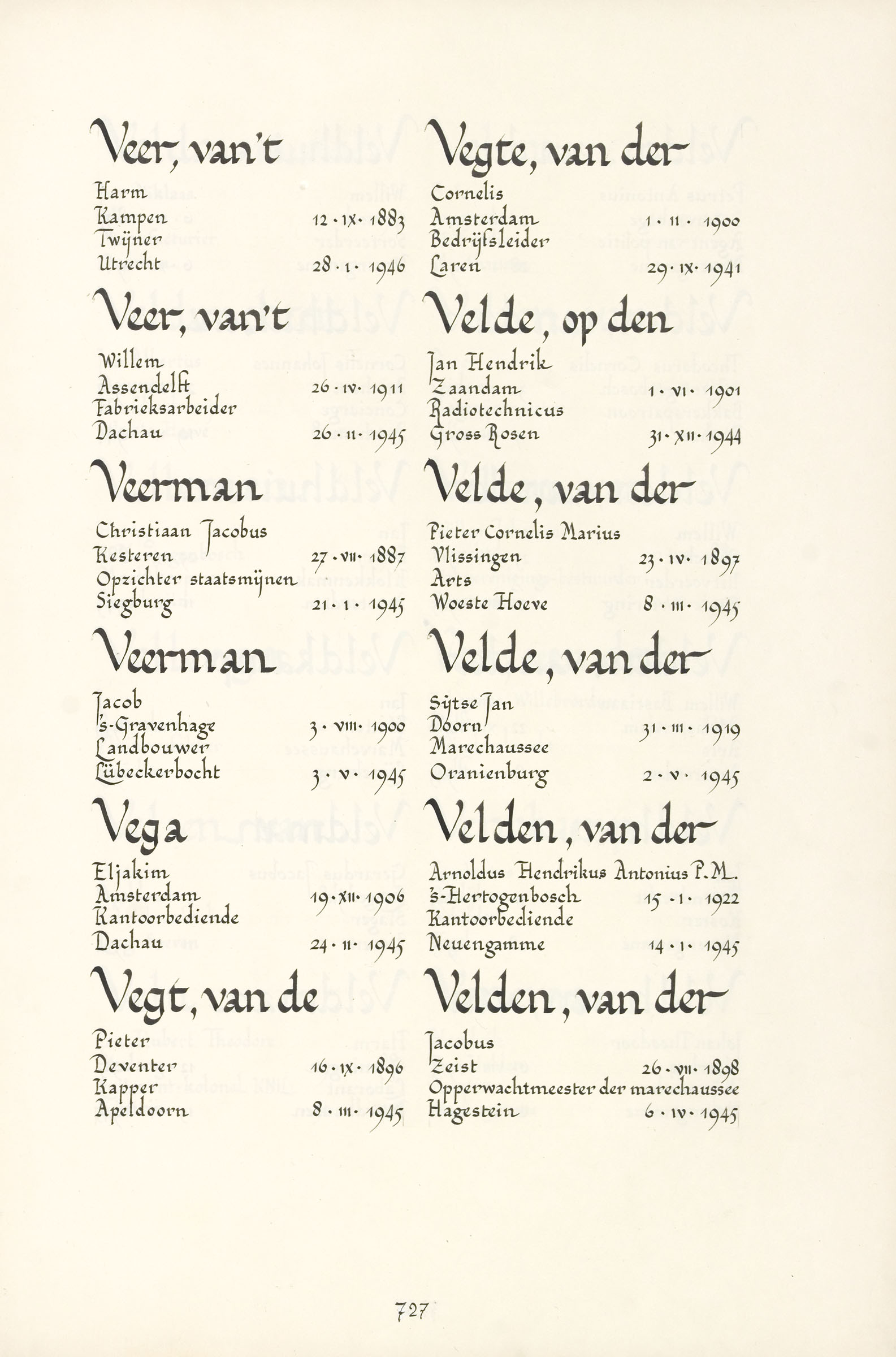
The Dutch papers reported the sinking within weeks, Het Parool on 4 June 1945 (the article) and Het Vrije Volk on the 6th (the article).
The Dutch state's roll of honour, the Erelijst van Gevallenen 1940–1945, carries him on page 727: "Veerman, Jacob, 's-Gravenhage 3·VIII·1900, Landbouwer, Lübeckerbocht 3·V·1945", in the group Verzet, resistance (entry). The war graves foundation lists him on the Cap Arcona monument at Neustadt in Holstein and in volume 34 of its books of remembrance (Oorlogsgravenstichting; war graves file, scans 8–9).
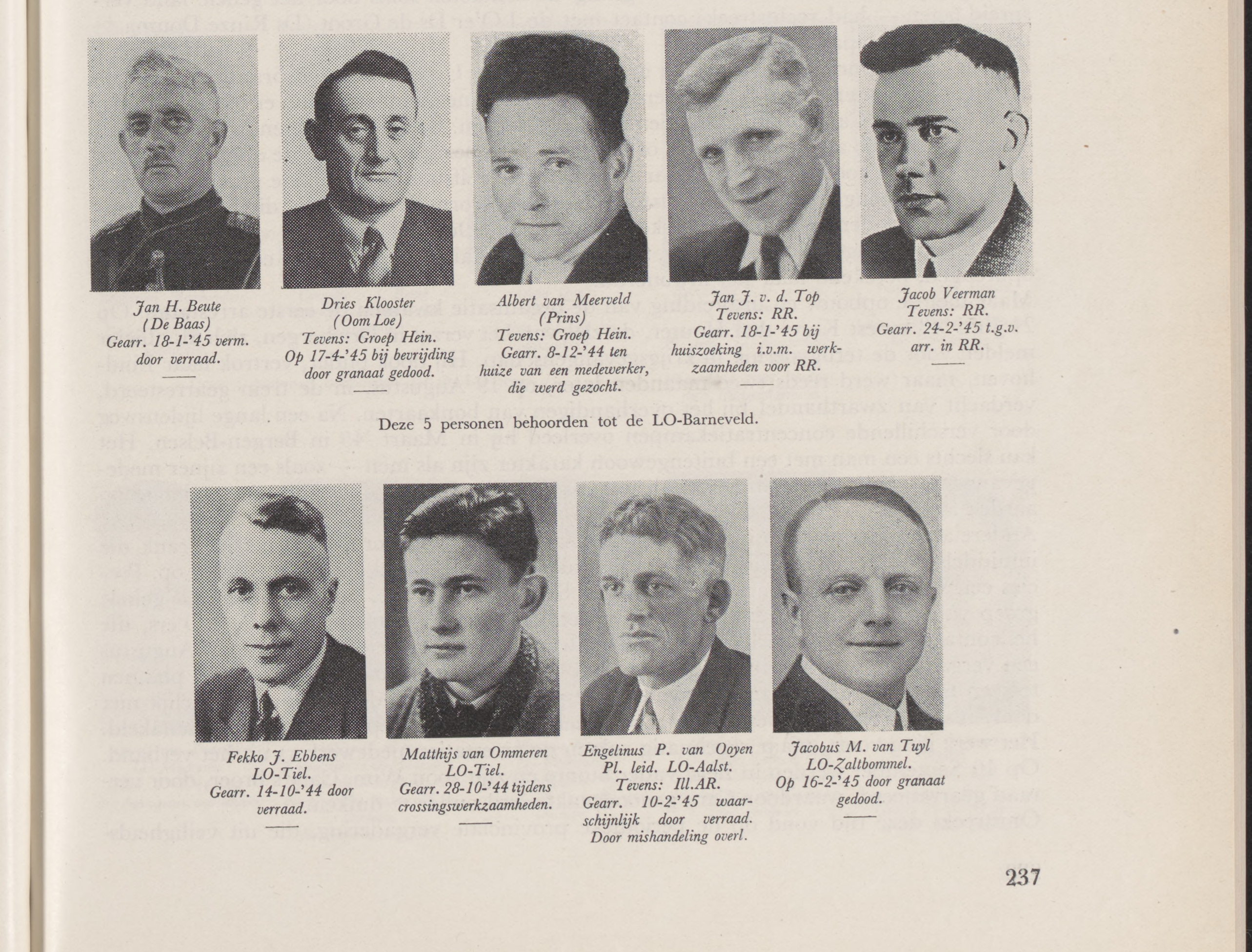
✓ The resistance's memorial book of 1951, Het grote gebod, puts him among the five fallen of the LO-Barneveld, with Dries Klooster and Albert van Meerveld: "Jacob Veerman / Tevens: RR. / Gearr. 24-2-'45 t.g.v. / arr. in RR." (also the RR; arrested 24-2-'45 as a result of arrests in the RR), and under the row "Deze 5 personen behoorden tot de LO-Barneveld" (these 5 persons belonged to the LO-Barneveld) (Het grote gebod, p. 237, read on the page).
The Leusder Krant named him in 1970, twenty-five years after the liberation, and again in 1973, among the men of the Leusden villages who had fought the occupier (1970; 1973). In 1970 it remembered him and the baker who, it says, provided the rye bread for the paratroopers:
Jacob Veerman of "Klein Achterveld", a good man, managed to keep dozens of paratroopers out of the Germans' hands. He stops to talk for a moment with the baker Hein Schouten, who provides the rye bread for the paratrooper-liberators; it is his last conversation. The Grüne Polizei lie in wait for Jacob …
Dutch originalJacob Veerman van „Klein Achterveld" — een goed mens — heeft tientallen parachutisten uit handen van de Duitsers weten te houden. Hij praat nog even met bakker Hein Schouten die zorgt voor roggebrood voor de parachutisten-bevrijders, het is zijn laatste gesprek. De Grüne Polizei wacht Jacob op …
— Leusder Krant, 2 April 1970, p. 8 (Archief Eemland)
The article is signed "J. M. Sch." (the page), ◐ very probably Jan M. Schouten, the village historian and Hein's son (Hein Schouten); if so, the bread is a son writing of his father, one family source, and ⚠︎ the article does not say the paratroopers were the men Jacob hid.
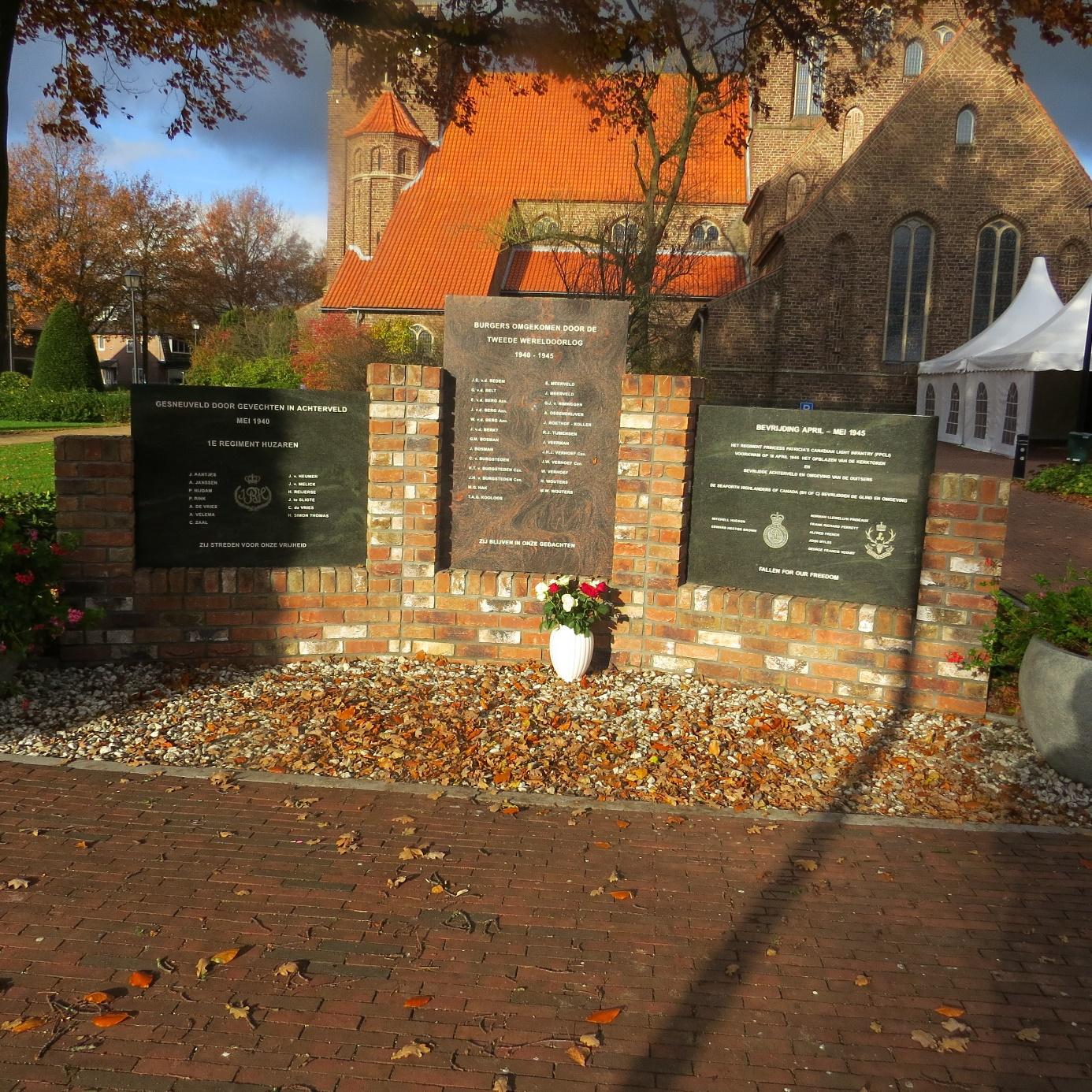
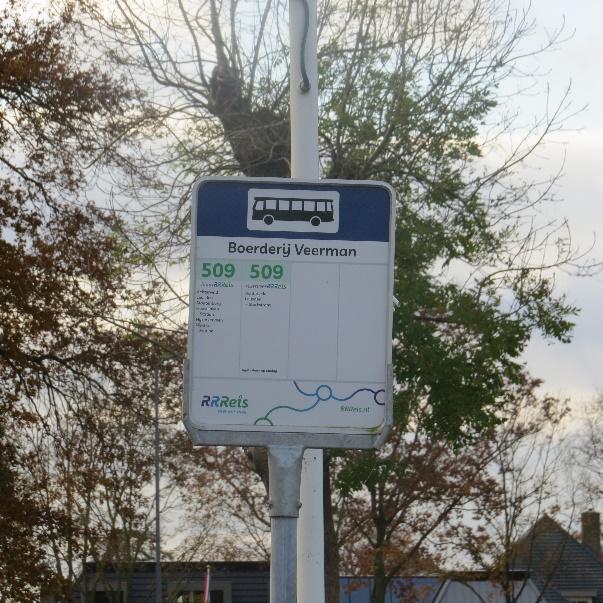
At Achterveld he is on the memorial by the Sint-Jozefkerk, "J. VEERMAN" among the civilian dead of the war (4 en 5 mei), and the bus stop by the farm is named after the farm, in his memory (Jacques Vanhaelen's account). Barneveld's archive holds a photograph of him, not yet digitised (catalogue, GB00294). On 3 May 2024, 79 years after the sinking, a granddaughter of his read his letter from Amersfoort aloud on a boat over the place where the Cap Arcona went down (RTV Utrecht).
Where the sources disagree
Link to the section Where the sources disagree- The date of the arrest. Huurdeman has 24 January 1945 (Neuengamme online memorial). His family's form of May 1946, the L.O.-L.K.P. form of February 1946, the Rijkspolitie and the burgemeester of Barneveld in 1950, the resistance's memorial book of 1951 and Marie Visser-Derksen, by her own account there that day, all have 24 February (p. 4; the L.O.-L.K.P. form; Gemeentearchief Barneveld 002, inv. 1546, PDF pp. 343, 345; war graves file, scan 20; Het grote gebod, p. 237; the booklet, p. 111).
- When he reached Neuengamme. The Neuengamme memorial's record has 18 March 1945 (Neuengamme online memorial); the Rijkspolitie's report of 1950 has 16 March, "voor zover hier bekend" (as far as is known here) (Gemeentearchief Barneveld 002, inv. 1546, PDF p. 343), the day the identification office has him put on the train at Amersfoort (war graves file, scan 19).
- Where he died. The Dutch civil register has "Neustadt (Duitsland)", the Erelijst "Lübeckerbocht", the war graves forms "Baai van Lübeck", "Duitsche bocht" and the Cap Arcona, and the family's own answer to the identification office "In de Oostzee bij Neuengamme" (in the Baltic near Neuengamme) (the index entry; entry; war graves file, scans 1, 3, 17, 19). ✓ They agree on the day, 3 May 1945, and on the Cap Arcona; the town, the bay and the Baltic are one stretch of coast. "Near Neuengamme" is loose: the camp is by Hamburg, not on the coast.
- The year of the arrest. ✗ A compiled genealogy, G.J. Broekhuis's BROBOL Genealogie, has "24 februari 1944" (his entry), a year early: every record above has 1945, and he hid Murphy and Hardy at the farm in November and December 1944. The genealogy gives no sources. ✗ RTV Utrecht's 2024 piece also has "De Duitsers hebben hem in 1944 opgepakt" (the Germans arrested him in 1944) (RTV Utrecht). The same entry says that Jopie, a courier, "heeft ook nog een tijdje vastgezeten" (was held for a while too), ✓ as the records bear out (TracesOfWar; the Vrouwenmars list; Jopie Veerman).
- Why he was taken. ⚠︎ None of the reasons below connects it to Murphy.
- For his courier daughter: Huurdeman; the Rijkspolitie's report of 1950, which has the SD searching the house to arrest her and taking him because she was not at home (Gemeentearchief Barneveld 002, inv. 1546, PDF p. 343); and the L.O.-L.K.P. form of 1946, which answers "no" to whether the arrest was for his own work, "omdat zijn dochter koerierster was" (because his daughter was a courier), and adds that she was not at home (the form).
- "T.g.v. arr. in RR" (as a result of arrests in the RR): the memorial book of 1951 (Het grote gebod, p. 237).
- For his illegal work: the Den Haag registry's answer to the war graves foundation in 1955, "Is voor zijn illegale werk naar Duitsland overgebracht" (was taken to Germany for his illegal work) (war graves file, scan 2).
- For his own courier and intelligence work, the sheltering found out afterwards: the family's form for the Americans (p. 4; p. 8).
- "Wegens bewijzen, dat vader Engelsen onderdak verleende" (because of proof that father sheltered Englishmen): the 1955 form (war graves file, scan 3).
- Betrayal: Alie (the booklet, p. 83).
- Who was hidden. Huurdeman has a Jewish woman and her daughter; Alie a Jewish mother and her son from Germany. Alie puts the English and Australian airmen in 1943; the family's 1946 table puts Ward and McGeachin there from 20 October to 20 November 1944, and the evader register has them brought to the Pegasus II launching point at Meu-Lunteren on 17 November 1944 (p. 9; SGLO E0842).
- The eyewitness on the ship. Seen aboard that morning and taken to the sick bay (1945), or taken out to the ship by launch an hour before (1955). A genealogy site has the Barneveld dentist Lokker meeting him at Neuengamme and watching from the deck of the Athen, the ship Lokker was on (BROBOL).
- "Dozens of paratroopers" (Leusder Krant, 1970), written twenty-five years later, against Huurdeman's three pairs of airmen and the family's table, which has Ward and McGeachin, Hardy and Murphy, and four more RAF men, eight Allied men in all (p. 9). The same article does not name the ship he died on and has it sinking in the Elbe; the Cap Arcona, which other sources put him on, sank in the Bay of Lübeck (Leusder Krant, 2 April 1970, p. 8).
- His age and his youngest son's. Hardy has him 43 and "YAP" 5; he was 44, and Jaap was 8.
- The revolver. Hardy says Jacob gave it; Murphy says a policeman uncle did; a son of Jacob's remembers Jacob fetching it from his brother Leen. ◐ The revolver was probably Leen's (above).
- The bus stop. Jacques Vanhaelen's account says it is named after the farm in one place and after Jacob Veerman in another.
- The Daily Express in 1974 has him "taken off to detention as a collaborator" and killed "in an Allied bombing raid": wrong on the first, loose on the second.