Bram Baar
Haren 12 Aug 1924 – Varsseveld 2 Mar 1945
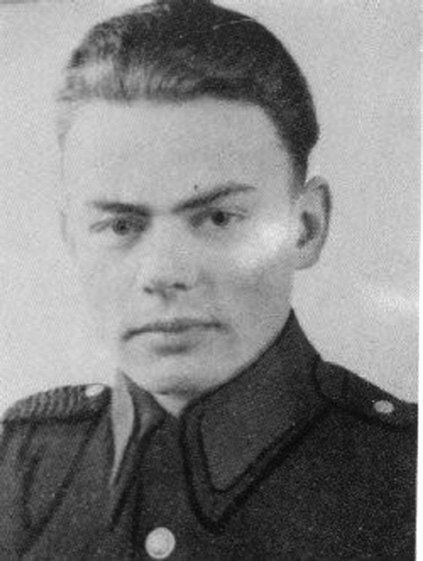
Hilbrand Johannes Baar, "Bram", on the Dutch roll of honour as "Plaatsv. Cdt. B.S.", deputy commander in the Binnenlandse Strijdkrachten
About: Hilbrand Johannes Baar, "Bram", of Hulshorst, of Joop Migchelsen's resistance group, who looked after Murphy and the others at the forester's house Kijkuit in 1944. Arrested in January 1945, he was shot at Varsseveld on 2 March 1945.
Unit or role: The group Hulshorst-Hierden of the N.B.S. (the Binnenlandse Strijdkrachten, the Dutch forces of the interior), second to Migchelsen; his rank is given five ways (below). Migchelsen called him the "guard of the house where the pilots were sheltered" (Migchelsen's file, p. 2); the American form filed for him has "R.V.V. Hulshorst" as his movement (his file, p. 2). Before that, a grocer's assistant, and a policeman of the Staatspolitie.
Where: Haren; from 1940 his parents' house, Oudeweg 123, Hulshorst; Schalkhaar and Amsterdam in the police, and ⚠︎ Nijmegen (the biography only); in autumn 1944 the forester's house Kijkuit in the Leuvenumse Bos; after his arrest De Kruisberg at Doetinchem, and ⚠︎ the Jan van Schaffelaer barracks at Ermelo (the biography and a Nunspeet book); shot at the Rademakersbroek near Varsseveld; buried at Nunspeet.
Evidence: ✓ his file with the Americans, made out after his death by A. Baar (US National Archives 286635262, pp. 1–5); ◐ Hardy's report ("BRAM", "BRUMMAGER": Hardy never writes Baar; Noordman supplies the name and the match is ours); ✓ Migchelsen's file, pp. 2 and 4; ✓ his death deed at Wisch, 8 March 1945 (Gelders Archief); ◐ the list of the 46 shot at Varsseveld, sent to the British in June 1945, which has him as "Hilbrand Haar" (Arolsen Archives); ✓ the War Graves Foundation's file (Nationaal Archief 2.19.255.01, 4955A); ✓ the Erelijst, p. 408; ✓ the war dead register; ⚠︎ the biography on the Oorlogsgravenstichting's page, also on the Rademakersbroek memorial's, no sources given; Noordman, pp. 270, 278–280.
With Joop Migchelsen and the rest of the group at Kijkuit.
He was born at Haren, in Groningen, on 12 August 1924 (the Foundation's questionnaire; the Erelijst), the son of Arent Baar, born at Bierum on 17 April 1897, and Henderika Vrieling, born at Haren on 31 January 1900 (the same questionnaire). They had married at Haren on 23 November 1923: Arent, 26, a signalman of the Nederlandsche Spoorwegen, born at Bierum and living at Haren, son of Hilbrand Baar, a labourer, and Frouwke Brondijk of Zuidlaren; Henderika, 23, a domestic servant, born and living at Haren (the marriage deed, Haren no. 56, read on the scan). The biography on the Oorlogsgravenstichting's page says he was named after his father's father, and that the couple had three children (the page). Haren struck him off its register on 19 November 1924 for Vries, "Wachtpost 49 Vries-Zuidlaren" (the Foundation's file, scan 3); Vries sent the Foundation's form back on 24 October 1953 saying he was "hier onbekend" and had never been entered in its population register ("niet in het bev register dezer gemeente is opgenomen geweest") (scan 2).
The biography has him leave the Mulo after a year and a half because he wanted to be a policeman or a soldier, and at fifteen become a grocer's assistant with Albert Heijn; the family had moved to Hulshorst, on the Veluwe, where his father had been made stationmaster, and he worked at Putten and then Nunspeet and took his shopkeeper's diploma (the page). The war dead register calls him a grocer's assistant ("kruideniersbediende") with Albert Heijn at Nunspeet (the register). Ermelo's register has him entered on 11 April 1940 "komende uit de gemeente Putten" at Oudeweg 123, Hulshorst; struck off on 7 December 1942 for Diepenveen, Schalkhaar, Frieswijk 50a; and on 21 October 1943 for Amsterdam, Corn. Troostplein 23 (scan 3). Ermelo gave his occupation in 1953 as "onderwachtmeester Staatspolitie", a junior sergeant of the State Police, and his father's as stationmaster (scan 2).
⚠︎ The biography, from the Nationaal Onderduikmuseum at Aalten, gives no sources (the page). It says:
- the station house at Hulshorst was where Jews and others without papers got off the train and disappeared unseen into the house, a hiding place and a stop on the way to others, until it became too dangerous at the end of the war;
- at the end of 1942, in agreement with the resistance, he went as an infiltrator to the police training at the Westenberg barracks at Schalkhaar, near Deventer, set up in July 1941 to train pro-German policemen;
- posted to Nijmegen, he guarded a monastery where senior NSB police officials met and where what was left of the Hague population register had been taken after the bombing of April 1944, and at the resistance's request made the cards of wanted resistance people disappear;
- later posted to Amsterdam, he went into hiding at the resistance's signal, with uniforms and weapons.
The war dead register also has him infiltrating the police training battalion at Schalkhaar (the register); Ermelo's register agrees on Schalkhaar (December 1942), but its Amsterdam entry is of 21 October 1943, before the April 1944 bombing that the biography puts before his Nijmegen posting and his later move to Amsterdam, and it has no Nijmegen: ⚠︎ the biography's order does not fit the register.
With Murphy
Link to the section With MurphyMigchelsen's group, autumn 1944
Link to the section Migchelsen's group, autumn 1944⚠︎ By the biography, in September 1944 he joined Joop Migchelsen's group Hulshorst-Hierden full time, as its commander and instructor and "de rechterhand van de leider" (the leader's right hand). The group provided ration coupons for people in hiding, forged identity cards, spread underground papers, passed on messages, moved weapons and explosives, and hid airmen on the Stakenberg estate near Elspeet. On 30 September 1944 he was arrested with two friends at an arms transport and got away by knocking a German out (the page).
Hardy and Haller, 12 October 1944
Link to the section Hardy and Haller, 12 October 1944James Hardy and the glider pilot John Haller, who had escaped together from Apeldoorn, reached Hulshorst after a night in a tobacco shed, and a woodcutter and his brother took them that night to a meeting place in the woods (Hardy). Haller dates it 12 October (Noordman, p. 270).
- Hardy's account, from his interview of 13 January 1945: "the two Underground members they took us to were BRAM and JOOP (?)", and "JAN and EEVID left us and BRUMMAGER and JOOP took us to a house in the woods" (Hardy). Noordman renders the meeting "Jan en Evert droegen Hardy en Haller over aan Bram Baar en Joop Migchelsen" (Jan and Evert handed Hardy and Haller over to Bram Baar and Joop Migchelsen) (p. 278).
- Haller's account, as Noordman prints it in Dutch: two young lads fetched them from the farm, "een van hen was klein en donker en ongeveer achttien jaar" (one of them was small and dark and about eighteen); he forgot the lad's name, and was told later that the Germans had shot him around March 1945. The second, taller, introduced himself as Adriaan de Kok (p. 270).
- Noordman's identification: "De knaap van wie Haller de naam was vergeten heette Bram Baar" (the lad whose name Haller had forgotten was Bram Baar) (p. 270). ◐ Baar was twenty that October, not eighteen.
The house was Kijkuit, a forester's house in the Leuvenumse Bos (Noordman, p. 278). Migchelsen described it as a double house at Hierderweg 132, Hulshorst, one half lived in by the forester's family, Van der Vlist, the other lent to him for his underground work by a Mr van der Elst of Amsterdam: "In this house the pilots we[re] sheltered" (Migchelsen's file, p. 3).
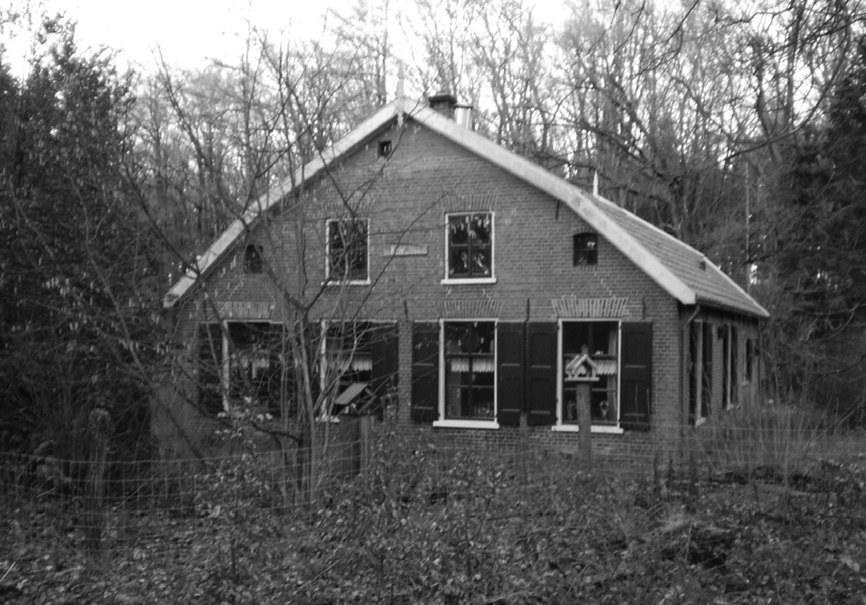
At Kijkuit
Link to the section At KijkuitIn the house were Eric Blok, "EMMY, a girl of 19", P/O "BRENTFORD" (James Branford), "ADRIAN", and two Dutchmen in hiding: "BRUMMAGER also stayed here but JOOP left us" (Hardy). Branford had first checked Hardy's identity "on behalf of the Dutch helpers, BRUMMAGER & Co." (same). Haller remembered giving the lad he met at Hulshorst his pocket knife (◐ Noordman takes the lad to be Baar): "Toen ik vertrok voor deelname aan de crossing Pegasus II, gaf ik hem als herinnering mijn zakmes cadeau" (when I left to join the Pegasus II crossing, I gave him my pocket knife as a keepsake) (Noordman, p. 270).
Hardy left on 19 October for the lines, was taken in at Elspeet by "DEREK", and met Murphy and "another Paratrooper" at Derek's great-aunt's house (Hardy); Noordman names them Dirk van Eysinga, Sam Walsh and the house Sterrehoveke (pp. 279–280). When a raid on Elspeet was expected, "It was suggested that we should go to BRUMMAGER's house in LEUVENUM where I had been before"; on the evening of 26 October "DEREK and his aunt" went ahead "pushing their bikes", "and MURPHY, the other Paratrooper, and myself following a short distance in the rear" (Hardy). Noordman renders BRUMMAGER's house as "het huis van Bram Baar in Leuvenum" (p. 280). "The same party was still occupying the house", and on 29 October Tex Banwell joined them; at midnight on 6 November Derek and "LOEW" took the six to Harskamp (Hardy).
The papers filed for him and for Migchelsen say what he did there:
- His own file, filled in by A. Baar: "was in charge of the daily safety etc. of the pilot camp in Hulshorst. All the pilots were safely delivered." (p. 2).
- Migchelsen's list of his helpers: "H. BAAR 121 Oude weg Hulshorst (not married) guard of the house where the pilots were sheltered." (p. 2).
- The biography: "Baar smokkelt parachutisten en verzorgt een groep van zes Engelse piloten" (Baar smuggles paratroopers and looks after a group of six English airmen) (the page); ◐ very probably the six of Kijkuit.
His file lists the six with their numbers, and "one, name unknown" (p. 3):
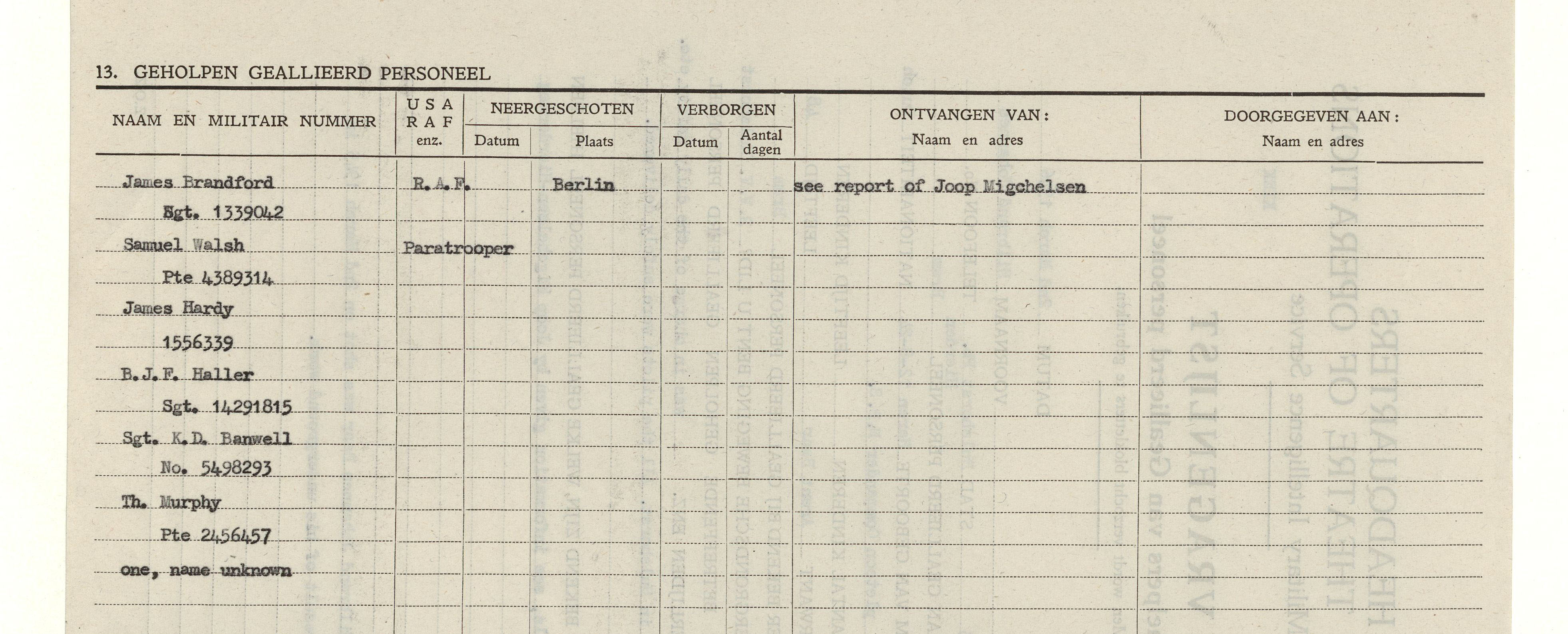
By the biography his parents urged him to be careful, and he answered: "Die ondergronds werkt, weet als ze hem te pakken krijgen, dat hij de kogel krijgt. Die er bang voor is moet er niet bij gaan" (whoever works underground knows that if they catch him he gets the bullet; whoever is afraid of that should not join) (the page).
Arrest, 13 January 1945
Link to the section Arrest, 13 January 1945The war dead register has him arrested at Hulshorst on 13 January 1945 and held at Kamp De Kruisberg in Doetinchem (the register). The accounts of the arrest:
- ⚠︎ The biography: arrested on 13 January 1945 with others of the group; in the afternoon, crossing the railway lines, he walked into a trap set by the Sicherheitsdienst; hard interrogation and torture followed at the Jan van Schaffelaer barracks at Ermelo while his friends were made to watch, and he said nothing; in February he was held at De Kruisberg (the page).
- Migchelsen, June (year not given; his form on p. 2 is dated August 1945): "Hilbrand BAAR died, he was arrested because of weapon smuggling and shot as reprisal measure. He was a N.B.S. er." (p. 4).
- ◐ A Nunspeet book (6th revised edition, 2004), read only through the Internet Archive's text search: a woman called Minie was arrested and, with "koerierster Emmy Vroe- ge en Bram Baar", held at a barracks at Ermelo, where "Bram Baar zou daar vreselijk mishandeld zijn" (Bram Baar is said to have been terribly mistreated there) (the snippets). Emma Vroege's story, as Emerson Lavender tells it, has her arrested on 13 January 1945 (The Evaders, snippets).
Varsseveld, 2 March 1945
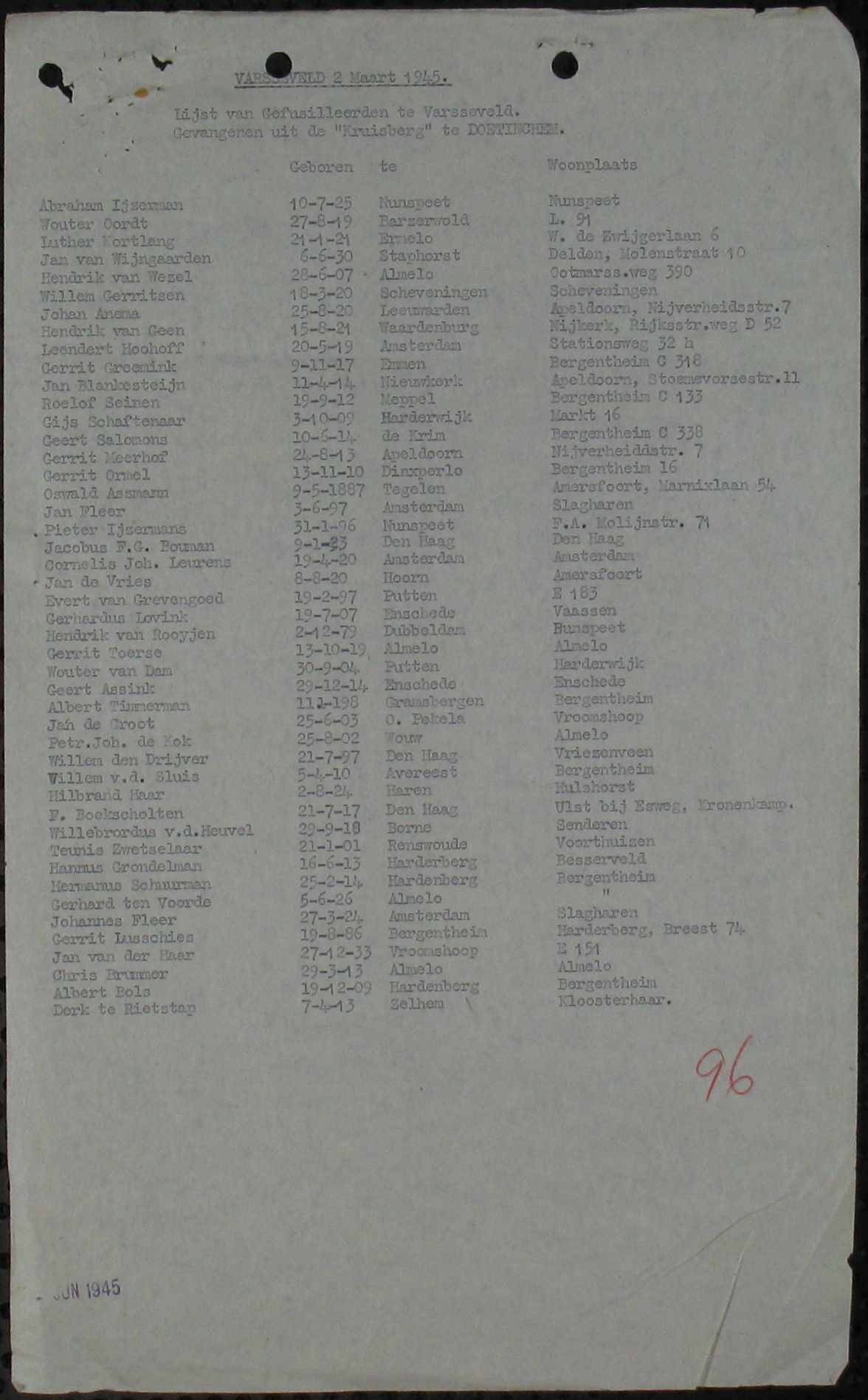
Link to the section Varsseveld, 2 March 1945He was one of 46 prisoners from De Kruisberg shot at the Rademakersbroek near Varsseveld on 2 March 1945 (the register; the list). ⚠︎ The biography gives the reason as a reprisal for the killing of four German soldiers by the resistance group De Bark, whose headquarters that winter was a farm at De Heurne near Dinxperlo (the page).
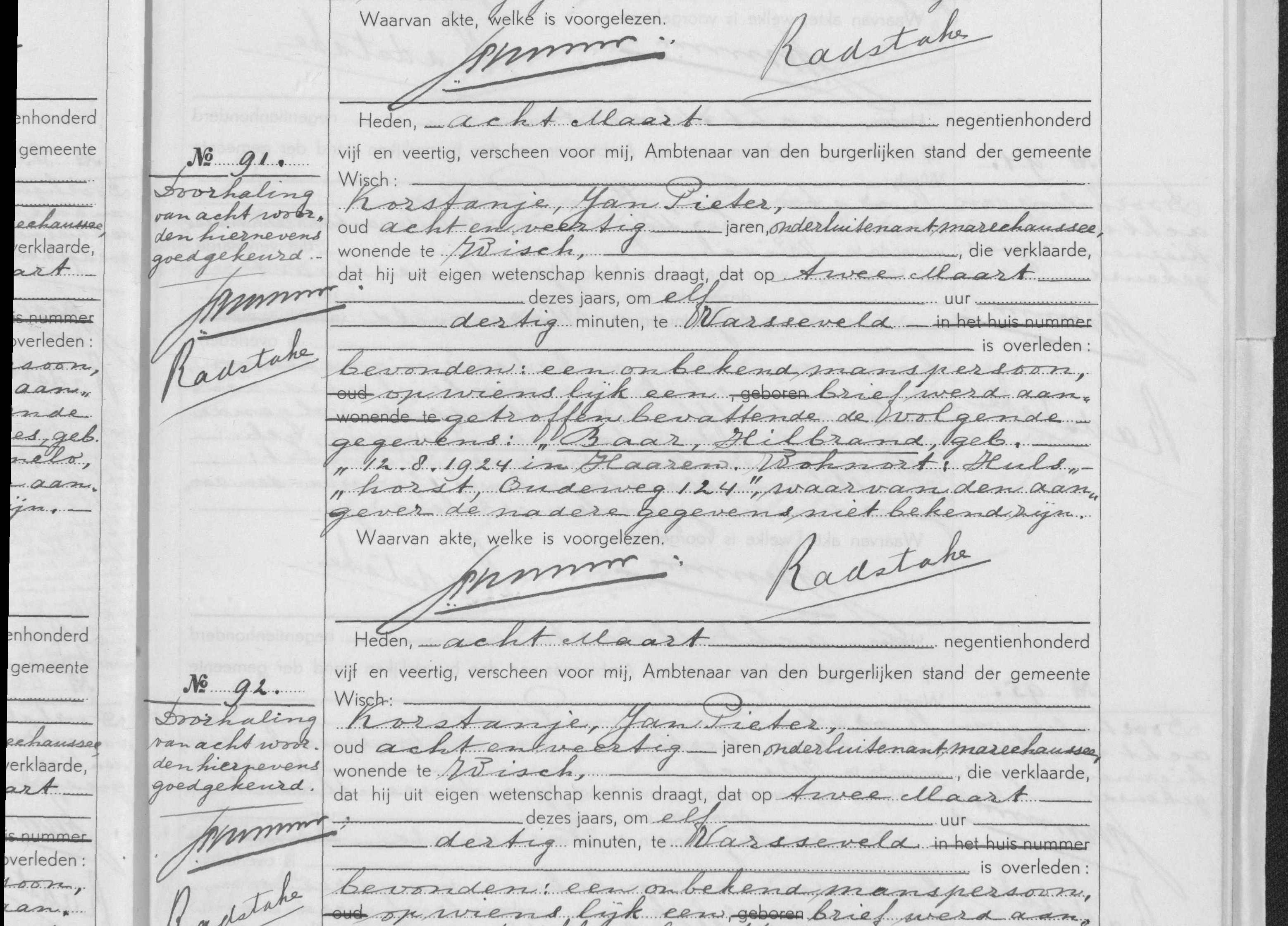
The Wisch register of deaths records it on a marechaussee officer's word: on 8 March 1945 Jan Pieter Korstanje, 48, a sub-lieutenant of the marechaussee, declared that on 2 March at 11.30 at Varsseveld there had died "bevonden: een onbekend manspersoon" (found: an unknown man) on whose body a letter was found with these details: "Baar, Hilbrand, geb. 12.8.1924 in Haaren. Wohnort: Hulshorst, Oudeweg 124" (deed no. 91, read on the scan). The deeds around it (of those archived here, nos. 90 and 92, on the same scan) record other unknown men found dead at Varsseveld at the same hour, each named from a letter on the body. Ermelo entered a copy in its own register on 30 April 1945: Baar, Hilbrand, twenty, born at Haaren, living at Nunspeet (Ermelo, Nunspeet office, deed no. 91).
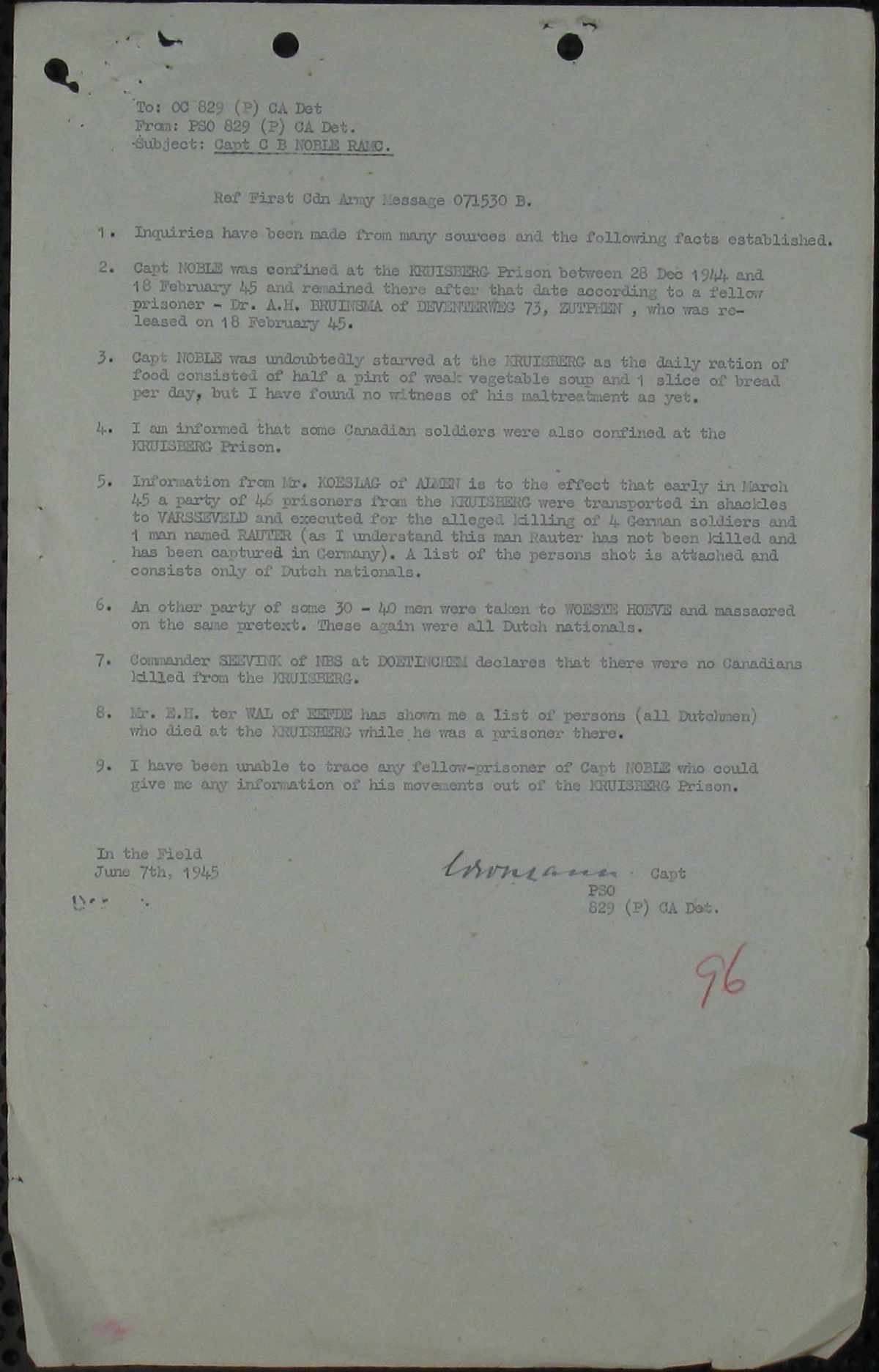
◐ A list made in 1945 names him among the 46. It reached the British with their enquiry into Charles Noble's treatment at the Kruisberg, as the enclosure to a report of 7 June 1945, headed "VARSSEVELD 2 Maart 1945" and listing those shot at Varsseveld, all prisoners from the Kruisberg at Doetinchem. His line reads "Hilbrand Haar, 2-8-24, Haren, Hulshorst" (the list). The typist wrote Haar for Baar and the 2nd for the 12th of August; his first name, birthplace, year and month of birth, home, prison, and the day and place of his death all agree with the war dead register (war dead register). The report gives what the British were told of the shooting:
Information from Mr. KOESLAG of ALMEN is to the effect that early in March 45 a party of 46 prisoners from the KRUISBERG were transported in shackles to VARSSEVELD and executed for the alleged killing of 4 German soldiers and 1 man named RAUTER (as I understand this man Rauter has not been killed and has been captured in Germany). A list of the persons shot is attached and consists only of Dutch nationals.
— PSO, 829 (P) CA Det · report on Capt C.B. Noble RAMC, para 5 · 7 June 1945 · the report
Burial at Nunspeet
Link to the section Burial at Nunspeet✓ He was buried at Nunspeet on Wednesday 9 May 1945. The Elburger courant of Tuesday 15 May reported that five Nunspeet men "die hun leven hebben gegeven voor het Vaderland" (who gave their lives for the Fatherland), H. J. Baar first, had been buried on the Wednesday amid great attention, and that Vierhout and Baar were buried from the Dutch Reformed church at 11.30, the coffins covered with the tricolour (Elburger courant, checked on the image). The burial register has "Begraven Nunspeet aan Eperweg - Oosterlaan, perk L - T" on 9 May 1945, with the remark "gefusilleerd te Varsseveld" (Open Archieven). The biography names others shot at the Rademakersbroek who were buried with him, Dionisius Dirk Bakker and a father and son named IJzerman, and says their graves and another local resistance man's form a monument (the page). The Foundation's grave check has him in the new general cemetery at Nunspeet, grave 374, class 1, a state grave never to be cleared, alone in it, an upright stone as part of a monument (the grave check).
The roll of honour and the War Graves Foundation
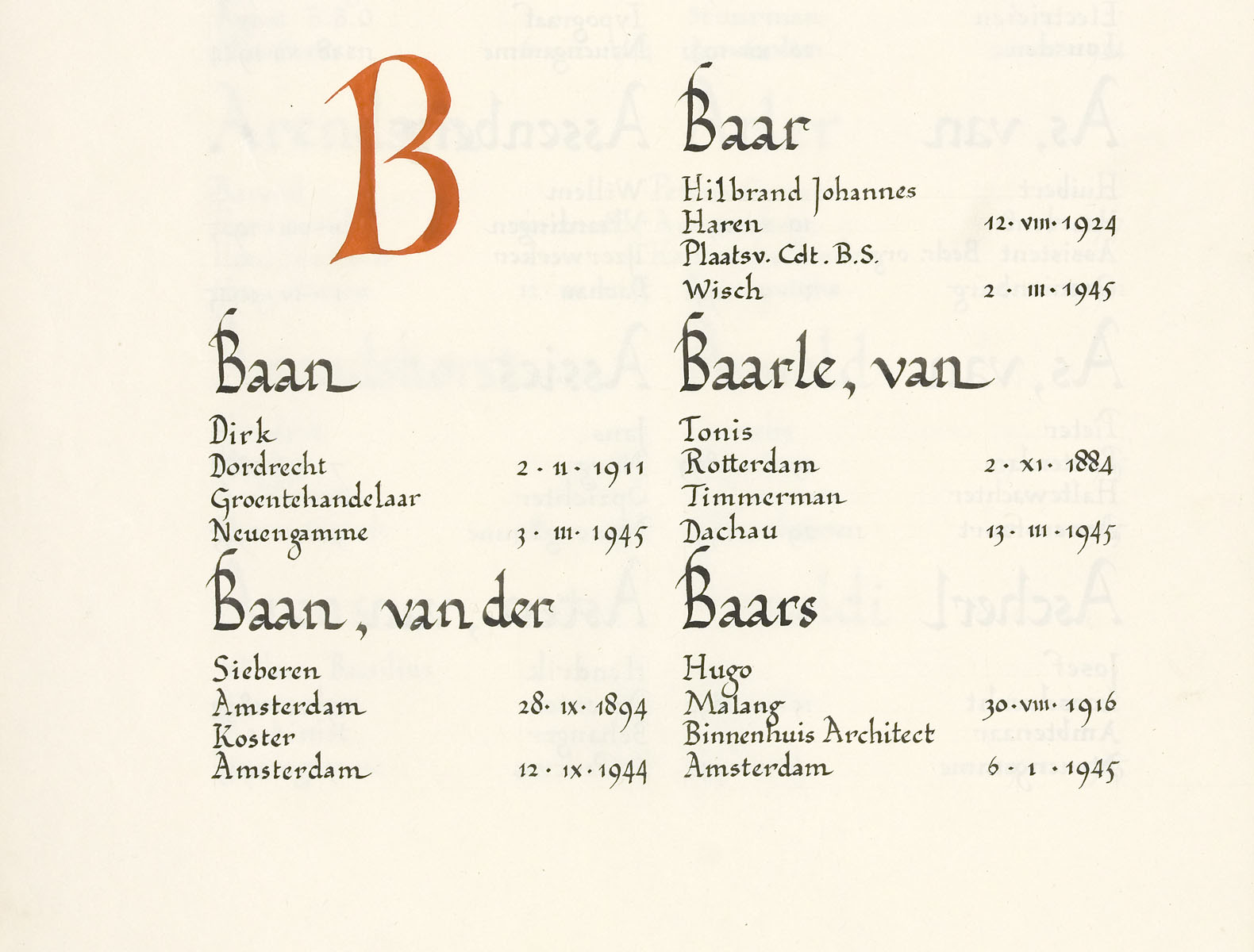
Link to the section The roll of honour and the War Graves FoundationOn page 408 of the Erelijst, the roll of honour kept by the Tweede Kamer, he is entered as "Baar / Hilbrand Johannes / Haren 12·VIII·1924 / Plaatsv. Cdt. B.S. / Wisch 2·III·1945" (the Erelijst, read on the page).
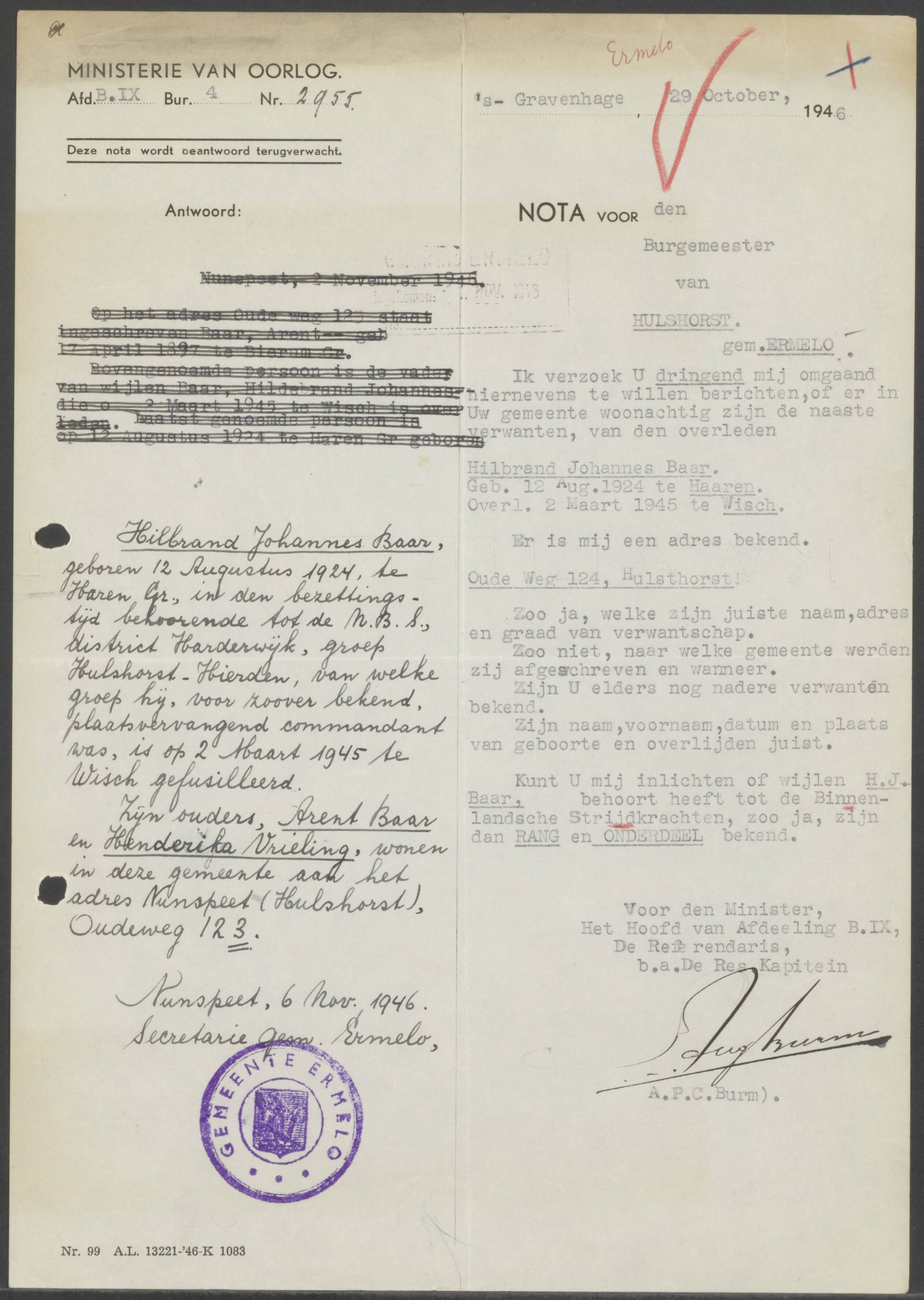
The War Graves Foundation's file, nine scans open at the Nationaal Archief, has no account of his arrest, a camp or the airmen in the seven scans transcribed (scan 1, the contents sheet, and scan 6, a reply about his family, are not) (the file). It holds:
- The Ministry of War's inquiry, 29 October 1946, which had his address as "Oude Weg 124, Hulsthorst", and Ermelo's answer of 6 November: during the occupation he belonged to the N.B.S., district Harderwijk, group Hulshorst-Hierden, of which he was, as far as was known, deputy commander, and he was shot at Wisch on 2 March 1945; his parents lived at Oudeweg 123 (scan 8).
- The Ministry's card: "Plaatsv. Cdt., B.S. Harderwijk", and the cause "Represaille. Gefusilleerd." (scan 9).
- A Foundation form: "Peletons Commandant" of the B.S. Hierden-Hulshorst, "gefusilleerd na arrestatie" (shot after arrest) (scan 4).
- The Ministry of Justice's stamp of 11 November 1953, signed for the Minister by the head of the Bureau Bijzondere Rechtspleging (scan 3), one sentence:
- "Uit de bij het Ministerie van Justitie ondergebrachte archieven blijkt niet" (from the archives held at the Ministry of Justice it does not appear),
- "dat betrokkene gedurende de bezettingstijd zich heeft schuldig gemaakt aan politieke handelingen of gedragingen" (that the person concerned, during the occupation, was guilty of political acts or conduct),
- "die geleid hebben tot het opleggen van enige straf of maatregel door organen der Bijzondere Rechtspleging" (that led to any penalty or measure being imposed by bodies of the Special Jurisdiction).
His file with the Allies
Link to the section His file with the AlliesA year to the day after his death, on 2 March 1946, A. Baar of Oudeweg 123, Hulshorst, filled in the Americans' questionnaire for him, "because "Bram" was shot owing to this work" (p. 5). It names his next of kin as Arent Baar, 48, and his rank as "pletoon Commander N.B.S." (p. 2). The claim on the back:
- Money: "does not want financial compensation." (p. 4).
- Bicycles: "For the collecting of food and clothes for the Allied Troops, his own and later on also his Father's bicycle was stolen by the Germans"; the claim asks for "ONLY ONE COMPLETE BICYCLE." (pp. 4–5).
- The house: "Due to his "underdiving" as a railway worker, everything was stolen by the Germans", and the house was later badly damaged by a bombardment of the railway line; "During the attakk [sic] at "Bram" the last things were taken away." (p. 4, read on the image). ◐ The railway worker is the father, the stationmaster.
- Witnesses: Joop Migchelsen, and "Emmy Vroege, Boreelstraat 2b, Rotterdam" (p. 5, read on the image).
The Americans graded him 5 ("Grade 5. Conf. 51. 16/5/46", on the file's cover, p. 1). The British index of Dutch helpers has "BAAR, Hilbrand J", Oudeweg 123, Hulshorst, Pb. Hierden, certificate 14476, grade "5(posthumous)" (the index, photograph b11, read on the image; What the British recorded afterwards).
Where the sources disagree
Link to the section Where the sources disagree- His birth day. 12 August 1924 in the war dead register, the burial register, the Foundation's forms and the printed Erelijst. Two copies have it wrong:
- 2-8-24 on the list of the 46 shot at Varsseveld, where the typist also wrote Haar for Baar (the list);
- 12-09-1924 in the erelijst.nl website's record, where its own page scan has 12·VIII·1924 (the Erelijst).
- ✓ 12 August: his death deed of 8 March 1945 copies "12.8.1924" from the letter found on his body (deed no. 91).
- When he was buried at Nunspeet. 9 May 1945 in the burial register, and 9 May without a year in the biography; 9-5-46 on the Foundation's questionnaire and grave check (Open Archieven; the grave check). ✓ 1945: the Elburger courant of Tuesday 15 May 1945 reports the five Nunspeet men, H. J. Baar first, buried "Woensdag", the Wednesday before, 9 May (Elburger courant, checked on the image). The Foundation's 1946 is a slip.
- His rank, given five ways:
- platoon commander: the Foundation's form (scan 4) and the American file, "pletoon Commander N.B.S." (p. 2);
- deputy commander: Ermelo in 1946, the Ministry's card and the Erelijst (scan 8; the Erelijst);
- "Groepscommandant", group commander, in the Oorlogsgravenstichting's record, and commander, instructor and the leader's right hand in its biography (the page);
- in charge of "the pilot camp in Hulshorst" (the American file), the "guard of the house" (Migchelsen, p. 2).
- ◐ Read together, they have him second to Migchelsen in the group, or in charge of the airmen's house.
- His movement. N.B.S. or B.S. on every Dutch paper and in Migchelsen's own words; "R.V.V. Hulshorst" on the American form filled in by A. Baar (p. 2).
- His house number on the Oudeweg. 123 in Ermelo's register, the Foundation's file, his American file and the British index; 121 in both of Migchelsen's lists (p. 2, p. 4); 124 in the letter found on his body (deed no. 91) and the Ministry of War's note of 1946 (scan 8).
- Who fetched Hardy and Haller. Hardy has the brothers JAN and EEVID hand them over in the woods to BRAM and JOOP, who took them to the house (Hardy); Haller has two lads fetch them from the farm, the one he forgot (Baar, by Noordman) and Adriaan de Kok (Noordman, p. 270); Migchelsen, in his statement of 14 June, says only "I met B. and C. wandering in the woods", B and C being Hardy and Haller (p. 3). ◐ Baar is in both Hardy's and Haller's.
- When the men left Kijkuit. Midnight on 6 November in Hardy's report (Hardy); "11th Nov. 1944 (midnight 1 o'clock)" in Migchelsen's statement of 14 June, "transported through the woods to Bos, Farm Staverden" (p. 3); the early morning of 7 November, when Dick Kragt picked them up, in Noordman (book, p. 281).
- Whose house Kijkuit was. The half lent for the underground work by a Mr van der Elst of Amsterdam, in Migchelsen's statement (above); "een boswachterswoning van de heer Jurriaanse" (a forester's house of Mr Jurriaanse) in Noordman (p. 303); ⚠︎ Noordman's source for it is not given.
- Why he was arrested. Weapon smuggling, in Migchelsen's statement of June (year not given) (p. 4); a trap set by the SD at the railway lines, in the later biography (the page).
- Why the 46 were shot. For "the alleged killing of 4 German soldiers and 1 man named RAUTER" in what the British were told in June 1945 (the report); for four German soldiers killed by the group De Bark, in the biography (the page).