Hein Schouten
Barneveld 29 Dec 1892 ◐ – Amersfoort 29 Jun 1965 ◐
About: The baker of Achterveld, Hendrik (Hein) Schouten, whom a 1970 article remembering Jacob Veerman names as the baker who "provides the rye bread for the paratrooper-liberators" (◐ the article does not say these were the men Jacob hid), and as the man Jacob stops to talk to in what it calls his last conversation, before he was taken. Murphy and James Hardy were hidden on that farm from about 25 November to 23 December 1944 (Hardy).
Unit or role: Baker and grocer at Achterveld, of a family of bakers there.
Where: His bakery and shop on the Hessenweg, Achterveld, built in 1923.
Evidence: ⚠︎ Leusder Krant, 2 April 1970, p. 8 (the bread); ◐ Jacob's daughter Alie, who gives the baker's surname only, in Oorlogsverhalen om nooit te vergeten (Achterveld, 2025), p. 83; ✓ the shop on the Hessenweg, opened in December 1923: its own opening advertisement, headed "1923" and signed H. Schouten, announces the opening for Saturday 15 December at 2 o'clock (15 December 1923 was a Saturday), reprinted in Leusden Toen, 22 March 2000, p. 5 (read on the image), and both Leusder Krant, 3 February 1981, p. 11, and Leusden Toen, p. 4, give 1923; ◐ its handover in 1958, which the same two papers give but which is the family's own business history told twice (one source, not two); ◐ the older history of the bakery, where the two disagree (below); ◐ his marriage and death in the civil registers (Open Archieven). Page numbers for the Leusden Toen issues are the archive's scan numbers: those scans are two-page spreads, and the printed pages are 388–389 (archive p. 4) and 390–391 (p. 5) for 22 March 2000, and 432–433 (archive p. 6) for 1 January 2001. The 1979 special edition's scans are single pages, given here by their printed page: the front page (archive p. 29) and p. 15 (archive p. 43).
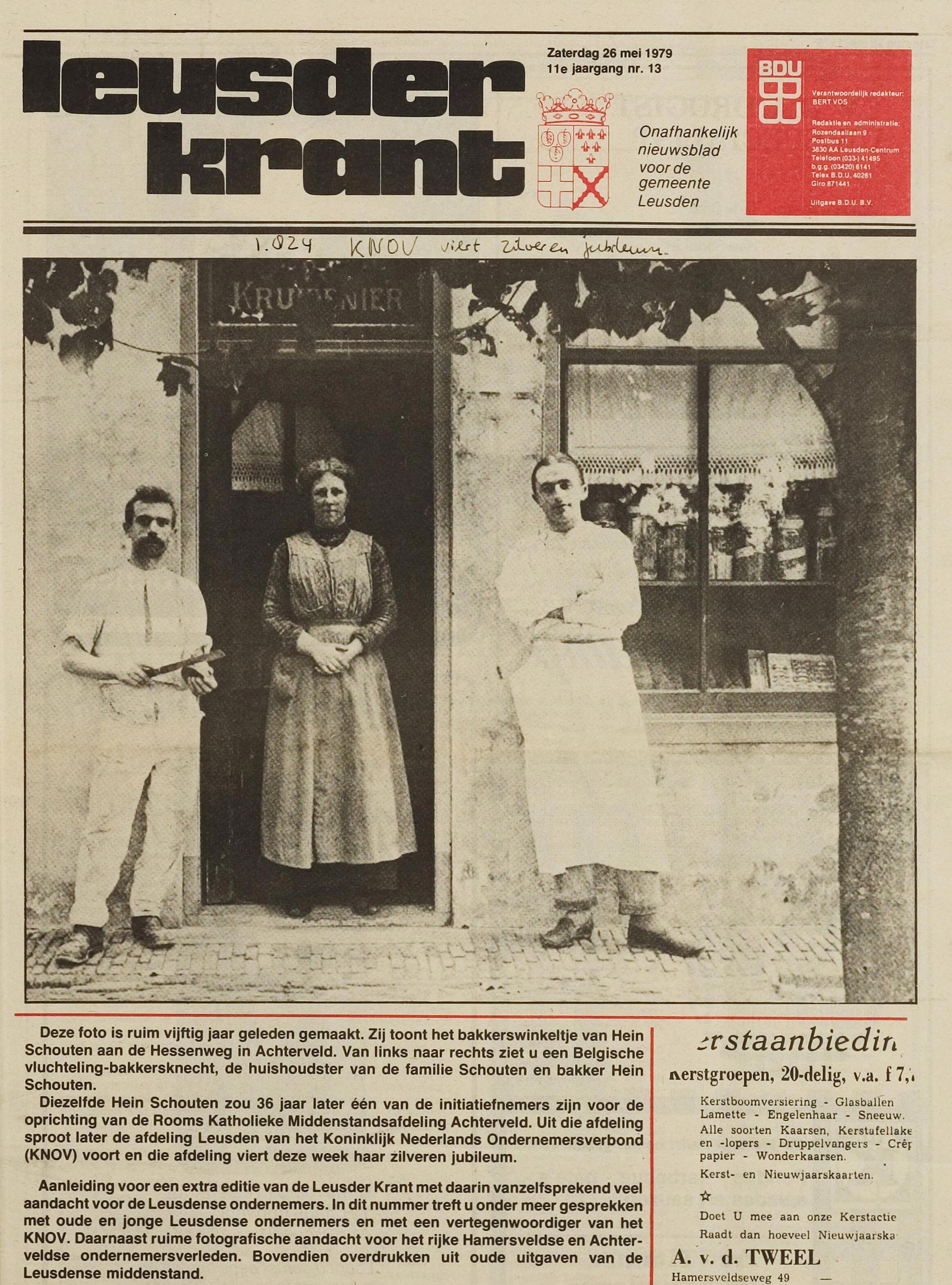
The bakery. The Leusder Krant, writing up the shop's reopening in 1981, gives its history: Helmus Schouten began baking bread on the Kerkdijk at Achterveld in 1860, with a flour trade, a grocery, a farm and a café beside it; "De jongste zoon Hein nam het bedrijf van de vader over en verplaatste de zaak naar de Hessenweg" (the youngest son, Hein, took the business over from his father and moved it to the Hessenweg). ◐ Helmus is very probably the Wilhelmus whom Leusden Toen and the civil registers give as Hein's father (below). The paper says the bakery of the baker Otterlo, next to Lammers's wagon works, was taken over, without saying by whom; ◐ Hein is taken to be the one, working there some years before he bought from Hendrik van de Koedijk a piece of land "ook gelegen aan de Hessenweg" (also on the Hessenweg). ✓ The shop was built there in 1923 (Leusder Krant, 3 February 1981, p. 11).
His son's account. In 2000 the Historische Kring Leusden's magazine told the bakery's story from his son Jan, the village historian (Leusden Toen, 22 March 2000, pp. 4–5, read on the image):
- The family's baking began with Hermanus Schouten, who came from Groenlo and settled on the Kerkdijk in 1845 as a tailor and baker; his son Wilhelmus carried it on, and then "Zoon Hendrik (de vader van zegsman Jan)" (his son Hendrik, the father of Jan, who tells the story) (p. 4).
- He was called "de zingende bakker" (the singing baker) for the voice that rang through the bakery and in church, where he was the parish choir's precentor. He bought pasture on the Hessenweg for a modern shop, his brother Herman, an architect, drew it, and it opened in December 1923 (p. 4).
- He and his wife, "Cilia Schouten-van Valkengoed", had ten children, who carried the faggots for the wood-fired oven; she ran the shop (p. 5).
- He bought his rye straight from a farmer at Garderen, for its drier grain, and had it ground at the cooperative in the village (p. 5).
- The round ran from Moorst in Woudenberg to the Kopermolenbrug by Amersfoort, and halfway to Barneveld, the hamlet of Den Aart and the mill at Terschuur, by dog cart and later by bicycle (p. 5).
◐ The civil registers have a Hendrik Schouten, son of Wilhelmus Schouten and Gerharda Boersen, aged 27 and born at Barneveld, marrying Helena Cicilia van Valkengoed, 25, at Stoutenburg on 6 May 1920; a prayer-card index gives his birth at Barneveld on 29 December 1892 (the marriage and the card). The records give no trade; they are tied to the baker by his name, his father's and his wife's, all three as Leusden Toen gives them.
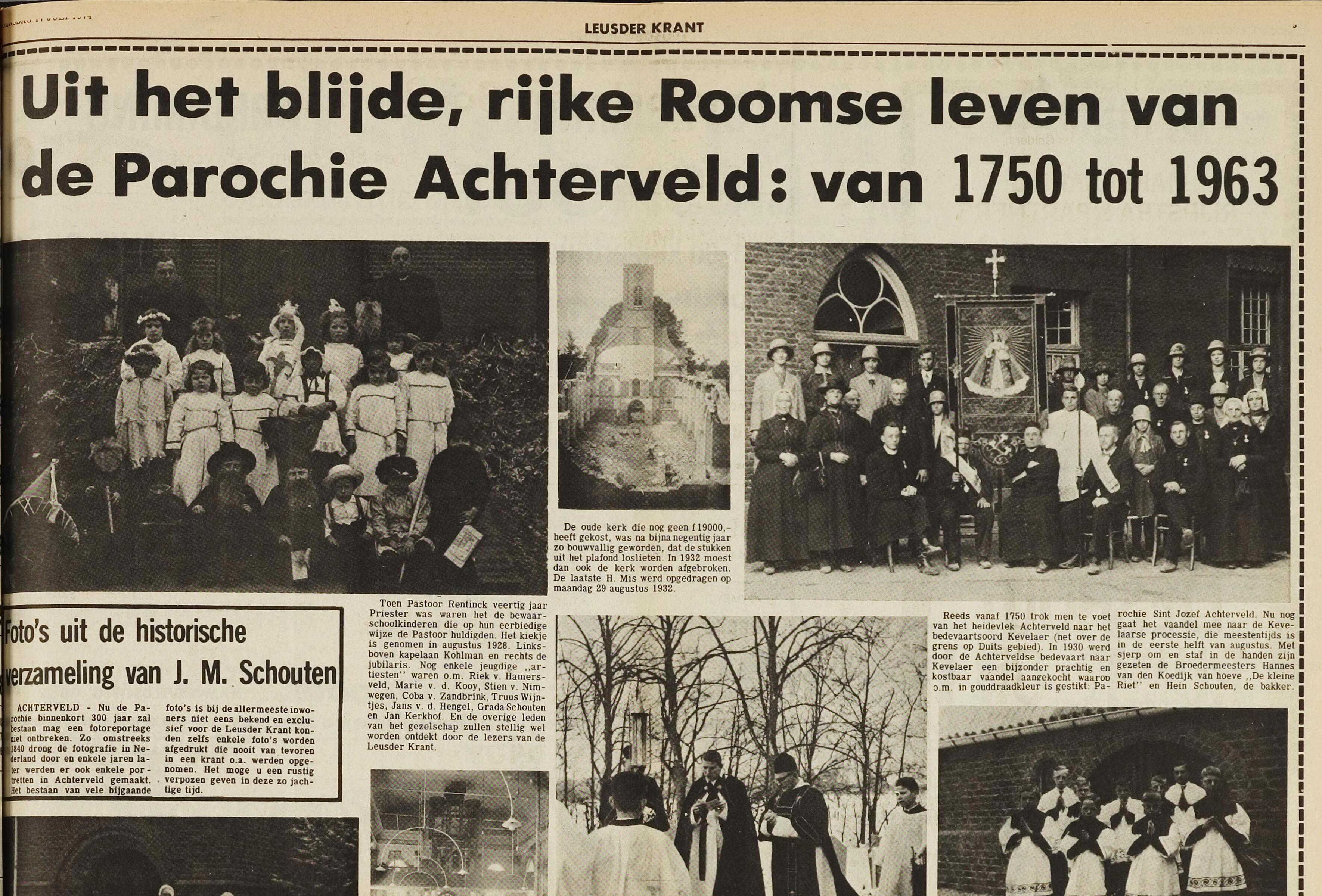
J. M. Schouten tells of three unmarried sisters who went to church at the Rudolphstichting and bought their bread from "de Roomse bakker Hein Schouten uit Achterveld" (the Roman Catholic baker Hein Schouten from Achterveld), and stood by him when their minister urged them to buy from one of their own faith (the Leusder Krant, 16 June 1977, p. 13). He was one of the two Broedermeesters (masters of the brotherhood) of Achterveld's pilgrimage to Kevelaar:
J. M. Schouten also wrote of an old man who went twice a week into the shop of the baker and grocer Hein Schouten ("de winkel binnen van de bakker-kruidenier Hein Schouten") for a twist of chewing tobacco. The man was Dirk van de Berg, "Dirk Dot", an inmate of the Sint Joseph home at Achterveld, who died on 1 May 1935, so the scene is before that date (Leusden Toen, 1 January 2001, p. 6, printed 433). ◐ He thanks the baker as "Heiltje" and says he knew the baker's "schoonmoeder Garrigje" well; Heiltje fits Helena, Hein's wife, and Garrigje fits Gerharda, his mother in the registers, which would tie the Hendrik of the registers to the baker, but it is our reading of two pet names.
With Murphy
Link to the section With MurphyMurphy and James Hardy were hidden on the Veerman farm, Klein Achterveld, from about 25 November to 23 December 1944 (Hardy has the 23rd, leaving at about 14:00 (Hardy); the family's table has 25 November for 30 days (005) and 25 November to 25 December (009)). No source names Murphy or Hardy with the baker. A Leusden paper, remembering Jacob in 1970, named the baker who provided the rye bread for the "paratrooper-liberators":
Jacob Veerman of "Klein Achterveld", a good man, managed to keep dozens of paratroopers out of the Germans' hands. He stops to talk for a moment with the baker Hein Schouten, who provides the rye bread for the paratrooper-liberators; it is his last conversation. The Grüne Polizei lie in wait for Jacob …
Dutch originalJacob Veerman van „Klein Achterveld" — een goed mens — heeft tientallen parachutisten uit handen van de Duitsers weten te houden. Hij praat nog even met bakker Hein Schouten die zorgt voor roggebrood voor de parachutisten-bevrijders, het is zijn laatste gesprek. De Grüne Polizei wacht Jacob op …
— Leusder Krant, 2 April 1970, p. 8 (Archief Eemland)
⚠︎ The article was written twenty-five years after the events, and its "dozens" stands against the family's own table, which lists eight Allied men helped in all (p. 9). It also has the prison ship bombed by an Allied aircraft, which the article ties to Jacob's death, "sink in the Elbe" ("het schip zinkt in de Elbe"), where Story 6 has the Cap Arcona sunk in the Bay of Lübeck. Nothing else held ties Hein to the men Jacob hid: Alie's "bakker Schouten" (below) is about flour for the hungry at the door. What speaks for it is that the writer says he carried bread himself in April 1945 (below); what speaks against it is that the claim comes from one article, written long after, by a probable relative. It gives no date for the conversation; the paper places it just before Jacob was taken, on 24 February 1945 by his family's form (24 January in Huurdeman's account, Jacob Veerman).
Who wrote it. The article, part of a series on Achterveld at the liberation, is signed "J. M. Sch." (the page, read on the image). ◐ That is very probably Jan M. Schouten, the Achterveld historian who published as J. M. Schouten (Leusder Krant, 16 June 1977, p. 13), and Leusden Toen makes the village historian, Jan, the son of Hein (22 March 2000, p. 4). If that holds, the claim that Hein provided the bread is a son writing about his father: one family source, not an independent one. The writer was in Achterveld in April 1945: "Ik moet een achtponder roggebrood brengen (lopend heen en terug 8 km) op „Dashorst" bij Dirk Moesbergen" (I have to take an eight-pound rye loaf, on foot, 8 km there and back, to Dirk Moesbergen at Dashorst) (the article).
◐ Very probably the same baker is in Alie Veerman's memory of the hungry people who came to the farm door, though she gives only the surname:
Mother would make up sandwiches and leave them ready in a bread tin, which was often empty before midday. But Schouten the baker had told father, "Jacob, your flour is running out", and then you'd be on that other bread. So father told mother that once the tin was empty she was to say no. Until he saw a family walking away with nothing, and quickly made up some bread after all and took it after them.
Dutch originalMoeder had dan brood gesmeerd en in een broodtrommel klaargezet, dat vaak al voor de middag op was. Maar bakker Schouten had tegen vader gezegd; Jacob je meel raakt op en dan kreeg je van dat ander brood. Vader zei dus tegen moeder dat als de trommel leeg was, ze nee moest zeggen. Totdat hij een gezin weg zag lopen, zonder eten en toch nog gauw wat brood smeerde en het achterna bracht.
— Alie Veerman, Jacob Veerman's daughter, in Oorlogsverhalen om nooit te vergeten (Achterveld, 2025), p. 83 · the booklet
He is not on the British index of Dutch helpers: looked for and not found (the index's notes).
On 20 June 1946, in the meeting room of the cooperative, the schoolmaster A. P. Kerstens and "bakker Hein Schouten" formed the Achterveld football club from what was left of an earlier club; several of his sons played in its first team (Leusder Krant, 1 April 1976, p. 13). He was one of the initiators of the Roman Catholic small-business section of Achterveld (Middenstandsafdeling), from which the Leusden branch of the Koninklijk Nederlands Ondernemersverbond (the royal Dutch federation of businesses) grew (Leusder Krant, 26 May 1979, front page; p. 15).
◐ He ran the bakery until 1958 and handed it to a son (the family's own account, in both papers), whose son ran the supermarket across the road in 2000 (Leusden Toen, 22 March 2000, p. 5; Leusder Krant, 3 February 1981, p. 11). ◐ Hendrik Schouten, husband of Helena Cicilia van Valkengoed, died at Amersfoort on 29 June 1965, aged 72; she died there on 18 September 1972 (the registers).
Where the sources disagree
Link to the section Where the sources disagree- When the family began baking.
- 1860, with Helmus Schouten, whom the paper makes Hein's father, on the Kerkdijk (Leusder Krant, 1981, p. 11).
- 1845, with Hermanus Schouten, Hein's grandfather, a tailor and baker, on the same road; his son is Wilhelmus, then Hendrik (Leusden Toen, 2000, p. 4).
- ◐ Helmus is very probably that Wilhelmus, since the registers give Hein's father as Wilhelmus (the registers). The two dates then need not conflict (1845 a tailor and baker settling, 1860 the year the 1981 paper has him begin baking), and both are retellings of the family's story.
- They agree that Hein took the business to the Hessenweg and that the shop there dates from 1923.
- How many men Jacob helped. "Dozens of paratroopers" (Leusder Krant, 1970), against eight Allied men in the family's table of 1946 (p. 9).