Amerongen and the last night
The Esveld family's house, the ferry over the Rhine, and the night march that ended in gunfire short of the lines.
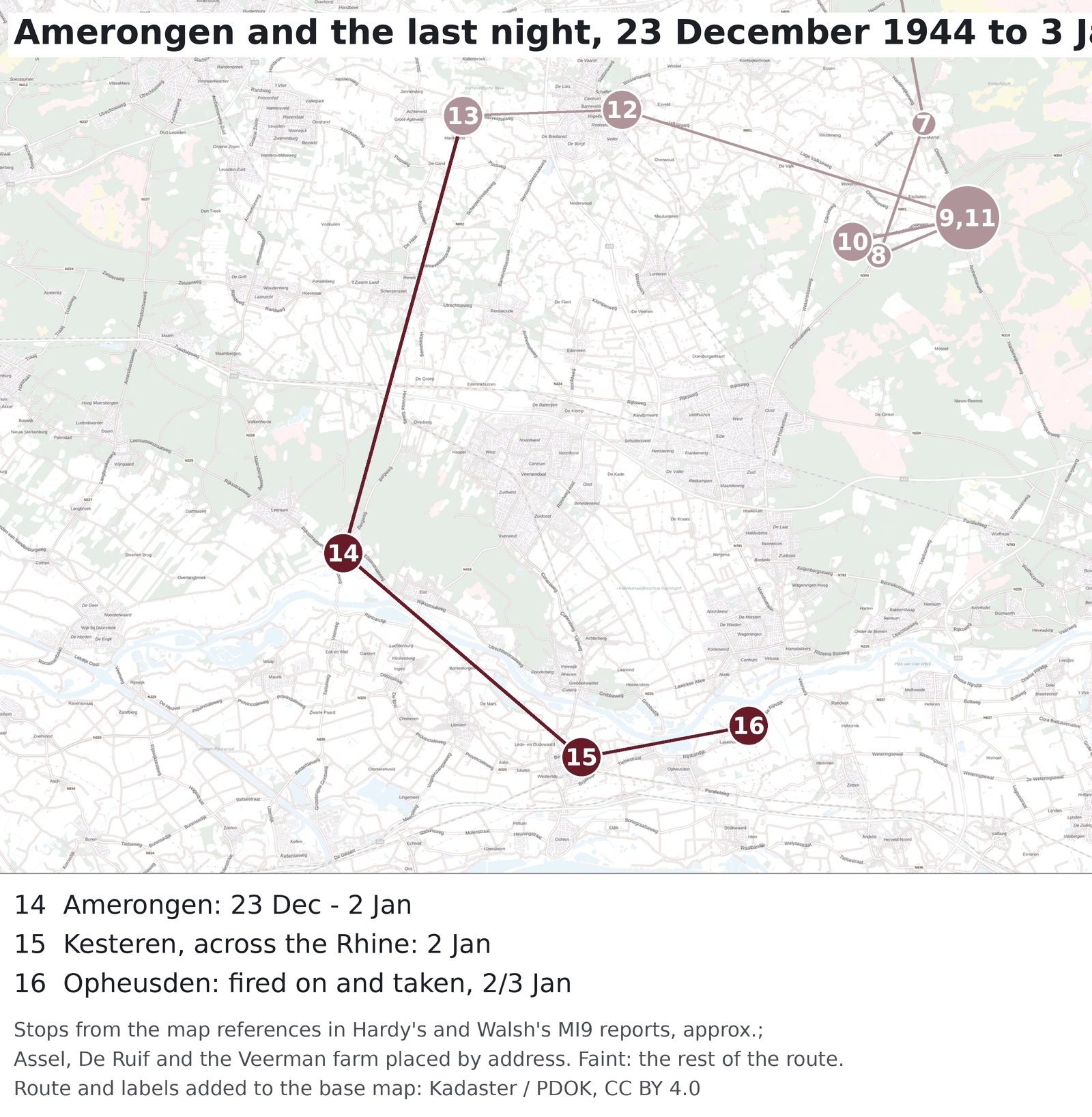
Amerongen: December 1944 to January 1945
Link to the section Amerongen: December 1944 to January 1945From Hardy:
- 23 December, c.1400: "Jan (3)" moved them on; bicycles at Ghys's house; rode with "Han" to Amerongen, arriving about 1630. Met Capt. V. R. Schjelderup MC (1st Bn The Canadian Scottish Regiment), CSM Berry, and another Canadian Scottish private.
- After dark, a young man took them to his father's house in Amerongen: "His father is a garage proprietor, named Gerald ESVELD, a married man" with two sons, "Koen" and "Beent", and a daughter.
Coen and Berend Esveld of Amerongen are documented on the Dutch side. Coen Esveld, with Chris Cornelisse, ran evaders across on the Amerongen–Eck en Wiel ferry, which operated throughout the occupation, three parties of six. One of Amerongen's three ferrymen warned Cornelisse when Germans were aboard. His brother Berend, resistance name "Flip", went on one run. On the third crossing two Germans boarded at the last moment and began eyeing the evaders' British boots — "de Nederlanders al sinds lang geen schoenen meer hadden kunnen kopen" (the Dutch had not been able to buy shoes for years); Coen said "Jij die en ik die" (you that one, me that one: one German each) and the two of them put the Germans over the side. That ended the ferry crossings (Geschiedenis Magazine). ◐ A snippet of Caspers's history of the resistance on the Utrechtse Heuvelrug (the book not read) has the rest: "Esveld had met zijn zoons Berend en Coen een garagebedrijf" (Esveld and his sons Berend and Coen ran a garage), which is Hardy's garage proprietor and his "Koen" and "Beent", the sons' names as the British recorded them, phonetically (Caspers, p. 64).
Murphy's crossing on 2 January went off without difficulty, so it was not that run.
Mrs Esveld's account
Link to the section Mrs Esveld's account✓ Mrs Esveld gave it to the Americans herself, on 28 May 1945:
Lt. Tom MERPHY, 6457, C Company, 156 Batt. Parachute Regt., A.P.O. England. MERPHY came down near ARNHEM on 17 Sep. He was wounded and was nursed in APELDOORN hospital. He escaped and was sheltered by farmers on the Veluwe, first at a little place near AMERSFOORT until 24 Dec, and then he was taken by Louis (Gerrit ESVELD) to Mrs. ESVELD. He stayed there until 2 Jan, and was then taken away by Louis and Kik for a crossing, which did not succeed.
James, or Jim, was working with the Red Cross. He also landed in ARNHEM and after a time in hospital at APELDOORN, was with Tom MERPHY all the time.
— US National Archives · RG 498, helper file of Mrs G.H. Esveld-Strubbe, Amerongen · answer to question 10, 28 May 1945 · the archive's copy
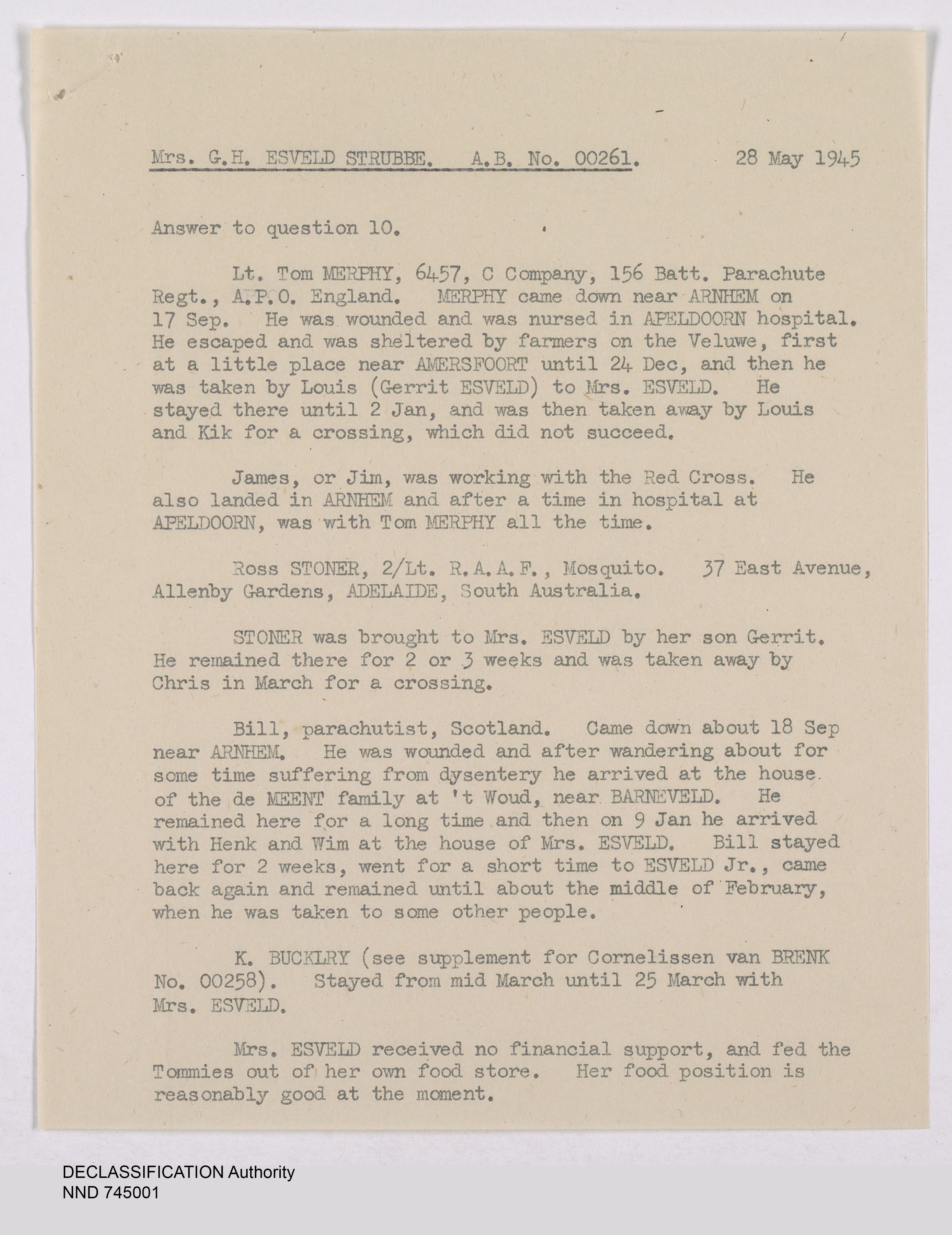
The slips are the interviewer's or her memory's: he was a private, "6457" is the end of 2756457, he dropped on the 18th, Hardy has the move to Amerongen on the 23rd, not the 24th, and "a little place near Amersfoort" is the Veerman farm. "Jim" is Hardy, of the Field Ambulance. ◐ "Louis" is her son Gerrit: her form gives two children, aged 35 and 25 (p. 3), the elder is Berend, "Flip", born 1910 (his file, p. 5), and a statement of July 1945 ties "Koen ESVELD" to her household's report number (Leendert Cornelisse, p. 6). ◐ So Hardy's "Koen" and the Coen of the Dutch histories are very probably the younger son, Gerrit Herman Esveld (born 1920; his page), under another name. "Kik" is Hardy's "KEEK": ✓ Freerk Stob Jr of the Overstraat, Amerongen, of the K.P. there, born 1924, whose statement for the Americans of 28 May 1945 says that "Tom MERPHY and James (Jim)" "were brought by Kik at the beginning of January to LIENDEN, to the stone quarry opposite RHENEN" (his statement, p. 4). Hardy's "and a daughter" is not in her form.
Gerrit did not survive the war. He had taken a "Captain" George Mikol to Maarn; Mikol came to Flip at the end of January, and after the middle of February "crossed with G.H. ESVELD, Wim and Henk from BARNEVELD. Since this nothing more has been heard of them" (Flip's file, p. 7). Hendrik van Loenen, who ran the crossings from that district, listed the four men he "Lost … by trying to discover opening in front" as "Wim and Henk van de Meent from Renswoude, Koen Esveld from Amerongen, George Andrews" (his statement, in the Cornelisse-van Brink file, p. 16). ◐ Flip's "Wim and Henk" are very probably the same pair, the brothers Wim and Henk van der Mheen of Lunteren, whose files with the Americans hold questionnaires made out for them (next of kin: their mother) that have van Loenen send them over the Rhine on 28 January (Henk's questionnaire, p. 13), and where Flip has G.H. Esveld, van Loenen has Koen: the strongest tie yet between the two names. ⚠︎ Van Loenen's fourth man, George Andrews, may be Flip's "Captain" George Mikol: one first name, two surnames. But the Dodewaard police report of 29 June 1945 has the brothers set out from Amerongen on 27 January with both "een Engelsch spion en een Amerikaan" (an English spy and an American), naming neither (the note), so they may be two men; not settled (George Andrews). In July 1945 Koen Esveld was "only recently … found dead in the neighbourhood of DOODEWAARD" (Leendert Cornelisse, p. 6), and in 1946 his brother wrote that he had fallen on a journey to the English lines, on a special mission (Flip's file, p. 11). ✓ The municipality of Dodewaard, answering the War Graves Foundation in 1953, has him and three companions found dead there on 29 June 1945 (⚠︎ which does not fit Henk, buried there as an unknown man at the end of January: his page), and leaving for the Betuwe "to carry an English message", probably on 27 January, three weeks before Flip's "after the middle of February"; Hendricus Derksen's form has him rowing a party of seven over the Rhine on 25 January (the letter; Derksen, p. 4). The family's own notice of 30 June 1945 has him fallen "eind Jan. 1945" (Het Parool, 3 July 1945). ⚠︎ Not settled between the end of January and Flip's "after the middle of February". Flip's is first-hand and was written in May 1945, before Coen's body was found; the end-of-January side is a family notice, an inquiry whose papers are not held, and entries derived from it, and the exact day is open (Coen's page). Flip's own list has "Jimmy and Tom, 2 Engl. paratroopers from Arnhem, both were in the big transport which failed near Wageningen" (◐ by our reading of the names Hardy and Murphy: Mrs Esveld has "Tom MERPHY" and "James, or Jim"), with "Charles, English Capt. Doctor" below them, and the typed note beside the group reads "Crossed them personally to English lines near Dodewaard, with a transport of 12 men"; pencil lines add Shelderup to it (p. 10). ◐ The failed transport is very probably Pegasus II. ⚠︎ Hardy and Mrs Esveld have Koen (Louis) and Keek (Kik) taking them to the ferry, so it is Flip's claim against theirs.
The Canadians' houses, from Porter's side. ⚠︎ Hardy does not name the house where he met Schjelderup, and which house it was is not settled (Mr and Mrs Cornelissen). Porter's party of seven Canadians reached Amerongen before Christmas, and his chapter 5 names where they were put: "Roger and I were taken into the house of Cornelissen … their sixteen year old teenage daughter could speak a little. Her name was Nellie", and of the others:
two of the other fellows were taken to the family Esveld and the three others to the family of Hoogland. Our hosts were farmers and had enough food put away to feed us
— Bob Porter, The Long Return, chapter 5 (Porter, pp. 136–137)

Her parents spoke no English; she spoke a little. Porter's "our hosts were farmers" comes after his mention of the Esvelds and Hooglands, so it may not cover the Cornelissens. Six of the seven were escapers like Murphy, soldiers who had cut their way out of a prisoner train as it left Utrecht on 23 October, five of them taken at the Leopold Canal in Belgium on the 7th; Porter, an airman, had been working with the underground for six months since parachuting from his plane (Two Came Back!, pp. 1–4; Before Amerongen).
Christmas 1944
Link to the section Christmas 1944On Christmas Day, in the house where Berry and Briere stayed, they had "a Christmas tree for the little girl who lived in the house. Wilf, who was the Sergeant Major, had a Sten gun wrapped up under the tree" (p. 138). Then, between Christmas and New Year's Eve:
We met a couple of British paratroopers from the Arnhem airborne drop. They were also getting fed up and were very anxious to get back … We met an English Private, a Sergeant and a Captain, (who was also a Medical Doctor Paratrooper,) who were also going to go with us
— Bob Porter, The Long Return, p. 139
◐ He names none of them, but the party that set out on 2 January had exactly one doctor captain (Noble), one British sergeant (Banwell) and two British privates (Hardy and Murphy), so these are men of that party, seen a week before. ◐ The captain is very probably Noble. ⚠︎ Which private is not certain (Hardy was English and Murphy a Scot, though a Canadian may not have told them apart), nor whether the sergeant was Banwell, though he is the likeliest, nor whether the "couple of British paratroopers" are the same men or two more. Two of the Canadians were put with "the family Esveld", perhaps Murphy's own hosts; the British helper index gives the Esvelds and the Cornelissens different streets (What the British recorded afterwards). The Cornelissens of Porter's book are the household of Chris Cornelisse, the ferryman, at Rijnstraat 472: his wife's own account for the Americans has Porter "at Chris and Mam's till 3 Jan, when he was taken to OPHEUSDEN by Chris" (Mr and Mrs Cornelissen).
Kessel crossed the Rhine from the same village too, and his account of that night is the only description found of what the crossing meant in that winter: a manure boat "moored fast in the ice of a pond, a good half-mile from the Rhine", the guides smashing the ice with the oars, and the boat dragged over frozen furrows to the river (Kessel, pp. 187–188). Murphy's party had the ferry, and ten cents. ◐ The book gives no date for the night. By our reading it belongs to the failed January attempt that Hackett's report calls "abortive … at TIEL", not to the February crossing: after it the party cycled on to a farm where Jan Stam should have met them and found no one, and Hackett found Kessel back at Maarn by 30 January (Lipmann Kessel). Noordman has two January starts from Maarn, on 12 and 18 January, both ending in failure at the river, and the book's own account does not clearly match either.
Kragt's report has a different night: "I guided Col. Warrack and Capt. Lipman-Kessel out over that line", the line being the Sliedrecht route he set up with Brigadier Hackett a few days after his own departure with Fabian's party was called off (Kragt's report). ◐ On our reading of the dates that is the February run from Maarn to Sliedrecht and the Biesbosch, not the manure-boat night at Amerongen, so the two accounts need not collide; which January attempt the manure boat was is not settled. Nothing in it bears on Murphy, who was gone by then; it is a warning about the rest.
Murphy names the family himself, in his memoir and without prompting, the only Dutch household he names apart from the Veermans (Jacob and Jopie) and Van Nispen. Before that, on the same page, he tells of the RAF drops:
I helped with small arms and ammo, dropped by the RAF. We were ordered to lie doggo, by the Officer i/c of paras in hiding, as any action meant reprisals to Dutch people. To conclude, I stayed with the Esveldt family in Amerongen, near the Rhine. I put on overalls over my uniform, supplied by the family, got over the Rhine by ferry, but ran into a Jerry patrol, and was lucky not to get shot, as there were a few Jerry corpses lying about, after a night raid by British troops
— Tom Murphy, his memoir, p. 12 (the page)
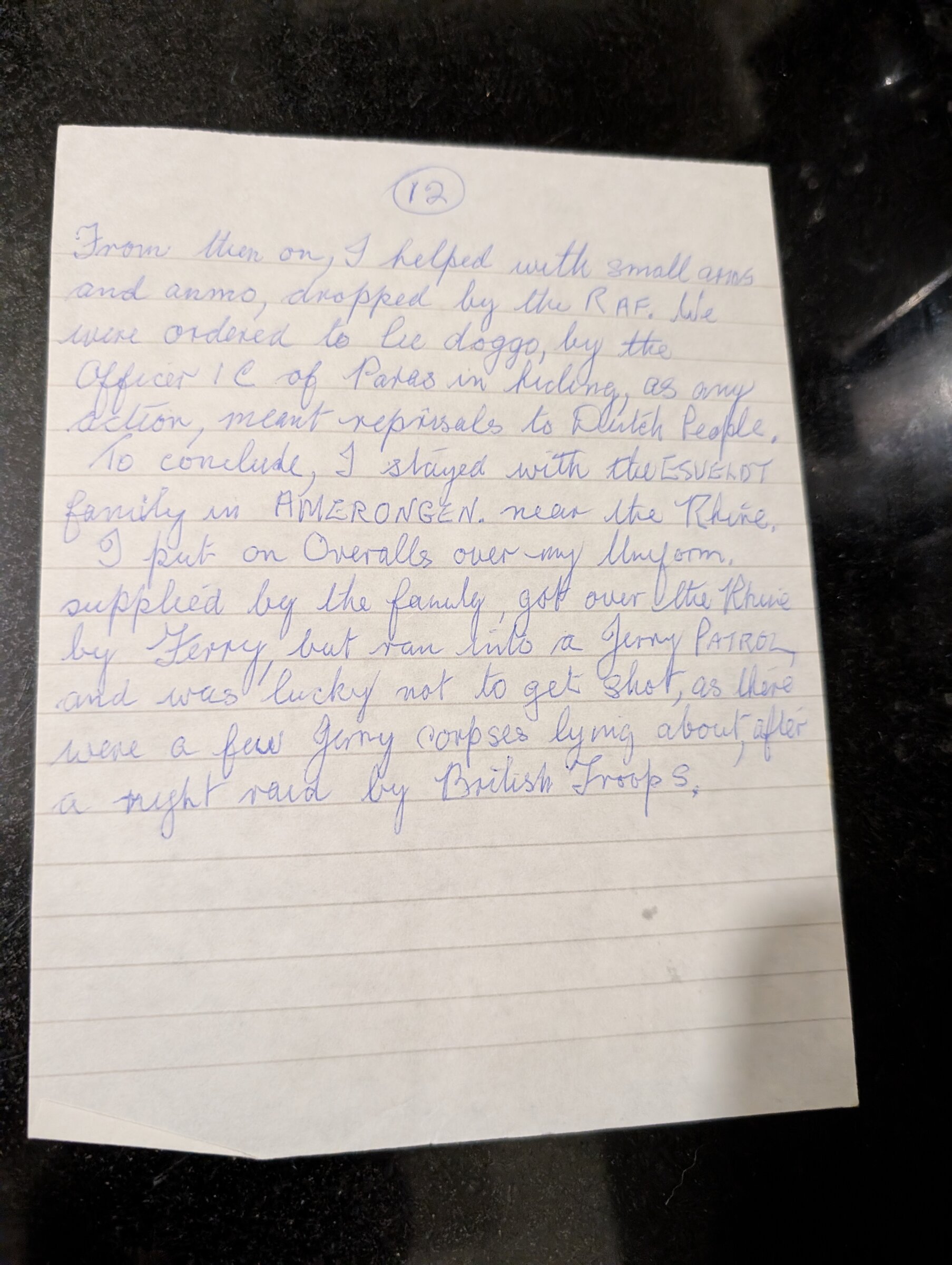
✓ Surname, town, the overalls and the ferry all match Hardy's report, written before Murphy was home.
The crossing and recapture: 2/3 January 1945
Link to the section The crossing and recapture: 2/3 January 1945From Hardy and the Schjelderup extract on the same page. ◐ The whole of Schjelderup's MI9 report, of which the Pegasus Archive prints the crossing, is Kew WO 208/3351/2349, 1 February 1945; it is held here as a transcript shared by Lisan Koppenol, the original not seen:
- 1300, 2 Jan: left by bicycle with Koen and "Keek" for the ferry. Civilian suits lent by Koen, uniforms in bags strapped to the cycles. Crossed without difficulty. Schjelderup: "We crossed the RHINE by ferry … by paying 10 cents."
- Cycled to Kesteren; met Banwell again, Sgt Gri, and Canadian Scottish men. Joined by seven more evaders.
- 1830: "11 Allied personnel, DERRICK, and 2 other Dutchmen" set off on foot across the frozen, flooded Betuwe; "11 Allied personnel" in the commanding officer's words, though his list runs to twelve entries, one of them an unnamed Polish soldier.
Schjelderup's nominal list runs: Schjelderup, CSM W. Berry, Sgt A. Gri MM, Sgt R. E. Porter RCAF, Pte H. Swartz, Pte M. Brierre, Pte L. F. Trainor, a Polish soldier, Pte Hardy, Pte T. Murphy, 156 Para Bn, Capt. Noble (133 Fd Amb), Sgt K. Banwell (10 Bn).
- c.2100: encountered a German patrol; the party froze until it passed, then pushed on. Later, on a road, fired on at very close range with automatic weapons; the party scattered. "We lost, and never saw again, one Dutchman and the following three men: Capt. NOBLE, Sgt. TEX (?) [Banwell], Pte. MURPHY." CSM Berry badly wounded in the left elbow.
- Fired on again from three mutually supporting positions with Bren guns and British mortar flares, captured Allied kit, the likely reason Murphy believed he was approaching Canadians.
-
Only Schjelderup, Gri and Hardy reached a British forward post of the Recce Regiment, 49th Division, near Dodewaard. Hardy was awarded the Military Medal, partly for this night. The recommendation, approved in June 1945, tells how he went back onto the ice for the men who had scattered and could not find them. By Schjelderup's report those were the men who panicked at the second position; Murphy, Noble and Banwell had been lost earlier, at the first (Hardy, Schjelderup's report):
A Canadian officer has praised HARDY's conduct during the final crossing of German lines at the beginning of Jan.45. He went out alone under fire on to the ice covering the flooded countryside to bring back members of the party who had dispersed when the enemy were encountered. He failed to find them. A wide canal had still to be crossed; HARDY swam to the other side and, although owing to the overhanging ice he had difficulty in climbing on to the further bank, he finally did so and secured a wire, enabling the two remaining members of the party to follow without being swept away by the current. They met a British unit the same afternoon, near DODEWAARD.
— Recommendation for the Military Medal, 1556339 Pte. J. Hardy · The National Archives, WO 373/64/316 · the citation, p. 2
✓ The Canadian Scottish regimental history tells the same crossing from the regiment's war diary. On 2 January:
in broad daylight, and in parties of two's and three's, six Canadians and four British paratroops crossed the Rhine by ferry. They paid ten cents for the trip and some German soldiers helped to push the ferry from the dock
— R. H. Roy, Ready for the Fray, the Canadian Scottish regimental history · pp. 372–373, citing "W.D., 1 C Scot R. January, 1945, Appx. 23, 'Two Came Back'" · Roy
The party "kept on splitting up until, on the eve of their return to Allied lines, Schjelderup's group consisted of himself, Gri and Pte. 'Scotty' Hardy, a British paratrooper", who reached "the 41st Reconnaissance Squadron of the British 49th Division on the afternoon of January 5" (Roy, the same pages). The four British paratroops are Hardy, Murphy, Banwell and Noble. ✓ The 49th Division's own situation report for 5 January has "One offr and two OR evaders crossed from enemy territory to A Sqn 49 Recce Regt about 1700 hrs" (7th Canadian Infantry Brigade battle log, 6 January 1945, checked on the image), which agrees with Roy and with Schjelderup's own count of the days.
The appendix Roy worked from survives, and it is on line: "Two Came Back!", nine typed pages stamped TOP SECRET, written up for the battalion's war diary by its diarist, Pte R.F. Bradley, from what Schjelderup and Gri told him on their return (the regiment's copy, UVic; Library and Archives Canada). The January diary is signed off "Diarist: R.F. Bradley", and the next appendix is "as narrated by Lieut. E.W. Schneider to Pte R.F. Bradley" (Library and Archives Canada, RG24-C-3, vol. 15040, item 927730). It names none of the three paratroopers who were lost, but it gives the moment they were:
Three of these led the group of ten along the south bank of the Rhine after dusk. No Germans were met for 4½ hours until, at 2300 hours, an enemy patrol was sighted. The guides had no knowledge of fieldcraft so panicked without a shot being fired. … At about midnight the party approached a concealed German fort. They came quite close before the enemy opened fire with Schmeizers and rifles. Again the party was made smaller. All who were left were Capt Schjelderup, CSM Berry, Sgt Gri, Ptes Briere and Swartz of the Canadian Scottish; Pte Trainer of the Essex Scottish; Sgt "Bob" Porter, RCAF, and Pte Hardy of the 1st British Airborne Bn.
— Pte R.F. Bradley, "Two Came Back!", from what Schjelderup and Gri told him; war diary, 1st Bn The Canadian Scottish Regiment, January 1945, Appendix 23, p. 6 (the scan)
So of the four paratroopers who crossed that afternoon, Murphy, Banwell and Noble were gone by about midnight on 2/3 January, either when the guides scattered, panicking at the patrol, or under the fire from the German post, which is Hardy's account (above) in other words. The Canadian clock is two hours later than Hardy's "c.2100". The same pages have the evaders' Dutch cover, the one the Sunday Post gave Murphy: "Those who could not speak any Dutch claimed to be Deaf and Dumb" (p. 5).
✓ Where Hardy came from: both. He was born at Hamilton on 19 November 1913, the Hamilton of "Two Came Back!", as ScotlandsPeople's staff told Lisan Koppenol (the register entry not seen), and was living near Banbury in 1945 by his own report (his page).
Capt. Charles Noble's report (Noble, written 23 September 1945) is the third account of the night, from a man who was caught. He was told on 2 January that he "and 12 escapees were being taken through the line that night", a "joint British-Underground enterprise" with a British patrol to meet them; crossed by the Amerongen ferry at 4 p.m. "in civilian clothes over uniform"; assembled at "a farm house or brick factory building about 300 yards West of the RHENEN bridge"; the party included "one or two German deserters and Poles and 2 Dutchmen"; a German patrol passed and the second-stage guide was lost; at about 11 p.m. they reached "the brick factory on the river bank opposite WAGENINGEN"; a mile south, on the main east–west road, "at about 20 yards range a machine-gun opened up, after a challenge. The party scattered and we rolled off the road down the dyke." Noble hid in a hollow tree, was challenged by a sentry, answered "Heil Hitler" to bluff him, ran, and was surrounded in a flooded field under flares: "I made 3 attempts to reach the Southern end, but the Germans gradually closed in and I found myself inside a ring of Germans without any cover … I surrendered." He adds that a British patrol did come out to the bridge before dawn on the 3rd, and "One of the prisoners taken on it later told me that 8 were killed and 3 captured". ⚠︎ That patrol and its losses are Noble's hearsay from another prisoner; not yet checked against 49th Division records. His questionnaire says he was captured "with 8 people".
Noble told the night again long after the war, in his own later account of his whole war (unpublished private papers, shared with us privately). It is late memory: ◐ where a 1945 record agrees, ⚠︎ where it stands alone.
- ◐ The ferry. "Disguised as farm labourers", the party was "taken over uneventfully by the Germans to whom we paid a small amount of money", as in Schjelderup's "10 cents", and in the German soldiers who helped push the ferry in Roy (above).
- ◐ The march. "About eight to nine miles through the polders", past German "Achtung Minen" signs, on ground the Dutch thought frozen hard enough not to set the mines off, which is his report's "frozen ground rendered the minefields innocuous". The distances differ: his report has "a circuitous course mainly Eastwards for about 3 miles" to the brick factory opposite Wageningen, where the account has "eight to nine miles" of polders and, at the dyke house, "possibly after going east ten miles".
- ⚠︎ Who was to meet them. "we were to be met by fifteen Canadians. A platoon was coming from the Canadian line", where his report of 1945 has a British patrol.
- ⚠︎ The second guide. A V1 "malfunctioned, dropped near us and killed our second guide plus a cow". His report has that guide "lost" in the confusion when a German patrol passed, and Schjelderup's has the party lose "the Dutchman who was the guide for the latter phase" there; neither has anyone killed, and Noordman has the missing guide return later (Albert van Hattem). Coen Esveld, ◐ one of the guides that night (above), was killed by a V-1 explosion beyond the German lines on a later attempt, at the end of January (Coen's page).
- ⚠︎ Before the firing. East along the dyke road they came to a deserted dyke house "full of loose Canadian ammunition. We interpreted this, wrongly as it turned out, to mean it was held by the Canadians and at that point we lit cigarettes and started shouting". Going on east, "a German voice yelled at us to halt and opened fire with a machine gun, a dug-in machine gun about forty yards away"; they rolled off the dyke and "none in the group was nick-nailed" [sic].
- His report has the guide insist on the road and the machine gun open up "at about 20 yards range … after a challenge", with no house and no shouting, and one man wounded, Berry. Schjelderup's has captured Allied kit at the second position (above).
- ◐ His own capture, as in his report: the hollow tree for about an hour, the sentry and the "Heil Hitler", the flares over a flooded field, and a ring of Germans at the end. ⚠︎ Only the account has the paddock "frozen" and "about ten all around me" at the last flare. What followed is on Captivity.
The Canadians' own reports
Link to the section The Canadians' own reports✓ Three of the Canadians' own MI9 reports name Murphy in the party. Two of them, Swartz's and Briere's, were photographed at Kew by the late John Howes, who passed the photographs to Lisan Koppenol, and she sent them on in October 2026. The third, Schjelderup's, which lists "Pte. MURPHY, T." and says that "one Dutchman" and "Capt. NOBLE, Sgt. TEX (?) [BANWELL], Pte. MURPHY" were lost in the firing and never seen again, is held as a transcript only, the Kew original not seen (Schjelderup's report). Pte Harvey Swartz, interviewed in September 1945, crossed by the ferry with Trainor and two Dutch escorts and went along a dyke road to a barn:
Here we were rejoined by Sgt. TRY, Sgt. BANWELL, Pte. MURPHY and another Canadian Airborne soldier. Later we were joined by Capt. SHELDROP, Sgt. PORTER, Capt. NOBLE, R.A.M.C., and some Dutch Underground.
— Pte H. Swartz, Canadian Scottish, on Murphy · MI9 liberation report, Appendix C · 1945 · the photograph
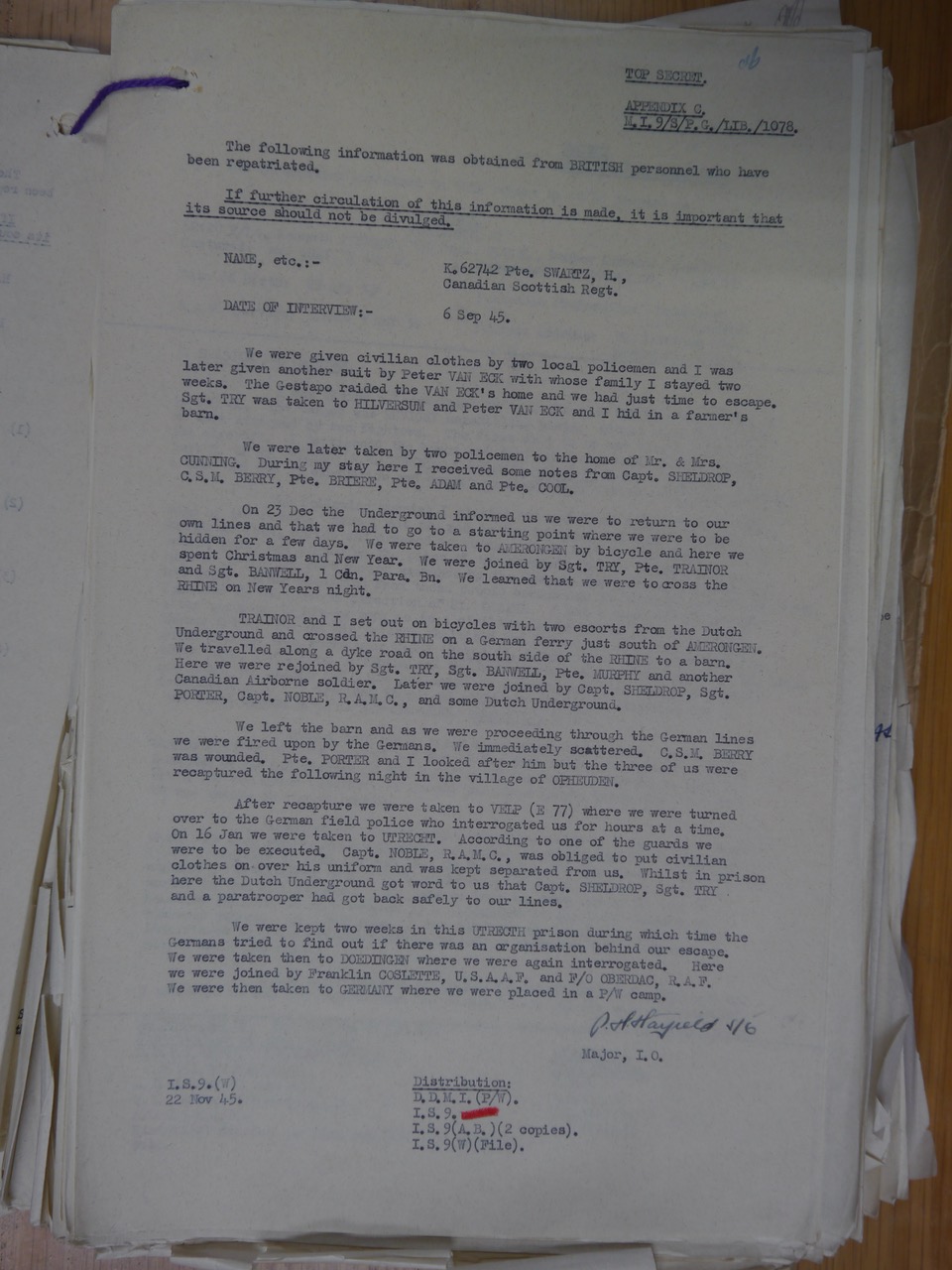
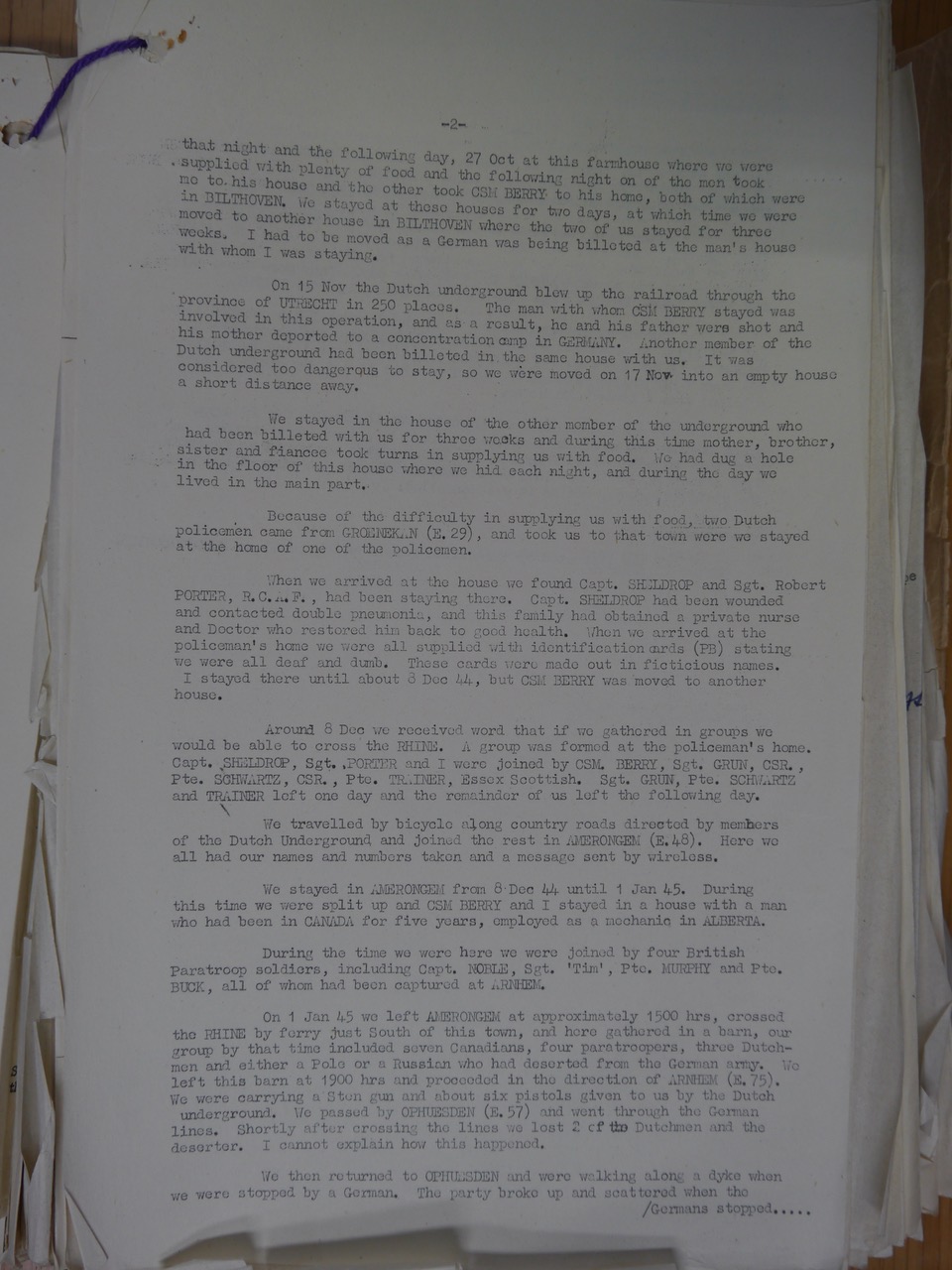
Try is Gri. Swartz puts Banwell in "1 Cdn. Para. Bn.", where he was in the British 10th Battalion. Pte Marcel Briere, interviewed in June 1945, has four British paratroopers joining them at Amerongen, "Capt. NOBLE, Sgt. 'Tim', Pte. MURPHY and Pte. BUCK, all of whom had been captured at ARNHEM" (p. 2). ◐ "Tim" is very probably Banwell, Schjelderup's "TEX (?)", and Buck very probably Hardy: Briere has Buck getting through with Schjelderup and "Sgt. GRUN", where every other source has Hardy (p. 3). Briere dates the crossing 1 January; everyone else has the 2nd.
The Dutch guides
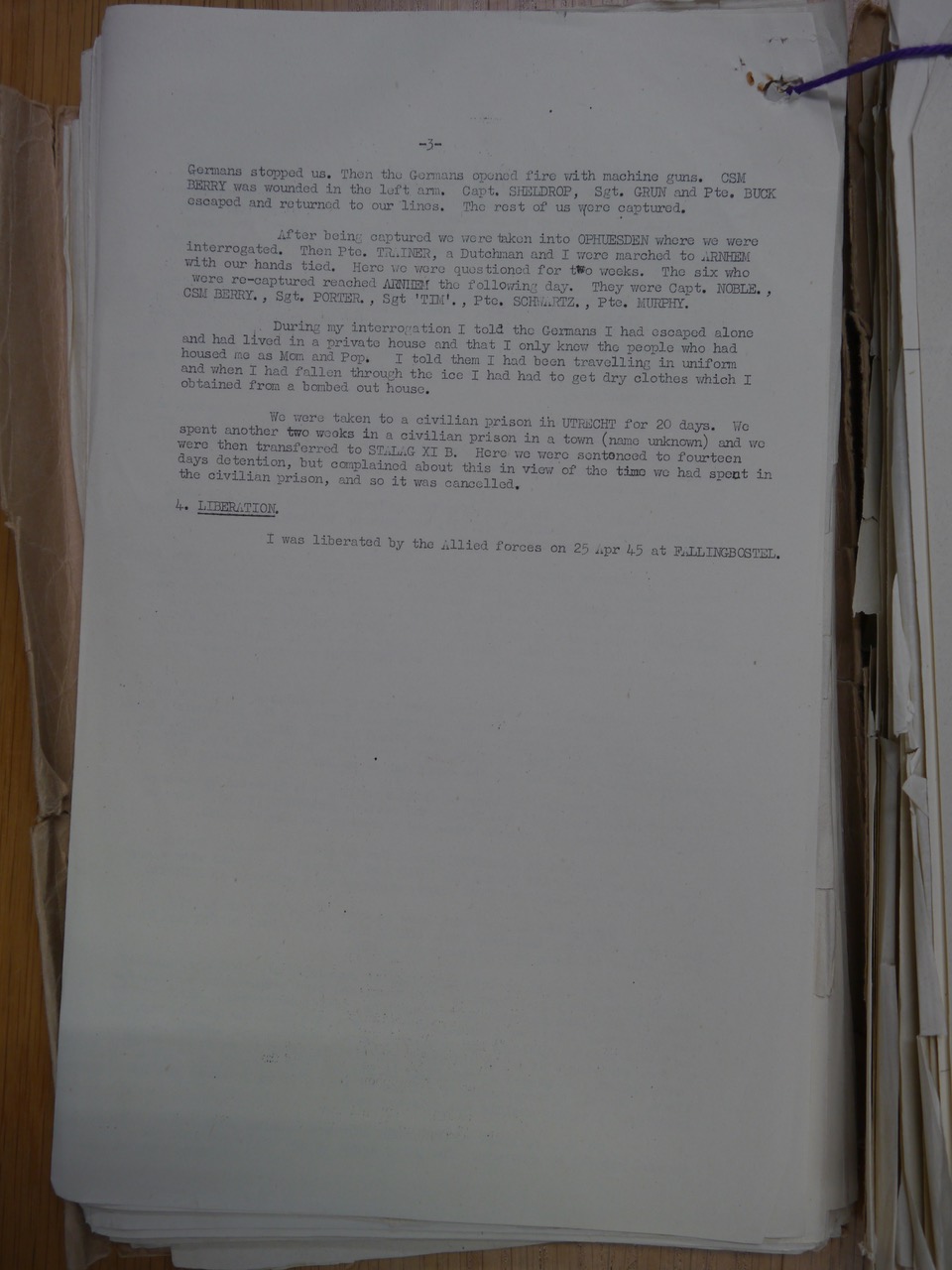
Link to the section The Dutch guides◐ A snippet of Caspers (the book not read) names the Dutchmen who took the party out: "Coen Esveld, Dirk Maljers en nog twee gidsen, in totaal negentien personen, op pad" (Coen Esveld, Dirk Maljers and two more guides, nineteen people in all, set out). Nineteen is Porter's count, "making nineteen of us" (p. 143); Schjelderup counted three Dutchmen. So the Esveld son who had lent Tom his suit and taken him to the ferry went on with the party as a guide. Maljers went because his Ausweis, with his photograph, had fallen into German hands in a raid on a barber's shop, and he was now a wanted man himself. Coen was not taken with Maljers: he appears again carrying a drawing of German defences, sewn into the lining of his coat, towards the Allied lines (Caspers, pp. 175, 177), and, ◐ if he is the G.H. Esveld his brother has crossing again after the middle of February (Flip's file, p. 7), on the "special mission" on which he fell (Amerongen); the municipality of Dodewaard puts that last journey about 27 January and calls its purpose carrying an English message (Coen's page). ◐ Elsa Caspers's English memoir has the end: on 29 January 1945 "Coen made one more attempt to find an escape route", with two Dutch boys and a South African soldier, and their bodies were found in June, killed by a V-1 explosion beyond the German lines; ⚠︎ her 29 January is two days after Dodewaard's 27 January (Caspers, To Save a Life, p. 66; Coen's page, where it is set against Flip's date).
The Dutch side has the same night, told from the guide. Adriaan Maljers (his real name; "Dirk" was the name the evaders, and Caspers, knew him by, his page) was a policeman from Zeeland who led a resistance group around Langbroek and had months of experience guiding Allied soldiers through the occupied country. A Betuwe local-history page on him, the resistance man who led the party, gives a reconnaissance on 1 January that reported the route passable and the Allied line thought to be near Opheusden, the Rhine crossed "in small groups of two at a time", assembly at the brickworks at Lienden, and a Dutch guide who vanished mid-route "together with a Pole in hiding", leaving the party in mined, flooded country it did not know. Then:
The group managed to get to about two kilometres north of Opheusden. There it was decided to go up onto the dyke. Suddenly fire was opened from close range … The Germans used flares to light up the ground.
Dutch originalDe groep wist ongeveer twee kilometer ten noorden van Opheusden te komen. Daar werd besloten de dijk op te gaan. Plotseling werd vanaf korte afstand het vuur geopend … De Duitsers gebruikten lichtkogels om het terrein te verlichten.
It names the British paratroopers who lost their comrades in the chaos:
Among those paratroopers were Thomas Murphy of the 156th Parachute Battalion, Captain Charles B. Noble of the 133rd Parachute Field Ambulance and Sergeant Keith D. Banwell of the 10th Parachute Battalion.
Dutch originalOnder die parachutisten bevonden zich Thomas Murphy van het 156th Parachute Battalion, Captain Charles B. Noble van de 133rd Parachute Field Ambulance en Sergeant Keith D. Banwell van het 10th Parachute Battalion.
⚠︎ The page says its names come "uit Canadese en Britse bronnen" (from Canadian and British sources), so this is the MI9 reports read back into Dutch, not an independent record of him.
What is independent is Maljers's own story: captured near Opheusden station, "samen met enkele geallieerden naar Velp gebracht" (taken to Velp with some of the Allied men), interrogated and tortured there, and then:
After about three weeks Maljers was taken, together with seven Allied servicemen, to the Wolvenplein prison in Utrecht … The group was later taken to De Kruisberg in Doetinchem.
Dutch originalNa ongeveer drie weken werd Maljers samen met zeven geallieerde militairen naar de gevangenis Wolvenplein in Utrecht gebracht … De groep werd later naar De Kruisberg in Doetinchem gebracht.
That is Noble's route, Recapture, interrogation, captivity, though not quite his dates: he was moved from Velp after about two weeks, about 18 January. ⚠︎ His own later account has "approximately three weeks" of questioning before Utrecht, the figure the Betuwe-West page gives for Maljers; Maljers's own record of service has four weeks at Velp (his page).
Maljers "was taken to Velp with some of the Allied men" and interrogated under torture there; Velp was where the SD held its prisoners, in the seized Rotterdamsche Bank on the Hoofdstraat, from November 1944 to April 1945, and a plaque on the building remembers those who died in it (4 en 5 mei). De Kruisberg at Doetinchem was an SD prison that held resistance people and Allied servicemen; the Germans in the end treated the Allied men as prisoners of war, and Maljers as a resistance man under sentence of death (Maljers). Noble is on the Doetinchem memorial foundation's list of Allied prisoners of De Kruisberg (Doetinchem Herdenkt).
Maljers's own statement
Link to the section Maljers's own statement✓ Maljers wrote the night down himself in December 1945, for the Americans, and it tells the night as the local-history page above does (reconnaissance, two at a time, the brickworks, the guide who vanished), though in the English of his statement the guide is himself "a hidden Pole", where his Dutch original has the guide gone "met een ondergedoken Pool" (with a Pole in hiding, p. 20). What it adds comes before: a raid on his headquarters at Langbroek on 30 December, in which Piet de Springer was killed (Jan de Bloois, an agent dropped from England; Heaps has the 29th, his page); the plan made at Amerongen "to cross the gang of soldiers, consisting of 14 men, through the Betuwe to Doodenwaard"; and "I went away last with Cornelisse, Captain Scheldrop and Phorter". Then:
It was a beautiful night to make a trip like that with 14 soldiers and 3 Dutchmen. It was perfectly dark and misty at the same time, so it could not be better. … When we had walked as far as about two kms. above Opheusden, we decided to go up the dyke. Whe had been climbing the dyke a bit when we were suddenly fired at. We fled into the grounds.
— Adriaan Maljers, statement of 3 December 1945, p. 2 (his file, p. 16)
After the firing Maljers went on across the flooded land "with five Canadians among whom was Captain Scheldrop". His list at the end of the statement names "Major Scheldrop, B.Phorter, Harry Zwarchz" (p. 18). He does not name Murphy. The other Dutchman he names, "the other underground-worker Berry", ◐ Berry Melis of Tilburg, told the Americans about the attempt. His file has it in the third person:
tried to pass the German lines near Opheusden together with 11 Canadians on 2th January 1945. The expedition was a failure 3 men came through but the others were scattered. M. himself swam across the Rijn
— US National Archives · RG 498, helper file of B.J.H. Melis, Tilburg · p. 3 · his file
How many set out
Link to the section How many set out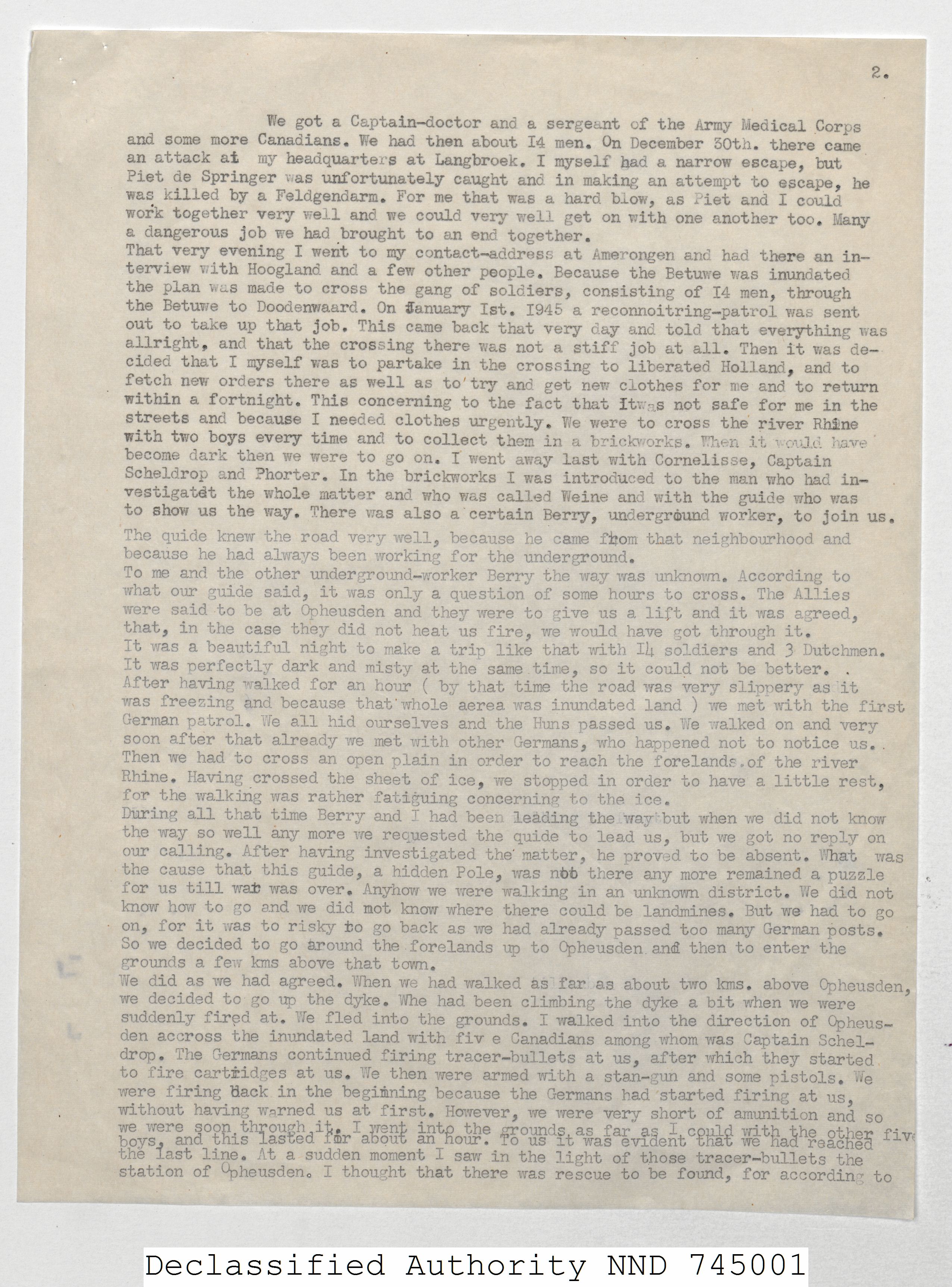
⚠︎ The two guides' counts, Maljers's 14 soldiers and 3 Dutchmen and Melis's 11 Canadians, agree neither with each other nor with Porter's and Caspers's nineteen, which Fowler's 1996 article on Schjelderup repeats ("the group totalled 19", Fowler). Gri, asked by the RCAF about Porter in February 1945, gave a fifth, thirteen, and Schjelderup said where he last saw them. Four more are held: Berry's "about 15" and "There were 15 of us at the time" (p. 2); Briere's "seven Canadians, four paratroopers, three Dutchmen and either a Pole or a Russian", which makes fifteen (p. 2); "13 Canadians and 1 Dutchman" on van Wijnen's form (p. 3); and, of the ferry crossing, "six Canadians and four British paratroops" in Roy (pp. 372–373, extract). Not reconciled.
Captain Schjelderup states: "On the night of 2nd/3rd January 1945, F/Sgt. Porter, myself and others set out to cross through the lines to freed Holland. The party was badly shot up, and on the second shooting, F/Sgt. Porter and others panicked. I last saw them crashing out across the ice in a badly flooded area under fire from three German machine gun posts. I never saw them again."
Sgt. Gri stated: "At approximately 23:30 hours on 2nd January 1945, I was one of 13 people making their way back to the British lines between the Maas and the Rhine Rivers. We were fired on, and all took cover. With the exception of myself and two others in the party, the remainder moved off, and we were unable to locate them after that."
— RCAF Overseas HQ to Ottawa · 24 February 1945, on F/Sgt R. E. Porter · reproduced in Porter, The Long Return, p. 168 · the page
Porter's account
Link to the section Porter's account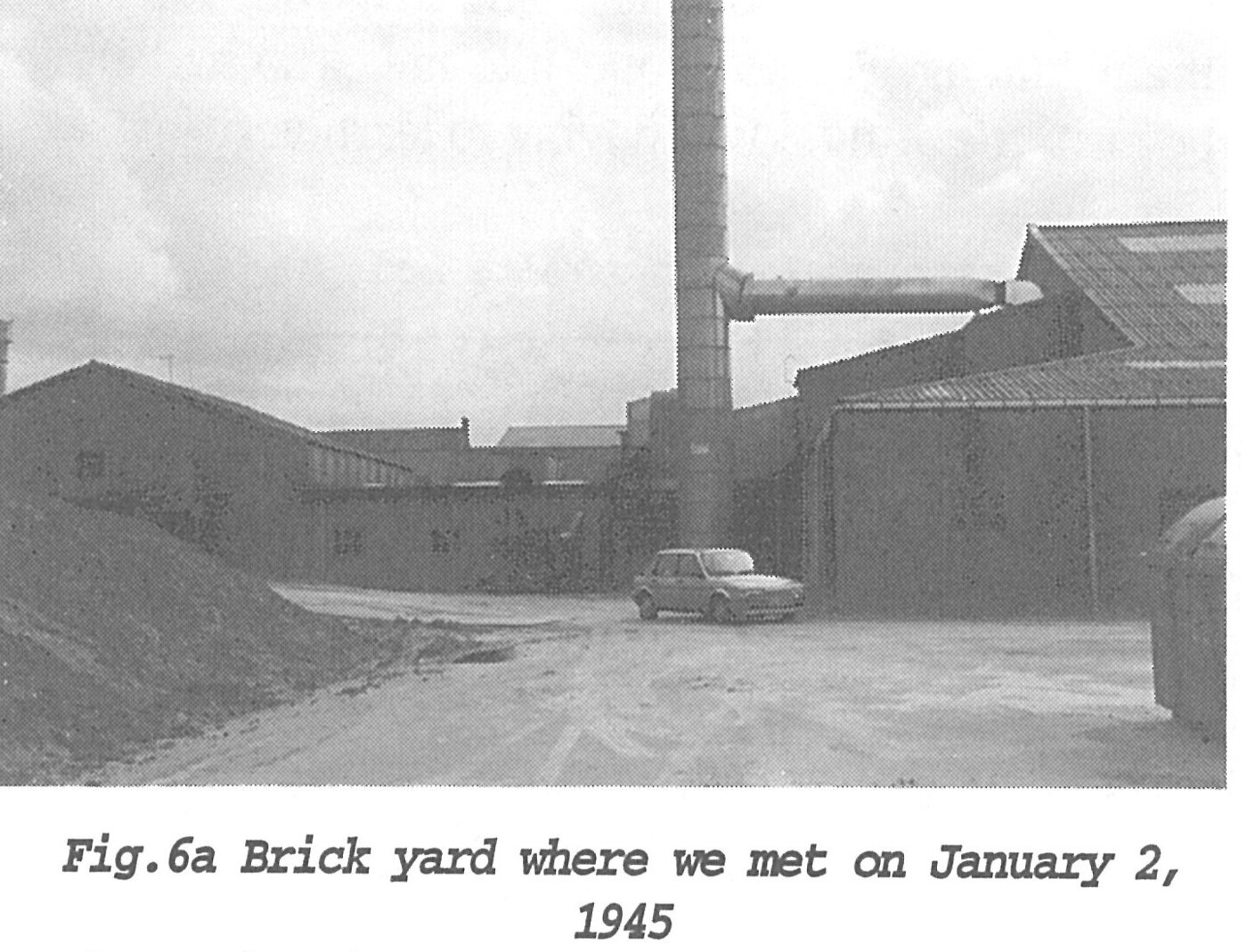
A fourth account, from the Canadian airman in the party. F/Sgt Bob Porter, RCAF, published The Long Return in 1997; the chapters are online as scans and the passages that bear on this site are transcribed with page numbers in the archive (Porter). At the brickworks on the evening of 2 January: "There were seven of us plus the three paratroopers. Later another five plus our guides came along, making nineteen of us. No one introduced anyone" (pp. 142–143). The three paratroopers with the Utrecht party of seven are Hardy, Murphy and Banwell. The guide was "Dirk" (p. 143), which is Schjelderup's "DERRICK". A cyclist saw them on the road, "suddenly there was a shout and machine gun fire" (p. 145); Porter ran with CSM Berry, who "had been shot in the arm" (p. 146); they hid in a fruit shed and were taken on 3 January by Wehrmacht troops, who gave Porter wooden shoes and soup, before "the Field Army Police (Feld-Gendarmerie) soon took over" (p. 149); Berry had left his Sten gun in the shed, and the Germans found it (p. 148). His letter to his mother of 15 May 1945, printed in the same book, tells it four months after: he ran with Berry and Schjelderup, lost his shoes on the ice, and hid with Berry, "a bullet in his arm", in "a little shack until daylight", then headed off what they found was "almost an island" and into the German lines; "We wore civilian clothes, and had a sten gun, with us. The Germans took a very dim view of this and we knew they could have legally shot us" (p. 223), and "we were taken to Dodewaard and then to Felp" (p. 224) (chapter 11; Porter's page). ⚠︎ The two differ on a fruit shed or a shack, and on Schjelderup, whose own report has him with Gri and Hardy.
⚠︎ Porter's "we learned that four or five of our group had been killed" (p. 148) does not say from whom. The men's own reports name one man wounded, Berry, and no death: Noble's has "Only one person was wounded", and Berry's "Nobody was killed during the first attack", which says nothing of the second (Noble; Berry, p. 2; Schjelderup). Against them, the Air Ministry wrote to Porter's wife on 10 March 1945 that "two members of the party were killed" (p. 171), and the RCAF to his mother on 10 May that "two other Royal Canadian Air Force personnel who were believed to be with your son" had been reported dead by the Germans through the Red Cross (p. 211); neither names them (chapter 7; chapter 11). A Dutch helper, Adrianus van Wijnen of Kesteren, wrote on his form of October 1945 that "several people were killed" (p. 3; Berry Melis). Noble's "8 killed" belongs to the British patrol the next morning, not the party. ⚠︎ His own later account has one death that night, the second guide, by a V1, and no one hit at the dyke (above).
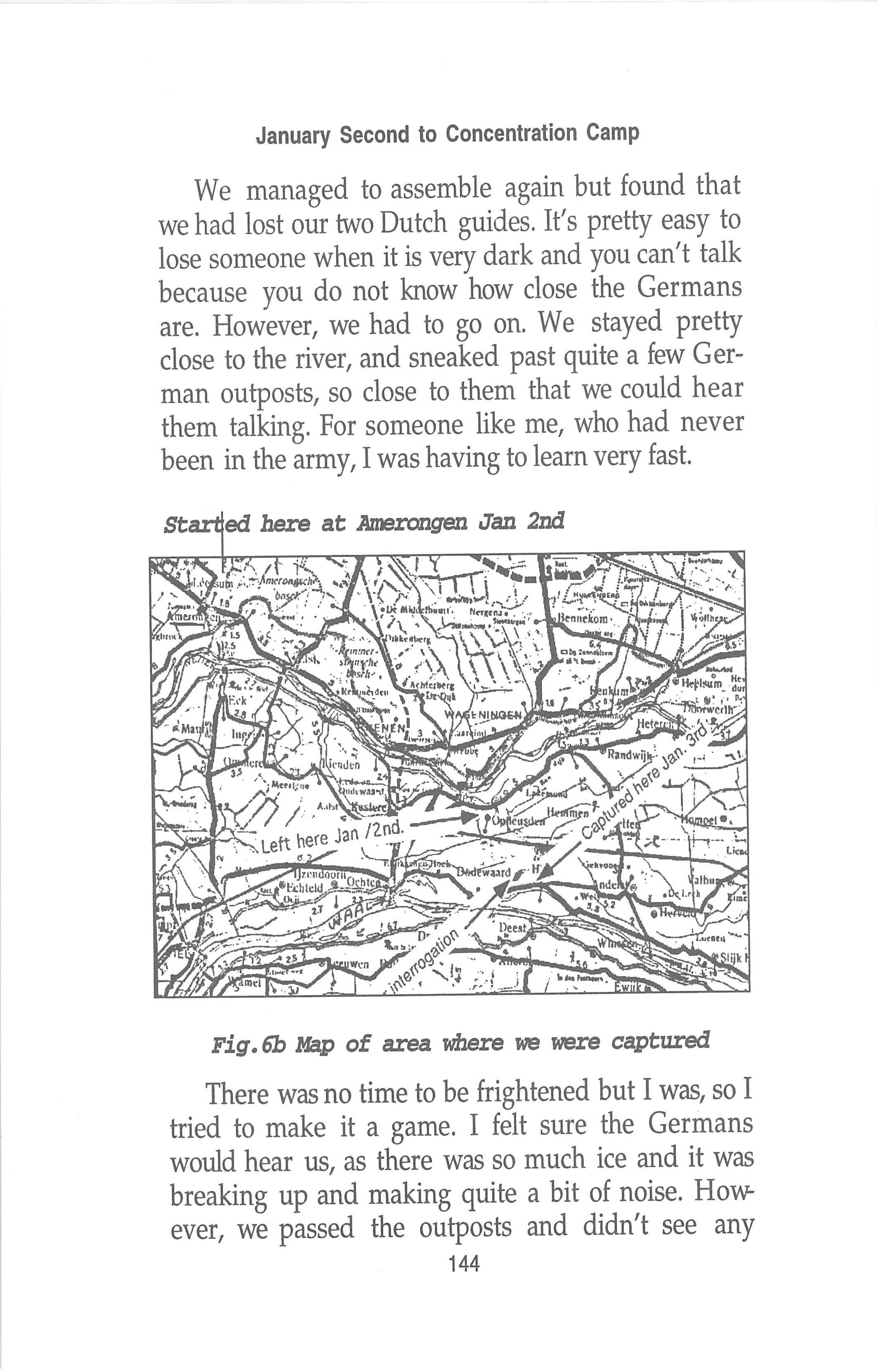
He also drew the night on a map.
Porter has written on it where the party started, at Amerongen on 2 January; where they left the bank; where they were taken on the 3rd, a label between Randwijk and Heteren whose arrow points south-east of Opheusden, near Dodewaard; and the label "interrogation", written south of the Waal, with its arrow on Dodewaard (as in his letter, "taken to Dodewaard", p. 224). It is one participant's memory drawn fifty years later, and it puts the capture a little east of Opheusden, where the Dutch account of Maljers puts it; but it is the only picture anyone in the party left of the ground Murphy was taken on.
What became of the guide, from the one man who saw him afterwards. Porter was held with him in the first days. Maljers had lost his shoes in the mud and ice too:
but the Germans did not give him any shoes and his feet were bleeding badly. He had some old rags wrapped around them. They had also beaten him up severely. We had to totally ignore him as it wouldn't have done either of us any good to have recognised each other.
— Bob Porter, The Long Return, p. 150
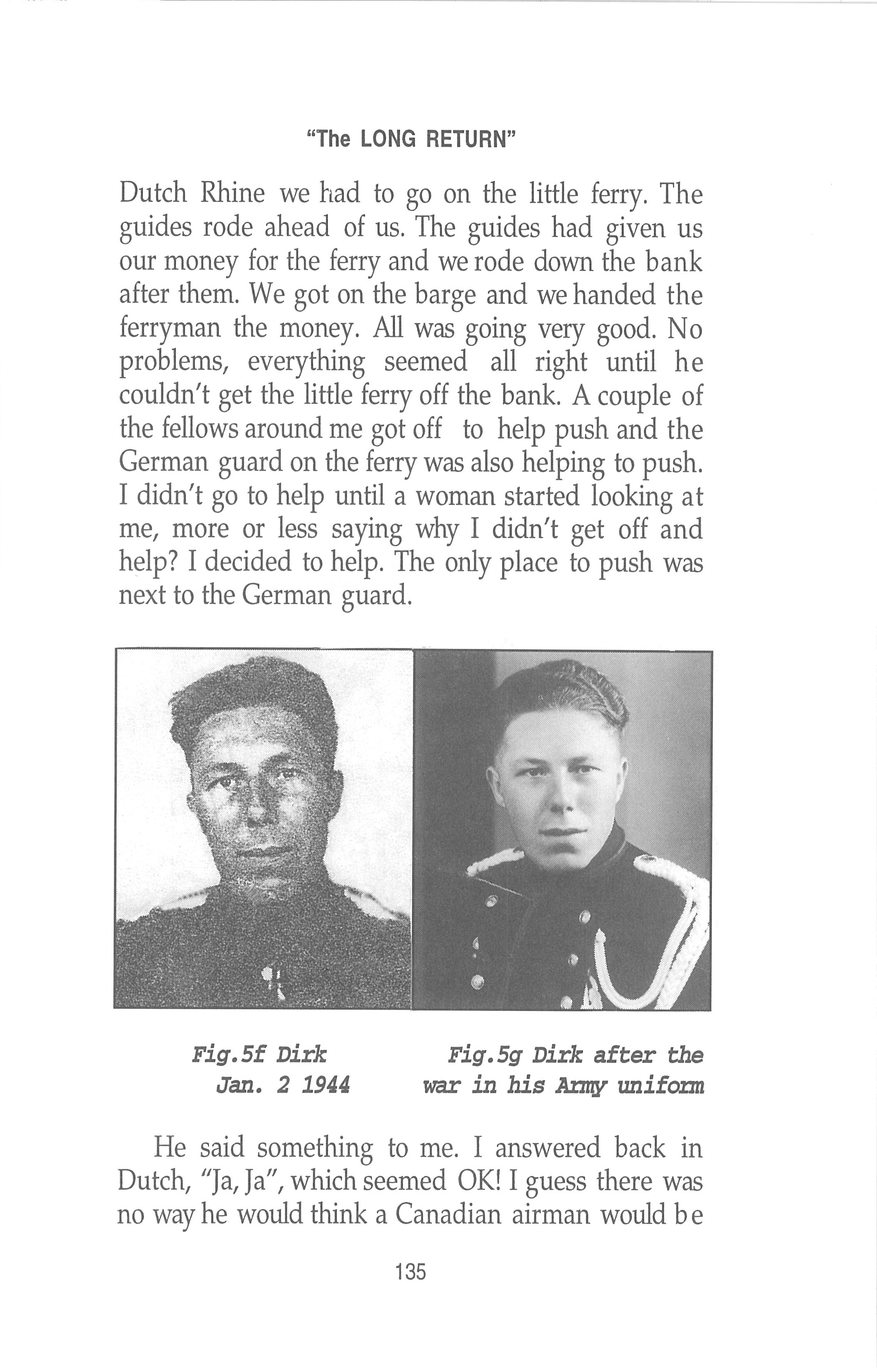
He saw him "in the next couple of weeks off and on, but then never saw him again", and "always thought he must have lost his feet or died in a concentration camp" (p. 150). He had not: Maljers was told at the Wolvenplein prison in Utrecht that he had been sentenced to death, and lived to the liberation (his page).
Porter published both, so the man he thought had died in a camp is the man in the second photograph.
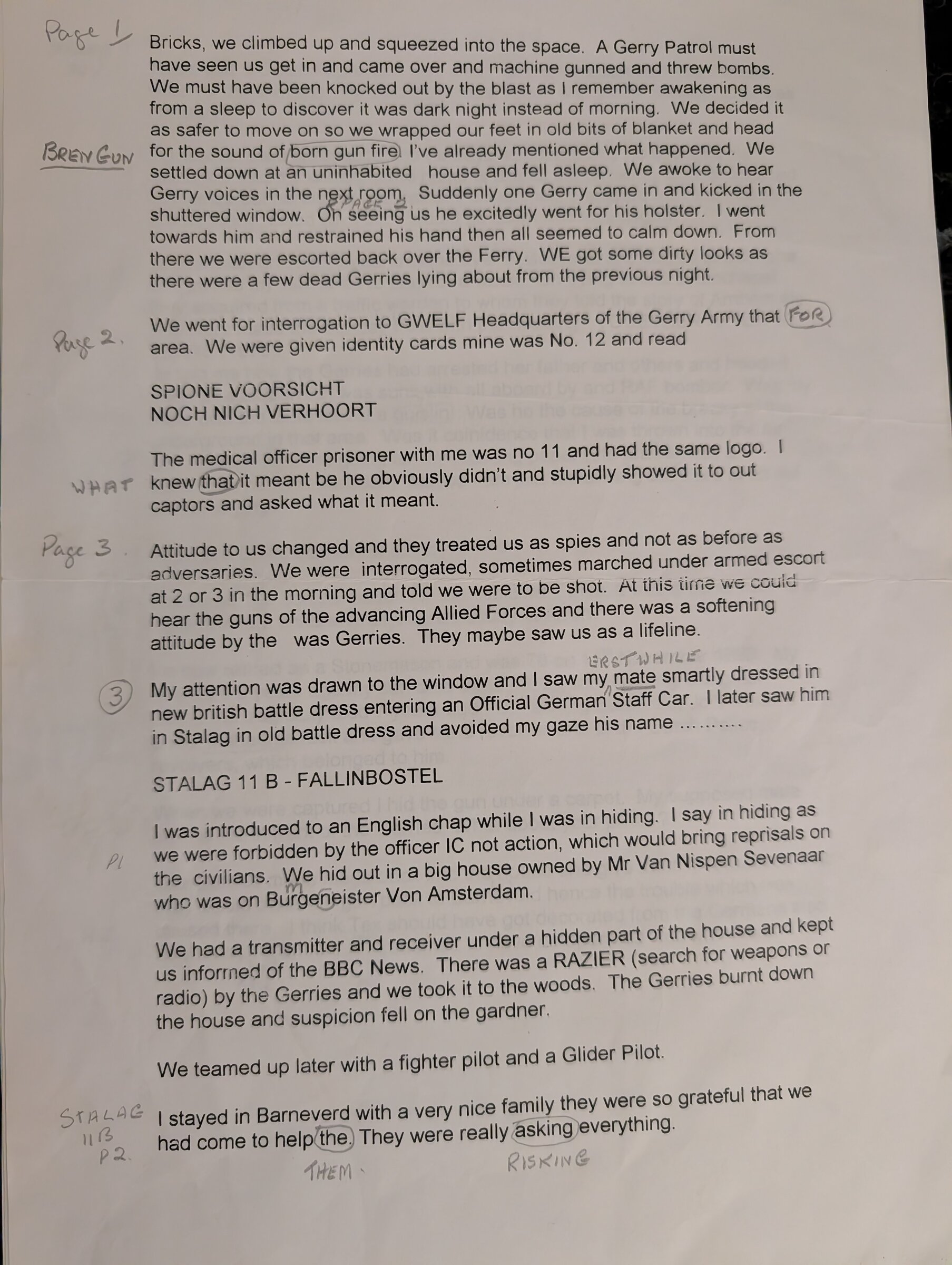
How he was taken, two accounts, both his. The Sunday Post of 29 April 1945 (scan), four days after he came home, says they "were recaptured when swimming across the Rhine in the hope of meeting British soldiers a few miles away". His typed notes, fifty years later (typed pp.1–3), say the party scattered under fire, that he and "my new found mate" took refuge in brickwork, that "a Gerry patrol must have seen us get in and machine gunned and threw bombs", that they came to in a house to hear German voices next door, that a German kicked in the shutter and went for his holster and Murphy "restrained his hand", and that "from there we were escorted back over the Ferry". ⚠︎ Swimming and being taken in a house are not the same event. The newspaper line is a reporter's sentence, and its geography is loose: the party had crossed the Rhine by ferry the day before (Amerongen) and the Allied lines were beyond the Waal. His own account fits Schjelderup's and Hardy's: fired on at close range, the party scattered, on the flooded, frozen Betuwe where Hardy himself swam a canal. The 1945 account is the contemporary one, but second-hand. Unresolved on the detail; both agree he was taken trying to reach the British lines.
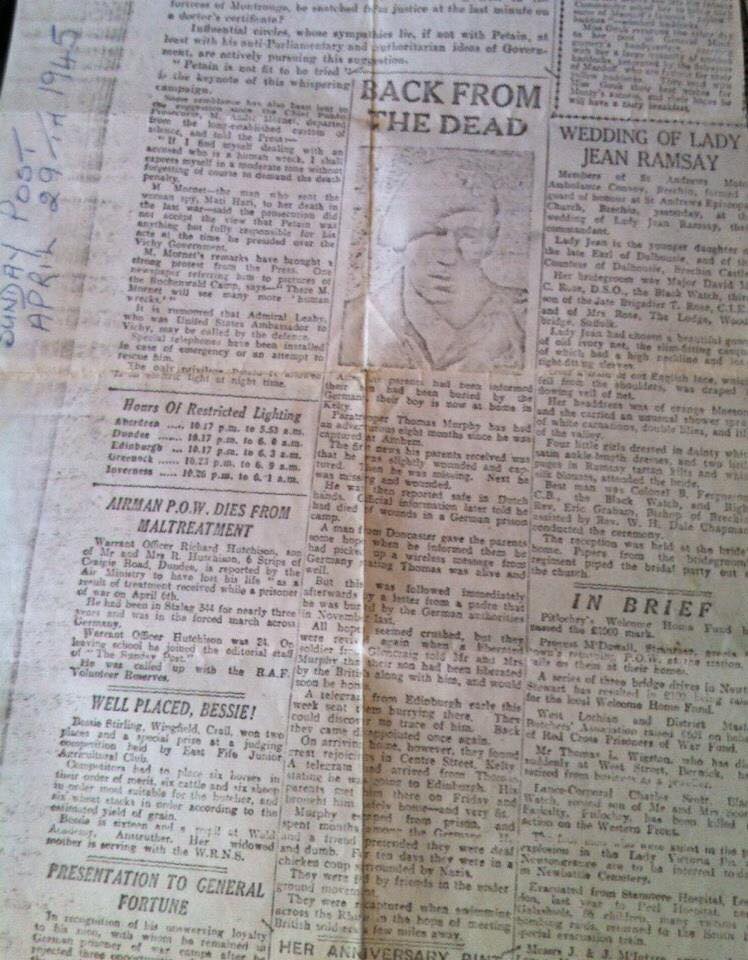
What followed he told alone for fifty years. Noble's report stands beside it: Noble was sent to German counter-intelligence at Velp, "having been captured in civilian clothes", then held eight weeks in strict solitary, the last five and a half in the Gestapo prisons at Utrecht and Doetinchem, "prolonged questioning, threatening", before reaching Stalag XI-B at the end of February (Noble). Noble does not name Murphy, so what follows (Recapture, interrogation, captivity) is still Murphy's account of himself; but it is no longer an account of treatment nobody else described. The Canadian airman in the party, Bob Porter, wrote the same road up in 1997: a house at Arnhem where "they kept referring to us as spies and threatened to shoot us many times", interrogation "at three or four o'clock in the morning", then "a big prison in Utrecht called 'Wolvenplein Prison' … run by the German SS", then Doetinchem at the end of January (Porter, pp. 155–165).
Briere is the one man in the party who says where Murphy went. After the ambush he, Trainor and a Dutchman were marched to Arnhem with their hands tied, and "The six who were re-captured reached ARNHEM the following day. They were Capt. NOBLE., CSM BERRY., Sgt. PORTER., Sgt 'TIM'., Pte. SCHWARTZ., Pte. MURPHY." (his report, p. 3). So a fellow prisoner, in June 1945, put Murphy at Arnhem, which Velp adjoins. The report does not date "the following day", or say where or with whom each was taken.
- ◐ Four of the six put themselves at Velp, by Arnhem, in their own accounts: Noble, Berry, Swartz (Velp, then Utrecht on 16 January), and Porter in his letter ("Felp"); Murphy has his party taken to "GWELF" (Noble; Berry, p. 2; Appendix C; GWELF). ⚠︎ "Tim" rests on Briere alone.
- ⚠︎ Porter's book has a different six: "Wilf, Louis, Harvey, Marcel Briere, the Army Doctor and myself were taken to Arnhem" (p. 151). That puts Briere and Trainor with him, where Briere has the two of them marched ahead, and has no Murphy and no "Tim". Not reconciled: Briere's is a report of June 1945, Porter's a book written fifty years on, in which he never saw Murphy after the ambush ("we didn't see any of the others", p. 150), and Murphy is not named at the Wolvenplein or the Kruisberg.
That he was one of the seven Allied servicemen taken with Maljers to the Wolvenplein is the natural reading of the numbers and of Briere's six, and nothing more.