Fokke Dijkstra
Barneveld 25 Jan 1927 – Germany, 16 Mar to 19 Apr 1945 ⚠︎
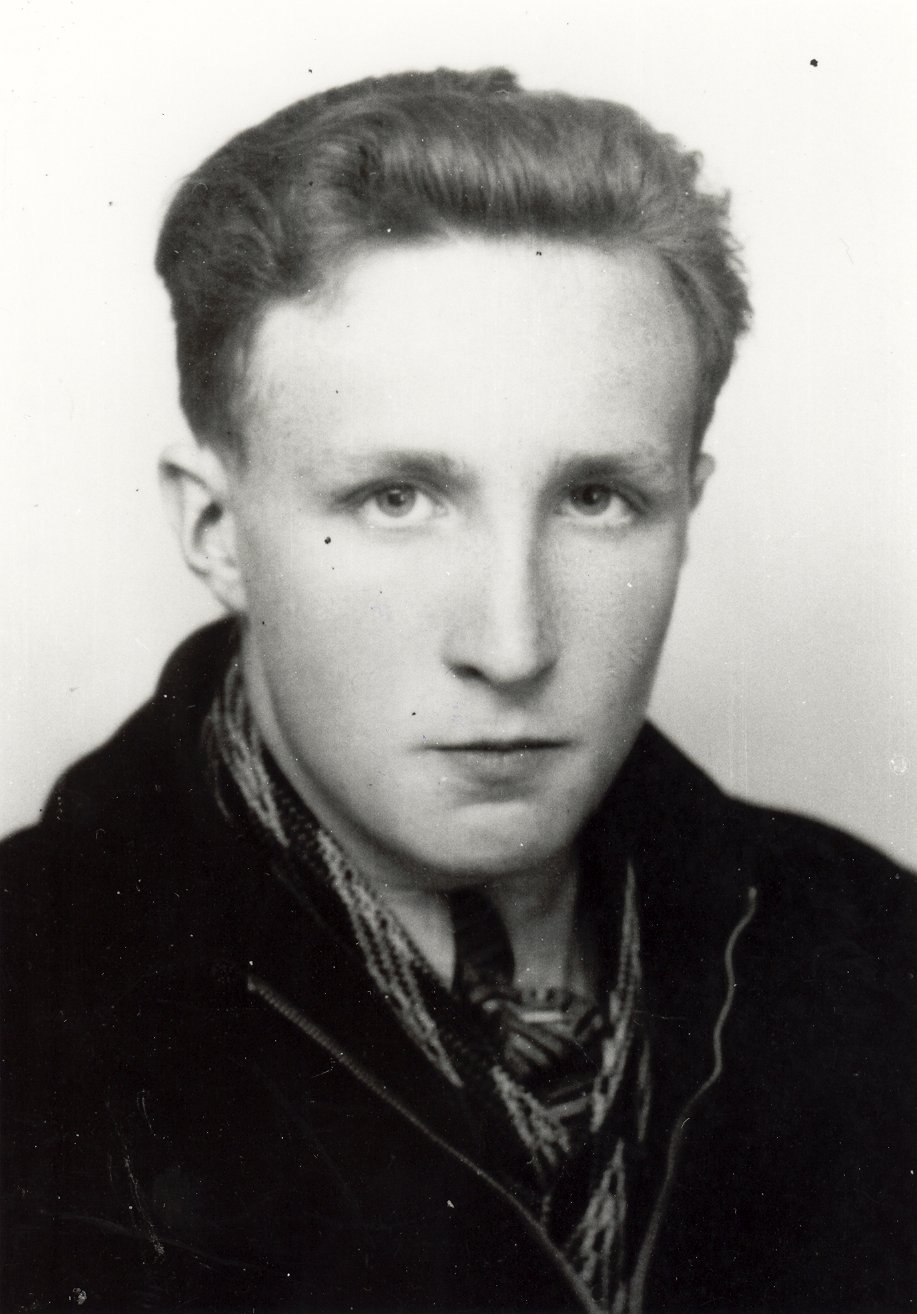
Fokke Jacob DIJKSTRA, Amersfoort prisoner 9607 (his camp card)
About: A courier of seventeen from De Glind, taken by the SD at Scherpenzeel on 15 December 1944 while Murphy hid nearby; he died in Germany in the spring of 1945. ◐ Very probably the son who took Capt. Charles Noble to his father's house that December.
Unit or role: Courier (koerier) carrying post for the resistance; "N.B.S." on the questionnaire made out in his name in 1945; Student on his camp card.
Where: Postweg 35, the Rudolphstichting at De Glind, municipality of Barneveld, post address Achterveld.
Evidence: ✓ Huurdeman, via the Oorlogsgravenstichting; ✓ his Amersfoort cards (Arolsen Archives); ✓ Digitaal Monument Neuengamme; ✓ the War Graves Foundation's file, with the Red Cross notice of 1947; ✓ his death record; ✓ the Erelijst, folio 935; ✓ his American helper file and the Grade 5 list; ✓ the British index of Dutch helpers, sheet D/13; ✓ Trouw, 11 August 1945; ◐ his brother Jan's account, 2014 (the text); ◐ Jan's memory as ParaData prints it; ◐ Oud Scherpenzeel, March 2020, pp. 20–21; ◐ Davison's memoir; ◐ Noble's report; ◐ the Landelijke Organisatie's list of the missing, 13 July 1945, the De Glind young men's society's notice, 14 June 1946 and Van der Fange's diary in the Telegraaf, 1994 (these three OCR only)
De Glind
Link to the section De Glind✓ He was born at Barneveld on 25 January 1927, the son of Boke Dijkstra and Trijntje Kroese (the Foundation's questionnaire; his death record). His father was the wasbaas, the head of the laundry, at the Rudolphstichting, the children's village at De Glind, from 1924; his mother worked in the linen room, and the house took in foster children from the Stichting. His brother Jan, born in October 1921, wrote in 2014 of a foster brother from Utrecht who came when Jan was eight, "net zo oud als mijn broertje Fokke, die omgekomen is in de oorlog" (just as old as my little brother Fokke, who died in the war), and of the four little ones running round together at one of the Gereformeerd church's annual meetings (Jan's account, p. 1). His father's form of July 1945 gives four children, aged 28, 23, 18 and 13 (Boke's form, p. 4); ◐ Fokke is the 18 and Jan the 23 (more on the family on Boke Dijkstra's page).
His camp card has him as a Student, single, Protestant ("Evangl.") (the card); the Foundation's questionnaire of 1957 has his church as Gereformeerd (the questionnaire). He was a young member of the De Glind young men's society, "Dient den Heere" (its notice, 1946; OCR only).
A team of the Binnenlandse Strijdkrachten, September 1944
Link to the section A team of the Binnenlandse Strijdkrachten, September 1944◐ Huib van der Fange, an onderduiker at the Rudolphstichting and deputy commander of the Neder-Veluwe district of the Binnenlandse Strijdkrachten, wrote in his diary on 24 September 1944 that they had reported to "Bart", Piet Veenendaal, had a railway line to reconnoitre ("De spoorlijn van A'foort naar Apeldoorn verkennen. Hij moet opgeblazen worden", reconnoitre the railway from Amersfoort to Apeldoorn; it must be blown up), and:
Our team keeps growing. It now consists of Barends (Jan Dijkstra), Piet (Wim Boersma), Flippie (Gerard van Wijk), Sjon, Fokke Dijkstra, Gerrit (Henk van Bentum), Rijndert (Huib van der Fange).
Dutch originalOnze ploeg breidt zich steeds uit. Hij bestaat nu uit Barends (Jan Dijkstra), Piet (Wim Boersma), Flippie (Gerard van Wijk), Sjon, Fokke Dijkstra, Gerrit (Henk van Bentum), Rijndert (Huib van der Fange).
— Huib van der Fange's diary, 24 September 1944, as printed in De Telegraaf, 17 September 1994 · the article (OCR only)
◐ The names in brackets are very probably the article's, not the diary's (the article does not say whose they are), and it does not say that the two Dijkstras are brothers. ◐ It is very probably this Fokke, with his brother Jan as "Barends": Van der Fange lived at the Rudolphstichting where the Dijkstras did, Jan's own account names Wim Boersma as his partner in the resistance (Jan's account, p. 2), and the De Glind young men's society's notice of 1946 names Gerard van Wijk and Huib van der Fange beside Fokke (the notice). Fokke was seventeen.
Major Coke at the house, October and November 1944
Link to the section Major Coke at the house, October and November 1944His family's house took in a wounded Arnhem officer, Maj. J. S. A'D. Coke of the KOSB, who had broken out of the hospital at Paleis Het Loo: Willem Zegers of Uddel passed him on to "B. Dijkstra, Postweg 35, Glinden, Post Achterveld", and Gerrit Hogeweg's form has Jan take the Major "to his father" (Zegers's table, p. 4; Hogeweg, p. 2; more on Boke Dijkstra and Maj. John Coke's pages). In Jan's memory as ParaData prints it, Coke gave Jan and Fokke a ten-guilder note when he left, and Fokke went with them to the rendezvous (below, Pegasus II).
With Murphy
Link to the section With MurphyNo source puts him with Murphy in person. His family's house, and the operation he is said to have guided, crossed Murphy's road in November and December 1944.
Pegasus II, November 1944
Link to the section Pegasus II, November 1944Pegasus II was the crossing of 17/18 November 1944 that Murphy's party set out for and never reached (Operation Pegasus II). Two sources put Fokke on its road.
◐ Jan's memory, as ParaData prints it in English, has him go with them when Jan took Major Coke to the rendezvous; Coke went on Pegasus II as "de commandant van de achterhoede" (the commander of the rearguard) (Boeree, p. 183):
He also gave me and my brother Fokke a ten guilder bank note. Over his uniform he wore a long coat. He said goodbye to my parents and there we went on my bicycle with John on the back. Fokke accompanied us and another member of the Resistance was cycling about a 100 yards in front of us to warn us of any danger. Between the villages of Barneveld and Lunteren we met up with others of the Resistance and said goodbye to John.
— Jan Dijkstra, as quoted by ParaData (Airborne Assault Museum), "Major John Coke" · the page
Jan dates it only to "one of the next Saturdays"; which Saturday is on Maj. John Coke's page.
◐ The Americans' summary sheet on Fokke, dated 4 March 1946 and naming Lt Kiek and 8 February 1946, has:
This man was one,of the guides for the Pegasus 1 and Pegasus 2 crossing where mass crossing of the Rhine were made. Casehas been authenticated.
— US Army · summary sheet on Fokke Jacob Dijkstra, grade 5 · 4 March 1946 (Lt Kiek, 8 February 1946) · the sheet, p. 5 (image-checked; the comma and "Casehas" are the typist's)
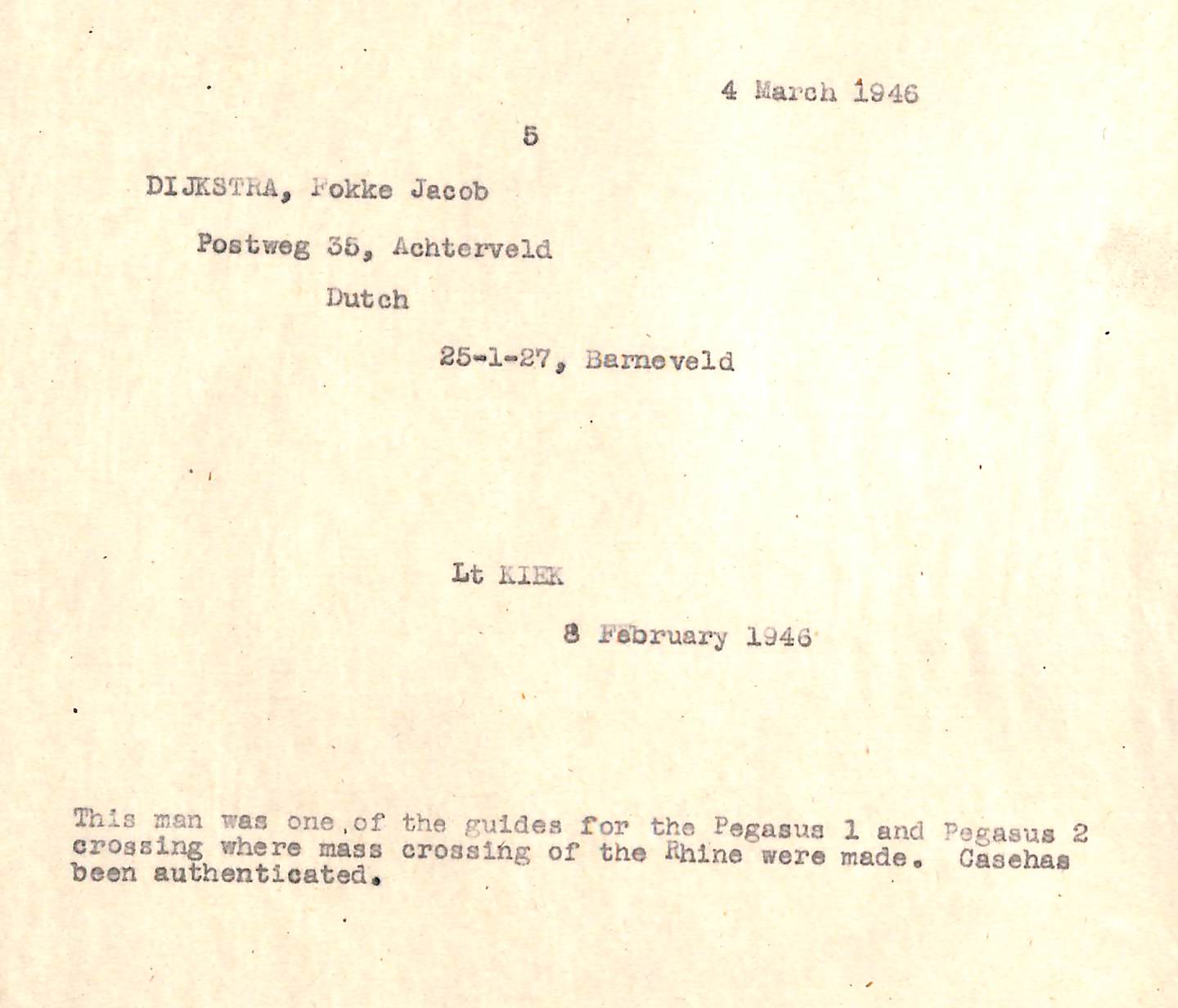
It gives no night, no place and no task. The slip in the same folder says only that he "always helped with the crossings of the Allied Personnel" (p. 2), and the Dutch sources call him a courier (Where the sources disagree). The Pegasus II story page counts him, ◐, among the Dutch guides of the later attempts, with no night or party given (Pegasus II).
Leslie Davison at the house, November 1944
Link to the section Leslie Davison at the house, November 1944◐ Leslie Davison, the private who rode with Murphy and James Hardy towards Achterveld on 25 November and left them there with two of the guides (Hardy), stayed about ten days with a family he could name only after the war:
I was introduced to the family which consisted of Ma and Pa, four sons and a maid, only two of them gave me their names, these were two of the teenage sons, Jan and Faulkner. It turned out that these two were the only active members of the underground in the family … Also on that same Sunday afternoon, Jan and Faulkner asked me if I would like to accompany them on a walk in the woods. I suggested that this might be dangerous for all of us but they pooh-poohed the idea said not to worry as they were well known to the local soldiers and I had already been accounted for as the cousins from Amsterdam.
— Pte L. Davison, his memoir · Pegasus Archive
The memoir names the family as "Dijkstra's (I only learned and named after the war)", its head as "the manager of the local public baths" (Davison). ◐ "Faulkner" is probably Fokke, then seventeen (the memoir gives only the sound of the name), beside his brother Jan; Jan was twenty-three, which the memoir calls teenage. The memoir brings Davison there from a cow barn after Pegasus II, not from the ride with Murphy; the difference is set out on Leslie Davison's and Jan Dijkstra's pages.
Charles Noble at the bath-house manager's, December 1944
Link to the section Charles Noble at the bath-house manager's, December 1944◐ Charles Noble, the doctor later taken with Murphy, was moved in early December from Dries Klooster's house at Barneveld, whose household's form passed "C.B. Noble" on to the "Rüdolfstichting" (Klooster's file, p. 3), while Murphy was nearby at the Veermans':
After 10 days the situation became no longer safe, and I was taken to ACHTERVELD nearby, to the house of the manager of the penal settlement bath-house (name unknown). It was his son who conducted me to the house. He was arrested the following week and has not been heard of since. At the time of his arrest I believe he was carrying reports to Capt. Michael KING, SAS.
— Capt C.B. Noble, his report (Noble)
- Fokke's father Boke was the head of the laundry of the Rudolphstichting, the children's village at De Glind on the edge of Achterveld (Jan's account, pp. 1, 3), and in Jan's memory as ParaData prints it the family lived "in the annex of the laundry and bathing building" (ParaData): ◐ Noble's "manager of the penal settlement bath-house".
- ◐ The son who conducted him and was arrested the following week is very probably Fokke, taken on 15 December (Huurdeman). ◐ Noble's "Capt. Michael KING, SAS" is Gilbert Kirschen, "Captain King", by the name, "SAS", the date and the area; no document ties Noble's man to him directly, and ⚠︎ the "Michael" is unexplained: no source gives Kirschen that name (Kirschen's page). The December arrests followed the SD's discovery of his team's old billets (Huurdeman).
- After three days Noble was "taken by another son of the bath-house manager to a farm near SCHERPENZEEL" where Tex Banwell was hiding, and moved on from there after ten days, "(i.e: about 16th Dec)" (Noble). Counting back from Noble's own figures (our arithmetic), he reached the bath-house manager's about 3 December and left about 6 December.
- ⚠︎ No source names the Dijkstras as Noble's hosts. The identification rests on the occupation, the place, the Klooster form's "Rüdolfstichting", and the son who conducted him and was arrested a week or so later.
- ⚠︎ Noble's own later account (unpublished private papers, shared with us privately), told long after the war, does not name Achterveld or the bath-house. Between Barneveld and Scherpenzeel it has "about five days in another farm which was used as a collection point for the British agents who had been dropped and had radio communication with London", where his report has three days; it names no son and no arrest. ◐ That it is the same stay rests on its place in his route.
- ⚠︎ Noble's "That night the KLOOSTER's house was raided" follows his sentence on the son's arrest but may mean the night he came to Achterveld; the Dutch record dates the raid to 8 December (Oorlogsgravenstichting; Albert van Meerveld).
The arrest, 15 December 1944
Link to the section The arrest, 15 December 1944The SD took him in or near its raid on Piet Veenendaal's farm at Scherpenzeel on 15 December 1944 (⚠︎ inside the farm or near it: Where the sources disagree), the first of the arrests that followed its discovery of the billets of Kirschen's team. Murphy was then at the Veerman farm at Klein Achterveld, from about 25 November to 23 December (Hardy; Jacob Veerman). Huurdeman:
Fokke Dijkstra, who had the bad luck to be there as a courier at the wrong moment, was brutally mistreated, just as Piet Veenendaal was.
Dutch originalFokke Dijkstra, die de pech had als koerier daar op het verkeerde moment te zijn werd evenals Piet Veenendaal op grove wijze mishandeld.
— Huurdeman, Ondergronds in de Tweede Wereldoorlog, via the Oorlogsgravenstichting
All of them were taken to the Willem III barracks at Apeldoorn (Huurdeman). Three other sources tell how he was taken:
- ◐ Oud Scherpenzeel, from T. A. Boeree's post-war manuscript: "Fokke Jacob Dijkstra die bij dezelfde verzetsgroep hoorde als Piet Veenendaal was diezelfde morgen nog om 08.00uur op de boerderij geweest en daarna weggereden" (who belonged to the same resistance group as Piet Veenendaal, had been at the farm at eight that same morning and ridden away again); close to the farm he ran into the advancing Germans, was taken with secret post on him, and was brought to Apeldoorn (Oud Scherpenzeel, 2020, p. 20).
- ◐ The Barneveld labour exchange, asked by the War Graves Foundation in 1958, answered "volgens verkregen inlichtingen" (according to information obtained) that he was "tijdens zijn illegale activiteit (overbrengen van post) aangehouden en gearresteerd" (stopped and arrested during his resistance activity, carrying post), then taken to Germany, where he died (the labour exchange's answer).
- ◐ His brother Jan, who got away, told it in 2014, seventy years on:
My little brother was taken in a raid just behind the Stichting, at Piet Veenendaal's, a farmer who was the leader of the resistance, a former soldier. That business was rolled up and Wim Boersma and I managed to get away, but my brother had just been to Scherpenzeel with post for the resistance, and how exactly he was taken, nobody knows.
Dutch originalMijn broertje is bij een razzia opgepakt, net achter de stichting bij Piet Veenendaal, een boer die de leider was van het verzet, een oud militair. Die zaak werd opgerold en Wim Boersma en ik wisten te ontsnappen, maar mijn broertje was net met post voor het verzet naar Scherpenzeel geweest en hoe hij precies is opgepakt, weet niemand.
— Jan Dijkstra, his account, 2014, p. 3 · the text
Jan goes on: "Hij is naar de boerderij van Piet Veenendaal gebracht en daar is hij gemarteld. Henk van Benthem was daar ook bij. Later is hij naar het concentratiekamp gebracht" (he was brought to Piet Veenendaal's farm and tortured there. Henk van Benthem was there too. Later he was taken to the concentration camp; ◐ very probably the "Henk van Bentum" of Van der Fange's diary above) (his account, p. 3). The raid as a whole, and who else was taken, are on Piet Veenendaal's page.
Amersfoort and Neuengamme
Link to the section Amersfoort and Neuengamme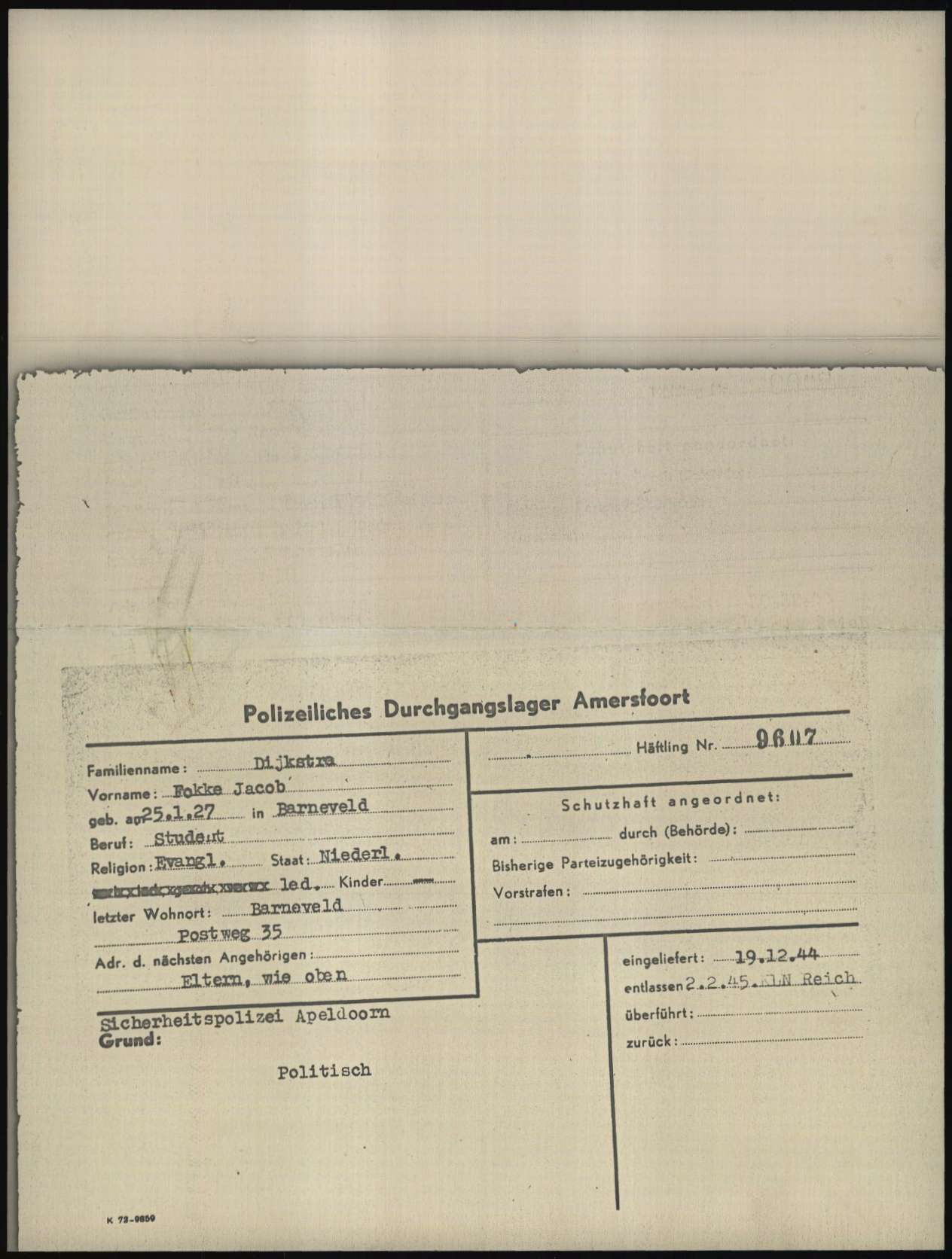
✓ The Amersfoort police transit camp registered him as prisoner 9607: Student, single, of Postweg 35, Barneveld, next of kin "Eltern, wie oben" (parents, as above), sent in by the Sicherheitspolizei Apeldoorn, reason "Politisch", delivered (eingeliefert) on 19 December 1944 and released (entlassen) on 2 February 1945, the line ending Reich, preceded by KLN with the first letters faint; ◐ the camp's index card has 2-2-45 KLN in pen (the index card), and the card of Jan Verhoef, released the same day, has "KL ins Reich" (concentration camp, into the Reich). A typed Dutch index form drawn from the Amersfoort records ("Ontleend aan: AMERSFOORT K.A.4") adds under Aantekeningen "Naar Amersfoort. Op transport naar Neuengamme." and the date 2 2 45 (to Amersfoort; on transport to Neuengamme) (the form). He turned eighteen there, on 25 January 1945. ◐ Albert van Meerveld, taken at Barneveld on 8 December, left Amersfoort the same day, so the two very probably went east on the same transport (Piet Veenendaal).
The Digitaal Monument Neuengamme has him arrested at Scherpenzeel on 15 December 1944 (✓), held at "Apeldoorn, Amersfoort (blok 10), vanaf 19-12-1944 tot 02-02-1945" (✓, as the Arolsen card has it), and lists Neuengamme among its camps, with his arrival from Amersfoort on 4 February 1945 ◐ (Digitaal Monument Neuengamme). The memorial gives no source for the arrival date.
The Arolsen Archives also hold a tracing case of the International Tracing Service for him, no. 26.654, with no pages online (the catalogue entry).
Missing, 1945
Link to the section Missing, 1945In July 1945 the Landelijke Organisatie's list of the missing had him as no. 173:
Fokke Jacob Dijkstra, born 25 Jan. 27. Living at Postweg 35, Barneveld. Identity card no. 11234. Arrested 15-12-44. From Apeldoorn to Amersfoort. 19-12-44 to Neuengamme 2-2-45. Probably a camp near Wöbbelin.
Dutch originalFokke Jacob Dijkstra, geb. 25 Jan. 27. Wonende Postweg 35, Bameveld [Barneveld]. PB. nr. 11234. Gearr. 15-12-44. Van Apeldoorn naar Amersfoort. 19-12-44 naar Neuengamme 2-2-45. Waarschijnlijk kamp bij Wöbelin.
— Mededeelingen van C.B.-L.O., 13 July 1945, list of the missing, no. 173 · the text (OCR only)
A month later an appeal in Trouw asked for news of him, with answers to "H. H. Kroese, Spoolde A 131":
Who can give information about Fokke Jacob Dijkstra, born 25 January 1927 at Barneveld; taken on 15 Dec. '44 near Scherpenzeel, brought from there to Apeldoorn. Came to the camp at Amersfoort on 19 Dec., until 2 February '45; was then taken to the camp Neuengamme near Hamburg and from there taken away again at the end of February, to where is not known.
Dutch originalWie kan inlichtingen verstrekken aangaande Fokke Jacob Dijkstra, geboren 25 Januari 1927 te Barneveld; op 15 Dec. '44 opgepakt onder Scherpenzeel, vandaar naar Apeldoorn gebracht. Op 19 Dec. in het kamp te Amersfoort gekomen tot 2 Februari '45; is toen naar het kamp Neuengamme bij Hamburg gebracht en vandaar eind Februari weer weggevoerd, waarheen onbekend.
— Trouw, 11 August 1945, advertisement · the text (OCR only)
The appeal does not say who H. H. Kroese was.
His death
Link to the section His deathHe died in Germany in the spring of 1945, aged eighteen. ⚠︎ The day and the camp are not settled (Where the sources disagree).
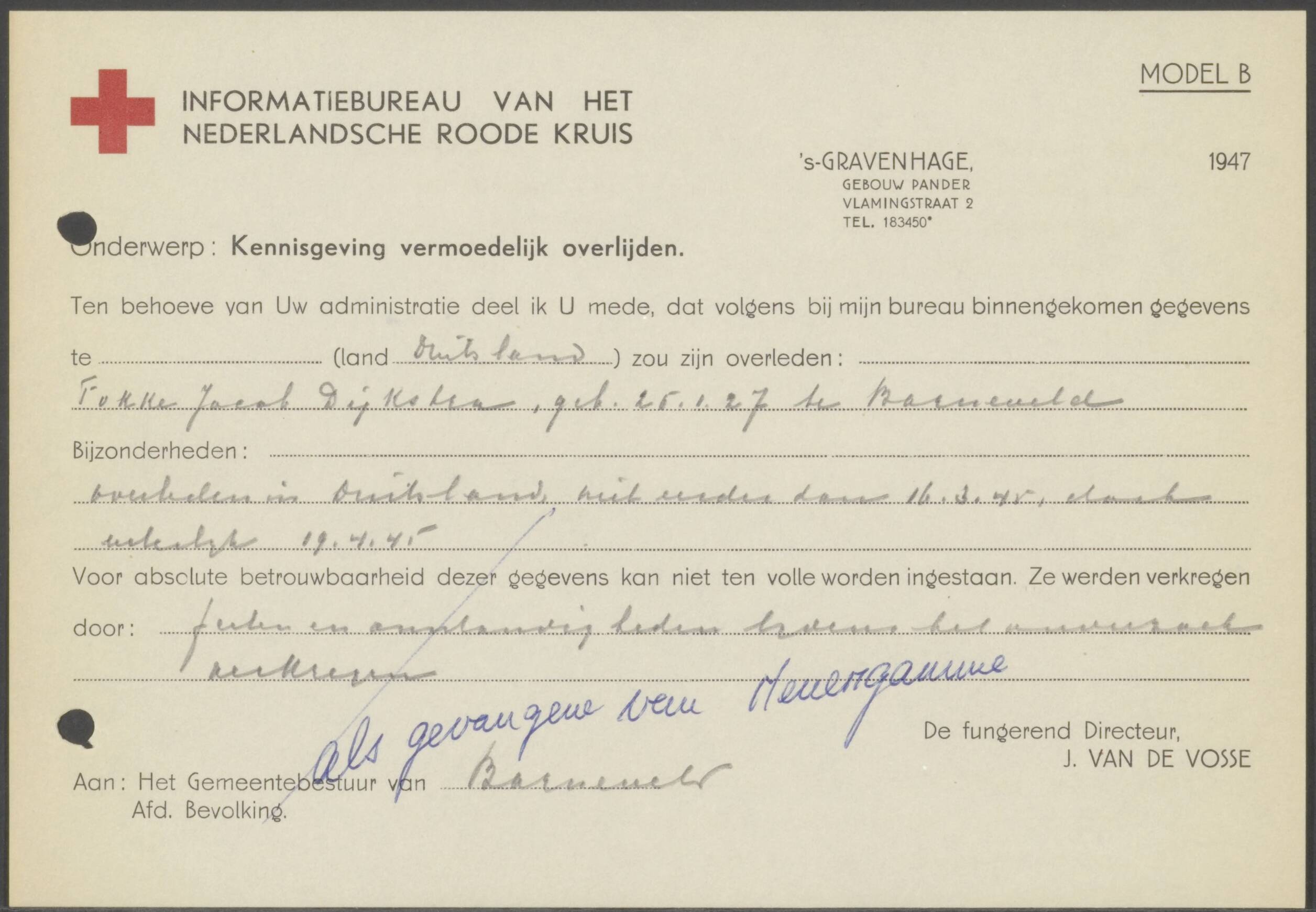
- ✓ The Red Cross, 1947. The Netherlands Red Cross's notice of presumed death to Barneveld has him dead in Germany "niet eerder dan 16.3.45, doch uiterlijk 19.4.45" (not before 16 March 1945, but at the latest 19 April 1945), and, added in blue ink, "Als gevangene van Neuengamme" (as a prisoner of Neuengamme) (the notice).
- ✓ The register. His death was entered at Barneveld only on 2 May 1952, as 19 April 1945 "in Duitsland", with his parents as Boke Dijkstra and Trijntje Kroese (his death record). Arnhem's list of Boke's children in 1969 has him "afgevoerd 8-10-46. C.B.R." (struck off 8 October 1946, to the C.B.R., ◐ the central population register) (the Foundation's file, scan 3).
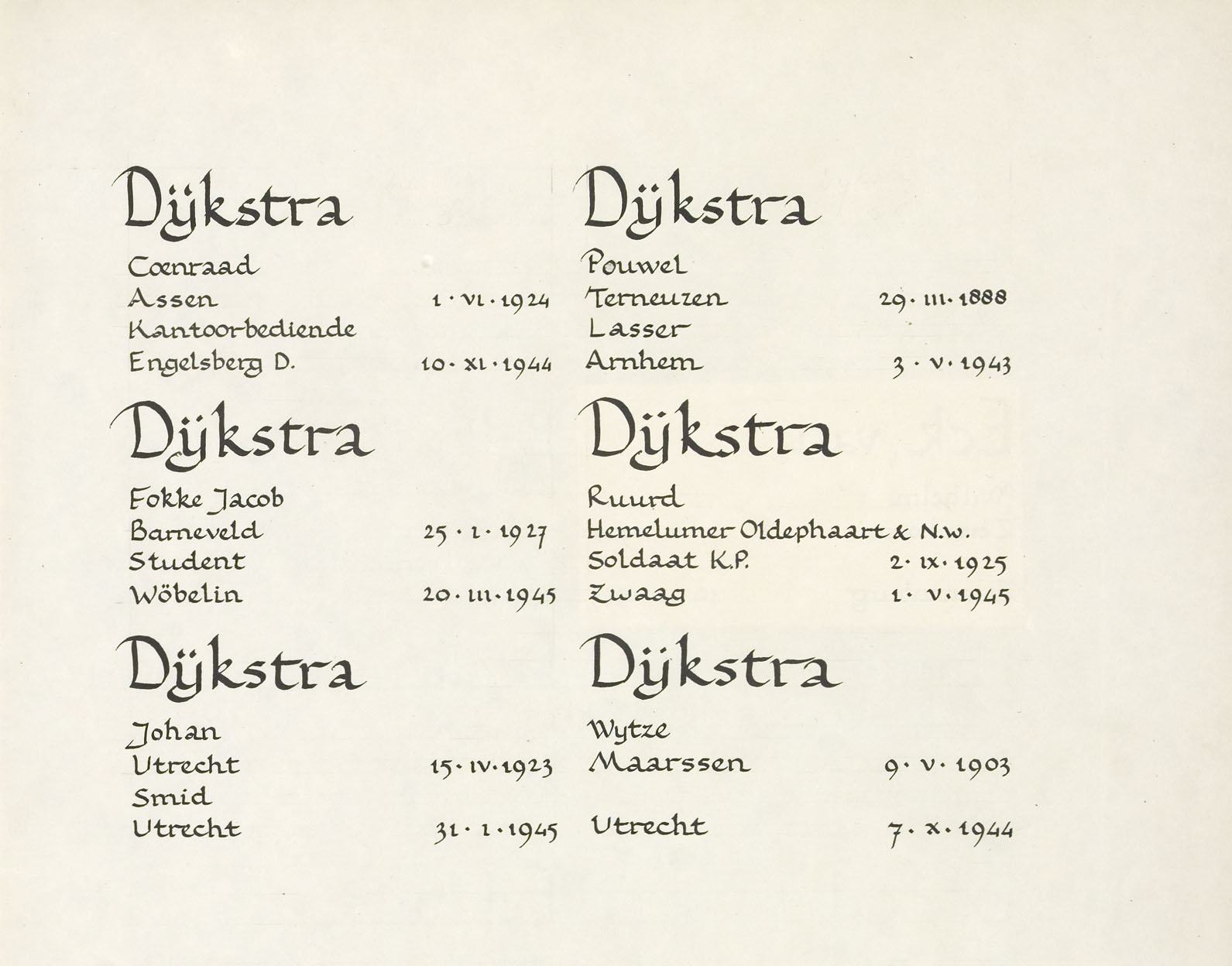
- ✓ The Erelijst. The printed roll of honour of the Dutch war dead has him on folio 935 as "Dijkstra / Fokke Jacob / Barneveld 25·I·1927 / Student / Wöbelin 20·III·1945" (the roll's entry; the page, read on the image). The roll's website credits its record to José Huurdeman; when the entry was made is not known here.
- ◐ The De Glind young men's society, in June 1946 (Gereformeerd jongelingsblad, 14 June 1946; OCR only):
- "Voorts ontving zij eerst thans bericht dat haar jonge lid FOKKE JACOB DIJKSTRA in Februari 1945 in het concentratiekamp Wöbelin door ziekte en ontbering omkwam" (it has also only now had word that its young member Fokke Jacob Dijkstra died in February 1945 in the concentration camp Wöbelin of illness and hardship).
- The same notice mourns Gerard van Wijk and Huib van der Fange, ◐ both very probably of the team of September 1944, who "beiden tegelijk vielen in den ondergrondschen strijd op 17 April '45" (both fell together in the underground fight on 17 April 1945).
The War Graves Foundation's file
Link to the section The War Graves Foundation's fileThe Foundation opened his file in 1957 and asked Barneveld the usual questions: its form has him dead "Duitsland" on 19 April 1945, gone to Germany "in ieder geval niet vrijwillig" (in any case not voluntarily), single, last at Postweg 35, and his parents as Boke Dijkstra, born at Mildwolde [sic: Midwolde] on 25 November 1890, and Trijntje Kroese, born at Urk on 13 October 1891, of Postweg 35, Achterveld; the Ministry of Justice found nothing against him in 1958 (the questionnaire). In 1962 and 1969 it chased his parents' address, which by 1969 had gone to Arnhem (the file, scans 2–4). Its page has him as a lid verzet (member of the resistance), in its memorial book (Gedenkboek) no. 34, dead on 19 April 1945 "in Duitsland", with a visitor's note "Conc. kamp Neuengamme te Hamburg" (the page).
His file with the Allies
Link to the section His file with the Allies- ✓ The British list, May 1946. The British awards bureau, I.S.9 (A.B.), put him on a list of cases "considered to be Grade 6" and sent to Lieut. Burke of MIS-X for confirmation on 7 May 1946: "20. DIJKSTRA, Fokke Jacob (POST) Postweg 35, Achterveld", ◐ the "(POST)" very probably for posthumous, as the British index's "Post." is, among thirty names that include Ima van Eysinga (the list, p. 43; image-checked).
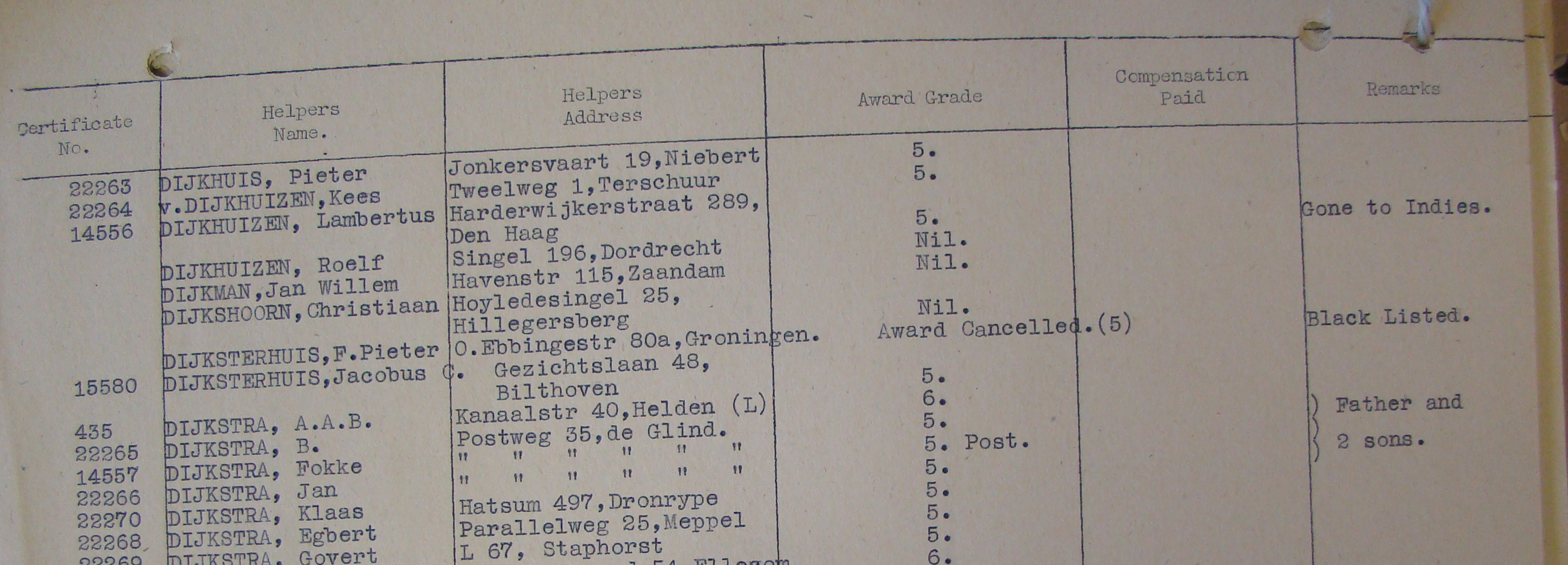
- ✓ The British index. Sheet D/13 of the British index of Dutch helpers has "DIJKSTRA, B." (certificate 22265), "DIJKSTRA, Fokke" (14557) and "DIJKSTRA, Jan" (22266) together at "Postweg 35, de Glind.", with the remark "Father and 2 sons." (sheet D/13, read on the image; the index's notes).
- The address and grade columns run up to a line above the names. Counted row by row, the sheet has 22 names, 22 addresses and 22 grades; every Nil or cancelled award falls on a row with no certificate number, and the three grade-6 rows carry the low numbers 435, 1828 and 436.
- So "5. Post.", printed beside his father's line, is on Fokke's row, the eleventh. It agrees with the British list's "(POST)" for him and the Americans' "Posthumous", and his father lived until 1969.
- His American folder (the archive's copy):
- A questionnaire in his name dated 5 July 1945, while he was missing: Postweg 35, Achterveld; born at Barneveld on 25 January 1927; next of kin "B. Dijkstra", 55; known to the Allied men as "Fokke"; underground organisation "N.B.S."; unmarried; the sections for the men helped and the people he knew are blank, and so is the table on its back (the questionnaire, p. 3).
- A typed slip: "Fokke Dijkstra always helped with the crossings of the Allied Personnel. He has been captured on the 15th of December 1944, and till now no message is received from him" (p. 2).
- The action report of 20 September 1945: "Helped with crossings. He has been arrested and is still missing"; the conference found the questionnaire "rather scanty" and sent the case for further investigation (p. 6).
- The summary sheet of 1946 (above); the cover is pencilled "Grade 5", "Conf 31/ 8-2-46" and "20/9" (p. 1).
- ✓ The American list. The Americans' list of Grade 5 (Eisenhower) certificates, every page headed "Award Grade 5", has "(1109) DIJKSTRA, Fokke J. (Posthumous), c/o Postweg 35, Achterveld, The Netherlands"; his father is "(1107) DIJKSTRA, B." on the page before, and "(1111) DIJKSTRA, Jan, Rudolphestichting", ◐ very probably his brother, two entries on (p. 45; p. 44; image-checked).
Where the sources disagree
Link to the section Where the sources disagreeWhen he died. ⚠︎ Not settled; the Red Cross's window is 16 March to 19 April 1945.
- 19 April 1945: the Barneveld register (entered 1952), Barneveld's answer to the Foundation in 1957, the Oorlogsgravenstichting's page, the Neuengamme memorial and Huurdeman (his death record; the questionnaire; Digitaal Monument Neuengamme; Huurdeman).
- "Niet eerder dan 16.3.45, doch uiterlijk 19.4.45": the Red Cross, 1947, so 19 April is the latest possible day and not a known one (the Red Cross notice). ◐ Another man of the same round-up, Jan Rothuizen, also carries 19 April 1945, while his father wrote in 1959 that the day and place were unknown; the date may be a convention for the dead of the Neuengamme camps in those weeks.
- 20 March 1945 at Wöbbelin: the Erelijst, folio 935 (the roll), and the list of the raid's results at the end of the article in Oud Scherpenzeel (signed Hans van den Ham; sources Boeree and G. van Ginkel), "18 jaar, omgekomen op 20 maart 1945 in Wöblin" (Oud Scherpenzeel, 2020, p. 21). ◐ It falls inside the Red Cross window. The roll's website credits Huurdeman, whose own list has 19 April at Neuengamme; neither the roll nor Oud Scherpenzeel gives a document for 20 March.
- February 1945 at Wöbbelin, of illness and hardship: the De Glind young men's society, 1946 (the notice; OCR only). It falls before the Red Cross window opens, and before the end of February, when Trouw's appeal has him taken on from Neuengamme; nothing says where the society had it from.
Where he died. ⚠︎ Huurdeman has Neuengamme (Huurdeman); the Red Cross has Germany, "as a prisoner of Neuengamme" (the notice); the register and the Foundation say only "Duitsland" (his death record); Trouw's appeal of August 1945 has him taken away from Neuengamme at the end of February, "waarheen onbekend" (Trouw). Wöbbelin, a Neuengamme subcamp, is given by the Landelijke Organisatie's list of July 1945 (as "Waarschijnlijk", probably), the young men's society's notice of 1946, the Erelijst and Oud Scherpenzeel (the list; the notice; the roll; Oud Scherpenzeel, p. 21). ◐ None of them gives a document for it, and the camp is not settled.
How he was taken. Huurdeman has him at the farm "op het verkeerde moment" (at the wrong moment) as a courier; Oud Scherpenzeel has him gone from the farm since eight and stopped near it with secret post; the labour exchange has him arrested while carrying post; Jan has him just back from Scherpenzeel with post, and "hoe hij precies is opgepakt, weet niemand" (how exactly he was taken, nobody knows) (Huurdeman; Oud Scherpenzeel, p. 20; the labour exchange's answer; Jan's account, p. 3). ◐ All four have him carrying post or working as a courier (three say post; Huurdeman says only koerier); they differ on whether he was inside the farm when the SD came.
What he did, and his grade. ◐ The Americans' summary sheet has him "one of the guides" for the two big crossings; the slip in his folder says only that he "always helped with the crossings"; Jan's memory has him ride along when Coke was taken to the rendezvous for Pegasus II; the Dutch records have a courier of post (the summary sheet, p. 5; p. 2; ParaData; Huurdeman). These need not conflict, but no source says what he did on either crossing. Grade: the British list of 7 May 1946 "considered" him Grade 6; the British index and the Americans' folder and list have Grade 5, the Americans' marked posthumous (the British list, p. 43; sheet D/13; the folder's cover; the Grade 5 list, p. 45).