Wouterus Verhoef
Barneveld 7 Sep 1879 – Hamburg-Neuengamme 25 Dec 1944
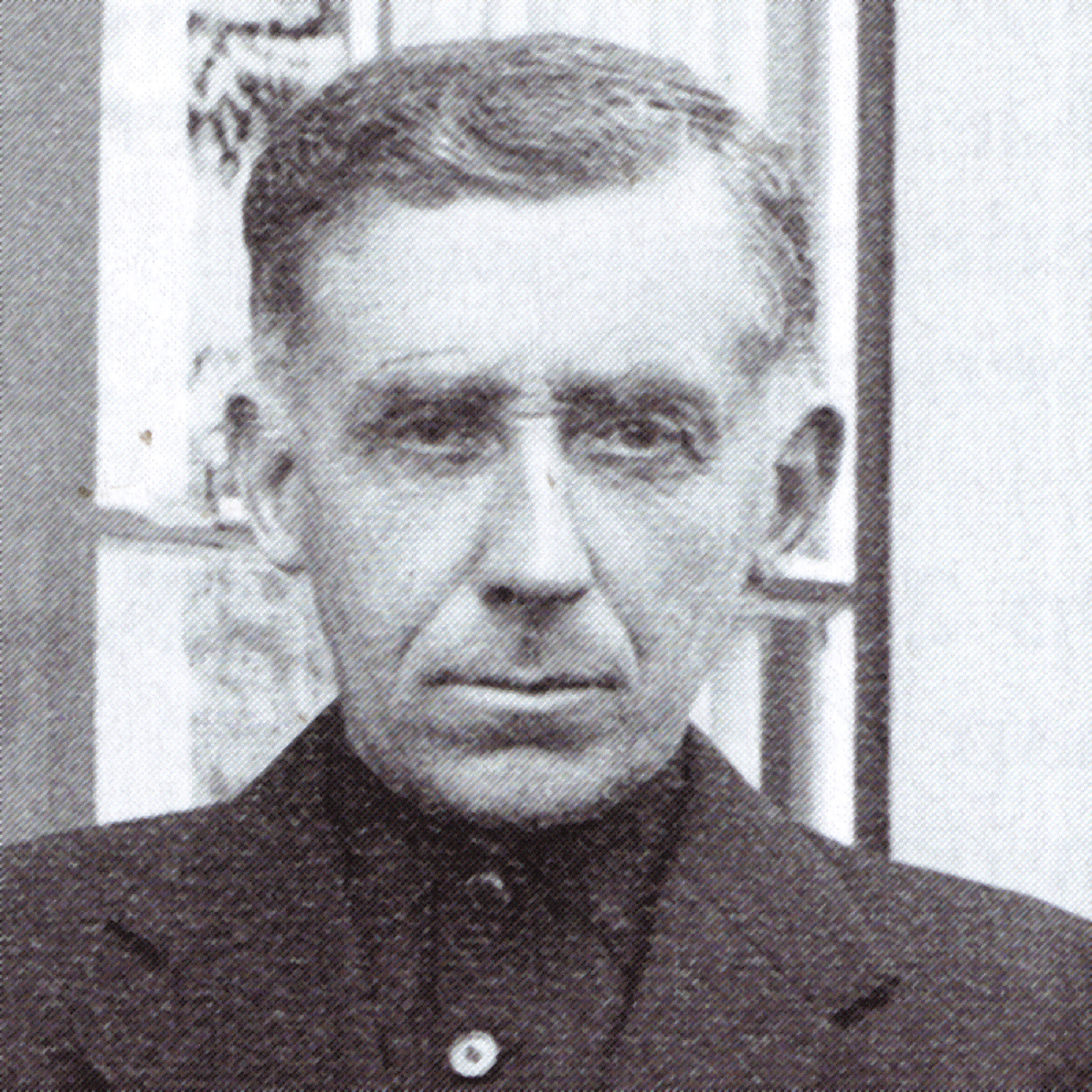
About: A farmer of Nieuw Bakelaar at Terschuur, in Barneveld, whose farm was a courier post of the Raad van Verzet. The SD took him on 5 October 1944, after a train was shot at nearby; he was sent from Amersfoort to Neuengamme as a "Terrorist" and died there on 25 December 1944 (Huurdeman, on the Oorlogsgravenstichting's page; the camp files).
Unit or role: Farmer (Bauer on the Amersfoort card, Landwirt on the death certificate) (the card; the certificate). Holder of "Koerierspost 2" of the Raad van Verzet in Huurdeman's account (the page), "posthouder B.S." on the Foundation's grave form of 1950 (the grave form).
Where: The farm Nieuw Bakelaar, at Kallenbroek near Terschuur, by the mill (the Kallenbroeker Molen on the Foundation's page, Den Olden Florus in the booklet), in Barneveld municipality (the page; the Achterveld booklet, p. 85); Stoutenburgerweg 28, Terschuur, on the Foundation's form (the grave form), typed "Stoutenbergenweg 28" on the Amersfoort card (the card).
Evidence: ✓ Amersfoort registration card; ✓ German death certificate (the camp files); the Dutch Red Cross's list of the dead; Digitaal Monument Neuengamme; the War Graves Foundation's file; civil records; his daughter Greet Schouten's account in the Achterveld booklet, pp. 85–88
He is a separate arrest from the December round-up at Achterveld, and not the father of the two Verhoef sons (Jan and Johan) taken from the Klettersteeg, whose parents were Cornelis Verhoef and Rengertje Blom (the camp files).
Wouterus Verhoef was born at Barneveld on 7 September 1879, the son of Herminus (the Dutch register has Hermanus) Verhoef and Mechtilda van den Berg (the Amersfoort card; the German death certificate; Open Archieven). His birth deed of 1879 has him born at Kallenbroek on 7 September, the son of Hermanus Verhoef, a farmer of 51, and Mechtilda van den Berg, 51 (the birth, index only).
He was a farmer, Catholic, married to Gijsbertha van den Tweel, born at Nijkerk on 4 February 1888 (Barneveld's questionnaire for the Foundation, item 13, "4 Feb. 88", read on the image, the scan; the same date in a prayer-card index). She was 27 when they married at Nijkerk on 21 April 1915, and the marriage record has her parents as Gerardus van den Tweel and Aleida Koekoek (the marriage, index only); the Foundation spells her van der Tweel on some forms. The Amersfoort card counts eleven children (the Amersfoort card). His daughter Greet Schouten, whose account is in a booklet that calls its stories oral history and disclaims responsibility for errors of fact or date (preface, p. 2), gives "vader, moeder en 12 kinderen, 7 meisjes en 5 jongens" (father, mother and 12 children, 7 girls and 5 boys) (the booklet, p. 85), and a contribution on the Oorlogsgravenstichting's page has "een vrouw en twaalf kinderen" (the page).
Children in the civil registers. They give six births to Wouterus and Gijsbertha at Kallenbroek and Barneveld between 1916 and 1921, a seventh child that died on its birthday, and the death of Johannes in 1944. The Amersfoort card's eleven are not all in them, and nobody else born after 1921 is named here (Open Archieven, index only).
- Mechtilda, born 7 February 1916; Gerardus, 20 March 1917; Hermanus, 5 March 1918; Gijsbertus, 17 April 1919.
- Aleida, called Alie, born 21 July 1920 (the birth). ◐ That she is the "Alie" of the raid below is our reading, and no source joins the two.
- For it: Alie is the usual short form of Aleida, and Aleida married Hendrikus Hermanus van Ruitenbeek, a farmer of 29 from Nijkerk, at Nijkerk on 28 September 1944, a week before the raid, which fits the St Lucas text's "pasgetrouwde dochter Alie" (newly married daughter Alie) (the marriage).
- Against it: Greet Schouten, twenty when her father died ("Ik was twintig", p. 88), calls the bride "mijn zusje" (my little sister, p. 86), and Aleida was 24 at her marriage. Zusje is often used loosely, so this does not rule Aleida out.
- Cecilia, born 25 July 1921; an unnamed child born and dead at Barneveld on 14 September 1922.
- Johannes, a farmer of 17, born at Barneveld, died on 20 January 1944 at Utrecht and was entered in Barneveld's register as "overleden in andere gemeente" (died in another municipality) (the death). The index gives no cause and nothing says whether it was war-related.
- ✓ The Utrecht deed itself, no. 181 in that city's register, has him dying at Utrecht on 20 January 1944 at four o'clock, aged 17, "landbouwer, geboren en wonende te Barneveld" (farmer, born and living at Barneveld), son of Wouterus Verhoef and Gijsbertha van der Tweel, "both living at Barneveld"; a clerk (bediende) of Utrecht, Wilhelmus Hendrikus Broekman, aged 59, made the declaration (the deed; our transcript; the index record; read on the scan).
- It gives no place of death within Utrecht, no cause, and not whether the hour is morning or afternoon, so the question the Barneveld index left open is still open. ◐ The deed above it on the page is a man from outside Utrecht, who died on 19 January 1944, declared by the same Broekman, which would fit a hospital or similar; nothing in the deed says so.
1940. Greet Schouten tells "In de aanloop naar de mobilisatie in 1940 werden er blokhoofden aangesteld" (in the run-up to the mobilisation in 1940 block heads were appointed), and "mijn vader was ook blokhoofd in zijn buurt" (my father too was block head in his neighbourhood); in May 1940 the family evacuated to Elspeet, where they lodged in the Doopsgezind Broederschapshuis, and came home after the capitulation (the booklet, p. 85).
The courier post. Huurdeman has the farm as Koerierspost 2 of the Raad van Verzet (Huurdeman, on the page). A contribution on the same page, taken from the St Lucas parish site at Achterveld, has the RVV set up a national network of courier posts in the autumn of 1944, so that couriers could carry mail from address to address and cover long distances in a day, and has him keep one of the posts with his wife, the post hidden "in een ijzeren kist die verborgen was achter in een loods" (in an iron chest hidden at the back of a shed), and wireless equipment on the farm (the page). The Foundation's grave form of 1950 gives his part as "posthouder B.S.", post-holder of the B.S. ◐ (the initials read by us as the Binnenlandse Strijdkrachten) (the grave form).
People in hiding. Greet Schouten says the family had "onderduikers en ook een Joodse jongen" (people in hiding and also a Jewish boy), who slept in the straw with the stable door open so they could run into the fields, and two engine drivers (machinisten) during the railway strike; there were meetings in the evening, and she thinks a transmitter stood on the farm for contact with England, "maar ik heb nooit geweten dat mijn ouders in het verzet zaten" (but I never knew my parents were in the resistance) (the booklet, p. 86).
A neighbour at Terschuur, Gerardus van den Beek of Stoutenburgerweg 17, whose own form calls him "the post- and intermediate-address of the Organisation Jupiter and organizer of the R.V.V. meetings", listed "W. VERHOEF, Stoutenburgerweg, Terschuur" in section 11 of his form of 5 July 1945 among the people he knew who had helped Allied personnel; the form gives no detail of what Verhoef did (Van den Beek's form, p. 2, image-checked). ✓ The form lists that name. ◐ It fits Wouterus, who lived at Stoutenburgerweg 28, but the entry has an initial, a road and a village, no first name and no number.
Another Wouterus Verhoef. The Barneveld register has a different Wouterus Verhoef, a farmer of 64, son of Johannes Verhoef and Hendrika van Voskuijlen, who died at Barneveld on 18 August 1934 (the record, index only).
With Murphy
Link to the section With MurphyNo source puts him with Murphy, and his arrest is not part of the SD's round-up of December 1944 at Achterveld (The December round-up). He was taken on 5 October 1944 (Huurdeman, on the page). By James Hardy's MI9 report, Hardy and Murphy stayed a month at Jacob Veerman's farm near Achterveld and moved on on 23 December 1944 (Hardy).
The arrest, by Huurdeman. On 4 October 1944 an RVV brigade shot at a train loaded with horses near his farm, which lies by the Apeldoorn to Amersfoort line. People in the neighbourhood were arrested as partisans, among them a courier who had nothing to do with it but who collected and delivered post at Nieuw Bakelaar (Huurdeman, on the page):
Under pressure of heavy ill-treatment he gave Wouter Verhoef's name, and the next day, 5 October 1944, a raid took place on Nieuw Bakelaar. The SD men stormed in with violence, kicking in the front and back doors, and made everyone stand with their hands up. Wouter Verhoef, his daughter Alie, who was suspected of being a courier, and one of the railway men in hiding were taken away and brought to the town hall at Nijkerk. Alie was released the next day. […] The 65-year-old Wouter Verhoef was interrogated and tortured but kept silent. No one was arrested through him.
Dutch originalOnder druk van zware mishandelingen gaf hij de naam van Wouter Verhoef door, waarop de volgende dag, 5 oktober 1944, een inval op Nieuw Bakelaar plaatsvond. Met geweld – waarbij voor- en achterdeur werden ingetrapt – stormden de SD’ers naar binnen en dwongen iedereen met de handen omhoog te gaan staan. Wouter Verhoef, zijn dochter Alie die verdacht werd koerierster te zijn, en een van de spoorwegonderduikers werden meegenomen en naar het stadhuis in Nijkerk gebracht. Alie werd de volgende dag weer vrijgelaten. [...] De 65-jarige Wouter Verhoef werd verhoord en gemarteld maar bleef zwijgen. Niemand is door zijn toedoen opgepakt.
— José Huurdeman · Ondergronds in de Tweede Wereldoorlog (2019), via the Oorlogsgravenstichting · the text
The railwayman in hiding was put to work at the Deelen airfield and later escaped; a second man at the table, who stayed seated with his head on his arms, was left alone and went into hiding elsewhere (Huurdeman, on the page). The page's other contribution, from the St Lucas site, tells it with the SD taking Wouter and one man in hiding from the farm and then driving on to his newly married daughter Alie, who was taken for questioning and let go a few days later (the page).
The arrest, by his daughter. His daughter Greet Schouten (the Oorlogsgravenstichting contribution calls him "de vader van Greet Schouten") was working away from home and came back for a few days in early October to help prepare her sister's wedding on the farm (the page; the booklet, p. 86):
A man was leaving who had been talking to my parents. He said: they can't touch me, I have a revolver in my boot. I was shocked and said to my parents: what a strange man, he has a revolver on him. Oh, said my mother, he's just talking, and that was the man, that courier, who later, after he had been tortured, gave my father's name. On the day my sister was married a train was shot at by the resistance. The Germans then picked people up, among them that courier. My father was warned. Verhoef! You must go! You must get away! I won't, said my father, for what would happen to my wife and children then. I am staying at my post.
Dutch originalEr ging een man weg, die met mijn ouders gesproken had. Hij zei; Mij maken ze niets want ik heb een revolver in mijn laars. Ik schrok en zei tegen mijn ouders; wat is dat voor een rare man, hij heeft een revolver op zak. Oh, zei mijn moeder; hij kletst maar wat en dat is de man, die koerier, geweest die later, na gemarteld te zijn, mijn vaders naam heeft genoemd. Op de dag dat mijn zus getrouwd is, is er een trein beschoten door het verzet. De Duitsers hebben toen mensen opgepakt waaronder de bewuste koerier. Mijn vader is nog gewaarschuwd. Verhoef! Je moet weg! Je moet vluchten! Dat doe ik niet zei mijn vader, want wat gebeurt er dan met mijn vrouw en kinderen. Ik blijf op mijn post.
— Greet Schouten, his daughter, in Oorlogsverhalen om nooit te vergeten (Sint Jozefkerk Achterveld, 2025), pp. 86–87 · the booklet
She left the farm on the evening she gives as "5 mei" [sic], in an account that has her home in early October and her father taken to Amersfoort on 7 October, and remembers "precies waar mijn vader stond, hoe hij keek en wat hij aan had" (exactly where my father stood, how he looked and what he was wearing), the last time she saw him (p. 87). Her brothers came the next day:
The day after, my brothers came and said: you must come home, father has been picked up. Perhaps half an hour after I had left, four men came, who kicked in the doors and stood everyone there against the wall with their hands up. Father and one of the engine drivers in hiding were taken away. My sister, who had been married only a day, was picked up later too, because she looked like a Jewish woman of about the same age. This Jewish woman was being sought. She was locked up for a night in the police station at Nijkerk. But she really knew nothing and was then let go.
Dutch originalDaags daarna kwamen mijn broers en zeiden; je moet naar huis komen want vader is opgepakt. Misschien een half uur nadat ik weg was kwam er 4 man die de deuren intrapten en de aanwezigen met de handen omhoog tegen de muur zetten. Vader en een van de ondergedoken machinisten werden meegenomen. Mijn zus, die net een dag getrouwd was, is later ook opgepakt omdat ze op een Joodse vrouw leek die ongeveer even oud was. Deze Joodse vrouw werd gezocht. Ze heeft een nacht opgesloten gezeten op het politiebureau in Nijkerk. Maar ze wist echt van niets en is toen weer vrijgelaten.
— Greet Schouten, Oorlogsverhalen om nooit te vergeten, p. 87 · the booklet
Amersfoort. By his daughter's account he spent two nights at Nijkerk and was taken to Amersfoort on 7 October (the booklet, p. 87). ✓ The camp's card, headed "Polizeiliches Durchgangslager Amersfoort", enters him as prisoner 8573, delivered on 7 October 1944, with the reason "Einsatzkomm. Deventer / Terrorist", and released on 11 October 1944 with the note "KL N", to Neuengamme (the Amersfoort card). Huurdeman writes that the camp was then called the Erweitertes Polizeigefängnis (Huurdeman, on the page).
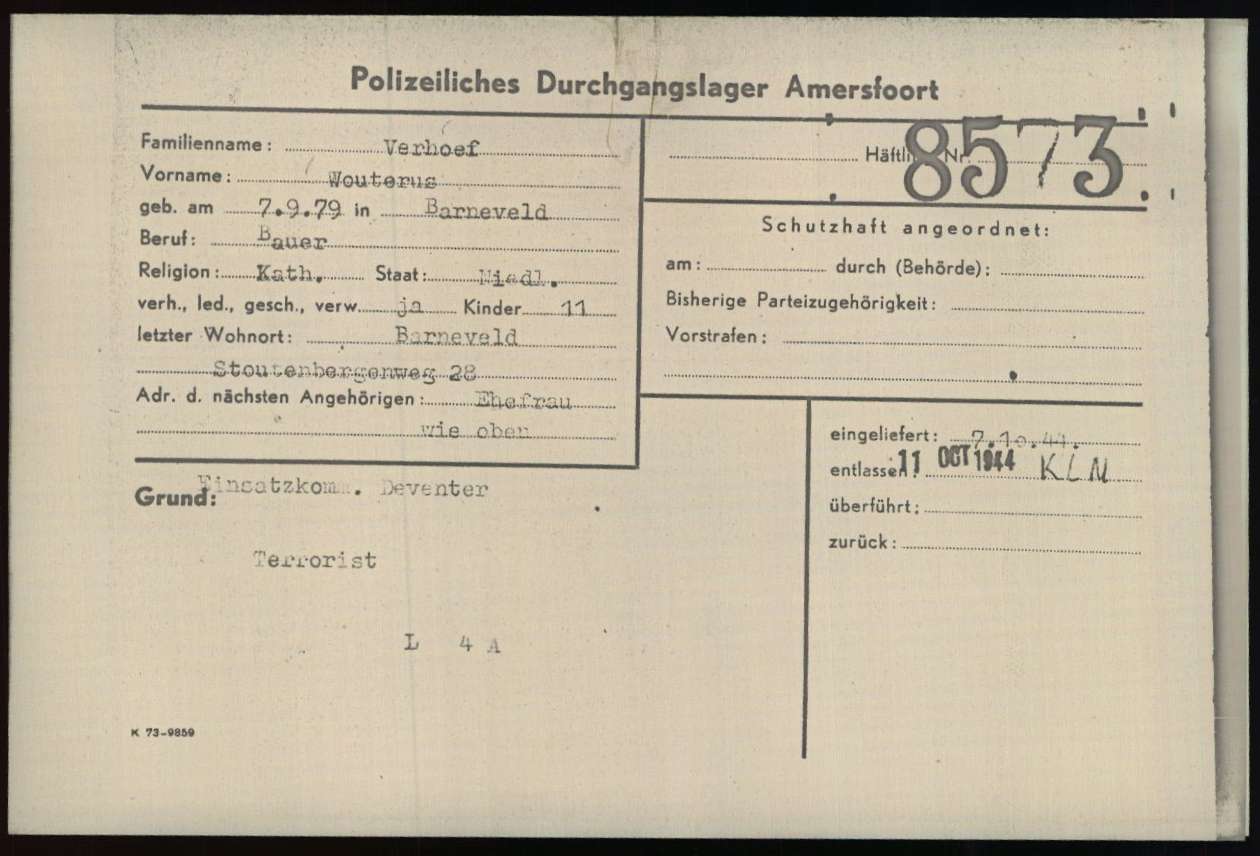
Neuengamme. Huurdeman has him sent on 11 October with the group from Putten to Neuengamme, where he arrived on 14 October, and the Neuengamme memorial gives the same arrival date, from Amersfoort (Huurdeman, on the page; Digitaal Monument Neuengamme). His daughter says the men walked from the camp to the station, "een hele grote groep van wel 1400 man" (a very big group of some 1,400 men), arrived at Neuengamme on 14 October with the men of the Putten raid, and that when the train slowed near Stroe some jumped out; "Vader niet. Hij was 65 jaar oud" (Father didn't. He was 65 years old) (the booklet, p. 87). She adds that he was registered as a terrorist and tortured: "Hij bleef zwijgen en heeft niemand verraden" (He kept silent and betrayed no one) (p. 87).
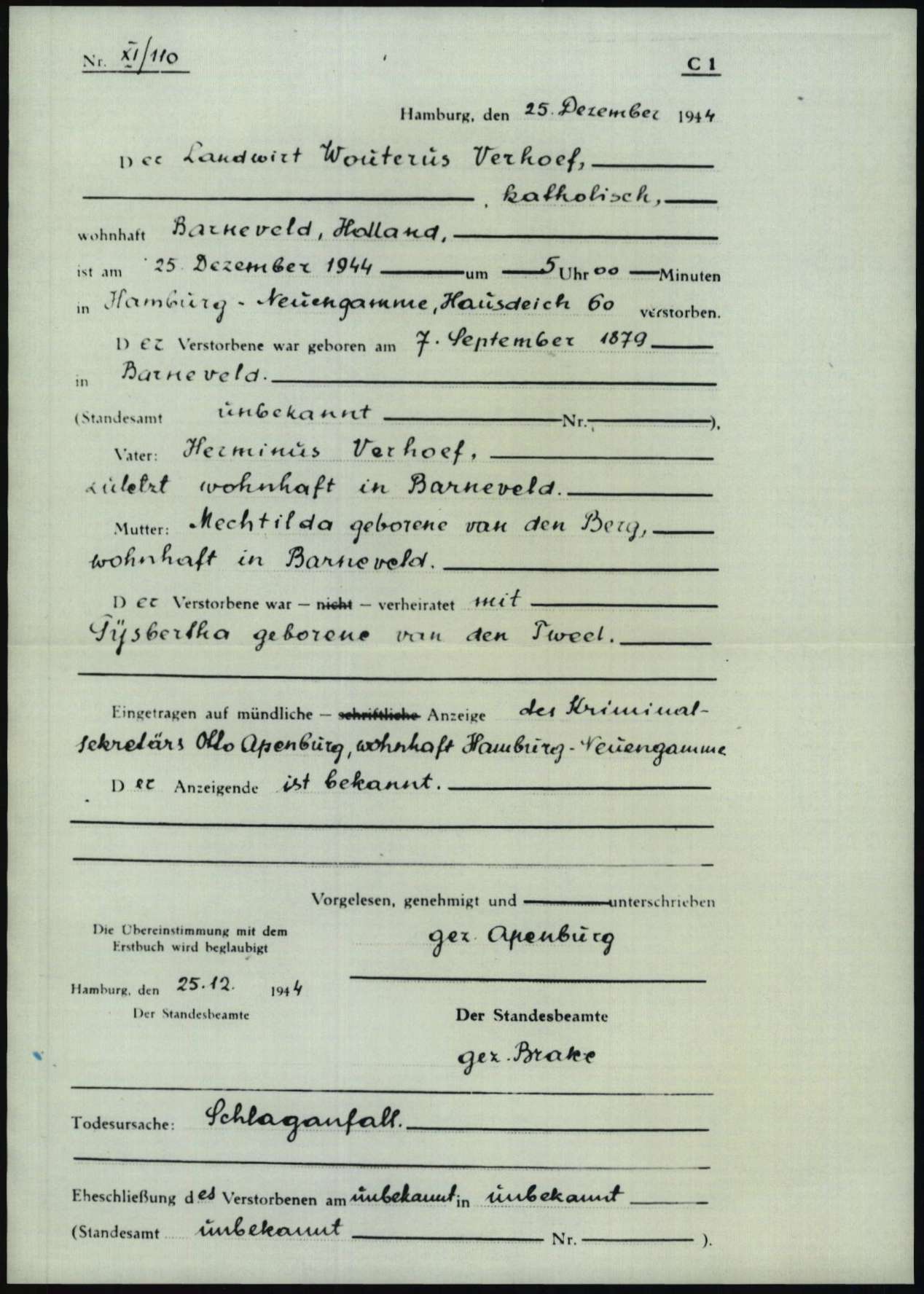
His death. ✓ He died at Hamburg-Neuengamme on 25 December 1944 at 5 a.m., of "Schlaganfall", a stroke (the death certificate). Huurdeman writes that he died that morning of deprivation, malnutrition and illness (Huurdeman, on the page).
The certificate begins "Der Landwirt Wouterus Verhoef, katholisch, wohnhaft Barneveld, Holland, ist am 25. Dezember 1944 um 5 Uhr 00 Minuten in Hamburg-Neuengamme, Hausdeich 60, verstorben" (the farmer Wouterus Verhoef, Catholic, resident at Barneveld, Holland, died on 25 December 1944 at 5.00 a.m. at Hamburg-Neuengamme, Hausdeich 60) (Arolsen Archives 1.1.30.2).
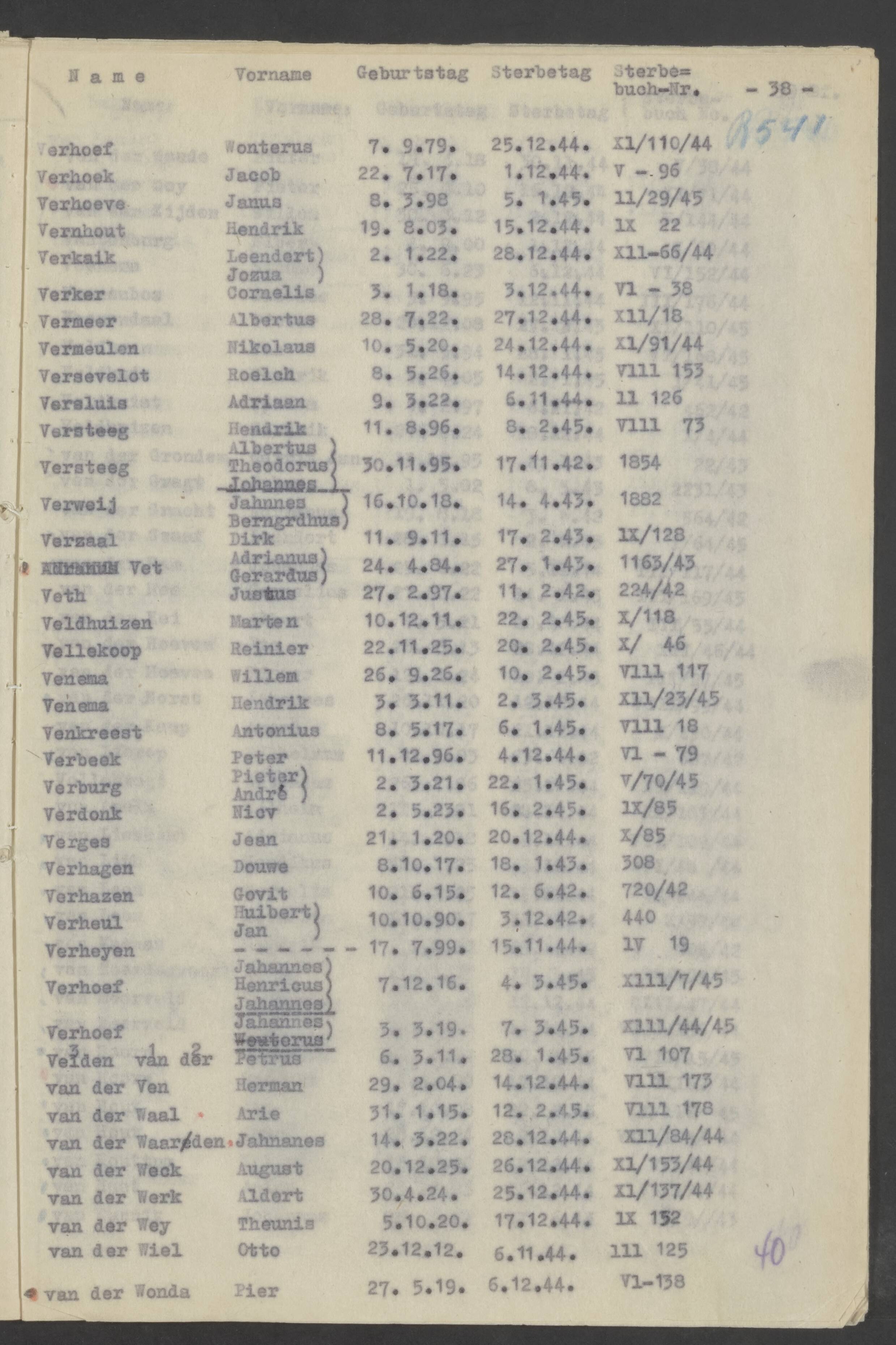
✓ The Dutch Red Cross's typed list of Dutch dead in Kreis Hamburg has him in its first row on page 38, "Verhoef | Wonterus | 7. 9.79. | 25.12.44. | X1/110/44", the last column the number of the certificate; the same page has Jan and Johan Verhoef of the Klettersteeg (the list, read on the scan). Barneveld registered the death of a landbouwer of 65 on that day, "Neuengamme (Duitsland)", deed 184 of 1945, naming his wife (Open Archieven). The Neuengamme memorial has the same stroke ("Beroerte"), at Hausdeich 60 (Digitaal Monument Neuengamme). The state's roll of honour has him too, "Verhoef, Wouterus, Barneveld 7·IX·1879, Landbouwer, Neuengamme 25·XII·1944", the same birth and death days (the roll, folio 732, read by eye; its website record).
The news at home. By his daughter's account, the parish priest came on 6 February and told her mother "Vader is met Kerstmis overleden" (Father died at Christmas); he had the news "van de opperbevelhebber uit Barneveld" (from the commander from Barneveld). "Er is een begrafenis geweest met een lege kist, maar ik kan me er niets meer van herinneren" (There was a funeral with an empty coffin, but I can't remember anything of it). Her brothers carried on the farm. "Later hoorden we dat ze gecremeerd waren. Wij hebben een steen geplaatst daar in Neuengamme" (Later we heard that they had been cremated. We placed a stone there at Neuengamme) (the booklet, pp. 87–88).
The Foundation's file. The grave form of 1950 says he was cremated and died of "armoede en ellende" (poverty and misery), 24 December (the grave form). Barneveld's questionnaire of October 1956 has 25 December, adds that "Betr. is gedwongen naar Duitsland vertrokken. Is door de Duitsers gearresteerd. Was, voor zover bekend, politiek betrouwbaar" (taken to Germany by force, arrested by the Germans, politically reliable as far as known), and gives his parents as Hermanus Verhoef and Mechtilda van den Berg (the questionnaire).
His widow. She was at Stoutenburgerweg 28, Terschuur, on the Foundation's form of 1950 (the grave form), and Barneveld's questionnaire of 1956 gives the widow's address in handwriting as Stoutenburgerweg 21, Terschuur (the questionnaire, item 19). The file also holds an address-change card of 1966 and an enquiry of 30 October 1967 for a "G. Verhoef-van der Tweel" at Adm. de Ruyterlaan 165, Hilversum; Hilversum's answer on the back is about "Grietje van der Tweel weduwe van Jan Verhoef", who died there on 11 February 1967, so neither paper is shown to concern Gijsbertha, and the card's victim lines look like a filing mix-up (the card; the enquiry; the answer; the file's README). ✓ Gijsbertha van den Tweel died at Nijkerk on 4 February 1971, the register naming Wouterus Verhoef as her husband (her death record, index only); a prayer-card collection has the same day and her birth at Nijkerk on 4 February 1888 (the card's index entry), and their daughter writes "Moeder is in 1971 overleden" (the booklet, p. 88).
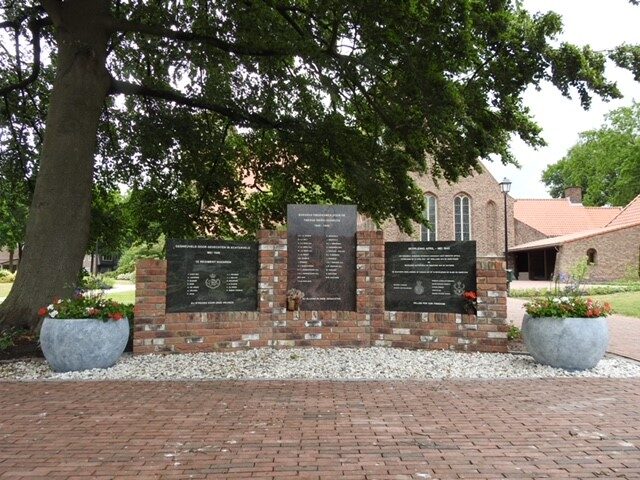
Remembered. He is on the war memorial by the Sint-Jozefkerk at Achterveld, "W. VERHOEF" among the civilian dead, and its register gives him as "W. Verhoef (geboren 7-9-1879, overleden in het Duitse concentratiekamp Neuengamme op 25-12-1944)" (4 en 5 mei; the Oorlogsgravenstichting's page).
Where the sources disagree
Link to the section Where the sources disagree- The day of his death. ✓ 25 December 1944: the German death certificate, the Red Cross list, Barneveld's death register, the Barneveld questionnaire of 1956, Huurdeman and the Neuengamme memorial. The Oorlogsgravenstichting's page and the grave form of 1950 have 24 December (the page).
- The cause. A stroke on the German certificate and the Neuengamme memorial; "armoede en ellende" on the Foundation's form; deprivation, malnutrition and illness in Huurdeman; "de ontberingen in het kamp" (the hardships of the camp) in his daughter's account, with "Ze geven de dood en oorzaak maar wij weten het niet" (they give the death and the cause, but we don't know) (the booklet, p. 87). ◐ These need not conflict: the certificate names the final event, the others the conditions he died in. The certificate is the primary record.
- The father's name. Herminus on the German certificate only; Hermanus in the Dutch death register, Barneveld's questionnaire of 1956 and his own birth deed of 1879 (the birth).
- His birth year. 1879 on every record but two: the Amersfoort index card types "7.9.77" (the camp files), and the Open Archieven index of the roll of honour has 1897, where the printed roll has 1879 (the index record).
- The number of children. Eleven on the Amersfoort card; twelve in his daughter's account and in a contribution to the Oorlogsgravenstichting's page.
- Who was taken from the farm. Huurdeman: Wouterus, his daughter Alie and one of the railwaymen in hiding. The St Lucas contribution: Wouterus and one man in hiding. Greet Schouten: her father and one of the engine drivers in hiding, by four men (the page; the booklet, p. 87).
- The married daughter's arrest. ⚠︎ Not settled, and ◐ it rests on Alie being the Aleida of the registers, which Greet Schouten's "mijn zusje" and age leave open (above).
- Huurdeman: taken from the farm with her father as a suspected courier, freed the next day.
- The St Lucas contribution: the SD drove on to his newly married daughter afterwards, and she was freed a few days later.
- Greet Schouten: her sister, "die net een dag getrouwd was" (married just a day), was picked up later because she looked like a Jewish woman who was being sought, and spent a night in the police station at Nijkerk.
- The wedding. ◐ If Alie is Aleida: the civil marriage of Aleida Verhoef at Nijkerk was on 28 September 1944, a week before the raid (the marriage). Greet Schouten has the train shot at on her sister's wedding day, which Huurdeman dates 4 October, and has the sister, picked up after the raid, "net een dag getrouwd" (married just a day) (p. 87). A civil and a church wedding can fall on different days, but no source says they did here, and Greet calls the bride her zusje (little sister) where Aleida was about four years older (above).
- When he left for Germany. The Foundation's grave form of 1950 has 9 October 1944; the Amersfoort card has him released to Neuengamme on 11 October and the memorial has him arrive on 14 October (the grave form; the Amersfoort card). ◐ The form does not say who supplied its answers, so its 9 October may or may not be the family's.