J. van Vemde
Stiens 13 Jun 1905 – Aug 1974
About: Jan van Vemde of Aerdenhout, evacuated to Wekerom, who with Kauffeld and Bettink hid and fed Allied soldiers after Arnhem and after Pegasus II; ◐ very probably the keeper of the dug-out where Murphy hid from 20 to 24 November 1944. The SD arrested him on 24 November and released him on 20 January 1945.
Unit or role: A 1st Lieutenant of Engineers by his own form, with "Reserve" struck out (p. 4); by 1974 the former director of the contracting firm J. van Vemde B.V. of Beverwijk (the firm's notice), ◐ the contractor at Roekel in 1942 (below); a helper of Allied soldiers, naming no underground organisation; Grade 5 on the American and British lists.
Where: Bentveldsweg 100, Aerdenhout, in 1946; "Otterloo, Agneta Hoeve", the address the Allied men knew (his form, p. 4); in 1944 Krijgsman's house on the Roekelseweg at Wekerom, by Ede's history (Ede manuscript, p. 48); ◐ Otterloscheweg 84, Roekel, in 1942 (below).
Evidence: ✓ his own helper file with the Americans, US National Archives 286711685 (his form, p. 4; his letter of 20 May 1946, p. 8; pp. 1–9 in all); ✓ Boeree, Kroniek van Ede (1947), pp. 188, 201–203, checked on the page images; ✓ Ede, manuscript "Het Verzet", pp. 48–49 (Gemeentearchief Ede 1006/1160); ✓ the British index of Dutch helpers, sheet V/5; ◐ Hardy's MI9 report, for the dug-out, which does not name him.
- ✓ Birth. Jan van Vemde was born at Stiens on 13 June 1905, the son of Andries Bernardus van Vemde, 37, a spoorwegambtenaar (railway official), of Stiens, and Martje Vondeling; the birth was registered at Leeuwarderadeel the next day (the birth record, index of the Leeuwarderadeel register, 1905, no. 141; the population register entry; what they say). The scans were not seen: Tresoar's image server was offline on 21 October 2026.
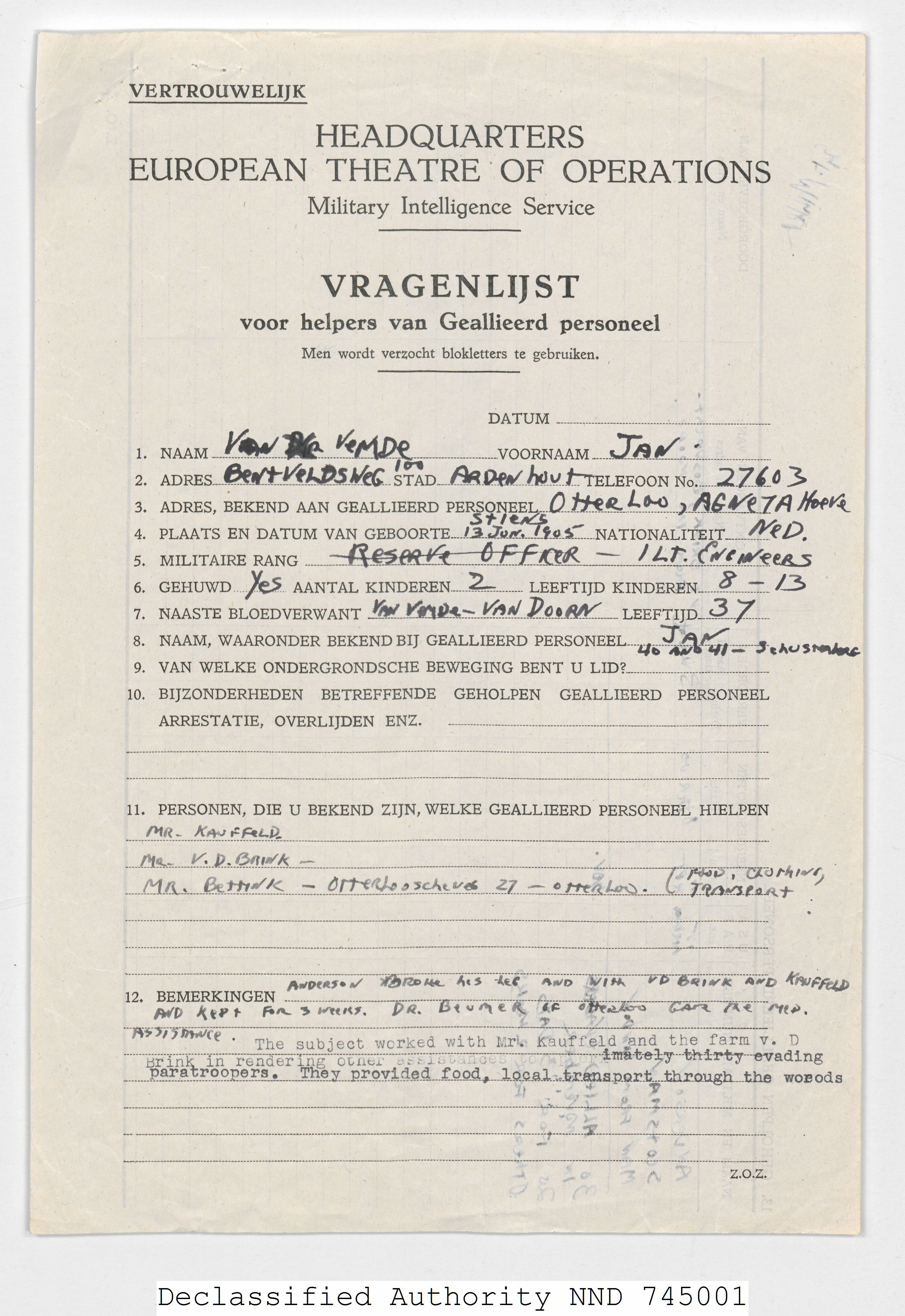
- ✓ His form. Filled in by hand in block capitals and undated: "VAN VEMDE" (a "DE" struck out before the surname), first name "JAN", of "BENTVELDSWEG 100", "ARDENHOUT" [sic], telephone 27603; born at "STIENS 13 JUN. 1905"; married, two children aged 8 and 13; next of kin "VAN VEMDE - VAN DOORN", aged 37; known to the Allied men as "JAN", with a line below, "40 AND 41 - SCHUSTERBERG [?]", which ◐ we cannot explain (p. 4, read on the image).
- His rank reads "RESERVE OFFICER - 1LT. ENGINEERS", with a line through "RESERVE" only (read on the image; whether he struck it as wrong or as out of date is not shown); the office's typed copy has only "Lt. Eneweers" [sic] (p. 2), and "Jan." in the date box, a partial date where the hand form has none.
- The question on his underground organisation is left blank (p. 4).
- ◐ The army. The Nationaal Archief's index of soldiers' service records for men born 1900–1910 has a "J. van Vemde", born 1905, inventory 8487, registration number 05.06.13.004 (the index record; what it says). The number is year, month, day and a running number, as on Gerrit van Ee's army number (see his page), so it reads as 13 June 1905, the date on his own form and in his birth record. That is a date read from a number; the index has no first name or place, and the service record itself was not seen.
- ✓ Marriage. He married Antje van Doorn at Utrecht on 2 January 1930: the record gives him as 24, born at Leeuwarderadeel, the son of Andries Bernardus van Vemde and Martje Vondeling, and her as 22, born at Hoorn, the daughter of Gijsbertus van Doorn and Leuntje Hofmeester (the marriage record, index of Het Utrechts Archief, Utrecht 1930, no. 6; what it says).
- The Leeuwarder courant of 3 January 1930 carried the notice, "Getrouwd: J. VAN VEMDE en A. VAN DOORN. Utrecht 2 Januari 1930" (the notice, read on the page image). His wife is the "VAN VEMDE - VAN DOORN" of his form (above).
- ◐ Roekel, 1941–1942. De Arnhemsche courant of 3 January 1942 lists "J. van Vemde, gez., Otterloscheweg 84, Ede, v. Bloemendaal" among the arrivals at Ede from 22 to 27 December 1941 (gez., with a family; his letter of 1946, written from Aerdenhout, has him living "weer in Bloemendaal", in Bloemendaal again, after the war) (the list).
- On 6 July 1942 its trade-register column has "J. van Vemde, Roekel, gem. Ede, Otterloscheweg 84, aann.-bedr. Zaak per 1-6-1942 verpl. naar H'stede": a contractor's business at Roekel, moved on 1 June 1942 to "H'stede", ◐ Heemstede (the entry).
- Both read from the page image. Initial and surname only, so ◐: they fit a man who later hid soldiers in the woods at Roekel, lived at Aerdenhout and ran a contracting firm (below), but neither says what became of the house after June 1942.
Three paratroopers, September 1944
Link to the section Three paratroopers, September 1944- ✓ His letter. Most of the men he helped, he wrote, were paratroopers dropped near Arnhem from 17 to 20 September 1944. "De eerste werd door mij gevonden op 18 September 1944. Zijn naam is, voorzoover ik mij herinneren kan, Anderson. Deze had zijn kuitbeen gebroken." (I found the first on 18 September 1944. His name, as far as I can remember, is Anderson. He had broken his calf bone.)
- "Met behulp van Mr.Kauffeld is deze verborgen gehouden in een schuur op het terrein van Mr.Kauffeld" (with Mr Kauffeld's help he was kept hidden in a barn on Mr Kauffeld's land). On 19 September Bettink found another in the wood, and a few days later a third came in.
- After Dr Beumer of Otterlo had seen to the wounded man, the three were given civilian clothes after about three weeks and handed to "een zekere Edens van Harskamp" (one Edens of Harskamp), and crossed the Rhine "via diverse menschen" (through various people) (his letter, p. 8).
- ✓ His form. His table lists "ANDERSON", "SCOTSMAN" and "MAN FROM LONDON", only Anderson's row filled in: "1ST AIRBORN", "17 SEPT", "OTTERLOO", "3 WEEKS", received from "V D BRINK, BOSWACHT- FROM THE WOODS" (the forester H. van de Brink) (p. 5). His remarks: "ANDERSON BROKE HIS LEG AND WITH VD BRINK AND KAUFFELD AND KEPT FOR 3 WEEKS. DR. BEUMER OF OTTERLOO GAVE THE MED. ASSISTANCE." (p. 4).
- ✓ His neighbours. Kauffeld's own table has "Cpl R. Anderson 2nd Bn Par. Rgt. 1126901" and "Christofer Glidle same Rgt", 14 days each (Kauffeld's file, p. 8), and names "Dr. Beensma, Otterlo" as having "attended injured men" (p. 7). Bettink's form lists "R. ANDERSON CHR. GLIDLE PARA TROOP REG." (Bettink's file, p. 4).
With Murphy
Link to the section With MurphyAfter the crossing, 18–20 November
Link to the section After the crossing, 18–20 November- ✓ Ready to help. With the helpers at Kootwijkerbroek in hiding after the arrests there of 15 November, "Gelukkig waren Kauffeld, van Vemden, Betting en Morren, die in de naaste omgeving woonden, tot helpen bereid" (fortunately Kauffeld, Van Vemden, Bettink, printed "Betting", and Morren, who lived close by, were ready to help) (Boeree, p. 201).
- ✓ Six men behind the Agneta farm. On the Monday (◐ 20 November; see Where the sources disagree) six men had walked off from the wood meaning to go back to Westeneng and ended up at a Pol's, who handed them to Bettink (below).
- When Rinus got home that day, word was waiting that "Bettink had gemeld, dat hij zes man bij van Vemden had opgeborgen" (Bettink had reported that he had put six men away at Van Vemden's) (same page). Rinus had by then agreed that the troop would be fetched with horse and wagon that evening.
- "De vier man van Heiwegen werden weggehaald, twee gingen naar Rap, twee naar het hol" (Heiwegen's four men were fetched; two went to Rap, two to the hole) (same page). ◐ "The hole" is very probably the dug-out at Van Vemden's, which Boeree calls "het hol bij van Vemden" on the next page.
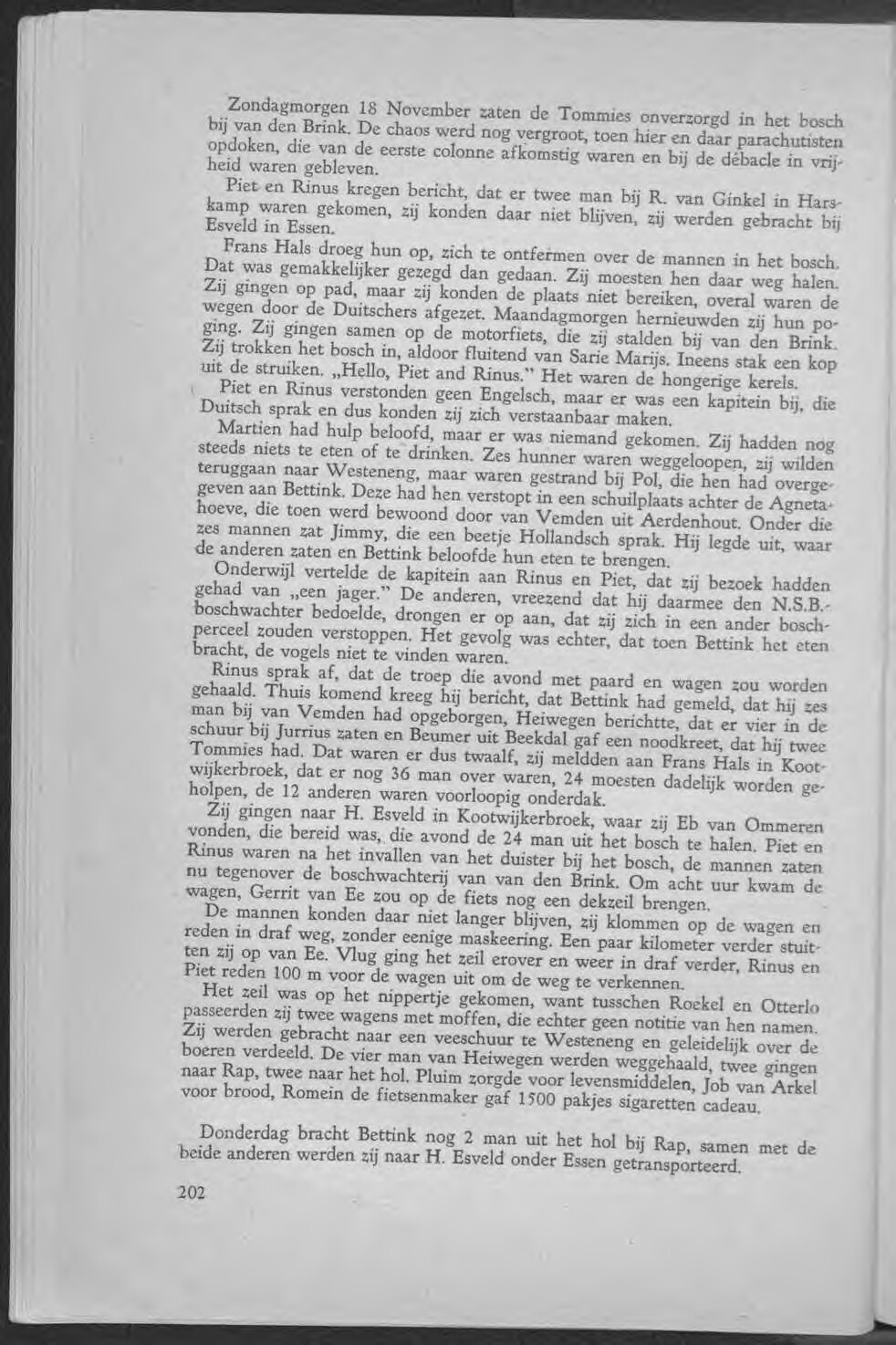
He had hidden them in a hiding place behind the Agneta farm, then lived in by Van Vemden from Aerdenhout. Among those six men was Jimmy, who spoke a little Dutch.
Dutch originalDeze had hen verstopt in een schuilplaats achter de Agneta-hoeve, die toen werd bewoond door van Vemden uit Aerdenhout. Onder die zes mannen zat Jimmy, die een beetje Hollandsch sprak.
— Th. A. Boeree · Kroniek van Ede (1947) · p. 202, checked on the page image
◐ Boeree's six who walked off are possibly Hardy's five (below), ◐ at most: the counts differ, and Boeree has the six with Bettink by the Monday morning, while Hardy's party left its wood at about three that morning and reached the farmer at the edge of Otterlo only at first light. Hardy has "BRENTFORD" (Branford), "who spoke Dutch", talk to the farmer (Hardy), so Boeree's Jimmy is ◐ possibly Branford, though Hardy was a James too.
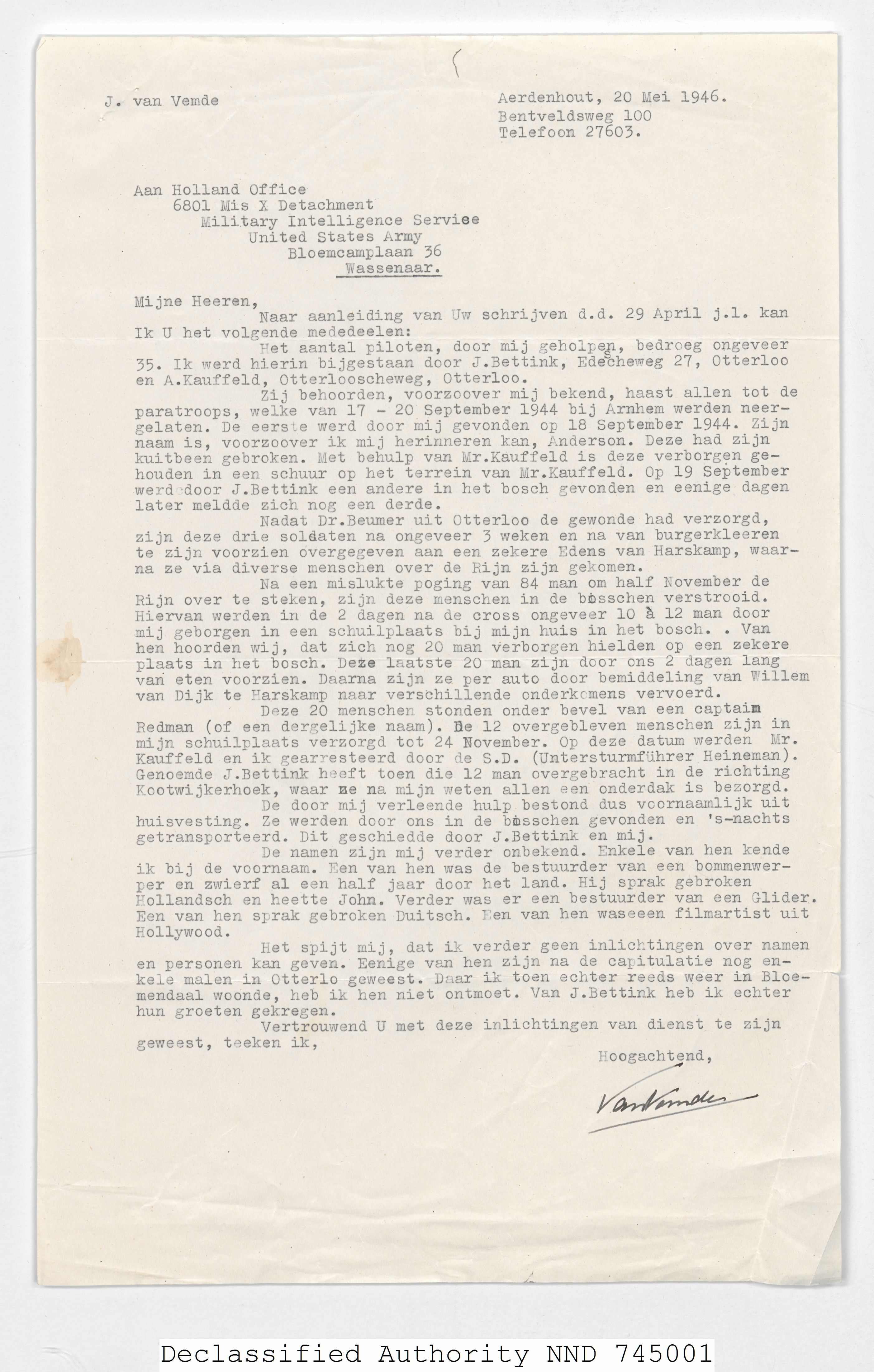
In his own words, to the Americans, after an attempt by 84 men to cross the Rhine in the middle of November:
these men were scattered through the woods. Of them, about 10 or 12 were taken in by me, in the 2 days after the crossing, in a hiding place by my house in the wood. From them we heard that another 20 men were hiding at a certain place in the wood. These last 20 we kept supplied with food for 2 days. After that they were taken by car, through Willem van Dijk of Harskamp, to various shelters.
Dutch originalzijn deze menschen in de bosschen verstrooid. Hiervan werden in de 2 dagen na de cross ongeveer 10 à 12 man door mij geborgen in een schuilplaats bij mijn huis in het bosch. . Van hen hoorden wij, dat zich nog 20 man verborgen hielden op een zekere plaats in het bosch. Deze laatste 20 man zijn door ons 2 dagen lang van eten voorzien. Daarna zijn ze per auto door bemiddeling van Willem van Dijk te Harskamp naar verschillende onderkomens vervoerd.
— J. van Vemde to the Holland Office, 6801 MIS-X Detachment · Aerdenhout, 20 May 1946 · his file, p. 8
The twenty, he went on, "stonden onder bevel van een captaim [sic] Redman (of een dergelijke naam)" (were under the command of a Captain Redman, or some such name) (p. 8). ◐ They were very probably the party from Elburg that missed the column, with Capt. Redman, RAMC, among them, which was fetched from the wood on the evening of 20 November; the other accounts have them taken by horse and wagon to a barn, ◐ J. van Essen's by Noordman, where his car does not fit (Where the sources disagree). Willem van Dijk's page has his part. ⚠︎ Charles Noble's own later account (unpublished private papers, shared with us privately), told long after the war, has "Theo Redman whom I knew from 133 Field Ambulance" in that party and puts it at "about twenty to twenty five", and does not say who was in command.
The dug-out
Link to the section The dug-out✓ James Hardy's MI9 report has Murphy's party, five men, leave the wood at about three in the morning of 20 November and stop at a farm on the outskirts of Otterlo:
The farmer gave us a meal and then sent us off with a young lad who took us down to a dug-out in the woods near ROEKEL at approx. 614905. Here we found five more evaders including Pte. MOORE … It was a very small dug-out and we were very cramped and with 10 men living in it the atmosphere was very bad.
— MI9 · Pte J. Hardy, 16 Parachute Field Ambulance · IS9/WEA/1/270/2351 · 13 January 1945 · the report
After four nights Hardy "spoke to the man who had taken us there (and who brought us our food)", and on the morning of 24 November he and Murphy left "with our friend" for the farm at Otterlo (same). Hardy does not name the man.
◐ That is very probably Van Vemde's hiding place: about ten men, by his letter's count ten or twelve; Hardy's map reference converts to a point by the Immenkampweg and the Roekelseweg at Wekerom (the conversion), the road where Ede's history puts him in Krijgsman's house (Ede manuscript, p. 48); and by his letter he kept it until 24 November, the morning Hardy and Murphy left (Boeree has the men moved to Morren's wood before the raid: Where the sources disagree). No source names Murphy with him, and his file does not name Murphy (What the helpers told the Americans).
- ✓ Fed by the neighbours (Boeree, p. 203, checked on the page image).
- "De mannen in het hol bij van Vemden werden goed verzorgd, mede dank zij de hulp van de familie Kauffeld, die op de Roekel woonde." (The men in the dug-out at Van Vemden's were well cared for, partly thanks to the help of the Kauffeld family, who lived at Roekel.)
- A better hiding place, "prachtig gemaskeerd" (beautifully camouflaged), was then made in the wood behind Morren's house and the men were moved there; "'s morgens bracht Bettink hun daar brood, 's middags zorgden de families Kauffeld en van Vemden voor een groote ketel stamppot" (in the morning Bettink brought them bread there; at midday the Kauffeld and Van Vemden families provided a big pan of stamppot).
- ◐ Two men moved on.
- "Donderdag bracht Bettink nog 2 man uit het hol bij Rap, samen met de beide anderen werden zij naar H. Esveld onder Essen getransporteerd" (on Thursday Bettink brought 2 more men out of the hole at/to Rap's; with the other two they were taken to H. Esveld near Essen) (Boeree, p. 202).
- The paragraph before it has Heiwegen's four men taken away, "twee gingen naar Rap, twee naar het hol" (two went to Rap, two to the hole), so the hole is a place apart from Rap's. ◐ That favours Bettink taking two more men from the hole to Rap's, to join the two already there, over taking two men out of the hole at Rap's; either way the four went on to H. Esveld near Essen. Boeree's Thursday is ◐ 23 November.
- ✓ The men he remembered (his letter, p. 8). "De namen zijn mij verder onbekend." (The names are otherwise unknown to me.)
- He knew some by first name: "Een van hen was de bestuurder van een bommenwerper en zwierf al een half jaar door het land. Hij sprak gebroken Hollandsch en heette John." (One of them was the pilot of a bomber and had been wandering the country for half a year. He spoke broken Dutch and was called John.)
- There was also "een bestuurder van een Glider" (a glider pilot); one spoke broken German; and one "waseeen [sic] filmartist uit Hollywood" (was a film actor from Hollywood).
- ◐ Hardy's party had one of each, but they do not line up cleanly: Branford, RAF, had been five months in hiding but was a bomb-aimer, not a pilot, and it is the glider pilot Haller whom the MI9 reports call "John" (Haller's page).
Arrested, 24 November 1944
Link to the section Arrested, 24 November 1944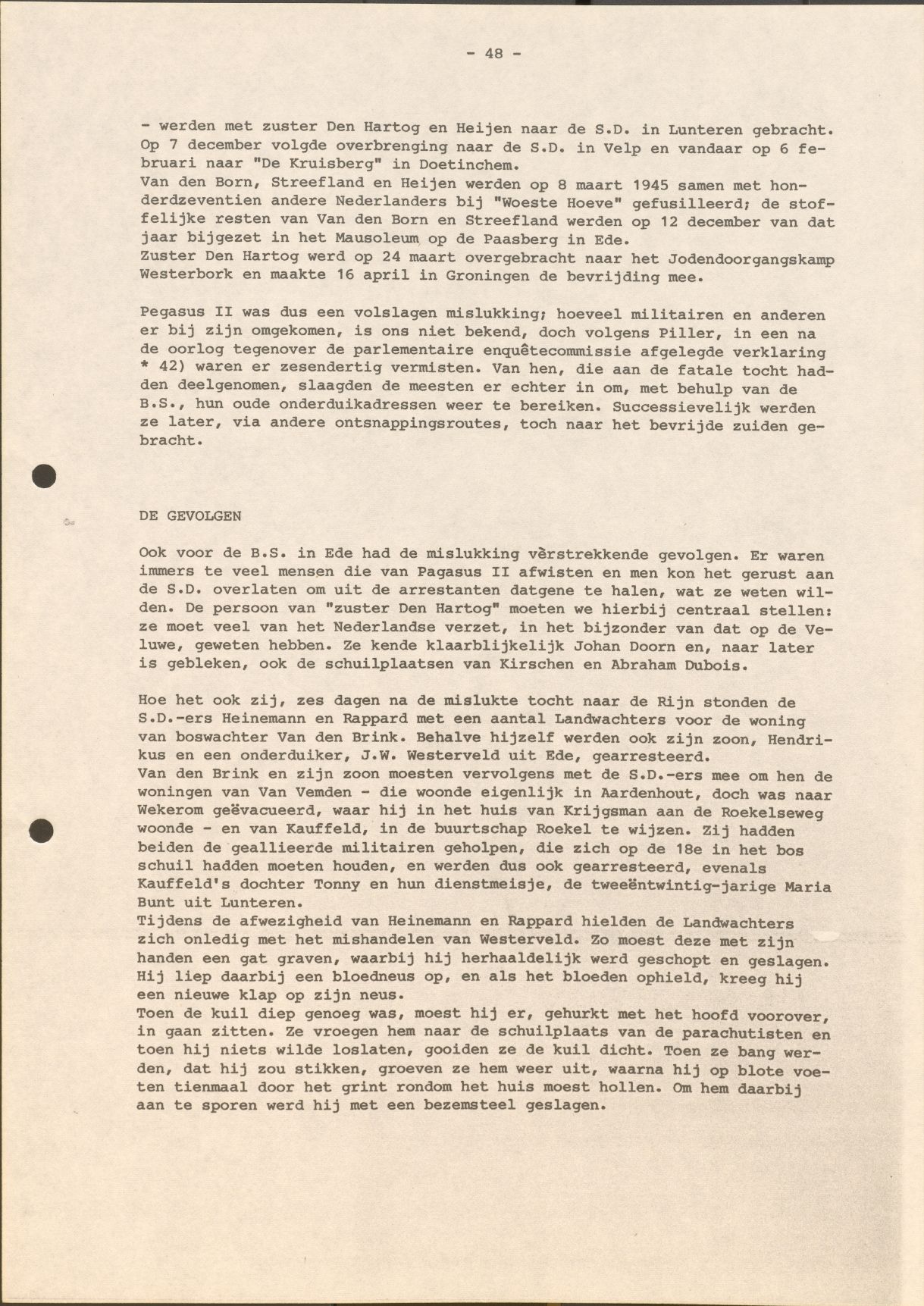
- ✓ His own date (his letter, p. 8).
- "De 12 overgebleven menschen zijn in mijn schuilplaats verzorgd tot 24 November. Op deze datum werden Mr. Kauffeld en ik gearresteerd door de S.D. (Untersturmführer Heineman)." (The 12 who were left were looked after in my hiding place until 24 November. On that date Mr Kauffeld and I were arrested by the SD, Untersturmführer Heineman.)
- "Genoemde J.Bettink heeft toen die 12 man overgebracht in de richting Kootwijkerhoek, waar ze na mijn weten allen een onderdak is bezorgd." (The said J. Bettink then moved those 12 men towards Kootwijkerhoek, ◐ Kootwijkerbroek, where as far as I know they were all found shelter.)
- ✓ Ede's history. Six days after the failed march the SD men Heinemann and Rappard, with a number of Landwacht men, arrested the forester Van den Brink, his son Hendrikus and an onderduiker, J. W. Westerveld of Ede, and the forester and his son had to show them the houses of Van Vemden and of Kauffeld:
- "Van Vemden — die woonde eigenlijk in Aardenhout, doch was naar Wekerom geëvacueerd, waar hij in het huis van Krijgsman aan de Roekelseweg woonde" (Van Vemden, who really lived at Aerdenhout but had been evacuated to Wekerom, where he lived in Krijgsman's house on the Roekelseweg).
- "Zij hadden beiden de geallieerde militairen geholpen, die zich op de 18e in het bos schuil hadden moeten houden, en werden dus ook gearresteerd" (they had both helped the Allied soldiers who had had to hide in the wood on the 18th, and so they were arrested too), with Kauffeld's daughter Tonny and their maid, Maria Bunt (Ede manuscript, p. 48).
- All were taken to "De Wormshoef" in Lunteren (p. 49). The forester's page has the same round from his side (H. van de Brink).
- ✓ Boeree. "Op 24 November werd razzia gehouden in Otterlo en Roekel. Van Vemden en Kauffeld werden gearresteerd." (On 24 November a raid was held at Otterlo and Roekel. Van Vemden and Kauffeld were arrested.) The Germans missed Bettink, who was with the men in the hiding place bringing their bread (Boeree, p. 203).
- That evening Bettink set off with the men; they lost their way and came to Kamphuis at Wekerom, and a column of "de 8 Tommies op fietsen" (the 8 Tommies on bicycles) went through Otterlo, Rinus in front and Piet at the rear: "Allen werden opgeborgen bij van Ee in Essen" (all were put away at van Ee's in Essen) (p. 203). ◐ Which Van Ee is not shown (Other men named Van Ee).
- ◐ Hardy and Murphy had left the dug-out that morning, so they were not in the column (Hardy).
The Wormshoef and Velp
Link to the section The Wormshoef and Velp- ✓ The Wormshoef. "Kauffeld en van Vemden werden overgebracht naar de Wormshoef, de huiszoeking in hun woningen had niets opgeleverd." (Kauffeld and Van Vemden were taken to the Wormshoef; the search of their houses had found nothing.) There they met Streefland, Van den Born, Heijen, "Martien" (Abraham du Bois) and Sister Den Hartog (Boeree, p. 203). Sister Den Hartog heard there that Martien had been taken "en dat ook Kauffeld en van Vemden waren gegrepen" (and that Kauffeld and Van Vemden had been seized too) (p. 188).
- ✓ To Velp. Her account has the move on 7 December: "Op 7 December ging zij op transport naar Velp. Daarheen werden ook overgebracht Martien, van den Born, Streefland, Dr. Gerritsen, Heijen, Kauffeld en van Vemden." (On 7 December she was sent on transport to Velp. Also taken there were Martien, Van den Born, Streefland, Dr Gerritsen, Heijen, Kauffeld and Van Vemden.) (p. 188).
- ✓ In the cellar. Charles Verbruggen of Bennekom wrote to the American office on 21 January 1946 that Frank Coslett, who by the letter lived at the office's address, "was with me in the cellar of the prison in the Rotterdam Bank [sic] at Velp with Det. Gerritgen [?] and Instr. Kauffeld, van der Vemde etc." (his letter, p. 9; the date read on the image).
- ✓ Released, 20 January 1945. "Daar werden ze op 20 januari 1945, zes weken later dus, vrijgelaten en konden naar huis terug gaan" (there they were released on 20 January 1945, six weeks later, that is, and could go home) (Ede manuscript, p. 49). Boeree has Van Vemden discharged on 20 January (p. 203).
The uniform
Link to the section The uniform✓ In the prison at Velp:
Martien told Van Vemden that he absolutely had to have his uniform back to prove he was a soldier. When Van Vemden was discharged on 20 January he promised to see to it.
Dutch originalMartien vertelde aan van Vemden, dat hij noodzakelijk zijn uniform moest terughebben om te bewijzen dat hij militair was. Toen van Vemden op 20 Januari werd ontslagen beloofde hij er voor te zorgen.
— Th. A. Boeree · Kroniek van Ede (1947) · p. 203
The uniform lay with Knottenbelt. "Tweemaal ging van Vemden op pad, beide keeren werd hij geschaduwd." (Twice Van Vemden set out; both times he was shadowed.) Then Bettink took it over, and Flip delivered the parcel to the Ortscommandant (the local German commandant) at Ede, who did not send it on; it was fetched from there and handed in at Velp (Boeree, p. 203, checked on the page image). The rest of Martien's story is on Abraham du Bois's page.
The Americans, 1946
Link to the section The Americans, 1946- ✓ The interview and the questions. On 29 April 1946 Lt Felix Bilgrey of the American office at Wassenaar wrote to him "Naar aanleiding van Uw onderhoud met kapitein Coslett" (following your interview with Captain Coslett, ◐ Frank Coslett, see In the cellar), asking ten questions: how many pilots, their names, from whom and to whom, when, shelter or transport, and so on (p. 9). His letter of 20 May 1946 (above) is the answer.
- It opens its answer "Het aantal piloten, door mij geholpen, bedroeg ongeveer 35. Ik werd hierin bijgestaan door J.Bettink, Edescheweg 27, Otterloo en A.Kauffeld, Otterlooscheweg, Otterloo." (The number of pilots I helped was about 35. I was helped in this by J. Bettink … and A. Kauffeld …) (p. 8).
- It ends: some of the men had come back to Otterlo several times after the capitulation, but "Daar ik toen echter reeds weer in Bloemendaal woonde, heb ik hen niet ontmoet. Van J.Bettink heb ik echter hun groeten gekregen." (As I was by then living in Bloemendaal again, I did not meet them. But I had their greetings from J. Bettink.) (p. 8).
- ✓ His form, as the office typed it. The remarks say he "worked with Mr. Kauffeld and the farm v.d. Brink in rendring [sic] other assistances about thitty [sic] evading paratroopers", providing "food, local transport through the woods" (p. 2); the table, "30 ALLIED EVADERS in November. 20 for 3 days. others for two weeks." (p. 3). The typed copy is pencilled "O.K. 5 Pete" (p. 2).
- ✓ Checking him. A slip in his file reads "Get me folder Bettink", and in pencil "no folder no card. not confirmed by Kauffeld. Write Kauffeld for confirmation" (p. 7). On 31 May 1946 Bilgrey asked Kauffeld to confirm that Van Vemde had worked with him; the office copy is pencilled "Confirmed / Pete." (p. 6). The folder is marked "Grade 5", "Conf 57, 14-6-46" (p. 1).
- ✓ Confirming Bettink.
- Bettink's two forms of 23 June 1946 name "J.v.Vemden" among the persons they knew who helped Allied personnel (question 11), and each carries the handwritten note "Confirmed by v. Vemden" (Bettink's file, p. 2; p. 4).
- A slip headed "To Vemden (5)" sums up his report as confirming Bettink's help "in taking care of, providing with food, transport of 20 men in direction Kootwijk[erbroek]", "Transport at night in the woods by v Vemden en Bettink together", under the heading "To Vemden (5): big report." (p. 6).
- Bettink's own summary card, a faint carbon, has him working with "J. van Vemde Bentveldsweg 100 Aerdenhout", and "van Vemde and Kauffeld were a rested [sic] by the SD" (p. 8).
- ✓ The British index. "van VEMDE Jan", "Bentveldsweg, AERDENHOUT", certificate 15879, Grade 5 (the sheet, read on the image, where the address and grade columns sit half a line above the names; the index's README).
Later life
Link to the section Later life- ✓ Death. De Telegraaf of 15 August 1974 carried his family's notice: "JAN VAN VEMDE in leven oud-directeur van Aannemersbedrijf J. van Vemde B.V. op de leeftijd van 69 jaar" (Jan van Vemde, in life former director of the contracting firm J. van Vemde B.V., aged 69), who had died "nog onverwacht" (still unexpectedly); it is signed first by "A. van Vemde-van Doorn" and dated "Aerdenhout, 14 augustus 1974 Bentveldsweg 100", his address of 1946 (the notice, read on the page image). It names his children and grandchildren too, who are not named here.
- The notice sets the cremation for Friday 16 August 1974 at the Velsen crematorium at Driehuis-Westerveld (same). It does not give the day or place of death; 14 August is the date of the notice.
- The firm's staff announced "het overlijden van onze oud-Directeur JAN VAN VEMDE" (the death of our former director), from "Beverwijk, 14 augustus 1974. Zuiderkade 23 A." (De Telegraaf, 16 August 1974), and the Algemeen Dagblad's weekly list of deaths of 17 August has "Jan van Vemde, Beverwijk." (the list), the firm's town, not his home's.
Where the sources disagree
Link to the section Where the sources disagree- His birth date. "13 JUN. 1905" in his own hand (p. 4); "13 Jan. 1905" in the office's typed copy (p. 2); both read on the images. ✓ June: his birth record has 13 June 1905 (the record).
- His name. Van Vemde on his own form and letter; "van Vemden" in Boeree, Ede's history and Bettink's forms; "van der Vemde" in Verbruggen's letter (sources above).
- How many men.
- His letter: about 35 in all; 10 or 12 taken in after the crossing and "De 12 overgebleven menschen" kept to 24 November; 20 more fed for two days (p. 8).
- His form: 30 in November, "20 FOR 3 DAYS / OTHERS FOR 2 WEEKS" (p. 5).
- Boeree: six placed with him on the Monday, and eight "Tommies" taken away on 24 November (pp. 202–203); Hardy: ten in the dug-out (Hardy).
- ◐ Counts of a group that was moving, from his memory a year and a half on, a chronicler's, and an evader's.
- The twenty in the wood, 20 November. Moved "per auto", by car, through Willem van Dijk, by his letter (p. 8); by horse and wagon by Boeree (p. 202), Noordman (pp. 284–285), Stearns and Noble (J. van Essen, with the sources).
- Where the men were when the SD came, 24 November.
- His letter: the 12 "in mijn schuilplaats verzorgd tot 24 November", and Hardy's party left the dug-out that morning (p. 8; Hardy).
- Boeree: a better hiding place was made behind Morren's house and the men from the hole at Van Vemden's "werden daarheen overgebracht", undated and before the raid; on 24 November Bettink was bringing bread "aan de mannen in de schuilplaats" (p. 203, checked on the page image).
- ◐ Boeree's eight "Tommies" of that evening are the right number for Hardy's ten less the two who left that morning, but that is our arithmetic, and which hiding place held them is not shown.
- The paratroopers of September 1944. Three men for about three weeks, Anderson's leg broken, in his letter and form; two, Cpl R. Anderson and "Glidle", 14 days, on Kauffeld's form (p. 8). He has Anderson come from the forester Van den Brink on his form and found by himself in his letter. The doctor is Dr Beumer of Otterlo in his letter and form, "Dr. Beensma, Otterlo" on Kauffeld's (p. 7).
- When he went to Velp. 7 December 1944 in Sister Den Hartog's account (p. 188); "na veertien dagen", after fourteen days, in Ede's history, which from 24 November is about 8 December (p. 49); "Even voor Kerstmis" in Boeree's other passage (p. 203).
- Boeree's days. He heads the next section "Zondagmorgen 18 November" (p. 202), but 18 November 1944 was a Saturday, and his p. 201 has already told the morning after the crossing night ("De volgende morgen ging van der Hoeden naar Kootwijkerbroek").
- His Monday and his Thursday fit the 20th and the 23rd, and the raid he dates 24 November was on a Friday.
- ◐ By Hardy the party left the wood at three in the morning of 20 November, which fits Boeree's Monday being the 20th. On p. 201 the morning after the crossing of the evening of 17 November is the 18th, which fits his date and not his weekday, so which of "Sunday" and "18" is the slip is not settled; the Monday is the 20th either way (Hardy).
Other Van Vemdes
Link to the section Other Van Vemdes- Aalt van Vemde of Epe is ◐ another man. De Volkskrant of 30 April 1965 reported the death at Epe of "de heer H. van Vemde (53)", "Aalt van Vemde", who had hidden many onderduikers in the woods round Epe (the report); 53 in 1965 puts his birth about 1911–12, not 1905, and the paper calls him H. and Aalt, not Jan.
- A "G.J. v. Vemde, Epe" passed "Stoppelaar van Bleydestein", a paratroop lieutenant, to Hermannus van Essen of Epe (Hermanus on his own form) on 13 April 1945 (Van Essen's file, p. 3, "dropped 4 days before the liberation"; the year from p. 2, "± 1 April 1945 Stoppelaar van Bleydestein"): ◐ of the Epe Van Vemdes, not shown to be connected with him.
- A "VAN VEMDE JAN b. 10/15/1903 VELSEN" in the Arolsen Archives (a Bremen state-archive list) is another man by his birth date and place (the sweep's hit).