Liesbeth Verweij
Noordwijk 16 Jan 1891 – 1 Apr 1948
Liesbet VERWEY, of Kromme Steeg 40, Elspeet, on her form for the Americans and in her death notices; Liesbeth Verweij in Noordman's book (her form for the Americans, p. 2; Noordman, p. 346)
About: ◐ A daughter of the writer Albert Verwey and the companion of Ima van Eysinga at Sterrehoveke, Elspeet. In October 1944 she brought Murphy and Walsh there from De Ruif, walked them and Hardy to Kijkuit, and wrote the account of those weeks that Noordman prints.
Unit or role: "Pilot transport Org. ‘Jupiter’ and ‘Frans Hals’" on her own form, known to the Allied men as "Liesbet" (p. 2); "een vriendin en gezelschapsdame" (a friend and companion) of Ima van Eysinga in Noordman's source list (p. 346), gouvernante (governess) in his own sentence on p. 293 and in the caption of fig. 184 on p. 280 (Noordman); the gouvernante in his text on p. 280 is his Dutch rendering of Hardy's "niece" (below). Grade 5 on the British index of Dutch helpers, certificate 15059 (sheet V/9), and on the American list (p. 167).
Where: Kromme Steeg 40, Elspeet (p. 2); the house is "Sterrehoveken" in her family's death notice (the notices) and Sterrehoveke in Airborne Magazine, Sterrenhoveke in Noordman (pp. 280, 300); born at Noordwijk.
Evidence: ✓ her own form for the Americans, 27 January 1946, pp. 1–3; ◐ her account as Noordman prints it, pp. 293–294, 301–303, with his source list, p. 346; ✓ Hardy's MI9 report, 13 January 1945; ✓ the Tresoar catalogue; Airborne Magazine; Omroep Gelderland; ✓ her death notices, Algemeen Handelsblad, 2 April 1948; ✓ the Americans' Grade 5 list.
She was born at Noordwijk on 16 January 1891 (her form, p. 2), a daughter of "de schrijver Albert Verweij" (the writer Albert Verweij) in Noordman's source list (p. 346); ◐ the poet Albert Verwey, as the notes below show.
◐ Albert Verwey's eldest daughter, in 1908 and after. The editor's note in Wolfskehl und Verwey (1968), the letters of her father and the poet Karl Wolfskehl, has "Liesbet, Verweys älteste Tochter, war Sept. 1908–März 1909 in Clausthal, Harz" (Liesbet, Verwey's eldest daughter, was in Clausthal in the Harz from September 1908 to March 1909); she was 17 when it began and turned 18 there. In letters of Verwey in the same stretch of the book, the snippets have "Sie wissen daß Liesbet jetzt eine Stellung im Haag hat?" (you know that Liesbet now has a post in The Hague?) and "unsere Liesbet 6 Wochen in Bergün" (our Liesbet six weeks in Bergün); the snippets do not date the letters, and say nothing of the post; the OCR's "alteste", "daB" and "Bergiin" are given here as älteste, daß and Bergün (search snippets only, the book is lending-only; page image not seen). Another of the book's notes says that a letter in it "war von Liesbet Verwey und befindet sich im Nachlaß von Hanna W." (was from Liesbet Verwey and is among the papers left by Hanna W.); the snippet does not show which letter or its date (the snippets).
◐ Her father's poem. An anthology of Dutch poems on friendship, Vriendschap (2016), prints Albert Verwey's "Aan Liesbet Verwey" (To Liesbet Verwey), taken from his Dichtspel, dated 5 December 1916, when she was 25. It is put together here from the Internet Archive's overlapping search snippets, not read on the page:
Your friends live in your heart, but elsewhere too, so many friends! This book helps find their addresses, scattered through the alphabet. Their houses stand to every wind, but the fixed address is in your heart.
Dutch originalUw vrinden wonen in uw hart, Maar elders ook —zo vele vrinden! — Dit boek helpt hun adressen vinden Door ’talfabet uiteengeward. Hun huizen staan op alle winden, Maar ’t vaste adres is in uw hart.
— Albert Verwey, "Aan Liesbet Verwey", 5 December 1916, in Vriendschap: gedichten voor vrienden (2016), p. 131 · the snippets
With Ima van Eysinga
Link to the section With Ima van EysingaNoordman's source list has her "een vriendin en gezelschapsdame van jvr. E.H.J. (Ima) van Eysinga (1881-1958), die geruime tijd samen met haar op het buitenverblijf Sterrenhoveke in Elspeet woonde" (a friend and companion of Jonkvrouw E.H.J. (Ima) van Eysinga (1881–1958), who lived with her for a long time at the country house Sterrenhoveke in Elspeet) (Noordman, p. 346). Noordman has her a friend and companion, and the remarks on her form say only that she lived in the same house as Ima; Hardy has her the old lady's niece (below).
At the opening of Ima's honorary exhibition at Utrecht in 1951 her brother spoke, and the paper's report of the speech, not marked as his words, has "Tot haar dood heeft de oudste dochter van Albert Verwey, Ima's trouwe metgezel, haar op die reizen begeleid" (until her death the eldest daughter of Albert Verwey, Ima's faithful companion, went with her on those journeys), Ima having visited no country without first learning its language (Nieuw Utrechtsch Dagblad, 27 August 1951, image-checked). ◐ The report does not name her; the Wolfskehl note above makes Liesbet the eldest daughter, and Noordman has the daughter who lived with Ima as Liesbeth. See Ima's page.
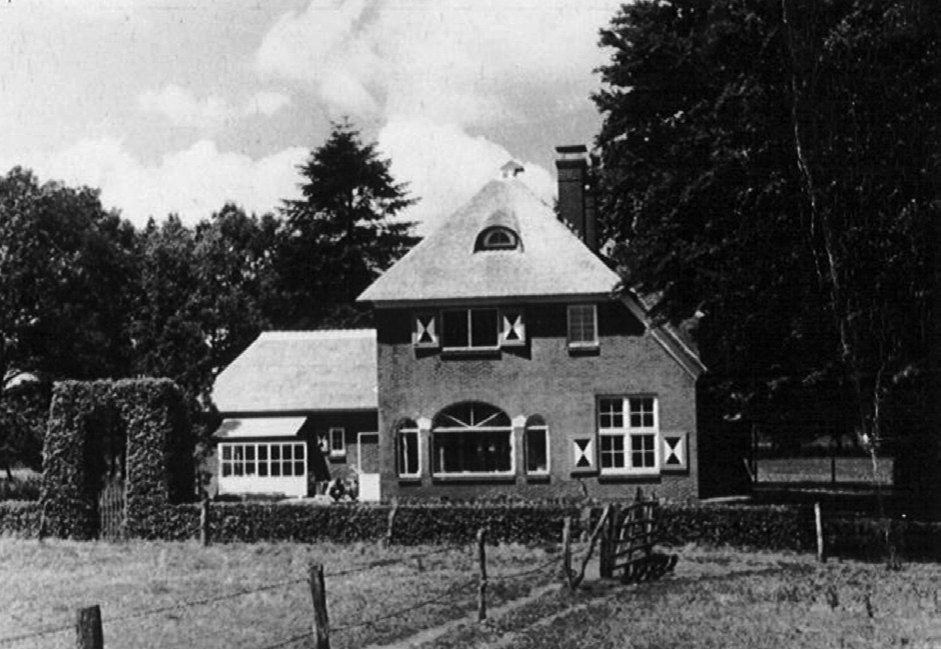
Dirk van Eysinga, "Derek" to the British, was hiding in the same house, "een neef van haar" (a nephew of hers, of Ima's) in Noordman (p. 300). Hardy, brought there on 19 October 1944, told the MI9 interviewer on 13 January 1945 that Derek took him "to the home of his great-aunt where he was hiding. She was an old lady and very deaf and living with her was her niece, a lady of about 40" (Hardy). ◐ The second woman was Liesbeth Verweij, then 53 by her own form's birth date: our identification, from her own account, which has her at the fireside with Ima, and from the house.
With Murphy
Link to the section With MurphyFrom De Ruif to Sterrehoveke, October 1944
Link to the section From De Ruif to Sterrehoveke, October 1944Noordman prints her account of how Murphy and Walsh came to the house (Noordman, pp. 301–302). Seven paratroopers were at De Ruif, Dr Kruimel's house at Garderen, at once, so two were to come to Sterrehoveke, and Dirk was to settle the day with "Oom Joop", Kruimel. "Dit was omstreeks 10 oktober" (this was around 10 October). A round-up that day kept Dirk in the hiding place behind the water tank in the attic, so she cycled to De Ruif herself and arranged to fetch the two at seven the next evening. They made the attic ready: the men were to sleep in the Persian carpets, and once they were upstairs the stairs were pulled up. The next evening she was at De Ruif at six and ate with the seven paratroopers and the Van Nispen tot Sevenaer family (p. 301).
At a quarter past seven Uncle Joop came home from Terschuur, and he was ready at once to make the journey to Elspeet. He thought it best if I rode about twenty metres ahead and could give a sign if there was danger. After me came Tom and Sam, and Uncle Joop brought up the rear. We rode along the cycle paths and by-roads. At every crossing I looked round and all went well. But the English are no heroes on a bicycle and I had to hold my pace back.
Dutch originalOm kwart over zeven kwam Oom Joop thuis uit Terschuur en hij was onmiddellijk klaar om de tocht naar Elspeet mee te maken. Het beste leek hem als ik ongeveer twintig meter vooruitreed en een teken kon geven bij onraad. Na mij volgden Tom en Sam en de rij werd besloten door Oom Joop. We reden langs de fietspaden en over binnenwegen. Bij ieder kruispunt keek ik om en alles ging goed. Maar Engelsen zijn geen helden op de fiets en ik moest mijn tempo inhouden.
— Liesbeth Verweij, in Noordman, Schuilplaats de Veluwe, p. 301
Before the mill it was pitch dark and she lost them for "wel meer dan een kwartier" (well over a quarter of an hour), until she heard Kruimel's voice and the whispered English of Tom and Sam. At about eight she gave the usual tap on the side window of the sitting room and Dirk, relieved, opened the doors of the studio. Kruimel slept in the iron chest, "de slaapstede in oorlogstijd voor een onnoemelijk aantal legalen en illegalen" (the wartime bed of a countless number of legal and illegal people, those living openly and those in hiding), and wrote in the house's guestbook "‘Keep smiling; ook in tijden van gevaar’" (keep smiling, even in times of danger) (p. 301).
Tom and Sam
Link to the section Tom and SamLife with Tom and Sam was regular and disciplined. They were not allowed to get up until Dirk called them. If there was danger, the word "Coffee" was called upstairs. Dirk said it was unbelievable how quickly, deftly and silently they would vanish behind the water tank, after rolling up the Persian carpets. As it seemed wiser, for their own safety, that they should be in the house as little as possible, by day they went gathering wood in the Elspeet woods, each taking a different way there. Tom, a Scot, had a head wound that still had not healed. He was a miner by trade, serious and cool-headed, with a typically English sense of humour. Sam was a machinist with ambitions to get on.
Dutch originalHet leven met Tom en Sam was regelmatig en gedisciplineerd Zij mochten niet opstaan voor Dirk hen riep. Was er onraad dan werd het woord: ‘Coffee’ naar boven geroepen. Dirk zei dat het ongelofelijk was zo vlug, handig en geruisloos ze plachten te verdwijnen achter het waterreservoir, na de Perzische tapijten opgerold te hebben. Daar het met het oog op hun eigen veiligheid verstandiger leek dat zij zo weinig mogelijk in huis waren, gingen zij overdag hout sprokkelen in het Elspeter Bos. Zij namen dan ieder een andere weg erheen. Tom, een Schot, had een hoofdwond die nog steeds niet genezen was. Hij was van beroep mijnwerker, ernstig en koelbloedig en met een typisch Engels gevoel voor humor. Sam was een machinist met aspiraties om het verder te brengen.
— Liesbeth Verweij, in Noordman, Schuilplaats de Veluwe, p. 302
⚠︎ "A miner by trade" is what she understood; Murphy's own trade is set out on his page. Hardy's report has the same days: "we kept out of the house as much as possible as the Germans had visited the house before … Our usual practice was to go out daily in the surrounding woods and gather wood" (Hardy).
Hardy, "Jack"
Link to the section Hardy, "Jack""Na ongeveer een week" (after about a week) Bep van Asbeck (Noordman calls her the occupant of Het Roode Koper, a country house at Leuvenum, on p. 279; ◐ the Mrs van Asbeck-Patijn of the forms, see her page), came to the dining-room door to say she had a paratrooper with her, hidden in a stand of pines; Dirk went with her and questioned him, to be sure he was no German in disguise. "Hij heette James Hardy maar werd Jack genoemd en hij was hongerig" (his name was James Hardy but he was called Jack, and he was hungry); he wore a red beret and a camouflage uniform, and was to stay in the pines until dark, to be fetched by Dirk for supper (Noordman, p. 302). That evening, "met ons zessen om het haardvuur" (six of us round the fire), Jack was the cheerful one. She has him a merchant seaman ("matroos bij de koopvaardij") who had become a medical orderly; his own report has "Peacetime Profession: Waiter." (Hardy), so the two differ. His hero was Eric, with whom he and a few other Allied men had sat "‘far away in a lovely wood’" in "‘a hidden house’"; from his descriptions they soon knew where he had been, and Eric "bleek ook … een bekende te zijn" (turned out to be someone they knew). When he was homesick he sat at the piano and played sentimental English songs (p. 302).
By her booklet, as Noordman reports it, Ima was given "een biljet van100 franc" [sic] (a 100-franc note) when Hardy left; Hardy said he gave 100 francs of the 2,000 he was handed in the barracks to one of his helpers (Noordman, p. 274).
To Kijkuit, 26 October 1944
Link to the section To Kijkuit, 26 October 1944When Jack had been there about ten days, word came that the Germans meant to search every house and that Dirk must hide. In her account:
"I'm going back to Eric," said Jack. "There will be ten of us, but Eric will know what to do; he always does." "Only," he went on in despair, "How do I find Eric?" We would see to that. Eric was supposed to be at "de Kijkuit" in the Leuvenumse Bos, a forester's house of Mr Jurriaanse.
Dutch original‘I’m going back to Eric,’ zei Jack. ‘There will be ten of us, but Eric will know what to do; he always does.’ ‘Only,’ liet hij er wanhopig op volgen, ‘How do I find Eric?’ Hier zouden wij wel voor zorgen. Eric moest op ‘de Kijkuit’ zitten in het Leuvenumse Bos, een boswachterswoning van de heer Jurriaanse.
— Liesbeth Verweij, in Noordman, Schuilplaats de Veluwe, pp. 302–303
At about eight the three packed their things and checked their weapons; Jack wore overalls over his uniform and the other two were in civilian clothes. They took a warm leave of Ima "en volgden Dirk en mij op een behoorlijke afstand" (and followed Dirk and me at a fair distance). It was pitch dark and the two of them had trouble finding the way over the heath, by the Refugium and through the wood to the cycle path from the Stakenberg to Hulshorst, the three men behind in single file. At the path to the forester's house Jack said "‘Let me alone now; I do not want Eric to know I have been taken here by a woman!’", went to the house alone and knocked; it was nearly a quarter of an hour before he came back for Tom and Sam. "Inderdaad waren er ook nog andere geallieerden in die boswachterswoning" (there were indeed other Allied men in the forester's house too). Dirk spent the night with Mr and Mrs Adriaanse, and after warning a few more people she was home at midnight (Noordman, p. 303). Hardy dates it: "as soon as it was dark on the evening of 26 Oct we set off, DEREK and his aunt going ahead pushing their bikes" (Hardy).
At Kijkuit the men were in the care of Joop Migchelsen's group, with Eric Blok and Bram Baar (Hardy; Noordman, pp. 278, 292).
The night march, 6/7 November, as Dirk told it
Link to the section The night march, 6/7 November, as Dirk told itShe was not on the march; she wrote it down from what Dirk told her when he came home at six in the morning, "Het uur waarop ik opstond, zodat ik nog kon genieten van zijn verslag, voordat hij het bed in dook" (the hour I got up, so that I could still enjoy his report before he dived into bed) (Noordman, p. 294). In her telling Joop Migchelsen led the first stretch to Bes, through the Leuvenum woods; Lou followed with a revolver, then the six Britons, with Tex Banwell carrying the only Sten, and Dirk at the rear with his creaking bicycle (pp. 293–294). "Plotseling stopte Tom Murphy en duwde Dirk een doosje schoenvet in de hand" (suddenly Tom Murphy stopped and pressed a small box of shoe grease into Dirk's hand), and by the time the bicycle was greased Dirk had lost the party and had to catch up by a detour past Het Roode Koper and the hotel De Zwarte Boer. On the Speulderheide, under a full moon, "Tom Murphy en James Hardy hadden moeite met het fietsen" (Tom Murphy and James Hardy had trouble with the cycling) and fell behind with Lou; three figures with packs passed the column without a word when Banwell sprang to Dirk's side with the Sten. At about five "klonk het afgesproken fluitsignaal van ‘Frans Hals’" (the agreed whistle of "Frans Hals" sounded), Dick Kragt, at signpost 215, and Dirk cycled home from Boeschoten (p. 294). The full march is on Dirk van Eysinga's page.
⚠︎ Her Lou, "als lid en medeoprichter van de K.P. in Rotterdam" (as a member and co-founder of the K.P. in Rotterdam), had broken into three distribution offices and stolen 25,000 ration cards (p. 293); no other source held says it. Noordman reads her Lou as Huib de Jongh (p. 281); the Tresoar catalogue's key to her typescript has "Lou = van Vliet senior" (the catalogue).
Her form for the Americans
Link to the section Her form for the Americans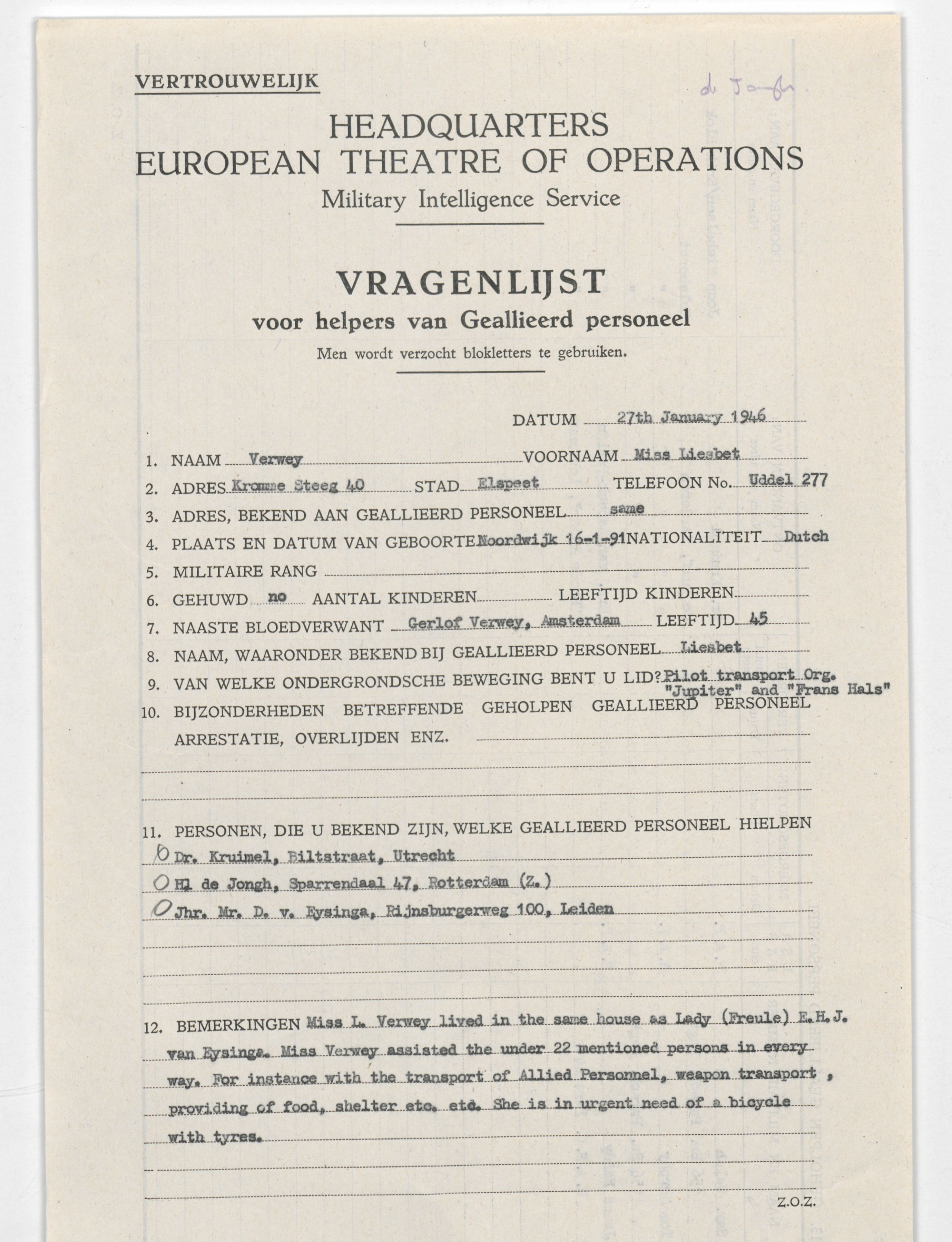
On 27 January 1946 the Americans' questionnaire for helpers was typed up in her name: living at Kromme Steeg 40, Elspeet; known to the Allied men as "Liesbet"; working for the pilot transport organisations "Jupiter" and "Frans Hals". "de Jongh" is pencilled at the top right of the sheet. The remarks are in the third person, ◐ so very probably someone else typed them; the sheet does not say who. Ima's form of the same day has the same pencilled name; the sheets do not say why. The "22" in the remarks does not match the three names listed, and nothing explains it:
Miss L. Verwey lived in the same house as Lady (Freule) E.H.J. van Eysinga. Miss Verwey assisted the under 22 mentioned persons in every way. For instance with the transport of Allied Personnel, weapon transport, providing of food, shelter etc. etc. She is in urgent need of a bicycle with tyres.
— remarks typed on Liesbet Verwey's questionnaire for the Americans, 27 January 1946 · her file, p. 2
The helpers she knew were Dr Kruimel of Utrecht, H. de Jongh of Rotterdam and Jhr. Mr D. van Eysinga of Leiden, each ringed in pencil (the image does not show by whom) (p. 2). On the back she listed three men:
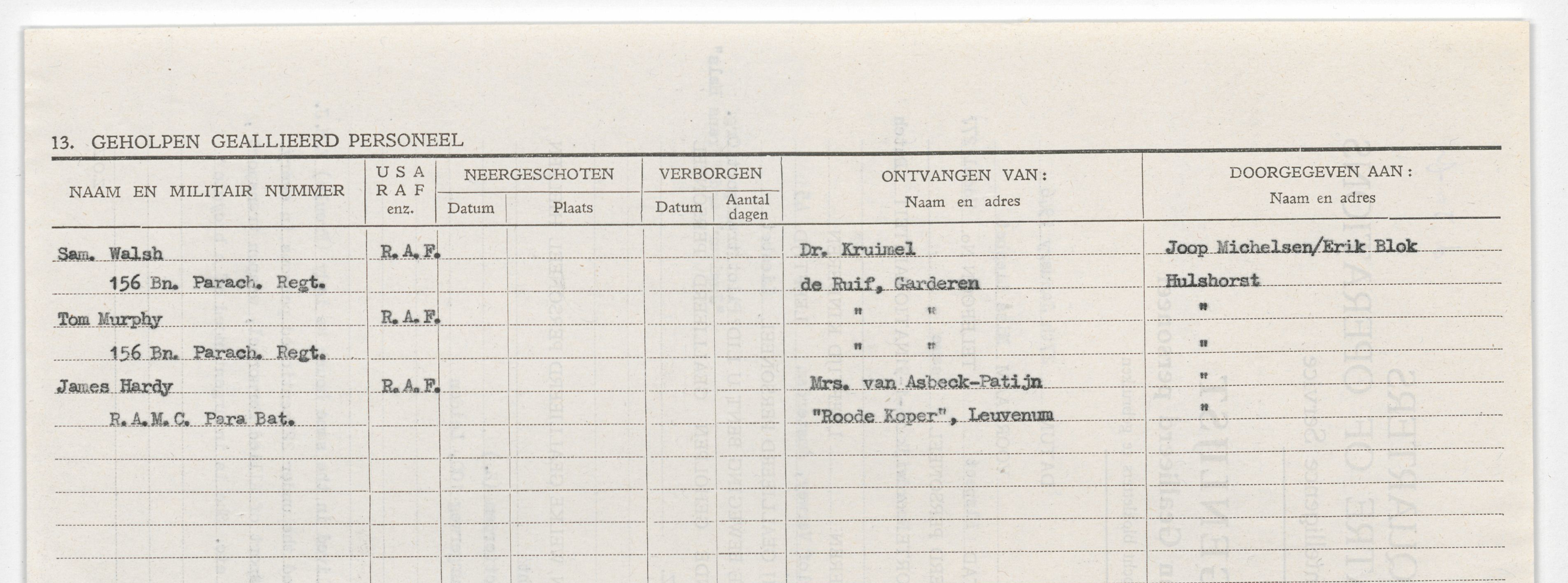
"Sam. Walsh, 156 Bn. Parach. Regt." and "Tom Murphy, 156 Bn. Parach. Regt.", received from "Dr. Kruimel de Ruif, Garderen", and "James Hardy, R.A.M.C. Para Bat.", from "Mrs. van Asbeck-Patijn "Roode Koper", Leuvenum", all passed on to "Joop Michelsen/Erik Blok Hulshorst". The columns for dates and days are blank (p. 3). Ima van Eysinga's form, of the same day, lists the same three men from and to the same people (her file, p. 3).
Her grade
Link to the section Her gradeThe British I.S.9 office's letter of 21 May 1946 to MIS-X lists "VERWEY, Liesbet. Kromme Steeg 40, Elspeet", number 18, among cases "considered to be Grade 5" (the letter, p. 25, image-checked; number 19, W. T. Verwey of Tull en 't Waal, is someone else). The folder of her file has "Grade 5 Conf. 52 23/5/46." (p. 1), and the Americans' list of Grade 5 (Eisenhower) certificates has "(4389) VERWEY, L.", Kromme Steeg 40, Elspeet ✓ (the list, p. 167, image-checked). The British index of Dutch helpers has "VERWEY Miss Liesbet", Kromme Steeg 40, Elspeet, Grade 5, certificate 15059 (sheet V/9, read on the image).
Her account of Sterrehoveke
Link to the section Her account of SterrehovekeNoordman calls it a little book she wrote "direct na de oorlog" (straight after the war) (p. 301), and in his foreword "het dagboek" (the diary), "De voornaamste bron" (the main source) in the Van Eysinga family's archive, naming among the Allied men who appear in it "John Haller, Tom Murphy, James Hardy, Sammy Walsh, Lipmann-Kessel, Cerediq Longland, Allenby en Allan" (Noordman, p. 8; Omroep Gelderland reprints that foreword, so it is the same source). His source list describes it as a "Manuscript over verzetsactiviteiten van jhr. D. van Eysinga, H. de Iongh en J.P. Kruimel" (manuscript on the resistance work of Dirk van Eysinga, Huib de Iongh and Kruimel), set mostly round Elspeet, Hulshorst and Garderen in the autumn of 1944, "Niet gepubliceerd" (unpublished), lent to him by jhr. C. van Eysinga of Sint Nicolaasga (p. 346). Airborne Magazine calls it her never-published herinneringen (recollections), "‘Spannende tijden op en rond Sterrehoveke’" (Exciting times at and around Sterrehoveke), and quotes her on Kruimel: "Als regel droeg hij een korte broek en een bruin piloten buisje van Canadeesche piloten" (as a rule he wore shorts and a brown pilot's jacket of Canadian pilots) (Airborne Magazine).
The typescript is at Tresoar in Leeuwarden, in the Van Eysinga family archive, item 7665: "Typoscript van "De Pilotenlijn", door Liesbeth Verweij", dated about 1945, with a copy of a letter of Dirk van Eysinga's to Henk Baud, the text of a poem for Ima, and Noordman's letters of 1990 and 1991, "Openbaar vanaf: 01-01-2067" (open from 1 January 2067). The catalogue's note gives two of its cover names, "Mulder = van Heemstra; Lou = van Vliet senior". Item 7895 of the same archive is a piece of 2017 on the two women, "De freule en de gezelschapsdame" (the lady and the companion), closed until 2093 (the catalogue).
Her death
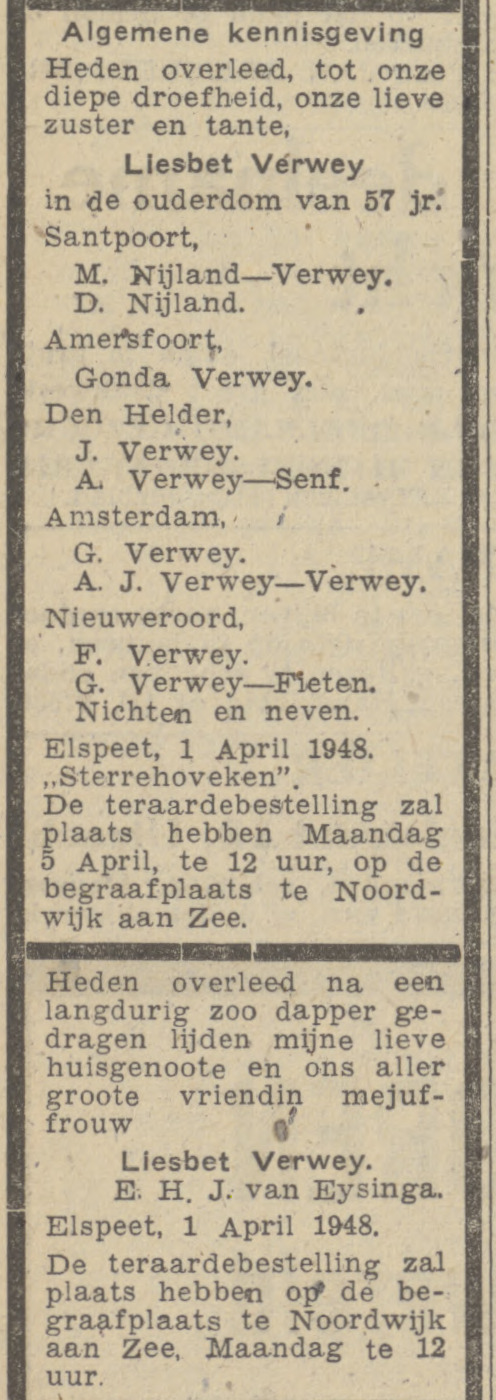
Link to the section Her death✓ The Algemeen Handelsblad of 2 April 1948 carries two notices of her death, both dated Elspeet, 1 April 1948, the family's from "Sterrehoveken". One is from her sisters, brothers and their families: "Heden overleed, tot onze diepe droefheid, onze lieve zuster en tante, Liesbet Verwey in de ouderdom van 57 jr." (today died, to our deep sorrow, our dear sister and aunt, Liesbet Verwey, aged 57). The other is from Ima van Eysinga: "Heden overleed na een langdurig zoo dapper gedragen lijden mijne lieve huisgenoote en ons aller groote vriendin mejuffrouw Liesbet Verwey" (today died, after a long illness so bravely borne, my dear housemate and the great friend of us all, Miss Liesbet Verwey). Both set the burial for Monday at 12, at the cemetery of Noordwijk aan Zee; the family's notice gives the date, 5 April (the notices, image-checked). Aged 57 fits a birth on 16 January 1891.
Where the sources disagree
Link to the section Where the sources disagree- When Murphy and Walsh came to Sterrehoveke.
- ⚠︎ "omstreeks 10 oktober" (around 10 October) and the next evening, in her account (Noordman, p. 301).
- "About 21 Oct" in Walsh's report, which has the two moved to the house in Elspeet "where Pte. HARDY … was living" (Walsh).
- Before 19 October in Hardy's, who found Murphy there when he came that day (Hardy); she too has Hardy come after the two (p. 302).
- How long Hardy stayed. About ten days in her account (p. 302); a week in Hardy's, from 19 to 26 October (Hardy).
- Who walked them to Kijkuit, and how. "Dirk en mij" (Dirk and me), the men following in single file, and no mention of bicycles (p. 303); "DEREK and his aunt going ahead pushing their bikes" in Hardy's report.
- Who she was. Hardy's "niece, a lady of about 40" (Hardy); 53 by her own form's birth date (p. 2), and a friend and companion in Noordman (p. 346), and the remarks on her form say only that she lived in the same house as Ima.
- Whose house Kijkuit was. Mr Jurriaanse's, in her account (p. 303); half of it lent to Joop Migchelsen by a Mr van der Elst of Amsterdam, in his statement (Migchelsen's file, p. 3).
- Where the men came to Kijkuit from. From Sterrehoveke with her and Dirk, in her account and Hardy's; "presumably from "Ome Joop" (Dr. Kruimel) p.a. Farmer Bos" at Staverden, in Migchelsen's statement (same page).
- The guides on 6/7 November. Migchelsen, Lou and Dirk in her account (pp. 293–294); "DEREK and LOEW", two guides, in Hardy's report.
- Who Lou was. Huib de Iongh in Noordman (p. 281); "van Vliet senior" in the Tresoar catalogue's key to her typescript (the catalogue).
- What her account is. A dagboek (diary) in Noordman's foreword (p. 8), which Omroep Gelderland reprints; a boekje written straight after the war (p. 301) and an unpublished manuscript (p. 346) in Noordman; never-published herinneringen in Airborne Magazine; a typescript of about 1945, "De Pilotenlijn", at Tresoar.