Apeldoorn and the escape
A prisoner in the barracks hospital at Apeldoorn, until he and Sam Walsh got out at dusk on 6 October.
Captivity at Apeldoorn
Link to the section Captivity at ApeldoornTwo facilities, easily confused:
-
Het Loo hospital, Apeldoorn. Walsh was held here from 22 September. Prisoners stripped and searched on arrival, uniforms confiscated and replaced with green field kit. Escape near-impossible: second floor, one guarded exit, no boots (Walsh).
-
Willem III Barracks, Apeldoorn, a British hospital under the administration of captured RAMC officers (Col. Graeme Warrack, ADMS 1st Airborne Division).
- Hardy and the medical staff were taken there on 25 September (Hardy has "all the Medical personnel, including myself" taken there on the 25th; ◐ Warrack's diary has the barracks opening that day, but Alford's party sent on at 11.30 on the 26th and Warrack's own arriving at 18.30, so not all the staff came on the 25th as Hardy has it); Walsh was moved in from Het Loo about 2 October (Walsh).
- Warrack's page says it was converted "specifically for 1,700 airborne casualties"; Hardy's report puts about 1,000 wounded there, and Warrack's diary about 900 on 26 September (below). For the first five days the guard was Dutch SS, then older Wehrmacht men (Hardy).
- Warrack commanded; Martin Herford, Arthur Marrable and Bill Alford ran it (ParaData's article on the hospital; the detail on their pages).
- This is the building he escaped from.
- ⚠︎ The British later opened a file on the care of the wounded there (Kew WO 311/1297, not yet read; Warrack's page).
Security was poor and escapes were frequent. Hardy, a medical orderly held there, estimated the number:
During the ten days I was in the Barracks there were many men who escaped. I would estimate as many as 200 … I only know of ten men who were recaptured
— James Hardy, his report (Hardy)
Two methods predominated: hiding in the cookhouse block until dark, or being carried out on a stretcher as a corpse to the mortuary shed.
The escape: 6 October 1944
Link to the section The escape: 6 October 1944Corroborated by Walsh's report, by Dutch published history, and by the family account.
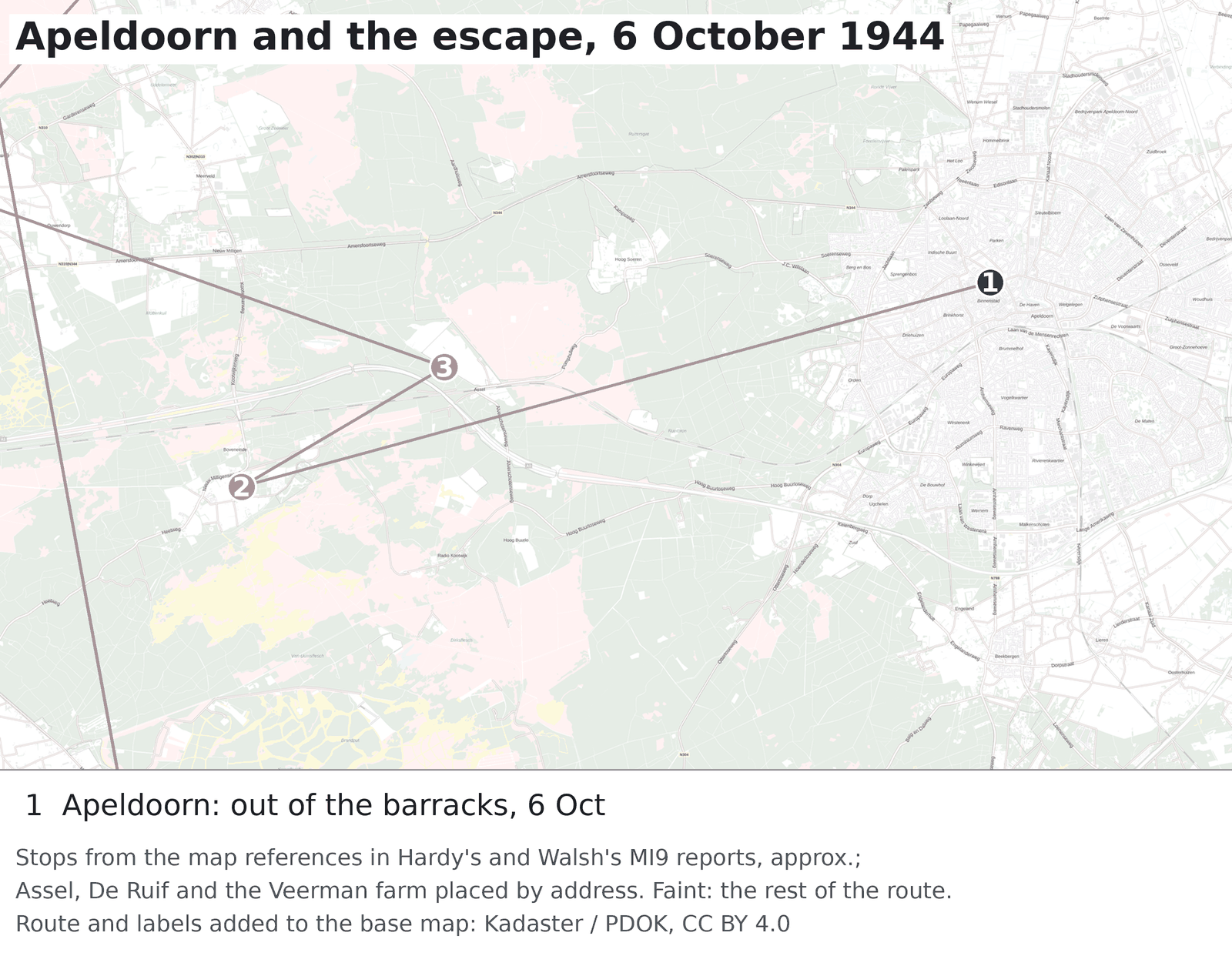
RSM Lionel Bryson (181 Airlanding Field Ambulance) had made clear that on escape it was every man for himself. At dusk on 6 October, Murphy and Walsh took a stretcher as camouflage and walked past the guard on their building as though carrying out an ordered task. They made for a disused building near the perimeter wire, lay up until dark, then slipped out and climbed over the fence (Walsh). They moved west to clear Apeldoorn, intending to turn south for the Rhine. They had no Dutch and no route.
The Dutch record has it too:
They escaped on 6 October from the Airborne Hospital in the Willem III barracks in Apeldoorn.
Dutch originalZe zijn 6 oktober ontsnapt uit het Airborne Hospital in de Willem III-kazerne in Apeldoorn.
— Somford, "Op zolder bij Oom Joop", Airborne Magazine nr.27, 2023
His own telling, which matches Walsh's stretcher:
A truce was arranged, so a surgeon could come over from the British side and treat the wounded. I escaped by telling the guards I was going for a (dod kamarad); I lifted a stretcher and they let me pass. I went towards the wire, lay hidden on the grass, under the crow's nest, and when darkness came jumped over the wire. I remember singing, as I walked along a railway, it was freedom. Two Germans came testing the railway, on the contraption meant to clear it, for saboteurs, and paid me no heed. I was exhausted and climbed on a haystack, which had a canopy, and went to sleep. I slid down in the daylight and shocked a lady, hanging out her washing. I could see no telephone wires so knew I was OK. I did notice her boy had disappeared, the reason was obvious. Two gentlemen arrived, and you know the rest (I passed scrutiny).
— Tom Murphy, his memoir, pp. 10–11 (the pages)
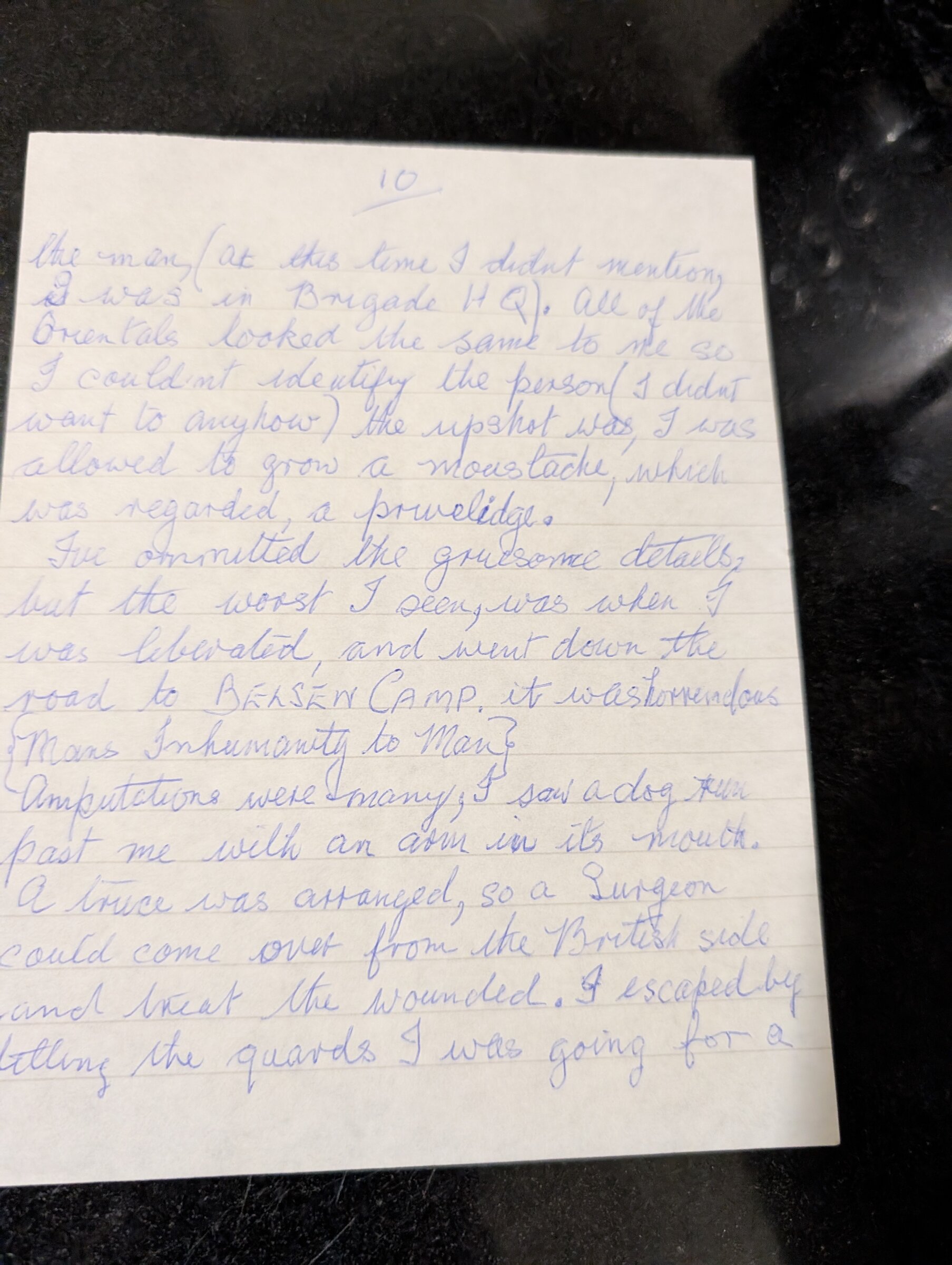
⚠︎ The truce and the surgeon are his word; the crossing of the wire after dark is Walsh's too. The railway is the Apeldoorn–Amersfoort line the poultry farmer thought too close (On the run).
The scrutiny:
the Underground, who gave me a going over, as Gerry was infiltrating their ranks, disguised as British paras. Questions such as where do Arsenal play, or Rangers, or Celtic, or Hearts, were asked of us till they were satisfied we were pukkah
— Tom Murphy, his memoir, p. 8 (the page)
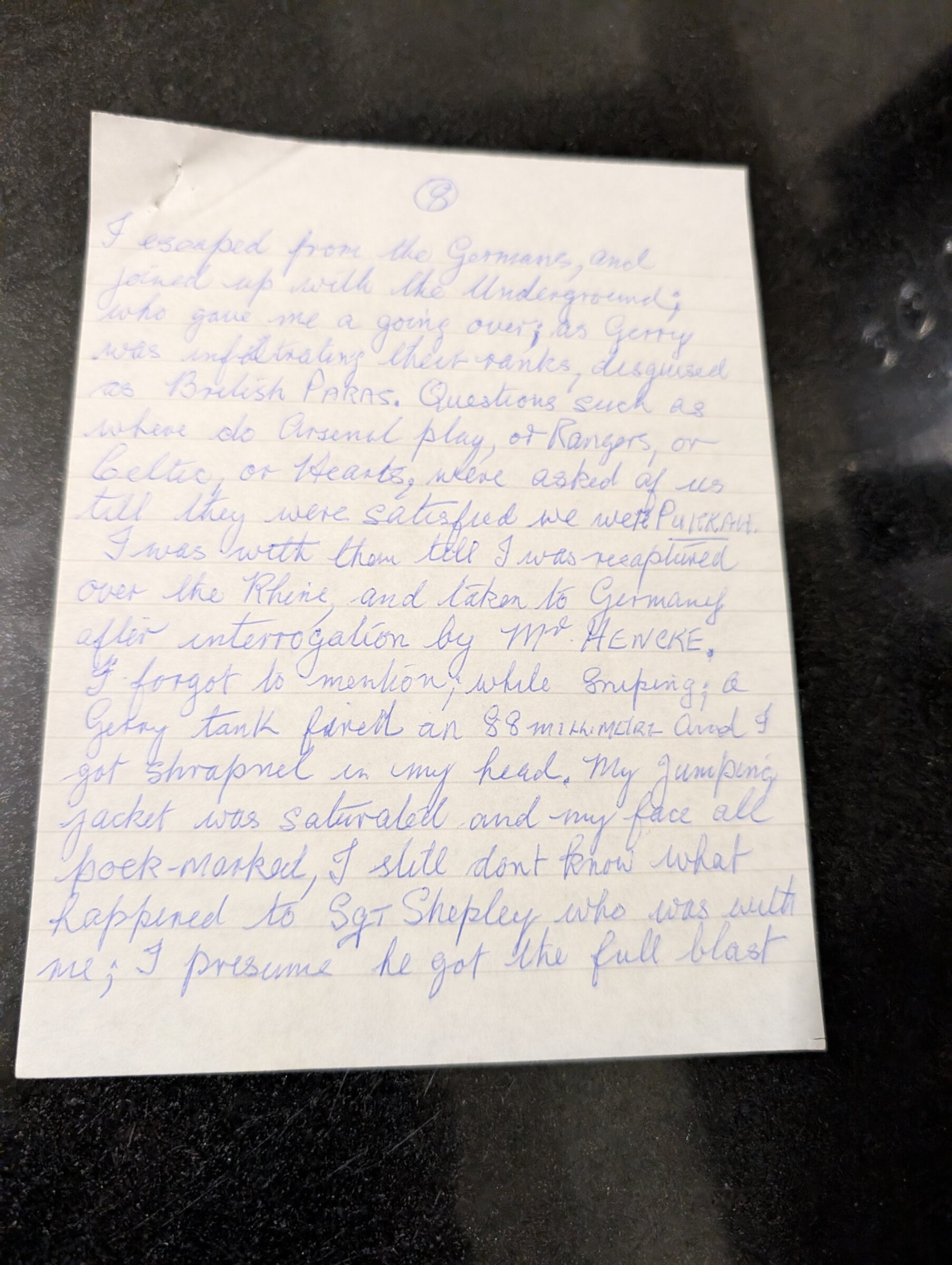
◐ Hardy has "Derek" vetting the British at Elspeet with a paybook and questions about the Land Army (Hardy); the football questions are Murphy's.
Beside him: the hospital's own records
Link to the section Beside him: the hospital's own recordsCol. Warrack, who ran the hospital, kept a diary of the weeks Murphy was there, and two men who escaped from its grounds in the same days left their own reports; his second in command, Lt-Col Herford, wrote one too, which is on his page. None of them names Murphy.
What Warrack's diary adds
Link to the section What Warrack's diary addsWarrack kept a diary in the barracks, later given to the Liddell Hart Centre at King's College London; the typed transcript its staff edited, of about 1982, is at the Wellcome Collection as RAMC/1584 (his foreword; Graeme Warrack). It never names Murphy or Walsh. By his foreword he began it "in diary form while they were still fresh in my memory", so the entries up to 26 September were written up afterwards, and ◐ the later ones are near-contemporary, since no source says they were written the same day. Page numbers below are the transcript's (Warrack's diary).
- ✓ The numbers. The barracks had opened on 25 September "with a flood of some 800 patients, of whom 500 were evacuated almost at once"; Warrack's party came in at 18.30 on the 26th, bringing it to "some 900 patients" (pp. 26–27). By the evening of 6 October, the night Murphy and Walsh went, it was down to 103 (p. 41).
- ✓ The trains. A train of 250 lightly wounded left about 3 October, and a hospital train for 496 was loaded on 5 October and was still standing in the station on the evening of the 6th (pp. 35–41; the rest on Warrack's and Alford's pages). Herford's report gives the same two: 250 light cases sent to the station on 2 October and gone by the 4th, and the train loaded on the 5th still awaiting an engine on the 6th and 7th (his report; JRAMC 1952, pp. 297–298).
- ✓ Escapes and guards. On 3 October: "There has been quite a lot of escaping going on all the time, which is very cheering. Some don't get far." (p. 37). On 4 October:
By day there are about six guards round the three blocks and a guard at the gate. By night this is doubled. The guards themselves are known as the 'BISMARCK Youth' and are all obviously category men. They have the most antique-looking muskets. It can be no trouble to outwit them if we put our minds to it. At the moment any patient who is fit enough can make a break, but I need the whole staff to look after the patients.
— Col. Graeme Warrack · his diary, 4 October 1944 · typed transcript, Wellcome Collection RAMC/1584, pp. 38–39 · the transcription
- ⚠︎ The four shot. On 7 October the Germans told Warrack that four men had been shot dead escaping from a train; he called it "A very fishy tale" (p. 42). What Kessel, the CWGC and a footnote add is on Warrack's page.
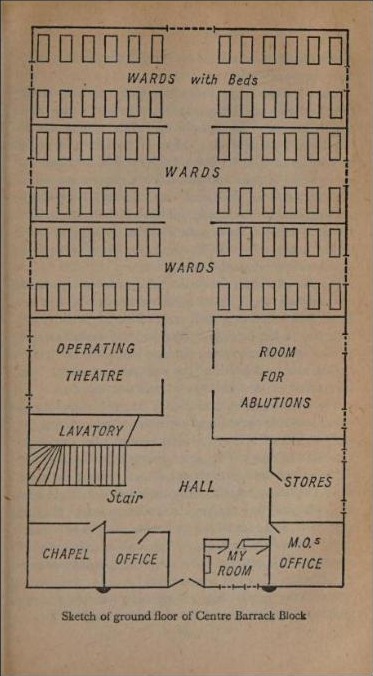
The roll. "Medical personnel at Apeldoorn", which the foreword calls "a record of all officers and other ranks RAMC who were with me at APELDOORN" (pp. 51–55), marks one man "(f) Believed escaped": "1556339 Pte HARDY J", Murphy's later companion (James Hardy). A "MURPHY F", 14671649, on p. 54 is a man of the medical staff, not Thomas Murphy: that is not his army number (2756457, his page), and the roll lists RAMC men only.
Lt-Col Martin Herford, Warrack's second in command, wrote his own report on the same weeks, printed in the Journal of the RAMC in 1952 (the report); it is on his page. He never names Murphy either.
Three who got out before him
Link to the section Three who got out before himTwo MI9 reports at Kew tell of three men of the hospital who escaped from the barracks grounds in the days before Murphy left it. None names him. ◐ Walsh's report has him and Murphy moved in about 2 October, so Gauntlett and Johanson's escape of 1 October very probably came before Murphy arrived, and Reid's of 5 October while he was there.
- ✓ 1 October. Spr Alan Gauntlett, 1st Parachute Squadron RE, and L/Cpl Johanson found no one watching them in the grounds at about 12.30, went behind a shed and over barbed wire to a road, and a man led them to an air-raid shelter (Gauntlett, Kew WO 208/3324/78, read on the image).
- ✓ 5 October. Pte James Reid, 16 Parachute Field Ambulance, hid in a shelter by the incinerator and went "in the moonlight to a shrubbery and from there over the barbed-wired ditch to the road" (Reid, WO 208/3324/76, read on the image).
- ✓ Out. Both reports have them leaving Holland and reaching England on 24 October; the Dutch helpers' forms have Gerrit Huiskamp's group sheltering all three in Apeldoorn. The escapes are on James Hardy's page; the helpers' forms, and the dates that do not agree, on Dick Kragt's.