Pte James Hardy
19 Nov 1913 – 18 Feb 1995
Pte James Hardy MM (1556339)
About: A medical orderly of 16 Parachute Field Ambulance who escaped from the Willem III barracks at Apeldoorn on 6/7 October 1944, met Murphy at Elspeet on 19 October and stayed with him until the night of 2/3 January 1945, when he swam a canal to reach the British lines. His MI9 report of 13 January 1945 is the fullest account of Murphy's route and of the people who hid him.
Unit or role: Private, 16 Parachute Field Ambulance, RAMC, attached to 1st Parachute Battalion at Arnhem; Military Medal. By his report born 19 November 1913, a waiter before the army, of "Church Lane, Addersley, Nr. Banbury, Oxon" (the report); the Kew catalogue entry for the report has the same birth date (WO 208/5414/21).
Where: Born at Hamilton, Scotland, as "Two Came Back!" has it, and living near Banbury, Oxfordshire by his own report and two helpers' lists; he died at Galashiels in 1995 (below). He was hidden, in 1944, at Hulshorst, Uddel, Elspeet, Kijkuit, Harskamp, the Rockelsche Zand, Otterlo, Klein Achterveld and Amerongen.
Evidence: ✓ Hardy's MI9 report, IS9/WEA/1/270/2351, 13 January 1945; ✓ his Military Medal (the recommendation, WO 373/64/316; London Gazette, p. 4684); ✓ the Kew catalogue entries for his report and awards (WO 208/5414/21, 3351/2351, 5273/2090, 5275/440, 5275/3988, service record WO 422/44584, catalogue text only); ✓ the helpers' forms for the Americans (Veerman, Migchelsen, van Milligen, den Besten, Mrs Esveld); ◐ Boeree, Kroniek van Ede (1947), pp. 200, 202 (checked on the page images); Schjelderup's report; den Besten's file, p. 3; Warrack's roll of the medical staff at Apeldoorn (p. 53).
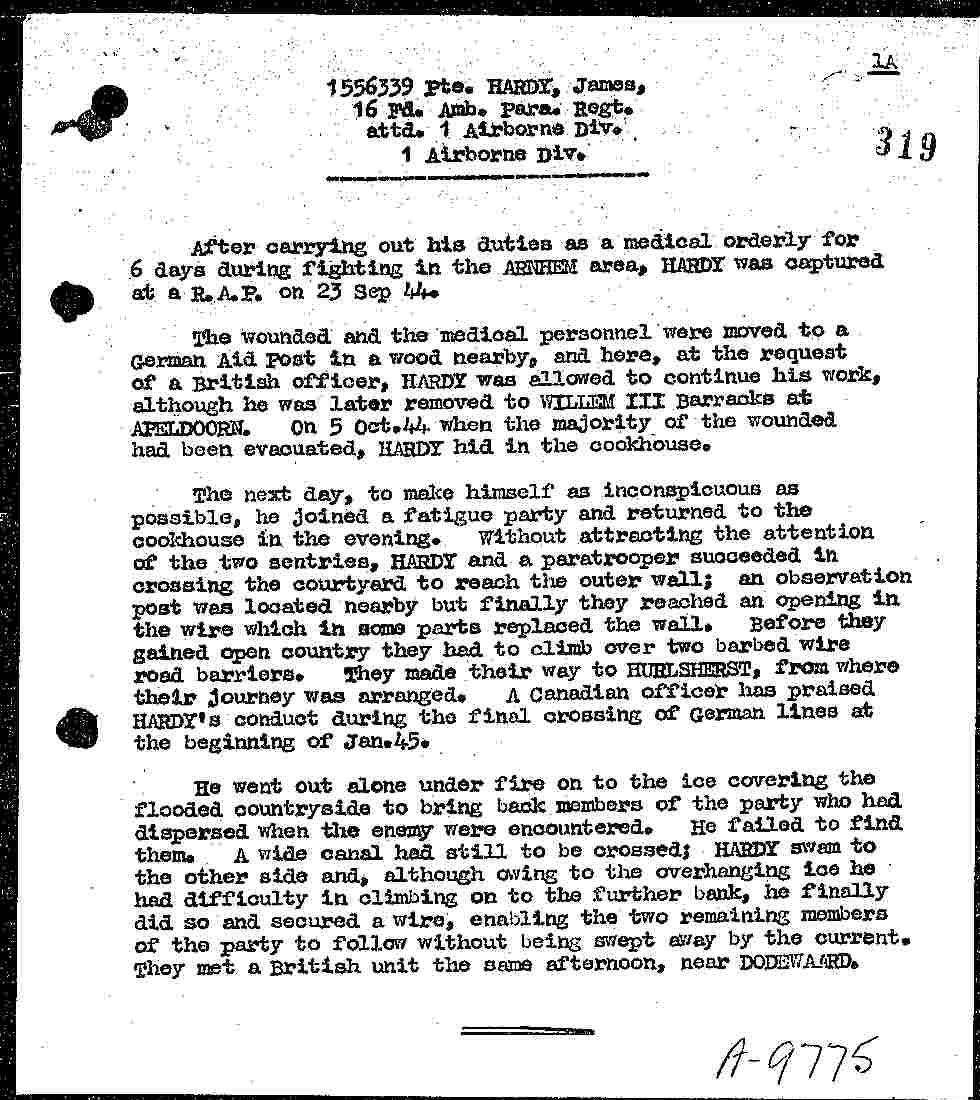
He escaped from the Willem III barracks at Apeldoorn on the night of 6/7 October 1944 with a glider-pilot sergeant called John, and on the morning of 12 October crossed the level crossing at Hulshorst, where a young woodcutter, "JAN", took them home, fed them and that night handed them to the underground, "BRAM and JOOP" (Hardy). The woodcutter's own form names him: Jan den Besten of the Harderwijkerweg, Nunspeet, born 1917, found two airborne men in the woods "On the 12th Oct. 1944", kept them a day, and passed "James Hardy Oxford." and "John Allen" to "Joop Migchelsen near the station Hulshorst"; one of the two, he wrote, was "Sgt. and pilot of the glider" (den Besten's file, pp. 2–3). ◐ "John Allen" is very probably the glider pilot Hardy calls John, Bernard "John" Haller. Kew's catalogue entry for Haller's MI9 escape report (WO 208/3326/2991, 9 May 1945; the report the Pegasus Archive prints) names "Private James Hardy" as the only other man, so Haller's own account of 1945 has the same pair (the catalogue entry; catalogue text only, not digitised). His escape report is WO 208/5414/21 at Kew, which the catalogue dates 14 January 1945; the report itself gives 13 January as the date of the interview (the catalogue entries). His Military Medal citation adds the weeks before: he had worked as a medical orderly for six days of the fighting, was "captured at a R.A.P. on 23 Sep 44", and at a British officer's request was allowed to go on working at a German aid post in a wood before he was moved to the Willem III barracks. On 5 October, when most of the wounded had gone, he hid in the cookhouse; the next day he joined a fatigue party, and that night he and "a paratrooper" crossed the courtyard past the two sentries, got through the wire where it replaced the wall, and climbed two barbed-wire road barriers (the recommendation, p. 2). Haller's own citation tells the same escape, the cookhouse, the fatigue party, the two sentries and the two barriers, with "a medical orderly" beside him (his recommendation, p. 2).
Haller's own account, in the Dutch book De zwarte herfst (1984), names him: "Together with the paratrooper Jim Hardy he saw a chance, on 6 October, to escape. With the help of a little compass and a piece of a map they made their way north-west", meaning to find the Zuiderzee and a fishing boat near Harderwijk; on the way the underground put them with a group of others "in a little house deep in the woods" (Dekkers and Vroemen, pp. 229–230, checked against the page images when the extract was made). ✓ That is Hardy's 6 October and agrees with both citations. Haller adds that when the signal came for Pegasus II he could not keep up, from dysentery, and so was not in the clash with the Germans (Bernard Haller); Hardy's report has Haller among the five who went back towards Otterlo on 20 November.
✓ Uddel, 7 to 9 October. Berend van Milligen, a widower of Heegderweg 42, Uddel, born there in 1888, hid them two days: his table has "Pte Hardy J. R.A.M.C." and "Sgt. HALLER B.T.T. 14291815 Glider Pilot Regt.", "7/9 '10 '44", 2 days, "escaped from het Loo", and for where they went, "address given by J. van der Hoorn Hulsthorst, but it never arrived" (his table, p. 4). "After 2 days stay they went away, just before the razzia's started. According to rumours they arrived at Mr. van Beuningen in Vierhouten" (his questionnaire, p. 3). That fits the escape of 6/7 October and Hulshorst on the 12th. The same two lines, word for word, were typed into section 13 of the form of A. J. A. Tjeenk Willink-Meinders of Brummen, who hid Major Hibbert, and struck out there in pen (that table, p. 3); ◐ by the look of it, a clerk's slip.
The roll at Apeldoorn
Link to the section The roll at Apeldoorn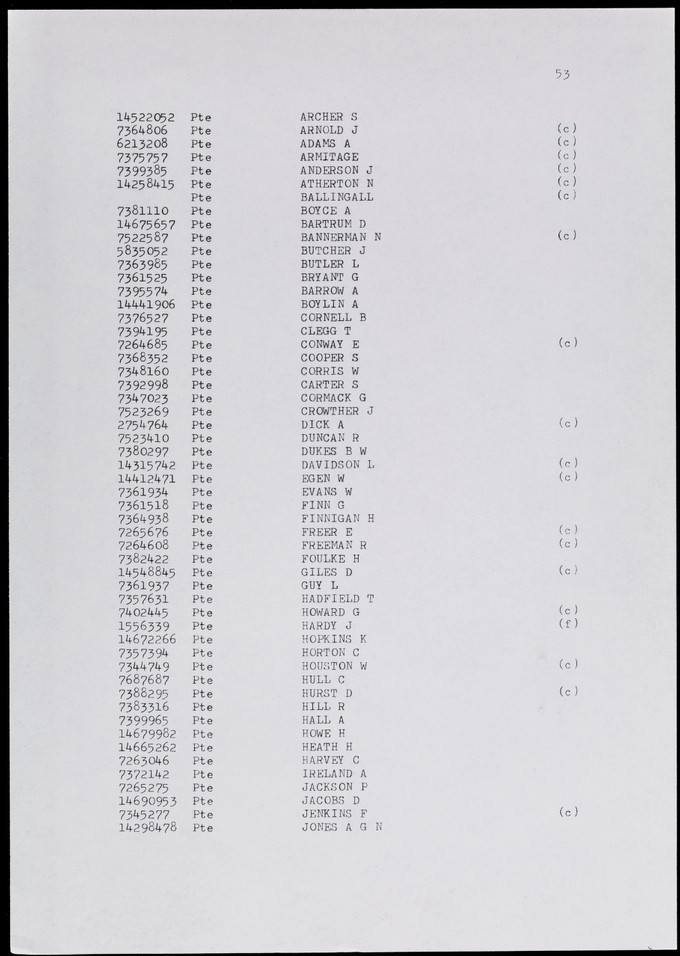
✓ The diary Col. Graeme Warrack kept as commander of the hospital in the barracks ends with a roll, which his foreword calls "a record of all officers and other ranks RAMC who were with me at APELDOORN". Hardy is on it as "1556339 Pte HARDY J", his own army number, with the note (f), "Believed escaped", the only man on the roll so marked (the roll, pp. 53, 55; the transcription). The diary never names him.
◐ Its entries for the days of his escape fit his citation and his report:
- At 10.00 on 5 October the Germans asked for 496 patients, ten doctors and 64 orderlies to be ready by 13.00 for a hospital train, and Warrack decided to send "all officers and ORs of the Para Bdes"; Hardy's field ambulance, the 16th, was 1st Parachute Brigade's (the diary, p. 39; the officers' list, p. 48). His report has him told that morning that he was to leave with an evacuation that afternoon (Hardy; Lionel Bryson).
- The hospital's count fell from 537 before the move to 103 on the evening of 6 October; the train stood in the station from the 5th to the 7th and was reported gone on the morning of the 8th (pp. 40–42). His citation has him hide in the cookhouse "On 5 Oct.44 when the majority of the wounded had been evacuated", and get out on the night of the 6th (the recommendation, p. 2).
Others who got out of the barracks
Link to the section Others who got out of the barracksThree other men of the hospital escaped over the wire in the same week, one of them of his own field ambulance, by two MI9 reports at Kew, Gauntlett's and Reid's (Johanson has none; ◐ neither report names Hardy; Apeldoorn and the escape):
- ✓ 1 October, by day. Spr Alan Whitworth Gauntlett, 1st Parachute Squadron RE, and "L/Cpl. JOHANSON", walking in the grounds at about 12.30, found no one watching them: "We darted behind a shed and after some time were able to make our way over some rough ground and barbed wire to a road" (Gauntlett's report, WO 208/3324/78, read on the image).
- Wounded and taken at Oosterbeek, Gauntlett was moved through the Arnhem hospital to "APELDOORN (Z 70) hospital". "Some people" were "watching us from a house"; "A man came out, recognised us as being English, and motioned us to lie low. He returned with another man and led us through some gardens to their air-raid shelter", and they were kept there till dark.
- ✓ 5 October, the day Hardy hid. Pte James Reid of Hardy's own unit, 16 Parachute Field Ambulance, hid "On the afternoon of 5 Oct" in a shelter by the incinerator, where he dumped rubbish, and went "in the moonlight to a shrubbery and from there over the barbed-wired ditch to the road" (Reid's report, WO 208/3324/76, read on the image); the underground took him to the house where Gauntlett and Johanson were hidden. Hardy's citation has him hide in the cookhouse the same day and go the next night (the recommendation, p. 2).
- ✓ Out. Reid stayed with the other two until 16 October, then went to another house, and "On 23 Oct we were taken to the rendezvous in the wood from where the evacuation took place" (Reid's report only; Gauntlett's gives no date for the rendezvous). Both reports, taken down by IS9 on 20 November 1944, have them leaving Holland and arriving in England on 24 October. Their Dutch helpers are on Dick Kragt's page.
- ✓ The train they missed. Lt-Col Martin Herford's report has the train of 5 October "for 500", loaded at once, still waiting for an engine on the 6th and 7th, and gone "during the night for the Hanover region" before the morning of the 8th (Herford's report, Journal of the RAMC, vol. 98 (1952), p. 298, read on the page image; Martin Herford).
With Murphy
Link to the section With Murphy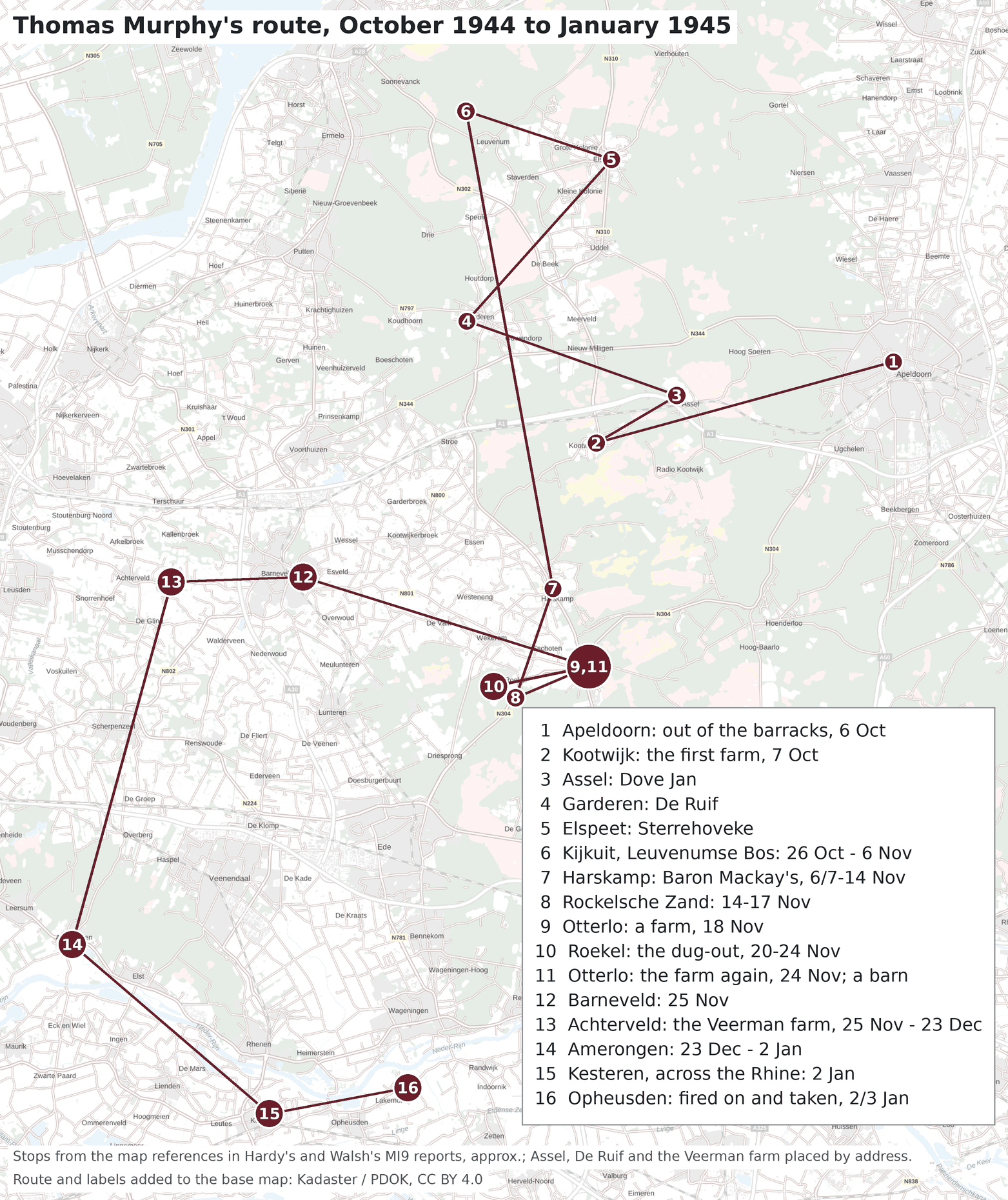
He met Murphy at Sterrehoveke, the house of the Van Eysingas (Ima and Dirk) on the Krommesteeg at Elspeet. On 19 October 1944 he left the hidden house in the woods, Kijkuit, meaning to reach the Allied lines alone; at Leuvenum an English-speaking lady, ◐ Mrs van Asbeck-Patijn, walked him to Elspeet, where "DEREK" (Dirk van Eysinga) checked his paybook and questioned him, and after dark took him to:
the home of his great-aunt where he was hiding … Here also I met Pte. MURPHY … and another Paratrooper whose name I do not know, both of the 156 Para Bn. They had both been wounded and had escaped from WILLEM III Barracks in APELDOORN
— MI9 · Pte J. Hardy, 16 Parachute Field Ambulance · IS9/WEA/1/270/2351 · 13 January 1945 · the report
The other paratrooper was Sam Walsh, whose own report says that for "my movements until 25 Nov see report of Pte. HARDY … which is the same except for one detail" (Walsh). Liesbeth Verweij of the house remembered Hardy as "Jack": brought in hungry from the pinewoods, in a red paratrooper's cap and a camouflage uniform, he became "de vrolijke noot in het gezelschap" (the cheerful note in the company), and when he was homesick he sat at the piano and played sentimental English songs (Noordman, pp. 301–302). The three kept out of the house as much as they could and gathered wood in the forest by day; Uncle Joop visited them there (Hardy; Elspeet).
When word came of a house-to-house search, Hardy wanted to go back to "BRUMMAGER's house in LEUVENUM where I had been before": "I'm going back to Eric … Eric will know what to do; he always does", in Verweij's memory. On the evening of 26 October Derek and Verweij went ahead pushing their bicycles, "and MURPHY, the other Paratrooper, and myself following a short distance in the rear", and at the path to Kijkuit Hardy told her, "Let me alone now; I do not want Eric to know I have been taken here by a woman!" (Hardy; Noordman, pp. 302–303). At Kijkuit were Eric Blok, "Emmy", James Branford and Bram Baar; Tex Banwell joined them on 29 October, and Uncle Joop came to say a crossing was being arranged for a hundred or more (Kijkuit). The forester Z. van der Vlist's form lists Murphy, Walsh, Hardy, Haller, Branford and Banwell together, "between Elspeet and Hulshorst" for "6 or 7 weeks", and Hilbrand Baar's lists the same men with Hardy's number, 1556339 (Van der Vlist, p. 3; Baar, p. 3). ⚠︎ The "6 or 7 weeks" is longer than Hardy's own dates give for the Elspeet and Kijkuit stay, 19 October to 6 November. At midnight on 6 November Derek and "LOEW" took the six, Banwell, the glider pilot John (Bernard Haller), Murphy, Branford, Walsh and Hardy, towards Harskamp; on the Speulderheide, under a full moon, Murphy and Hardy struggled with the cycling and fell behind with Lou (Noordman, p. 294). At Harskamp Baron Mackay hid them for a week in a chicken hut on his estate, with Germans in two of its three houses, and on 14 November they were taken by Red Cross ambulance to the Rockelsche Zand (Hardy; Harskamp).
On the night of Pegasus II, 17 November, he rode a tandem with Branford, Banwell rode with Murphy, and at a fork in the dark "BANWELL, BRENTFORD, MURPHY & I took the wrong fork and lost the rest of the party"; they searched for hours, whistling the first two bars of Lili Marlene, and went back to the farm where the bicycles had come from (Hardy; Operation Pegasus II). The next night Willem and a Dutch policeman brought them to join a party of about twenty, among them Leslie Davison and Victor Moore; the lorry never came, and after a day and a night in the wood Hardy talked it over with Branford, and at three in the morning of 20 November five of them, Branford, Murphy, Haller, Walsh and Hardy, went back towards Otterlo, Banwell staying with the larger party. A farmer near Otterlo sent them to a dug-out in the woods near Roekel, ten men in a space built for far fewer (The keeper of the dug-out):
So, after four nights there I spoke to the man who had taken us there … and told him I intended to move. So on the morning of 24 Nov Pte. MURPHY and I left with our friend
— MI9 · Pte J. Hardy, 16 Parachute Field Ambulance · IS9/WEA/1/270/2351 · 13 January 1945 · the report
◐ Th. A. Boeree's Kroniek van Ede (Frouws, 1947) tells the same days from the Ede side and names none of the evaders. On the Sunday morning the "Tommies" sat uncared for in the wood by Van de Brink's house, and on the Monday Frans Hals sent "Piet en Rinus", Willem van Dijk and Martinus van Beek, to fetch them. They found the men hungry; six had walked off, meaning to go back to Westeneng, but had been stranded at a Pol's, who handed them to Bettink, and he hid them in a hiding place behind the Agneta-hoeve, then lived in by Van Vemden: "Onder die zes mannen zat Jimmy, die een beetje Hollandsch sprak" (among those six men was Jimmy, who spoke a little Dutch) (Boeree, p. 202, checked on the page image). The six are possibly the men who left the wood at three in the morning of 20 November, ◐ at most: Boeree has six and Hardy five, and Boeree has the six with Bettink by the Monday morning, while Hardy's party reached the farmer at the edge of Otterlo only at first light. The hiding place is ◐ very probably the dug-out near Roekel (The keeper of the dug-out). ◐ Boeree's Jimmy is probably not Hardy, though both men were James: Hardy's report says it was Branford, "who spoke Dutch", who talked to the farmer, and the helpers' forms call him "Jimmy Branford" (Maasen van der Brink's table, p. 3; James Branford); Boeree gives no surname. The same page has the two guides of the night, "Piet en Rinus", one of them in police uniform (p. 200), which fits Hardy's "WILLEM and the Dutch Policeman whom I had met before".
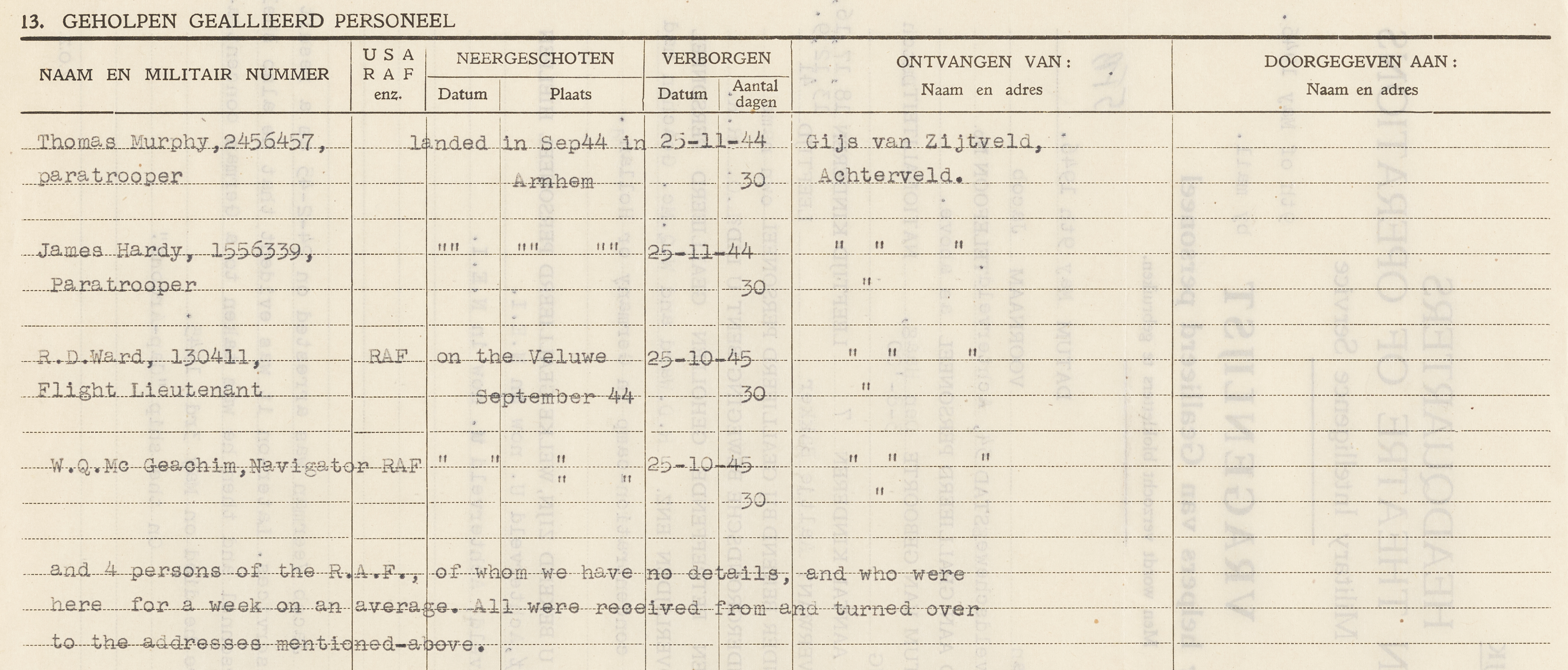
From then until the crossing the two were not parted. That night "WILLEM's brother" took them to a barn in the Otterlo area, ◐ J. van Essen's at Harskamp by Noordman, where they found Davison, an RAF officer and four American airmen; the next evening Davison, Murphy and Hardy were cycled "pannier fashion" to the outskirts of Barneveld, met "GHYS" and "JAN (3)", Gijs van Zijtveld and Jan Dijkstra, and near Achterveld, Gijs took the two of them on to Jacob Veerman's farm, Klein Achterveld (Hardy; Noordman, pp. 285–286). "We stayed here for a month during which time we were very well fed and cared for. They did everything possible to make us comfortable." The family wrote both men down for the Americans in 1946, "JAMES. HARDY. No. 1556339. parachutist" beside Murphy, hidden from 25 November for 30 days (their file, p. 5; Achterveld). By Hardy's report Murphy's revolver came from Jacob Veerman; ⚠︎ Murphy says it came from a policeman in the family (The revolver).
The month at Klein Achterveld. Hardy's description of the family he found there:
The owner of the farm was called Jacob VEERMAN, aged 43, married, with four daughters and three sons, the eldest a girl of 17 named JOANNA and the youngest a boy of 5 named YAP.
— MI9 · Pte J. Hardy, 16 Parachute Field Ambulance · IS9/WEA/1/270/2351 · 13 January 1945 · the report
✓ The family is Jacob Veerman, born 3 August 1900, so 44 when they arrived, his wife Aaltje, and seven children, the eldest Jopie, born 1 December 1927 and so 17 from 1 December (TracesOfWar), and the youngest "Jaap", ◐ 7 or 8 that autumn, where Hardy guessed five: the family's form of May 1946 lists the children's ages as "18,17,16,14,13,12,9", so the youngest was 9 in May 1946 (the form; Jacob's page; Achterveld); Jacob's birth is in the records. Ghys and Jan visited three times, "bringing us soap, shaving material, etc, and giving us the news" (Hardy). The family dated their stay in 1946 from 25 November for 30 days, passed on to Jan Dijkstra of Achterveld, and a copy of 24 May has "25 Nov. 25 Dec. '44 | 1 month" (their table, p. 3; p. 7); Hardy's own departure is 23 December. The two airmen of the month before, Ward and McGeachin, and the four RAF men who followed are on Jacob's page.
On 23 December Jan walked them to Gijs's house for bicycles and a guide Hardy calls Han took them to Amerongen, where they met Capt. Roger Schjelderup and two of his Canadian Scottish, and after dark "a young man came and took MURPHY and me to his father's house", Gerald (Gerrit Hendrik) Esveld's, where they stayed until 2 January (Hardy; Amerongen). Mrs Esveld told the Americans that Murphy's companion "James, or Jim, was working with the Red Cross. He also landed in ARNHEM and after a time in hospital at APELDOORN, was with Tom MERPHY all the time" (her statement, p. 5), and her son Flip listed ◐ the two, by our reading of the names, as "Jimmy and Tom" (his file, p. 10).
At one in the afternoon of 2 January the two "left on bicycles with KOEN and KEEK (?)", Coen Esveld and Freerk "Kik" Stob, who wrote that he took "Tom MERPHY and James (Jim)" "at the beginning of January to LIENDEN, to the stone quarry opposite RHENEN" (his statement, p. 4), in civilian suits lent by Koen, their uniforms in bags strapped to the bicycles, and crossed the Rhine by ferry without difficulty. "Both MURPHY and I had revolvers by this time. Mine was given by KOEN and MURPHY's given him by Jacob VEERMAN." (⚠︎ Murphy remembered his as a policeman uncle's own, and a son of Jacob's remembers Jacob fetching it from his brother Leen; ◐ probably Leen's: Jacob Veerman.) At a barn at Kesteren they met Banwell again, with Sgt Gri and two Canadian privates, and in the afternoon seven more evaders came, among them Schjelderup (Hardy). Schjelderup's nominal list of the party that set out on foot at about half past six has "Pte. HARDY - Paratrooper" and "Pte. MURPHY, T. … 156 Para. Bn.", with Charles Noble and Banwell (Hardy, Schjelderup's report). At about nine they met a German patrol; later, on a road, they were fired on at very close range and scattered, and Murphy, Noble and Banwell were lost. At a second position, under fire from three posts, Hardy took cover with Schjelderup and Gri, and when "the remainder panicked and ran madly onto the ice", Schjelderup sent him after them: "His reply was simply 'Yes, Sir'. He went out under fire with great risk, the ice being very treacherous." He did not find them, and the three were all that was left (Hardy, Schjelderup's report; The crossing and recapture). Murphy was not among them; he had been lost when they were first fired on. After a day and a night lying up, he swam the canal with a wire tied to him so that the other two could follow on a raft, and near Dodewaard, "HARDY, who was in the rear, yelled 'TOMMIES!'", and the three were picked up by a forward post of 49th Division's reconnaissance regiment (same).
His debrief of 13 January 1945 is the reason most of the people who hid Murphy are recorded at all, and it had Murphy alive on 2 January, though the Army later recorded Murphy's death as 20 November 1944 (Operation Pegasus II).
He was recommended for the Military Medal "from the escape angle" by the D.M.I. at the War Office on 10 June 1945, on the same minute as Frank McNaught and a sergeant of the airborne reconnaissance squadron, who were put up for mentions; the D.M.I. asked on 21 June whether it could go forward and M.S. agreed on 23 June (the recommendation, p. 1). The citation ends with the night of the crossing:
A Canadian officer has praised HARDY's conduct during the final crossing of German lines at the beginning of Jan.45.
He went out alone under fire on to the ice covering the flooded countryside to bring back members of the party who had dispersed when the enemy were encountered. He failed to find them. A wide canal had still to be crossed; HARDY swam to the other side and, although owing to the overhanging ice he had difficulty in climbing on to the further bank, he finally did so and secured a wire, enabling the two remaining members of the party to follow without being swept away by the current. They met a British unit the same afternoon, near DODEWAARD.
— War Office · citation for the Military Medal, June 1945 · The National Archives, Kew, WO 373/64/316 · the transcription
By Schjelderup's report the men Hardy went out for were not Murphy's group: Murphy, Noble and Banwell had been lost earlier, at the first ambush, and the men on the ice were "the remainder", who ran from the second position (Hardy, Schjelderup's report; The crossing and recapture). ◐ Footnote [1] of the transcript of Schjelderup's report, which is the transcriber's, gives him as "1556339. Pte. Hardy. J. 16 Para Fld Amb, RAMC. IS9 2351", the number, unit and report reference of this page; the interview behind Schjelderup's own report is dated 13 January 1945, the day of Hardy's (the transcript). The Military Medal was gazetted on 20 September 1945: "No. 1556339 Private James HARDY, Royal Army Medical Corps" (London Gazette, p. 4684).
⚠︎ Charles Noble, who crossed with them, told the night again long after the war, in his own later account (unpublished private papers, shared with us privately). It does not name Hardy. It has the party's second guide killed by a V1, where Noble's report of 1945 and Schjelderup's have him lost when a German patrol passed, and a deserted dyke house "full of loose Canadian ammunition" before the firing, where the party, taking it for Canadian-held, "lit cigarettes and started shouting". It is late memory; the night is set out against the 1945 reports on The crossing and recapture.
Where the sources disagree
Link to the section Where the sources disagreeWhere he came from
Link to the section Where he came fromBoth: born in Scotland, as the Canadians had it, and living in England by his own report and two helpers.
- England. His report gives his address as "Church Lane, Addersley, Nr. Banbury, Oxon" (◐ probably Adderbury; Hardy). Joop Migchelsen's list has "HARDY, James - Church Lane, Adderbury-Banburry-Oxon" (his file, p. 3), which settles "Addersley" as Adderbury, and the Nunspeet helper Jan den Besten listed him in 1946 as "James Hardy Oxford." (his file, p. 3).
- Scotland. "Two Came Back!" calls him Pte "Scotty" Hardy, going home to "his home and family at Hamilton, Scotland" (p. 8), and Haller remembered, in Noordman's Dutch, that like Hardy, Murphy came from Glasgow (Noordman, p. 270). ⚠︎ The Portugal section on Schjelderup in We Were There (vol. 4, p. 2005) has "Pte 'Scotty' Hardy, a British paratrooper" too, from the same source as "Two Came Back!", so it is not a third witness (extracts; OCR only).
- ◐ Haller's Glasgow is loose: he had Murphy, who was from Kelty, from Glasgow too. Hardy was also, by Verweij's account, a merchant seaman before the war (Noordman, p. 302), where his own report says "waiter".
✓ The Scottish records. The statutory index has a James Keir Hardy born at Hamilton in 1913, mother's maiden name Miller, and a James Kier Hardy, mother's maiden name Miller, who died at Galashiels in 1995 aged 81 (the index entries). Asked whether that James Hardy was born on 19 November 1913, the date in Hardy's report and in the Kew catalogue, ScotlandsPeople's staff answered on 21 October 2026 that he was, and that he died on 18 February 1995 (their reply; the register entries themselves not seen). The same name, the same day of birth and the Hamilton of "Two Came Back!" make him the paratrooper. Lisan Koppenol, a Dutch researcher, put the question to ScotlandsPeople. ◐ England and Wales have no James Hardy born on 19 November 1913 in the death index from 1969 to 1997 (FreeBMD).
When the three were picked up
Link to the section When the three were picked upThe Military Medal citation has them meet a British unit "the same afternoon" as the swim (the recommendation); Schjelderup's report has the swim at 11:00, a house reached at 15:00 where they stayed to dry out, and the last stretch begun at 13:00 the following day (Hardy, Schjelderup's report). ◐ The 11:00 is the Pegasus Archive's reading. The whole report, held as a transcript (the Kew original not seen), has "At 100 hrs approx., we moved our raft", perhaps a dropped digit; the battalion's account has the crossing made in daylight (p. 7). The two transcriptions also differ on the grid reference of the demolished factory, "Sheet 4, 571746" at Pegasus and "Sheet 5, 571746" in the transcript. The report gives no date for the swim or the pick-up.
Where the party met on 2 January
Link to the section Where the party met on 2 January⚠︎ Hardy has himself and Murphy cycle to Kesteren (515730) and wait in "a barn adjoining a farmhouse", where Banwell, Gri and two Canadian Scottish privates were and, in the afternoon, "seven more evaders including Capt. SCHJELDERUP" came (Hardy). Schjelderup's report, held as a transcript, has "the whole lot of us" assembled "in a brick factory at (Sheet 5, 4876)" before the party set off at about 18:30, and no barn. Noble has the party meet "about 300 yards West of the RHENEN bridge" and reach "the brick factory on the river bank opposite WAGENINGEN" at about 23:00 (Noble). ◐ Hardy and Schjelderup may be giving two stops of one afternoon: if both are Sheet 5 references, 515730 and 4876 are about three and a half kilometres apart.
✓ Two of the Canadians' own MI9 reports have a barn too. Swartz crossed with Trainor and went along a dyke road "to a barn", where they were "rejoined by Sgt. TRY, Sgt. BANWELL, Pte. MURPHY and another Canadian Airborne soldier" (Swartz's Appendix C); Berry met the rest "in a barn four kms. from the ferry" (Berry, p. 2). ◐ Swartz's "another Canadian Airborne soldier" may be Hardy: Swartz puts Banwell in a Canadian parachute battalion as well. Schjelderup's MI9 report names Banwell too, without a barn: it lists "Sgt. BANWELL, K." in the patrol and has "Sgt. TEX (?) [BANWELL]" lost with Noble and Murphy in the firing at the road (transcript; the bracket is the transcriber's).
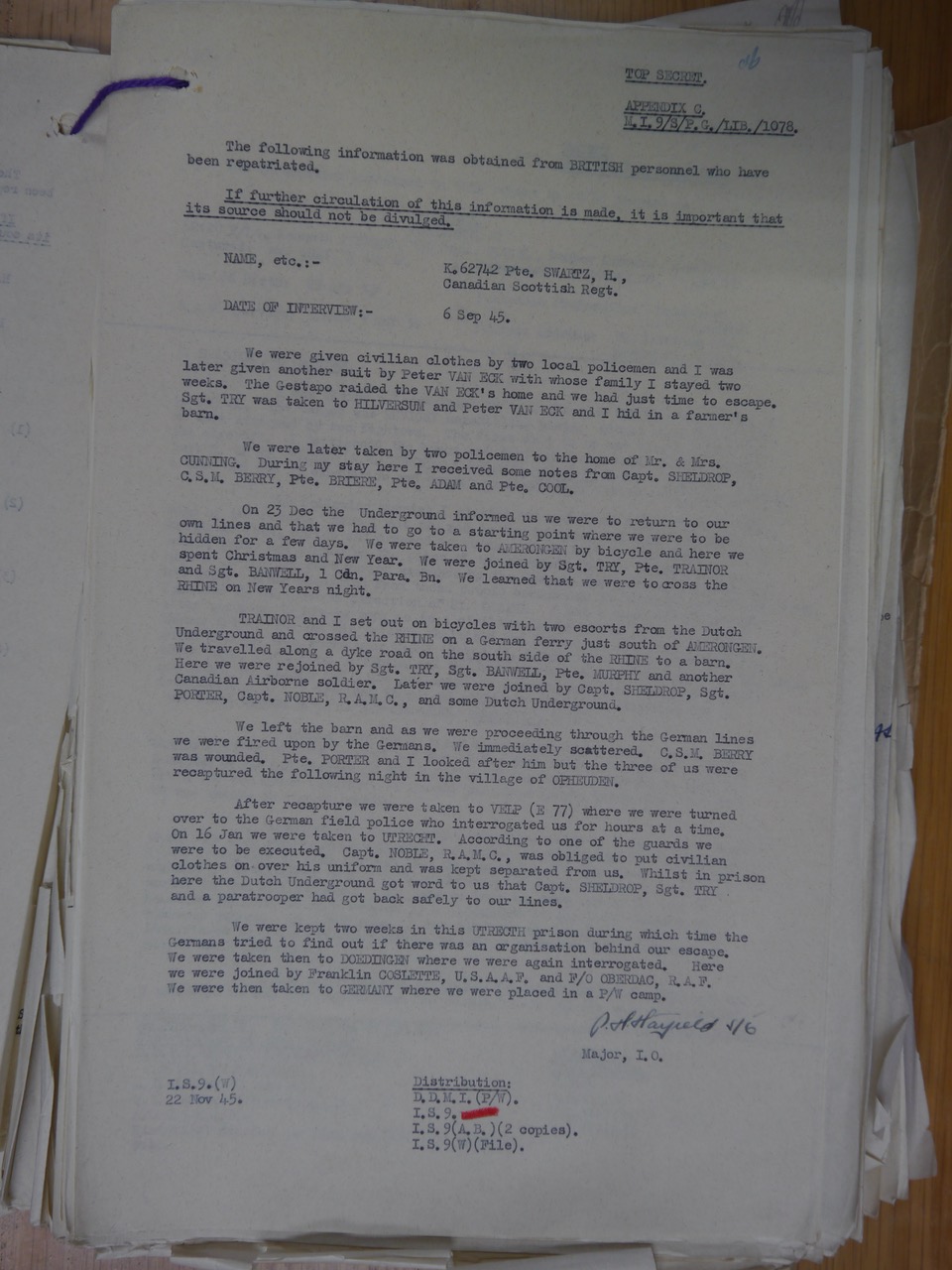
Briere's "Pte. BUCK"
Link to the section Briere's "Pte. BUCK"◐ Pte Marcel Briere's MI9 report has four British paratroopers joining them at Amerongen, "Capt. NOBLE, Sgt. 'Tim', Pte. MURPHY and Pte. BUCK", and after the ambush "Capt. SHELDROP, Sgt. GRUN and Pte. BUCK escaped and returned to our lines" (p. 2; p. 3). Every other source has Hardy as the third man through, so Briere's Buck is very probably Hardy under a name Briere misheard or misremembered. No Buck is in Schjelderup's nominal list.
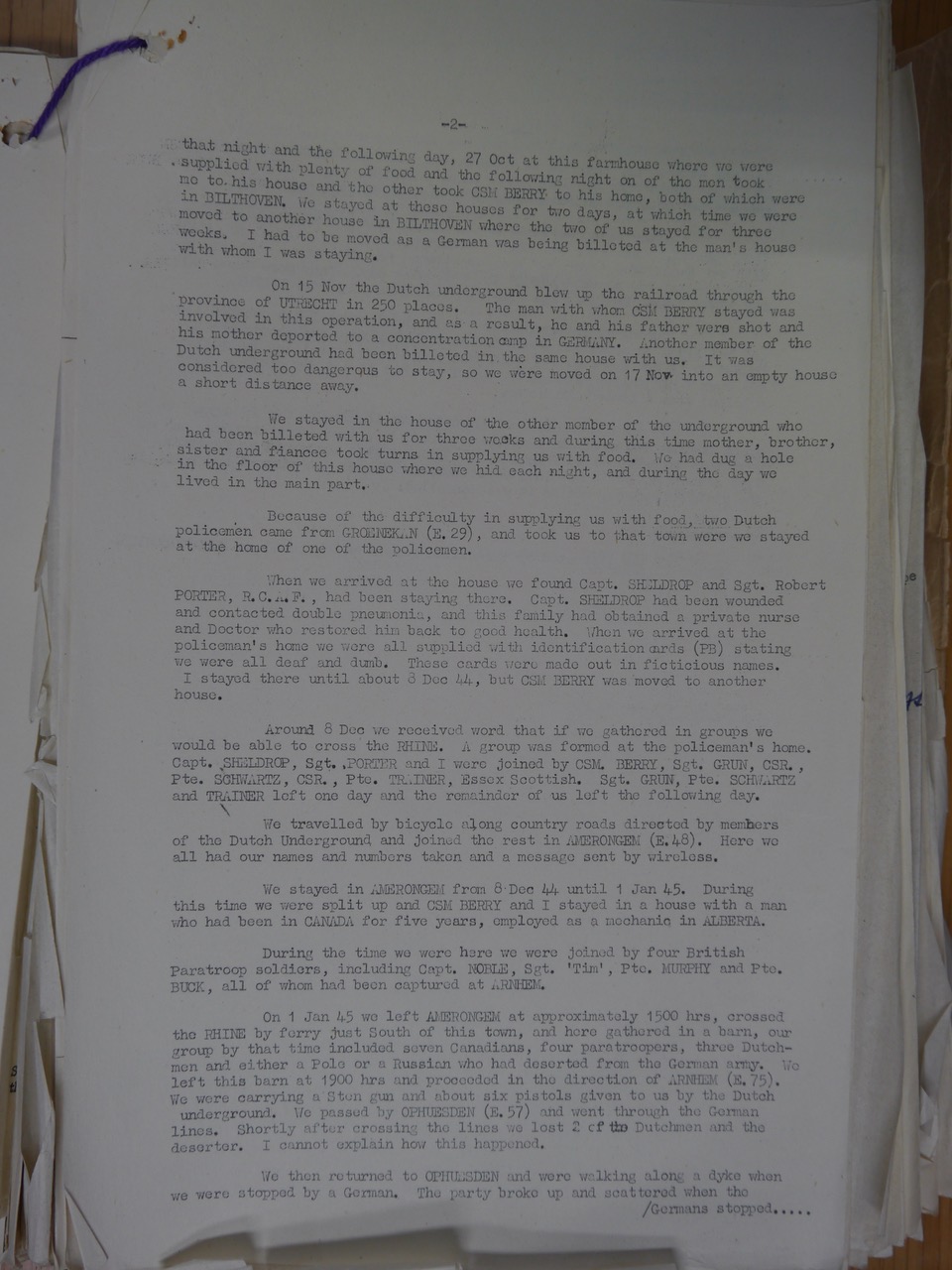
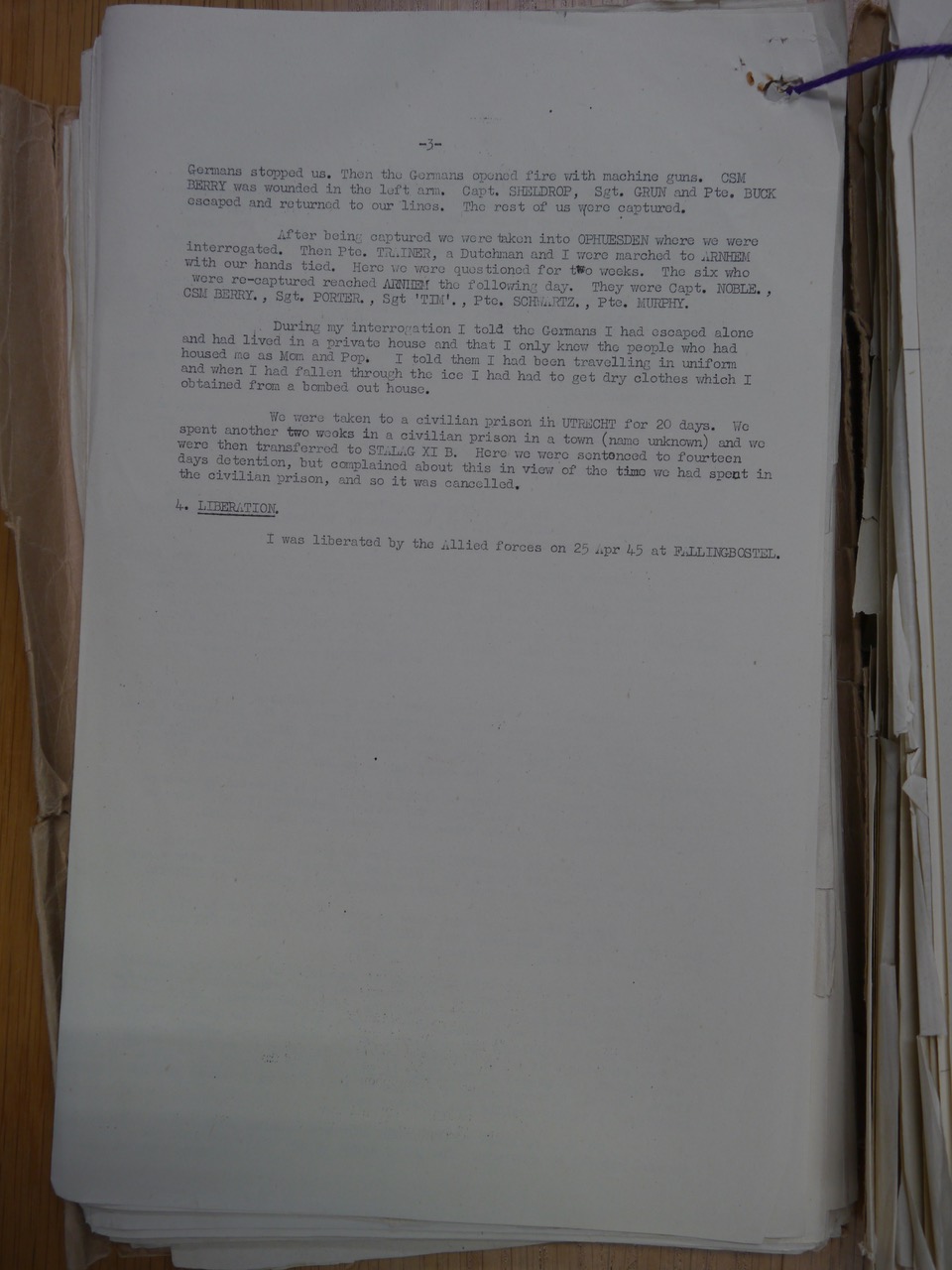
The days after the crossing, in Boeree
Link to the section The days after the crossing, in BoereeBoeree heads the morning in the wood "Zondagmorgen 18 November" (p. 202), but 18 November 1944 was a Saturday, and his next day is "Maandagmorgen". ◐ By Hardy the party reached the wood on the night of 18 November, "stayed in the wood the rest of the night and all next day" and left at three in the morning of 20 November, which fits Boeree's Monday being the 20th. On p. 201 the morning after the crossing of the evening of 17 November is the 18th, which fits his date and not his weekday, so which of "Sunday" and "18" is the slip is not settled; the Monday is the 20th either way (Hardy; Van Vemde). Boeree has six men walk away from the wood and end at Bettink's hiding place; Hardy has five leave and find five more in the dug-out, ten in all, and Van Vemde writes of "10 à 12" (Boeree, p. 202; Van Vemde's file, p. 8). ◐ Boeree's six may be only the first arrivals, or a count from memory; not settled.
Where Murphy was on 17/18 November
Link to the section Where Murphy was on 17/18 NovemberHardy has Murphy lost at the fork with him, Banwell and Branford; Walsh, who says his account is Hardy's "except for one detail" without saying which (◐ probably this one), has the guides losing only Hardy and Branford and taking Banwell, Haller, Murphy and Walsh on to a house near Kootwijkerbroek (Walsh). Hardy is the likelier, because he describes Murphy continuously afterwards; not settled (Operation Pegasus II).
When he met Murphy at Elspeet
Link to the section When he met Murphy at ElspeetHardy reached Sterrehoveke on 19 October and found Murphy already there, as Verweij's account has it too; Walsh's report has Murphy and Walsh moving there from De Ruif about 21 October, "where Pte. HARDY … was living" (Walsh; Where, and with whom).