P/O James Branford
6 May 1915 ◐ – before 2019
P/O James BRANFORD (Hardy: "Brentford").
About: An RAF bomb-aimer shot down over Berlin in August 1943, who escaped from Stalag IVB in April 1944, spent the summer and autumn hidden in Overijssel and on the Veluwe, and was with Murphy for weeks from Kijkuit to Pegasus II. He got out by the Sliedrecht route in March 1945 and was made an MBE.
Unit or role: RAF; "an Air Bomber of a Stirling crew who had been shot down over BERLIN about 16 months ago, had escaped from a prison camp near LEIPZIG and had been hiding in HOLLAND for 5 months"; spoke Dutch.
Where: At home, "The Cottage", Deancourt Road, Rottingdean, Sussex, as the Dutch helpers give it.
Evidence: ✓ Hardy; Walsh; ✓ the National Archives catalogue (searches); ✓ London Gazette, 17 August 1945, p. 4186; ✓ the helpers' files below; ◐ Boeree, Kroniek van Ede (1947), p. 202 (read on the page image).
✓ In the National Archives catalogue (searches): Flying Officer James Branford, 1339042, 149 Squadron, 3 Group, RAF, born 6 May 1915, captured in Germany on 27 August 1943, escaped from Stalag IVB, which Hardy calls "a prison camp near LEIPZIG" (WO 208/5406/7). ◐ Adrian Gilbert's POW: Allied Prisoners in Europe (2006) has "Pilot Officer James Branford — who made the camp's only British home run" from Mühlberg, citing "James Branford, PRO WO 208/3274, appx D, p. 7" (the search hits, not read on the page); WO 208/3274 is the Stalag IV B file at Kew, 1941–1945, not digitised (the catalogue entry). A sergeant, 1339042, he was commissioned pilot officer from 21 July 1943 (London Gazette, 28 September 1943, p. 4309) and made flying officer from 21 January 1944, while a prisoner (21 January 1944, p. 423). The entry lists as other names mentioned in it Squadron Leader Mahoney, Sergeants Burton, Hood and Van Haardt, F/O McKirdy and Sergeant Dixon (RCAF), ◐ his crew and the men he escaped with, going by the Almelo police's list of the Stirling's crew below. His German prisoner-of-war card, "Sergeant … 1339042 … Stalag IV B, Muhberg", PoW number 222575, is at Kew (WO 416/40/104; the catalogue entries).
The citation for his MBE tells the story to the summer of 1944. One night in August 1943 his Stirling was hit over Berlin and caught fire; he came down by parachute some 10 km west of the city with a gashed chin and a sprained ankle, and he and the navigator hid by day and walked by night until they were caught on the fifth day. At the interrogation camp near Frankfurt he passed himself off as a Frenchman and got out of the camp hidden in a dust cart, "just got clear before the German guards bayonetted the dust heap", and was taken back. He escaped again in April 1944, rode four days in a railway truck with five others, and was then "taken care of by a Dutch farmer with whom he stayed for 7 weeks" (London Gazette, 17 August 1945, p. 4186; the heading on p. 4185).
◐ S. P. MacKenzie's The Colditz Myth (Oxford, 2004) uses his report on his interrogation: the man questioning him "pointed out that they had had a lot of trouble with spies being dropped in Germany", and "it was made very clear that I had still to prove my identity"; its note cites "PRO, WO 208/3274, report on escape of J. Brandford" and the index has him on p. 55 (the hits; search snippets only, not read on the page).
◐ Thomas Lancashire, a prisoner who "arrived at Muhlberg at exactly the same time" as he did, quotes him in A Trenchard Brat at War (Isis, 2011) from "an official report after the war", which he gives as the "Secret Camp Histories of Stalag IVB", WO 208/3274 (the hits; search snippets only, and the Archive gives no usable page; the text layer has a colon after "bullying", read here as a comma):
Had we allowed it, the bullying[,] arrogant guards would have made life a pretty good hell. The RAF did all they could to wear them down. Turning up late for parade, talking, booing the guards whenever they kicked anyone for small offences. Finally their attitude changed and they gave it up as a bad job trying to keep us in order.
— Pilot Officer James Branford · quoted in Thomas Lancashire, A Trenchard Brat at War · Isis, 2011 · the hits
The Dutch helpers' own files pick him up there. A helper at Oldenzaal had him for 42 days from May 1944: "James Branford … Picked up near Deurningen. Ex.P.W.", passed on to J. Haeck at Hengelo, with the Canadian Jean Warren (Hilbrink's file, p. 7). H. J. Snel of the Hasselterdijk at Zwollerkerspel, of the group "de Groene", hid him from early June to early October 1944, with Warren and the American Frank Coslett for part of the time (Snel's file, p. 3). That fits Hardy's "hiding in HOLLAND for 5 months" when they met. Hendrik Jan Rigter of Groeneweg 136, Zwolle, "Henk of Pijl", one of the leaders of the same group's work for Allied men in Zwolle, listed "Jimmy Brandford", R.A.F., on the line under "Johnny Warren", Canada, both received from "Tijhues [Tijhuis] Nijverdal" (his list, p. 3; his form, p. 2, 17 July 1945). ◐ The Americans' reviewer noted that Rigter knew of and sanctioned the work, but that it was done under the direction of "Willem de Groene". Warren's own escape report, at Kew and not digitised, names among others "Pilot Officer J Brandford" (WO 208/3326/2996, the catalogue entry).
✓ The Nijverdal and Zwolle end. Willem Maasen van der Brink of Nijverdal lists "Jimmy Branford", RAF, "Duitsland (Berlijn)", "gevlucht uit Dresden", hidden 42 days, received from "Heerdink Nijverdal", passed to "de Groene" of Zwolle, "verborgen gehad tot 5 Augustus 1944", with his home address at Rottingdean (his table, p. 3). Jacobus van Aartsen of Wierden gave "J.L.N. Warren, RCAF, and Jimmy Branford, RAF" food, shelter and clothing "for 3 days" (his summary, p. 2). Nine more forms of the Zwolle, Harderwijk, Dalfsen and Staphorst helpers carry much the same two lines, most as "Johnny Warren", Canada, and "Jimmy Brandford", RAF, received from "Tijhuis, Nijverdal", with variations (Gooy names no Tijhuis, Keilholz has Warren from "Jos. Bovani, Staphorst", Peters swaps the two nationalities, Beyjer lists Brandford first), beside the American Frank Coslett's block: those of Graver (p. 8, his summary of 12 February 1946), Stil (p. 5), Aan't Rot (p. 9), Peters (p. 3), Alink (p. 4), Keilholz (p. 3), Noach-Meijer (p. 19), Beyjer (p. 3) and Gooy (p. 11). Beyjer's table sends the pair on to "Baron v. HEEKEREN, Hattum, via Zwolle to Amsterdam" (◐ the layout does not make clear whether that is for Warren alone). None gives Branford's own dates beyond Graver's "May 1944", which is Coslett's. Beernink-de Riet's table has, unnamed, "1 Canadian middle August … from Nijverdal, Tijhuis teacher" and "1 Englishman middle Sept." at Hierden near Harderwijk (her table, p. 5), ◐ very probably Warren and Branford.
◐ A Zenderen helper, Albertus Koekkoek, lists 119 evaders, among them "113. Sgt. Jean L.N. Warren" and "114. James Branford, Goudhs & Co., 440 Strand, London" (his list, p. 15), the same two names side by side, the identity resting on that pairing. The Almelo police's list of the airmen in E. B. Brune's papers has "James Branford p/o 1339042 Bomb Aimer" in a Stirling crew listed as W/C W. C. Harrison (no status given), Sq/Ldr Mahoney, P/O Hood, Sgt Dickson and P/O van Aardt (prisoners of war), and Sgt Burton, killed (the letter, p. 4, 28 February 1947; the letter's account of Brune is in Frank Coslett: a suspicion only).
With Murphy
Link to the section With MurphyHe was already at Kijkuit, the forester's house in the Leuvenumse Bos where Bram Baar ("BRUMMAGER") of Joop Migchelsen's group looked after the men, when James Hardy and John Haller were brought there after dark on 12 October 1944, and he checked Hardy's identity "on behalf of the Dutch helpers, BRUMMAGER & Co."; Hardy describes him there as "an Air Bomber of a Stirling crew who had been shot down over BERLIN about 16 months ago, had escaped from a prison camp near LEIPZIG and had been hiding in HOLLAND for 5 months" (Hardy). Hardy left on 19 October and came back on the night of 26 October with Murphy and Sam Walsh; on 29 October Tex Banwell joined them, and the six, Murphy, Walsh, Hardy, Banwell, Haller and Branford, were together from then until the early hours of 20 November, when Banwell stayed with the larger party, apart from the night of 17/18 (Kijkuit; Hardy).
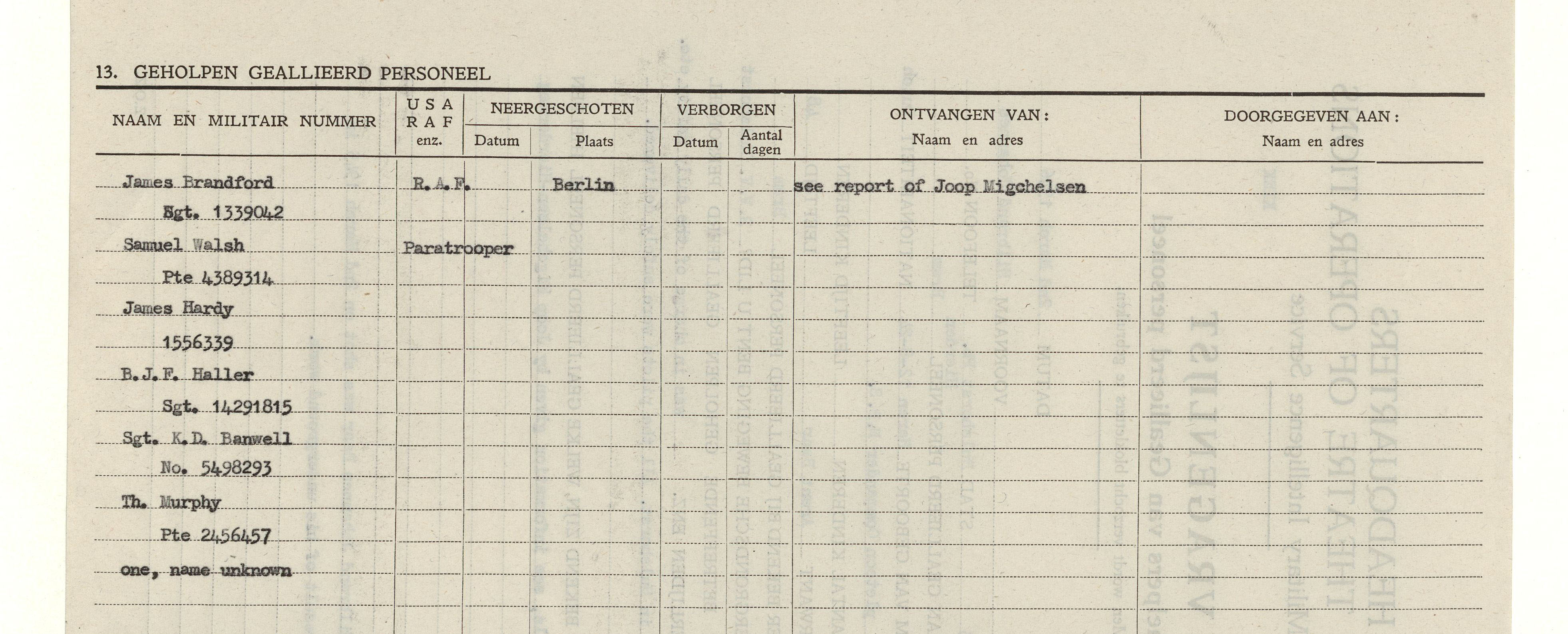
Haller, who came to Kijkuit with Hardy, remembered meeting Branford there first, with Walsh and Murphy "later". His first talk with Branford stayed with him: Branford questioned him closely to prove he was who he said, since he had no identity papers, a torn uniform and a camouflage jacket with one sleeve torn off at the elbow; Branford had no regional English accent, and they tried to talk about flying, Branford a Stirling bomb-aimer and Haller a glider pilot who knew the Stirling from the other end of the cable. Haller learned his first Dutch from him, since Branford had by then a fair knowledge of it after several months in Holland (Noordman, pp. 270–271, Haller's own account). Haller added that he, Branford and Walsh stayed together until after Pegasus II, and were then separated for lack of room; since his own Dutch was by then good enough, they agreed that Sam should stay with Branford (same, p. 271). At midnight on 6 November they set out with two guides, broke the journey for a meal and a rest, and reached Harskamp at about nine on the evening of 7 November, where they were hidden in Baron Mackay's chicken hut; on 14 November they were taken by Red Cross ambulance to the Rockelsche Zand (Harskamp; Hardy). A one-guilder note signed by the six is described below.
On the night of Pegasus II, 17 November, he rode a tandem with Hardy, and with Banwell and Murphy took the wrong fork and lost the guides; they searched for two or three hours, whistling the first two bars of Lili Marlene, and went back to the farm where the bicycles had come from (Hardy; Operation Pegasus II). The next night they joined the party of about twenty left in the woods when the lorry failed to come. "I talked the situation over with P/O. BRENTFORD and our small party and we decided that something had gone wrong", Hardy wrote, and at about three in the morning of 20 November the five, Branford, Murphy, Haller, Walsh and Hardy, set off back towards Otterlo; at a farm on the edge of Otterlo "BRENTFORD, who spoke Dutch, conversed with the farmer", who fed them and sent them with a boy to a dug-out in the woods near Roekel (Hardy). ◐ The keeper of the dug-out, J. van Vemde, remembered among the men he hid "de bestuurder van een bommenwerper" who had been on the run for half a year, spoke broken Dutch and was called John; Branford is the nearest fit, though he was a bomb-aimer and the reports give "John" to Haller (Van Vemde's letter of 20 May 1946, p. 8; The keeper of the dug-out). Hardy and Murphy left the dug-out on 24 November; the next day, warned that their helper had been arrested, the men in the hide split into two parties of three, Branford, Haller and Walsh making for Valk (Walsh).
◐ Th. A. Boeree's Kroniek van Ede (1947), which names none of the evaders, has Piet and Rinus find a group of hungry men ("de hongerige kerels", with a captain who spoke German) in the wood on the Monday after the crossing; six had walked off, were stranded at Pol's and were handed to Bettink, who hid them behind the Agneta-hoeve, where Van Vemden lived. "Onder die zes mannen zat Jimmy, die een beetje Hollandsch sprak" (among those six men was Jimmy, who spoke a little Dutch) (Boeree, p. 202, read on the page image). ◐ Possibly him, if Boeree's six are Hardy's five, itself possible at most (the counts and the hours differ: Johan Bettink): the helpers' forms call him "Jimmy Branford" (Maasen van der Brink's table, p. 3), and Hardy's report has "BRENTFORD, who spoke Dutch", talking to the farmer on the way to the dug-out (Hardy). Boeree gives no surname, and James Hardy was a James too, but it was Branford whom Hardy's account sets talking to the farmer; the rest of the page's reading is on Hardy's page and in The keeper of the dug-out.
The banknote the six signed
Link to the section The banknote the six signedThe Airborne Museum's archive, catalogued at the Gelders Archief, holds a one-guilder note of 1943 signed by six British soldiers, and the catalogue gives their names:
Six paras in a hole on the Veluwe. The late husband of the donor lived, or was in hiding, on the Veluwe as a young man in the last years of the war, and was involved in the Resistance. He supplied these six men with food and so on in the months after the battle, when they were hiding in the woods of the Veluwe, in a hole in the ground. … The "six men in a hole" were: Sergeant Keith D. (Tex) Banwell, 10th Battalion, The Parachute Regiment; Private Thomas Murphy, 156 Battalion, The Parachute Regiment; Corporal James Haidy, Royal Army Medical Corps; Private Edward C. Bradford, 1st Battalion, The Border Regiment; Sergeant John Haller, The Glider Pilot Regiment; Private S. (Sammy) Walsh, 156 Battalion, The Parachute Regiment.
Dutch originalZes para's in een hol op de Veluwe. Wijlen de echtgenoot van de schenkster … heeft als jongeman tijdens de laatste oorlogsjaren op de Veluwe gewoond dan wel ondergedoken gezeten. Daarbij was hij betrokken bij het Verzet. Hij heeft deze zes mannen van voedsel e.d. voorzien in de maanden na de Slag toen zij in de bossen van de Veluwe zaten ondergedoken, in een hol in de grond. … De 'Zes mannen in een hol' waren: Sergeant Keith D. (Tex) Banwell, 10th Battalion, The Parachute Regiment; Private Thomas Murphy, 156 Battalion, The Parachute Regiment; Corporal James Haidy, Royal Army Medical Corps; Private Edward C. Bradford, 1st Battalion, The Border Regiment; Sergeant John Haller, The Glider Pilot Regiment; Private S. (Sammy) Walsh, 156 Battalion, The Parachute Regiment.
— Gelders Archief · Airborne Museum collection, toegang 1604, item 350 · catalogue entry
⚠︎ "Haidy" will be Hardy, and the museum's "Edward C. Bradford, 1st Border" stands where every other source has the RAF officer James Branford (Bradford's page). The museum has nothing more on Bradford, Murphy, Haller and Walsh. ◐ When it was signed is not stated, and nobody here has seen the signatures: the archive scans on request.
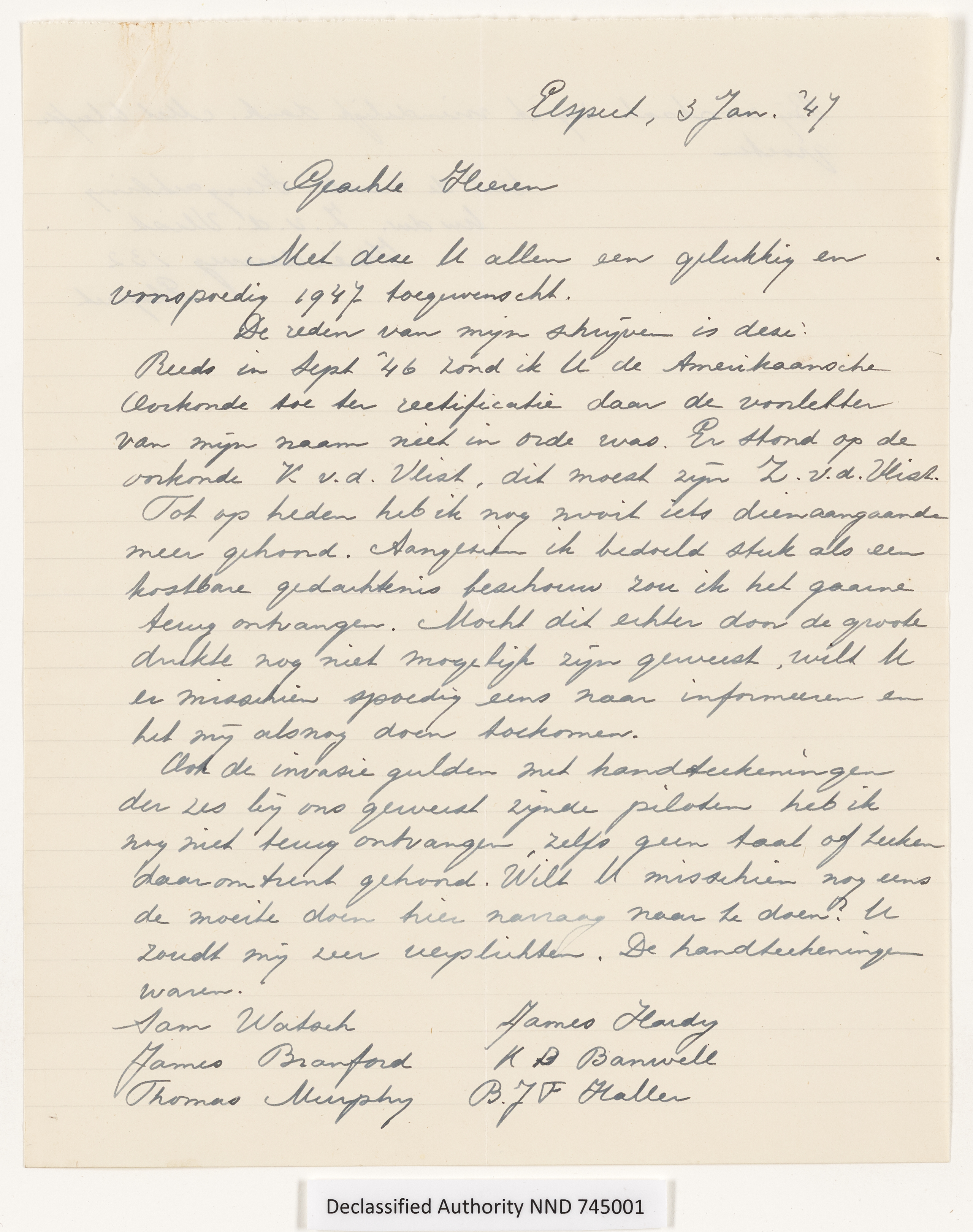
The forester at Kijkuit had a note of his own, or the same one. Z. van der Vlist, whose family lived in one half of the double house at Kijkuit, with the six in the other (Migchelsen's statement: his file, p. 3), asked the Americans in September 1946 after "een invasiegulden met zes handteekeningen van de piloten die hier vertoefden" (an invasion guilder with six signatures of the pilots who stayed here), sent to their office at Wassenaar about November 1945 by a Mr van Hattem of Elspeet; the office answered on 23 September 1946 that it had passed it to the British bureau I.S.9 (his file, pp. 13, 11). It never came back, and in January 1947 he wrote again, setting the signatures out as they stood:
Also the invasion guilder with the signatures of the six pilots who were with us I have still not had back … The signatures were: Sam Watsch, James Hardy, James Branford, K D Banwell, Thomas Murphy, B.J.F. Haller
Dutch originalOok de invasie gulden met handteekeningen der zes bij ons geweest zijnde piloten heb ik nog niet terug ontvangen … De handteekeningen waren. Sam Watsch, James Hardy, James Branford, K D Banwell, Thomas Murphy, B.J.F. Haller
— Z. van der Vlist to the American office, Elspeet, 3 January 1947; US National Archives, RG 498, helper file of Z. van der Vlist (the archive's copy, p. 9)
His is the third name of the six, spelled Branford. ◐ Whether the forester's note is the museum's is not settled: both are invasion guilders with six signatures from the same party, which fits one note; but his went to I.S.9 and had not come back by January 1947, while the museum's came from the widow of the man who fed the six in their hole in the ground, which is not the forester's house. Either way, a letter of 1947 has "James Branford" among the six signatures, and the museum's entry, with its "Bradford", is the one that has his name wrong.
How Murphy remembered him
Link to the section How Murphy remembered him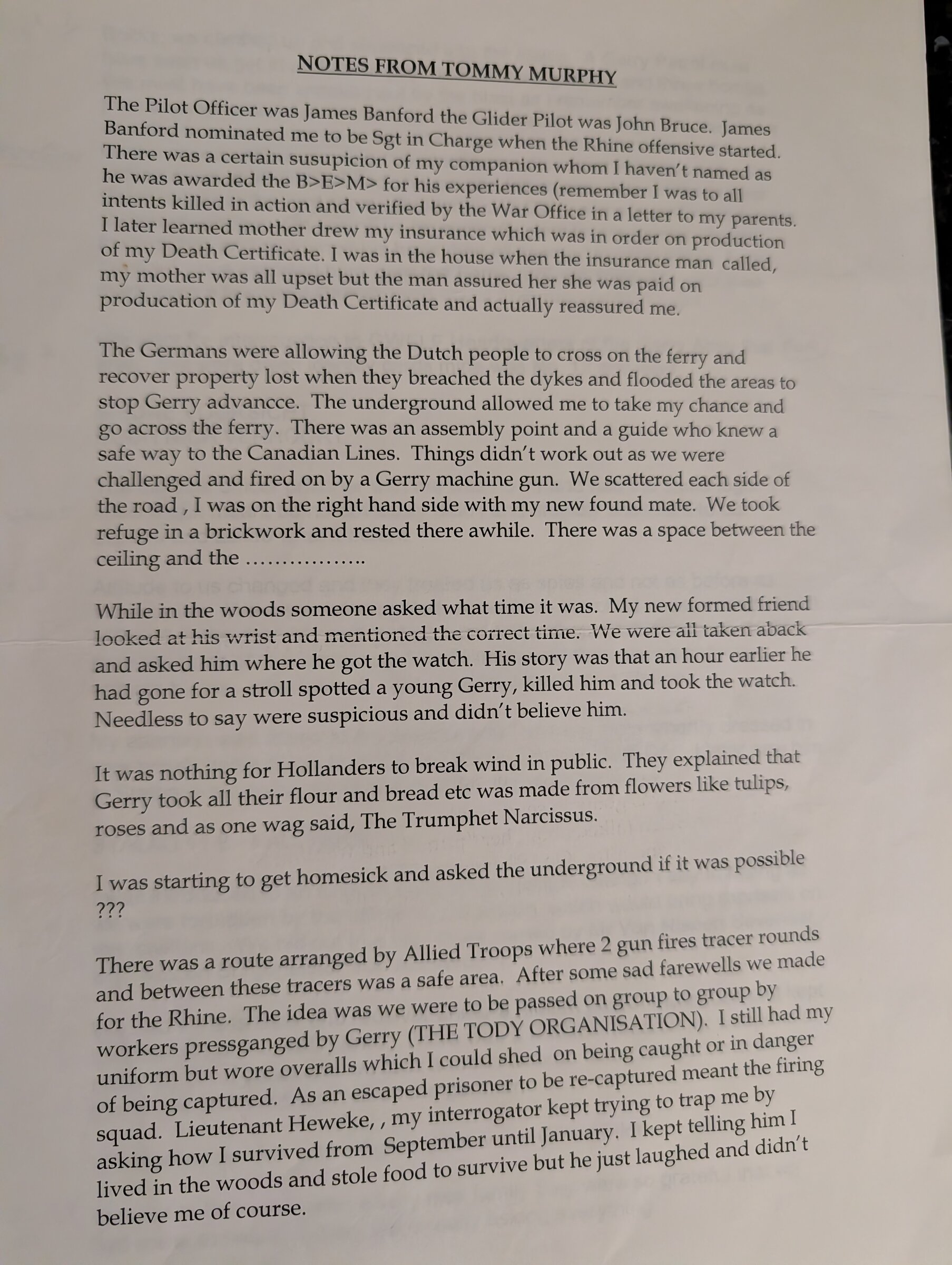
⚠︎ Murphy calls the Pilot Officer "James Banford" and says Banford nominated him Sgt in charge (notes). ✓ The same man: Noordman, who had the reports, calls him "James Branford", a Stirling bomb-aimer shot down near Berlin who had escaped a camp in Germany, and lists an escape report "Branford, James, 10-3-1945" (Noordman, pp. 270, 279, 340). So Murphy had his first name right and his surname one letter out; Hardy's "Brentford" is the mishearing.
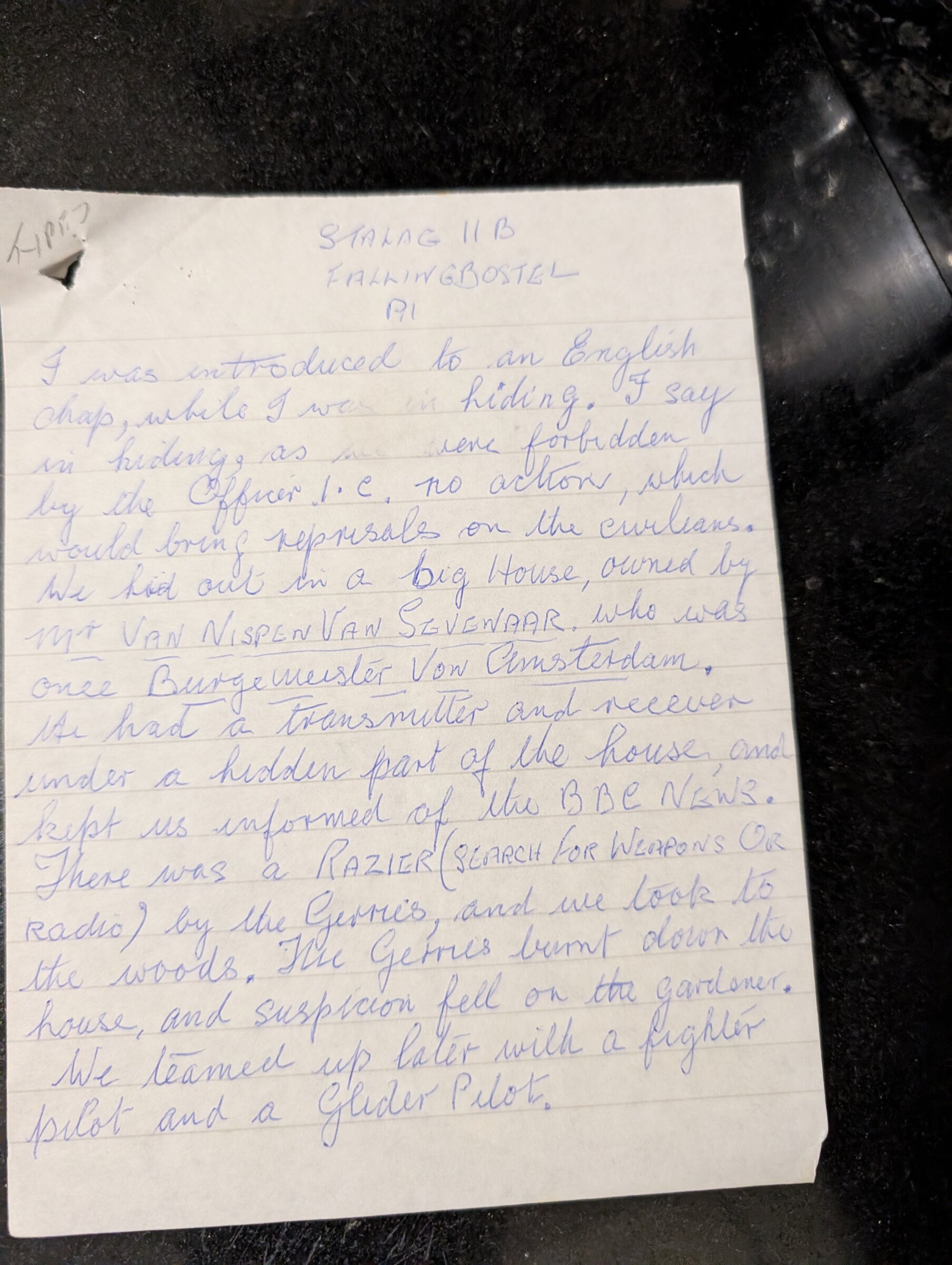
In his Fallingbostel notes he writes only that "We teamed up later with a fighter pilot and a Glider Pilot" (Stalag p. 1). ✗ Branford was a bomb-aimer, not a fighter pilot. ⚠︎ The notes have Banford nominate Murphy "to be Sgt in Charge when the Rhine offensive started", and do not say which crossing that was; Branford was at Evert van de Braak's farm from 1 December 1944 until 26 February 1945 by that helper's list, so he was not with Murphy at the Amerongen crossing of 2 January 1945 (Van de Braak's file, p. 5; Amerongen).
Walsh's report tells the winter. The three walked to Valk and at about two in the afternoon came to the house of a builder Walsh knew as HANK, "married, with three daughters", who put them up for a week. On 1 December "GERD", one of their guides on the night of Pegasus II, came for them:
He took us to his own house which was in the area of KOOTWIJKKERBROEK … and after staying there overnight he took P/O. BRENTFORD and me to a farm on the outskirts of VALK while Sgt. Haller was taken to another address in this area. Our new host was Evaard VAN BRAAK, a farmer, married, with one daughter aged about eight
— MI9 · Pte S. Walsh, C Company, 156 Parachute Battalion · report of 7 March 1945 · the report
Gerd visited them often, with extra food and tobacco (Walsh). Gerd was Gerrit van Ee of Kootwijkerbroek (Noordman, p. 304). On the evening of 7 February 1945 Walsh went to Gerd's birthday and stayed the night with McNaught and Riley instead of going back to Van Braak's; next morning Gerd told him to prepare to leave, and had his uniform fetched from the farm (Walsh). Evert van de Braak's list has Branford, of Rottingdean, there "1.12.44 till 26.2.45", from the "Pilot club" and Gerrit van Ee, with Walsh beside him and three Americans over the same winter (Van de Braak's file, p. 5), and Heimen van Esveld's list has a James Branford of Rottingdean for seven days (his file, p. 8).
He went out the way Walsh did, by the Sliedrecht line. At Schalkwijk a list given by Copier's son, in the enclosure to the file of A. P. Copier, has five evaders "from 20 Febr. - 8 March (this in connection with the phase of the moon)", among them "Mr. James Branford. 'the Cottage'. Deancourtroad. Rottingdean Sussex", while the German Ortskommandant and his officers were billeted in the same house (Copier's file, p. 6; there are two Copier files from Schalkwijk, father and son, set out on Edward Bradford), and a Sliedrecht helper who guided evaders from Molenaarsgraaf to Sliedrecht by bicycle listed "JAMES BRANFORD, F/O. R.A.F." with McNaught and Riley (his file, p. 15). Houten and Sliedrecht gave him the last days. Johannes Hoekstra, a Houten policeman, lists "Mr. James Bradford", RAF, 1944, 10 days, received from A. A. J. A. Copier of Schalkwijk and "passed to J.C. Sturkenboom, Houten", with K. C. Parsons (his table, p. 3); the fourth letter of the surname there is a d and an n typed one over the other (the crop), and his Dutch copy of the same table types "Mr. James Branford" cleanly (p. 5). It adds "thans overleden" (now dead) after Copier, ◐ the son, Joep, by his forenames and age on Hoekstra's form of April 1946 (Edward Bradford). The form for the widow Sturkenboom-Straver of Houten, of 12 July 1945, says two evaders had been with her "from the last week of Febr. till the 8th of March" by way of Hoekstra, but "the old lady had forgotten their names. I suppose it must have been Jim and Ken": the names are the form-filler's guess, and a handwritten note at the foot, initialled FB, adds "Fliers' names: James Bradford, K.C. Parsons", the same two names in the same order as Hoekstra's table, ◐ very probably taken from it (her form, p. 4), and again on 22 March 1946 with his Rottingdean address, "10 days" (her letter, p. 7). At Sliedrecht Cornelis van Woerkom's table has "James Branford R.A.F., 9/3/'45, ½ day", with no destination on his row (his table, p. 20; the typed list, p. 25); ◐ the helper's note says that 19 of the 21 other men at his house went on to Brabant. ◐ So he crossed about 9 to 10 March 1945, the date Noordman gives his report (above).
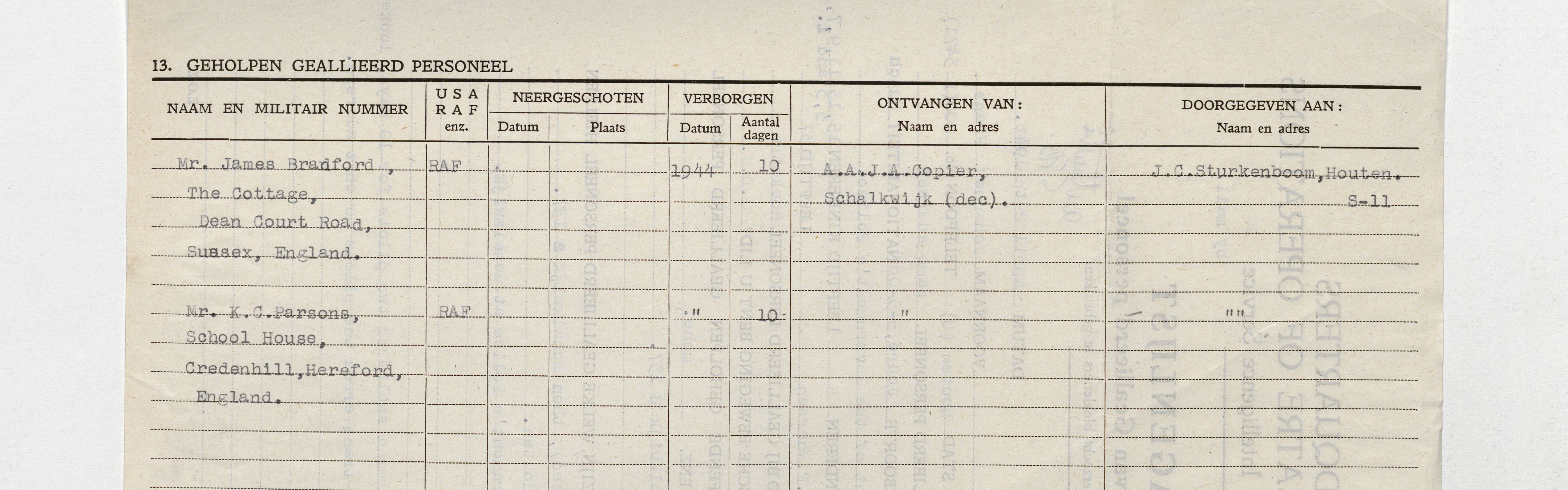
He is on the lists of Klaas Heijboer of Groot-Ammers, whose crossing group took men over the Lek to Sliedrecht (his file, p. 30), and of Pieter Visser of Sliedrecht, received from Heijboer (his file, p. 29). The list in Dirk Leendert van der Brugge's file, of the men helped by the I.S.9 organisation around Sliedrecht, has "J. BRANFORD, F/O R.A.F.", received from "Dick Kay, S.A.S." and passed on to "P. Visser, Sliedrecht" (p. 12); ◐ the Americans noted that the names on it were helped by the organisation, not by Van der Brugge himself (p. 9). His Holland report, IS9/WEA/1/298/2391, is catalogued as "has not survived" under WO 208/3352/2391 (WO 208/3352/2391), the series' general note; ◐ but WO 208/5406/7, his Stalag IVB escape questionnaire, carries that same number as its former reference, so it is very probably the report itself (the catalogue entry). Two index entries to it survive too (WO 208/5273/1436; WO 208/5275/103). He was made an Additional Member of the Order of the British Empire for his escape, gazetted on 17 August 1945 (p. 4186). Haller, who had met him at Kijkuit and was with him until the first days of December 1944, told Noordman that he had had no contact with Branford since the end of the 1940s and was sorry to hear that he had died: "Sinds het eind van de veertiger jaren heb ik geen contact meer met Branford gehad. Het is erg jammer te horen dat hij inmiddels overleden is" (Noordman, p. 271). The book gives no date for the remark. Noordman lists his correspondence with Haller as 1987 to 1993 and an interview in 1994, so ◐ he had most probably died by about 1994, when Haller was asked; the hard limit is the book's own year, 2019 (Noordman, p. 336).
◐ Leo Heaps's The Grey Goose of Arnhem (1976; published in the United States as The Evaders) puts him in the organ loft of the church at Groot-Ammers on the Sunday evening that Hackett arrived from Maarn: "Sitting on the floor in the loft and also waiting for the evening broadcast were Flying Officers Kenneth Parsons, Eric Blakemore, James Branford of the RAF, and Captains Angus Low and Charles Barlow of the American Air Force", the beadle Gerrit Hakkesteeg having opened a secret panel above the keyboard to switch on the BBC news (Heaps, p. 215, leaf 216; the text layer of the lending copy, not read on the page image). Heijboer's list, which the Groot-Ammers group used for the men it took over the Lek, has the same three RAF names in a row, "JAMES BRANFORD", "ERIC J. BLAKEMORE" and "K.C. PARSONS", followed by "CHARLES F. RAMLOW, Lt." and "ANGUS F.W. LOW, Capt." (p. 30), so Heaps's Barlow is probably Ramlow; the dates are a clash (below).
Where the sources disagree
Link to the section Where the sources disagree- His year of birth. 6 May 1915 in his escape-report entry (WO 208/5406/7); 6 May 1916, London, on his German POW card (WO 416/40/104).
- ⚠︎ The catalogue dates WO 208/5406/7 to 12 March 1944, before his escape from Stalag IVB on 30 April 1944; with its former reference IS9/WEA/1/298/2391 it is ◐ very probably his Holland report of March 1945, which Noordman dates 10 March 1945, and the 1944 a catalogue slip. The file itself would settle it.
- When he was shot down. August 1943 in the MBE citation (the catalogue gives only his capture, 27 August 1943); "Dec 43" on the Oldenzaal list (p. 7); "Oct. 43" on Van de Braak's (p. 5).
- When he left Van de Braak's. 26 February 1945 on Van de Braak's list (p. 5); Copier at Schalkwijk has him among five evaders from 20 February (Copier's file, p. 6); the Houten widow has him from the last week of February to 8 March, and van Woerkom on 9 March.
- ⚠︎ A lead only: Lt Charles Ramlow, who is also on Van de Braak's list, left Lunteren on 11 February when he "was joined by three English and one Scottish evader", and the five went by Scherpenzeel and Leersum to Schalkwijk; the report names none of the four, and no source puts Branford among them (Ramlow's report, p. 6, read on the image; Evert van de Braak).
- Whether he was at Groot-Ammers on 4 February. ◐ Heaps's scene is the Sunday before Hackett left Groot-Ammers, 4 February 1945; Hackett gives his own departure as "a Monday morning, 5th February" (Hackett, I Was a Stranger, p. 183); against it, Van de Braak's list has Branford elsewhere that day:
- Van de Braak has him at his farm from 1 December 1944 to 26 February 1945 (his file, p. 5).
- Copier at Schalkwijk has him from 20 February, and the Houten widow with Parsons from the last week of February; both begin after 4 February and say nothing of it (Copier's file, p. 6; her form, p. 4).
- Heaps gives no source for the scene in the text we hold and Heijboer's list carries no dates, so the loft on 4 February is not borne out; he probably passed Groot-Ammers in late February, but nothing dates it.
- How good his Dutch was, and who else was with him. Hardy has him "who spoke Dutch"; Boeree's Jimmy spoke "een beetje Hollandsch", a little, and was one of six, where Hardy has five leave the wood with him and five more already in the dug-out (Hardy; Boeree, p. 202). ◐ A fluent speaker may still be called "a little" by a chronicler who heard it second-hand; the counts are set out on Hardy's page.
- Who was lost at the fork on 17 November. Hardy has Banwell, Branford, Murphy and himself; Walsh, who says his account is otherwise Hardy's, has the guides losing only Hardy and Branford, and taking Banwell, Haller, Murphy and Walsh on to a house at approx. posn 560984, ◐ near Kootwijkerbroek by the map reference (Walsh; Operation Pegasus II).
- How long he was hidden in Overijssel. "Until 5 August 1944", 42 days, on Maasen van der Brink's table; early June to early October 1944 on Snel's; "42 days" from May on the Oldenzaal list; Hardy's "5 months" on 12 October fits the longer span.
- Where he escaped from. Dresden on Maasen van der Brink's table; the camp near Leipzig in Hardy's report; Stalag IVB in the catalogue, Mühlberg in Gilbert's book and on his German card.
- ✗ A namesake. Jhr. M. L. van Geen of Putten lists "A. TISSINGTON and A. BRENFORD, American paratroopers", 22 October to 5 November 1944, brought by H. G. van Geen, and says Branford "was apparently killed" (his form, p. 2, OCR read). An American paratrooper called Brenford is not an RAF bomb-aimer who was with Murphy at Kijkuit from 12 October, and the page does not belong to him.
- How he got home. The MBE citation ends "finally, in June, 1944, a journey was arranged for him and he was able to return to this country" (p. 4186). The helpers' files have him in Holland until March 1945, and Noordman's list has his escape report dated 10 March 1945. ◐ The citation probably compresses or withholds the last nine months.