Maj. Cedric Longland
30 Sep 1914 – 14 Jan 1991
About: "Shorty" Longland, a surgeon of 16 Parachute Field Ambulance who ran a surgical team in the St Elisabeth Hospital at Arnhem, escaped from Apeldoorn with Kessel in October 1944 and came to De Ruif; the Van Eysinga papers at Elspeet name him with Murphy. He was wounded in the thigh on Pegasus II and captured, and was later a Glasgow surgeon who helped treat King George VI.
Unit or role: 16 Para Fd Amb; Major (a "WS Capt (T/Major)" on his recommendation), RAMC, 236049; surgeon.
Where: Born at Swindon by his POW card, in the Belgian Congo by the BMJ; his parents of The Grange, Watchfield, Berkshire in 1945; Arnhem (St Elisabeth Hospital), Apeldoorn, De Ruif at Garderen, Kootwijkerbroek; Pegasus II on 17/18 November 1944; Lingen or Münster as a prisoner; Glasgow Royal Infirmary 1954–77; Grittleton from 1982.
Evidence: ✓ Pegasus Archive; ✓ London Gazette, 10 July 1942, p. 3036, 20 March 1947, p. 1315 and 3 May 1949, p. 2178; his German POW card at Kew (the catalogue entries); ✓ his Dutch award card; ✓ the BMJ obituary, read from the page scan (BMJ, 16 March 1991, p. 652); ✓ Boeree, Kroniek van Ede (1947), p. 179 and p. 191 (checked on the page images); the accounts of Warrack, Kessel and Heaps.
✓ He was born on 30 September 1914, by his POW card, which has the place as Swindon (WO 416/227/307; the catalogue entries), and by the BMJ, which has it as the Belgian Congo (BMJ, 16 March 1991). The BMJ's obituary has him educated at Monkton Combe School and St Bartholomew's Hospital Medical School, qualifying MB, BS in 1937, and serving with the 1st Airborne Division in North Africa, Sicily and Italy before Arnhem. On 13 October 1945 The Times printed his engagement as "only son of Mr. and Mrs. Frank Longland, of The Grange, Watchfield, Berkshire" (The Times, 13 October 1945; read on the page image, in the "Forthcoming Marriages" column of a leaf whose printed page number is not legible).
✓ His first commission was as a lieutenant in the RAMC with the date 6 June 1942: the list headed "The undermentioned to be Lts.:—" on p. 3035 of the supplement of 10 July 1942, with the date "6th June 1942", runs on to p. 3036 and has "Cedric James LONGLAND, M.B., F.R.C.S. (236049)" (Gazette, p. 3035 and p. 3036, both read on the page images).
◐ A paper in The Lancet of 4 November 1944, "The Film in Medical Education. I. Planning", is by "Cedric J. Longland MB Lond FRCS" and Ronald Mackeith (pp. 585–587), and a letter in the Documentary News Letter of July 1945 from the Royal Society of Medicine at 1 Wimpole Street is signed Cedric Longland, Ronald Mackeith and Brian Stanford, with the heading "Royal Society of Medicine, 1 Wimpole Street, London, W.1", and dated "…th July, 1945" (p. 95; the index lists "Longland, Cedric, 95", index). Neither says he was in the army. The identification rests on the name and the degrees, which match the Gazette's "M.B., F.R.C.S.". The Factual Film (1947), a report prepared for the Arts Enquiry, cites the Lancet paper in a footnote, "(i) 'Planning,' by Cedric J. Longland and Ronald MacKeith", (p. 128, read on the image), and its index has him on that page alone (p. 251, text layer); it adds nothing about him.
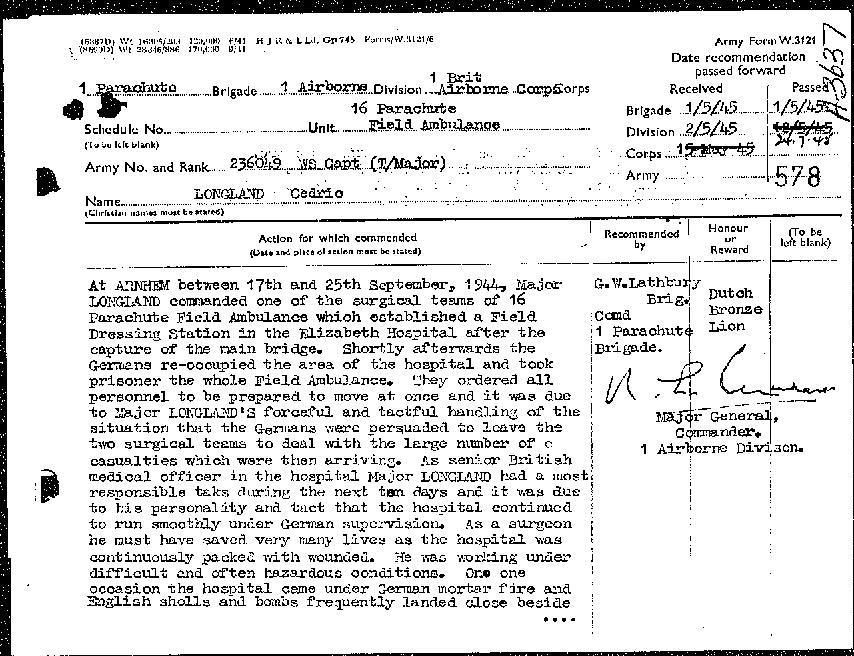
At Arnhem, from 17 to 25 September 1944, he commanded one of the two surgical teams of 16 Parachute Field Ambulance in the St Elisabeth Hospital. When the Germans retook the area and took the whole Field Ambulance prisoner, "it was due to Major Longland's forceful and tactful handling of the situation that the Germans were persuaded to leave the two surgical teams to deal with the large number of casualties", and as senior British medical officer in the hospital he kept it running under German supervision for ten days, under mortar fire and with shells blowing in the theatre windows (Pegasus Archive, quoting the citation; the recommendation, pp. 2–3).
Kessel's book tells that takeover from the same theatre: the SS division's dental officer ordered the unit marched away; after argument "the two surgical units in charge of Shorty Longland and myself" were allowed to stay, and when told that night to leave at once Longland answered through the interpreter "Tell your officer I protest most strongly" and "merely repeated his intention", until the German "gave in" (Kessel, Surgeon at Arms, pp. 16–17). Of Longland the book says he was "normally gentle-mannered though dogged, the son of a rural parson, and with a fondness for medical research" (p. 17; see the disagreement on his father below). Heaps has "Shorty" Longland "of the 1st Brigade's surgical team" operate on Brigadier Lathbury, and Lipmann Kessel, Theo Redman and Longland "operated almost the entire day" (Heaps, The Grey Goose of Arnhem, pp. 83, 100); Lathbury's own recommendation of him is below, under Awards. Warrack, back from the German headquarters, "had a talk with Major Shorty Longland and Captain Lipman Kessel, the surgeons of the 16th (Parachute) Field Ambulance" (Warrack, Travel by Dark, p. 43); Ryan has "the head of the surgical team, Major Cedric Longland" among those who greeted Warrack and Wolters (A Bridge Too Far, p. 557, page transcribed from the image). ✓ Sky Warriors (2024), a history of the British airborne forces by Saul David, tells the same exchange on pp. 404–405: the 9th SS Hohenstaufen's dental officer, two surgical teams "led by Major Cedric 'Shorty' Longland and Captain Lipmann 'Lippy' Kessel", Longland at the operating table answering "'I've never heard such rot!'" and "'Tell your officer I protest most strongly'", and the dentist giving in. It quotes, without naming a speaker, the description of him that Kessel gives in his book (p. 17, above), and adds that he "was also a veteran of the Sicily campaign and did not suffer fools" (p. 404, read on the image). Its endnote for the passage is "Lipmann Kessel, Surgeon At Arms (London, 1958; repr. 1974), pp. 23–5", with Beevor's Arnhem for the next (p. 519, notes 10–11, read on the image); ◐ so it very probably retells Kessel's book and Beevor and is no further witness. It does not name the hospital on these pages.
The SS and the weapons. ◐ Heaps has Longland, "now the senior medical officer", receive "an ominous, official grey envelope from the SS commandant in Arnhem on October 2" ordering the captured arms handed over, and decide with Father McGowan how to deal with it (Heaps, p. 114); Kessel's book has Longland hand him the opened envelope as he packed to leave with a convoy of wounded ("You're O.C. here now") and Kessel and the padre bury the weapons that night (Kessel, pp. 35–37). When he left St Elisabeth is argued under Where the sources disagree.
With Murphy
Link to the section With Murphy✓ In Warrack's diary. The diary Warrack wrote in the barracks (◐ near-contemporary; no source says each entry was written the same day) calls him "SHORTY", which the transcript's list of the other officers mentioned in it gives as "Maj C LONGLAND", surgeon, 16 (Para) Fd Amb (the officers' list, p. 49; Warrack's diary, typed transcript of about 1982, Wellcome Collection RAMC/1584; page numbers are the transcript's).
- Warrack's medical plan of 22 September, written for Airborne Corps, has a casualty clearing station go into Arnhem and "est contact with Major LONGLAND at ST ELIZABETH HOSPITAL" (p. 56).
- At 12.00 on 27 September "SHORTY LONGLAND, JIMMY LOGAN, GRAHAM JONES, DEREK RIDLER [?] and JOCK LAWSON turned up with a party from ST ELIZABETH's. Very glad to see them all" (p. 28).
- He was put on the hospital train of 5 October and taken off it: at 14.30 on 6 October Warrack went "down to the station and collect SHORTY LONGLAND, JIMMY LOGAN and the three 181 Fd Amb officers", after Zingelinck signalled "that five officers are to be exchanged from the train"; then "SHORTY wants to change his team from the train", and on the 7th Warrack was "Trying to organise the change-over of SHORTY's surgical team from the train" (pp. 40–41).
- He is on the diary's roll of the medical staff as "236049 Maj C LONGLAND", with no note against him (the roll, p. 51).
✓ In Herford's report. Lt-Col Martin Herford, taken to Arnhem by the German medical chief on 25 September, wrote:
At Arnhem Elizabeth Hospital I saw Major Longland of 133. There were 300 British casualties. He agreed to send a Surgical Team and Orderlies as soon as the Germans sent transport.
— Lt-Col M. E. M. Herford · report for 24 September to 19 October 1944 · Journal of the RAMC, vol. 98 (1952), pp. 250–251, read on the page images · the text
◐ "of 133" is Herford's slip: every other source has him a surgeon of the 16th. The same report has the St Elisabeth cleared in the days of 12 to 14 October, "the British Medical personnel—3 M.Os. and 16 Orderlies—sent to our Hospital", and on 15 October "Three M.Os. and 2 Orderlies escaped intending to join a party of Airborne men known to be in a particular locality" (pp. 299–300); ◐ the three doctors fit his own party, he, Kessel and Allenby, with Allen one of the two orderlies; the report names no one. ◐ Herford and Hall (p. 186) count five who went, three MOs and two orderlies, one more than Kessel's party of four (Kessel, Longland, Allenby and Allen); Warrack's staff counts at 20.00 fall by four between the 15th and the 16th (141 to 137, diary pp. 46–47), which fits four. ⚠︎ Not settled.
✓ At Apeldoorn, Warrack's book has, on "the 12th October", "a party of thirty wounded, half a dozen doctors, a dental officer and orderlies" who "came in from the St Elizabeth Hospital at Arnhem", "led by Shorty Longland and Lipman Kessel, who had been working there since the second day of the battle"; he adds "They could themselves have walked out, but didn't like to do so for fear that reprisals might be taken against the Dutch staff of the hospital" (Warrack, p. 78; page image and bottom). Warrack "suggested the following Saturday and Sunday as the best dates to choose" (p. 79), and "Shorty, Lippy, and one of their staff sergeants, also Peter Griffin, John Taylor and several other ranks opted for Sunday"; the evening service at half past five was arranged so that "Shorty and his party" could "get lost" on the way back (p. 80). Kessel's book has Longland plan the way out: "the weakest point in the fence system was probably at the eastern end of the camp, beyond the cook-house", and the idea "to disappear just before we were locked up for bed, to hide somewhere outside the sleeping-block and beyond the circuit followed by the guards" (Kessel, pp. 63–64); Longland asked Kessel to team up with him and "Peter" (Peter Allenby). The escape was on Sunday 15 October or on the 16th (Lipmann Kessel).
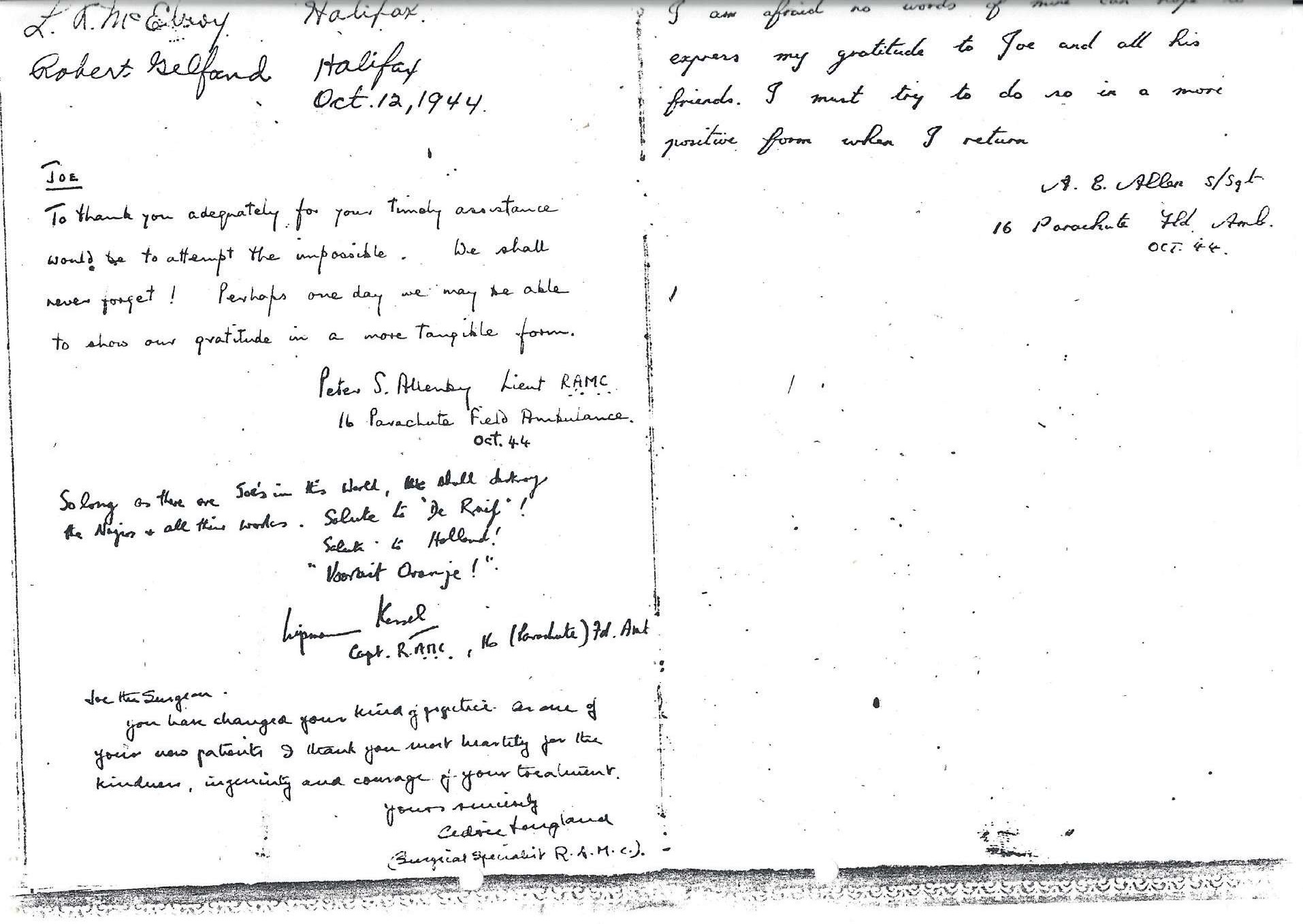
With Kessel at De Ruif; named with Murphy in the Sterrehoveke account. He came to De Ruif with Capt. Lipmann Kessel, Lt Peter Allenby and S/Sgt Albert Allen, the party for whom Murphy and Walsh were moved on (Garderen; Lipmann Kessel). He thanked "Joe the Surgeon … you have changed your kind of practice" in the De Ruif guestbook (The De Ruif guestbook), and Noordman's list of the escapers named in the Van Eysinga papers has "Cerediq Longland" with Murphy (Noordman, foreword, p. 8). Joop Piller's list of the men his organisation hid begins "Maj. C.J. LONGLAND 236049", dropped at Arnhem, with Allenby and Allen (Piller's file, p. 14). ◐ Kessel's account, as Noordman prints it, has "we" taken after two days to Kootwijkerbroek, three weeks under a sheep-pen near Frans Hals's headquarters, and out to the Pegasus II hen-house on 16 November; the "we" follows his naming of Longland, Allenby and Allen, and Noordman's caption to the guestbook has the four leave Garderen for Kootwijkerbroek (Noordman, pp. 309–311).
✓ Pegasus II; ◐ the hospital at Lingen. Boeree's Kroniek van Ede (1947) has him in the crossing of the night of 17 to 18 November 1944 (Operation Pegasus II). Maguire's order of march had a vanguard under himself, "een hoofdmacht onder de doktoren Longland en Allenby" (a main body under the doctors Longland and Allenby), made up of pilots and hospital staff and unarmed, and a rearguard of fighting men under Major Coke (p. 179, checked on the page image). Warrack, who was in the column, "sent a signal up by Shorty Longland, my liaison officer, to tell Hugh to cut it down" (Warrack, p. 148; page image); Kessel has him helping to get people back on to the track, and, later, "Someone whispered that Shorty had been shot — through the thigh" (Kessel, pp. 131–132). Heaps has "Longland was wounded in the thigh and captured" (p. 195); Warrack heard in the next days that "Shorty had been wounded in the thigh and Peter Allenby had remained behind with him and the other wounded" (p. 165; page image); Kessel was told by Kragt that "When Shorty was shot in the thigh, Peter had apparently insisted on staying with him and others who were wounded" (p. 153). In the story of "Wim R.V.V." (W. J. van Hoorn Alkema, Jan Thijssen's secretary), who was wounded in the crossing and passed himself off as an English flight sergeant, Boeree writes "Tot de gewonden behoorde ook Majoor Longland" (among the wounded was also Major Longland). All the wounded went on to the prisoner-of-war hospital at Lingen, where French doctors treated them, and Wim "lag enkele maanden samen met majoor Longland op één kamer. Op 5 April werden zij door de Engelschen bevrijd" (lay for some months in one room with Major Longland; on 5 April the English freed them) (p. 191, checked on the page image). Boeree does not say how or where Longland was hit, or the day he was taken.
By the BMJ's obituary he "escaped and linked up with the Dutch underground but was later recaptured" (BMJ). His German prisoner-of-war card has him a major of the RAMC, number 236049, in Oflag VI-D at Münster as prisoner 129330; four cards, not digitised (WO 416/227/307; the catalogue entries). The Times of 11 January 1945 prints him in a column of announcements, in the OCR "Major CEDRIC LONGLAND, R.AMC., to be wounded and P.O.W. in Germany", directly after an entry that mentions Arnhem and says the man "is now known to be P.O.W. and to be recovered from wounds" (the hit; the longer passage; the Archive's leaf 10 of the issue). ◐ From the full-text index, not read on the page, so the page number and the exact wording of the notice are unchecked. If it says what the OCR says, he was already a wounded prisoner in Germany by January 1945, which fits the BMJ's recapture and, on the wound, the accounts above.
◐ Reported a prisoner. The BMJ of 27 January 1945 has, under a heading ending "at Arnhem, now known to be wounded and prisoner of war in Germany", "Major C. J. Longland, R.A.M.C.", and a 1945 list in the Journal of the RAMC (the snippet does not show its heading) has "Temp. Major C. J. Longland, N.W. Europe" (the search hits, read in the Archive's full text, not on the pages).
Awards. The Netherlands gave him the Bronze Cross, gazetted on 20 March 1947: "Major (temporary) Cedric James LONGLAND, M.B., F.R.C.S. (236049), Royal Army Medical Corps" (London Gazette, p. 1315); the recommendation, by Lathbury, commanding the 1st Parachute Brigade, received and passed at brigade on 1 May 1945 and passed by the division on 24 July, puts him up as "WS Capt (T/Major)" for the "Dutch Bronze Lion", and its citation is the one quoted above (the recommendation, p. 2). The Dutch Chancery of Orders' card has the decree: the Bronze Cross, register number 1437, by royal decree of 9 February 1946, no. 1, to "Major v.h. Britsche Leger", proposed by the War and Foreign Ministries; it gives only his initial, and no citation (his award card, Nationaal Archief 2.02.32). After the war he was in the team that treated King George VI, and on 3 May 1949 he was appointed a Member of the Fourth Class of the Royal Victorian Order, "Cedric James LONGLAND, Esq., M.B., B.S., F.R.C.S." (London Gazette, p. 2178); the BMJ's obituary calls him a lieutenant of the order and heads him "LVO" (BMJ), ◐ the same Fourth Class under the name the obituary used in 1991.
◐ Surgery and film, 1950 to 1952. Three notices in the medical press name a surgeon Longland; none mentions Arnhem or the army. The review and the Lancet list carry the name Cedric J. Longland and surgical subjects, and are him by that, as with the papers of 1944 and 1945 (above); the film notice carries only "Longland" and is ⚠︎ a surname and a subject, with two ties beyond the surname: the subject, medical film, on which he wrote in 1944 and 1945 (above), and the Royal Society of Medicine, at the same address, 1 Wimpole Street, as the 1945 letter.
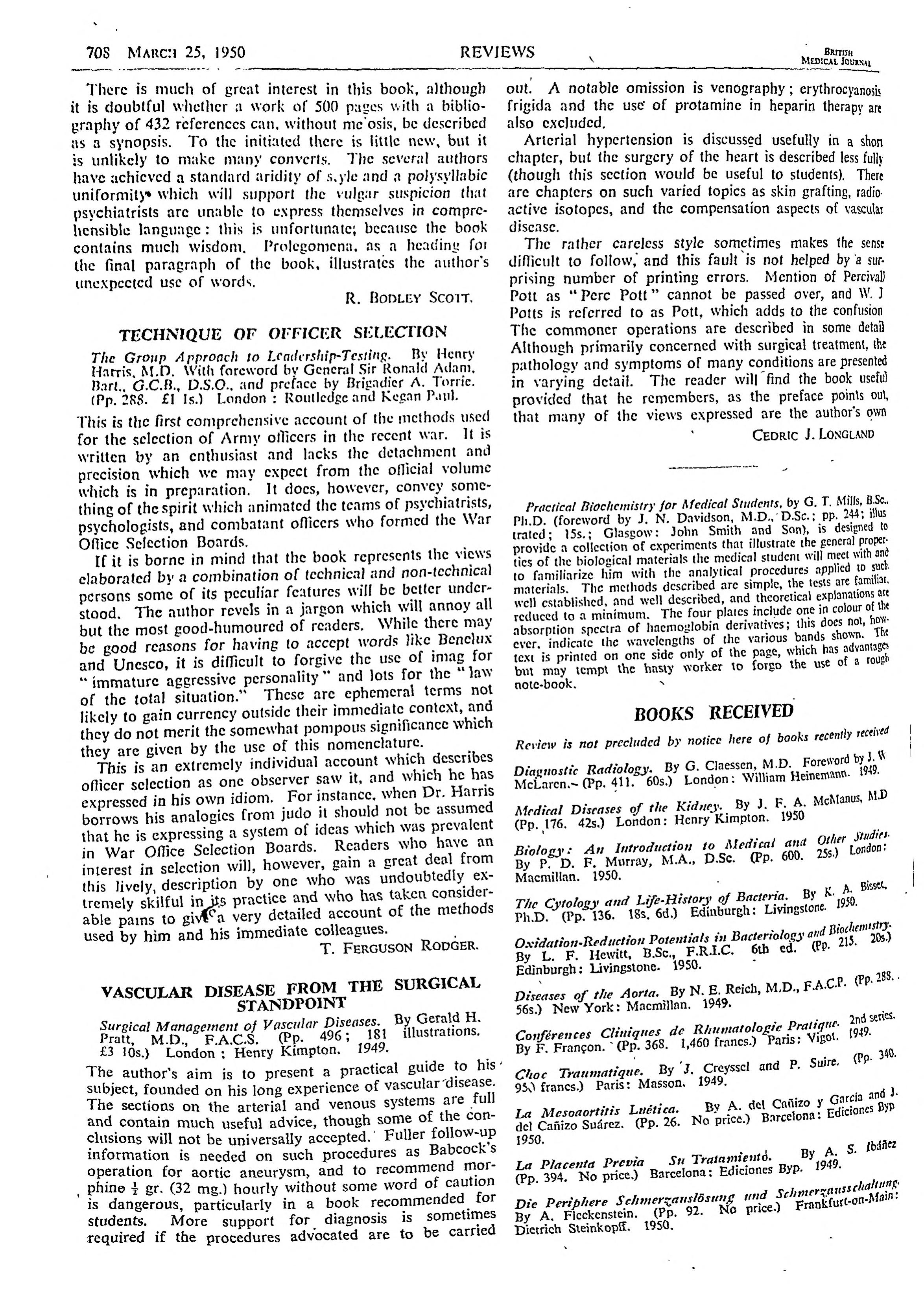
- A review in the BMJ of 25 March 1950, headed "Vascular Disease from the Surgical Standpoint", of Surgical Management of Vascular Diseases (London: Henry Kimpton, 1949), is signed "CEDRIC J. LONGLAND". It finds that "some of the conclusions will not be universally accepted", and the book useful to a reader who remembers, "as the preface points out", "that many of the views expressed are the author's own" (BMJ, p. 708, read on the page image). The notice printed below a rule under his signature, of a book on biochemistry, is a separate unsigned notice, not part of his review.
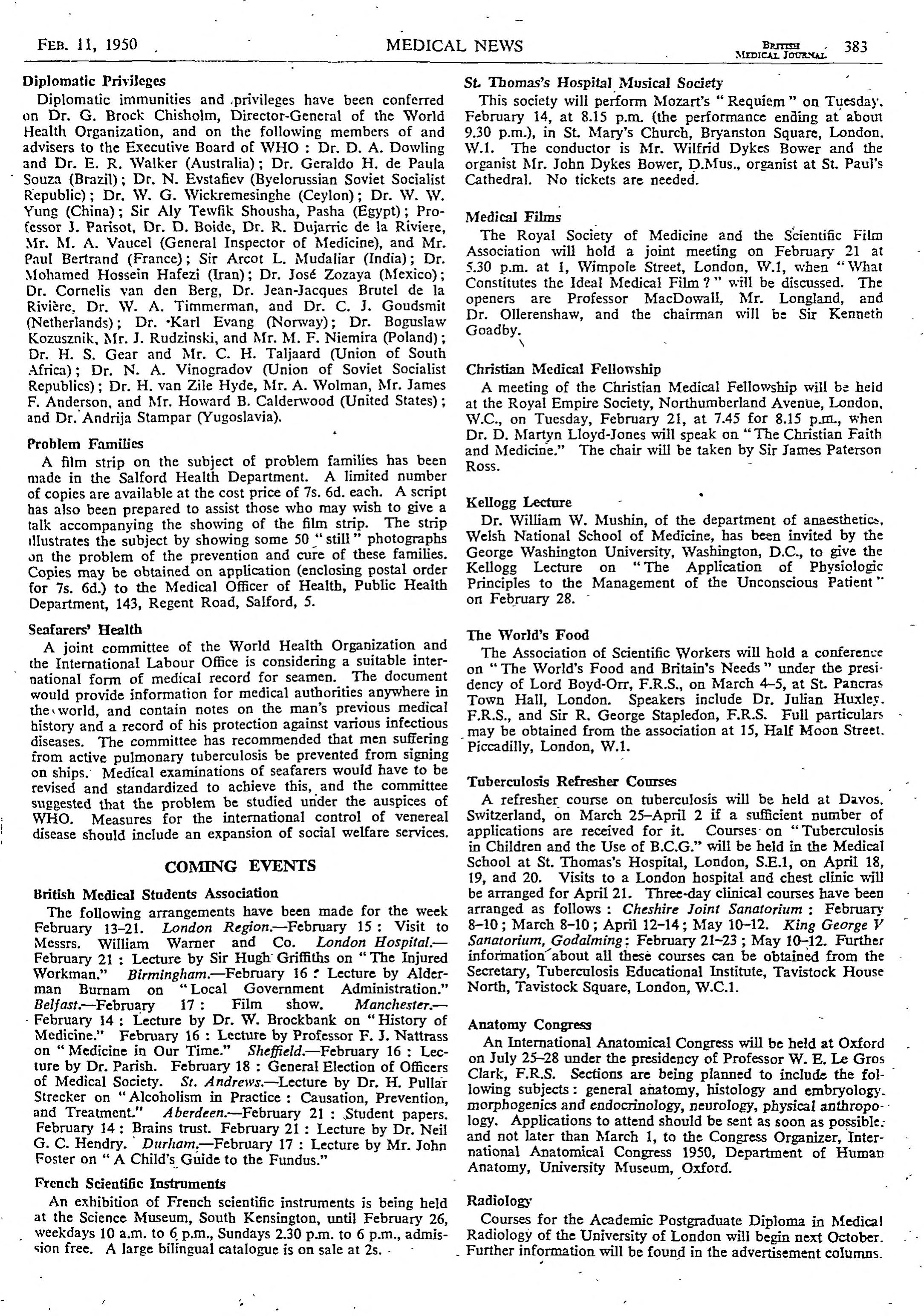
- The BMJ of 11 February 1950 announces a joint meeting of the Royal Society of Medicine and the Scientific Film Association on 21 February at 1 Wimpole Street, on "What Constitutes the Ideal Medical Film?", with "Mr. Longland" among its three openers (BMJ, p. 383, read on the page image). It gives the surname only.
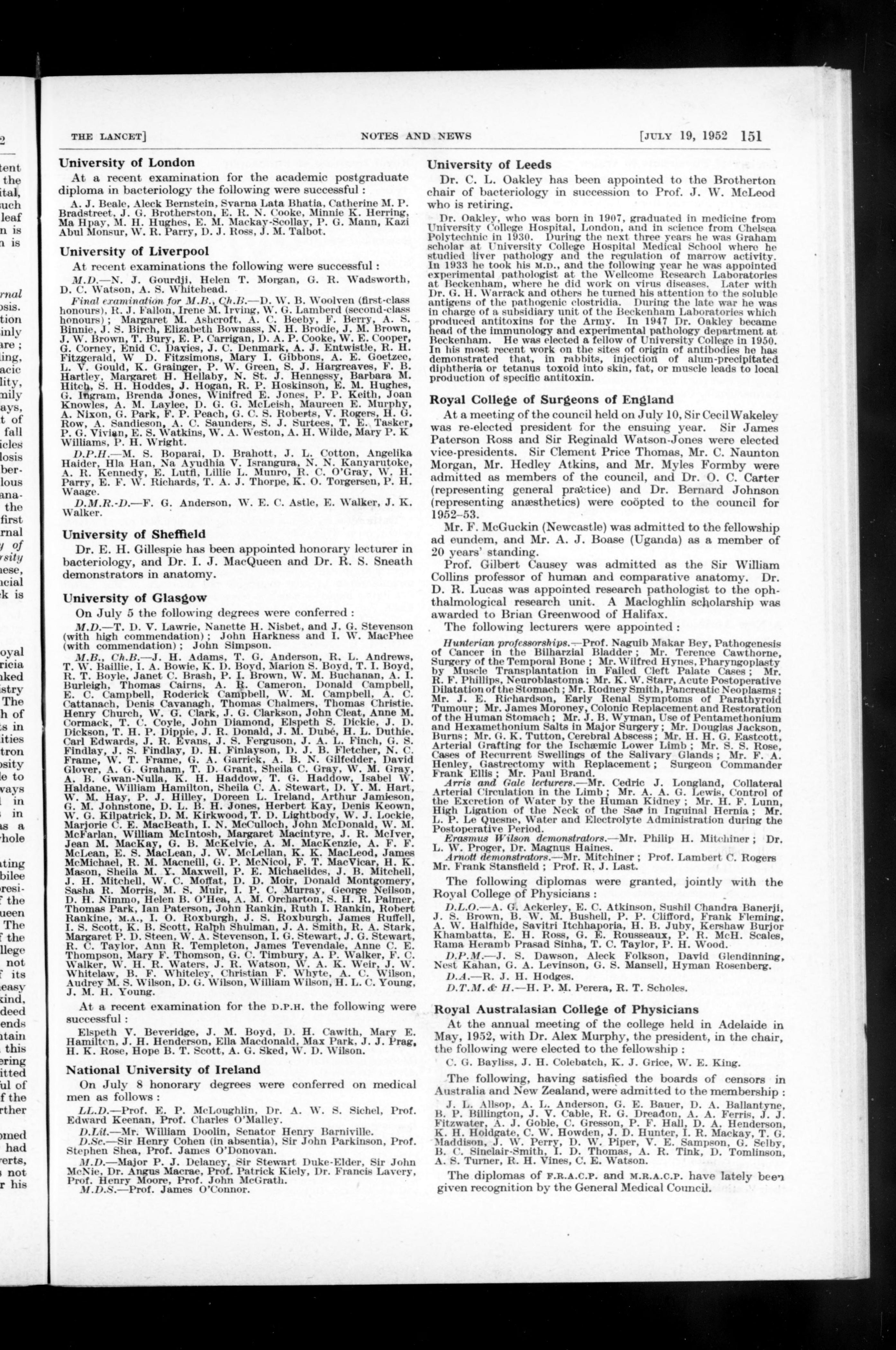
- At its meeting of 10 July 1952 the council of the Royal College of Surgeons of England appointed its lecturers, among them "Arris and Gale lecturers.—Mr. Cedric J. Longland, Collateral Arterial Circulation in the Limb" (The Lancet, 19 July 1952, p. 151, read on the page image).
Later life. From 1954 to 1977 he was a consultant surgeon at Glasgow Royal Infirmary, the first chairman of its surgical division and chairman of the West of Scotland Surgical Association, a pioneer of mechanical suturing in gastrointestinal surgery, and taught for a year in Nairobi. He crewed in the Bermuda–New York ocean race, moved in 1982 to Grittleton, where he was churchwarden, and composed music. He died on 14 January 1991 (BMJ, 16 March 1991, p. 652). Warrack's last chapter has "Shorty in Glasgow" in 1963 (p. 254; page image); ✓ Ryan lists among those he interviewed "Longland, Cedric James, Major [1st Airborne]. Surgeon, Dumbartonshire, Scotland" (A Bridge Too Far, p. 621), and indexes him at p. 557 (p. 661); the place is the one beside every name on that page, which we read as an address.
◐ His wife: the engagement notice of 1945 names Helen Mary Cripps, younger daughter of the Rev. J. Ivory Cripps of Edgbaston, Birmingham (The Times); a death notice in The Times of 23 May 2008 has Helen Mary Longland die peacefully at home on 21 May 2008, aged 88, "Much loved wife of the late Cedric Longland F.R.C.S." (The Times, 23 May 2008, p. 79; read on the page image). The 2008 notice does not say "R.A.M.C." or "Cripps", so tying it to the major is our inference from the forenames, the surname, the degree and an age that fits, and the BMJ obituary's "their three daughters" matches the three daughters the notice names; the notice names living family, who are left out here.
Where the sources disagree
Link to the section Where the sources disagree- When he left St Elisabeth.
- ParaData has his team leave for Apeldoorn on 27 September, leaving Kessel's team behind (ParaData).
- The account Noordman prints under Kessel's name has him leave "around 30 September" (Noordman, p. 308).
- Heaps has him receive the SS notice at St Elisabeth on 2 October, as senior medical officer (p. 114); Kessel's book has him leave with a convoy of wounded after handing Kessel that notice (pp. 35–36).
- Heaps also has the St Elisabeth close on 11 October with "Longland and Lipmann Kessel" joining Warrack at Apeldoorn (p. 115), and Warrack has the two of them lead a party of wounded there on 12 October (p. 78; page image).
- ✓ Warrack's diary, ◐ near-contemporary, has him arrive at Apeldoorn at noon on 27 September with a party from the St Elisabeth, and Kessel ("LIPPY") on 13 October with Allenby and Father McGowan, without him (the diary, pp. 28, 45). That agrees with ParaData's 27 September and with Kessel's book having him go ahead, against Warrack's own book of 1963 and against Heaps.
- ◐ Heaps's 2 October at St Elisabeth is left unexplained.
- The night of the escape and who went. Sunday 15 October with Kessel, Allenby and Allen (Warrack, Kew's entry for Kessel's report); 16 October in ParaData's page on the Apeldoorn hospital, which has "Lt Col Herford, Maj Longland, Capt Lipmann-Kessel and Padre McGowan" escaping that night "during two separate attempts" (ParaData) and in the account Noordman prints (p. 309). Warrack's book has Herford go on Monday 16 October (pp. 90, 91; full text).
- ◐ Warrack's diary has a church parade at 17.45 on Sunday 15 October and at 11.00 on Monday 16 October a "Counting parade, as some citizens appear to have gone absent" (the diary, p. 46), which fits a break-out after the Sunday service; it names no one.
- Its staff counts at 20.00 are 142 on 14 October, 141 on the 15th and 137 on the 16th (pp. 46–47), and at 17.30 on the 16th "Another check and they find three missing. How very odd!" (p. 47). ◐ The fall between the Sunday and Monday counts fits a departure on the Sunday night; a count does not say who left or when.
- ✓ Herford's report of 1944 has "Three M.Os. and 2 Orderlies escaped" under 15 October, the Sunday (p. 300); ◐ it names no one, but it is a dated entry by a man who was in the barracks that night, and agrees with Warrack's book and Kessel's report. ◐ Herford and Hall (p. 186) count five who went, three MOs and two orderlies, one more than Kessel's party of four (Kessel, Longland, Allenby and Allen); Warrack's staff counts at 20.00 fall by four between the 15th and the 16th (141 to 137, diary pp. 46–47), which fits four. ⚠︎ Not settled.
- ◐ Warrack's diary has a church parade at 17.45 on Sunday 15 October and at 11.00 on Monday 16 October a "Counting parade, as some citizens appear to have gone absent" (the diary, p. 46), which fits a break-out after the Sunday service; it names no one.
- Where he marched. Boeree has him commanding the main body with Allenby; Warrack has him as his liaison officer (Warrack, p. 148; page image); Kessel has him at the front of the column and then helping to restore order (p. 131). None says the others are wrong.
- Where he was held. Boeree has him in the prisoner-of-war hospital at Lingen, in a room with Wim until the British freed them on 5 April 1945 (p. 191); his German POW card has "Oflag VID Munster", prisoner 129330, with no date of capture or of anything else (the catalogue entry, WO 416/227/307). ◐ No clash can be shown: the card names the camp that registered him and says nothing of a hospital, and neither source says the other is wrong. The four cards are not digitised and might settle it.
- His birthplace and his father. Swindon on the German POW card (WO 416/227/307); the Belgian Congo in the BMJ obituary (the obituary). Kessel's book calls him "the son of a rural parson"; the engagement notice of 1945 has "Mr. and Mrs. Frank Longland, of The Grange, Watchfield, Berkshire", with no title or calling for the father. ◐ Only Kessel's book makes him a parson, and the three places do not exclude each other.
- His Dutch award. The Gazette and the BMJ have the Bronze Cross (p. 1315), and the Pegasus Archive "Bronzen Kruis"; the recommendation itself, WO 373/144/174, asks for the "Dutch Bronze Lion", for a "WS Capt (T/Major)" (the recommendation, p. 2), and Kew's catalogue has "Dutch Bronze Lion, 08 November 1945" (the catalogue entries). ✓ He was recommended for the Bronze Lion and given the Bronze Cross: the Dutch Chancery of Orders' card for "Longland, C.", a major of the British Army, records the Bronze Cross, no. 1437, by royal decree of 9 February 1946 (his award card).
- The Military Cross. The Pegasus Archive lists an MC among his awards and quotes a citation (Pegasus Archive); ✓ that citation is the text of his recommendation for the Dutch Bronze Lion, with the typing slips put right (the recommendation), so it is not evidence of an MC. No Gazette entry for an MC has been looked for.