Pte Harvey Swartz
25 Mar 1915 – ?
Pte Harvey Swartz (K62742), 1st Bn The Canadian Scottish Regiment
About: Pte H. Swartz was taken at the Leopold Canal on 7 October 1944, jumped from the prisoner train at Utrecht on 23 October with Gri, and was hidden at Maartensdijk. He crossed the Rhine from Amerongen with Murphy's party on 2 January 1945, was recaptured the next night, and was freed at Fallingbostel on 16 April 1945.
Unit or role: Private, C Company, 1st Bn Canadian Scottish Regiment; a salesman before the war (his MI9 report; Van Eck's form, p. 3, has "C Coy."). The Dutch forms call him corporal or lance-corporal (Where the sources disagree).
Where: Vancouver (private address 1122 Nelson Street in 1945, by his report; the army's missing list has "Parkhurst, via P.G.E."); Maartensdijk and Hollandsche Rading, October to December 1944; Amerongen from 23 December.
Evidence: ✓ his own MI9 liberation report, M.I.9/S/P.G./LIB./1078, with Appendix A and Appendix C; ✓ Two Came Back!, p. 6; ◐ Schjelderup's MI9 report (transcript; the Kew original not seen); ✓ the forms of the Dutch families who hid him; ✓ the Nelson Daily News list of 22 November 1944.
Who he was. ✓ His own report gives his birth date as 25 March 1915, his army service as starting on 10 July 1940, his peacetime profession as salesman and his address as 1122 Nelson Street, Vancouver; the catalogue entry for the other copy of it has the same birth date (WO 208/3332/1078). The Nelson Daily News of 22 November 1944 puts him in the Army "Missing" list under warrant officers, NCOs and men: "Swartz, Harvey, Pte., Parkhurst, via P.G.E., B. C.", next to "Sjursen, John, Cpr. [sic], Vancouver", with Gri, Berry and thirteen others (seventeen men in all), and Schjelderup and a Prince Rupert lieutenant the two officers listed missing (22 November 1944, p. 10, read on the page image). ◐ "P.G.E." is presumably the Pacific Great Eastern Railway; the list gives no street.
His own MI9 liberation report
Link to the section His own MI9 liberation report✓ M.I.9/S/P.G./LIB./1078, interviewed on 6 September 1945 (the date, on Appendix C), with an Appendix A of helpers and an Appendix C of narrative. The photographs were taken at Kew by the late John Howes, who passed them to Lisan Koppenol, and she sent them on (the folder's notes). Its first page is the source for the next paragraphs; the appendices run through Who hid him and With Murphy.
Captured at the Leopold Canal. ✓ "I was captured at the LEOPOLD CANAL on 7 Oct 44." The report's table of camps, names and dates typed in two columns that run in step, has him on the Middelburg barge 9 to 12 October, Dordrecht 12 to 15 October and Utrecht 15 to 23 October (page 1; the spellings are the typist's). The battalion's account of the day, the barge and the siding at Utrecht is on Schjelderup's page.
The jump, 23 October. ✓ In his own words:
Whilst on the train from UTRECHT to AMERSFOORT (HOLLAND, 1:250,000, Sheets 2A & 3A, E 29) we left the train at BLAUWKANEL on 23 Oct 44. I was accompanied by Sgt. TRY, Cdn. Scottish Regt., Capt. SHELDROP and Capt. BROWNLEY, both Canadians. We were later joined by Pte. TRAINOR, Essex Scottish Regt.
— Pte H. Swartz · MI9 liberation report, M.I.9/S/P.G./LIB./1078, p. 1 · 6 September 1945 · the photograph
(Try is Gri; Brownley is Capt Brownridge RCA, as in Berry's report.) ◐ Schjelderup's own report has the plan made by four men with a penknife, Swartz one of them: "Capt. R. BROWNRIDGE, 23 R.C.A.: Sgt. GRI, Pte. SWATRZ, H. No. K62742 and myself with a penknife prepared our escape", and he "hung on the side until BROWNRIDGE, SWARTZ and GRI were clear, then I jumped" (the transcript spells him "SWATRZ" once). "Two Came Back!" tells the escape as the Canadian Scottish men together (Schjelderup's page).
24 and 25 October. ✓
As soon as we left the train we split up into pairs. Sgt. TRY and I left on our own. We walked until early in the morning on 24 Oct when we were discovered by a farmer while resting in his farmyard. We were given food and a map by this man (name unknown).
— Pte H. Swartz · MI9 liberation report, M.I.9/S/P.G./LIB./1078, p. 1 · the photograph
The next day they went north by mistake, and on 25 October approached:
a young farmer who was very suspicious of us. He brought a Canadian Sgt. named PORTER who was able to identify us after which time we were placed in the hands of the Dutch Underground until arrested.
— Pte H. Swartz · MI9 liberation report, M.I.9/S/P.G./LIB./1078, p. 1 · the photograph
✓ Gri's own account has the two of them leave the others at 00:30, climb into a hayloft at about 04:00 and be found by the farmer at about 06:00 (Gri's page). "Two Came Back!" has the underground make them prove they were not Germans: Swartz said he came from Vancouver and showed a letter postmarked there, and Bob Porter, who came from Vancouver himself, questioned him for about two hours on the city before vouching for him; the two were then placed in homes (p. 4). Roy has only that Gri and Swartz "were interrogated for two solid hours" before being posted to homes in Hilversum, with nothing on Vancouver or Porter (Roy, p. 371). Jean E. Portugal's We Were There, vol. 4 (1998), retells the same, with "Silversum" for Hilversum (p. 2004; OCR only, adding no new fact).
Who hid him
Link to the section Who hid him- De Groot, Hollandsche Rading. ✓ D. H. de Groot's form has "Harvey [SWARTZ [?]] and Sgt. A. GRI (Doc.)" hide in his hay-rick, where he "found them, fed and clothed them, gave them a wash and a shave and kept them for another few days", then sent them to Scheepvaart and Van Eck (his file, p. 2); a second page of his has "The arrested man, Harvey Swarts, was transported to the prison in Wolvenplein, Utrecht and from there he went to Neurenberg, where he was liberated by the American Army" (p. 6), which is hearsay (below).
- Holwerda's account of the start. Tjeerd Holwerda of Maartensdijk wrote that "The next day sgt. Gri and Corp. Swartz were discovered by farmer D. de Groot in his hay-stack"; that De Groot told him the two "had the intension to go to Rotterdam on their own"; and that they changed their mind "on the order of capt. Schelderup" (his file, p. 7). ◐ That is the note Schjelderup says he wrote to Gri on the evening of 25 October, "telling him to stay in the district for a little while" (the transcript).
-
Van Eck, Maartensdijk. ✓ Two helpers' forms and Swartz's own report put him with the Van Ecks for a few weeks.
-
Holwerda has "Swartz with W.J. van Eck, Dorpsweg 94", and van Eck made his clothes to measure (p. 7 and p. 8). On the end of the stay:
Some weeks afterwards Swartz had to leave the house of Fam v. Eck all of a sudden because the German Sicherheitspoliz took the house by surprise to make a search, in connection with railroad-attacks, committed by us some days ago. Scarcely could Swartz and son Pieter escape from the SIPO.
— Tjeerd Holwerda, Maartensdijk · helper form · US National Archives, p. 7
-
W. J. van Eck's own form has Swartz "from about mid Oct - approx. 12 Nov 44", "till the attack at the railway when one of the young men was seized by the Germans, told them some names, and it became too dangerous to stay at the same address" (his file, p. 3).
-
✓ Swartz's own words:
We were given civilian clothes by two local policemen and I was later given another suit by Peter VAN ECK with whose family I stayed two weeks. The Gestapo raided the VAN ECK's home and we had just time to escape. Sgt. TRY was taken to HILVERSUM and Peter VAN ECK and I hid in a farmer's barn.
— Pte H. Swartz · MI9 liberation report, Appendix C · the photograph
-
His Appendix A puts the Van Ecks at "26 Oct 44 (Approx)": "Peter van ECK and family, Post Office at MAARTENSDIJK", "Provided food and lodging for two weeks" (Appendix A).
- The Cunnings. After the raid on the Van Ecks' house:
We were later taken by two policemen to the home of Mr. & Mrs. CUNNING. During my stay here I received some notes from Capt. SHELDROP, C.S.M. BERRY, Pte. BRIERE, Pte. ADAM and Pte. COOL.
— Pte H. Swartz · MI9 liberation report, Appendix C · the photograph
- Appendix A: "Mr. CUNNING, Post Office at MAARTENSDIJK", "Provided food and lodging for several days" (Appendix A). Its fourth entry is "Johann De BRUIN, Post Office at MAARTENSDIJK", "Provided false ration cards and identification cards".
- ◐ By sound only, the Cunnings may be G. H. Kanning of the Tolakkerweg, who is on Gri's page; ◐ "Pte. ADAM" and "Pte. COOL" are Ptes L. Adams (K73483) and W. M. Cool (K1495) of the Canadian Scottish, two of the ten who dropped from the car (Two Came Back!, p. 4, which has "Adame L." in the scan's OCR); the Nelson Daily News missing list of 22 November 1944 has "Adams, Leonard, Pte., Victoria" and "Cool, William McDonald, Pte., Victoria" (22 November 1944, p. 10), and Schjelderup's page names "Adams, Cool" among the ten.
- Scheepvaart, Tolakkerweg. ✓ Mrs W. Scheepvaart-Witteveen's form has "On 21 Oct 44 Harvey SWARTZ came here and remained till 27 Dec. SWARTZ came from Mr. van ECK" (her file, p. 4). Her son Sjouke's form has "Harvey Swartz K 62742 e coy. 1st Bn CSRC", sixty days from 21 October 1944, passed to "Dirk van Langbroek" (the Scheepvaart file, p. 3); the same two names, "A. Gri" and "H. Swartz", are on Hendrik Willem Dirks's form of 17 July 1945 with no dates and no helper (p. 3). See Gri's page for what these two forms say of Gri.
- Bakker. ⚠︎ J. Bakker's form has "Doc and Harvey Swarts" go "to van Eck and Scheepvaart. After a house search Swarts went to Hilversum and later on to Kanning (Cawton 45), and Doc to Scheepvaart (Cawton 46)" (Bakker's file, p. 4; the bracketed note in our transcription says the carbon is faint and that Holwerda's report has Gri, not Swartz, at Hilversum). Swartz's own report, and Kanning's and Mrs Scheepvaart's forms, have Gri taken to Hilversum.
- Hellendoorn. Hans Hellendoorn of Bilthoven listed the six Canadians and "BOB", Porter, as "Allen doorgegeven aan 'Dirk' Langbroek en wel in Amerongen op Vrijdag en Zaterdag voor Kerstmis 1944" (all handed to "Dirk" of Langbroek, at Amerongen, on the Friday and Saturday before Christmas 1944, which were 22 and 23 December) (his file, p. 5); his line for the party has "Lance-Corp. Harvey SWARTZ".
- ✓ What the British recorded afterwards. The British index of helpers, read on the sheet images; it lists addresses after the Liberation.
- De Groot, Dirk Hendrik, "Holl.Rading West 2a, Achttienhoven", certificate 22931, grade 5 (sheet G/10).
- Scheepvaart-Witteveen, W., Tolakkerweg 60, Maartensdijk, certificate 9404, grade 5, and Scheepvaart, Sjouke, "G.v.Amstelstr 436, Hilversum", certificate 15850, grade 5 (sheet S/3).
- ◐ Van Eck: "v.ECK, Dirk Jan", certificate 22277, and "v.ECK, W,J,", certificate 22278, both grade 5, with "Dorpsweg 94, Maartensdyk" and "Burniestraat 36,Den Haag" in the address column (sheet E/11, read on the image).
- The rows on that sheet run one to one, each address level with its name, so on the sheet's own sequence Dorpsweg 94 is Dirk Jan's line and Den Haag is W.J.'s.
- W. J. van Eck's own form gives Dorpsweg 94 as his address (his file, p. 3); the folder's README reads W.J. as Dorpsweg 94 as well (the index's notes), against the sheet's order.
- The remarks column does not settle it, so which Van Eck the index puts at Dorpsweg 94 is open.
-
At Groenekan. Berry has him at Groenekan between about 1 and 24 December: "I met four other Canadians who had escaped - Capt. SHELDR[?]UPP, Sgt. GRI, Pte. SWARTZ, and Pte. TRAINOR" (a letter in the first name is blurred; Berry, p. 2). Briere has a group formed "Around 8 Dec" at the policeman's house at Groenekan, with "Sgt. GRUN, CSR., Pte. SCHWARTZ, CSR., Pte. TRAINER, Essex Scottish", of whom "Sgt. GRUN, Pte. SCHWARTZ and TRAINER left one day and the remainder of us left the following day" (Briere, p. 2). ⚠︎ That puts him at the policeman's house, which his own report and the Dutch forms do not (above).
With Murphy
Link to the section With Murphy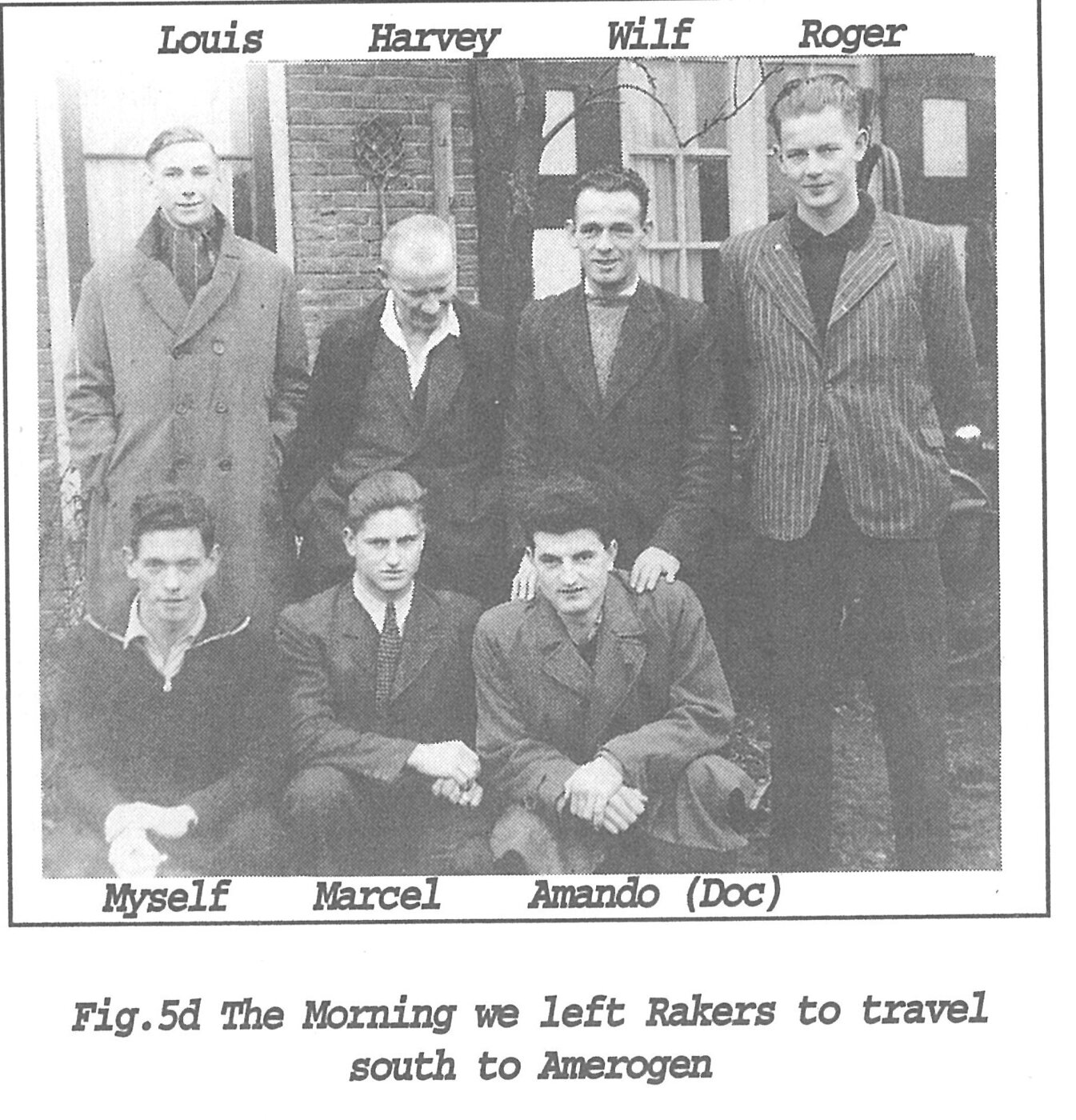
To Amerongen. ✓
On 23 Dec the Underground informed us we were to return to our own lines and that we had to go to a starting point where we were to be hidden for a few days. We were taken to AMERONGEN by bicycle and here we spent Christmas and New Year. We were joined by Sgt. TRY, Pte. TRAINOR and Sgt. BANWELL, 1 Cdn. Para. Bn. We learned that we were to cross the RHINE on New Years night.
— Pte H. Swartz · MI9 liberation report, Appendix C · the photograph
Porter and Schjelderup were at the Cornelisses' house: Schjelderup's Appendix A has "Food and shelter for Source and Sgt. PORTER" from Mr Cornelissen at Amerongen, 23 December to 2 January (Schjelderup's page; Mr and Mrs Cornelissen); Berry says he and all six Canadians were "in the same locality" from 24 December (Berry, p. 2).
The crossing, with Murphy at the barn.
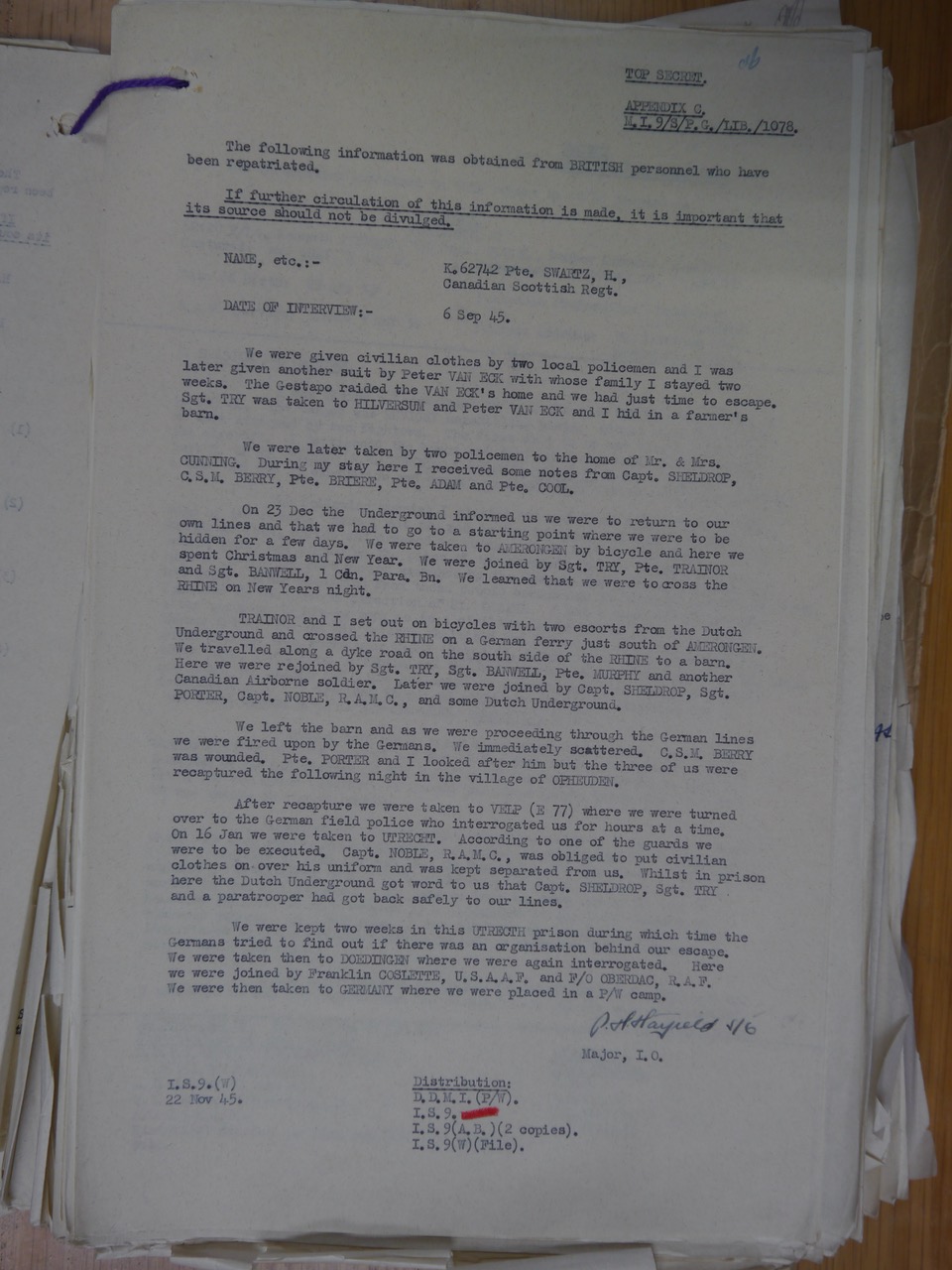
TRAINOR and I set out on bicycles with two escorts from the Dutch Underground and crossed the RHINE on a German ferry just south of AMERONGEN. We travelled along a dyke road on the south side of the RHINE to a barn. Here we were rejoined by Sgt. TRY, Sgt. BANWELL, Pte. MURPHY and another Canadian Airborne soldier. Later we were joined by Capt. SHELDROP, Sgt. PORTER, Capt. NOBLE, R.A.M.C., and some Dutch Underground.
— Pte H. Swartz · MI9 liberation report · interviewed 6 September 1945 · Appendix C
Swartz does not say who was in the barn first, and the "other Canadian Airborne soldier" is not named. Hardy has the opposite order: he and Murphy reached the barn at Kesteren and "met Sgt. BANWELL , 10 Para Bn, Sgt. GRI and two Pte's, all of them Canadian Scottish" (Hardy), ◐ the two privates very probably Swartz and Trainor. Schjelderup's group came later in both. Trainor's page tells the same from his side; Banwell's battalion is the British 10th, not "1 Cdn. Para. Bn." (below).
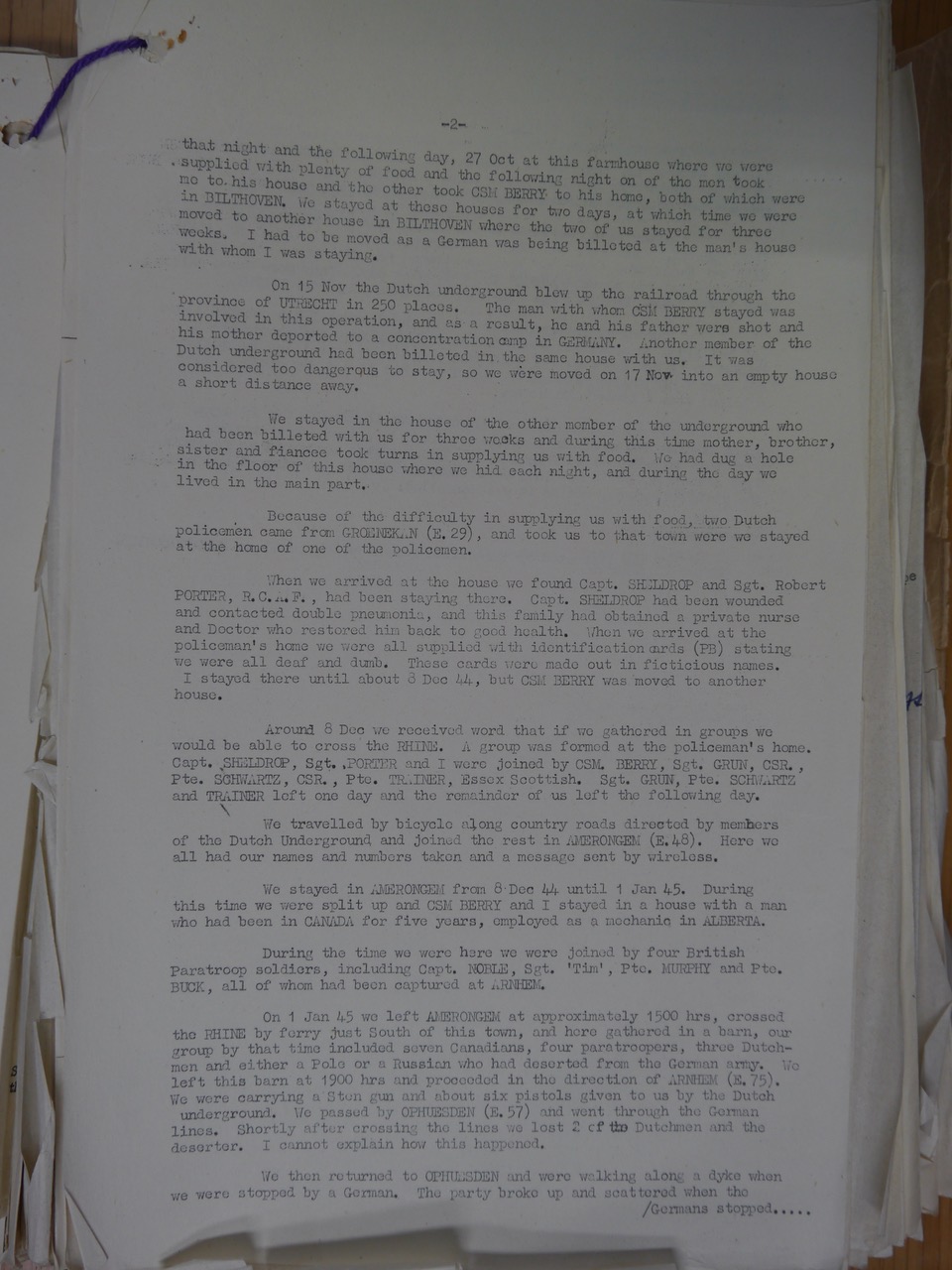
The firing. ◐ Schjelderup's list of the party has "Pte. SWARTZ, H." (K.62742) beside Murphy, Hardy, Noble and Banwell, and by the report's own list he was one of the five (Berry, Porter, Swartz, Briere, Trainor) who "panicked and ran madly onto the ice" at the second firing (Schjelderup's page). "Two Came Back!" has "Ptes Briere and Swartz of the Canadian Scottish" among the eight left after the first firing, at the "concealed German fort", before this second one (p. 6). His own words:
We left the barn and as we were proceeding through the German lines we were fired upon by the Germans. We immediately scattered. C.S.M. BERRY was wounded. Pte. PORTER and I looked after him but the three of us were recaptured the following night in the village of OPHEUDEN.
— Pte H. Swartz · MI9 liberation report · interviewed 6 September 1945 · Appendix C
The same hours are on Berry's page, from Berry's side. Maljers, the guide, wrote that he went on across the flooded land "with five Canadians among whom was Captain Scheldrop" (his statement, p. 16); the Westbetuwe memorial site's page on Maljers, a modern summary, names "Wilfred Berry, Marcel Brierre en Harvey Swartz" as the three Canadian Scottish men who "kwamen niet met Schjelderup mee" (did not go on with Schjelderup) (the page).
Velp and Utrecht.
After recapture we were taken to VELP (E 77) where we were turned over to the German field police who interrogated us for hours at a time. On 16 Jan we were taken to UTRECHT. According to one of the guards we were to be executed. Capt. NOBLE, R.A.M.C., was obliged to put civilian clothes on over his uniform and was kept separated from us.
— Pte H. Swartz · MI9 liberation report · interviewed 6 September 1945 · Appendix C
Noble is held apart from the Canadians in the Utrecht prison. "Whilst in prison here the Dutch Underground got word to us that Capt. SHELDROP, Sgt. TRY and a paratrooper had got back safely to our lines" (Appendix C): ✓ Schjelderup, Gri and Hardy.
⚠︎ Charles Noble's own later account (unpublished private papers, shared with us privately), told long after the war, has the Canadians of the party with him at Utrecht, naming none of them. At a first prison, "the wrong prison", the Canadians came in, whom he had not seen at Velp: "There were about five of them … These were the ones who had been on the dyke when we had been shot at". In the waiting room a German who took them for terrorists spat in Noble's face, until his guard said he was "an English doctor". At the Wolvenplein Noble was alone in a cell for three weeks: "The others were kept in two cells." At Doetinchem "There were Canadians who were in the cell next to me with two Americans and one Pole."
Doetinchem and Germany.
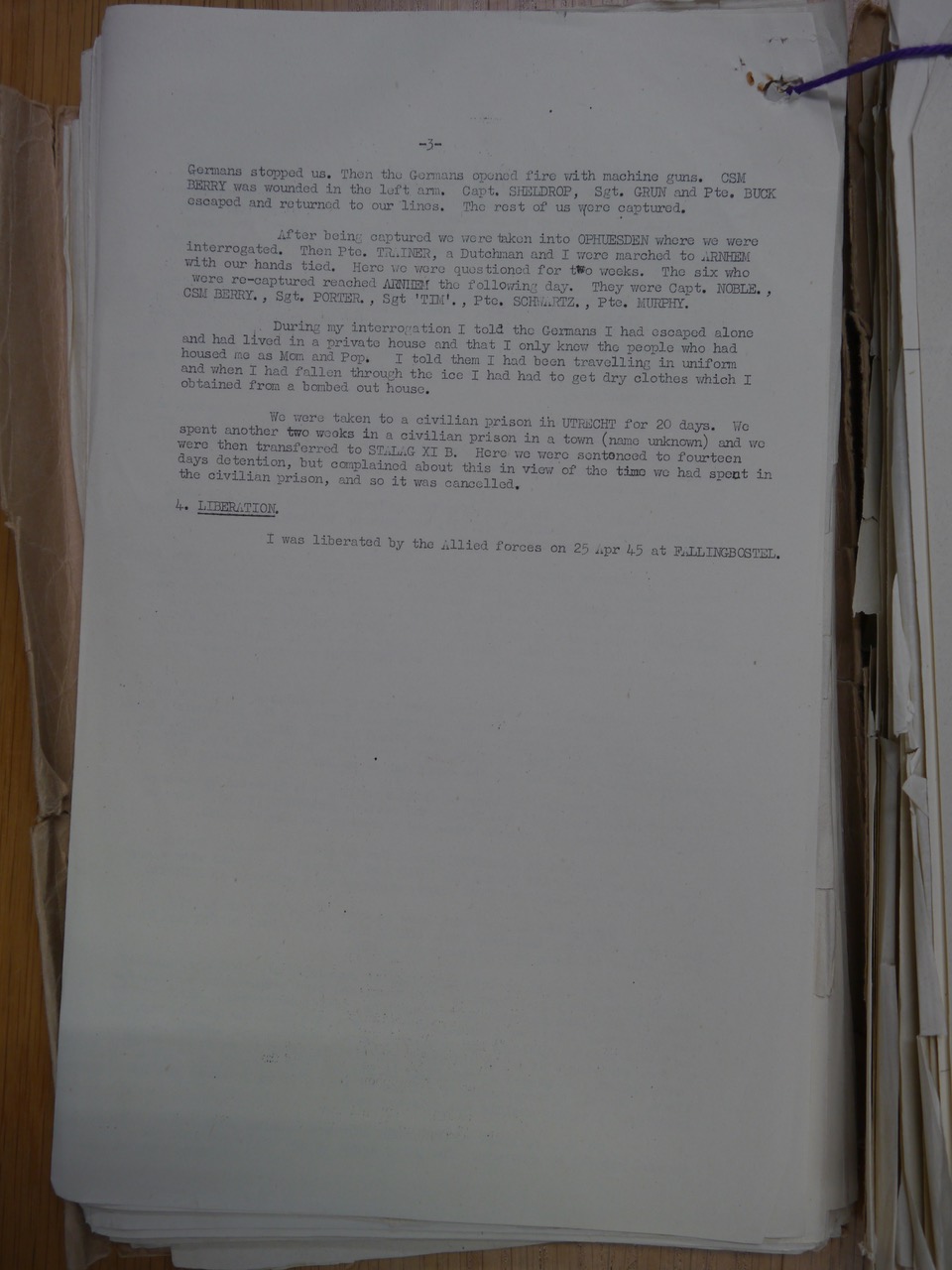
We were kept two weeks in this UTRECTH [sic] prison during which time the Germans tried to find out if there was an organisation behind our escape. We were taken then to DOEDINGEN where we were again interrogated. Here we were joined by Franklin COSLETTE, U.S.A.A.F. and F/O OBERDAC, R.A.F. We were then taken to GERMANY where we were placed in a P/W camp.
— Pte H. Swartz · MI9 liberation report · interviewed 6 September 1945 · Appendix C
The airman is Frank Coslett. ⚠︎ Swartz names the two others held at Doetinchem as Coslett and Oberdac; Noble's later account (unpublished private papers, shared with us privately) has the Canadians in the cell next to his "with two Americans and one Pole", and names none of them. The camp table on page 1 has, after the Dutch prisons already given, Velp 3 to 16 January 1945, the Utrecht civilian prison 16 January to 6 February, "DOEDINGEN" 6 to 21 February, "BOCHOLT" 21 to 22 February and Stalag XI B (Fallingbostel) 27 February to 16 April 1945 (page 1). Porter has him with Berry, Trainor, Briere and himself on the lorry to the concentration camp and out of it again, and parted from them at a holding camp ("Wilf, Louis, Harvey and Marcel were there", p. 163; "back together again, just the five of us", p. 176; transcript; chapter 8).
Liberated. ✓ "I was liberated on 16 Apr 45" (page 1); the catalogue entry for the duplicate has Fallingbostel, 16 April 1945 (WO 208/3332/1078). That is the camp Murphy names in his typed notes (page 1).
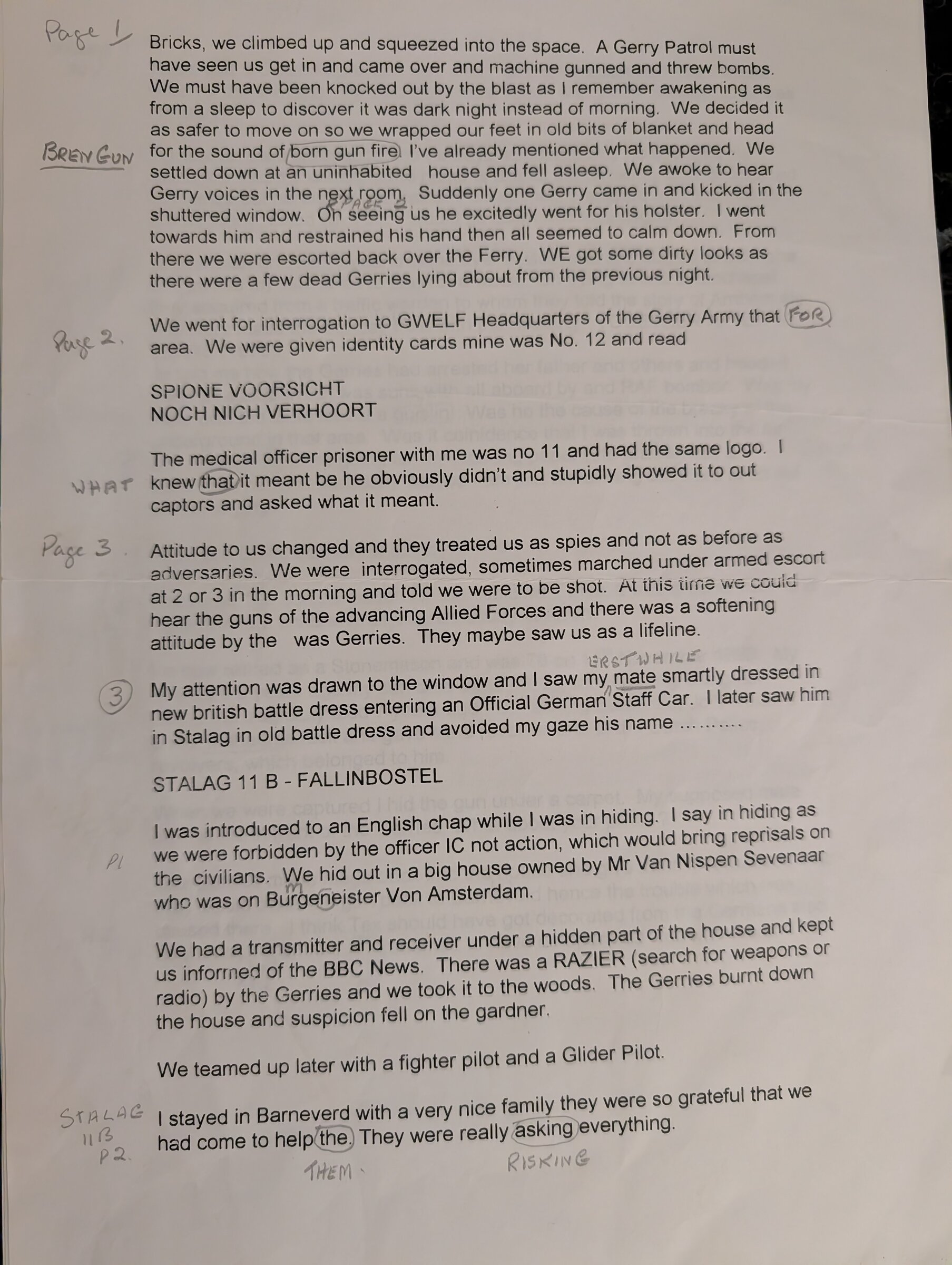
Later. Nothing has been found of his life after 1945. The name-sweep of 17 October 2026 searched UBC Open Collections' index for "Harvey Swartz" and "Harry Zwarchz": two hits for the first, both in the student paper The Ubyssey (1972 and 1987, not read), none for the second (the log).
His helpers, in his own Appendix A
Link to the section His helpers, in his own Appendix A"TOP SECRET", "obtained from BRITISH personnel who have been repatriated", the source not to be divulged (Appendix A; interviewed 6 September 1945; Appendices A and C are both dated 22 November 1945, Appendix A at the foot of its page, "I.S.9.(W) 22 Nov 45"). Names as typed:
- 26 Oct 44 (approx), Peter van ECK and family, Post Office at Maartensdijk. "Provided food and lodging for two weeks."
- Oct to Dec 44, Mr. HUSS, Hilversum, Holland. "Harboured Sgt. TRY and gave him clothing." (Appendix A.) The same line is on Gri's page.
- Oct to Dec 44, Mr. CUNNING, Post Office at Maartensdijk. "Provided food and lodging for several days."
- Oct to Dec 44, Johann De BRUIN, Post Office at Maartensdijk. "Provided false ration cards and identification cards."
Where the sources disagree
Link to the section Where the sources disagree- His rank. Private in his own report, on Schjelderup's list and in the Nelson list; "Corp. Swartz" in Holwerda's report (p. 7), "cpl. H.Swarts K.62742" in his table (p. 23) and "Lance-Corp. Harvey SWARTZ" in Hellendoorn's.
- His home. ◐ He told Porter he was from Vancouver and showed a letter postmarked there; his report has Vancouver; the paper's list has Parkhurst, a stop on the Pacific Great Eastern line, as the address it was given.
- When he was at Maartensdijk. ⚠︎ Mrs Scheepvaart's form has him with her from 21 October to 27 December, which cannot stand against Amerongen from 23 December; Van Eck's has him from about mid October to about 12 November; Sjouke Scheepvaart's has sixty days from 21 October. His own Appendix A has the Van Ecks from about 26 October for two weeks, then a barn, the Cunnings "for several days" and Amerongen on 23 December. 21 October is before the train escape of 23 October on any reading. See Gri's page.
- Who went to Hilversum. ⚠︎ Bakker's form has Swartz go there after the house search; his own report and the Kanning and Scheepvaart forms have Gri go there.
- His first night. ⚠︎ Gri's report has the hayloft at about 04:00 and the farmer's discovery at about 06:00 on the morning of 24 October (the transcript), and Holwerda has Gri and Swartz "discovered by farmer D. de Groot" "the next day", after Schjelderup and Trainor (Holwerda, p. 7; Gri's page).
- Where he was in December. ⚠︎ Briere puts him in a group at the policeman's house at Groenekan from about 8 December; his own report and the Dutch forms put him at Maartensdijk.
- When he was taken. ⚠︎ "The following night" in Opheusden by his report; Berry, who was with him, has about 13:00 on 3 January, "about 15 hours after we had been attacked" (Berry, p. 2; Berry's page). Briere has the six who "reached ARNHEM the following day", a day the report does not fix, as Noble, Berry, Porter, "Sgt 'TIM'", Swartz and Murphy (Briere, p. 3; Briere's page); Porter's book has a different six, Berry, Trainor, Swartz, Briere, the army doctor and himself (p. 151, Porter's page).
- When he went to Germany. ✗ Porter puts it about the end of March 1945 (p. 176), and the story page repeats that (The men taken with him). His own report has "BOCHOLT" on 21 to 22 February and Stalag XI B from 27 February; Berry has the transit camp on 25 to 28 February and Briere on 24 to 27 February (Berry, p. 1; Briere, p. 1; Berry's page; Briere's page).
- How long he was in the Utrecht prison. ⚠︎ His own table has the civilian prison from 16 January to 6 February (three weeks), and his Appendix C has "We were kept two weeks in this UTRECTH [sic] prison". Briere, who was taken with him, has "20 days" there (Briere, p. 3).
- Where he was held in January and February. His report has Velp from 3 January, the Utrecht civilian prison from 16 January to 6 February and Doetinchem to 21 February.
- ✓ Holwerda's list has Trainor, Porter, Swartz, Berry and Briere in the Utrecht prison "from 16-1-45 until 9-2-45" (p. 23): the report's 16 January start, and an end three days later than its 6 February.
- Berry, who says he was taken with him, has Velp to 19 January and Utrecht 19 to 24 January (Berry, p. 1).
- Noble has the Gestapo prison from 18 January to 7 February (Noble), so ◐ Swartz's 16 January and Noble's 18 January differ by two days.
- Where he was freed. ✗ Holwerda's report has him liberated by the Americans at Nuremberg (p. 8; p. 23), and De Groot has the same (p. 6); Nuremberg is in none of the three men's reports. His questionnaire has Fallingbostel on 16 April ✓.
- Banwell's battalion. ✗ Appendix C has him "1 Cdn. Para. Bn."; he was in the British 10th Parachute Battalion (Banwell's page).