Dr Johannes Kruimel, “Uncle Joop”
Bodjonegoro 23 Apr 1900 – 23 May 1976
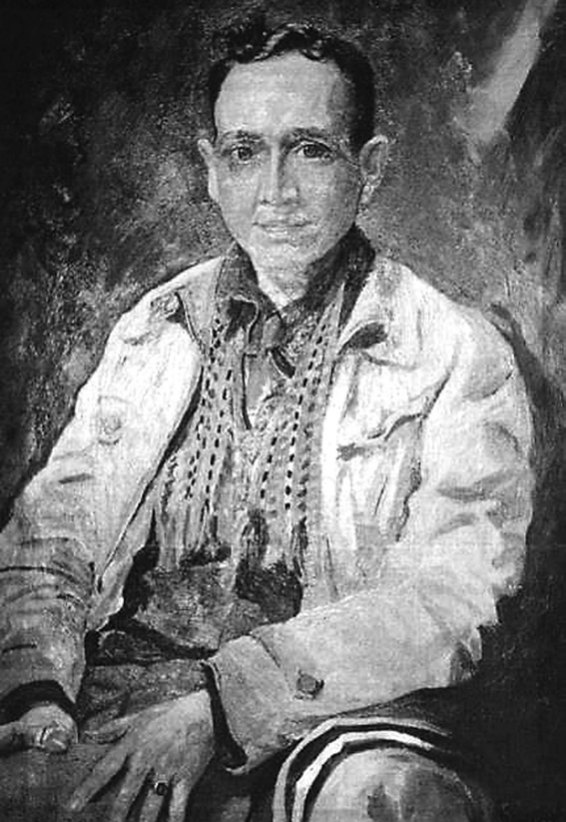
Dr Johannes Petrus Kruimel, "Uncle Joop", "Joe Smith"
About: Orthopaedic surgeon of Utrecht whose country house De Ruif at Garderen hid Jews from 1942 and airmen and paratroopers from 1943, Murphy and Walsh among them in October 1944. The Germans burned it on 23 October 1944; he died on 23 May 1976.
Unit or role: Orthopaedic surgeon at the St Joannes de Deo and St Antonius hospitals in Utrecht, and doctor at Garderen; in the Veluwe pilot line from May 1943 as "Oom Joop", to the evaders "Joe Smith" (Airborne Magazine).
Where: De Ruif, Roeëkamperweg, Garderen; Biltstraat 176, Utrecht (the war-damage list, p. 2; his letter).
Evidence: ✓ Airborne Magazine; Noordman, pp. 15, 19, 71–74, 80; Omroep Gelderland; Walsh; the Americans' file on him; death notice.
His life
Link to the section His life✓ Johannes Petrus Kruimel was born at Bodjonegoro in Java on 23 April 1900, the son of Johannes Petrus Kruimel and of Kasmina, also called Lusmina (Utrecht's family card and the Hillegersberg marriage); Noordman gives the same day, with "Bojonegoro" for the place (Noordman, p. 15). "Hij ging in 1915 in Arnhem naar de middelbare school en studeerde later geneeskunde" (he went to secondary school at Arnhem in 1915 and later studied medicine) (same). The magazine's biography box, drawn from L. F. Bakker's Biografie van de Nederlandse orthopaeden (1989) and other books, has him receive his medical degree on 23 April 1926 and then work as an assistant in surgery at Rotterdam's municipal hospital; train as an orthopaedist at Hillegersberg in 1928; settle in Almelo as surgeon and orthopaedist in 1929; and in 1931 join the St Joannes de Deo and St Antonius hospitals at Utrecht, taking the country house De Ruif at Garderen in that period (Airborne Magazine). He had a large practice at Utrecht, and at De Ruif people came to consult him "van heinde en verre … meestal zaterdags" (from far and wide, mostly on Saturdays) (Noordman, p. 15); the magazine calls him an unpaid doctor at Garderen.
He married at Hillegersberg, by Rotterdam, on 28 August 1928, aged 28; the marriage was dissolved in 1933, when the couple were living at Utrecht (the records). ✓ Utrecht's family card has him, an arts (doctor), coming from Hillegersberg on 2 May 1932 to Stolberglaan 23 and at Biltstraat 176 from 14 February 1933; his wife left for The Hague on 19 January 1934, and on 17 July 1934 Wilhelmina Catharina Maria Kuijpers, a masseuse, born at Eindhoven on 14 October 1909, was entered in his household. On 2 August 1945 at Ermelo he married Wilhelmina Antonia Maria Kuijpers, 35, born at Eindhoven, daughter of Martinus Josephus Kuijpers and Gezina Alberdina Tempelman; ◐ she is very probably the woman on the card, by the birthplace and the age, though the two indexes give her second name differently (the card, read on the scan, and the marriage).
1942 to 1943: Jews at De Ruif
Link to the section 1942 to 1943: Jews at De RuifBy the account of Max Glaser, a patient who became a friend, Kruimel operated on his wife Ilse's foot in the winter of 1940/41 and then came almost every evening; when Jews were barred from the streets after eight he was "een dagelijks komende, graag geziene gast" (a daily, welcome visitor), "fel anti-Duits en vooral een grote jodenvriend" (fiercely anti-German and above all a great friend of the Jews). In July 1942, with the Glasers on a list for arrest, Kruimel told them to leave their house the next morning without luggage or star and wait in his waiting room at the St Antonius hospital; on 31 July 1942 he drove them from there to De Ruif, which already held another Jewish couple with a son and a daughter. He registered them with the national organisation for helping people in hiding, which got them false identity cards, and on 4 September 1942 they went on by night to a farm at Nijkerk. At the end of December, by the sequence 1942, he came to them white-faced: "Men wilde hem in Utrecht in zijn huis arresteren, maar hij kon door een wilde vlucht ontkomen. 'Oom Joop' was nu zelf ook een onderduiker." (They had wanted to arrest him at his house in Utrecht, but he escaped by a wild flight. "Uncle Joop" was now himself in hiding.) (Max Glaser, in Noordman, pp. 71–74). After the war, Glaser says, Kruimel had him write off the bills of his Jewish patients who returned: "Dit was 'Oom Joop' ten voeten uit!" (That was Uncle Joop to the life) (p. 80).
Nelly Eskes remembered that when she and her husband Dirk went into hiding late in 1942, "Joop de verzetsman" brought them to the carpenter Nol Burger's house at Garderen, and that he "had een buitenhuis in Garderen en had daar een joods echtpaar met zoon [name omitted] en dochter [name omitted] ondergebracht" (had a country house at Garderen and had put a Jewish couple with a son and a daughter there), and also a Jewish doctor, Albert Groen, who had been warned at the Bilthoven sanatorium that his safety could no longer be guaranteed; "In het huis van Joop waren door Nol Burger schuilplaatsen gemaakt" (hiding places had been made in Joop's house by Nol Burger), and the first airman to be well sheltered there was Neville Fearneyhough (Nelly Eskes, in Noordman, pp. 18–19; Nol Burger).
Fearneyhough was shot down at Hoenderloo "± 27/4/43" (about 27 April 1943) by Groen's handwritten table (1 May by his own account, below) and, by the same table, was "verborgen bij Dr. Kruimel, "De Ruif" Garderen" (hidden at Dr Kruimel's, De Ruif, Garderen) from 29 April to 22 June 1943 (Groen's file, p. 5; the Americans' typed translation is on p. 3). Noordman has Eskes bring him to Garderen, where the Jewish family and Groen were already hiding, and four weeks later the bungalow was raided by the Germans: the daughter of the Jewish family, Marianne Happ in Noordman's text, escaped through the back door and over the heath to Nol Burger's house, and was passed on to the Eskes family and to Bos at Staverden (Noordman, p. 65). The Airborne Magazine has the raid "Niet lang daarna" (not long after) May 1943, the parents and the son of the Jewish family taken and sent on to Sobibor, a Jewish doctor and a British airman in the attic left undiscovered, and Kruimel himself hiding from then on at nearby Staverden, "maar hij zet zijn activiteiten onverminderd voort" (but he carries on his activities undiminished) (Airborne Magazine). Groen's own account of 1945 says that in October 1944 a "real Londoner" who had been "very briefly" at Kruimel's left "just in time", since the house was raided the next day (Noordman, p. 69; Groen's page); Noordman reads the Londoner as Tex Banwell (p. 70).
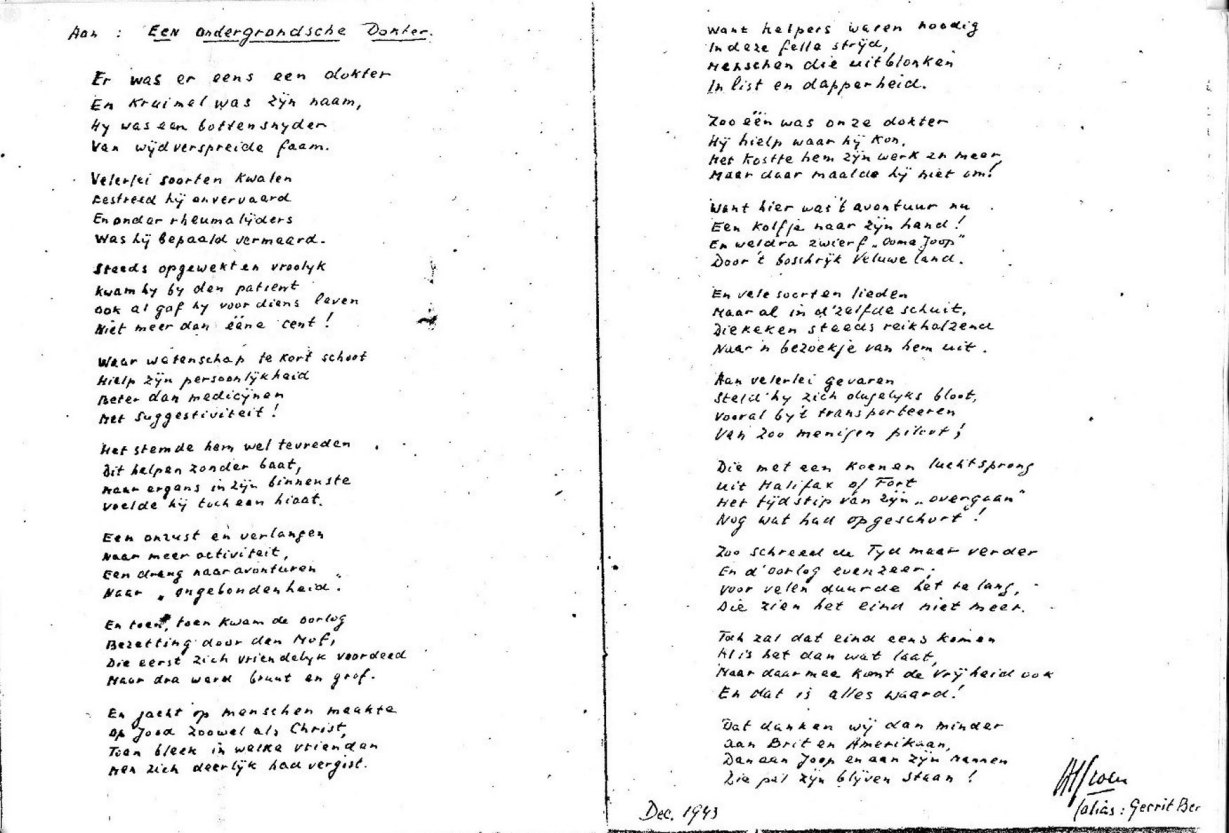
The pilot line, 1943 to September 1944
Link to the section The pilot line, 1943 to September 1944He was in the Veluwe pilot line from May 1943 as "Oom Joop", introducing himself to evaders as "Joe Smith" (Airborne Magazine). Noordman's source for the alias is the airman Carl Spicer's story, in which a doctor "Joe Smith" meets him at a station; Noordman identifies him as Kruimel, who used the name with the Allied men (Noordman, pp. 7, 126). The guestbook of De Ruif carries thanks from airmen from 1943: McDonald and McGlinchey wrote in it on 31 December 1943, Binks and Booth in early 1944, and Glisynski, O'Barr (who baled out at the end of May 1944), Lalley and Bailey later in 1944 (Noordman, figs. 69, 74, 83, 93, 96, 104–105, pp. 128, 133, 141, 149–150, 166–167), but Noordman warns that a name in it does not mean the man was housed at De Ruif: most were placed at farms round about (Omroep Gelderland).
Helpers' forms. Several helpers' forms of 1946 know him as "Dr. Kruimel, Utrecht", hiding and moving airmen on the northern Veluwe well before Arnhem. Albert Groen, in hiding himself, wrote in his handwritten Dutch form of "het huis van Dr. Kruimel in Garderen - waar ik o.a. met Sgt. R.A.F. Nevil Fearneyhough samen was" (Dr Kruimel's house in Garderen, where I was together with, among others, Sgt. R.A.F. Nevil Fearneyhough) (p. 4), and his table has Fearneyhough, shot down at Hoenderloo "± 27/4/43" (about 27 April 1943; see below), hidden at "Dr. Kruimel, "De Ruif" Garderen" from 29 April to 22 June 1943 (p. 5; the Americans' typed English translation is on pp. 2–3). Nel Lind's list has the same sergeant "found at 'Uncle Joop'(Dr. Kruimel, Utrecht) in a wood near Ermelo", and adds that Kruimel, in hiding himself, helped other airmen too (her file, p. 9). At Ermelo, D. M. Hulstijn's family fed five airmen on 11 November 1943: "Three times they came in our house, together with Dr.Kruimel from Utrecht. (Oom Joop)" (his file, p. 3).
Two more helpers' forms.
- ◐ Hendrik de Bruin of Houtdorp, Ermelo, got the American pilot Walter Mallard away "under the eyes of Germans" near an airfield, housed him four days and handed him to "Dr. Kruimel, who was at that time in Staverden and did much illegal work" (his form, p. 2, April 1946). Mallard came down in May 1944 (Schaeffer's list, p. 5), so this puts Kruimel at Staverden that spring.
- G. J. van de Brink, a Catholic priest of the Scheut mission fathers at Oijen near Oss, wrote in August 1945 that he had "meerdere malen P.B.'s" (identity cards, several times) "voor transport van piloten" given to "Dr. Kruimel toen verblijvend te Garderen en een zeer actief werker voor piloten transporten" (then staying at Garderen, a very active worker for moving pilots), and that his house at Garderen had in the end been burned by the Germans (his letter, p. 5).
More helpers' forms, 1943 to 1946. Each as the form has it; none gives more than a line on Kruimel himself.
- ◐ Vierhouten. Daniel van Beuningen and Willem van Putten both put the RAF sergeant (Fearneyhough; "Nevile Farnborough" on Van Beuningen's first table, "Nevill Feruborough" on his second and on Van Putten's) with them in 1943, 70 or 80 days from May; they do not name the same helpers.
- Van Beuningen's first table: received from "C. BOS, STAVERDEN", passed on to "Oome Joop" (Dr. Kruimel), 70 days (p. 4). His second: "Bos, Staverden near Elspeet" and "Dr. Kruimel, Utrecht", 80 days (p. 6). He names Bos and Kruimel as the helpers he knew (p. 5).
- Van Putten: received from "Wood near Staverden", passed on to "Dr. Kruimel in Utrecht", 80 days (p. 3).
- ⚠︎ Groen's table has the same sergeant at De Ruif itself from 29 April to 22 June 1943 (below).
- ◐ Kampen and Nunspeet. L. A. Snoep, owner of a factory at Kampen, lists under "Group Kampen and surrounding" "Dr. Kruimel, Biltstraat, Utrecht" and "E. Bos, Labourer, Staverden": the factory hid "many allied evaders" and "was a starting-point for the route between Kampen and the 'Veluwe'", the men taken on "in the direction of Staverden and Amersfoort and further South". "No names nor dates" (his summary, p. 2; 11 June 1946).
- ◐ Groningen, October 1943. K. H. van Oord of Hollandsche Rading has two US airmen, "M. Glinchey 0-676329" and "M. Donald 0-672372", shot down in October 1943, received from Groningen and passed on, in a handwritten note that reads, as far as it can be read, "Oom Joop" - Dr. Kruimel. Brabant [?] escort from Elspeet - farmer Kaaymans [?] by train. Bos. (his table, p. 4). The Americans' letter of 29 April 1946 says he was visited in July 1945 "door den heer Kruimel", to whom he gave information (p. 5); it does not say that this was Dr Kruimel.
- ◐ Leiden and Hollandsche Rading, 1944. H. J. de Koster of Wassenaar, after a Belgian line failed in March 1944 and he turned down a German officer's offer to drive airmen to France: "Lest through D. Kok chemist in Leyden, I contacted D. Kruimel a surgeon, who called himself Joop and lived somewhere on the Veluwe" (his report, p. 10). Hendrik Dirks of Hollandsche Rading, who made photographs for pilots, names "K. H. van Oord (Dick)" and "Dr. Kruimel (oome Joop)" (his form, p. 2).
- ✓ Friesland. Klaas Maring of Leeuwarden, "Klazinga" to the airmen at Drachten: "Dr. Kruimel, Utrecht knows about it … Transported several times Allied Personnel. Was the contact-man of Dr. Kruimel in the North provinces"; the Americans pencilled "Kruimel" at the head of the form (Maring, 9 September 1945, p. 2). Pieter Wijbenga of Leeuwarden, leader of the L.O. and K.P. there: "Some pilots were helped back by Mr. Smith (Dr. Kruimel at Utrecht)" (his further statement, p. 23), which agrees with the alias "Joe Smith" above.
- ◐ Doorn and the Betuwe. Hendrik van Donselaar of Doorn, 27 June 1945: Kruimel "often stayed at the DONSELAAR's", and Donselaar "helped oome Joop (Dr. KRUIMEL) clearing the way for the evaders in the Betuwe" (his form, p. 2). It is not dated; it fits the Betuwe side of the crossings (see Kok-Thyssen, below).
- ◐ Terschuur, 1946. Gerardus van den Beek lists the people he knew as "(LOU) H. de Jongh Sparrendaal 47 Rotterdam (Z)", "(UNCLE JOOP) Dr. Kruimel Chirurg Biltstraat Utrecht" and "(DIRK) Jhr. Mr. van Eyzinge" (his form, 28 March 1946, p. 8): Huib de Jongh, Kruimel and Dirk van Eysinga as three names from one helper's memory.
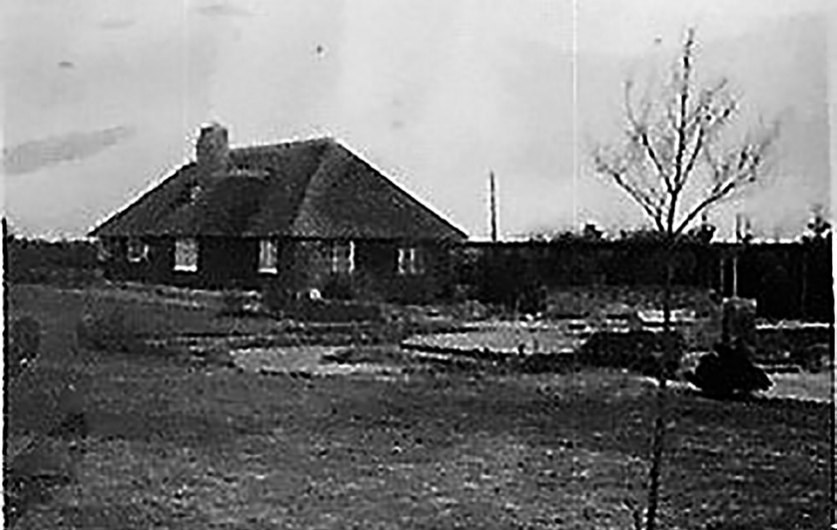
In December 1943 he made De Ruif available to the dismissed mayor of Laren, Jhr van Nispen tot Sevenaer, and his family (Tijding, 17 May 1945); "Dr. Kruimel zelf woonde in Utrecht en had het huis verhuurd aan de familie van Nispen tot Sevenaer" (Dr Kruimel himself lived in Utrecht and had let the house to the Van Nispen tot Sevenaer family) (du Bois and Holvoet). By the son's account the first pilot came on 1 January 1944, and the office noted from him that "The Fliers were brought to the house by Dr Kruimel, Dr Eskes, Nol Burger … Mostly Dr Kruimel fetched them again" (the father's file, p. 3; the son's file, p. 4).
With Murphy
Link to the section With MurphyMurphy and Sam Walsh, escaped from the Willem III barracks at Apeldoorn, came to De Ruif in October 1944: around 8 October by the guestbook and the Airborne Magazine (Airborne Magazine; Where, and with whom), on the evening of 14 October by Walsh's report, which has them taken to:
a fairly large house on the outskirts of the village owned by a member of the Underground known to me as Uncle JOOP and often referred to as the Doctor by his friends. I believe he was a surgeon before the war
— MI9 · Pte S. Walsh, C Company, 156 Parachute Battalion · report of 7 March 1945 · the report
Tex Banwell was there too, by the guestbook below, and Sgt Harding of the 10th Battalion joined them a few days later (Walsh). Murphy wrote two pages in Kruimel's guestbook, his poem "The Ladies from Hell" and "With sincere thanks to my Dutch friends for their kindness & hospitality shown to me in time of need", signed "Pte Thomas Murphy, 156 Battalion, The Parachute Regt, Army Air Corps, ex Black Watch", with Walsh's page facing and Banwell's dated 8 October (Noordman, figs. 189 and 193, pp. 293 and 300; The De Ruif guestbook).
The two had to move, "to make room for a party of six R.A.M.C. officers who were expected" (Walsh). Liesbeth Verweij of Sterrehoveke cycled over to arrange it with Kruimel; the next evening, when he came home at a quarter past seven, they set off along the cycle paths, she ahead, Tom and Sam behind her and Kruimel at the rear, and he stayed the night at Sterrehoveke and wrote in its guestbook, "Keep smiling; ook in tijden van gevaar" (even in times of danger) (Noordman, pp. 301–302; Liesbeth Verweij's account). The forms of Ima van Eysinga and Liesbeth Verweij have Walsh and Murphy received from "Dr. Kruimel 'De Ruif', Garderen" (Ima van Eysinga's file, p. 3). ◐ Pieter Hoekstra's own list has two First Airborne privates, "Spud" and "Tom", received from "Johan v Oldenbarnevelt" at about 16 October and passed to "Dr Kruimel, de Ruif Garderen" (his list, p. 9); ⚠︎ Dove Jan's list has the pair going on to Dirk Eskes, and the forms do not agree on who took them to De Ruif. ◐ He stayed in touch with them. Hardy, who met Murphy at Sterrehoveke, had "a visit from another member of the Underground who went by the name of Uncle JOOP (?)" there, and at Kijkuit in early November "Uncle JOOP visited us and told us that a crossing was being arranged for us … 100 or more in the party" (Hardy); in Noordman's narration it was Kruimel who came to Kijkuit to warn them to be ready to move, to the Kootwijkerbroek area to be taken over by Dick Kragt, about 6 November (p. 293; Hardy has them taken to Harskamp; Harskamp). Joop Migchelsen, whose group kept the six at Kijkuit, had Walsh, Murphy and Banwell coming "presumably from 'Ome Joop' (Dr. Kruimel)", and the transport out taken over by "Loet and Dirk, 2 assistants of Ome Joop" (his file, p. 3).
The medics who took Murphy's place were Capt. Lipmann Kessel, Lt Peter Allenby, S/Sgt Albert Allen and Maj. Cedric Longland of 16 Parachute Field Ambulance, who thanked "Joe" in the guestbook; Kessel wrote "So long as there are Joe's in this world, we shall destroy the Nazis & all their works. Salute to 'De Ruif'!", and Longland "Joe the Surgeon … you have changed your kind of practice" (read off the guestbook pages in the magazine: Kessel's, Longland's; Garderen). ⚠︎ When they came is not settled. Kessel's book gives no date in our extracts; "about 21 October" is the heading of our extract, from Ham's "Last night we were both at a dance in Oxford" (p. 93) and Walsh's dates for the move to Sterrehoveke (Kessel, 1959). Boeree has the agents dropped on 17 October (p. 161), and Noordman has Kessel escape from Apeldoorn on 16 October and, from Nelly Eskes, Dirk Eskes and Kruimel fetching four officers the evening they were found, and the four "two days in Garderen" (Noordman, pp. 308–311). ◐ Together these narrow it: the agents had been dropped "net de afgelopen nacht" (just the night before) when the four arrived (Noordman, p. 310, from Kessel), Boeree dates the drop to 17 October, and the magazine has Kessel arrive "half oktober", so the evening of 17 or 18 October, which is against Walsh's "About 21 Oct" for leaving to make room; the Van Nispen son's form has "De laatste vertrok op 21 Oct 44" (p. 4). ⚠︎ Groen's table has Banwell sheltered with Foppen at Staverden "12 - 17 Oct 44" (p. 3), which does not sit easily with Tex at De Ruif when the medics came and leaving on 22 October. In the house they found the agents Abraham du Bois ("Ham") and Raymond Holvoet ("Bacon"), newly dropped, and Tex; the four slept in Kruimel's bunker, "a good fifteen feet deep", and the guide came back for them at six the next evening (Kessel, 1959, pp. 90–101); Kessel gives no date for the leaving, and the magazine has Tex leave on 22 October (Airborne Magazine). The agents had been brought to Kruimel's bunker on landing; du Bois's task was "het bijeenbrengen van de verspreide parachutisten en het voorbereiden van een crossing over de Rijn" (gathering the scattered paratroopers and preparing a crossing of the Rhine), the operation Murphy was then in the middle of (du Bois and Holvoet).
Kessel, as the Airborne Magazine quotes the 1974 edition of his book, called his host "Karl" and described "a short square man in a leather wind-breaker and tweed knickerbockers. Looks like a very tough bantam-cock. He speaks good English", who told him he had been an orthopaedic surgeon before the war and often went on ski expeditions in Switzerland (Airborne Magazine). ◐ Our extracts of the 1959 US text have the guide "Karl" lead the four to "a low house, standing in what appeared through the rain to be a well-kept garden" and do not hold that sentence (Kessel, 1959, pp. 90–92). At Sterrehoveke Liesbeth Verweij, in her unpublished memoir as the magazine quotes it, remembered him as a rule in short trousers and a brown jerkin of Canadian pilots, and one of his fixed domiciles as "de boerderij van de familie Bes op Staverden" (the farm of the Bes family at Staverden; the magazine prints "Bes", ◐ perhaps the Bos of Staverden named on the helpers' forms) (same).
On 23 October 1944, two days after Murphy and Walsh had left by Walsh's "About 21 Oct" (⚠︎ about 10 to 11 October by Liesbeth Verweij, and by 19 October at the latest by Hardy, who found Murphy at Elspeet that evening: Sgt Harding), Germans quartered at Elspeet came to Garderen to requisition a car, found the hideout under the stable with a transmitter and a pilot's equipment, took the furniture, glassware, paintings, crystal and silver, and razed the house with fire and hand grenades (Airborne Magazine). Kruimel was away at the time, Walsh heard later from Harding (Walsh). The guestbook has the date on a page of its own: "De oude „De Ruif” door duitschers afgebrand op 23 October 1944" (the old De Ruif burned down by Germans on 23 October 1944) (Noordman, fig. 2, p. 16).
In Boeree's chronicle. ✓ Th. A. Boeree's printed Kroniek van Ede (Frouws, Ede, 1947) names "Oome Joop (Dr. Kruimel)" five times, all read on the page images (Boeree; the PDF page is the printed page plus 4):
- P. 161, the agents. Abraham du Bois and Holvoet, dropped at Garderen on 17 October, were taken by Tinus (the head teacher J. A. van den Bovenkamp) and Nol (Burger) "naar een bunker gebracht bij het landhuis de Ruif van Oome Joop (Dr. Kruimel)" (to a bunker by the country house De Ruif, Oome Joop's). Du Bois went that evening to Nol's house, and Holvoet was put up with Huber.
- P. 162, De Ruif and its tenants. Huber's house lay "vlakbij het huis van Oome Joop (Dr. Kruimel)" (close to Oome Joop's house), and "Dit huis (de Ruif) werd tijdelijk bewoond door den heer van Nispen van Sevenaer, ontslagen burgemeester met diens gezin" (this house, De Ruif, was lived in for the time being by Mr van Nispen van Sevenaer, the dismissed mayor, with his family), which fits the let of December 1943 (above).
- P. 163, the burning.
- One of the young people living at De Ruif had lit a fire in the damp bunker. The smoke was still rising through the open hatch when a Feldgendarmerie patrol, looking for hidden cars, came by, found the stairs and door under it, and in it a few hand grenades, some English uniforms and a radio ("micro receiver").
- The family, at lunch, fled before the Germans reached the house: "De familie Kruimel was niet aanwezig" (the Kruimel family was not there).
- The Germans had a removal van brought, declared house and contents forfeit, loaded everything and set the house on fire. Holvoet, lodged close by, had to leave "op die 23e October" (on that 23 October).
- P. 204, Ermelo. On the pages headed "Piet van de Veluwe", Berend Dijkman, a policeman at Ermelo before the war, came out of 21 months' imprisonment and gave himself wholly to the resistance with "de krachtige steun van Dr. Kruimel, Dr. Eskes, van Thijssen en anderen" (the strong support of Dr Kruimel, Dr Eskes, Thijssen and others); Dirk Eskes is the Dr Eskes.
- P. 216, a stranger at Ermelo.
- Helmuth Blümcke, a chemist from Flensburg who had served in Belgium as a Sonderführer and gone into hiding in 1942, was arrested by the SD on 2 June 1944 and escaped from Amersfoort with a man called Balk.
- He lodged at Ermelo with the Townsend family but "had dadelijk een groote belangstelling voor Oome Joop (Dr. Kruimel)" (at once had a great interest in Oome Joop). The family had little trust in him, and the daughter moved him to her fiancé's empty house.
- Boeree does not say what became of the interest, and the rest of the passage is about Piet and the SD.
On p. 163 the discovery is the smoke from the fire in the bunker; the Airborne Magazine has the Germans from Elspeet come for a car and find the hideout under the stable (Where the sources disagree).
✓ The Americans' own file on him, made out by their office in May 1946, has no form of his; the office filled in the questionnaire itself and wrote:
Well known underground worker, who took over from van de Weert (Wentworth) when the latter came through to liberated territory and contacted and sheltered evaders in not very large numbers. Unhelpful in producing any further information cocerning [sic] his activities
— US National Archives · RG 498, helper file of Dr J. Kruimel · the office's own questionnaire, May 1946 · p. 11
It graded him 5 and then upgraded him to 4 (p. 1), and on 22 July 1946 recommended "Dr. J. Kruimel, Dutch civilian, Biltstraat 176, Utrecht" for the Medal of Freedom without palm, for service "from July 1940 to November 1943" (US National Archives, RG 498, helper file of Dr J. Kruimel, pp. 7, 9, 11; p. 3 gives "Dr Kruimel Biltstraat 176 alias 'Ome Joop'"). General Orders 282 of 9 October 1946 award it to "J. Kruimel, Dutch Civilian--7 December 1941 to November, 1943" (a copy, in G. M. van der Weerd's file, p. 12). The Airborne Magazine has it presented on 12 March 1947 (Airborne Magazine). The American papers mention neither De Ruif nor 1944. ⚠︎ Mrs R. P. Kok-Thyssen, at Maurik in the Betuwe, south of the Rhine, lists "Uncle Joop (Dr. Kruimel) - 23 Oct. 44" among the men who stayed with her (her file, p. 6). 23 October 1944 is the day De Ruif was burned; nothing else puts him over the Rhine. ◐ The Utrechtsch Katholiek Dagblad's roll of honour from the Medal of Freedom ceremony in Utrecht on 12 March 1947 has "Dr. J. Kruimel, Utrecht", very probably him by the title and the town (the article, read on the page image; Joop Doornebosch has the ceremony).
The magazine says that after the failure of Pegasus II every trace of him is missing until the liberation, and that he took up his Utrecht practice again in 1945 (Airborne Magazine); Max Glaser, who helped him rebuild his practice papers, has him back at Utrecht with a surgery and later withdrawing to the country: "Langzaam trok hij zich terug en verdween uit de stad naar het platteland, daar ergens zijn spreekuren voortzettend" (slowly he withdrew and disappeared from the town to the country, holding his surgery somewhere there) (Noordman, p. 80).
Albert Groen, writing to Nevil Fearneyhough in August 1945: "Uit Garderen zijn alleen Joop Kruimel en Nol Burger door de oorlog gekomen" (from Garderen only Joop Kruimel and Nol Burger came through the war) (Noordman, p. 70, Noordman's Dutch rendering of the letter).
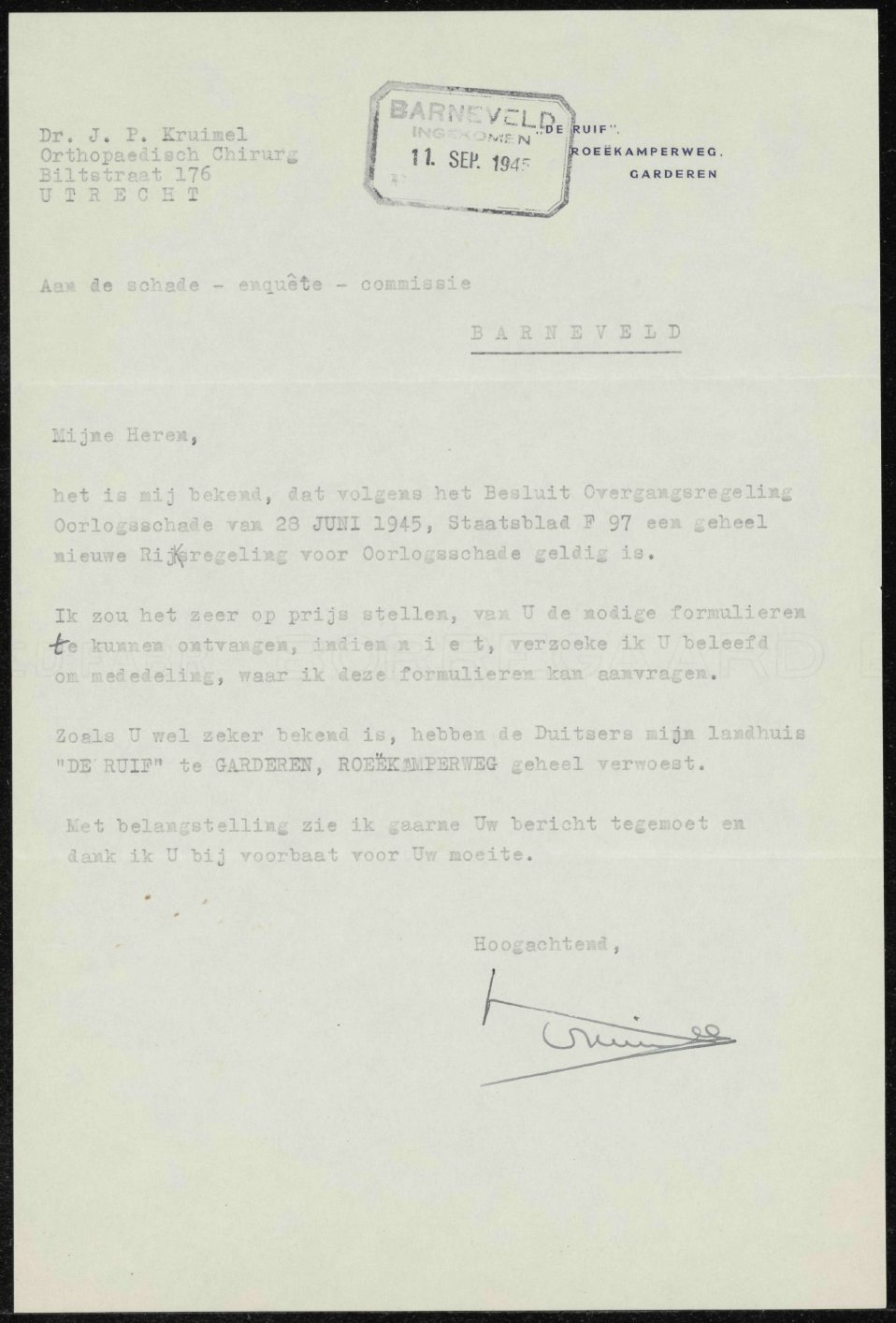
In September 1945 he asked Barneveld's war-damage committee for the claim forms: "Zoals U wel zeker bekend is, hebben de Duitsers mijn landhuis 'DE RUIF' te GARDEREN, ROEËKAMPERWEG geheel verwoest" (as you will surely know, the Germans completely destroyed my country house De Ruif at Garderen, Roeëkamperweg) (the letter, Gemeentearchief Barneveld 002/1558; Kruimel's letter). The town's list of damage still to be assessed gives the house's address as Roeëkamperweg 7, Garderen (list, p. 2). The new house was opened on 24 July 1946, by the guestbook (Noordman, fig. 2, p. 16; the magazine's biography box has the same day).
✓ He died on 23 May 1976, aged 76. The notice, signed by his executor, says the burial "in stilte" (in silence) "heeft plaatsgevonden te Garderen" (has taken place at Garderen) in accordance with his wish, and is datelined "De Ruif", Garderen, 25 May 1976; it does not say where he died (Barneveldse Krant, 25 May 1976). By his will his estate went to the older people of Garderen: Noordman has it pay for homes for the elderly and a residential home (Noordman, p. 80), and the magazine dates the start of building fourteen homes for the elderly to 1983 and the opening of the Dr. Kruimelstaete centre to 2009 (Airborne Magazine). Gemeentearchief Barneveld holds his estate papers, among them "Aanvaarding schenking nalatenschap van dr. J.P. Kruimel te Garderen, 1976 - 1980" (acceptance of the gift of the estate), his will of 1976 and the letters from people wanting to buy De Ruif; none is digitised, and no guestbook is listed (the catalogue entries).
Where the sources disagree
Link to the section Where the sources disagree- Where Nevil Fearneyhough was in 1943. Groen's handwritten table has him "verborgen bij Dr. Kruimel, "De Ruif" Garderen" from 29 April to 22 June 1943, shot down at Hoenderloo "± 27/4/43" (about 27 April) (Groen's file, p. 5; the Americans' typed translation, p. 3, drops the "±").
- Van Beuningen's tables have him from May, 70 or 80 days, received from Bos at Staverden and passed to Kruimel; Van Putten's puts him in a "wood near Staverden"; both give "Ede" as where he came down (Van Beuningen, p. 4; Van Putten, p. 3).
- Fearneyhough's own account has the Halifax leave Elvington on the night of 30 April/1 May and himself shot down "in de vroege ochtend van 1 mei 1943" (in the early morning of 1 May 1943), a local diary having the crash at about half past two that night (Noordman, pp. 63–64), after both of Groen's dates.
- ⚠︎ Not settled: the dates overlap, the places do not.
- How the Germans found the bunker at De Ruif. ◐ Not settled.
- The Airborne Magazine has Germans quartered at Elspeet come to Garderen to requisition a car, and that same afternoon the son of the mayor of Laren, also in hiding at De Ruif, had made a fire in the hideout under the stable; when they inspected it they found a transmitter and a pilot's equipment (Airborne Magazine).
- Boeree has a Feldgendarmerie patrol looking for hidden cars, drawn to the open hatch by smoke from a fire a young resident had lit in the damp bunker, and finding hand grenades, English uniforms and a radio (Boeree, p. 163, read on the page image).
- Both agree on the cars, the bunker, the fire and the radio; the magazine names the son of the Van Nispen family as the one who lit it, Boeree "een der jeugdige bewoners van de Ruif" (one of the young residents of De Ruif). The son's own form says only that the house "werd toevallig ontmaskerd op 23 Oct.44" (was exposed by chance) (his form, p. 4).
- Tijding of 17 May 1945 has a third version: because of the underground work done in the house, "de Grüne Polizei op 23 October de familie van Nispen met een bezoek" (the Green Police visited the Van Nispen family on 23 October) (Tijding).
- The day he died. 23 May 1976, in the death notice and in Noordman; the magazine's biography box has "18 juli 1976" (the notice; Noordman, p. 15; Airborne Magazine). ✓ The notice is dated 25 May 1976, so 18 July cannot be the day.
- When he came to Utrecht. 1931, in the magazine's biography; Utrecht's family card has him arrive from Hillegersberg on 2 May 1932 (Airborne Magazine; the card). The card also has his first marriage on "2/8/28", the register 28 August 1928; ◐ the card's date is a slip for 28/8 or the register's is wrong, and the register image has not been seen.
- The years of the Medal of Freedom service. "July 1940 to November 1943" in the recommendation, "7 December 1941 to November, 1943" in General Orders 282 (above); the magazine's biography box has his resistance work 1940–1945.
- The first raid on De Ruif, and who was taken. Noordman has one daughter of the Jewish family, Marianne Happ, escape; the magazine adds that the parents and the son were taken and sent to Sobibor, and neither says on which day it fell, beyond Noordman's four weeks after Fearneyhough came (29 April 1943 by Groen's table) and the magazine's "not long after" May 1943. Who raided is not agreed either: Groen's own form has "a surprise-attack by the NSB" (Groen's file, p. 2), Noordman and the magazine have Germans. Not settled.