Berend “Flip” Esveld
Amerongen 17 Feb 1910 – after 1974
About: The elder son of the Amerongen family, resistance name "Flip", Hardy's "Beent", a garage-keeper and head of the K.P. at Amerongen who guided evaders to the Rhine and through the lines. The Sunday Post of 1972 has him writing to Murphy after finding Murphy's name in a sideboard.
Unit or role: Garage-keeper: "Flip Esveld, Amerongen (garage-keeper)" in a Leersum resistance leader's list of helpers (Evert Cent's file, p. 2). On his own form, "B.S. (formerly K.P.)", the Binnenlandse Strijdkrachten, formerly the Knokploeg (his file, p. 5).
Where: Amerongen; A 12 Rijksstraatweg, Leersum, on his form of May 1945; Overstraat B 375a, Amerongen, in 1953; Dwingeloo, Drenthe, by 1973.
Evidence: ✓ Flip's file and the British helper index, certificate 22352; Geschiedenis Magazine; Caspers, p. 64; ✓ his marriage; ✓ his birth, 1910; ✓ the War Graves Foundation's file on his brother Coen, 1953–1973 (Nationaal Archief 2.19.255.01, 41478A).
Berend Albert Esveld, 32, of Amerongen, son of Gerrit Hendrik Esveld and Martina Gijsberta Strübbe, married at Amerongen on 20 August 1942 (marriage record), which ties him to the household that hid Murphy: his father Gerald (Gerrit Hendrik) Esveld, his mother Mrs Esveld-Strubbe and his younger brother Coen. Caspers has "Esveld had met zijn zoons Berend en Coen een garagebedrijf" (Esveld and his sons Berend and Coen ran a garage) (Caspers, p. 64). ✓ The Amerongen birth register has him born on 17 February 1910, the son of Gerrit Hendrik Esveld and Martina Gijsberta Strübbe (deed 8; the record). His own form for the Americans, of 28 May 1945, agrees: born at Amerongen on 17 February 1910, married with two children, and living at A 12 Rijksstraatweg, Leersum, the address the Allied men knew (his file, p. 5); ◐ Caspers has "Esveld aan de Rijksstraatweg in Leersum" with a space under a sloping roof as a hiding place (Caspers, p. 39).
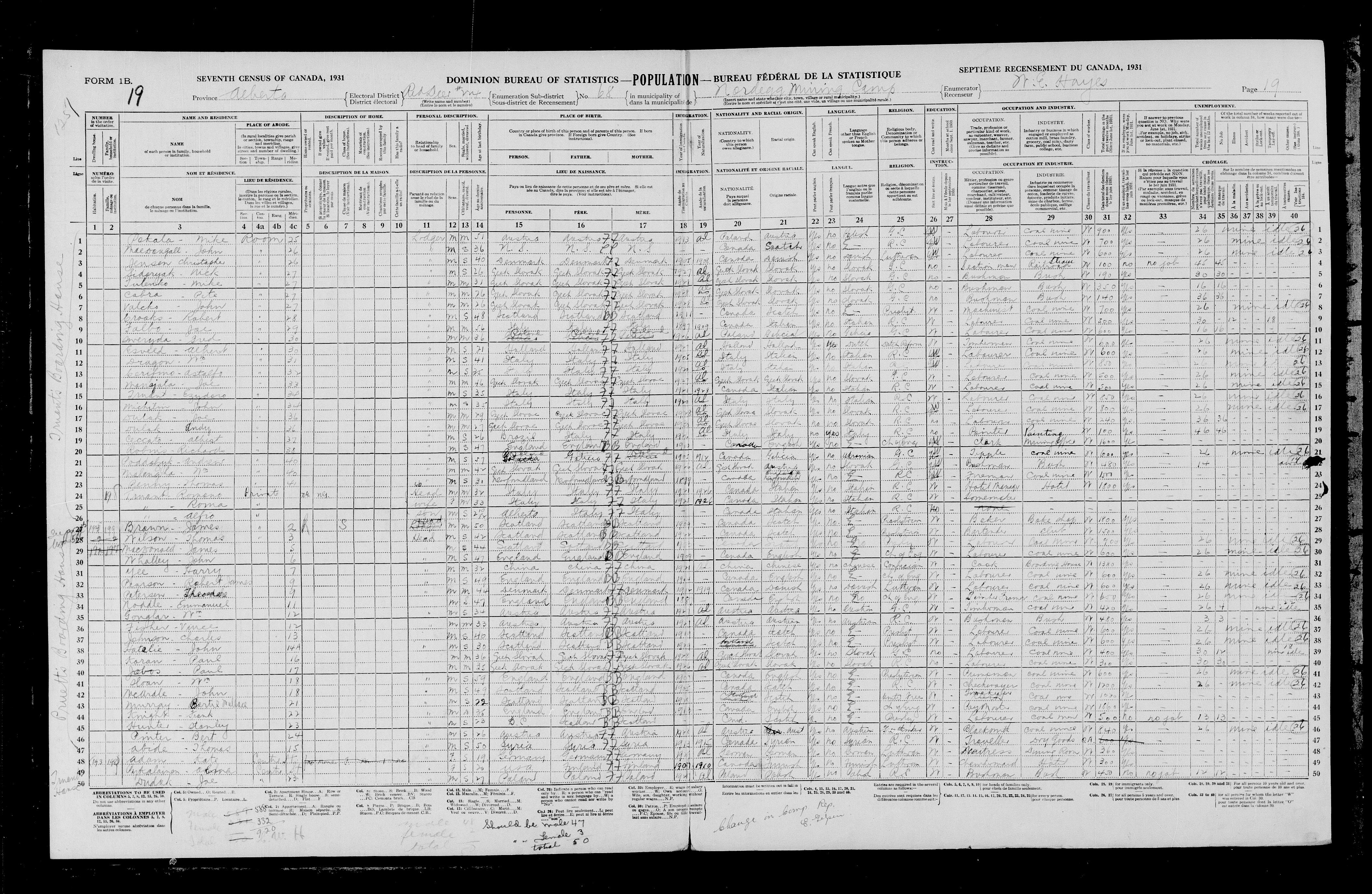
◐ Canada, 1927 to about 1932. A Berend Esveld, 17, landed at Quebec from the Athenia on 4 September 1927, and in June 1931 the census of Canada found Albert Esveld, 21, single, born in Holland and arrived in 1927, lodging at the Nordegg Mining Camp in Alberta and working as a timberman in the coal mine, which had stood idle for 26 weeks of the year (the census page and the passenger list). He was Berend Albert, born in February 1910, so the names and ages fit, and two of the men he helped in 1944 remembered a Canada connection: Briere's host at Amerongen "had been in CANADA for five years, employed as a mechanic in ALBERTA", and Noble's guide "had spent some years in Canada" (below). Nothing found yet ties the Nordegg lodger to Amerongen by record, so this stays ◐.
He went on one of the ferry runs. The ferry from Amerongen to Eck en Wiel ran all through the occupation, and Coen and Chris Cornelisse took a group of six airmen across on it three times, warned by one of Amerongen's three ferrymen when Germans were aboard: "Coens broer Berend, die in het verzet Flip heette, ging een keer mee" (Coen's brother Berend, who was called Flip in the resistance, went along once). On the third crossing two Germans came aboard just before it left and began eyeing the Englishmen's boots; Coen said to Chris "Jij die en ik die" (you that one, me that one), and they put one German each over the side, which ended the ferry crossings (Geschiedenis Magazine). The article does not say which run he went on, or when.
◐ His grandfather, whose first name he bears, very probably the "Koetsier BERENT ESVELD" (coachman) whom a Mrs Loopuit honoured in the Arnhemsche Courant of 7 June 1915, forty years in her service from 8 June 1875: his father Gerald was the son of Berend Esveld, a koetsier at Arnhem, and Jacomina Pasman (the advertisement, read on the page images; the marriage of 1877; the birth of 1883). The match is by name, trade and town; his father's page has the reasoning and the picture.
With Murphy
Link to the section With MurphyOn 23 December 1944 Murphy and James Hardy were brought to Amerongen, and after dark:
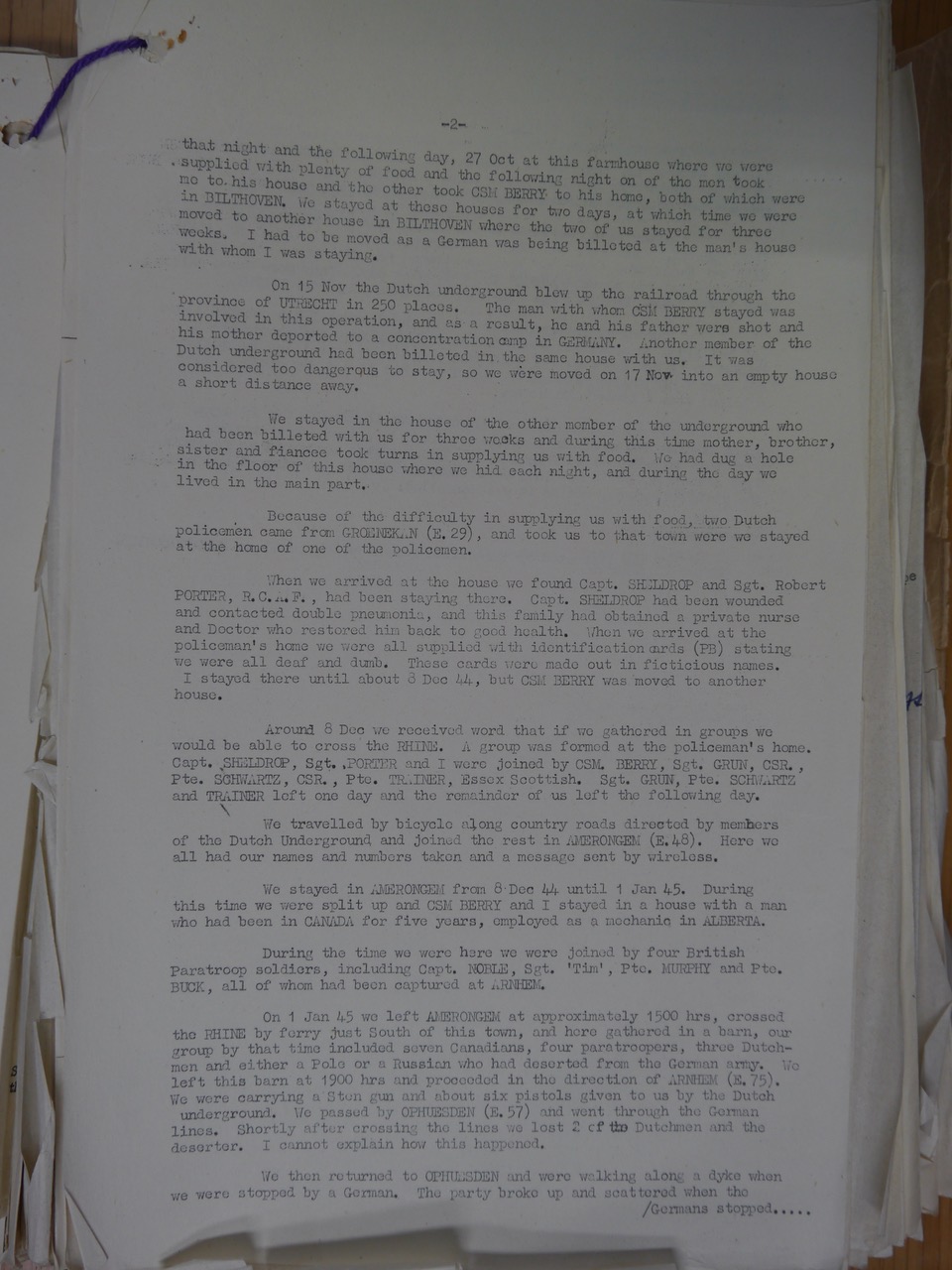
a young man came and took MURPHY and me to his father's house, also in AMERONGEN. His father is a garage proprietor, named Gerald ESVELD, a married man with two sons, KOEN (?) and BEENT (?) and a daughter. Here we stayed until 2 Jan 45
— MI9 · Pte J. Hardy, 16 Parachute Field Ambulance · IS9/WEA/1/270/2351 · 13 January 1945 · the report
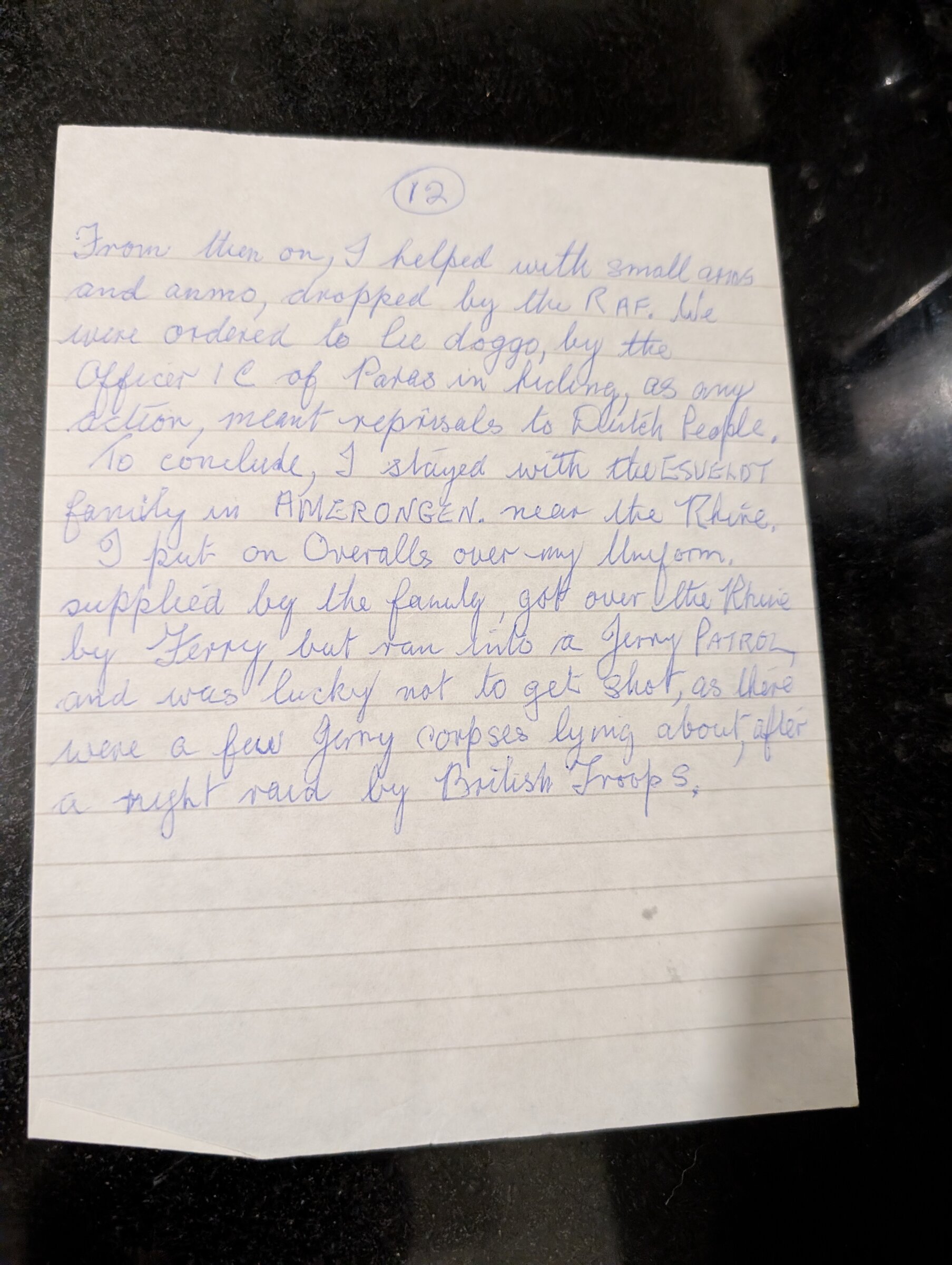
Their mother has her younger son, "Louis", bringing Murphy and taking him away for the crossing (her statement, p. 5; Mrs Esveld's account). Murphy named the household himself: "I stayed with the Esveldt family in Amerongen, near the Rhine" (his memoir, p. 12).
Flip's own record has him on the crossing of 2 January. His list for the Americans has "Jimmy and Tom, 2 Engl. paratroopers from Arnhem, both were in the big transport which failed near Wageningen" (◐ Hardy and Murphy, by our reading of the names: Mrs Esveld has "Tom MERPHY" and "James, or Jim"), with "Charles, English Capt. Doctor" (Charles Noble) below them, and the typed note beside the group reads "Crossed them personally to English lines near Dodewaard, with a transport of 12 men allied personnel"; pencil lines add Shelderup to it, and the Canadian Scottish sergeant major Berry and Marcel Briere are entered "took them myself to Engl. lines" (p. 10). ◐ The failed transport is very probably Pegasus II, which Murphy and Hardy missed on 17/18 November. His statement of May 1945 is more particular: Marcel Briere, escaped from the train near Bilthoven, "was taken by Dirk and Piet to Flip. Flip kept him hidden until the first week in January 1945 and then acted as his guide for the crossing", and Wilfred Berry likewise (p. 7; Marcel Briere; Wilfred Berry). Both Canadians were in the party Murphy set out with, which was fired on north of Opheusden in the night of 2/3 January (The crossing and recapture). ⚠︎ Hardy and Mrs Esveld have Koen (Louis) and Keek (Kik) taking Murphy and Hardy to the ferry, and Caspers names Coen among the guides that night and not Berend, so it is Flip's claim against theirs (below).
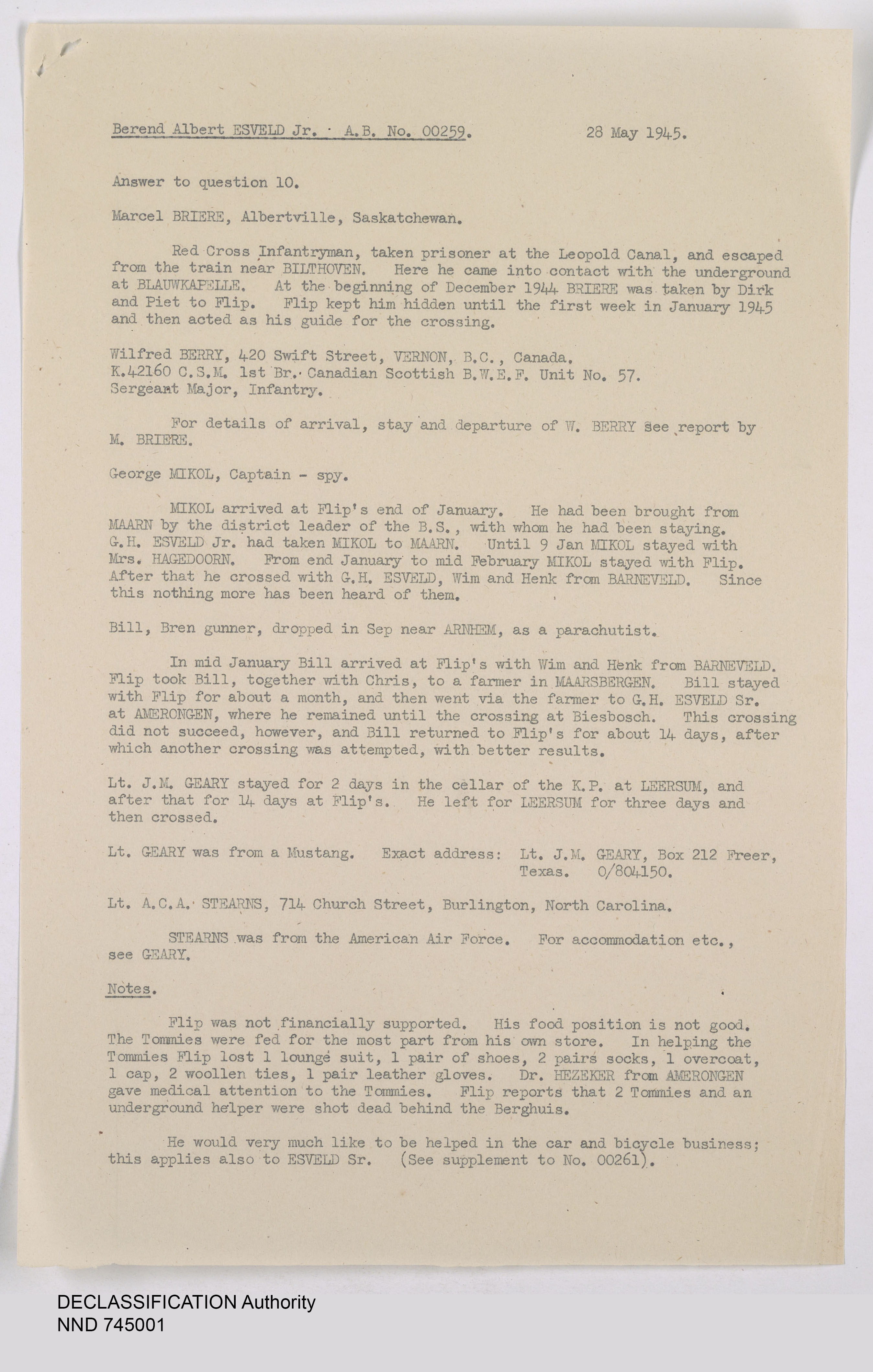
His file records what became of his brother Gerrit Herman, called Coen, "G.H. ESVELD Jr." in it: a "Captain" George Mikol, whom Gerrit had taken to Maarn, came to Flip at the end of January, and after the middle of February "crossed with G.H. ESVELD, Wim and Henk from BARNEVELD. Since this nothing more has been heard of them" (Flip's file, p. 7). His own list of 26 April 1946 has the captain as "George. English spy.", hidden 21 days, received from "Kreuner, Maarn. (gefusill.)" (shot), the column for whom he was passed on to blank (p. 13). ◐ His "Wim and Henk from BARNEVELD" are very probably the brothers Wim and Henk van der Mheen of Lunteren: the same list has Bill received from "v. d. Mheen. Lunteren" (p. 13). The Dodewaard police report of 29 June 1945 has the two brothers, who had been hiding with the garage owner Esveld, go into the Betuwe on 27 January "met gevieren met een Engelsch spion en een Amerikaan (Medicus)" (four of them, with an English spy and an American, a doctor), naming neither foreigner (the note); ⚠︎ whether Mikol was that spy is not settled (George Mikol). In 1946 he wrote that his brother had fallen on a journey to the English lines, on a special mission (p. 11). ⚠︎ His family's notice of 30 June 1945 and the Gemeente Dodewaard's inquiry "at the time" put Gerrit's last journey at the end of January, about 27 January, three weeks before Flip's "after the middle of February"; Flip's is first-hand and written in May 1945, theirs rests on a notice that does not say how the family knew and on papers not held (the letter of 17 August 1953; Coen's page). In 1953 the War Graves Foundation listed him, at Overstraat B 375a, with his father as Gerrit's only next of kin (scan 4). By February 1973 he was living at Dwingeloo, in Drenthe (scan 5). His wife and children are in the same file and are not named here. The statement of May 1945 also has him keeping "Bill", a Bren gunner dropped at Arnhem, for about a month before Bill went on to "G.H. ESVELD Sr. at AMERONGEN" (the other accounts of Bill are on Mrs Esveld's page), and two American airmen, Geary and Stearns; he lost a lounge suit, shoes, socks, an overcoat, a cap, ties and gloves to the men he helped, fed them mostly from his own store, and asked for help with the car and bicycle business, "this applies also to ESVELD Sr." (p. 7). The British helper index has "ESVELD, Berend Albert", A 12 Rijksstraatweg, Leersum, grade 5, the address on his own form (What the British recorded afterwards).
What the Americans did with his file, 1945 to 1947.
- ✓ On 30 October 1945 he signed for "one used service bicycle" from Lt H. L. van Loenen, and Captain Franklin D. Coslett had written to him on 2 October asking him to come to van Loenen's house at Zeist on 6 October, where something would be handed over that he would surely value ("waarop U zeer zeker prijs zult stellen") (receipt, p. 2; letter, p. 16).
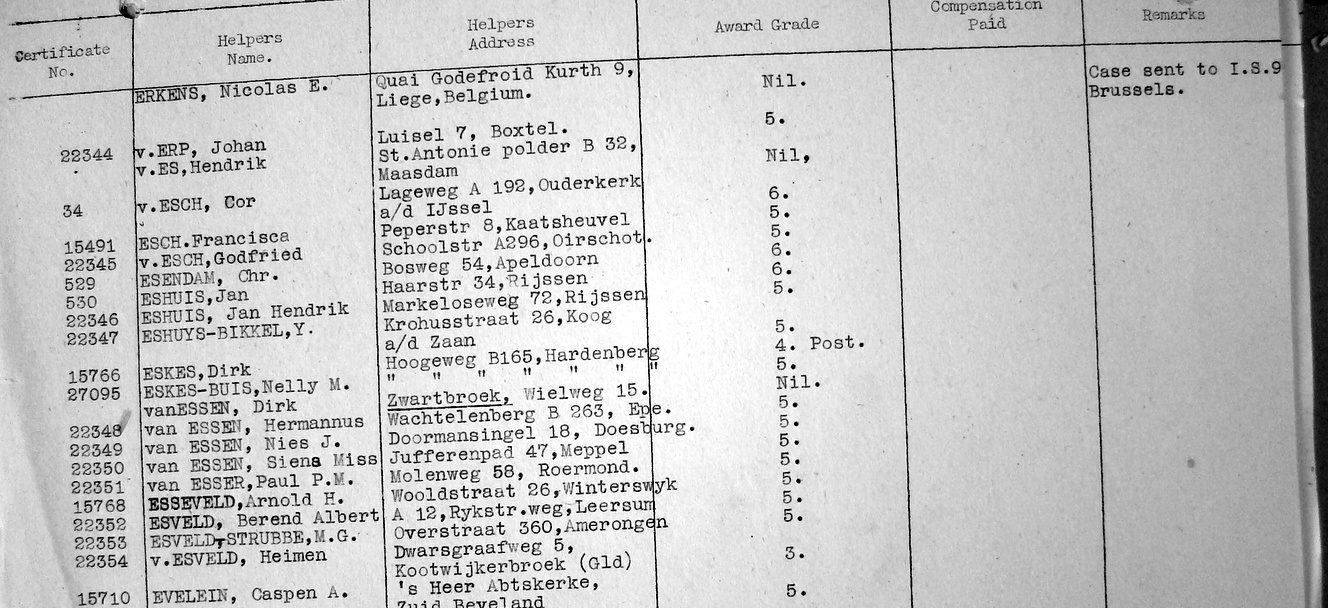
- ✓ The Americans graded him 5 ("Served as transport guide for allied personnel. Provided housing and feeding facilities for period ranging from 3 days to 1 month"), naming Briere, Berry, George Mikol, Lt J. M. Geary and Lt A. C. A. Stearns (p. 8). The British index has him as certificate 22352, grade 5, at A 12 Rijksstraatweg, Leersum (sheet E/5, read on the image).
- On 31 May 1946 the Americans' office wrote to C. Cornelissen at Amerongen, because Flip's second form named him and Cornelissen's own form did not name Flip, asking whether he knew him and what help he had given (pp. 17–18); a pencil note on a slip says "personal check, not mentioned by Cornelissen. Write him for confirmation" (p. 19). No answer is in the file.
- In the autumn of 1946 he wrote to the Americans about a problem with the Rijksverkeersinspectie (the road-traffic inspectorate) at Amerongen, which the file does not describe.
- An office slip of 25 October 1946 asks what can be done (p. 22).
- On 8 November 1946 (the typed date on one covering note is 1947) the office gave him a letter for the inspectorate saying he "is known to this office as a patriot who assisted Allied aviators", "is known to have transported at least five Allied fliers through the German lines" and had "furnished housing and feeding facilities for periods ranging from three days to one month"; a draft slip adds "Only thing to do is rec. to Rijksverkeers[?] inspectie [?] but won't help very much" (the letter, p. 20; the covering note, p. 3; the draft slip, p. 21).
- A transmittal of his "basic letter" to the military attaché is dated 22 November 1946 as read (p. 4).
Other helpers who name him. Piet van Veenendaal of Betonweg C 56, Amerongen, a member of the OD and the K.P., wrote that six men were "brought to the following addresses", the last "castle At Amerongen and Esveld"; ◐ that is this family, but the form gives no first name (his form, p. 3). Flip's own table has "Jonny", one day, received from "D.C. K.P. Veenendaal" and "transported to Biesbos, 1st etappe" (p. 10). Caspers's index has "Esveld-van Manen, E.P., Bep" among those who worked with Dagnelie, and "Berend Esveld of the Amerongen resistance group" cycling past a scene on p. 105, from snippets only (Caspers, pp. 105, 244).
Passed to him from Maartensdijk. Tjeerd Holwerda, who led the underground at Maartensdijk, lists "B. Esveld, Amerongen" among the people he knew who helped Allied personnel, and his table has Sergeant Major Berry hidden for one day, "23-12-44", received from "fam Rakers" and passed on to "B.Esveld, Amerongen" (Holwerda's file, p. 22, p. 23 and p. 30; his form is dated 13 April 1946). ◐ B. Esveld is Berend: the initial and Amerongen fit, and no first name is given. ⚠︎ It puts Berry with Flip from about 23 December, not from the beginning of December as Flip's own statement has it (below).
Collected from him at Leersum. T. J. Ploeg of C 122 Drift, Amerongen, born there on 12 February 1892 and a member of the N.B.S., wrote on 31 October 1945 that he supplied the men hidden in the "Put" and helped with the crossing of the Allied pilots: "He then went to Leersum to fetch them. They were: Christi, Carl, Jack and 2 Americans from Berent Esveld at Leersum" (Ploeg's form, p. 2, image-checked). The form gives no dates and no surnames, and the Americans graded Ploeg 5 on 5 February 1946 (p. 4). Ploeg's spelling is Berent; Hardy's is "Beent".
His second form, April 1946. On a fresh helper's questionnaire of 26 April 1946 he gives his rank as "Commander B.S. Amerongen" and his movement as K.P., and against the question on arrests and deaths writes "8 men were arresred while being transported. One Canadian was wounded in his arm." (his file, p. 9, image-checked). ◐ That fits the party fired on on the night of 2/3 January, in which Sergeant Major Berry was hit in the elbow (The crossing and recapture), but he names neither the night nor the men. Asked which people he knew who helped, he lists "C. Cornelisse. G.H. Esveld, killed while being on a special mission for allied personnel. J. Doornebos, G.H. Esveld, Sr., L. Cornelisse": Chris Cornelisse, his brother Gerrit (Coen), Joop Doornebosch, his father and Leendert Cornelisse, the last identification ◐ from the surname and Amerongen.
Sheltered by him, then passed to Chris Cornelisse. On the reverse of that form, below the entry for the transport of twelve, he writes:
transported to shelter; to C. Cornelisse, Amerongen: 2 Canadians, Christie and Carl, and Jack (English detective). These 2 I sheltered and nursed in a shelter in the woods, because I was head K.P., then sheltered with C. Cornelisse, Amerongen.
— B. A. Esveld · helper's questionnaire, reverse · 26 April 1946 · p. 10, image-checked
✓ It is Flip's own word that he was head of the K.P. at Amerongen. ◐ The names are those Ploeg has collected from Berend at Leersum (above), and Chris's page has Christie reaching the Rijnstraat in March: Valentine Brock Christie, RCAF, who came south from Hoogland with Stoner, Craven and Stearns (Mr and Mrs Cornelissen), so ◐ "Jack" may be Craven, though no source says so; "These 2" is not clear on whether it means the Canadians only, or Jack too.
An American's own dates. 2/Lt John M. Geary's I.S.9 interview of 15 March 1945 ends with a list of his hosts, and the last is "Mr. ESVELD nr LEERSUM", 3 March to 10 March 1945, seven days (Geary's report, appendix C, p. 23, image-checked). ◐ This is Flip: the surname and Leersum fit, and Flip's own statement has Geary with him (below). ⚠︎ The days do not agree with Flip's.
February 1945, from a helper's statement. Wiebe H. Hoogeveen, who worked with the "Leopold" S-phone team and was hidden at Amerongen from mid January 1945 by J. van Dooleweerd, says that "Bill Gordon, a Scott from London, R.A.F. who baled out over Arnhem arrived at van Dooleweerd's from Flip beginning February", stayed about seven days, and that Wiebe "took Bill then to Leersum to Flip for the crossing, which was successful"; at the end of February he fetched six officers, two Canadians, two Americans, an Australian and a Scot, from a chicken house at Leersum to the cellar at Amerongen (Hoogeveen's statement, p. 5, image-checked, 12 June 1945). ◐ Flip is Berend: the places fit and the statement is numbered A.B. 00277, in the same series as Flip's 00259. Whether Hoogeveen's Bill is the Bren gunner "Bill" of Flip's own statement is open: Hoogeveen has him a Scot and RAF, where Mrs Esveld's Bill is from Scotland, Flip's own list has London, and Marrigje Dogterom's list has a "W. Gordon, R.A.F.". Pte William Gordon of 156 Para is the man our pages match to Mrs Esveld's Bill, not exactly, and whether he is Hoogeveen's is left open there.
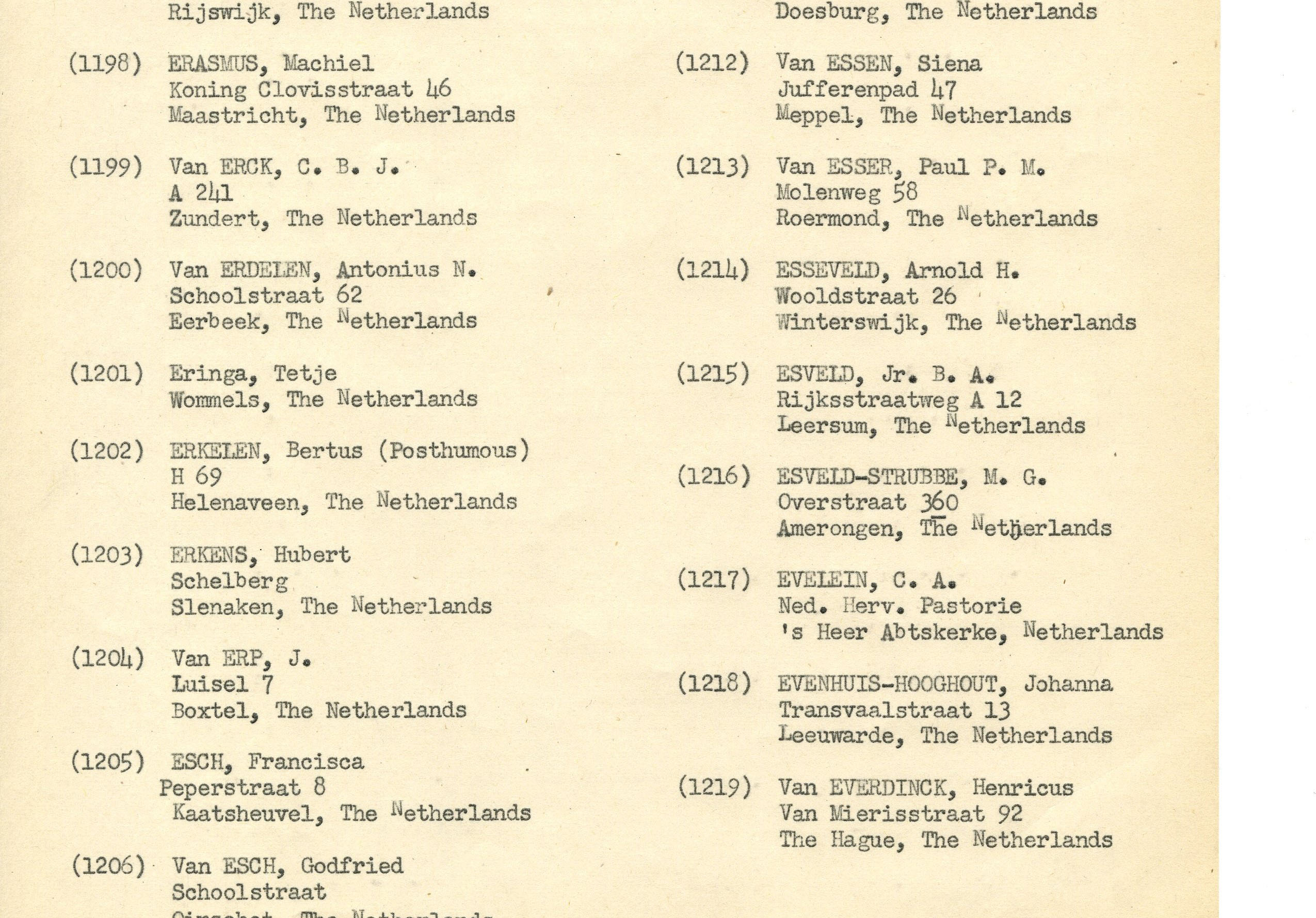
✓ The Americans' list of Grade 5 certificates has "(1215) ESVELD, Jr. B. A., Rijksstraatweg A 12, Leersum", and "(1216) ESVELD-STRUBBE, M. G., Overstraat 360, Amerongen", his mother (the list, p. 48, image-checked).
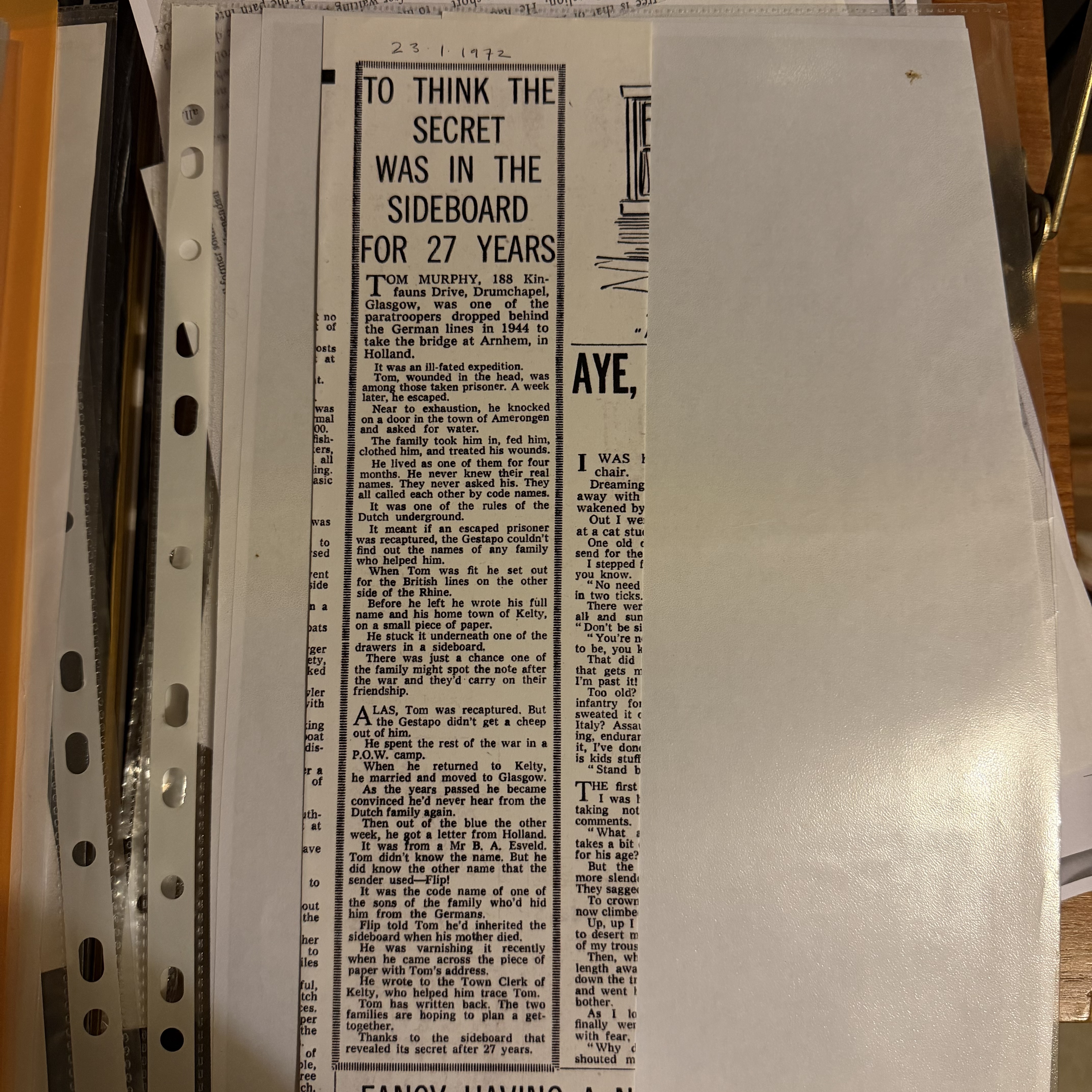
The note in the sideboard, 1972. ◐ The Sunday Post of 23 January 1972 (so Liz Moore, Murphy's niece, who kept the cutting; the masthead is not on it) tells how "the other week" Murphy had had a letter from Holland, from "a Mr B. A. Esveld". Murphy did not know the name, "But he did know the other name that the sender used—Flip!", the code name "of one of the sons of the family who'd hid him from the Germans". By the paper, Murphy had written his full name and home town on a small piece of paper before he left and stuck it underneath one of the drawers of a sideboard; ⚠︎ that is the paper's account alone, and ◐ the families who hid men often kept their names and addresses for after the war (the Van Nispens wrote Murphy's down in 1945, their list, p. 3). "Flip told Tom he'd inherited the sideboard when his mother died" (his mother died in June 1966): he found the paper while varnishing it, and wrote to the Town Clerk of Kelty, who helped him trace Murphy. "The two families are hoping to plan a get-together"; whether they met is not known (the cutting; After the war). The Daily Express of 1974 has Jopie Veerman find Murphy the same way, by a note under a sideboard and the Town Clerk, and calls Murphy himself "Flip" (Jopie); nothing found says she did not. ◐ In May 1974 "Mr B. A. Esveld, left, of Owingsloo [Dwingeloo, where he lived by 1973], Holland" was photographed taking tea with the station commander at RAF Odiham, one of a party of 40 Dutch resistance workers hosted by the RAF Escaping Society (Reading Evening Post, 24 May 1974, p. 15, the British Newspaper Archive's search text only: the snippets). Nine weeks later Jopie met Murphy at Loch Lomond; nothing found says whether Flip saw him on that visit.
Where the sources disagree
Link to the section Where the sources disagree- Who took Murphy and Hardy to the crossing. Flip, by his own list: "Crossed them personally to English lines near Dodewaard" (p. 10). Koen and Keek, by Hardy, written eleven days after the crossing (Hardy); Louis and Kik, by their mother (her statement, p. 5); Kik himself, Freerk Stob, by his own statement (p. 4); Coen with Dirk Maljers and two more guides, by Caspers (p. 175). ⚠︎ Not settled. Only three men got through to the English lines that night, Schjelderup, Gri and Hardy, so "crossed them personally to English lines" is not literally true of Murphy whoever guided him.
- When Gerrit (Coen) died. ⚠︎ Not settled between the end of January and "after the middle of February"; the full comparison is on Coen's page.
- Flip's file has the party crossing "after the middle of February". His statement is first-hand and was written in May 1945, before Coen's body was found.
- The family's own notice of 30 June 1945, signed by their father, has him fallen at Dodewaard at the end of January (the notice). Dodewaard's inquiry has the party leaving about 27 January, Caspers 29 January, the Foundation's grave form "± 30 Jan."
- The end-of-January date rests on a family notice, an inquiry whose papers are not held, entries derived from Dodewaard and a memoir fifty years on. The exact day is open too.
- When Berry and Briere came to him. ⚠︎ Not settled; Berry's own list has 24 December.
- Berry's own MI9 report lists his helpers, the fifth being "FLIP", AMERONGEN, "Member of the Underground. Owner of garage.", from 24 December 1944 to 2 January 1945, after the policeman Rakers at Groenekan from 1 to 24 December (his Appendix A, photographed at Kew by the late John Howes, who passed it to Lisan Koppenol, and she sent it on).
- Briere's own report has "We stayed in AMERONGEM from 8 Dec 44 until 1 Jan 45", in a house with Berry (p. 2), which is nearer Flip's beginning of December; it was taken down in June 1945.
- Flip's statement has Marcel Briere taken to him by Dirk and Piet "at the beginning of December 1944" and kept until the first week of January, with Berry's stay as Briere's (p. 7); it was written in May 1945.
- Holwerda has Berry at Maartensdijk on 23 December and then passed to B. Esveld (p. 23).
- Hellendoorn has all the Canadians handed to "Dirk" at Amerongen on the Friday and Saturday before Christmas (his file, p. 5; Marcel Briere), and Hardy met Berry at Amerongen on 23 December (Wilfred Berry).
- Whether he had lived in Canada. ◐ Very probably, 1927 to about 1932.
- Briere says he and Berry stayed at Amerongen "in a house with a man who had been in CANADA for five years, employed as a mechanic in ALBERTA" (p. 2); Berry's list has Flip, the garage owner, for those days (Appendix A).
- Noble's guide to the ferry on 2 January "stayed on the AMERONGEN – LEERSUM road and had spent some years in Canada" (Noble), and Flip's own form has him on the Rijksstraatweg at Leersum (p. 5).
- A Berend Esveld, 17, landed at Quebec from the Athenia on 4 September 1927, and the 1931 census of Canada has Albert Esveld, 21, single, born in Holland, arrived 1927, a lodger working as a timberman in the coal mine at the Nordegg Mining Camp, Alberta, with the mine idle for 26 weeks of the year (the census page and the passenger list, read on the image).
- ◐ The names (he was Berend Albert) and the ages fit Flip, born in February 1910; nothing found yet ties the Nordegg lodger to Amerongen, and the census has him a timberman, Briere a mechanic.
- How long Geary stayed. Flip has Geary two days in the cellar of the K.P. at Leersum, fourteen days at his house and three more at Leersum before the crossing (p. 7); Geary's own list has "Mr. ESVELD nr LEERSUM", 3 to 10 March 1945, seven days, and his interview is dated 15 March (appendix C, p. 23). ◐ Not settled: Geary may have counted only the week at the house.