Joop Piller
Amsterdam 12 Mar 1914 – after Feb 1991
Joseph Piller, born at Amsterdam on 12 March 1914 (his file with the Americans, p. 11), known in the resistance as Joop van Amstel.
About: A Jewish bookkeeper from Amsterdam, in hiding on the Veluwe, who as "Joop van Amstel" ran the Frans Hals pilot line with the MI9 agent Dick Kragt from June 1943, opposed Pegasus II, and after the war, as a captain, questioned the forger Han van Meegeren (his statement; Het Parool, 1995).
Unit or role: Co-leader with Kragt of the "Frans Hals organisation", by his own statement (p. 18); "Captain" on his questionnaire of July 1945 (p. 13), and after his crossing to the south in March 1945 "an accredited officer of the Dutch Government", by the Americans' summary (p. 12).
Where: Ceintuurbaan 101 I, Amsterdam, on the Jewish Council's card (Arolsen); in hiding at Emst, then from late 1943 in the Barneveld area (De Jong, deel 7, pp. 946–947); Essenerweg 70, Barneveld, in July 1945 (p. 13); Hilversumscheweg 6, Laren, in 1946 (p. 8); Heemstede, a manufacturer (fabrikant), in May 1949 (the hearing, p. 1320); Mallorca by 1986 (De Volkskrant, 1986).
Evidence: ✓ his helper file with the Americans, US National Archives 286680491 (his statement, the summary, the recommendation); ✓ Kragt's own report of 22 July 1945 (pp. 2–4); ✓ L. de Jong, Het Koninkrijk der Nederlanden, deel 7 (pp. 945–947, checked on the images); ✓ his hearing before the parliamentary commission, 25 May 1949 (the transcript); ✓ the Amsterdam marriage record of 1939 (the record); ✓ the American General Orders 285 of 1946 (p. 31); ◐ The Times, 21 August 1953 (the item); ✓ Graeme Warrack, Travel by Dark (1963), pp. 183–207, 255 (the text; page images in the folder); ◐ Jonathan Lopez, The Man Who Made Vermeers (2008), pp. 14–16, 259 (the pages); ✓ Gerard Aalders, Berooid (2001), pp. 233–235 (the pages).
Amsterdam
Link to the section Amsterdam✓ Joseph Piller, 25, bookkeeper (boekhouder), born at Amsterdam, son of Coenraad Piller, a merchant (koopman), and Rebecca Hes, married at Amsterdam on 1 June 1939 Elisabeth Clasina Veldman, 27, born at Amsterdam, daughter of Jan Veldman, a fitter (monteur), and Elisabeth Barends (the marriage record, North Holland Archives; index only). The Amsterdam militia register has him born on 12 March 1914 (index only; the register's page could not be read at the size the archive serves it) (the record). The Jewish Council's index card in the Arolsen Archives, undated, has him "PILLER Joseph", born Amsterdam 12.3.14, living at Ceintuurbaan 101 I, "Ned." (Dutch) and "geen" (none, on a line the card does not label), "boekh." (bookkeeper), "gehuwd" (married) (the card; read on the image).
◐ His wife is the "Lies Veldman" of the photograph below and the "Lies" of the Allied men's "Joop en Lies": the questionnaire has "Joop en Lies" and, as next of kin, Elizabeth van Amstel (his questionnaire, July 1945, p. 13), the marriage record has Elisabeth Clasina Veldman (above), and the notice of 1991 has "ELISABETH PILLER-VELDMAN (Lies van Amstel)" (below). The questionnaire gives her age as 33 and the notice has her dead at 79; both fit a woman of 27 in June 1939.
✓ De Jong's official history, deel 7, introduces him as one of the Jews whom the distribution official J. J. van den Boogert of Emst helped: "Een van die Joden, Joseph ('Joop') Piller, was uit Amsterdam afkomstig" (one of those Jews, Joseph ('Joop') Piller, came from Amsterdam). He was born in 1914 and in 1939 married a non-Jewish wife; before the war he had more than once housed German political refugees, among them some communists, one of whom got him an altered identity card in 1941, when the cards came in, so that he could pass as a non-Jew if he chose; at the start of 1942, when there were arrests in Amsterdam among those who had sheltered German communists, he was taken and, after a few days, let go by the SD man handling his case, "in een toegefelijke bui" (in an indulgent mood) (De Jong, deel 7, pp. 945–946, checked on the images; NIOD edition, CC BY 3.0 NL; the text layer misreads the year as '43, the print has "Begin '42").
Emst, 1942 to 1943
Link to the section Emst, 1942 to 1943Together with his wife and little daughter Piller then went into hiding in a cottage at a holiday camp at Emst, run by a friend. He did not sit idle there: he fetched Jewish children from Amsterdam and had them hidden in the holiday camp or elsewhere.
Dutch originalSamen met zijn vrouw en zijn dochtertje dook Piller toen onder in een huisje dat te Emst op een vakantiekamp stond dat door een vriend gedreven werd. Hij bleef er niet werkeloos zitten: hij haalde Joodse kinderen uit Amsterdam op die hij in het vakantiekamp of elders liet onderduiken.
— L. de Jong · Het Koninkrijk der Nederlanden in de Tweede Wereldoorlog, deel 7, p. 946 · NIOD edition, CC BY 3.0 NL · the pages
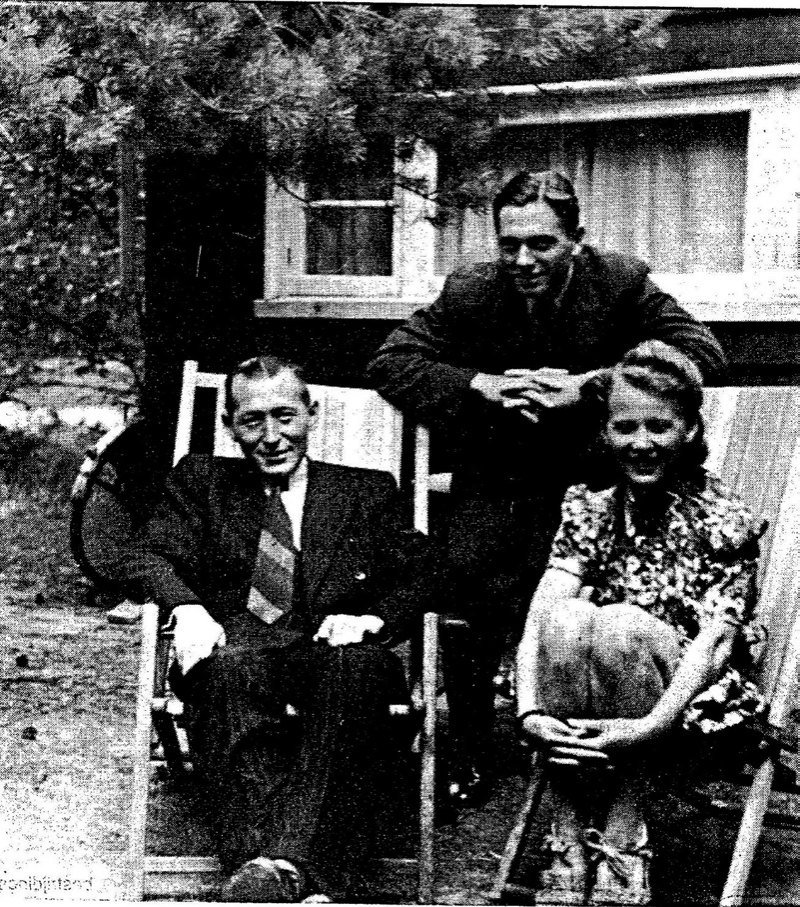
For those children, and for his own family, the distribution papers came to him "achterom" (by the back way) from van den Boogert; because van den Boogert's own work mattered to so many people in hiding, it seemed unwise that he himself should help Kragt, "het was Piller die die taak ter hand nam" (it was Piller who took on that task), and "Kragt trok bij hem in" (Kragt moved in with him). Through van den Boogert Piller was already in touch with the LO leadership, in particular Hilbert van Dijk (De Jong, p. 946, checked on the image).
Kragt's arrival, June 1943. ✓ Piller's own statement for the Americans, Amsterdam, 3 December 1945, signed "Joop v. Amstel (J. Piller)": Kragt ("Frans Hals" of I.S.9) was dropped near Vaassen in June 1943, three kilometres from his intended place, and lost his packs in the trees; after hiding the night of the drop and the next day and night, he reported at 8 in the morning to his contact address, J. J. van den Boogaard, Misselscheveld 118, Epe, about 10 km away, and because of raids on students expected in the area that day was brought straight to "mijn huis, waar wij hem in onze schuilplaats onderbrachten" (my house, where we put him in our hiding place), the more so as his Dutch had an accent and his identity card did not pass every test (p. 17). The Americans' summary of 8 January 1946 has the contact at Epe on 25 June and Kragt "immediately brought to the house of the subject"; it says Kragt "ascribes to the subject greater cleverness than his own, stating that his efforts would have been negligible without the work of Joop van Amstel" (p. 11; the summary types the year of that date as 1945).
- ✓ After some weeks of searching they made contact with England through intermediaries and a set of the B.I. (the Dutch intelligence bureau), and used that and other sets "tot Januari 1945, waarna wij eigen zenders kregen" (until January 1945, when we got our own) (p. 17).
- ✓ The work was split: "Wat de organisatie betreft, hadden Frans Hals en ik gezamenlijk de leiding" (as for the organisation, Frans Hals and I shared the leadership); Kragt tested the evaders' reliability and Piller looked after the Dutch contacts; the transports were done by the two of them at first and later with their helpers (p. 18).
- ✓ Kragt's side. His report of 22 July 1945 (pp. 2–3; p. 3):
- His first host at the Vossebes sent him to hide in an underground dug-out in the woods, where he met "Joop": "whom I met in the dug-out, and whom I, after several meetings, decided to employ as my right-hand men in the organisation I was to build up", with "Koos" and "Leo".
- "During these five months with the exception of six weeks I was the guest of Joop and Lies, who looked after me most lovingly." The six weeks away followed the finding of a dead man's body near the dug-out they were improving (p. 3).
The raid, autumn 1943. The house at Emst was lost after van den Boogert's arrest. The sources give three accounts of what he did after it:
- ✓ Piller, 1945: "Na zijn arrestatie bekende hij de S.D., dat ik een Engelsche agent in huis had en dat wij ons bezig hielden met spionnage en sabotage van de Duitschers" (after his arrest he confessed to the SD that I had an English agent in the house and that we were engaged in espionage and sabotage against the Germans); the SD raided them, they got away with minutes to spare, and practically everything they owned was taken off in three large vans and never found again (p. 18). He dates the arrest November 1943.
- ✓ Kragt, 1945, in the block below: "Koos" was taken after a boy arrested by the Germans said Koos had made out his identity card; a courier sent by "Leo" warned them less than half an hour before the SD came; and Koos, at first, told the SD what he knew, then "pulled himself together again, and showed he was a brave man". ◐ Koos is van den Boogert: Kragt's report has them both guests "at van den Boogert's house" before the raid, and In the Shadows names "Jacobus van den Boogert, known as Koos" (the passages).
- ✓ The Americans, May 1946: his file, care of "Capt. Piller" at Laren, calls him the man "given as contact address for Dick (Lt. Kragt) when he parachuted into Holland", "closely connected with van Amstel in evasion activities", and puts him down for "GRADE V Posthumous" (his file, p. 4). De Jong has the arrest in October 1943, and "Kragt en Piller hadden toen Emst overhaast moeten verlaten" (Kragt and Piller then had to leave Emst in haste) for new addresses at Barneveld (pp. 946–947).
This was due to a Jew boy after his arrest proclaiming that Koos had filled in his "persoonsbewijs". On this information Koos was arrested. "Leo", on hearing this, within five minutes of it actually happening, immediately dispatched a courier to warn us of this, only just in time, as less than half an hour later the S.D. were in our house, but found the birds flown. It appears that Koos was at first so nervous, that he told them everything he knew of any local activities, after which fact he pulled himself together again, and showed he was a brave man. But the damage had been done and he was shot some months later.
— Frans Hals (Dick Kragt) · report on his activities, 22 July 1945, p. 3 · his file with the Americans, p. 33
Kragt's report adds that the SD took their personal belongings and a large stock of food, knocked a hole in the wall looking for the transmitter, and that "This happened the day of Theo's arrival in Holland"; after several weeks they found a house in the Barneveld area and kept the address "clean" for almost a year (p. 3).
The line, 1943 to 1944
Link to the section The line, 1943 to 1944- ✓ The airmen before Arnhem. By his own count they cared for "ongeveer 50 tot 60 piloten" (about 50 to 60 airmen) until September 1944, sent evaders down lines they could not check, and found that most of the escape lines proposed to them ran into Gestapo traps (p. 17). He names the Kleikamp case among their espionage, drawings sent to England (same page).
- ✓ The November 1943 drop. A man was dropped for them in November 1943 with transmitters and cameras; the drop failed and they lost all the equipment, all but the money sent, f. 50,000 (p. 17). Kragt's report calls him "Theo", "minus equipment, bearing fl.50.000.-" (p. 2).
- ◐ John Justice, October 1943.
- Gerrit Jan van den Top of Stroe passed five men on to "Joop and Dick": John Justice (October 1943) and, in 1944, Bill Lalley (from 30 April), Conny O'Bar, Eugene Gezinski and Bob Bailey (June) (his table, p. 3, checked on the image; Bill Lalley; Robert Bailey).
- Noordman, after printing Justice's own account of being questioned at night by a Dutchman and a British agent, names the two as "Joop Piller en de Britse agent Dick Kragt" (Noordman, p. 92); Justice does not name them.
- ⚠︎ In 1944 "Joop" could also be Dr Kruimel, whom Boeree calls "Oome Joop (Dr. Kruimel)" (Boeree, p. 161; Johannes Kruimel), and Mrs Eskes-Buis has a "Joop" guiding the same airmen out of Stroe (her file, p. 7); nothing on van den Top's table separates them.
- ✓ A pilot's view. Lt Carroll Stearns's escape report says that in 1944 he was "in the hands of the FRANS HALS organization", whose "chief was known to him as DICK, and his assistant was JOEP" (Appendix C, p. 6).
- ✓ Food from over the IJssel. Kragt's report, after the railway strike:
Gradually the food situation and clothing position became more and more difficult. Here Joop showed great genius. He managed to set up our own food collecting and distribution centre, collecting food by lorry, through the German posts, from the other side of the IJssel. This relieved us of a great worry, once it was functioning properly, as the only way, to "place" evaders in billets was by offering food.
— Frans Hals (Dick Kragt) · report on his activities, 22 July 1945, p. 4 · his file with the Americans, p. 34
Piller's own statement says that in return for the use of the houses of "Piet van Arnhem", leader of the underground groups on the Veluwe, they fed about 300 people of the resistance there (pp. 18–19). Wouter Albert Hulstyn wrote for the Americans that in September 1944 he "came in contact with H. de Jong (LOE) [and, struck through] Rotterdam and Lt. van Amstel (JOOP)", who asked him to send "every fortnight 4 cows and food" to feed pilots; he lost 1,500 guilders when he left in April 1945, had 750 back from the L.O., and "Lt. van Amstel told me long ago that I didn't have to worry about that money" (his report, p. 3).
In the histories
Link to the section In the histories- ✓ De Jong, deel 10b: Kragt "trok een Joodse onderduiker, Joseph Piller, als zijn voornaamste helper aan" (took on a Jewish hider, Joseph Piller, as his chief helper) (p. 544, checked on the image); deel 9: Kragt, "bijgestaan door de Joodse onderduiker Joseph Piller" (helped by the Jewish hider Joseph Piller), stayed active until the liberation (pp. 959–960, text layer). Deel 7 has Piller find fifty to sixty addresses near Kootwijkerbroek through a reliable postman and a policeman; it is Kragt who then helped the Vrij group at Maastricht get going (p. 947, checked on the image).
- ✓ Stewart Bentley, "The Dutch Resistance and the OSS", Studies in Intelligence 41, no. 5 (1998), p. 107: Kragt "managed to link up with a Dutch Jew named Joop Piller, living in the town of Emst, and they built a network designed to hide, protect, and eventually smuggle downed airmen out of Holland" (the article; text; read from the page image).
- ◐ In the Shadows, the Intelligence Corps's history (Biteback, 2022), from the Archive's full-text index: Kragt was taken to an underground dugout "where he linked up with Jacobus van den Boogert, known as Koos, and Joop Piller, a Jewish resistance worker in Emst" (the passages, printed pp. 81–82, by the OCR's running heads).
- ◐ Leo Heaps, The Grey Goose of Arnhem (1976), read from the text layer of the Archive's lending copy (the text), on p. 24: Kragt survived by "joining forces in the town of Emst with Joop Piller, a Dutch Jew", and "after Piller corrected some glaring mispronunciations and changed a faulty identification card that showed the Dutch lions facing the wrong way, Kragt could pass easily as a Dutchman".
- ◐ The same book, p. 192, tells a story on Piller's word; Heaps names no one, and whether he means "Theo" of November 1943 is not said:
The man whom IS9 sent to help Kragt arrived drunk according to Joop Piller, and proved a disastrous security risk for the Resistance. Eventually he was sent back to England.
— Leo Heaps · The Grey Goose of Arnhem (1976), p. 192 · the text
- ◐ Het Parool, 1973. A diarist, in the issue of 17 November 1973 (his entry dated "Donderdag 15 nov."; Het Parool; checked against the image; the piece carries no byline):
- met "Joop van Amstel (later wist ik, dat hij de confectionair Piller was)" (later I knew he was the clothing manufacturer Piller), and met Piller "later nog enige malen" (several times later); ◐ a confectionair fits the fabrikant of the 1949 hearing (p. 1320);
- ✗ called him "een jood, die zich, als ik mij niet vergis, driemaal boven bezet Nederland heeft laten afwerpen" (a Jew who, if I am not mistaken, had himself dropped over occupied Holland three times).
- No other source has Piller dropped at all: Kragt was dropped once, on 23 June 1943, and De Jong and the Americans' file have Piller in hiding in the Netherlands throughout (above).
- ◐ The same entry tells later of a boy in the attic who "al voor de derde maal naar beneden was gekomen, en alzo al driemaal Engeland had bereikt" (had already come down for the third time, and so had reached England three times); the diarist may have run the two men together, which the entry does not settle.
-
◐ "Jan Roskam te Den Haag", probably the Jan Roskam on Piller's own list of his helpers (Piller's file, p. 18; Johannes Roskam), in De zwarte herfst (1984): "Joop Piller, evenals ik aangesloten bij de organisatie 'Frans Hals', en Dick Kragt stonden steeds in verbinding met Engeland. Hun marconist was Dick Last, die we kenden als Zwarte Kees" (Joop Piller, of the Frans Hals organisation like me, and Dick Kragt were always in touch with England; their wireless operator was Dick Last, whom we knew as Black Kees) (Dekkers and Vroemen, p. 273).
-
◐ Jonathan Lopez's The Man Who Made Vermeers (2008), a history of the Van Meegeren case, gives his war in two pages, from the text layer of the Archive's lending copy (pp. 14–16, 259):
- Soon after May 1940 he took refuge in Emst with his wife and infant daughter, "A skinny twenty-six year old, a garment worker by trade", joined the local resistance and found hiding places for Jewish children from the cities (p. 15, read on the page).
- "one day in 1942, when a British secret agent named Dick Kragt fell from the sky", the two of them hid and moved Allied airmen "time and again, over the next two and half years" (p. 16).
- Lopez's note for the war years cites De Jong's deel 7, the commission's report and hearings, B. de Graaff's Schakels naar de vrijheid (1995), p. 73, and Warrack, p. 199 (below); none of them is cited for a particular date (p. 259). His years are against the other sources (below).
With Murphy
Link to the section With MurphyNo source has Murphy name Piller, or Piller Murphy. Both were part of Pegasus II on 17 and 18 November 1944, Piller at the assembly point and Murphy in a party that took the wrong fork and never reached the main body (Hardy's report); and Murphy passed through the hosts and men of the organisation.
Pegasus II, 17 and 18 November 1944
Link to the section Pegasus II, 17 and 18 November 1944✓ De Jong: "Kragt en Piller hielden 'Pegasus II' voor onuitvoerbaar maar Neave legde hun negatief advies terzijde" (Kragt and Piller thought Pegasus II unworkable, but Neave set their negative advice aside) (deel 10b, p. 551, checked on the image). His own statement of December 1945: after September 1944 they had some hundreds of evaders in their care, and "Ruim honderd menschen hebben wij toen laten crossen via Bill van Ede, die deze menschen bij Ede overnam in November 1944" (we then had over a hundred people cross by way of Bill of Ede, who took them over near Ede in November 1944) (p. 17). Of that crossing:
We were very much against this crossing, because it did not seem right to us to have so great a number of men, in the difficult conditions of the time and after a month of sitting still, which had certainly worsened the evaders' physical state, make so dangerous and long a march. But it was an order and we thought we had to obey it. On this crossing 6 men got over, an estimated 37 were taken prisoner, and the rest we got back again in various ways, among others by searching the surroundings at night with our people, so that many were saved from captivity.
Dutch originalTegen deze crossing hebben wij ons zeer verzet, omdat het ons niet juist leek zoo'n groot aantal menschen onder de toen geldende moeilijke omstandigheden en na een maand van stilzitten, waardoor de lichamelijke gesteldheid van de evaders zeker achteruitgegaan was, een dergelijke gevaarlijke en lange tocht te laten ondernemen. Het was echter een bevel en wij meenden hieraan te moeten gehoorzamen. Bij deze crossing zijn 6 menschen overgekomen, naar schatting 37 krijgsgevangen gemaakt en de rest hebben wij op verschillende manieren weer terug gekregen, door o.a. 's nachts met onze menschen de omgeving af te speuren, waardoor vele voor krijgsgevangenschap gered zijn.
— US National Archives · RG 498, helper file of Joseph Piller · his statement, Amsterdam, 3 December 1945 · the archive's copy
The assembly point. ✓ Boeree's chronicle of Ede, under Piller's alias, has the gathering of the paratroopers done "onder leiding van Frans Hals en Joop van Amstel" (under the leadership of Frans Hals and Joop van Amstel), with the courier Puck, all of them then lodging "bij Broekhuizen te Kootwijkerbroek" (Boeree, p. 199; checked on the image). Their trusted men were Jhr. Dirk van Eijsinga for the North Veluwe, Lou (Huib de Jong) for Ermelo, Bruinekreeft (Boeree's "Brunekreeft") for Kootwijkerbroek, Schol for Hoenderloo, and Van Beek and Van Dijk for Harskamp and Otterlo (p. 199; Dirk van Eysinga, Marten van Beek, Willem van Dijk). On the evening of 17 November the concentration point was the forester van den Brink's house at the foot of the Herteberg on the Otterlo–Ede road, where "Frans Hals zou daar komen met de mannen uit Essen en Kootwijkerbroek", Van Dijk and Van Beek with the men from Harskamp, and Huisman with a cattle lorry of 40 men from Elburg (p. 200). Then:
- ✓ "Bij de woning van van den Brink zaten Joop van Amstel en Frans Hals met 15 man, daar waren ook Martien en Bart van der Hoeden" (at van den Brink's house sat Joop van Amstel and Frans Hals with 15 men; Martien and Bart van der Hoeden were there too) (Boeree, p. 200; "Martien" is Abraham du Bois; H. van de Brink).
- ✓ At about half past ten they heard machine-guns and saw flares in the direction the first column had taken; "Frans Hals ging naar huis, hij liet aan Martien over, zich uit de moeilijkheden te redden" (Frans Hals went home and left it to Martien to get himself out of the difficulties), and only then did 24 of the Elburg 40 arrive (pp. 200–201).
- Boeree is not consistent about Frans Hals: p. 201 ends the same passage with "Frans Hals was met de Elburgers meegekomen, maar nu scheidden allen, Frans Hals ging naar Kootwijkerbroek" (Frans Hals had come with the Elburgers, but now everyone parted; Frans Hals went to Kootwijkerbroek).
- Boeree does not say where Piller went.
- ◐ Kragt's report tells the same second night with a "we": "The rendez-vous was at 1930 hrs. local. Nothing appeared. We waited and waited", until a messenger said the guides of a party of six had lost four of their men (his report, p. 4). The report does not say who "we" were; Boeree's page puts Piller with him.
✓ Murphy's party. Hardy's MI9 report has Murphy, Hardy, Banwell and Branford (Hardy spells him "Brentford") take "the wrong fork" in the rain on the night of 17 November and lose the rest of their party. Fetched on the evening of the 18th, they were led to a party of "about 20 in all, I think", and only after waiting there does Hardy write "I gathered that we had by this time missed the main body through the failure of the transport" (Hardy's report). ◐ They are very probably the four men Kragt's "party of six" lost (the case is on Dick Kragt's page); Piller told the commission that he was at the crossing himself and that he and Kragt came back (questions 54967 to 54968), but no source names him among the men who looked for them.
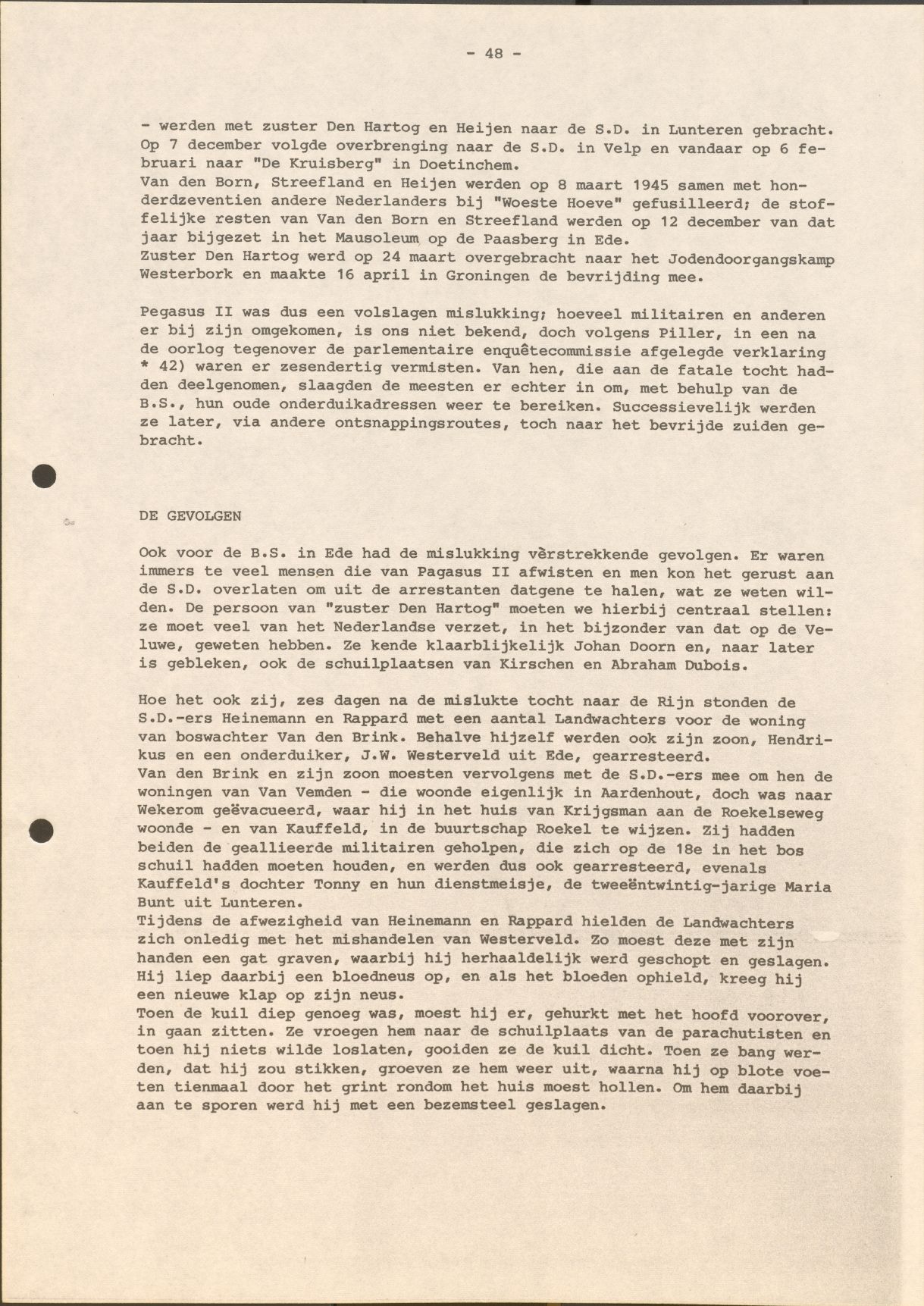
How many got over. Six over and an estimated 37 taken, in his statement (above); to the commission in 1949, "we lost 36 people, three got through" (the hearing, questions 54964 to 54968); De Jong: seven men reached the Betuwe, and "Volgens Piller waren er, afgezien van diegenen die de Rijn over waren gekomen, zes-en-dertig vermisten" (according to Piller there were, besides those who had crossed the Rhine, thirty-six missing) (deel 10b, p. 553); Ede's own history of the war gives the same "zesendertig vermisten" from his statement to the inquiry (Ede manuscript, p. 48; text). See Where the sources disagree.
Murphy's companions on his line
Link to the section Murphy's companions on his line- ✓ Heimen van Esveld of Kootwijkerbroek had all his men from "Joop and Dick", among them three of the men who had been with Murphy: "B.J.F. Haller" (84 days), "James Branford" (7) and "S. Walsh" (7) (his list, p. 8; Heimen van Esveld; Bernard Haller; James Branford; Sam Walsh). ◐ "Joop and Dick" are very probably Piller and Kragt: the file gives no surnames.
- ✓ The medics of De Ruif. Longland, Allen and Allenby are on Jeane van Galen's list of the men she helped at De Ruif, and the same three head Piller's own list of men he helped; neither list gives dates.
- His own list of the men he helped begins with Maj. C. J. Longland, Lt P. S. Allenby and Sgt A. E. Allen, "dropped Arnhem". The next two lines are Sgt A. Simpson, a glider pilot, and a "Maj. Mc. GUIRE" of Bath, with "3 others" (his table, p. 14, a faint carbon; Cedric Longland; Peter Allenby; Albert Allen; Hugh Maguire).
- Jeane van Galen's list of the Allied men she helped (her address, known to the Allies, is "de Ruif", Garderen) has Longland, Allen, Allenby, Kessel, Banwell, Walsh and "T.Murphy 2756457" (her file, p. 3).
- ◐ Kessel at Kootwijkerbroek.
- Lipmann Kessel, as Noordman prints his account in Dutch, was moved after two days at Garderen to a house at Kootwijkerbroek where "the British agent Frans Hals had his headquarters", into a hide under a sheepfold for three weeks: "We werden verzorgd door Frans' naaste medewerker Joop en diens vrouw Lies" (we were looked after by Frans's closest colleague Joop and his wife Lies) (Noordman, p. 311; Lipmann Kessel).
- Noordman glosses Joop as Piller, and gives the headquarters as G. Broekhuijzen's on the Essenerweg (same page). Kessel's own book has "'From now on Joop here will be responsible for you'" (Kessel, 1959, p. 104).
The winter of 1944 to 1945
Link to the section The winter of 1944 to 1945✓ Kragt's report: after Arnhem, "At all times of the night, night after night, Joop and I arranged and partook in guiding smaal [sic] gangs of evaders from one address to another, or meeting other guides at rendez-vous and taking over these men", until they judged it too much, and too risky for the leader of the organisation, and trained a couple of men for it (p. 4). Piller's statement: from September 1944 the hard part was finding houses, since sheltering Allied soldiers was by then punishable by death; evaders had to be moved four or five times a week; "Voor zoover ons bekend hebben wij in dien tijd twee geallieerde militairen verloren" (as far as we know we lost two Allied soldiers in that time) (p. 18).
- ✓ The helpers he named. "Jan Roskam, Eb van Ommeren [overtyped] (overleden), Evert Bruinekreeft, Willem van Dijk en Marinus van Beek", and in his hand "en de koerierster Puck de Jong" (and the courier Puck de Jong); their wireless operator, whose name he left to the Americans, kept sending though the Germans sometimes stood in the farmyard (p. 18; ◐ Eb van Omme, by the name; Willem van Dijk; Marten van Beek).
- ✓ His wife. "Mijn vrouw heeft vanaf September 1944 een groot aantal evaders voor langeren tijd en ook voor slechts enkele dagen op doortocht, tot een maximum van 11 man per nacht, in huis gehad" (from September 1944 my wife had a great many evaders in the house, for longer periods and also for a few days in passing, up to 11 men a night); with him and Kragt mostly away she looked after them alone, once with Germans quartered on the ground floor above the hiding place, and she worked as a courier (p. 19).
- ✓ The Sliedrecht line. After failed attempts they found "een uitstekende weg via Sliedrecht" (an excellent route by Sliedrecht): groups of about seven, cycling about 20 km a night in the dark of the moon, through Barneveld, Scherpenzeel, Leersum, Amerongen, Groot Ammers and Sliedrecht; "Op al deze tochten hebben wij slechts één man verloren in April 1945" (on all these journeys we lost only one man, in April 1945) (pp. 17–18).
- ◐ Seven men from the Achterhoek, undated. A. G. Hopink of Zevenaar wrote for the Americans in 1946 that J. W. van Loon of Doesburg had guided "6 Belgians and one Norwegian pilot" by bicycle "in cooperation with Dick and Joop (Lt. Kragt and J. van Amstel)"; they "were supposed to cross the lines at de "Biezenbosch"", and Hopink did not know whether they got through (Hopink's letter in Van Loon's file, p. 23).
Warrack's "Joop", December 1944 to January 1945
Link to the section Warrack's "Joop", December 1944 to January 1945✓ Col. Graeme Warrack, senior medical officer of the 1st Airborne Division, in hiding on a farm that winter, wrote of Joop and Lies in Travel by Dark (1963), from the Archive's lending copy (the text, checked on the page images; Graeme Warrack). He names him once in full, as the man Kragt had been given "the name of a loyal Dutchman, Joop van Amstel", "the sole contact with Piet of the Veluwe", and the two of them "a wonderful team" (p. 183).
- ✓ Their house. "Dick was living with the contact Joop, a quick-thinking and very brave man, and his wife Lies", with their little girl and "an adopted child living with them, whose parents had been taken by the Germans"; Joop found farmers ready to take "Underground guests" and "often cycled as much as 130 miles a day"; they were living in a farmhouse about four miles from Warrack's, with a detachment of German soldiers billeted at the other end of the farm (p. 199). ◐ The child fits the "Jewish child" with his wife and daughter at Voorthuizen in April 1945 (below).
- ✓ New Year's Eve, 1944. Joop and Lies had Warrack and three other evaders, Lipmann Kessel among them, to their farm for the day and a party in the evening, with a punch of fruit juice, gin, rum and cough mixture; "Joop and Dick sang songs from Holland", and at midnight they sang Auld Lang Syne. "Joop and Lies still talk of that party as one of the most memorable in the whole of their married lives" (pp. 199, 200, 201, 202; Lipmann Kessel).
- ✓ The way out. "Dick and Joop had a plan of their own": to take Warrack's party down to the river in parties of six to a stone quarry where a British patrol would fetch them; then "Fabian King" (◐ Gilbert Kirschen) told Dick to get them ready to go south, a plan later cancelled (p. 204).
- For the next plan, by Amerongen, Warrack's party gathered at "Joop's house", were told they would leave at half past two in the morning, and "all kissed Lies, who had been such a good friend to us, and, thanking Joop warmly, got on to our bicycles" (pp. 206, 207).
- ◐ Noordman's version of Kessel's account has Warrack, Derek Ridler and Kessel set off at about four in the morning of 12 January 1945 (Noordman, p. 314). Warrack has them told to leave at 2.30 a.m. and dressing at 2 (p. 207), so the two accounts of the start differ by about two hours.
The houses on the helpers' forms
Link to the section The houses on the helpers' formsHosts across the Veluwe wrote down where their men came from. Where a form says "Joop and Dick" with no surname, the pair is very probably Piller and Kragt (◐); where it says van Amstel, it is Piller by van Beek's form.
- ✓ Van Beek, Harskamp. Martinus van Beek, February 1946: "All details about our work is known to Capt. Dick Kay, Capt.van Amstel (J.Piller) and Jhr. van Eysinga, leader of the P.T.O. North Veluwe": the plainest helper's line that van Amstel and Piller are one man (his form, p. 2).
- ✓ Bol, Barneveld. Jacob Bol lists as received from "Joop en Dick" Cook and Moore of the Airborne from 30 October 1944, Maj. H.P. McGuire from 8 November, Kessel and Ridler from 19 November, Warrack and Low from 27 December, and four Belgian SAS men from 22 February 1945 (his form, p. 17; p. 5; Hugh Maguire; Lipmann Kessel). The days differ between the two copies, and so does the name: page 5 has "Frans Hals" in both columns, page 17 "Joop en Dick".
- ✓ Van Rheenen, Kootwijkerbroek. Jean van Rheenen lists "D. Simpson, Syston, Leicester", a glider pilot shot down near Arnhem, hidden from 10-11-44 for 5 days, received from and passed to "Joop and Dick" (his form, p. 5, checked on the image). ◐ The "Sgt. A. SIMPSON" of Piller's own list.
- ✓ Bronkhorst, Evers and Goorhuis, Kootwijkerbroek. Gerrit Bronkhorst lists Kenneth Buckley, Robert de Lange and Jan Falkowski, RAF, from March 1945, received from and passed to "Joop en Dick" (table, p. 4); Maas Evers, Sgt Maj David Morris of the 1st Airborne Division, from 7 November 1944 for 5 days (p. 3); Gerrit Jan Goorhuis, Lt Noyes Richey and Lt Charles Ramlow, "end Sept.", 50 days (p. 7), where ⚠︎ Heimen van Esveld has them for 5 and 28 days (his list). All checked on the images.
- ◐ Van Lagen, Kootwijkerbroek. Rik van Lagen "Received through Joop and Dick 5 airmen, of whom only the Christiannames are known (Alfred, Jim, Charles, Tom and Jack)"; the Americans pencilled "Insufficient info, no confirmation" (his form, p. 3, checked on the image). None of the five is identified.
- ✓ Van Doorn, Ede. Hendrik van Doorn helped Bill in November 1944 in "stealing 40 hectolitre of cokes, destined for Captain Kea and Joop van Amstel" for the hidden airmen (his form, p. 2, checked on the image). ◐ Captain Kea is Kragt (Dick Kragt).
- ✓ Bruinekreeft, Soel and Van Veldhuizen. The Hague office's summary of 22 June 1946 on Evert Bruinekreeft names "the helpers, who used to co-operate with Capt. van Amstel (Joop Piller), "Dick" (Frans Hals), Roskam Teunis and Johannes" (p. 17); Gerrit Soel ("Gerard") of Kootwijkerbroek lists "Captain Dick, Lieutenant Van AMSTEL, J. ROSKAMP, E. BRUINSCHREEFT, Wijnand v.d. BERG" (p. 3); Albertus van Veldhuizen of Barneveld wrote that his men "were also handed on to Lt. van Amstel and Capt. Kay", August 1944 to 15 April 1945 (p. 5).
- ✓ Roskam. The summary of 22 June 1946 for Johannes Roskam of Barneveld has his pilot work done "in co-operation with Joop Piller (Capt. van Amstel), Laaren (Grade I)" and "Dick", and has him "one [of] the escorters of an important body of paratroopers and pilots who tried to make a collective crossing of the Rhine in autumn 1944", ◐ Pegasus II (his file, p. 4).
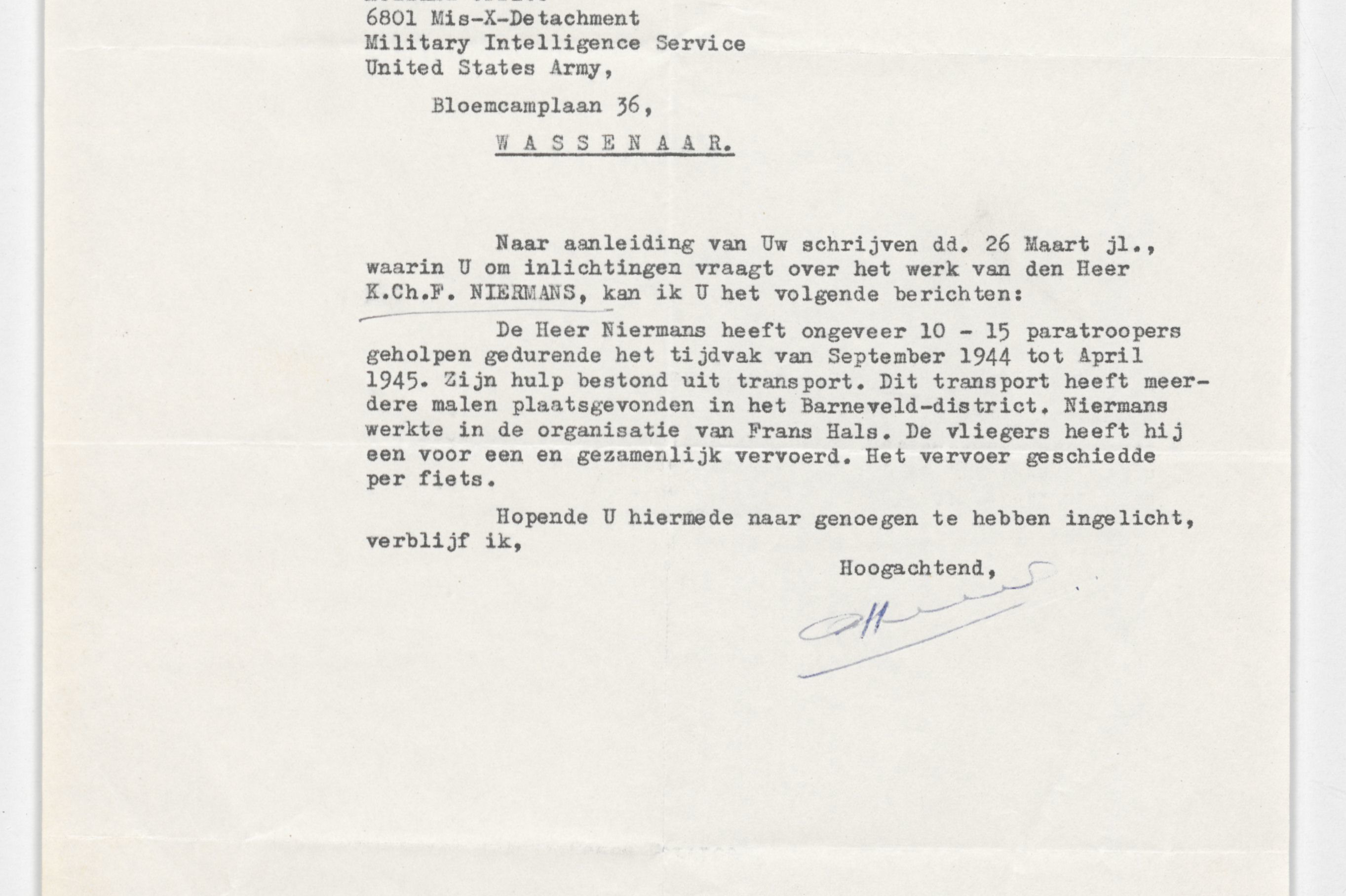
- ✓ Niermans, a courier. Karel Niermans wrote that he "Was living in the house of capt. Kay and capt Piller at Essen, and later at Barneveld", worked in the Frans Hals organisation and carried 10 to 15 paratroopers by bicycle between September 1944 and April 1945 (his form, p. 4); he lists Longland, Kessel, Allenby, Simpson, Allen, Warrack and others as "Known to capt. D Kay and capt. J. Piller" (p. 5). Asked by the Americans, Piller confirmed it on 3 April 1946:
Mr Niermans helped about 10 – 15 paratroopers during the period September 1944 to April 1945. His help consisted of transport. This transport took place several times in the Barneveld district. Niermans worked in the organisation of Frans Hals. He transported the airmen one by one and together. The transport was by bicycle.
Dutch originalDe Heer Niermans heeft ongeveer 10 - 15 paratroopers geholpen gedurende het tijdvak van September 1944 tot April 1945. Zijn hulp bestond uit transport. Dit transport heeft meerdere malen plaatsgevonden in het Barneveld-district. Niermans werkte in de organisatie van Frans Hals. De vliegers heeft hij een voor een en gezamenlijk vervoerd. Het vervoer geschiedde per fiets.
— US National Archives · RG 498, helper file of K. Ch. F. Niermans · letter of J. Piller, Laren, 3 April 1946 · the letter
- ✓ A schoolgirl courier at Arnhem. A girl of the Arnhem lyceum, born in the Dutch East Indies in November 1927 (so not named here), wrote on 20 June 1946 that her help was "mainly in connection with couriers work for Jo v. Amstel and Dick Kay" (her form, p. 2; read on the scan).
- A second copy of her form has an unsigned remark that she "acted as one of the messengers for the Frans Hals organisation and as such was one of our best", was "always ready to cycle any distance given" and "transported weapons and acted as guide to evaders", "during the awful winter of 1944-45 in the area, North of Arnhem mainly" (p. 8; image-checked).
- ◐ The "our" is the organisation's, so the remark is probably Kragt's or Piller's own; the page does not sign it.
- ◐ The De Ruif household. The Van Nispen tot Sevenaer family, who lived at De Ruif, listed helpers known to them, "Dr. Kruimel, Utrecht … A. Heg, Barneveld J. Piller, Laren (NH)" in the son's form and "Kapt. Piller [?] Laren. NH." in the father's (the son's form, p. 2; the father's, p. 4; Van Nispen tot Sevenaer). Neither form says how they knew him.
- Both Van Nispens give Laren addresses of their own (Stationsweg 3 on the son's form of 31 May 1946, Stationsweg 23 on the father's of 7 January 1946), and Piller's Laren address is the one he gave after the war, so the listing may come from neighbours rather than De Ruif.
- ✓ A register. A friend writing to the American embassy on 2 March 1947 for Jan Buitenhuis of Apeldoorn calls "The famous Mr. Piller welknown to you" the man who "registrated all the names of these pilots" (the letter, p. 11). ◐ A third party's remark; no register by Piller is held here.
Voorthuizen, January to April 1945
Link to the section Voorthuizen, January to April 1945✓ The widow Vonkeman's farm "Klein Harselaar" at Voorthuizen was, on the Americans' action report of 19 October 1945, "Dick Kay's H.Q.", with a claim of f. 680 "to be referred and checked by J. van Amstel" (the action report, p. 2; the farm's name is on p. 9). Vonkeman's own supplement to his report, 21 July 1945, lists the expenses he made "On behalf of Joop van Amstel": the rent and evacuation costs of "the whole family van Amstel from 19th Jan. till 12th April" at f. 300 a month, two months paid, and other costs, f. 680.35 in all (the supplement, p. 9; checked on the image).
- On Thursday 12 April at half past seven in the morning twelve men of the Landwacht and the SD surrounded the farm. Among those ordered into the kitchen were "Mrs. van Amstel, wife of Lt. J. van Amstel with their little daughter and a Jewish child", and her brother-in-law (p. 9).
- They questioned the servant Willem v.d. Pol about a pilot organisation and beat him and the widow's daughter Annie; "Neither Annie nor v.d. Pol told anything, this fact helped to save the archives of the Frans Hals organisation and as a result also the life of Joop van Amstel's family" (p. 9).
- The next morning five SD men came back for the son, Willem, and for motor tyres; "In the meanwhile Mrs. van Amstel c.s. had departed" (p. 10). An unsigned advice of 21 July 1945 says the trial of two Landwacht men proved that the raid followed from the Frans Hals headquarters being at the farm (p. 4). Dick Kragt has the farm's other side.
- ◐ A claim form in Piller's own file, signed "H. de Jongh" on 13 September 1945, asks f. 630.35 "(not f. 730,35)" and part of the stolen goods, the loss "as a result of the attack on the farm", with "Mrs. van Amstel, Kokshuisje, Barneveld" as witness (the form, pp. 15–16, read on the images). Which farm and which H. de Jongh it does not say.
Piller's statement has the SD raid them again "half April 1945, eenige dagen voor de bevrijding" (in mid-April 1945, a few days before the liberation), when they lost part of their belongings and "Onze hond werd tevens door de S.D. medegenomen" (the SD took our dog too) (p. 18).
Across the lines, March 1945
Link to the section Across the lines, March 1945✓ On 8 March 1945 he crossed to the liberated south to talk to I.S.9 about working as one team with the group on the free side; they aired many grievances, agreed changes, and the area was liberated before they took effect (p. 19). The Americans' summary adds that "immediately following his own crossing to the allied forces, that he became an accredited officer of the Dutch Government", and that he and Kragt were overrun by the advancing army on 19 April 1945 (pp. 11–12).
Before the commission of inquiry, 1949
Link to the section Before the commission of inquiry, 1949✓ The parliamentary commission on the wartime government's policy heard him on 25 May 1949 (printed in deel 4C-II, pp. 1320 to 1324, read on the page images; the transcript):
On 23 June 1943 Kragt was dropped for I.S. 9, a department of the English Intelligence Service, between Epe and Vaassen. On landing he lost his transmitter with everything that went with it; the next day he came to me and worked with me practically the whole war.
Dutch originalOp 23 Juni 1943 is voor I.S. 9, een afdeling van de Engelse Inlichtingendienst, gedropt Kragt, tussen Epe en Vaassen. Bij het landen is hij zijn zender kwijtgeraakt met alles, wat er bij hoorde; hij is de volgende dag bij mij gekomen en heeft practisch de gehele oorlog met mij samengewerkt.
— Joseph Piller · hearing before the commission, 25 May 1949 · Enquêtecommissie Regeringsbeleid, Verslag deel 4C-II (1950), p. 1320, question 54929 · the transcript
- He said the Germans searched his house two or three times: in October 1943, "dat was toen Nel Lind gearresteerd werd" (that was when Nel Lind was arrested; he did not know whether the two were connected), in September 1944 and at the end of February 1945 (questions 55019 to 55020).
- "Frans Hals" was Kragt's code name, known in Holland only to Nel Lind, van den Boogert, van Borssum Buisman and himself; asked how the Germans got it, he said "Ik meen te mogen aannemen" (I think I may assume) that van den Boogert told it after his arrest in 1943, and that Nel Lind "kan die naam bij haar arrestatie ook verteld hebben" (may also have told it when she was arrested) (54957 to 54960).
- They sat first at Epe, had to leave in October 1943 and went to Barneveld (54956); after Arnhem the paratroopers went on by Apeldoorn, Woudenberg, Amerongen, Doorn, Groot-Ammers and Sliedrecht "in zes of zeven groepen" (in six or seven groups) (54950); at one time they had "250 Engelsen en Amerikanen" (250 English and Americans) placed; eight people worked in the group, and all but van den Boogert came back (54972 and 54973).
- On the crossing of 17 November 1944, "ongeveer 130 man" (about 130 men) were to go over; asked whether he was there himself, "Ja. Wij hebben 36 mensen verloren. Drie zijn er doorgekomen" (yes; we lost 36 people, three got through), and he and Kragt were among those who came back (54964 to 54968).
- A man dropped "± October 1943" (about October 1943) to be Kragt's operator, "Theo", lost his things and was by 1949 studying in Switzerland (54990 and 54991).
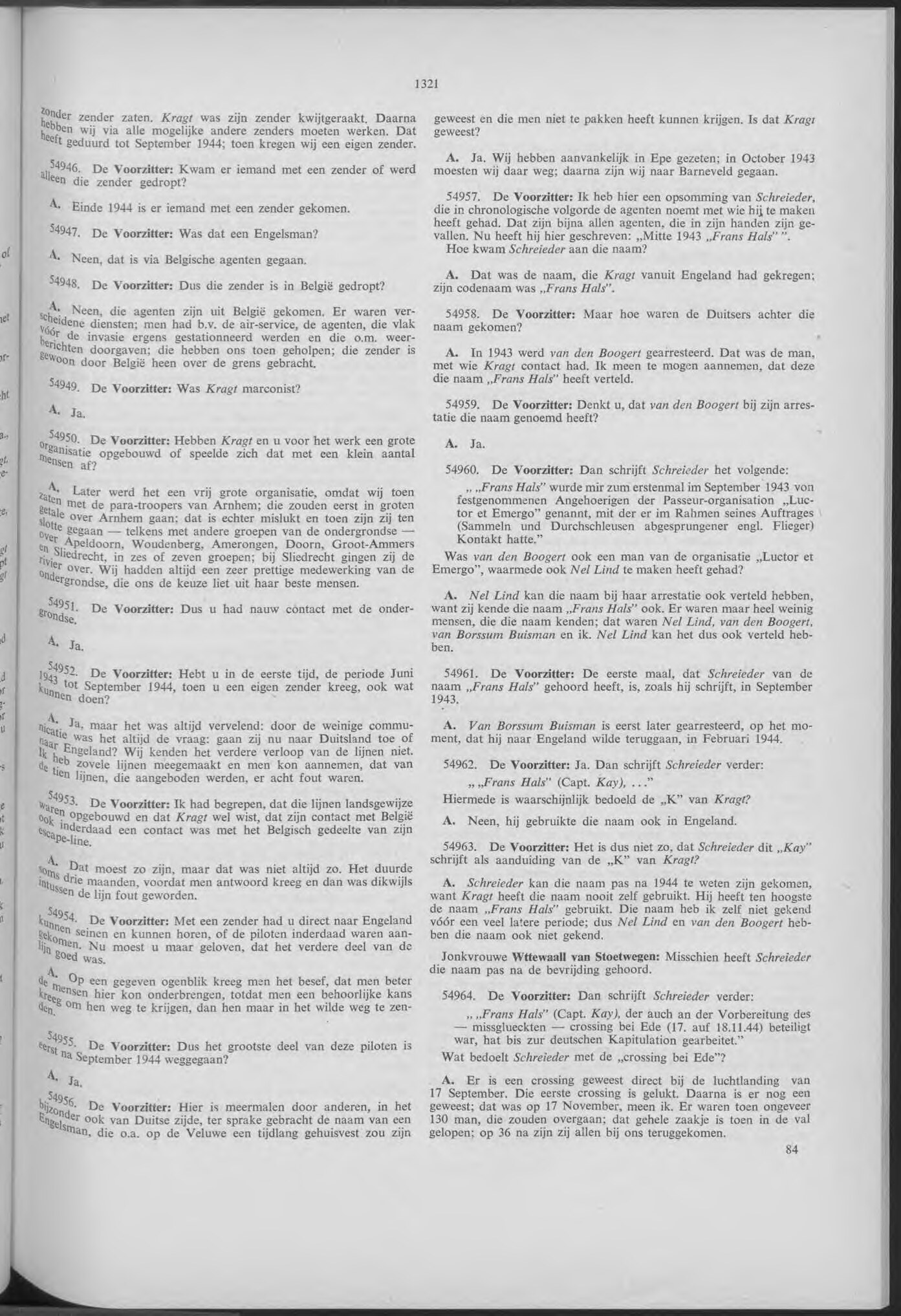
The commission printed its own summary in deel 4A/B: Kragt came to him the day after his drop and "zij hebben practisch de gehele oorlog samengewerkt"; "Tussen de 100 en 200 piloten zijn weggebracht"; they built "een organisatie opgebouwd voor het verzorgen van piloten" for I.S. 9, linked with the B.I. agent van Borssum Buisman, who sent their telegrams. It has a crossing "direct bij de luchtlanding van 17 September 1944 een crossing geweest bij Ede, welke gelukt is" and then, in November 1944, about 130 men who "in de val zijn gelopen. Op 36 na zijn zij allen bij de organisatie van de heren Piller en Kragt teruggekomen … Slechts drie zijn er door gekomen" (the report, 1950, p. 274, read on the page image). On p. 275 it has him tell of Captain King, a Belgian SAS agent, and of "Dubois", shot, he thought, in November or December 1944 after being dropped near Garderen "ongeveer twee maanden tevoren" (about two months before) with an operator who, "naar de heer Piller gelooft, maar één dag gewerkt" (as Mr Piller believes, worked only one day) (p. 275; Abraham du Bois).
- ✓ The Americans. His folder is marked "Grade 1" (p. 1). The recommendation of 20 August 1946, signed by Lt Col R. H. Betts (pp. 4–5), says:
- that he was "directly instrumental in the escape from the enemy of more than one hundred Allied and American airmen during the period from May 1942 to April 1945", and that "Lt. Kragt considers Joseph Piller his most able and intelligent aid and collaborator";
- that he "did particularly distinguished work in connection with the carefully planned and brilliantly executed mass escape of more than 120 American and Allied airmen across the Rhine River to safety behind the Allied lines in October 1944".
- It went forward on 27 August with Adriaan van Wijlen's and Harry Tummers's and was approved on 2 September (p. 3; p. 6).
- ✓ Clearance. The Americans asked the Dutch Ministry of the Interior on 1 August 1946 to clear "J. PILLER, Essenerweg 70, Barneveld", adding that clearance had been asked before under the name Joop van Amstel, "an error on our part since his real name is Piller, and J. van Amstel was a "schuilnaam" he used during the war" (p. 2); the ministry gave it on 2 September 1946 for "Joseph Piller (Joop van Amstel), Hilversumscheweg 6, Laren (N.H.)" (letter no. 4997, p. 8).
- ✓ The ceremony and the order.
- On 21 August the Holland office wrote to him that the Medal of Freedom with gold palm would be presented on 4 September at the Binnenhof in The Hague, asking him to be in the Rolzaal at 10.00, an hour before (the letter, p. 9).
- General Orders 285 (headed 12 October 1946, cited as 11 October) lists "Joseph Piller, Dutch Civilian--May, 1942 to April, 1945" for the Medal of Freedom with gold palm, with Adriaan van Wijlen, and the citation credits him with "the evasion of more than one hundred aviators" (GO 285, p. 31; the citation, p. 33).
- ⚠︎ The file does not show whether the ceremony of 4 September took place for him.
- ✓ His wife. "(3283) PILLER, Mrs. Elizabeth, Hilversumscheweg 6, Laren" is on the American list of Grade 5 certificates (the page, p. 123). The British index of Dutch helpers has both, "PILLER, Elizabeth", certificate 14664, Grade 5, and "PILLER, Joseph", 14665, Grade 1, with the remark "Joop van Amstel" (the sheet, read on the image: the address and grade columns run one line above the names on this sheet; the index).
- ✓ The British MBE. Kew's catalogue entry for him, dated 25 June 1946, has "Joseph Piller. Date of birth: 12 March 1914. Place of birth: Amsterdam. Nationality: Dutch. Award or honour: MBE. Duration of service: 2 years" (WO 208/5457/17, catalogue entry only, not digitised).
- ◐ Ons Noorden of 7 July 1948 announced that the British ambassador would present decorations at the Binnenhof on Thursday 8 July to "ruim 200 Nederlanders", and its list includes "Joseph Piller, Laren" (the article, p. 2, read on the image). ⚠︎ The class printed before the first names of that list, an honorary knight-commander, is not shown to be his.
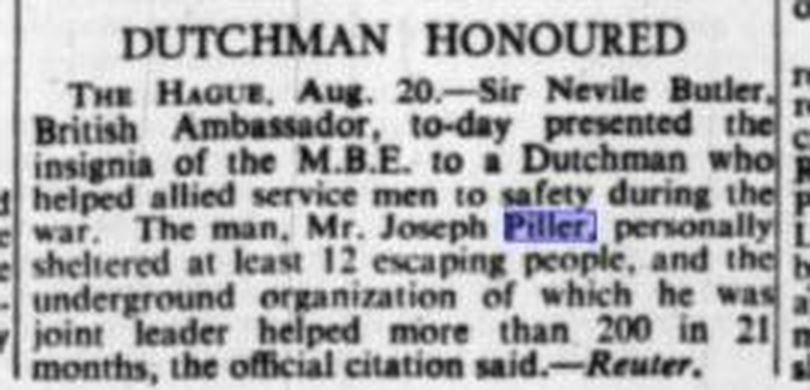
- ◐ The Times of 21 August 1953 reported the presentation of the M.B.E. to him at The Hague the day before (below).
Sir Nevile Butler, British Ambassador, to-day presented the insignia of the M.B.E. to a Dutchman who helped allied service men to safety during the war. The man, Mr. Joseph Piller, personally sheltered at least 12 escaping people, and the underground organization of which he was joint leader helped more than 200 in 21 months, the official citation said.
— Reuter · "Dutchman honoured", The Hague, 20 August · The Times, 21 August 1953, p. 5 · the item, read on the image
◐ The name, the M.B.E. and the joint leadership fit him; the item gives no place or birth date, and another Joseph Piller (Swiss) was in The Times eight days earlier, so the identification is ours.
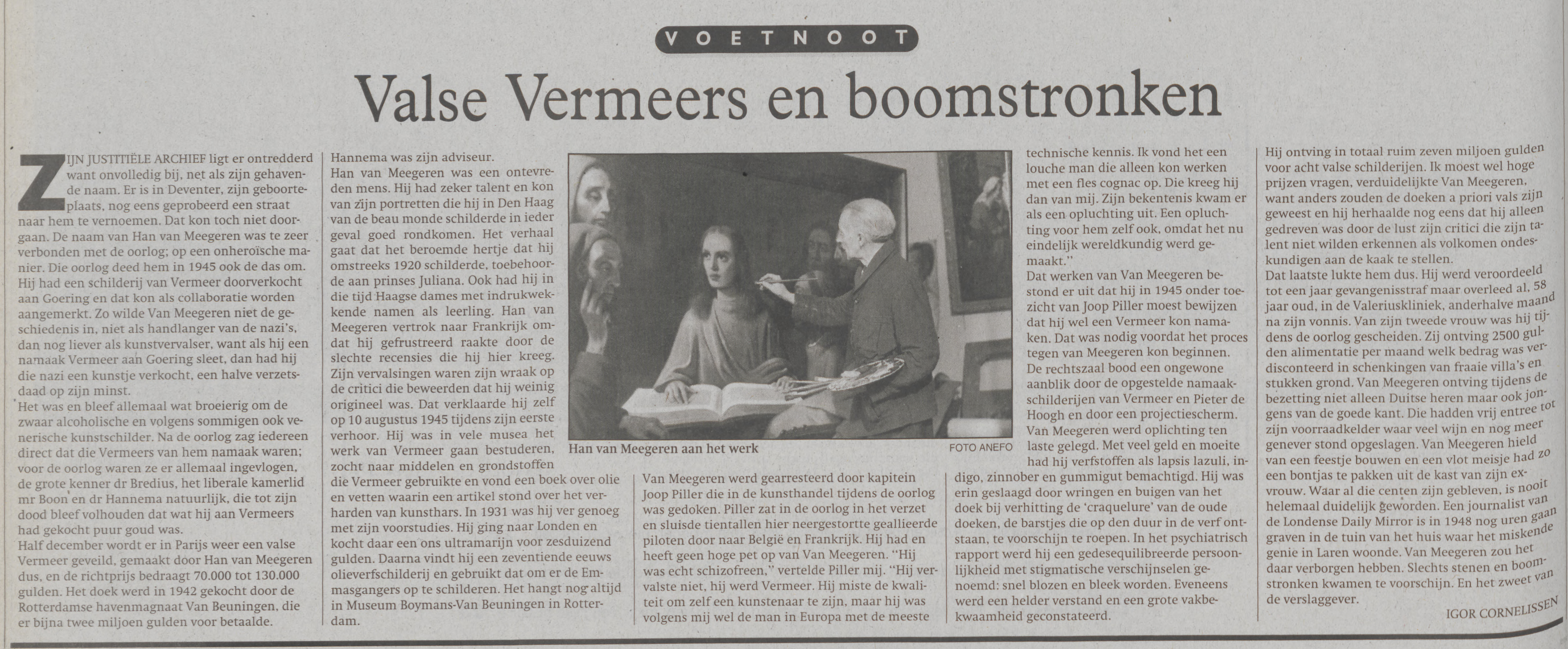
Van Meegeren and the Bureau
Link to the section Van Meegeren and the Bureau✓ Het Parool of 18 November 1995: "Van Meegeren werd gearresteerd door kapitein Joop Piller die in de kunsthandel tijdens de oorlog was gedoken" (Van Meegeren was arrested by Captain Joop Piller, who had dived into the art trade during the war; gedoken, from duiken, can also mean gone into hiding); in 1945, "onder toezicht van Joop Piller" (under Joop Piller's supervision), Van Meegeren had to prove he could make a Vermeer. Piller told the writer, Igor Cornelissen, "Hij vervalste niet, hij werd Vermeer" (he did not forge, he became Vermeer), that he thought him "een louche man die alleen kon werken met een fles cognac op" (a shady man who could only work with a bottle of cognac inside him), "Die kreeg hij dan van mij" (and he got it from me) (the article; read on the image).
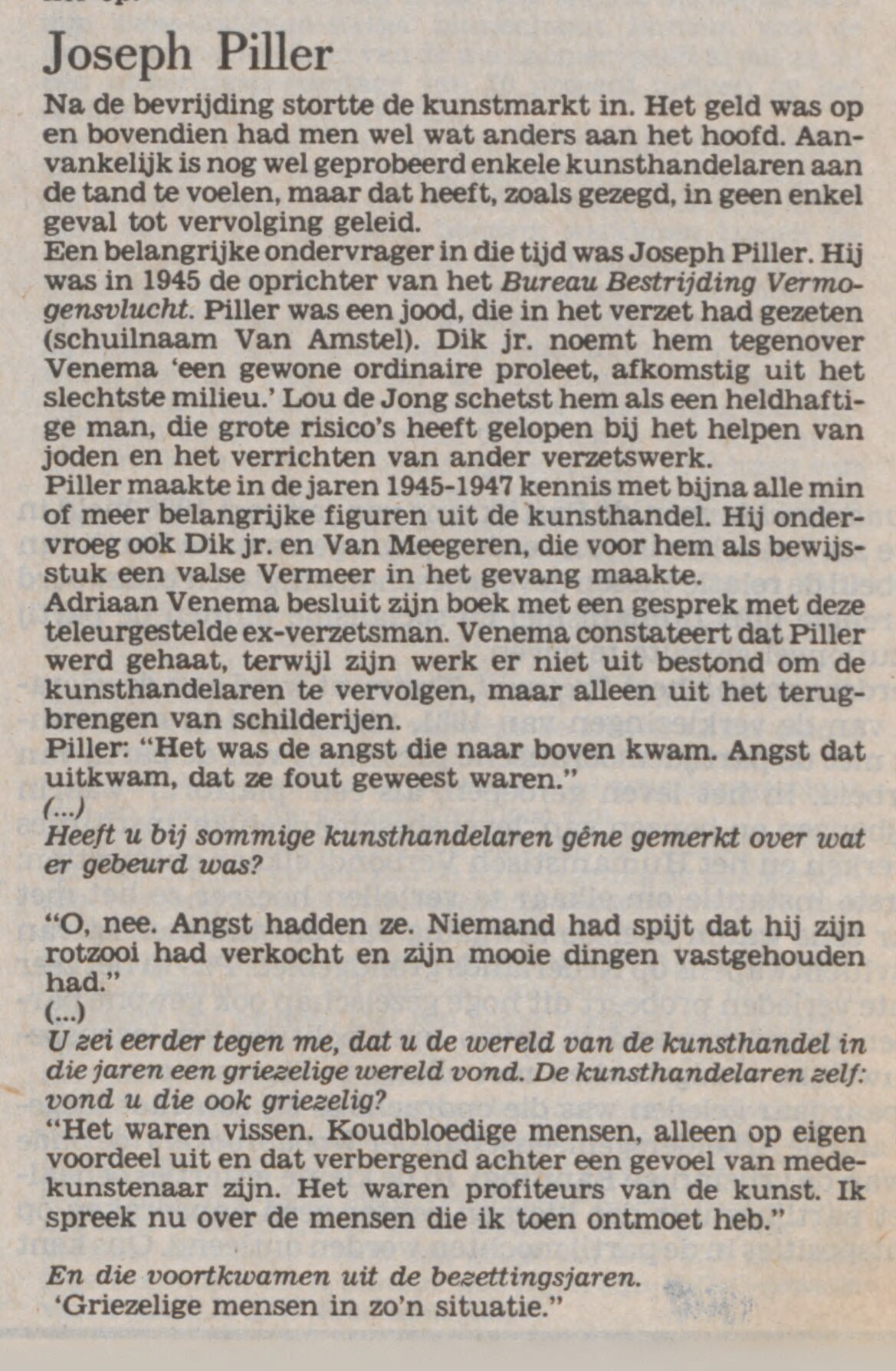
✓ Venema's book, 1986. Four Dutch papers of April and May 1986 reviewed Adriaan Venema's Kunsthandel in Nederland 1940-1945 (De Arbeiderspers), which ends with an interview with him; all four are read on the page images.
- Het Parool of 5 April, in a boxed piece headed with his name: "Een belangrijke ondervrager in die tijd was Joseph Piller. Hij was in 1945 de oprichter van het Bureau Bestrijding Vermogensvlucht" (an important questioner at that time was Joseph Piller; in 1945 he founded the Bureau for Combating the Flight of Capital), a Jew who had been in the resistance (alias Van Amstel), who in 1945 to 1947 met nearly every figure of any importance in the art trade (the column).
- He questioned the man the paper calls Dik jr., who called him "een gewone ordinaire proleet, afkomstig uit het slechtste milieu" (a common vulgar prole from the worst background) to Venema, and Van Meegeren, "die voor hem als bewijsstuk een valse Vermeer in het gevang maakte" (who made a false Vermeer for him in prison as evidence); the paper sets Lou de Jong's portrait of him as a brave man who ran great risks helping Jews against that.
- Venema ends his book with an interview with him, "deze teleurgestelde ex-verzetsman" (this disappointed former resistance man) in the paper's words, and finds he was hated although his work was not to prosecute the dealers but only to bring paintings back.
- De Volkskrant of 3 May: "Piller woont op Mallorca waar Venema met hem sprak. Hij toonde zich gefrustreerd en teleurgesteld" (Piller lives on Mallorca, where Venema spoke to him; he showed himself frustrated and disappointed) (De Volkskrant). The Algemeen Dagblad of 5 April: "Een teleurgesteld man. "Ze hebben me gehaat," zegt Piller over de kunsthandelaren" (A disappointed man. "They hated me," Piller says of the art dealers) (Algemeen Dagblad).
- His verdict on the dealers, in Het Parool and De Volkskrant: "Het waren vissen. Koudbloedige mensen, alleen op eigen voordeel uit en dat verbergend achter een gevoel van mede-kunstenaar zijn. Het waren profiteurs van de kunst" (they were fish: cold-blooded people, out only for their own gain and hiding it behind a feeling of being fellow artists; they were profiteers of art). The Algemeen Dagblad's crop runs to "Koudbloedige mensen,"; Trouw of 3 April has the end of it (Trouw).
- ◐ The book itself is not held, so what he told Venema is known only as the papers print it, and as Lopez prints it in English, citing Venema, p. 508 (his note dates the book 1984; the papers above reviewed it in 1986): "It was clear that I didn't like collaborators", and "I was young and had witnessed many deaths, and I hated anyone who had worked with the Germans" (Lopez, pp. 14–15, 259).
✓ The Bureau, in a history of restitution. Gerard Aalders's Berooid (2001), on the return of property stolen from Jews, gives the Bureau Bestrijding Vermogensvlucht (BBV) a section (pp. 233–235, transcribed from the page images; p. 233 read on the image):
- It was "in 1945 opgericht door Joseph Piller" (founded in 1945 by Joseph Piller) as his own private initiative, Piller being the man "die in het verzet bekend stond als 'kapitein Van Amstel'" (who was known in the resistance as "Captain Van Amstel") (p. 233).
- After making contact with Prince Bernhard's staff he "erin geslaagd daar te worden gemilitariseerd in de rang van kapitein" (succeeded in being taken into the military there with the rank of captain), and a mandate from the Finance Ministry followed; by the bureau's own undated report, probably of late 1945, it traced about fl. 15 million in diamonds, gold, silver, antiques and art in about half a year (p. 233). From January 1946 it was gradually absorbed into the Centrale Vermogens Opsporingsdienst (p. 235).
- ◐ Aalders writes that "Piller/Van Amstel had de naam een avonturier te zijn" (had the name of being an adventurer), that his way of working met resistance, and that the Stichting Nederlands Kunstbezit (SNK), the foundation recovering looted art, drew away from him when "'kapitein Van Amstel' hevig aan het intrigeren was geslagen" ("Captain Van Amstel" had set about intriguing hard) for powers The Hague would not give him (p. 233 for the adventurer and the resistance; the intrigeren quote p. 234, read on the images).
- A historian's judgement on his post-war work; De Jong's brave man of the war years is above.
Later life
Link to the section Later life✓ His wife, "Liesje ELISABETH PILLER-VELDMAN (Lies van Amstel)", died at Mallorca after a short illness, "op de leeftijd van 79 jaar" (aged 79); the notice, dated 12 February 1991, is signed first "Mallorca: Joop Piller" (NRC Handelsblad, 20 February 1991). He was alive in February 1991, when he signed her notice, and in 1986 (De Volkskrant, Venema). ◐ Het Parool of 18 November 1995 writes that he "had en heeft" (had and has) a low opinion of Van Meegeren, but the present tense is the columnist's and the interview is undated (the article). At the 1949 hearing he was a manufacturer (fabrikant) living at Heemstede (p. 1320). Warrack, in 1963, has "Joop is doing very well in his business in Amsterdam" (Travel by Dark, p. 255; page image). No record of his death has been found. ◐ Lopez's notes cite an obituary, H. A. van Wijnen, "Leider Onder de Grond", NRC Handelsblad, 3 January 1998, as the source of his calling himself a "simple Jewish boy" (Lopez, pp. 15, 259); if it is an obituary, he had died by the start of 1998. The article is not held.
The Gemeentearchief Barneveld holds a 2010 oral-history interview, not digitised, with a Kootwijkerbroek man, nineteen in 1945, on the people hidden there, Dick Kragt and Joop Piller among them (the catalogue entries).
Where the sources disagree
Link to the section Where the sources disagree- When van den Boogert was arrested, and Kragt's first contact. Piller's statement has the arrest in November 1943, and the contact address at Epe (p. 17; the arrest, p. 18); De Jong has October 1943, spells him Boogert, and has Kragt find him at Emst (deel 7, pp. 945–946); Piller to the commission in 1949: the house searched in October 1943 (questions 55019 to 55020). Piller's statement and the Americans' summary spell him van den Boogaard.
- The raids on his house. November 1943 and mid-April 1945 in his statement of 1945 (p. 18); October 1943, September 1944 and the end of February 1945 to the commission in 1949 (above). ◐ The Voorthuizen raid of 12 April 1945, where his wife and daughter were, fits the first account's April.
- Their own transmitter. "tot Januari 1945" in his statement (p. 17); "until September 1944" to the commission, and in another answer a set dropped "at the end of 1944" (questions 54945 to 54948).
- How many were lost on Pegasus II. Six over and about 37 taken (his statement, 1945); "we lost 36 people, three got through" (his hearing, 1949); "Slechts drie" through, 36 missing (the commission's summary); seven to the Betuwe and thirty-six missing "volgens Piller" (De Jong, deel 10b, p. 553). His own counts move between three and six over; the 36 or 37 stays.
- Where Piller and Frans Hals were on the night of 17 November. Boeree p. 200 has Joop van Amstel and Frans Hals at van den Brink's house, Frans Hals then going home; p. 201 has Frans Hals come back with the Elburgers and go to Kootwijkerbroek, and does not say where Piller went. Piller told the commission he was at the crossing and came back with Kragt (questions 54967 to 54968).
- "Ruim honderd" or about 130. Over a hundred sent to cross by way of Bill of Ede in his statement (p. 17); about 130 meant to go over, to the commission (questions 54964 to 54968; the report, p. 274).
- His rank. Vonkeman's supplement of July 1945, Hulstyn and Van Veldhuizen call him "Lt."; "Captain" is on his own questionnaire of July 1945, in Niermans's and van Beek's forms of 1946, and in the Van Meegeren arrest as Het Parool told it in 1995. In 1986 Trouw has "luitenant 'Van Amstel' in het verzet", the Algemeen Dagblad "kapitein Van Amstel". ◐ The Americans' summary has him an accredited Dutch officer only after March 1945, which would fit a lieutenant before that and a captain after; no source says so.
- Aalders has both: "in het verzet bekend … als 'kapitein Van Amstel'" (known in the resistance as "Captain Van Amstel"), and taken into the military as a captain through Prince Bernhard's staff after the war (p. 233).
- Lopez has him given "an officer's commission in the newly reconstituted Dutch army" by the time he met Van Meegeren in 1945 (p. 16).
- When his work began. General Orders 285 and the recommendation give May 1942 to April 1945, the recommendation's proposed citation April 1942; Kew's MBE entry gives "2 years"; his statement has the work with Kragt begin in June 1943; De Jong has him from 1942 fetching Jewish children from Amsterdam (deel 7, p. 946; the recommendation, pp. 4–5). ◐ The earlier date may count his help to Jewish hiders; the recommendation does not say.
- Lopez has him at Emst from soon after May 1940 and Kragt arriving "one day in 1942" (pp. 15–16), against De Jong's move to Emst after his release early in 1942 and the sources that date Kragt's drop to June 1943 (Roskam also has 1942, and Warrack, Heaps and Kessel have May 1943; see Dick Kragt); Lopez gives no source for either year.
- How Kragt came to him. Warrack has Kragt given "the name of a loyal Dutchman, Joop van Amstel" before he left England (Travel by Dark, p. 183; page image); De Jong and Piller's own statement have van den Boogert's address as the contact, and Piller taking Kragt in after he reported there (De Jong, deel 7, pp. 945–946; p. 17).
- His trade. A bookkeeper (boekhouder) on his marriage record of 1939 and the Jewish Council's card; "de confectionair Piller" (the clothing manufacturer) in Het Parool in 1973; a fabrikant in 1949; "a garment worker by trade" in 1940 in Lopez (p. 15). ◐ They need not exclude each other: none says what he did when.
- The British honour: when, and which class. Kew's entry of June 1946 has the MBE; Ons Noorden lists him among those to be decorated on 8 July 1948 under a list headed by an honorary knight-commander; The Times has the M.B.E. insignia presented to him on 20 August 1953. ⚠︎ Whether he was at the 1948 ceremony, and why the presentation came in 1953, the sources do not say.
- "October 1944". The American recommendation credits him with a mass escape of more than 120 airmen across the Rhine in October 1944 (p. 5): ◐ very probably Pegasus I, of 22 to 23 October, which De Jong has 138 people trying to cross (deel 10b, pp. 549–550); the recommendation names no operation. His own statement names only the November crossing "via Bill van Ede"; the commission's summary has a successful crossing at Ede "direct bij de luchtlanding", at the time of the airborne landing.
- The English version of his statement renders "tot September 1944" as "until February 1944" and "na een maand van stilzitten" (after a month of sitting still) as "after months of sitting still" (pp. 17, 20). The Dutch is his.