Dirk van Eysinga
Leiden 7 Nov 1916 – Donoratico 17 Aug 1980
Jonkheer Dirk VAN EYSINGA, "Derek" to James Hardy, "Dirk" to the helpers, "Evert" in one helper's file and "Dirk Bussink" in Noordman's book and the Elspeet history.
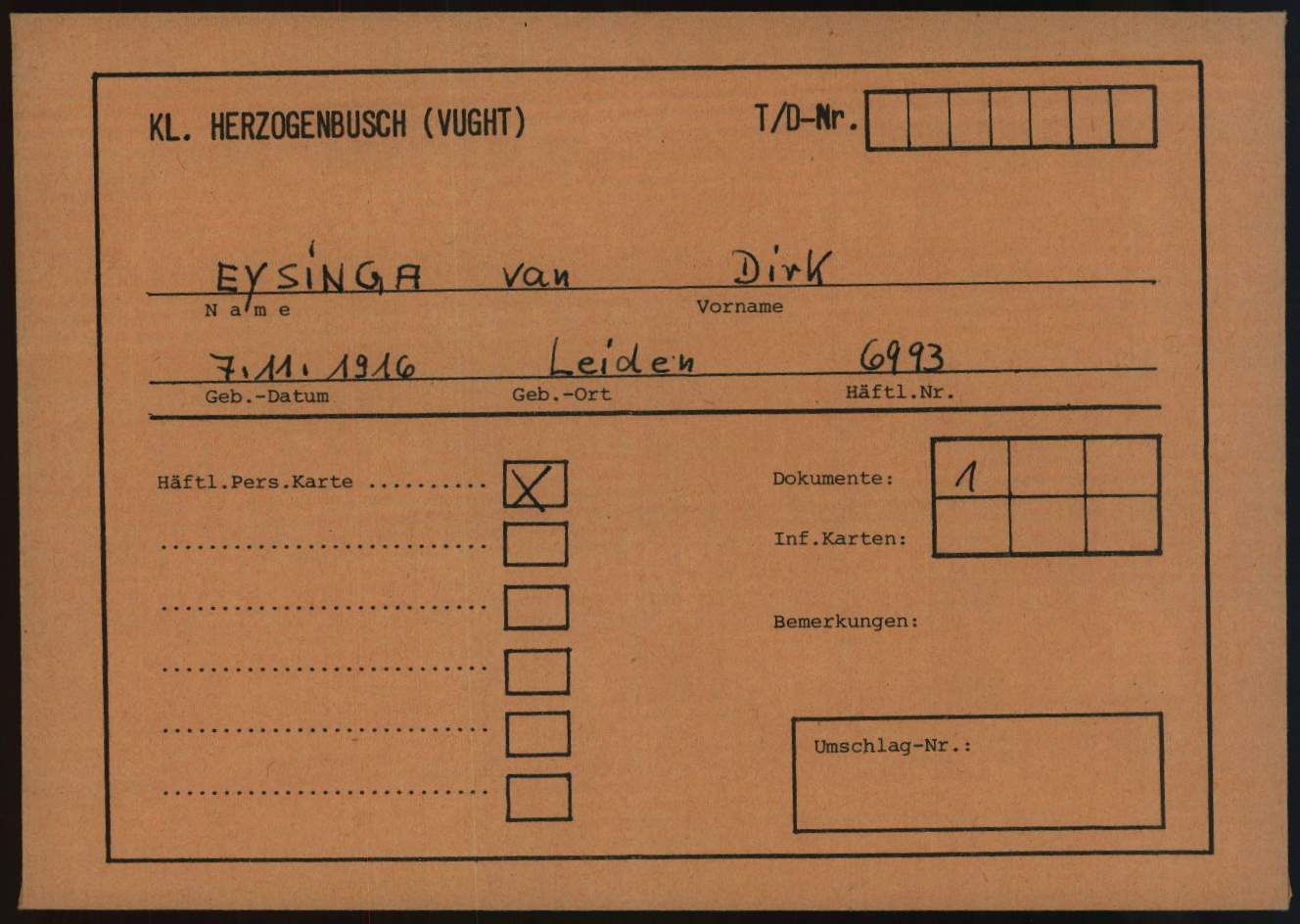
About: "Derek" of Sterrehoveke at Elspeet, a jonkheer from Leiden hiding at his aunt Ima van Eysinga's house, who sheltered Murphy and Walsh there in October 1944 and guided their party on two night marches; later the Netherlands' ambassador in Bucharest.
Unit or role: The pilot organisations "Jupiter" and "Frans Hals" (the typed copy of his questionnaire, p. 2); "one of the liaison officers for the FRANS HALS organisation" (the summary sheet, p. 3); "leader of the P.T.O. North Veluwe" in one helper's words (Van Beek, p. 2). On the British index of Dutch helpers as certificate 15914, grade 5 (sheet E/7), and on the Americans' list of Grade 5 certificates as no. 1238 (the list, p. 49).
Where: Sterrehoveke, Krommesteeg 40, Elspeet, the address he gave as the one the Allied men knew (p. 2); his Leiden address, Rijnsburgerweg 100 (p. 3).
Evidence: ✓ his helper file with the Americans, US National Archives 286705707 (pp. 1–3); ✓ Hardy's MI9 report; ✓ Liesbeth Verweij's account of Sterrehoveke as Noordman prints it (Noordman, pp. 279–281, 293–294, 300–303); ✓ his birth record (the index entry; the register scan was not opened); ✓ Nederland's Adelsboek of 1941, 1951 and 1955; ✓ his Vught camp card; ✓ the helpers' forms of 1946 that name him (below); ✓ Scînteia, 1968 and 1969; ✓ his family's death notices of 1980 (De Telegraaf; Leeuwarder Courant; La Stampa Sera); the Elspeet history.
Jonkheer Dirk van Eysinga was born at Leiden on 7 November 1916, the son of Willem Jan Mari van Eysinga, a professor, and Coralie Leopoldina van Hogendorp (birth record, the index entry); in 1946 he gave his next of kin as "Prof. van Eysinga. Leiden.", ⚠︎ aged 70 (his questionnaire, p. 2), where Ima's form gives the professor as 68 (her form, p. 2) and his birth date in the Adelsboek, 31 January 1878, makes him 68 in 1946. ✓ Nederland's Adelsboek of 1955 gives the father as "Jhr Mr Dr Willem Jan Mari van Eysinga, geb. Noordwijkerhout 31 Jan. 1878, oud-referend. Min. van Buit. Zaken, oud-hoogl. Volkenrecht Univ. te Leiden" (a former official of the Ministry of Foreign Affairs and former professor of international law at Leiden), married at The Hague on 30 June 1908 to Coralie Leopoldine barones van Hogendorp, and Dirk as the third of their children (Adelsboek 1955, p. 101, page image read). The 1941 edition has his brother Tjalling Aedo Johan, born at Scheveningen on 7 August 1914, as the child before him (Adelsboek 1941, pp. 361–362, page images read).
✓ Ima van Eysinga, the painter of Sterrehoveke, is his father's sister. The Adelsboek has her as "kunstschilderes. [Elspeet]" (painter, Elspeet) in the same family entry as his father (1941, p. 361; 1955, p. 101). De Telegraaf of 17 June 1937 has prof. jhr. mr. W. J. M. van Eysinga thanking the Lakenhal at Leiden "namens zijn zuster" (on behalf of his sister) at her exhibition (1937), and the Nieuw Utrechtsch Dagblad of 27 August 1951 calls him "broer van de kunstenares" (the artist's brother) (1951). His father's mother, Henriette Jacoba Kluit, died at The Hague on 3 May 1931 aged 79; the notice is signed, among her children, by his parents and by Ima (Nieuwsblad van Friesland, 8 May 1931; OCR only). The Van Eysinga family archive at Tresoar in Leeuwarden lists photographs of about 1930 of Ima at Elspeet with a shepherd and "de kinderen van jhr. Willem Jan Mari van Eysinga" (the children of W. J. M. van Eysinga), not digitised (Tresoar, toegang 323, item 6523).
✓ Nederland's Adelsboek of 1941 has him as "Jhr. Mr. Dirk van Eysinga, geb. Leiden 7 Nov. 1916, employé bij de Bataafsche Petroleum Mij. ['s Gravenhage]" (an employee of the Batavian Petroleum Company, The Hague) (Adelsboek 1941, p. 361); the 1955 edition has him as "oud-empl. B.P.M.", a former employee of the same company (p. 101).
Vught, 1943
Link to the section Vught, 1943The Arolsen Archives hold his card from Kamp Vught: "Eysinga van. Dirk", B.V. 6993, block 22, of Leiden, born at Leiden on 7 November 1916, "Binnengekomen" (brought in) on 12 August 1943 and "Verplaatst" (moved on) on 27 October 1943 (the card, read on the image; Arolsen Archives 1.1.12.2). A Tjalling A. J. van Eysinga, born at The Hague on 7 August 1914, was booked in with him as 6994 (the camp files). ✓ He is Dirk's brother: the Adelsboek's Tjalling Aedo Johan was born at Scheveningen, part of The Hague, on 7 August 1914 (Adelsboek 1941, pp. 361–362). Why the two were held is not on the cards.
With Murphy
Link to the section With MurphySterrehoveke, October 1944
Link to the section Sterrehoveke, October 1944The Elspeet history's page on Jeanne Dijkstra's book has him living during the war with his aunt at Sterrehoveke on the Krommesteeg, where "Samen met dokter Kruimel en Huib de Jongh verborg hij, met medeweten van zijn tante, niet alleen wapens op Sterrehoveke, maar ook onderduikers, piloten, parachutisten en ontsnapte doktoren" (with Dr Kruimel and Huib de Jongh he hid, with his aunt's knowledge, not only weapons at Sterrehoveke but people in hiding, pilots, paratroopers and escaped doctors) (Elspeet history). Noordman calls him "Jonkheer Dirk van Eysinga, alias Dirk Bussink, een neef van haar" (a nephew of hers), who "was daar ook ondergedoken en deed ook veel ondergronds werk" (was also in hiding there and did a lot of underground work) (Noordman, p. 300). The Elspeet history spells the house Sterrehoveke; Noordman's book has Sterrenhoveke.
Liesbeth Verweij, Ima's companion, wrote down how Murphy and Walsh came to the house, in an account Noordman prints (Noordman, pp. 301–303):
- The day they were to come. With seven paratroopers at De Ruif, two were to go to Sterrehoveke, and "Dirk zou met Oom Joop de dag van overbrenging bepalen" (Dirk was to settle the day of the move with Uncle Joop), around 10 October. A round-up that day kept him indoors, "met een kruik en enige dekens in de vrij tochtige schuilplaats achter het waterreservoir op zolder" (with a hot-water bottle and some blankets in the rather draughty hiding place behind the water tank in the attic), so she cycled to De Ruif instead (p. 301).
- Their arrival. The next evening, at about eight, she tapped on the side window of the sitting room "en deed Dirk opgelucht de deuren van het atelier open" (and Dirk, relieved, opened the doors of the studio) (p. 301).
- Their days. They were not to get up until Dirk called them; at danger the word "Coffee" was called up the stairs, and "Dirk zei dat het ongelofelijk was zo vlug, handig en geruisloos ze plachten te verdwijnen achter het waterreservoir …" (Dirk said it was unbelievable how quickly, deftly and silently they would vanish behind the water tank …) (p. 302).
⚠︎ Verweij's date sits badly with Walsh's report, which has the two near Kootwijk until 14 October, at Garderen after it and moved to Elspeet "About 21 Oct"; Hardy found Murphy already at the house on 19 October, two days before that (Hardy; On the run sets the dates side by side).
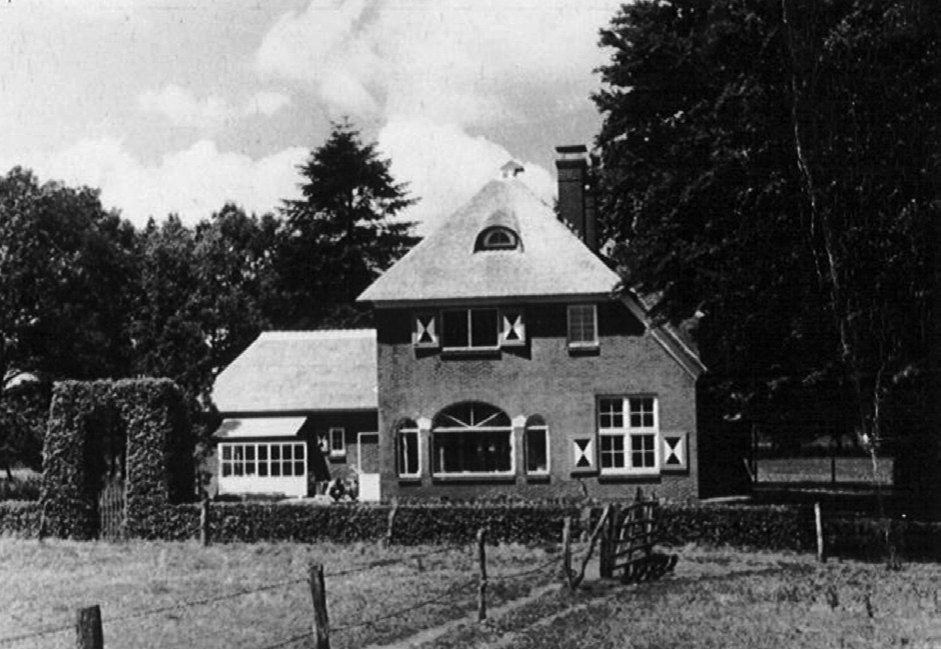
Hardy, 19 October
Link to the section Hardy, 19 October◐ Very probably Mrs van Asbeck-Patijn of Leuvenum, Hardy's unnamed English-speaking lady, brought James Hardy to Elspeet on 19 October (Ima's and Liesbeth's forms, p. 3; Noordman, pp. 279, 302). In Hardy's report, "she took me to a house where I met a member of the Underground who was known by the name of DEREK"; Hardy hid in the garden and was given a meal "while DEREK accompanied the English-speaking lady back to LEUVENUM", and "on first meeting DEREK he checked my identity by examining my pay book and asking me questions about the English [British] Land Army. Derek spoke English". "As soon as it was dark DEREK took me to the home of his great-aunt where he was hiding", where Hardy met Murphy and the other paratrooper (Hardy). Verweij's account has the same meeting: to be sure the man was no German in disguise, "ging Dirk mee en nam hem een verhoor af" (Dirk went along and questioned him), and he was to stay in the pines until dark "en zou voor het avondeten door Dirk opgehaald worden" (and would be fetched by Dirk for supper) (Noordman, p. 302).
To Kijkuit, 26 October
Link to the section To Kijkuit, 26 OctoberAfter staying here a week DEREK heard that a large number of German soldiers were expected in the village and it was decided that we should move. It was suggested that we should go to BRUMMAGER's house in LEUVENUM where I had been before but DEREK did not have any connection with the Underground in that area nor did he know of this house. However I showed him the approximate location on a map and he said he knew it and so did his aunt, so as soon as it was dark on the evening of 26 Oct we set off, DEREK and his aunt going ahead pushing their bikes, and MURPHY, the other Paratrooper, and myself following a short distance in the rear.
— MI9 · Pte J. Hardy · report of 13 January 1945 · the report
◐ Verweij tells what is probably the same evening, with herself, not Ima, beside Dirk; she gives no date and has Hardy at the house "ongeveer tien dagen" (about ten days), where Hardy has a week (p. 302): the three took a warm leave of Ima "en volgden Dirk en mij op een behoorlijke afstand" (and followed Dirk and me at a fair distance), across the heath by the Refugium to the cycle path from the Stakenberg to Hulshorst; at the path to the forester's house Hardy went ahead alone, and "Dirk vond die nacht een slaapplaats bij de heer en mevrouw Adriaanse" (Dirk found a bed for the night with Mr and Mrs Adriaanse) (Noordman, pp. 302–303). The house was Kijkuit in the Leuvenumse Bos, where Hardy had been with Eric Blok and "Brummager", Bram Baar (Hardy; Noordman, pp. 278, 281, 303).
The night march, 6–7 November
Link to the section The night march, 6–7 NovemberAt midnight on 6 Nov we were taken by DEREK and LOEW (another member of the Underground) to HARSKAMP (Sheet 2, 640945). There were eight of us including the two guides, Sgt. BANWELL, the Sergeant Glider Pilot JOHN, Pte. MURPHY, P/O. BRENTFORD, the other Paratrooper and myself. We arrived at HARSKAMP about 2100 hours on 7 Nov having broken our journey at the house of a man called DICK (?) for a meal and a rest on route.
— MI9 · Pte J. Hardy · report of 13 January 1945 · the report
Noordman names the guides as Huib de Iongh, Joop Migchelsen and "Dirk van Eysinga (Dirk Bussink)", taking the men to the area of Kootwijkerbroek "en daar overgenomen zouden worden door Dick Kragt" (to be taken over there by Dick Kragt) (p. 293). Verweij, who got up at six, the hour Dirk came home, "zodat ik nog kon genieten van zijn verslag, voordat hij het bed in dook" (so that I could still enjoy his report before he dived into bed), has it as follows: Migchelsen led the first stretch, Huib de Jongh ("Lou") followed with a revolver, then the six Britons, with Banwell carrying the only Sten, and Dirk at the rear with his bicycle, which creaked fearsomely and could give the transport away (Noordman, pp. 293–294):
Suddenly Tom Murphy stopped and pressed a small box of shoe grease into Dirk's hand. By the time Dirk had greased the bicycle, he had lost the party.
Dutch originalPlotseling stopte Tom Murphy en duwde Dirk een doosje schoenvet in de hand. Toen Dirk de fiets gesmeerd had, was hij zijn gezelschap kwijt.
— Liesbeth Verweij, in Noordman, Schuilplaats de Veluwe, p. 294
He caught up by a detour past Het Roode Koper and the hotel De Zwarte Boer. On the Speulderheide, under a full moon, Murphy and Hardy fell behind with Lou, and when three figures came towards them Dirk rang his bicycle bell, the agreed alarm; "De afspraak was dat Dirk met zijn meest vertrouwde wapen, zijn mond, zou vechten. Tex Banwell dook echter niet weg maar was in een sprong bij Dirk, met de stengun in de aanslag" (the arrangement was that Dirk would fight with his most trusted weapon, his mouth; but Tex Banwell did not take cover and was at Dirk's side in one leap, his Sten at the ready), and the three passed without a word. At about five Frans Hals (Dick Kragt) whistled them in at signpost 215 by Boeschoten, and "Dirk keerde vanaf de paddenstoel bij Boeschoten per fiets naar Elspeet terug en arriveerde daar om zes uur in de morgen" (Dirk cycled back from the signpost by Boeschoten to Elspeet and arrived there at six in the morning) (p. 294).
Joop Migchelsen's statement of 14 June (◐ 1945), in his American file, has all six "Delivered 'en bloc' on 11th Nov. 1944 (midnight 1 o'clock) transported through the woods to Bos, Farm Staverden, where the transport was taken over by Loet and Dirk, 2 assistants of Ome Joop" (his file, p. 3). ⚠︎ His 11 November is five days after Hardy's 6 November, written in January 1945.
Tex Banwell
Link to the section Tex BanwellElbert Bos of Staverden listed for the Americans on 15 May 1946 the men who had passed through his farm, among them "Tex", of Arnhem, received from "Dr. Kruimel" and passed to "Tijs Foppen and later on to Dirk Eisinga"; his list of helpers has "Jhr. Dirk Eisinga, Elspeet now in Switzerland" (his form, p. 2; his table, p. 3, checked on the image). ◐ "Tex" is Tex Banwell, whom Hardy has brought to Kijkuit by the underground on 29 October (Hardy); the form gives no date, and Groen's table has Banwell at Staverden "± 12-17 Oct '44" (Banwell at Staverden).
The pilot line
Link to the section The pilot lineThe office that made out his file summed up his work:
Dirk during the latter six months of the occupation of the Netherlands by the Germans collected, transported, and found accommodation for some 60 - 70 evaders. Took part in the transporting of evaders from KAMPEN to the area just north of EDE (Pegasus II crossing).
He was most useful in organising the food supply from the northern provinces.
— US National Archives · RG 498, helper file of Jhr. Mr. Dirk van Eysinga · summary sheet no. 17 in his file · the report
The same report has him one of the liaison officers "for the FRANS HALS organisation to various groups of underground workers", assisting "in the IJSSEL-crossings from east to west" and later making "the preparations for the crossings in the reverse direction", and calls him "Very intelligent and practicle" (p. 3). It is the sheet numbered 17, initialled illegibly; no. 16, on Huib de Iongh, says "In conjunction with Dirk EYSINGA (See separate report) he obtained food … from the northern provinces for an even greater amount of evaders" (De Iongh's file, p. 3). In the typed copy of his own questionnaire, dated 7 June 1946, he names Huib de Jongh and Kragt in section 11 and refers the office for more to the reports of "v.d.Weert. (Jupiter.)", "Huib de Jongh. (Loe.)" and "Dr. Kruimel. (Oom Joop, Garderen.)" (p. 2).
On the IJssel. ◐ The helper file of Henk Zwaan of Veessen, on the IJssel, dated 15 February 1946, has a remark signed "H. de Iongh": "Henk Zwaan acted as ferry man for Dirk van Eysinga and H. de Jongh during their contact journeys to Overijssel all this notwithstanding German Guards with dogs" (Zwaan's file, p. 4, image-checked). The names and the river fit the IJssel crossings of his own file; the form gives no date.
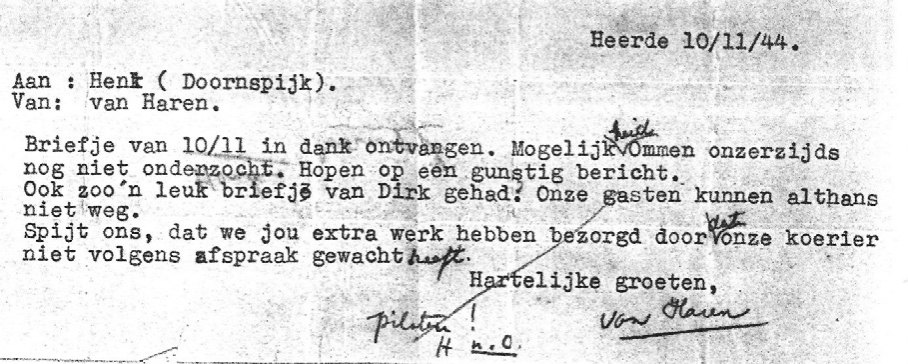
On the line to Heerde. ◐ Noordman prints two courier notes of November 1944 from "Van Haren", the dentist Van Dijk of Heerde, to Henk Baud ("Henk Doornspijk") of Doornspijk, about a transport of airmen planned for Friday 10 November by post van, to call first at the parsonage at Veessen, and says "Genoemde Dirk in het tweede briefje is 'Dirk Bussink' (Jonkheer Dirk van Eysinga)" (the Dirk named in the second note is Dirk Bussink, Jonkheer Dirk van Eysinga) (Noordman, p. 255). The typed note, dated "Heerde 10/11/44", has "Ook zoo'n leuk briefje van Dirk gehad. Onze gasten kunnen althans niet weg" (also had such a nice note from Dirk; our guests at any rate cannot leave) (fig. 169, p. 256, read on the image). The Tresoar catalogue lists a copy of a letter "van jhr. Dirk van Eysinga aan Henk Baud" with Verweij's typescript, closed until 2067 (Tresoar, toegang 323, item 7665).
A printed account of 1947. Boeree's chronicle of Ede, on the men who gathered paratroopers on the Veluwe under Frans Hals and Joop van Amstel: "Op verschillende plaatsen hadden zij vertrouwensmannen, Jhr. Dirk van Eijsinga voor de Noorder-Veluwe, Lou (Huib de Jong) voor Ermelo, Brunekreeft voor Kootwijkerbroek, Schol voor Hoenderloo en van Beek en van Dijk voor Harskamp en Otterlo" (in several places they had trusted men: Jhr. Dirk van Eijsinga for the northern Veluwe, Lou (Huib de Jong) for Ermelo, and so on) (Boeree, p. 199, page image read).
How the helpers named him. Helpers' forms of 1946 name him, some by his first name, one by the name "Evert":
- Martinus van Beek, Harskamp, 17 February 1946: "All details about our work is known to Capt. Dick Kay, Capt. van Amstel (J.Piller) and Jhr. van Eysinga, leader of the P.T.O. North Veluwe" (p. 2, image-checked).
- Pieter Cornelis Derk Toxopeus, "Pete the Dutchman", of the R.V.V. in Overijssel, a liaison officer with the Canadian army, 12 March 1946:
- "Jhr van Eisinga, zoon van de prof uit Leiden, was hoofd van het transport over de Veluwe, terwijl ik moest zorgen voor transport in Overijssel. Door snelle oprukken hier niets meer van gekomen" (Jhr van Eisinga, the son of the professor from Leiden, was head of the transport over the Veluwe, while I had to see to the transport in Overijssel; with the rapid advance nothing came of it) (p. 4, in Dutch; the office's English on p. 2, both image-checked).
- The father identifies him.
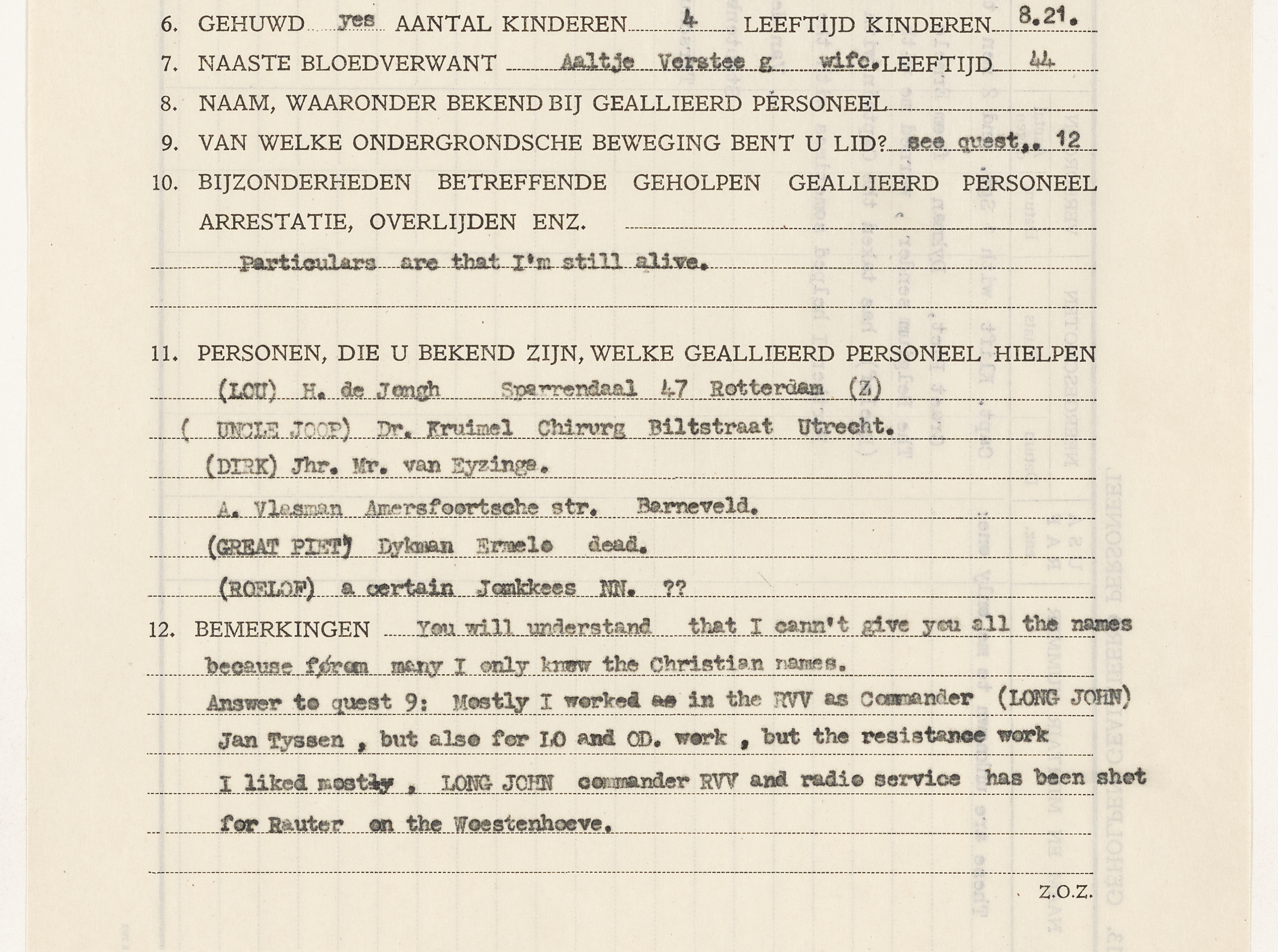
- Gerardus van den Beek, Terschuur, 28 March 1946: in section 11, "(LOU) H. de Jongh, Sparrendaal 47 Rotterdam (Z)", "(UNCLE JOOP) Dr. Kruimel, Chirurg, Biltstraat Utrecht" and "(DIRK) Jhr. Mr. van Eyzinge" (p. 8, image-checked).
- Christiaan Esendam, Apeldoorn, 10 May 1946: "Dick van Ijsinga at Elspeet, "Lou" Henk Berger and wife" (p. 2, image-checked). ◐ Dick at Elspeet is Dirk.
- Elbert Bos, Staverden, 15 May 1946: "Jhr. Dirk Eisinga, Elspeet now in Switzerland" (above).
- Teunis Platenkamp, Oene, summary of 3 June 1946:
- He "rendered help to Lou and Evert (chiefs of pilot-transports from Overyssel to Gelderland)" from the beginning of 1944, and "Information … can further be obtained from Mr. Eysinga, Rynsburgerweg 100, Leiden. (Evert) and Lou H. de Jongh, Sparendaal 47, Rotterdam. (Lou)" (p. 14, image-checked). The sheet is typed by the Americans' office, not Platenkamp's own words.
- ✓ "Evert" is Eysinga by the Leiden address: Rijnsburgerweg 100 is on the summary sheet in his own file (p. 3) and is the address Ima's and Liesbeth's forms give for him (Ima's form, p. 2; Liesbeth's, p. 2); his own form of June 1946 has Bern.
- Ima van Eysinga and Liesbeth Verweij, 27 January 1946: each lists him, with Kruimel and de Jongh, among the helpers she knew; the office ringed all three names in pencil (Ima's form, p. 2; Liesbeth's, p. 2).
The certificates
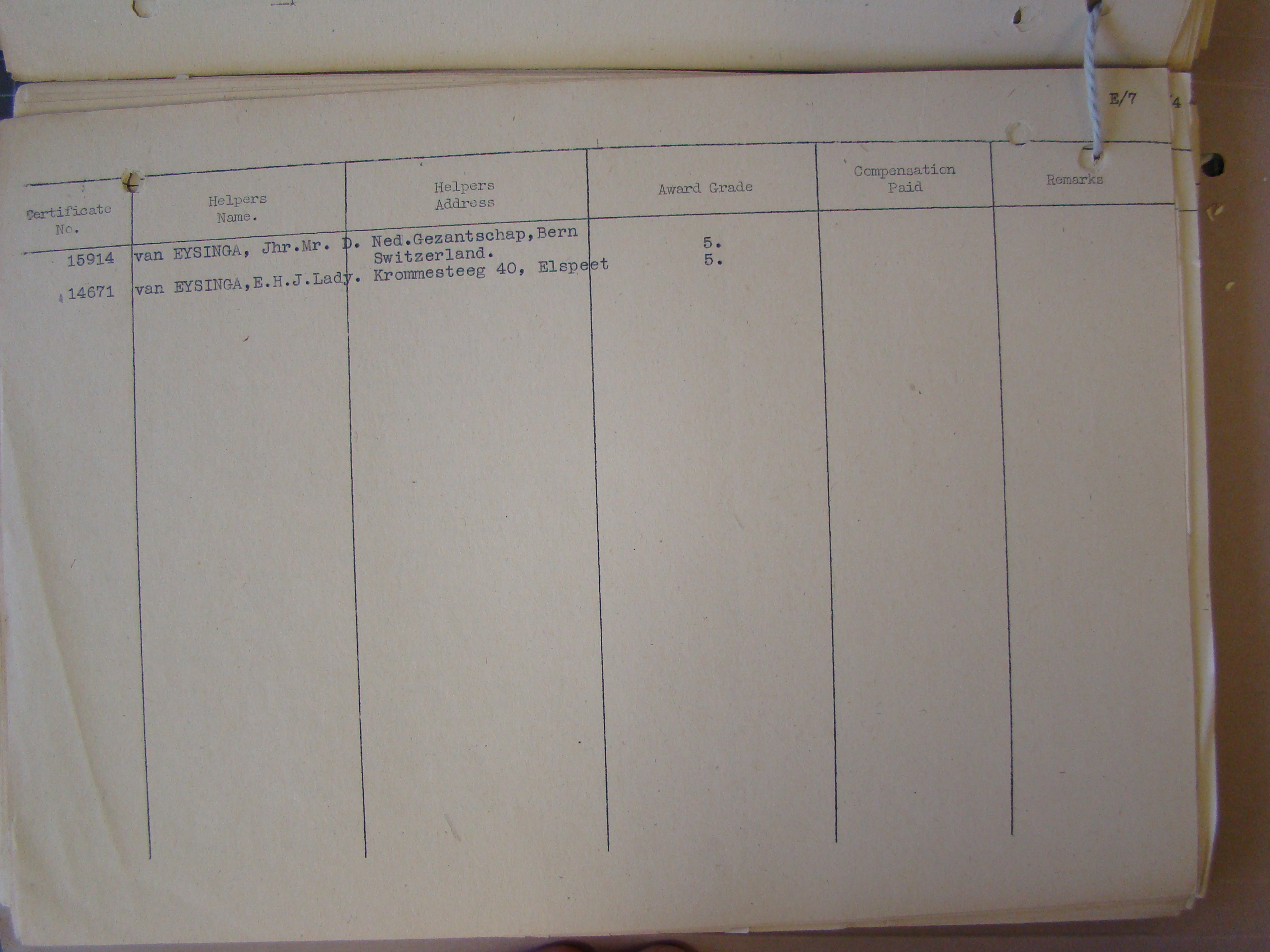
Link to the section The certificatesThe Americans graded him 5 (p. 1); in June 1946 he was at the Netherlands legation in Bern (p. 2), and their Grade 5 (Eisenhower) certificate list has "(1238) Van EYSINGA, Jhr. Mr. Dirk, Ned. Gezantschap, Netherlands Legation, Bern, Switserland", with his aunt as (1239) (the list, p. 49, image-checked). The British index of Dutch helpers has the same two on one sheet: "15914 van EYSINGA, Jhr.Mr. D. Ned.Gezantschap, Bern Switzerland. 5." and "14671 van EYSINGA, E.H.J.Lady. Krommesteeg 40, Elspeet 5." (sheet E/7, read on the image).
Marriage and the diplomatic service
Link to the section Marriage and the diplomatic service✓ On 28 January 1948 at Brussels he married Anna Silvia Guglielmina Alagia Maria della Torre di Lavagna, born at Rivarolo Canavese in Italy on 12 October 1901, a daughter of Count Giulio della Torre di Lavagna and Alice della Chiesa, and the widow of the Dutch diplomat Jhr. Mr. Emile Gerrit de Serière, who had died in 1929 (Adelsboek 1951, p. 231; Adelsboek 1955, p. 101; both page images read; the books print "Rivavolo", and the 1955 edition "Guilio"). The 1951 edition, in the entry for her first husband, ends the line on her remarriage to him with "[Ankara.]", which the file's note reads as where she lived in 1951; the 1955 edition has him "1e ambassadesecr." (first secretary of embassy) at Bonn (1951; 1955).
In April 1960, as counsellor of the Netherlands embassy in Cairo, he visited Meewis Goudswaard, a Dutchman held there on a charge of spying (Het Parool, 25 April 1960), and De Telegraaf of 7 March 1961 reports that, when rioters stormed and burned the Belgian embassy in Cairo (the excerpt gives no date for the riot), "de Nederlandse ambassaderaad, jhr. mr. Dirk van Eysinga, greep bijtijds in" (the Dutch embassy counsellor stepped in in time) and got the Belgian ambassador and his wife to safety, though threatened himself (De Telegraaf, 7 March 1961, OCR excerpt).
Bucharest, 1968–69
Link to the section Bucharest, 1968–69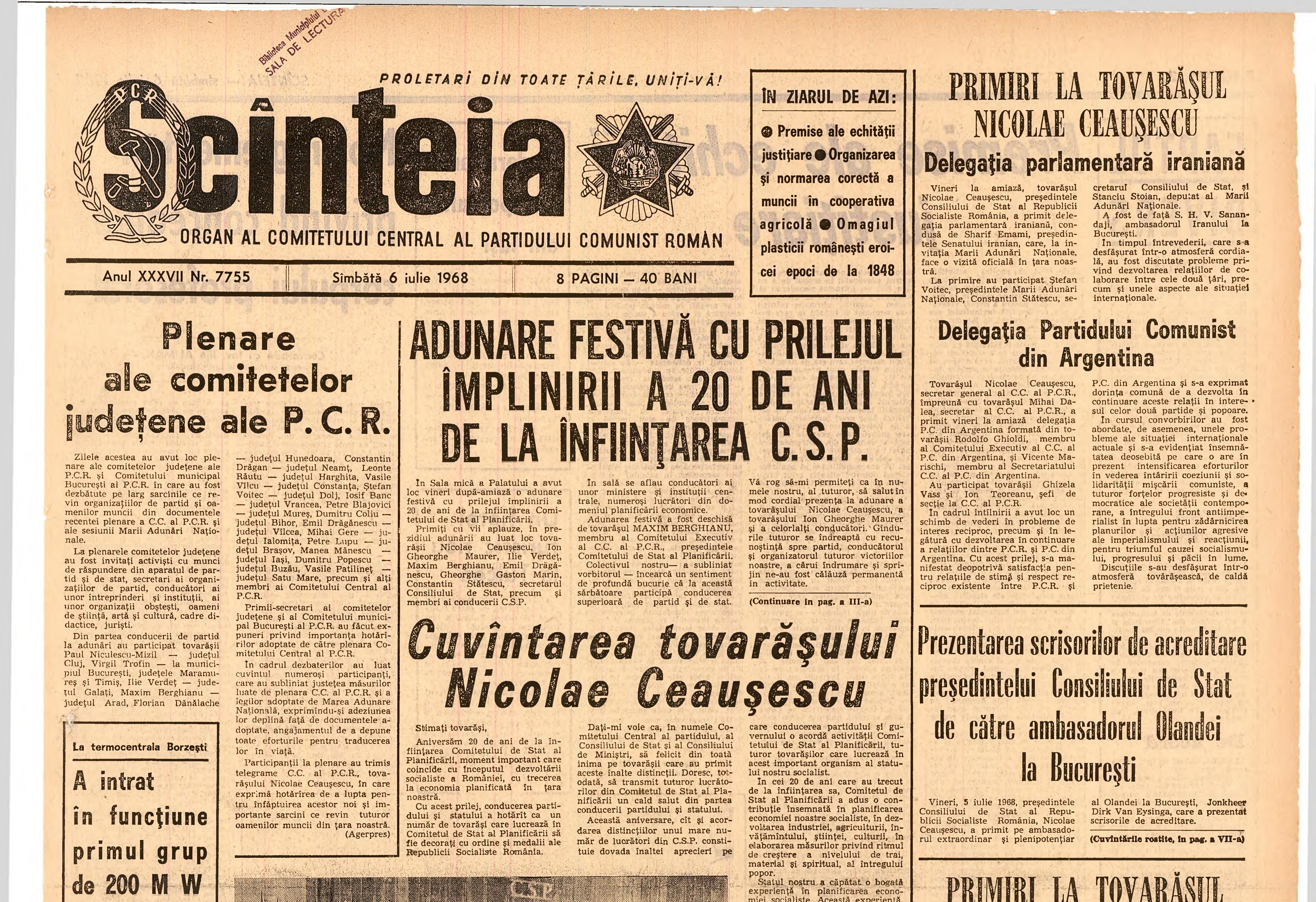
✓ The Romanian party paper Scînteia of Saturday 6 July 1968 reports on its front page that on Friday 5 July 1968 the President of the State Council, Nicolae Ceauşescu, received "ambasadorul extraordinar şi plenipotenţiar al Olandei la Bucureşti, Jonkheer Dirk Van Eysinga, care a prezentat scrisorile de acreditare" (the ambassador extraordinary and plenipotentiary of the Netherlands in Bucharest, Jonkheer Dirk Van Eysinga, who presented his letters of credence) (Scînteia, 6 July 1968, p. 1, read on the image). Romanian press bulletins of 1969 have him among the heads of mission received on 14 March 1969, at the talks of the Dutch prime minister Piet de Jong and foreign minister Luns in Romania on 27–30 October 1969, and at farewell calls on Prime Minister Maurer (the item has no date; the items either side are of 10 December) ("Jonkheer Dirk van Eysinga ... who paid a farewell call on relinquishing diplomatic activity because of family reasons") and on President Ceauşescu on 15 December 1969 (the bulletins, the archive's OCR, not checked against the page images). ✓ Scînteia of Thursday 18 December 1969 reports that "Miercuri seara a părăsit definitiv ţara noastră Jonkheer dr. Dirk Van Eysinga" (on Wednesday evening Jonkheer Dr Dirk Van Eysinga left our country for good), that is on 17 December 1969 (Scînteia, 18 December 1969, p. 5, read on the image). ◐ The Europa Year Book 1969 lists "Netherlands: Aleea Zoe 18 (E); Ambassador: Dirk VAN EYSINGA" (search snippet only). The Elspeet history has "Na de oorlog zou Dirk van Eysinga ambassadeur van Roemenië worden" (after the war Dirk van Eysinga would become ambassador [in] Romania) (Elspeet history).
The index of the Dutch Chancery of Orders has four entries for him: Officer of the Order of Orange-Nassau, register number 14573, and three foreign orders, none of them dated in the index; ◐ they fit his career as a diplomat. None is a resistance or bravery award, and his card itself is not among the archive's scans (the index entries, Nationaal Archief 2.02.32).
His death
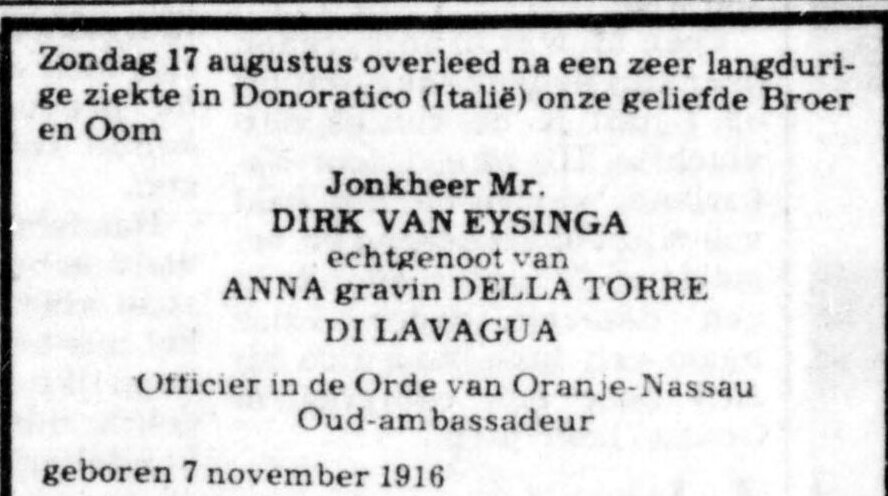
Link to the section His death✓ His family's notice in De Telegraaf of 23 August 1980 says that he died on Sunday 17 August 1980 "na een zeer langdurige ziekte" (after a very long illness) at Donoratico in Italy: "Jonkheer Mr. DIRK VAN EYSINGA", husband of Anna, countess della Torre di Lavagna (the paper prints "DI LAVAGUA"), Officer in the Order of Orange-Nassau, "Oud-ambassadeur" (former ambassador), "geboren 7 november 1916"; printed after the day, it says "De teraardebestelling heeft plaatsgevonden te Rivarolo bij Turijn op 19 augustus 1980" (the burial took place at Rivarolo near Turin on 19 August 1980) (the notice, image-checked). He was 63; the Elspeet history has "Hij is op 63-jarige leeftijd gestorven" (he died aged 63) (Elspeet history). The Leeuwarder Courant of the day before carries the same notice, printing "della Torre di Lavagna" (22 August 1980, image-checked). The notice is from his family, "onze geliefde broer en oom" (our beloved brother and uncle), and the first name under it is T. A. J. van Eysinga of Rijs in Friesland, ✓ his brother Tjalling, booked in beside him at Vught (above); the other names are not given here.
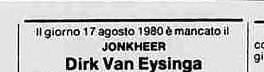
✓ A notice from Turin is in La Stampa Sera of Thursday 21 August 1980, page 7: "Il giorno 17 agosto 1980 è mancato il Jonkheer Dirk Van Eysinga", dated Torino, 21 August 1980, from his wife, his siblings (fratelli) and relatives; it names a brother "Tjalling" (the notice and the page, image-checked; the other names are left out).
His papers
Link to the section His papersThe family's papers on Elspeet are in the Van Eysinga archive at Tresoar in Leeuwarden. Item 7665 is Liesbeth Verweij's typescript "De Pilotenlijn", with the copy of his letter to Henk Baud and Noordman's letters of 1990–91 to jhr. Cornelis van Eysinga, closed until 1 January 2067; Noordman's source list has it as a manuscript "over verzetsactiviteiten van jhr. D. van Eysinga, H. de Iongh en J.P. Kruimel" (on the resistance work of Jhr. D. van Eysinga, H. de Iongh and J. P. Kruimel) (Tresoar; Noordman, p. 346). The Elspeet history has his youngest brother, "emeritus-predikant Cornelis van Eysinga uit St.Nicolaasga" (the retired minister Cornelis van Eysinga of Sint Nicolaasga), telling of him and the pilot line in Dijkstra's book (Elspeet history), and Noordman credits jhr. C. van Eysinga of Sint Nicolaasga for the photograph of Sterrehoveke (fig. 184).
Where the sources disagree
Link to the section Where the sources disagree- Where he was born. The American summary sheet has "Born: St NICOLAASGA (Fr.)" (p. 3); the Leiden birth register, the Vught card and the Adelsboek have Leiden (birth record; Adelsboek 1955). Sint Nicolaasga, in Friesland, is where his brother Tjalling lived (the Adelsboek of 1941, pp. 361–362, ends his entry with the address "de Oorsprong, St. Nicolaasga", and his Vught card of 1943 gives St. Nicolaasga as his woonplaats), and where his brother C. van Eysinga lived later (above).
- His degree. The Adelsboek of 1941 has the title "Mr." (a law degree) (p. 361); the Americans' summary sheet has the title Mr. and "Law student" in the same entry (p. 3). No source held gives the date of his degree.
- Great-aunt or aunt. Hardy calls Ima his great-aunt (Hardy); ✓ she was his father's sister (above).
- Who walked with him to Kijkuit on 26 October. Hardy has "DEREK and his aunt"; Verweij has "Dirk en mij" (Dirk and me) (Hardy; Noordman, p. 303). Hardy also has Derek not knowing the house until shown it on a map; Verweij has them working out where Eric was from Hardy's description. Verweij gives no date for the evening and has Hardy at the house "ongeveer tien dagen" (about ten days) where Hardy has a week (Noordman, p. 302).
- How far he went on 6/7 November. Hardy has the party taken "to HARSKAMP" by Derek and Loew; Verweij has Dirk turn back at the signpost by Boeschoten at about five in the morning and reach Elspeet at six; Migchelsen has "Loet and Dirk" take over at the Bos farm at Staverden on 11 November (above).
- When Murphy and Walsh came to Sterrehoveke. ⚠︎ Around 10–11 October in Verweij's account; "About 21 Oct" by Walsh's report; before 19 October by Hardy's, who found Murphy there that day, so Walsh disagrees with Hardy as well as with Verweij (above).
- Who "Lou" was. Noordman and Boeree have Lou as Huib de Iongh (de Jong) (Noordman, p. 281; Boeree, p. 199), as do Van den Beek's and Platenkamp's forms (above); the Tresoar catalogue's note on Verweij's typescript has "Lou = van Vliet senior" among the cover names in it (Tresoar, item 7665). The typescript itself is closed.
- Leader or liaison officer. Van Beek calls him "leader of the P.T.O. North Veluwe", Toxopeus "hoofd van het transport over de Veluwe" and Boeree the trusted man "voor de Noorder-Veluwe"; the Frans Hals organisation's report has him "one of the liaison officers" (above).