Pte Leslie Davison
18 Jan 1924 – ?
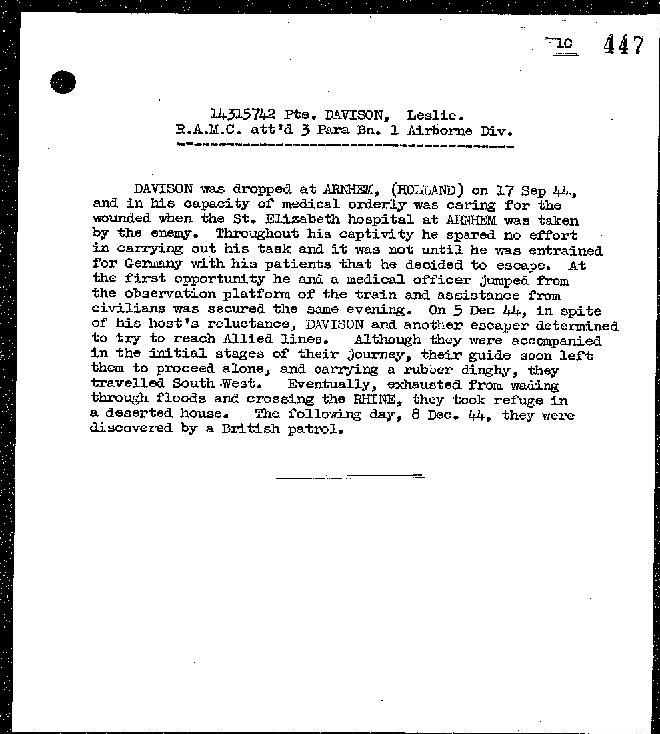
Pte Leslie Davison (14315742; born 18 January 1924, WO 208/5409/14)
About: A medical orderly attached to the 3rd Parachute Battalion who jumped from the prisoners' train in October 1944 and was in the party Murphy's group joined after Pegasus II. He cycled with Murphy and Hardy towards Barneveld on 25 November and crossed the Rhine by dinghy in December 1944.
Unit or role: Private, 14315742, Royal Army Medical Corps, attached 3rd Parachute Battalion, 1st Airborne Division (the recommendation, p. 2).
Where: Arnhem (the St Elisabeth Hospital), Apeldoorn (the Willem III barracks), Wapenveld (the manse), Elburg, the wood near Otterlo, a barn at Harskamp (◐), the Dijkstras' house (◐ De Glind), a farm at Scherpenzeel; home, by his memoir, Keighley in Yorkshire.
Evidence: ✓ Hardy; Davison; London Gazette, 20 September 1945, p. 4685; the Kew catalogue entries for his MI9 report, IS9/WEA/1/263/2315 (WO 208/3351/2315), his escape report (WO 208/5409/14) and his award (WO 208/5275/3635); ✓ the Dutch helpers' forms of 1946 (US National Archives, RG 498), read on the page images and linked below; ◐ his own memoir, written "after 56 years" for the BBC's WW2 People's War, as the Pegasus Archive prints it, and his chapter in De zwarte herfst (1984).
Arnhem and the St Elisabeth Hospital
Link to the section Arnhem and the St Elisabeth Hospital- ◐ His battalion. By his memoir he moved to the 3rd Battalion about the first week of August 1944, attached as a medic to its headquarters company under the medical officer, Capt. Rutherford, while the battalion was billeted at Spalding in Lincolnshire, and he dropped at Wolfheze on 17 September (Davison). The escape report's catalogue entry lists "Capt Rutherford" among the names it mentions (WO 208/5409/14). His memoir names his hometown, Keighley in Yorkshire, in passing (same).
- ✓ The hospital. He was caring for the wounded at the St Elisabeth hospital in Arnhem when the Germans took it (the recommendation, p. 3).
- His memoir has him and a patient wheeled into it as if dead, under white sheets, then twelve-hour shifts on the wards, with Brigadier Lathbury and Brigadier Hackett among the patients (Davison).
- In De zwarte herfst he had wheeled sixteen wounded paras on a borrowed stretcher from a cellar first-aid post in Lombok to the hospital, been carried into it under a white sheet on Thursday 21 September, worked there eight days, and at the end of September come to the Willem III barracks at Apeldoorn (Dekkers and Vroemen, p. 202).
- The "pocket diary" leaf in De zwarte herfst (caption 41, p. 122) is not about the escape: it is a list he kept in the St Elisabeth hospital of foreign money collected for the Germans, with Bert Tenucci also on it (same).
The train
Link to the section The train- ✓ The jump. When he was put on the train for Germany with his patients he and a medical officer jumped "from the observation platform of the train", and had help from civilians the same evening (his citation, the recommendation, p. 3). The officer was Capt. Theo Redman, of 133 Para Field Ambulance, whom the catalogue entry for his escape report lists among the names it mentions, and dates the jump 7 October 1944 (WO 208/5409/14).
- ◐ His memoir. A converted hospital train, held three days in Apeldoorn station by bombing of the line, left "one evening about the 10th of October" (Davison).
- On arriving at the observation platform he found half a dozen medical officers on the adjoining platform, among them his commanding officer, Colonel Townsend, who told him the officers had drawn straws for which of them would escape and "a Captain Theo Redden [Redman] had won the draw"; they jumped one from each side while the other officers started a mock argument to distract the guards on the roof (same).
- The escape report's entry lists "Colonel Townsend" among its names (WO 208/5409/14). ◐ He is very probably Lt-Col Eric Townsend, RAMC, 107206, born 17 November 1907, who as a captain won the Military Cross in the Middle East in 1942 and was held at Oflag XII B, Hadamar, by the Kew catalogue: the name, the rank and the corps fit (WO 373/21/93; WO 416/365/203).
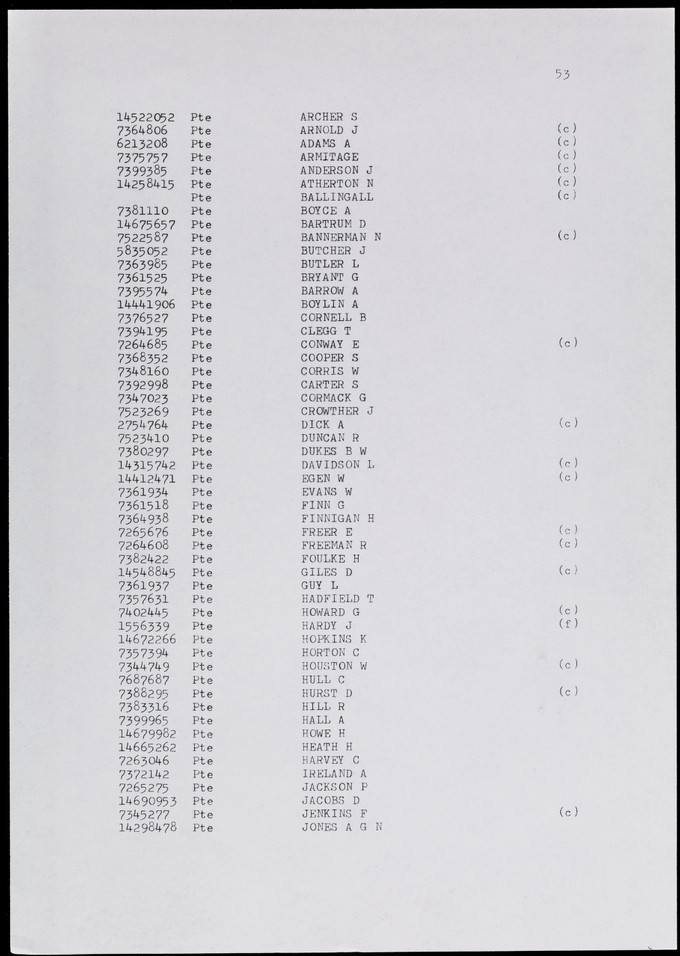
- ✓ Warrack's diary and roll. The diary Col. Graeme Warrack kept as commander of the hospital in the barracks ends with a roll of its medical staff, which has "14315742 Pte DAVIDSON L", his own number under that spelling, with the note (c), "Proceeded to GERMANY on Ambulance train 6 Oct 44" (the roll, pp. 53, 55; typed transcript of about 1982, Wellcome Collection RAMC/1584). Redman is on it as "Capt T F REDMAN", also (c) (p. 51).
- The diary has that train: "a complete hospital train" for 496 patients, ten doctors and 64 orderlies, loaded on the evening of 5 October; on the afternoon of the 6th "this morning's attack has busted the line and also that there is no engine", and that evening "Finally officers on the train are: BILL ALFORD, PETE SMITH, IAN HUDDLESTON, REDMAN, LAWSON and RANDALL" (Warrack's diary, pp. 39–41).
- It had "failed to get away even yet" on the morning of the 7th, and on the morning of the 8th it was "Reported that train has left" (pp. 41–42).
- ◐ The roll does not match that list: it marks Huddleston and Lawson (a), "Ambulance train 2 Oct 44", not (c), and on 2 October Warrack had picked a Lawson for the first train (p. 36).
- ◐ Held evidence points to one Lawson: Derek Ridler tells Kessel that Lawson jumped the first train and got away (Kessel, p. 123), the roll marks Capt J Lawson, Ridler and Simmonds all (a), and the diary's list of officers has one Lawson (p. 49), so the odd entry is the "LAWSON" in the 6 October list (p. 41), not the roll. Huddleston's (a) is still unexplained.
- ◐ Townsend is not in the 6 October list of officers or on the roll (he is in the diary's key, p. 48, as "Lt Col E TOWNSEND MC, 16 (Para) Fd Amb"); the diary does not say every officer aboard was from the barracks.
- ◐ In De zwarte herfst. A German hospital train left Apeldoorn on the evening of Friday 13 October 1944, with one orderly to every ten wounded; about half an hour out he went "naar het achterbalkon van de wagon" (to the rear platform of the carriage), saw Redman on the next carriage's platform with the same plan, and "We besloten samen te ontsnappen" (we decided to escape together) (Dekkers and Vroemen, pp. 201–202). The book's caption has him "jumped from the train to Germany at Wapenveld with Theo Redman" (p. 138). The three dates are under Where the sources disagree.
Wapenveld
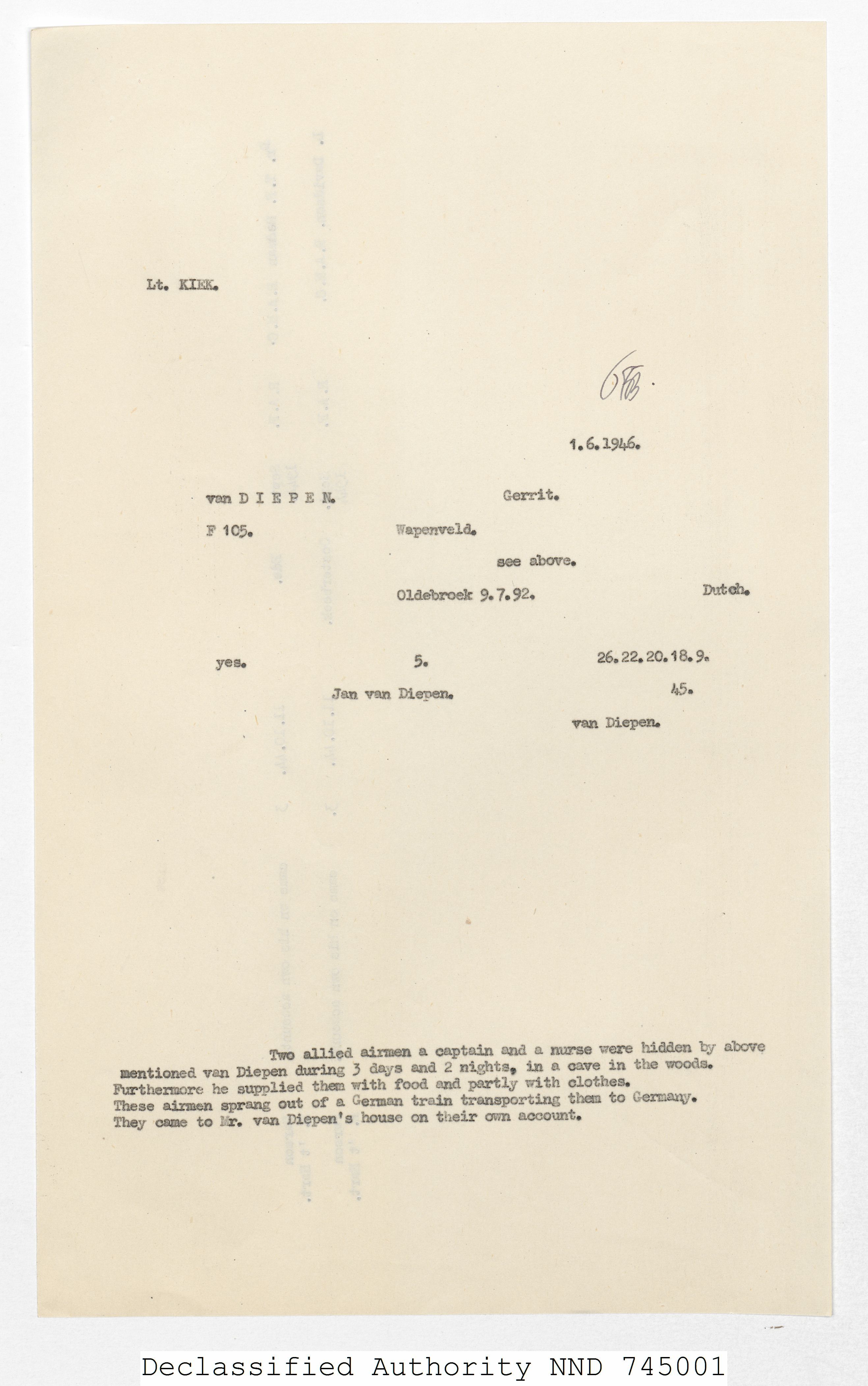
Link to the section Wapenveld- ✓ The first night and the hole in the wood. Lt Kiek's typed note of 1 June 1946 on Gerrit van Diepen has them in his care first (his note, p. 2; his table, p. 3).
- It says "Two allied airmen a captain and a nurse were hidden by above mentioned van Diepen during 3 days and 2 nights, in a cave in the woods", that "These airmen sprang out of a German train transporting them to Germany", and that they "came to Mr. van Diepen's house on their own account".
- His table has "Dr. T.F. Redman R.A.M.C." and "L. Davidson R.A.M.C.", hidden from "11.10.44" for 3 days and passed to "N. 't Hart".
- His memoir has a house in the woods about 11 pm, a girl who spoke English, a night in the haystack, and next morning a hiding place under a trapdoor, "about twelve feet by twelve feet square", where a Calvinist minister came at seven that evening and questioned them (Davison).
- De zwarte herfst has the girl, the haystack and a hide-out in the wood "about four metres square"; 't Hart remembered: "Samen met Henk Pool heb ik hen opgehaald uit dat hol, dat door jongens was gemaakt in het bos. We hebben beide para's stevig aan de tand gevoeld, omdat het heel goed vermomde Duitsers konden zijn" (with Henk Pool I fetched them out of that hole, which boys had made in the wood; we questioned both paras hard, because they could well have been Germans in disguise) (Dekkers and Vroemen, pp. 203–205).
- ◐ The "cave in the woods" of van Diepen's form is very probably that hole; van Diepen's three days against the memoir's one are under Where the sources disagree.
- ✓ The manse. The two were then about six weeks at Wapenveld with Nico, the minister there, and Lena, in the attic of the vicarage, hiding in the roof of the church next to the house when a raid was likely (Davison). The minister's own forms for the Americans tell the same stay.
- Ds. Nicolaas 't Hart of Wapenveld listed "Cpt. T. Redman R.A.M.C." and "Pte. L. Davidson R.A.M.C." from October 1944 for 40 days: he "Feched him in the woods, where he hided himself, after he jumped out of a train, when he was on transport to Germany as POW", and passed them on to "H. Kloosterziel Heerde" (his form of 18 February 1946); his first form, in the interviewer's pencil, gives 42 days (the pencil original).
- ✓ De zwarte herfst names him: when the questioning at the hole was done, "Hij stelde zich voor als Nicolaas 't Hart" (he introduced himself as Nicolaas 't Hart), and after a walk of about seven kilometres the house was the manse of Ds. N. 't Hart, minister at Wapenveld, with his wife Lena (Dekkers and Vroemen, p. 203). So "Nico" was Ds. Nicolaas 't Hart: the same village and the same two men.
- After the war Redman went back to 't Hart "for informations" (the remarks). His second form of 1946 has three more men reaching him in January 1945 from "Miss Kalkema, Apeldoorn / Hospital Sprengenweg", among them David Ward, the RAF bomb aimer hidden on the Veerman farm before Murphy (the form); his first form dates Ward and De Lange only "1944" and Sherriff "Jan.45" (the first form).
- ✓ The helpers around the manse. W. D. van Dommelen of Wapenveld listed "Dr. Redman Davison" for 42 days (the form's dates are muddled, 15 October and 11 September 1944), received from H. Pool of Wapenveld and passed on to C. Docter, and "gave a suit to Dr. Redman and didnot get it back; gave him food and tobacco" (his table; his remarks).
- The baker had his own form: Cornelius Dokter, baker, Zuiderzeestraat E 53, Doornspijk, born 21 October 1918, who "Provided food, clothes, cigarettes and comforts while the pilots Davidson and Redman were staying with Domine (Padre) 't Hart" (his form, p. 2, 1 March 1946). The memoir's "Mr. Doktor but in fact was a baker" told them to be ready to leave (Davison); De zwarte herfst has "bakker Docter" a frequent visitor (p. 203).
- In the house, by his memoir, an elderly Jewish man had been hidden for some months; De zwarte herfst has 't Hart name him "Meneer Van Straten" (real name Staal) and keep the two parties from knowing of each other (Davison; Dekkers and Vroemen, pp. 204–205).
- ◐ To Elburg.
- By the memoir a courier, "Henk", led them by night on the same tyreless bicycles, about an hour on cobbles, a German lorry asking Redman the way to Amersfoort, to "a very large house" full of airborne evaders and RAF men; by the memoir Redman recognised fellow medical officers there, "Captain Lippman Kessel" and "major 'Shorty' Longland", and the next evening they left in "various vehicles" for the Rhine (Davison).
- In De zwarte herfst "a certain Henk" fetched them, a ride of nearly thirty kilometres, to the house "Old Putten" of the Rambonnet family at Elburg, where sixteen other paras were, and lorries took them on the next day (p. 203).
- ⚠︎ Kessel's own book puts him in the barn at the assembly point, not at Elburg (Where the sources disagree).
- ◐ Adrian Davies, a fighter pilot lodging at Elburg with Mrs Docter-Scholten, told Noordman about 1990 that on 17 November about twenty Allied men waited in a barn near a farm, among them "kapitein Redman en kapitein Noble", and that when the lorry had not come "keerde ik in gezelschap van soldaat Davison … terug naar mijn onderkomen bij de weduwe" (I went back, with Private Davison, to my lodging with the widow) (Noordman, pp. 257–258). The only account that names Davison at Elburg on that night.
- ◐ Johannes van de Brake of Doornspijk lists Noble (not Davison) from 28 October to 19 November, 21 days, as received from "Group Oud Putten" (his table, p. 14). That is the same Rambonnet group's house that took Davison in, and the network that sent the lorry of twenty from Elburg that both men were on. Noble's report names his Doornspijk farmhouse as Jan van den Brink's and a farmer "Hannes", so that van de Brake was Noble's helper rests on his own form and on reading "Hannes" as Johannes (Noble; Charles Noble; Noordman, pp. 284–285).
With Murphy
Link to the section With MurphyPegasus II, 17–18 November 1944
Link to the section Pegasus II, 17–18 November 1944He came to Pegasus II from the north. Boeree's chronicle of Ede (1947) has the lorry of "Elburgers" reach the assembly point late, after the column had passed Westenrode an hour before and the firing had been heard at about half past ten: "De wagen had te vroeg halt gehouden en de mannen uitgeladen" (the lorry had stopped too early and unloaded the men), "Van de 40 mannen waren slechts 24 gekomen" (of the 40 men only 24 had come), and they were put "bij de anderen in het bosch" (with the others in the wood) (Boeree, p. 201, read on the image). Boeree names none of them. In Noordman's account, which cites Boeree, the twenty off the Elburg lorry, Davison among them, were led to the right point by the seventeen-year-old Jewish boy Bart van der Hoeden after the main column had long gone (Noordman, pp. 284–285). There, by Hardy's dating on the night of 18 November 1944, Murphy's small party found them (the three accounts of which night the Elburg men arrived are under Where the sources disagree):
We followed them to a spot about 602880 where we met another party of evaders, about 20 in all, I think, amongst whom were Pte. DAVISON … and Pte. MOORE … (Report No's IS9/WEA/1/263 & 262)
— MI9 · Pte J. Hardy, 16 Parachute Field Ambulance · IS9/WEA/1/270/2351 · 13 January 1945 · the report
The lorry that was to take them on never came, and they spent the rest of the night and the next day in the wood; at three in the morning of 20 November Hardy, Branford, Murphy, "JOHN" (◐ Haller) and "the other Paratrooper" (◐ Walsh) went back towards Otterlo, and Banwell stayed with the larger party (Hardy; Operation Pegasus II). Davison's own accounts tell the night differently: he and Redman at the back of a long column that was fired on at the front and scattered (Where the sources disagree).
The barn and the ride, 24–25 November
Link to the section The barn and the ride, 24–25 NovemberHe met Murphy again on 24 November, in a barn in the Otterlo area, ◐ J. van Essen's at Harskamp by Noordman: "In the barn I met Pte. DAVISON", with an RAF officer and four American airmen (Hardy; Noordman, p. 285). The next evening the three British soldiers were moved on together:
We stayed there overnight and the following evening DAVISON, MURPHY and I were taken by DICK and another member of the Underground to a nearby farm. Here we met three more men and a woman, each of whom had a bicycle. DAVISON, MURPHY and I rode pannier fashion with the men while the woman rode on ahead as guide. We cycled to the outskirts of BARNEVELD … using the main road all the way. Unfortunately one of the bikes broke down on route and for about 3 miles one of the bikes had to carry three of us.
— MI9 · Pte J. Hardy, 16 Parachute Field Ambulance · IS9/WEA/1/270/2351 · 13 January 1945 · the report
Three more men met them with three spare bicycles just outside Barneveld, and "On approaching ACHTERVELD … DAVISON left us with two of our guides while MURPHY and I continued our journey with GHYS" (Hardy). Hardy gives only "GHYS" and "one JAN"; Noordman identifies them as ✓ Gijs van Zijtveld and ◐ Jan Dijkstra of Achterveld (Noordman, p. 286; Operation Pegasus II). Noordman has Davison taken on to Wijnand van Veldhuizen's farm at Scherpenzeel (Noordman, p. 286). No source has them meeting again; neither his memoir nor his citation names Murphy.
The Dijkstras and Scherpenzeel
Link to the section The Dijkstras and Scherpenzeel- ◐ The Dijkstras.
- His memoir has a helper he knew as Jan ter Wall take him on the crossbar of a bicycle to a family he named after the war as the Dijkstras, whose head was the manager of the local public baths and whose two "teenage" sons Jan and Faulkner (◐ Fokke) were in the resistance; German soldiers were billeted a few doors away, and German NCOs came in for coffee while he sat as "the deaf and dumb cousins from Amsterdam" (Davison).
- ◐ Where Hardy's two guides took him on 25 November, the memoir does not say: it brings him to the Dijkstras from a cow barn on the afternoon after Pegasus II, not from the ride with Murphy (Where the sources disagree; Jan Dijkstra; Boke Dijkstra).
- ◐ To Scherpenzeel.
- After about ten days, with the Germans searching house to house for the men of Pegasus II, Jan ter Wall took him about 15 km on the crossbar to a farm at Scherpenzeel: the farmer Wynand, his wife, two boys, and Jan's own hideout. There he found Tex Banwell and Victor Moore, who had been there two weeks, "since immediately after the Pegasus two ambush"; the three slept in the chicken house and helped with the farm work (Davison).
- Charles Noble, who came to the same farm in early December, wrote that Davison had hidden there before his crossing (Noble); Noordman reads that as Noble having been at the farm "gelijktijdig" (at the same time) with Davison "volgens eigen verklaring" (by his own statement), which Noble's report does not say (Noordman, p. 286).
- ⚠︎ Noble's own later account (unpublished private papers, shared with us privately), told long after the war, does say it: at the farm "there were several British including a sergeant whose name I cannot remember and a person Davison", and Davison was "the only one of the group, to my knowledge, who managed to get back over the Rhine". It is late memory, and it sits badly with the dates: by Davison's memoir he left on 5 December, and by Noble's report Noble came about 6 December (counted back from "about 16th Dec").
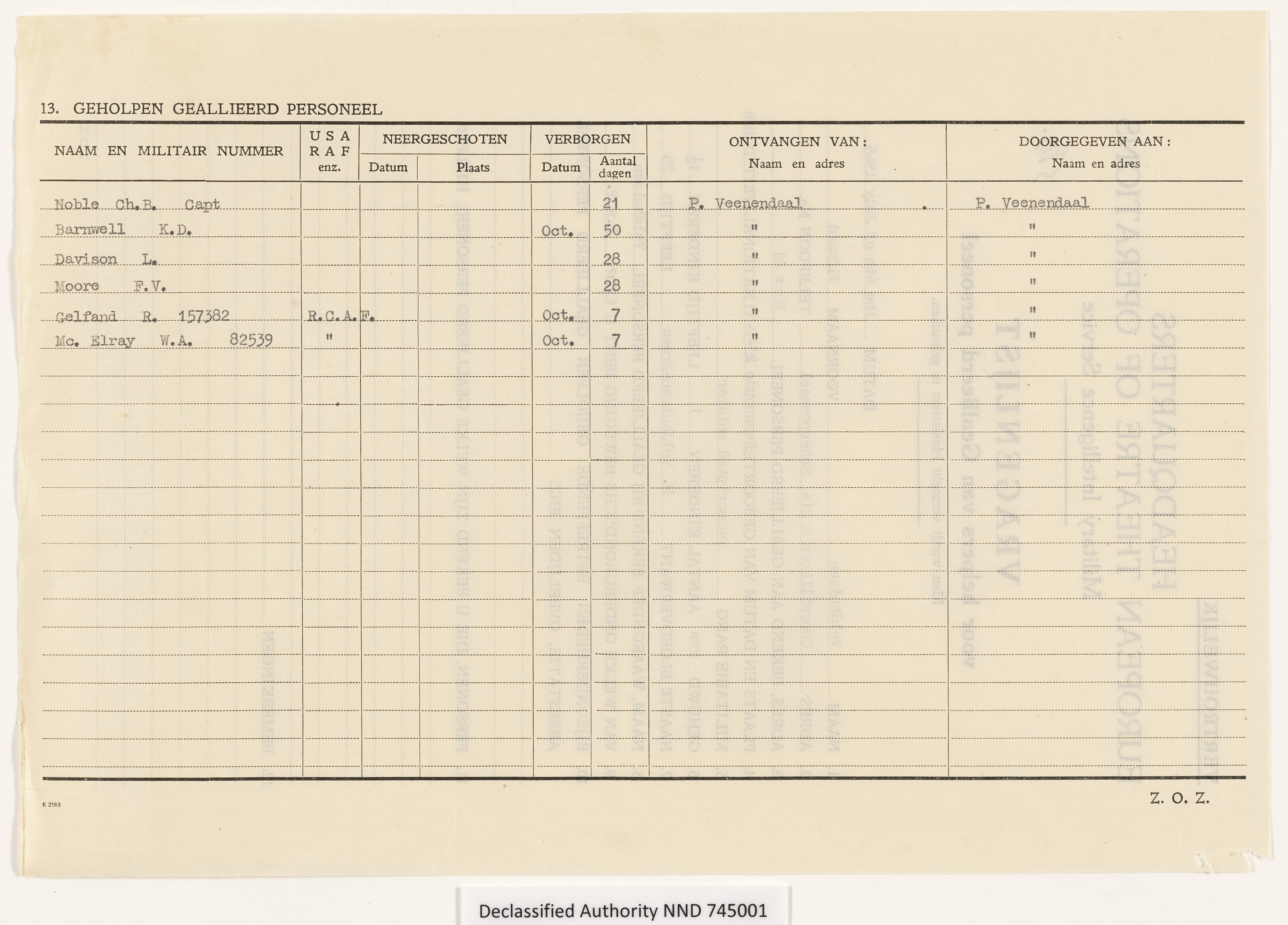
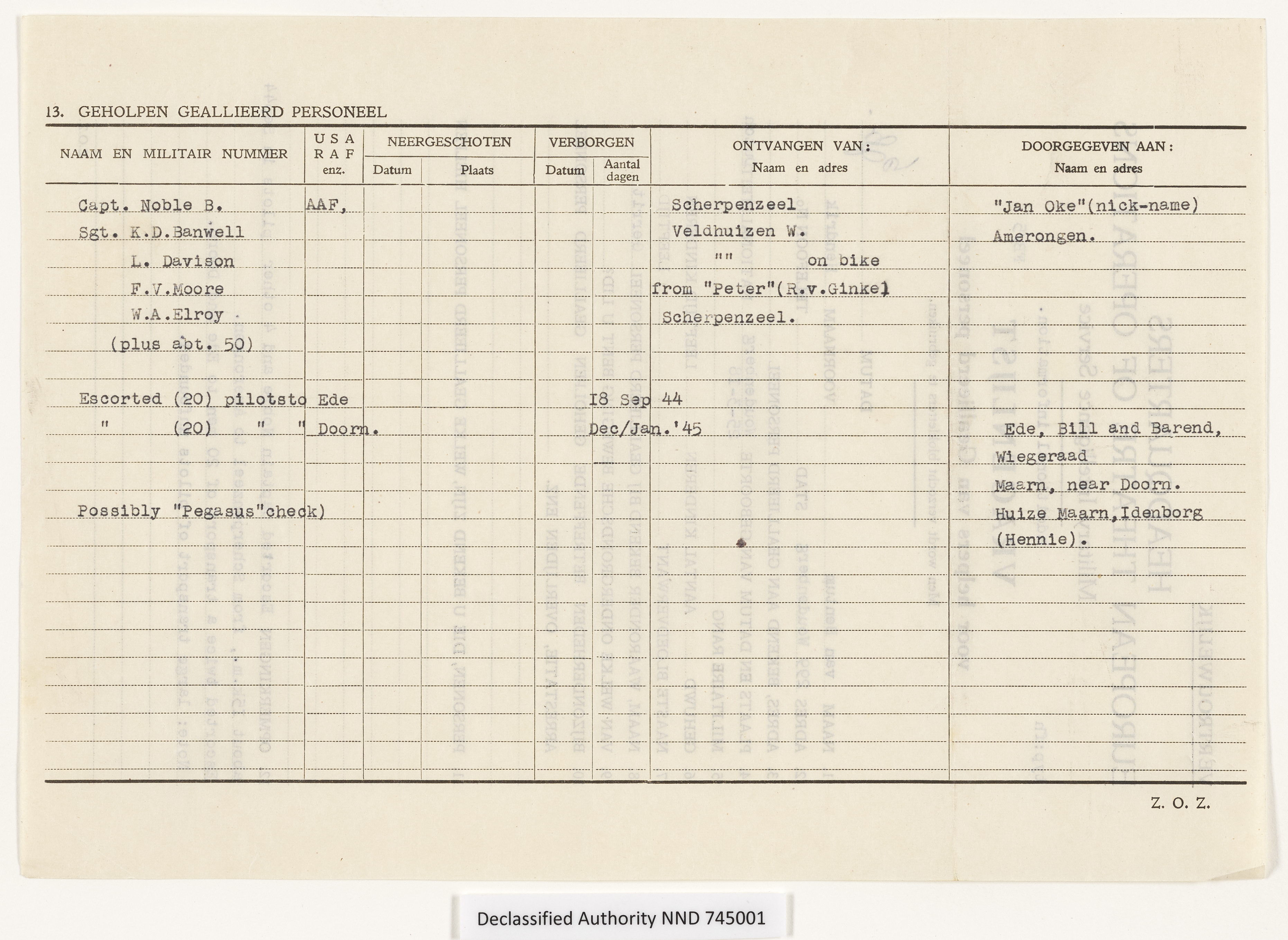
- ✓ The farmer's form. Wijnand Veldhuizen, of Gooswilligen, Scherpenzeel: "Davison L.", 28 days, received from and passed to "P. Veenendaal" (Piet Veenendaal), on a sheet with "Moore F.V." (28), "Noble Ch.B. Capt" (21) and "Barnwell K.D." (50) (his table, p. 3; the form, p. 2). ⚠︎ The 28 days cannot be a stay at the farm (below).
- ✓ Van Bentum.
- He is one of the five names H. van Bentum of Woudenberg gave, from memory, of the Allied personnel he lodged "with unsuccessful crossings" (the letter does not say which of the five were lodged that way): "Capt. Charles B. Noble / Serg. K.D. Banwell / L. Davison / F.V. Moore" (van Bentum's letter of 18 January 1946, p. 18), and van Bentum's table of helped Allied personnel lists "L. Davison" with Noble, Banwell, Moore and W.A. Elroy (his table, p. 9; Hoogland family).
- ◐ Davison's memoir names a frequent visitor to the farm, "Willems", a captain in the underground and leader of the local group, "I have known Willems as Henk van Bentum since 1969", when Davison first went to the September remembrances at Arnhem (Davison).
The dinghy, 5–8 December 1944
Link to the section The dinghy, 5–8 December 1944- ✓ The citation. On 5 December, "in spite of his host's reluctance", he and another escaper set off with a rubber dinghy, their guide soon left them, they waded floods and crossed the Rhine, and on 8 December a British patrol found them in a deserted house (the recommendation, p. 3). The other escaper was Victor Moore, whose own citation tells the same last journey (WO 373/64/399, pp. 1–2).
- ◐ His memoir.
- A rubber dinghy from a shot-down aircraft sank under the three of them in the duck pond, so "it was decided that Vic and I would go and Tex would stay behind and take his chances with the resistance".
- On the evening of 5 December Wynand cycled them to a T-junction on the Utrecht–Arnhem road and turned back; a sentry fired at them in the dark, they dumped the bicycles, and they hid the next day in the hay of a deserted cowshed with German soldiers below.
- At midnight, when the sentries on the towpath changed, Moore got into the boat and Davison swam behind pushing it; on the far side a signpost read "Nijmegen 20 km", the road was under water, and at dawn they hid upstairs in a flooded house near Zetten, where a Canadian patrol in a D.U.K.W. took them to Nijmegen (Davison).
- ◐ In De zwarte herfst. The children of Wijnand Veldhuizen, on the next farm, found the dinghy: "Aan dat bootje hebben Victor Moore en ik onze vrijheid te danken" (Victor Moore and I owe our freedom to that boat); Veldhuizen took them by bicycle to the Rhine on St Nicholas's Eve, they hid in a haystack until the next evening, Moore got into the boat and Davison, "als geoefend zwemmer" (as a trained swimmer), pushed it across; they found the way to Elst, where a Canadian patrol picked them up (Dekkers and Vroemen, p. 204).
The mention and later
Link to the section The mention and later- ✓ The recommendation. The D.M.I. at the War Office put him up for a mention in despatches "from the escape angle" on 4 March 1945, as "14315742 Pte. DAVISON, Leslie. / R.A.M.C. att'd 3 Para Bn. 1 Airborne Div.", on one minute with Victor Moore and four other airborne escapers; the list went to the airborne corps headquarters on 7 March (the recommendation, p. 2).
- ✓ Gazetted. Mentioned in despatches for his escape, gazetted on 20 September 1945, "14315742 Pte. L. DAVISON.", under the Royal Army Medical Corps (London Gazette, p. 4685); Kew's award entry has "Mention in Despatches, Reference: BM/588/45; IS9/WEA/1/263/2315" (WO 208/5275/3635).
- ✓ His reports. His MI9 report is WO 208/3351/2315, "Appendix A Included. Appendix C Included" (the entry), and his escape report, of 10 December 1944, WO 208/5409/14, with his birth date and a list of the people it mentions, Redman, Townsend, Longland and Kessel among them (the entry). Neither is digitised, and neither is held here. His army record is WO 423/1523329, closed until 2040 (the entry).
- ◐ Home. By his memoir he and Moore were interrogated at Nijmegen, went to Brussels the next day and flew home to "Northbolt Park aerodrome" [sic], and he was given three months' leave (Davison).
- ◐ In 1994.
- The NRC Handelsblad reporter wrote that Davison, then "71" (70 by the birth date in his escape report, 18 January 1924), had hidden at Ermelo and in the attic of a little church at Wapenveld before he was brought to Pegasus II (Ermelo is in none of his other accounts), and dates the encounter with the Germans 16 November, with about 75 men.
- In the article's one quotation of him he describes the night: "Ik liep achteraan in de rij. Plots hoorden we mitrailleurvuur vooraan, toen was het lopen en wegwezen" (I was at the back of the line. Suddenly we heard machine-gun fire at the front, and then it was run and get away) (NRC Handelsblad, 18 October 1994).
- Noordman lists correspondence with him from 1987 to 1997 and interviews in 1989, 1992 and 1994 among his sources (Noordman, the list of sources).
Theo Redman after Pegasus II
Link to the section Theo Redman after Pegasus II◐ Redman got back only on 6 February 1945, by his own recollection in 1984, after hiding with the Rouwenhorst family at Barneveld; "Na bijna drie maanden zag ik kolonel Warrack en majoor Lipmann Kessel terug" (after nearly three months I saw Colonel Warrack and Major Lipmann Kessel again), the resistance having taken him to the other divisional doctors at the end of 1944, and several attempts to cross the rivers "op 6 februari 1945 eindelijk gelukte" (finally worked on 6 February 1945) (Dekkers and Vroemen, p. 204; Graeme Warrack, Lipmann Kessel).
Where the sources disagree
Link to the section Where the sources disagreeHis number. The Pegasus Archive page gives "Army No. : 7384504", with his unit as 16 Parachute Field Ambulance (Davison). The London Gazette gives "14315742 Pte. L. DAVISON" (p. 4685), as does every Kew entry for him: his MI9 report, his escape report and the recommendation for his mention, which also has him attached to the 3rd Parachute Battalion (the recommendation). The same issue of the Gazette gives 7384504 to "Corporal (acting) Harold Roy COULING, Royal Army Medical Corps (Plymouth)" (p. 4684), and Kew has that number under Couling twice: one entry (WO 373/55/363, "Henry") gives his regiment as 16 Parachute Field Ambulance, the other (WO 416/80/96, "Harold Roy") only the Royal Army Medical Corps (the catalogue entries). ✓ 14315742 is Davison's; ◐ the archive page has taken Couling's number, and very probably his unit.
The day he jumped from the train. 7 October 1944 in the Kew catalogue entry for his escape report of December 1944 (WO 208/5409/14); "about the 10th of October" in his memoir, written 56 years on (Davison); and in 1984, in De zwarte herfst, the evening of Friday 13 October, with "Op vrijdag de dertiende" in his own words (Dekkers and Vroemen, pp. 201–202). ⚠︎ Three dates six days apart. 13 October 1944 was a Friday, and the book is the only source here to date the train's departure from Apeldoorn; Hardy and Haller's escape from the same barracks was on the night of 6/7 October, at about 00:15 on the 7th by Hardy (Hardy). Gerrit van Diepen's form has Redman and "Davidson" in his cave in the woods at Wapenveld from "11.10.44" for 3 days (p. 3): ⚠︎ if the date is right the jump was on or before the 11th, not on Friday the 13th. Noordman, who interviewed Redman, has Redman jump at Wapenveld on 7 October (Noordman, p. 314). ✓ Warrack's diary, ◐ near-contemporary (no source says it was written the same day), has the train Redman was on (he is named on the 6 October list of officers, p. 41) loaded on 5 October, held in Apeldoorn station on the 6th and 7th with the line broken, and gone by the morning of the 8th (the diary, pp. 39–42; the roll, pp. 51, 53, 55). ◐ Davison's place on that train rests only on the roll's (c), which does not agree with the 6 October list for every officer (above). That fits Kew's 7 October and Noordman's, and the memoir's three days in the station, and is against their train leaving Apeldoorn on 13 October (the diary's next train, a Red Cross train of 12 October: Warrack could muster only 12 of the 40 lying cases asked for, Kramer was to collect more from other hospitals, Logan and Jeffrey went as the doctors, and the counts fell by 17 patients and 11 staff, so about ten orderlies went too; it does not name Redman, pp. 44–45); ◐ the diary alone does not rule out an orderly leaving on it. ◐ The jump itself is not dated by the diary; the Dutch forms of 1946 give dates from memory.
✓ Lt-Col Martin Herford's report of 1944, written by a man who was at Apeldoorn that week, has the hospital train of 5 October still "awaiting engine" on the 7th and gone "during the night for the Hanover region" by the 8th (Herford's report, Journal of the RAMC, vol. 98 (1952), p. 298, read on the page image; Martin Herford). ◐ Warrack's diary has the train still in the station at 09.00 on 7 October ("News through that the train has failed to get away even yet") and "Reported that train has left" at 09.00 on the 8th (the diary, pp. 41–42), so with Herford it left between the morning of the 7th and the morning of the 8th, by his word in the night. That fits the Kew entry's 7 October only if it left before midnight and the jump came that same evening; a jump in the night's later hours would be the 8th, and nothing we hold dates the train's leaving more closely. Herford does not name the men on it, and the 13 October of De zwarte herfst fits no train in either diary or report.
The first days at Wapenveld. Gerrit van Diepen has them three days and two nights in the cave (p. 2); the memoir has one night in a haystack and one day in the hole before the minister came that evening (Davison).
How long he was at Wapenveld. The forms give 40 to 42 days and his memoir about six weeks; De zwarte herfst has "seven weeks", which from 13 October would end on 1 December, after Pegasus II (Dekkers and Vroemen, p. 203). ⚠︎ It cannot be seven weeks if the Elburg lorry came to the march of 17 November, five weeks after the 13th. Counted from van Diepen's 11 October and three days in the cave, the forms' 40 to 42 days at the manse would run to 23–25 November, after the lorry too: the day counts are all approximate.
Who was at Elburg. ⚠︎ His memoir has Redman recognise "Captain Lippman Kessel" and "major 'Shorty' Longland" at the house at Elburg the night before the march (Davison). Kessel's own book has him and "Shorty" Longland in the barn at the assembly point with Maguire and Warrack before the march: "Shorty! Dan!" Warrack greets them in the hen-house (Kessel, pp. 122–129), and Boeree puts Longland and Allenby in command of the main body that marched from there (Boeree, p. 179). Redman's own words in De zwarte herfst, that he saw Kessel again "na bijna drie maanden" (after nearly three months), at the end of 1944, do not fit a meeting in mid-November either: three months from mid-October is mid-January at the earliest (p. 204).
Where he was on the night of Pegasus II. Hardy has him in the party of about twenty that missed the main column and waited in the wood (Hardy); Boeree has the Elburg lorry arrive after the column had gone and the firing had been heard, and its men put in the wood (p. 201); Noordman has him off that lorry (pp. 284–285). ◐ Davies's account in Noordman has Davison back at Elburg on the night of 17 November, the lorry not having come; Henk then told them the main body would not cross before Saturday evening, 18 November, and that evening, "omstreeks tien voor zeven" (about ten to seven), the lorry arrived and left at "tien voor halfacht" (ten to half past seven, 19:20) (pp. 257–258), which fits Noble's Saturday and Hardy's dating against Boeree's and Davison's own. The Ede manuscript says the twenty or thirty from the north Veluwe were to gather on the evening of the 17th at van de Brink's, arrived too late, missed the column, and had to hide all day on the 18th in the wood behind his house (Ede manuscript, p. 46); both are later retellings. ⚠︎ The sources put the Elburg men's arrival on different nights. Boeree dates his chapter's evening 17 November, with the firing heard at about half past ten (the next page, p. 202, opens "Zondagmorgen 18 November" with the Tommies unattended in the wood, though 18 November 1944 was a Saturday: Boeree); Hardy has his own party set off at about 1830 hours on 17 November, lose its guides, shelter through the next day, and leave "at about 1730 hours (18 Nov)" for the lorry point where, after about two hours' waiting and a dash down the road, they met the twenty; Noble has the Elburg lorry delayed by a control and leave "the following morning" after "On or about Friday, 17th Nov", which is Saturday the 18th, and believes the main party was intercepted "at about midnight" (Noble). Not settled; the date question is under Operation Pegasus II.
- His own accounts put him in the column. In 1994 he told the NRC Handelsblad that he was at the back of the line when the machine-gun fire came from the front (NRC Handelsblad); De zwarte herfst has him and Redman at the rear when shots were fired at the front (pp. 203–204).
- His memoir has the column of about 120 scattering after an hour's march; four of them, Noble, two glider pilots and himself, hid in a cow barn, and Jan ter Wall took him from there that afternoon to the Dijkstras' (Davison). The memoir does not mention Murphy, Hardy, the barn or the ride of 25 November.
- Noble's own report of the same night names Capt. Redman as the man he went out with on the reconnaissance for food, and has the party "left at the wrong spot", which missed the main column and waited in a wood, then five days in a barn; it does not mention Davison until Scherpenzeel (Noble). ⚠︎ His own later account, told long after the war, has "something like fifteen to twenty people" taken by lorry from Elburg to near Otterlo, "late", with "Theo Redman whom I knew from 133 Field Ambulance", and does not name Davison there either.
- Hardy wrote within two months; De zwarte herfst is forty years on and the memoir 56. De zwarte herfst also goes from the haystack straight to Scherpenzeel and "a week and a half" there, with nothing of the Dijkstras or the ride of 25 November; his memoir has the Dijkstras for about ten days first.
How long Moore had been at the farm. The memoir has Moore and Banwell there for two weeks when he arrived, "since immediately after the Pegasus two ambush". ⚠︎ Hardy has Moore in the Roekel dug-out from 20 November ("Here we found five more evaders including Pte. MOORE"), and Moore's own citation has him go back alone to Barneveld after three days there and, "towards the end of November", be taken to Scherpenzeel, where "another escaper" joined him (Hardy; WO 373/64/399, p. 2). The citation fits the memoir's order, Moore first and Davison joining, but not two weeks.
How long he was at the Scherpenzeel farm. ⚠︎ Veldhuizen has Davison and Moore 28 days each (p. 3). The citation has them leave on 5 December and De zwarte herfst has them arrive "a week and a half" before, after Pegasus II; counting the memoir's ten days at the Dijkstras' from Hardy's 25 November leaves nothing; counted from the memoir's own start, the day after the march, they end about 28–29 November. Twenty-eight days back from 5 December is 7 November, before Pegasus II. ◐ Veldhuizen's figure looks like an estimate of his share of their time in the area, not a stay at his farm.
Whose farm he stayed on. De zwarte herfst has Veldhuizen's children on the farm next to the one where Davison stayed ("op de boerderij naast de onze", p. 204). His memoir puts him on the farm of Wynand the farmer, and Noordman on "de boerderij van Wijnand van Veldhuizen" (p. 286); ✓ Veldhuizen's own form lists "Davison L." (his table), the strongest evidence for his farm and not a neighbour's.
The night he crossed, and who found him. The citation has him set off on 5 December and be found by a British patrol on 8 December (the recommendation, p. 3), and Moore's citation has the 8th for the patrol too (WO 373/64/399). His two later accounts both have them hide through 6 December and cross that night: by the memoir they crossed at midnight and a Canadian patrol in a D.U.K.W. found them at dawn near Zetten, which is the morning of 7 December (Davison); De zwarte herfst has a Canadian patrol pick them up near Elst (p. 204). ⚠︎ The 7th or the 8th, a Canadian or a British patrol: not settled.