Albert van Meerveld
Nijkerk 1 Oct 1909 – Wöbbelin 14 Mar 1945
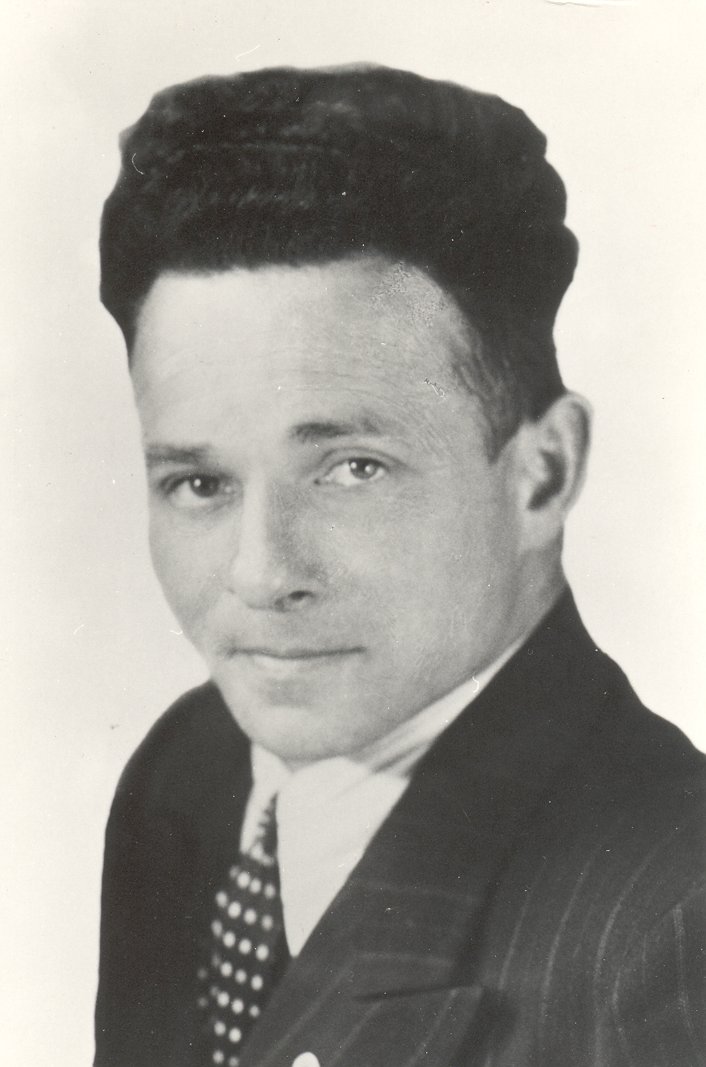
About: Albert "Ab" van Meerveld, cover name "Prins", of Group Hein, who moved Allied evaders around Barneveld until he was arrested at Dries Klooster's house on 8 December 1944; he died at Wöbbelin in March 1945, and is ◐ very probably Charles Noble's "Ape".
Unit or role: Group Hein: his questionnaire has "Head organiser of the organisation 'Hein'", and the In Memoriam written after his death calls him one of its founders (his questionnaire, p. 3; the In Memoriam); the LO-Barneveld, by the resistance's memorial book (Het grote gebod, p. 237). By trade the manager of "Zaadhandel Robertus", grain and seed merchants at Barneveld (the American report, p. 5).
Where: Born at Nijkerk; Romeynstraat 18, Barneveld, until he went into hiding at his wife's parents' farm, Blankenhoefscheweg 2, Zwartebroek; his firm's storeroom at Kampstraat 8, Barneveld; arrested at the Klooster house, Amersfoortsestraat, Barneveld; Apeldoorn, Kamp Amersfoort, Neuengamme, Wöbbelin.
Evidence: ✓ his helper file with the Americans, US National Archives 286708870 (questionnaire, report, list of men); ✓ the LO-LKP's form for its book of the fallen, February 1946 (NIOD, p. 1, p. 2); ◐ civil records, index entries only, the register scans not opened; ✓ the Amersfoort and Neuengamme papers; ✓ the War Graves Foundation's file and biography; ◐ the "Ape" identification is by name and house; the date does not support it (below).
He was born at Nijkerk on 1 October 1909, the son of Teunis van Meerveld, a farmer, and Antje Jonker, and was a works manager of 33 when he married Hendrika van 't Hof at Barneveld on 11 March 1943 (civil records). The War Graves Foundation's biography of him, by Gerjan Crebolder, gives her birth as 3 December 1918 at Barneveld and has a son born to them that October (Oorlogsgravenstichting). His questionnaire gives his birthplace as "Appel (distr. Nijkerk)" and one child, aged one in August 1945 (p. 3). The LO-LKP's form of February 1946 has his religion "Gereformeerd" and, against his parents, his mother, a widow, at Voorthuizen (NIOD, pp. 1–2).
Group Hein
Link to the section Group HeinThe Encyclopedia of the Righteous Among the Nations has Diet Eman and her fiancé Hein Sietsma found the group with fourteen friends, "including Albert (Ab) and Hendrika (Riet) van Meerveld", naming it after Hein and as "an acronym of the words 'Helpt Elkander In Nood' ('Help Each Other in Need')" (Michman and Flim, vol. 1, 2004, the entry for Eman, search snippets, not read on the page). ⚠︎ Eman's own book has him "with Hein Sietsma, the co-leader of our group (Group HEIN)" (Eman, Things We Couldn't Say, 1994, unread search snippets, no page numbers).
The form the LO-LKP's memorial committee had filled in for him at Barneveld, dated February 1946, gives his cover name as "Prins", the people he worked with as "Hein en Henk Sietsma en Diet Eman", his work as "Jodenverzorging Onderduikers" (care of Jews, people in hiding), "Nieuws verspreiding" (spreading news) and "Piloten", and adds that "Hij was in naam wel bedrijfsleider bij Robertus maar sinds September deed hij enkel illegaal werk" (he was still works manager at Robertus in name, but from September he did nothing but illegal work) (the form, p. 1, read on the scan; one line on when he began is hard to read).
Crebolder's biography has the group, which grew more or less out of church youth work, working on its own and never joining a national organisation; its contact address was the J.L. Robertus seed firm in the Kampstraat, where the group's weapons were kept. It says he "zou hebben voorkomen" (is said to have prevented) the Germans' requisition of horses in September 1944, by a raid on the office holding the horse-registration papers, and with a hand in starting the underground paper "Voor Vrijheid, Waarheid en Recht" that month (Oorlogsgravenstichting). The horses are in the In Memoriam too:
When in Sept. '44 the Germans wanted to requisition horses, he said very firmly: "If I can prevent that, it will not happen." And it did not happen. When the Moffen [the Germans] came to the office of the P.B.H. to ask for the registration papers, these turned out to have been taken in a raid by Ab and a couple of helpers.
Dutch originalToen in Sept. '44 de Duitsers paarden wilden gaan vorderen sprak hij zeer beslist: „Als ik dat kan verhinderen, zal het niet gebeuren". En het gebeurde ook niet. Toen de Moffen op het bureau van de P.B.H. kwamen, om de registratiebewijzen op te vragen, bleken deze te zijn gekraakt door Ab met een paar helpers.
— "Piet" · In Memoriam Albert van Meerveld (Ab Prins), 1946 · NIOD, archive 251a Stichting LOLKP · the transcript
Evasion work
Link to the section Evasion workThe Americans' report on him, written at The Hague on 24 May 1946 from what Mrs Klooster, Mrs van der Woerd, Mrs van de Heg and G. van Schuppen of Amersfoort told them, gives his war (pp. 5–6). With grain short under the occupation he had time on his hands and joined the underground. For the first two or three years he worked mostly for Dutch Jews, finding them hiding places and keeping them in food, clothes and ration cards, and he took part in sabotage. About September 1943 the men of the evasion work reached him, among them Hein Sietsma of Nijkerk and Klooster. His first airmen were two of the crew of a plane brought down near Hooglanderveen in the autumn or winter of 1943, whom he took to the farmer Bouwman at Zwartebroek. He had to give up his house in Barneveld, Romeynstraat 18, and go into hiding at his wife's parents' small farm at Zwartebroek, spending his nights there and at Klooster's by turns. He kept a stock of clothes and food in a storeroom of his firm, Kampstraat 8, and by van Schuppen's count at least fifty Allied pilots and paratroopers passed through his hands.
According to witnesses, he had assembled quite a substantial stock of clothes and food in one of the storage-rooms of his firm, Kampstraat 8, Barneveld, and so could always meet immediate requirements. … Mr. van Schuppen, Amersfoort, who knew him very well, states that at least 50 allied pilots and paratroopers went through van Meerveld's hands, and confirms that the last months of his activities before his arrest were entirely devoted to evasion-work.
— US National Archives · RG 498, helper file of Albert van Meerveld · report, The Hague, 24 May 1946 · the archive's copy
The list of men "handeld [sic] by Albert van Meerveld" includes two American and a Newfoundland airman and Pte J. N. Bright of the 11th Parachute Battalion, taken by him to Klooster's house, and three more whom he and Klooster took from there to Otterlo (p. 7). Other helpers' forms show the same work from their side:
- Mrs Heine-van Bentum of Barneveld had "Berry, 1 Air. Div." and Cox from "A. van MEERVELD, BARNEVELD" on 1 November 1944 for 14 days, handed on to A. van Rouwenhorst; her summary has three men, Dr Lawson among them, handed over by Van Meerveld, "who fetched them afterwards", where her table has Lawson from A. v.d. Heg (her table, p. 3; p. 5). This J. Berry of Battersea (his list, p. 7) is not the Canadian Wilfred Berry.
- Cornelis Lof's table has four men received from "A.B. Meerveld" on 24 November 1944, among them "Capt. A.F.W. Low 180708 | Gl. pil.", hidden for 68 to 87 days and passed on to the widow van der Woerd, G. van Schuppen and Scherpenzeel (Lof's file, p. 10).
- ✓ B. R. H. Eman, Diet Eman (the Americans' letter to her of 17 January 1946 is addressed "Aan Mejuffrouw Diet Eman" (p. 6); the encyclopedia gives her names as "Berendina Roelofina Hendrika"), wrote on her own form that "I worked together with A. van Meerveld who died", on ration cards, food, hiding addresses and moving pilots around Barneveld (her file, p. 7).
- Aart van de Heg "worked with van Meerveld (his chief)" (his file, p. 8): more on Aart van de Heg.
With Murphy
Link to the section With MurphyNo source puts him with Murphy. His path crosses Murphy's through Charles Noble, the doctor who was ◐ in Murphy's party when it was fired on on the night of 2–3 January 1945 (no source says they were captured together; see Noble's page). Noble was hidden at the Klooster house in Barneveld for ten days, after Pegasus II, which he missed (his report does not name the operation, but has him set down at the wrong place on the Ede–Otterlo road and then five days in a barn), and wrote that after he left, "the KLOOSTER's house was raided and another man who had rendered assistance in the way of tobacco, etc, 'APE' was arrested. I have no information as to his fate" (Noble).
- ◐ Noble's "Ape" is very probably "Ab", the name he went by (the In Memoriam's "(AB PRINS)"; the encyclopedia's "Albert (Ab) van Meerveld", the Klooster entry), heard by an Englishman; the house and the arrest match.
- ⚠︎ Noble gives no dates, and the date does not support the identification. His "That night" follows his sentence on the arrest of his Achterveld host's son, but may mean the night he came to Achterveld.
- His own count runs ten days at Klooster's, three at Achterveld, then ten at the Scherpenzeel farm before the move on "about 16th Dec". ◐ By our arithmetic that puts the night about 3 December, five days before the Dutch date; his figures are estimates, so this does not disprove the identification.
- ◐ Cornelis Lof's table has two Americans and Sjursen, the men Noble describes as "two USAAF officers and one Canadian private" in the Klooster house, received "from Klooster" on 4 December 1944 (Lof's file, p. 10), so the house was being emptied of evaders four days before the raid; that neither settles the date nor rules out Noble's dating.
- The Dutch records date the raid to 8 December (the LO-LKP form, p. 2; the American report, p. 6), and the son, ◐ Fokke Dijkstra, was taken on the 15th (Huurdeman).
- His own file ties the two men. The last entry on the list of men he handled is "C.B. NOBLE, 1st Airborne Div.", with two Americans and "J. STURSEN, 1st Can.Scotl.Rgt.", ◐ the Cpl Sjursen of the Canadian Scottish who had jumped from the Utrecht train with Schjelderup, all "Names given by Mr. G.v.Schuppen" (p. 7).
Tex Banwell, later Murphy's companion, came to the same Klooster household on 20 November 1944 from A. v.d. Heg, whose own file has him working with Van Meerveld "(his chief)", the American interviewer's wording (Klooster's file, p. 3; Aart van de Heg's file, p. 8).
The raid of 8 December 1944
Link to the section The raid of 8 December 1944The Germans came for Klooster at about half past four in the morning of 8 December 1944. Klooster's wife gave the two men time to destroy and hide papers, and Klooster got into a prepared hiding place; Van Meerveld would not, saying they had come for Klooster, not him, "as his real name was not known to them" (the American report, p. 6, from Mrs Klooster). The LO-LKP form gives the arrest date and, to whether his imprisonment was directly connected with his work, answers in four lines: "Arrestatie niet. Hij was in een gezocht huis waar waarschijnlijk zijn ze later meer van hem te weten gekomen en hebben hem daarom vastgehouden" (not the arrest. He was in a house that was being sought, where probably they later found out more about him and therefore held him); a pencil note at its foot has him "ondergedoken" (in hiding) and sleeping at Klooster's (the form, p. 2, read on the scan).
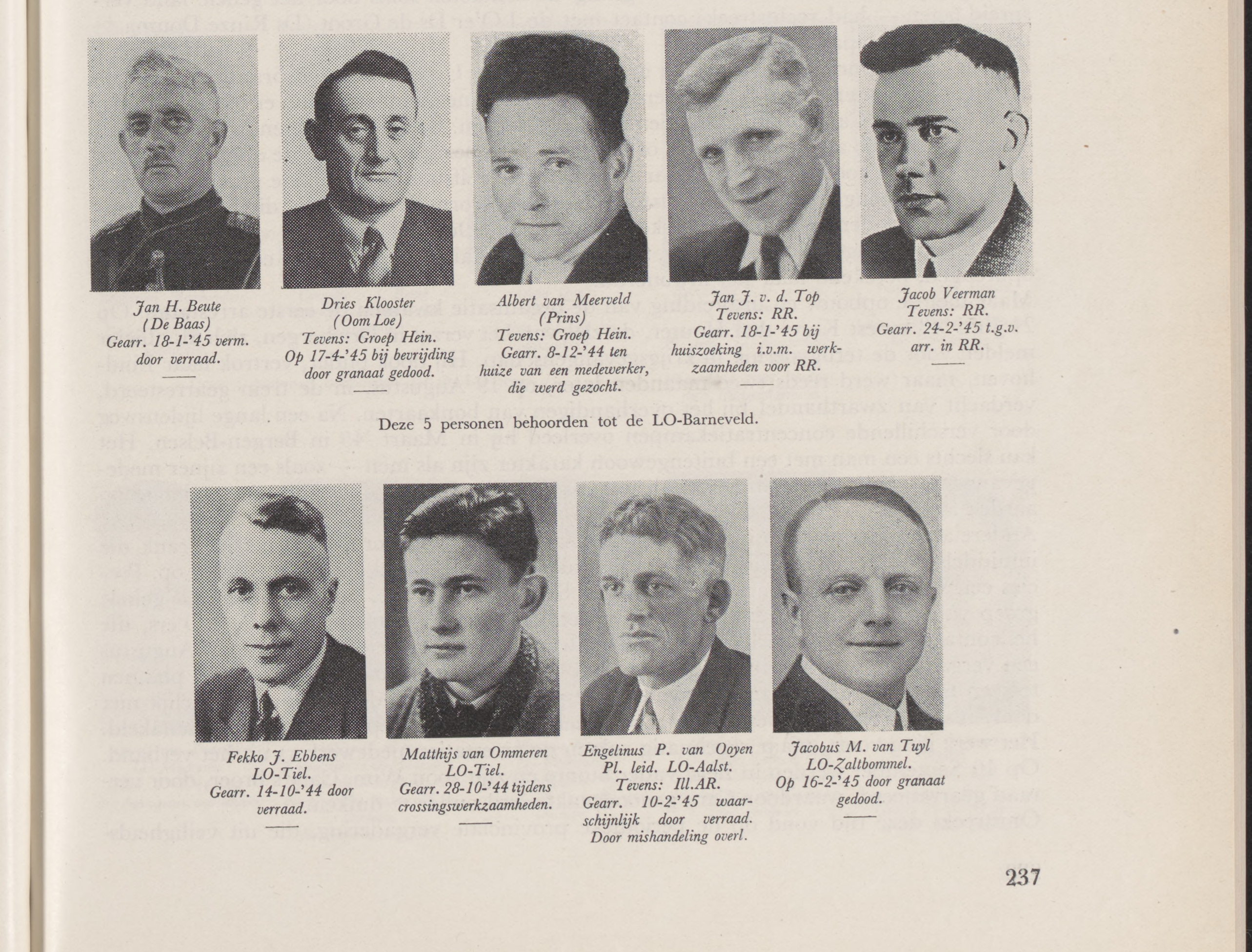
Dries Klooster and Jacob Veerman are two of the other four of the LO-Barneveld on that page (Het grote gebod, p. 237, read on the page). The Encyclopedia of the Righteous Among the Nations puts him in the raid in two lines: Dries Klooster "managed to escape detection by utilizing a hiding place he had prepared, but his friend Albert (Ab) van Meerveld, who was visiting, was apprehended" (Michman and Flim, vol. 1, 2004, pp. 414–415, in copyright, the entry only). Eman tells the raid twice, differently (see Where the sources disagree).
Why he was taken
Link to the section Why he was takenThe American report gathered what its witnesses said about it (pp. 5–6). It says that "It seems" the Gestapo were looking for him under his cover name "A. P r i n s", with "some confusion as to how the Germans finally knew that Prins and van Meerveld were one and the same person" (p. 5). Under "Reasons for arrest" it then says, in this order:
According to Mr. van Schuppen, Amersfoort, Mr. Lokker, Amersfoortsche Straat 15, Barneveld, and Mrs. Klooster, the Germans never knew anything about van Meerveld's evasion-activities, in spite of the fact that he hardly did anything else. Some people say that one Mr. S c h u m a n, Barneveld, who had been arrested on the same day, saw van Meerveld at the Gestapo H.Q. and denounced him to the Germans as being "A. Prins". This is contradicted by Mr.Lokker, who was present at Schuman's first interrogatory and heard Schuman tell the Germansthat [sic] van Meerveld assisted a conference of the O.D. held on September 5th or 6th 1944.
— US National Archives · RG 498, helper file of Albert van Meerveld · report, The Hague, 24 May 1946 · the archive's copy
- ⚠︎ Three different claims. The first sentence is given to Van Schuppen, Lokker and Mrs Klooster together. The Schuman story is "some people say", with no one named. Lokker's contradiction is an eyewitness account, given in the report's words, not his own, and it denies only the naming as "A. Prins". None is first-hand to us, and no other record of any of them has been found.
- Lokker, who says he was present at Schuman's first interrogation, denies that Schuman named Van Meerveld as "A. Prins"; by Lokker's account Schuman told the Germans that Van Meerveld had "assisted" (◐ attended, on our reading, from the French assister à) an O.D. meeting on 5 or 6 September 1944. He is also named, second of three, in Van Schuppen's list further down, of men who are "suppoesed [sic] to have given names of their organisation to the Germans".
- By Van Schuppen, the Germans "were not specially looking for van Meerveld, who was only arrested because he was in Klooster's house and was then taken, tortured and deported as an underdiver, so evidently a resistance-man". The report then has him say that Klooster "was wanted by the Gestapo following the arrest of" Kamphuis of Kootwijkerbroek, Lokker of Barneveld and Schuman of Barneveld, who, in the report's words, are "suppoesed" to have given those names. ⚠︎ The report does not say whose words "suppoesed" are, Van Schuppen's or its writer's, and no other record of it has been found.
- ⚠︎ The "some people say" sentence has Schuman "arrested on the same day" as van Meerveld, and Van Schuppen has Klooster wanted "following the arrest of" Schuman; the report also has the Germans come for Klooster at about half past four in the morning of the 8th. It does not say how these fit.
- It ends: "It may be taken that van Meerveld was arrested not for evasion-activities, but that this arrest was a logical consequence of this work, which was the reason for his presence in Klooster's house at the moment it was raided" (p. 6; the "not" is typed in above the line).
- The LO-LKP form's own answer is quoted above: it was not the arrest itself; he was in a house that was being sought, and they "waarschijnlijk" (probably) learned more about him later and held him for that.
- ⚠︎ Eman's book, from unread search snippets with no page numbers, has the Nazis raid Klooster's home "because they had received a tip that Allied pilots were being hidden there", and the Gestapo "very happy to snatch Ab, because he had become known to them as 'the man in the leather jacket'; he was on their most-wanted list" (Eman). It is the only source on this page that gives a tip about pilots as the reason for the raid.
The In Memoriam has only "Tragisch is het dan ook, dat hij gearresteerd werd door een misverstand" (it is tragic, then, that he was arrested through a misunderstanding) (the transcript).
Apeldoorn, Amersfoort and Germany
Link to the section Apeldoorn, Amersfoort and GermanyThe American report has the Germans take him at first for a man in hiding, then to the Apeldoorn prison, where he was tortured for a fortnight before he reached Amersfoort barely able to walk, without betraying anybody:
The Germans at first took him for an underdiver and took him to their H.Q. and afterwards to the Apeldoorn prison, where he was horribly tortured for a fortnight. He was then transferred to the concentration-camp at Amersfoort : eye-witnesses declare that he was by then hardly able to walk. It is certain, however, that in spite of the tortured [sic] he never betrayed anybody.
— US National Archives · RG 498, helper file of Albert van Meerveld · report, The Hague, 24 May 1946 · the archive's copy
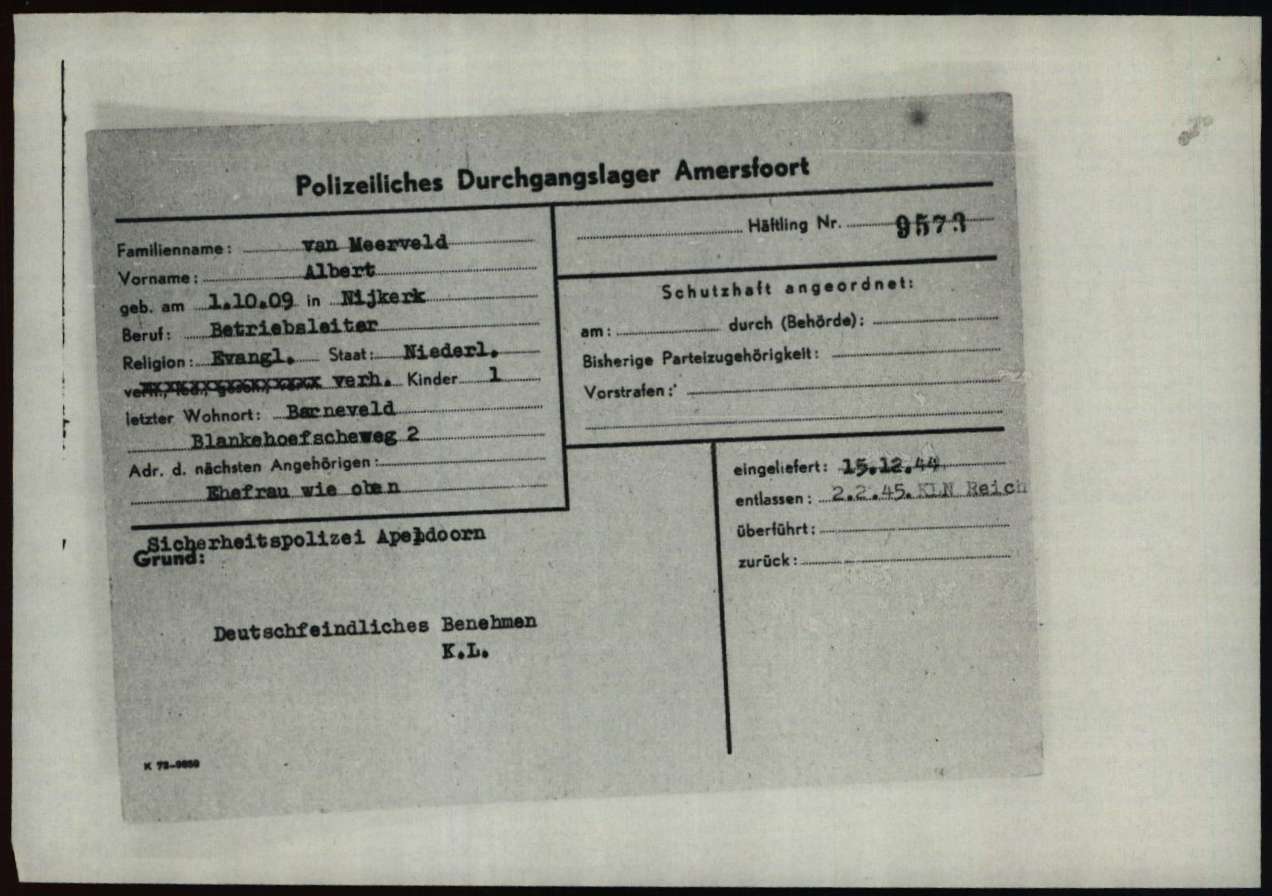
The Oorlogsgravenstichting has him tortured at the Willem III Kazerne at Apeldoorn and sent to Kamp Amersfoort a week later (Oorlogsgravenstichting); the LO-LKP form has "1 week in de gevangenis in Apeldoorn" (p. 2). The camp's card has him as Amersfoort prisoner 9573, a works manager, married with one child, of Blankehoefscheweg 2, Barneveld, sent in by the Sicherheitspolizei Apeldoorn for "Deutschfeindliches Benehmen", anti-German conduct, and marked K.L., delivered 15 December 1944 and released 2 February 1945 "KL ins Reich" (to a concentration camp in Germany) (the camp files). ◐ He and Fokke Dijkstra, prisoner 9607, left Amersfoort on the same day, so very probably went east on the same transport (the camp files).
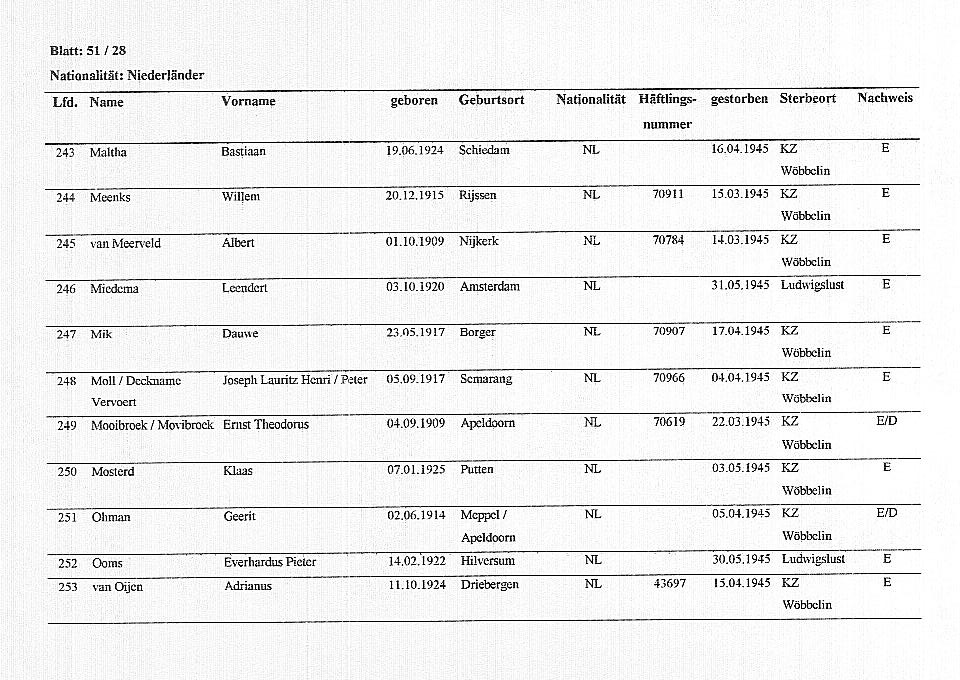
The American report has him deported "on the 2nd of February 1945 (Neuengamme)" and dead "at Wobeln (Near Neuengamme)" on 14 March (p. 6). The Digitaal Monument Neuengamme has him arrive at Neuengamme on 4 February 1945 from Amersfoort, with Kampen in his detention history between them (the monument). ✓ At Neuengamme he was prisoner 70784. The post-war list of the Dutch dead has "van Meerveld | Albert | 01.10.1909 | Nijkerk | NL | 70784 | 14.03.1945 | KZ Wöbbelin", and the Arolsen tracing card for him (Office for the Registration of Dead) has "Td.tag: 14.3.45" (the list; the card). No record found says when he went on from Neuengamme to Wöbbelin, a camp where, the Foundation's letter reports, the first Dutch prisoners "zouden" (are said to) have arrived on 12 February 1945; Crebolder's biography has him moved there on 2 February (the Foundation's letter on Wöbbelin, in Gerrit Kamphorst's file).
He died on 14 March 1945; Crebolder's biography has it ◐ "als gevolg van dysenterie" (of dysentery), "zou zijn" (reportedly) (Oorlogsgravenstichting). The Dutch Red Cross's list of Netherlanders who died in Germany has "van Meer-veld | Albert | 1.10.09 | Nijkerk | 14.3.45 | a. Gr. Laasch | VIII Ndl 646": the death reported to the register office of Gr. Laasch (Nationaal Archief 2.19.323, inv. 1233, line 224, read on the scan). In January 1948 a letter to the WAST's liquidation service in Berlin asked for his death certificate, giving his last home as Barneveld, Romeijnstraat 18 (the Arolsen file, document 104134480, machine-read).
His grave is not known: the War Graves Foundation's questionnaire leaves it blank, the LO-LKP form has "In Wöbbelin. Waarschijnlijk daar. Niet zeker" (probably there, not certain), and the Neuengamme monument gives Wöbbelin (Ludwigslust) (the questionnaire; the form, p. 2; the monument).
The papers after the war
Link to the section The papers after the war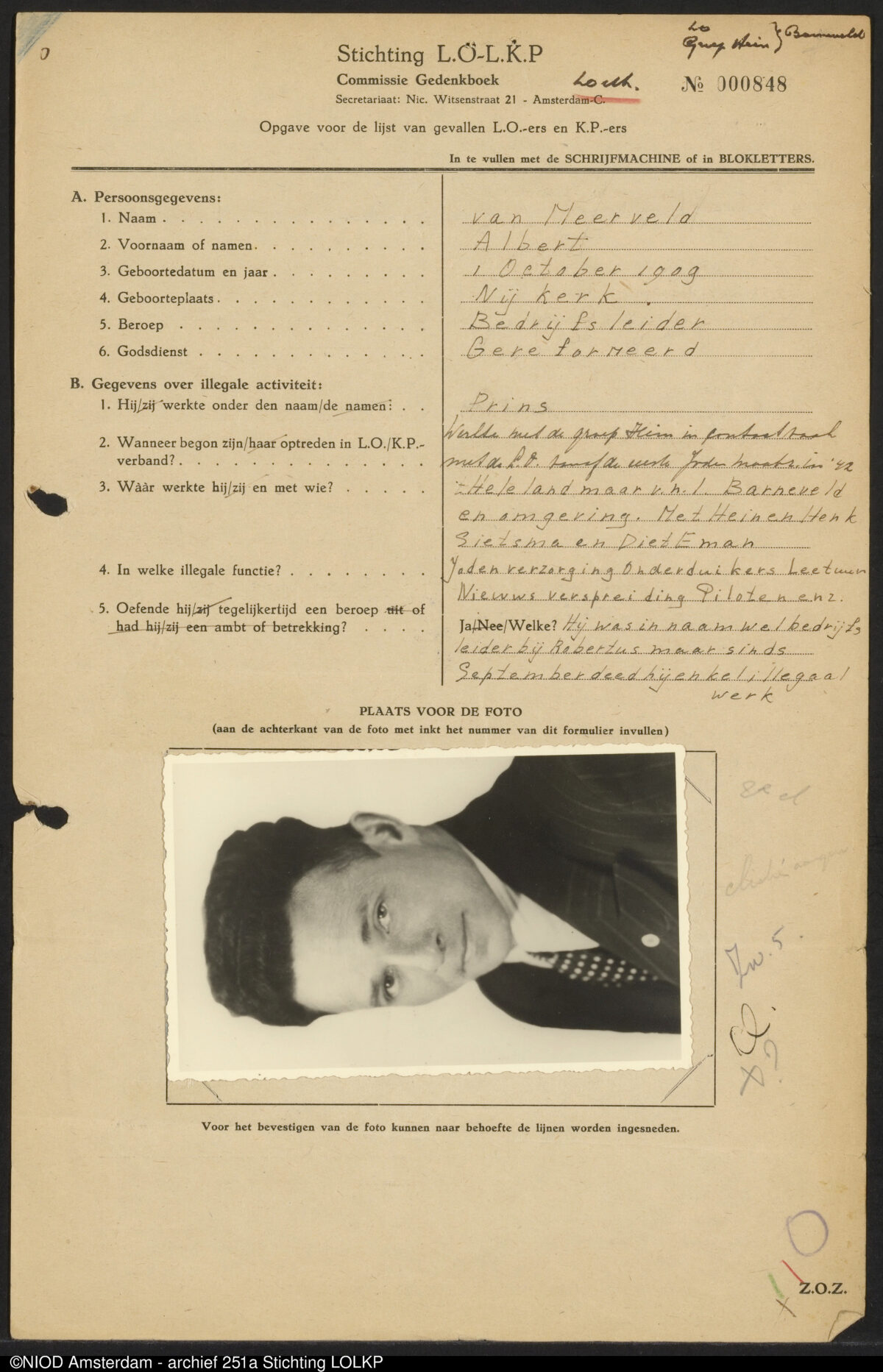
The form's last answer gives the reason for his resistance: "v. Meerveld's verzet sproot niet alleen voort uit zijn Vaderl. liefde maar ook uit zijn geloof" (his resistance sprang not only from his love of his country but also from his faith) (p. 2). The In Memoriam signed "Piet", with his photograph, calls his little office at Barneveld "het centrum van het werk op de Veluwe" (the centre of the work on the Veluwe) and ends "Hij viel voor het vaderland"; the clipping shows no paper or date (a hand has written "5-46" under it), and Crebolder's biography quotes it from De Zwerver of 2 February 1946 (the transcript; Oorlogsgravenstichting).
On 5 December 1945 G. van Schuppen wrote to the American intelligence service at Wassenaar that a list of men "van A. van Meerveld te Zwartebroek thans te Barneveld" should have reached IS9: "De man is in een kamp te Duitschland overleden. Heeft veel gedaan voor piloten en parachutisten" (the man died in a camp in Germany; he did a great deal for pilots and paratroopers), and that his widow had been forgotten, asking for a bicycle, clothing and a food parcel for her (Van Schuppen's file, p. 12, read on the scan).
The War Graves Foundation's file on him is three scans. The questionnaire it sent to his widow in July 1958 has Albert van Meerveld, born at Nijkerk on 1 October 1909, died 14 March 1945, Reformed, Bedrijfsleider, left for Germany on 2 February 1945, the reason "Illegale werk", and, against who arrested him, "onbekend" (the questionnaire). Barneveld's form of July 1957 gives "Wöblin Dl." for the place of death and 14 March 1945 for the day, and answers "ja, niet vrijwillig" to whether he went to Germany under compulsion; the Ministry of Justice's stamp of 29 July 1958 says the archives show no "politieke handelingen of gedragingen" that led to a penalty from the Bijzondere Rechtspleging (the post-war special courts) (Barneveld's form). The Erelijst van Gevallenen, the national roll of honour, has him on p. 606: "Meerveld, van / Albert / Nijkerk 1·X·1909 / Bedrijfsleider / Neuengamme 14·III·1945" (the Erelijst, read on the folio). A photograph is filed under his name and birth date on Kamp Amersfoort's site of prisoners' photographs; its file name ends in "95731", where his camp card has 9573 (the photograph).
Awards and remembrance
Link to the section Awards and remembrance- The Americans. His folder's cover has "Grade 5" struck through and "UPGRADED to POSTH. AWARD GRADE 4" (p. 1). They awarded him the Medal of Freedom without palm, posthumously, for service "September, 1943 to December, 1944" (General Orders 319, 5 November 1946; p. 8; the recommendation naming his widow, p. 11), with a citation and a printed certificate over General Eisenhower's signature (p. 10; p. 21). In January 1947 he was on the list of posthumous awards still to be presented to the families (p. 18).
- ◐ The Utrechtsch Katholiek Dagblad's roll of honour from the ceremony in Utrecht on 12 March 1947, where about twenty of the hundred medals were given posthumously, has "A. v. Meerveld, Terschuur", very probably him, posthumously: the Yad Vashem notice of 1977 has his widow at Terschuur (below) (the article, read on the page image).
- The British. A Posthumous Commendation "for services to the Allied Cause", duration of service three years (WO 208/5457/22, 25 June 1946; WO 208/5275/2492, "Posthumous Certificate", BM/4151; the catalogue entries); the British index of Dutch helpers has "v.MEERVELD, Albert" of Zwartebroek, certificate 9372, grade "4. Post." (the index sheet; the index README).
- Yad Vashem. The Nieuw Israelietisch weekblad of 2 December 1977 lists among the Dutch honoured by Yad Vashem "mevrouw Hendrika van Meerveld- Van 't Hof te Terschuur en postuum haar man Albert van Meerveld" (the notice, the KB's text, not read on the page); the Encyclopedia of the Righteous marks him as having an entry of his own, in volume 2, which has not been read.
- Zwartebroek. Crebolder's biography says a street in Zwartebroek was named after him, at the request of the local association and of private people (Oorlogsgravenstichting).
Where the sources disagree
Link to the section Where the sources disagree- When and where he was arrested. The American report, the LO-LKP form and Het grote gebod have 8 December 1944 at the Klooster house (report, p. 6; form, p. 2; p. 237). The Digitaal Monument Neuengamme has "Gearresteerd op 18-11-1944", "Gearresteerd in Apeldoorn of omgeving", by the SIPO Apeldoorn, group "Illegale groep Apeldoorn" (the monument). The monument is compiled and gives no source for it. The Foundation's biography and the Encyclopedia of the Righteous also give 8 December, and Eman's snippets (⚠︎ unread), but they are later and probably not independent of the accounts above (Oorlogsgravenstichting; Michman and Flim).
- How long at Apeldoorn. A fortnight in the American report; a week by the LO-LKP form and the Foundation's biography (report, p. 6; form, p. 2; Oorlogsgravenstichting). His Amersfoort card has him delivered on 15 December 1944, a week after the arrest (the camp files).
- Why he was taken. "Deutschfeindliches Benehmen" on the camp card; the American report has him taken for being in the house; the Foundation's form, filled in for his widow, gives "Illegale werk"; the Neuengamme monument "verzet" (the questionnaire; the monument).
- Shot, or died in a camp. The struck-through remark on his questionnaire begins "Albert van Meerveld was shot for the underground work", with "de Jongh says no claim. Was not shot for pilot work" written beside it (p. 3), and Jacob de Boer's form has "A. van Meerveld Wilhelminastraat Barneveld (shot)" (de Boer's file, p. 2).
- ◐ That is very probably him: Barneveld's 1957 form has his last known address as "Wilhelmina[…] 48", the street name not read with confidence (the form), against Romeynstraat 18 in 1948, and Aart van de Heg too lived in the Wilhelminastraat (his file, p. 8). Every camp record and the Foundation have him die at Wöbbelin.
- Where he died. Wöbbelin on the Neuengamme list, the tracing card and the Foundation's file; "Neuengamme" on the Erelijst; the Red Cross list has the death reported at Gr. Laasch (the list; the Erelijst; the Red Cross list).
- When he reached Wöbbelin. Crebolder's biography has him moved there on 2 February 1945; the American report has him deported on 2 February 1945; the Neuengamme monument has him arrive at Neuengamme on 4 February; the Foundation's letter has the first Dutch prisoners reaching Wöbbelin on 12 February (Oorlogsgravenstichting; report, p. 6; the monument; the Foundation's letter).
- Group Hein and the LO. Crebolder's biography has the group never joined to a national organisation; the LO-LKP's own form has him with Group Hein in contact with the LO, and Het grote gebod counts him among the LO-Barneveld, "Tevens: Groep Hein" (Oorlogsgravenstichting; the form, p. 1; p. 237). The Foundation's page also gives him a rank, "Sectie Cdt.", in the "N.B.S.", which no other record has (Oorlogsgravenstichting).
- His trade. Manager (bedrijfsleider) of the Robertus firm on every Dutch record and the American report; ⚠︎ Eman's book, "Ab was a sales representative" (Eman, unread snippet).
- His church. Geref. Godd. on the Foundation's questionnaire, Gerk [sic] on Barneveld's form, "Gereformeerd" on the LO-LKP form; the camp card has Protestant (the Foundation's file; the form).
- His wife's age. His questionnaire, filled in for him in August 1945, gives it as 37 (p. 3); born on 3 December 1918 by the Foundation's biography, and 24 at her marriage in March 1943 (Oorlogsgravenstichting; civil records), she was 26. ◐ The 37 is probably a slip.
- The years of his work. The American summary sheet says his house was a transit house for Allied men "in 1942 and 1943" (p. 2); the report and the award give September 1943 to December 1944 (pp. 5, 8).
- ◐ Why he was at the Klooster house on 8 December. The Americans' report and Eman's two tellings differ.
- The American report has the Germans come for Klooster, and Van Meerveld refusing to hide because "his real name was not known to them" (p. 6); the LO-LKP form's pencil note has him sleeping there while in hiding (p. 2).
- ⚠︎ Diet Eman's book, from unread search snippets that could not be read on the page and have no page numbers, has him "at the Kloosters' almost coincidentally on the 8th", and elsewhere that "He went to Barneveld to warn Dries Klooster; but Dries had already disappeared, and Ab was arrested at the Klooster address" (Eman, Things We Couldn't Say, 1994).
- Eman also has him as "the man in the leather jacket" on the Gestapo's most-wanted list (same snippets), the name Crebolder's biography gives too (Oorlogsgravenstichting); the American report has the Germans not know his real name. ⚠︎ Check the book itself.