Sgt A. Gri MM
Trail, British Columbia 25 Dec 1917 ◐ – ?
About: Sergeant Armando Gri of the Canadian Scottish, a garage owner from Trail, British Columbia, was taken at the Leopold Canal on 7 October 1944, jumped from the prisoner train at Utrecht on 23 October and was hidden round Maartensdijk and Hilversum (Before). He crossed the Rhine from Amerongen with Murphy's party on 2 January 1945 and, with Schjelderup and Hardy, reached a British post near Dodewaard (With Murphy).
Unit or role: Sergeant (K46862), C Company, 1st Bn The Canadian Scottish Regiment, commanding 14 Platoon in October 1944 (Two Came Back!, p. 1); a garage owner at Trail before the war (his MI9 report).
Where: Trail and Kelowna, British Columbia; the Leopold Canal, Oosthoek, October 1944; Hollandsche Rading, Maartensdijk, Hilversum and Groenekan, October to December 1944; Amerongen from late December.
Evidence: ✓ the recommendation for his Military Medal and for his DCM; ✓ the Gazette entries; ✓ "Two Came Back!"; ◐ his MI9 escape report (transcript; the Kew original not seen); ✓ the Dutch helpers' forms; ✓ the MI9 liberation reports of Swartz, Briere and Berry; ✓ the Nelson Daily News, 1944 to 1946; ◐ its 1941 items (Before).
◐ Born 25 December 1917, by his MI9 report, which has him of Trail, British Columbia, and a "Garage Owner" before the war (the report); the press calls him "a native of Trail" and gives ages that do not fit the date (Where the sources disagree). ◐ The Nelson Daily News, read on the page images, has an "Armando Gri of Trail" marrying in May 1941 and called up that August. The tie to this Gri is inferred: the name, Trail, a wife from Kelowna (where the 1944 report of his being missing puts his wife) and a "3 years, 7 months" of service that his report gives Schjelderup too.
- Marriage announced, May 1941. ◐ In its Trail column of 2 May the paper reports that his bride "left Thursday for her home at Kelowna, where her marriage to Armando Gri of Trail takes place Saturday", which was 3 May (2 May 1941, p. 2).
- A shower item in the same column has the wedding at Penticton on that day. Both are announcements, not a record of the marriage.
- On 29 May the column has "Mr. and Mrs. Armando Gri" at Christina Lake over the holiday weekend (29 May 1941, p. 5).
- Her name is in the paper and is left off here.
- Called up, August 1941. ◐ Trail men called for military training were to report to Vernon on 28 August, and the paper lists him among three Trail men who "left by train for Vernon Wednesday morning", Wednesday being 27 August (28 August 1941, p. 10). The next day: "Mrs. Armando Gri is visiting her parents at Kelowna while her husband is at military training camp at Vernon" (29 August 1941, p. 3).
- ◐ If it is the same man, that is a year before the "September 1942" enlistment the 1944 and 1945 press gives, and in the same summer as the "3 years, 7 months" of army service in his MI9 report (the same figure stands in Schjelderup's column) (Where the sources disagree).
The Military Medal, Calais, 22 September 1944
Link to the section The Military Medal, Calais, 22 September 1944The recommendation for his Military Medal (WO 373/50/62) was for 22 September 1944, outside Calais: as platoon commander he was leading a platoon attack on a strongpoint "being one of the outer defences of CALAIS, northeast of HAMES BOUCRES", when a machine gun opened up on them.
The platoon was pinned down and took cover in ground which was inundated to a depth of about three feet. Shouting to his platoon to give him covering fire, with utter disregard for his own personal safety, Sergeant Armando GRI ran forward through the water, jumped some concertina wire and arrived at a point, in full view of the enemy gun crew, about 30 yards from the gun, and fired at the gunner with his rifle, hitting him between the eyes. He then ran in and threw two 36 grenades into the position.
— 1st Bn The Canadian Scottish Regiment · recommendation for an immediate award, 24 September 1944 · The National Archives, Kew, WO 373/50/62 · the transcription
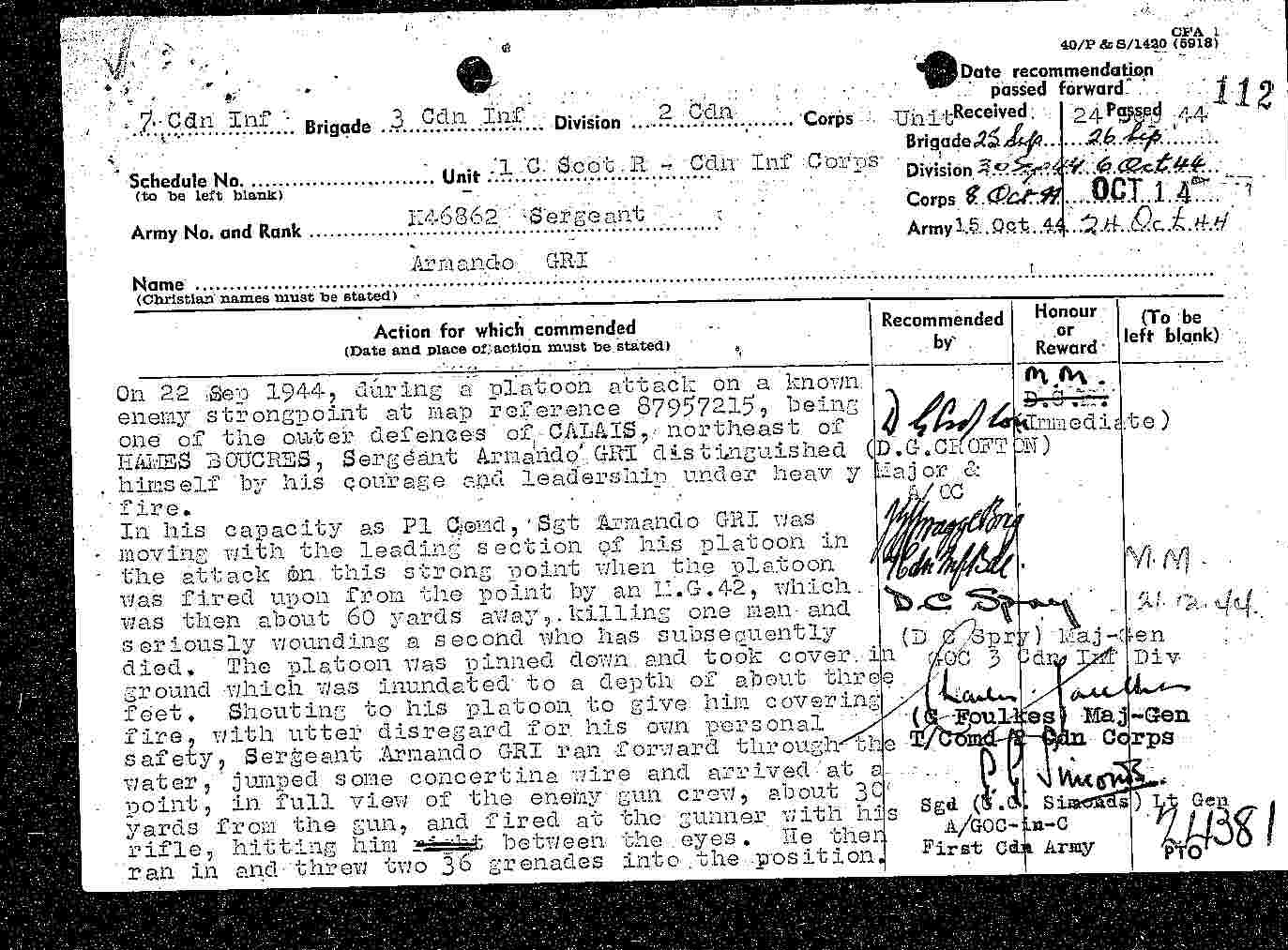
The rest of the gun crew surrendered and the platoon took the strongpoint; the attack was a diversion meant to make the Germans think a large-scale assault on Calais had begun, and the citation says the enemy radio reported that night that it had (p. 2). ✓ The award typed on the form is struck through and "M.M." written above it in ink; ◐ the struck-out award looks like the DCM. It went up through his divisional, corps and army commanders and was signed by Montgomery (the transcription).
◐ Two books from the Archive's full-text index, search hits only and not read on the page: T. Robert Fowler's Courage Rewarded (2008) has him "resourceful enough to hide a small penknife in his anklet", as the recommendation says, but ends "Sergeant Armando Gri received a Mention in Despatches" and the hits do not show the DCM (the hits; the longer passage); ⚠︎ the Gazette has both (below). Dave Brown's Faces of War says he is "identified in records only as Sgt. A. Gri" (the hits), which is as these pages first knew him.
◐ Two more books from the same index, search hits only and not read on the page. Mark Zuehlke's Terrible Victory (2007) has him in the Leopold Canal fight (index pp. 227 and 230): "Sergeant Armando Gri, commanding No. 14 Platoon, had sprinted over to apprise Schjelderup that ..."; he "led it in a desperate gun battle", "only Gri remained in the fight 'against overwhelming odds'", and "Gri was the only survivor from the platoon"; later "Schjelderup and Gri were among the escapees, reaching friendly lines" (the hits). That agrees with Two Came Back! and the DCM recommendation above, and Zuehlke's notes cite Schjelderup's own correspondence, so it is not independent of them. Zuehlke's The Cinderella Campaign (2017), p. 390 by its index, has "a 'C' Company platoon commanded by Sergeant Armando Gri—a tough, competent soldier" at Calais: Major Dave Pugh of D Company "decided Gri's platoon would" break out "by way of the railway gun building"; "Gri and his men slipped off into the darkness", and Gri "finally found an entrance to the main building and the platoon unearthed 105 Germans" (the hits). ⚠︎ The hits give no date, and nothing in them shows this is the 22 September strongpoint attack above (a machine gun and a diversion, northeast of Hames-Boucres) rather than a later night at Calais, so it is not used to add to or correct the Military Medal.
From the Leopold Canal to the jump
Link to the section From the Leopold Canal to the jumpHis first name was Armando (war diary, January 1945, Appendix 22, PDF p. 52 of e011374613). At 04:45 on 7 October 1944, at Oosthoek by the Leopold Canal, he had gone from 14 Platoon, which he commanded, to report at company headquarters when the silent German counter-attack came in. He went back through the Germans throwing grenades, killing at least four on the way, and fought on from house to house and ditch to ditch until he was the last of the platoon, his ammunition gone and the building on fire; his battalion commander's recommendation of him for the DCM says his clothes were burning when he surrendered, and credits him with twenty Germans killed or wounded (Two Came Back!, p. 1; the recommendation, PDF p. 52). At Oostburg he saved some thousands of French francs from the searchers by stuffing them down his trousers, and answered a "Heil der Führer" with "The fewer the better!" (p. 2). On the canal barge, where an Italian labour battalion was put in the hold with them, he talked to the Italians in their own language and they gave the starving Canadians all the food they had (p. 3). His recommendation says the knife was his, and so does the Times Colonist (2016), in the journalist's own voice (the recommendation, PDF p. 52; Times Colonist); ⚠︎ Schjelderup's recommendation says the same of him, that he "successfully concealed his knife" (PDF p. 51, Schjelderup's page); Two Came Back! has only "One man produced a pen-knife" (p. 3). After the jump he and Swartz reached the underground, which made them prove they were not Germans: Bob Porter questioned Swartz for two hours before they were accepted and placed in homes in Hilversum (p. 4). The underground needed instructors for its Bren guns, Stens and PIATs, and "CSM Berry, Sgt Gri, and the others" became its "trusted accomplices"; he went on a raid that destroyed a German supply railway in eighteen places (p. 5; Roy, pp. 372–373, has the men instructing the Dutch and Berry, Gri and others on a raid on a supply train). Neither names Gri as an instructor. The whole story is on Schjelderup's page.
His own MI9 report
Link to the section His own MI9 report◐ Schjelderup's MI9 report (transcript; the Kew original not seen) is I.S.9/WEA/1/271/2349 and covers Gri too, as 272/2350 (Kew WO 208/3351/2349–2350). It has his short section and the Appendix A of Schjelderup's helpers, none of his own; Kew's entry for 2350 says Appendices A and C are included (the catalogue entries), so his own helpers may be listed there. The brackets and footnotes in the transcript are the transcriber's.
- The header. "K46862. Sgt. GRI, A.", "'C' Coy, 1 Bn, Canadian Scottish Regt", born "25 Dec 17", army service "3 years, 7 months", peacetime profession "Garage Owner", of Trail, B.C. (Porter has Trail too, below). His section begins: "From 7 Oct – 23 Oct 44 my experiences are the same as those of Capt. SCHJELDERUP."
- Four prepared the escape. "Capt. R. BROWNRIDGE, 23 R.C.A.: Sgt. GRI, Pte. SWATRZ [sic], H. No. K62742 and myself with a penknife prepared our escape", Schjelderup writes. He was one of the first out: Schjelderup "hung on the side until BROWNRIDGE, SWARTZ and GRI were clear, then I jumped". Schjelderup then "worked my way back with GRI till we met the others", and once clear of the railway Gri and Swartz formed the second of two parties.
-
The farm, 24 October. His own words:
At 0030 hrs with SWARTZ we left the others. We decided to make our way north and try and find a farm where we could get some food and have a wash which we badly needed and also some rest. At 0400 hrs approx. we spotted an isolated farm and climbed into the hayloft. At 0600 hrs approx. a dog started barking and looking up towards us. Immediately the farmer climbed up the ladder and bumped into us. He gave us a good meal to start with and from there till I crossed the lines my movements were arranged for me.
— Sgt A. Gri · MI9 escape report, I.S.9/WEA/1/272/2350, 1 February 1945 · the transcript (the Kew original not seen)
- ◐ The hayloft is very probably D. H. de Groot's hay-rick at Hollandsche Rading (see "Who hid him" below). "Two Came Back!" says "How the actual contact was made will not be disclosed by Sgt Gri" (p. 4); this is how.
- Schjelderup's note. On the evening of 25 October, at the Rakers house, Schjelderup "learned that Sgt. GRI was in the vicinity" and "scribbled a note to him telling him to stay in the district for a little while". ◐ Holwerda wrote that Gri and Swartz, found in De Groot's hay-stack, meant to go to Rotterdam on their own and changed their plan "on the order of capt. Schelderup" (p. 7).
Who hid him
Link to the section Who hid himPorter calls him "Sergeant Amando Gri, nicknamed 'Doc', of Trail, B.C." (Porter, chapter 5, p. 117), and the Dutch helpers knew him as Doc too. After the jump he and Swartz hid in a hay-rick on D. H. de Groot's farm at Hollandsche Rading, where the farmer found them, fed and clothed them (De Groot's file, p. 2). He then stayed three weeks with Mrs W. Scheepvaart-Witteveen on the Tolakkerweg, Maartensdijk, whose son Sjouke was in the underground, until "the railway attack" sent him to Hilversum (her file, p. 4), and he ended up with G. H. Kanning, at Tolakkerweg 84A (Kanning's file, p. 4). ⚠︎ The Maartensdijk forms of September 1945 put these stays about a month early against the escape of 23 October.
✓ What the British recorded afterwards. The British index of helpers, read on the sheet images, has De Groot, Dirk Hendrik, "Holl.Rading West 2a, Achttienhoven", certificate 22931, grade 5 (sheet G/10); Scheepvaart-Witteveen, W., Tolakkerweg 60, Maartensdijk, certificate 9404, grade 5, and Scheepvaart, Sjouke, "G.v.Amstelstr 436, Hilversum", certificate 15850, grade 5 (sheet S/3). The index lists addresses after the Liberation.
Three more forms name him.
Dirks, Hollandsche Rading. Hendrik Willem Dirks (born Rotterdam 1891, B.S.) typed "A. Gri" and "H. Swartz" in section 13 of his form of 17 July 1945 and nothing else in that table, no dates, no helper, no rank (p. 3; the page is also on 005.jpg of the same file). In box 12 he writes "Has made photograph's for pilots, special espionage-photograph's for the Radio- service of the Raad van Verzet" (p. 2). ◐ The form does not say what he did for these two; Hollandsche Rading is where De Groot's hay-rick was, above.
Sjouke Scheepvaart, Maartensdijk. His form, filled in for him by someone else, as it says on the page, has "A. Gri ?", unit "CSRCA", hidden from 21 October 1944 for 60 days, handed on to "Dirk van Langbroek at Langbroek"; Swartz is on the next line with the same dates (typed copy, p. 3; handwritten copy, p. 5). Its box 12 says his mother housed the two for ten weeks (p. 4). ◐ "Dirk van Langbroek" is very probably Adriaan Maljers, "Dirk" to the evaders, who writes of "my headquarters at Langbroek" (his statement, p. 16); Hans Hellendoorn's file has the same "Dirk" of Langbroek taking the Canadians over at Amerongen on the Friday and Saturday before Christmas 1944 (see Swartz).
Plantinga, Utrecht and Hilversum. Pieter Plantinga, K.P. ("of Siem", later chief K.P.), has a form marked "received by mail. 1.6.1946", written in the third person, which says he guided allied personnel through the German lines and "He does not know any of the names" (p. 2). The back of the form, after "p.t.o.", has a typed note:
Sgt. A. Gri. K 46862. 1st Borne [sic] Canadian Scottish Regiment, Canadian Army B.L.A. Above mentioned Sgt. had escaped as a P.O.W. After a 3 weeks period he was transported through the lines to North-Brabant.
— US National Archives · RG 498, helper file of Pieter Plantinga · reverse of his questionnaire, received 1 June 1946 · p. 3
⚠︎ The note does not name who moved him or where the three weeks were spent, and it sits oddly with the form's "does not know any of the names"; it may have been added by MIS-X from Gri's own report. His own journey, from Amerongen over the Rhine to a British post near Dodewaard (above), ended in the Betuwe, not in North Brabant.
In the liberation reports of the Canadians
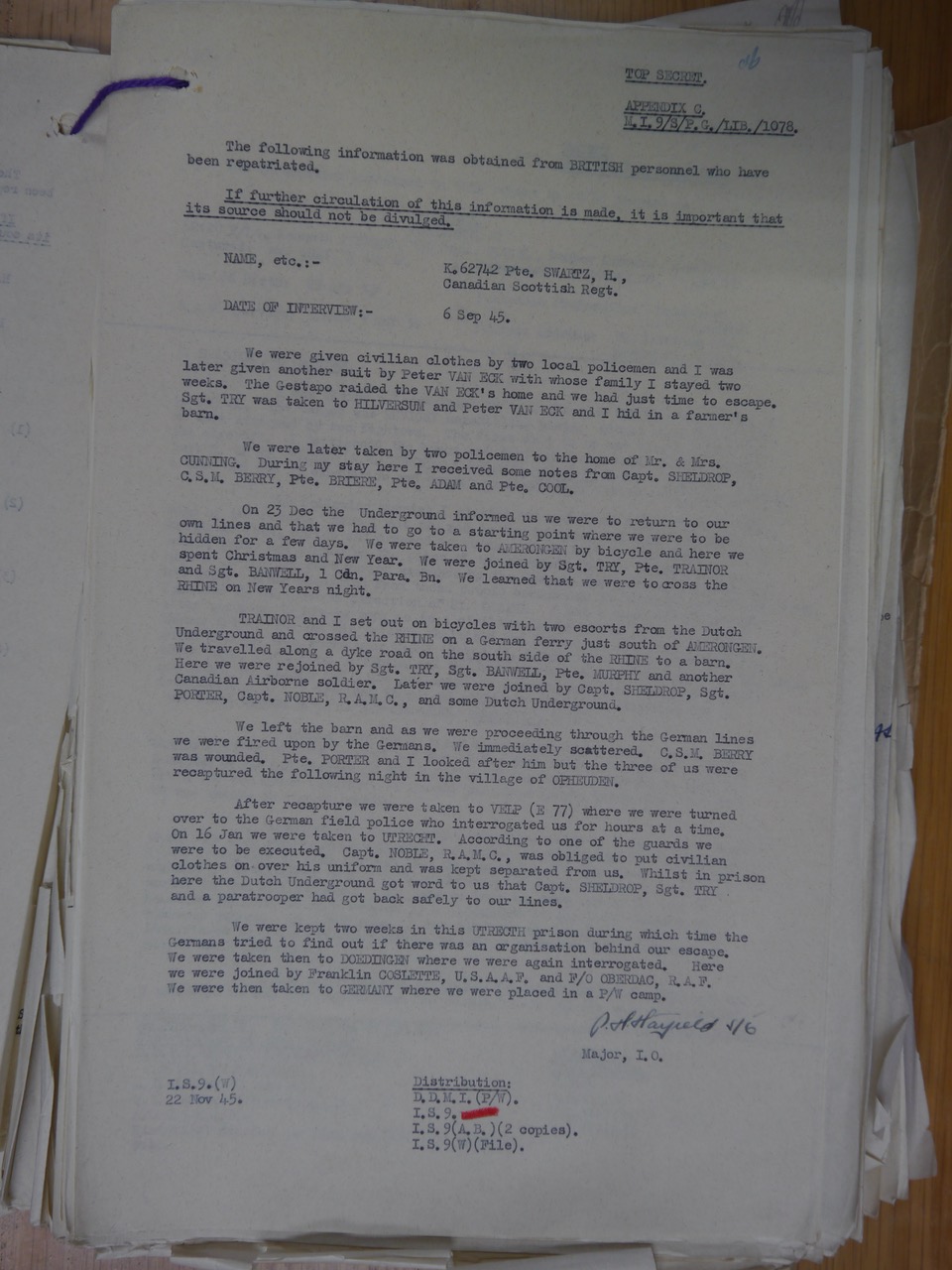
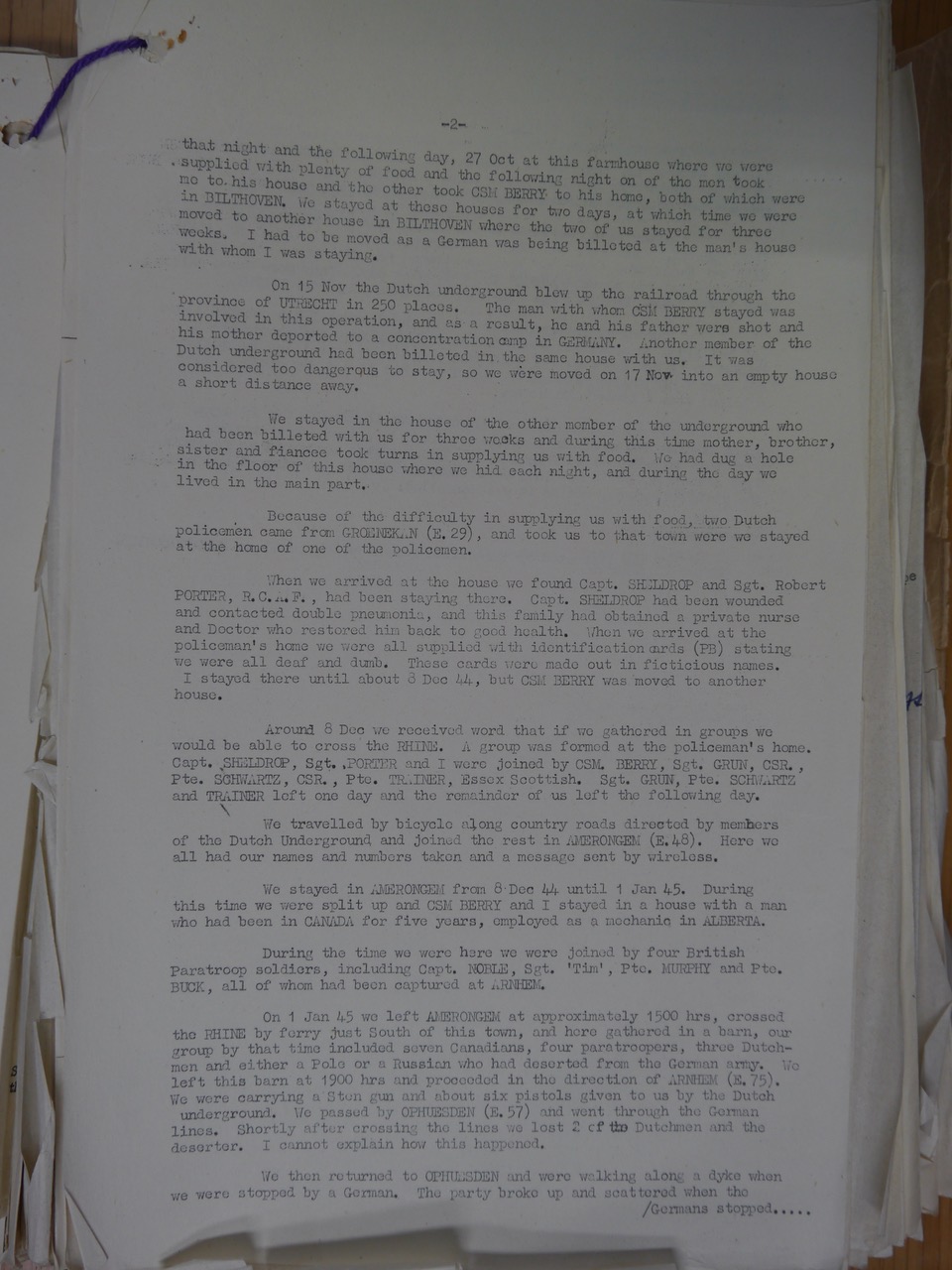
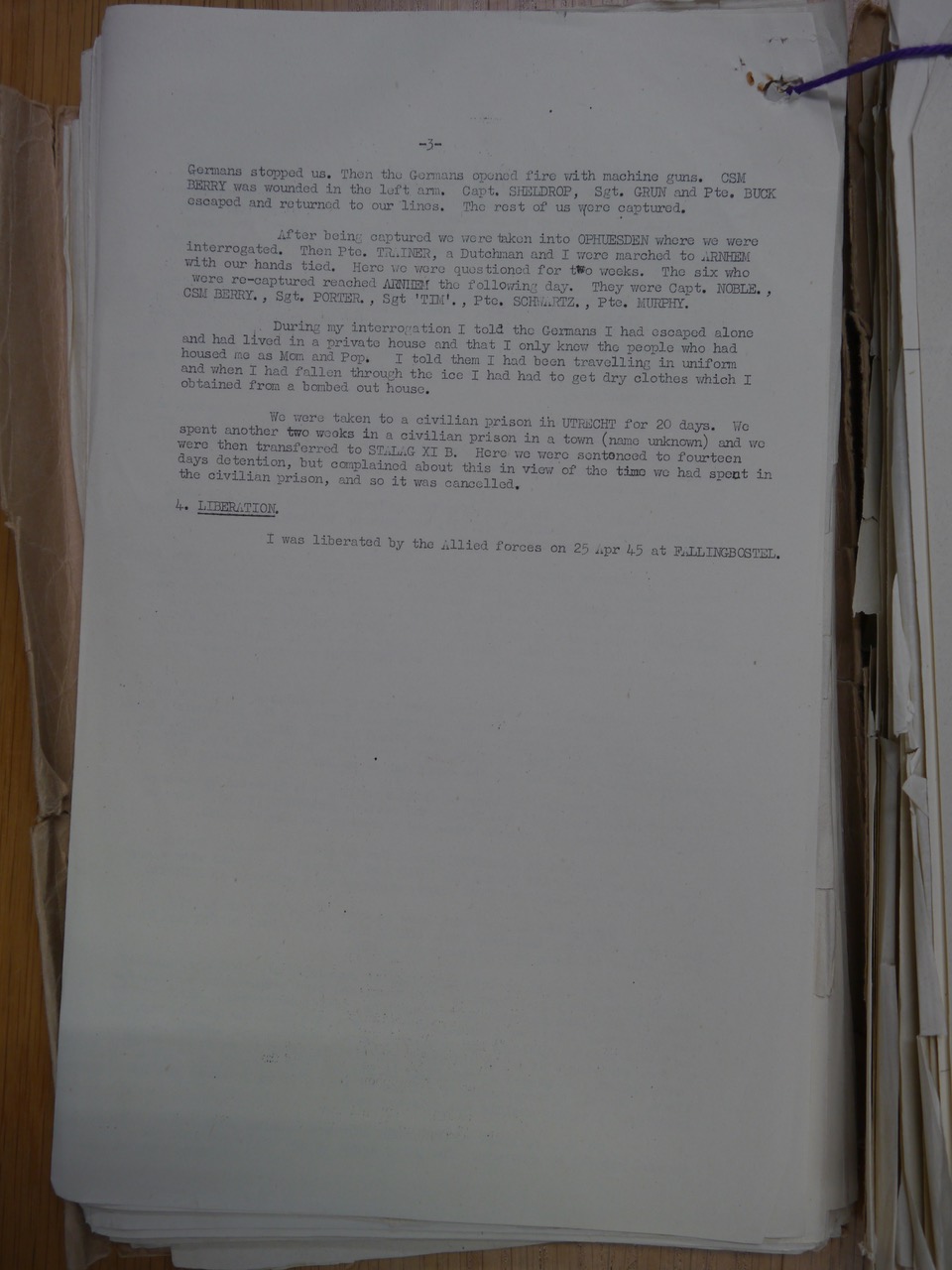
Link to the section In the liberation reports of the Canadians✓ Three MI9 liberation reports, photographed at Kew by the late John Howes, who passed them to Lisan Koppenol, and she sent them on, name him: Swartz's as "Sgt. TRY, Cdn. Scottish Regt.", Briere's as "Sgt. GRUN, CSR." and Berry's as "Sgt. GRI". Swartz's own report, which calls him Try throughout, is on Swartz's page.
- The jump and the first days. Swartz left the train at Blauwkanel on 23 October "accompanied by Sgt. TRY", then "Sgt. TRY and I left on our own", were found by a farmer on the morning of 24 October and given food and a map, and on 25 October were identified by Porter (Swartz, p. 1).
- Hilversum. After the Gestapo raid on the Van Ecks' home, "Sgt. TRY was taken to HILVERSUM" (Swartz, Appendix C). Appendix A has "Oct - Dec 44", "Mr. HUSS, HILVERSUM, Holland", "Harboured Sgt. TRY and gave him clothing" (Swartz, Appendix A). ◐ That is the Hilversum stay in Roy and Plantinga's note above; Huss is not on the Dutch forms held here.
- Groenekan and Amerongen. Berry met "Sgt. GRI" at Groenekan between 1 and 24 December (Berry, p. 2). Briere has "Sgt. GRUN" leaving the policeman's house a day before himself, with Swartz and Trainor (Briere, p. 2); Swartz has "Sgt. TRY, Pte. TRAINOR and Sgt. BANWELL" joining him at Amerongen, and Try in the barn south of the Rhine with Banwell and Murphy (Swartz, Appendix C).
- After the ambush. Briere has "Capt. SHELDROP, Sgt. GRUN and Pte. BUCK escaped and returned to our lines" (Briere, p. 3); Swartz heard of it in the Utrecht prison (Swartz, Appendix C). ✓ Both agree with Hardy's account.
With Murphy
Link to the section With Murphy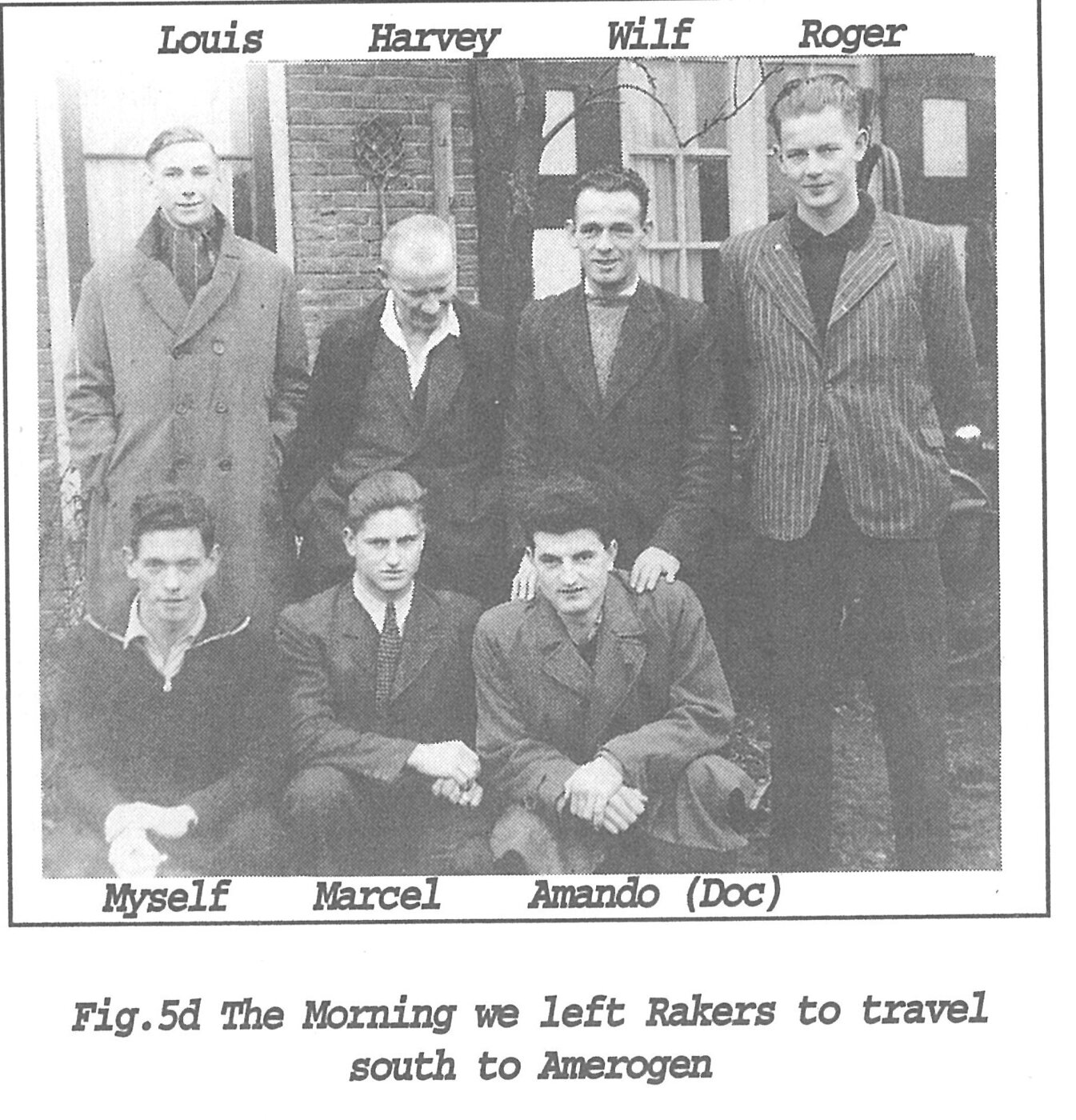
He was in the party that crossed the Rhine from Amerongen on 2 January 1945. Hardy met him at Kesteren after the ferry, and he is on Schjelderup's nominal list as "K.46862 Sgt. GRI, A., M.M." (Hardy). After the ambush only Schjelderup, Gri and Hardy reached a British forward post of the Recce Regiment, 49th Division, near Dodewaard; a 49 Division sitrep timed 2359 on 5 January records "One offr and two OR evaders crossed from enemy territory to A Sqn 49 Recce Regt about 1700 hrs", and 3rd Division told 7th Brigade at 2015 that evening that 49 Div "have picked up Capt R Scheldrup and Sgt Gri" (the 7th Brigade battle log, checked on the image). ✓ That is 5 January, as the Canadian Scottish regimental history has it (Roy, pp. 372–373) and as "Two Came Back!" does (subtitle "to Jan 5, 1945"; "At 1400 hours, 5 Jan", p. 8). The battalion's war-diary appendix "Two Came Back!" is headed "a summary of the experiences of Capt V.R. Schjelderup, M.C. and Sgt Gri" and signed by its diarist, R.F. Bradley (the scan; Schjelderup's page). His part is told on Amerongen and the last night.
✓ In Swartz's liberation report he is "Sgt. TRY": in the barn south of the Rhine, where Swartz and Trainor "were rejoined by Sgt. TRY, Sgt. BANWELL, Pte. MURPHY and another Canadian Airborne soldier" (Swartz, Appendix C); Swartz does not say who was there first. Hardy has himself and Murphy reach the Kesteren barn and meet "Sgt. BANWELL, 10 Para Bn, Sgt. GRI and two Pte's, all of them Canadian Scottish" (Hardy); ◐ the two privates are very probably Swartz and Trainor.
- 2 January. He took cover with Schjelderup and Hardy at the second firing, when "The remainder panicked and ran madly onto the ice".
- Schjelderup took Gri and went out onto the ice for Hardy, and chose a direction "sending Sgt. GRI ahead all the time", and wrote that "Through Sgt. GRI's determined efforts we found a spot where the ice was strong enough to get us onto a small island".
- At the canal he tried the raft first, "made several attempts and failed", and crossed after Hardy's swim with Schjelderup, "one hand on the raft and the other paddling" (Schjelderup's page).
- ⚠︎ Charles Noble's own later account of the same night (unpublished private papers, shared with us privately), told long after the war, does not name Gri. It has the second guide killed by a V1 and the party shouting at a deserted dyke house it took to be Canadian-held before the firing, where Schjelderup's report has the guide lost at the German patrol; it is set out on Schjelderup's page.
At the canal "one pair of boots were lost" in the water, and "Since Capt Schjelderup's feet were in very bad condition he used Sgt Gri's boots"; Gri's feet "were cut and bloody" by the time they reached a house (Two Came Back!, pp. 7–8). The recommendation for his DCM, quoted here, says Schjelderup lost his boots and Gri went on barefoot.
Sergeant Armando GRI's unselfishness, zeal and determination cannot better be exemplified than by the fact that while swimming a canal, Captain Vilhelm Roger SCHJELDERUP lost his boots, Sergeant GRI without hesitation gave up his own and continued the journey for a matter of two days over the ice and snow in his bare feet.
— 1st Bn The Canadian Scottish Regiment · recommendation for the DCM, 7 January 1945 · war diary, January 1945, Appendix 22 · Library and Archives Canada
He had not known he had been awarded the MM, which had been gazetted on 21 December 1944, in an Ottawa list of 9 December, while he was in hiding: "No. K46862 Sergeant Armando Gri, Canadian Infantry Corps" (London Gazette, p. 5863; the heading, p. 5862).
The underground had shaved off his heavy moustache; on 6 January he told the whole story to his brigade and divisional commanders (pp. 8–9). The DCM was granted: "No. K46862 Sergeant Armando GRI, M.M., Canadian Infantry Corps" (London Gazette, 31 May 1945, p. 2743), and he was also mentioned in despatches (p. 2746).
In the Nelson Daily News, 1944 to 1946
Link to the section In the Nelson Daily News, 1944 to 1946✓ Read on the page images of the Nelson Daily News, held by the University of British Columbia Library (BC Historical Newspapers). Most of it is Canadian Press copy from Kelowna, Ottawa, London and Vancouver, and a Trail reporter's round-up of the investiture.
- Missing, 20 October 1944. "Sgt. S. Gri of Trail Missing", datelined Kelowna, 19 October: his wife had word that he was missing after the action of 7 October; he "is a native of Trail and enlisted in September 1942, and went overseas in August, 1943"; she lived at Kelowna with her mother (20 October 1944, p. 6). The initial is printed S., not A.
- The roll of honour, 22 November 1944. "Gri, Armando, Sgt., Kelowna, B. C." is in the "Missing" list of warrant officers, NCOs and men, with CSM Berry ("Vernon"), Swartz ("Parkhurst, via P.G.E.") and fourteen others; Schjelderup and a Prince Rupert lieutenant are the two officers listed missing above them (22 November 1944, p. 10). That is 46 days after the capture of 7 October.
- The Military Medal, 24 January 1945. "Sgt. Gri, Trail Wins Military Medal in Heroic Calais Battle", London, 23 January (24 January 1945, p. 4). A British patrol picked him up "soaked to the skin, minus his boots", and when he had eaten "the C.O. of his battalion turned up" and told him he had won the medal; how he got away from his guards "is one of the stories which come under a security ban until the war is over" ✓ (the Gazette of 21 December 1944 had printed the award while he was in hiding, above).
- The Calais story as the paper tells it. An 88 mm gun in a fortified position was holding up the Canadian Scottish; Gri's platoon waded "up to their waists" towards it under mortar fire and was pinned down by "two Spandau posts guarding the gun"; he went on alone, shot the gunner "right between the eyes", and "led the assaults which silenced the second Spandau and then the 88 itself".
- ◐ The recommendation (WO 373/50/62, above) has the same rifle shot and the same wade through flooded ground, but names an M.G.42, not an 88 and two Spandau posts.
- It says the gun crew surrendered; the press has the platoon "bagged" prisoners, with the number cut off at the page edge.
- A second story, from the C.O. Gri's company at Calais was "completely encircled", short of food and ammunition; he and his platoon were "told to attempt a break through the ring of Boche surrounding them and bring back supplies", and "soon returned, bringing with him food, ammunition and 97 prisoners". ◐ That reads like the night in Zuehlke's The Cinderella Campaign (above) when Gri's platoon broke out and "unearthed 105 Germans"; neither gives a date, and 97 and 105 differ, so they are not tied together here.
- The Calais story as the paper tells it. An 88 mm gun in a fortified position was holding up the Canadian Scottish; Gri's platoon waded "up to their waists" towards it under mortar fire and was pinned down by "two Spandau posts guarding the gun"; he went on alone, shot the gunner "right between the eyes", and "led the assaults which silenced the second Spandau and then the 88 itself".
- Safe, 13 February 1945. "Previously Reported Missing, Now Reported Safe: Gri, (M.M.) Armando, Sgt., Kelowna, B.C." (13 February 1945, p. 3), four days after Schjelderup's name appeared in the same list (9 February). Both had reached the British post a month before.
- The DCM, 7 May 1945. "Sgt. Gri of Trail Honored", Ottawa, 4 May: the award of the Distinguished Conduct Medal to "Sgt. Armando Gri, 26, of Trail and Kelowna"; no citation yet; "Gri was a mechanic at Trail prior to enlistment in 1942", and his wife and young son lived at Kelowna (7 May 1945, p. 7). Its wording for the Military Medal, "courage and leadership" under heavy fire, is the recommendation's own.
-
The citation, 1 June 1945. "Nelsonite's Courage an Inspiration; Trailite Helped Balk Breakthrough", Ottawa, 31 May: twenty-eight citations released, his under "Helped Prevent Break-through" (1 June 1945, p. 5).
- ✓ It is the battalion's recommendation of 7 January (the recommendation, PDF p. 52) cut down: the same burning clothes, the twenty killed or wounded, the break-through to the Leopold Canal prevented, and the same 6 January and 75 days. The press adds that his stand let company headquarters "hold out against the enemy a further 2 1/2 hours".
- What it leaves out is the knife: the recommendation has him "successful in concealing his knife" and helping to cut through the side of the van, and has the boots paragraph above, and the printed citation has neither.
-
The escape paragraph as printed:
Sgt. Gri was determined to escape. During the time the goods van in which they were confined as prisoners of war was standing on a siding, he materially assisted Capt. Vilhelm Roger Schjelderup in keeping up the morale of the others. On October 23, 1944, the train pulled out for their prisoner of war camp, and Sgt. Gri and his companions made their escape, returning to our lines on January 6, 1945, 75 days later, bringing valuable information.
— Department of National Defence citation as printed in the Nelson Daily News · 1 June 1945, p. 5 · UBC Library
-
Home, 31 July 1945. "Trail Man Wears Disguise While Escaping", Vancouver, 30 July (31 July 1945, p. 4). He is now "CQMS. Armando Gri, D.C.M., M.M." and "returned to Vancouver yesterday", 29 July:
For three months, CQMS. Armando Gri, D.C.M., M.M., walked among German soldiers in Holland while he was disguised as a Dutch peasant and figured on how he could escape. Gri returned to Vancouver yesterday.
— Canadian Press · Vancouver, 30 July 1945 · Nelson Daily News, 31 July 1945, p. 4 · UBC Library
- It says he was "held by the Germans for 16 days before he cut through the side of a boxcar and escaped", got in touch with the Dutch underground and "finally crossed the Rhine on a German ferry"; and that he "operated a garage at Trail when he enlisted, and is going back to that profession".
- It has him escaping with "Major Roger Schjelderup, D.S.O., M.C. and Bar, of Courtenay", who "took pneumonia, was nursed in a Dutch hospital under the noses of the Germans", while "Gri worked with the underground, and twice helped to blow up railway tracks".
- ◐ The sixteen days are 7 to 23 October, which agrees with the 75 days of the citation (23 October to 6 January). The railway matches the raid Two Came Back! has him on above, but that account has the line cut "in 18 places" in one night, not twice. Schjelderup's own report and Briere put his illness in the Rakers house with a private nurse and a doctor, not a hospital (Schjelderup's page).
- The investiture, 12 July and 8 August 1946. The Vancouver list of the officers and men to be decorated by Governor-General Viscount Alexander at Jericho Air Station on Saturday, 13 July, has "Sgt. A. Gri, D.C.M., M.M. Kelowna" (12 July 1946, p. 4).
- A Trail item of 7 August, "Receive Powell and Gri Citations", names "ex-Sgt. A. 'Gabby' Gri of Trail" and prints his citation, which this time has the knife: he escaped "with use of a concealed knife on Oct. 23, with several companions" and "eventually returned to our lines on January 6, 1945, 75 days later" (8 August 1946, p. 1). Porter and the Dutch called him "Doc"; this is the one source that gives "Gabby".
Where the sources disagree
Link to the section Where the sources disagree- His age. ⚠︎ The press gives 27 on 20 October 1944 and 26 on 7 May and 1 June 1945; his MI9 report gives "25 Dec 17", which is 26 in October 1944 and 27 in May 1945, the other way round.
- When he enlisted. ⚠︎ "September 1942" and "1942" in the press (20 October 1944, 7 May 1945); his MI9 report has "3 years, 7 months" of army service on 1 February 1945, which is about July 1941, and the Nelson Daily News has an "Armando Gri of Trail" called up for training at Vernon on 28 August 1941 (◐ only if it is the same man; Before); the 1942 of the press and the 1941 of these two sources are not reconciled.
- His trade and his home. ◐ "Garage Owner" in his report, "a mechanic at Trail" on 7 May 1945, "operated a garage at Trail" on 31 July 1945. The lists give him "Kelowna" (22 November 1944, 13 February 1945, 12 July 1946), where his wife lived, "Trail" in the headline of 24 January 1945 and "of Trail" in the Trail item of 8 August 1946; the 7 May article has "of Trail and Kelowna".
- How long he was a prisoner. ⚠︎ "In a German jail for nearly three months" (24 January 1945): he was held for sixteen days, 7 to 23 October, and was then free in the Netherlands for the 75 days to 6 January, as the citation says.
- The return to the lines. ⚠︎ The citation and the Trail citation of 1946 say "January 6, 1945", which is the day in the battalion's recommendation; Roy and the 49th Division's sitrep have the afternoon of 5 January (above).
- How long he was hidden at Maartensdijk. Sjouke Scheepvaart's form has Gri and Swartz hidden from 21 October 1944 for 60 days (p. 3) and its box 12 says ten weeks (p. 4); his mother's own form has Gri there three weeks, until the railway attack (p. 4). 21 October is also before the train escape of 23 October that these pages give, so the start date on the Scheepvaart form is early on any reading.
- Plantinga's note has him taken to North Brabant after three weeks; see above (⚠︎).
- When he reached the farm. ⚠︎ His report has the hayloft on the morning of 24 October, within hours of the jump. Holwerda has Schjelderup and Trainor found first and Gri and Swartz "the next day" (p. 7), which on Schjelderup's 25 October would be the 26th.
- His boots. ⚠︎ The report has both Schjelderup and Gri losing "our shoes and socks" in the canal, and Schjelderup finding shoes in a house later while "Sgt. GRI was not as lucky". The recommendation for Gri's DCM has Schjelderup alone losing his boots, and Gri giving up his own and going on barefoot for two days (the recommendation, PDF p. 52); "Two Came Back!" has "one pair of boots" lost without saying whose, Schjelderup using Gri's, and Gri's feet "cut and bloody" (p. 7). The report's version still leaves Gri barefoot.