Pegasus II and Roekel
The mass crossing that failed, a night lost in the dark, and a dug-out in the woods near Roekel.
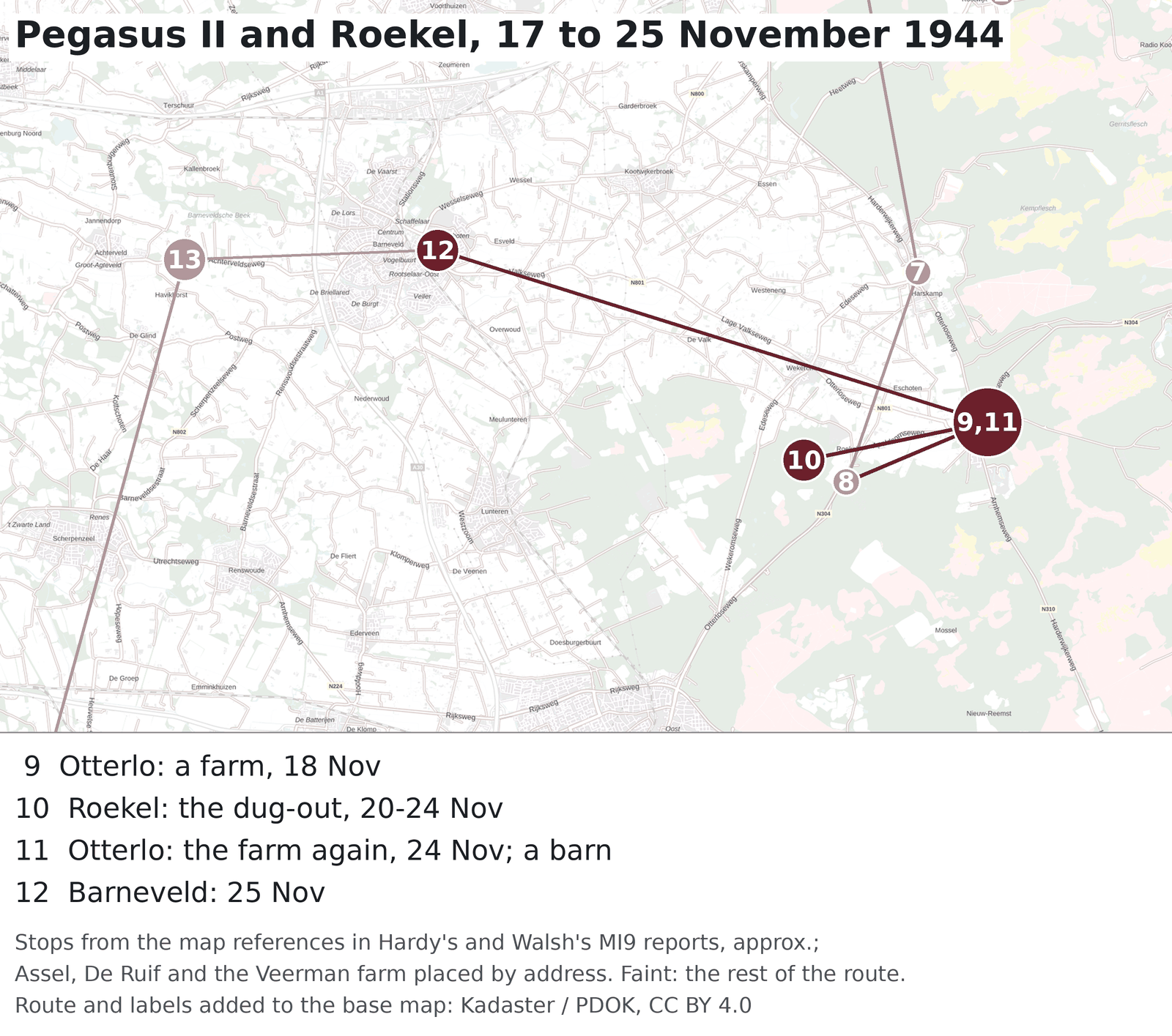
Operation Pegasus II: 17/18 November 1944
Link to the section Operation Pegasus II: 17/18 November 1944The planned mass crossing of 116 men, organised by Dick Kragt ("Frans Hals"), the IS9 agent who ran the Veluwe pilot line.
Actual operation date: night of 17/18 November 1944 (Liberation Route). The memoir gives 20 November, which is wrong, though not randomly so (see below).
⚠︎ Noordman puts the crossing a night later. His introduction to Part II has Pegasus II "uitgevoerd op de avond van 18 november 1944" (carried out on the evening of 18 November 1944, p. 198); in the Ragsdale chapter he glosses it as the failed crossing "in de nacht van 18 op 19 november 1944" (p. 176); and his Kessel chapter has the column leaving at 0330 on the 18th, lying up all day and setting off again at 1800 (Noordman, pp. 311–312). He is not consistent about Murphy's party either: Hardy's account, which he prints, has the six setting out on the evening of the 17th, but he has Gerrit van Ee guiding "de groep van zes man" on "de avond van 18 november" (p. 304). The British side gives 18 November too: Warrack's OBE recommendation has him "On 18 Nov. 44 … a member of a large party of Allied personnel who were dispersed when being guided through the German lines" (WO 373/64/167). Which night the main column met the German post is not settled by Noordman or Warrack's citation. ◐ Ede's own wartime history gives the 17th: the men came in "in de morgen van de 16e" (on the morning of the 16th) to the assembly point, the Wolfswinkel brothers' chicken houses on the Meulunterseweg at Lunteren, and the latecomers from the north were due "in de avond van de 17e" (on the evening of the 17th) (Ede manuscript, pp. 45–46), and the research notes behind it say "mislukte crossing bij Ede 17/18.11.44" (the failed crossing at Ede, 17/18 Nov 1944) (Ede 1006/493, p. 6).
⚠︎ Helen Fry's MI9 (2021) has a fourth date, from a different angle: the "water was rising further and even the storm boats were going to struggle", and "Pegasus II was rescheduled for 22 November" (the hits; the longer passage; ◐ from the Archive's full-text index, not read on the page, so what was rescheduled from is not known). None of the other sources on this page gives the 22nd, and they put the attempt on 17 or 18 November.
✓ L. de Jong, Het Koninkrijk der Nederlanden in de Tweede Wereldoorlog, the Dutch official history (NIOD edition, CC BY 3.0 NL; the passages, with translations), settles it for the main column: assembled at a farm near Lunteren, it was to walk in the night of 16/17 November to a wooded plot by the Ede–Arnhem road, hide there through the 17th and reach the Rhine the next night; all went well to the plot, and when the second leg began in the dark, "they had not yet crossed the Ede–Arnhem road when they noticed they were close to a German post", the part that went on south ran into a fight with the Germans at the road, and, in Boeree's words, "all contact was broken" (deel 10b, p. 552, checked on the image, quoting Boeree's Kroniek van Ede). It has about 120 people meant to escape, among them a number of Airbornes ("among them Keith Banwell"), RAF men, a Frenchman, a Russian and a few Dutchmen; Kragt and Piller thought the operation unworkable, but Neave set their advice aside (p. 551, checked on the image). Only seven men reached the Betuwe; most of the rest got back to their hiding places with their guides; Piller counted thirty-six missing. The men taken were brought to the Feldgendarmerie at Ede, among them six Dutch resistance workers, two of whom had been guides, and "both" were shot some time later as Todeskandidaten (p. 553, checked on the image). ⚠︎ That is two guides, where the Liberation Route figure above has three of the wounded executed at the Woeste Hoeve; De Jong gives no date or place. He puts Tex Banwell among the prisoners, taken to Berlin and then Auschwitz, which the dates in the 1945 reports do not allow.
◐ Boeree gives the main column's order of march as Maguire set it: "een voorhoede, waarover hij zelf het commando nam, een hoofdmacht onder de doktoren Longland en Allenby en een achterhoede onder majoor Coke" (a vanguard he commanded himself, a main body under the doctors Longland and Allenby and a rearguard under Major Coke), the six Sten guns with the vanguard and the main body, pilots and hospital staff, unarmed; Lipmann Kessel was with the rearguard, carrying the records (Boeree, p. 179).
The rest of the column is told on its people's pages. Major John Coke, commanding the rearguard, was killed that night at a German battery's quarters near the Hindekamp, by Boeree after losing his way. ◐ In his party was Pte Thomas Lorne of Murphy's own 156th Battalion, who had been hidden at Eerbeek and was shot and taken when Germans challenged them in a wood. A woman in nurse's dress, Sister den Hartog, joined the column at Westerrode and was taken at the Heibloem. Two days before, on 15 November, the SD had arrested Berend Dijkman, the Veluwe resistance commander.
Four young resistance men arrived on bicycles at about 1830 on 17 November; after a short walk a lad of about 16 left them, so three guides remained. The party rode tandem, two to a machine: Hardy with P/O Branford, Banwell with Murphy, the sergeant glider pilot "John" (Haller) and Walsh on guides' bikes. All three guides drew too far ahead in the dark; at a fork, Banwell, Branford, Murphy and Hardy took the wrong turning and lost the party. They waited half an hour, then searched for two or three hours whistling the recognition signal, the first two bars of Lili Marlene, with no response (Hardy). ◐ Kessel, walking behind the leading guide as interpreter, has the same fork from the head of the column: "At one place, however, where the path divided, the local guide disagreed with the man leading us as to which was the correct one to take. They argued earnestly", and while they argued a Sten was let off by accident behind them (Kessel, 1959, p. 130). Kragt remembered that night himself: a new guide lost four of his six men in the dark and simply went home to bed, and Kragt searched two hours in the pouring rain before his scouts found them the next day (Noordman, p. 117).
⚠︎ The two reports disagree about which side of the split Murphy was on. Walsh writes that his account is the same as Hardy's "except for one detail" and does not say which; ◐ this is probably it, since his own account has the guides, after Hardy and Branford were lost, take Banwell, Haller, Murphy and Walsh on to a house at 560984 (Walsh), which on today's map is the north edge of Kootwijkerbroek, where the Plaggenweg, Kapweg and Garderbroekerweg meet (Walsh's reference, converted to today's grid). Hardy has Murphy in the lost group with him. Hardy is the likelier, because he describes Murphy continuously afterwards. Not settled.
Kragt's account
Link to the section Kragt's accountKragt wrote the arrangements up himself. He met "HAM", du Bois, in the Nieuwe Wetering and fixed the rendezvous and times for the Pegasus II crossing; on the first night "the forty odd men coming from four different directions were handed over to his guides as arranged"; on the second, six men were due on foot and twenty-four from Elburg by lorry, in pouring rain at 1930, and neither arrived, the guides having lost four of their party and the lorry's gas generator having failed. The men were re-routed to the Otterlo–Ede road north of Ede the next night, where the lorry again did not come, "when John Haller almost embraced a German sentry" (Kragt's report). ◐ That is very likely the Sgt Haller of Murphy's group, the "Sgt John" of the MI9 reports (Haller's page); Kragt gives no unit, and a name is not proof.
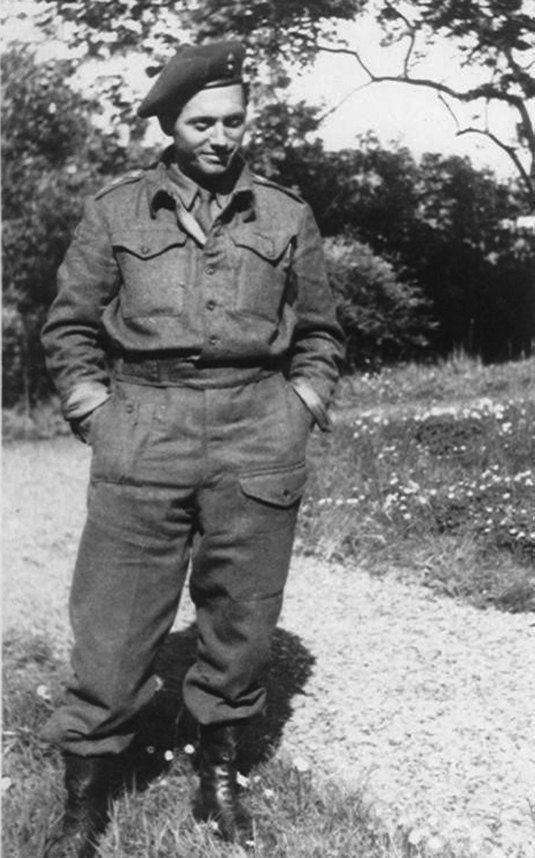
◐ Kragt's partner Joop Piller gave the parliamentary inquiry his own figures in 1949: in November 1944 "zouden er ± 130 man overgebracht worden, die in de val zijn gelopen. Op 36 na zijn zij allen bij de organisatie van de heren Piller en Kragt teruggekomen" (about 130 men were to be brought over, who walked into the trap; all but 36 came back to Piller's and Kragt's organisation), and "Slechts drie zijn er door gekomen" (only three got through) (Enquêtecommissie, deel 4 A en B, 1950, p. 274, read on the page image). It is his recollection, five years on, as the commission summarised it.
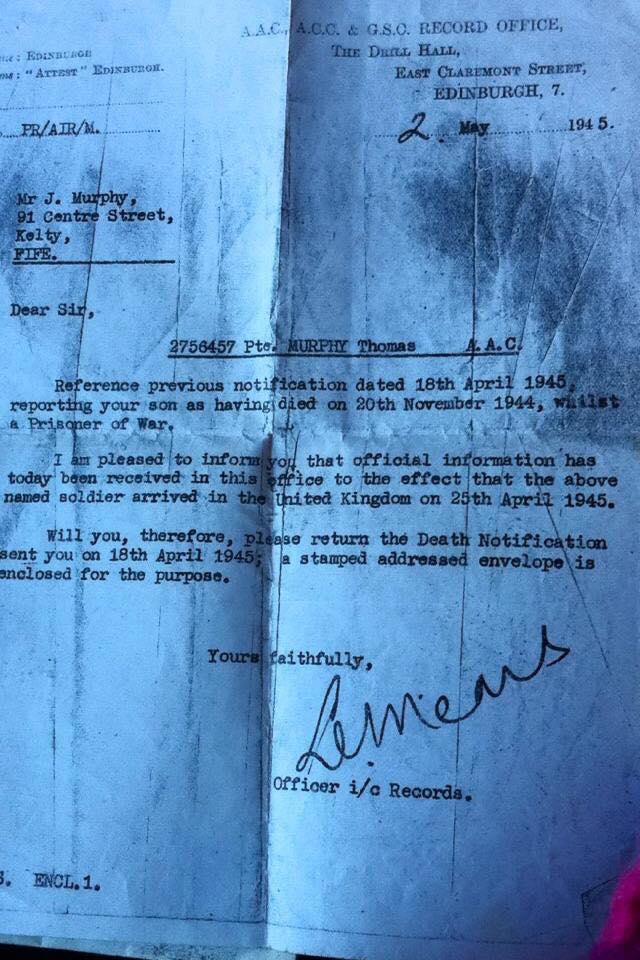
Pegasus II failed. Of 116 participants, seven reached the south bank. Two participants and one American rescuer were killed; a Dutch guide died of injuries days later; one man went missing and was never found. 48 were captured, twelve of them wounded, and three of those were unmasked as resistance men and executed at the Woeste Hoeve on 8 March 1945. The other 64 got away and went back into hiding (Liberation Route). Ede's own history of the war agrees on seven: "uiteindelijk bereikten dus slechts zeven mannen de Betuwe" (so in the end only seven men reached the Betuwe), and gives Joop Piller's statement to the parliamentary inquiry that there were "zesendertig vermisten" (thirty-six missing) (Ede manuscript, pp. 47, 48). The figure the evaders themselves were given at the time was smaller: Kessel, hidden on the Veluwe that week, heard from Dick Kragt that London reported "only five men had got through", and later "a few had been killed and several wounded, but the majority had been recaptured, only a handful having managed to slip away like we had" (Kessel, pp. 137, 152). ◐ MI9's own historians, M. R. D. Foot and J. M. Langley (1979), called Pegasus II "a shambles" and wrote that the blame "can reasonably be laid on the London journalist" who "interviewed some of the evaders on Pegasus I" (the search text breaks off before they say what he did); they also date it "23/24 November", ✗ a week late, and their pages have so far been read only through the Internet Archive's search (Hugh Maguire; the fragments, pp. 249–250). The date the Army later recorded as Murphy's death was 20 November 1944, three days after he failed to appear at the rendezvous, "whilst a Prisoner of War" (Record Office letter). ⚠︎ What that date rested on is not known. The letter's words, and the messages his parents were sent, that he had died of wounds in a German prison camp and then a padre's letter saying he had been buried (Killed on paper), point to a report that he had died in German hands, not simply to the missed rendezvous. And the date survived Hardy's debrief of 13 January 1945, which had him alive on 2 January. The missing-men file, WO 361/633 (The National Archives, Kew), is where the answer would be.
Subsequent attempts (Hardy):
- 18 Nov: at 1730 "WILLEM and the Dutch Policeman whom I had met before" arrived with bicycles; a second try from a farm near Otterlo; joined a party of about 20 evaders (including Pte Leslie Davison and Pte Frederick Moore); the lorry never came.
- One of the guides who took the six out in those days was Gerrit van Ee of Kootwijkerbroek, who remembered the cycle ride and the four getting lost, and carried Haller on his carrier (Noordman, pp. 283–285).
- ◐ Another was very probably Fokke Dijkstra of De Glindhorst: the Americans' summary of his file has him "one of the guides for the Pegasus 1 and Pegasus 2 crossing" (his file, 8 February 1946), though it does not say which night or which party.
- The lorry had brought the twenty from Elburg late and, according to Boeree, to the wrong place, and the party left behind in the woods, the one Banwell stayed with, was fetched on the evening of Monday 20 November with a horse and cart by Eb van Omme and Van Ee (Noordman, pp. 283–285).
- Charles Noble, the doctor later taken in Murphy's party, was on that lorry. His report of 1945 has it stopped twice by road controls and the party "left at the wrong spot and so missed" the main column (Noble). ◐ His own later account (unpublished private papers, shared with us privately), told long after the war, has them posing as "workers from the Ijssel-limit going home on the weekend" at the German checkpoints, and "it turned out later we were late", as Boeree has it.
- 20 Nov: Banwell chose to remain with the larger party. Murphy went on with Hardy, Branford, Haller and Walsh. Dug-out near Roekel, ten men in a space built for far fewer. ✓ Moore's page has the same hole: "hidden in a dug-out at Roekel. After three days spent in great discomfort Moore returned alone to Barneveld" (Moore).
The barn, 24–25 November
Link to the section The barn, 24–25 November- 24 Nov: Hardy and Murphy left for the Otterlo farmhouse, then a barn, "somewhere in the OTTERLO area, but as it was dark I have little idea where it was" (Hardy).
- ◐ Noordman names it as J. van Essen's, on the Westerhuisweg at Harskamp; with them were Davison, the RAF officer John Craven and four Americans from a Fortress shot down on 21 November (Noordman, p. 285).
- Noordman is the only source for the name: the British helper index has no Van Essen at Harskamp, and the Americans' own escape reports (Willig, Bonekat, Haydel: E&E 2976, 2977, 3057) do not mention the barn or the British paratroopers. Willig's names a farmer "VAN EE" near Stroe on 23 November and the vet Teus Roskamp outside Barneveld on the 24th.
- 25 Nov: with Davison, cycled pannier-fashion towards Barneveld. Guides "Ghys" and "Jan (3)". ✓ Gijs van Zijtveld and Jan Dijkstra, "uit Achterveld" (same, p. 286); ◐ Dijkstra is very likely the De Glind man who had been bringing airmen to the Veerman farm since 1943 (his page).
The helpers at Roekel
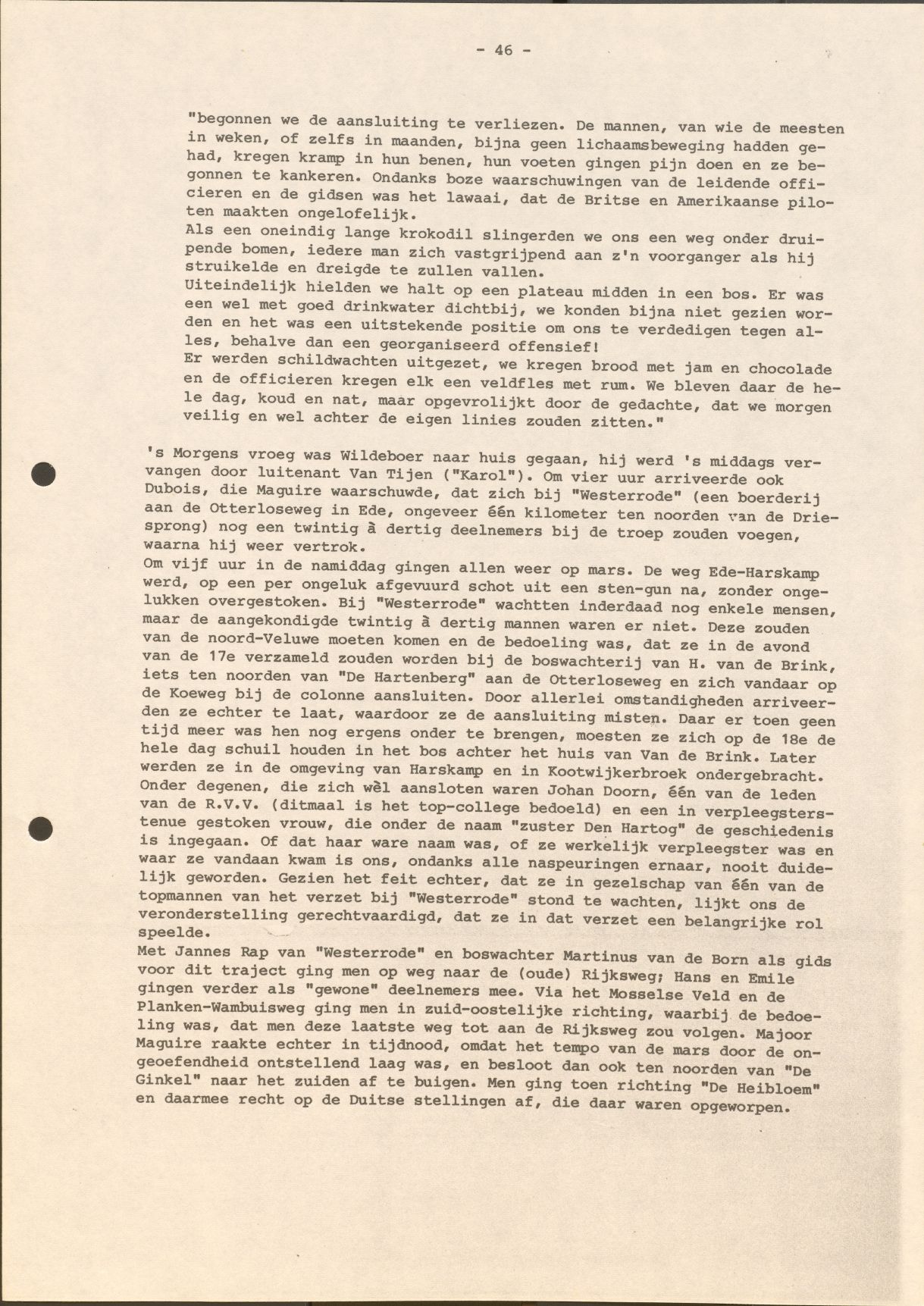
Link to the section The helpers at RoekelEde's municipal history of the war, a typescript written for the book Ede 1940–1945 and now in the town archive, tells the same days from the Dutch side. The twenty or thirty men due from the north of the Veluwe were to gather on the evening of the 17th at forester H. van de Brink's, a little north of De Hartenberg on the Otterloseweg, and join the column on the Koeweg:
Through all sorts of circumstances, though, they arrived too late and missed the connection. As there was no time left to put them up anywhere, they had to hide all day on the 18th in the wood behind Van de Brink's house. Later they were lodged around Harskamp and in Kootwijkerbroek.
Dutch originalDoor allerlei omstandigheden arriveerden ze echter te laat, waardoor ze de aansluiting misten. Daar er toen geen tijd meer was hen nog ergens onder te brengen, moesten ze zich op de 18e de hele dag schuil houden in het bos achter het huis van Van de Brink. Later werden ze in de omgeving van Harskamp en in Kootwijkerbroek ondergebracht.
— Ede, manuscript "Het Verzet", p. 46 (Gemeentearchief Ede 1006/1160)
Six days after the failed march the SD came for the people who had helped them. They arrested Van de Brink and an onderduiker (a man in hiding) staying with him, and made the forester show them the houses of two men: Van Vemden, evacuated from Aerdenhout to Wekerom and living in Krijgsman's house on the Roekelseweg, and Kauffeld, in the hamlet of Roekel. "Zij hadden beiden de geallieerde militairen geholpen, die zich op de 18e in het bos schuil hadden moeten houden" (both had helped the Allied soldiers who had had to hide in the wood on the 18th). While the SD men were away, the Landwacht, the Dutch Nazi auxiliary guard, made him (the onderduiker taken with the forester) dig a pit and crouch in it:
They asked him where the paratroopers were hiding, and when he would give nothing away they filled the pit in.
Dutch originalZe vroegen hem naar de schuilplaats van de parachutisten en toen hij niets wilde loslaten, gooiden ze de kuil dicht.
— Ede, manuscript "Het Verzet", p. 48
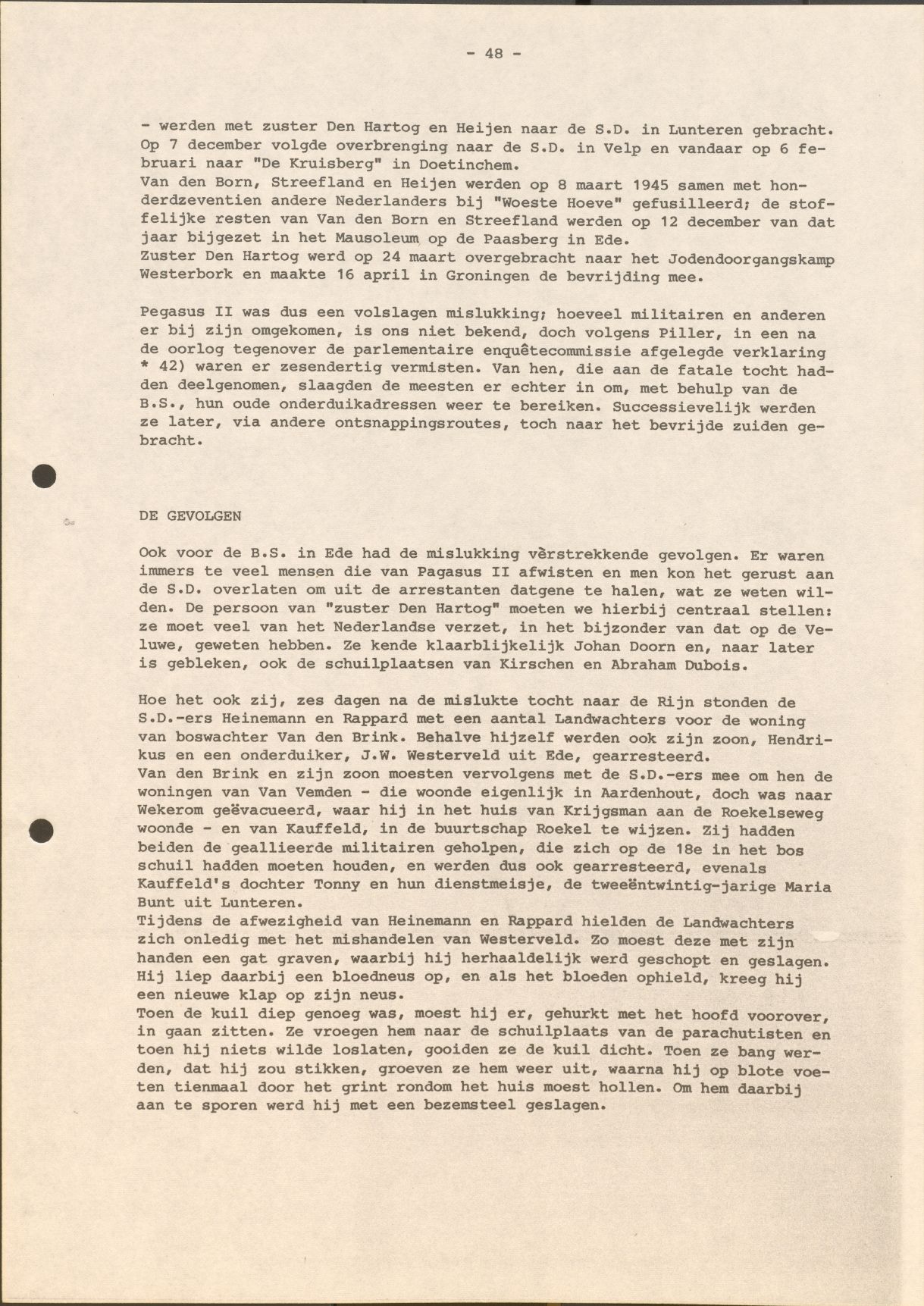
They dug him out before he suffocated. Kauffeld and Van Vemden were sent on to the SD at Velp and released from the SD prison there on 20 January 1945; afterwards Kauffeld thanked an Ede police constable, G.J. Michels (Otterlo in the war, Harskamp after), for his help before, during and after the arrest (same, p. 49).
◐ This is very probably Murphy's party, though no Dutch source names him. Hardy's group lost its guides on the night of the 17th, rested on the 18th at a farm near Otterlo, and that evening met "another party of evaders, about 20 in all", then hid with them in a wood "the rest of the night and all next day" (Hardy). Ede has the latecomers in the wood on the 18th (they "moesten ze zich op de 18e de hele dag schuil houden in het bos achter het huis van Van de Brink"), Hardy a day later, which is one more sign of the one-day disagreement over the night of the march (Still open, item 16). The party Banwell stayed with was fetched on the 20th by two men from Kootwijkerbroek (above), which fits "lodged … in Kootwijkerbroek", and Hardy and Murphy went on to a barn at Harskamp. Hardy's dug-out near Roekel is on the Roekelseweg on today's map, Hardy and Murphy left it on 24 November, about when the arrests began, and on the 25th Walsh was told "the member of the Underground who was looking after us (name unknown) had been arrested" (Walsh). What the record does not have is a document putting Murphy in Van de Brink's wood. ◐ The dug-out was very probably Van Vemden's (The keeper of the dug-out).
The keeper of the dug-out
Link to the section The keeper of the dug-outThe keeper of the dug-out has a name. Van Vemden, as J. van Vemde, wrote to the Americans in May 1946 that after the failed crossing:
these men were scattered through the woods; of them, about 10 or 12 were taken in by me, in the 2 days after the crossing, in a hiding place by my house in the wood
Dutch originalzijn deze menschen in de bosschen verstrooid. Hiervan werden in de 2 dagen na de cross ongeveer 10 à 12 man door mij geborgen in een schuilplaats bij mijn huis in het bosch
— J. van Vemde to the Americans, 20 May 1946 (his file, p. 8)
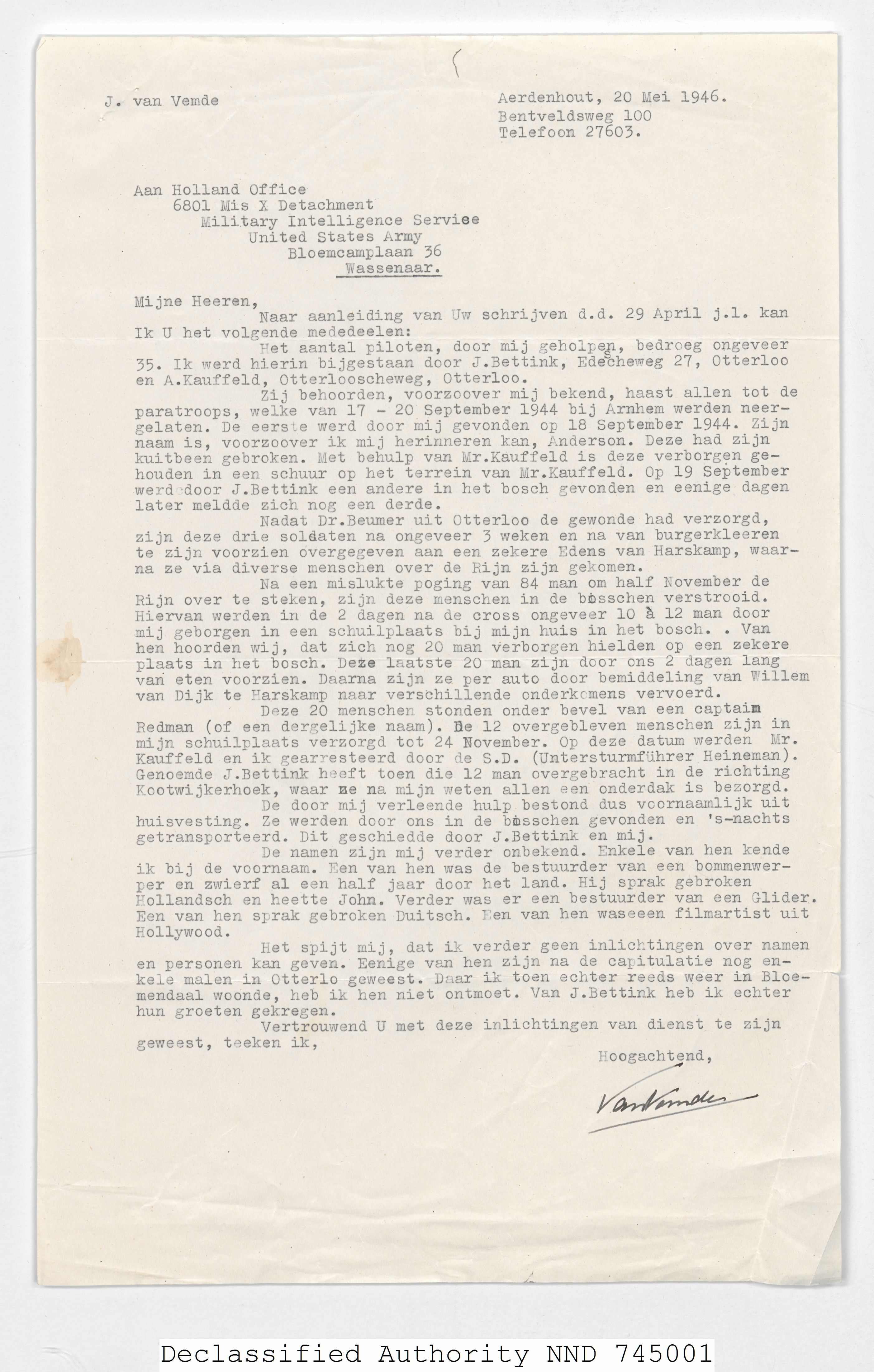
He also wrote that "De 12 overgebleven menschen zijn in mijn schuilplaats verzorgd tot 24 November. Op deze datum werden Mr. Kauffeld en ik gearresteerd door de S.D." (the 12 who were left were looked after in my hiding place until 24 November, when Mr Kauffeld and I were arrested by the SD). J. Bettink then moved the twelve "in de richting Kootwijkerhoek" (towards Kootwijkerhoek, ◐ Kootwijkerbroek) (his file, p. 8). ◐ That is very probably Hardy's dug-out (above): about ten men, by the Roekelseweg, until 24 November. Van Vemde knew few names, but remembered "de bestuurder van een bommenwerper", a bomber pilot who had been on the run for half a year, spoke broken Dutch and was called John, and "een bestuurder van een Glider", a glider pilot. ◐ Hardy's party in the dug-out had one of each, but they do not line up cleanly: Branford, RAF, had been five months in hiding but was a bomb-aimer, not a pilot, and it is the glider pilot Haller whom the MI9 reports call "John" (Haller's page). ◐ An undated typed slip in Kauffeld's file, in the office's third person, covers the same men, among about 35 in all: "All these persons came after the failed crossing from 18-11-'44 and came in the hands of Frans Ha Hals [sic]" (his file, p. 4).
◐ Th. A. Boeree's Kroniek van Ede (1947) tells the same days from Ede and names none of the evaders. Six of the men in Van de Brink's wood walked off, meaning to go back to Westeneng, were stranded at a farmer's named Pol, and were handed to Bettink, who hid them in the hiding place behind the Agneta-hoeve, where Van Vemden lived: "Onder die zes mannen zat Jimmy, die een beetje Hollandsch sprak" (among those six men was Jimmy, who spoke a little Dutch) (Boeree, p. 202, checked on the page image). Hardy's report has Branford, "who spoke Dutch", talk to the farmer for the five who left the wood, Murphy among them (Hardy), so Boeree's Jimmy is ◐ possibly Branford, though Hardy was a James too. ◐ That Boeree's six are Hardy's five is possible at most: Boeree has six men, Hardy five leaving the wood and ten in the dug-out in the end, and Van Vemde ten or twelve, and Boeree has the six with Bettink by the Monday morning, while Hardy's party reached the farmer at the edge of Otterlo only at first light. Boeree's date for the morning in the wood, "Zondagmorgen 18 November", does not match the calendar, since 18 November 1944 was a Saturday; which of the day and the date is the slip is not settled, and his Monday is the 20th either way (Hardy's page).