Col. Graeme Warrack
27 Jun 1913 – 13 Jan 1985 ◐
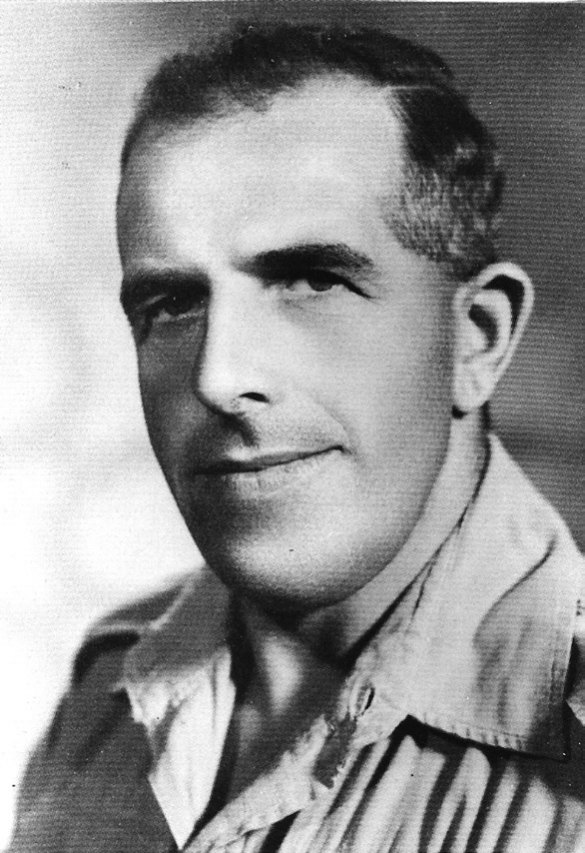
About: The senior medical officer of 1st Airborne Division, who commanded the airborne hospital in the Willem III barracks at Apeldoorn that Murphy escaped from, hid in a hollow above his cupboards when it was cleared, and reached the British lines in February 1945. He wrote it up as Travel by Dark (1963), and was an Edinburgh dentist and doctor, a Territorial colonel and a Deputy Lieutenant of the city.
Unit or role: Colonel (acting), ADMS (Assistant Director of Medical Services) 1st Airborne Division; RAMC, 57723; his MI9 report is IS9/WEA/1/275.
Where: Edinburgh (30 Dick Place in 1963; Humbie, East Lothian, at his death); Oosterbeek; the Willem III barracks, Apeldoorn; Otterlo, Barneveld, Doorn and Maarn in hiding; Sliedrecht and the Biesbosch.
Evidence: ✓ Warrack; ✓ his own book, Travel by Dark; ✓ Kew's entry for his report; the Gazette notices listed under Later life; London Gazette, 24 May 1945, p. 2647; 20 September 1945, p. 4675; ✓ Hackett's escape report; ◐ the helpers' forms of Kroner, Bol and Niermans
✓ He was born on 27 June 1913: the date is on Kew's entry for his escape report (WO 208/5433/23) and in The Times's obituary (18 January 1985; search snippets only), which has him educated at Edinburgh Academy and Trinity College, Glenalmond. The note about the author in the 1976 paperback of his book opens "Graeme Warrack was born in 1913", has the same schools, says he "qualified in Medicine and Dentistry in Edinburgh" and "also studied at the University of Pennsylvania", and that "at the outbreak of the Second World War" he "was a Company Commander in the 7th/9th Royal Scots (a territorial battalion)" (Travel by Dark, Fontana, 1976, the author note, the page before the title page; text layer, leaf 2). He followed his father into dentistry and also qualified in medicine, with the L.D.S. diploma in 1936 (British Dental Journal, 6 April 1985; snippets only), and the Fasti has him in 1939 as "L.R.C.P.&S., L.D.S." (Fasti, below).
✓ As an officer cadet of the Edinburgh University contingent of the Officers' Training Corps he was made second lieutenant in the 7th/9th Battalion, the Royal Scots, a Territorial unit, on 28 January 1933 (London Gazette, 27 January 1933, p. 594; read on the page image). The dentists' obituary calls it the "Dandy Ninth" and has him rising to major in it (BDJ; ◐ snippets only). ⚠︎ Nothing else we hold shows the rank: the Gazette of 1940 below has him a captain with seniority from 16 January 1938, the Fasti entry for his marriage in September 1939 "Captain, Royal Scots", and his own author note "a Company Commander".
◐ He married on 22 September 1939 Jean Buchanan, a daughter of the Rev. William Brown (died 2 December 1940), minister of Dunbar; the entry has him "Captain, Royal Scots" (Fasti Ecclesiae Scoticanae, vol. 8, p. 108; OCR text, not checked on the page image). The Times obituary has "Jean Buchanan Brown" and two daughters and a son. ◐ She died on 27 March 1995, "beloved wife of the late Graeme Warrack", in a notice whose own first words, with her name, were not recovered; the three children it names are the three his death notice of 1985 names, which is the match (The Times, 29 March 1995; BDJ, 9 February 1985; snippets only).
✓ He moved from the Royal Scots to the RAMC in 1940: "Capt. Graeme Matthew WARRACK (57723), R. Scots, to be Capt. 30th July, 1940, with seniority 16th Jan. 1938", under the heading "Royal Army Medical Corps. General List" (Gazette, supplement of 20 August 1940, p. 5085, read on the page image). The author's note in his book has "In 1940 he was transferred to the RAMC. In 1942 he was with the Airborne Division with which he served in Sicily and Italy and at Arnhem." ◐ The dentists' obituary has him go into the RAMC at the outbreak of war, volunteer for airborne training and command the 181 Airlanding Field Ambulance "which took part in the North Africa and Sicily landings", then join the 1st Airborne Division as its chief doctor and ADMS (BDJ; snippets only). By Arnhem the 181st was Lt Col Arthur Marrable's.
At the St Elisabeth Hospital, on the way back from the German headquarters, he talked to the two surgeons (Warrack, p. 43; page image); Kessel's book has Longland send Kessel to the staff-room, where he found Warrack with Captain Skalka, the SS division's medical officer (Surgeon at Arms, pp. 5–6); Ryan has "the chief British medical officer, Captain Lipmann Kessel; the head of the surgical team, Major Cedric Longland; and the senior Dutch surgeon, Dr. van Hengel" greet him and Wolters, "all of whom, Warrack remembers, 'were desperately anxious for news'" (A Bridge Too Far, p. 557, transcribed from the image). More on them: Lipmann Kessel, Cedric Longland.
Apeldoorn and the escape
Link to the section Apeldoorn and the escapeL. de Jong's Het Koninkrijk der Nederlanden in de Tweede Wereldoorlog (NIOD edition, CC BY 3.0 NL; the passages, with translations) names him at the end of the battle: after the Saturday, "Colonel Graeme M. Warrack", head of the medical service of the Airborne Division, concluded that the wounded had to be evacuated if at all possible, and on the Sunday morning, 24 September, Urquhart approved that Warrack make contact with the Germans, and he went with a white flag (deel 10a, p. 405, checked on the image). In the withdrawal across the Rhine on the night of the 25th all the wounded were to be left behind, "Warrack and his whole staff and the padres" staying with them (p. 407, checked on the image). ✓ That is the staying behind of the paragraph that follows.
Captured with the medical staff who stayed behind at Oosterbeek, on 26 September 1944 by his OBE citation, he was taken the same day to the Willem III barracks at Apeldoorn (the recommendation, p. 3), turned into a hospital for about 1,700 airborne wounded; his deputy, Lt-Col Martin Herford, persuaded the Germans to run it as a hospital on the understanding that nobody would try to escape. The Pegasus Archive's narrative has him hide in a cupboard in his room for fourteen days, starting shortly before the hospital closed on 26 October, until he could leave the deserted camp (Warrack); his OBE citation puts him in it earlier, and tells it in detail. He climbed into a hideout he had made ready, "a hollow space 10 ft. x 3 ft. x 18 inches, situated above two cupboards in his own room", during the main evacuation of the prisoners in mid-October; while the rear party stayed on, his room was made the dental centre at his suggestion, so he could come out for a few hours each evening, until the rear party left on 26 October. Seen from outside once while the Germans cleared the building, he hid under a bed in a ward and got back to the cupboard unfound, and stayed there, but for half an hour a day, until the noise stopped on 1 November. A unit then took over the building as a barracks and its commanding officer took his room, and only on an evening in early November could he climb out of the window, under a full moon, and crawl along the fence to a gap in the wire. Thirst drove him to an isolated house near Otterlo, where he was helped at once (the recommendation, pp. 3–4). ◐ The scan is faint on the day figures; the Pegasus Archive's copy reads them as 18 October and 3 November. ◐ The editors of his diary have it stop, on 16 October, "the day before the writer escaped and was hidden" (below), which puts the hiding on 17 October.
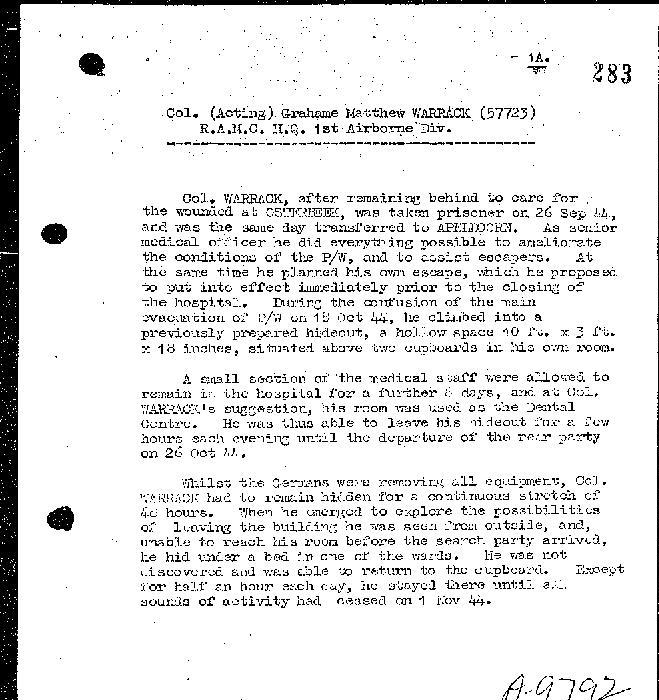
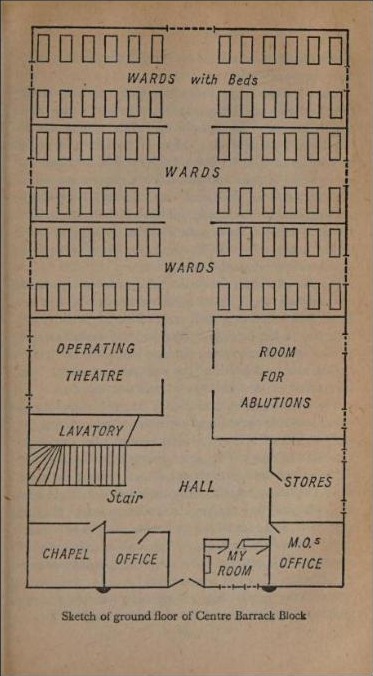
◐ Matthew Hall's life of his deputy, Lt-Col Martin Herford, has him the last to arrive at the hospital, and without his badges of rank (Hall, A Doctor at War, pp. 180–181, the reader's text layer):
The last to arrive was Colonel Graeme Warrack, Assistant Director of Medical Services 1st Airborne Division. Just before capture he had removed his badges of rank in the hope that he would be less likely to be immediately transferred to Germany to a Senior officers' POW camp if he masqueraded as a private. This strategy worked well for getting him as far as the hospital, but once there he wished to resume his authority and be recognised as an officer by the Germans. Warrack attempted to remonstrate with a German NCO who responded by threatening to march him off into custody for insubordination. He did not, at any time, wear badges of rank.
— Matthew Hall · A Doctor at War · Images Publishing, 1995 · the text, pp. 180–181
◐ In command, and a letter to Urquhart. Kessel, writing of the days after the division withdrew, has the Division's medical staff at the Apeldoorn barracks, "most of them were now there under the command of Graeme Warrack", who "managed to send a message" to Kessel's hospital at St Elisabeth that conditions were bad and that fitter casualties would be moved to Germany (Kessel, Surgeon at Arms, 1959, p. 28). Leo Heaps, in The Grey Goose of Arnhem, has him "in command there since September 26" and joined by Longland and Kessel when St Elisabeth closed on 11 October, and then:
Warrack wrote a letter to General Urquhart in England and gave it to the Resistance, which delivered it for him. As Warrack said, he had no intention of going to Germany and missing St. Andrew's Night in Edinburgh.
— Leo Heaps · The Grey Goose of Arnhem · Weidenfeld, 1976 (Futura printing, 1977), p. 115 · the full text
Heaps is a secondary writer and gives no source or date for the letter, and neither Travel by Dark nor Kessel's book mentions it (both searched in full text for Urquhart and letters), so this stands on Heaps alone. Warrack's own book has Urquhart hearing of him by a radio signal sent through the Resistance's "King" at the end of January 1945, which was "the first definite news" his wife had had of him (Travel by Dark, p. 228; page image); that does not rule out an earlier letter, but it does not mention one. The Apeldoorn hospital is the one Murphy escaped from.
On 18 November 1944 he was in "a large party of Allied personnel who were dispersed when being guided through the German lines", Pegasus II; he and three others tried to go on alone but had to turn back to Otterlo, and a month later he was taken to Barneveld. A second attempt, begun about the middle of January, was given up because the rivers were frozen, and the small party was hidden in the Maarn area (◐ the scan reads "HAARN [?]", the Pegasus Archive reads Maarn, and ✓ Hackett's report places him there on 30 January, below); a third scheme failed too before he reached safety in February 1945 (the recommendation, p. 4). In 1963 De Telegraaf had him hidden for fourteen days "in een muurkast" (in a wall cupboard), then months on the run over the Veluwe, the Betuwe, the Sticht and the Alblasserwaard, until he reached the Allied lines at Lage Zwaluwe on 6 February 1945 (De Telegraaf, 7 November 1963). His Pegasus Archive page has him cross in February 1945 with Brigadier Hackett (Warrack). Mrs D. G. Lels-Ebeling of "Hooge Zand", Doorn, English-born, hid "Lt. Col. Graham Warrack" for "two to three weeks, Jan '45", with Cpl Derek Ridler (her file, p. 14). ◐ Het Parool's diarist of 16 September 1964 has Warrack met at the Hoek van Holland by Murk "Leis", a Rotterdam shipowner and his host for the visit, at whose house at Doorn he had knocked "op een koude januariavond in 1945" (on a cold January evening in 1945) and been welcomed by Mrs "Leis", English by birth, who had died early in 1964 (Het Parool; OCR only, the page image is not served). ✓ His own book ties the two: the hostess "whom we now called Dorothy" (p. 227), "her husband, Murk" (p. 230) and "Murk and Dorothy are at their little house at Doorn" (p. 255) (Travel by Dark); the helper's form has "Doritty Gladys", so only the spelling of the surname, Leis in the OCR and Lels on the form, is ◐. Dick Kragt wrote that he guided "Col. Warrack and Capt. Lipman-Kessel out over" the Sliedrecht line (Kragt's report).
His diary
Link to the section His diary✓ He kept a diary covering 17 September to 16 October 1944, and later gave it to the Liddell Hart Centre for Military Archives at King's College London, which holds the original; the typed transcript its staff edited, of about 1982, is at the Wellcome Collection as RAMC/1584, with his foreword, a list of the officers it mentions and a roll of the medical staff at Apeldoorn (the record; the transcription, which runs from 24 September; page numbers below are the transcript's). ◐ Wellcome's title says it was written "during and immediately after" the operation, while the foreword below has him starting it as a captive at Apeldoorn to get the facts down "while they were still fresh", so whether the battle days were written on the day is not settled. His foreword says how he came to keep it:
The GERMANS were very cooperative. I had an office; on its table was an empty book with 'Agenda' written on its cover.
As ADMS I would have to write a report on the operation we had just taken part in for my Divisional Commander and my DDMS at Airborne Corps. What better than to get the facts down in diary form while they were still fresh in my memory?
— Col. Graeme Warrack · foreword to the transcript of his diary · Wellcome Collection RAMC/1584 · the transcription
- Kept in the open. "At any time during these weeks of our captivity the GERMAN Commandant or his staff could take away my diary or, if he wanted, read it or copy it"; the German senior medical officer used to say "'Ah, Colonel, you are always writing!'" For security he called many officers by their Christian names, with "a post-war pencil note about these on Folio 47" (the foreword).
- Where it went. When he went into hiding he took it with him and "left it in the KAZERNE until the Liberation in April 1945. It was returned to me in May of that year." It was "the basis of my book Travel by Dark: after Arnhem published by Harvill Press Ltd in 1963, as well as of the BBC", where the foreword breaks off in the copy (the foreword).
- What it is worth. ◐ By his foreword he began the book at Apeldoorn, writing up the facts "while they were still fresh in my memory", so the entries up to 26 September were written up there afterwards and the later day entries are near-contemporary (no source says the same day), kept where the Germans could read them; what he saw himself is near-contemporary evidence, what he was told is hearsay, and the square brackets and footnotes are the editors' or his own later additions.
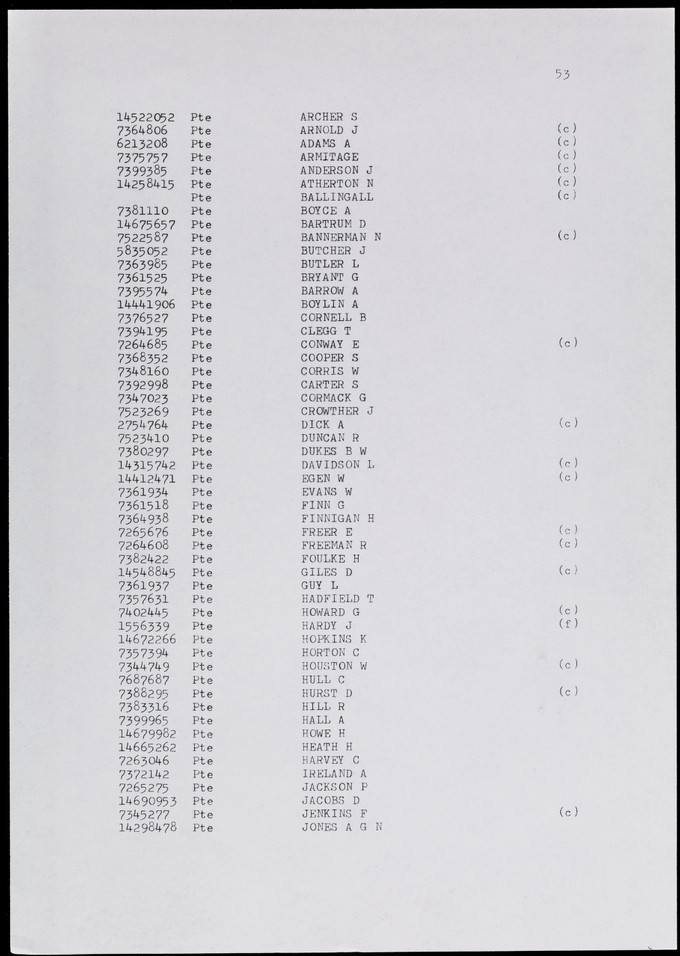
25 September to 16 October, from the diary.
- The order to stay. At 08.00 on 25 September at Division he "Received the information that during the night the Division was pulling out and that I was to stay with the Medical services and look after the wounded. This was a great blow" (p. 22).
- The hospital. On 26 September he cleared the last dressing stations at Oosterbeek, sent Bill Alford ahead to Apeldoorn "to prepare the way", and reached the barracks at 18.30, where he found Redman and met Lt-Col Martin Herford (pp. 26–27).
- At 21.30 he set it up: "The hospital is to be run with two sides: the adm under ARTHUR and the medical under BILL. JIMMY is to be Registrar, HERFORD 2 i/c and REDMAN liaison officer" (p. 27).
- His list of officers makes Arthur Marrable and Bill Alford, and Jimmy ◐ Maj. J. E. Miller, since the other Jimmy, Logan, came only next day (the officers' list, p. 48).
- The Germans. The camp commandant was Lt-Col Schroeder, "quite a reasonable chap" on 27 September and "a queer fish" the next day, who "isn't quite sure whether he's commanding a Stalag or a Military Hospital" (pp. 28, 30). He dealt with the German medical chiefs, General Meyer, Lt-Col Zingelinck and Kramer, and on 29 September "Protested most strongly on medical grounds" when they asked 500 cases for "A hospital train consisting of cattle trucks" (pp. 31–33).
- The broadcaster, 2 October. A war correspondent he took for "a Quisling" wanted men to broadcast greetings home; Warrack "gave a direct order that no BRITISH officer or other rank should speak on his machine", and when the man came back for names "He didn't get a single one" (pp. 35–36).
- The numbers. ✓ The barracks had opened on 25 September "with a flood of some 800 patients, of whom 500 were evacuated almost at once"; his party came in at 18.30 on the 26th, bringing it to "some 900 patients" (pp. 26–27). His counts run from 796 at 18.30 on 29 September and 756 at noon on 2 October to 533 at 20.00 on 3 October and 537 before the move of 5 October, and 103 on the evening of 6 October, the night Murphy and Walsh went (pp. 34–41).
- The first train, 2 October. The Germans asked for 250 patients, three doctors, a dentist and 14 orderlies. He chose the doctors "one from each Brigade", saw the party to "a row of cattle trucks with straw on the floor and small Red Crosses painted on the roof", told Schroeder the train was "thoroughly unsatisfactory", and returned "seething with indignation" (pp. 36–37). The train had still not gone at 11.30 next day, and on 4 October he heard it "left last night", Tuesday 3 October (pp. 35–38).
- Escapes. On 3 October, the day after Hugh Maguire slipped out of the parade of walking wounded, he gave him "my blessing", and wrote "There has been quite a lot of escaping going on all the time, which is very cheering" (p. 37); on 4 October, "At the moment any patient who is fit enough can make a break, but I need the whole staff to look after the patients" (p. 39) (the diary).
- The second train, 5 October. For the 496 patients the Germans wanted he decided "to send BILL as OC Train and all officers and ORs of the Para Bdes to accompany him. It is an awful decision to have to make" (p. 39); on the afternoon of the 6th it stood in the station: "this morning's attack has busted the line and also that there is no engine" (p. 40); it had still not gone on the morning of the 7th, and on the morning of the 8th "Reported that train has left" (pp. 41–42).
- ◐ The roll of the medical staff at the back dates its men's departures "Ambulance train 2 Oct 44", "4 Oct 44" and "6 Oct 44" (p. 55); the diary has trains loaded on 2 and 5 October and none on the 4th, and the roll does not say whether its dates are of loading or leaving.
- Herford's report has "Hospital Train left" under 4 October, so 4 October is his day for the first train leaving, 2 October is its loading in both, and 6 October falls while the second stood in the station. ⚠︎ Not settled: what the roll's dates mean, and whether its 4 October is the first train or another.
- ◐ The roll of the medical staff at the back dates its men's departures "Ambulance train 2 Oct 44", "4 Oct 44" and "6 Oct 44" (p. 55); the diary has trains loaded on 2 and 5 October and none on the 4th, and the roll does not say whether its dates are of loading or leaving.
-
The four shot. ⚠︎ Warrack wrote on 7 October that Zingelinck had told them four men had been shot dead "while trying to escape from the train which left on Tuesday"; he called it "A very fishy tale", and a later footnote has "Subsequently it transpired that Capt JOHN KEESEY was shot dead when jumping off the train!" (p. 42). The entry in full:
> {voice uk} > > ZINGELINCK had told us how four of our chaps were shot dead while trying to escape from the train which left on Tuesday. This requires investigation. Apparently they fired a revolver at the guard, who returned fire. A very fishy tale. > > — Col. Graeme Warrack · his diary, 7 October 1944 · typed transcript, Wellcome Collection RAMC/1584, p. 42 · [the transcription](../sources/uk/wellcome-ramc-1584-warrack-diary/transcript-diary-24sep-16oct-and-reports.md)- ◐ Kessel's Surgeon at Arms has a different account from Derek Ridler, who jumped: on the cattle-truck train "three of us should jump the train", Clifford Simons, "being the odd man, agreed to stay behind", "Lawson and I managed all right … but John Keesey was unlucky … shot through the head by a guard" (Kessel, p. 123). We have Ridler's words only as Kessel wrote them down; they have three jumping and one shot, not four shot after firing a revolver.
- ◐ CWGC has Capt John Howard Keesey (199991) as died on 2 October 1944, buried at Becklingen War Cemetery (the CWGC sweep), a day before the diary has the train leaving (the night of the 3rd; the roll's note (a) says "2 Oct 44"). ⚠︎ Nothing we hold names a second man shot.
- The inspection. The same day a German general inspected the hospital and told Schroeder "'Remember this is a hospital and not a PW camp'" (p. 41); on 9 October, hustled away at a guard's gun-point, Warrack reminded the Commandant of it (p. 43).
- The last days. On Sunday 15 October a church parade at 17.45; on Monday 16 October at 11.00 a "Counting parade, as some citizens appear to have gone absent", and at 14.30 Schroeder asking "'When the wounded go, what is to be done with you doctors?'" (p. 46). That afternoon ten patients came from Het Loo, "KRAMER had got tired of them as they persisted in escaping", and at 17.30 "Another check and they find three missing. How very odd!" (p. 47).
- Where it stops. The editors' note under the last entry: "[The Diary stops the day before the writer escaped and was hidden from the GERMANS. It was found again when HOLLAND was liberated in May 1945.]" (p. 47); his foreword has it left in the barracks "until the Liberation in April 1945" and "returned to me in May". ◐ The two accounts differ on when it was found: the foreword separates the liberation (April) from its return (May), the editors put the finding at the liberation of Holland in May; we have checked neither date.
- ◐ Matthew Hall's life of Herford, written from Herford's diaries, has Herford get back into the barracks "Two days after the town's liberation", where "He found the hiding place in the ceiling of Warrack's room, and to his great relief the diary and a little hoard of belongings were still there. These he returned to Warrack's family" (Hall, A Doctor at War, pp. 206–207). That fits the foreword: found in April, back with him in May. It is Hall's account; neither Warrack's foreword nor the editors name who found it.
- Hall has Apeldoorn fall on 15 April 1945 (p. 206), so Herford's return on the 17th. ✓ A. J. Kliest of Apeldoorn, writing on 10 July 1945, has "On the 17th of April 1945, the day of Apeldoorn's liberation" (his statement, p. 18 of the file, read on the image). The two dates for the liberation do not agree, so the day of Herford's return is not settled.
His second in command's report, and Hall. Lt-Col Martin Herford's own report of 1944, printed in 1952, and Hall's life of Herford tell the same weeks from Herford's side (Herford's report, Journal of the RAMC, vol. 98, pp. 249–252, 297–302, read on the page images; Hall):
- ✓ Arriving. He came "During the afternoon" from Oosterbeek, "where he had been supervising the evacuation of casualties"; he "called a meeting of Senior Officers" and "asked me to act as his 2nd i/c and be Liaison Officer" (report, p. 251). His diary has 18.30 (above).
- ✓ Bluffing. On 28 September he "suggested that supplies may be dropped by parachute", which General Mayer promised to put to Field Marshal Model; on the 29th "The position was so comic that Col. Warrack described it as an 'Alice in Wonderland' story. We had decided to bluff to the uttermost and play for time" (report, p. 252).
- ✓ The hide-out. In the days of 12 to 14 October, "Col. Warrack and I have rigged up a hide-out in the building with supplies and food"; "Col. Warrack was very anxious to come too, but was greatly influenced by his responsibilities to the wounded", and it was settled "that he would hide when I left and then remain to keep contact and advise until the last". On the 16th Herford and Father McGowan were "aided out by Col. Warrack and Lt.-Col. Marrable" (report, pp. 299–300).
- ◐ Hall's additions. "Graham Warrack was encouraging escapees and there was relatively little fencing to prevent it"; at the meeting that freed the staff to escape "Warrack suggested that approaches be made to the Dutch underground, but Herford was against it", for the risk to the Dutch, and Herford proposed the hiding place inside the hospital (pp. 185–186). The morning after Herford left, orders came at 8.15 for the hospital to be cleared but for five doctors, two padres and twenty orderlies, and "by 11.30 Colonel Warrack had disappeared" (p. 207).
- ◐ The Town Major. His diary's "Town Major of APELDOORN", "a Maj Baron VON OLDENHAUSEN", spoke good English, brought gin and comforts, and on 7 October asked to put 600 soldiers in one of the blocks (the diary, pp. 28–31, 34, 42).
- He is very probably the man in the caption of De zwarte herfst: "De Ortskommandant van Apeldoorn, die de Nederlanders een goed hart toedroeg: de majoor Eckbrecht Freiherr von Oldershausen. Na de bevrijding kreeg hij een 'non-enemy'-verklaring" (the Ortskommandant of Apeldoorn, who wished the Dutch well; after the liberation he was given a "non-enemy" declaration) (caption 89, p. 246; the photograph not seen).
- The text layer has the caption's number as "69", which we read as 89 from the order of the captions around it, and the book's index (p. 304) lists "Oldershausen, lt.kol. E. von" at pp. 245, 246 and 248, a lieutenant-colonel where the caption has "majoor".
- Herford's report has "The District Commander, Baron Von H——", "very friendly and anti-Nazi", who said "If I did anything they would kill my family" (p. 299). ◐ A similar post ("District Commander" here, "Town Major" in the diary, Ortskommandant in the caption), but the initial does not match, so not shown to be him.
- He is very probably the man in the caption of De zwarte herfst: "De Ortskommandant van Apeldoorn, die de Nederlanders een goed hart toedroeg: de majoor Eckbrecht Freiherr von Oldershausen. Na de bevrijding kreeg hij een 'non-enemy'-verklaring" (the Ortskommandant of Apeldoorn, who wished the Dutch well; after the liberation he was given a "non-enemy" declaration) (caption 89, p. 246; the photograph not seen).
Otterlo, Barneveld and Maarn
Link to the section Otterlo, Barneveld and MaarnThe helpers' forms and Hackett's escape report put houses and dates on the months his citation leaves vague.
- ◐ Otterlo, from 4 November.
- Tine (Tineke) Kroner of Otterlo lists "Lt. Cl. Warrack", RAMC, hidden "4.11.44" for 42 days, passed on to Wim van Dyk of Harskamp (her form, p. 3); her remarks send the reader to his report, "I.S. 9/WEA/1/275/2365", the number Kew gives it (p. 2). Forty-two days from 4 November run to about 16 December, after Pegasus II.
- ◐ She is very probably the "isolated house near Otterlo" of his citation, though it names no one: Het Parool's diarist in 1964 has him show photographs of "Tineke, het moedige meisje uit Otterloo, dat de zwervende officier onderdak aanbood" (Tineke, the brave girl from Otterlo, who gave the wandering officer shelter) (Het Parool, 16 September 1964; OCR only).
- ◐ Low was there too. The USAAF pilot Lt John L. Low Jr., who was on Pegasus II, gave his own stay with "Tineke Kramer" (as the Americans' summary has it "or Kroner") as 19 or 20 November to 16 or 17 December (his report, p. 39; p. 9), and Kroner's form lists "Lt. John Low USAAF" after Warrack (p. 3). ◐ Warrack's 42 days from 4 November cover the whole of Low's stay, so the two were probably in that house together for about four weeks; neither form says so.
- ✓ Back from Pegasus II, and Hackett's plan. Hackett, in hiding at Ede, wrote in his report of 7 February 1945 that, after he had begun in mid-December to write to the other side, he "heard through PIET that Col. WARRACK ... had made his way back alone from the Pegasus II operation to OTTERLOO".
- He sent a note across the lines proposing Warrack's inclusion in the crossing he was planning for Christmas Day.
- The crossing was put off for the moon, then to 7 January, and on 9 January he was told it was impossible (Hackett's report, p. 9).
- ◐ Barneveld, from 27 December.
- Jacob Bol of Barneveld, "Baas" to the men he hid, lists "G.M. Warrack, 1e Airb. Div.", 27/12/44, 14 days, with "J. Low", 2 days, received from and passed to "Frans Hals" (his form, p. 5).
- His second typed copy has "Dr. G.M. Warrack Col. arts [doctor] Edinburg" and Low at 8 days each, received from "Joop en Dick" (p. 17): Kragt and Piller.
- Low's report has him with a schoolteacher at Barneveld from 20 to 27 December and at Gerrit van Omme's from 4 January (p. 9), so the 8-day copy fits and the 14 would run past the day Low left.
- ◐ Known to Kay and Piller. Karel Niermans, a courier of the Frans Hals organisation who lived in their house at Essen and Barneveld, lists "major Dr. Graeme M. Warrack" with Longland, Kessel, Allenby, Allen, Ridler, Maguire and others as "known to capt. D Kay and capt. J. Piller", who "have all details they signed at the time over to England" (his form, p. 5).
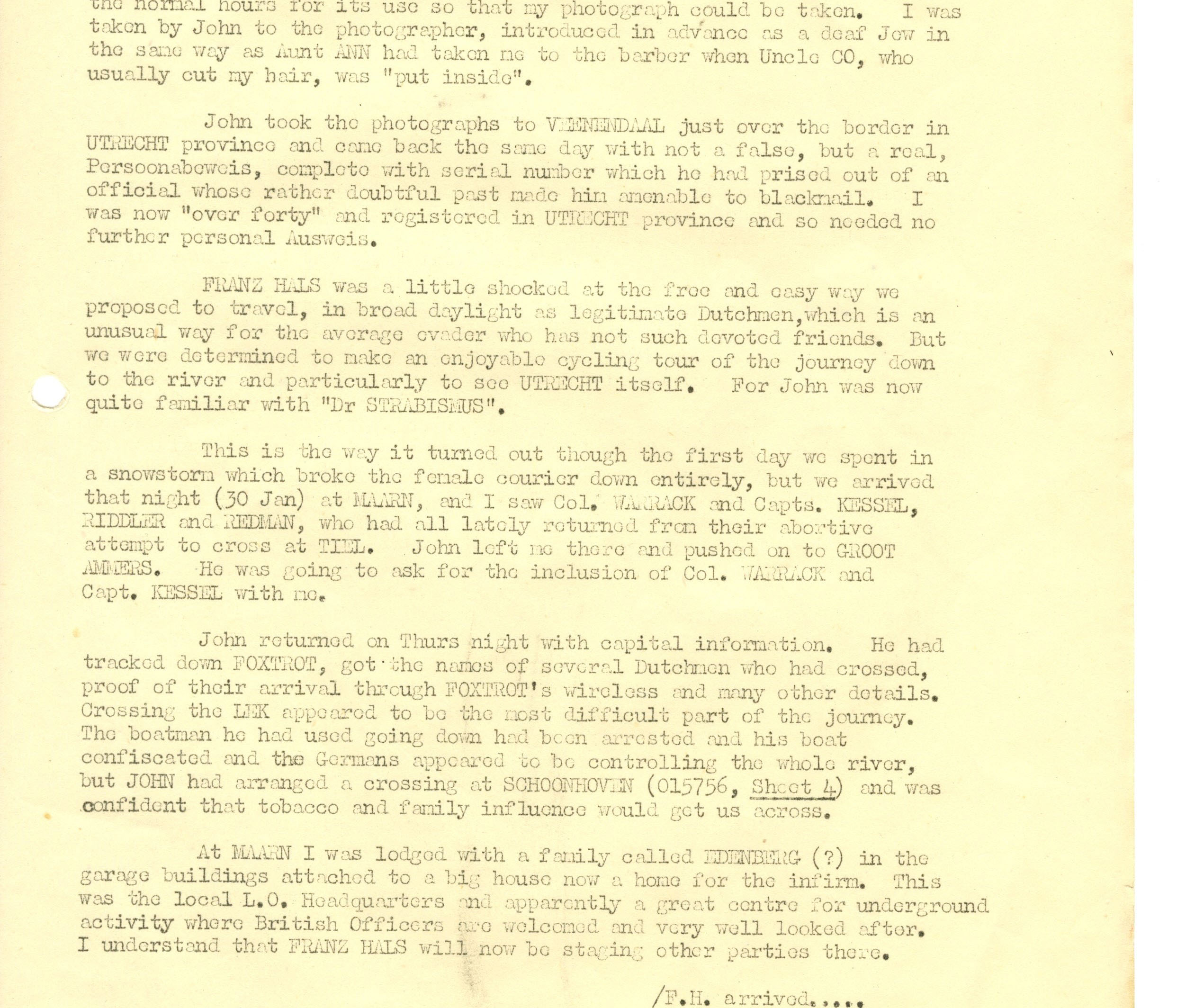
- ✓ Tiel, then Maarn. Hackett reached Maarn on the night of 30 January and "saw Col. WARRACK and Capts. KESSEL, RIDDLER and REDMAN, who had all lately returned from their abortive attempt to cross at TIEL" (Hackett's report, p. 13). ◐ Very probably the second attempt of his citation; Tiel is in the Betuwe, on the Waal.
- ◐ Pte William Gordon may have been of this party: his report has him set off with a guide on 19 January "to contact another group that was making the crossing" near Tiel and hands that part to Redman's report, which is not held; neither Warrack's nor Kessel's book names him.
- Hackett lodged with "a family called EDENBERG (?)" in garage buildings by a big house, "now a home for the infirm", "the local L.O. Headquarters" (p. 13); ◐ the Idenburgs' of Caspers's book (Dick Kragt).
- Dick Kragt, "FRANZ HALS" or "F.H." in the report, told Hackett that Warrack and Kessel were at a house near Maarn, and on 3 February "Col. WARRACK, Capt. KESSEL and F.H. set off the next morning (3rd) at 4.30", "travelling 'dirty'" and preferring darkness; Hackett and John Snoek left about four and a half hours later (pp. 12, 14). ✓ This agrees with Caspers's 3 February and with Kragt's own report that he guided the two out.
His own escape report, at Kew and not digitised, is WO 208/5433/23, dated 7 February 1945 (former reference I.S.9.(W.E.A.)/1/275/2365): captured at "Oosterbeck" on 26 September 1944, escaped from the "Hospital, Apeldoorne", October 1944, with among the other names mentioned Lieutenant Colonel Herford, Major Longland, Captain Lipman Kessel, Lieutenant Allenby, Staff Sergeant Allen and the padres McGowan and McGee (the catalogue entry).
He was recommended for the DSO for Arnhem by his divisional commander, with the corps commander, Gale, and Montgomery signing in turn; it passed the division on 21 March 1945 (the recommendation, p. 1). It is the only one of his citations to tell his part in the battle:
There was considerable shortage of food and water in the hosp and Col WARRACK after interview with the German Comd managed to arrange for our jeeps, during the battle, to draw water from German held sources. In spite of the constant shelling and mortaring he many times passed to and fro from the hosp through the German positions to the Divisional HQ and kept both places infm of the general situation.
— 1st Airborne Division · recommendation for the DSO, March 1945 · The National Archives, Kew, WO 373/53/419 · the transcription
At Apeldoorn, it goes on, his insistence on the Geneva Convention meant the treatment in the hospitals and the evacuations "were carried out as comfortably as possible"; when the last evacuation to Germany was ordered he sent doctors and orderlies with the parties of wounded, then hid and escaped "into Dutch hands" (p. 2). He was given the DSO for North-West Europe, "Colonel (acting) Graeme Mathew WARRACK (57723), Royal Army Medical Corps (Edinburgh)" (London Gazette, 24 May 1945, p. 2647), and made an OBE in September, "Colonel (acting) Graeme Matthew WARRACK, D.S.O. (57723), Royal Army Medical Corps" (20 September 1945, p. 4675); the OBE recommendation, for his escape, is filed with the typed list of that award, where he heads the same list as Lipmann Kessel's MBE (the recommendation, p. 2). He wrote the escape up in Travel by Dark; the Dutch edition, Tocht door het duister, came out in 1964 (Sijthoff), and Amigoe di Curaçao reviewed it on 12 May 1964 as the work of "the Scottish army doctor", now a GP in Edinburgh and fifty years old, who reached "the Biesbosch" and safety in North Brabant on 5 February 1945, with, as the review has it, the book's last lines thanking the Jans, Willems and Hanses who were his hosts and guides (Amigoe di Curaçao, 12 May 1964; checked against the image). ◐ Het Parool reviewed the English book on 18 February 1964 (review; OCR only). The Dutch edition came out through A. W. Sijthoff of Leiden: a bookseller's advertisement in the Leekster Courant of 27 November 1964 lists it as "Ontsnapping na de slag om Arnhem. Toegevoegd: Ervaringen van de ondergrondse helpers" (escape after the battle of Arnhem; added: the underground helpers' experiences) (advertisement; OCR only), and Trouw's review of 15 September 1964 reads, through a badly garbled OCR, as saying that the foreword thanks Prince Bernhard, that Warrack gave the addresses of his helpers, and that the book ends with the underground workers appearing by name, dedicated to the Dutch Underground (Trouw; OCR only, too corrupt to quote). The English book's last lines are "As for all the other Jans and Willems and Hans who were our hosts and guides and who took such risks on our behalf—wherever you are—thank you" (Travel by Dark, p. 255; page image). The English book names its hosts by first name (Dorothy, Murk, Tineke, Klaas, Jan, Hans), and De Telegraaf of 1963 says the seven helpers at his reunion "worden allen bij name in zijn boek genoemd" (are all named in his book); the Dutch edition adds a chapter on the helpers, which we have not seen. In 1976 the NOS and BBC made a film from it, "Arnhem, het verhaal van een ontsnapping", with John Hallam as Warrack, shown on Dutch television on 22 September; Trouw's review has his hideout behind a hatch in a cupboard at Apeldoorn, a first attempt to reach the British lines that fails when a German patrol opens fire, and a second that succeeds after he and an American soldier return to the old hiding place (Trouw, 22 September 1976; checked against the image). The review describes the film, not the escape.
✓ In 1963, with a practice in Edinburgh, he invited seven of the Dutch underground who had helped him to a reunion at the Airborne Club in London (De Telegraaf, 7 November 1963).
The book and the film in more detail. The title page of the English book has "Foreword by H.R.H. Prince Bernhard of the Netherlands" (Travel by Dark, Fontana, 1976, title page; foreword, signed by Bernhard at Soestdijk Palace in June 1963). The Dutch translation, by J. F. Kliphuis for A. W. Sijthoff of Leiden at 10.90 guilders, has the route on its end-papers and an added chapter by Evert Werkman, who talked to the people who had helped him, and Warrack was still in touch with some of them; the review quotes Dick Kragt on the evaders, "Vaak konden ze niet fietsen" (often they could not ride a bicycle), and adds "Warrack kón fietsen" (Algemeen Handelsblad, 18 July 1964); ◐ the review is OCR only. A feature in the Nieuwsblad van het Noorden of 2 June 1964 prints excerpts from the book on his hiding place and on the first failed crossing (the feature; checked on the image). The film "Arnhem - het verhaal van een ontsnapping" was shot in March 1976 on Dutch locations as a BBC and NOS co-production, including the Willem III barracks "complete with the cupboard in which Warrack managed to stay hidden for two weeks", and was shown again on Nederland 1 on 3 January 1979, followed by an interview Wil de Jong had made with Warrack and the original "Tineke" (Leeuwarder Courant, 2 January 1979; Nieuwsblad van het Noorden, 3 January 1979; De Telegraaf, 3 January 1979; all checked on the images). Its cast, John Hallam as Warrack and Gavin Campbell as Martin Herford, is in the Nieuwsblad's cast list.
⚠︎ Kew holds a Judge Advocate General's file on "Medical neglect of wounded British prisoners of war at Apeldoorn barracks, Netherlands, September 1944" (WO 311/1297; the catalogue entries), the hospital he ran. It has not been read, and the catalogue does not say whose neglect it means.
Later life
Link to the section Later lifeHis Territorial career, as the Gazette has it (every page below read on the image or the page text; the number is 57723 throughout):
- ✓ Efficiency Decoration. In the list of 14 November 1947 for "the following Officers of the Territorial Army" is "Maj. (Hon. Lt.-Col.) G. M. WARRACK, D.S.O., O.B.E. (57723)" (supplement 38122, p. 5356; heading on p. 5355). The 1st Clasp is of 3 November 1950 (39058, p. 5484), the 2nd of 10 January 1958 (41279, p. 206) and the 3rd of 30 June 1959 (41755, p. 4275).
- ⚠︎ The intervals are about three years (the TD to the 1st Clasp), seven years (the 1st to the 2nd) and seventeen and a half months (the 2nd to the 3rd), and the notices give no reason for any of them.
- ✓ Rank.
- "Maj. (Hon. Col.) Graeme Matthew WARRACK" is "from T.A. Res. of Offrs., to be Maj., 10th Oct. 1950, with seniority 9th Jan. 1945", and "granted the actg. rank of Lt.-Col." (supplement 39096, 22 December 1950, p. 6385).
- Lt.-Col. in the Army Emergency Reserve of Officers from 27 June 1951 (supplement 40155, 23 April 1954, p. 2409).
- Then, in the Territorial Army list of 29 January 1957, "from A.E. Res. of Offrs., to be Lt.-Col., 1st Dec. 1956 … and is granted the actg. rank of Col., 1st Dec. 1956" (p. 643).
- On 21 April 1961 "Col. G. M. WARRACK … from Active List, to be Col., 1st Dec. 1960, and is granted the local rank of Brig." in the Territorial Army Reserve of Officers (supplement 42332, p. 2961).
- ✓ Honorary Physician to the Queen, from 29 July 1958 (Gazette, 29 July 1958, p. 4717; read on the page image) to the "tenure expired" of the notice that appoints his successor on 29 July 1960 (supplement 42134, 2 September 1960, p. 6081).
- ✓ Deputy Lieutenant of the City of Edinburgh: "Colonel (local Brigadier) Graeme Matthew Warrack, D.S.O., O.B.E., T.D., of 30 Dick Place, Edinburgh 9" (London Gazette, 26 November 1963, p. 9714; the same notice in the Edinburgh Gazette, 29 November 1963, p. 801).
- ✓ Honorary Colonel, 144 Field Ambulance, RAMC (Volunteers), Territorial and Army Volunteer Reserve, from 10 January 1969, "Col. Graeme Matthew WARRACK, C.B.E., D.S.O., T.D., D.L., M.R.C.P., L.R.C.S., F.D.S." (supplement 44786, p. 1500); his successor was appointed on 10 January 1979 "in succession to Col. Graeme Matthew WARRACK … tenure expired" (supplement 47824, 24 April 1979, p. 5389). The book's author note of 1976 calls him "Honorary Colonel to the Airborne TAVR Field Ambulance RAMC".
◐ The Times has him president of the Royal Odonto-Chirurgical Society of Scotland in 1967 (18 January 1985); it also has him chairman of the Royal British Legion, Scotland, from 1981 to 1984, where the BDJ obituary has 1981 to 1983 (BDJ; see Where the sources disagree below).
✓ In June 1971 a Trustee Act notice for "WARRACK, Andrew Noel", a retired banker of the Avenue Nursing Home, Scarborough, who died on 4 September 1969, names as executors "The Chartered Bank and Dr. Graeme Matthew Warrack, C.B.E., D.S.O., T.D., D.L." (Gazette, 8 June 1971, p. 6111). The notice does not say how the two were related.
✓ The CBE came in the New Year Honours of 1 January 1968, to "Brigadier (Local) Grame Matthew WARRACK, D.S.O., O.B.E., T.D., L.R.C.S., L.R.C.P. (57723), late Royal Army Medical Corps, Territorial and Army Volunteer Reserve", Military Division (supplement 44484, p. 6; read on the page image). Kew has it as WO 373/172/424, "Colonel, P/57723", digitised, but the recommendation itself is not held (the catalogue entry). ◐ The dentists' obituary ties it to his post as the brigadier adviser to the Director General of Army Medical Services on Territorial matters (BDJ).
◐ He went back to dentistry after the war: the same obituary has him honorary visiting surgeon to the Edinburgh Dental Hospital, part-time consultant oral surgeon at the Royal Infirmary, centenary president of the Royal Odonto-Chirurgical Society, a founder and past president of the Airborne Medical Society, surgeon to the Queen's Bodyguard for Scotland (the Royal Company of Archers, whose trophies he won), and for 33 years until 1984 on the governing council of Glenalmond. Robin Salvesen, writing of the practice that looked after his family's teeth, remembers "a very big and tall man who wrote about his exploits at Arnhem, was a doctor and a dentist in the practice which looked after the Salvesen family's teeth" (Salvesen, Ship's Husband; search snippets only).
◐ In 1977 he was one of the Arnhem veterans who wrote to The Times against the film of Cornelius Ryan's book. The Sunday Times of 23 October 1977, after Attenborough had written to such critics, has him as the colonel "who ran the Airborne's medical services at Arnhem and was furious with the manner in which the film demoted their role in favo[u]r of Sir Laurence Olivier's mythical Dutch dector [doctor]" and quotes him: "I'm not accustomed to 'saying one thing one moment and, because I get a nice jolly letter from Richard Attenborough, to go back on it." (the passage, from search snippets chained together; the page was not read, and the article does not say in what he had written to The Times, so the letter itself is not held).
◐ He died on 13 January 1985, aged 71, "peacefully at home, Humbie, East Lothian" (BDJ, 9 February 1985; The Times, 18 January 1985; a funeral service on the Wednesday, The Times, 15 January 1985). The Times calls him a soldier who "played a distinguished role at the battle of Arnhem" and later "became known for his book Travel by Dark", and the dentists' obituary "an outstanding dentist, soldier, army medical officer, citizen, churchman, author and great Scotsman". The Museum of Military Medicine has an item "Col G M Warrack", 13 January 1985, in the Royal Army Dental Corps papers, RADC/GEN01/49: the date is the day he died, and nothing says what the item is (the catalogue entry). The Royal College of Physicians of Edinburgh's collection of obituaries lists a "Warrack, Graeme M" (OBJ/NEW/2/23); ◐ possibly him, since he held the Edinburgh licence, but the entry has no dates.
Where the sources disagree
Link to the section Where the sources disagreeWhether he was in command from the first day. Heaps has him "in command" at the Apeldoorn hospital "since September 26" (Heaps, p. 115) and Kessel has the medical staff there "under the command of Graeme Warrack" (Kessel, p. 28); Hall's life of Herford has him "the last to arrive", without badges of rank, and threatened by a German NCO when he tried to resume his authority, with Herford the one who made the arrangements (Hall, pp. 180–181). ◐ Not reconciled: his rank made him the senior officer, and the OBE citation has him taken to Apeldoorn on the 26th (the recommendation, p. 3), but who dealt with the Germans on the first days is Hall's claim for Herford alone. ◐ His diary agrees with Hall that Redman and Herford were there before him, and with Heaps on the command: at 18.30 on the 26th he found Redman and Herford already there, and at 21.30 he called the officers together and set out who would run what (his diary, pp. 26–27). ◐ Herford's own report agrees with the diary on who organised the hospital, but not on the time: it has Warrack arrive "During the afternoon" where the diary has 18.30, and gives no time for the meeting where the diary has 21.30. It has him call "a meeting of Senior Officers", "immediately" begin "a proper Hospital organization" and make Herford his second in command (p. 251); ◐ Hall has the conference "next morning" (p. 181).
How many wounded. The Pegasus Archive has the barracks converted for about 1,700 (Warrack); his diary has "some 900 patients" on 26 September, 796 on the 29th, and on the 28th "nearly 2000 wounded" landed on the German medical services (◐ counting those in the town's other hospitals, where on the 29th the Dutch Red Cross doctor, Trip, put "over 1000 BRITISH" wounded in the town) (his diary, pp. 27, 31–32, 34). Herford's DSO recommendation has 1,500 (WO 373/53/562, p. 2); the recommendation for Bryson has 900 (WO 373/144/184, p. 2). ◐ The figures count different things on different days.
An undertaking not to escape? The Pegasus Archive has the hospital granted "on the understanding that there would be no attempts to escape" (Warrack). His diary, which the Germans could read, mentions no such undertaking, calls the escaping of 3 October "very cheering", and on 4 October has "any patient who is fit enough can make a break, but I need the whole staff to look after the patients" (his diary, pp. 37, 39). ◐ The diary's silence does not show there was none.
When Longland and Kessel came from Arnhem. Heaps has them join him when the St Elisabeth closed on 11 October (Heaps, p. 115), and his own book has them lead a party in on 12 October (p. 78); ✓ his diary has "SHORTY LONGLAND" arrive with a party from the St Elisabeth on 27 September and "LIPPY", Kessel, on 13 October (his diary, pp. 28, 45; Cedric Longland; Lipmann Kessel).
How he got back to Otterlo. Hackett's report, from what Piet van Arnhem told him, has Warrack make his way back from Pegasus II "alone" (p. 9); his own citation has him and three others try to go on and turn back (the recommendation, p. 4). ◐ Both can be true if the four split on the way back; Hackett had it second-hand.
How long at Bol's in Barneveld. Fourteen days in one typed copy of Bol's table, eight in the other (p. 5; p. 17); see above.
How long he was in the cupboard. Fourteen days in the Pegasus Archive's narrative and in De Telegraaf (Warrack; De Telegraaf); his OBE citation has him in the hideout from the main evacuation in mid-October, coming out in the evenings until 26 October, and leaving the building in early November (the recommendation, pp. 3–4). ✓ His own book has him decide, on the evening of Monday 16 October, to get into his hideout "about 6 o'clock next morning" (p. 92), notes "It was November 1st" as he packs (p. 108), and has him leave through his window at about 10.45 that night (p. 109, bottom) after hiding "for two weeks" as he tells the family at Otterlo (p. 118) (Travel by Dark); that is 17 October to 1 November, fifteen days. ◐ He then walked for at least a night before he reached the house, so his arrival falls on 2 November or a day or two later; Kroner's form has 4 November (above).
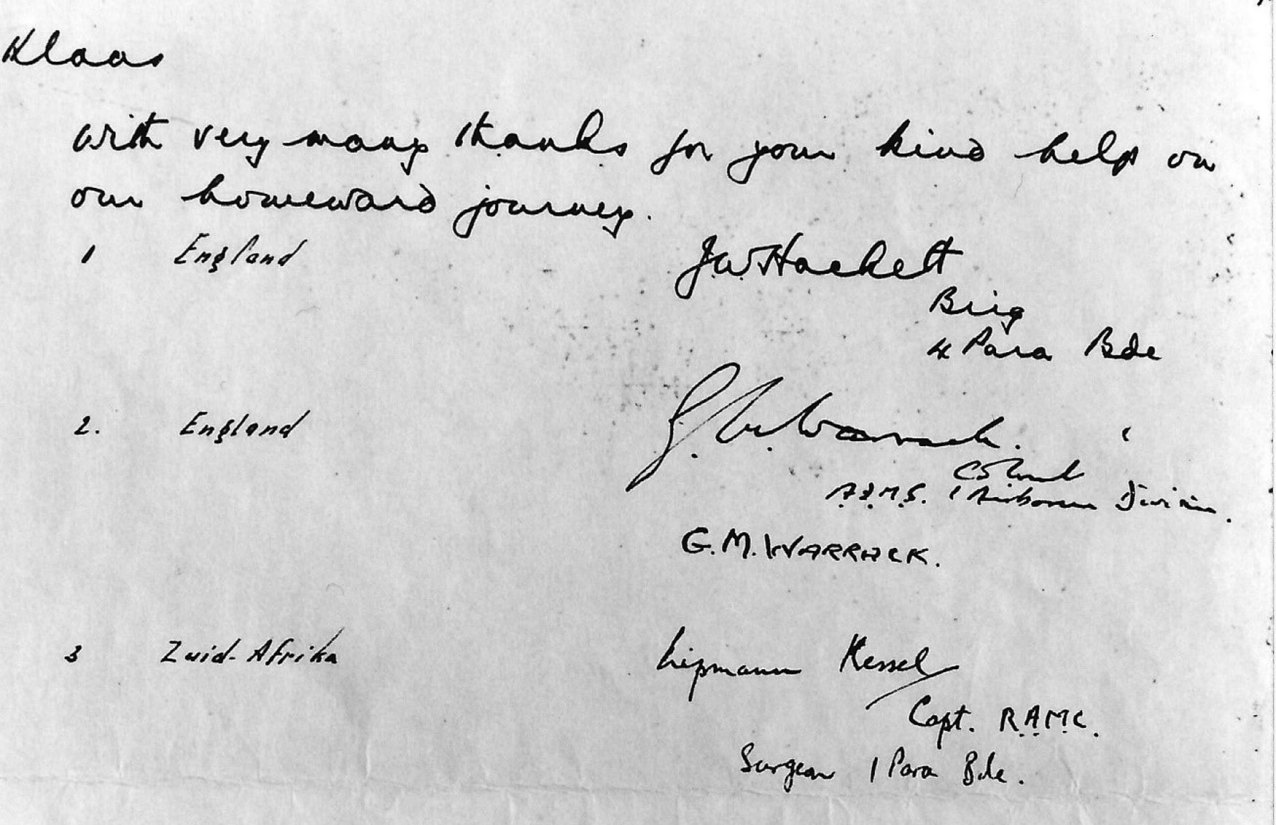
When he crossed. ✓ Hackett's memoir dates it. Warrack was lodged with the village minister at Groot-Ammers, met Hackett there on the afternoon of 4 February, and on Monday 5 February "had now, we heard, gone on ahead" to Sliedrecht (Hackett, I Was a Stranger, p. 183). He came down the Biesbosch in a canoe on the night of 5/6 February, "the canoe which was bringing Graeme Warrack" (p. 195), reached Lage Zwaluwe ahead of Hackett ("Another canoe came in a little while back"), and was worried that Kessel's canoe was "long overdue" and went to search for it alone (pp. 197–198). The Postscript names the other boatman as Jan Visser, "who had brought down the other canoe that night, the one in which Graeme Warrack arrived" (p. 217). Before that, Hackett puts him in the January party that had set out with Kirschen and "failed completely and been forced to come right back" (p. 149), and with Kragt at the house near Doorn at the end of January (pp. 167–172); Theo Redman, who escaped with Davison, told the Dutch book De zwarte herfst in 1984 that he met "Colonel Warrack and Major Lipmann Kessel" again after nearly three months, tried to cross the rivers several times with them, and got through on 6 February 1945 (Dekkers and Vroemen, p. 204), which fits the same day as De Telegraaf's Lage Zwaluwe. Elsa Caspers has Kragt over the Lek with two British officers on 3 February (Caspers, To Save a Life, p. 73). That is three days before De Telegraaf's 6 February at Lage Zwaluwe.
Who brought him down. ⚠︎ Three accounts name three boatmen. Hackett's Postscript has Jan Visser (above). The account Noordman prints under Kessel's name has Warrack's guide "Hans" (Johan Lanser of Groot-Ammers) and Kessel's "Jan" (Jan van der Ley) swap after Kessel's canoe sank, so that Warrack went on with Jan (Noordman, p. 317); and Mrs Van Woerkom's account has "Jan Staart nam kolonel Warrack mee in de kano" (Jan Staart took Colonel Warrack in the canoe) and "Hans" leave with Kessel (p. 316). ◐ The name Van der Ley is also that of I. J. van der Ley, the Dordrecht group commander on Kessel's page; nothing says they are one man.
Where he crossed. His DSO recommendation, written in March 1945, has him passed over the Rhine (p. 2); De Telegraaf has him reach the Allied lines at Lage Zwaluwe, and Kragt guided him over the Sliedrecht line (above). ◐ The Sliedrecht helpers' lists bear out the route Kragt describes: Klaas Heijboer of Groot-Ammers, who led "the crossing group Lek", taking Allied men "over the river Lek through German lines via Groot-Ammers and then to Sliedrecht and ultimately to Noord-Brabant" in "constant communication" with Kragt, has "G.M.WARRACK, Colonel" second, after Hackett and before Lipmann Kessel (his file, p. 29), and Pieter Visser of Sliedrecht has the three received from Heijboer (his file, p. 29); their thanks in Heijboer's guestbook are below. Three more Sliedrecht-line forms name him and carry him on from there. Jakob van Leeuwen of Sliedrecht, "acted as a guide for allied evaders", has "Cd. Warck (Scott | 1st Airb. | Sept. | Arnhem", received from "Kl. Heyboer" and passed on to "Kees v. Woerkom", with "L. Kessel (S. African)" beside him and no dates (his file, p. 4, image-checked). Heine Volker van Leeuwen's table has "Col. Gneame Watwack" (her spelling, for Warrack), "Airb.", hidden 5/2/45, received from "Dr. Ingelse" and passed on to "C. v. Woerkom", again with Kessel (her file, p. 6, image-checked). And Johannes Snoek of Renkum, the Ede helper who found the Sliedrecht contact for Hackett in January, wrote that he handed the route to Joop van Amstel and Frans Hals (Captain Kay) so that 37 officers could use it after Hackett, "Amongst others, Colonel WORRICK, Captain Lipman KESSEL and Captain REDMAN" (his file, p. 13, image-checked). ◐ Volker's 5 February is the day he was at Sliedrecht, which fits Hackett's memoir having him gone ahead to Sliedrecht by Monday 5 February and in the canoe that night; the form does not say what the date means. None of the three forms names a boatman; the hand-over to Woerkom is the Biesbosch stage, and who then paddled him is under "Who brought him down" above.
The day he reached safety. Amigoe's review of the book has 5 February 1945 across the Biesbosch (Amigoe); De Telegraaf has the Allied lines at Lage Zwaluwe on 6 February, and Hackett's book the canoes on the night of 5/6 February (above). ◐ A reviewer's summary of a book, so the earlier date is probably the day he set out from Sliedrecht; the book itself has not been seen. Het Parool's review of the English book on 18 February 1964 has "Pas op 6 februari 1945" (only on 6 February 1945) as the day he reached his own lines again, 26 September 1944 as the start of his journey (review; ◐ OCR only, garbled around the words), which is the later date.
When he entered the RAMC. The Gazette has him a captain of the Royal Scots transferred to the RAMC on 30 July 1940 (p. 5085), and his book's author note has "In 1940 he was transferred to the RAMC"; the dentists' obituary has him transferred to the RAMC when war broke out, which its snippet gives as "was broke out he was transferred to the RAMC" (BDJ; snippets only). ◐ The Gazette and his own note are the better evidence; the obituary may be compressing.
His second name. The Gazette prints Mathew in May 1945 and Matthew in September (p. 2647; p. 4675), and both his recommendations Matthew; the Dutch helpers wrote Graham, as does the War Office minute of 9 July 1945 that put him up for the OBE (WO 373/64/307, p. 1), and his OBE citation spells his first name Grahame (DSO; OBE, p. 3).
His years as chairman of the Royal British Legion in Scotland. 1981 to 1984 in The Times obituary, 1981 to 1983 in the BDJ obituary (The Times; BDJ; snippets only). ◐ Both are obituaries written from memory; no other source is held.