Gerrit Herman “Coen” Esveld
Amerongen 2 May 1920 – Dodewaard 28 Jan 1945 ⚠︎
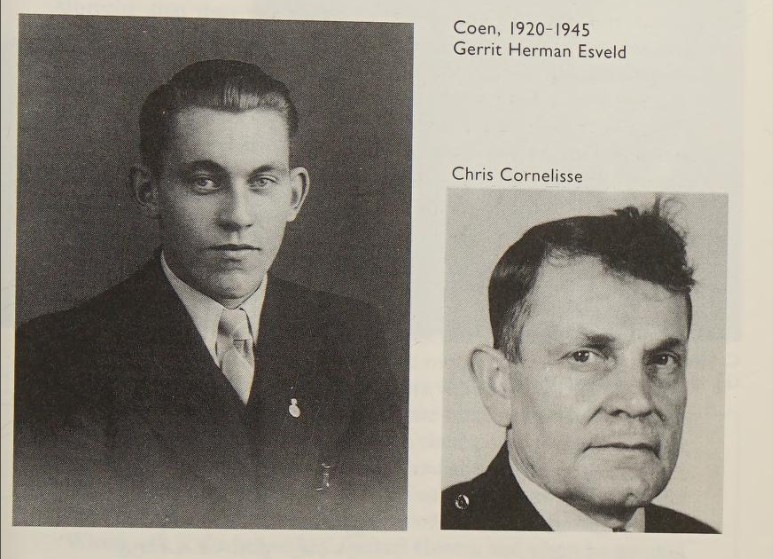
About: The younger son of the Amerongen family that hid Murphy from 23 or 24 December 1944 (Hardy has the evening of the 23rd, his mother the 24th) to 2 January 1945, a resistance man who ran evaders over the Rhine with Chris Cornelisse (Geschiedenis Magazine) and, by Caspers, one of the guides of the party Murphy set out with (p. 175). He was found dead at Dodewaard on 29 June 1945 (his death deed); 28 January, the day on the dates line, is the date the municipality assumed (How and when he died).
Unit or role: "Waarnemend Hoofd K.P." (acting head of the K.P.) on the Foundation's grave form, with "K.P." as his unit (Nationaal Archief 2.19.255.01, 41478A, scan 4). ◐ K.P. is the Knokploeg, the local armed resistance group: that is our reading of the initials, which his brother's own form also uses for his unit ("B.S. (formerly K.P.)", Flip's file, p. 5). The form names no group and no place for it. The national roll of the fallen, the Erelijst, gives his occupation as Garagehouder (garage proprietor), the death deed monteur (mechanic) (the roll's entry; folio 824, read on the image).
Where: Amerongen
Evidence: ✓ Amerongen death register 1945, Nr. 48; his birth and death records; Hardy; Geschiedenis Magazine; ◐ Caspers, pp. 64, 175, snippets, the book not read; ◐ Elsa Caspers, To Save a Life (1995), pp. 61–62, 66; ✓ his family's death notice, Het Parool, 3 July 1945; ✓ the Erelijst van Gevallenen (the national roll of honour), folio 824 (the entry); ✓ the War Graves Foundation's file on him, 1953–1973, with the Gemeente Dodewaard's letter of 17 August 1953 (Nationaal Archief 2.19.255.01, 41478A; the Foundation's page)
Gerrit Herman Esveld was born at Amerongen on 2 May 1920, the son of Gerrit Hendrik Esveld and Martina Gijsberta Strübbe (his birth record, Amerongen 1920, deed 28). His father kept a garage, and in 1945 he was a mechanic, monteur (his death deed); Caspers has "Esveld had met zijn zoons Berend en Coen een garagebedrijf" (Esveld and his sons Berend and Coen ran a garage) (Caspers, p. 64). His mother's form for the Americans gives her two children's ages as 35 and 25 on 28 May 1945 (p. 3), and he was 24 when he died, and would have turned 25 on 2 May 1945. He was in the family with his parents, Gerald (Gerrit Hendrik) Esveld and Mrs Esveld-Strubbe, and his elder brother Berend, "Flip", born 1910.
◐ The Nieuwe Utrechtsche courant of 27 July 1938, listing those who passed the MULO (lower secondary) examinations, has "G H Esveld, Amerongen" among the successful candidates for Diploma A (the list; read from the page image). Initials and town only, and his father has the same initials, but a candidate of 18, as Coen was that July, is likelier than a man of 54.
The ferry from Amerongen to Eck en Wiel ran all through the occupation, and he and his friend Chris Cornelisse used it to take evaders over the Rhine: "Met deze pont brachten Chris en zijn makker Coen Esveld drie keer een groep van zes piloten over" (with this ferry Chris and his mate Coen Esveld took a group of six airmen across three times). One of Amerongen's three ferrymen warned Cornelisse when there were Germans aboard, and Coen's brother Berend went with them once. On the third crossing two Germans came aboard just before it left and began eyeing the Englishmen's good boots, when the Dutch had not been able to buy shoes for years; it looked as if they would start asking questions, and Coen said to Chris "Jij die en ik die" (you that one, me that one). They each took hold of a German and put him over the side. After that the crossings there went by rowing boat, not the ferry (Geschiedenis Magazine; Amerongen). Elsa Caspers, in her English memoir, has the same pair rowing evaders across from "Den Duinen", between Amerongen and Wijk bij Duurstede: "Piet or two local men - Coen (Esveld), in his twenties, and Chris Cornelisse, who was middle-aged - rowed them across", and in the autumn floods and ice "Coen and Chris made three or four trips a week" (Caspers, To Save a Life, pp. 61–62). The article does not date the three runs; Murphy's own crossing on the ferry, on 2 January 1945, went off without difficulty, so it was not the third. ✓ One night is dated, and it is late: Hendricus "Henk" Derksen, a skipper of Wijk bij Duurstede, wrote for the Americans on 29 May 1945 that he "helped on 25 Jan 45 with snow and ice to row over three times. They were with 7 together with Koen ESVELD" (Derksen's file, p. 4), so Coen was on the Rhine, in ice, on 25 January 1945, in a party of seven that Derksen rowed over.
◐ His grandfather, very probably the "Koetsier BERENT ESVELD" (coachman) whom a Mrs Loopuit honoured in the Arnhemsche Courant of 7 June 1915, forty years in her service from 8 June 1875: his father Gerald was the son of Berend Esveld, a koetsier at Arnhem, and Jacomina Pasman (the advertisement, read on the page images; the marriage of 1877; the birth of 1883). The match is by name, trade and town; his father's page has the reasoning and the picture.
With Murphy
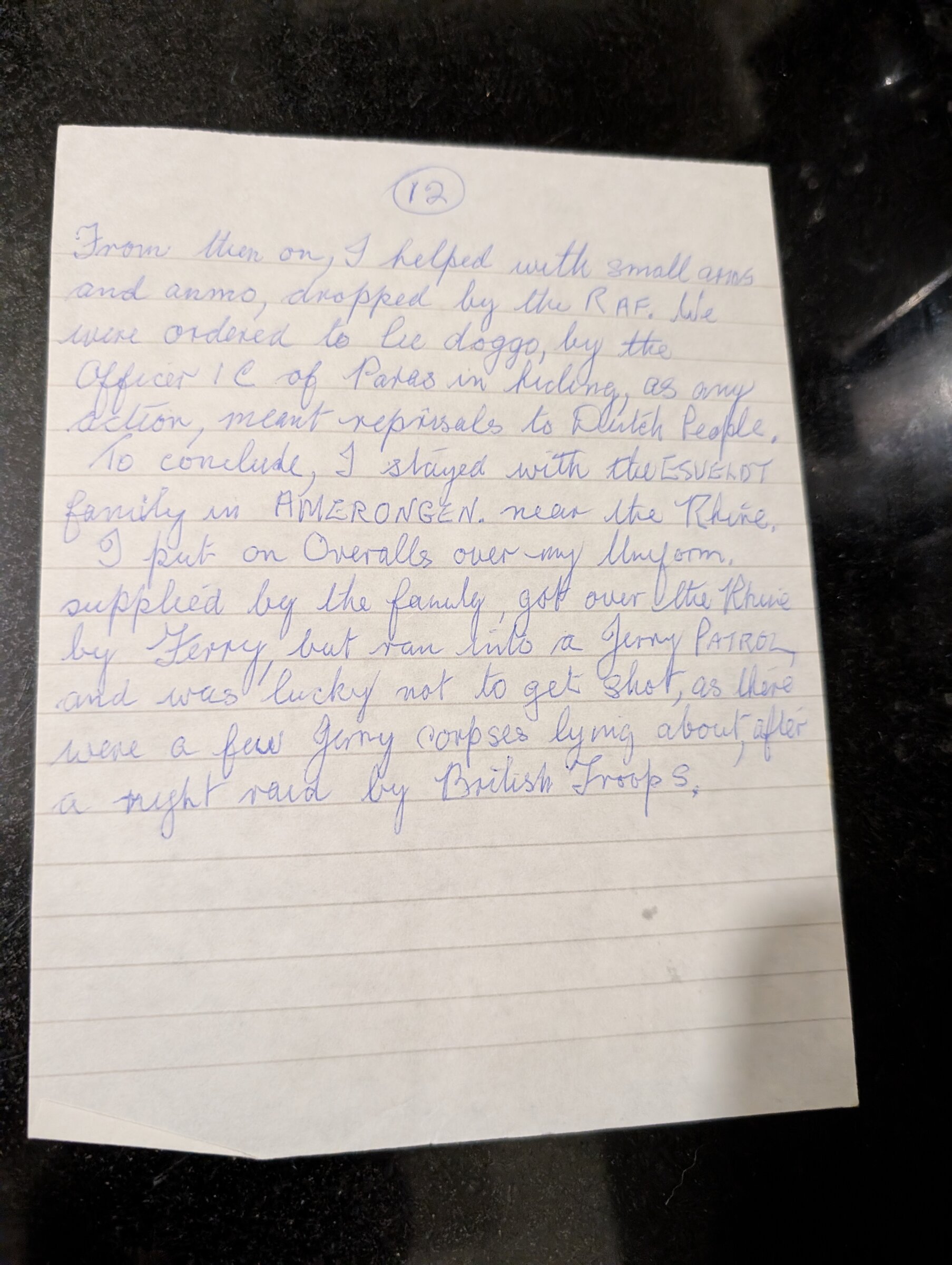
Link to the section With MurphyHardy and Murphy reached Amerongen on the afternoon of 23 December and were taken first to a house where Schjelderup and two of his Canadians were; "I stayed there until after dark when a young man came and took MURPHY and me to his father's house, also in AMERONGEN", a garage proprietor with two sons, "KOEN (?) and BEENT (?)" (Hardy). His mother says who it was. Murphy stayed with her from 24 December to 2 January, by her own account: he was "sheltered by farmers on the Veluwe, first at a little place near AMERSFOORT until 24 Dec, and then he was taken by Louis (Gerrit ESVELD) to Mrs. ESVELD", and "taken away by Louis and Kik for a crossing, which did not succeed" (her statement, p. 5). On 2 January, at one in the afternoon, Hardy and Murphy "left on bicycles with KOEN and KEEK (?) and rode down to a ferry on the RHINE", both in civilian suits "loaned to us by KOEN", with their uniforms in bags strapped to the bicycles, and crossed without difficulty; Hardy's revolver "was given by KOEN", Murphy's by Jacob Veerman (Hardy; The crossing and recapture). Murphy remembered the clothes as overalls over his uniform, "supplied by the family" (his memoir, p. 12). ◐ A snippet of Caspers (the book not read) names him among the guides who took the party out that evening: "Coen Esveld, Dirk Maljers en nog twee gidsen, in totaal negentien personen, op pad" (Coen Esveld, Dirk Maljers and two more guides, nineteen people in all, set out) (Caspers, p. 175), so he was with Adriaan Maljers, "Dirk", when the party was fired on north of Opheusden in the night of 2/3 January and Murphy, Noble and Banwell were lost: the snippet says only that they set out, and Derksen has Coen on the Rhine on 25 January (The Dutch guides). ◐ The Esveld who called for Charles Noble, the doctor of the same party, at the Lindenhof, "Then he too was collected by Esveld for a crossing", is not given a first name by Mrs J.H.D. Ronaldus-Hagedoorn, who hid Noble (her statement). Maljers himself names no Esveld in the party; his note of 3 July 1945 says the seven Canadians were lodged with "Cornelissen, Esveld Jr., Esveld Sr. and Hoogland" (p. 13), where "Esveld Jr." may be Coen or Flip. His brother Flip claimed the crossing for himself (below). The whole story is on Amerongen and the last night.
◐ He was not taken with Maljers: Derksen has him on the Rhine on 25 January (above), and Caspers has him carrying a drawing of German defences, sewn into the lining of his coat, towards the Allies (Caspers, p. 177). His brother Flip's statement of May 1945 has "G.H. ESVELD Jr." taking a "Captain" George Mikol to Maarn, and Mikol, after the middle of February, "crossed with G.H. ESVELD, Wim and Henk from BARNEVELD. Since this nothing more has been heard of them" (Flip's file, p. 7). Flip's own list of 26 April 1946 has the captain as "George. English spy.", hidden 21 days, received from "Kreuner, Maarn. (gefusill.)" (shot), and the column for whom he was passed on to blank (p. 13, the handwritten original). Hendrik van Loenen listed the four men he "Lost … by trying to discover opening in front" as "Wim and Henk van de Meent from Renswoude, Koen Esveld from Amerongen, George Andrews" (his statement, in the Cornelisse-van Brink file, p. 16). His Dutch report counts these four apart from the men lost to his intelligence work: of about 400 men, "6 bij het spionagewerk en 4 bij de crossing verloren gingen" (6 were lost in the spying work and 4 at the crossing) (his report, p. 14).
On 13 July 1945 Leendert Cornelisse wrote that Koen Esveld "only recently was found dead in the neighbourhood of DOODEWAARD" (his file, p. 6). The civil record has the day: the Dodewaard register, copied into Amerongen's on 10 July 1945, records that "op negen en twintig Juni dezes jaars te dertien uur is overleden bevonden: Esveld, Gerrit Herman, oud vijf en twintig jaren, monteur, geboren en wonende te Amerongen" (on 29 June this year at one o'clock was found dead: Esveld, Gerrit Herman, aged twenty-five, mechanic, born and living at Amerongen) (Amerongen 1945, Nr. 48; Dodewaard deed 13 of 3 July 1945, the records). Overleden bevonden means found dead, so 29 June is the day he was found, not the day he died; the register does not say when or how he died. The Foundation's file gives the municipality's own reckoning of when he left, and Caspers says how he died, both below. In 1946 Flip wrote that his brother had fallen on a journey to the English lines, on a special mission (Flip's file, p. 11).
How and when he died
Link to the section How and when he diedHe was still on the Rhine on 25 January, in a party that Derksen rowed over (Derksen's file, p. 4; above). After that there are four accounts of his last journey.
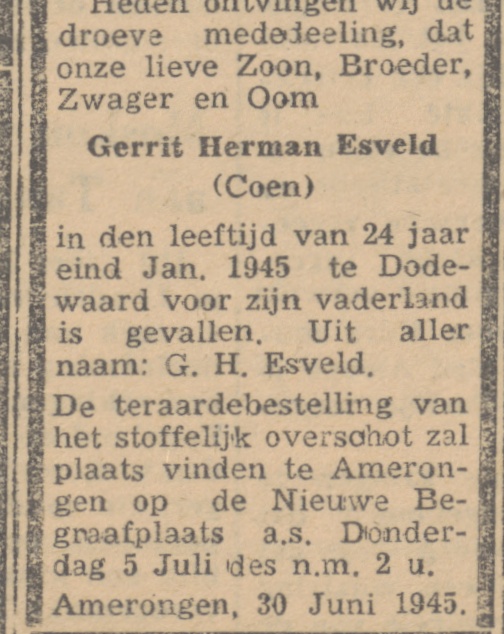
The family's notice. The first date comes from his father, the day after the bodies were found. Het Parool of 3 July 1945 printed the family's notice, dated Amerongen, 30 June:
Today we received the sad news that our dear son, brother, brother-in-law and uncle Gerrit Herman Esveld (Coen), aged 24, fell for his country at the end of January 1945 at Dodewaard. On behalf of all: G. H. Esveld. The burial of the remains will take place at Amerongen at the New Cemetery next Thursday 5 July at 2 p.m.
Dutch originalHeden ontvingen wij de droeve mededeeling, dat onze lieve Zoon, Broeder, Zwager en Oom Gerrit Herman Esveld (Coen) in den leeftijd van 24 jaar eind Jan. 1945 te Dodewaard voor zijn vaderland is gevallen. Uit aller naam: G. H. Esveld. De teraardebestelling van het stoffelijk overschot zal plaats vinden te Amerongen op de Nieuwe Begraafplaats a.s. Donderdag 5 Juli des n.m. 2 u.
— Het Parool, 3 July 1945, "Familiebericht" · the notice
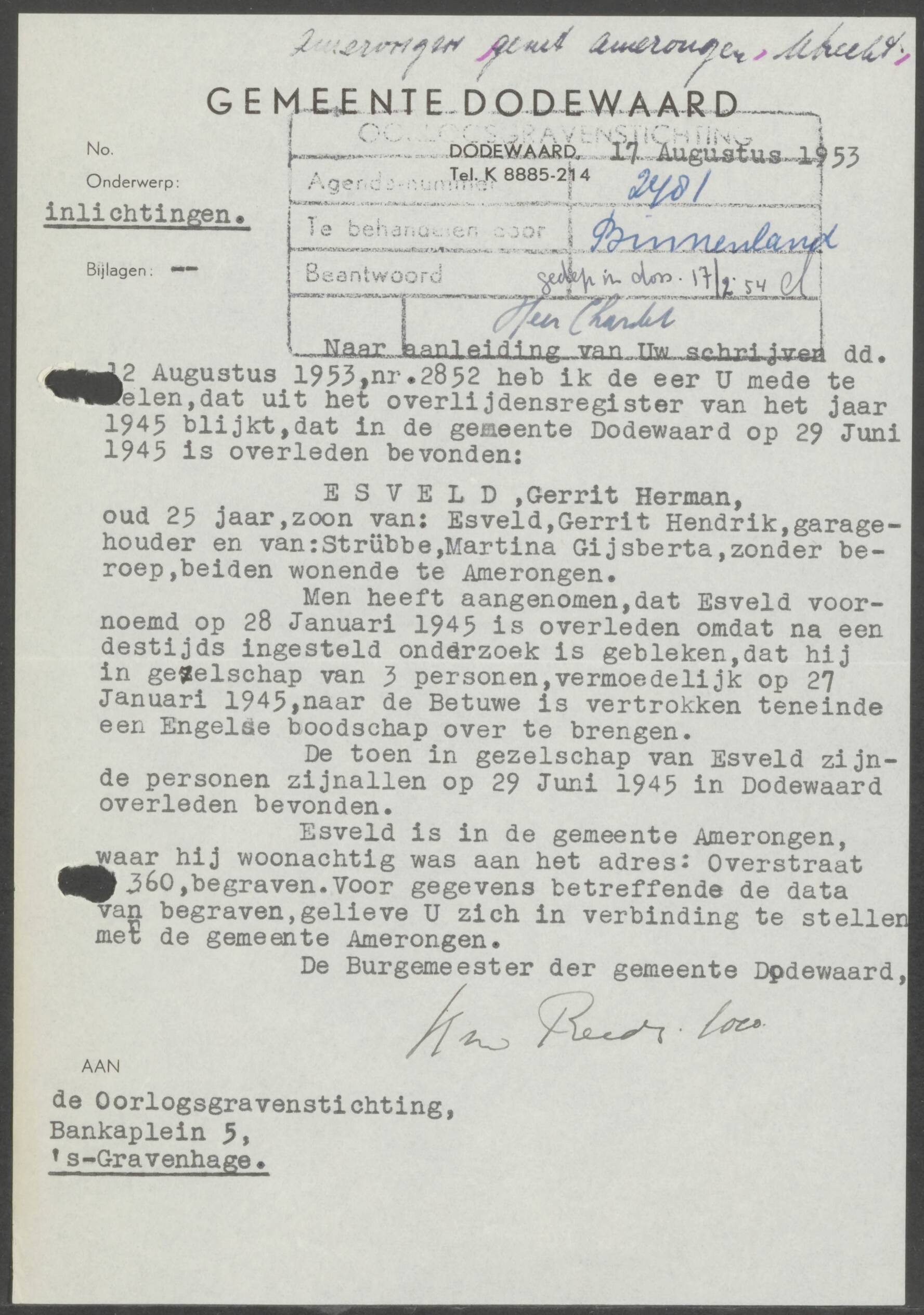
The municipality's inquiry. In August 1953 the War Graves Foundation, whose own data had him dying at "Hien, Dodewaard, 30-1-45", asked Dodewaard for the exact date (its enquiry, 12 August). The burgomaster's deputy answered on 17 August, after giving the register entry of 29 June:
It has been assumed that Esveld died on 28 January 1945, because an inquiry made at the time showed that, in the company of 3 persons, probably on 27 January 1945, he had left for the Betuwe in order to carry an English message. The persons who were then with Esveld were all found dead at Dodewaard on 29 June 1945.
Dutch originalMen heeft aangenomen, dat Esveld voornoemd op 28 Januari 1945 is overleden omdat na een destijds ingesteld onderzoek is gebleken, dat hij in gezelschap van 3 personen, vermoedelijk op 27 Januari 1945, naar de Betuwe is vertrokken teneinde een Engelse boodschap over te brengen. De toen in gezelschap van Esveld zijnde personen zijn allen op 29 Juni 1945 in Dodewaard overleden bevonden.
— Gemeente Dodewaard, for the burgomaster · to the Oorlogsgravenstichting · 17 August 1953 · Nationaal Archief 2.19.255.01, 41478A, scan 7 · the letter
What it gives:
- A party of four. ✓ The letter has Coen and three companions, all found dead at Dodewaard on 29 June 1945. It names none of them.
- ◐ That the van der Mheen brothers' party in the police report (below) was Coen's is our match, by the dates and by the Dodewaard deeds, where Willem's deed 14 sits beside Coen's deed 13 (the index records).
- ⚠︎ The letter's 29 June fits Willem van der Mheen, found that day, but not his brother Henk, buried as an unknown person at Dodewaard on 30 or 31 January 1945 and exhumed on 30 July 1946; the burial date rests on the War Graves Foundation's form, which also has his birth as 22 October 1925, where his identification card has 14 July 1924 (104012A, scan 4; scan 6).
- ◐ It fits Caspers's "two other Dutch boys and a South African soldier" (below) and Hendrik van Loenen's four lost, whose "Wim and Henk van de Meent" are very probably the brothers. The third would be a captain, George Andrews or Mikol; who it was is not settled (George Andrews).
- ✓ A message. He went "teneinde een Engelse boodschap over te brengen", to carry an English message. ◐ It sits with Caspers's drawing of German defences sewn into his coat and with Flip's 1946 "special mission" (above).
- A reckoning, not a record. ✓ 28 January is called an assumption, and 27 January is "vermoedelijk" (probably). The inquiry "destijds" (at the time) is not named, dated or held in the file, and the letter does not say whom it asked.
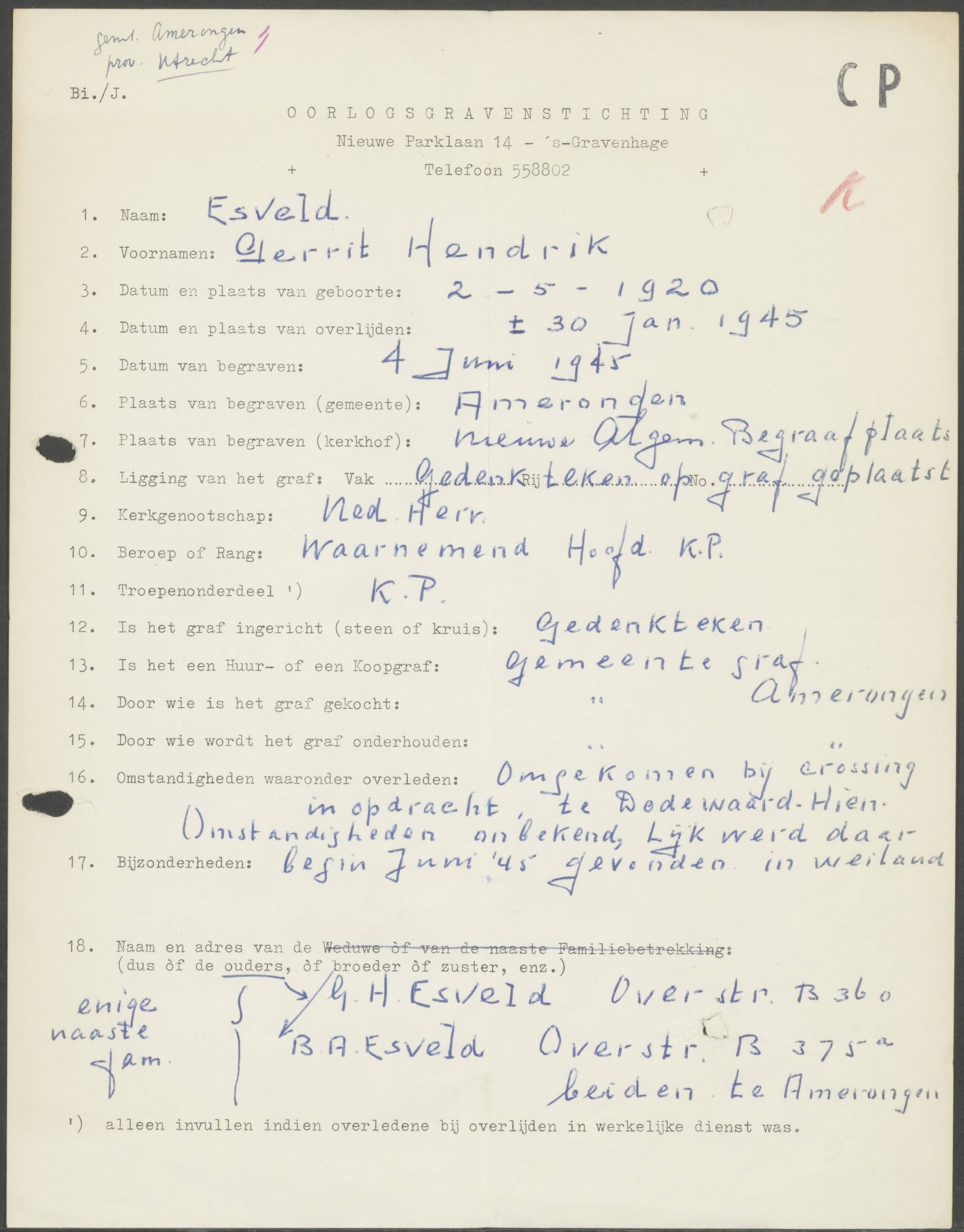
The Foundation's own grave form, filled in before this answer, has the same January end and a rank:
It gives "Omgekomen bij crossing in opdracht, te Dodewaard-Hien. Omstandigheden onbekend. Lijk werd daar begin Juni '45 gevonden in weiland" (killed during a crossing, on assignment, at Dodewaard-Hien; circumstances unknown; the body was found there in a meadow at the beginning of June 1945), and his death as "± 30 Jan. 1945" (scan 4). The Foundation's papers after Dodewaard's answer carry 28 January instead: its grave control report has "28-1-1945" with a "29" written beneath it, and its enquiry of 1973 has 28 January (scan 10; scan 5). Those follow Dodewaard and are not a separate source.
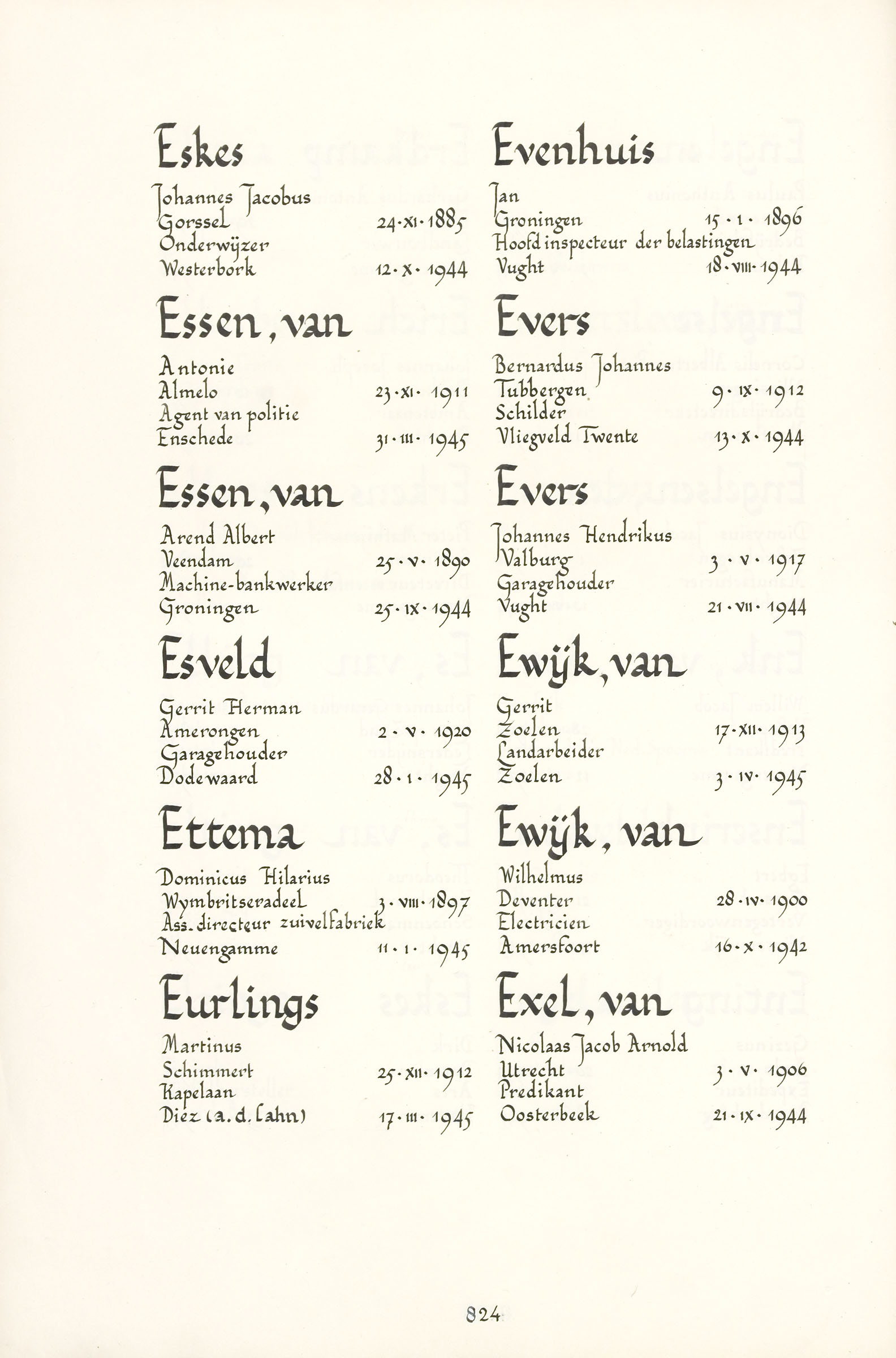
The national roll. ✓ The Erelijst van Gevallenen 1940–1945, the Dutch roll of honour of the war dead, carries him on folio 824: "Esveld / Gerrit Herman / Amerongen 2·V·1920 / Garagehouder / Dodewaard 28·I·1945" (the entry; the page, read on the image). Its 28 January is the same assumed date as the Foundation's and Dodewaard's, ◐ very probably taken from them, so it adds no evidence for the day.
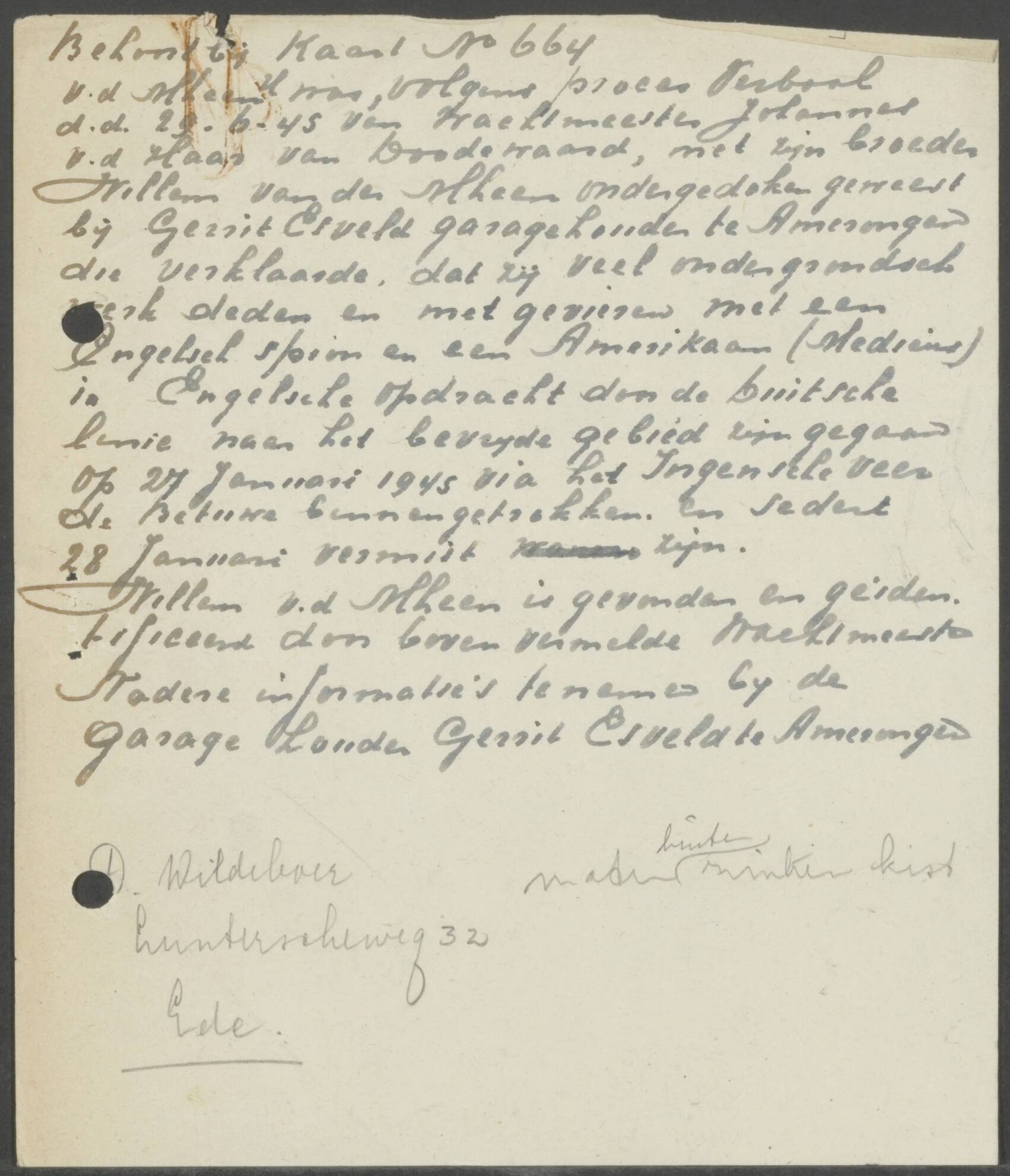
The police report of 29 June 1945, as noted for the identification service. ✓ The War Graves Foundation's file on Hendrik van der Mheen of Lunteren holds a handwritten note attached to his identification card, No. 664, summarising a report by the Dodewaard policeman who found his brother Willem:
According to the official report of 29-6-45 by Wachtmeester Johannes v.d. Haas of Doodewaard, H. v.d. Mheen had been in hiding with his brother Willem van der Mheen at the house of Gerrit Esveld, garage owner at Amerongen, who declared that they did a great deal of underground work and, four of them, with an English spy and an American (doctor), went on an English mission through the German line to the liberated area. On 27 January 1945 they went into the Betuwe by the Ingen ferry, and have been missing since 28 January.
Dutch originalv.d Mheen H was, volgens proces Verbaal d.d. 29-6-45 van Wachtmeester Johannes v.d Haas van Doodewaard, met zijn broeder Willem van der Mheen ondergedoken geweest bij Gerrit Esveld garagehouder te Amerongen die verklaarde, dat zij veel ondergrondsch werk deden en met gevieren met een Engelsch spion en een Amerikaan (Medicus) in Engelsche Opdracht door de Duitsche linie naar het bevrijde gebied zijn gegaan Op 27 Januari 1945 via het Ingensche Veer de Betuwe binnengetrokken. en sedert 28 Januari vermist zijn.
— Note on Hendrik van der Mheen's identification card, No. 664, from the Dodewaard police report of 29 June 1945 · Nationaal Archief 2.19.255.01, 104012A, scan 8 · the note
The note reads Haas; the last letter is not certain, and Haar is the other reading. It is undated, and ends "Nadere informatie's te nemen bij de Garage Houder Gerrit Esveld te Amerongen" (further information to be had from the garage owner Gerrit Esveld at Amerongen). ◐ The garage owner who made the declaration is the father, Gerald (Gerrit Hendrik) Esveld, whom Coen's death deed calls garagehouder (Amerongen 1945, Nr. 48); the note names no Esveld among those who went. ◐ Met gevieren is literally "as a party of four", and the note does not say who the four are: the two brothers, the spy and the American, with Coen outside the count, or a party including Coen, which gives Dodewaard's "Coen and 3 persons" but leaves the brothers, spy and American one more than his three companions. Neither foreigner is named; whether they were Mikol and Andrews is not settled (George Andrews). ◐ That this police report is the inquiry "destijds" (at the time) Dodewaard's letter rests on is our reading of the matching dates.
◐ Elsa Caspers, a courier of the resistance on the Utrechtse Heuvelrug, gives the only account of the day, in a memoir written fifty years on:
On 29 January 1945 Coen made one more attempt to find an escape route. He went with two other Dutch boys and a South African soldier. No message of their safe arrival came over the radio that evening or the next one. It was not until June, more than a month after the end of the war, that their bodies were found in grazing land. They had gone through the German lines and crossed no-man's-land, so they must have known that they had made it. Then they were killed by a V-1 'doodle-bug' explosion.
— Elsa Caspers, To Save a Life, Robert Hale, 1995 · p. 66 · extracts
She adds that his failure to return "meant that we had to find another escape route", the one west of the Lek through Maarn that Hackett's party took a few days later (p. 66; Dick Kragt). This fits the June find: the civil record has him found on 29 June near Dodewaard. It fits Hendrik van Loenen's list of four lost "by trying to discover opening in front" (above) if the "two other Dutch boys" are the van der Mheen brothers and the South African soldier is George Andrews, but Caspers names none of them, so ◐ that match is ours. Her party of three companions is the municipality's "3 persons". ⚠︎ Her 29 January is two days after the 27 January of the police report and Dodewaard's letter, and neither of them mentions a V-1.
Where the sources disagree
Link to the section Where the sources disagreeHis name. Flip's letter of 8 May 1946 calls him "Gerrit Hendrik Esveld, mijn broer" (p. 11). The civil records name him Gerrit Herman, and give Gerrit Hendrik as his father: his birth in 1920 and his death in 1945 (the records; the death deed). The same letter asks for a form for "G. H. Esveld Sr.", the garage owner, so father and son shared the initials, and Flip's "G.H. ESVELD Jr." is the son (p. 7). His mother's interviewer has him as "Louis (Gerrit ESVELD)" (her statement, p. 5), and a statement of July 1945 ties "Koen ESVELD" to her household (Leendert Cornelisse, p. 6), so ◐ Hardy's "Koen" and the Coen of the Dutch histories are very probably this younger son under another name (Mrs Esveld's account). The War Graves Foundation indexed him as "Gerrit Hendrik" on its grave form, control report and enquiries, his father's second name, though Dodewaard's letter and the civil records have Gerrit Herman (scan 4; scan 7). ✓ That is how Flip's "Gerrit Hendrik Esveld, mijn broer" came about: the Foundation, and a brother writing in 1946 for the Americans, used the name the family's papers gave the father. Caspers indexes him as "Esveld, G.H.; Coen" (Caspers, p. 308). ✓ Elsa Caspers's English memoir To Save a Life (1995) captions a photograph "Coen, 1920–1945 / Gerrit Herman Esveld" (plate after p. 70, at the top of this page), the full name and the birth year of the civil records.
Who took Murphy and Hardy across. Hardy has Koen and "KEEK" taking them to the ferry (Hardy), and ✓ Keek is Freerk "Kik" Stob, whose own statement has "Tom MERPHY and James (Jim)" brought by him "at the beginning of January to LIENDEN" (his statement, p. 4); and their mother has them "taken away by Louis and Kik for a crossing, which did not succeed" (her statement, p. 5). Flip's own list for the Americans claims it for himself: "Jimmy and Tom, 2 Engl. paratroopers from Arnhem, both were in the big transport which failed near Wageningen" (◐ Hardy and Murphy by our reading of the names), with "Charles, English Capt. Doctor" below them, and beside the group "Crossed them personally to English lines near Dodewaard, with a transport of 12 men allied personnel" (Flip's file, p. 10); his statement of May 1945 has him acting as guide for the crossing of the Canadian Marcel Briere in the first week of January (p. 7). ⚠︎ Not settled: Hardy wrote his within a fortnight; Caspers names Coen among the guides that night and not Berend (Caspers, p. 175). Flip's side is on his page.
When and how he died. Late January, or after the middle of February.
- After the middle of February. Flip's statement of May 1945: the captain "crossed with G.H. ESVELD, Wim and Henk from BARNEVELD. Since this nothing more has been heard of them" (Flip's file, p. 7).
- ⚠︎ A guide killed on 2 January. Charles Noble's own later account (unpublished private papers, shared with us privately), told long after the war, has a V1 that "malfunctioned, dropped near us and killed our second guide plus a cow" on the night of 2 January. It does not name the guide. Noble's report of 1945 and Schjelderup's have the second-stage guide lost, not killed, when a German patrol passed (Noble; The crossing and recapture), and Derksen has Coen alive on 25 January (next). The V-1 in Coen's own death is Caspers's, ◐ at the end of January (above).
- ✓ Alive on 25 January. Derksen has him on the Rhine on that day, in snow and ice, in a party of seven that Derksen rowed over (Derksen's file, p. 4). That puts him on the river two days before the municipality's 27 January and four before Caspers's 29 January; it fits them without dating his death or touching Flip's later date.
- ⚠︎ Late January. His family's notice of 30 June 1945, "eind Jan. 1945" (the notice); Dodewaard's inquiry "at the time": left probably 27 January, assumed dead 28 January (the letter), the day the national roll of honour prints, "Dodewaard 28·I·1945", ◐ very probably taken from the same reckoning (Erelijst, folio 824); the Foundation's earlier data and grave form, "± 30 Jan." (scan 4); Caspers, 29 January, with two Dutch boys and a South African soldier, killed by a V-1 explosion beyond the German lines (To Save a Life, p. 66).
- All of these put it there by different routes, against Flip alone.
- That side rests on a family notice, an inquiry whose papers are not held, entries derived from Dodewaard and a memoir fifty years on.
- Flip wrote his statement in May 1945, before Coen's body was found, and it is first-hand for his own house: "MIKOL arrived at Flip's end of January", and "From end January to mid February MIKOL stayed with Flip. After that he crossed with G.H. ESVELD, Wim and Henk from BARNEVELD".
- The two cannot both be right if Mikol was the captain in a party that left on 27 January. Not settled.
- ⚠︎ Still open. The exact day, and one name.
- The inquiry's papers are not in the file, so 27 January is a municipal reckoning of when he left, the Foundation's 28 January an assumption, Caspers's 29 January a memoir written fifty years on, and the family's notice does not say how it knew.
- Hendrik van Loenen's four lost men include George Andrews, a captain "dropped" whom he says he received at the beginning of February (his statement, p. 14). That cannot be squared with a departure on 27 January unless van Loenen's date is out, or Andrews is not one of the three (George Andrews).
The day he was found, and when he was buried. Dodewaard's letter and register have all four found on 29 June 1945, and Leendert Cornelisse wrote on 13 July that he had "only recently" been found. ⚠︎ The Foundation's grave form has the body found "begin Juni '45", an entry with no source, against the municipality's own letter. The burial has three dates:
- 5 July 1945. The family's notice, dated 30 June, announces the burial at Amerongen's new cemetery for Thursday 5 July at 2 p.m. (the notice).
- 2 July 1945. Amerongen's answer to the Foundation and the Foundation's control report: buried at the new general cemetery on the Hollenweg, section C, a war grave, alone in the grave, with a monument and a flat stone (scan 2; scan 10).
- 4 June 1945. The Foundation's grave form and its enquiry to Dodewaard (scan 4; scan 8).
- ✗ 4 June is not borne out: it would be before the find of 29 June.
- ◐ 2 July is the better supported of the other two: it is the date in Amerongen's own answer to the Foundation, and the control report has the same, whereas the family's notice only announces a funeral and does not record one. A burial on 2 July would fall a day before Dodewaard drew up its death deed on 3 July (deed no. 13; copied at Amerongen on 10 July), which is possible but odd (the records).