Tex Banwell
8 Oct 1917 or 1918 ⚠︎ – 25 Jul 1999 ◐
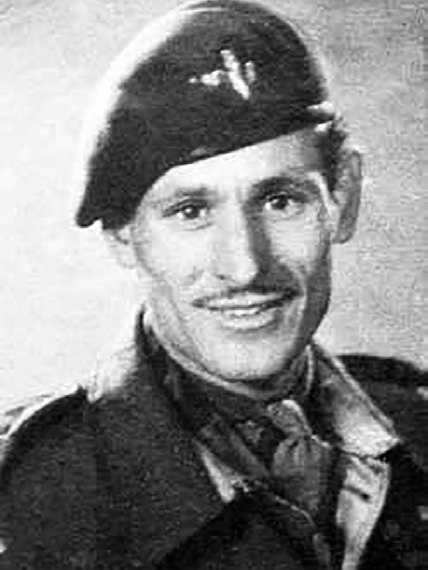
Sgt Keith Deamer "Tex" Banwell (5498293)
About: A sergeant of the 10th Parachute Battalion who escaped from the prisoner train after Arnhem, stayed on the Veluwe with the Dutch resistance, was with Murphy in October and November 1944 and in the crossing party of 2/3 January 1945, and was lost in the same firefight; the Netherlands gave him its Resistance Memorial Cross. Murphy's memoir makes an allegation about him, set out on this page with the records (On Tex Banwell).
Unit or role: Sgt, 10th Parachute Battalion (Army Air Corps), A Company: No. 4 Platoon by the Pegasus Archive's page on him, No. 3 Platoon by the compiler's brackets on Noble's and Hardy's pages (Pegasus Archive; Noble; Hardy). Hampshire Regiment from 1936 by the Pegasus Archive; other accounts start him in the Coldstream Guards (below). After the war provost sergeant of the 10th (Volunteer) Battalion, The Parachute Regiment.
Where: Islington, London, as the Dutch helpers' forms give his home (Migchelsen, p. 3; Diet Eman's list, p. 5); in the Netherlands from the Arnhem landings of September 1944 (A Company was on the Dreijenseweg on 19 September), at large from 30 September, on the Veluwe and round Putten, Garderen, Scherpenzeel and Amerongen.
Evidence: ✓ Pegasus Archive; ✓ London Gazette 44740 and his BEM recommendation, Kew WO 373/173/228; ✓ the MI9 reports of Schjelderup, Swartz and Briere; ✓ the Resistance Memorial Cross register; ✓ the Dutch helpers' forms (Oosterbroek, Schimmel, Veldhuizen); ◐ accounts at second hand: Heaps, Kessel, De Jong, Tiemens.
He enlisted in the Hampshire Regiment in August 1936 and served with its battalions in Palestine, in India on the North West Frontier, and in Egypt; he transferred to the Army Air Corps in January 1943, went to the 10th Parachute Battalion, and as a sergeant commanded a section of A Company in Italy in September 1943 (Pegasus Archive). Other accounts of his early service differ (below).
At Arnhem, and the train
Link to the section At Arnhem, and the trainAt Arnhem, by the Pegasus Archive:
- On Tuesday 19 September, when the 4th Parachute Brigade was held on the Dreijenseweg, A Company, under Captain Queripel (awarded the Victoria Cross posthumously for a later action), was sent on a flanking attack. Banwell and two men went ahead as scouts, came very close to a German patrol, and brought back a count of five tanks, two supply trucks and two fuel tankers beyond the pumping station. The attack made no headway.
- On the 20th he was separated from the battalion at the railway line and made his own way into the Oosterbeek perimeter, to the Hartenstein Hotel, with Corporal Bill Cuttill and Private Ginger Whadcoat.
- On Sunday the 24th, searching the woods for food with CSM Lashmore, he was hit by a machine-gun bullet that took off the tips of the index and middle fingers of his right hand.
- Told by Major Hugh Maguire of the withdrawal, he and Lashmore could not find the embarkation point; they stripped and tried to swim the Rhine, and turned back when the current proved too strong. Back at the Hartenstein for food from the supply containers, he climbed a tree to cut one down; the crash brought the Germans, and they were taken.
- Marched to a warehouse at Stroe, he met Staff-Sergeant Alan Kettley of the Glider Pilot Regiment and Lieutenant Leo Heaps. The three broke a window out of their cattle truck on the train to Germany and jumped into the night, and by dawn on 30 September were walking west.
The Putten resistance, September and October 1944
Link to the section The Putten resistance, September and October 1944From the train he, Heaps and Kettley came to the resistance around Putten; Heaps and Kettley went south on 1 October and left him behind with it (Heaps, p. 127).
The attack at the Oldenallerbrug
Link to the section The attack at the OldenallerbrugBanwell took part in the resistance attack on a German vehicle between Putten and Nijkerk on the night of 30 September / 1 October 1944:
After taking part in the attack on German officers near Putten on 30 September, 'Tex' ends up at Kruimel's.
Dutch originalNa te hebben deelgenomen aan de aanslag op Duitse officieren bij Putten op 30 september komt 'Tex' bij Kruimel terecht.
— Somford, "Op zolder bij Oom Joop", Airborne Magazine nr.27, 2023
In the attack he was with Piet Oosterbroek, who had met the three escapers at a farmhouse the morning after the train (Pegasus Archive). He reached De Ruif afterwards; the Airborne Magazine has him there around the time most of the British left on 19 October for the crossing of 22 October, and has him leave on 22 October, the day before the raid on the house (Somford). ◐ Noordman, in the same passage that has him at De Ruif only briefly, says he met Sgt Harding there: "Hier ontmoette hij sergeant Harding die bij hetzelfde bataljon hoorde" (here he met Sergeant Harding, who belonged to the same battalion) (Noordman, p. 292).
⚠︎ Leo Heaps, writing in 1976, has Oosterbroek take the three to his farmhouse outside Putten, where "the charming Mrs. Oosterbroek" fed them and hid them in the hayloft, and in the night two men on motorcycles, "One was Oosterbroek, the other a local policeman named Witvoet", take them to Henk Pouw's chicken coop at Enny's Hoeve (Heaps, pp. 125–126; Piet Oosterbroek).
⚠︎ His own account of the attack, given to Het Vrije Volk in 1988: after the train he, Leo Heaps and Alan Kettley were taken in by Piet Oosterbroek (◐ Oosterbroek's own form of 1946 lists "Lt. Heaps", "Sergt. Kettley" and "Sergt. K.D. Banwell", hidden at the end of September 1944 for a day, received from the Donkersgoed family of Putten and passed on to a policeman from Ermelo: Piet Oosterbroek; and Melis Schimmel of Klein Boesschoten, Putten, known to the men as "Chimpansee", hid "Keith Banwell", "Lt. Heaps" and "Sgt. Kettley" "for some days", received from "H. Pouw and P. Oosterbroek": his form, p. 3, checked on the image), and at Enny's Hoeve, near Voorthuizen, he was kept back to teach the resistance the weapons that had been dropped; he chose the place for the ambush at the Oldenallerbrug and put the men in position; he fired the Bren himself, and killed "de chauffeur en de mannen achterin" (the driver and the men in the back), taking the driver for the officer, "omdat ik vergat dat bij de Duitsers het stuur aan de andere kant zat dan bij de Engelsen" (because I forgot that with the Germans the steering wheel was on the other side from the English); the wounded officer was taken to Enny's Hoeve and questioned, and Banwell wanted him shot and was overruled, because the officer had seen and heard enough to lead the Germans back to them and "dan zouden de Duitsers ons vangen, martelen en fusilleren" (then the Germans would catch, torture and shoot us), and he had met a resistance man the Germans had released with every fingernail torn out; and he denied that the Bren had jammed, and that it had been mounted on a vehicle: "We hebben nooit een auto gehad!" (We never had a car!). He blamed the "paniekerige" (panicky) way the attack was handled afterwards for what followed. Afterwards he and others hid in the cellar of Enny's Hoeve while the Germans burned the farm (Het Vrije Volk, 1988).
◐ Two more helpers' forms from those first days, both checked on the images on 11 October 2026. Hendrik Livestro had "Luiten Heaps, Sgt. Banwell, Sgt. Kettley" for a day at the end of September, "picked up, in the woods. (Pilots had escaped from a prisoners camp-Stroe.)", and passed them to Oosterbroek (Livestro's table, p. 3). Steven van Donkersgoed of Veenhuizerveld, Putten, the "Donkersgoed family" of Oosterbroek's form, has the same three, "Sgt. Banwell" among them, "end Sept. 44", one day, "from the woods", passed to "P. Oosterbroek E 180 Putten" (his table, p. 3, checked on the image). Hendrik Pouw, the Pouw of Schimmel's form, filled in two tables for him: one has "Keith D. Banwell", "jumped out of train", from 28 September for 14 days, received from Oosterbroek, with "Jaques" written at the right of Oosterbroek's line (◐ the alias Boeree gives Oosterbroek, Piet Oosterbroek), and Heaps and Kettley as his two friends (p. 3); the other has "A. Banwell, 1e Airb. Div.", "jumped out the train near Stroe", 20-9-44, 10 days, passed to "Frans Hals" (p. 7). ⚠︎ The two dates and stays do not agree with each other or with Oosterbroek's one day. Pouw's form gives his London address, "Liverpool Bldgs: 139, Highbury str. Rd, Islington", which Diet Eman's list of men also has (her list, p. 5).
⚠︎ A Dutch columnist who interviewed him in 1984 asked him what the attack was for: "Hij wist het niet precies. Hij sprak geen Nederlands en stond onder bevel van Nederlanders" (He didn't know exactly. He spoke no Dutch and was under Dutch command) (Het Parool, 24 September 1994), which does not sit with his 1988 account of choosing the place and posting the men. ⚠︎ Both his 1988 account and the Pegasus Archive have him training the group daily and taking them to the spot days beforehand, which is hard to fit between the train jump at the end of September and the ambush on 30 September / 1 October.
The reprisal was the Razzia van Putten. On 1 October the village was raided; on 2 October 659 men were taken to Kamp Amersfoort, some were released there on grounds of health, and on 11 October the other 601 were sent to Neuengamme. 48 came home (Wikipedia NL). The English Wikipedia has 661 taken and 552 men and a woman dead (Wikipedia EN).
The Pegasus Archive's compiler writes that "Banwell had no knowledge of these events until after the war, and later expressed his sorrow" (Pegasus Archive). ◐ As to the raid itself, it is contradicted ("these events" also takes in how many never came back, which nobody could know before the war ended): Kessel's memoir has Banwell telling him about the reprisal at De Ruif in October 1944, and Banwell's own accounts never claim he did not know:
He told us too how the Germans had been incensed by this attack and had taken immediate and violent revenge. The Grüne Polizei fell on the village of Putten ... seized all the men and took them away, rounded up the women and children and locked them in the church and, after an orgy of looting, set fire to all the houses
— Lipmann Kessel, Surgeon at Arms, pp. 97–98 (Kessel, 1959)
His own words on Putten in 1988:
The story of Putten is a sad story. The price of the attack was terrible. The Germans seized the people of Putten because they held them responsible for the attack, but they had nothing to do with it.
Dutch originalHet verhaal van Putten is een triest verhaal. De prijs voor de aanslag was verschrikkelijk. De Duitsers grepen de mensen van Putten, omdat ze hen verantwoordelijk achten voor de aanslag, maar ze hadden er niets mee te maken.
— Tex Banwell · Het Vrije Volk, 26 September 1988 · Delpher
The Dutch official history on the Putten group
Link to the section The Dutch official history on the Putten groupL. de Jong's Het Koninkrijk der Nederlanden in de Tweede Wereldoorlog names Banwell five times, all in deel 10b (the passages, with translations; used under the NIOD edition's CC BY 3.0 NL licence). It does not name Murphy anywhere. For Banwell it gives no source of its own.
-
✓ He is in the second night of the ambush, not the first: on 29/30 September Witvoet's group put six men (Oosterbroek, Dankaart, Helsdingen, Van Heessen, Hora Siccama and Slotboom) at the road and the attempt came to nothing (p. 48). ✓ His Hora Siccama is "de jurist jhr. mr. W. J. H. D. Rengers Hora Siccama", named in full on p. 47 (Rengers Hora Siccama). He joined the group, De Jong says, as one of "a few Airbornes" helped to escape from a prisoner transport.
In the following night, that of Saturday 30 September to Sunday 1 October, the ambush was set again. Witvoet stayed with his men this time; they were seven, because Banwell was one of the party as well. Witvoet, Oosterbroek and Hora Siccama had used a lorry driven by Oosterbroek, with which they had picked Banwell up; the other four came by bicycle.
Dutch originalIn de volgende nacht: die van zaterdag 30 september op zondag 1 oktober, werd de hinderlaag opnieuw gelegd. Witvoet bleef nu bij zijn mannen; die waren ditmaal zeven in getal, want Banwell was ook van de partij. Witvoet, Oosterbroek en Hora Siccama hadden gebruik gemaakt van een door Oosterbroek bestuurde vrachtauto waarmee ze Banwell hadden opgehaald, de overige vier waren komen fietsen.
— L. de Jong · Het Koninkrijk der Nederlanden in de Tweede Wereldoorlog, deel 10b, p. 48 · NIOD edition, CC BY 3.0 NL · the volume
-
◐ That is seven men besides Witvoet, so eight at the road, counted from De Jong's sentences.
- Trouw's count in 1969 is "een achttal" (about eight; below), Het Vrije Volk's in 1988 "een acht man tellende groep" (a group of eight men) and Heaps's eight, Witvoet among them; the Volkskrant of 1994 has "zeven mannen die de aanslag uitvoerden" (seven men who carried out the attack), without saying whether it counts Witvoet (Piet Oosterbroek).
- The Bren was fixed on the cab of the lorry. De Jong does not name Banwell again in the telling (pp. 49–50); the footnotes cite a 1974 newspaper interview with Witvoet (p. 48), and Dankaart, in Groen and Van Maanen's Putten op de Veluwe, and Kirschen's book (pp. 49–50), not Banwell.
- ⚠︎ It does not match Banwell's own telling of 1988, above. In De Jong the car stopped in the verge, Oberleutnant Eggert was wounded in the knee and Leutnant Sommer in the stomach (Sommer died in hospital at Ermelo on the Monday), the two NCOs got away, and the one man killed was Slotboom, on the Dutch side, who died next morning and was buried at Enny's Hoeve (p. 49; p. 56). No driver is said to have been killed on the spot.
- Kirschen's version, relayed in a footnote, has three Luftwaffe officers killed (Gilbert Kirschen), and so did Banwell himself when he told it to Kessel in October 1944 (below).
- ◐ Trouw has Oosterbroek's own account on the 25th anniversary: "Tex, een Engelse parachutist, was deze keer brenschutter", and "Tex wilde gaan schieten, maar de bren weigerde. Even later, maar net te laat deed de bren het toch" (Tex meant to fire, but the Bren refused; a moment later, just too late, it fired after all) (Trouw, 4 October 1969; checked on the page image). That is the jam Banwell denied in 1988.
- In 1994 de Volkskrant reported the Putten amateur historian K. Friso as saying that neither the jammed gun nor Witvoet was the reason the attack failed, and said of Banwell that he "was degene die schoot bij de aanslag. Volgens hem werkte de mitrailleur wel" (was the one who fired in the attack; by his account the machine-gun did work); Friso said he had proof Oosterbroek and Dankaart had agreed their statements (de Volkskrant, 1 October 1994).
- Heaps has the jam, and so does the Pegasus Archive, whose telling follows Heaps's incident by incident and is not a separate account (Piet Oosterbroek), as does a popular history of 2005, where "Tex’ brengun weigerde" (Tex's Bren refused) and fired only when the car was nearly past the lorry (Oog in oog met het verleden, p. 402; search snippets only).
- ◐ Igor Cornelissen visited Banwell in London and wrote in 2000 that "Banwell was de brenschutter die in de avond van 30 september 1944 de Duitse auto onder vuur nam" (Banwell was the Bren gunner who fired on the German car on the evening of 30 September 1944) (Cornelissen, Terug naar Zwolle; search snippets only, the book is lending-only).
- Banwell believed the aim was papers showing what the Germans planned, and remembered a tube of papers marked "geheim" (secret) that went to a Belgian agent; Cornelissen ties it to the papers in Kirschen's memoir of 1946, among them a sketch of Hitler's headquarters in East Prussia.
- Cornelissen reconstructs the attack as following an order from the headquarters of the Binnenlandse Strijdkrachten to spread panic and seize couriers' documents; the snippets do not show what he based it on.
- The same visit has Banwell in Hardwicke Street, north London, call his four months in Holland the most important of his life, and tells the Montgomery-double story as four weeks on the North African front.
- Oosterbroek's "commandant Ronald", in Trouw a policeman in hiding from Assen who twice ran off, is not named Witvoet there; De Jong has Witvoet posted to Putten from Genemuiden (p. 47), with no Assen. ⚠︎ Vrij Nederland in 1978 joins the two, "Ab Witvoet, alias Ronald", in one article held only as OCR, which names no source for it (Vrij Nederland).
- Oosterbroek's words are about "Ronald" as Trouw names him (Piet Oosterbroek).
- ◐ At Enny's Hoeve on Sunday 1 October, De Jong has him with Oosterbroek, Dankaart, Helsdingen and Hora Siccama while the news of the Putten round-up reached the farm during the day; Oosterbroek, leading in Witvoet's absence, forbade Hora Siccama to give himself up, pointing out that under the SD's torture methods he might have to give away details that would endanger the lives of many other resistance workers, and Eggert was released (pp. 55–56, p. 56 checked on the image; Banwell is not named in the decision itself).
- Trouw has two men wanting to give themselves up, not Hora Siccama alone (Rengers Hora Siccama).
- After Eggert's release the five left, "extremely angry with Witvoet" (p. 61, text layer only).
- If he was there, he was told that day, which does not sit with the compiler's "no knowledge of these events until after the war" above; it agrees with Kessel's account, with his own cellar story of 1988, and with Heaps, who also has him in the cellar of Enny's Hoeve the day the Germans burned it (Heaps, p. 133).
With Murphy
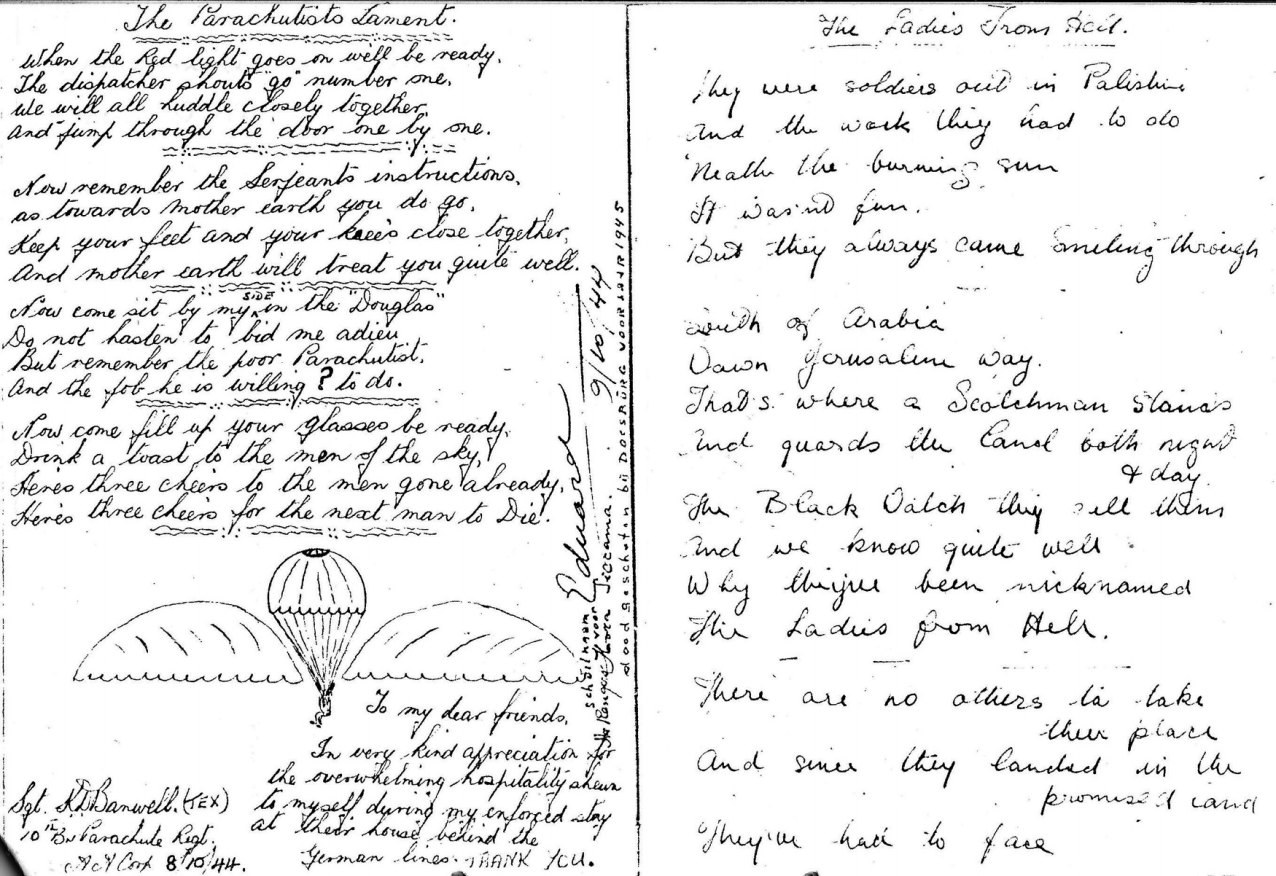
Link to the section With MurphyBanwell and Murphy are on the same spread of the De Ruif guestbook: Banwell's page, dated 8/10/44, faces the start of Murphy's poem (Noordman, fig. 189, p. 293; picture below). By Hardy's report Banwell joined Murphy's party on 29 October and stayed with the larger party when Murphy's group went back to Otterlo without him on 20 November (Hardy); by Schjelderup's report of 1945 both were in the party that crossed from Amerongen on 2 January 1945 and were lost in the same scatter (the transcript). Between 20 November and 2 January his helpers' forms and reports have him at Barneveld (the Klooster household's form gives 20-11-44 in its date-hidden column for "K.D. Barnwell", the form), then at Scherpenzeel, Ginkel, Leersum and Amerongen with Noble, not with Murphy (Amerongen by Swartz, Briere and Doornebosch, p. 22: "Tex and Doc went to AMERONGEN"); Staverden, by Groen's "± 12-17 Oct" and the guestbook's 8 October, was before he joined Murphy (below). Murphy's account of him, and what the records say of it, is on this page's allegation section.
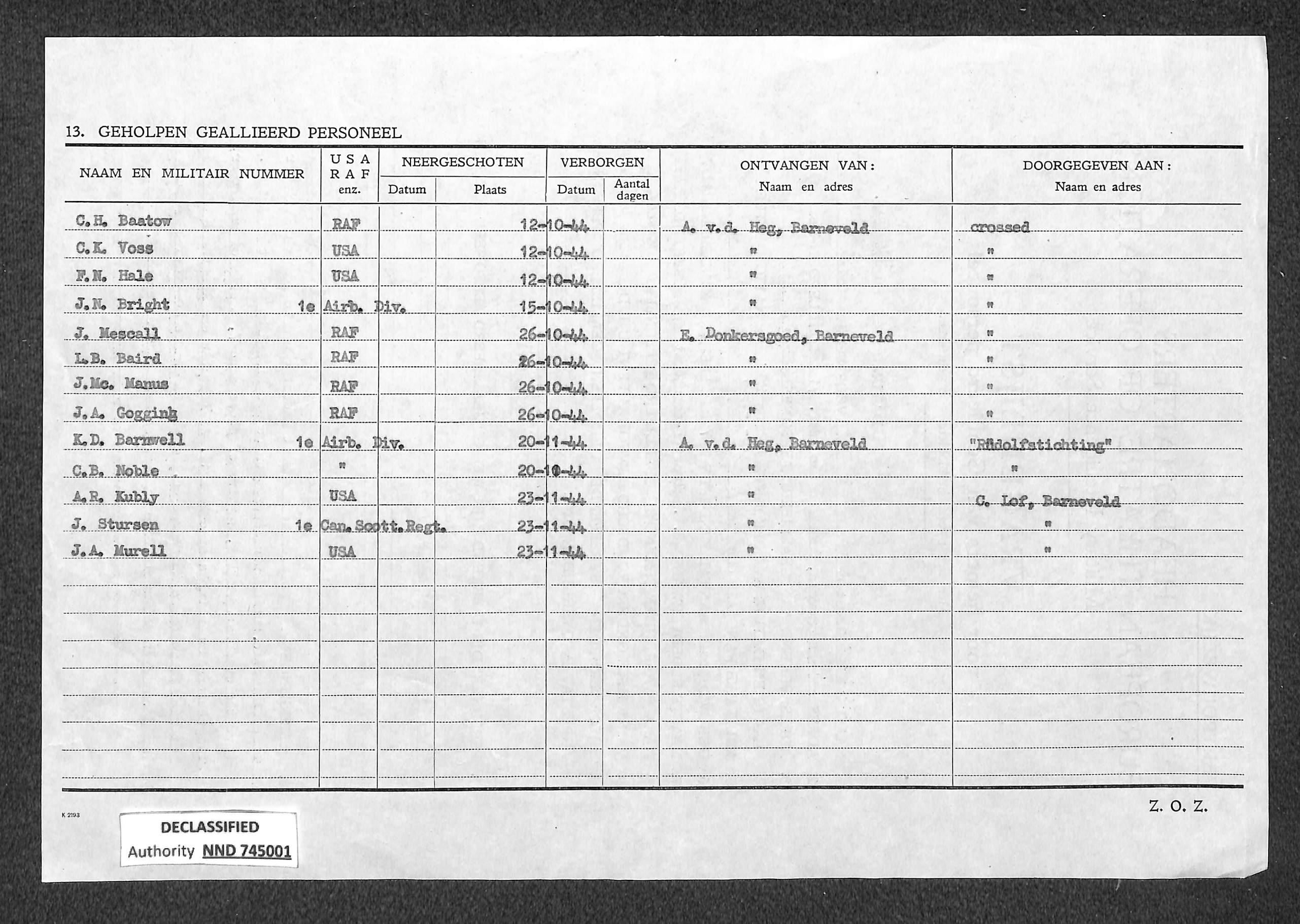
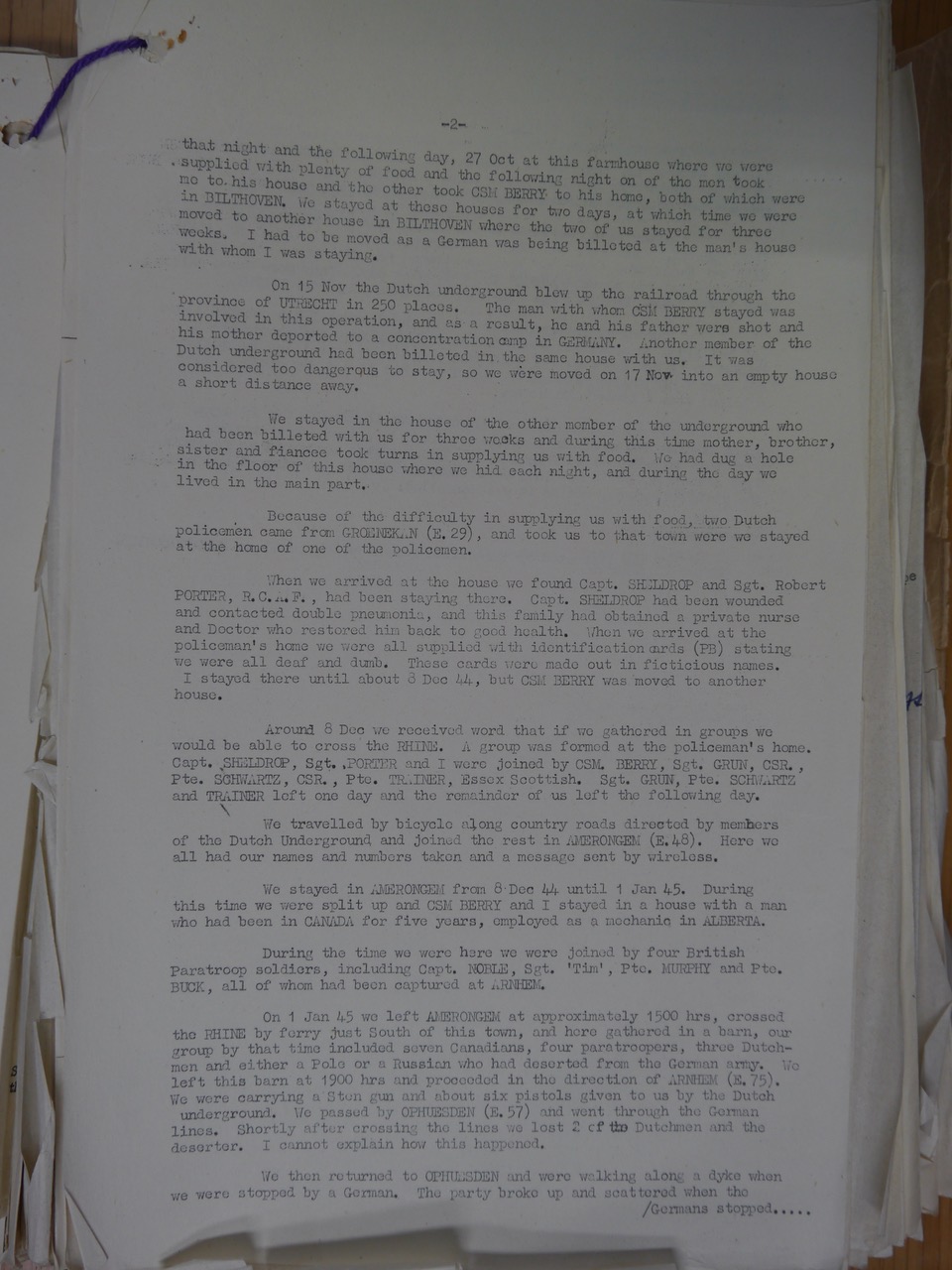
At De Ruif, by Kessel
Link to the section At De Ruif, by KesselLipmann Kessel's portrait of him at De Ruif, October 1944 (Kessel, 1959, pp. 93–98, 100–101):
- He introduced himself, "Tex is the name. Sergeant, Tenth Batt.", in "a civilian lounge suit which clearly wasn't meant for him"; "none too pleased to see us there"; "there's too much bullshit for my liking—the old woman, I mean", of the hostess; "he seemed to be very well established".
- He had a wireless set of his own in the bunker: "There's plenty of sets about, only up at the house they're windy of using one".
- He had "attached himself to the local underground group and had been teaching them how to use Sten guns and their single and much-prized light machine-gun".
- He told the story of the ambush, which Kessel puts "ten days before we'd arrived": "They killed three Luftwaffe officers", and in one officer's pocket found a sketch of the layout of Hitler's headquarters (pp. 96–97).
- Kessel's judgement: "It was impossible not to respect Tex's contempt for the Germans, even if it was often little short of foolhardy".
- Kessel's book first came out in London in 1958 (these pages are from the 1959 US edition); the memoir that makes the allegation was written about 1998 (Sources).
Banwell at Staverden
Link to the section Banwell at Staverden⚠︎ Groen's account has Banwell leave De Ruif the day before the raid, after only a short stay. Albert Groen, hidden at the Bos farm at Staverden, wrote in August 1945 of "a real Londoner" who came to them in October 1944, having been "very briefly" at Kruimel's and left "just in time", the day before the Germans raided it; Noordman identifies him as Banwell (Noordman, pp. 69–70), and in his own chapter on Banwell has him at De Ruif only "voor korte tijd" (for a short time) before being moved on (p. 292). Noordman bases that on Banwell's guestbook entry of 8 October, which is a leaving note, thanking his hosts for "the overwhelming hospitality shewn to myself during my enforced stay at their house", with "Eduard" and 9 October in the margin (p. 293): ◐ Rengers Hora Siccama's cover name by Kruimel's note beneath it; Noordman calls it "eigenhandig geschreven" (written in his own hand) and, a few sentences later, says "De toevoegingen zijn van dokter Kruimel" (the additions are Dr Kruimel's), so whose hand wrote it is not settled (p. 292; Rengers Hora Siccama). The raid on De Ruif was on 23 October 1944 (Holvoet "op die 23e October" in Boeree, p. 163; the Airborne Magazine; Tijding, 17 May 1945), so ◐ by our reading Groen's letter, with its "a day later", has Banwell leave about 22 October. The Airborne Magazine gives that date, "Op 22 oktober vertrekt hij weer" (on 22 October he leaves again); ⚠︎ it may not be a second witness: it lists Noordman, who prints Groen's letter, among six sources, and gives no source for the date.
Kessel found Tex at De Ruif "very well established" (Kessel, p. 94) when he came, ◐ on 17 October or a few days later. He escaped from Apeldoorn on the night of 16 October (Noordman, p. 309), and the agents Ham and Bacon, whom he met at De Ruif, had "only just come over" (Kessel, p. 93); Nelly Eskes, in Noordman, says the officers were fetched "die avond" (that evening) of the day they were found, which Kessel's account makes 17 October (p. 309).
Kessel's account does not fit a stay that ended on 8 or 9 October (Kessel, pp. 93–94). He also has Tex say that "Ten days before we'd arrived" he had gone out on the raid that ambushed a staff car (pp. 96–97); with the Putten ambush at 30 September, that gives about 10 October for Kessel's arrival. These accounts do not agree on when Banwell was there. The quoted phrases are Noordman's Dutch rendering of Groen, translated back.
Three forms from Staverden put Banwell there, briefly, but only one gives a date, and it does not fit Groen's story either. Groen, himself in hiding there (he struck out "Geholpen", helped, and wrote "Gekend", known), has "'Tex' Banwell. Sgt." hidden "± 12-17 Oct '44", in a table whose men were with Foppen at Staverden (Groen, p. 5); Thijs Foppen's has "Banwell Parachute Regt." for "1 day", undated (Foppen, p. 3); and Elbert Bos's has "Tex", undated, from "Dr. Kruimel", passed to "Tijs Foppen and later on to Dirk Eisinga" (Bos, p. 3).
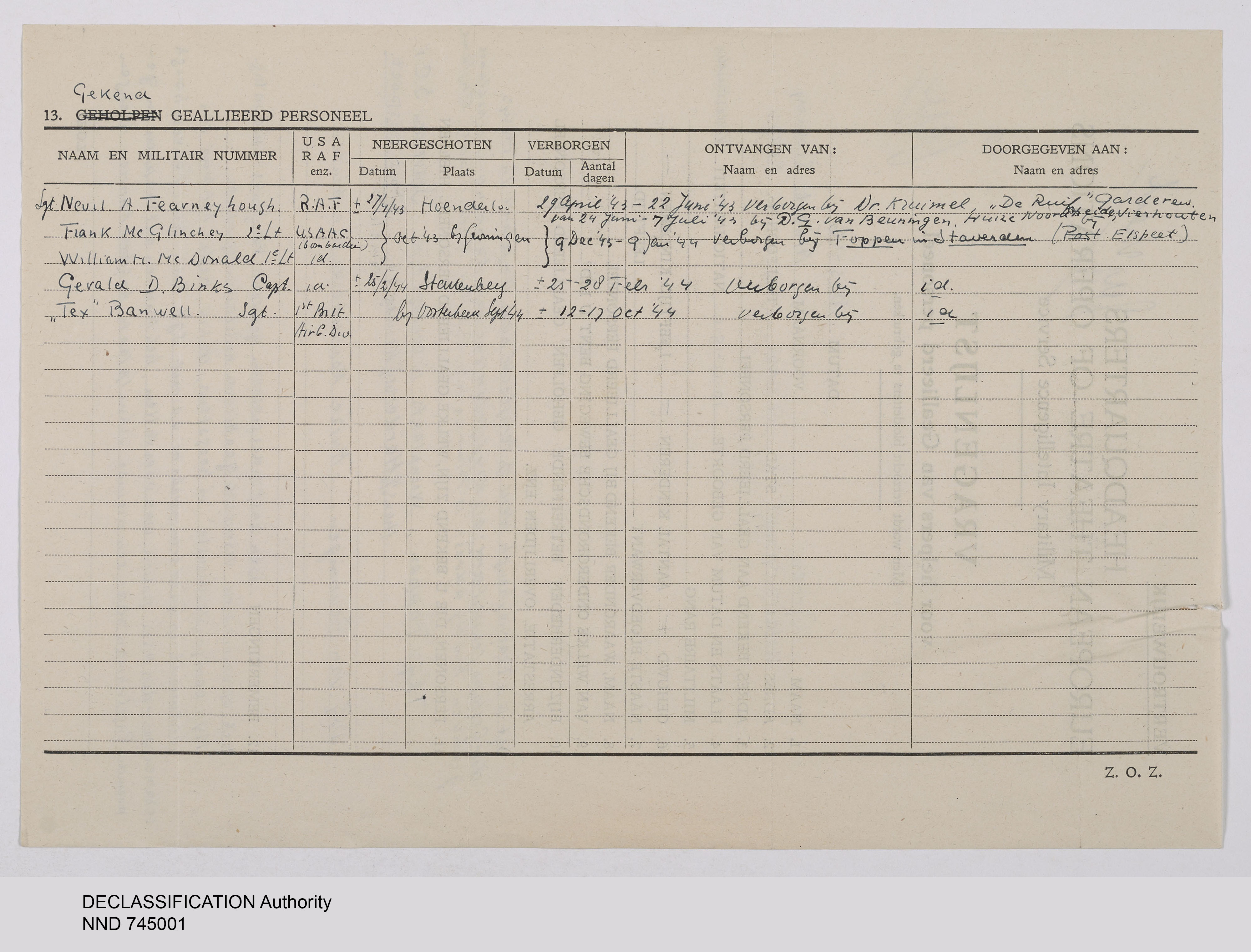
⚠︎ A British officer backing Lambertus Huber's claim in 1946 listed, among the twenty or so Airborne men Huber sheltered at Garderen after the escapes from Apeldoorn, "Captain Redman, Capt. Lippman Kessel, Major Coke, Corporal Flekker, "Tex" (Barnwell ?) mainly for short periods up to a week" (Windham-Wright's memo, p. 3); the question mark is his, and no date is given.
Pegasus II, Scherpenzeel and the crossing
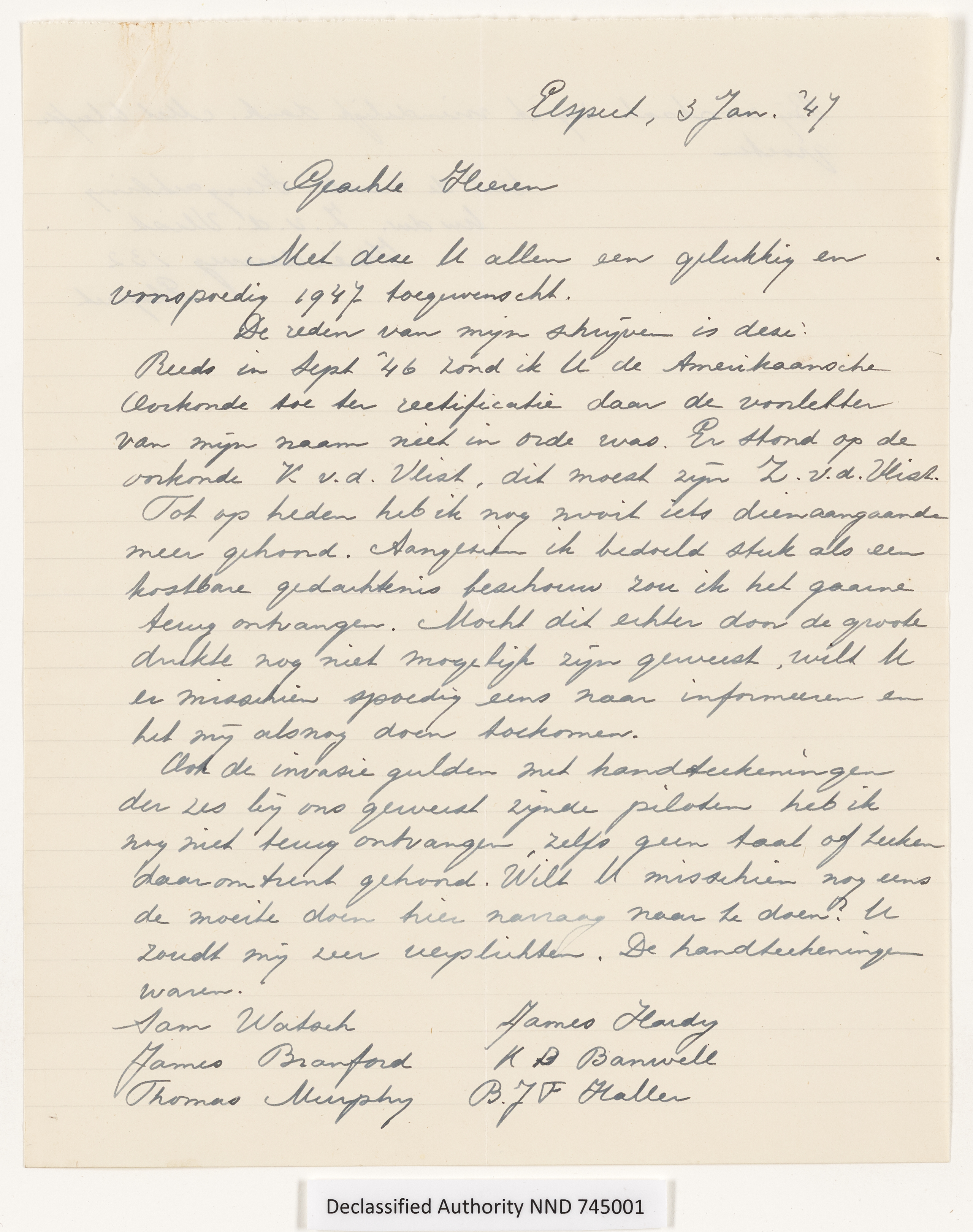
Link to the section Pegasus II, Scherpenzeel and the crossing- He joined Murphy's party on 29 October (Hardy), at Kijkuit (Noordman, p. 292). By the crossing on 2 January Murphy had a revolver: ◐ by Hardy's report of January 1945 from Jacob Veerman; ⚠︎ by Murphy's own notes from Veerman's policeman brother; ⚠︎ by a son of Jacob's, in October 2026, from Jacob, who had fetched it from his brother Leen; ◐ probably Leen's (The revolver).
- On Pegasus II, on 17 November, he and Murphy rode one bicycle, and with Hardy and Brentford took the wrong fork and lost the party; on 20 November, when Hardy's small group went back to the farm at Otterlo, "Sgt. BANWELL decided to remain with the larger party" in the wood near the Roekelsche Bosch (Hardy).
- The form made out for the Klooster household at Barneveld has "K.D. Barnwell | 1e Airb. Div. | 20-11-44", received from A. v.d. Heg and sent on to the Rudolphstichting, the children's village at De Glind (Klooster's file, p. 3).
- Diet Eman, who says she assisted Albert van Meerveld, listed "Sgt. K.D. Banwell" among the men she helped in her table of May 1946, and gave "The addresses were they sheltered" as Klooster, Heine, Rouwenhorst and Heg at Barneveld and Bouwmans at Terschuur, without saying which man was where; her table gives no dates, and its Bouwmans line ties him to "2 pilots who had a forced landing in February 1944" (her table, p. 8, read on the image).
- "Sgt. BANWELL was at that time in communication with Capt. KING through the Underground" (Hardy).
- In early December he was at a farm at Scherpenzeel with Davison and Moore; a dinghy turned up, which sank when all three got in, and "it was decided that Vic and I would go and Tex would stay behind and take his chances with the resistance"; the two left on 5 December and were found by a British patrol on the 8th (Davison).
- ◐ Noble reached the same farm about 6 December (his report gives no arrival date: "After 10 days (i.e: about 16th Dec)" they were moved on, and Davison had left on 5 December, so 6 December is counted back from those), found him there, "with whom it was intended to make the escape", and was moved with him to Ginkel near Leersum and then to the Berghof at Leersum, where "the idea of an independent attempt was postponed" (Noble).
- H. van Bentum of Woudenberg, who moved men round Scherpenzeel for R. van Ginkel's group, gave lodging to "Capt. Charles B. Noble / Serg. K.D. Banwell / L. Davison / F.V. Moore", and handed them on to the guides (his letter of 18 January 1946, p. 18).
- His questionnaire lists the same men with "W.A.Elroy" and "(plus abt. 50)", received from Scherpenzeel, W. Veldhuizen and "Peter" (R. v. Ginkel), and in the handed-on column "‘Jan Oke’ (nick-name), Amerongen", the cover name of Nico Hoogland; the typed table does not line its cells up name by name, so it does not show which of the men went to him (p. 9, checked on the image).
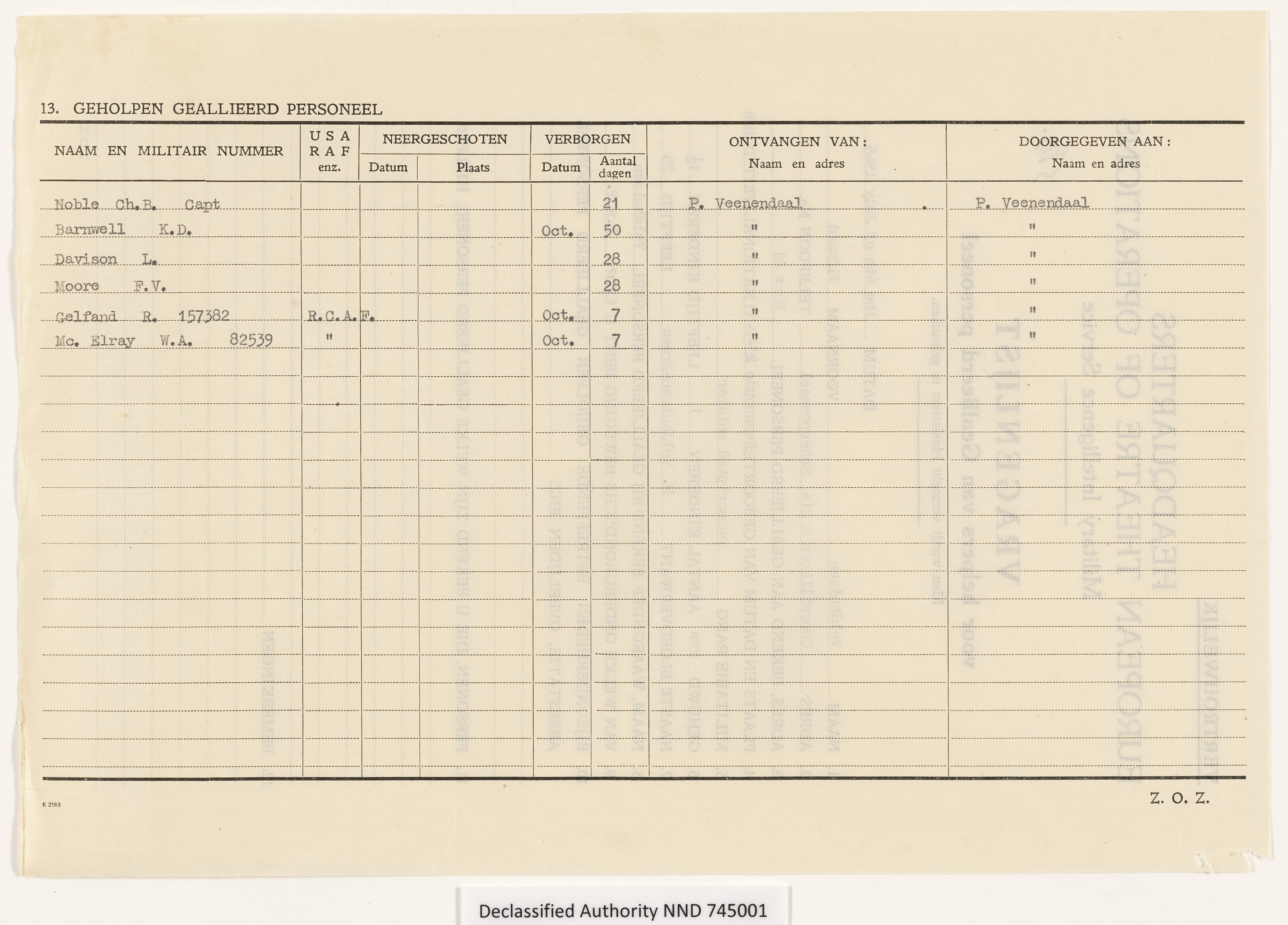
- W. Veldhuizen's table has the same four with two RCAF airmen, all received from and passed back to P. Veenendaal: "Barnwell K.D.", "Oct.", 50 days, against Noble's 21 and Davison's and Moore's 28 (his table, p. 3, checked on the image). ⚠︎ None of those counts fits a stay at the farm (see Noble's page); they read as the helper's reckoning of each man's time in the district.
- ⚠︎ Noble's own later account (unpublished private papers, shared with us privately) does not name Banwell here: at the farm at Scherpenzeel "there were several British including a sergeant whose name I cannot remember and a person Davison", and he stayed "about ten to fourteen days". It says nothing of a joint escape, or of Ginkel and the Berghof, and goes on from the farm to Amerongen.
- ⚠︎ The account puts Davison at the farm with Noble. The report has Davison hide there "Prior to his successful attempt to cross the Rhine" (Noble), and by the dates above Davison had left on 5 December, the day before the 6 December counted back from the report for Noble's arrival (Leslie Davison).
- Heaps, writing up what Banwell told him, has him since early October travelling "to Amerongen and Tiel on missions with the Resistance. There were numerous opportunities to reach his own lines but he never took them" (Heaps, p. 196). The 1945 reports have him trying: on Pegasus II, left behind when the dinghy proved too small, in the joint attempt with Noble that was put off, and in the January crossing.
- On the night of 2/3 January 1945 the party crossing from Amerongen was scattered in a firefight, and Schjelderup lost "Capt. NOBLE, Sgt. TEX (?), Pte. MURPHY" in it (The crossing and recapture).
- ✓ The Canadians' reports name him in the party.
- Schjelderup's list of the patrol has "Sgt. BANWELL, K." (above; transcript).
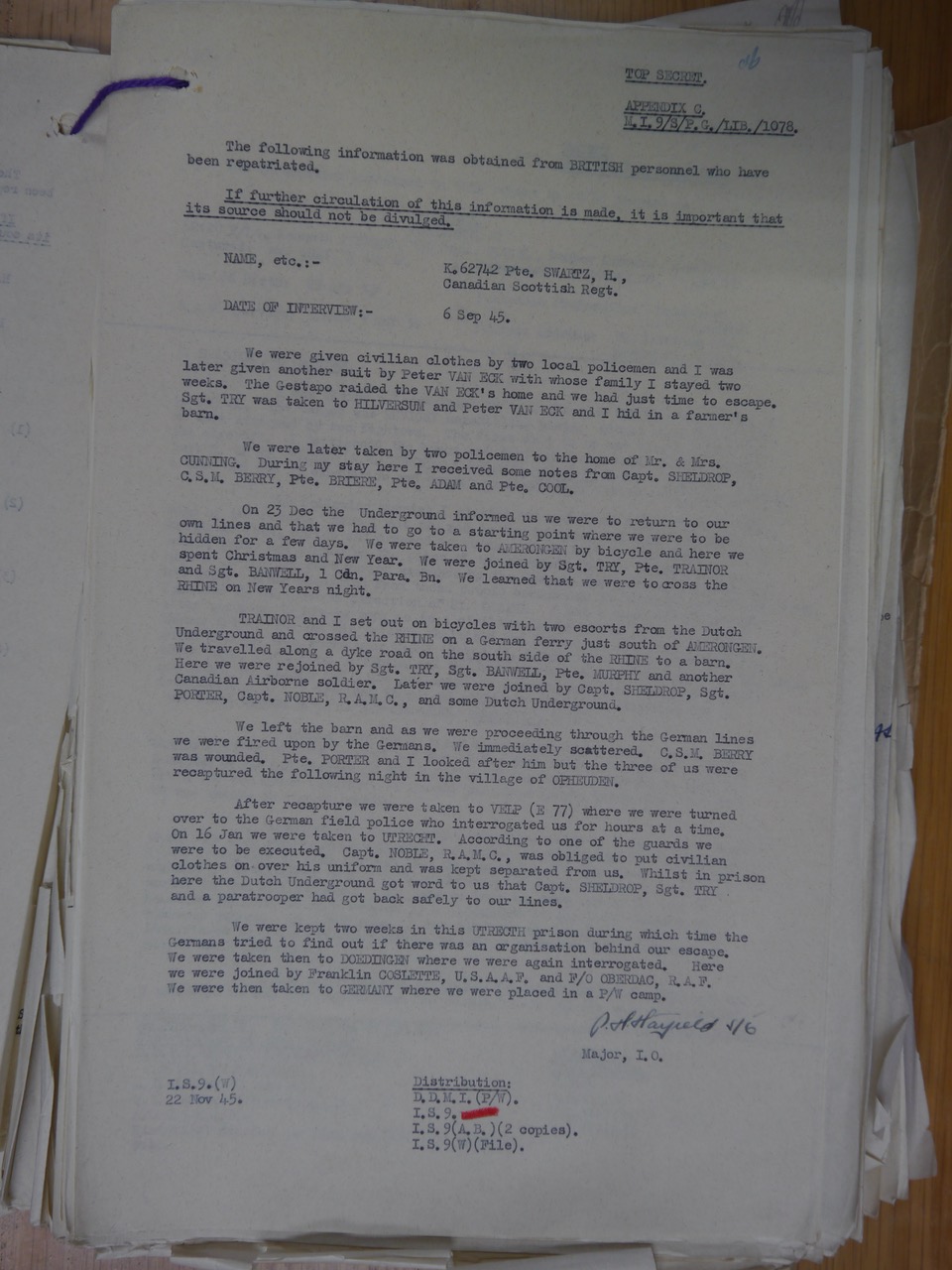
- Two of the Canadians' own MI9 reports name him too; they were photographed at Kew by the late John Howes, who passed them to Lisan Koppenol, and she sent them on. Swartz has him join them at Amerongen, where they spent Christmas and New Year, and then at the barn south of the Rhine on 2 January, "Sgt. BANWELL, 1 Cdn. Para. Bn." (Appendix C); ◐ Briere's "Sgt. 'Tim'", one of four British paratroopers who joined them at Amerongen, is very probably him (Briere, p. 2).
Captured, January 1945
Link to the section Captured, January 1945How he was taken, and what happened to him afterwards, is told many ways, and the accounts do not agree.
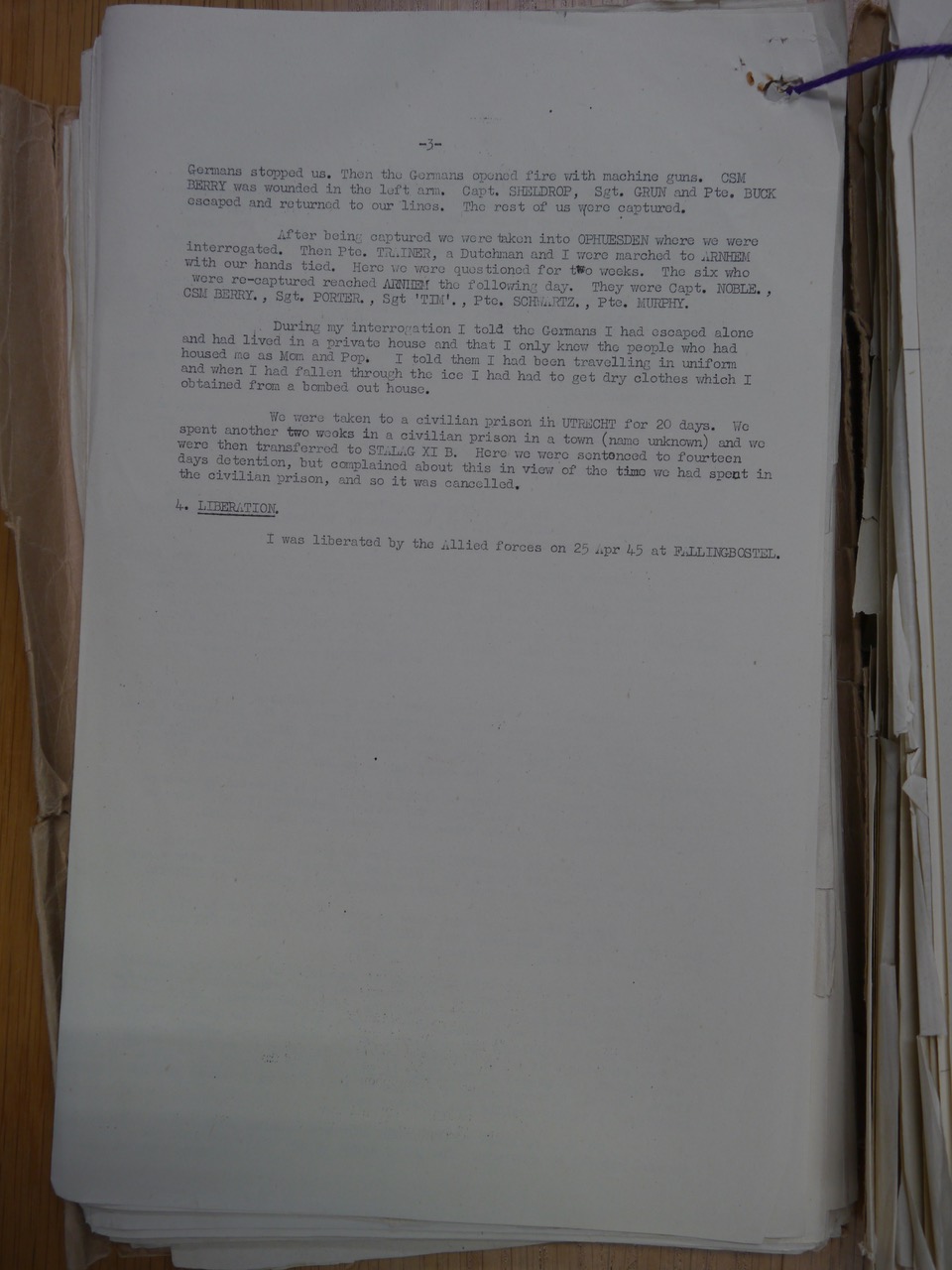
- Briere's six. Pte Marcel Briere's report of June 1945, after he, Trainor and a Dutchman had been marched to Arnhem: "The six who were re-captured reached ARNHEM the following day. They were Capt. NOBLE., CSM BERRY., Sgt. PORTER., Sgt 'TIM'., Pte. SCHWARTZ., Pte. MURPHY." (p. 3). The report does not date "the following day", or say where or with whom each was taken.
- ◐ Four of the six put themselves at Velp, by Arnhem, in their own accounts: Noble, Berry, Swartz, and Porter in his letter ("Felp"); Murphy has his party taken to "GWELF" (Noble; Berry, p. 2; Swartz; GWELF). ⚠︎ "Tim", ◐ very probably Banwell (picture below), rests on Briere alone.
- ⚠︎ Porter's book has a different six: "Wilf, Louis, Harvey, Marcel Briere, the Army Doctor and myself were taken to Arnhem" (p. 151). That puts Briere and Trainor with him, where Briere has the two of them marched ahead, and has no Murphy and no "Tim" (Porter; Porter's page). Not reconciled: Briere's is a report of June 1945, Porter's a book written fifty years on.
- The published account of what happened to him. Taken separately ("at various phases"),
marched to Velp for interrogation, stripped and, because his underwear was clean, suspected of
long shelter by the Resistance and handed to the Gestapo. Flown to Berlin. "Ordered to reveal the
names of the Dutch Resistance he had been in contact with, and his refusal to answer led to him
being twice brought before a mock firing squad." Then "released by the Red Army in March 1945"
(pegasusarchive).
- The Dutch researcher Willem Tiemens has the same Velp interrogation, and the same reason for the suspicion: "he was well fed, neatly shaved and wearing clean civilian clothes" (Tiemens).
- ⚠︎ Tiemens's capture is his own: at the end of January 1945, after snow, Banwell was taking an American airman across when they ran into a German line; the airman was taken, Banwell hid in a copse, and the next day the Germans found him with a tracking dog. That has him taken alone, and later than the 1945 reports allow (Tiemens).
- ⚠︎ His own account.
- At the 25th anniversary in 1969 he told the Algemeen Dagblad (Algemeen Dagblad, 15
September 1969):
- that his group was caught trying to cross the Rhine in January 1945,
- that the Germans found him well fed and wanted to know who had hidden him since September,
- that he was sent to Berlin, told he would be shot and taken to a wall full of bullet holes,
- that he would not tell, because "ik had vrienden in Nederland, die me gered hadden en ik dacht: Als ik het vertel gaan ze terug, doden iedereen en steken de huizen in brand" (I had friends in the Netherlands who had saved me, and I thought: if I tell, they'll go back, kill everyone and set the houses on fire),
- and that afterwards "Ik werd naar Auschwitz gestuurd en daar ben ik drie maanden gebleven tot we bevrijd werden door de Russen" (I was sent to Auschwitz and stayed there three months until we were freed by the Russians).
- The paper adds that his friends from the underground were waiting below the drop, "een huldiging en twee onderscheidingen" (a tribute and two decorations).
- In 1988 Het Vrije Volk told it again, in the reporter's words (Het Vrije Volk, 26
September 1988):
- he "bracht Britten en Amerikanen over de Rijn, totdat hij in januari 1945 met een groep op Duitse soldaten stuitte en gevangen genomen werd" (took British and Americans over the Rhine, until in January 1945 he ran into German soldiers with a group and was taken),
- was questioned by the SS and the Gestapo at Velp,
- was moved to Berlin when he would not name the resistance,
- and was twice put before a firing squad.
- Het Vrije Volk's text says nothing of Auschwitz; the Airborne Museum's catalogue summary of the same 1988 interview has him sent to Auschwitz and "Nadien … overgebracht naar het krijgsgevangenkamp Stalag XIB" (afterwards moved to the prisoner-of-war camp Stalag XIB), a summary, not his words (Gelders Archief).
- This is his own story, told 25 and 44 years after the event.
- At the 25th anniversary in 1969 he told the Algemeen Dagblad (Algemeen Dagblad, 15
September 1969):
- ⚠︎ But the published record on Banwell does not agree with itself. The endings:
- The first press report found, 1961, from his reunion in England with Mrs F. Schuitemaker, who had hidden him in 1944: taken again while working in the Dutch resistance, "ter dood veroordeeld" (sentenced to death), the execution suspended, and a prisoner-of-war camp for the rest of the war (Nieuwsblad van het Noorden, 9 September 1961, read on the image; the same report in De nieuwe Limburger).
- The Pegasus Archive: Berlin, then "released by the Red Army in March 1945" (above); the Daily Telegraph's obituary of 23 August 1999, reproduced on the same page, has him recaptured "while escorting a small party of escaping prisoners", sentenced to death by a court martial, put twice before a firing squad, and then imprisoned in Auschwitz until the Russians freed the camp (the obituary, the Vrijheidsmuseum's cutting, checked on the image).
- A Dutch columnist who interviewed him in 1984 has "enkele weken in Auschwitz" (a few weeks in Auschwitz), "maar daarover wilde hij met mij niet praten" (but he did not want to talk to me about that) (Het Parool, 24 September 1994).
- Wikipedia: "sent to Auschwitz concentration camp. He survived four months" there, and "was then moved to Fallingbostel, where he was liberated by the Red Army in March 1945" (Wikipedia).
- ◐ The Oxford Dictionary of National Biography (2004), the source Wikipedia cites: captured "on one of his forays", court-martialled, sentenced to death, twice before a firing squad that did not fire and then fired blanks, taken to Auschwitz and "kept in a 6 foot square cage and starved", then "moved to Fallingbostel, from where he was liberated by the Russians" (the entry, pp. 733–734; from search snippets, spot-checked in the book viewer). It is Wikipedia's version without the four months and the date, and its author, Philip Warner, lists private information from the family and Heaps among his sources.
- Tiemens: sent to Auschwitz, and "Bij de nadering van de Russen verhuisde hij naar het krijgsgevangenkamp STALAG IIB in Fallingbostel. Daar beleefde hij de bevrijding" (as the Russians approached he was moved to the POW camp Stalag IIB at Fallingbostel, and was there at the liberation) (Tiemens).
- The Airborne Museum's 1988 summary: Auschwitz, then Stalag XIB (above).
- Wikipedia, Tiemens and the 1988 summary agree on Auschwitz and then Fallingbostel, the camp where Murphy says he saw him. Wikipedia's and the ODNB's Russians cannot stand: Fallingbostel was liberated by British troops on 16 April (Wikipedia), and its four months do not fit either. Recaptured on 2/3 January, he could have been at Auschwitz for at most the 24 or 25 days before the Russians reached it on 27 January.
- Where the Auschwitz story comes from, and what fails in it. ✗ for Heaps's November date and for an ending at Auschwitz, freed there by the Russians in March after three months; ⚠︎ for a short stay at Auschwitz before Fallingbostel, which the dates allow but nothing contemporary confirms.
- ⚠︎ Ede's municipal history tells it (the SD knew of his resistance work from the captured papers of the West Veluwe BS commander, took him to Berlin and then Auschwitz, "waaruit hij uiteindelijk door de Russen werd bevrijd", from which he was in the end freed by the Russians) and cites R. Brammall's The Tenth (Ipswich, 1966), the 10th Battalion's history (Ede manuscript, p. 47, note 40).
- But the manuscript was written after 1982: it also cites De Jong's deel 10B (1982), and its Banwell paragraph follows De Jong's p. 553 almost word for word (below). Brammall's book has not been seen, so whether the story was in print by 1966 is not known.
- His BEM recommendation, written by his commanding officer on 12 July 1968, has Auschwitz in one line: "He was captured at ARNHEM, escaped and served with the Dutch Under-ground only to be recaptured and sent to AUSWITZ." (the recommendation, p. 3).
- Banwell told it himself, Berlin and Auschwitz and the Russians, to a Dutch paper in 1969 (Algemeen Dagblad).
- The fullest version is Leo Heaps, The Grey Goose of Arnhem (1976), who had jumped from the prisoner train with Banwell in September 1944 and wrote up what Banwell told him afterwards.
- Heaps has him taken "On the morning of November 21" in "the frozen brickyard at Wageningen" beside an American pilot who was shot (no such pilot is in the January party's casualties), marched to Velp, flown from an airfield near Apeldoorn to Berlin "late in November 1944", twice before a firing squad, then "a car drove Banwell to Auschwitz", where "the Russians found the sergeant in March 1945" (Heaps, pp. 196–197).
- Against that date stand the 1945 reports and the Klooster household's form, which carry him from
Pegasus II to the January crossing (above), and one more
Dutch form:
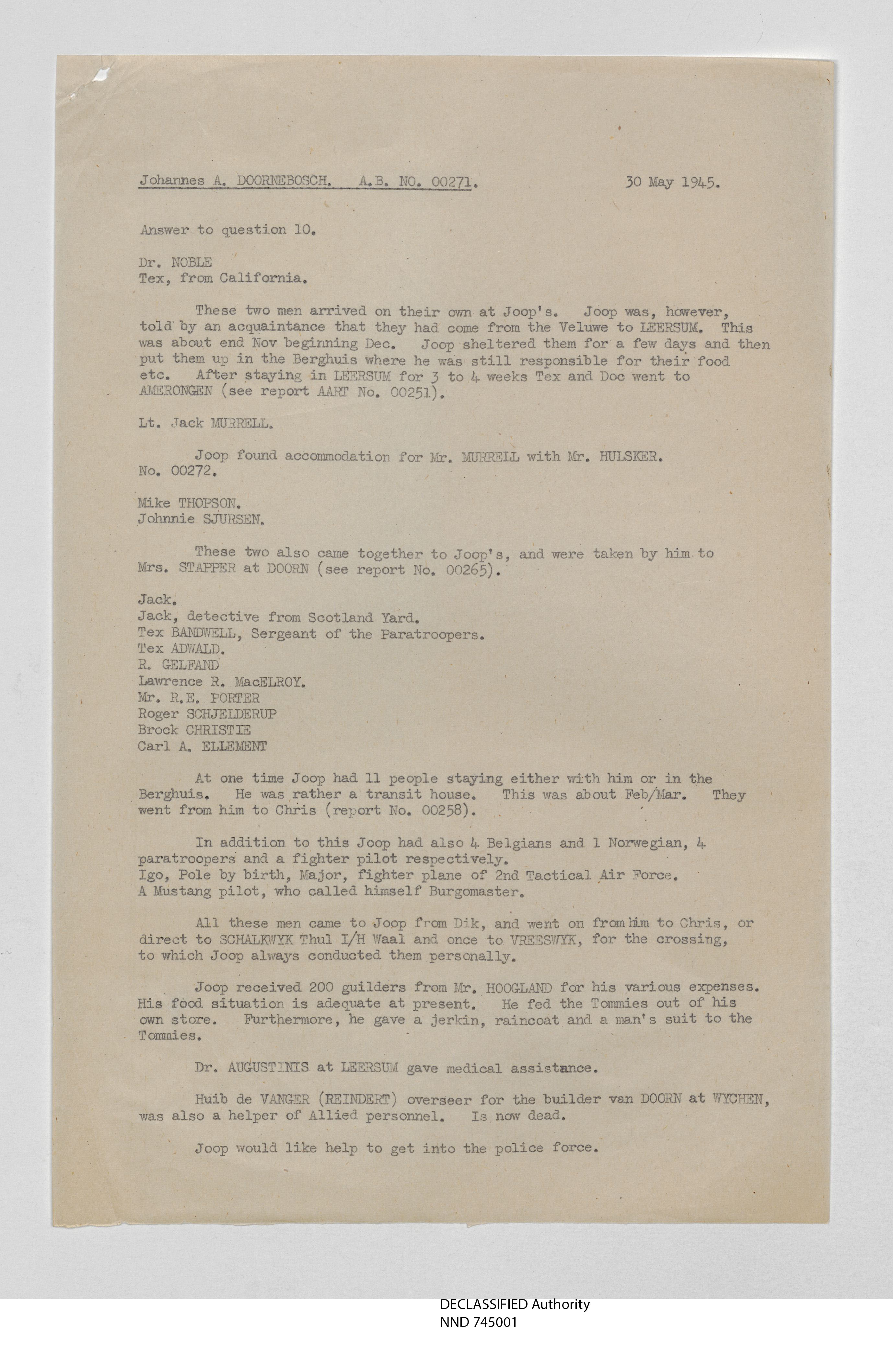
- Joop Doornebosch at Leersum had "Dr. NOBLE / Tex" arrive from the Veluwe at about the end of November or the start of December, stay three to four weeks and go on to Amerongen (his file, p. 22).
- ⚠︎ Doornebosch's "Tex" is "from California", and the same page lists "Tex BANDWELL, Sergeant of the Paratroopers" separately, in a group of men it dates "about Feb/Mar" with Porter and Schjelderup, who had crossed on 2 January; so the Tex with Noble is ◐ Banwell on the strength of Noble's own report, which has Banwell with him.
- ⚠︎ An unsigned enclosure about Doornebosch's partner at Leersum, Cornelis Dieckmann, "Frits", of Rhenen, typed in the third person, has as the first two men he helped "Capt. Noble. Med. Officer of the Paratroupers, Glasgow" and "Sgt. Tex Bantwell of the paratroupers", who "lodged with Frits in the 'Berghuis' Leersum from about Half Dec.-2 Jan. 45" (the enclosure, p. 6, 13 July 1945).
- Its compiler, who is not named, added "We have to take his information with a grain of salt", and, sending on Dieckmann's own report on a Norwegian's lost or stolen pistol, wrote: "It is assumed that he is the delinquent, but of course in his own report it is somebody else." ◐ Read as grammar, "he" is Dieckmann; the page names no one else in connection with the loss. Dieckmann's report is addressed to "Captain I.S. H. van Loenen" of Zeist (p. 8; Joop Doornebosch).
- It agrees with Noble's report on Banwell being with him at Leersum, and is no stronger than that.
- ◐ The capture Heaps describes looks like that night put in the wrong month: the party met near the Rhenen bridge and at about 11 p.m. reached "the brick factory on the river bank opposite WAGENINGEN" over frozen ground (Noble), and Murphy's own notes have him taking refuge "in brickwork" with a companion (The crossing and recapture).
- Banwell's own accounts of 1969 and 1988 both put his capture in January 1945 (above).
- Whatever the date, an ending at Auschwitz does not hold: it was liberated on 27 January 1945, six weeks before Heaps has the Russians find him there, which leaves no room for the three months there he spoke of in 1969 (Wikipedia). A few weeks there before a move west, as Tiemens and the 1984 interview have it, is not ruled out by the dates.
- ◐ A contemporary witness, at second hand. Noble's POW questionnaire, 26 April
1945: "Do not know fate of the 8 people with whom captured in Jan. In particular Sgt. Banwell,
AAC. (Reported sent back to Gestapo in Holland from Stalag XIB)"
(Noble). Noble himself was in XI-B from 28 February
to 6 March 1945.
- ⚠︎ "Reported" is Noble's word: hearsay, not something he saw. "From Stalag XIB" can be read two ways: that Banwell was sent back from the camp, which puts him in it, or that the report reached Noble there.
- It is the only contemporary word of what became of Banwell after the capture; Briere's list of the recaptured, with ◐ "Sgt 'TIM'" (picture below), stops at their reaching Arnhem the day after the capture. It fits Banwell's own account (which Heaps wrote up and De Jong repeats without a source) that the Germans wanted more from him, and equally Murphy's, that he saw him get into a German staff car and later in the Stalag (below); it does not say why.
- Noble counts Banwell among "the 8 people with whom captured in Jan.", a contemporary statement that has him taken with the others. Briere's list (◐ "Sgt 'TIM'", as above) puts him among the prisoners who reached Arnhem "the following day", which is not the same as saying where or when he was taken, and Porter's six (above) leave him out.
-
⚠︎ Noble's later account. Noble told his war again long after it (unpublished private papers, shared with us privately). It has him declared a prisoner of war at Doetinchem, a week at Fallingbostel, and then a camp at "Hahndorf" (Hallendorf, near Brunswick, in his report), and goes on:
About a fortnight after I left Fallingbostel the Sicherheitsdienst arrived and were looking for me. But the Wehrmacht did not know anything about me. This was bad news. A report about me had presumably gone to Berlin. And now Berlin was here. One of the people that night actually finished up in a concentration camp. That was a sergeant called Tex.
— Capt. C. B. Noble, RAMC · his own later account · unpublished private papers
- It is late memory from one man, and the same man as the questionnaire above, so it does not add a second witness. It does not say how he knew, which night "that night" is, or which camp.
- ◐ The Tex is Banwell on the strength of Noble's own questionnaire, which names "Sgt. Banwell, AAC" in particular after "the 8 people with whom captured in Jan." (Noble); his report also has "Sgt. BANWELL" with him at the Scherpenzeel and Ginkel farms.
- ◐ That the SD took Banwell from Fallingbostel is also in the questionnaire above, "Reported sent back to Gestapo in Holland from Stalag XIB": a 1945 record, but Noble's own and reported, not seen. ⚠︎ "Concentration camp" is in the later account alone.
- Noble names no camp. The Auschwitz story told of Banwell by other sources is a separate claim (below).
- The Dutch official history puts his capture on Pegasus II, and sends him to Berlin and Auschwitz without naming a source. In its account of the planned crossing, De Jong lists him among the Airbornes meant to go, "who had taken part in the raid at the Oldenallerbrug" (deel 10b, p. 551, checked on the image). Two pages on, after the men taken to the Feldgendarmerie at Ede that night, the book turns to him:
Keith Banwell, on the other hand, who was also taken prisoner, fared worse: the SD knew of his involvement in the illegal work (perhaps because, as mentioned earlier, Berend Dijkman, the commander of the RVV's Veluwe brigade, had fallen into German hands on 15 November with all his papers) and took him to Berlin; there Banwell was subjected to heavy interrogations. When he gave nothing away, he was shut up in the Auschwitz concentration camp. He was liberated there by the Russians.
Dutch originalKeith Banwell daarentegen, die ook gevangen was genomen, trof het slechter: de SD wist van zijn betrokkenheid bij het illegale werk af (wellicht als gevolg van het feit dat, gelijk eerder vermeld, Berend Dijkman, de commandant van de brigade-Veluwe van de RVV, op 15 november met al zijn stukken in Duitse handen was gevallen) en bracht hem naar Berlijn over; daar werd Banwell aan zware verhoren onderworpen. Nadat hij daarin niets had losgelaten, werd hij in het concentratiekamp Auschwitz opgesloten. Hij is daar door de Russen bevrijd.
— L. de Jong · Het Koninkrijk der Nederlanden in de Tweede Wereldoorlog, deel 10b, p. 553 · NIOD edition, CC BY 3.0 NL · the volume
- The page's two footnotes are about Johan Doorn, killed on the way to the march, and Boeree's Kroniek van Ede, which the text cites for the guides' beating; neither is a source for Banwell's sentences, and none is given on p. 551 either (checked on the images).
- The same chain (the seized papers of the brigade commander, Berlin, Auschwitz, the Russians) is in Ede's manuscript above, which is later than De Jong and follows him; it cites Brammall's The Tenth. Where De Jong had it from, he does not say.
- ✗ The capture on Pegasus II cannot be right: the 1945 reports and the Barneveld form carry him on to the January crossing (above).
- ⚠︎ Berlin and Auschwitz stay his own story as others retold it, unsourced in De Jong as in Ede's manuscript. After a recapture on 2/3 January they would have to fit into the 24 or 25 days before the Russians reached Auschwitz on 27 January. De Jong suggests, without a source ("wellicht"), that the SD knew of his work from Dijkman's captured papers; Heaps too has the Gestapo at Velp produce "a dossier which gave a surprisingly accurate picture of the sergeant's background" (Heaps, pp. 196–197). How they knew is not recorded.
- Banwell has no liberation questionnaire indexed on Ancestry. A search of the WO 344 collection on 5 September 2026 found none for him (The National Archives, Kew). Murphy's has not been identified either: three Thomas Murphys are indexed, none yet shown to be him. Every liberated British POW was meant to complete one, but a missing one can be an administrative accident, and the absence says nothing on its own.
On Tex Banwell: an allegation
Link to the section On Tex Banwell: an allegationThis section records what Thomas Murphy wrote about a fellow evader. None of his accusations is established.
Who he means
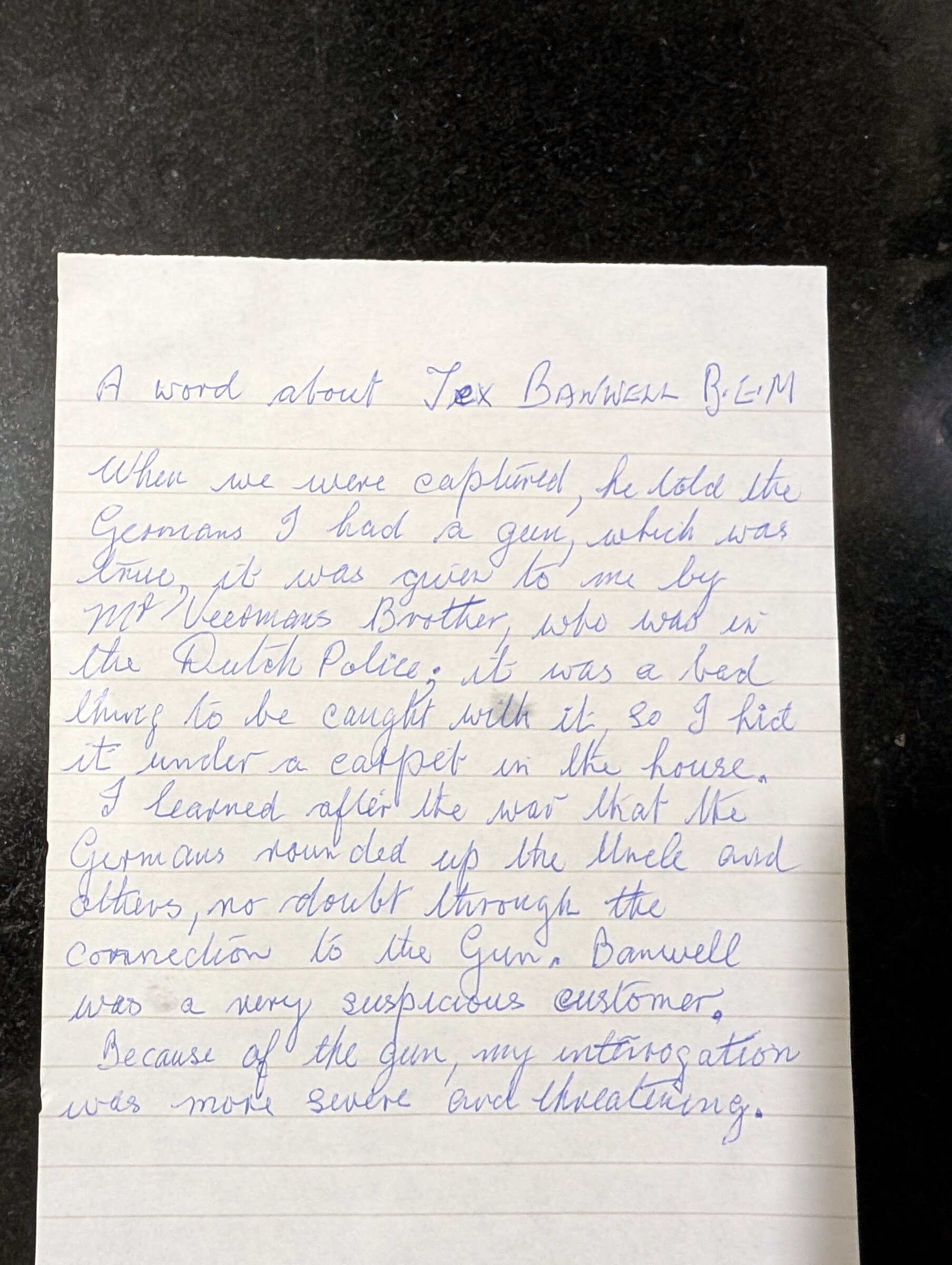
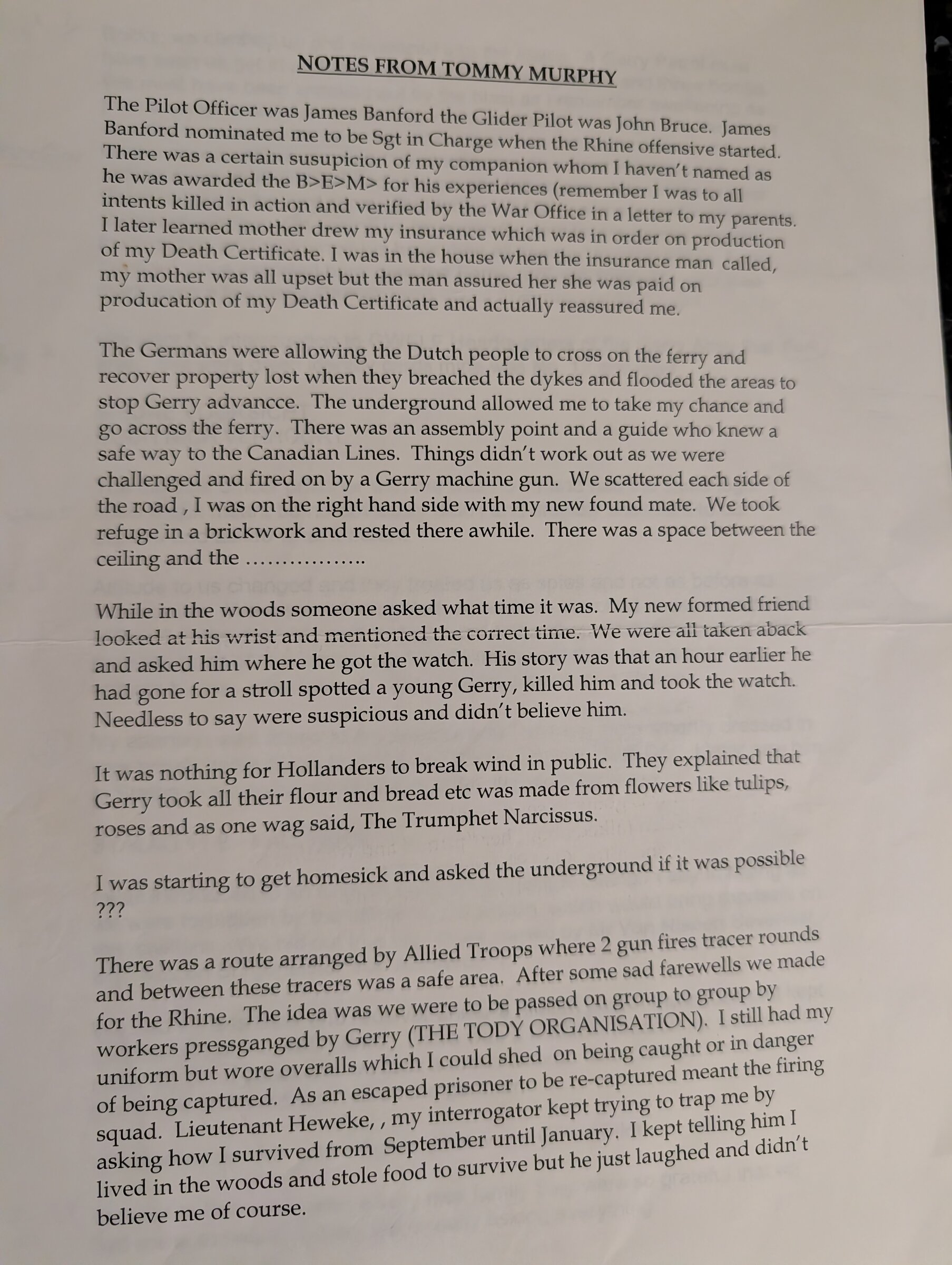
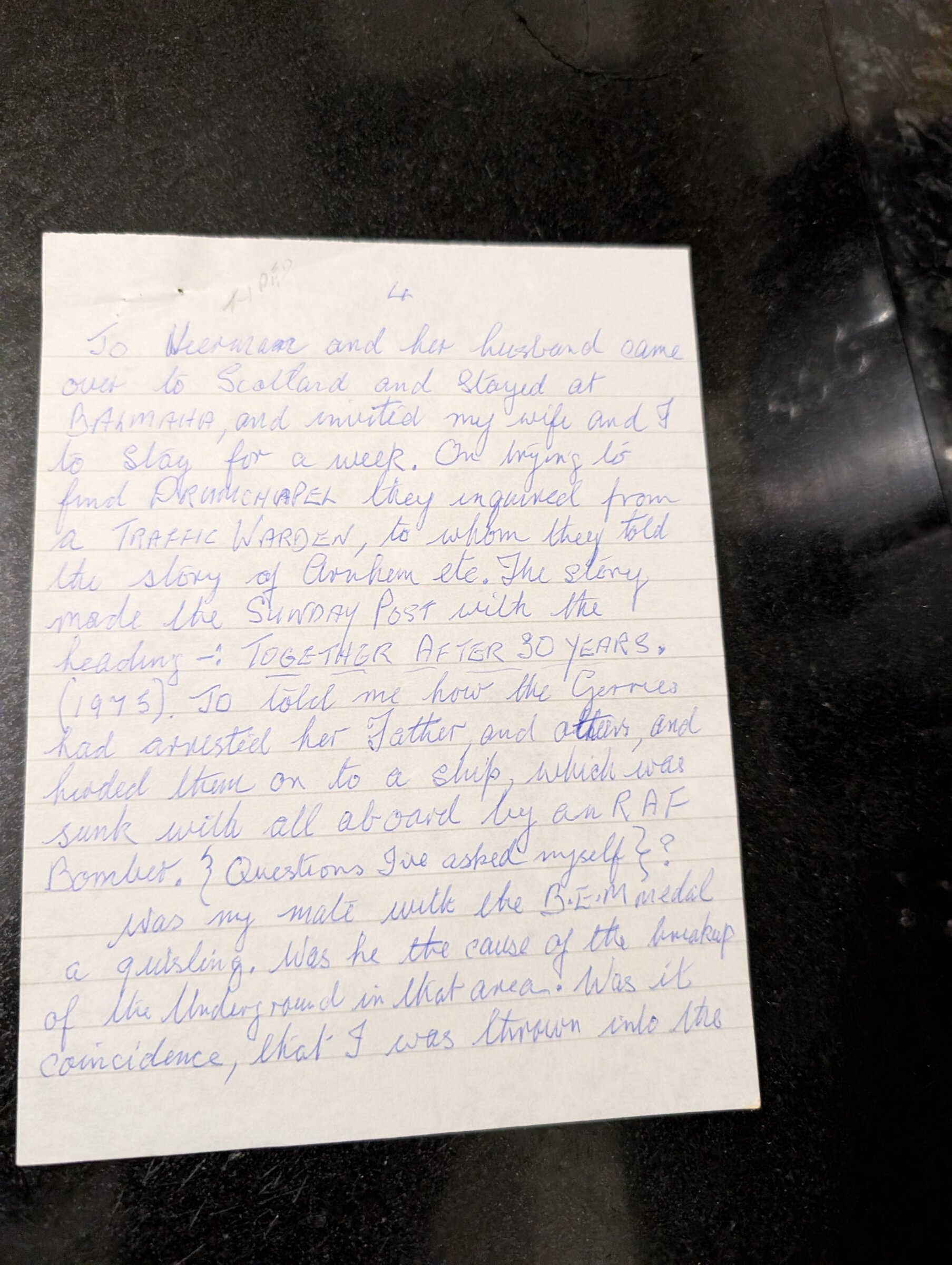
Link to the section Who he meansMurphy calls him "Tex" on the handwritten pages, and identifies him three times as the man with the BEM: the handwritten heading "A word about Tex BANWELL B.E.M" (ms); "my companion whom I haven't named as he was awarded the B.E.M. for his experiences" (notes); "Was my mate with the B.E.M medal a quisling" (p.4). Banwell "was awarded a BEM in 1969" (Banwell): London Gazette supplement 44740, 1 January 1969, p. 25, "22290927 Sergeant Keith Deamer BANWELL, The Parachute Regiment, Territorial and Army Volunteer Reserve", British Empire Medal (Military Division), with no citation (Gazette). There is no doubt who is meant, and Murphy's knowledge of the award dates his writing to after 1969. He wrote the memoirs about 1998, in his late seventies, more than fifty years after the events (Sources).
Verdict, claim by claim
Link to the section Verdict, claim by claimEach thing he said about the man, and where it stands:
| What he said | Status | Why |
|---|---|---|
| The man with the BEM is Tex Banwell | ✓ | London Gazette 44740; Banwell was in the party (Hardy, Schjelderup) |
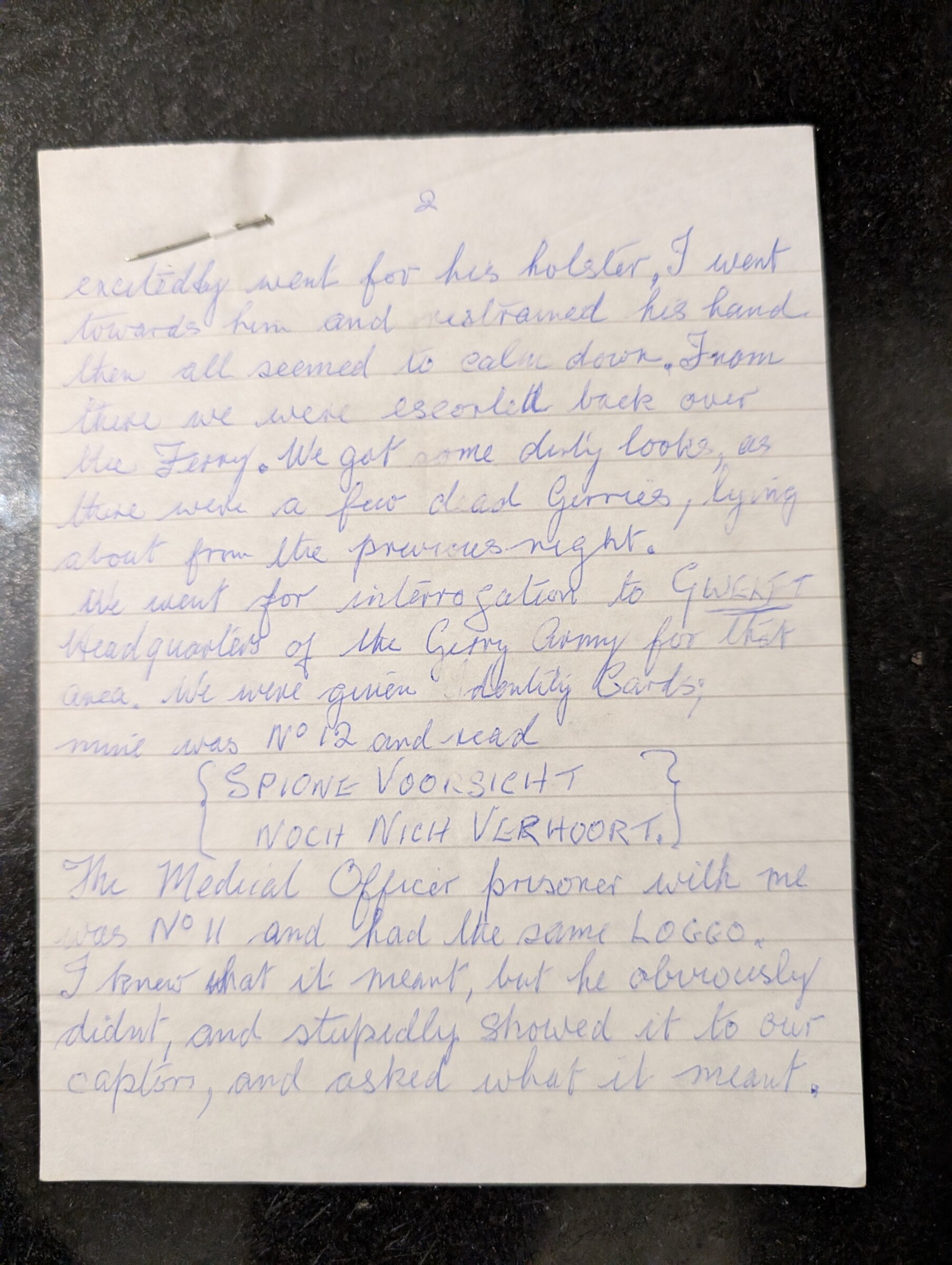
| Banwell was with him when he was captured | ◐ | ◐ for the same capture: Noble's questionnaire of 26 April 1945 counts Banwell among "the 8 people with whom captured in Jan." (Noble), and Murphy's identity-card page has "The Medical Officer prisoner with me", ◐ Noble (p.2); Schjelderup lost "one Dutchman and the following three men: Capt. NOBLE, Sgt. TEX (?) [BANWELL], Pte. MURPHY" in the same scatter (the transcript). That Banwell was with him in the house, where the pistol was hidden, is his word alone. Murphy's typed notes have "I was on the right hand side with my new found mate. We took refuge in a brickwork": the mate is unnamed, a paragraph after "my companion whom I haven't named as he was awarded the B.E.M.", and whether he is Banwell the notes do not say (notes). The Pegasus Archive's account (⚠︎) has Banwell taken separately (above). Briere's report has "Sgt 'TIM'" and Murphy among the six recaptured who reached Arnhem "the following day", undated, which puts them on the same road, not in the same capture (Briere, p. 3); Porter's book, fifty years on, has a different six, without either (p. 151; above). Banwell's own accounts (⚠︎) have him taken in January 1945 with a group, trying to cross the Rhine (1969; 1988) |
| "What about your pistol?", said in front of the Germans | ⚠︎ | His word alone; nothing else found mentions it. ✓ that he carried a revolver at the crossing: Hardy's MI9 report of 13 January 1945, "Both MURPHY and I had revolvers by this time", which has it from Jacob Veerman; Murphy has it from a policeman uncle, and a son of Jacob's from Jacob's brother Leen; ◐ probably Leen's (Hardy; Jacob Veerman) |
| The gun led the Germans to "the Uncle and others" | ⚠︎ | Not shown. The December round-up began before his capture and has a documented cause; who "the Uncle" was, and whether, when and why he was taken, is not known (below) |
| The gun brought on Jacob Veerman's arrest | ⚠︎ | Not shown; the record gives other reasons (below) |
| His interrogation was harsher because of the gun | ⚠︎ | His word for his own case. Porter, taken from the same party after the firefight, writes that the Germans "told us many times that, as we were captured in civilian clothes and armed, we were classified as spies" (Porter, p. 150); the weapon he names is the Sten gun Wilf Berry left in the shed, found afterwards (p. 148). His letter of 15 May 1945 has it four months after: "We wore civilian clothes, and had a sten gun, with us. The Germans took a very dim view of this and we knew they could have legally shot us" (p. 223), and at Velp the interrogators "were trying to find out which Dutch people had hid us and helped us" (p. 224) (Porter, chapter 11). Briere has the party leaving the barn with "a Sten gun and about six pistols given to us by the Dutch underground" (Briere, p. 2). Noble gives his own as "Prolonged questioning. Threatening" (Noble). Neither Noble nor Porter says any one man was handled harder |
| Banwell in new battledress getting into a German staff car | ⚠︎ | His word. Banwell's own account and later ones (⚠︎) have him moved on from Velp for interrogation; no contemporary record says so, or what he wore (below) |
| Banwell later in the Stalag, in old battledress | ◐ | ◐ that he was in XI-B: Noble's questionnaire, at second hand and read one way, and later retellings of his own story (Wikipedia, Tiemens, the 1988 summary) that have him moved to Fallingbostel (above). The battledress and the look are his word |
| "Cooperated well with them" | ⚠︎ | His opinion, stated as such. Nothing found for it |
| "A quisling"; "the cause of the breakup of the Underground"; whether the 1957 accident was "coincidence" | ⚠︎ | Put by him as questions. Nothing found for any (His account) |
What Murphy alleged
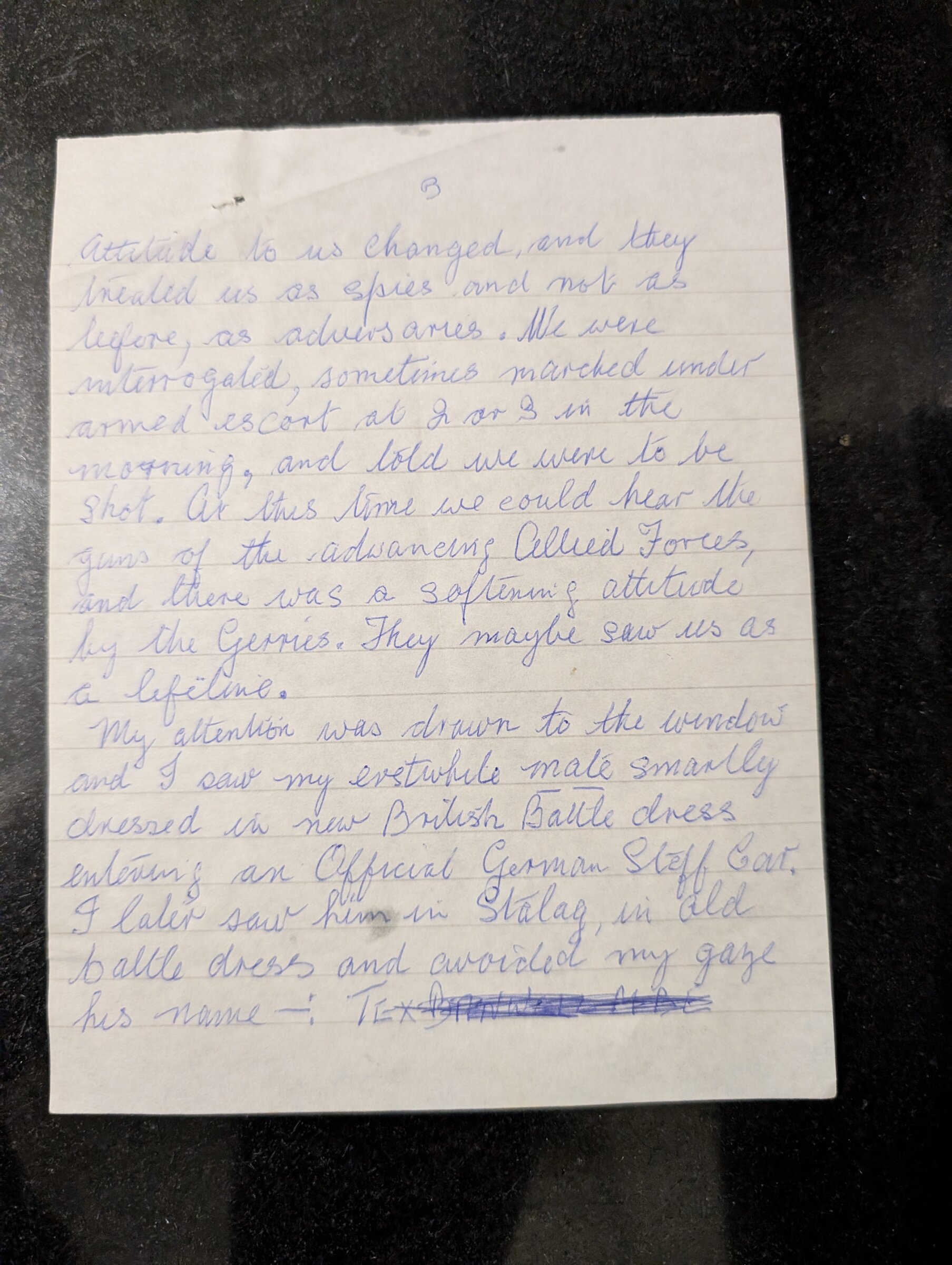
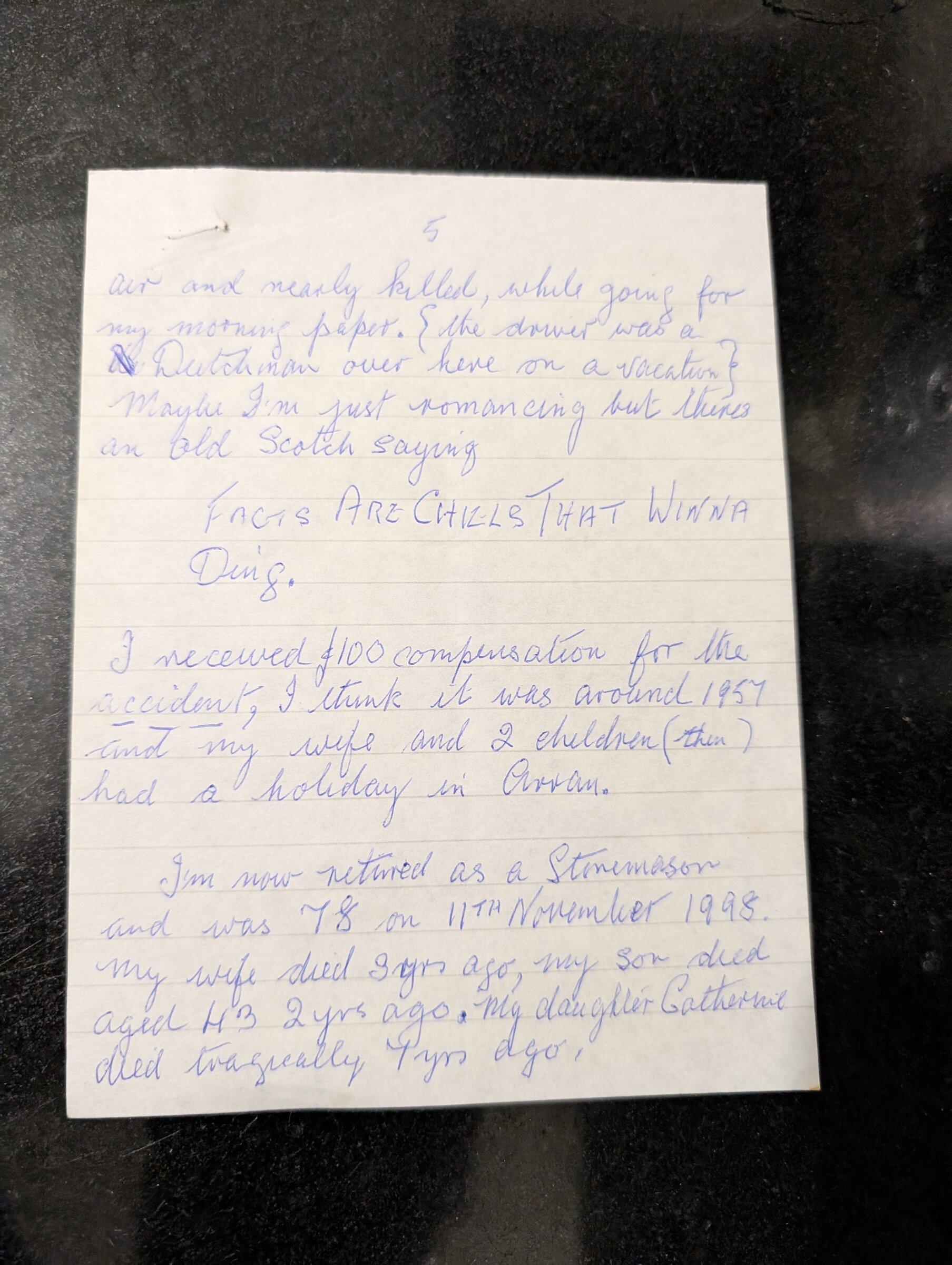
Link to the section What Murphy allegedIn the memoirs (ms; ms; p.4; p.5; p.6; typed pp.1–3; typed pp.4–6):
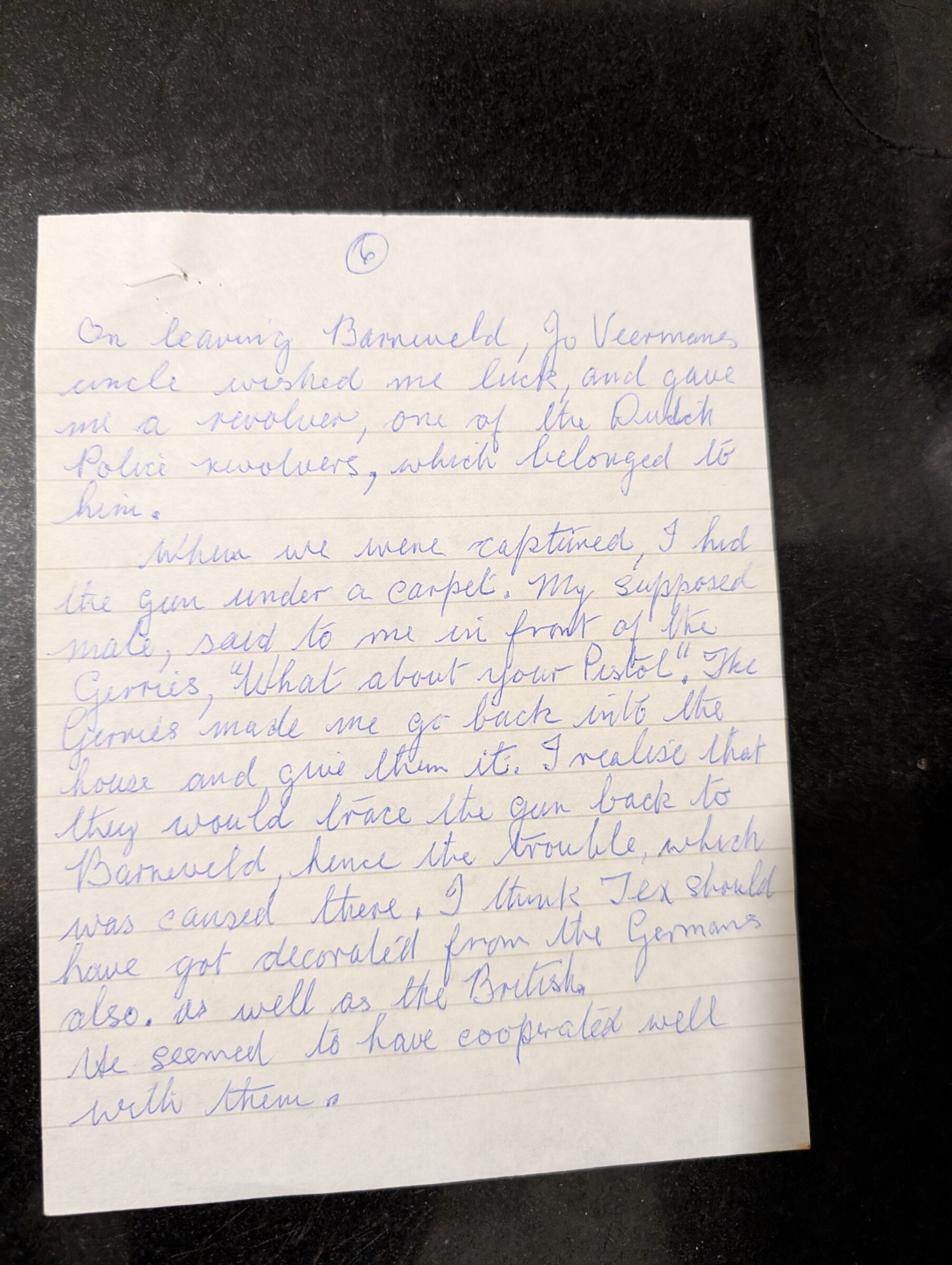
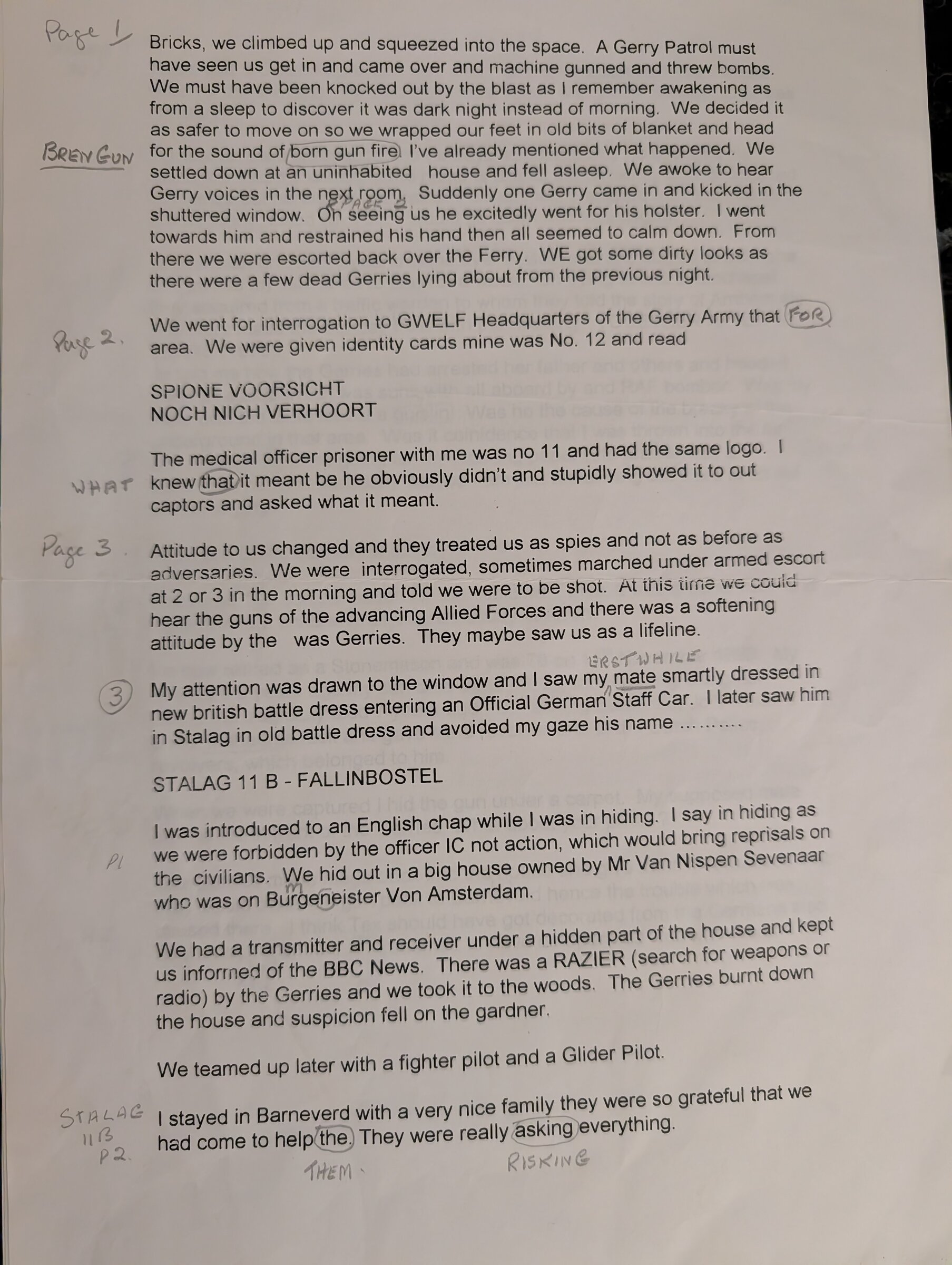
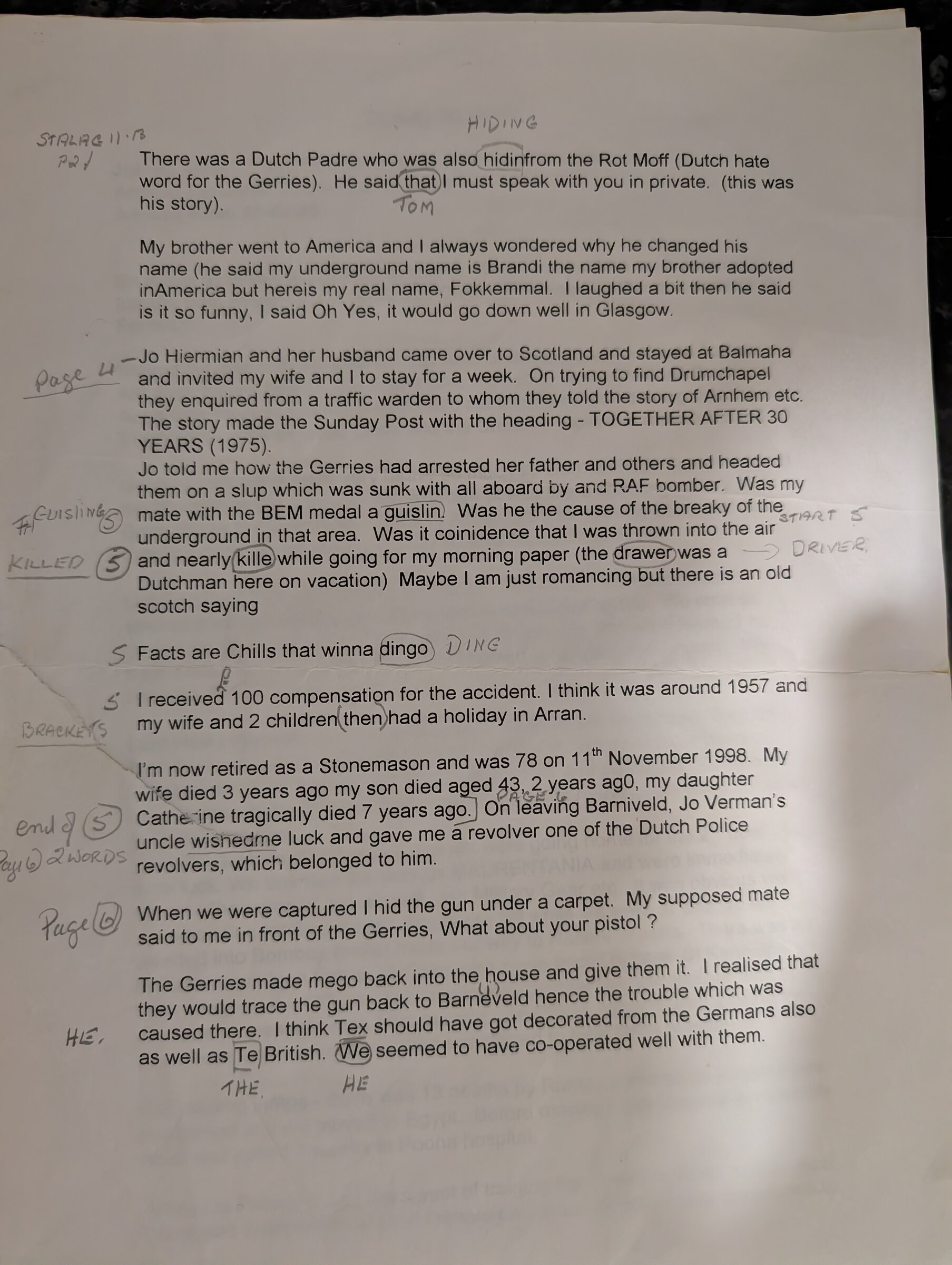
- That on recapture, "he told the Germans I had a gun, which was true", and, in front of the Germans, said "What about your pistol?", obliging Murphy to retrieve it from under the carpet.
- That the Germans would therefore trace the revolver back to Barneveld, "hence the trouble which was caused there".
- That "Banwell was a very suspicious customer"; that "because of the gun, my interrogation was more severe and threatening".
- That he saw the man "smartly dressed in new British Battle dress entering an Official German Staff Car", and "later saw him in Stalag in old battle dress and avoided my gaze".
- "I think Tex should have got decorated from the Germans also, as well as the British. He seemed to have cooperated well with them."
- And, as questions: "Was my mate with the B.E.M medal a quisling. Was he the cause of the breakup of the Underground in that area?"
- And, third, whether a road accident about 1957, the driver a Dutchman on holiday, was coincidence: "Was it coincidence, that I was thrown into the air and nearly killed, while going for my morning paper." (p.4; p.5; His account)
On one handwritten page (p.3) he wrote the name and scored it out; on another he headed the page with it. The quisling, the breakup and the accident he put as questions, under the heading "Questions Ive asked myself"; the rest he wrote as fact. After the questions he went on: "Maybe I'm just romancing but theres an old Scotch saying FACTS ARE CHIELS THAT WINNA DING" (p.4; p.5).
What the record says
Link to the section What the record saysAgainst the causal claim:
- Jacob Veerman was arrested by the SD on 24 February 1945, "wegens spionage diensten" (for espionage work) by one version of his family's form (p. 4) and for courier work by the other (p. 8), his daughter's courier work by the published account (Neuengamme; Jacob Veerman). None mentions a revolver.
- ⚠︎ Both versions of the family's form add that it later came to light that he had sheltered Allied men, "Waarschijnlijk is Hij hiervoor naar Duitsland gezonden" (probably that is why he was sent to Germany) (p. 8). How the Germans learned of it is not recorded, and nothing found connects it to the gun.
- ⚠︎ Murphy also says he "learned after the war that the Germans rounded up the Uncle and others, no doubt
through the connection to the Gun"; the Uncle, he says, was "Mr Veermans Brother, who was in the Dutch Police"
(ms). He gives no date. There was a
round-up, from December 1944, while he was in the Veerman house, and the Dutch record has it in
full (The December round-up):
- The round-up began on 15 December 1944, nineteen days before his capture, and went on after it, with arrests on 5 January 1945 (Huurdeman).
- The cause the Dutch record gives is the SD working back through Kirschen's abandoned SAS billets after the arrest of the RVV leader Jan Thijssen (Huurdeman).
- No Veerman was among those taken in it, so if "the Uncle" was a brother of Jacob's, as Murphy has it, this is not his arrest. Who the Uncle was is not known: Murphy has the revolver from a policeman brother of Mr Veerman's, Hardy's report of January 1945 from Jacob himself, and a son of Jacob's, in October 2026, from Jacob, who had fetched it from his brother Leen; ◐ probably Leen's (Jacob Veerman).
- ⚠︎ By an RTV Utrecht report of 2024, quoting his granddaughter, a brother of Jacob's was also held at Neuengamme; which brother, and when and why he was taken, is not said, and Jacob's grandson knows of no one in the family coming back from there (Jacob Veerman).
- ◐ The only dated arrest of Leen (Leendert Jan) Veerman in an archive note is 21 October 1943, a year before Murphy came, by one unsigned note of the Ede compilers that gives no cause; his Vught card also has a typed "arrestatie 3.1.44" that nothing explains (Leendert Jan Veerman).
- ✓ There were arrests that winter, and a house at Barneveld was raided before his capture: the Klooster house, on 8 December 1944, where Albert van Meerveld, ◐ very probably Noble's "Ape", was taken; he died at Wöbbelin on 14 March 1945 (Albert van Meerveld).
On the sighting:
- What became of Banwell after Velp is set out above. His own accounts of what followed do not agree with each other or with the dates:
- The three months at Auschwitz, until the Russians freed them, that he gave in 1969 (Algemeen Dagblad) cannot be right, since the Russians reached Auschwitz on 27 January 1945, 24 or 25 days after his capture (Wikipedia).
- A columnist who interviewed him in 1984 has "enkele weken" (a few weeks) there (Het Parool, 1994), and Het Vrije Volk's 1988 text says nothing of Auschwitz (1988).
- A short stay there is not confirmed by anything contemporary (Captured, January 1945).
- Murphy says he saw the staff car from a window while he was being interrogated, before the Stalag (ms p.3). Banwell's own account and the later ones (⚠︎) have him moved on from Velp for interrogation, and Heaps has a Gestapo escort drive him to an airfield near Apeldoorn (Heaps, pp. 196–197), though Heaps's date for it fails (above). Tiemens has him taken in clean civilian clothes. No record says what he wore when he left Velp.
Position
Link to the section PositionNothing found supports or refutes Banwell's remark about the pistol, or the staff car; that Murphy had a revolver at the crossing is in Hardy's report (Hardy). Noble's report, at second hand, can be read to put Banwell in Stalag XI-B, the camp Murphy's own notes name ("STALAG 11 B - FALLINBOSTEL"; Liberation), where Murphy says he saw him. Nothing found shows that Banwell worked with the Germans, and nothing contemporary shows what he said or how he was handled after his capture, beyond Noble's second-hand report that he was "sent back to Gestapo in Holland from Stalag XIB". The MI9 reports of 1945 have him with the resistance and trying to cross until the night he was taken; they say nothing of what followed. His own account, in the reporters' words (⚠︎), is that the Germans wanted to know who had hidden him (1969) and the names of the resistance (1988); Heaps, who wrote it up, has the Gestapo produce a dossier on him, and De Jong, without a source, has heavy interrogations at which he gave nothing away. No German record has been found. His liberation questionnaire, if it exists, and the German records of Velp, if any survive, would settle more.
✓ The Netherlands gave him its Resistance Memorial Cross (Verzetsherdenkingskruis): the register of its holders in the published Gedenkboek Verzetsherdenkingskruis of 1985 has "Banwell, Keith D. 08-10-1918" (the register, p. 70, checked on the image), a name and a birth date and nothing else. It was given on application: from 1981 nearly 19,000 people applied to the national committee, some were refused, and the resistance work each claimed was checked against the sources and witnesses' statements, with the Ministry of Defence supporting the committee (the Nationaal Archief's inventory). His own application file, with whatever witnesses vouched for him, should be among the granted files there; it has not been seen. Tiemens has it pinned on him by the burgomaster of Arnhem, J. Drijber, on 17 September 1982, and writes that of all his decorations it was the one he felt most honoured by (Tiemens). When, and whether he was the only British serviceman to have it, the sources disagree (below).
He was recommended for the British Empire Medal in the New Year honours of 1969 by his commanding officer in the 10th (Volunteer) Battalion, The Parachute Regiment, on 12 July 1968; his brigade commander added "An outstanding example to the Volunteers. Very strongly recommended", and the army commander "Very strongly recommended" (the recommendation, p. 2). The citation covers 1948 to 1968, at the White City, where he was the battalion's provost sergeant:
Sergeant BANWELL is the Regimental Police Sergeant who has served with the Territorial Army since the Parachute Battalions were formed in 1948. This Non Commissioned officer shows exceptional enthusiasm which, due to his personal standing and reputation, is felt throughout the Battalion. The Sergeant seldom misses any Drill Night Period in spite of a 40 mile drive each way and it is unusual for him to be absent from a Battalion weekend.
— 10th (Volunteer) Battalion, The Parachute Regiment · recommendation for the BEM, 12 July 1968 · The National Archives, Kew, WO 373/173/228 · the transcription
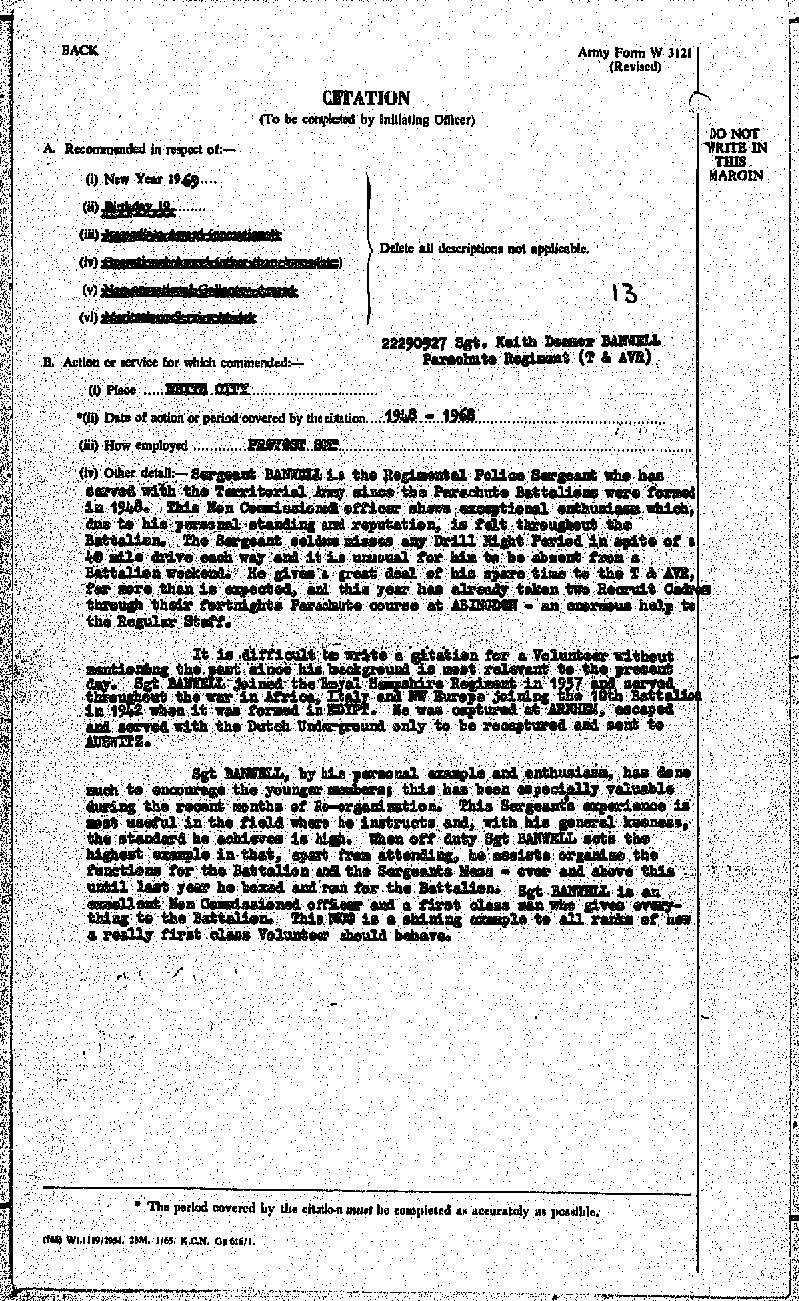
That year he had already taken two recruit cadres through their fortnight's parachute course at Abingdon, he helped run the battalion's and the sergeants' mess's functions, and "until last year he boxed and ran for the Battalion" (p. 3). Of his war it says that he "joined the Royal Hampshire Regiment in 1957 and served throughout the war in Africa, Italy and NW Europe joining the 10th Battalion in 1942 when it was formed in EGYPT" (p. 3). The medal was gazetted on 1 January 1969 (above).
◐ On 10 September 1963 a Dutch paper announced that five men of the 10th Battalion would jump on Ginkel Heath again on 18 September 1963 in memory of their comrades: "Het zijn de Britten Banwell, Berry, Small, G. en C. House" (Nieuwe Haarlemsche Courant, 10 September 1963; OCR only, surname only). He jumped on Ginkel Heath on Saturday 2 September 1967, one of two veterans of 1944, with Maj-Gen A. J. Deane-Drummond, in a detachment of thirty of the 10th Parachute Battalion under Lt-Col Stewart Richardson (Het Rotterdamsch Parool, 4 September 1967; the article checked against its image). ◐ The Times, previewing that anniversary from Arnhem, wrote that among the jumpers "will be the only Arnhem soldier still jumping, Mr. Tex Banwell, a General Post Office worker" (Peter Hopkirk, "Red Devils back at Arnhem after 25 years", 18 September 1969, p. 8; read through the Internet Archive's OCR only, the text). He jumped there again for the 25th anniversary in September 1969, his 519th jump, by the Algemeen Dagblad (15 September 1969) (his 650th, by the Pegasus Archive), in 1983, the 39th commemoration, he jumped in wind and rain with three members of the National Paracentre at Teuge, "de 64-jarige Londenaar" (Algemeen Dagblad, 19 September 1983; checked against the image), and in 1994, at 76, he was the only veteran to jump at the 50th, when the weather stopped the rest (Het Parool, 24 September 1994). ⚠︎ What he told a Dutch columnist in 1984 of his service before Arnhem, in India, Palestine and North Africa, on Crete in 1941, where he says he was questioned by the boxer Max Schmeling, and as Montgomery's double, is his own story (the same column).
In 1974 Leo Heaps, who had jumped from the prisoner train with him and Alan Kettley, put appeals in the Dutch papers for the people who had helped them; ◐ by the timing, he was gathering material for The Grey Goose of Arnhem (1976). The first, in De Telegraaf, was for the helpers of any of the paratroopers:
Survivors of the airborne troops, Arnhem, September 1944. Would those who hid the surviving British paratroopers after the Battle of Arnhem in 1944, or helped them in any way, please contact the undersigned. This is urgent. Leo J. Heaps, Duke St. House, 415 Oxford St., London W1, England.
Dutch originalOverlevenden van de luchttroepen Arnhem September 1944. Willen diegenen die de overlevende Britse parachutisten na de Slag om Arnhem in 1944 hebben laten onderduiken of op enige manier geholpen hebben, contact opnemen met ondergetekende. Dit is dringend. Leo J. Heaps, Duke St. House, 415 Oxford St., London W1, England.
— Leo Heaps · advertisement, De Telegraaf · 17 April 1974, p. 10 · the transcription
On 4 June 1974 the local paper at Barneveld carried a second, naming Banwell. Its second point names only Heaps and Kettley, which fits Heaps's book, where he and Kettley went south on 1 October and left Banwell behind with the resistance (Heaps, p. 127):
APPEAL. Lieutenant Heaps seeks contact with those who: 1. gave help or shelter to him, Tex Banwell and Sgt. Kettley in the Garderen area on their escape from captivity after the landing at Arnhem in Sept./Oct. 1944; 2. housed him and Kettley on a farm between Barneveld and Scherpenzeel. Telephone / address: 03490-26371.
Dutch originalOPROEP. Luitenant Heaps zoekt contact met degenen, die: 1. Hem, Tex Banwell en Sgt. Kettley op hun vlucht uit gevangenschap na de landing bij Arnhem in sept./okt. 1944 in de omgeving van Garderen hulp resp. onderdak boden. 2. Hem en Kettley huisvestten op een boerderij tussen Barneveld en Scherpenzeel. TEL. ADRES: 03490-26371.
— Leo Heaps · advertisement, Barneveldse Krant · 4 June 1974, p. 6 · the transcription
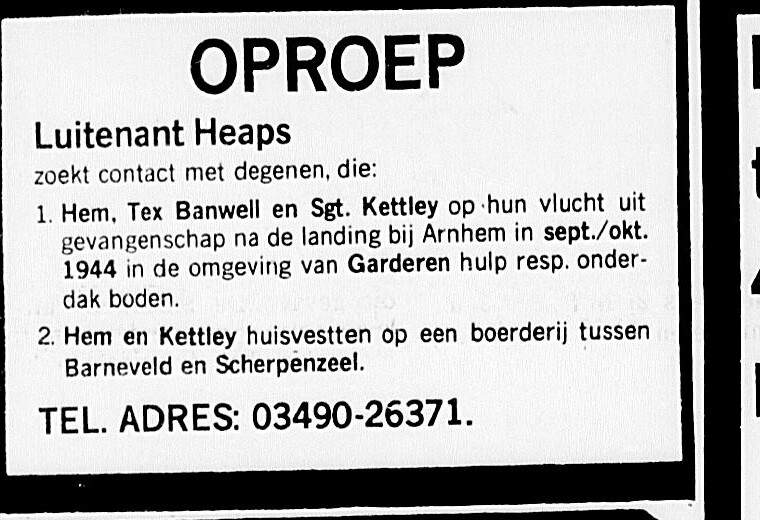
The number in the Barneveld notice was a Dutch line, not Heaps's own (the Telegraaf gave his London address); whose it was is not stated. A search of the Dutch papers online for 1973 to 1977 found neither notice printed a second time (the search log), and what answers Heaps had is not known.
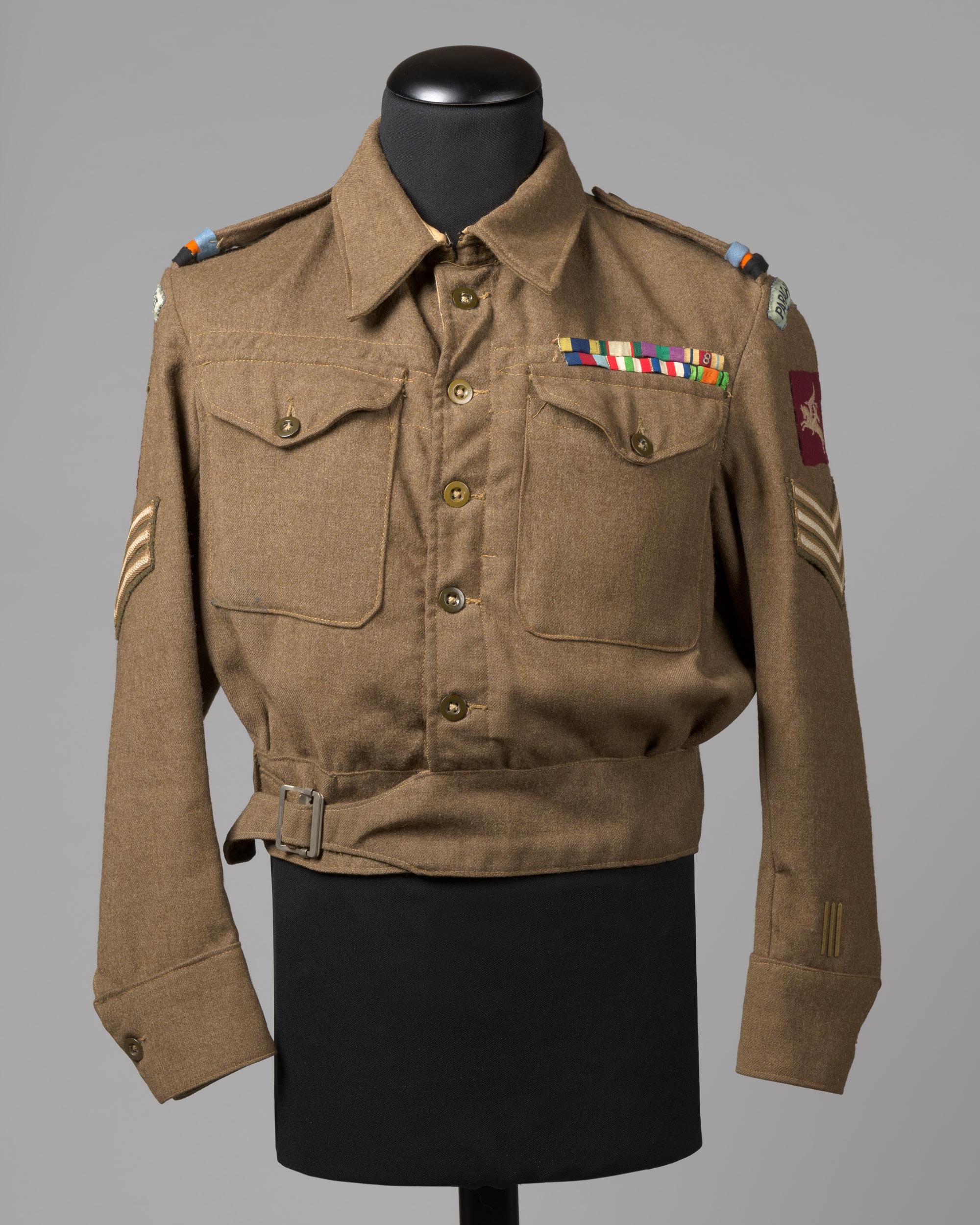
◐ In later life, by search snippets only: The Guardian of 4 November 1978 has "TEX BANWELL, Special Constable, started his work as a Post Office maintenance man in North London at midnight on Tuesday" (the snippet), which fits the Post Office job of 1969 above and the special constabulary in the Oxford Dictionary of National Biography (the entry). The ODNB has his thousandth parachute jump at Arnhem on the battle's fortieth anniversary and another on the fiftieth. John Parker's The Paras (2000) has him, "at 81", at the London parade "to see the 10th off" in his wheelchair, "having made his last parachute jump just four years earlier" (the snippets).
Banwell died in 1999; his ashes are in the Airborne Cemetery at Oosterbeek, his battledress jacket and medals are displayed at the Airborne Museum Hartenstein, and he was survived by three children (Wikipedia).
Where the sources disagree
Link to the section Where the sources disagreeWhen he was born and died. ⚠︎ The day, 8 October, is agreed; the year is not. 1918: the register of the Resistance Memorial Cross (the register), Tiemens (Tiemens, who also puts the birth abroad, "in Australië ter wereld", born in Australia, against the Airborne Museum's Saffron Walden and the Oxford Dictionary of National Biography's Wenden Lofts, below) and the Oxford Dictionary of National Biography (below). 1917: the Pegasus Archive's page on him ("Born on the 8th October 1917", Pegasus Archive). Wikipedia gives 8 October 1917 to 25 July 1999 (Wikipedia), and so does the Airborne Museum's record, born at Saffron Walden and died at Enfield (the museum's record); the Pegasus Archive has him die "in 1998" (Pegasus Archive); the Daily Telegraph's obituary of 23 August 1999, read on the cutting, has "born on October 8 1917" and "aged 81", with no date of death (the cutting); a Telegraph notice seen only in the Internet Archive's search index has "July 28 1999, aged 81", and the New York Times has him dead "at 80" (the index hits). ◐ The Oxford Dictionary of National Biography (2004), whose entry is by Philip Warner and cites private information from his family, has him born on 8 October 1918 at Pond Street, Wenden Lofts, Newport, Essex, and dead on 25 July 1999 at Chase Farm Hospital, Enfield, buried in north London on 3 August (the entry; search snippets only, the volume is lending-only). ⚠︎ Algemeen Dagblad called him "64-jarige" in September 1983, which fits 8 October 1918 and not 1917 (AD). ⚠︎ Het Parool of 24 September 1994 called him "de 76-jarige Tex Banwell", which fits 8 October 1917 and not 1918 (Het Parool); the two ages point opposite ways. The Oxford Dictionary of National Biography entry lists "b. cert. - m. cert. … - d. cert." among its sources (the entry), the register's "08-10-1918" is printed on the image, and the New York Times's "at 80" fits 1918 as well, so 1918 is the better-supported year; the GRO birth index (Saffron Walden district, December quarter 1918) would settle it. The ODNB's death certificate also backs 25 July over the Telegraph notice's 28 July. The Pegasus Archive and the Daily Telegraph's obituary both have him jump again at the 50th anniversary in 1994 "at the age of 77" (Pegasus Archive; the cutting), which fits neither year: before his birthday in October 1994 he was 76 on the 1917 reading and 75 on the 1918.
When he joined the army, and where he served. His BEM recommendation of 1968 has him join "the Royal Hampshire Regiment in 1957" and serve "throughout the war in Africa, Italy and NW Europe", joining the 10th Battalion in Egypt in 1942 (the recommendation, p. 3); 1957 is typed so, and cannot be right beside "throughout the war". Wikipedia has him join the Coldstream Guards in 1936 and later move to the Hampshire Regiment, and serve in India, Palestine and Egypt, the Commandos and the Long Range Desert Group, with no Italy (Wikipedia). Heaps and Tiemens have him join the Coldstream Guards in 1931, at thirteen by Tiemens (Heaps; Tiemens); Het Vrije Volk has him fight in North Africa and Sicily (Het Vrije Volk). ⚠︎ The 1961 reunion report goes furthest: "De Duitsers namen Banwell gevangen op Kreta, te Tobroek, in Italië en bij Arnhem. Telkenmale slaagde hij er in te ontsnappen" (the Germans took Banwell prisoner on Crete, at Tobruk, in Italy and near Arnhem; each time he managed to escape) (Nieuwsblad van het Noorden, 9 September 1961, read on the image). No record of his service puts him on Crete or at Tobruk, or a prisoner before Arnhem, but the later accounts tell the same story without giving a source for it: Heaps has "captivity in Tobruk, escape in a half-track, later imprisonment in Crete as a Commando" (Heaps), and the Daily Telegraph's obituary has him "captured in a raid on Tobruk" with the Long Range Desert Group, escaping in a stolen German vehicle, and taken prisoner at Heraklion "during a subsequent raid on Crete" (the cutting), as do the Oxford Dictionary of National Biography (the entry, search snippets only), the Pegasus Archive (Pegasus Archive), Wikipedia (Wikipedia) and the Airborne Museum's note (Gelders Archief). Only the 1961 report has him taken in Italy. Whether the 1961 words were his or the paper's is not known.
When he was taken. Heaps has 21 November 1944 at Wageningen; De Jong has him taken on Pegasus II, 17/18 November, with no source (deel 10b, p. 553); the 1945 reports and his own accounts of 1969 and 1988 have January 1945 (above). ✗ De Jong's and Heaps's dates both fail against the 1945 reports.
Whether he was in Putten that day. The Pegasus Archive's compiler says he had no knowledge of the reprisal until after the war; Kessel has him telling it at De Ruif, and De Jong has him at Enny's Hoeve on 1 October, while the news came in (above). ◐ De Jong names him there only in the list of who was present.
Where he was on Pegasus II. Hardy's report of January 1945 has him on a bicycle with Murphy, losing the party at the fork with Hardy's group (Hardy); Heaps has him "Not far behind Maguire … carrying a Sten gun", acting as a mobile patrol for the main column (Heaps, p. 193).
Why he did not swim the Rhine. The Pegasus Archive has him and Lashmore strip and try, and turn back when the current proved too strong (Pegasus Archive); Het Vrije Volk in 1988 has an arm stiff with blood poisoning make it impossible for him to swim (Het Vrije Volk), and Tiemens has his wounded finger so infected that he could hardly use the arm, so that he did not try (Tiemens).
The Resistance Memorial Cross. Tiemens dates it 17 September 1982 and calls him the only British serviceman to receive it (Tiemens); Wikipedia has 1982 and "one of very few" (Wikipedia); the register cannot settle it, since it gives no nationality or date; the Daily Telegraph's obituary has "in 1992 the Netherlands Silver Cross" (the cutting), as do the Oxford Dictionary of National Biography ("the Netherlands silver cross for services to Dutch resistance in 1992", the entry) and the Pegasus Archive (Pegasus Archive), and the Airborne Museum's note has it "26 jaar later" than a British Empire Medal it dates to 1966 (Gelders Archief); the BEM was gazetted in 1969 (above).