Piet Veenendaal
Leusden 20 Dec 1908 – Hamburg-Neuengamme 27 Feb 1945
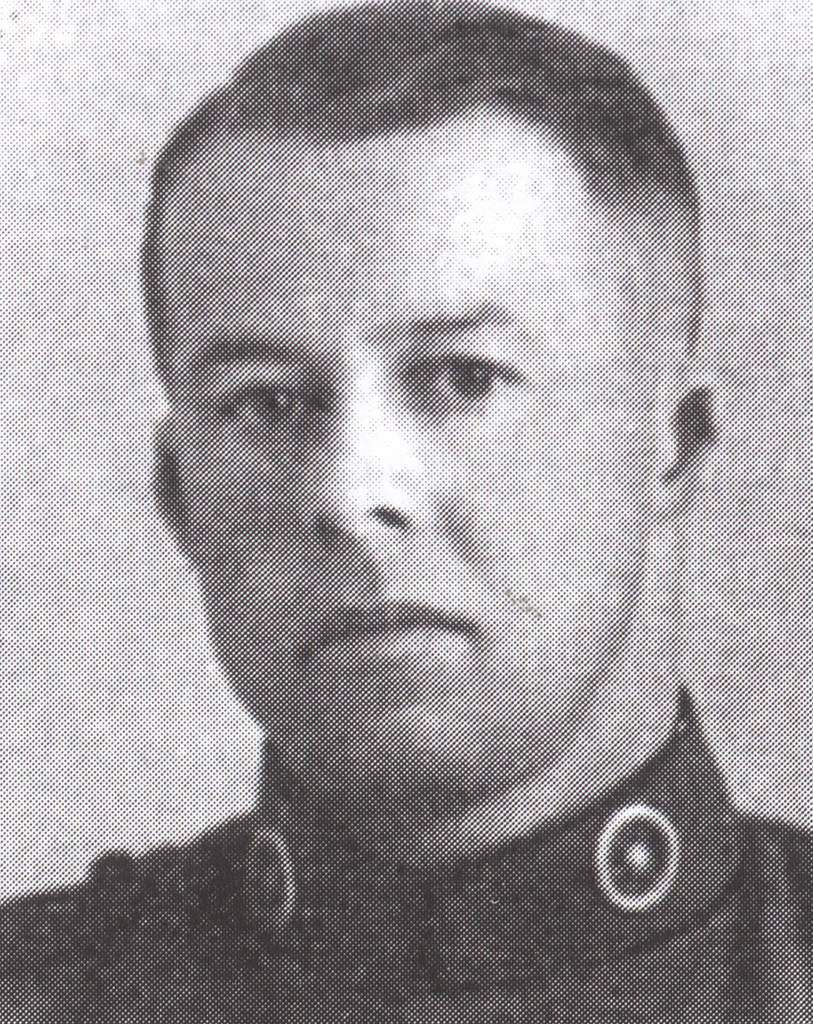
Pieter "Piet" VEENENDAAL, "Bart", Kamp Amersfoort prisoner 10593 (his Amersfoort card)
About: A farmer of Scherpenzeel and a district commander of the R.V.V., resistance name "Bart", whose chain, ◐ by the helpers' forms (none gives a first name), passed Allied evaders on, among them Charles Noble and Tex Banwell, later in the party fired on near Opheusden on 2/3 January 1945, ◐ with Murphy. The SD raid on his farm on 15 December 1944 was the first of the arrests Huurdeman lists in the round-up that followed Kirschen's billets, through the villages round Achterveld while Murphy was hidden there, and he died at Neuengamme on 27 February 1945.
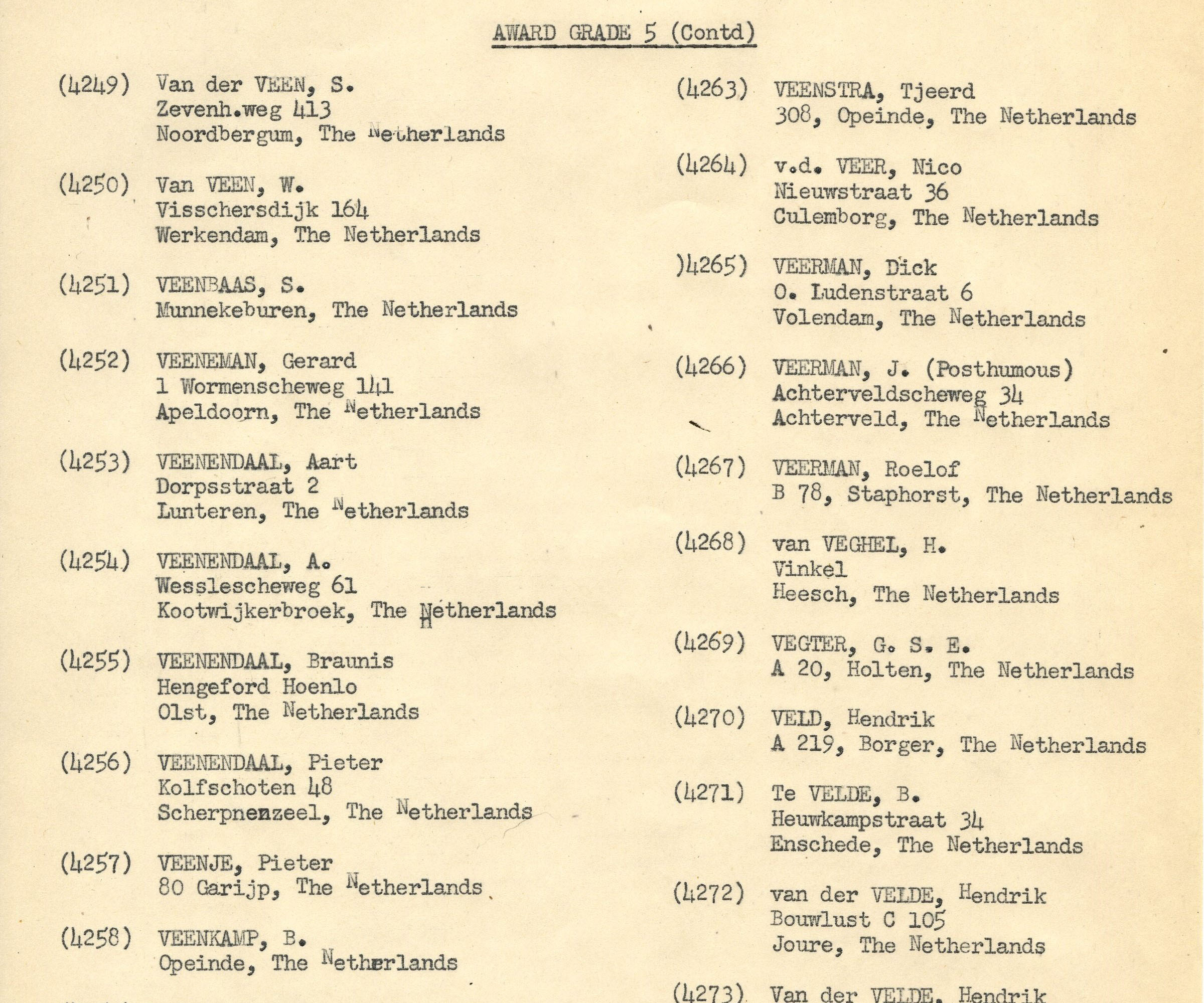
Unit or role: The R.V.V.: "district-troupscommander" in R. van Ginkel's note in the Americans' file, his army rank soldier (his file, pp. 3–4); "commandant RVV" in Huurdeman's list of the dead (Huurdeman); in the group of Rijk van Ginkel (Peter van Scherpenzeel) by Boeree (Oud Scherpenzeel, 2020, p. 18). On the British index of Dutch helpers as certificate 22228, grade "5 (Posth.)" (the index page), and on the Americans' list of Grade 5 certificates as no. 4256 (the list, p. 162).
Where: Kolfschoten B 48, Scherpenzeel, a farm a little outside the village (the Amersfoort card; Oud Scherpenzeel, p. 20); "landbouwer te de Glindhorst" in the In Memoriam of 1945 (Digitaal Monument Neuengamme). Born at Leusden. Held at the Willem III barracks at Apeldoorn, Kamp Amersfoort and Neuengamme.
Evidence: ✓ his helper file with the Americans, US National Archives 286712861 (pp. 2–6); ✓ the camp files (Amersfoort card, Neuengamme card, German death certificate); ✓ the Dutch Red Cross's list of Dutch dead in Kreis Hamburg (Nationaal Archief 2.19.323, inv. 521); ✓ the War Graves Foundation's file; ✓ the British helper index; Huurdeman; Digitaal Monument Neuengamme; ◐ Oud Scherpenzeel, March 2020, pp. 17–21, from T. A. Boeree's post-war manuscript; ◐ Baron van Lynden's helper file (US National Archives 286708726); ◐ the Landelijke Organisatie's In Memoriam, 20 October 1945 and Van der Fange's diary in the Telegraaf, 1994 (OCR only).
Family and farm
Link to the section Family and farmPieter Veenendaal was born at Leusden on 20 December 1908, the son of Johannes Veenendaal, a farmer, and Neeltje van de Burgt, who died in 1936; he moved from Leusden to Scherpenzeel on 4 April 1935, was a farmer, Reformed (Gereformeerd), and married to Geertje Jacoba van Leyenhorst, with two children (the Foundation's file, scans 1, 2, 4 and 12). His German death certificate spells his mother "Neeltje geborene van de Burcht" and his wife "Geertje geborene van Leijenhorst" (the certificate, read on the image). ✓ Their banns were printed in the Utrechtsche courant of 29 March 1935, under Hamersveld: "Ondertrouwd: Pieter Veenendaal en Geertje Jacoba van Leijenhorst" (the column, read on the page image; the same page prints it again, abridged, as "R. Veenendaal en G. v. Leyenhorst"). He married her at Leusden on 4 April 1935, when he was 26 and she, born at Valburg, 23 (the marriage, index only). The questionnaire in his name for the Americans, dated 3 July 1945, gives Kolfschoten B 48, Scherpenzeel, his birth date, a wife of 35, two children of eight and one, and the R.V.V. (p. 4).
His resistance name was "Bart". The farm stood at Kolfschoten by Scherpenzeel, across the road from Bart van Ginkel's on the Kolfschoterdijk, an outlying farm with an underground hiding place for weapons and a radio, where the local resistance met about arms drops and where people in hiding and Allied airmen and paratroopers came and went on their way south (Oud Scherpenzeel, 2020, pp. 17–18, from Boeree's post-war manuscript, ◐ a later account). The same magazine calls him the contact man between the national organisation and the local R.V.V. group (p. 7).
◐ "Bart" in a diary of September 1944. Huib van der Fange, a young onderduiker at the Rudolphstichting (which the article puts vlak onder Achterveld, just below Achterveld) and deputy commander of the Neder-Veluwe district of the Binnenlandse Strijdkrachten, kept a diary that the Telegraaf printed in part in 1994. For 24 September 1944, after a night at the youth hostel at Putten, it has "We brengen verslag uit bij Bart (Piet Veenendaal)" (we report to Bart (Piet Veenendaal)); the diary of the same day lists the members of Van der Fange's team, among them Fokke Dijkstra and "Barends", whom the article glosses as Jan Dijkstra (De Telegraaf, 17 September 1994, "Een oude truc"; OCR only; the names in brackets, Piet Veenendaal's too, are the article's, not the diary's, so this is ◐). The Mededeelingen of the Landelijke Organisatie of 20 October 1945 head their In Memoriam "„BART", signed PETER, with "Pieter Veenendaal, geb. 20-12-1908 overleden 15-2-1945, Neuengamme" beneath (the issue), and the questionnaire in his name has "Bart" as the name the Allied men knew him by, the reading marked uncertain in the transcript (p. 4).
Captain King, September 1944
Link to the section Captain King, September 1944Gilbert Kirschen's Belgian SAS team, "Captain King", was dropped in the night of 14 to 15 September 1944 and taken in by the R.V.V.; "Met de zijnen werd hij ondergebracht in een boerderij te Scherpenzeel" (he and his men were put up at a farm at Scherpenzeel) (De Jong, deel 10a, p. 331). By Huurdeman the team was at two addresses in De Glind and Scherpenzeel from 15 September to 5 November 1944, and after the arrest of Jan Thijssen the SD got hold of "de voormalig verblijfplaats van Kirschen op het adres van Piet Veenendaal" (Kirschen's former lodging at Piet Veenendaal's address) (Huurdeman).
◐ A typed sheet in the American file of Baron Diederik Jan van Lynden, "Arend", of the R.V.V., says Arend was posted by Roelof as a courier near the dropping zone where King was to land, to tell Roelof at once when he arrived, and: "Together with Roelof he took King by car to Piet Veenendaal and collected afterwards his luggage" (the sheet, p. 8, read on the image; the form of 3 July 1945, p. 6). The sheet gives no date and no place; its "Piet Veenendaal" is read as this man by the name and by Huurdeman's billet. Heaps has Roelof van Valkenburg as Kirschen's liaison (Heaps, p. 25). Kirschen's own story is on his page.
◐ Boeree's Kroniek van Ede has, after the request of 19 September that Wuf Lagerweij give up the improvised villa on his farm to evacuees, a visit to Lagerweij from "Bart, een van de ondergrondsche vrienden" (Bart, one of the underground friends), who asked for the loan of a motorbike and "zocht ook plaats voor een paar lui met een zendertje" (also looked for a place for a couple of men with a little transmitter); King moved into the villa that night (Kroniek van Ede, 1947, pp. 157–158; OCR only). The book gives no surname, so ◐ "Bart" is Piet Veenendaal by the resistance name alone. Wuf Lagerweij's farm was the team's other billet.
The men he passed on
Link to the section The men he passed onR. van Ginkel wrote in a note in the file the Americans kept on him:
Veenendaal did as district-troupscommander a great deal for the Allied personnel. He sheltered them and looked after them. He is captured on the 15th December 1944 and died in the camp Neu-Gammen. His house was burnt down.
— US National Archives · RG 498, helper file of P. Veenendaal · note by R. van Ginkel · the archive's copy
The names of the men he sheltered were not known, but the case was "authenticated" (p. 2).
Three other helpers' files name a "P. Veenendaal" (◐ this man, as the paragraph after the list says) as the man they received Allied men from, and Van Ginkel's own form names a "Widow Veenendaal":
- ◐ Boke Dijkstra of Postweg 35, De Glindhorst, "recieved them from P. Veenendaal" (the initial is faint on the slip), who "also attended to the sending on", 13 men for three days to two months (the slip, p. 3; Boke Dijkstra).
- ✓ Samuel de Zoete of Postweg 27, De Glindhorst, sheltered "two pilots- 5 days. Recieved from P. Veenendaal and by the latter further transported" (Van Ginkel's slip, image-checked).
- ✓ W. Veldhuizen of Gooswilligen, Scherpenzeel, lists six men received from and passed on to "P. Veenendaal", among them Noble and Banwell (below, With Murphy).
- ✓ Rijk van Ginkel, his group commander, wrote in section 11 of his own form of 15 January 1946, among the people he knew who had helped, "Widow Veenendaal", with Veldhuizen, "S. de Zoete" and "Dijkstra" (Van Ginkel's form, p. 13, image-checked).
◐ The "P. Veenendaal" and the "Widow Veenendaal" of these forms are read as Piet and his widow Geertje Jacoba: the surname, the initial, the district and Van Ginkel's group fit, but no form gives a first name. The Oorlogsgravenstichting's page has the In Memoriam from the C.B.-L.O. bulletin of 20 October 1945 (no. 65, by its account), signed Peter, ◐ probably Rijk van Ginkel. The wording below follows the printed issue as Delpher gives it (OCR only); the Neuengamme memorial's copy has verbleef where the issue has bleef steeds:
Many people in hiding were looked after by him, and many ration cards and sums of money passed through his hands. He did his work carefully and dutifully, and always stayed at his post. His brave conduct was a shining example to the groups under him. […] He suffered severe bodily pain for the sake of his fellow fighters. But he kept silent, though not about his faith in his Saviour Jesus Christ.
Dutch originalVeel onderduikers zijn door hem verzorgd, veel bonkaarten en gelden zijn door zijn handen gegaan. Nauwgezet en plichtsgetrouw vervulde hij zijn werk, en bleef steeds op zijn post. Zijn moedig optreden was een lichtend voorbeeld voor de onder hem gestelde groepen. […] Zwaar lichamelijk lijden heeft hij terwille van zijn medestrijders moeten verduren. Doch hij heeft gezwegen, echter niet van zijn geloof in zijn Verlosser Jezus Christus.
— Mededeelingen van C.B.-L.O. · In memoriam signed Peter · 20 October 1945 · the issue, Delpher OCR
With Murphy
Link to the section With MurphyNo source puts Murphy himself in Veenendaal's hands, and Murphy is on none of the tables that name Veenendaal. His chain, ◐ if the "P. Veenendaal" of the forms is he (above), carried men of Murphy's own party and men of the party fired on with him. ✓ W. Veldhuizen of Gooswilligen, Scherpenzeel, lists six men received from and passed on to "P. Veenendaal": "Noble Ch.B. Capt" (21 days), "Barnwell K.D." (50), "Davison L." (28), "Moore F.V." (28) and two RCAF airmen (7 each) (Veldhuizen's table, p. 3, image-checked). Tex Banwell was with Murphy in October and November 1944 and in the party fired on near Opheusden on 2/3 January 1945, ◐ with him and Charles Noble (how each was taken is told many ways, on Banwell's page); Leslie Davison cycled with Murphy on 25 November; Victor Moore was in the same party of about twenty on the night of Pegasus II. The days are what Veldhuizen entered under aantal dagen (number of days); Rijk van Ginkel calls Veldhuizen's house the transit-house, where pilots stayed one or two days and sometimes about two weeks (Van Ginkel's form, p. 13), and the days do not fit Noble's own dates (Noble's page).
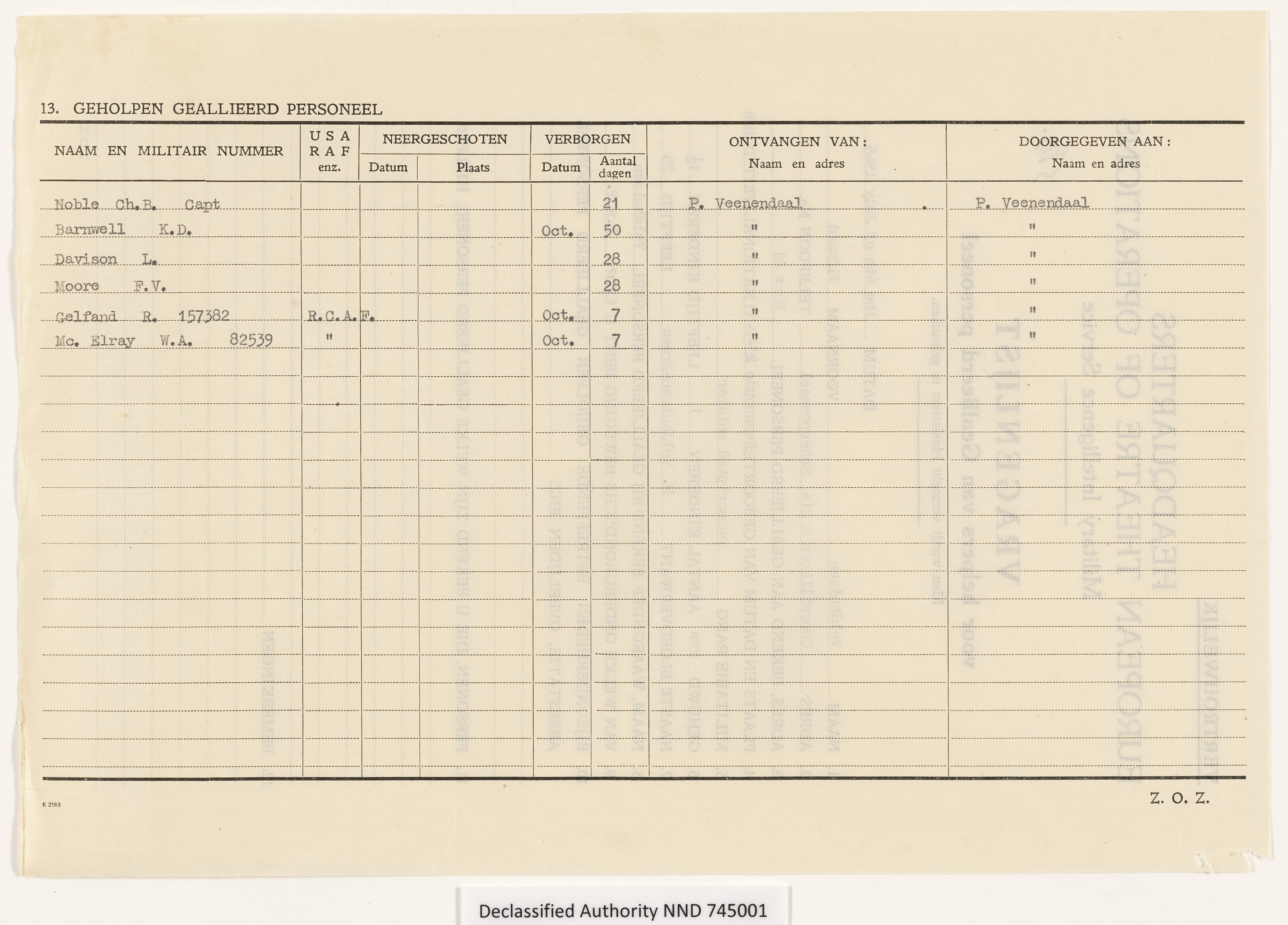
The SD's raid on his farm on 15 December 1944 was the first raid listed in the round-up that went on through the villages round Achterveld into January 1945, its first raids while Murphy was hidden at the Veerman farm (The December round-up, below).
The raid of 15 December 1944
Link to the section The raid of 15 December 1944◐ Boeree's account, as Oud Scherpenzeel abridged it in 2020 under the heading "Het verraad van Juffrouw X", has a young woman, an evacuee from Wageningen who had been lodged with the Van Ginkels across the road and then worked at the Hotel de Prins, tell a German billeted there, Heinz Wiesener, what she had picked up about the resistance; Wiesener reported it to the Ortskommandant, who passed it to the SD at Apeldoorn. The account does not name her, and neither does this page (Oud Scherpenzeel, 2020, pp. 17–19).
On 15 December 1944 six SD men came from Apeldoorn and were met at Scherpenzeel by Wiesener and Wehrmacht soldiers, to search the farm for weapons, ammunition, explosives and transmitters. Veenendaal and his wife saw them coming and took it for a raid for men in hiding; Boot, a resistance man in hiding there, and the two Lammers cousins went to their hiding places. The SD tied Veenendaal to a post with copper wire, hands over his head, and beat him; the hiding place under the haystack gave up Boot. The farm was stripped of food, clothes, 3,000 guilders, horses and cattle. Veenendaal was taken away by car. When his wife warned the Lammers cousins to run, one was shot and beaten to death, the other was caught in the wire and arrested. Fokke Dijkstra, who had been at the farm at eight that morning and left, was stopped near it with secret post and taken too (Oud Scherpenzeel, pp. 19–20). A search found weapons and a walkie-talkie there (same, p. 7).
Huurdeman has Veenendaal and Dijkstra beaten and all of them taken to the Willem III barracks at Apeldoorn, and the dead man in hiding as the namesake cousin of the Hermanus Lammers who was arrested (Huurdeman). On 19 December the SD took him, "hevig bloedende" (bleeding heavily), to the Verhoef farm on the Klettersteeg, to look for the man in hiding there, Joop Rothuizen, whose name he had given "Onder zware druk" (under heavy pressure) (Huurdeman; more on the raid on Cornelis Verhoef's page). On 20 December the Germans came back, put the house to the fire and threw grenades into it (Oud Scherpenzeel, p. 20); the Americans' note says "His house was burnt down" (his file).
◐ Fokke's brother Jan Dijkstra, who got away, told it in 2014, seventy years on:
My little brother was taken in a raid just behind the Stichting, at Piet Veenendaal's, a farmer who was the leader of the resistance, a former soldier. That business was rolled up and Wim Boersma and I managed to get away, but my brother had just been to Scherpenzeel with post for the resistance, and how exactly he was taken, nobody knows.
Dutch originalMijn broertje is bij een razzia opgepakt, net achter de stichting bij Piet Veenendaal, een boer die de leider was van het verzet, een oud militair. Die zaak werd opgerold en Wim Boersma en ik wisten te ontsnappen, maar mijn broertje was net met post voor het verzet naar Scherpenzeel geweest en hoe hij precies is opgepakt, weet niemand.
— Jan Dijkstra · his account · 2014, p. 3 · the text
He goes on that Fokke was brought to the farm "en daar is hij gemarteld" (and there he was tortured), and that "Twee neefjes van Piet Veenendaal probeerden ook te vluchten en één van hen is dood geschoten" (two of Piet Veenendaal's neefjes, nephews or cousins, tried to run too, and one of them was shot dead) (the same account, p. 3).
The December round-up
Link to the section The December round-upAfter Kirschen's billets the SD arrested its way through the villages round Achterveld from December into January. Murphy was at the Veerman house at Klein Achterveld from about 25 November to 23 December 1944 (Jacob Veerman), so the raids of 15 and 19 December fell during his stay and those of 31 December and 5 January after he had left. Huurdeman's history gives the cause and the order. Capt. Charles Noble, another Arnhem evader, was hidden at Achterveld itself in early December.
- What set it off. Kirschen's Belgian SAS team, "Captain King", had been billeted at De Glind and Scherpenzeel from 15 September to 5 November 1944. After the SD arrested the RVV leader Jan Thijssen they got hold of the old billet in December, and "Hoewel het SAS-team al meer dan een maand weg was voerde de SD diverse arrestaties uit" (although the SAS team had been gone more than a month, the SD carried out a series of arrests) (Huurdeman, Ondergronds in de Tweede Wereldoorlog, via the Oorlogsgravenstichting).
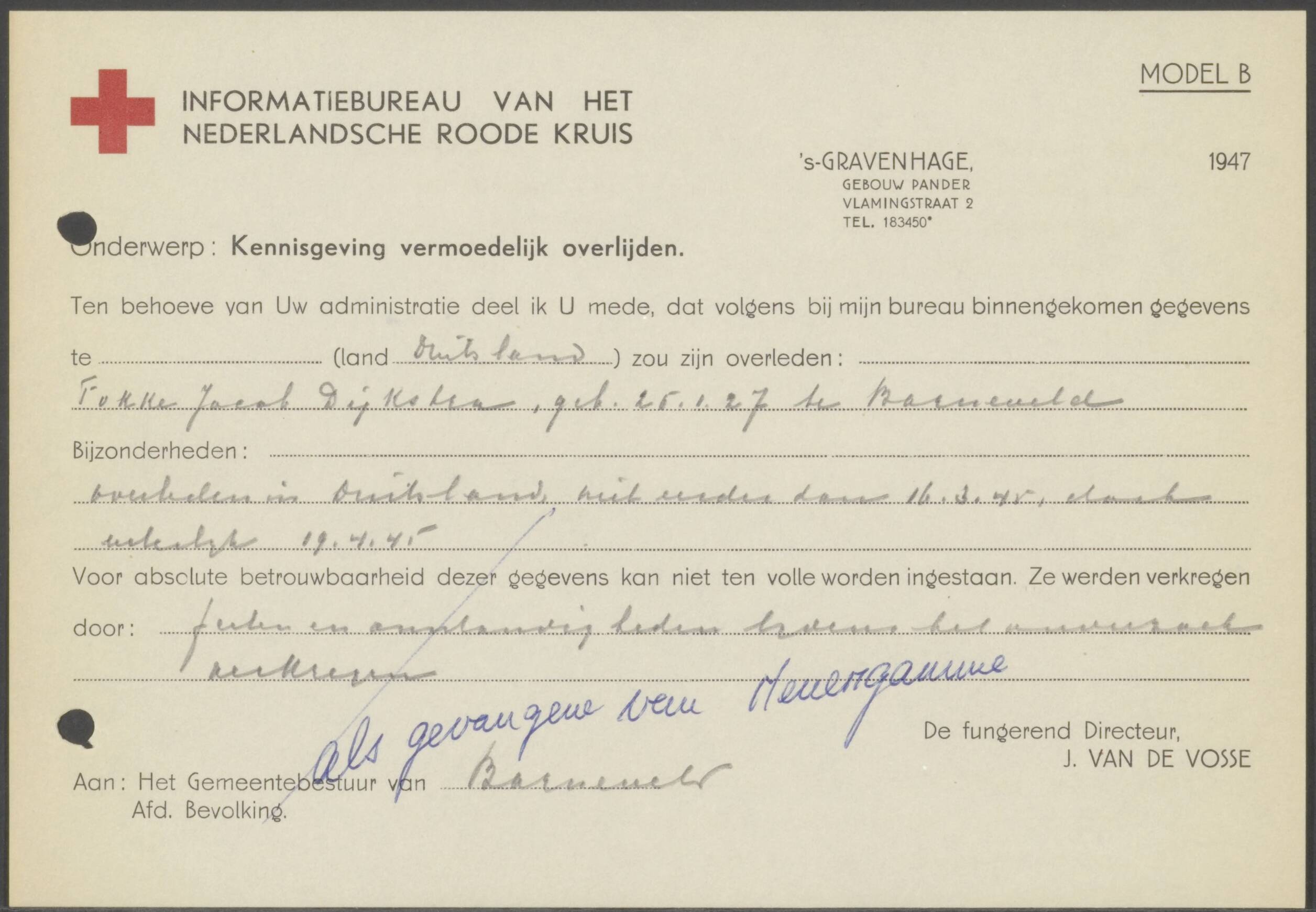
- 15 December 1944, Veenendaal's farm at Scherpenzeel, where they took, among others, a seventeen-year-old courier (born 25 January 1927, by the Red Cross notice), Fokke Dijkstra (⚠︎ in or near the farm: his page), "die de pech had als koerier daar op het verkeerde moment te zijn" (who had the bad luck, as a courier, to be there at the wrong moment), and beat him and Veenendaal badly; both were taken to the Willem III barracks at Apeldoorn (Huurdeman).
- 19 December, on a name forced out of Veenendaal: the Verhoef farm on the Klettersteeg at Achterveld, where the SD took every young man in the house, the sons Jan and Johan among them, with Jan Rothuizen, and across the road Laurens Liezenberg (Huurdeman; more on Cornelis Verhoef's page).
- 31 December (⚠︎ 5 January 1945 in three other records: Hendrik van de Kuilen), the farm Hardeveld on the Postweg at Leusden, the team's other billet: two farmhands, Gerrit Kamphorst and Hendrik van de Kuilen, and the maid; the farm was Wuf Lagerweij's, and the Lagerweij couple were in hiding and could not be found. 5 January 1945, the gamekeeper Bab van Garderen's house next to it: his wife and an evacuee (Huurdeman).
- 8 December 1944, a raid not on Huurdeman's list: the SD came to Dries Klooster's house at Barneveld, where Noble had been hidden, and took Albert van Meerveld, ◐ Noble's "Ape". Whether it had anything to do with Kirschen's billets is not known.
What it cost
Link to the section What it costHuurdeman closes his list: "De vrouwen kwamen na 7 weken vrij, maar de mannen zijn allen omgekomen in Neuengamme of in een van de buitenkampen" (the women were freed after seven weeks, but the men all died at Neuengamme or in one of its subcamps) (Huurdeman, Ondergronds in de Tweede Wereldoorlog, via the Oorlogsgravenstichting).
✓ The Germans' own paperwork survives, and the files have been read (the camp files, from the Arolsen Archives, 18 September 2026). They put dates and causes on what the Dutch account describes.
- Veenendaal died at Hamburg-Neuengamme on 27 February 1945 (After).
- The men taken at his farm.
- Huurdeman has Hermanus Lammers, "ondergedoken voor de Arbeitseinsatz bij Piet Veenendaal" (in hiding from forced labour at Piet Veenendaal's), dying at Hamburg on 16 March 1945, aged 24, and Jacob Boot, "lid van het verzet, ondergedoken bij Piet Veenendaal" (a resistance man in hiding at Piet Veenendaal's), at Neuengamme on 26 February 1945, aged 57 (Huurdeman).
- Oud Scherpenzeel's list has the cousin Hermanus Lammers, 22, shot dead on 15 December 1944, the other, 24, dead in Germany, and "Jacob Boot uit Zierikzee, 56 jaar, omgekomen op 29 februari 1945", a date that does not exist in 1945 (Oud Scherpenzeel, p. 21).
- Fokke Dijkstra died in Germany in the spring of 1945, aged 18: Huurdeman has him dying at Neuengamme on 19 April, but ⚠︎ the Red Cross allows only "not before 16 March, at the latest 19 April", so 19 April is the latest day and not a known one (the Red Cross notice; his page).
- Albert van Meerveld, Amersfoort prisoner 9573, and Fokke Dijkstra, prisoner 9607, both left Amersfoort on 2 February 1945, the day Veenendaal's card has him released from it, so ◐ very probably went east on the same transport. Van Meerveld died at Wöbbelin, a Neuengamme subcamp, on 14 March 1945 (Oorlogsgravenstichting; his page; Veenendaal's card).
- Other men of the round-up went by a different road: Huurdeman has Johan Verhoef, Laurens Liezenberg and Jan Rothuizen moved to De Kruisberg at Doetinchem and put on its transport to Neuengamme, the train that left on the night of 1/2 February by Zutphen and Hengelo with Peter Whittaker among the 17 who jumped from it (Huurdeman; Doetinchem Herdenkt).
- The two Verhoef sons, both unmarried, died at the Wöbbelin labour camp in Kreis Ludwigslust of dysentery: Jan on 4 March 1945, Johan at 8 a.m. on 7 March 1945, four days after his twenty-sixth birthday. Wöbbelin is where Van Meerveld died a week after Johan (Arolsen; Jan; Johan).
- The deaths of the other men, Liezenberg, Rothuizen, Kamphorst and Van de Kuilen, are on their own pages, with where the sources disagree.
- Wouterus Verhoef is a third Verhoef and a separate arrest, not the boys' father: Amersfoort prisoner 8573, delivered 7 October 1944 by the Einsatzkommando Deventer as a "Terrorist", and dead at Hamburg-Neuengamme, Hausdeich 60, at 5 a.m. on 25 December 1944, aged 65 (Arolsen).
- ◐ Hendrik Verhoef, born 25 September 1919, who also has an Amersfoort file, is nothing to do with it: he lived in the town at Everenstraat 45 and his one document is a transport card sending him to the Rhein-Main Halbzeugwerke at Heddernheim near Frankfurt as a "Versp. Urlauber", a labourer who had not gone back off leave (the camp files).
- ✗ Cornelis Lagerweij, a bricklayer of Ede who died at Hausdeich 60 at half past midnight on 1 February 1945, is not one of the round-up. No Lagerweij is on Huurdeman's list of those taken, and none was taken at Hardeveld: the Lagerweij couple could not be found, and the men taken there were the two farmhands with the maid. He was dead at Neuengamme by 1 February, before the transports that took the round-up men whose route is known. His is a separate arrest, not traced (Arolsen; Huurdeman; Wuf Lagerweij).
Apeldoorn and Amersfoort
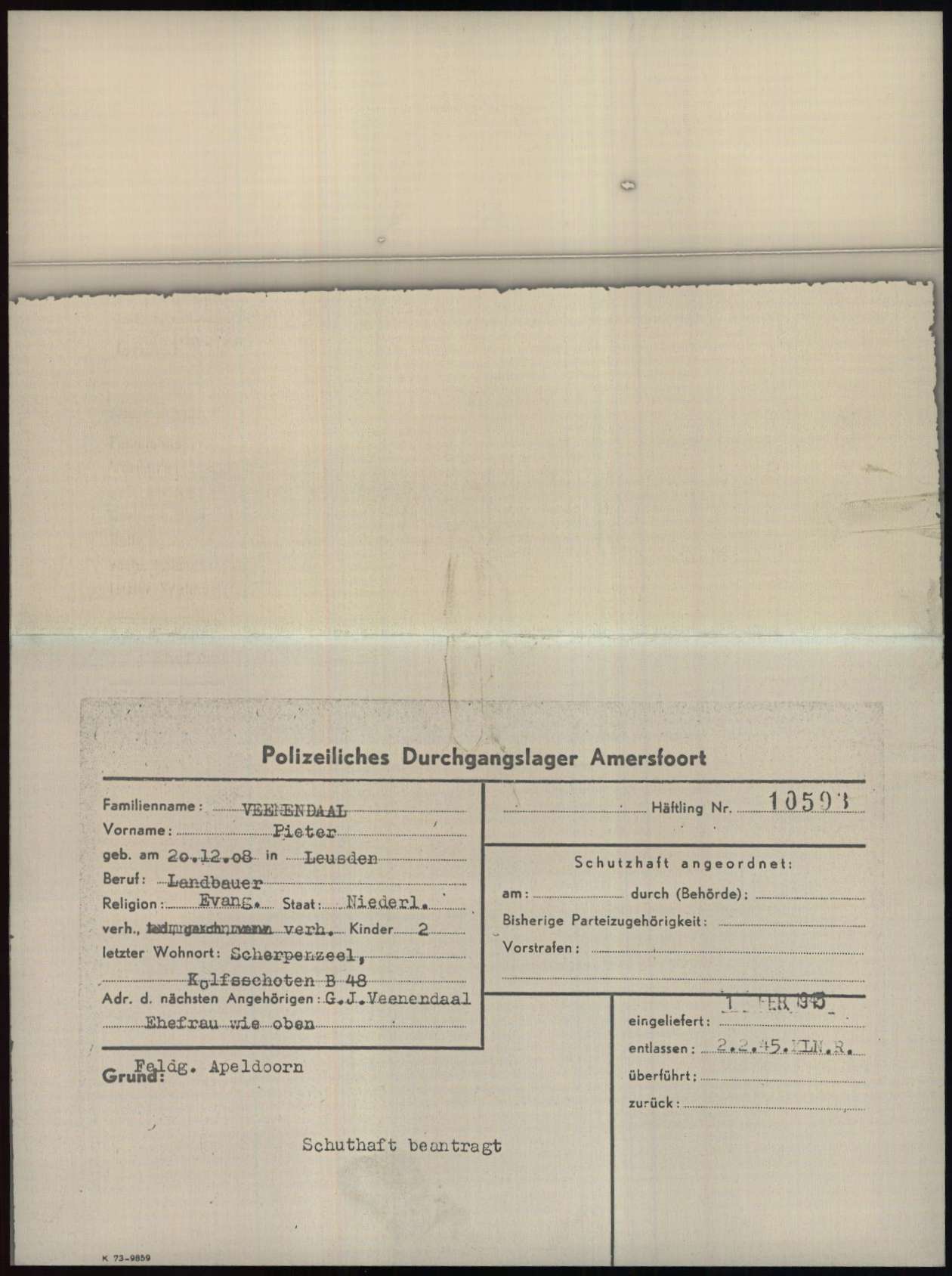
Link to the section Apeldoorn and AmersfoortAfter the Verhoef farm Veenendaal was kept at the Willem III barracks at Apeldoorn, in a cell with a man called Huber from the end of December to 1 February 1945 on the Neuengamme memorial's account, and a fellow prisoner's letter from Amersfoort has "P. Veenendaal, uit Scherpenzeel" in a cell at Apeldoorn (Digitaal Monument Neuengamme; Oud Scherpenzeel, 2020, p. 15). ✓ He was at Kamp Amersfoort as prisoner 10593: the registration card has Landbauer, Evang., married with two children, Scherpenzeel, Kolfschoten B 48, next of kin "G.J. Veenendaal, Ehefrau", reason "Feldg. Apeldoorn" and "Schuthaft beantragt" (protective custody requested), the delivery stamp smudged to "1.. FEB 1945", and release on 2 February 1945, "KL N.R.", to a concentration camp in the Reich (Arolsen Amersfoort card). ◐ The Neuengamme memorial has him at Amersfoort from 1 February, which fits the stamp, and reaching Neuengamme on 4 February 1945 (Digitaal Monument Neuengamme).
Neuengamme
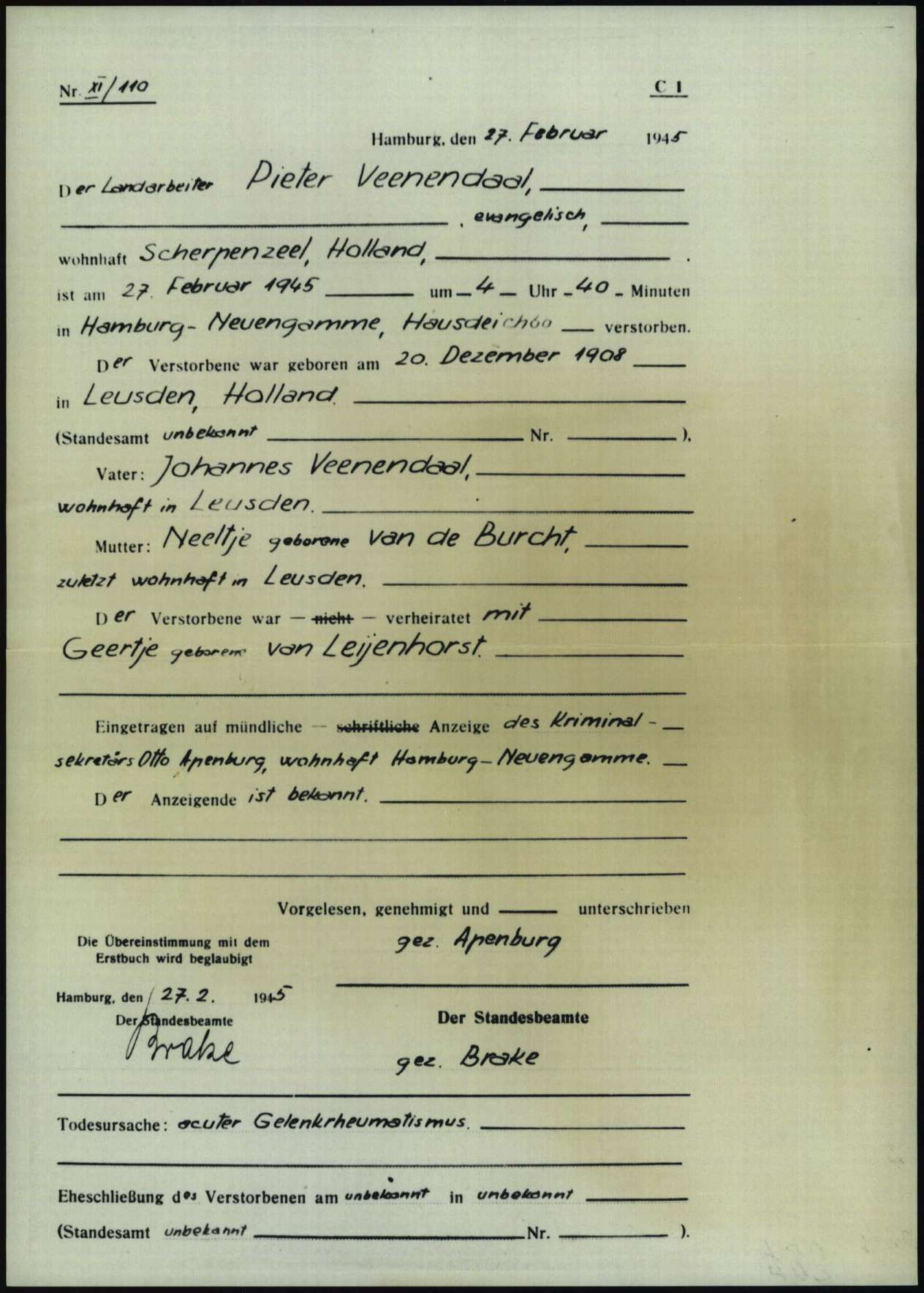
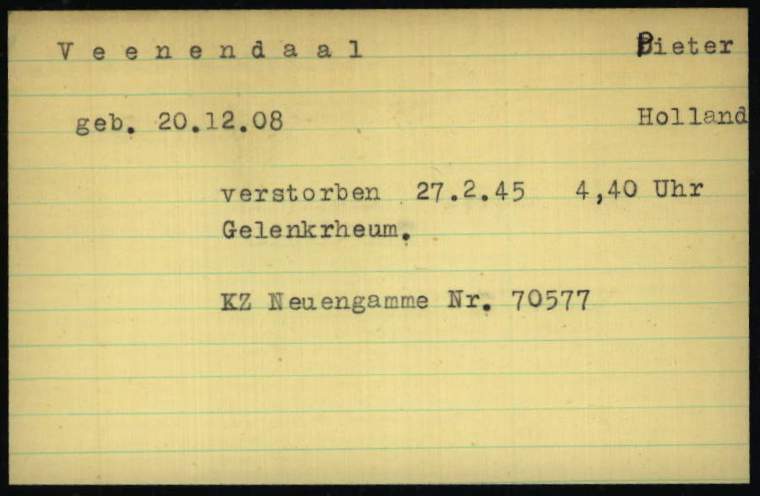
Link to the section Neuengamme✓ At Neuengamme he was prisoner 70577 (the card); ◐ Jan Verhoef, who left Amersfoort the same day, was 70574, three numbers before him (Jan Verhoef). A German death certificate, Hamburg XI/110, made out on 27 February 1945, says the farm labourer Pieter Veenendaal, evangelisch, of Scherpenzeel "ist am 27. Februar 1945 um 4 Uhr 40 Minuten in Hamburg-Neuengamme, Hausdeich 60 verstorben" (died on 27 February 1945 at 4.40 a.m. at Hamburg-Neuengamme, Hausdeich 60), the cause entered as "acuter Gelenkrheumatismus" (acute articular rheumatism), on the spoken report of the Kriminalsekretär Otto Apenburg of Hamburg-Neuengamme. It names his father Johannes, his mother Neeltje van de Burcht and his wife Geertje van Leijenhorst (the certificate, read on the image). The camp's card for the dead has "verstorben 27.2.45 4,40 Uhr Gelenkrheum. KZ Neuengamme Nr. 70577", the same day and hour (the card).
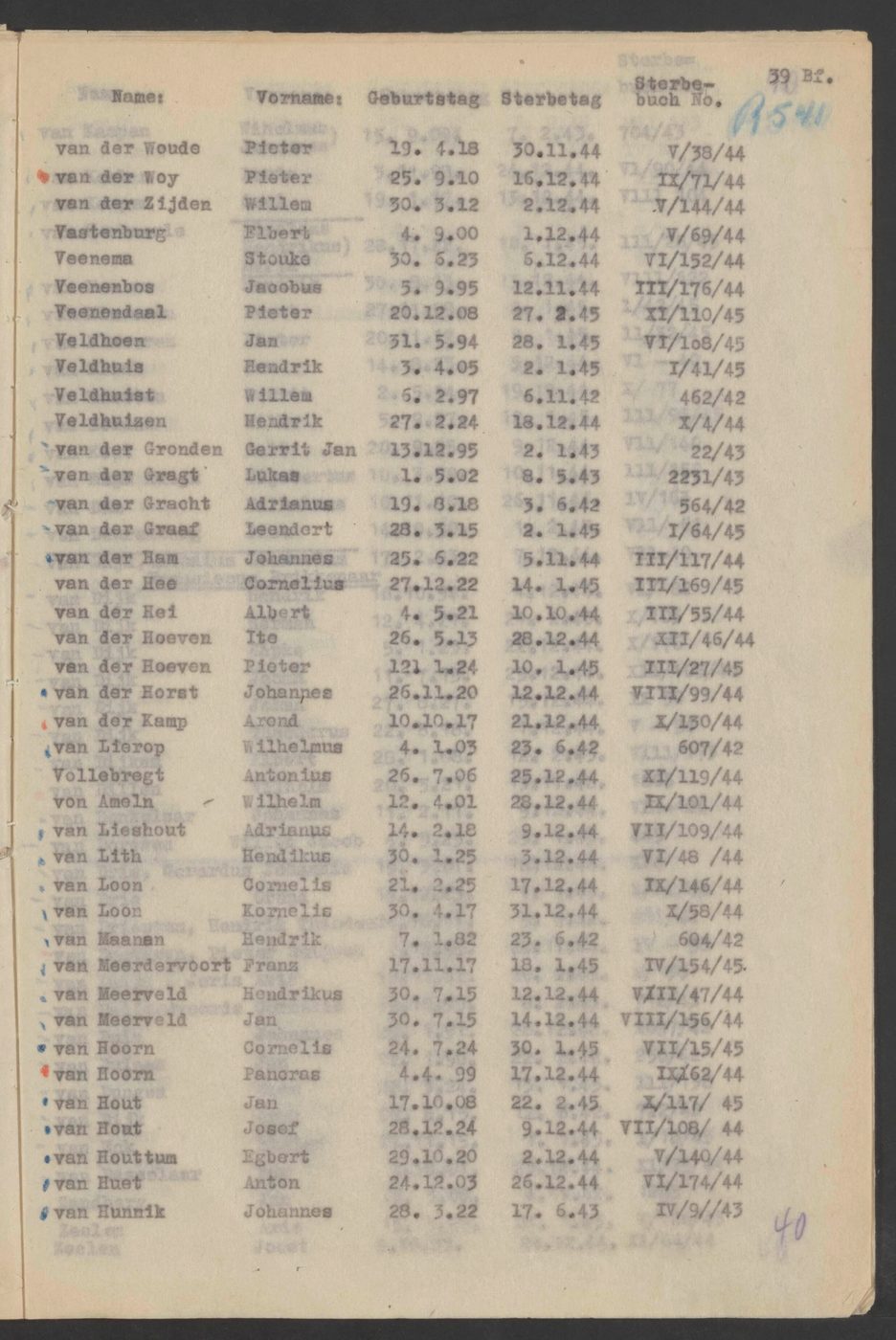
✓ The Dutch Red Cross's typed list of Dutch dead in Kreis Hamburg has him on its page 39: "Veenendaal | Pieter | 20.12.08 | 27. 2.45 | XI/110/45", the last column the number in the register, the same as the certificate's (Nationaal Archief 2.19.323, inv. 521, read on the image).
The War Graves Foundation's file has the same death date and place in every paper of it that has been read, from Leusden's form of 1957 ("gedwongen (opgepakt) politiek volkomen betrouwbaar", taken by force, arrested, politically completely reliable) to Amersfoort's note on his widow ("overleden 27-2-1945 te Neuengamme Dl."), and the Ministry of Justice found nothing against him in 1958 (the Foundation's file). The Oorlogsgravenstichting's page lists him as a landbouwer and lid verzet on the monument at Scherpenzeel (the page).
Awards, and his widow
Link to the section Awards, and his widowVan Ginkel added that his widow had been helped as much as possible, that "A pair of ladies shoes, seize 41, would be highly appreciated", and that "as a souvenir for the widow it is considered that she should recieve a decoration" (p. 3). The British and the Americans both graded him 5 (p. 1):
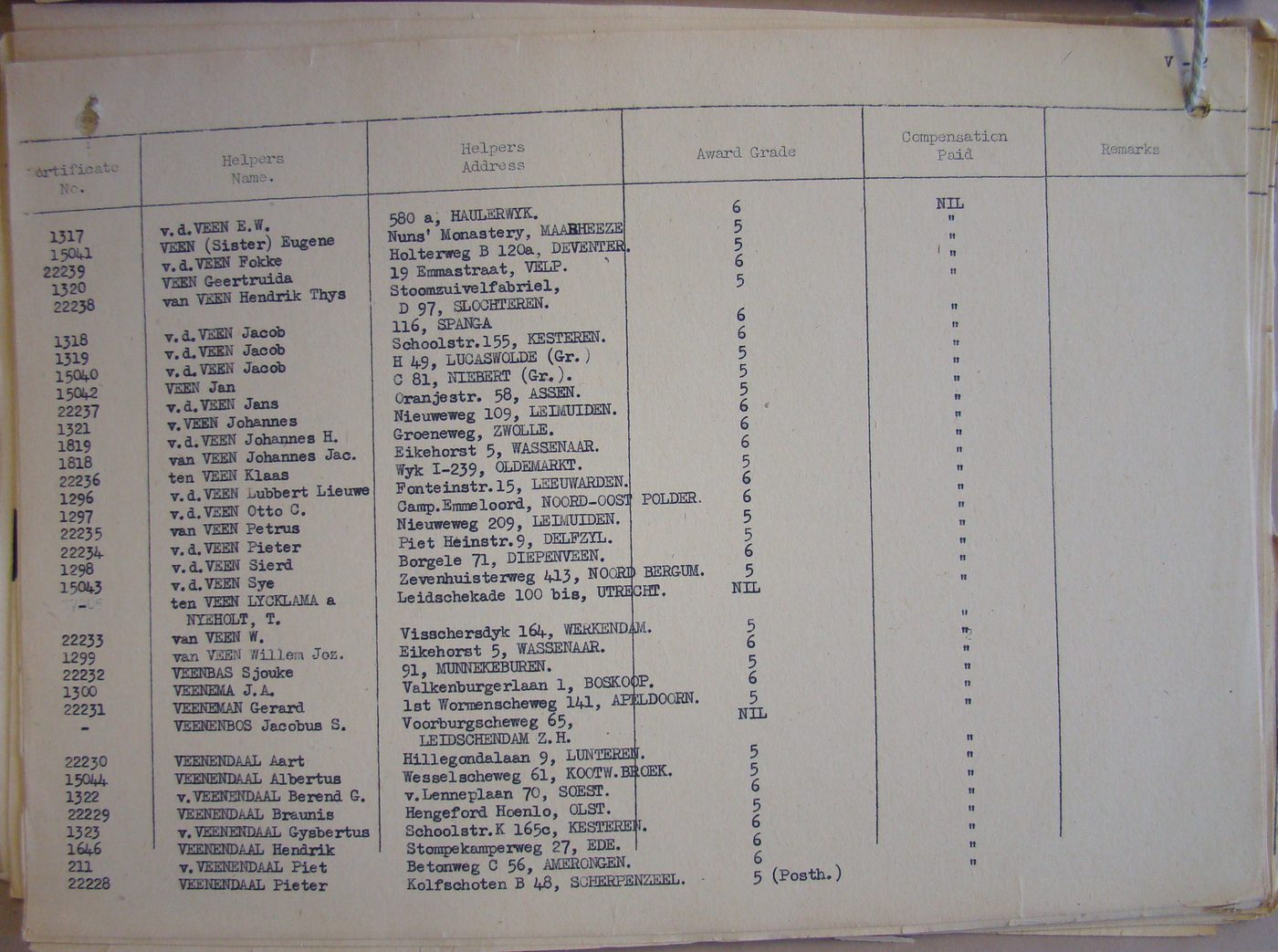
- ✓ The British index of Dutch helpers has "22228 | VEENENDAAL Pieter | Kolfschoten B 48, SCHERPENZEEL. | 5 (Posth.)", the last line of its sheet V/2 (the sheet, read on the image). The two lines above it are other men: "v. VEENENDAAL Piet" of Betonweg C 56, Amerongen, grade 6, and Hendrik Veenendaal of Ede (the index's notes).
- ✓ The Americans' list of Grade 5 (Eisenhower) certificates has "(4256) VEENENDAAL, Pieter, Kolfschoten 48, Scherpnenzeel" (sic), without the "Posthumous" the list puts beside some of the dead, such as Fokke Dijkstra (the list, p. 162; p. 45; image-checked). On the cover of his file a "Post." is struck through (p. 1).
- On 23 November 1945 the bicycle issued in his name was signed for by "G. J. Veenendaal", followed by a word the transcript reads van Huijenhorst [?] (the hand is not clear, and van Leyenhorst, her maiden name, fits the letters as well): ◐ his widow Geertje Jacoba, by the initials (p. 6).
Where the sources disagree
Link to the section Where the sources disagree- The day he died. ✓ 27 February 1945: the German death certificate, the camp's card, the Red Cross list and the Foundation's file; the certificate and the card also give 4.40 a.m. (the camp files; the Red Cross list; the Foundation's file).
- ✗ 15 February in Huurdeman's list of the dead (Huurdeman), and in the state's roll of honour, the Erelijst: "Veenendaal, Pieter, Leusden 20·XII·1908, Landbouwer, Neuengamme 15·II·1945" (the roll, folio 726, read by eye; its website record). ◐ The birth day and place on the roll are right; how the roll came by 15 February is not recorded, and Huurdeman's list may be its source, which is unproven.
- ✗ 15 February is in print as early as October 1945: the heading of the Landelijke Organisatie's In Memoriam, under "„BART" and the signature PETER, reads "Pieter Veenendaal, geb. 20-12-1908 overleden 15-2-1945, Neuengamme" (Mededeelingen, 20 October 1945; OCR only; the issue's page images were not served). ◐ That is the earliest print of the 15 February we hold, and may be where Huurdeman's list and the roll got it; unproven.
- ✗ 25 February in the Oud Scherpenzeel list of the results of 15 December, from Boeree and Dhr. G. van Ginkel, the two sources the article names (Oud Scherpenzeel, 2020, p. 21).
- How he died. Acute joint rheumatism (acuter Gelenkrheumatismus) on the certificate and the card, acute gewrichtsreumatiek on the memorial; dysentery in the In Memoriam of 1945, which was written by a comrade after the war, and in nothing else (the camp files; Digitaal Monument Neuengamme). ◐ The certificate and the card are the camp's own.
- The farm's address. Kolfschoten B 48 on the Amersfoort card, the questionnaire and the British index; Kolfschoten 35 in Huurdeman; Kolfschoten 15 and 35 in two places in Oud Scherpenzeel; Kolfschoten 68 [?] on the Foundation's form of 1957 (the Amersfoort card; the British index; Huurdeman; Oud Scherpenzeel, 2020, pp. 19–20). ◐ B 48 is the old numbering and the others the modern; which modern number is right is not settled.
- The Lammers men. Huurdeman has the man shot and the man arrested as cousins and namesakes, Hermanus Lammers both; Oud Scherpenzeel has "de neven Lammers", both Hermanus Lammers, 22 and 24; Jan Dijkstra has "Twee neefjes van Piet Veenendaal" (Huurdeman; Oud Scherpenzeel, pp. 19–21; Jan Dijkstra, p. 3). ◐ Neef means both nephew and cousin; no source found gives how either was related to Veenendaal.
- His religion. Gereformeerd in the Foundation's file, evangelisch on the death certificate, Evang. on the Amersfoort card (the Foundation's file; the certificate; the card). ◐ The German forms have only the one word for Protestant.
- His mother's surname. van de Burgt in the Foundation's file, van de Burcht on the death certificate (the Foundation's file; the certificate).
- His widow's birth date. 29 August 1911 on the form of 1957, 25 August 1911 in Amersfoort's note (the Foundation's file).
- His widow's age. The questionnaire of 3 July 1945 has "35 years" (p. 4); either birth date makes her 33 then. No other paper gives her age.
- Where Kirschen's team stayed first. A farm at Scherpenzeel in De Jong (deel 10a, p. 331); Veenendaal's, by Huurdeman, and King taken by car to Piet Veenendaal in Van Lynden's file (Huurdeman; Van Lynden, p. 8); "van Ee aan de straatweg Barneveld—Scherpenzeel" in Boeree's Kroniek van Ede (p. 158), which on p. 157 has ◐ Bart, by his name Piet Veenendaal, arranging a place for King's transmitter at Lagerweij's farm; a hunting lodge the first night, then Wuf Lagerweij's farm, in Heaps (Heaps, p. 25).
- Namesakes.
- Piet van Veenendaal of Betonweg C 56, Amerongen, born 5 May 1913, "PEER" to the Allied men he helped, is another man, with his own American file (US National Archives 286711520) and British certificate 211, grade 6 (the index sheet).
- ⚠︎ A. Baars of Rhenen hid men listed as "RAF Paratr.", down at Arnhem in September 1944, from the end of that month, received from "Piet" Veenendaal and passed on for a crossing of the Rhine; the form gives no more, and nothing ties the name to either Piet (Baars's file, p. 3).