Capt. Lipmann Kessel
Pretoria 19 Dec 1914 – 5 Jun 1986
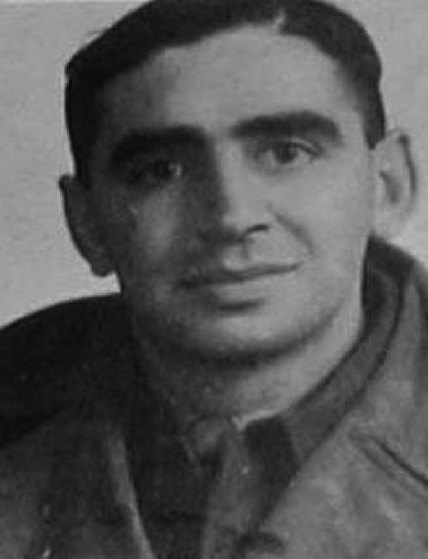
About: The South African-born surgeon of 16 Parachute Field Ambulance who saved Brigadier Hackett's life at Arnhem, escaped from Apeldoorn on 15 or 16 October 1944 and reached De Ruif at Garderen about when Murphy left, joined Pegasus II, and got through to the British lines in February 1945. He told it in Surgeon at Arms (1958) under the name "Daniel Paul", and became a professor of orthopaedics in London.
Unit or role: 16 Para Fd Amb, surgeon; Captain, RAMC, 227647; after the war a consultant orthopaedic surgeon and Professor of Orthopaedics in the University of London (The Times, 17 June 1986).
Where: Pretoria (born); St Mary's Hospital, Paddington; the St Elisabeth Hospital, Arnhem; the Willem III barracks, Apeldoorn; De Ruif at Garderen; Kootwijkerbroek; Barneveld; Maarn near Doorn; Sliedrecht and the Biesbosch; after the war Fulham, St Mary Abbots and the Royal National Orthopaedic Hospital, London; buried in the civil cemetery at Oosterbeek.
Evidence: ✓ London Gazette, 17 April 1942, p. 1702 (his commission); ✓ The Times, 17 June 1986, p. 18 (his obituary); ✓ Hackett in Encounter, March 1987; ✓ Pegasus Archive; ParaData; ✓ London Gazette, 20 September 1945, p. 4675 and p. 4684; his MI9 report, catalogued at Kew, not digitised (the catalogue entries); ✓ Hackett's escape report; the forms of Bol, Niermans and Van der Ley.
Alexander William Lipmann Kessel was born at Pretoria in December 1914, to Jewish parents, a Lithuanian father and a German mother; he went by "Lipmann" or "Lippy", studied medicine at St Mary's, Paddington, qualified in 1937, was called up into the RAMC in March 1942, passed through Ringway that September and joined 16 Parachute Field Ambulance in North Africa, where he took over No. 3 Section early in 1943, and served in Italy (ParaData). The Home Office's register of his British naturalisation certificate, of 1 December 1952, gives his birth as 19 December 1914 at Pretoria (HO 334/462/9080; the catalogue entries). ✓ Kew's entry for his escape report gives the same day, 19 December 1914 (WO 208/5419/25); ParaData's page head reads "01 Dec 1914" (below).
By The Times's obituary he studied first at the University of the Witwatersrand and then at St Mary's Hospital Medical School, London (The Times, 17 June 1986, read on the page image). ✓ On 21 May 1937 "Medical Student lately called Lipmann Kessel" signed a deed poll by which he was to be known as "Alexander William Lipmann-Kessel in lieu of his former names of Lipmann Kessel"; it was enrolled on 26 May and printed in the Gazette of 28 May (p. 3480, read on the page image). ✓ The Lancet of 7 August 1937 lists "A. W. Lipmann-Kessel, St. Mary's" among the candidates who had passed the final examination of the Conjoint Board (p. 357, read on the page image), which is the qualification ParaData and The Times date to 1937. ✓ Its list of appointments of 5 April 1941 has "LIPMANN-KESSEL, A. W., M.R.C.S.: R.M.O. at the Royal Cancer Hospital (Free), London" (the page, read on the image). ✓ On 20 November 1941 he spoke at Aylesbury on health and medicine in the USSR: The Lancet of 29 November reports that "Dr Lipmann-Kessel told how he had visited a mother and child welfare clinic in Moscow in recent years" (p. 677, read on the page image).
✓ He was commissioned lieutenant in the RAMC with the date 14 March 1942: the list headed "The undermentioned to be Lts.:— 14th Mar. 1942" has "Alexander William LIPMANN-KESSEL (227647)" (Gazette, supplement of 17 April 1942, p. 1702, read on the page image), which fits ParaData's "called up in March 1942". The Times has him join the RAMC "at the outbreak of war" (below).
At Arnhem his team "took the first shift" in the St Elisabeth Hospital, to be relieved by Longland's team next morning (ParaData), and he stayed when the Germans took it on 18 September; his MC citation has him, "later when most of the wounded had been evacuated", "left behind with 30 seriously wounded cases" (the recommendation). He operated on Brigadier Hackett, whom a German doctor had written off, and is credited with saving his life (ParaData; Pegasus Archive). ✓ Hackett's own report, made on 7 February 1945, has it the same way: he was taken by jeep to the St Elisabeth Hospital, "where I was operated on that same evening by Capt. KESSEL, 16th Fd. Amb. and the shell splinter, which had punctured the lower intestine, was successfully removed" (Hackett's report, p. 1). Of the hospital's "danger list" he says: "In this direction noble work was done by Capt. KESSEL and up to the time of my escape, of the 8th I believe, there were 12 men, mostly officers, got away" (Appendix C, p. 1), which is the MBE's "danger" list (WO 373/64/169) from the other side. His MBE citation adds that he kept lightly wounded men on the "danger" list so that they could escape, organised a "transit camp" for evaders, and got a wireless, machine-guns and detonators stored in the hospital to the underground (WO 373/64/169, p. 2, told in full under After).
His own book tells the first German takeover from the operating theatre: the SS division's dental officer ordered the unit to be ready to be marched away, and "after a lot of argument it was agreed that the two surgical units in charge of Shorty Longland and myself should be allowed to stay behind"; that night the order came again, and Longland said through the interpreter "Tell your officer I protest most strongly", until the German "gave in" on condition that they would not leave the theatre without permission (Surgeon at Arms, pp. 16–17). The recommendation for Longland's Dutch award tells it from his side (Cedric Longland). Warrack, back from the German headquarters, found Kessel and Longland at the hospital: Kessel's book has "Shorty" tell him to see the colonel (pp. 5–6); Warrack has "a talk with Major Shorty Longland and Captain Lipman Kessel, the surgeons of the 16th (Parachute) Field Ambulance" (Travel by Dark, p. 43); Ryan has Kessel as "the chief British medical officer" and Longland as "the head of the surgical team" (A Bridge Too Far, p. 557).
Two later accounts of Hackett's operation. ✓ Hackett himself, in 1987:
I was brought in to St Elizabeth's Hospital in Arnhem … with severe abdominal injuries. A German SS-surgeon, working in that confused situation with the RAMC Captain, Lipmann Kessel, advised him that I was beyond hope. Lippy disregarded his advice and, after what has been described as a surgical miracle, I lived.
— John Hackett · "Malign, or Muddle-Headed … ?" · Encounter, March 1987, p. 38 · the page
(Read on the page image.)
◐ A mortar man of the division, McAnelly, said in a Dutch paper of 1989 that Kessel "decided to give General Hacket [sic] and me priority of treatment", against the German rule that head and stomach wounds were given a fatal injection (Het Vrije Volk, 16 September 1989; only these two paragraphs checked on the image). John Hackett has the rest.
With Murphy
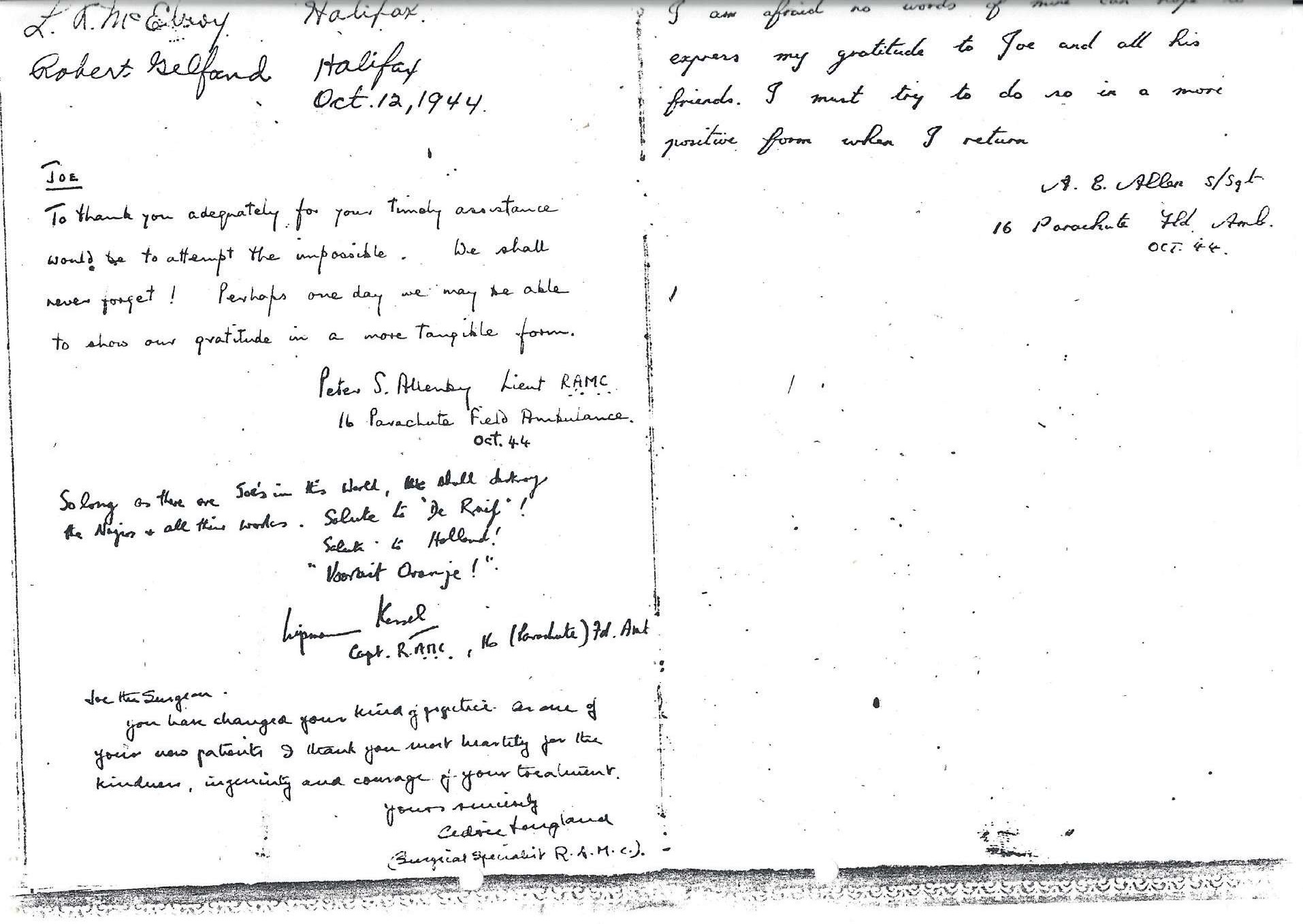
Link to the section With MurphyHe arrived at De Ruif as Murphy left, by Walsh's dates; ⚠︎ by Verweij's and Hardy's, after he had gone (Garderen). On 13 October 1944 he and the remaining patients were moved to Apeldoorn; with permission to escape, he walked out two nights later "unchallenged, with 3 other members of the R.A.M.C.", marched north for two nights and came into friends' hands (Pegasus Archive, quoting the MBE citation). ◐ The three were Cedric Longland, Peter Allenby and Albert Allen, the four who came to De Ruif together (Cedric Longland; Albert Allen). Surgeon at Arms (1958) (ParaData) does not name Murphy, but describes De Ruif, the burgomaster, Ham, Bacon and "Tex" on the night Murphy left, and the Pegasus II fork (Garderen, Operation Pegasus II, Tex Banwell, Regimental and published). His citation has him the interpreter of the Pegasus II march; when he and two officers found themselves alone after the clash with the Germans, they went back to the Otterlo–Barneveld area (Pegasus Archive).
✓ In Warrack's diary. The diary Warrack kept in the barracks calls him "LIPPY", which the transcript's list of the other officers mentioned in it gives as "Capt L KESSEL", surgeon, 16 (Para) Fd Amb (the officers' list, p. 49; Warrack's diary, typed transcript of about 1982, Wellcome Collection RAMC/1584; page numbers are the transcript's).
- On 3 October Warrack was "Visited by a nasty little man with an AMERICAN accent who had been in ARNHEM seeing Capt KESSEL" (p. 37).
- At 16.30 on 13 October "LIPPY, ALLENBY and Father McGOWAN turned up from ARNHEM with 16 orderlies and a certain amount of gen, all of which was most illuminating" (p. 45).
- On Sunday 15 October there was a church parade at 17.45, and at 11.00 on Monday the 16th a "Counting parade, as some citizens appear to have gone absent" (p. 46); ◐ that fits his party breaking out after the Sunday service, but the diary names no one.
- He and Allenby are not on the diary's roll of the medical staff at Apeldoorn, which has Longland (the roll, pp. 51–55); the roll is undated.
- ◐ Where the diary has "the KESSEL", on 11 October, it very probably means the pocket at Oosterbeek (German Kessel), not him: a corporal "from the ARNHEM Division" came "to get a chit from me for the doctor who helped us at the KESSEL" (p. 44).
◐ He was one of the men Lambertus Huber of Garderen sheltered: a British officer backing Huber's claim in 1946 listed among "about 20 British Airborne evaders after their escape from Het Loo hospital Apeldoorn" "Captain Redman, Capt. Lippman Kessel, Major Coke, Corporal Flekker, "Tex" (Barnwell ?) mainly for short periods up to a week" (Windham-Wright's memo, p. 3; the question mark is the memo's, and Tex Banwell carries the same line). No dates are given.
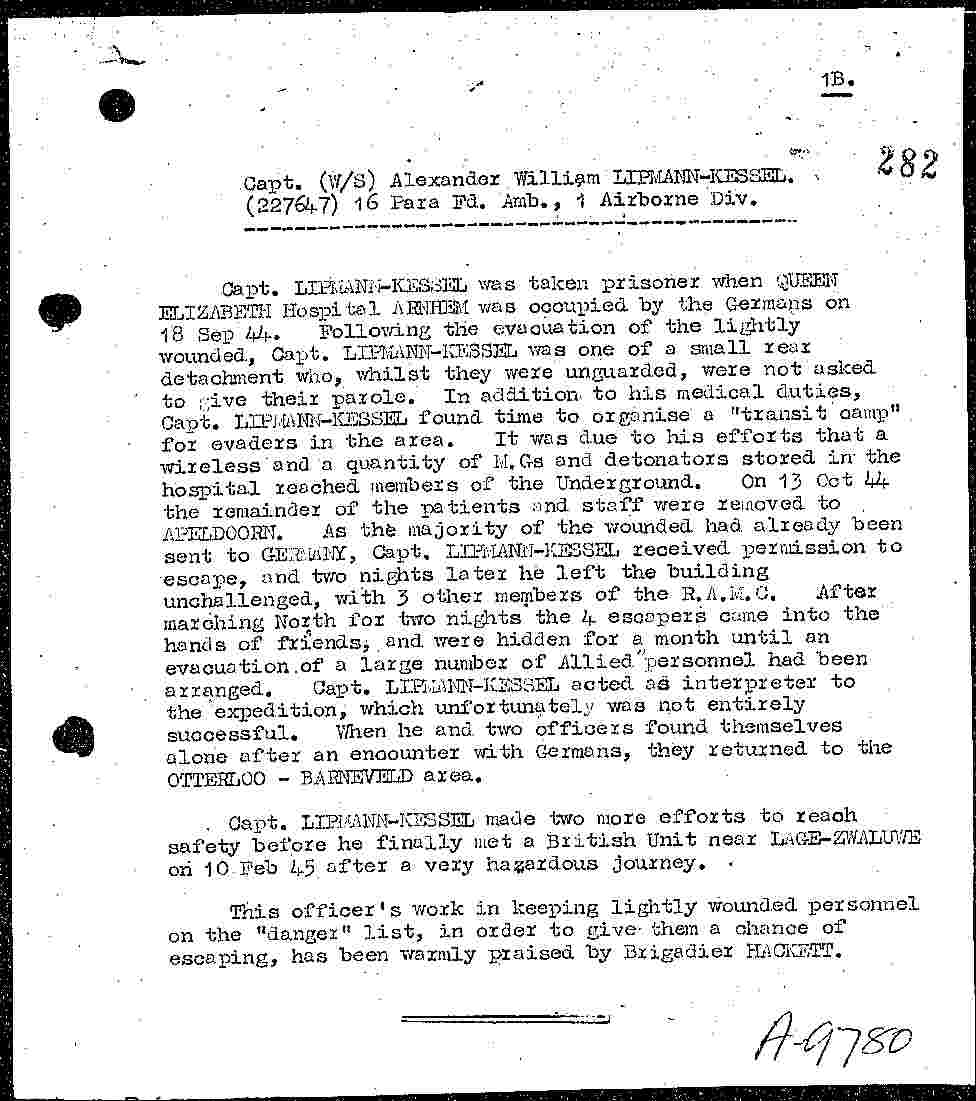
He made two more attempts before he met a British unit near Lage Zwaluwe on 10 February 1945 (Pegasus Archive). ✓ He went out by the same Sliedrecht line as Hackett and Warrack, and by Hackett's account on the same night. Hackett had him at the house near Doorn at the end of January, and on the morning Hackett left "Lipmann Kessel had gone off the night before to join up somewhere with Graeme Warrack and Theo and leave in the early morning guided by Vandyck" (Dick Kragt) (Hackett, I Was a Stranger, pp. 169–174). Elsa Caspers has Kragt take "the two other British officers" over the Lek at Ammerstol on 3 February (Caspers, To Save a Life, p. 73). Then the Biesbosch canoes went down from Sliedrecht on the night of 5/6 February; at Lage Zwaluwe Warrack arrived in one canoe and Hackett was told "A canoe with Lipmann Kessel in it was long overdue", which Warrack went back alone to search for (Hackett, pp. 197–198, 217). The book does not say when Kessel's canoe came in. ◐ The Pegasus Archive's 10 February for his meeting a British unit near Lage Zwaluwe may be that late arrival; nothing else dates it. Theo Redman, Davison's companion, told De zwarte herfst that he rejoined "Colonel Warrack and Major Lipmann Kessel" after nearly three months and that after several attempts they got across on 6 February 1945 (Dekkers and Vroemen, p. 204), a different day from the Pegasus Archive's 10 February. Klaas Heijboer of Groot-Ammers, who led "the crossing group Lek", taking Allied men "over the river Lek through German lines via Groot-Ammers and then to Sliedrecht and ultimately to Noord-Brabant" in "constant communication" with Kragt, lists "LIPMANN KESSEL, Capt., R.A.M.C. 1.Par.Br." third, after the two of them (his file, p. 29), and Pieter Visser of Sliedrecht has him received from Heijboer (his file, p. 29). Kragt says he guided Warrack and Kessel over that line himself (John Hackett). Kew's catalogue entry for the report with its cover sheet (WO 208/5419/25, dated 10 February 1945, former reference I.S.9.(W.E.A.)/1/279/2367) has him escaping from the "Queen Wilhelmina Kazerne III at Apeldoorn" (◐ the cataloguer's garbling of the Willem III barracks) on 15 October 1944, and among the other names mentioned "Cply Hardy", "Major C J Longland", "Lieutenant P S Allenby" and "Staff Sergeant A Allen" (the catalogue entry; catalogue text only, not digitised; the list does not include Murphy). ✓ The 15th agrees with the MBE citation's two nights after the move of 13 October, against the 16th of Noordman's account. Three of the four names are the De Ruif party; ◐ "Cply Hardy" may be James Hardy, though every other record has him a private, and the list has 28 entries, some of them repeated (Meakin, Payne, Meyers/Myers and Longland each twice). This entry is the report itself; Kew's listing entry for it, "Captain A W Lipmann Kessel (service number 227647)", with appendices A, C and D, is WO 208/3352/2367 (index entry WO 208/5275/618, IS9/WEA/1/279/2367; the catalogue entries).
The MBE was for the escape. The Director of Military Intelligence put him up for it on 9 July 1945, "purely from the escape angle", on one minute with Warrack's OBE and a mention for Hackett, noting that all three had "already received awards or been recommended for them by the Airborne authorities for their operational services" but that "such awards should not affect any recommendation for their escape"; the Military Secretary agreed on 13 July (WO 373/64/307, p. 1). The citation, which calls the St Elisabeth "QUEEN ELIZABETH Hospital", says that there he "found time to organise a 'transit camp' for evaders in the area", that it was due to him "that a wireless and a quantity of M.Gs and detonators stored in the hospital reached members of the Underground", that he "acted as interpreter to the expedition" of November, and that "This officer's work in keeping lightly wounded personnel on the 'danger' list, in order to give them a chance of escaping, has been warmly praised by Brigadier HACKETT" (WO 373/64/169, p. 2). He was made an MBE "in recognition of gallant and distinguished services in the field" (London Gazette, 20 September 1945, p. 4675) and given the Military Cross in the awards for Arnhem in the same issue (p. 4684; the list begins on p. 4683). The Military Cross recommendation is Lathbury's, as commander of the 1st Parachute Brigade, received and passed at brigade on 1 May 1945, for "LIPMANN-KESSELL Alexander", "W/Captain", of 16 Parachute Field Ambulance; its citation is the one on the Pegasus Archive page, and it closes on his escape: "Finally, Captain Lipmann-Kessell showed great initiative in escaping from captivity", and "I recommend him most strongly for the immediate award of the Military Cross" (the recommendation).
In 1945, as a major, he led a surgical team at Belsen; he went back to civilian surgery and became a professor (ParaData).
What the helpers' forms and Hackett's report add, November 1944 to February 1945.
- ◐ Pegasus II, 16–18 November. In Maguire's order of march Boeree has him with the rearguard under Major Coke: "Bij de achterhoede was ook kapitein Lipmann Kessel, die de administratie meevoerde" (with the rearguard too was Captain Lipmann Kessel, who carried the records) (Boeree, p. 179).
- ◐ Barneveld, from 19 November. Jacob Bol lists "Lipmann Kessel" and "D. Ridler", received from and passed to "Frans Hals" (the second copy has "Joop en Dick"), hidden from 19/11/44, the morning after Pegasus II failed in the night of 18/19 November, for 53 days on one typed copy and 63 on the other (Bol's form, p. 5; p. 17): Dick Kragt and Joop Piller.
- Fifty-three days run to about 11 January.
- ◐ Karel Niermans, a Frans Hals courier, lists "capt. A.W.Lipmann-Kessel" with Longland, Allenby, Allen, Warrack and others as "known to capt. D Kay and capt. J. Piller" (his form, p. 5).
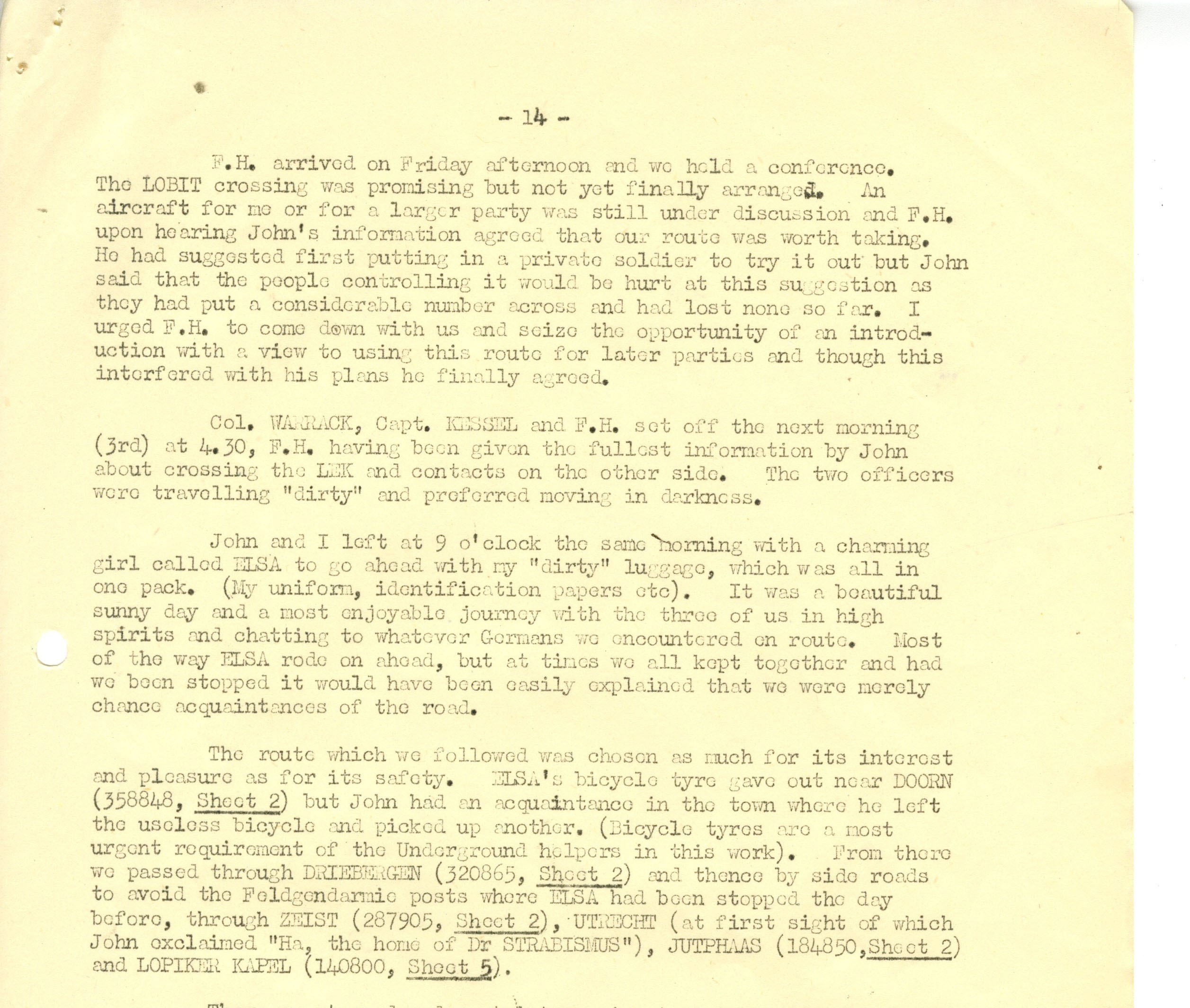
- ✓ Tiel and Maarn, January. Hackett reached Maarn on 30 January and found "Col. WARRACK and Capts. KESSEL, RIDDLER and REDMAN, who had all lately returned from their abortive attempt to cross at TIEL" (Hackett's report, p. 13). ◐ Pte William Gordon may have been of this party: his report has him set off with a guide on 19 January "to contact another group that was making the crossing" near Tiel and hands that part to Redman's report, which is not held; neither Warrack's nor Kessel's book names him.
- Kragt, "F.H." in the report, had told him that Warrack and "Capt. KESSEL (Report No. IS9/WEA/1/279)" were "located" at a house near Maarn (p. 12).
- "Col. WARRACK, Capt. KESSEL and F.H. set off the next morning (3rd) at 4.30", "travelling 'dirty'" and preferring darkness (p. 14). This is the 3 February of Caspers's book and the "led out by Kragt" above.
- ✓ Maarn to Groot-Ammers, from the Dutch side. Dirk van Opijnen of Amersfoort, a navy stoker who guided evaders round Maarn, wrote in July 1945 that "the first 3 evaders were: Lipman Kessel, army doctor. A brigade-commander (name unknown). Theo, also an army doctor", who "went with Dik from Maarn to Schalkwijk - Schoonhoven, and afterwards to Groot-Ammers", the route "pointed out by Dik hemself".
- Maarn was a fixed contact point and he named the Idenburg house, "Henny" (the enclosure, p. 6; his summary has the same route, p. 4; both image-checked).
- ◐ The brigade-commander is probably Hackett and Theo is Redman, but the writer says he did not know the name, and Hackett's report has him go with Snoek, not with Van Opijnen.
- ✓ Sliedrecht and Lage Zwaluwe, five forms. Johannes Martinus Snoek of Renkum, "Hans", Hackett's courier, lists "Colonel WORRICK, Captain Lipman KESSEL and Captain REDMAN, all of the Parachute Regt" among the "37 English Officers" who used the route after Hackett, with his contacts passed to "Joop van AMSTEL and Frans HALS (Captain KAY)" (Snoek's table, p. 13; his form, naming the address Torenstraat 5, Ede, p. 12).
- Jakob van Leeuwen of Sliedrecht "acted as a guide for allied evaders", "Cd. Warck - 1st Airborne" and "I. Kessel, English doctor" (his summary, p. 2), and his table has "L. Kessel (S. African)" received from "Kl. Heyboer" and "Dr. Ingelse" and passed to "Kees v. Woerkom" and "Jan de Landgraaf" (p. 4).
- Jacobus Meyer of Sliedrecht guided "from Sliedrecht underground to I.S. 9 Lage Zwaluwe" and lists Hackett and F/O Blakemore (p. 2), and Harm Hoekstra of Fort Vuren, an agent's helper, "also helped in getting Major Lipman Kessel through the lines", between January and the capitulation, with the code name "Love" for the operator he worked with (p. 15; the form is faint, checked on the image).
- All image-checked; none gives his date.
- ◐ Zwerus de Nooy, from a Holland Office letter. A Holland Office reply about Zwerus de Nooy, who had several paratroops in his house for some time after the Arnhem operation, adds by hand "Both Brigadier Gen. HACKETT and Capt. Lipmann Kessel, from the latter's [?] whom he has a personal [?]" and, in the margin, "recommendation, Burns [?] of his work"; the handwriting is hard to read (the letter, p. 14). The legible words point to a recommendation from Kessel, the "aanbeveling" of Boeree below; the letter gives no date for it.
- ◐ The water crossing. The Americans' recommendation for I. J. van der Ley, a group commander of the Dutch Interior Forces at Dordrecht, says he "assisted greatly in a very difficult crossing of several borders of water from Molensgraaf to Sliedrecht", and names among the evaders "Brig. Gen. HACKETT" and "Surgeon Capt. LIPPMANN KESSEL" with McNaught, Walsh and others, with no dates (his file, p. 13, checked on the image; Sam Walsh).
- ◐ A Lek ferryman, Johannes Boon. His helper form says he took nine Allied men over the Lek, "o.a. Brig. Hackett", in a boat of the Rijkswaterstaat, and gives the nine only as "De eerste 9, voorkomende op de lijst van 'Klaas'" (the first nine on the list of Klaas Heijboer) (Boon's form, remarks, p. 4; the list line, p. 5; both image-checked).
- If those are the first nine names of Heijboer's summary sheet, Kessel is third (pp. 29–30); the form does not name him, and it gives no date.
- John Hackett has the form, Heijboer's listing of Boon (p. 2) and the questions about the boat.
- ✓ Kessel's written thanks to a Dutch guide at the hospital. Boeree's Kroniek van Ede has Paul de Nooij's brother Zwerus, who went as guide and interpreter with the English from Heelsum, put to work after the failed drop at the St Elisabeth Hospital, "toegevoegd aan kolonel Warrick" (attached to Colonel Warrick), until early October (Boeree, printed p. 127; checked on the page image):
- He "heeft veel herstelde zieken met ontvluchten geholpen, waarvoor hij van Capt. Lipmann Kessel een tevredenheidsbetuiging kreeg en tevens een aanbeveling voor de Engelsche legerleiding" (helped many recovered sick to escape, for which he received from Capt. Lipmann Kessel a letter of satisfaction and a recommendation to the English command).
- He also helped wounded out of the hospital and took eleven people to Van der Ven at Schaarsbergen; after "the crossing" he was arrested, escaped from the train near Apeldoorn and met Brigadier Hackett again in the Torenstraat (John Hackett).
- ◐ He is probably the Zwerus de Nooy of the Holland Office letter above, who had paratroops in his house for some time after the Arnhem operation; the book has his surname through his brother Paul, the letter spells it "Nooy", and neither says the two are one man.
The attempt from Maarn, in his book. Surgeon at Arms has "four British officers, three of whom couldn't speak Dutch" (one is called Theo) and two Belgian agents, Kirschen ("Fabian King") and "Moishe" with his transmitter, waiting at the Huis te Maarn for a boat to meet them near Tiel, with a medical student called Roelof as escort (pp. 180–185). The book has the first try fail; the party hides in a barn loft, and in the evening is sent "along the dyke to Amerongen where one of them would put us up for the night"; at the next dawn they drag "a large flat-bottomed affair of the kind used to carry manure" from a frozen pond about "a good half-mile from the Rhine", for about two hours, and cross in two trips in twenty minutes (pp. 186–189). They then cycle south along the dykes to a farm where Jan Stam should have met them and found no one (pp. 189–190). ◐ This is the "abortive attempt to cross at Tiel" of Hackett's report, and the same stretch of river as Murphy and Banwell's crossing attempts (Amerongen). The book gives no dates for it, and the names in it are the book's first names and cover names. Noordman's version of the same weeks has two January starts, from Frans Hals's house on 12 January and from Huis te Maarn on 18 January, both ending in failure at the river; the book's own account, with a crossing of the Rhine that succeeds, does not clearly match either, so which January attempt Hackett's "Tiel" is, or whether it is the book's manure-boat night, is not settled.
Kootwijkerbroek, in his book. Surgeon at Arms has the people of the hiding weeks mostly by first names and nicknames. One evening at the farm, "an oddly-paired couple were ushered in to meet us. Evart, short and blond, was the village postman" (five pages later, on p. 112, "Evart the postmaster"), and Maria, who "was soon bringing Joop and Lise up to date with gossip from the near-by village — it was called Kootwijkerbroek"; the farm was "not far from the village where Evart and Maria kept their grocery shop", and "fat Maria's father who had the advantage of being the village policeman and was thus in an excellent position to act as courier" was one of the ten or so in the group code-named "Frans Hals" (Surgeon at Arms, the text layer of the Norton, New York, 1959 printing, which is the edition all the quotations here are from; "postman" on p. 107, at line 6235 of the file; "postmaster" on p. 112, at line 6487). ◐ The book gives no surname for them, and no source here does: they are not identified on this site.
The book also prints three photographs taken in 1958, captioned "Maria was among the first to be recruited to the local Underground group", "Evart's grocery shop was a convenient centre for messages" and "Maria's father had the advantage of being the village policeman" (the Internet Archive's lending copy, the Norton, New York, printing of 1959: our note on the copy; the book). The 1958 Heinemann first edition is not on the Archive and was not seen.
His own account of November 1944 to February 1945, as Noordman prints it. Wolter Noordman gives Kessel's story in Dutch, introduced "We volgen nu zijn verhaal" and in quotation marks, without naming the source (his own report or his book; the Dutch is a translation either way) (Noordman, chapter 23, pp. 307–320). ◐ It runs as follows:
- He and the others spent two days at De Ruif and then three weeks "under a sheep-pen" at Kootwijkerbroek with Frans Hals's assistant Joop and his wife Lies, and on 16 November, at about 7.30 in the evening, were taken to a gathering place and then to a hen-house where Pegasus II was prepared (pp. 310–311).
- After the failure he walked back with Ridler and John Goggin to Otterlo, where a girl took them in, and then to Jacob Bol's farm near Barneveld, "until 11 January 1945", Christmas and New Year being spent at Frans Hals's address (p. 313).
- On 12 January he left at four in the morning with Warrack, Ridler, Kirschen ("Captain King") and a guide, fainted after two hours on a bad bicycle and was taken back; he was told that the rest of the party had been delayed and had not been able to cross the Rhine as arranged, so he set out again next morning, was met outside Barneveld by Theo Redman, and went on to Huis te Maarn and the Idenburg family.
- At four in the morning of 18 January he left Maarn again and met the rest of the group on the way to the Rhine: "Tot onze grote teleurstelling liep ook deze poging op een mislukking uit" (to our great disappointment this attempt too ended in failure), and on 24 January they were back at Huis te Maarn, where he stayed "until 4 February" (pp. 313–314).
- He gives 31 January as the day Hackett arrived at Huis te Maarn (Hackett's own report has the night of 30 January, above), and says that the next morning at four he and Warrack left with Frans Hals and the guide Johan Snoek for Jaarsveld, crossed the river at about five, and met Hackett that day at Groot-Ammers (pp. 314–315).
The account is not consistent with itself on whether he left Maarn on 1 or 4 February, and Hackett's report has the move on 3 February (above).
◐ In October 1944, a month after Arnhem, The Times of 25 October printed a notice that he was "reported missing at Arnhem, believed prisoner of war", from his family (the snippets, p. 10; Archive full-text index, not read on the page). By then he had been out of German hands for over a week, and the family did not know. In 1958 the Nijmeegsch Dagblad reviewed Surgeon at Arms under "Ontsnapte Britse legerarts zwierf over het Veluweland" (an escaped British army doctor roamed the Veluwe) and followed his route: a rescuer at Kootwijkerbroek and "een oude schuur" where they hid while the Wehrmacht was above, then Barneveld and Scherpenzeel, a "streng gelovig gezin met veel dochters" he took for Mormons, Groot-Ammers and the Biesbosch (the review; OCR only). ◐ In 1977 he wrote to The Times on the film A Bridge Too Far, as Professor Lipmann Kessel of the Institute of Orthopaedics at the Royal National Orthopaedic Hospital (the snippets, 22 July 1977, p. 28). ◐ An MI9 report of February 1945 by Lt. Bernard Locket, captured at Arnhem on 21 September 1944, lists "Captain Lipmann-Kessell" among the names mentioned (the catalogue entry; the report is not digitised and was not read).
In March 1960 the Dutch edition of his book came out, Een chirurg valt uit de lucht, translated by Ans Kamstra, and he spoke about it in English at the Royal in Arnhem; the local paper retold his escape "met drie anderen uit een krijgsgevangenkamp in de buurt van Apeldoorn" (with three others from a prisoner-of-war camp near Apeldoorn) (Arnhemsche Courant, 30 March 1960). De Telegraaf of the same day gave the interview under the headline "Honderdvijftig operaties in negen dagen" (a hundred and fifty operations in nine days), with a second line that he had landed that Tuesday at Schiphol on a scheduled flight from London, the second time he had come down on the Netherlands from the air (De Telegraaf, 30 March 1960; the headings and opening checked against the image, the rest OCR only). In November 1979 he was with Sir John Hackett at the Anglo-Netherlands Society's dinner in London, and De Telegraaf told, from Hackett's side, how a German officer inspecting the wounded with him pushed Hackett over with his boot and said "give him an injection"; the caption calls him the man "who saved Hackett's life" (De Telegraaf, 24 November 1979; checked against the image). He died in June 1986 and was buried in the civil cemetery at Oosterbeek near the Airborne cemetery, his headstone with a Pegasus badge (ParaData). The Dutch papers of 12 June 1986 say he had left it in his will that he be buried in the Netherlands, near his old comrades (Leeuwarder Courant; Het Parool; De Telegraaf), and that the funeral was held up because his coffin did not arrive with the family; each tells the cause and the delay differently (below). De Telegraaf adds a photograph of the burial at Oosterbeek's general cemetery (Het Parool and De Telegraaf checked against the images).
◐ In November 1977 De Telegraaf ran a short column on Hackett's memoir I was a stranger that names him twice: "een Zuidafrikaanse chirurg, ook een krijgsgevangene, Lipmann Kessel" (a South African surgeon, also a prisoner of war), who "lapte hem zodanig weer op dat hij na een paar dagen ontsnappen kon" (patched him up so well that he could escape after a few days); and, in January, a bicycle ride by night to "een andere schuilplaats waar hij tot zijn verbazing Lopmann Kessel aantrof" (another hiding place where, to his surprise, he found Lipmann Kessel) (De Telegraaf, 5 November 1977, p. 89; every line checked against the image; the column is second-hand, from the Times Literary Supplement's review of 21 October, and prints his name wrongly the second time). ✓ The second matches Hackett's own report, which has Kessel already at Maarn when he arrived on 30 January (above); ⚠︎ the "few days" is not what Hackett's citation and report give, which have him leave the hospital about a fortnight after the operation (John Hackett).
His own words in 1949. ✓ On 3 December 1949 De Waarheid, the Dutch Communist Party's daily, printed a Dutch translation of a letter he sent the prime minister, Willem Drees, from "345 Uxbridge Road, Acton, Londen, W.3.", signed "A. W. Lipmann Kessel, MBE, MC, F.R.C.S.", protesting against the imprisonment at Schoonhoven of Dutch soldiers who had refused to serve in Indonesia (De Waarheid, 3 December 1949, p. 3; headline, introduction and letter checked against the image). He writes as a "voormalig officier van de eerste Engelse brigade valschermtroepen" who "later leerde van het Nederlandse volk te houden en het te bewonderen, toen ik daar vijf maanden ondergedoken was" (learned to love and admire the Dutch people, when I was in hiding there for five months). It is a translation, from a copy sent to a party paper; the English original is not held. ⚠︎ Five months is his round figure: from the escape on 15 October to the crossing in early February is under four, from Arnhem nearly five.
What the Dutch papers had from him in 1960 of the winter. Two short reports of his visit say more of the months in hiding than the page has from the book:
- ✓ Het Vaderland, 30 March 1960, on his lecture to the Genootschap Nederland-Engeland at The Hague (the report; the two sentences on Barneveld and the Biesbosch checked on the image, the rest OCR only):
- "Ook was Kessel nog zes weken op een kippenboerderij te Barneveld. In de koude maand februari was hij midden in de Biesbosch." (Also Kessel was another six weeks at a chicken farm at Barneveld. In the cold month of February he was in the middle of the Biesbosch.)
- He told the audience too that after the battle he stayed three weeks near the battlefield, and that everyone was then evacuated to the Wilhelmina barracks at Apeldoorn.
- ✓ Het Parool, 4 April 1960, on his visit to the publisher (the article; checked on the image):
- "Buiten Doorn, in 'Huis te Maarn', midden in de bossen, heeft dr. Lipmann Kessel een tijd in '45 ondergedoken gezeten met enkele andere Britten" (outside Doorn, in "Huis te Maarn", in the middle of the woods, he sat in hiding for a time in '45 with a few other Britons).
- "In een hoek van de kamer werd De Waarheid gemaakt, in een andere hoek een ander illegaal blad; een hoog Brits opperofficier was in die dagen 'militair medewerker' van de Waarheid" (in one corner of the room De Waarheid was made, in another another illegal paper; a senior British officer was in those days its "military collaborator").
- He made "in maart '45 een dodentocht per kano naar de Biesbos" (a death march by canoe to the Biesbosch in March '45), and on this visit met near Sliedrecht the old doctor who gave him a drink in those days, but not "Jan", the young Dutchman who stood chest-deep in the water with him there when their canoe leaked; Jan lived in Tasmania and had written to him after reading the book.
- ◐ The paper does not name the senior British officer, and nothing held says who he was or connects any named person to De Waarheid. The house is named only as "Huis te Maarn" near Doorn.
- ✓ His book names the same house and the paper: the Huis te Maarn, "as it was called, was now a hospital for the aged", with a bailiff who was normally the chauffeur and whose sons were active in the group, and in the cottage living-room "a muscular man" who "had been responsible for producing the local edition of De Waarheid, the organ of the Dutch Communist Party", while the bailiff and his sons "were very far from being Communists" (Kessel, pp. 181–182).
- The book does not mention a British officer helping with the paper.
Two more reports say why he wrote the book, in his words as the papers give them:
- ✓ Arnhemsche Courant, 31 March 1960, on the evening at the Royal the day before (the report; every line checked on the image):
- He put his experiences on paper straight after the war: "Twaalf jaar lang hield hij het manuscript onder zijn eigen hoede en gebruikte het pas weer, toen zijn kinderen vragen gingen stellen over de oorlog" (for twelve years he kept the manuscript to himself and only used it again when his children began asking questions about the war).
- "Kom maar binnen" (come in) were the words with which people always received him in 1944 on the long walk to the coast; several Dutch people he had met then were in the audience.
- ◐ The paper has him decide to publish "samen met een Engelse auteur" (together with an English author) and the two Englishmen visit the Netherlands a year earlier; it gets his initials ("W. A.") and his 1944 post wrong, so it is loose.
- ✓ De Tijd De Maasbode and the Nieuwe Haarlemsche Courant, 30 March 1960, the same short item "Chirurg uit de lucht" in a daily column (De Tijd De Maasbode; Nieuwe Haarlemsche Courant; both read on the images):
- He wrote it down so late because, he says, "een nieuwe generatie opgegroeid is, die er vragen over stelt" (a new generation has grown up that asks questions about it).
- He wanted it to get the right answer: war as "de afschuwelijke ramp die hij is" (the dreadful disaster it is), not a heroic event.
- The paragraph is the same in both; the pen name "Daniel Paul" is its last sentence.
Surgeon, professor and public speaker, 1945–1986
Link to the section Surgeon, professor and public speaker, 1945–1986- ✓ 1945 to 1958.
- In an interview for the Jewish Chronicle in October 1945 he stated "that the chief of those who had helped him to escape was an Amsterdam Jew"; by 1958 he was "Consultant Orthopaedic Surgeon of the Fulham and Kensington Hospital Group", read Sholem Aleichem for relaxation, and was joint author of a book entitled "Surgery in an Airborne Division" (Jewish Chronicle, 26 September 1958, p. 6, read on the page image; the October 1945 interview itself is not held).
- He was Fellow of the Royal College of Surgeons of England from 1947 (Gazette, 25 April 1975, p. 5459, read on the page image).
- The New Statesman of 27 November 1954 lists "Soviet Health Services, Dr. Lipmann Kessel, F.R.C.S." for 8 p.m. on Tuesday 30 November, the entry ending "Hamp. BSFS" (the page, read on the image).
- ◐ Time of 27 February 1956 names "London Surgeon A. W. Lipmann Kessel" for "espresso wrist" (snippet); a letter "Radiation from H-bomb" signed by him is in The Sunday Times of 18 December 1955 (snippet).
- ✓ The book.
- Surgeon at Arms appeared in 1958 in London. The American edition, "by Daniel Paul with John St. John" and published by Norton, is in Facts on File for 3 to 9 September 1959 ("English physician (A. W. Lipmann Kessel)", dated 26 August) and in American Medical News of 5 October 1959 ("written by London surgeon, Dr. A. W. Lipmann Kessel, under pseudonym of Daniel Paul") (Facts on File; American Medical News; both OCR only).
- ◐ A dictionary of pseudonyms of 1971 has "Paul, Daniel. Pseudonym of Lipmann Kessel (1914– ), English writer" (snippet). His Dutch tour of March 1960 is above and below.
- ✓ The Society for Cultural Relations with the USSR (SCR).
- Its officers for 1958–59 are headed by the president D. N. Pritt, QC, with "Chairman LIPMANN KESSEL, M.C., M.B.E., F.R.C.S." (Anglo-Soviet Journal, Autumn 1959, p. 55, read on the page image).
- In 1969–70 he is one of the members of its council (April 1970, p. 2); the journal names him in fifteen issues between 1959 and 1970 (the list).
- ◐ The Times of 16 January 1969 prints a letter "Trade with Russia" from "Mr. Lipmann Kessel and others" (snippet).
- ✓ Peace campaigning.
- The New Statesman of 12 May 1961 announces a London Peace Campaign public meeting, "Eichmann and Nazism", at Caxton Hall on Thursday 18 May, with "Lipmann Kessel, MBE, MC, FRCS" among the speakers (the page).
- The Jewish Chronicle of 26 May, under "Conspiracy of Silence", reports a London Peace Campaign meeting at Caxton Hall at which he said he was "a little troubled" by the Eichmann trial and that "I feel there is a conspiracy of silence behind this trial" (the page, read on the image). ◐ That this is the meeting announced for the 18th is our inference; the report gives no date.
- ◐ Peace News of 26 January 1962 lists a CND meeting, "Chairman: Lipmann Kessel" (snippet); Hackett wrote of him in 1987: "He was a member of Ex-Services CND and had for some years been chairman of its medical committee" (Encounter, p. 38).
- Exhibition, evidence and the university.
- ◐ Royal Academy exhibitors 1905–1970 has, for 1968, no. 826, "Lipmann Kessel, Esq., M.C., M.B.E., F.R.C.S. — bronze", printed under another exhibitor's entry and before the name "Kovacs": a bronze titled with his name and honours, so probably a portrait of him by another artist, not his own work (snippet).
- ◐ Volume 7 of the House of Commons Reports, Accounts and Papers for 1973–74 has an evidence session of "Wednesday, 7th November, 1973" with "Mr. Lipmann Kessel"; the snippet does not name the committee (snippet).
- ◐ The Journal of Bone and Joint Surgery of February 1974 notes at the Royal National Orthopaedic Hospital that "Mr Lipmann Kessel has taken up the post of Director of Clinical…", the snippet cutting off there (snippet); The Times of 24 January 1974 has a letter, "New-born babies", from him (snippet).
- ✓ He was one of nineteen candidates, for three vacancies, in the Royal College of Surgeons of England's election to its Council in July 1975, as "Alexander William Lipmann Kessel (Fellow 1947), Royal National Orthopaedic Hospital, Middlesex" (Gazette, 25 April 1975, p. 5459).
- ◐ In 1983 "Lipmann Kessel, London" is among the nominators of another candidate from the same hospital; the name and the hospital make it him, but the notice does not say so (Gazette, 29 April 1983, p. 5948).
- ◐ The University of London Calendar for 1980 has, in a run of entries in the form "Name (Subject) — year", "Lipmann Kessel (Orthopaedics) — 1980", after "John Stodart Kennedy (Animal Behaviour) — 1977"; the year printed after his name is 1980, and the snippet does not show what the list is or what the year marks (snippet).
- ✓ A Chelsea Football Club match programme of early January 1980, for the FA Cup third round against Wigan Athletic or Northwich Victoria, lists among the club's officials "Hon. Orthopaedic Surgeon: Prof. Lipmann Kessel, M.B.E., M.C., F.R.C.S." (page 3, read on the image; the file is named for Wigan because it sits in an archive.org item titled "Wigan Athletic 1979_1980_AWAY"). On 4 March 1985 The Times printed his letter "Informed consent", headed "From Emeritus Professor Lipmann Kessel" and signed "Lipmann Kessel" (p. 13, read on the image).
-
✓ His death and what was said of him. The Times of 17 June 1986 has him "Emeritus Professor of Orthopaedics in the University of London, who died on June 5", and says:
- he was "a leading figure of the post-war generation of orthopaedic registrars who became consultants in Britain in the early 1950s", consultant in orthopaedic surgery at Fulham and St Mary Abbots hospitals, who took a leading part in the discussions that led to the new Charing Cross Hospital on the Fulham site;
- his "chief contribution" was as Director of Studies and later Professor at the institute where he "laid a firm hand on that organisation"; from it "emerged important books on orthopaedic surgery and in particular on the surgery of the shoulder joint", and he formed an international organisation for its study (The Times, 17 June 1986, p. 18 and column 3, read on the page image; the obituary is unsigned).
Lipmann Kessel - 'Lippy' to his innumerable friends - was loved and respected by colleagues and by juniors for his boldness, for his informed but questioning approach and for his integrity. Holding unswervingly to Marxist principles, Kessel never sought to impose his views; he never failed, when the occasion arose, to state those views and the considered case for them.
— The Times · obituary of Professor Lipmann Kessel · 17 June 1986, p. 18 · column 3
- Hackett, whom he had operated on, wrote of him in Encounter in March 1987 as "a surgeon, widely respected and loved" and of their friendship: "Lippy, an Afrikaner and a Jew, was also a Marxist. I was none of these", adding that the two "never talked about these things" (p. 38, read on the page image). The funeral at Oosterbeek is above.
- ◐ BMJ of 20 September 1986 announces that a "celebration of the life and work of Professor Lipmann Kessel, who died on 5 June, will be held in the Royal", the snippet ending there (snippet); The Times of 16 October 1986 has a memorial meeting for him "held yesterday at the Royal College of Surgeons" (snippet).
- ◐ The Jewish Chronicle of 14 November 1986 has something "in memory of Professor Lipmann Kessel, emeritus professor of Orthopaedics at London" (snippet), and The Times of 19 November 1987 "the first Lipmann Kessel Travelling Professor to the Third World" (snippet).
The Dutch tour of March 1960, from the programme side
Link to the section The Dutch tour of March 1960, from the programme sideThe Dutch edition came out through H. J. W. Becht of Amsterdam, as Een chirurg valt uit de lucht by "Daniel Paul en John St. John", at 8.90 guilders (Het Binnenhof, 2 May 1960, p. 2; the line checked on the image). The Arnhemsche Courant of 21 March announced the bookseller Krooneman's evening at the Royal in Arnhem for Wednesday 30 March, with a recording for the NCRV, and called him "42-jarige" (the article, checked on the image). Het Vaderland of 28 March announced that "dr. Daniël Paul" would speak on Surgeon at Arms for the Nederland-Engeland society on Tuesday 29 March, at a quarter past eight, in Het Oude Hof (the notice; KB OCR, not read on the image). On Thursday 31 March he spoke at the Amstel Hotel in Hengelo, in Book Week, at the invitation of three booksellers (Twentsch Dagblad Tubantia, 1 April 1960, checked on the image; the evening is in the paper's agenda of 30 March, KB OCR). There, in the paper's Dutch (translated here), he said that "the growing-up youth must know what a war in this modern age means" and that this was "the main reason I wrote this book"; after the escape from Apeldoorn they tried repeatedly to reach their own lines, which "succeeded only in February 1945", when they crossed the Biesbosch in a canoe "between floes of ice", and he then took part in the liberation of Bergen-Belsen (the report). De Telegraaf of 30 March printed beside its interview two boxes: "Vrijwilliger", in which he is quoted (translated) as saying he had volunteered for the 1st Parachute Brigade "because I am a Jew, was fiercely opposed to the Nazis" and had done about 150 operations in nine days, and "Doeltreffend", on the months of planning to carry a field hospital by parachute (Vrijwilliger; Doeltreffend; both checked on the image).
Where the sources disagree
Link to the section Where the sources disagree- The coffin's delay at Schiphol, 11 June 1986. ⚠︎ The three papers of the 12th do not agree on the cause or the length.
- The Leeuwarder Courant has British Airways loading the coffin onto "het verkeerde vliegtuig" at Heathrow, and a delay of "enige uren" (the article).
- Het Parool has a mistake by the London forwarding agent leave the coffin "tussen ander vrachtgoed" at Heathrow, and it arriving "twee uur later" (the article).
- De Telegraaf says only that the coffin was not on board the British Airways flight, and that the delay was "enkele uren" (the article).
- His age at death, and the cemetery's name. Born in December 1914 (ParaData), he was 71. Het Parool has him "(76)" and calls the cemetery "Oosterwijk", twice; De Telegraaf has "(72)" and Oosterbeek (Het Parool; De Telegraaf). ⚠︎ Both ages are the papers' errors, on the face of it; Oosterwijk is a misprint of Oosterbeek.
- The night he crossed. A Dutch newspaper's profile of Hackett in 1994 narrates that he reached Lage Zwaluwe on 5 February and that "samen met hem, nog meer ondergedoken Britten, waaronder Lipmann Kessel, de oversteek hadden gemaakt" (other Britons in hiding, Lipmann Kessel among them, had crossed with him); this is the reporter's narration, which mentions Hackett's 1977 book, and Hackett is quoted only after it, on the days that followed (Nieuwsblad van het Noorden, 10 September 1994; OCR only).
- Hackett's book of 1977 has Kessel's canoe overdue that night, and De Telegraaf of 1963 and the page above have 6 February (Warrack's arrival); Pegasus Archive has 10 February (Hackett, p. 198). A snippet of Bennett's A Magnificent Disaster, cut off at the start, has "the surgeon Captain Lipmann Kessel the following night" after a crossing on 5 February (snippet, p. 330; not read on the page).
- ✓ The account Noordman prints under his name settles it as a failed first attempt and a second crossing:
- He and Warrack set out in two canoes with a guide each; "my canoe began to leak" and sank in the reeds; he went back with his guide "Hans", spent a night and a day until midnight on a pier, and walked back to Sliedrecht (Noordman, pp. 316–318).
- Mrs Van Woerkom remembers that after a few days they heard that Hackett and Warrack had arrived at Lage Zwaluwe and that when they were at table on the Wednesday Kessel and Hans walked in, "dead tired" (pp. 318–319).
- The second attempt was on "the evening of 9 February"; they left in a rowing boat about midnight, he and his guide went on alone by canoe, and "it was half past six in the morning" when he reported to a post of the 11th Hussars at Lage Zwaluwe (p. 319).
- That puts his arrival on 10 February, the Pegasus Archive's day, and Warrack's and Hackett's on the night of 5/6 February, with his canoe "long overdue" in Hackett's book.
- ◐ The 1994 newspaper's narration and Redman's 6 February have him crossing with them; Kessel's own account does not.
- The Sliedrecht hand-over date. ✓ Heine Volker-van Leeuwen's table, of the group that took men on from the Lek, has "Capt. Lipman Kessel" and Warrack at "5/2/45", received from "Dr. Ingelse" and passed on to "C. v. Woerkom", and the next group, Ridler and others, at "13/2/45" (her table, p. 6; image-checked). That puts Kessel in Sliedrecht on 5 February, the day Hackett's canoes left Sliedrecht, on his own report (the night of 5/6 February, above), and not on 10 February.
- How long at Bol's. Fifty-three days on one typed copy of Bol's table and sixty-three on the other (p. 5; p. 17); both begin on 19 November.
- February or March for the canoe trip. Het Vaderland of 30 March 1960 has him in the Biesbosch "in de koude maand februari"; Het Parool of 4 April 1960 has "in maart '45" (Het Vaderland; Het Parool). ⚠︎ Hackett's canoes left on the night of 5/6 February and the Pegasus Archive has Kessel with a British unit by 10 February (above), which fits February; no source says why the paper has March.
- How long at Barneveld. Het Vaderland has "zes weken" (six weeks) at a chicken farm there; Bol's two typed tables have fifty-three and sixty-three days from 19 November (Het Vaderland; Bol, p. 5, p. 17). ◐ Six weeks is a lecturer's round figure against a helper's count; neither says it was one house.
- When he reached De Ruif. Nelly Eskes says she met four officers in the woods at Uddel, and that her husband Dirk and Kruimel fetched them "die avond nog" (that same evening) to De Ruif.
- She gives no date; Noordman places it on 17 October, the day after the escape in the account he prints under Kessel's name (Noordman, p. 309; Dirk Eskes).
- ◐ In the same account Ham and Bacon had been dropped "net de afgelopen nacht" (p. 309), so his arrival follows from the date of their drop, and that is unsettled: 16, 17 and 18 October across the sources, de Jong's 18 October among them (de Jong, deel 10b, p. 551 n. 1; Abraham du Bois). A drop on the 18th would put the arrival on 19 October, not the 17th, which bears on "as Murphy left".
- His own book names neither De Ruif nor its owner and gives no date for the arrival (the extracts, pp. 90–92; His own account checked, row 15); "about 21 October" is the heading of our extract, not a date in the book.
- His birth date and his names.
- 19 December 1914 in the Home Office register and in Kew's entry for his escape report, "01 Dec 1914" in ParaData's page head, whose text says only "December 1914" (ParaData).
- ParaData says he "later dropped his first two names and was known by his third name"; the deed poll of 1937 takes "Alexander William" into his name in place of "Lipmann Kessel" (Gazette), and he signed "A. W. Lipmann Kessel" in 1949 and 1955 and stood as "Alexander William Lipmann Kessel" in 1975.
- Both can hold: the full name in documents, the short one in use.
- The date of his death. 5 June 1986 in The Times ("who died on June 5") and in the BMJ snippet; "01 Jun 1986" in ParaData's page head, with "June 1986" in its text. ✓ The funeral at Oosterbeek was on 11 June, by the Dutch papers of the 12th (above); the 5th is the contemporary record.
- When he joined the RAMC, and in what unit. The Times has him join "at the outbreak of war" and be "assigned as Surgeon in Command of 1 Parachute Surgical Team". He was a civilian resident medical officer at the Royal Cancer Hospital in April 1941 (The Lancet), commissioned on 14 March 1942 (Gazette), and by the MC and MBE recommendations and ParaData he was a surgeon of 16 Parachute Field Ambulance. ◐ The obituary is compressed; none of the other sources puts him in uniform before 1942.
- The night of the escape, and who went.
- Sunday 15 October: Warrack's book has Allenby among "those who had broken out of the Apeldoorn hospital on the Sunday night with Shorty and Lippy" (p. 143; page image), and Kew's entry for his report has 15 October (WO 208/5419/25).
- ◐ The same Kew entry names, among many others, "Capt Devlin", "Corporal Meakin", "Private Payne" and "Cply Hardy"; Jan van Dronkelaar's form for the Americans has "Alan Payne", "David Meakin", "Bryan Devlin" and "Ernest Hardie", Par/Reg, hidden from 15 October 1944 for 7 days, received from A. Roelofsen, Postweg, Lunteren (his file, p. 8, read on the image). That these four broke out of the barracks the same night is our reading of the date and the names; neither source says they went with him, and his own party went north to Garderen (above).
- ◐ The diary's patient counts (88 on the 15th, 98 on the 16th, which is the ten sent from Het Loo, who "persisted in escaping", pp. 46–47) show no barracks patient lost, though counts may be nominal.
- ◐ Warrack's diary, near-contemporary (no source says it was written the same day), has the Sunday evening church parade at 17.45 on 15 October and a count on the Monday morning "as some citizens appear to have gone absent" (p. 46); it does not name them.
- Its staff counts at 20.00 are 142 on 14 October, 141 on the 15th and 137 on the 16th (pp. 46–47), and at 17.30 on the 16th "Another check and they find three missing. How very odd!" (p. 47). ◐ With the Monday 11.00 parade held "as some citizens appear to have gone absent", the fall between the Sunday and Monday counts fits a departure on the Sunday night; a count does not say who left or when.
- ✓ Herford's report of 1944, written by a man who was in the barracks, has "Three M.Os. and 2 Orderlies escaped intending to join a party of Airborne men known to be in a particular locality" under 15 October, and the St Elisabeth staff, "3 M.Os. and 16 Orderlies", sent to the barracks in the days of 12 to 14 October (Lt-Col Martin Herford's report, Journal of the RAMC, vol. 98 (1952), pp. 299–300, read on the page images).
- ◐ It names no one; the three doctors fit Kessel, Longland and Allenby, and Allen one of the two orderlies. ◐ Herford and Hall (p. 186) count five who went, three MOs and two orderlies, one more than Kessel's party of four (Kessel, Longland, Allenby and Allen); Warrack's staff counts at 20.00 fall by four between the 15th and the 16th (141 to 137, diary pp. 46–47), which fits four. ⚠︎ Not settled.
- The 16 orderlies agree with the diary's 13 October (above). Matthew Hall's life of Herford has the same: the quartermaster on the night of the 14th, "and on the following: night three doctors and two orderlies" (Hall, p. 186).
- 16 October: ParaData's page on him, and the account Noordman prints under his name, which has the evening service and the four of them, Longland, Allenby and Allen (Noordman, p. 309).
- ParaData's page on the Apeldoorn hospital has "Lt Col Herford, Maj Longland, Capt Lipmann-Kessel and Padre McGowan" escaping on the night of 16 October "during two separate attempts" (ParaData); Warrack's book has Herford leave on Monday 16 October and Kessel's party on the Sunday (pp. 80, 90, 91; full text).
- When he left St Elisabeth for Apeldoorn. ✓ 13 October in Warrack's diary, ◐ near-contemporary (no source says it was written that day) ("LIPPY, ALLENBY and Father McGOWAN turned up from ARNHEM", p. 45), in ParaData and in the account Noordman prints (p. 309); 12 October in Warrack ("a party of thirty wounded, half a dozen doctors, a dental officer and orderlies came in from the St Elizabeth Hospital at Arnhem. They were led by Shorty Longland and Lipman Kessel", p. 78; page image); 11 October in Heaps (p. 115).
- Where he was on the Pegasus II march.
- Boeree puts him with the rearguard, carrying the records (p. 179), but the same paragraph also has, walking directly behind Maguire and the guides, "de Zuid-Afrikaansche kapitein", who "verkende de overkant" at each road and, because he understood Dutch, "kon zich bij de gidsen verstaanbaar maken" (explored the far side, and could make himself understood to the guides); that fits Kessel's own account of walking in front as interpreter, so Boeree either places him twice or means another South African captain, and nothing held says which, so the rearguard reading stays ◐.
- The account Noordman prints has him "voorop" with Maguire and the guides, as interpreter (p. 312), and his book has him helping Longland and a Canadian sergeant to get people back on the track, then "returned to my post in the front" (p. 131).
- His age in 1960. The Arnhemsche Courant of 21 March 1960 calls him "42-jarige"; by his birth date he was 45 (the article).