Capt. Charles Noble
Blantyre 7 Oct 1919 – 21 Dec 1997 ◐
Capt. Charles Bruce Noble (279738)
About: An RAMC anaesthetist born at Blantyre and living at Hamilton, captured at Ginkel, who jumped from the prisoners' train on 23 September 1944, evaded through the autumn, and was caught in the party fired on near Opheusden on the night of 2/3 January 1945, ◐ with Murphy and Banwell in it. He never names Murphy; after the war he was a surgeon in New Zealand.
Unit or role: Anaesthetist in a surgical team, HQ Section, 133 Para Fd Amb, RAMC; war substantive captain from 10 July 1944 (Noble).
Where: Hamilton, Lanarkshire: "Woodland View, Portland Park" on the Dutch helpers' forms (de Kempenaer, p. 3) and "Portland Park, Hamilton" on the Kruisberg file (Reussink, p. 8), his home in 1945; born at Blantyre, and schooled at Hamilton Academy (Royal College of Surgeons). In the Netherlands from 18 September 1944, on the run from 23 September 1944 to 2 January 1945. After the war, Wanganui, New Zealand (Royal College of Surgeons).
Evidence: ✓ Noble, his escape report of 23 September 1945 and POW questionnaire of 26 April 1945; the National Archives catalogue him independently of the transcript: WO 208/3336/246, "Captain C B Noble (service number 279738) … RAMC … Attempted escape only from train en route from Holland to Germany, Sep 1944"; WO 208/5274/1233, his liberation report; and the German POW card WO 416/273/71, "Charles Noble. Date of Birth: 07/10/1919. Place of Birth: Blantyre. Rank: Captain"; Schjelderup's report of 1945 (Hardy); Doetinchem Herdenkt; the British enquiry of May–June 1945 into his treatment at De Kruisberg, Arolsen Archives 6.3.1.1 (the file); his obituary in the Royal College of Surgeons' Plarr's Lives of the Fellows (the record). His own later account of his war from Arnhem to the end of it, told long after it, from unpublished private papers shared with us privately: late memory, ◐ on this page where a record of the time agrees with it, ⚠︎ where it stands alone.
He was born at Blantyre on 7 October 1919 and was from Hamilton, Lanarkshire (his German prisoner-of-war card; Noble). The Royal College of Surgeons' obituary of him gives the same birth, at Blantyre on 7 October 1919, the son of a consultant mining engineer and a farmer's daughter; he went to Hamilton Academy and Glasgow University, qualifying MB ChB in 1942 with a distinction in materia medica, was house surgeon at the Royal Alexandra Infirmary, Paisley, and joined the RAMC in 1943 (Royal College of Surgeons, summarised there). So the Blantyre of the card is where he was born, and the Hamilton of his questionnaire and the Dutch forms is his home address; the obituary gives only the school at Hamilton. The "C. B. Noble" in the list of Glasgow University graduates in medicine, M.B., Ch.B., at the ceremony of 24 October 1942 (BMJ and The Lancet, 7 November 1942; search snippets only) is ◐ very probably him, by the university and the year the obituary gives; he was given an emergency commission in the RAMC on 10 July 1943 (Noble); "C. B. Noble" is also among the new RAMC lieutenants in the BMJ's list of emergency commissions on 2 October 1943 (the snippets; initials alone). ✓ The London Gazette settles it: "Charles Bruce NOBLE, M.B. (279738)" is among the Royal Army Medical Corps officers "to be Lts." under 10 July 1943, in the supplement of 31 August 1943 (Gazette 36153, p. 3881, read on the image; the print is spotted and the text layer rough).
He volunteered for airborne forces in early 1944, was posted to 133 Parachute Field Ambulance on 25 February, and completed Parachute Course 108 at the parachute school at Ringway from 19 to 31 March 1944, his instructor writing "Above average, confident" (Noble, from the unit war diary and the course report as the compiler cites them). As a member of the third stick of the HQ Section he took off from Spanhoe on Monday 18 September 1944 in a C-47 of the 315th Troop Carrier Group, U.S.A.A.F., for Ginkel Heath, in the second lift of the Arnhem operation (Noble).
His own later account tells the landing and the capture at more length:
- The drop. ⚠︎ The pilot took evasive action under fire, so that by the time the jump light went on the plane "had passed over Ginkel Heide"; he came down in trees "something like two to three miles north" of it, hung with his feet about six feet from the ground while a young German fired at him, and got free as the German ran off (his later account).
- The first night. ⚠︎ He gathered "about twenty other ranks" of the HQ group, reached the rendezvous at the north-east corner of the heath by a long way round past Wolfheze, and was sent on to a casualty clearing station at Wolfheze; that evening he cycled to the Hartenstein Hotel, where a Major Simon Fraser told him no help was needed (his later account).
- Taken. ⚠︎ Next morning he went back with about five jeeps to clear the casualty clearing station at the rendezvous, the Germans first, about four with abdominal wounds; with the last walking wounded nearly away, "suddenly Germans appeared, looking very menacing with Schmeissers pointing at us", an SS unit as he understood it (his later account). ◐ His report of 1945 has him captured at Ginkel on 19 September, the day after the drop (Noble).
- To Amersfoort. ⚠︎ German medical orderlies kept the SS from looting him; the prisoners were marched up and down the road to Ede for an hour or two, and he was driven west to a headquarters he placed near the Grebbe, then next day to the Dutch army barracks at Amersfoort, a holding centre for prisoners (his later account).
He was captured at Ginkel, near Arnhem, on 19 September 1944, and early on the 23rd was put with the other prisoners on a train from Amersfoort for Germany; refused leave to look after the Division's wounded, he decided to escape, and after dark, between Hengelo and Enschede (the report's spelling of the first is garbled; de Kempenaer has Hengelo), he opened the compartment window and jumped. He walked west by compass, avoiding roads and hiding by day in barns, and by his own dating crossed the IJssel on 4 October in a boat found for him near Herkulo (Noble). The War Office later heard from an ex-prisoner that he had been "KNOWN TO BE EVADING IN HOLLAND NEAR R A A L T E ABOUT 30 SEPT 1944", which fits that road (the telegram of 5 May 1945; The 1945 enquiry). His report leaves most of the helpers on that road unnamed or garbled; the forms they filled in for the Americans in 1945 and 1946 name them (below).
His later account of the same days:
- Amersfoort. ⚠︎ About five hundred British prisoners, with several medical officers, among them a Captain Bonham-Carter and a Major Courteney, RAMC; he dealt with the German administration over the wounded and could move freely about the barracks (his later account).
- The train. ◐ Early on the morning of 23 September the prisoners were put on a passenger-compartment train at Amersfoort for Germany (Noble). ⚠︎ The account has them marched to the station early and in the dark (23 September 1944 was a Saturday), and adds the Dutch Red Cross's bread and cheese, and that at Apeldoorn he was let down the train to see the wounded and "satisfied myself that there was no need for the presence of any medical officer on the train" (his later account).
- In the compartment. ⚠︎ Two Americans threatened to report the escape until he talked them round, and another gave him a compass; the two guards in the corridor had diarrhoea (his later account). ◐ The report has "One of them supplied a compass", one of the four officers with him (Noble).
- Bonham-Carter. ⚠︎ Captain R. Bonham-Carter, meant to go with him (◐ the same man as Capt. Richard Erskine Bonham-Carter, 241068, captured 21 September 1944, by his prisoner-of-war record: WO 416/35/2; the match is by name alone, and the entry gives his unit, "4th Parachute Brigade", in square brackets, the cataloguer's insertion, with no corps), but from Apeldoorn had severe abdominal pains, thought to be appendicitis (his later account). The report has "No one accompanied me" (Noble), which fits, since he did not go.
- The jump. ⚠︎ "So after Enschede I pulled the window down, slipped over the side of the train and dropped", the train slowed to about twenty miles an hour (his later account); the report has between Hengelo and Enschede, at about 25 m.p.h. (Noble; below).
- West by compass. ⚠︎ About fifteen miles the first night, apples for food, a haystack near Hengelo, then the farm by the Twente Canal (below), the canal crossed at Delden in a gale, and several hours getting through German wire (his later account).
- Raalte. ◐ A farmer near Raalte "moved me on and was very unhelpful" (his later account); the War Office heard in 1945 that he had been evading "NEAR R A A L T E ABOUT 30 SEPT 1944" (the telegram). ⚠︎ Then heath, and a large house on a ridge: he lay up in a wood, warmed himself in its greenhouse among the grapes, and went to the house that night (his later account).
The helpers between the train and the IJssel
Link to the section The helpers between the train and the IJssel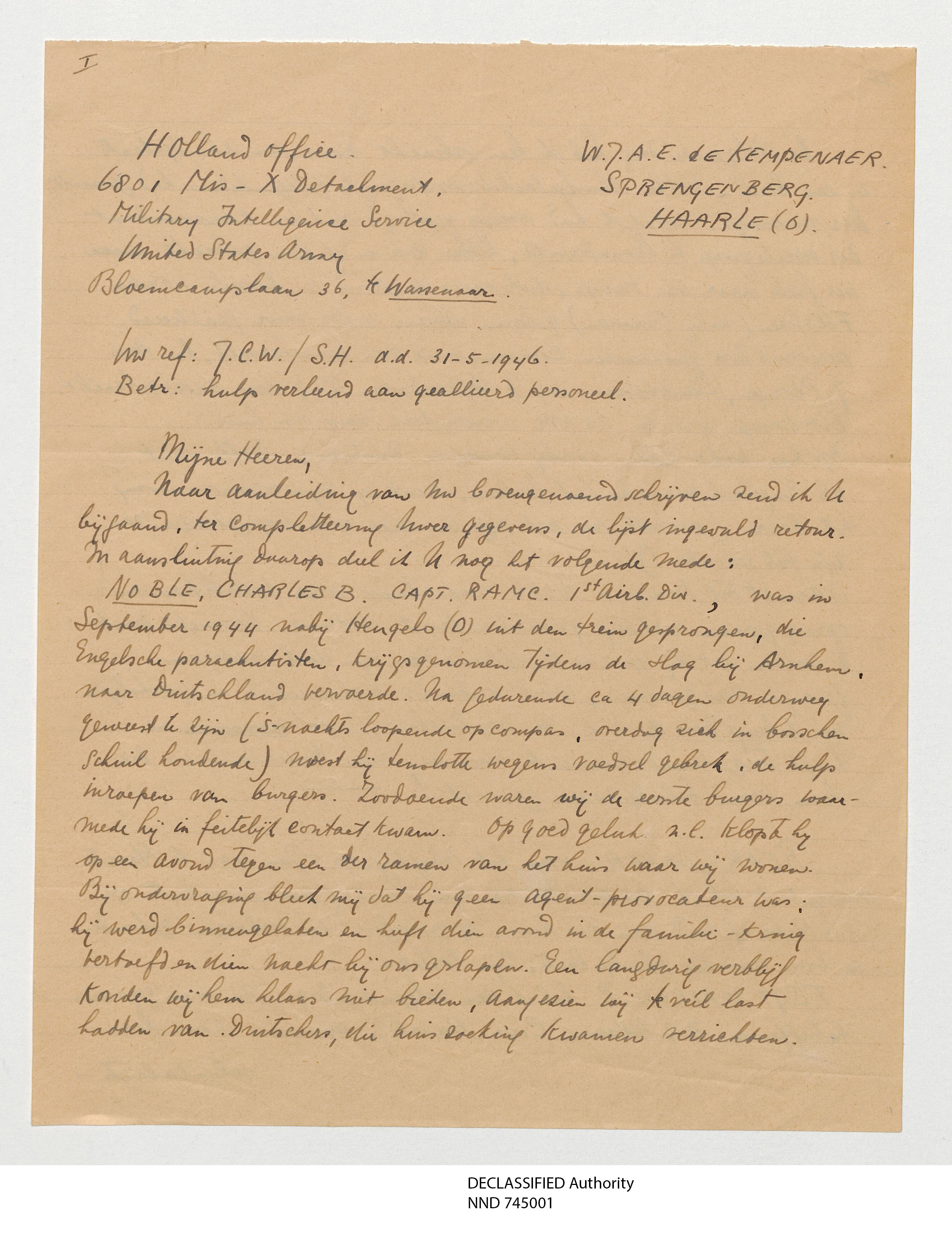
- Wiene, 25 September. After three days' walking Noble reached the canal near Delden and at nightfall "went to an isolated farm house"; the farmer gave him a map and food and showed him the way, and Noble did not know his name: "Farm is situated at WIENE, about 3 km's West of DELDEN" (Noble).
- ◐ Gerardus Hermanus Wilmink of Tusschede, Ambt Delden, "Gave Cpt. C.B. Noble. shelter for 1 day. 25.9.44, also map and assistance to Arnhem" (his summary of 22 February 1946, p. 2).
- His table has Noble "picked up near his farm", "near Weene", and "went by himself to Arnhem" (p. 6); its "25.9.44 escaped out of the train" is the day of the stay, not of the jump on the 23rd. The farm is Noble's by place, help and date.
- ⚠︎ His later account puts the farm "near a place called Goor": in the rain the people there told him to cross at Delden and gave him "a very good map indeed", one of the daughters mended a tear in his trousers, and he was in the house "for about ten minutes" (below).
- Haarle. Noble spent a day in the woods at Haarle after the priest refused him food, then asked at "a large house standing alone in the woods", "very pro-English", who gave him food and a bed for the night: "De KAMPENAER, SPRINGEMBERS, HAARLE" (Noble). ✓ Willem J.A.E. de Kempenaer of Sprengenberg, Haarle, lists "Noble, Charles Bruce, capt. R.A.M.C., 1st airb. div., Woodland View, Portland Park, Hamilton, Scotland", "escaped from convoy P.o.W.'s from Arnhem, September 1944" (his table, p. 3; a handwritten copy, p. 8).
- What de Kempenaer says of that night. The letter has Noble knock "op goed geluk" (on the off chance) at a window one evening, be questioned to make sure he was no agent-provocateur, and then "dien avond in de familie-kring vertoefd en dien nacht bij ons geslapen" (spent that evening in the family circle and slept the night with us); a long stay was impossible because of the German house searches (the letter, p. 4).
- ◐ His later account agrees on one night with the de Kempenaers, "very helpful" (his later account). ⚠︎ The account alone has a daughter in the family, and that he buried his army packs below the house before he left (his later account); the report has the son take him to a shack in the woods next morning (Noble).
- The way to the camp. Next day de Kempenaer took him to a shelter in the woods "which had been made for such cases", and that afternoon he and the commander of the Lemelerveld group took him by bicycle, disguised as a farmer with a spade tied to his carrier, about 25 km to a camp "partly underground in the woods" under "Filsteren" (Vilsteren [?], near Ommen), where the commander, J. Plomp of Hellendoorn, already had allied personnel (the letter, p. 5; the same in English, Plomp's file, p. 9).
- Noble has "an Underground worker" bring civilian clothes, "HENDRIJK de PLOOMP, HALLENDOORN", and the two take him "disguised as a Dutch labourer" to "a little encampment in the woods near RECHTEREN" (Noble).
- Plomp. ✓ Johannes H. Plomp, "Jo", Sanatoriumweg, Hellendoorn, of the L.O., K.P. and R.V.V., lists "Capt.C.B.Noble, Woodland View, Portland Park Hamilton Sc. (O.K. with E&E-suppl. clothes-local transport)", "Paratrooper who came down near Arnhem, was transported by me to Rechteren" (his list, p. 3). Noble's "Hendrijk" is the forms' Johannes H.: the village, the commander's part and the route to Rechteren agree.
- The camp at Rechteren. Noble names two American pilots there, "Lieut. VOGEL and 2/Lieut. SOLLERS", help from "Dr PAUL de BLECOURT of OMMEN", and "COUNT RECHTEREN on whose estate the campaign was" (Noble). ✓ Plomp's list has "Vogel Richard" and "Seller Leslie N." together, "Came down at the same time near Dalfsen, picked up by us and nursed in Rechteren", and his helpers include "Dr. Blecourt, Ommen" and "Graaf van Rechtem, Dalfsen" (his form, p. 2).
- ◐ His later account has "an underground camp near Ommen", "The name of the place I think was Rechteren", for "about ten days", the report's ten, with two American flyers (his later account). ⚠︎ The account alone has it run by a regular Dutch Army officer, about ten members, two young women, and plenty of food (his later account). ⚠︎ He remembered them as a group that had used explosives on railway lines and been told from London to hold back (his later account).
- Ommen. ◐ The Ommen contact man, Jan Hendrik Seigers ("Jan van Ommen"), whose helpers include Plomp and Dr du Blécourt (his form, p. 33), lists "Captain Charles B. Noble (Eng.) 8ste leger, 14 Liverpoolroad, Kingston Hill, Surrey" among Vogel and Sellers, with nothing entered for dates or days (Dutch, p. 34; English, p. 36).
- The name, rank, place and company fit.
- ⚠︎ The "8th Army" and the Surrey address do not: every other source has him a 1st Airborne officer from Hamilton. The entry is his only if the compiler took the description from the two escapers from Germany listed just before him, both "8ste leger".
After the river he was taken to "Mr. LANSVELT, EPERHEIM, Nr EPE" (Noble); a helper's table from Emst has "Dr.Charles Noble", in October, for "2 or 3" days, from L. van Norel at Emst to "Lensvelt / Eperheemweg / EPE" (the van Norel file, p. 4). Lensvelt's own form names him: Willem Adriaan Lensvelt of "Eperheem", Epe, commander of the RVV there, "Sheltered and brought to camp of Opa Capt. C.B.Noble"; his table has "C.B. NOBLE Capt. Dr.", hidden "1-8/10", 8 days, received from "Mondria Marechaussee Vaassen" and passed "To camp of OPA" (his form, p. 2, 18 February 1946; his table, p. 3). From there he went to a camp hidden in the woods near Elburg, about eighty people, mostly elderly Jews, with three RAF officers, Blakeney, Parsons and Craven, four Americans and a British glider pilot, where he tried to treat the sick with almost no medicines; then, with Parsons, three weeks on a farm near Doornspijk, waiting for the crossing being organised near Wageningen (Noble).
His later account of the river and Epe:
- The IJssel. ⚠︎ The Rechteren group arranged a boat "to cross over the Ijssel at Hattem"; he crossed the Zwolle–Deventer railway after the German patrol due at eleven, went down "to a factory at Hattem where the boat was", and rowed himself over on a moonlit night (his later account). His report has the boat "near a place called HERKULO", on 4 October (Noble; below).
- Gortel. ◐ He reached Gortel, a farmer was told of him, and he was hidden in a wood (his later account); the report has the same sequence (Noble).
- ⚠︎ The account alone has him lying in a ditch as guards passed a long line of parked German trucks, a dog finding him in a barn at Gortel, and the questioning by the farmer and the schoolteacher, who spoke English, wary of provocateurs, with a check through the underground at Apeldoorn; it has about three days in the wood (his later account).
- The report has him approach the farmer for food, who brought the forester, and two days in the wood (Noble).
- Epe. ◐ The police chief was told, and he was taken to "Mr Landsveld" at "Eperheem in north Epe" for three days; warned of a raid, he hid in the garden, then spent about five days in the woods north-east of Epe under his anti-gas cape, with "a good supply of Shakespeare in my pockets", before a man took him by bicycle to the "‘Pas-op’ camp" (his later account). The report has three days in the house, four in the woods, and the Dutch police (Noble).
The camp near Elburg and the farm at Doornspijk
Link to the section The camp near Elburg and the farm at Doornspijk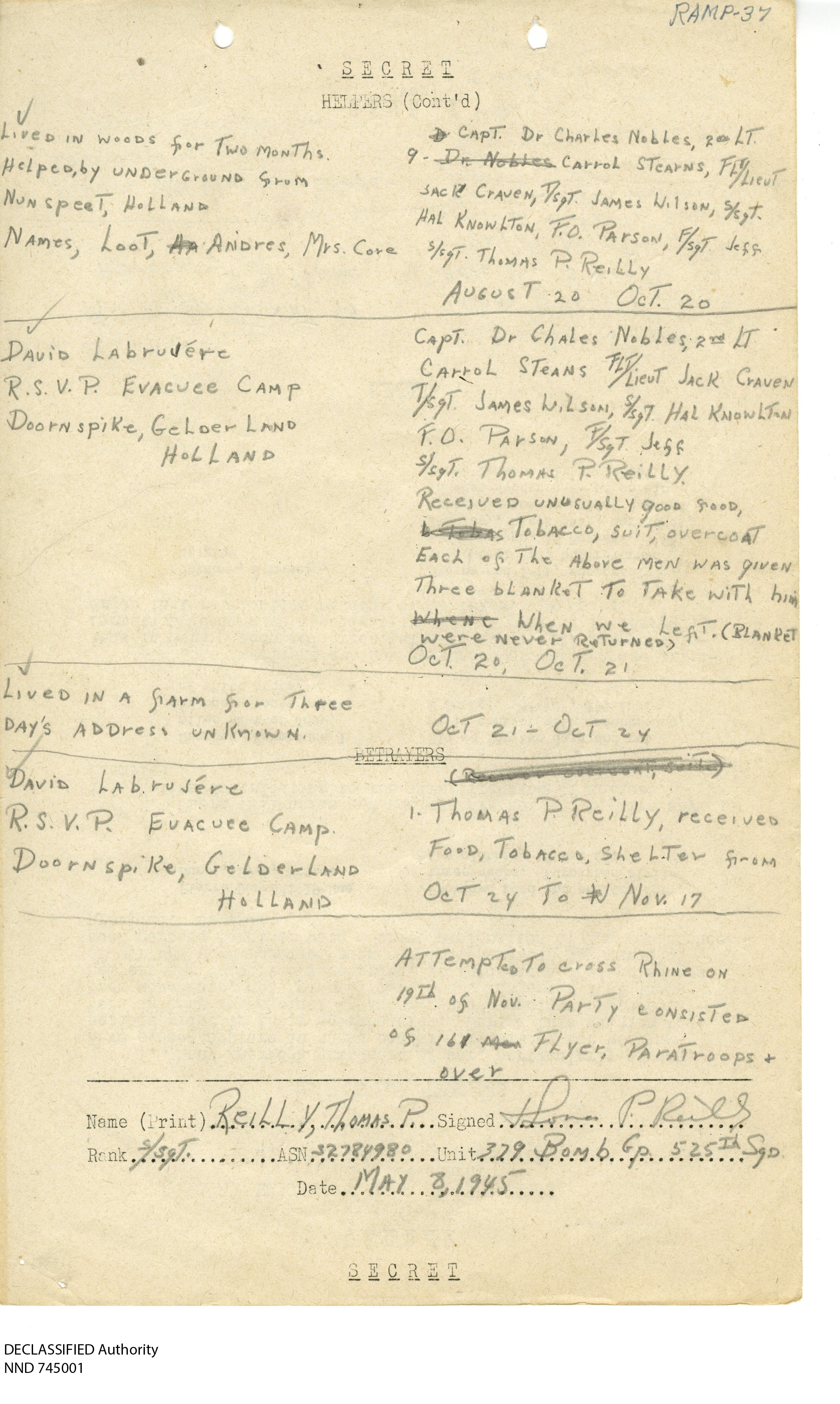
- An American's list. S/Sgt Thomas P. Reilly, 379th Bomb Group, wrote on 8 May 1945 of the men who "Lived in woods for two months", "Helped by underground from Nunspeet, Holland": "Capt. Dr Charles Nobles", Carrol Stearns, Jack Craven, James Wilson, Hal Knowlton, "F.O. Parson", "Jeff" and himself (the sheet, RAMP-37).
- Then the "R.S.V.P. Evacuee Camp, Doornspike" of David Labrusère on 20 and 21 October, "a farm for three days" until 24 October, and the evacuee camp again "Oct 24 to Nov. 17", before an attempt to cross the Rhine "on 19th of Nov." by "161" men.
- ✓ Craven, Parson, the evacuee camp and 17 November are in Noble's own report. ⚠︎ Reilly's "August 20 Oct. 20" for the woods are his own dates, since Noble was captured on 19 September, and the ranks run together as Reilly wrote them.
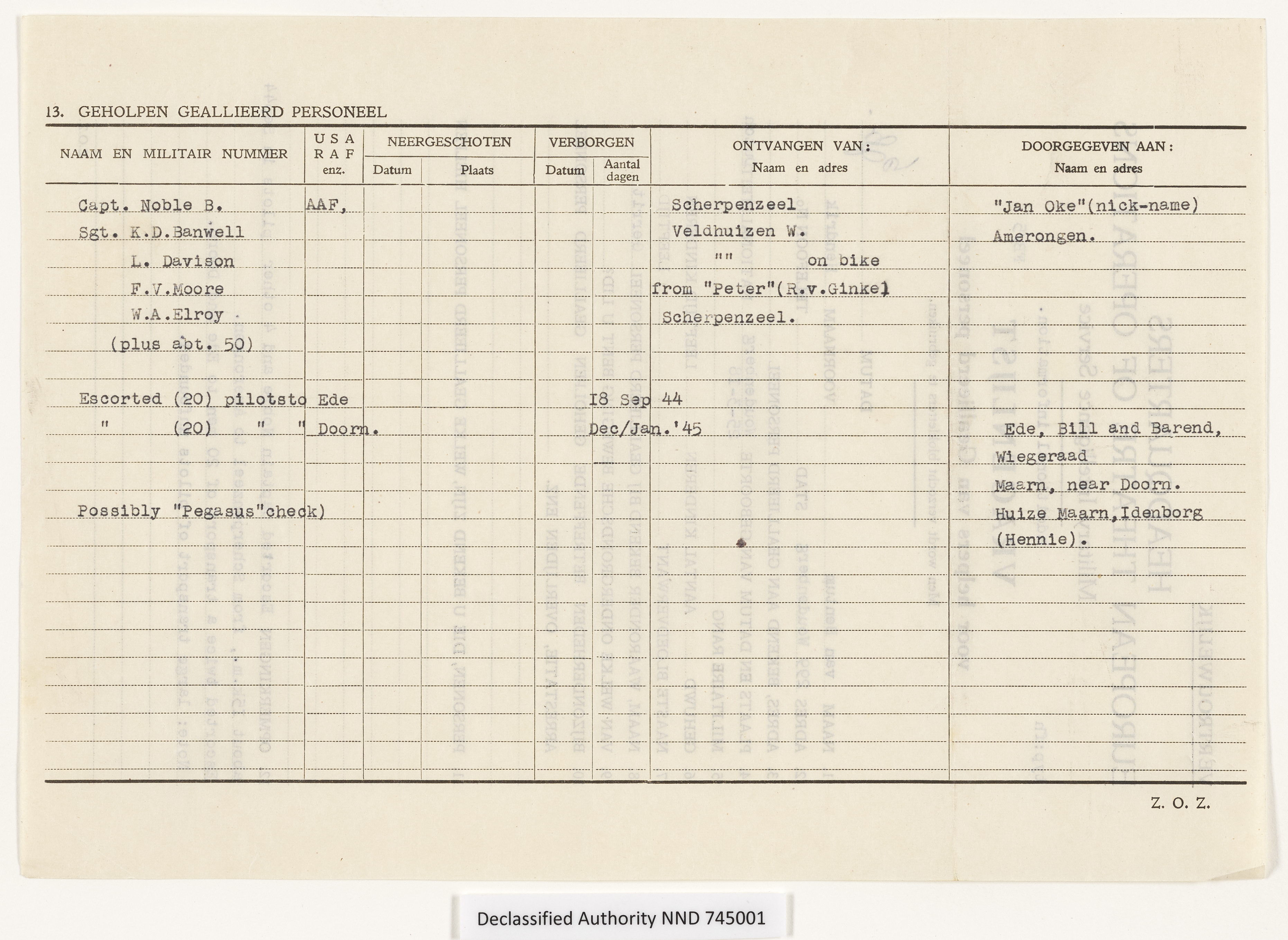
- Hannes. Johannes van de Brake, "Hannes", of Soppenhof, Doornspijk (R.v.V., N.B.S.), lists "Charles Nobel, Airborne Div. Arnhem", hidden "28-10" to "19-11", 21 days, received from "Group Oud Putten" and passed to "Transport over the Rhine" (p. 14). ✓ He is the "farmer 'HANNES'" whose dwelling Noble puts "close to that of the BRINK's", where he and Parsons stayed (Noble); his helpers include H.J. v.d. Brink of Elburg (p. 4).
- The RAF man beside him. Another sheet has "Kenneth, Captain Nobel, paratrooper from the Army that landed in Arnhem", 21 days, from "Nico Rabonnet [sic]", "Give him to a transport for over Rhine" (p. 16); a line beneath Noble's on p. 14 has "Kenneth", R.A.F., from Heerde, "same", 21. ◐ He is very probably the Flt/Lt Parsons of Noble's report, whom Noble's later account calls "Ken Parsons" (below); the form gives no surname. ◐ Noble's "NICK", the organiser, is Nicolaas Rambonnet of Huize "Old Putten" (p. 4, p. 16), by the name only.
- Back to him. v.d. Brake's remarks read "Captain Charles Nobles, airborne army, military doctor, landed near Arnhem, returned to me in June 1945" (p. 4).
His later account of the camp and the farm:
- Pas-op. ◐ The camp held 80 to 90 people in the account and about 80, mostly elderly Jews, in the report, which puts it near Elburg and has him there two weeks (his later account; Noble).
- ⚠︎ The account alone has "The ‘Pas-op’ camp is south of the road from Tongeren to Gortel", the Jews from Rotterdam and Amsterdam, in huts, his own hut shared with young Jews and two Americans; he did "the odd round of the various huts", the food was "pap" once a day, and his admiration for the people who fed ninety in hiding "has never ceased" (his later account).
- The other British. ◐ "Ken Parsons was one of them, Jack Cremer was another. The third man’s name I cannot remember" (his later account). The report's three are the flight lieutenants Blakeney, Parsons and Craven, and Reilly's list has "Jack Craven" (Noble; Reilly): ◐ "Cremer" is very probably John Craven.
- Away from the SS. ⚠︎ On a warning that Belgian SS were entering the wood, the underground came with bicycles, and he rode off with one of the Americans, "Carl Sterns" (◐ Reilly's "Carrol Stearns", the report's "2/Lt. STERNE"), to a crossroads near Elburg; a retired Dutch officer looked after them for a day, then a house in Elburg (his later account). The report has everyone moved on news of the SS to the evacuee-camp supervisor's house for two days (Noble).
- The farm on the Zuiderzee. ◐ He and Ken Parsons stayed "about two weeks" in a house on the shore between Doornspijk and Nunspeet, where he learnt to thresh wheat and German deserters came for food (his later account). The report has three weeks with Parsons at Jan van den Brink's farm near Doornspijk, on the shore (Noble); v.d. Brake has 21 days (above).
With Murphy
Link to the section With Murphy◐ He was very probably in the party Murphy's group joined after Pegasus II. Noble's own report has him one of about twenty collected in a barn near Elburg and taken in a lorry, disguised as labourers, to the Ede–Otterlo road, where "we were left at the wrong spot and so missed" the main column; they were told to wait in a wood, "Our numbers by this time had swollen to about 24" (the reconnaissance for food was with Capt. Redman, RAMC, the officer who had jumped from the train with Leslie Davison), and after two nights a cart took them to a barn where they spent five days (Noble). Hardy has Murphy's small party, lost at a fork on the night of the 17th, joining "another party of evaders, about 20 in all", Davison and Moore among them, on the night of the 18th, staying in the wood with them the rest of that night and the next day, and leaving at three in the morning of the 20th, when Banwell stayed with the larger party (Hardy); Noordman has the twenty from Elburg, Davison among them, set down in the wrong place, and the group left in the wood fetched with a horse and cart on the evening of Monday 20 November (Noordman, pp. 284–285; Operation Pegasus II). Neither report names the other's men except Davison, Moore and Banwell, so that Noble and Murphy shared the wood rests on the two accounts fitting.
His later account of Pegasus II, which names no one from Murphy's party either:
- The lorry. ◐ Fifteen to twenty were gathered at Elburg and driven "full-speed south to near Otterlo", stopped many times at German posts, where they said they were workers from the "Ijssel-limit" going home for the weekend; nobody came for them, and "it turned out later we were late" (his later account). His report has the lorry, two road controls, and the party "left at the wrong spot" (Noble).
- Who was there. ◐ The Americans and the three British airmen from Pas-op, "Theo Redman whom I knew from 133 Field Ambulance", and other airmen, "about twenty to twenty five"; of them all, he says, only Redman and he carried a water bottle (his later account). The report has "about 24", and Capt. Redman, RAMC (Noble).
- The wood. ⚠︎ At dawn he scouted with Carl Sterns and they ran from a German sentry hidden in the wood, guarding what he believed was a German headquarters, which Typhoons bombed that afternoon; next morning he and Redman scouted towards the Otterlo road, and on the way back two Dutch people would not believe there were twenty-five evaders until they were shown (his later account).
- The barn. ◐ Then a barn "not far from Barneveld" for about five days, with underwear and cigarettes from a drop from London (his later account); the report's barn of five days, where "DICK" brought food and clothing (Noble).
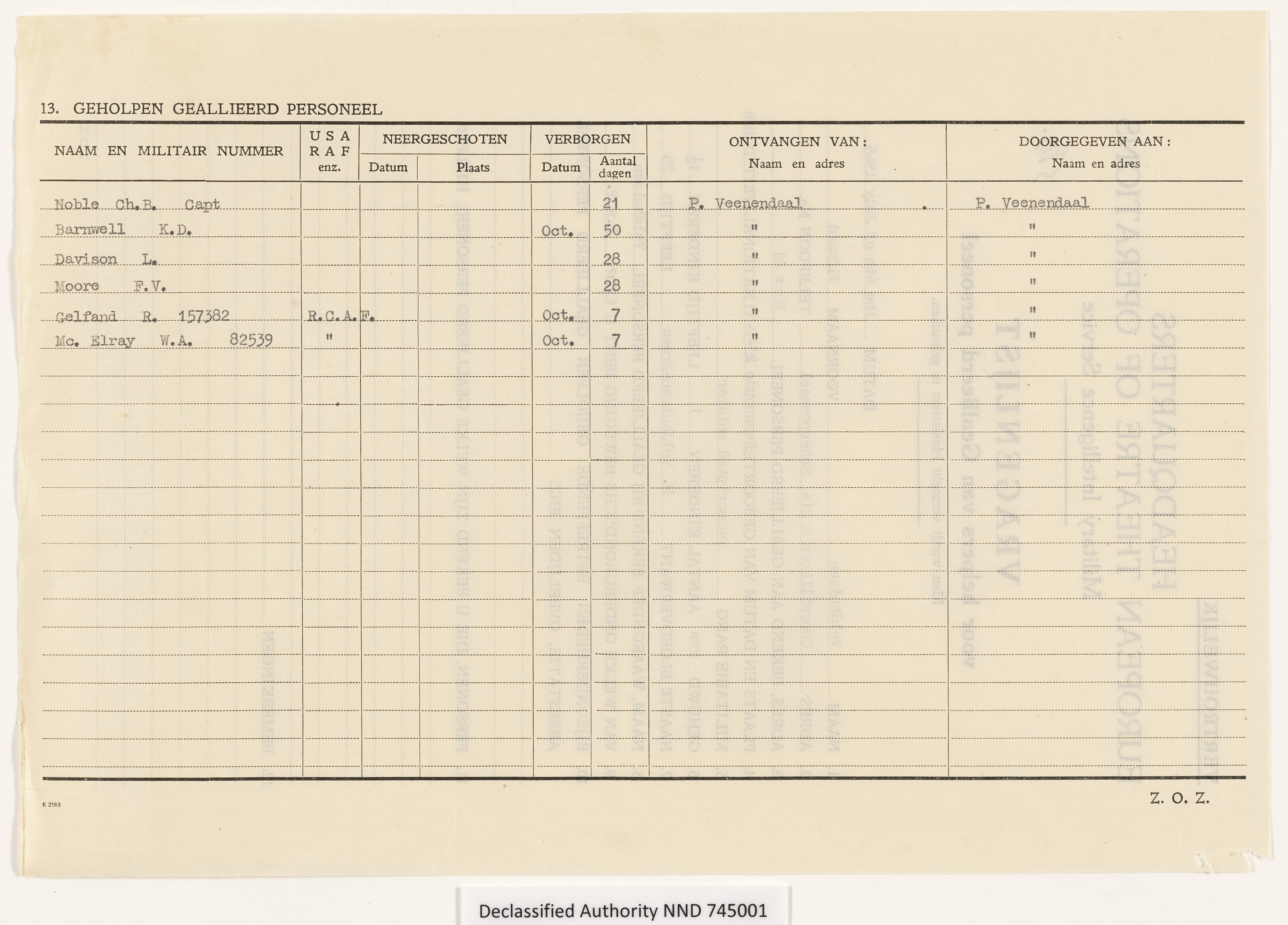
After the barn the party was split up, and Noble's road ran close to Murphy's without meeting it. At Barneveld the form made out for Dries Klooster's household lists "C.B. Noble", received from A. v.d. Heg (◐ Aart van de Heg) and passed on to the Rudolphstichting, the children's village at De Glind whose bath-house manager Noble names (Klooster's file, p. 3), and Albert van Meerveld's file has "C.B. NOBLE, 1st Airborne Div." among the men he handled, with Kubly, Stursen and Murrell (his file, p. 7). In early December, while Murphy was at the Veerman farm, Noble was nearby at Achterveld, in the house of "the manager of the penal settlement bath-house", ◐ Boke Dijkstra of De Glind; one son took him there and was arrested the following week, and after three days "another son of the bath-house manager" took him to a farm near Scherpenzeel where Tex Banwell was hiding and Leslie Davison had hidden (Noble; Fokke Dijkstra). H. van Bentum of Woudenberg, who moved men for R. van Ginkel's group and sheltered them at Barneveld, Achterveld and Scherpenzeel, lodged "Capt. Charles B. Noble" with Banwell, Davison and Moore "with unsuccessful crossings" (his letter of 18 January 1946, p. 18). The farm's own form is Wijnand Veldhuizen's, of Gooswilligen, Scherpenzeel: "Noble Ch.B. Capt", 21 days, received from and passed to "P. Veenendaal" (Piet Veenendaal, the Scherpenzeel farmer the SD raided on 15 December), on the same sheet as "Barnwell K.D.", 50 days from "Oct.", "Davison L." and "Moore F.V.", 28 days each, and two RCAF men; a typed note says his house was "the transmit-centre of all the soldiers who were on their passage through from Kootwijkerbroek to Leersum" (the table, p. 3; the note, p. 5; the form, p. 2). ⚠︎ The 21 days do not fit his own dates (below). About 16 December he and Banwell were moved to a farm at Ginkel near Leersum and then six days to an empty house in Leersum, the Berghof (Noble). ⚠︎ The Leersum helpers' forms date it differently. Joop Doornebosch wrote on 30 May 1945 of "Dr. NOBLE" and "Tex, from California":
These two men arrived on their own at Joop's. Joop was, however, told by an acquaintance that they had come from the Veluwe to LEERSUM. This was about end Nov beginning Dec. Joop sheltered them for a few days and then put them up in the Berghuis where he was still responsible for their food etc. After staying in LEERSUM for 3 to 4 weeks Tex and Doc went to AMERONGEN (see report AART No. 00251).
— US National Archives · RG 498, helper file of Johannes A. Doornebosch · answer to question 10, 30 May 1945 · p. 22
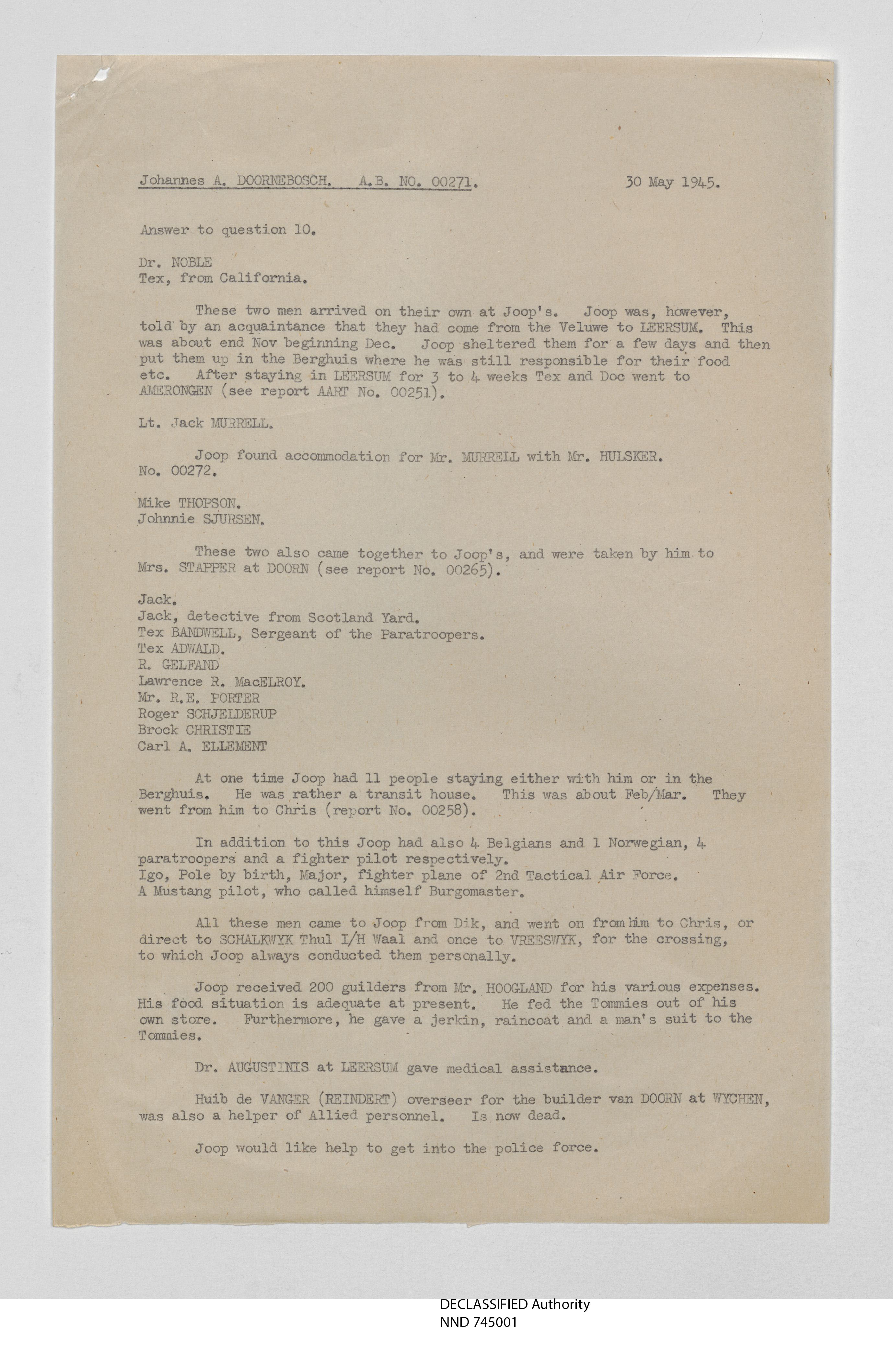
Noble's own report puts him at Leersum only from about 16 December, and the same page of Doornebosch's lists a "Tex BANDWELL, Sergeant of the Paratroopers" separately, so the "Tex" with Noble is ◐ Banwell on Noble's word, not Doornebosch's (Tex Banwell).
His later account of the weeks between:
- Barneveld. ◐ "a house in the main street in Barneveld", for about two weeks, with an RAMC other rank whose name he could not remember (his later account); the report's Klooster house, for ten days (Noble).
- A farm for agents. ⚠︎ Between Barneveld and Scherpenzeel, he says, he spent about five days at another farm "used as a collection point for the British agents who had been dropped and had radio communication with London", which he kept from his interrogators (his later account). At that point in the sequence the report has three days at Achterveld, at the bath-house manager's house; whether these are the same stay is not settled (below).
- Scherpenzeel. ⚠︎ A big farm with plenty of food, "several British including a sergeant whose name I cannot remember and a person Davison", for about ten to fourteen days; Davison, to his knowledge, was the only one of them to get back over the Rhine (his later account).
- The account puts Davison at the farm with him. The report has Davison hide there "Prior to his successful attempt to cross the Rhine" (Noble); by Davison's memoir he left on 5 December, and Noble's arrival counted back from the report's "about 16th Dec" is about 6 December (Leslie Davison).
- ◐ The report has Banwell at that farm, so the unnamed sergeant is very probably him (Noble).
- Leersum is not in the account, which goes from Scherpenzeel by bicycle to Amerongen (his later account).
Noble went on to Amerongen, where he was looked after for eight days at "the LINDENHOF, where Mrs. ROLAND-HARE-DOORN-METER and her sister in law, Mrs. Van HEYST" kept him (Noble). ◐ She is Mrs J.H.D. Rolandus Hagedoorn, whose own statement says:
Charles Noble, parachutist, came down near Arnhem 18 Sept., was brought by Luuk about 25 Dec. and was hidden by Mrs. Hagedoorn until 5 January. Then he too was collected by Esveld for a crossing.
— US National Archives · RG 498, helper file of Mrs J.H.D. Ronaldus-Hagedoorn, Amerongen · answer to question 10, 28 May 1945 · the archive's copy
◐ His later account has "a house in Amerongen called the ‘Linden’ house" and its lady, as the report has the Lindenhof and its lady (◐ Mrs Rolandus Hagedoorn, above) (his later account). ⚠︎ The account alone has her husband, who "I think had been the Mayor of Amerongen", and her four daughters, and about ten days reading from her library and playing Monopoly with the daughters at night while across the river "every night there was a huge barrage" (his later account); the report has eight days, and the lady with her sister-in-law (Noble; below).
She also had the "Captain George Nikol, agent of the English", brought and collected "by Esveld" (p. 4), ◐ Coen Esveld, who by Flip's statement took Mikol to Maarn. ⚠︎ It is not settled whether Mikol was the "Engelsch spion" (English spy) who, by the Dodewaard police report of 29 June 1945 as a note on Hendrik van der Mheen's identification card gives it, went into the Betuwe by the Ingen ferry on 27 January 1945 with the van der Mheen brothers, who had hidden at Amerongen (the note; George Mikol). Berend "Flip" Esveld's list for the Americans puts him with ◐ Murphy and Hardy, by our reading of the names (Mrs Esveld's statement has "Tom MERPHY" and "James, or Jim", p. 5): "Jimmy and Tom, 2 Engl. paratroopers from Arnhem", then "Charles, English Capt. Doctor", beside the note "Crossed them personally to English lines near Dodewaard, with a transport of 12 men allied personnel" (Flip's file, p. 10). ◐ Porter saw a doctor captain with a British private and a sergeant a week before the crossing, and Noble was the only doctor captain in the party: "an English Private, a Sergeant and a Captain, (who was also a Medical Doctor Paratrooper,) who were also going to go with us", Amerongen, between Christmas and New Year (Porter, ch. 5 p. 139; Christmas 1944).
On 2 January "the local Underground leader arrived and stated myself and 12 escapees were being taken through the line that night". At 4 p.m. Noble cycled with him "in civilian clothes over uniform to the AMERONGEN FERRY, where the Rhine was crossed without incident", to the meeting place "about 300 yards West of the RHENEN bridge"; the party "included one or two German deserters and Poles and 2 Dutchmen". After dusk a German patrol passed and the guide for the second stage was lost; at about 11 p.m. they reached "the brick factory on the river bank opposite WAGENINGEN", and a mile south, on the main road, "at about 20 yards range a machine-gun opened up, after a challenge. The party scattered and we rolled off the road down the dyke." Noble hid in a hollow tree, answered a sentry's challenge with "Heil Hitler", ran, and was ringed in a flooded field under flares: "I made 3 attempts to reach the Southern end, but the Germans gradually closed in and I found myself inside a ring of Germans without any cover … I surrendered." He believed Schjelderup, Gri, "an RAMC Private" (Hardy) and a Dutchman got through (Noble). Schjelderup's nominal list has "Capt. NOBLE … 133 Fd. Amb." beside "Pte. MURPHY, T." and "Sgt. BANWELL, K.", and at the first shooting "We lost, and never saw again, one Dutchman and the following three men: Capt. NOBLE, Sgt. TEX (?) [Banwell], Pte. MURPHY" (Hardy, Schjelderup's report; The crossing and recapture). His questionnaire: "Do not know fate of the 8 people with whom captured in Jan. In particular Sgt. Banwell, AAC." (Noble). The guide's side, from Adriaan Maljers, is on The Dutch guides; a Betuwe local-history page names "Thomas Murphy … Captain Charles B. Noble … Sergeant Keith D. Banwell" among the paratroopers lost that night, from the British and Canadian reports (Oorlogsslachtoffers Betuwe-West).
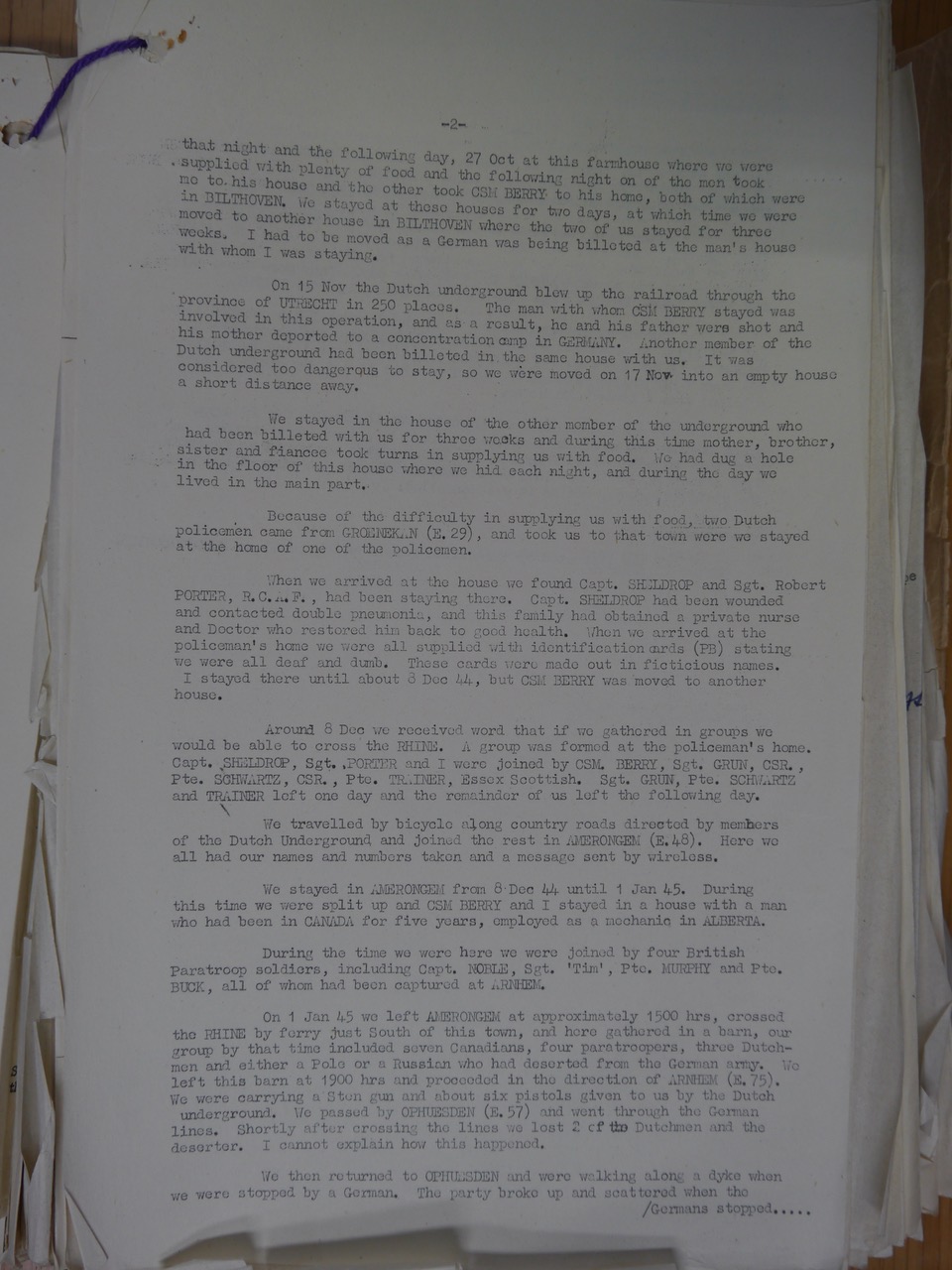
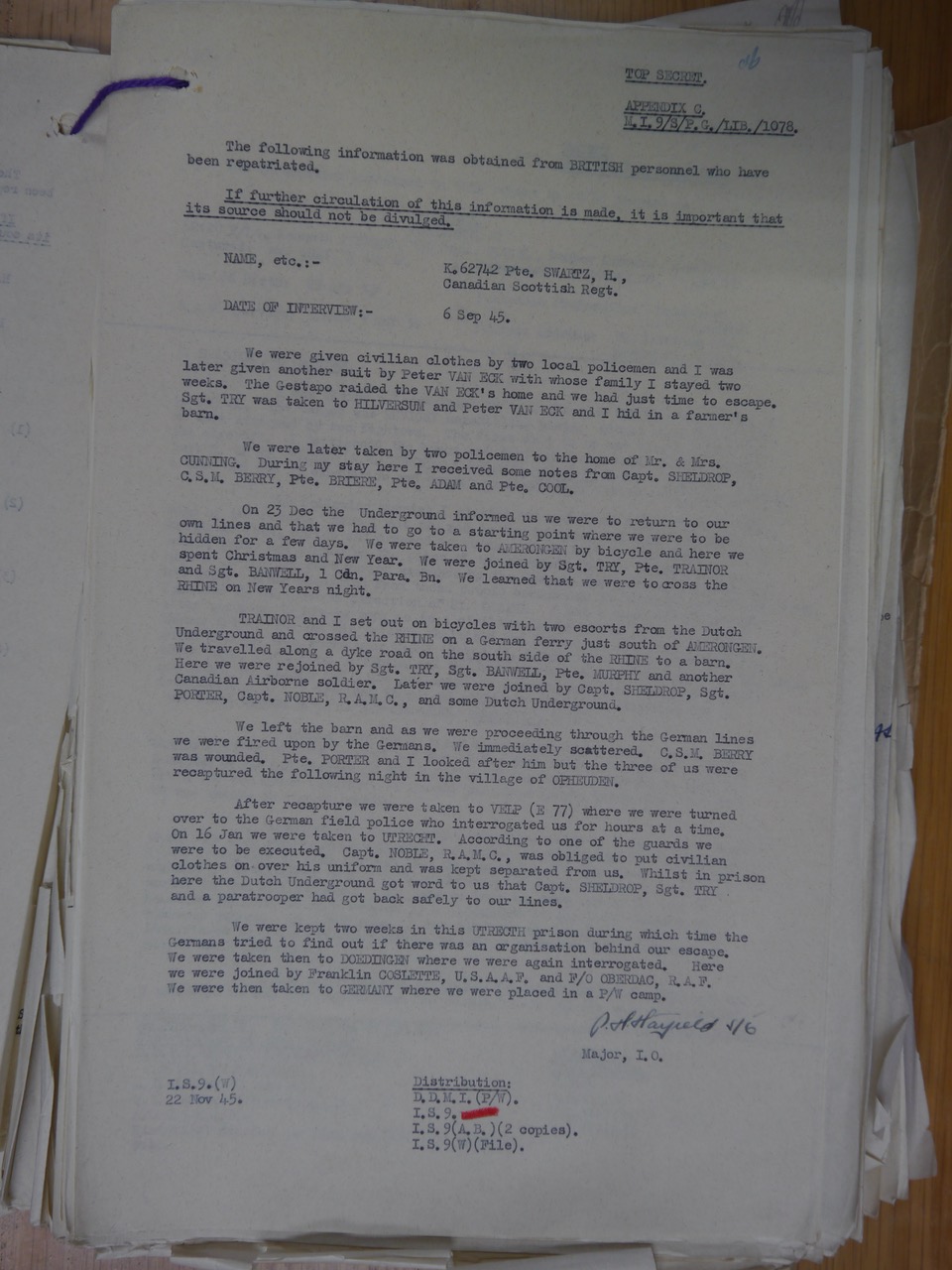
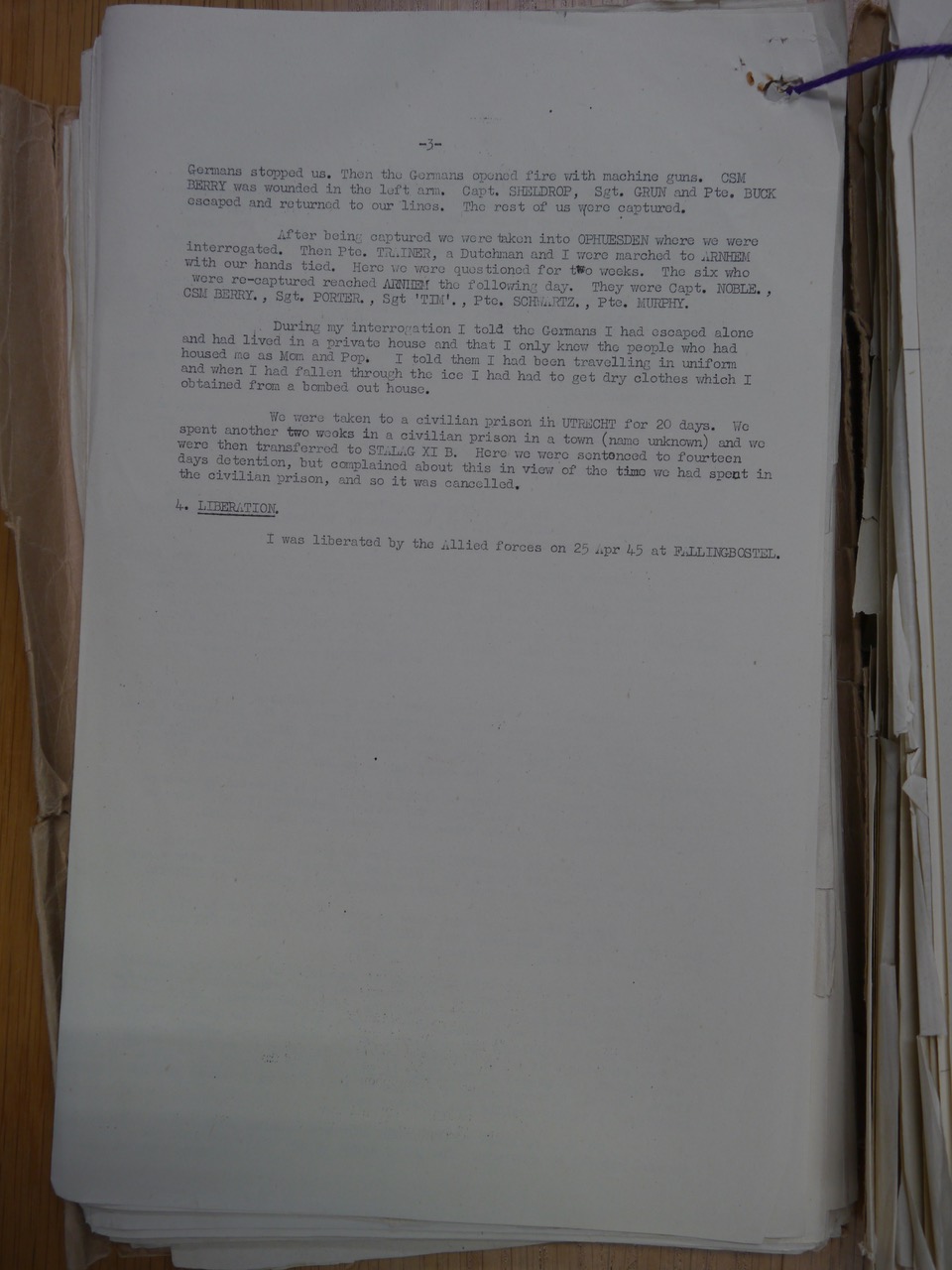
✓ The Canadians' own MI9 reports have him in the party with Murphy; the photographs of them were taken at Kew by the late John Howes, who passed them to Lisan Koppenol, and she sent them on. Swartz names "Capt. NOBLE, R.A.M.C." among those who joined them at the barn south of the Rhine, after "Sgt. TRY, Sgt. BANWELL, Pte. MURPHY" (Swartz's Appendix C); Briere has "Capt. NOBLE, Sgt. 'Tim', Pte. MURPHY and Pte. BUCK" joining them at Amerongen, and Noble first among "The six who were re-captured" who reached Arnhem "the following day", undated, Murphy last (Porter's book has a different six, the army doctor among them but not Murphy: Porter's page) (Briere, pp. 2–3); Berry has "a British Medical Captain, Capt. NOBLE, R.A.M.C." at the barn (Berry, p. 2). Swartz adds that at Utrecht "Capt. NOBLE, R.A.M.C., was obliged to put civilian clothes on over his uniform and was kept separated from us".
His later account of the crossing and the capture, which names no one in the party:
- The ferry. ⚠︎ Disguised as farm labourers, they were taken to "the German ferry run by the German Army near Amerongen at a place called Elst" and "taken over uneventfully by the Germans to whom we paid a small amount of money", then went by bicycle to a farmhouse beside the dyke on the south bank (his later account). The report has "the AMERONGEN FERRY, where the Rhine was crossed without incident" (Noble).
- The walk. ◐ After dark through the polders over frozen ground, the frost thought hard enough not to set the mines off, with two guides (his later account); the report has the frozen ground, the minefields and two guides (Noble). ⚠︎ The account has eight or nine miles, past signs reading "Achtung Minen", and, he learnt later, "fifteen Canadians" coming out from the line to meet them (his later account). The report has "about 3 miles" and a British patrol (Noble; below).
- The second guide. ⚠︎ "One malfunctioned, dropped near us and killed our second guide plus a cow": a V-1, he says, on its way from the Arnhem area to Antwerp (his later account). His report of 1945 has the guide for the second stage "lost" in the confusion when a German patrol passed (Noble).
- Elsa Caspers has Coen Esveld, ◐ one of that night's guides, killed by a V-1 on a later attempt, which she dates 29 January 1945 as the day of his last attempt, not of his death (Caspers, To Save a Life, p. 66).
- The Dodewaard burgomaster's letter of 1953 has him leave with three others "vermoedelijk op 27 Januari 1945" (probably on 27 January 1945) (the letter; Coen Esveld).
- The dyke house. ⚠︎ Past a brick factory burning across the river and beyond Wageningen, they found a deserted dyke house full of loose Canadian ammunition, took it, "wrongly as it turned out", for Canadian ground, lit cigarettes and went east along the dyke road shouting, until "a German voice yelled at us to halt and opened fire with a machine gun, a dug-in machine gun about forty yards away"; they rolled off the dyke (his later account). The report has the guide insist on the road, and the machine-gun at about 20 yards (Noble).
- Taken. ◐ A hollow tree for about an hour; "Heil Hitler" to a sentry, who fired; a flooded, frozen paddock where he stood still under each flare and was heard each time he moved, until "there were about ten all around me. So that was that." (his later account). The report has the same hollow tree, the challenge and the ring of Germans in a flooded field (Noble).
- His captors. ⚠︎ "Luftwaffe personnel of the Hermann Goering Division"; their officer told him he had a wet army uniform under his overalls and suggested he take it off, and he kept it on, which he later called "a major mistake"; then a rowing boat over the Rhine to a headquarters at Rhenen or Wageningen, "That was the second of January", where the officers' New Year party was still going at three in the morning and he sat with them till five (his later account).
He was "taken to the RHQ and from there sent to Div HQ, Counter Intelligence at VELP, having been captured in civilian clothes", and "For the next 8 weeks I was kept in strict solitary confinement, the last 5½ weeks being in the Gestapo Prison at Utrecht and Doetinchem" (Noble). ◐ He is very probably "the Medical Officer prisoner with me" whom Murphy remembered holding identity card No. 11, marked like his own No. 12 "SPIONE VOORSICHT / NOCH NICH VERHOORT": the only medical officer among the three men lost (p.2; Recapture, interrogation, captivity). Maljers, by his own statement arrested with "the 7 Canadians" (Maljers, p. 17), was taken after about three weeks "samen met zeven geallieerde militairen naar de gevangenis Wolvenplein in Utrecht" (together with seven Allied servicemen to the Wolvenplein prison in Utrecht) and later to De Kruisberg at Doetinchem (Maljers), which is Noble's route; Noble is on the Doetinchem memorial foundation's list of Allied prisoners of De Kruisberg, "Charles Noble, Britse arts" (British doctor) (Doetinchem Herdenkt). ✓ The British enquiry of June 1945 confirms that the Doetinchem of his report was De Kruisberg (The 1945 enquiry). ⚠︎ That is where the evidence stops for Murphy. Velp, the Wolvenplein and De Kruisberg are documented for five Canadians, Noble and the guide; Murphy is not on the Kruisberg list, names neither prison, and nobody who was in them says he was. That he was one of Maljers's "seven Allied soldiers", five Canadians, Noble and one of Murphy or Banwell, fits the numbers; it is a reading, not a record (Where the evidence stops).
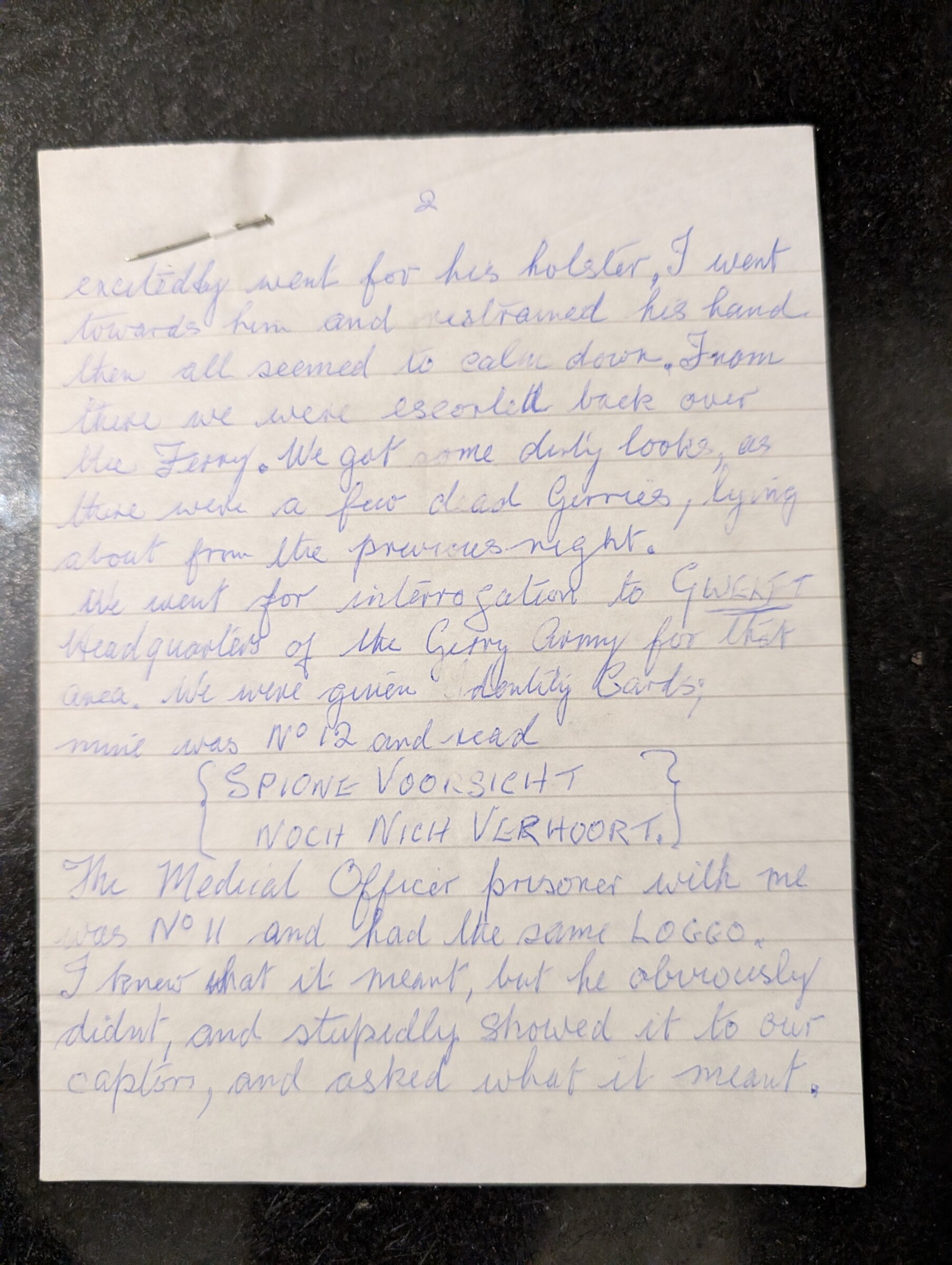
His later account of the interrogation:
- A spy's card. ⚠︎ The commandant "thought I was a spy" and took him to an interrogation centre at "Roosendaal" (◐ very likely Rozendaal, the village beside Velp, misspelt; Velp in the war), where he was given "a card with ‘Spion van Dyk’ on it"; questioned there every night, he was walked each morning, hands tied, "through Velp down to Arnhem", to a Feld Gendarmerie house where he spent the day (his later account).
- His questionnaire has "Arnhem (Velp, 1st Parachute Div, Counter Intelligence)" (Noble).
- ◐ Murphy remembered the medical officer's card as marked "SPIONE VOORSICHT" (above); the words on the two cards differ.
- Three weeks. ⚠︎ About three weeks of it: "The process was to keep people cold, hungry, frightened and deprive them of sleep"; the interrogator was a Lieutenant Enk, who spoke English "with an Irish accent"; they thought he had come through from the British lines, and for a time that he was "Michael Dark, who was in charge of the SAS in the area around Wageningen" (his later account).
- He kept back the farm used by British agents (his later account).
- His report has a "Capt. Michael KING, SAS" (Noble), discussed on Gilbert Kirschen's page; none of the sources we hold names a "Michael Dark".
- The end of it. ⚠︎ The head of the Feld Gendarmerie took an interest in him and had him given new clothes, and a young Obergefreiter who spoke French became a friend on the walks; when he felt his resistance weakening, "it just happened that at that time they stopped interrogating" (his later account). His report: "Interrogation was intensive during the first 2 weeks, but for the last 6 weeks intermittent" (Noble).
◐ Tjeerd Holwerda, who led the underground at Maartensdijk, wrote in 1946 that of the men taken on to Amerongen some were arrested "and taken to prison in Wolvenplein, Utrecht", naming "Swartz, Berry, Trainor, Porten, Briere and le Noble. The latter is not known by me" (his statement, p. 8); "le Noble" is very probably him. Mrs Hagedoorn "heard later that he had been maltreated by the Germans on the Wolvenplein at Utrecht and later in Brunswick" (her file, p. 4). His own list of his prisons has the Gestapo prison at Utrecht, 18 January to 7 February 1945, and Arbeitskommando 7001 at Hallendorf, near Brunswick, from 6 March (Noble). The list ends there on 11 April 1945, and his POW questionnaire is dated 26 April; his liberation report is WO 208/5274/1233 (the catalogue), and he wrote his escape report on 23 September 1945 (Noble).
At the Kruisberg he was in touch with the outside. G. J. te Gussinklo, "Frederik", of Aalten, bribed an N.S.B. guard to bring food every day to the ten Allied soldiers and officers held there; after a few small notes came "een uitgebreid relaas van Captain Noble (van de R.A.M.C.)" (a long account from Captain Noble), describing treatment by the Germans "meer dan beestachtig" (worse than bestial). With the K.P. at Zutphen a raid on the prison was prepared, the guard Roeleveld supplying details, and Frederik asked Noble how many weapons should be smuggled in so that the raid could be helped from inside; no answer came, because the guard was caught and put in a cell, and the tighter watch after that ended the contact. The file lists "Captain C.B. Noble, Portland Park 279738 Hamilton Scotland. R.A.M.C." as held in the Kruisberg (Reussink's file, p. 8).
His later account of Utrecht, Doetinchem and Germany:
- To Utrecht. ⚠︎ Told he was being sent to the Sicherheitsdienst, he was walked by two Luftwaffe guards from Arnhem to Ede by the lower road along the river, and taken on in a cattle truck to Utrecht, where at a crowded guardroom door, he says, he could have walked away and did not (his later account).
- The Canadians. ◐ The Canadians were at Utrecht when he was, about five of them, "who had been on the dyke when we had been shot at" (his later account); Swartz has Noble kept apart from them there (Swartz).
- ⚠︎ The account alone has them brought into the waiting room of "the wrong prison", whom "I had not seen" at Velp, and a German who spat in his face, "one of the few times I was physically touched by the Germans", and apologised when told he was an English doctor (his later account).
- The Wolvenplein. ◐ Prison clothes, three weeks alone in a cell that was warm because the central heating could not be turned off, "This time we were into February", a book every five days, once questioned by a Luftwaffe corporal; the Canadians were in two cells (his later account). His list has Utrecht from 18 January to 7 February (Noble).
- Doetinchem. ◐ After the Gestapo headquarters in Utrecht, a truck by night to Doetinchem, with Canadians in the next cell (his later account); his list has Doetinchem from 7 to 25 February (Noble).
- ⚠︎ The account has "a very unpleasant two weeks where there was no food", cold, one blanket, a wet cell, and with the Canadians two Americans who "had both been court-martialled and had both been sentenced to death" and a Pole who "knew he was going to be shot" (his later account).
- The War Office message of 5 May 1945 has him at the Kruisberg "IN JAN 1945 BEING MALTREATED AND STARVED BY SS TROOPS" (the message).
- His report gives the diet of his eight weeks in solitary as "150 grams of bread and 750 cl's of soup daily" (Noble).
- Frederik's bribed guard brought food every day to the ten Allied prisoners held there (Reussink's file, p. 8).
- ⚠︎ The account has "a very unpleasant two weeks where there was no food", cold, one blanket, a wet cell, and with the Canadians two Americans who "had both been court-martialled and had both been sentenced to death" and a Pole who "knew he was going to be shot" (his later account).
- "Tell your people that I am here". ⚠︎ By then his Dutch was good enough, he says, to give his name to Dutch staff with that message, several times (his later account). ◐ Frederik's notes through a bribed guard (above) are a record of the time of messages from him reaching the resistance; that they are what he meant is our reading.
- Into Germany. ◐ Declared a prisoner of war after two weeks, he went by "Bocholtz" to Fallingbostel for a week and then to "Hahndorf" (his later account); his list has Stalag XIB, Fallingbostel, from 28 February to 6 March, and Hallendorf near Brunswick from 6 March (Noble).
- The SD, and "Tex". ⚠︎ About a fortnight after he left Fallingbostel, he says, the SD came looking for him and the Wehrmacht knew nothing of him: "One of the people that night actually finished up in a concentration camp. That was a sergeant called Tex." (his later account). It is one man's memory, long after, and does not say how he knew. In his questionnaire of 26 April 1945 he wrote "Do not know fate of the 8 people with whom captured in Jan. In particular Sgt. Banwell, AAC. (Reported sent back to Gestapo in Holland from Stalag XIB)" (Noble).
- ◐ The "Tex" is Banwell on the strength of Noble's own questionnaire, which names "Sgt. Banwell, AAC" in particular after "the 8 people with whom captured in Jan."; his report also has "Sgt. BANWELL" with him at the Scherpenzeel and Ginkel farms (Noble).
- ◐ That the SD took Banwell from Fallingbostel is also in the questionnaire, "Reported sent back to Gestapo in Holland from Stalag XIB": a 1945 record, but Noble's own and reported, not seen. ⚠︎ "Concentration camp" is in the later account alone.
- The later accounts of Banwell's fate, and where they disagree, are on his page.
- "Oh, he was shot". ⚠︎ At the end of the war, in Brunswick, he met a man looking for prisoners whose fate was unclear, asked after "Charles Noble who had been in Doetinchem", and was told he had been shot (his later account).
The road to the Kruisberg, as the Canadians tell it
Link to the section The road to the Kruisberg, as the Canadians tell itPorter, taken from the same party after the firefight, walked part of the same road with a British Army doctor, "the doctor" or "the Army Doctor" in his book, who is ◐ Noble: Briere's and Swartz's reports have Noble with the Canadians after the capture, and he was the only medical officer in the party. Porter never names him, Murphy or Banwell (Porter, ch. 6):
- After the firing, "Louis, Marcel, Harvey, and the doctor from the Army all showed up", and the Germans "told us many times that, as we were captured in civilian clothes and armed, we were classified as spies so not protected by the Geneva Convention, so they could shoot us" (p. 150).
- "Wilf, Louis, Harvey, Marcel Briere, the Army Doctor and myself were taken to Arnhem", and held "in a house that the Germans had taken over after the paratroopers came" (p. 151). Of the interrogations, "They kept referring to us as spies and threatened to shoot us many times" (p. 155); one was "at three or four o'clock in the morning" (p. 157).
- Arnhem for "a week or so", then "a big prison in Utrecht called 'Wolvenplein Prison' where we were very well guarded, one for each of us … The prison was run by the German SS" (p. 159); "at least three weeks" there (p. 162); then a "very well-guarded concentration camp", "the Kruisberge at Doetinchem" in his belief, "the end of January" (p. 165).
On the doctor himself:
The doctor, a British Army medical officer who was captured with us, was also being held in the same house as us. He was tough and kept himself perfectly dressed. … He had a double guard as he was always trying to escape … He had a little more freedom to do things than we had, as he was a major, and had been captured in uniform and with ID. The Germans were not threatening to shoot him and treated him as a proper POW
— Bob Porter · The Long Return (1997) · ch. 6, p. 153
⚠︎ Porter's doctor does not match Noble's own report on two counts: Noble was a captain, and was taken "in civilian clothes" over uniform and kept in strict solitary (Where the sources disagree). Porter's "end of January" at Doetinchem also sits against Noble's own dates, Utrecht from 18 January to 7 February and Doetinchem from 7 February; Porter wrote fifty years on, and the two accounts are not reconciled.
The memorial foundation that keeps the Kruisberg's story describes the place:
From 5 September 1944 to 27 March 1945 the Sicherheitsdienst held hundreds of people prisoner at De Kruisberg: men and women of the resistance, and Allied servicemen.
Dutch originalVan 5 september 1944 tot 27 maart 1945 hield de Sicherheitsdienst honderden mensen gevangen op De Kruisberg: mannen en vrouwen uit het verzet en geallieerde militairen.
Its list of Allied prisoners has "Charles Noble, Britse arts" (British doctor). A Canadian airman held there in December 1944, Sgt Jean Louis Warren, called it "an S.D. special prison for transients going to GERMANY" (Warren). Murphy's own words on those weeks are in Told we were to be shot; Noble's report is the one contemporary account from inside the same net, and it never names him.
The 1945 enquiry into the Kruisberg
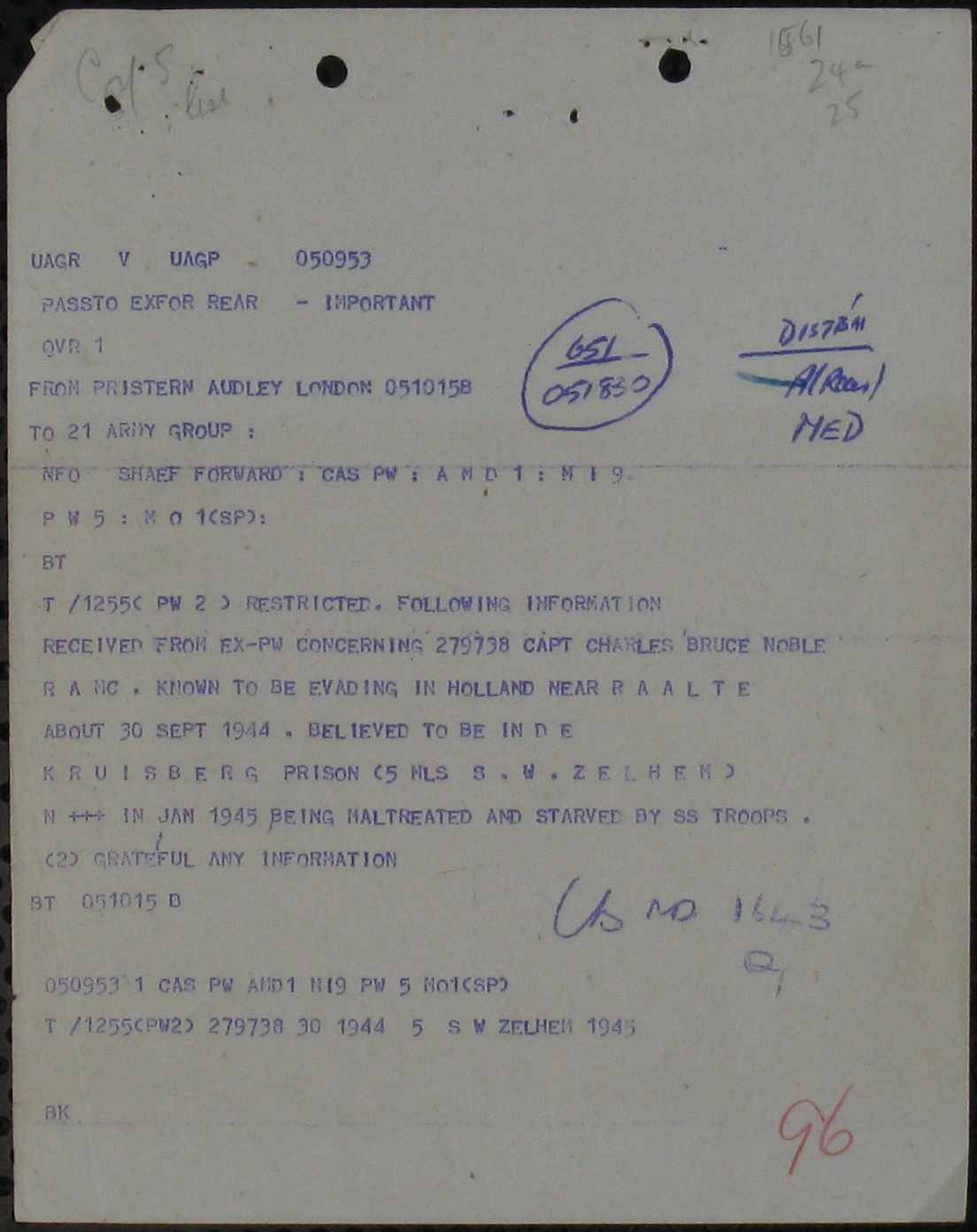
Link to the section The 1945 enquiry into the KruisbergOn 5 May 1945, nine days after Noble had filled in his questionnaire as a freed prisoner, the War Office passed to 21 Army Group what an ex-prisoner had told it:
FOLLOWING INFORMATION RECEIVED FROM EX-PW CONCERNING 279738 CAPT CHARLES BRUCE NOBLE R A MC . KNOWN TO BE EVADING IN HOLLAND NEAR R A A L T E ABOUT 30 SEPT 1944 . BELIEVED TO BE IN D E K R U I S B E R G PRISON (5 MLS S . W . Z E L H E M ) … IN JAN 1945 BEING MALTREATED AND STARVED BY SS TROOPS .
— War Office (PW 2) to 21 Army Group · teleprinter message T/1255 · 5 May 1945 · the message
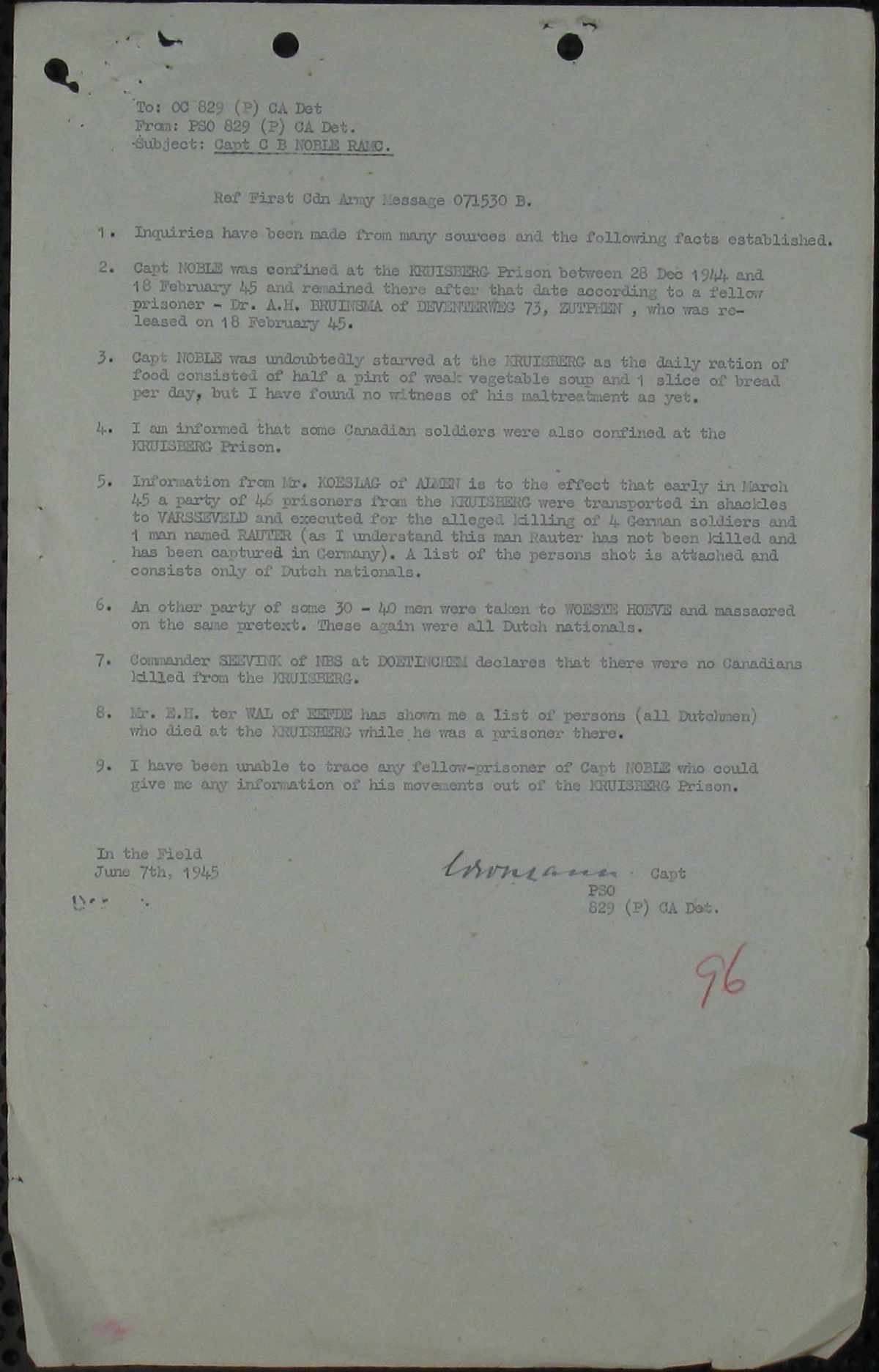
The question went down through First Canadian Army to 829 (P) CA Det, and its PSO reported on 7 June:
Capt NOBLE was confined at the KRUISBERG Prison between 28 Dec 1944 and 18 February 45 and remained there after that date according to a fellow prisoner - Dr. A.H. BRUINSMA of DEVENTERWEG 73, ZUTPHEN , who was released on 18 February 45.
Capt NOBLE was undoubtedly starved at the KRUISBERG as the daily ration of food consisted of half a pint of weak vegetable soup and 1 slice of bread per day, but I have found no witness of his maltreatment as yet.
— PSO, 829 (P) CA Det · report on Capt C.B. Noble RAMC, paras 2–3 · 7 June 1945 · the report
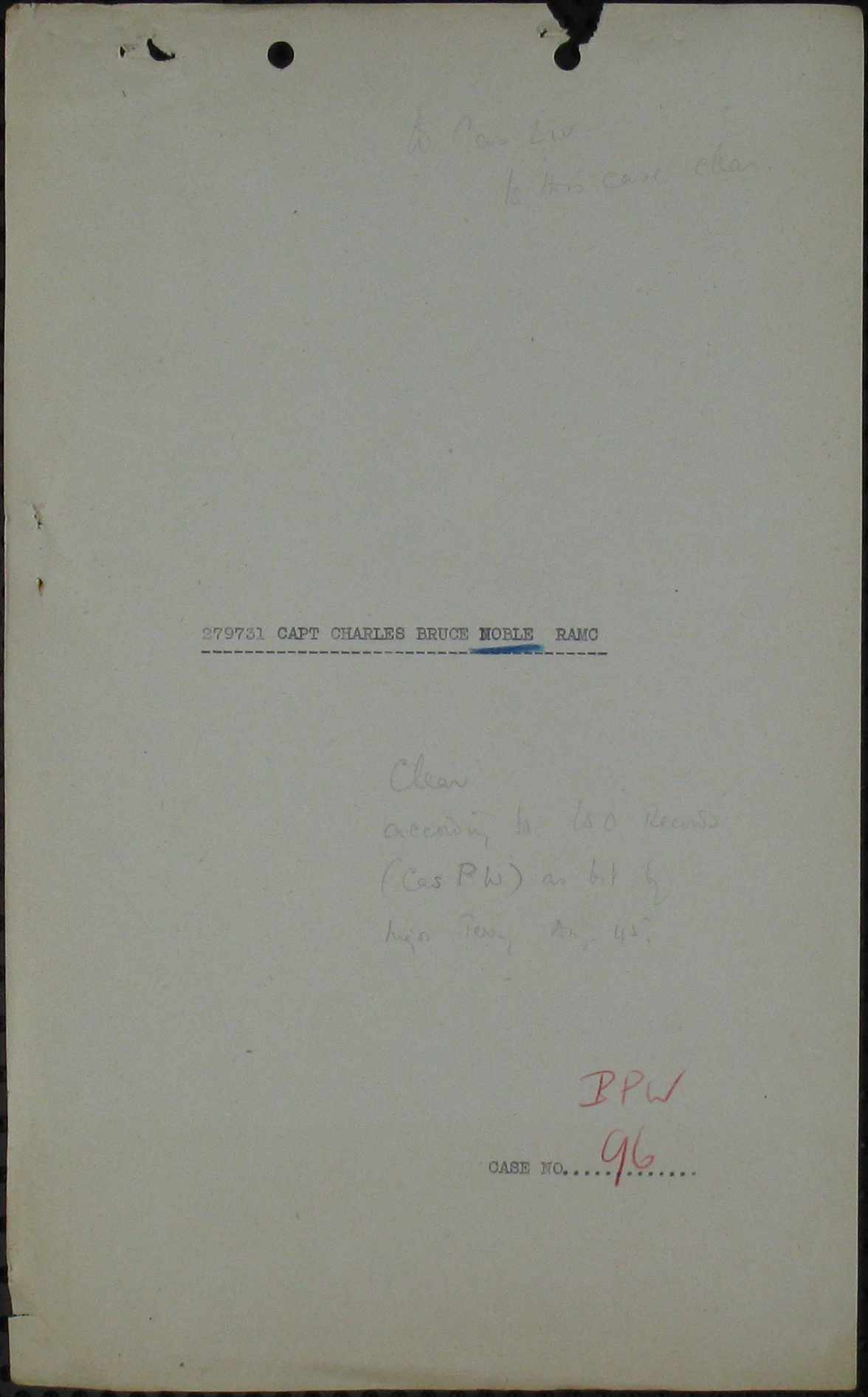
His own report gives the diet of his eight weeks in solitary as "150 grams of bread and 750 cl's of soup daily" (Noble). The PSO was also told that "some Canadian soldiers were also confined at the KRUISBERG Prison", and by the NBS commander at Doetinchem, Seevink, that no Canadians from it had been killed; he could find no fellow prisoner who knew where Noble had gone from there. He enclosed the list of the 46 Kruisberg prisoners shot at Varsseveld on 2 March 1945, all Dutch, among them Bram Baar (the list). On 15 June 21 Army Group answered the War Office: "confirmed that Capt NOBLE was confined KRUISBERG Prison between 28 DEC 44 and 18 FEB 45 (.) … no evidence yet of individual maltreatment" (the signal). The file's cover has, in faint pencil, "Clear according to WO records (Cas PW)", and First Canadian Army's papers in it give his number as 279731, the War Office's as 279738 (the file). The file names neither Murphy nor Banwell.
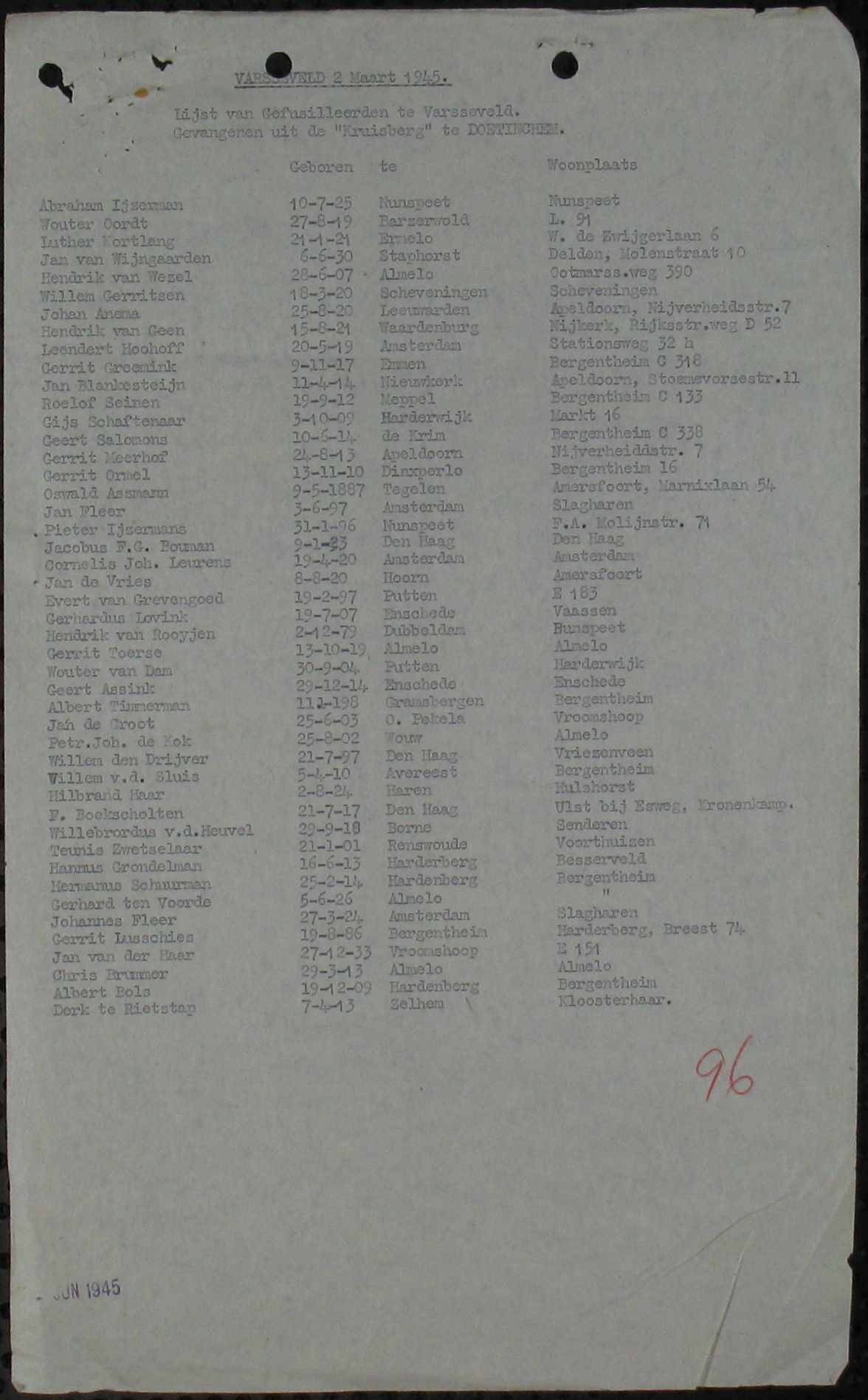
✓ So the Doetinchem prison of his own list was De Kruisberg, and he was there by 18 February, when Bruinsma was released. The dates the enquiry gives for the rest do not fit his record (below).
⚠︎ An unsigned enclosure about Cornelis Dieckmann, "Frits", of Rhenen, who worked with Doornebosch, typed in the third person on 13 July 1945, has Noble and "Sgt. Tex Bantwell" as the first two men he helped, lodged at the "Berghuis", Leersum, "from about Half Dec.-2 Jan. 45", his parents taking them food; its compiler, who is not named, added "We have to take his information with a grain of salt" (the enclosure, p. 6).
After the war
Link to the section After the war✓ The London Gazette of 29 January 1957 lists under the Royal Army Medical Corps, Emergency Commission, "Lt. (War Subs. Capt.) C. B. NOBLE, M.B. (279738), relinquishes his commn. on appointment to a T.A. commn. in New Zealand Army, 9th Nov. 1956" (supplement 40985, p. 643; read on the page image). The number is his, so he held his wartime commission until November 1956 and gave it up for a Territorial commission in the New Zealand Army.
The Royal College of Surgeons' obituary has the rest. After his release he served in Palestine with the 6th Airborne Division; then he was a clinical assistant at the Metropolitan Hospital, London, and surgical registrar at Park Hospital, Davyhulme, Manchester, and took the MRCS and FRCS in 1951. He married in 1949. In New Zealand he was consultant visiting general surgeon to the Wanganui and Patea Hospital Boards, became FRACS in 1962, and sat on the BMA council for the Wanganui division from 1970. ◐ He died on 21 December 1997 (Royal College of Surgeons, summarised there; for the date, below).
Where the sources disagree
Link to the section Where the sources disagreeHow long at Lensvelt's, and from whom. ⚠︎ Lensvelt has 1 to 8 October and 8 days, from Mondria, a marechaussee at Vaassen (p. 3); van Norel has 2 or 3 days, from himself at Emst (p. 4); and Noble's own report has him cross the IJssel on 4 October, which cannot sit with a stay from the 1st. ◐ The figures it is set against are no firmer. Noble walks three days to the canal at Delden (Wilmink has him there on 25 September), a night and a day on to Haarle, a night at de Kempenaer's, then "10 days in the camp" at Rechteren before the boat: that cannot end on 4 October. And the stages after the river add up the other way: three days in Lensvelt's house and four in the woods, two weeks at the Elburg camp, two days at the evacuee camp and three weeks at the farm make about 44 days, which counted back from the barn at Elburg on 17 November begins on 4 October. Lensvelt's 1 October, Reilly's list (the evacuee camp on 20 and 21 October, then a farm) and v.d. Brake's 28 October for 21 days fit that chain (Reilly; v.d. Brake, p. 14). So "4 October" and the ten days at Rechteren are the figures that do not fit, and Lensvelt's dates are the better-supported; no source settles the day of the crossing. ⚠︎ His later account keeps the ten days near Ommen and has three days at Lensvelt's, about five in the woods and "about two weeks" at the farm on the shore; it gives no dates (his later account).
Who first helped him. ⚠︎ De Kempenaer wrote that after about four days on the road, in the woods by day and walking by compass at night, "waren wij de eerste burgers waarmede hij in feitelijk contact kwam" (we were the first civilians he actually came into contact with) (the letter, p. 4). Noble's own report and Wilmink's form have the farm at Wiene first, a day or two earlier, and a priest at Haarle who refused food (Noble; Wilmink, p. 6). The accounts are not reconciled.
Where he jumped, and the farm near Delden. ⚠︎ His report has him jump between "HEMBELD" (Hengelo, as de Kempenaer has it) and Enschede, the train at about 25 m.p.h., and the farm at Wiene, about 3 km west of Delden, where the farmer walked him to the canal (Noble); Wilmink's form has "shelter for 1 day" (p. 2). His later account has him jump "after Enschede" at about twenty miles an hour, and the farm "near a place called Goor", where he was in the house "for about ten minutes" (his later account). Not reconciled.
Where the boat was. ⚠︎ His report has a boat "near a place called HERKULO" (Noble); his later account, a boat at a factory at Hattem (his later account). Not reconciled.
Where Pas-op was, and how long at the farm. ⚠︎ His report has the camp "near ELBURG", then two days at the evacuee-camp supervisor's house and three weeks with Parsons at Jan van den Brink's farm near Doornspijk (Noble); v.d. Brake has 21 days (p. 14). His later account puts the camp "south of the road from Tongeren to Gortel", then a day with a retired officer and a house in Elburg, and "about two weeks" at the house on the shore (his later account). Not reconciled.
From Barneveld to Amerongen. ⚠︎ His report has ten days at the Klooster house, three at Achterveld with the bath-house manager, about ten at the Scherpenzeel farm, two at Ginkel by Leersum, six at the Berghof and eight at the Lindenhof (Noble). His later account has about two weeks in Barneveld, about five days at a farm used by British agents with a radio, ten to fourteen at Scherpenzeel, no Leersum, and about ten days at the Linden house (his later account). The farm for agents is not in the report; the account says he kept it back from his interrogators.
The Lindenhof. ⚠︎ His report has "Mrs. ROLAND-HARE-DOORN-METER and her sister in law, Mrs. Van HEYST" looking after him for eight days (Noble); Mrs Rolandus Hagedoorn has him from about 25 December to 5 January (her file, p. 4); his later account has the lady of the house and her four daughters, for about ten days (his later account). Not reconciled.
The crossing. ⚠︎ His report and his later account differ on five points (Noble; his later account):
- the ferry: "crossed without incident" in the report; a German army ferry, "at a place called Elst", paid for, in the account;
- who was to meet them: "a British patrol" in the report; "fifteen Canadians", a platoon, in the account;
- the second guide: "lost" when a German patrol passed, in the report; killed by a V-1, in the account;
- the road: the guide insisted on it, in the report; the party took a deserted dyke house for Canadian ground and went along the dyke road shouting, in the account;
- the machine-gun: "about 20 yards range" in the report; "about forty yards away" in the account.
Who held and questioned him. ⚠︎ His questionnaire has "Arnhem (Velp, 1st Parachute Div, Counter Intelligence)", and his report the RHQ and then "Div HQ, Counter Intelligence at VELP" (Noble). His later account has Luftwaffe men of the Hermann Goering Division take him, and a Luftwaffe interrogation centre at "Roosendaal", from which he was walked each day through Velp to a Feld Gendarmerie house in Arnhem (his later account). ◐ His "Roosendaal" is very likely Rozendaal, the village beside Velp, misspelt: the Wehrmacht had radio and radar direction-finding stations near Rozendaal (Velp in the war), and the town of Roosendaal is in North Brabant, nowhere near Velp or Arnhem. So the place fits Velp in the 1945 papers; who held him does not, "Hermann Goering Division" in the account against "1st Parachute Div" in the questionnaire. Not reconciled.
How long at Veldhuizen's. ⚠︎ The farmer has Noble 21 days, and Davison and Moore 28 each (p. 3). Noble's own report brings him to the Scherpenzeel farm after three days at Achterveld in early December and moves him on about 16 December, so ten days at most; Davison and Moore left on 5 December (Leslie Davison), which would start Veldhuizen's 28 days on 7 November, before Pegasus II. ◐ The figures look like a helper's estimate of his share of each man's time in the area, not a stay at the farm; not settled. His later account has "about ten to fourteen days" at the farm (his later account).
How he was treated. ⚠︎ De Kempenaer wrote that Noble was taken again 200 metres from his goal and, "ondanks lichamelijke en geestelijke marteling door de S.D. te Doetinchem (?)" (despite physical and mental torture by the S.D. at Doetinchem [?]), never named a Dutchman who had helped him (the letter, p. 5). It is second-hand and the place is queried. Noble's questionnaire has "Prolonged questioning. Threatening" and eight weeks of solitary, the British enquiry "no witness of his maltreatment", and Mrs Hagedoorn heard of maltreatment at the Wolvenplein (Noble; The 1945 enquiry). ⚠︎ His later account has about three weeks of interrogation at Arnhem by keeping him "cold, hungry, frightened" and short of sleep, a German who spat in his face at Utrecht, "one of the few times I was physically touched by the Germans", a warm cell at the Wolvenplein, and two weeks at Doetinchem with no food and a wet cell (his later account).
When he left Amerongen. Mrs Hagedoorn has him with her until 5 January; Noble crossed on 2 January, as his own report and every other account of the party have it (Noble).
When Klooster's household had him. Its form dates him "20-10-44", the month typed over another figure, ◐ probably "20-11-44" (p. 3): his own report has him brought to the Klooster house after Pegasus II and five days in a barn, so late in November, and moved on after ten days, just before the house was raided (Noble).
When he was at the Kruisberg. The British enquiry has him there "between 28 Dec 1944 and 18 February 45", on the word of one fellow prisoner, Bruinsma, a doctor of Zutphen released on 18 February, and 21 Army Group passed it on as "confirmed" (the report; the signal). ✗ The start cannot be right: he was caught on the night of 2/3 January 1945, and his own list, its dates "approximate", has the Gestapo prison at Utrecht from 18 January to 7 February and Doetinchem from 7 to 25 February (Noble). The enquiry settles the place, and that he was there by 18 February; for the dates, his own list is the better source.
How he was captured. ⚠︎ Porter remembers "the doctor" as "a major, and had been captured in uniform and with ID … treated him as a proper POW" (p. 153, Porter); Noble's own 1945 report has civilian clothes over uniform and eight weeks' solitary. Porter wrote fifty years on; the two accounts are not reconciled. ◐ Noble's later account agrees with his report: taken in civilian clothes, with the uniform underneath that he declined to take off when the German officer suggested it (his later account).
The Dutchman, and his number, in Schjelderup's report. ◐ In Schjelderup's MI9 report (transcript; the Kew original not seen) he is "Capt. NOBLE. Paratrooper. 133 Fd Amb." in the list of the party, with no word that he was a doctor. Noble believed that Schjelderup, Gri, Hardy "and a Dutchman" got through (Noble); Schjelderup lists a Dutchman among the lost, "one Dutchman and the following three men", and names only himself, Gri and Hardy as left at the end (Schjelderup's page). The transcript's footnote [3], which is the transcriber's, gives his number as "2797738", an extra 7 against the 279738 of Kew's catalogue entries and his own papers (WO 208/3336/246), and ends "SPG Lib 246", which it does not explain.
When he reached Utrecht. ⚠︎ Noble's own list has the Gestapo prison at Utrecht from 18 January 1945, its dates "approximate" (Noble). Swartz, who was in the same party, has "On 16 Jan we were taken to UTRECHT", and that Noble, there, "was obliged to put civilian clothes on over his uniform and was kept separated from us" (Swartz's Appendix C, read on the image); Briere has "questioned for two weeks" at Arnhem and then "a civilian prison in UTRECHT for 20 days" (Briere, p. 3, read on the image), which is the length of Noble's 18 January to 7 February at Utrecht (20 days); Briere's two weeks of questioning is the same length as the "first 2 weeks" in which Noble says the interrogation was intensive. Swartz's 16 January is two days before Noble's 18th, and Swartz also has "We were kept two weeks in this UTRECTH [sic] prison", after which "We were taken then to DOEDINGEN" (Swartz's Appendix C, read on the image): 16 January and two weeks is about 30 January, a week short of Noble's 7 February for leaving Utrecht, whereas the table on Swartz's first page has the Utrecht civilian prison from 16 January to 6 February (page 1; Harvey Swartz, where the columns are paired by us), which fits Noble's 7 February. Noble marks his dates approximate, and Briere's 20 days and Swartz's own two figures do not agree; the dates are not settled. His later account gives no dates: about three weeks of interrogation at Arnhem, then three weeks at the Wolvenplein, at the end of which "we were into February" (his later account).
When he was at Leersum. ⚠︎ Doornebosch has "Dr. NOBLE" and a "Tex" arrive "about end Nov beginning Dec" and stay three to four weeks (p. 22); Noble's own report has him at Scherpenzeel in early December and at Ginkel and Leersum from about 16 December, with Dieckmann's "Half Dec.-2 Jan." between them (Dieckmann, p. 6). Not reconciled.
When he died. ◐ The Royal College of Surgeons' record has 21 December 1997, and the obituary is headed 1919–1997; it gives its source as the Daily Telegraph of 24 December 1998, a year after that death, so one of the two dates is probably a slip, and which is not settled (Royal College of Surgeons).