Pte Victor Moore
1 Jul 1925 – ?
Pte Frederick Victor Moore (14422713; born 1 July 1925, WO 208/5422/11)
About: A 1st Parachute Battalion private who got out of a prisoners' train through a ventilator on 27 September 1944 and was in the dug-out near Roekel with Murphy after Pegasus II. He crossed the Rhine by dinghy with Leslie Davison in December 1944.
Unit or role: Private, 14422713, No. 9 Platoon, "T" Company, 1st Parachute Battalion, 1st Airborne Division (Moore; the recommendation, p. 1).
Where: Home: Pulrose Park, Douglas, Isle of Man, on two Dutch helpers' forms (Peters; Van Toledo), "Isle of Man" on a third (Bol). In hiding: Beekbergen (from 26 or 29 September to October 1944), Barneveld (from 30 October), the wood near Otterlo and a dug-out near Roekel (November), a farm at Scherpenzeel (late November to 5 December).
Evidence: ✓ his recommendation for a mention in despatches, March 1945 (WO 373/64/399); ✓ Hardy's MI9 report, 13 January 1945; ✓ London Gazette, 20 September 1945, p. 4685; ✓ the Kew catalogue entries for his MI9 report, IS9/WEA/1/262/2316 (WO 208/3351/2316), his escape report of 10 December 1944 (WO 208/5422/11, which carries the same former reference, so possibly the same report) and his award (WO 208/5274/2122); ✓ the Dutch helpers' forms of 1945–46 (US National Archives, RG 498), linked below; ◐ Leslie Davison's memoir, written for the BBC's WW2 People's War, as the Pegasus Archive prints it, and his chapter in De zwarte herfst (1984).
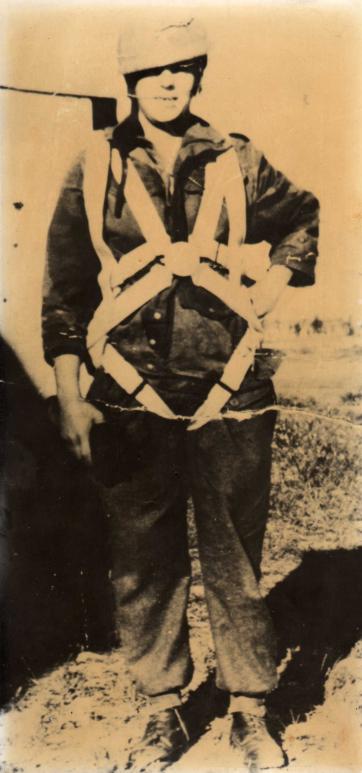
Captured, and out through the ventilator
Link to the section Captured, and out through the ventilator✓ The catalogue entry for his escape report has him captured at Arnhem on 23 September 1944 and escaped from the train near Apeldoorn station on 27 September 1944; the report, of 10 December 1944, mentions among others a "Private Berry, 11 Para Bn." (WO 208/5422/11). His citation tells the escape:
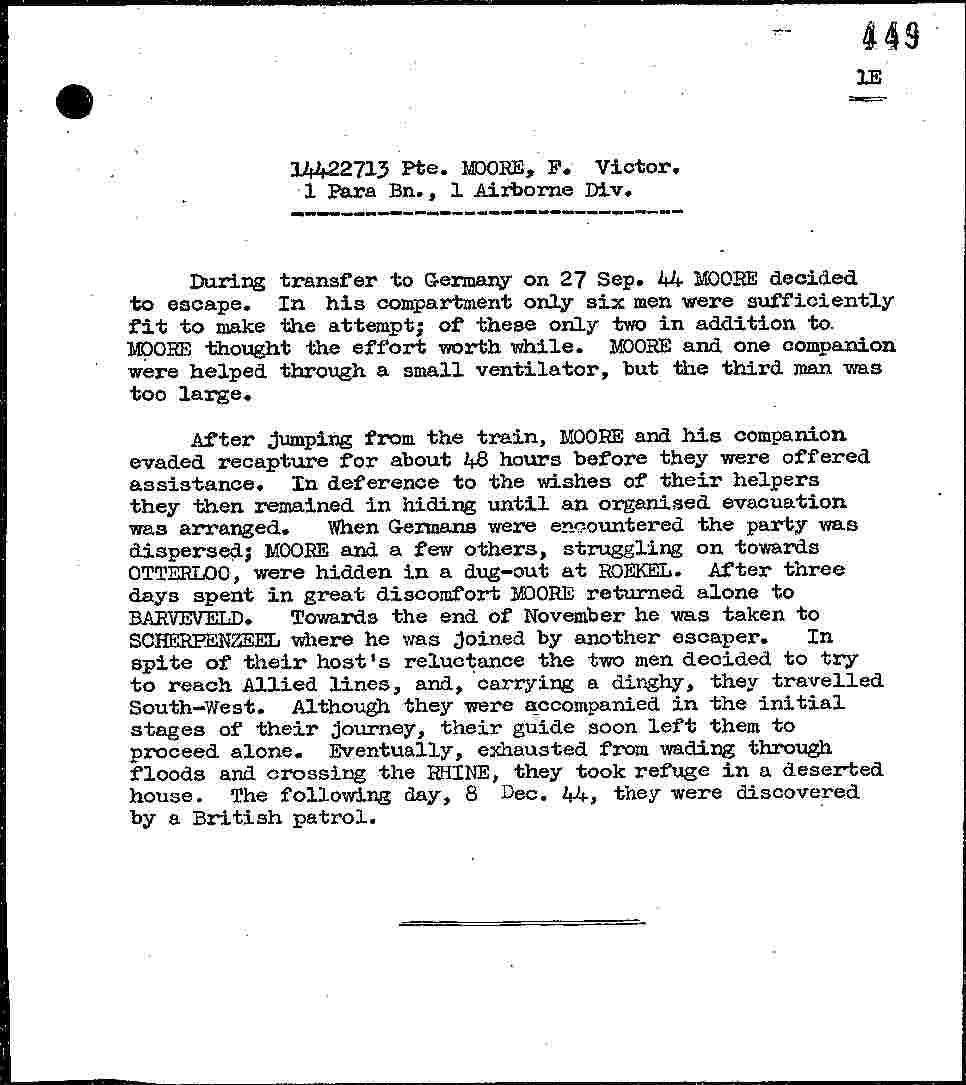
During transfer to Germany on 27 Sep. 44 MOORE decided to escape. In his compartment only six men were sufficiently fit to make the attempt; of these only two in addition to MOORE thought the effort worth while. MOORE and one companion were helped through a small ventilator, but the third man was too large.
— Director of Military Intelligence · citation for a mention in despatches, March 1945 · The National Archives, Kew, WO 373/64/399 · the transcription
"After jumping from the train, MOORE and his companion evaded recapture for about 48 hours before they were offered assistance. In deference to the wishes of their helpers they then remained in hiding until an organised evacuation was arranged" (same, p. 2).
Beekbergen
Link to the section Beekbergen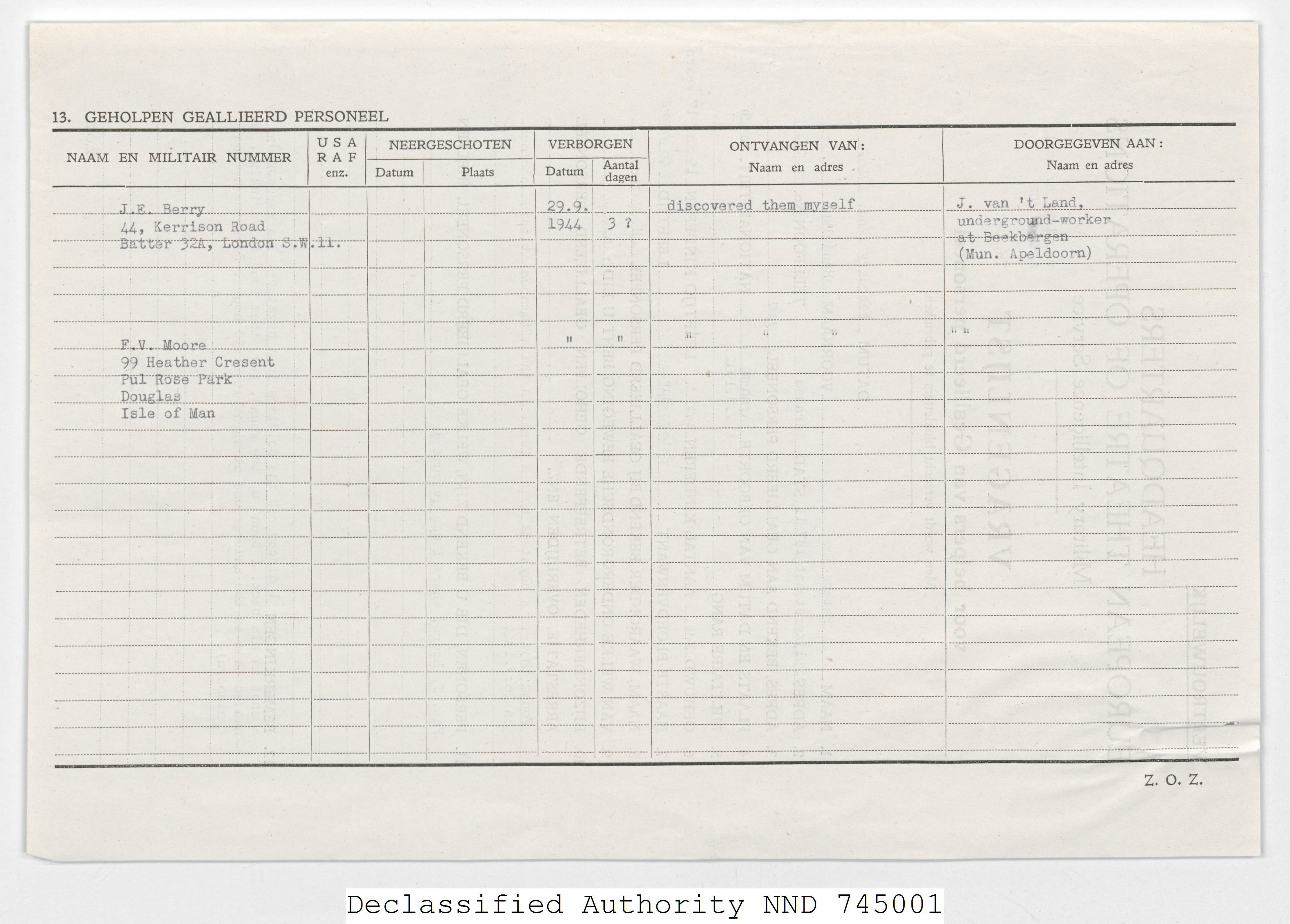
Three Dutch forms of 1946 put Moore at Beekbergen, by Apeldoorn, at the start of his time in hiding. The Pegasus Archive page and the citation have no place or helper for that stage.
- ✓ The haystack. Hendrikus Peters, evacuated there from Arnhem, wrote that he found two soldiers "in de hooiberg, op de boerderij daar ter plaatse, 's middags om drie uur. 26 Sept." (in the haystack, on the farm there, at three in the afternoon, 26 Sept.), one wounded by a shot in his back; he bandaged him, fed both and at half past nine that evening gave them to the underground at Beekbergen (his form, p. 3; his letter of 27 January 1946, p. 5).
- His table has "J.E. Berry" and "F.V. Moore", Douglas, Isle of Man, "29.9. 1944", "discovered them myself", passed to "J. van 't Land, underground-worker at Beekbergen" (p. 2; his note of the addresses, p. 6).
- ✓ Van 't Land. Gerrit van 't Land of Beekbergen (L.O.) writes "Moore and Berry landed as paratroopers near Arnhem Sept. 1944", and his table has "F.V. Moore, paratrooper" and "T.E. Berry", "wondering around" [sic], the date and days cells unclear; the helpers his form names for the group are Dr D. Pont, who "gave medical help to the wounded men", "Tony Zwiers, shot December 1944" and "A. Vaessen, Beekbergen" (his form, p. 2; his table, p. 3).
- ✓ Van Toledo. Benjamin van Toledo, "Ben" "The Policeman" of the O.D. at Arnhem, lists "F.V. Moore" and "F.E. Berry" with four others, six paratroopers in all, "all Paratroopers 17-25 September 1944", hidden "September, October 1944".
- He hid them in a barn with van 't Land and Zwiers, and he and Zwiers later took them "through the German lines to safety", at Beekbergen and south of it, "after the battle of Arnhem" (the form adds "(not during the week 17-25 September 1944.)") (his form, p. 2; his table, p. 3; in Dutch, p. 7; handwritten table, p. 8).
- ✓ All three give "F.V. Moore"; Peters and Van Toledo add Douglas, Isle of Man, the home Jacob Bol's list gives him too (below), and Van 't Land's table has no address.
- ◐ "Berry" is very probably the companion who went through the ventilator with him, whom the citation leaves unnamed: Peters and van 't Land have the two together, and the catalogue entry for Moore's own report names a Private Berry of the 11th Battalion. Peters gives his home as London S.W. 11 (p. 6). The initials differ on each form (J.E., T.E., F.E.).
- He is not Wilfred Berry, the Canadian company sergeant major on Murphy's crossing of 2 January 1945, who was taken at the Leopold Canal on 7 October 1944, after Moore's escape (Berry's report).
Barneveld
Link to the section Barneveld✓ At Barneveld he was at Jacob Bol's, Donkervoorterweg 10 (p. 4, OCR), whose section 13 lists "Pte F.V. Moore, Isle of Man", from "30-10-44", 17 days, beside L/Cpl Harold Cook (the same dates), "Maj. H.P. McGuire" (Hugh Maguire, "8-11-44", 8 days), and Capt Lipmann Kessel (Lipmann Kessel, "19-11-44"), all received from "Joop en Dick" (the typed copy, p. 17). The other typed copy has "F.Y. [V.?] Moore" and "Frans Hals" in both columns, ◐ Dick Kragt's organisation (p. 5). The name, initials and home are his. Seventeen days from 30 October end on 16 November, the day before Pegasus II.
With Murphy
Link to the section With MurphyPegasus II and the wood, 17–20 November
Link to the section Pegasus II and the wood, 17–20 NovemberThe citation is brief: "When Germans were encountered the party was dispersed; MOORE and a few others, struggling on towards OTTERLOO, were hidden in a dug-out at ROEKEL" (WO 373/64/399, p. 2). James Hardy's report, written two months after, puts him twice in Murphy's company. First, on the evening of 18 November by Hardy's dating, Murphy's small party reached the lorry point and found the men who had missed the column:
We followed them to a spot about 602880 where we met another party of evaders, about 20 in all, I think, amongst whom were Pte. DAVISON … and Pte. MOORE … (Report No's IS9/WEA/1/263 & 262)
— MI9 · Pte J. Hardy, 16 Parachute Field Ambulance · IS9/WEA/1/270/2351 · 13 January 1945 · the report
⚠︎ Bol's list ends his stay at Barneveld on 16 November; how he reached the wood no source says. Noordman has the party of about twenty, Leslie Davison among them, come off the lorry from Elburg (Noordman, pp. 284–285), and Hardy puts Moore in that party. The lorry that was to take them on never came, and at three in the morning of 20 November Hardy, "BRENTFORD" (Branford), Murphy, "JOHN" and "the other Paratrooper" left the wood (Hardy; Operation Pegasus II).
The dug-out near Roekel, 20–24 November
Link to the section The dug-out near Roekel, 20–24 NovemberWhen Hardy's five came to the dug-out the same morning, Moore was already there:
The farmer gave us a meal and then sent us off with a young lad who took us down to a dug-out in the woods near ROEKEL at approx. 614905. Here we found five more evaders including Pte. MOORE (Report No IS9/WEA/1/262).
It was a very small dug-out and we were very cramped and with 10 men living in it the atmosphere was very bad. So, after four nights there I spoke to the man who had taken us there (and who brought us our food) and told him I intended to move. So on the morning of 24 Nov Pte. MURPHY and I left with our friend …
— MI9 · Pte J. Hardy, 16 Parachute Field Ambulance · IS9/WEA/1/270/2351 · 13 January 1945 · the report
His citation gives his side: "After three days spent in great discomfort MOORE returned alone to BARVEVELD [sic]" (WO 373/64/399, p. 2). ◐ So he shared the dug-out with Murphy, Hardy and Hardy's "BRENTFORD" (Branford) and, by Noordman's identification of Hardy's "JOHN" and "the other Paratrooper" (Noordman, pp. 280, 285; Walsh's report), Haller and Walsh, for some of those days. Which of them left first no source says: Hardy and Murphy went on the morning of the 24th, and the citation's three days do not say when Moore's began.
- ◐ How he got there before Hardy's five.
- Boeree's chronicle of Ede has six men walk off from forester Van den Brink's wood after the failed crossing, meaning to go back to Westeneng; they were stranded at Pol's and handed to Bettink: "Deze had hen verstopt in een schuilplaats achter de Agneta-hoeve, die toen werd bewoond door van Vemden uit Aerdenhout" (he had hidden them in a hiding place behind the Agneta-hoeve, then lived in by Van Vemden from Aerdenhout) (Boeree, p. 202, read on the image).
- ◐ Very probably the same dug-out (J. van Vemde); Boeree names one of the six, "Jimmy, who spoke a little Dutch" (Onder die zes mannen zat Jimmy, die een beetje Hollandsch sprak), and Hardy found five.
- ⚠︎ Two men out on the Thursday. Boeree also has Bettink bring "nog 2 man uit het hol" (two more men out of the hole) on the Thursday (◐ 23 November, counting on from Noordman's Monday 20 November; Boeree gives no date) to Rap at Harskamp, together with the other two (◐ Heiwegen's two at Rap, below; ◐ "to Rap" is the reading the paragraph before favours: Johan Bettink), and from there to "H. Esveld onder Essen" (Boeree, p. 202; Heimen van Esveld). The citation has Moore go back to Barneveld alone; nothing names the two.
- ⚠︎ A Pte Moore in Drok's form.
- Arrien Drok of Arnhem, who had the questionnaire from his friend H. Heiwegen of Otterlo, wrote: "On the 20-11-44 I found 4 allied members in the woods these men were helped by us till the 22.11.44" (Drok's form, p. 2); the men told him they had "tried in the night from 18-19 Nov. 1944 with 200 men to cross the Rhine" (p. 3).
- His table has a Sgt Moore, American, a "Pte. Moore British | Paratr." and a Sgt Buckley, RAF, with a Canadian pilot officer on the line above, all "Found in the woods" and passed to "Underground member v. Dyk, Harskamp" (p. 3).
- Boeree has "De vier man van Heiwegen" (Heiwegen's four men) fetched, "twee gingen naar Rap, twee naar het hol" (two went to Rap, two to the hole) (p. 202; Willem van Dijk).
- No source says whether Drok's private is Victor Moore, and the name is common; Hardy already had Victor Moore in the dug-out on the morning of the 20th, the day Drok found his four.
Scherpenzeel, late November to 5 December
Link to the section Scherpenzeel, late November to 5 December"Towards the end of November he was taken to SCHERPENZEEL where he was joined by another escaper" (WO 373/64/399, p. 2).
- ◐ Davison's memoir. Davison came to the farm after about ten days with another family, on the crossbar of a helper he knew as Jan ter Wall, and found two paratroopers there: "They were Sergeant Keith "Tex" Banwell and Vic Moore, a private from the first battalion. These two had been there for two weeks, since immediately after the Pegasus two ambush" (Davison).
- The three slept in the chicken house and helped with the farm work, in overalls and clogs, and ran into the woods behind the farm when the SS searched it (same).
- The farmer was "Wynand", with his wife and two boys (same); ◐ Wijnand Veldhuizen, by his own form below.
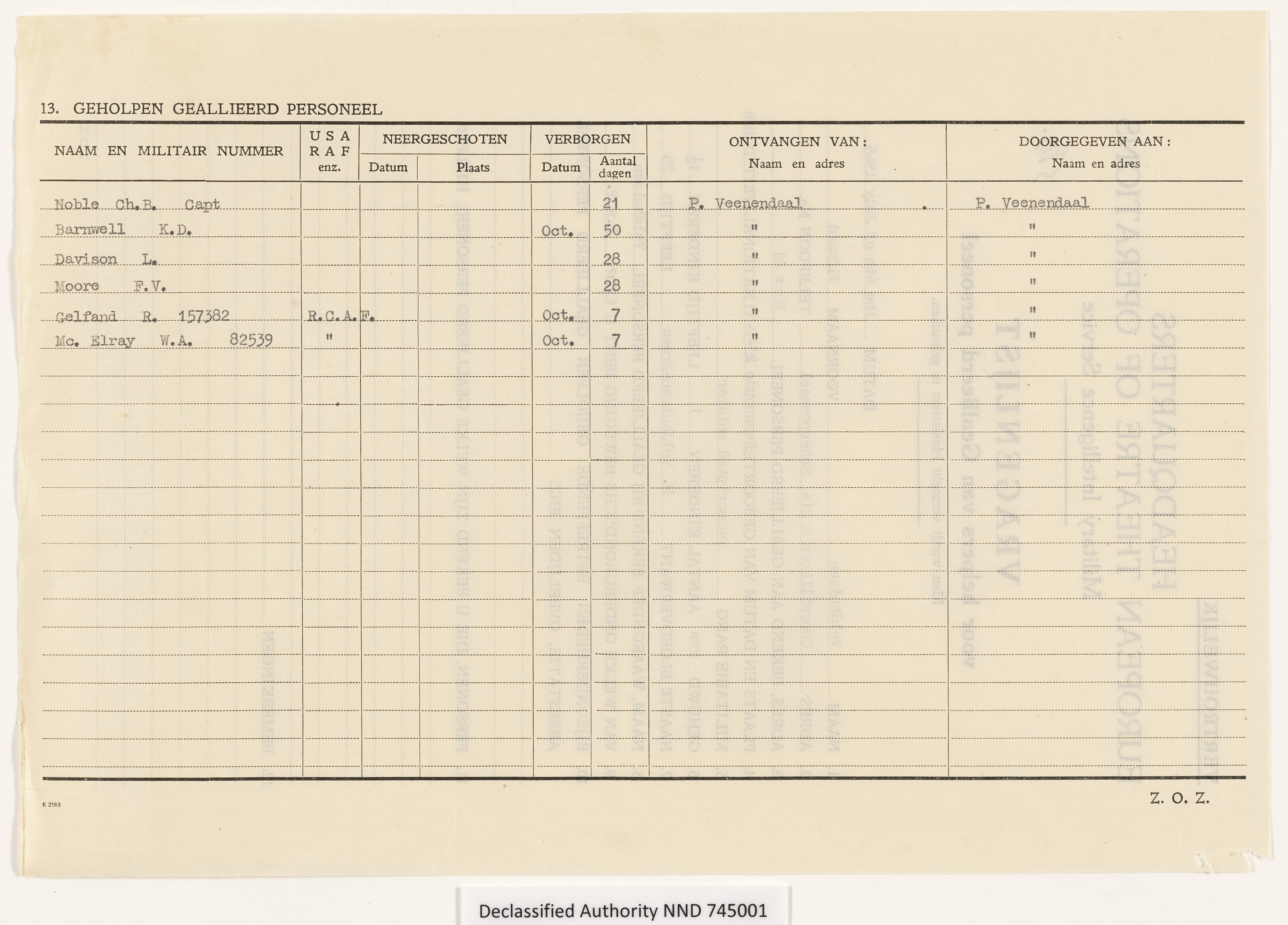
- ✓ The farmer's form. Wijnand Veldhuizen, of Gooswilligen B 21a, Scherpenzeel (L.K.P.), lists "Moore F.V.", 28 days, received from and passed to "P. Veenendaal" (◐ Piet Veenendaal), on a sheet with "Noble Ch.B. Capt" (21), "Barnwell K.D." (50), "Davison L." (28) and two RCAF men (his table, p. 3; the form, p. 2). ⚠︎ The 28 days cannot all be at the farm (below).
- The interviewers' note on him: "At Veldhuizen was the transmit-centre of all the soldiers who were on their passage through from Kootwijkerbroek to Leersum", and the Feldgendarmerie "did twice a house-search" (p. 5).
- ✓ Van Bentum.
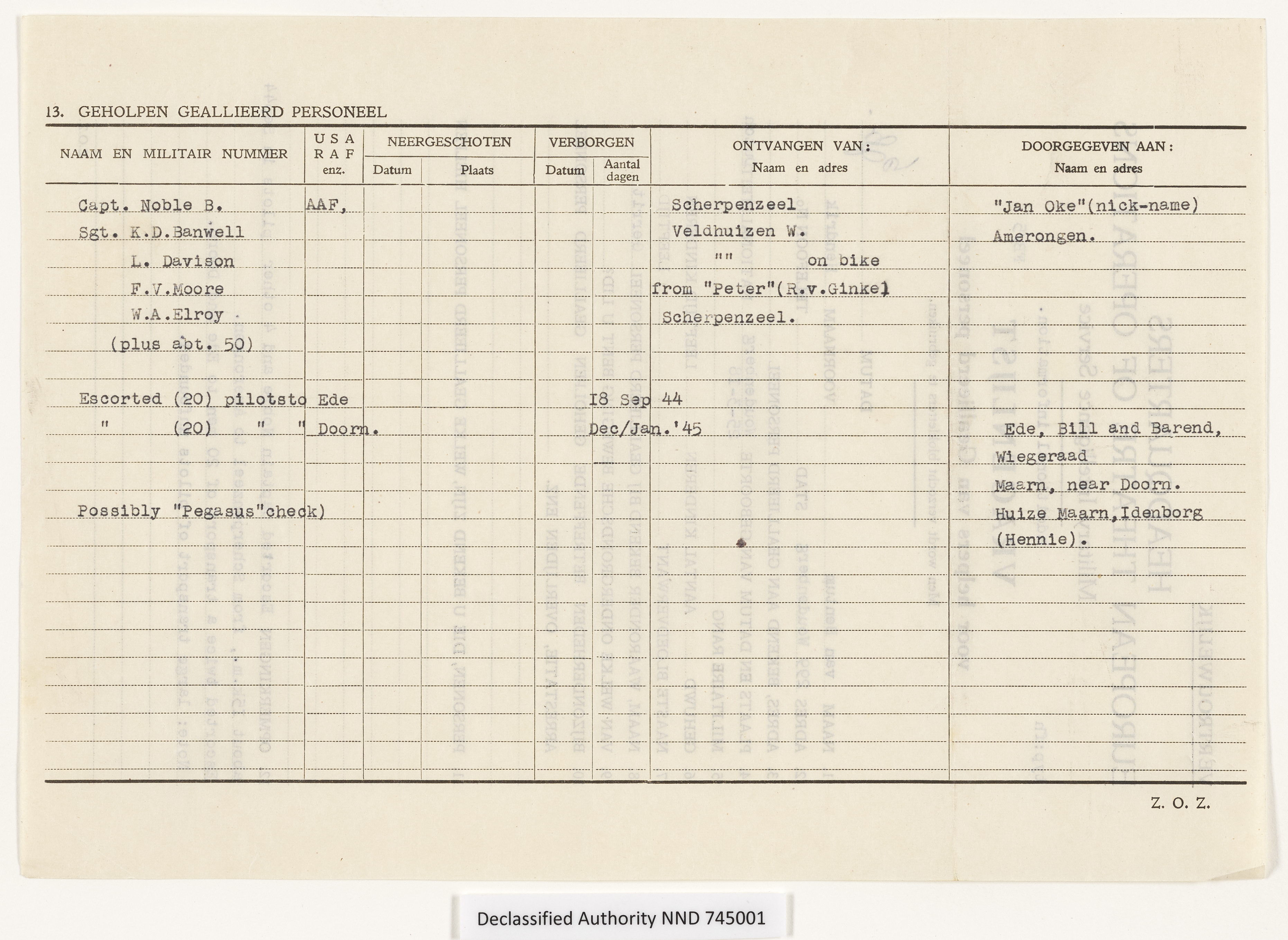
- He is one of the five names H. van Bentum of Woudenberg gave, from memory: "Several times with unsuccessful crossings I gave lodgings to Allied Personnel. I did not speak English and so I can remeber [sic] only the following names", "Capt. Charles B. Noble / Serg. K.D. Banwell / L. Davison / F.V. Moore and W.A. Elroij" (his letter of 18 January 1946, p. 18). The letter does not say which of the five were lodged after a failed crossing.
- His table lists him with the same four; its columns are not level; it names "Veldhuizen W." and Scherpenzeel in the "received from" column, which ties it to the Scherpenzeel stay, but which "received from" and "passed to" belongs to which man is not shown (his table, p. 9; Hoogland family).
The dinghy, 5–8 December 1944
Link to the section The dinghy, 5–8 December 1944Davison's citation dates the start: "On 5 Dec 44, in spite of his host's reluctance" (Davison's citation, p. 3). Moore's tells the last journey:
In spite of their host's reluctance the two men decided to try to reach Allied lines, and, carrying a dinghy, they travelled South-West. Although they were accompanied in the initial stages of their journey, their guide soon left them to proceed alone. Eventually, exhausted from wading through floods and crossing the RHINE, they took refuge in a deserted house. The following day, 8 Dec. 44, they were discovered by a British patrol.
— Director of Military Intelligence · citation for a mention in despatches, March 1945 · The National Archives, Kew, WO 373/64/399 · the transcription
- ◐ Davison's memoir. The two men told the underground they wanted to try alone, and "this brought up a problem, Vic could not swim and I had half promised him that I would not go without him" (Davison).
- A rubber dinghy from a shot-down aircraft sank in the duck pond when all three got in, so "it was decided that Vic and I would go and Tex would stay behind and take his chances with the resistance" (Davison; more on Tex Banwell).
- On the evening of 5 December Wynand cycled them to a T-junction on the Utrecht–Arnhem road and left them there; a sentry challenged them in the dark, "I supposed Vic was so excited about being so close to getting away, that he shouted something unprintable at the challenger who promptly started firing", and they dumped the bicycles (same).
- They hid through the next day in the hay of a deserted cowshed with German soldiers below, reached the dyke about 11 p.m., and crossed the towpath at midnight when the sentries changed: "We threw it into the water and then Vic climbed in. Then I slid into the water and started to push the boat", with "Vic paddling with the fence post and me swimming behind" (same).
- On the far side the road to Nijmegen was flooded; at dawn they broke into the upstairs of a flooded house near Zetten, where "Vic found a man's suit", and a Canadian patrol in a D.U.K.W. took them to Nijmegen (same).
- ◐ In De zwarte herfst.
- Davison in 1984: "Aan dat bootje hebben Victor Moore en ik onze vrijheid te danken" (Victor Moore and I owe our freedom to that boat).
- Veldhuizen took them by bicycle to the Rhine on St Nicholas's Eve, and they hid in a haystack until the next evening: "Vic stapte in het bootje en ik ging als geoefend zwemmer het water in om het naar de overkant te duwen" (Vic got into the boat and I, a trained swimmer, went into the water to push it across); they found the way to Elst, where a Canadian patrol picked them up (Dekkers and Vroemen, p. 204).
- ◐ Home. By the memoir they were questioned at Nijmegen in separate rooms, went to Brussels the next day and flew home, and were given three months' leave (Davison).
The whole crossing, from Davison's side, is on Leslie Davison's page.
The mention
Link to the section The mention- ✓ The recommendation. The Director of Military Intelligence put him up for a mention in despatches on 4 March 1945, "from the escape angle", on one minute with Leslie Davison, L/Cpl Harold Cook, L/Sgt John Humphreys and Cpl Charles Weir for mentions and Tpr Herbert Castelow of 1 SAS for the Military Medal; the list went to the airborne corps headquarters on 7 March (WO 373/64/399, p. 1). ◐ Cook is very probably the L/Cpl Harold Cook beside him on Jacob Bol's list (p. 17).
- ✓ Gazetted. Mentioned in despatches, gazetted on 20 September 1945, "14422713 Pte. F. V. MOORE.", under Army Air Corps, P.R. (London Gazette, p. 4685); Kew's award card has "Recommendation: Mention, reference: BM/588/45" (WO 208/5274/2122).
- ✓ His reports. His MI9 report is WO 208/3351/2316 (◐ possibly the same report as the next, which carries the same former reference IS9/WEA/1/262/2316), "Appendix A Included. Appendix C Included" (the entry), and his escape report of 10 December 1944 WO 208/5422/11 (the entry); two index cards carry the reference IS9/WEA/1/262/2316, one adding "Captured in Holland" (WO 208/5275/683; WO 208/5273/2515). Neither report is digitised, and neither is held here.
◐ His ashes were laid at Oosterbeek, by the caption of a photograph on his Pegasus Archive page, "At Oosterbeek, where Victor Moore's ashes were laid to rest", which gives no date (Moore). No record of his death has been found.
Where the sources disagree
Link to the section Where the sources disagree- When he reached Beekbergen. Peters's form has him find the two soldiers on 26 September, a day before the train of 27 September in the citation and the Kew entry; his own table has 29 September, which fits (p. 3; p. 2). ◐ The 29th.
- "He and Zwiers took them afterwards through the German lines to safety." Van Toledo's form says it of the six paratroopers, adding "They reached their own army again" (p. 2); Moore went on to Barneveld and reached his own army only in December, with Davison. ⚠︎ Van Toledo's line is about the group, or is wrong for Moore.
- How long he had been at the Scherpenzeel farm. Davison's memoir has Moore and Banwell there for two weeks when he arrived, "since immediately after the Pegasus two ambush" (Davison). ⚠︎ Hardy has Moore in the Roekel dug-out from 20 November, and the citation has him go back alone to Barneveld after three days there and only "towards the end of November" be taken to Scherpenzeel (Hardy; WO 373/64/399, p. 2). The citation fits the memoir's order, Moore first and Davison joining him, but not two weeks.
- How long he was there. ⚠︎ Veldhuizen has Moore 28 days (p. 3). Twenty-eight days back from 5 December is 7 November, when Bol's list has him at Barneveld. ◐ Veldhuizen's figure looks like an estimate of his share of Moore's time in the district, not a stay at the farm.
- The day they were found, and by whom.
- The citation has them leave with the dinghy and be found by a British patrol "The following day, 8 Dec. 44" (WO 373/64/399, p. 2); Davison's own citation has the same, and dates the start 5 December (Davison's citation, p. 3).
- Davison's two later accounts have them hide through 6 December and cross that night: by the memoir a Canadian patrol in a D.U.K.W. found them at dawn near Zetten, the morning of 7 December (Davison); De zwarte herfst has a Canadian patrol pick them up at Elst (p. 204).
- ⚠︎ The 7th or the 8th, a Canadian or a British patrol: not settled.
- Who the farmer was. De zwarte herfst has Veldhuizen's children on the farm "naast de onze" (next to ours) find the dinghy (p. 204); the memoir puts the two men on the farm of Wynand the farmer, and Veldhuizen's own form lists Moore. ◐ Veldhuizen's farm, by his form; the book has the children on the neighbouring farm, so Davison's farm may have been next to his, though the same book has Veldhuizen himself take them to the Rhine (p. 204, above).
- Berry's initials. J.E. on Peters's forms, T.E. on van 't Land's, F.E. on Van Toledo's (Peters; van 't Land; Van Toledo). Not settled.