Aaltje Veerman-Bakker
Landsmeer 22 Dec 1904 – Barneveld 13 Dec 1991
About: Jacob Veerman's wife and the mother of their seven children, who kept the house at Klein Achterveld through the month Murphy and Hardy were hidden there. Her husband was taken in February 1945 in place of their daughter Jopie and died on the Cap Arcona; she was left a widow at forty with seven children, and later married Hendrik Vaarkamp of Barneveld.
Unit or role: The wife of the farmer at Klein Achterveld; "zonder beroep" (no occupation) on her marriage record of 1927 and "zonder" on the war graves foundation's form of 1955; Gereformeerd (the marriage; war graves file, scan 1; the form for the L.O.-L.K.P. foundation's book of the fallen).
Where: Born at Landsmeer, on the Noordeinde; at Ilpendam (Den Ilp) with her mother from 30 June 1919 (the Landsmeer register); a farm at Purmerend, by her family's account; after her marriage Klein Achterveld, Achterveldseweg 34 (the family's form, 1946); by 1950 Torenstraat 9, Barneveld; by 1966 Stationsweg 165, Barneveld (war graves file, scans 4, 18).
Evidence: ✓ her marriage, 1927; ✓ the Landsmeer and Ilpendam population registers and her parents' and sisters' civil records (the records); ✓ the war graves file on her husband, with her own letters (Nationaal Archief 2.19.255.01, 157653A); ✓ her family's form for the Americans, 1946 (US National Archives 286713002); ✓ her daughter's death notice, 1977; her daughter Alie in the Achterveld booklet, pp. 83–84; her grandsons Jacques Vanhaelen's and Carel Plantagie's accounts, October 2026 (family knowledge).
Landsmeer and Ilpendam
Link to the section Landsmeer and IlpendamShe was born at Landsmeer, north of Amsterdam, on 22 December 1904, the daughter of Jan Bakker and Maretje de Vries; her mother was a shopkeeper (the marriage; war graves file, scan 1). Her parents had married at Landsmeer on 11 November 1892, Jan Bakker a labourer (arbeider) of 23 and Maretje de Vries, 21, born at Ilpendam (their marriage, index only). ✓ The Landsmeer population register for 1900–1921 has the household on the Noordeinde, Gereformeerd: Jan Bakker, head, born in 1869, his wife Maretje de Vries, born in 1871, and below them their sons and daughters, born from 1893 to 1912, Aaltje on line 10, born on 22 December 1904 (folio 236, read on the page). Her father, by then a cattle farmer (veehouder), died at Amsterdam on 16 March 1918, when she was thirteen (his death, read on the page). On 30 June 1919 she left Landsmeer for Ilpendam (Den Ilp), as her mother and most of the other children did that day (folio 236).
Her mother's family card at Ilpendam, in the register begun in 1924, lists her mother, a widow and shopkeeper (winkelierster), with six of the children but not Aaltje (the card; its back); ◐ by then she was not living at home. Where she was until her marriage no record found says. Her mother went back to Landsmeer with the four youngest daughters on 9 December 1927 (the Landsmeer card), and died there on 29 August 1950, aged 79 (her death).
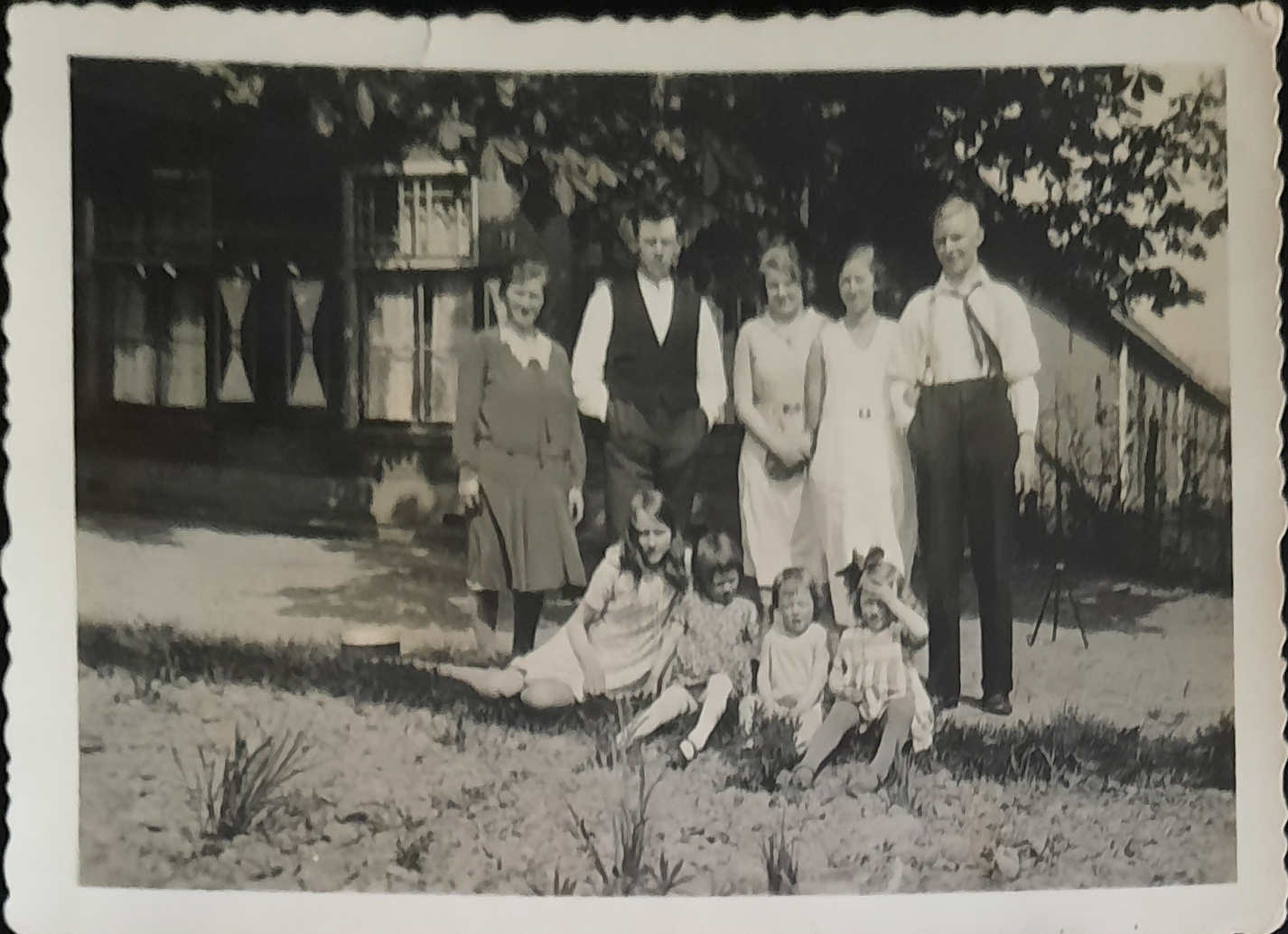
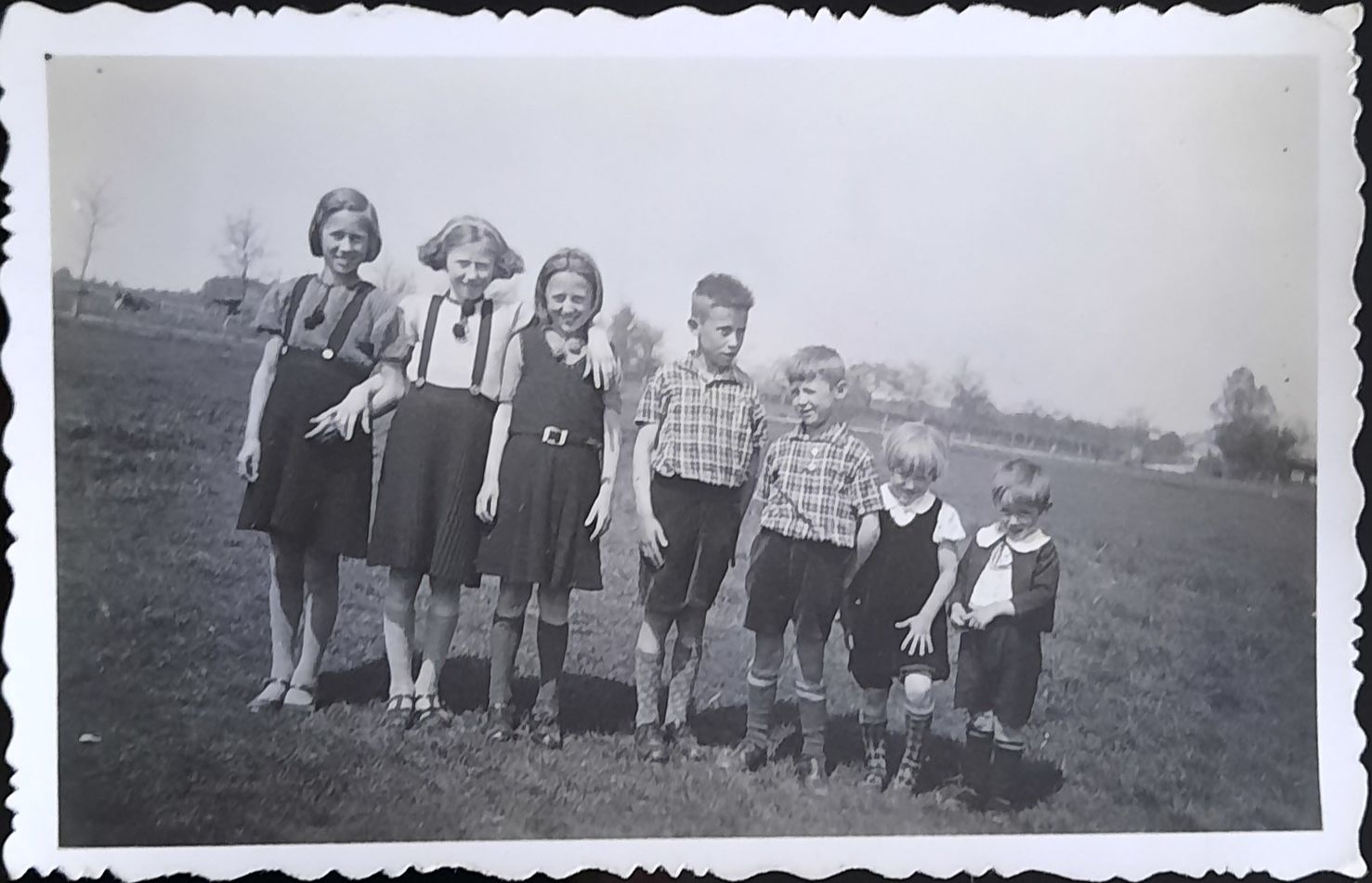
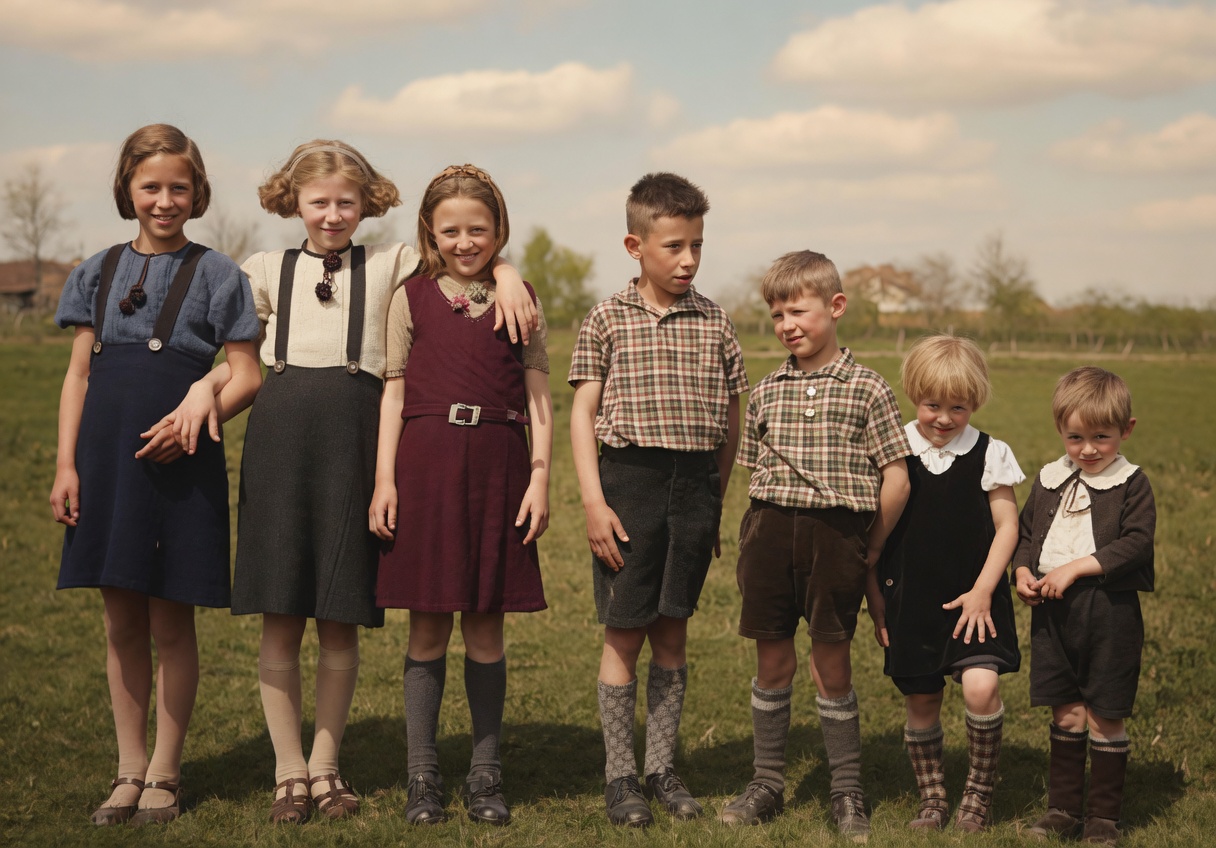
Seven of her sisters married at Landsmeer or Ilpendam between 1919 and 1937, each record naming Jan Bakker and Maretje de Vries as the bride's parents (the records). The youngest, Pietertje, born on 12 April 1912, married Jan Leguijt, a chauffeur of 23, at Landsmeer on 4 February 1937, with her brother Cornelis Bakker, a baker at Oostzaan, as a witness (the marriage, read on the page): ◐ the "Pie Bakker" and Jan Leguijt of the photograph below, by the names, the year of birth and Carel Plantagie's word that Pie was Aaltje's sister.
Marriage and the farm
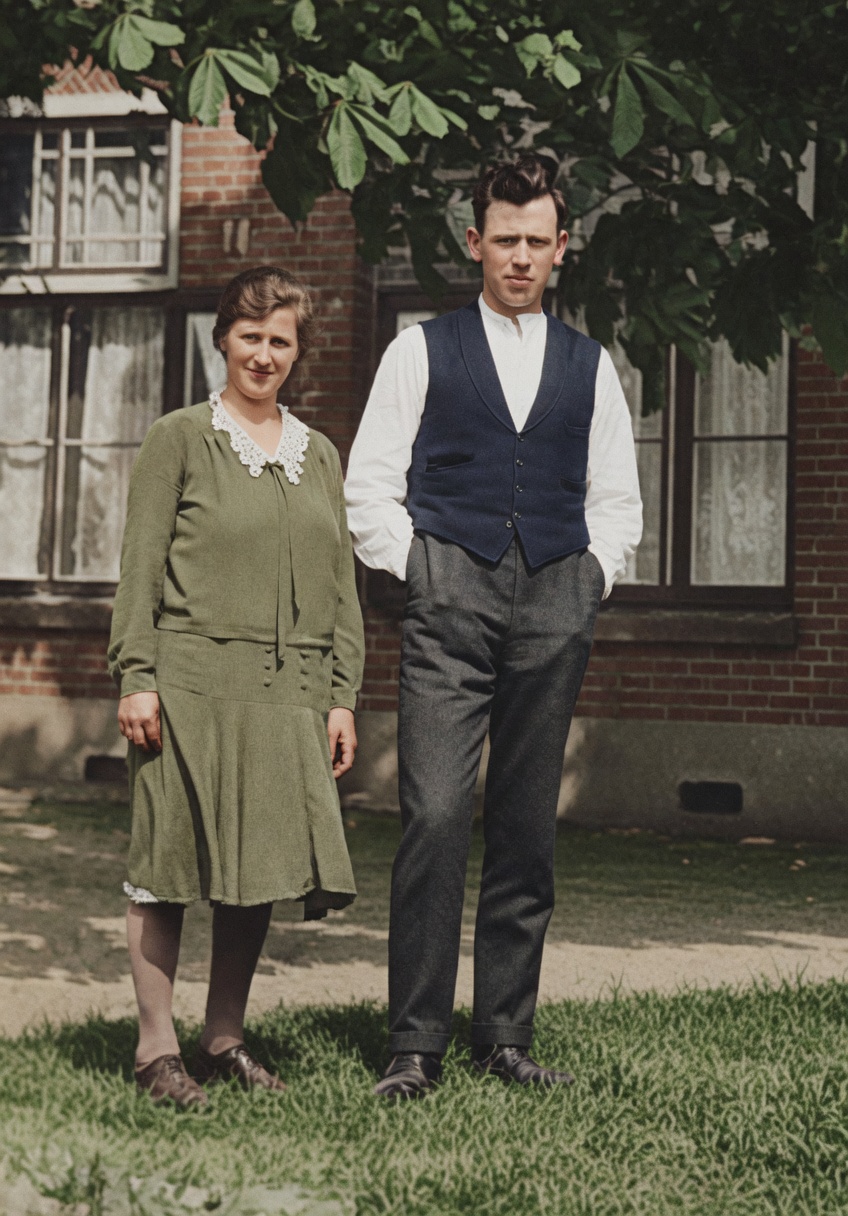
Link to the section Marriage and the farmShe and Jacob Veerman met on a farm at Purmerend, where she was a maid and he a farmhand (Jacques Vanhaelen's account); the Purmerend registers searched do not have her (the search). They married at Barneveld on 2 February 1927, she 22 and he 26 (the marriage). They farmed Klein Achterveld, between Achterveld and Barneveld, and had seven children, four daughters and three sons (Hardy), aged 18 down to 9 in May 1946 (the family's form): the eldest, Jopie, born on the farm on 1 December 1927, and the youngest, Jacob, "Jaap", born on 18 August 1936 (Jacques Vanhaelen's account). They were Gereformeerd (the form for the L.O.-L.K.P. foundation's book of the fallen).
The war on the farm
Link to the section The war on the farmFrom 1943 the farm hid Allied airmen, Jews and other people in hiding (Digitaal Monument Neuengamme, the Dutch Vriendenkring Neuengamme's online memorial; Jacob Veerman). Aaltje was called Alie too; the "Alie Veerman" quoted on this page is her daughter Alie (1930–2017). Hungry people came to the door as well, and she kept bread ready for them, as their daughter Alie remembered:
Mother would make up sandwiches and leave them ready in a bread tin, which was often empty before midday. But Schouten the baker had told father, "Jacob, your flour is running out", and then you'd be on that other bread. So father told mother that once the tin was empty she was to say no. Until he saw a family walking away with nothing, and quickly made up some bread after all and took it after them.
Dutch originalMoeder had dan brood gesmeerd en in een broodtrommel klaargezet, dat vaak al voor de middag op was. Maar bakker Schouten had tegen vader gezegd; Jacob je meel raakt op en dan kreeg je van dat ander brood. Vader zei dus tegen moeder dat als de trommel leeg was, ze nee moest zeggen. Totdat hij een gezin weg zag lopen, zonder eten en toch nog gauw wat brood smeerde en het achterna bracht.
— Alie Veerman, her daughter, in Oorlogsverhalen om nooit te vergeten (Achterveld, 2025), p. 83 · the booklet
With Murphy
Link to the section With MurphyOn about 25 November 1944 Gijs van Zijtveld brought Murphy and James Hardy to the farm, where they stayed a month, to 23 December (Hardy; the family's table). Her husband's mother had died that June, and his father died on 10 January 1945, eighteen days after the two men left (the records). Hardy, writing three weeks later:
We stayed here for a month during which time we were very well fed and cared for. They did everything possible to make us comfortable.
— MI9 · Pte J. Hardy, 16 Parachute Field Ambulance · IS9/WEA/1/270/2351 · 13 January 1945 · the report
Murphy, writing about 1998: "I stayed in Barneveld with a very nice Family; they were so grateful how we had come to help them; They were really risking everything" (page A2), ◐ very probably this family, since his typed notes go on to the revolver from "Jo Verman's uncle" on leaving Barneveld (typed pp. 4–6; Jacob Veerman; Father Fokkemmal). In May 1946 the family set the two men down on the questionnaire for the Americans that names her as Jacob's next of kin: "THOMAS MURPHY No 2456457. parachutist." and "JAMES. HARDY. No. 1556339. parachutist", hidden from 25 November for 30 days (the year written '45, a slip for 1944; Murphy's number was 2756457) (p. 4; p. 5; Jacob Veerman).
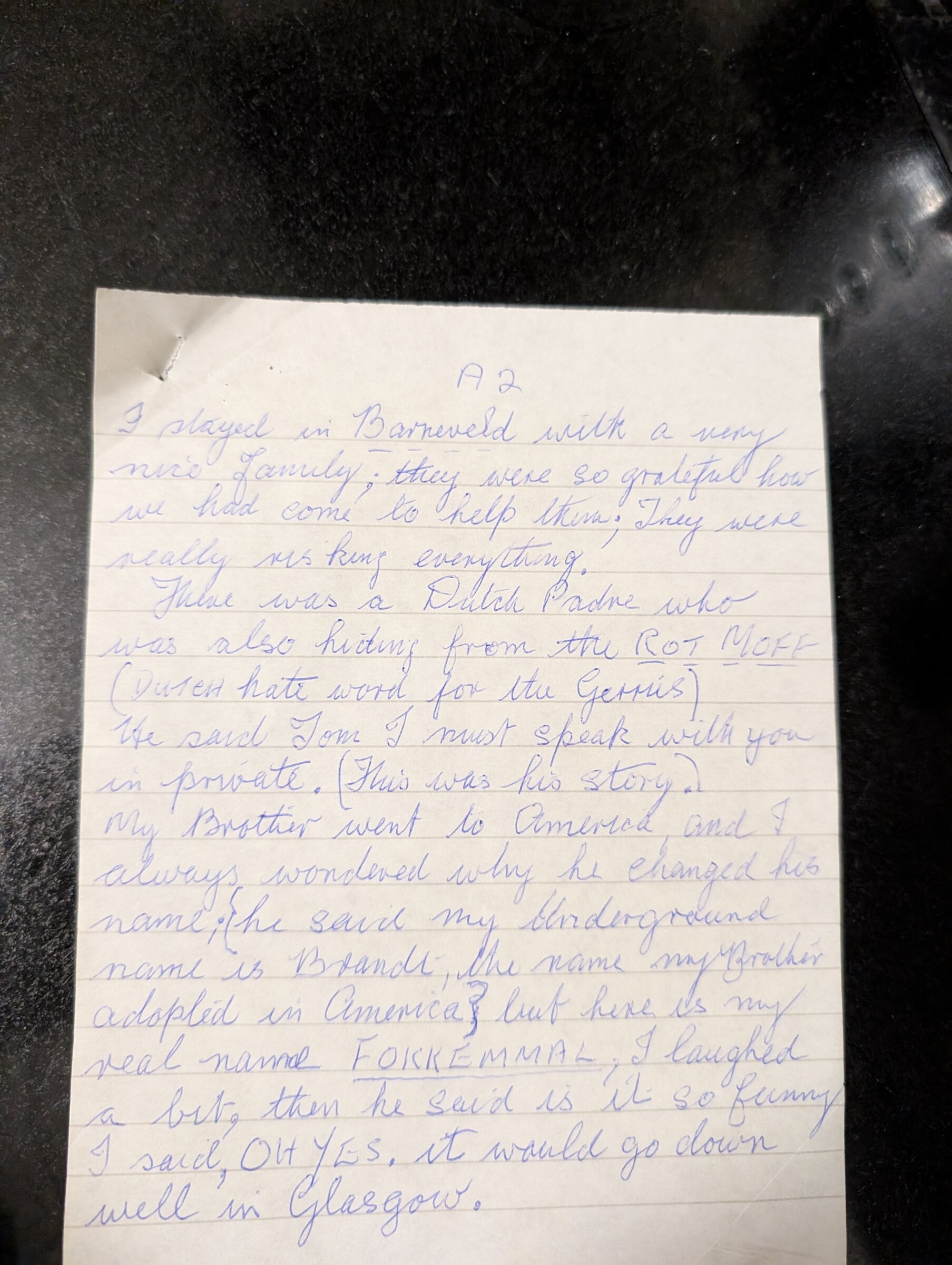
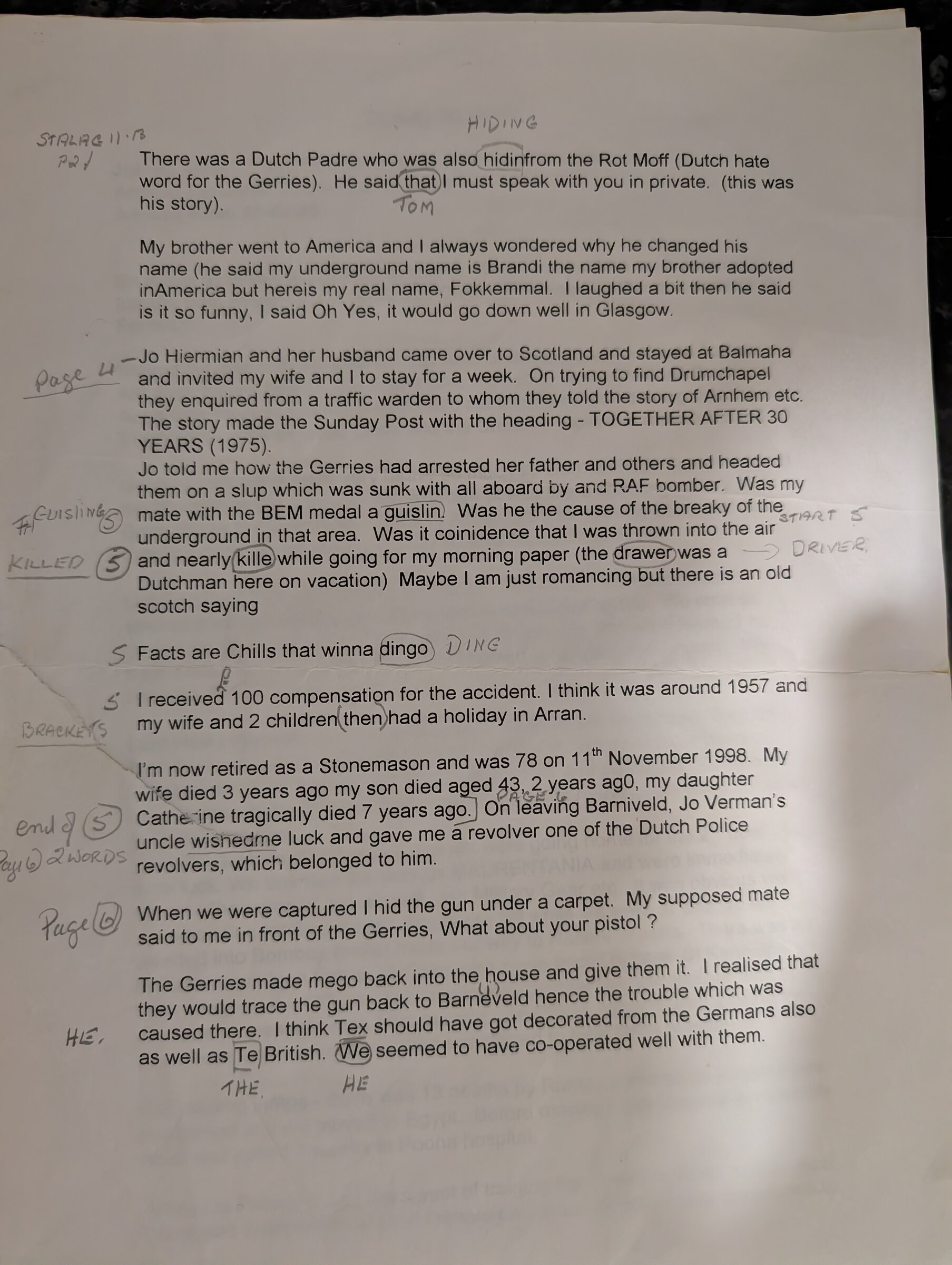
A son of hers, who is living, remembers a doctor called Brand, a refugee from Germany, who took the shrapnel out of Murphy's head and came often to the farm because he spoke good English (Jacques Vanhaelen's email, October 2026); no source outside the Vanhaelen family's own accounts has him, and Jacques Vanhaelen's earlier account (October 2026) calls him "Reverend Vogema (alias Dr. Brand), a mayor from Germany in hiding" (Father Fokkemmal; Jacob Veerman).
The raid, 24 February 1945
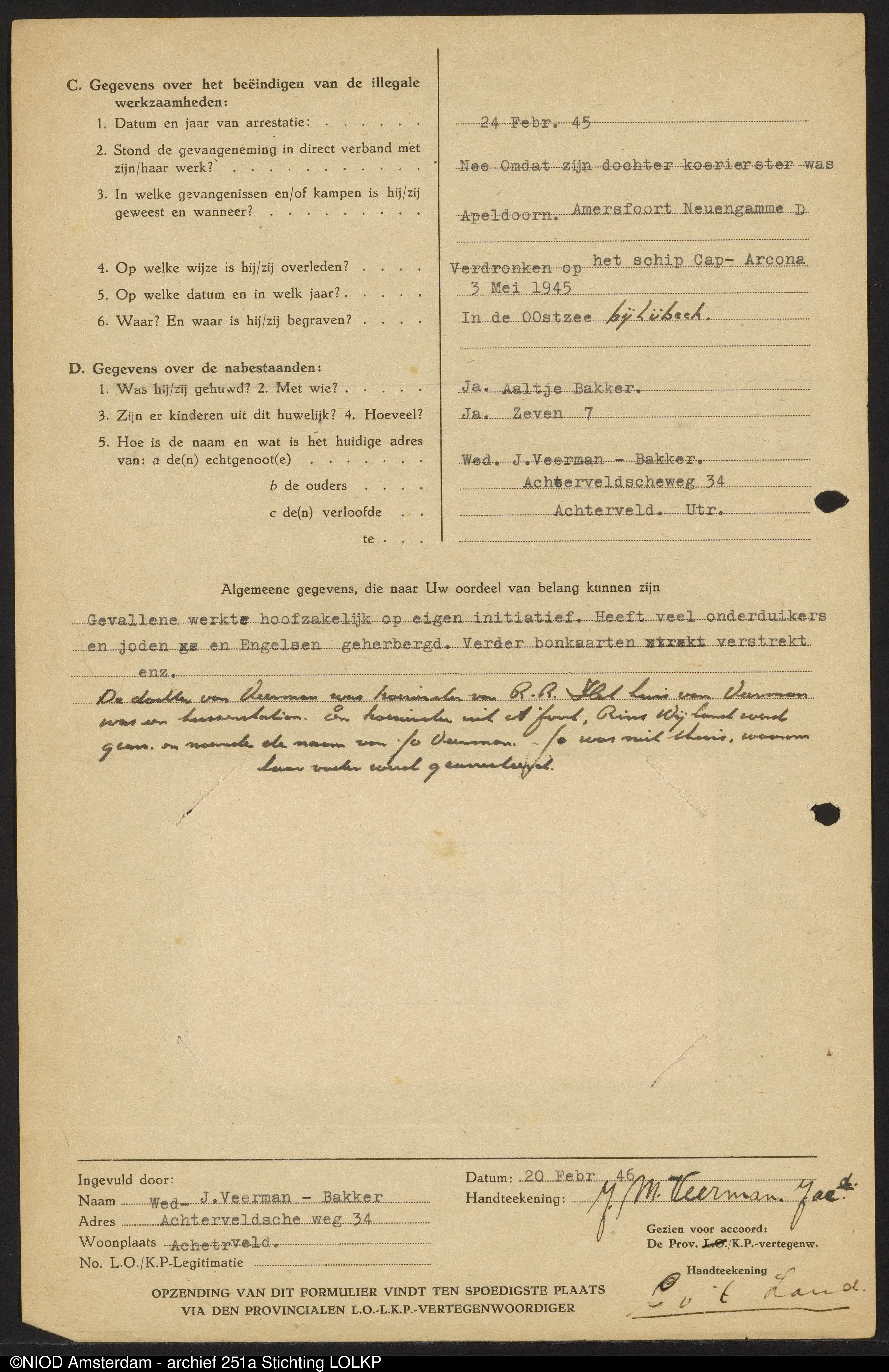
Link to the section The raid, 24 February 1945The SD came for her daughter Jopie, a courier, who was hiding with her uncle Gerrit at Ede (Neuengamme online memorial; Gerrit Jan Broekhuis). The form for the L.O.-L.K.P. foundation, filled in in Aaltje's name a year later, says how the SD came to Jopie's name: ⚠︎ a courier from Amersfoort had been arrested and gave Jo Veerman's name, and "Jo was niet thuis, waarom haar vader werd gearresteerd" (Jo was not at home, so her father was arrested; the last word read with doubt) (the form, general remarks). It is a short handwritten note under the typed remarks on the back of the form; nothing else we hold records the courier's arrest or what the courier said. ✓ The Rijkspolitie at Barneveld, in 1950, told the raid without the courier: on 24 February 1945 the Sicherheitsdienst of Apeldoorn searched the house to arrest the eldest daughter, said to be doing courier work for the resistance, and as she was not at home took her father (the report, 13 December 1950, PDF p. 343; Jacob Veerman). Her daughter Alie remembered a lorry of Dutch SS men on the yard, Jacob tied up on the floor for a good hour, and every one of them questioned separately about where Jopie was (the booklet, p. 83). An evacuee, Marie Visser-Derksen, puts herself at the farm that day by her own account, the only source that has her there: by it the Germans were also taking the farm's horses (⚠︎ no other source has the horses), and she, who had cycled over to see them, was searched by the Germans as soon as she rode in and told a story to explain herself; ◐ the woman of the house, very probably Aaltje, gave her something to eat, and the Germans let her go:
The woman of the house went to the corner cupboard, took a slice of rye bread and spread some lard on it with sugar. Then the Germans let me go.
Dutch originalDe vrouw des huizes ging naar de hoekkast en pakte een snee roggebrood en smeerde er wat smout op met suiker. Toen mocht ik gaan van de Duitsers.
— Marie Visser-Derksen, in Oorlogsverhalen om nooit te vergeten (Achterveld, 2025), p. 111 · the booklet
In the questioning a son of hers, who is living, said there was a rifle; an SS man held his head down on the kitchen table and swung the butt at his neck, missing, and he showed them where it was hidden (Alie, the booklet, p. 83). Jacques Vanhaelen's account tells it another way: Jacob, interrogated at Apeldoorn, admitted to a radio on the farm but never to the people hidden there; the same son (both accounts give the same first name) had to show the Germans the radio's hiding place, where two guns were hidden too, and the German who went with him "pretended not to have seen him" (his account, October 2026; Jacob Veerman). Both are about a rifle ("buks") or guns kept on the farm. ⚠︎ Neither account connects these weapons with Murphy's revolver. Alie's own reading of the cause is betrayal (the booklet, p. 83).
Jacob in the camps
Link to the section Jacob in the campsThey took Jacob, and let it be known he would be released if Jopie gave herself up. She did, and was sent to Westerbork; he was not released (Neuengamme online memorial; TracesOfWar and the booklet, p. 83, for Westerbork; Jopie Veerman). A son of hers, who is living, remembers that Jopie gave herself up that very same day, and that a member of the NSB who had fled from the south of the Netherlands was also hiding at the farm, and that he tried to get Jacob released but came too late: Jacob had already been deported to Germany (Jacques Vanhaelen's email, October 2026). He was taken in his clogs, cap and short jacket, and at Apeldoorn they took his ring and papers from him (the clothing entries on the identification office's form, scan 18, in another hand than her own note on it, below; war graves file, scan 18). On 14 March 1945 he wrote to her from Kamp Amersfoort, a letter the family still had in 2024, when a granddaughter read it aloud at the Cap Arcona commemoration (RTV Utrecht):
… And then, dear wife, you will not lose heart? And pray that we may soon be reunited? And think above all of what we agreed. About you I have not so much worry. I know that your thoughts, moment to moment, are with me, and I know that in hard days you will stay calm. Dear wife, how much too little I valued that we were always together, and how heavy the parting is. …
Dutch original… En dan lieve vrouw, zul je de moed niet verliezen? En bidden dat wij spoedig weer verenigd mogen worden? En denk vooral aan wat we afgesproken hebben. Over jou heb ik niet zoveel zorgen. Ik weet wel dat je gedachten, ogenblik tot ogenblik, bij mij zijn en ik weet dat je in moeilijke dagen kalm zult blijven. Lieve vrouw wat heb ik toch veel te weinig gewaardeerd dat wij altijd samen waren en hoe zwaar valt de scheiding. …
— Jacob Veerman, Kamp Amersfoort, 14 March 1945, as printed in Oorlogsverhalen om nooit te vergeten (Achterveld, 2025), p. 84 · the booklet · the whole letter
The last weeks of the war
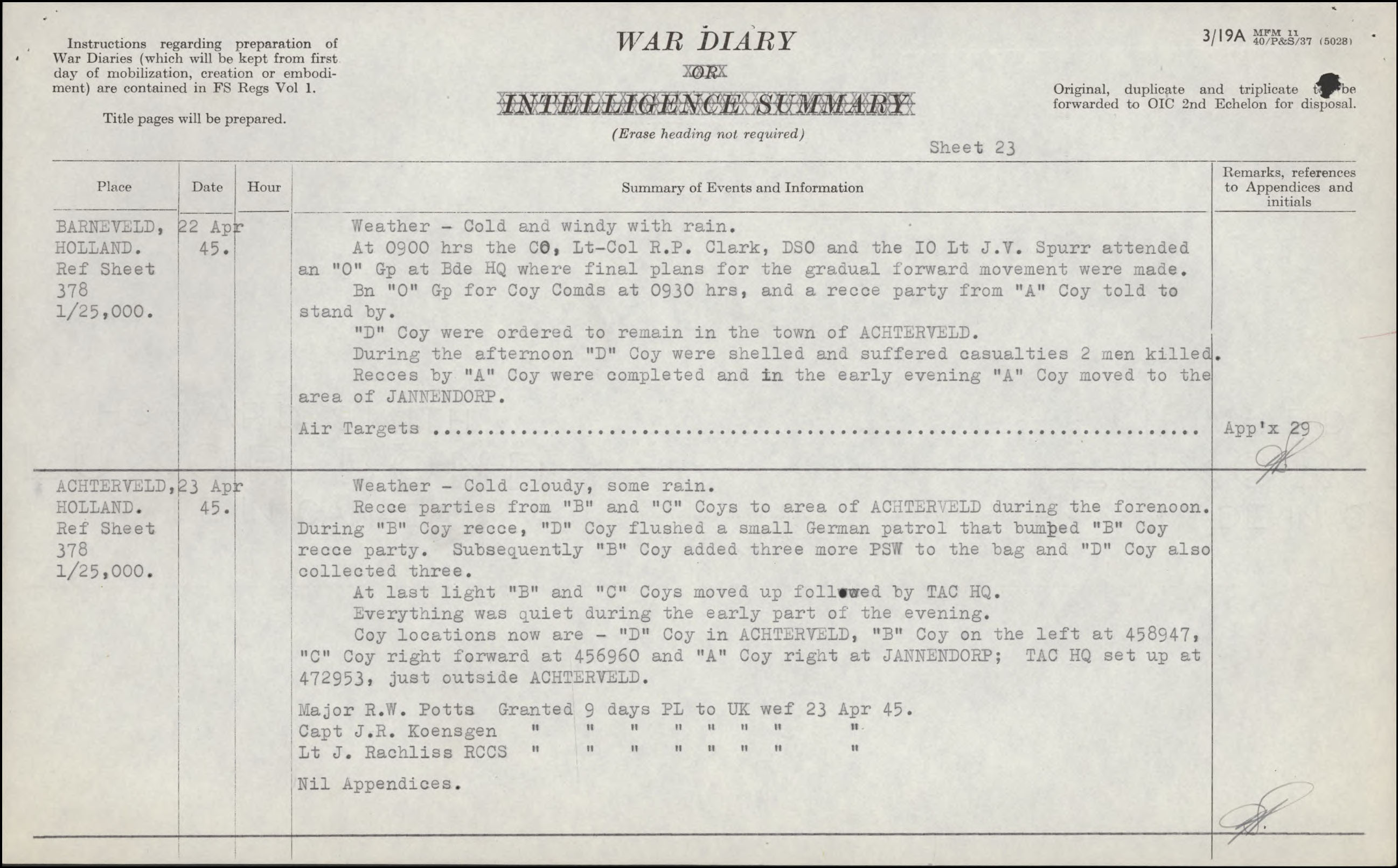
Link to the section The last weeks of the warIn the last weeks of the war, with Jacob taken, "moeder was alleen" (mother was on her own), as her daughter Alie puts it. The farm was requisitioned and German soldiers were quartered on it; they parked their lorries camouflaged all round it, set up a field kitchen outside and slept in the family's air-raid shelter, and later Canadians slept in the same shelter. "Moeder Veerman" took in several evacuees as well (Alie, the booklet, p. 84). By the head teacher's account, written in 1948, the Germans fell back on 17 April behind "de bekende linie tussen Achterveld en Hamersveld" (the well-known line between Achterveld and Hamersveld) (the booklet, p. 14). The Canadians reached Achterveld on 18 April 1945 by the village's accounts, on the 19th by their own war diary ⚠︎ (the booklet, pp. 11, 14; PPCLI war diary), and the village lay in no-man's-land, "om beurten bevrijd en dan weer bezet" (freed and occupied again by turns), until Canadians dug in near the school on the evening of 21 April (the head teacher, the booklet, p. 14). From 23 April their tactical headquarters stood "just outside ACHTERVELD" ✓ (PPCLI war diary), ◐ about 900 metres west of her house (our conversion); which of them slept in the shelter is not known ⚠︎. A truce held from 8 a.m. on 28 April ✓ (Achterveld). Jacob died on 3 May 1945, when the Cap Arcona was sunk in the Bay of Lübeck with the prisoners of Neuengamme aboard (Neuengamme online memorial; Jacob Veerman). On the evening of the 4th the village heard on the radio that the Germans in the Netherlands had surrendered, from 8 a.m. on 5 May ✓ (the priest, the booklet, p. 12; Achterveld). Jopie came home from the Vrouwenmars (the Women's March) in May 1945, "helemaal ondervoed en opgezwollen" (completely undernourished and swollen), as her sister Alie puts it (the booklet, p. 83; Jopie Veerman).
A widow
Link to the section A widow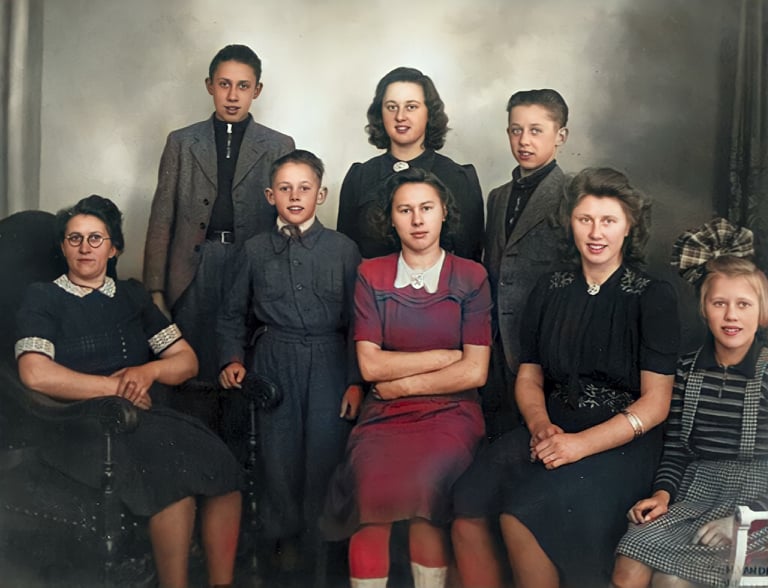
She was left with seven children aged 9 to 18 (her family's form). The form for the L.O.-L.K.P. foundation's book of the fallen was filled in in her name, "Wed. J. Veerman - Bakker", on 20 February 1946, and signed J.M. Veerman (the L.O.-L.K.P. form), and the questionnaire for the Americans in May, naming her, 41, as his next of kin (p. 4).
In the same weeks a "Mrs J. van der Woerd" of Stationsweg 168, Barneveld, wrote to the Americans about "Mevrouw Veerman"; their office answered on 18 May 1946 that it had nothing on her yet and could promise no help until a questionnaire came back, and enclosed one for her (US National Archives 286713014, p. 4). ◐ The writer was very probably Johanna van der Woerd-Moll, a widow born at Barneveld in 1893: a copy of the same letter is in the Americans' file on her, and her own questionnaire gives Stationsweg 169, one number from the letter's 168 (her file, p. 6; her questionnaire, p. 3). The letter gives "Mevrouw Veerman" no first name. ◐ She is probably Aaltje: Mrs van der Woerd's questionnaire names a G. v.d. Woerd as next of kin and herself as a "Contact address L.K.P." (item 9; p. 3), and Jacob's L.O.-L.K.P. form lists a "G. v.d. Woerd" of Barneveld among those he worked with (the form; that this is the same G. v.d. Woerd is our inference). ◐ A second candidate is Leendert Jan Veerman's wife Wilhelmina, a Mrs Veerman of Barneveld too: Ede's notes put his arrest on the same day as G. W. van de Woerd's (his page).
In November 1947 Barneveld listed two war-damage bills from "Wed. J. Veerman, Achterveldsew. 34", for 60.90 guilders (Barneveld claims list, p. 1). The Americans' file on "Mrs Veerman" was closed unprocessed in January 1948: "Sent questionnaire. No answer received." (p. 3).
No grave
Link to the section No grave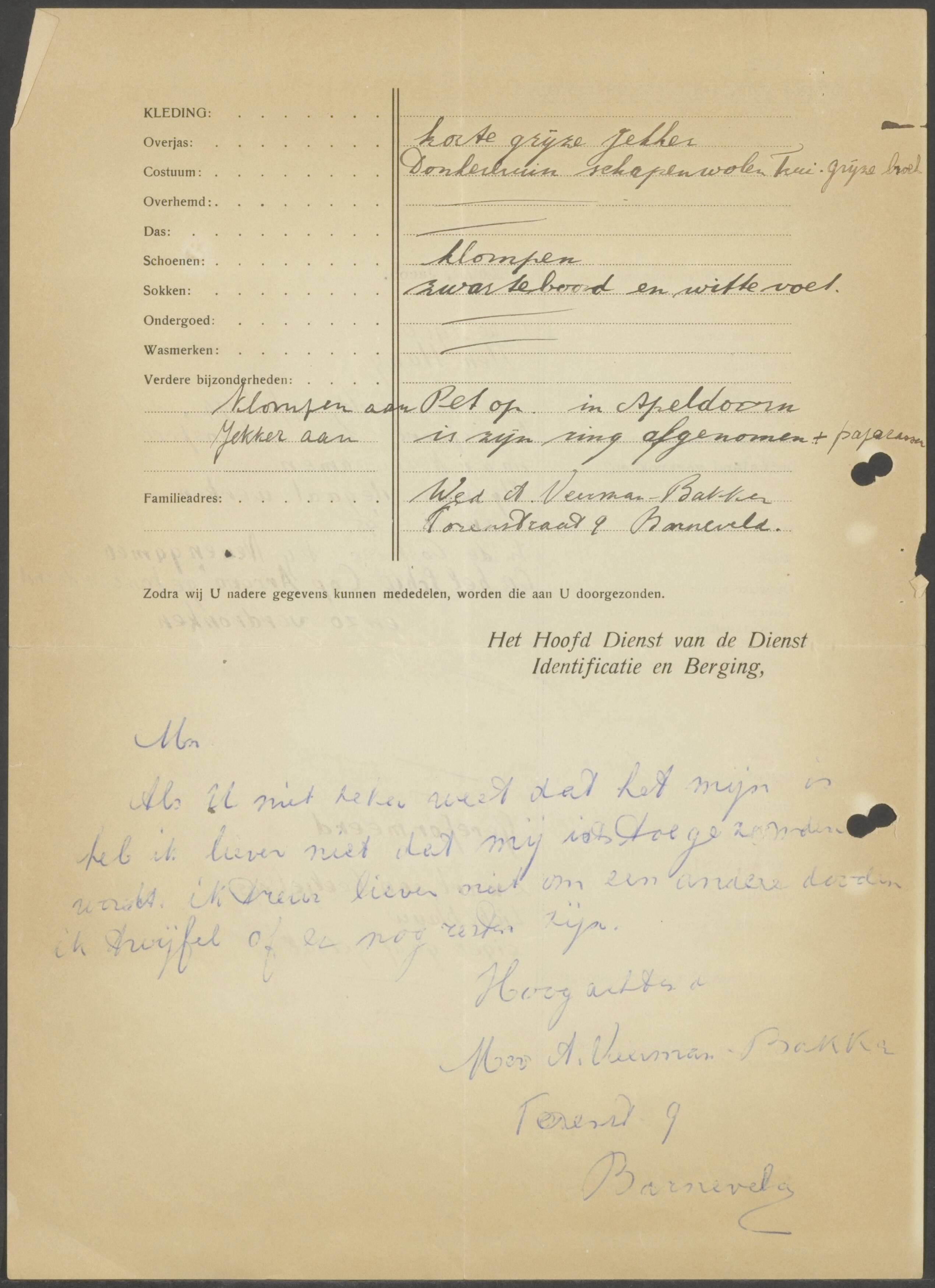
His body was never found. The Red Cross notified Barneveld of his presumed death on 16 May 1946 (Gemeentearchief Barneveld 002, inv. 1546, PDF p. 339). The family asked for his remains to be brought home at the state's cost if they were found, in a request she signed (war graves file, scan 16), and about December 1950 she wrote at the foot of the form of the Dienst Identificatie en Berging, the state office that traced the war dead:
If you do not know for certain that it is mine, I would rather nothing were sent to me. I would rather not mourn over someone else's dead. I doubt whether there are any remains.
Dutch originalAls U niet zeker weet dat het mijn [man] is heb ik liever niet dat mij iets toegezonden wordt. Ik treur liever niet om een andere doden. Ik twijfel of er nog resten zijn.
— Mev. A. Veerman-Bakker, Torenstraat 9, Barneveld, to the Dienst Identificatie en Berging · Nationaal Archief 2.19.255.01, 157653A, scan 18 · the file
Asked by the office on 6 December, the burgemeester of Barneveld certified on the 15th that Jacob had not gone to Germany of his own will; the Rijkspolitie's report of the 13th had him known there as politically entirely reliable (Gemeentearchief Barneveld 002, inv. 1546, PDF pp. 341–345; Jacob Veerman). The office had already answered her on 11 December 1950 that only remains whose identity had been established were brought home, and that since her husband had died with so many others the chance of finding his was extremely small (scan 21). She was still at Torenstraat 9 in 1955 and 1957 (scans 3, 5–7). Barneveld's death register for 1945–1950 records his death, on 3 May 1945 at "Neustadt (Duitsland)", as deed 108, with Aaltje Bakker named as his partner (the index entry; the scan not opened).
Later life
Link to the section Later lifeBy February 1966 she had married Hendrik Vaarkamp and lived at Stationsweg 165, Barneveld (war graves file, scan 4). She outlived her eldest daughter: Jopie's death notice, September 1977, is signed by "Mijnheer en mevrouw Vaarkamp-Bakker, haar ouders", with "H. Vaarkamp, Stationsweg 165, Barneveld" as the Dutch address (the notice). She died at Barneveld on 13 December 1991, aged 86, and was buried there on 18 December, by Jacques Vanhaelen's family genealogy; Carel Plantagie gives her years as 1904–1991 (their accounts, October 2026).
Where the sources disagree
Link to the section Where the sources disagree- Her age in 1946. The family's questionnaire of 9 May 1946 has 41, the copy of 24 May 40 (p. 4; p. 8); she was 41.