Lt-Col Martin Herford
Geneva 1909 ◐ – 14 Jul 2002 ◐
Major (temporary Lieutenant-Colonel) Martin Edward Meakin Herford, M.B.E., M.C., Royal Army Medical Corps (175256)
About: An RAMC doctor commanding 163 Field Ambulance of XXX Corps, who crossed the Rhine with medical supplies on 24 September 1944, was taken by the Germans and arranged with them the British hospital in the Willem III barracks at Apeldoorn, where he was Col Graeme Warrack's second in command while Private Thomas Murphy was held there. He broke out on the night of 16 October and swam the Lower Rhine back to the British lines with the list of the wounded.
Unit or role: Major (temporary Lt-Col), RAMC, 175256; a doctor of the 24 Casualty Clearing Station in Greece, 16 Motor Ambulance Convoy in the desert and 200 Field Ambulance in Sicily and Italy; CO 163 Field Ambulance (XXX Corps) from 1944; not an airborne soldier. MBE, MC and Bar, DSO.
Where: Valburg on 23 September 1944; across the river on the 24th, taken to the St Elisabeth Hospital at Arnhem and a German headquarters at Ede; the Willem III barracks at Apeldoorn, 25 September to 16 October; after the war Slough, then Cornwall.
Evidence: ✓ His own account, "Campaigning Notes, 1940-45", Bristol Medico-Chirurgical Journal, 1946, pp. 136–147 (read on the page images); ✓ the London Gazette: 1 April 1941, p. 1883, 30 December 1941, p. 7330, 18 November 1943, p. 5062, 13 January 1944, p. 255, 29 March 1945, p. 1710 and 6 August 1948, p. 4383 (all checked on the images); ✓ his four recommendations for awards at Kew, read on the page images: the MBE (WO 373/77/606), the MC (WO 373/3/144), the Bar to the MC (WO 373/4/22) and the DSO (WO 373/53/562); ◐ Warrack, Travel by Dark (1963), pp. 59, 62, 64–65, 71, 77–78, 80, 84–85, 90–91, 94, 252 (text layer; pp. 62, 77, 78 and 80 also read on page images); ◐ Heaps, The Grey Goose of Arnhem (1976), pp. 96, 115, 189–192, 229 (text layer); ParaData's record of him and its article on the hospital; ✓ his own report on the Apeldoorn hospital, "Period 24 Sept. to 19 Oct. '44", printed in the Journal of the Royal Army Medical Corps, vol. 98 (1952), pp. 249–252 and 297–302 (read on the page images); ◐ Hall, A Doctor at War (1995), the Apeldoorn chapters in the reader's text layer, and search snippets for the rest; ◐ the medical press, 1942–1945 (the search hits, snippets only).
Bristol, Spain and Finland
Link to the section Bristol, Spain and Finland- ◐ Born at Geneva, 1909; qualified at Bristol, 1937. The BMJ's obituary closes "b Geneva 1909; q Bristol 1937", and opens "Martin Herford's life was informed by his Quaker beliefs. After qualifying he went to work with children suffering from starvation as a result of the Spanish civil war" (BMJ, 14 September 2002, recovered from the Internet Archive's text search, not read on the page; the second sentence is also on the Belsen Trust's page). The Lancet of 1942 has his degree as "M.B. Brist." (snippet).
- ◐ Spain. A stretch of Hall's life of him has Herford on board a ship outside Valencia harbour, where the captain was ordered to examine a burning British tanker and those on deck could see "the mast tops of seven other ships which in the preceding month had all been sunk by Franco’s bombers" (Hall, snippets).
- ✓ Finland, 1940. In his own words (his account, p. 136):
- He was house surgeon to Mr Wright when the war began, "and like many others was 'fixed' at my post in expectation of heavy air raid casualties".
- "[F]or a variety of rather ill-defined motives, including pacifist ideas and a dislike of wearing uniform, I volunteered to go over and do medical work in Finland."
- He arrived on 13 March 1940 with about two hundred others, to join an advance guard of about a hundred that formed the nucleus of the British contingent of the International Volunteer Brigade, "the day after the Russo-Finnish armistice was signed", and stayed: "It took ten months to get out of Finland and several attempts failed."
- ◐ Hall has one of those attempts: a Dutch former volunteer on the train recognised Herford and protested to the Finnish police, and Herford and his companion were put off at the next halt; by November "The British contingent had now been moved to Korpilahti, and as there were very few medical duties to perform" (Hall, snippets).
- ◐ The Belsen Trust: he "failed to join RAMC in ’39 so he joined the Finnish Volunteers but was bored" (the Belsen Trust).
- ✓ The way out. In December 1940, through Tanner, the Finnish minister of finance, he had an interview with "the famous Madame Kolontay", the Soviet minister in Stockholm, and had a visa in four days; he left on 4 January 1941 "via Leningrad, to Odessa, Constantinople, Ankara, Beyrut, Haifa and Cairo" (his account, pp. 136–137).
Egypt and Greece, 1941
Link to the section Egypt and Greece, 1941- ✓ Commissioned. He reached Egypt on 19 January 1941, and "two days later I had my commission in the R.A.M.C. and was posted to the 63rd General Hospital at Helmieh" (his account, p. 138, checked on the image). The Gazette has "The undermentioned to be Lts.:—", "22nd Jan. 1941:— Martin Edward Meakin HERFORD, M.B. (175256)" (London Gazette, supplement of 1 April 1941, p. 1883, checked on the image).
- ✓ Greece. Five weeks later he persuaded the officer taking No. 24 Casualty Clearing Station to Greece to take him; they sailed on 9 March 1941 (his account, p. 138).
- When the Germans broke through at the Monastir gap the station and a company of 189 Field Ambulance stayed, and he asked to do liaison between them and the ambulance railhead: "The next three weeks, as we moved back and confusion grew worse and worse, were spent almost entirely on a motor-cycle" (p. 138).
- At Thebes he kept a strafed ambulance train moving, chasing its Greek drivers with a rifle and doing some of the shunting himself (p. 139); at Athens Brigadier Large, the DDMS, gave him a lorry of medical stores for the Peloponnese (pp. 139–140).
- He got away by caique from Monemvasia with the military attaché's party, reached Kythera on 28 April, and went on in the cruiser Auckland to Suda Bay in Crete and on to Alexandria (pp. 141–142).
- ✓ The MBE. "Lieutenant Martin Edward Meakin Herford, M.B. (175256), Royal Army Medical Corps" is in the list of 30 December 1941 (the Gazette, the name checked on the image). The recommendation, an Army Form W.3121 of 30 May 1941 from "81 Base Sub Area" (WO 373/77/606):
- "This Officer was detailed to remain behind with 24 Casualty Clearing Station, to await capture by the enemy, and performed very good service"; he made himself liaison officer between the station and the ambulance trains and, when communication ceased, "with the aid of a motor-cycle" kept in touch with each train, so that the station "was able to withdraw before capture".
- It is recommended by "Brig. Large, D.D.M.S."; the typed text spells him "HURFORD" once, and the name column has HERFORD.
- It names no place and no date for the service; Kew's catalogue puts it in Greece and Crete, and his own account places the motor-cycle work in Greece (p. 138). The Belsen Trust gives the Gazette heading as the Middle East from February to July 1941 (the Belsen Trust).
The desert, 1941–1943
Link to the section The desert, 1941–1943- ✓ Two years in the Western Desert with 7 and then 16 Motor Ambulance Convoys; he commanded 16 MAC in the battle that led to the loss of Tobruk, and heard that Tobruk had fallen from an Auster pilot he had asked over for a drink (his account, pp. 142–143).
- ✓ At Alamein his car went over a German mine, "This sent me out of the desert for a while"; he was then with No. 15 (Scottish) General Hospital and No. 99 Sub-Area (p. 143).
Sicily and Italy with 231 Brigade
Link to the section Sicily and Italy with 231 Brigade- ✓ In April 1943 he was posted second in command of 200 Field Ambulance, and landed in Sicily with his company alongside No. 231 (Malta) Brigade: "The Brigadier (now General Urquhart of the 1st Airborne Division), was worth a brigade by himself. How he survived is a miracle" (his account, p. 143, checked on the image).
- ✓ The MC. "Captain (temporary Major) Martin Edward Meakin Herford, M.B.E., M.B. (175256), Royal Army Medical Corps (Reading)" in the Gazette supplement of 18 November 1943 (p. 5062; the Military Cross heading is on the page before, which we do not hold, and the recommendation's "L.G. 18.11.43" ties it). The recommendation (WO 373/3/144):
- "This Officer was in command of the A.D.S. working with units of the Bde Gp" and was "constantly amongst the forward troops tending to the wounded"; at Agira on 28 and 29 July and at Regalbuto on 1 August his work, "at times under heavy fire, was magnificent", and "the prompt treatment accorded by him to the wounded must have saved many lives".
- It is a form of 231 Brigade, signed for the brigade by the typed name "R.E. Urquhart", then by the commander of 30 Corps (signature not legible), Montgomery of Eighth Army ("Immediate") and Alexander ("Granted an Immediate M.C."), with "L.G. 18.11.43" below. ✓ Herford's own words above make that brigadier the Urquhart who commanded 1st Airborne Division at Arnhem.
- ✓ Porto Venere and the Bar. In his account the brigade's landing at Porto Venere (he gives no date) went in late, in daylight, under steep hills: "By nightfall there were about 300 casualties", and the casualty centre moved into a railway tunnel (his account, pp. 143–144). "Bar to the Military Cross", supplement of 13 January 1944 (Gazette, p. 255, checked on the image). The recommendation (WO 373/4/22):
- "On the 8th September, 1943 during the assault on PORTO di S. VENERE (ITALY)" a shelled and burning landing ship reached the beach; Major Herford "led a stretcher party to the beach", helped get its casualties away under mortar and shell fire and dive-bombing, and "dressed several casualties".
- Recommended by his CO, "W.A. ROBINSON" of 200 Field Ambulance, then Urquhart, commanding 231 Brigade, the commander of 13 Corps (signature not legible), Montgomery and Alexander: "Granted an Immediate Bar to M.C.", "L.G. 13.1.44". The catalogue spells his middle name "Merkin"; the form has "Meakin".
163 Field Ambulance
Link to the section 163 Field Ambulance- ✓ The brigade came home to Avonmouth in November 1943 and went to the invasion concentration area in the New Forest in mid-March 1944; two days after he had been briefed on the landing, "a sudden posting came to take command of No. 163 Field Ambulance". The unit landed in Normandy a month after the brigade, joined 30 Corps, and had "a forward role from then until after the 1st Airborne landing at Arnhem" (his account, pp. 144–145).
With Murphy
Link to the section With MurphyHerford and Murphy are not shown meeting. Herford was second in command of the hospital at Apeldoorn for the whole of the few days Murphy spent there, and by the Pegasus Archive's account it was his arrangement with the Germans that made the barracks a hospital and not a prisoner-of-war camp (its page on Warrack).
The crossing, 24 September 1944
Link to the section The crossing, 24 September 1944The 1st Airborne reserve medical supplies were given to No. 163 Field Ambulance, with instructions to go forward and see what could be done to give aid. Attempts to cross the river were unsuccessful, and so on 24th September I called for four volunteers and with Captain Lewis of the 1st Airborne, who was unfortunately killed that night, went down to the river under cover of the Red Cross. We found an abandoned assault boat and took over some supplies. I left the party by the bank and went forward to reconnoitre. There was a lot of noise, but it was impossible to tell who was firing at whom. The exact location of the 1st Airborne troops was uncertain and, not unexpectedly, I entered the German lines. I demanded to see the senior officer in order to request passage or, if refused, the safe return of my party. I was blindfolded and for about an hour was led from place to place to find an officer sufficiently senior to make a decision. Ultimately they refused, but said my party would be returned, while I would be held for the night. Later in the evening they said I would be regarded as a prisoner, but I took a very strong line and, ultimately, it was decided that next day I should go to Apeldoorn and discuss matters with the senior medical officer in the region.
— Martin Herford · "Campaigning Notes, 1940-45", Bristol Medico-Chirurgical Journal, 1946, p. 145, checked on the image · the article
- ✓ The recommendation for his DSO, on the crossing (WO 373/53/562, p. 1):
- 163 Field Ambulance was at Valburg on 23 September to evacuate 1st Airborne Division's casualties if the division was relieved: "Reports stated there were 2000 (Br) casualties in the area N. of the river in urgent need of assistance and Medical supplies". A plan to take staff and stores across on the night of 23/24 September was dropped "owing to the non-availablity [sic] of sufficient craft".
- At 1430 on 24 September Lt-Col Herford "on his own initiative organised a party consisting of one Medical Officer and four Other Ranks", which crossed under the Red Cross flag in a boat loaded with medical equipment; he knew the bank was held by the enemy.
- Page 2: he went forward alone, "with [a vi]ew to making contact with the [Medical] [S]ervices of Airborne Div or making arrang[eme]nts with the enemy for the completi[on] of his mission" (the lines are torn; the brackets are the transcription's), and was taken prisoner.
- ◐ ParaData has him given permission to try, with Capt Percy Louis of HQ Airborne Corps and four other ranks of his unit; in daylight, under a Red Cross flag, they paddled an abandoned assault boat across, and he went forward alone to "reconnoitre", expecting to meet Germans and ask for a senior officer (ParaData). Its page on Louis has the four privates, "Privates Bean, Hill, Moore and Keeghan", taken prisoner, and Louis drowned in the Rhine trying to recross on 24 September (ParaData).
- ◐ Warrack was told it differently. Herford told him that Brigadier Eagger (Warrack's own words: "my Medical Chief at Corps") had ordered him over to help, "but that he had got picked up as soon as he crossed the river" (Warrack, p. 59).
- ◐ The evening of the 24th. ParaData: over the next few hours he met several German officers at different places before reaching a German headquarters at Ede, and one of those visits, on the evening of the 24th, was to the St Elisabeth Hospital at Arnhem, where he got Major Cedric Longland to release staff and equipment for Apeldoorn (ParaData). Herford himself: "Unknown to me, the A.D.M.S. of the 1st Airborne Division, Colonel Wanack [sic: Warrack], had that day approached the Germans to request evacuation of the wounded" (his account, p. 145).
The hospital at Apeldoorn
Link to the section The hospital at Apeldoorn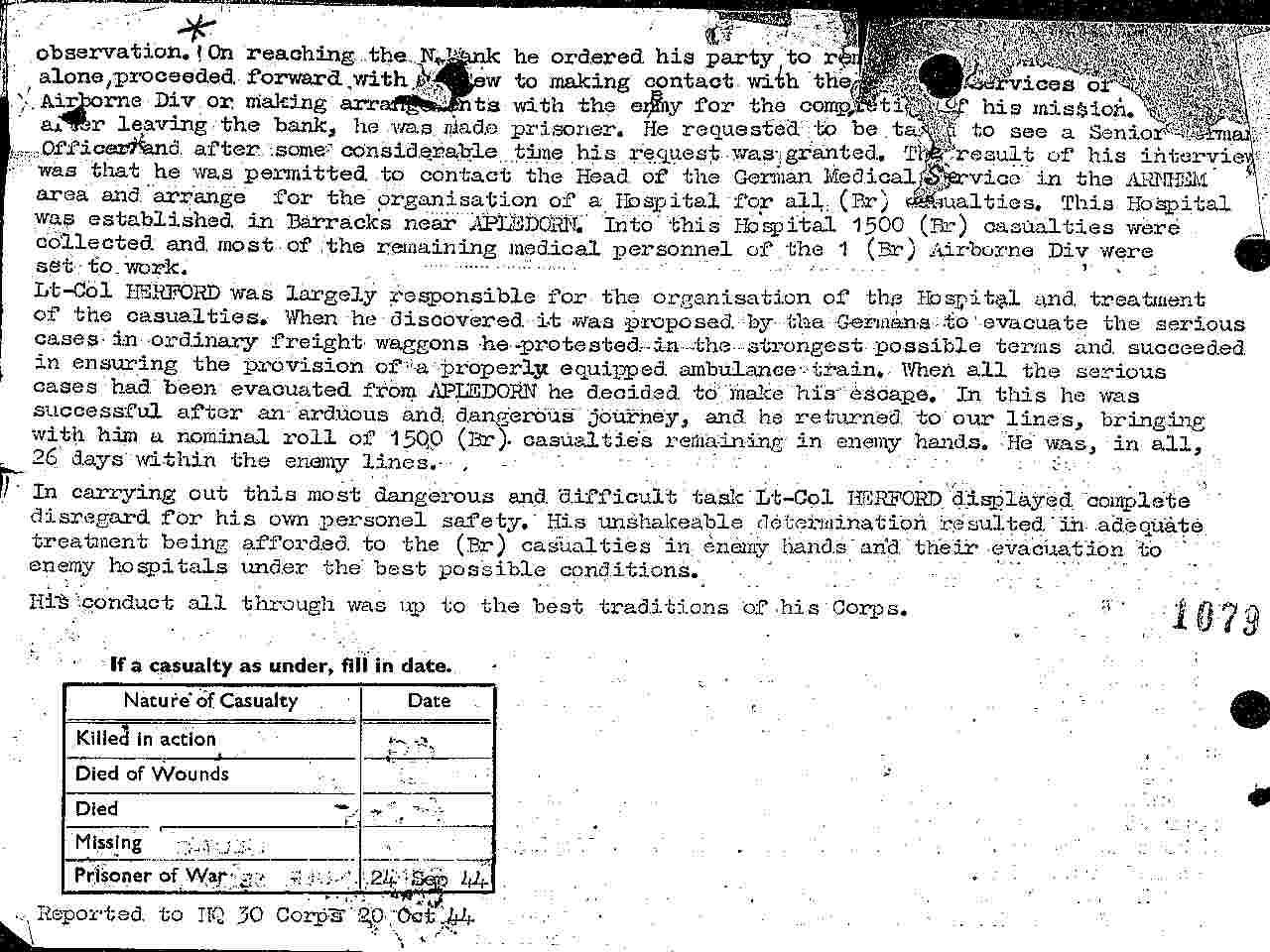
Next morning I met the German A.D.M.S. and it was arranged to establish a British hospital at Apeldoorn, staffed by Airborne medical personnel, many of whom had already been captured. About two thousand casualties passed through this centre. … I acted as intermediary with the Germans and Colonel Wanack [sic: Warrack] asked me to be his second in command. There were several thousand German wounded in the area and we emphasized that British troops might break through at any moment. It was in their own interest, therefore, to treat our wounded well.
— Martin Herford · "Campaigning Notes, 1940-45", 1946, pp. 145–146, checked on the images · the article
- ✓ The first night. With almost no equipment they had over seven hundred, chiefly walking wounded; at 5 a.m. a German officer came to say that five hundred were to go by train at 8, to make room for more (his account, p. 145).
- ✓ The recommendation. He asked for a senior German officer and after "some considerable time" was allowed to arrange "a Hospital for all (Br) casualties", set up "in Barracks near APLEDORN" with "1500 (Br) casualties" and "most of the remaining medical personnel of the 1 (Br) Airborne Div" (WO 373/53/562, p. 2):
Lt-Col HERFORD was largely responsible for the organisation of the Hospital and treatment of the casualties. When he discovered it was proposed by the Germans to evacuate the serious cases in ordinary freight waggons he protested in the strongest possible terms and succeeded in ensuring the provision of a properly equipped ambulance train. When all the serious cases had been evacuated from APLEDORN he decided to make his escape.
— Brigadier, DDMS 30 Corps · recommendation for the DSO, 26 October 1944 · the form
- ◐ ParaData. On 25 September the German regional medical officer, Lt-Col Zingerlin (◐ the "ZINGELINCK", ADMS Arnhem/Apeldoorn, of Warrack's diary, the officers' list, p. 48), showed him the Willem III barracks; Herford, fluent in German, proposed that it be a British hospital staffed by British medics, Zingerlin agreed, and it opened that day, Herford at first suspected of being a German plant (ParaData; the hospital article).
- The Pegasus Archive: he "managed to convince the Germans into treating the barracks as a hospital and not as a POW camp, on the understanding that there would be no attempts to escape" (its page on Warrack).
- ◐ Warrack's second (Warrack, pp. 59, 62):
- Warrack arrived at about 1900 on 26 September (ParaData; Warrack gives no date) and was being abused by a German sergeant major, who was about to take him off to "the ‘cooler’", when "a British Lieutenant Colonel wearing a khaki beret came up and spoke to him in German"; the sergeant major turned on his heel.
- The officer wore "an MC with two bars, an MBE, and an Eighth Army ribbon", and Warrack "remained suspicious of him for two or three days, which, in the light of what happened later, was rather a joke".
- "I was OC Hospital, with Martin Herford as my second-in-command", with Arthur Marrable over the administrative wing and Bill Alford the professional wing (Warrack's words, checked on the page image).
- Herford told him that Theo Redman had already done "tremendously good work" at the hospital (p. 59); General Meyer sent for the two of them for a conference that took them round several German and Dutch hospitals (pp. 64–65); and before Warrack came Herford "had been obliged to move a party, for which only cattle trucks had been provided", protesting that the wounded must be moved properly or not at all (p. 71).
- ◐ Hall has the two field ambulances under Marrable and Alford arriving, which left Herford "free to spend his time cajoling and scavenging for medical equipment and supplies", and Warrack "the last to arrive", without his badges of rank, threatened by a German NCO when he tried to resume his authority (Hall, pp. 180–181).
- ◐ Heaps has the hospital run by "the captive doctors - Theo Redman, Martin Herford, Derek Ridler and Graeme Warrack", Warrack in command since 26 September (Heaps, p. 115).
In Warrack's diary
Link to the section In Warrack's diaryWarrack's diary, written up in the barracks (by his foreword "while they were still fresh in my memory", so ◐ near-contemporary, not shown to be same-day), has him from the evening of 26 September (Warrack's diary, typed transcript of about 1982, Wellcome Collection RAMC/1584; page numbers are the transcript's).
- ✓ The first meeting. At 18.30 on 26 September Warrack met "Lt Col HERFORD MBE MC, comd 153 (Corps) Fd Amb, who had been sent across with JOE LOUIS and some Med stores to try and help us out"; he had seen "Doc E and got permission to try and get stuff in to us, but had been put in the bag meanwhile. All very wrong as he was an official envoy" (pp. 26–27).
- The transcript's list of the other officers mentioned in it has "Doc E" as Brig A. A. Eagger, DDMS 1 Airborne Corps (the officers' list, p. 49).
- "HERFORD is an excellent GERMAN speaker" (p. 27).
- ✓ Second in command. That night Warrack set the hospital up with "HERFORD 2 i/c" (p. 27), and wrote that Herford "was asked earlier for another 200 patients, but refused point blank to hand over any until they had rested up for a few days and until a reasonable train was forth-coming" (p. 28).
- ✓ The days that followed. On 27 September he was "organising blankets, paliasses, beds etc." and "is a veritable tower of strength and is really getting weaving with food and everything else" (pp. 28–29).
- When the Germans searched the men on 28 September "HERFORD got them all laughing and joking in the end" (p. 30).
- He and Redman interpreted at the conference with General Meyer that night (p. 31), and he went round the hospitals with Warrack and Zingelinck on 29 September and to Het Loo on 3 October (pp. 32, 37); on 9 October the two of them lodged a complaint with the Commandant after a guard drove Warrack off at gun-point (p. 43).
- ◐ His status. Warrack's list of the points from the conference with the Germans on 28 September includes "That the status of HERFORD should be thoroughly investigated" (the list mixes German statements with British demands, so it does not say who asked), and on 29 September Warrack wrote, of the Germans' talk, "He is probably going to be exchanged for a doctor from NIJMEGEN where we captured a GERMAN hospital intact" (pp. 31, 33). Nothing in the diary says the exchange happened.
- He is on the diary's roll of the medical staff at Apeldoorn as "175256 Lt Col M E M HERFORD MBE MC", with no note (the roll, p. 51). The diary's last entry is the 20.00 count on 16 October (p. 47), the hour Warrack's book has Herford leaving (pp. 90–91).
- That count has the staff at 137, four fewer than the 141 of the 15th (p. 46), and at 17.30 that day "Another check and they find three missing" (p. 47). ◐ With the Monday 11.00 parade held "as some citizens appear to have gone absent", the fall fits Kessel's Sunday-night party, not Herford, who left at about 20.00 on the 16th; the diary names no one.
His own report of 1944
Link to the section His own report of 1944✓ His report as OC 163rd (Br.) Field Ambulance, "Period 24 Sept. to 19 Oct. '44", is printed in the Journal of the Royal Army Medical Corps, vol. 98 (1952), in "All in the Day's Work", Part I, pp. 249–252, and Part II, pp. 297–302, among "Extracts of Quarterly War Reports" (the text; p. 249, p. 298, read on the page images). ◐ The printed text gives no date of writing; it is headed "Period 24 Sept. to 19 Oct. '44", and ◐ that the 19th is the day he swam the Rhine is our count (below); his "Campaigning Notes" (above) have only "It was now 19th October" once he reached 30 Corps. The same volume's apology (pp. 350–351) is over the first report in Part I, printed under Col. E. I. B. Harvey's name: Harvey states that he did not write it and was not ADMS of the division, and "categorically refutes any connection with these articles"; its author is not known. The apology disowns Harvey's connection with "the above mentioned report and articles" and says nothing against Herford's own report. What follows is from his side, day by day.
- 24 September. He took "about 6 cwts. of emergency supplies" over near Driel at 14.30 under the Red Cross, "accompanied by Capt. Louis of the Airborne Corps H.Q. and four medical orderlies of 163 Field Ambulance (Hill, Moore, Keeghan and Bean)", went forward alone, and met the German lines; he asked for a senior officer as an envoy, was blindfolded, and "In this way I lost contact with Capt. Louis" (pp. 249–250).
- At a divisional headquarters they would not accept a Red Cross flag in place of a white one, "agreed to regard me as a special prisoner, but not as an envoy", and sent him on to the regional medical chief, Lt-Col Zingerlin; "I was then in Ede" (p. 250).
- 25 September. At Schloss Haetloo, "a large German Military Hospital", Zingerlin, "a very reasonable, efficient man", expected 1,500 British casualties and showed him a barracks for 250 lightly wounded; at a German hospital he met Capt. Redman, shot through the arm, caring for 120 British wounded (p. 250).
- "I suggested to Zingerlin the barracks should be made a British Hospital, and staffed by our Medical personnel. He agreed." By the afternoon the wounded "were being laid in rows upon piles of straw" (p. 250).
- Blindfolded to Arnhem, he saw an SS general, who "decided I was a prisoner", and at the St Elisabeth Cedric Longland, with 300 British casualties, who agreed to send a surgical team. Back at the barracks "There was only Capt. Redman and 8 Orderlies to help. By 21.00 hrs. there was 800" (pp. 250–251).
- 26 September. At 02.00 a German doctor came for 500 lightly wounded; when 40 stretcher cases were wanted too, "it was not a proper Hospital Train but only straw-filled cattle trucks. I refused point blank" (p. 251). Zingerlin agreed "we might run a British Hospital"; Lt-Col Alford arrived during the day and Warrack "During the afternoon" (p. 251):
He called a meeting of Senior Officers. I outlined the position and he immediately began a proper Hospital organization. He asked me to act as his 2nd i/c and be Liaison Officer. I spoke sufficient German for this purpose and of the others only Capt. Redman could speak any German at all.
— Lt-Col M. E. M. Herford · report for 24 September to 19 October 1944 · Journal of the RAMC, vol. 98 (1952), p. 251 · the text
- 28 to 30 September.
- An SS search of the hospital; an intelligence officer said he "was definitely to be regarded as a prisoner"; Zingerlin "agreed that no further evacuation should take place except in properly equipped Hospital Trains" (pp. 251–252).
- On the 29th General Mayer admitted his detention as an envoy "was wrong, but said I had seen too much and must be detained"; "Col. Warrack described it as an 'Alice in Wonderland' story", and "We had decided to bluff to the uttermost and play for time" (p. 252).
- On the 30th, 300 lightly wounded were to go "in a truck train"; "Eight hundred and fifty patients and 250 staff in Hospitals" (p. 252).
-
2 to 8 October. The trains (pp. 297–298):
- 2 October: "In the afternoon 250 light cases were sent to the station with M.Os. and orderlies", after the Germans "agreed to paint crosses on the trucks". 3 October: "The train had not yet gone, due to block in line, and 50 more casualties were sent to join the party". 4 October: "Hospital Train left."
- 5 October: "The Hospital Train for 500 was announced, and loading started at once. Medical personnel were also sent, with Lt.-Col. Alford in charge."; he and Warrack were let down to supervise the loading.
- 6 October, the day Murphy and Walsh went: he "visited the Hospital Train, which still awaited an engine, and found a powerful flak train blazing away adjacent", and protested to the stationmaster and to Zingerlin. 7 October: "Train still awaiting engine." 8 October: "Hospital Train had left during the night for the Hanover region."
- ◐ Warrack's diary has trains loaded on 2 and 5 October as well, the second still in the station on the evening of the 6th and gone by the 8th; they differ by a day on the first, Warrack hearing on the 4th that it "left last night" (p. 38), Herford writing "Hospital Train left" under 4 October.
- The roll at the back of the diary dates its men's departures "Ambulance train 2 Oct 44", "4 Oct 44" and "6 Oct 44" (p. 55): 4 October is Herford's day for the first train leaving, 2 October its loading in both, and 6 October falls while the second stood in the station. ⚠︎ Not settled: what the roll's dates mean, and whether its 4 October is the first train or another.
-
⚠︎ On the 7th Zingerlin told him of four men killed on the previous hospital train, more fully than Warrack set it down, and Herford doubted it as Warrack did (p. 298):
Zingerlin said that on the previous Hospital Train there was a wagon with 30 unwounded P.O.Ws. He said that on the journey they had attempted to escape. One of them had fired on the guard with a pistol. The guard had replied and four of these prisoners were killed. I could get no further details. The story sounded very unlikely. The men had been thoroughly searched.
— Lt-Col M. E. M. Herford · report for 24 September to 19 October 1944, entry for 7 October · Journal of the RAMC, vol. 98 (1952), p. 298 · the text
-
It is the story Warrack called "A very fishy tale"; ◐ his "Zingerlin" is the diary's Zingelinck, the same post and the same story.
- 9 to 11 October. A guard threatened "the A.D.M.S. and myself", and the Commandant removed him; six hundred German troops took over part of the barracks; Zingerlin's assistant, "a Major Crammer", stopped his free visits to the Dutch hospital (pp. 298–299).
- 12 to 16 October. The St Elisabeth was cleared, "3 M.Os. and 16 Orderlies" coming to the barracks, and it was decided that any of the remaining "12 M.Os. and 100 Orderlies" who wished "shall be urged to go as soon as possible"; "Col. Warrack and I have rigged up a hide-out in the building with supplies and food" (p. 299). "The Hospital Q.M. escaped" on the 14th, and on the 15th "Three M.Os. and 2 Orderlies escaped intending to join a party of Airborne men known to be in a particular locality" (pp. 299–300).
- He would leave last, as "interpreter and Chief 'Protestor'"; Warrack "was very anxious to come too, but was greatly influenced by his responsibilities to the wounded", and "Lt.-Col. Marrable felt it his duty to remain with his unit, 181" (p. 299; Graeme Warrack; Arthur Marrable).
- The list. It was "A list giving number, rank, name and unit" of all the men and deaths in the hospital and the others nearby, made for "an Amsterdam doctor, who said a British officer had landed by parachute and requested such information"; it could not be sent, "so I thought I might as well try my luck" (p. 300).
Murphy's time there
Link to the section Murphy's time there- ✓ Sam Walsh's report has him and Murphy moved to the Willem III barracks, "being used as a British Hospital", about 2 October; the RSM there had given them to understand that "so far as escape was concerned it was every man for himself", and they walked out with a stretcher at dusk on 6 October (Walsh; Apeldoorn and the escape). Herford was Warrack's second in command through all of it.
The break-out, 16 October
Link to the section The break-out, 16 October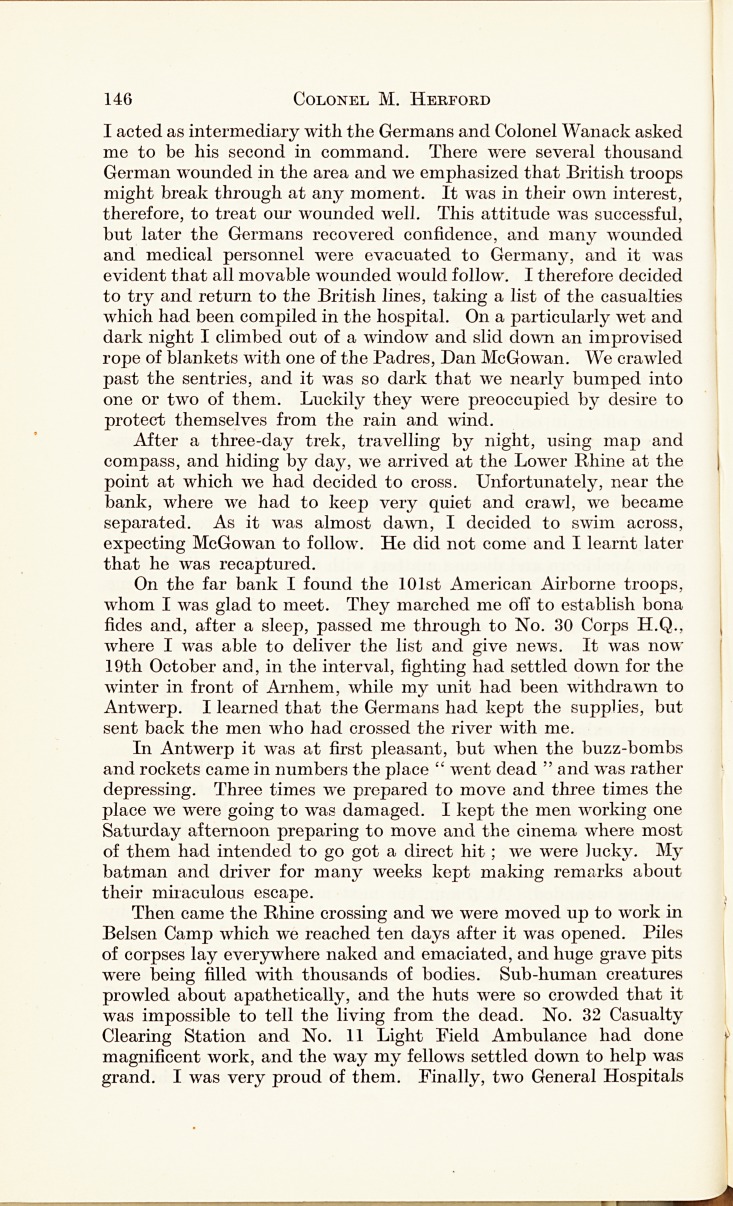
- Why.
- ◐ Warrack: Herford, not of the division, felt he had been wrongly made a prisoner and so justified in escaping; the two agreed to wait as long as they could (Warrack, p. 77). An agent from England wanted lists of all the wounded, and when the padres' contact found the list "too hot to handle", "we decided that it was our business to get the list across" (p. 84).
- ✓ Herford: the Germans had "recovered confidence" and many wounded and medical staff had gone to Germany; it was "evident that all movable wounded would follow", so he decided to go back to the British lines, "taking a list of the casualties which had been compiled in the hospital" (his account, p. 146).
- ◐ The plan. To take a compass bearing on the nearest point of the Rhine and follow it two or three nights: "It was a bold plan which deserved to come off—I am glad to say that it did" (Warrack, p. 84). He collected "food, a tin opener, a compass, an Airborne smock and an anti-gas cape to wrap his kit in when he swam the Rhine"; Warrack meant to hide inside the camp, and the two were to vanish at the same time so that the Germans would think they had gone together (p. 85).
- ◐ The night. On the evening of Monday 16 October, in rain and wind, "At 8 o'clock Herford, Father McGowan, Marrable, Rigby Jones and myself filed into the operating theatre"; they took down the blackout, helped Herford and then Father McGowan out of the window and shut it behind them. The American padre McKee tried after them and was caught (Warrack, pp. 90–91, 94); the Germans found next morning that Herford was missing (p. 94).
- ◐ Heaps has it at nine o'clock on 16 October, Herford sliding down a blanket held by one of the doctors, McGowan following, and the two digging under the wire (Heaps, pp. 189–190).
On a particularly wet and dark night I climbed out of a window and slid down an improvised rope of blankets with one of the Padres, Dan McGowan. We crawled past the sentries, and it was so dark that we nearly bumped into one or two of them. Luckily they were preoccupied by desire to protect themselves from the rain and wind.
After a three-day trek, travelling by night, using map and compass, and hiding by day, we arrived at the Lower Rhine at the point at which we had decided to cross. Unfortunately, near the bank, where we had to keep very quiet and crawl, we became separated. As it was almost dawn, I decided to swim across, expecting McGowan to follow. He did not come and I learnt later that he was recaptured.
On the far bank I found the 101st American Airborne troops, whom I was glad to meet. They marched me off to establish bona fides and, after a sleep, passed me through to No. 30 Corps H.Q., where I was able to deliver the list and give news. It was now 19th October and, in the interval, fighting had settled down for the winter in front of Arnhem, while my unit had been withdrawn to Antwerp. I learned that the Germans had kept the supplies, but sent back the men who had crossed the river with me.
— Martin Herford · "Campaigning Notes, 1940-45", 1946, p. 146, checked on the image · the article
- ◐ Heaps's version (Heaps, pp. 190–192):
- McGowan met Herford among others at the Apeldoorn barracks, "and together they planned their escape" (p. 96).
- The two went by Otterlo and Wolfheze, Herford with a prismatic compass, once falling into a drainage ditch.
- Herford told McGowan he was "a confirmed pacifist" who had served "with a Quaker unit in the Spanish Civil War" and as a volunteer doctor for the Finns.
- They crossed the landing zone among SS troops with their berets turned into forage caps, and reached the river after midnight on 18 October.
- McGowan was taken in his bush by the bank; Herford, after waiting an hour, "slipped quietly into the Rhine" and was picked up by a patrol of the 506th Regiment, 101st Airborne Division, near a brick factory on the south bank.
- ✓ His report of 1944 tells the same night and the walk (the text, pp. 300–302):
- On 16 October "Major Crammer arrived and from his talk it was evident our time was short"; a roll call began at 17.30, the guards "were changed for young men and trebled", and "It was raining heavily and gave promise of a foul night. I therefore decided to escape that night" (p. 300).
- "The R.C. Padre, McGowan, and two others wanted to come, but I considered that two was a maximum"; McGowan knew the Oosterbeek area. They left "at 21.00 hrs. through a side window", down a blanket, "aided out by Col. Warrack and Lt.-Col. Marrable" (p. 300).
- They walked south-west from 21.00 to 07.00, by a prismatic compass "I had been lucky enough to recapture when going in an ambulance to one of the Hospitals", and lay up the day at an empty cottage with a haystack (p. 300).
- On the night of the 17th a woman at a window told them they were at Otterloo and that there were very few Germans there ("I had heard of Otterloo as a very friendly centre" is his own earlier hearsay, not hers); a man in the road gave them tea and bread in a shed "where we found others" and set them on a track south (p. 301).
- They passed gliders near Wolfheze, lay up a day in oak scrub about 3 km from the river, crossed the Heelsum marsh, and lost each other near the bank: "I had last seen him 100 yards from the bank". He swam to a factory on the far side, challenged a patrol, which "proved to be American", and was taken to 101 Division HQ and 30 Corps, "there I reported and delivered the papers" (pp. 301–302).
- ◐ Hall's version. Matthew Hall's life of him, A Doctor at War (1995), was written from "Martin Herford's extensive diaries, correspondence and a draft typescript of his autobiography" (its imprint page) and adds detail no other source here has (Hall, the reader's text layer, leaves 188–205, printed pp. 185–202):
- Marrable suggested "the small window in the operating theatre on the ground floor"; Sandy Flockart, a dental officer who had meant to go with McGowan and stayed with the men, helped them up to it; they let themselves down "with the assistance of two knotted blankets" (his report has "a blanket").
- On the grass, in Hall's telling, Herford "almost bumped into one sentry", they lay still while a guard with a flashlight strolled past, he heard two sentries pacing near the wire and found a third "standing against a wall only yards away", and they crossed a single coil of wire "a little after 9 p.m." (pp. 187–190).
- McGowan wrote to Herford on 22 September 1979 that "Sandy said that he felt his place was with the men, and the next thing is he was asked, because of his size, to hoist me — and you first, I suppose — through the upper window of the operating room" (p. 188).
- At Otterlo a Red Cross worker up from Amsterdam was among the five men in the hut; the patrol on the far bank answered "Sergeant Butcher, 101 US Airborne Division"; at 30 Corps a young intelligence officer took the lists and "appeared most unimpressed" (pp. 195–202).
- ⚠︎ Hall opens the chapter "Herford had been a POW for two months" (p. 185); he was a prisoner from 24 September to 16 October.
- ✓ The DSO recommendation has him back "bringing with him a nominal roll of 1500 (Br) casualties remaining in enemy hands. He was, in all, 26 days within the enemy lines", with "Reported to HQ 30 Corps 20 Oct 44" in its casualty box (WO 373/53/562, p. 2); 24 September to 20 October is 26 days.
- ◐ In February 1945, across the river himself, Warrack was told that "Martin Herford had got through safely. He had walked straight down to the Rhine, crossed it and was now back with his unit" (Warrack, p. 252). Warrack's own escape report at Kew names "Lieutenant Colonel Herford" among the others mentioned (the catalogue entry, WO 208/5433/23).
- ✓ Antwerp, Belsen, Neuengamme, Lübeck. His unit had been withdrawn to Antwerp; after the Rhine crossing it was moved up to Belsen, "which we reached ten days after it was opened", then towards Lüneburg to take over the camp at Neuengamme, which he found evacuated; he was in Lübeck on the morning of the German collapse (his account, pp. 146–147). ◐ Hall's publisher's blurb has 163 Field Ambulance "one of the first British units to reach the newly-liberated Bergen — Belsen concentration camp" (Hall, snippets).
- ◐ Back at the barracks, April 1945. Hall has him talk his way past the Canadian checkpoints and reach the Willem III barracks "Two days after the town's liberation", where he "found the hiding place in the ceiling of Warrack's room, and to his great relief the diary and a little hoard of belongings were still there. These he returned to Warrack's family", keeping the mirror over Warrack's wash basin for himself (Hall, pp. 206–207; Graeme Warrack).
- Hall has Apeldoorn fall on 15 April 1945, so his return on the 17th; another source has the liberation on the 17th (Graeme Warrack).
- ⚠︎ Hall's "That afternoon, Herford was delighted to be reunited with Major Simon Fraser", the surgeon left in charge, follows a flashback to 26 October 1944, when Herford was already behind the British lines; Hall does not say when or where they met (Hall, pp. 207–208).
- ✓ On 1 June 1945 the unit moved to Goslar in the Harz to supervise hospitals of nearly 40,000 German casualties, then to Hanover; in September 1945 he was posted ADMS of the 5th British Infantry Division in Brunswick (his account, p. 147).
- ✓ The DSO.
- "Major (temporary Lieutenant-Colonel) Martin Edward Meakin Herford, M.B.E., M.C. (175256), Royal Army Medical Corps (Reading)" in the Gazette supplement of 29 March 1945 (p. 1710, checked on the image; the Distinguished Service Order heading is on the page before, which we do not hold, and the date "29.3.45" in the Second Army commander's block of the recommendation ties it).
- The recommendation was put up by the Brigadier, DDMS 30 Corps, on 26 October 1944; the award column shows "D.S.O." struck through and "O.B.E." written in and struck through in turn; the Corps commander's line, signed "B G Horrocks", reads "D.S.O."; the margin lists "Previous Awards": "M.B.E. - 30/12/41 - (M.E.)", "M.C. - 18/11/43 - (Sicily)" and "Bar to M.C. 13/1/44 - (Italy)" (WO 373/53/562).
- Honour to the Airborne lists it as "C.O. 163 F.A. att. 1st Abn" (snippet).
- ◐ In the medical press (the search hits; the Archive's full-text snippets, not read on the pages):
- The BMJ lists him "Wounded.—Major M. E. M. Herford, M.B.E., R.A.M.C." on 24 October 1942 (◐ very probably the Alamein mine above), and the Bar to his MC on 22 January 1944.
- The BMJ of 28 October 1944 has him under a heading that ends "believed prisoner of war" (the BMJ puts the heading before the names: "believed prisoner of war.—Lieut.-Col. M. E. M. Herford, M.B.E., M.C., R.A.M.C."), and The Lancet, in an issue of 21 October 1944 or later, has him under "MISSING, BELIEVED PRISONER OF WAR" (the excerpt, the Internet Archive's OCR of the bound volume); a 1944 list in the Journal of the RAMC (the snippet does not show its heading) has "Lt.-Col. M. E. M. Herford, N.W. Europe".
- The DSO is in the BMJ of 21 April 1945 and The Lancet of 1945, and the BMJ of 9 June 1945 has "163 Field Ambulance (Lieut.-Col. M. E. M. Herford, D.S.O., R.A.M.C.)" in a list of units; the snippet does not show what the list is.
- ✓ "Campaigning Notes". Written, he says, because he and other Bristolians, "most of whom are now out of uniform", had been asked to record their experiences in the Army; by-lined "Colonel Martin Herford, D.S.O., M.B.E., M.C., M.B., Ch.B., R.A.M.C., Rockefeller Research Fellow" (his account, p. 136).
- ✓ "All in the Day's Work". Heaps's bibliography lists a two-part article by him, “All in a Day’s Work.”, in the Journal of the Royal Army Medical Corps, April 1952 (Heaps, p. 229). It is in vol. 98 (1952), Parts I and II, by-lined "Colonel E. I. B. HARVEY, D.S.O." and "Lieut.-Colonel (now Colonel) M. E. M. HERFORD, D.S.O., M.B.E., M.C.", and holds his own report of 1944 (above).
- The same volume's apology (pp. 350–351) disowns Harvey's connection with "the above mentioned report and articles", the first report in Part I; its author is not known. It says nothing against Herford's own report (the text).
- ◐ A regular officer. The Gazette of 6 August 1948 prints his entry under the subheading "The undermentioned Lts to be Capts —" (✓ the entry, checked on the image of p. 4383, quoted as printed, with no full stops in the abbreviations and no closing bracket):
(War Cubs [sic] Lt -Col Martin Edward Meakin. HERFORD, D S O , M B E , M C , M B (175256), from Emerg Commn , 1st May 1947, with seniority, 22nd Jan 1942, and is granted the actg rank of Col , 1st May 1947
— London Gazette supplement · 6 August 1948, p. 4383 · the page
- ◐ What it says. He is made Captain from his emergency commission on 1 May 1947, with seniority from 22 January 1942, and acting Colonel the same day. That he was now a regular officer is our reading of "from Emerg Commn" under that subheading; the corps heading is on p. 4382, which we do not hold.
- ✓ Colonel. The Gazette of 24 February 1950 has him among "The undermentioned Capts. (actg. Cols.) to be Cols.", his name and number (175256), from 1 May 1947 (the text layer garbles his decorations) (p. 966), and that of 16 October 1953 "Col. M. E. M. HERFORD, D.S.O., M.B.E., M.C.. M.B. (175256) from Active List to be Col, 15th July 1953", under the Royal Army Medical Corps (◐ in the reserve of officers, whose heading is on an earlier page we do not hold) (p. 5496).
- ◐ Slough. After studying occupational medicine in the United States he became appointed factory doctor for Windsor and Slough and Deputy Medical Director of the Slough Industrial Health Clinic; he studied school-leavers starting work and wrote Youth at Work (1957) and, with T. A. A. Hunter, Adolescence: the years of indiscretion (1961) (the Belsen Trust; the periodicals' and catalogues' snippets). Later he and his wife Mary worked in general practice until her death in 1985, and he retired to Cornwall (the Belsen Trust).
- ◐ On screen. In Arnhem, the BBC and NOS television film of Warrack's book, shown on 22 September 1976 and announced for a repeat on 3 January 1979 as "Arnhem - Het verhaal van een ontsnapping", Gavin Campbell played Martin Herford (Leeuwarder Courant, 2 January 1979).
- ◐ Death. The BMJ's notice ends "d 14 July 2002", and "Predeceased by his wife, Mary, he leaves three daughters and nine grandchildren" (BMJ, 14 September 2002, search snippets). The Belsen Trust has him live in Cornwall "until five years before his death after a long illness in Weston-Super-Mare" (the Belsen Trust). Hall's book on him came out in 1995 and quotes things he "has remarked", so he was alive when it was written.
Where the sources disagree
Link to the section Where the sources disagree- His decorations in September 1944. Warrack saw "an MC with two bars" on him (p. 59); his diary, ◐ near-contemporary (no source says it was written that evening), has "Lt Col HERFORD MBE MC" (the diary, p. 26); ✓ the Gazette has the MC and one Bar before Arnhem, and the DSO recommendation lists the MBE, the MC and one Bar as his previous awards (WO 373/53/562, margin).
- Why he stayed behind in Greece. The MBE recommendation has him "detailed to remain behind with 24 Casualty Clearing Station, to await capture by the enemy" (WO 373/77/606); his own account has "I asked if I might stay and do liaison work" (p. 138).
- Why he went over the river, and with whom. His own account: he called for four volunteers and went with "Captain Lewis of the 1st Airborne" (p. 145); the DSO recommendation: "on his own initiative", with "one Medical Officer and four Other Ranks"; ParaData: given permission, with Capt Percy Louis of HQ Airborne Corps and four other ranks (ParaData); Warrack: ordered over by Brigadier Eagger (p. 59). ◐ "Lewis" is very probably Louis, whom ParaData has drowned that day.
- His unit. "153 (Corps) Fd Amb" in Warrack's diary and in its list of officers (the diary, p. 26; the officers' list, p. 49); 163 Field Ambulance in his DSO recommendation and his own account (WO 373/53/562; his account, p. 145). ◐ The diary's 153 is very probably a slip, by Warrack or the typist.
- ✓ His own report is headed "From: O.C. 163rd (Br.) Field Ambulance, R.A.M.C." (p. 249), which settles the 163.
- What became of his party. Herford learned that the Germans "sent back the men who had crossed the river with me" (p. 146); ParaData has the four privates taken prisoner and Louis drowned trying to recross (ParaData on Louis).
- His report of 1944: "In this way I lost contact with Capt. Louis, although they promised the party would be respected", and on 29 September General Mayer told him "Capt. Louis and the Orderlies, had, he said, been sent back" (pp. 250, 252). ◐ Hall has the party allowed back to the south bank and Louis "shot and killed" on a second attempt that night (p. 174).
- An undertaking not to escape? The Pegasus Archive has the hospital granted "on the understanding that there would be no attempts to escape", and goes on that Warrack, Herford and some other medical staff "escaped, though technically without breaking the agreement they had reached with the Germans" (its page on Warrack); Walsh's report has the RSM give them to understand that escape was "every man for himself" (Walsh); Warrack has Herford feel "justified in trying to escape" because he had been wrongly made prisoner (p. 77); Herford's own account mentions no undertaking.
- Warrack's diary mentions none either, calls the escaping of 3 October "very cheering", and on 4 October has "any patient who is fit enough can make a break, but I need the whole staff to look after the patients" (the diary, pp. 37, 39); ◐ the Germans could read it, so its silence does not show there was none.
- Ambulance train or cattle trucks. The recommendation has him win "a properly equipped ambulance train" for the serious cases; Warrack has him obliged to send a party off in cattle trucks before Warrack arrived (p. 71); Herford's own account has five hundred sent off by train at 8 a.m. on the first morning (p. 145).
- Warrack's diary has both: on 29 September and again on 2 October the Germans offered cattle trucks, and the party of 2 October went in them; on 5 October they produced "a complete hospital train", "very good, consisting of about 30-35 coaches and staffed by two doctors, two sisters", of which Warrack wrote "where he got the train from I just didn't know", the "he" ◐ Zingelinck, who brought the news (the diary, pp. 33, 36, 39). It does not credit Herford with that train.
- ◐ They can all be true of different parties on different days.
- ✓ His report of 1944 has both too, from his side: on 26 September he refused to send 40 stretcher cases because "it was not a proper Hospital Train but only straw-filled cattle trucks", on 28 September Zingerlin agreed "that no further evacuation should take place except in properly equipped Hospital Trains", the Germans on 2 October "agreed to paint crosses on the trucks", and the 5 October train was "The Hospital Train for 500" (pp. 251–252, 297–298).
- ◐ Hall puts the flak gun beside the trains of 30 September to 2 October ("Over the next two days Herford had the unfortunate task of seeing more than 500 men off in German trains"); the report has the flak train beside the train of 5 October, on the 6th (Hall, pp. 183–184; the report, p. 298).
- Who went on the night of 16 October. Warrack and Herford's own account have Herford and Father McGowan go together, and Warrack has the American padre McKee try and fail (Warrack, pp. 90–91; his account, p. 146). ParaData has "Lt Col Herford, Maj Longland, Capt Lipmann-Kessel and Padre McGowan" escape that night "during two separate attempts" (ParaData); Warrack has Lipmann Kessel's party go on the Sunday (◐ 15 October, the first Sunday after the 12 October he mentions on p. 78; Warrack gives no date for it) (p. 80).
- ✓ His report of 1944 has "The R.C. Padre, McGowan, and two others wanted to come", out "at 21.00 hrs. through a side window", "aided out by Col. Warrack and Lt.-Col. Marrable"; and under 15 October "Three M.Os. and 2 Orderlies escaped intending to join a party of Airborne men known to be in a particular locality" (p. 300), ◐ which fits Lipmann Kessel's party going on the Sunday. ◐ Hall adds Sandy Flockart at the window (p. 188); Warrack has Rigby Jones and himself in the theatre too, from 8 o'clock (above).
- When he got back. His own account: "a three-day trek, travelling by night", the swim at almost dawn, and 30 Corps reached on 19 October (p. 146); Heaps: at the river after midnight on 18 October and picked up later that day (pp. 191–192); the DSO recommendation: "Reported to HQ 30 Corps 20 Oct 44" (WO 373/53/562).
- ◐ His report of 1944 gives no date for the swim, but by its own nights (out at 21.00 on the 16th, Otterloo on the night of the 17th, a day in the oak scrub, the swim before light) it falls on the morning of 19 October, our count, with the Americans and then 30 Corps after a rest (pp. 300–302).
- How he crossed. He swam: his own account (p. 146), Heaps (p. 192) and the BMJ's obituary (via the Belsen Trust). Warrack, told it second-hand in February 1945, says only that he "crossed it" (p. 252).
- Where and when he met Longland. ParaData has him at the St Elisabeth on the evening of 24 September, before Ede (ParaData); his report has Ede that night and the St Elisabeth, "Major Longland of 133", on the 25th, after the barracks (pp. 250–251). ◐ The report is his own and headed as a quarterly war report for 24 September to 19 October 1944, but gives no date of writing; it gives Longland the wrong field ambulance, the 133rd for the 16th (Cedric Longland).
- When Warrack came. His report: "During the afternoon" of 26 September (p. 251); Warrack's diary 18.30 and ParaData about 1900 (above). ◐ A few hours apart; the diary is Warrack's own.
- The German medical chief's name. Zingerlin in his report (p. 250) and in ParaData, "ZINGELINCK" in Warrack's diary, "Sangerling" in Hall (p. 174). ◐ One man by his post and by what each says he did; his own spelling is not known.