Ima van Eysinga
Noordwijkerhout 12 Feb 1881 – Elspeet 28 Jun 1958
Jonkvrouw Ephraima Henriette Johanna "Ima" VAN EYSINGA, of Sterrehoveke, Krommesteeg 40, Elspeet (Nederland's Adelsboek, 1941, p. 361; her form for the Americans, p. 2)
About: A painter and embroiderer, deaf from the age of three, who lived at Sterrehoveke in Elspeet with her companion Liesbeth Verweij and, in the war, her nephew Dirk van Eysinga. By Liesbeth Verweij's account Murphy and Walsh were hidden in her house from about 10–11 October 1944 (Walsh has them reach Garderen only on 14 October and Elspeet about 21 October), and James Hardy joined them there on 19 October, until all three left for Kijkuit on 26 October.
Unit or role: Painter, lithographer and embroiderer (Leeuwarder Courant, 12 February 1941). On her own form for the Americans she named no underground organisation and was known to the Allied men as "Miss IMA" (p. 2). Grade 5 on the British index of Dutch helpers, certificate 14671 (sheet E/7), and no. 1239 on the Americans' list of Grade 5 certificates (the list, p. 49).
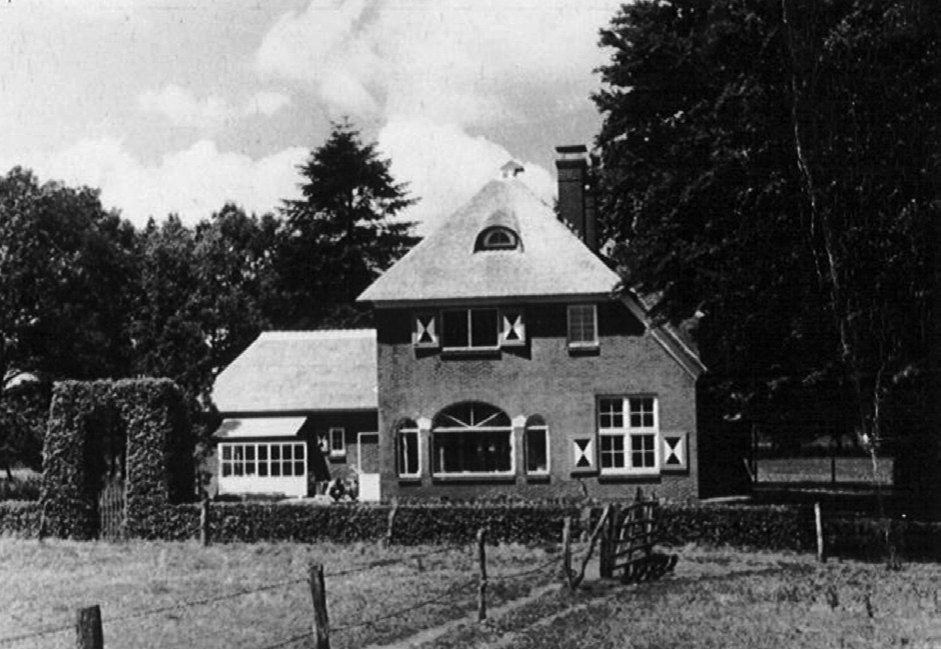
Where: Krommesteeg 40, Elspeet (her form, p. 2), the house ◐ "Sterrehoveke": so her own death notice prints it, dated at Elspeet on 28 June 1958 (Trouw, read on the image; Algemeen Handelsblad), and Liesbeth Verweij's of 1948 has "Sterrehoveken" (Algemeen Handelsblad). Noordman writes "Sterrenhoveke" (p. 280) and the Tresoar catalogue "Sterrenhovenken" (item 6517), both modern; no record of the war years gives the name (the searches). These pages use Sterrehoveke. In 1931 she still signed from The Hague and spent the summers on the Veluwe (below).
Evidence: ✓ her helper file with the Americans, US National Archives 286705702, 27 January 1946, pp. 1–3; ✓ Hardy's MI9 report, 13 January 1945; ◐ Liesbeth Verweij's account of Sterrehoveke as Noordman prints it, pp. 274, 279–281, 300–303, with his source list, p. 346; ✓ the British helper index, sheet E/7; ✓ the family entry in Nederland's Adelsboek of 1941 (page image read); ✓ her death notices (Algemeen Handelsblad, 30 June 1958; Friese Koerier, 1 July 1958); the Tresoar catalogue; Omroep Gelderland; Airborne Magazine
✓ Born at Noordwijkerhout in 1881. The Adelsboek of 1941 has her as "Jkvr. Ephraima Henriette Johanna van Eysinga, geb. h. klein-Leeuwenhorst, Noordwijkerhout 12 Feb. 1881, kunstschilderes. [Elspeet]", so the E. H. J. of the papers (Adelsboek 1941, p. 361, page image read). The Leeuwarder Courant of 12 February 1941 has "de schilderes jonkvrouwe E. H. J. van Eysinga te Elspeet" sixty that day, "Geboren te Noordwijkerhout"; the Algemeen Handelsblad of 11 February has "tomorrow", and the Leidsch Dagblad of 13 February quotes De Standaard (the Leeuwarder Courant, image-checked). Her own form has Noordwijkerhout and a different day, 12-11-1881 (see the disagreements).
✓ Her family. Her father was Jhr. Mr. Tjalling Aedo Johan van Eysinga, born at Leeuwarden in 1846, burgemeester of Noordwijkerhout, who died at The Hague on 11 January 1898, when she was sixteen; her mother, Henriette Jacoba Kluit, born at Leiden in 1852, died at The Hague on 3 May 1931, aged 79 (p. 360, foot, and p. 361, page images read). Her brother was Jhr. Mr. Dr. Willem Jan Mari van Eysinga, born 1878, whose son Dirk, born at Leiden in 1916, is in the same entry (p. 361); her form gives "Prof. van Eysinga, Leiden", 68, as her next of kin (form, p. 2). The mother's notice, from her children and dated at The Hague, Wagenaarweg 13, is signed from The Hague by "E. H. J. van Eysinga" and from Leiden by her brother and his wife (Nieuwsblad van Friesland, 8 May 1931; OCR only), the other signatures left out here. Her uncle Jhr. Mr. Cornelis van Eysinga, born at Irnsum in 1847, died at Boschoord near Sint Nicolaasga on 6 February 1930; his notice calls him "onze beste Oom en gewezen toeziende voogd" (our dear uncle and former supervising guardian) and is signed from The Hague by her too (Utrechtsch Provinciaal en Stedelijk Dagblad, 7 February 1930; OCR only). ◐ A supervising guardian fits children who were minors when their father died; that is inference.
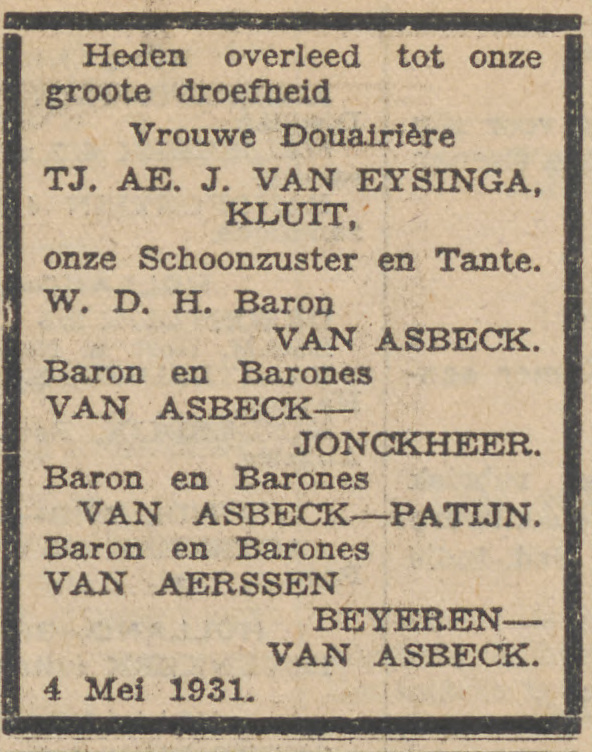
✓ The Van Asbecks. A second notice for her mother, dated 4 May 1931, calls her "onze Schoonzuster en Tante" (our sister-in-law and aunt); it is signed by "W. D. H. Baron VAN ASBECK" and three couples, among them "Baron en Barones VAN ASBECK—PATIJN" (Algemeen Handelsblad, 5 May 1931, image-checked). W. D. H. van Asbeck's wife was Anne Marie Jeanne Henriette Kluit (her death notice, 1927; her son's marriage record). The Van Asbeck–Patijns were Carel Johan Baron van Asbeck and his wife Elisabeth Henriette Maria Patijn (the marriage record; his father's death notice, 1935), ◐ very probably the Mrs van Asbeck-Patijn from whom, by Ima's form, James Hardy came to Sterrehoveke in 1944 (below). The notice does not say how the families were related beyond "sister-in-law and aunt".
✓ Deaf from the age of three. Her brother told the opening of her honorary exhibition in 1951 that at three she lost her hearing completely through scarlet fever and diphtheria. Their father, who drew well and had travelled in Italy with Burckhardt's books, found some talent for drawing in her and developed it, first teaching her himself and then with Theo van Hoytema, who came every Saturday afternoon; Van Hoytema trying to push a silk thread through a piece of cloth with his thick fingers was, her brother said, the beginning of her needlework (Nieuw Utrechtsch Dagblad, 27 August 1951, image-checked). Hardy's "very deaf" fits (below).
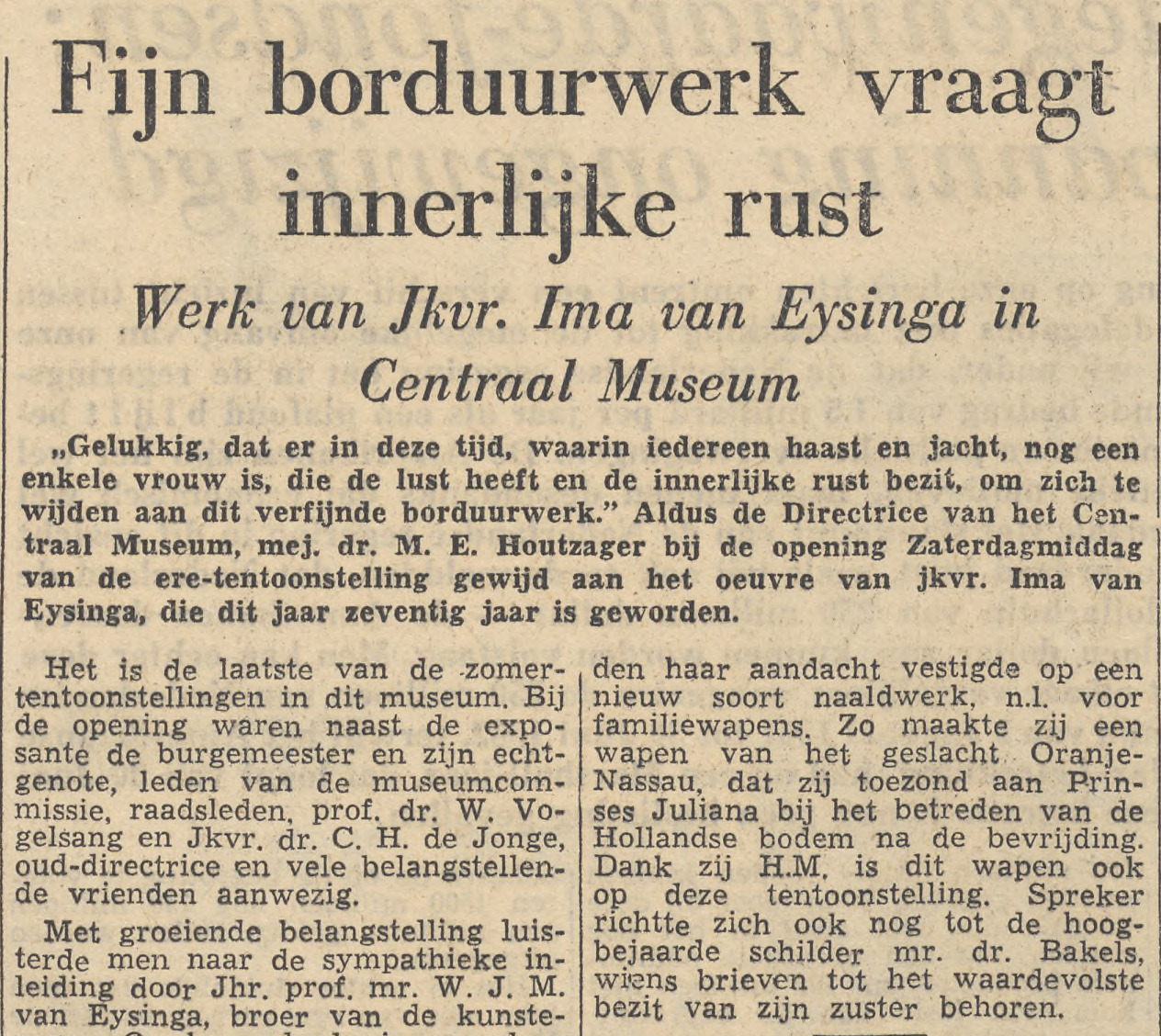
✓ Lip-reading, the convent and her teachers. The Leeuwarder Courant of 10 February 1951, two days before her seventieth birthday on the Monday, has her losing her hearing at three and having "van 1885—1891 privaatlessen in liplezen te Berlijn, Dresden en 's Gravenhage" (private lessons in lip-reading at Berlin, Dresden and The Hague, 1885 to 1891); "van 1891—1894 verbleef zij in het klooster Sacré coeur in Bourg la Reine" (she stayed at the Sacré-Coeur convent at Bourg-la-Reine, 1891 to 1894); then, from 1894 to 1899, drawing and embroidery lessons from "Th. van Hotema" (Van Hoytema, as printed) and, from 1910 to 1912, painting under "mr. dr. R. S. Bakels" (the notice, page 5, image-checked). It fits her brother's account of Van Hoytema as her teacher above and gives the years for the 1941 profile's Bakels (below); ◐ that the 1891 to 1894 convent stay is the 1941 profile's Bourg-la-Reine is our reading; it differs from the 1941 profile on what the Berlin and Dresden lessons were (see the disagreements).
◐ Land in Friesland, 1915 to 1933. The Tresoar notarial index (Open Archieven; index lines only, the deeds themselves not opened) has Ephraima Henriette Johanna van Eysinga, of The Hague until 1924 and of Elspeet in 1933, in thirteen deeds at Leeuwarden and Doniawerstal (the thirteen records). In 1915 she is one of the sellers, with her brother, her two sisters and members of the Humalda van Eysinga family, in two Leeuwarden deeds (15 March and 3 November, houses and meadows) and two at Doniawerstal (30 September, property at Follega; 13 December, property at Langweer for fl. 500); eight more deeds from 1915 to 1933 only name her. The one deed where she buys is of 19 February 1916: with Rijnhard de Beaufort of Doorn she takes property at Langweer from a widow and a man of Sneek (the record). On 6 May 1924 she is named beside Sierk Plantinga of Langweer with the remark "erfpacht" (ground lease), the last deed that gives a place or a thing (the record). The index does not say whose property the 1915 sales were or why the family sold together, and gives no bounds for the Langweer land.
◐ Sterrehoveke. The family archive at Tresoar holds "Ansichtkaarten en foto's van het woonhuis "Sterrenhovenken" te Elspeet van jkvr. Ephraïma van Eysinga" (postcards and photographs of her house Sterrenhovenken at Elspeet), dated about 1930, and reproductions of photographs of her with the shepherd Willem Mouw and her brother Willem Jan Mari's children at Elspeet, about 1930 (the catalogue, items 6517 and 6523; catalogue entries only, none digitised). In April 1931 a newspaper has her on the Veluwe, "waar zij 's zomers woont" (where she lives in summer), with the peacocks of the country houses round Elspeet (Utrechtsch Provinciaal en Stedelijk Dagblad, 2 April 1931; OCR only), and the notarial index has her of Elspeet by 1933 (above).
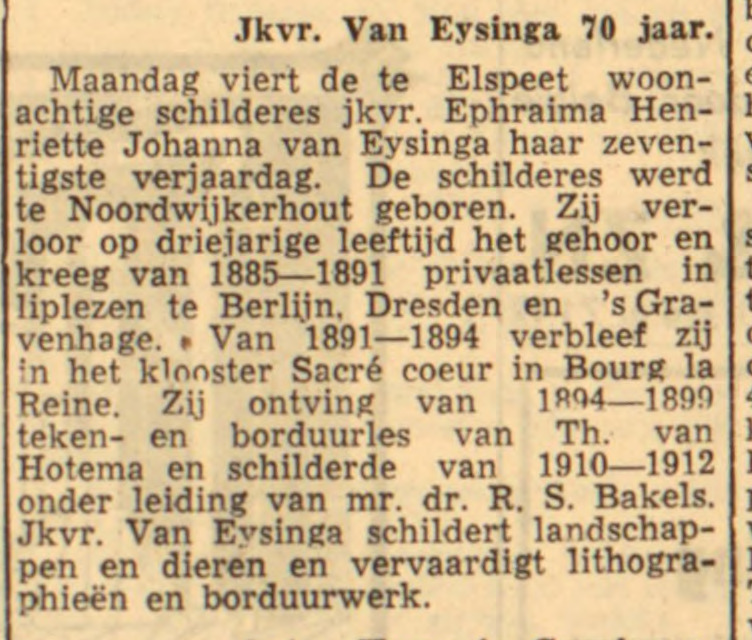
Painter and embroiderer. The 1941 profile says she took painting and drawing lessons at Berlin and Dresden, studied at The Hague with Van Hoytema and F. Jansen, worked at Bourg-la-Reine, in Italy and around The Hague, later painted on Texel and put herself under R. S. Bakels, with Haverman also contributing to her training, and that she made embroidery and lithographs as well as landscapes and animals; works of hers were at the exhibition of contemporary Frisian art at the Frisian Museum in 1940 (the Leeuwarder Courant). ◐ The artists' reference index The Artists of the World (Saur, 1999) has an entry for her, "painter, lithographer, embroiderer, * 12.2.1881 Noordwijkerhout", that gives her name also as "Ephraima van" and points to Vollmer and Scheen, two older artists' dictionaries not read here (the search snippets; snippets only, the book is lending-only). In June 1937 De Telegraaf reported the opening, on 16 June, of an exhibition of thirty or so mostly large embroideries at De Lakenhal in Leiden: screens, a wall hanging, "Pompoenen", of 1915, cushions and the wall pieces with white peacocks, one of them her brother's, with Princess Juliana among the lenders (De Telegraaf, 17 June 1937, image-checked).
◐ A freule Ima van Eysinga at Rome, 1904. Not her work, and the reports are read from the KB's OCR. At Rome station, when the Queen's train stopped on 24 April, "Bloemen werden aangeboden door freule Ima van Eysinga en een allerliefst klein meisje" (flowers were offered by freule Ima van Eysinga and a sweet little girl) (Tubantia, 26 April 1904); De Noord Brabanter of the same day has "freule Irma van Eysinga" (the report). The name is rare and the 1941 profile has her working in Italy, but nothing else puts her in Rome that year.
Her work shown before the war. ◐ Every newspaper item in this list is read from the KB's OCR, not from the page image; each names her, usually as jonkvrouwe with the initials E. H. J., and some as "Irma".
- February 1913, the earliest show found: "schilder- en naaldwerk van mejonkvrouw Ima van Eysinga" at Kunstzaal Kleykamp, The Hague, beside the De Ranitz sisters' needlework; the reviewer calls her Hoytema's pupil whose embroidered flowers are not borrowed (Het Vaderland, 6 February 1913). Sold: six drawings, among them poppies, dog studies and young swans, and two embroideries, a fan and a tea cosy (De Nieuwe Courant, 27 February 1913).
- 1916 to 1919: a group of her work with the Haagsche Kunstkring at the Steuntentoonstelling in May 1916 (Het Vaderland, 13 May 1916); a Kunstkring group show in April 1917 (De Avondpost, 1 April 1917); and a promised place in a Frisian art show at The Hague, 15 October to 2 November 1919 (De Locomotief, 30 August 1919).
- 1921 to 1924, Pulchri Studio:
- the lottery fund bought her no. 33, "Schapen in de sneeuw", in May 1921 (De Maasbode, 22 May 1921; Het Vaderland, 21 May); in July she sat on the Hague ladies' committee honouring Suze Robertson at 60 (De Nieuwe Courant, 16 July 1921);
- Pulchri's lottery of March 1922 had "een span ploegende ossen van Irma van Eysinga" (a team of ploughing oxen) (Het Vaderland, 11 March 1922); her sketch "Dooiweer" drew praise in May 1922 (NRC, 8 May and 20 May), and in October the NRC wrote of "het werk van Jonkvrouw Irma van Eysinga, dat zich tot een groote hoogte begint te ontwikkelen" (the work of Jonkvrouw Irma van Eysinga, which is beginning to rise to a great height) (20 October 1922);
- a still life in 1923 ("het opene, het innig-eerlijke", NRC, 16 May 1923), and a gallery listing of February 1924 has "hoofdgroep Jonkvr. E. H. J. van Eysinga" (Het Vaderland, 13 February 1924).
- April 1925, Kleykamp again, with Anna Abrahams and Anna de Ranitz: the Queen Mother visited on 15 April (Het Vaderland, 15 April 1925). The critics split: her needlework is "te impressionistisch" to be called embroidery yet she "staat hoog in haar naaldkunst" (NRC, 20 April 1925); her painting is very skilful (NRC, 16 April); and a third reviewer finds her an unsettled experimenter, not without talent but without great originality (De Avondpost, 22 April).
- July 1927, Amsterdam: paintings and watercolours by Anna Abrahams and "Jkvr. Irma van Eysinga" at the firm of A. Mak, 13 July to 3 August (De Avondpost, 14 July 1927).
- April 1931, Centraal Museum, Utrecht: an Easter exhibition of sixteen embroideries, 1 to 26 April, the earliest of about 1900 (fire screens), the sunflower screens of 1911 and 1912, animals, which she has made "wellicht met voorliefde" (perhaps with a preference) since 1924, and the peacocks of the country houses round Elspeet, on the Veluwe, "waar zij 's zomers woont" (where she lives in summer); a parrot was finished in 1930 (Utrechtsch Provinciaal en Stedelijk Dagblad, 2 April 1931; the museum's report notes it, Algemeen Handelsblad, 11 October 1932).
- 1939 and 1940, Frisian art: "een meisjesportret en schapen in laat zonlicht" at the Frisian societies' show at The Hague in November 1939 (Haagsche Courant, 8 November; Leeuwarder Courant, 8 November), the same show later at Hilversum (Leeuwarder Nieuwsblad, 25 November), and at the Frisian Museum in 1940 her needlework "Witte Zwanen" (no. 40) and the painting "Geiten op Silicië" [sic, KB OCR] (Leeuwarder Nieuwsblad, 10 August 1940).
Travelling, with Liesbeth Verweij. She travelled widely and learned each country's language first. In Sweden she followed the journey of Nils Holgersson and showed the result to Selma Lagerlöf; the drawings now belong to the Vereeniging voor Lichtbeelden in Amsterdam. "Tot haar dood heeft de oudste dochter van Albert Verwey, Ima's trouwe metgezel, haar op die reizen begeleid" (until her death the eldest daughter of Albert Verwey, Ima's faithful companion, went with her on those journeys) (Nieuw Utrechtsch Dagblad, 27 August 1951). ◐ The article does not name her; Liesbeth Verweij is the daughter of Albert Verwey who lived with Ima, "een vriendin en gezelschapsdame" (a friend and companion) in Noordman's source list (p. 346). "Steeds kwam de kunstenares in haar geliefde Elspeet terug" (the artist always came back to her beloved Elspeet), and she made the arms of the House of Orange-Nassau in needlework and sent them to Princess Juliana "bij het betreden van de Hollandse bodem" (as she set foot on Dutch soil) after the liberation, the source not saying when she made them; the arms were in the exhibition of 1951 by the Queen's favour (the same).
With Murphy
Link to the section With MurphyThe house in the war
Link to the section The house in the war✓ Her nephew Dirk van Eysinga was hiding at Sterrehoveke and working for the pilot line. Noordman:
Walsh and Murphy were then lodged in the house of jonkvrouw Ima van Eysinga, which was called Sterrenhoveke. The house was then lived in by her together with her companion Liesbeth Verweij. Jonkheer Dirk van Eysinga, alias Dirk Bussink, a nephew of hers, was also in hiding there and also did a lot of underground work.
Dutch originalWalsh en Murphy werden daarna ondergebracht in het huis van jonkvrouw Ima van Eysinga, dat Sterrenhoveke heette. Dit huis werd toen door haar bewoond samen met haar gezelschapsdame Liesbeth Verweij. Jonkheer Dirk van Eysinga, alias Dirk Bussink, een neef van haar, was daar ook ondergedoken en deed ook veel ondergronds werk.
— Noordman, Schuilplaats de Veluwe, p. 300
The Elspeet history society, citing Jeanne Dijkstra's book, has Dirk, with Dr Kruimel and Huib de Jongh, concealing at Sterrehoveke "met medeweten van zijn tante, niet alleen wapens … maar ook onderduikers, piloten, parachutisten en ontsnapte doktoren" (with his aunt's knowledge, not only weapons but people in hiding, pilots, paratroopers and escaped doctors) (Elspeet historie). ◐ An Elspeet man interviewed in 1980 called the house of "de familie Ysinga aan de Krommeweg" a resistance centre with an underground shelter (Nunspeter Courant, 1 May 1980, p. 11); it is one man's memory, thirty-six years on. The paper does not name Sterrehoveke or Ima, and her address is Krommesteeg 40, not Krommeweg; that this is her house is our reading.
Murphy and Walsh, October 1944
Link to the section Murphy and Walsh, October 1944◐ In Liesbeth Verweij's account, as Noordman prints it, seven paratroopers were at De Ruif, Dr Kruimel's house at Garderen, so two were to come to Sterrehoveke; "Dit was omstreeks 10 oktober" (this was around 10 October). A round-up that day kept Dirk in the hiding place behind the water tank in the attic, so Verweij cycled to De Ruif herself to arrange it, and "Ima die altijd overal bij betrokken was verheugde zich op de nieuwe logés" (Ima, who was always involved in everything, looked forward to the new guests). The attic was made ready, the men to sleep in the Persian carpets and the stairs to be pulled up once they were upstairs (Noordman, p. 301).
The next evening Verweij rode ahead of Tom and Sam on the cycle paths from Garderen, with Kruimel at the rear, and at about eight gave "de gebruikelijke tik op het zijraam van de woonkamer van ‘Sterrenhoveke’" (the usual tap on the side window of the sitting room); Dirk opened the doors of the studio, and the fire was burning. Kruimel slept in the iron chest, "de slaapstede in oorlogstijd voor een onnoemelijk aantal legalen en illegalen" (the wartime bed of a countless number of legal and illegal people), and "Die nacht schreef Oom Joop in ons gastenboek: ‘Keep smiling; ook in tijden van gevaar’." (That night Uncle Joop wrote in our guestbook: "Keep smiling; even in times of danger.") (p. 301). Her account of the men's days:
Life with Tom and Sam was regular and disciplined. They were not allowed to get up until Dirk called them. If there was danger, the word "Coffee" was called upstairs. Dirk said it was unbelievable how quickly, deftly and silently they would vanish behind the water tank, after rolling up the Persian carpets. As it seemed wiser, for their own safety, that they should be in the house as little as possible, by day they went gathering wood in the Elspeet woods, each taking a different way there. Tom, a Scot, had a head wound that still had not healed. He was a miner by trade, serious and cool-headed, with a typically English sense of humour.
Dutch originalHet leven met Tom en Sam was regelmatig en gedisciplineerd Zij mochten niet opstaan voor Dirk hen riep. Was er onraad dan werd het woord: ‘Coffee’ naar boven geroepen. Dirk zei dat het ongelofelijk was zo vlug, handig en geruisloos ze plachten te verdwijnen achter het waterreservoir, na de Perzische tapijten opgerold te hebben. Daar het met het oog op hun eigen veiligheid verstandiger leek dat zij zo weinig mogelijk in huis waren, gingen zij overdag hout sprokkelen in het Elspeter Bos. Zij namen dan ieder een andere weg erheen. Tom, een Schot, had een hoofdwond die nog steeds niet genezen was. Hij was van beroep mijnwerker, ernstig en koelbloedig en met een typisch Engels gevoel voor humor.
— Liesbeth Verweij, in Noordman, Schuilplaats de Veluwe, p. 302
⚠︎ "A miner by trade" is what Verweij understood; Murphy's own trade is set out on his page. ⚠︎ Walsh's own report has them leave Kootwijk for Garderen only "on 14 Oct after dark" and move from Garderen to Elspeet about 21 October, against Verweij's "around 10 October" for the move to Elspeet and Hardy finding Murphy already there on 19 October (the dates; Walsh).
James Hardy, 19 to 26 October
Link to the section James Hardy, 19 to 26 OctoberOn 19 October, by Hardy's date, ◐ very probably Mrs van Asbeck-Patijn of Het Roode Koper at Leuvenum brought a paratrooper to the house (the name is from Ima's form, below, and the "Bep van Asbeck" of Verweij's account; Hardy does not name her); Dirk questioned him in the pines and fetched him for supper after dark. "Hij heette James Hardy maar werd Jack genoemd en hij was hongerig" (his name was James Hardy but he was called Jack, and he was hungry) (Noordman, p. 302). Hardy's report dates it and describes the household:
As soon as it was dark DEREK took me to the home of his great-aunt where he was hiding. She was an old lady and very deaf and living with her was her niece, a lady of about 40. I do not know the address but the house was also in ELSPEET. Here also I met Pte. MURPHY … We were very well looked after here but we kept out of the house as much as possible as the Germans had visited the house before and there was always the danger that they might do so again.
— MI9 · Pte J. Hardy, 16 Parachute Field Ambulance · IS9/WEA/1/270/2351 · 13 January 1945 · the report
◐ The "niece" was almost certainly Liesbeth Verweij, "een vriendin en gezelschapsdame" (a friend and companion) in Noordman's source list (p. 346); no source held calls her a relative, and Hardy's "about 40" is 13 years short of the 53 she was by her own form's birth date, 16 January 1891 (her form, p. 2). In Verweij's account the household sat six round the fire that evening, and Jack played sentimental English songs on the piano when he was homesick (p. 302). ◐ By Verweij's booklet, as Noordman reports it, Ima was given a 100-franc note when Hardy left: "Volgens het boekje van Liesbeth Verweij kreeg jonkvrouw Ima van Eysinga een biljet van100 franc [sic] cadeau bij het afscheid van Hardy op ‘Sterrenhoveke’ te Elspeet"; Hardy said he gave 100 of the 2,000 francs a glider pilot had handed him in the barracks to one of his helpers (Noordman, p. 274).
To Kijkuit, 26 October
Link to the section To Kijkuit, 26 OctoberWhen word came that the Germans meant to search every house, Jack said he would go back to "Eric", who was to be at Kijkuit, a forester's house in the Leuvenumse Bos. In Verweij's account the three packed at about eight, "Zij namen hartelijk afscheid van Ima en volgden Dirk en mij op een behoorlijke afstand" (they took a warm leave of Ima and followed Dirk and me at a fair distance), over the heath to the forester's house, where there were other Allied men (Noordman, pp. 302–303). Hardy dates it: "as soon as it was dark on the evening of 26 Oct we set off, DEREK and his aunt going ahead pushing their bikes" (Hardy); who that "aunt" was is under the disagreements. The walk itself is told on Liesbeth Verweij's page.
Murphy in the Sterrehoveke papers
Link to the section Murphy in the Sterrehoveke papersNoordman, who worked from the Van Eysinga family's archive, found Murphy among the names of the escapers from the Willem III barracks in it: "Het is een haastige krabbel, maar er zijn ook indringende gedichten en een langere lijst met namen" (it is a hasty scribble, but there are also moving poems and a longer list of names) (Noordman, p. 8; Omroep Gelderland). The family archive at Tresoar holds Verweij's typescript "De Pilotenlijn", with the text of a poem for Ima ("tekst van een gedicht voor jhr. Ima van Eysinga"), closed until 2067, and a 2017 piece, "Irma van Eysinga en Liesbet Verwey. De freule en de gezelschapsdame", closed until 2093 (the catalogue, items 7665 and 7895). Neither has been read.
Her form for the Americans
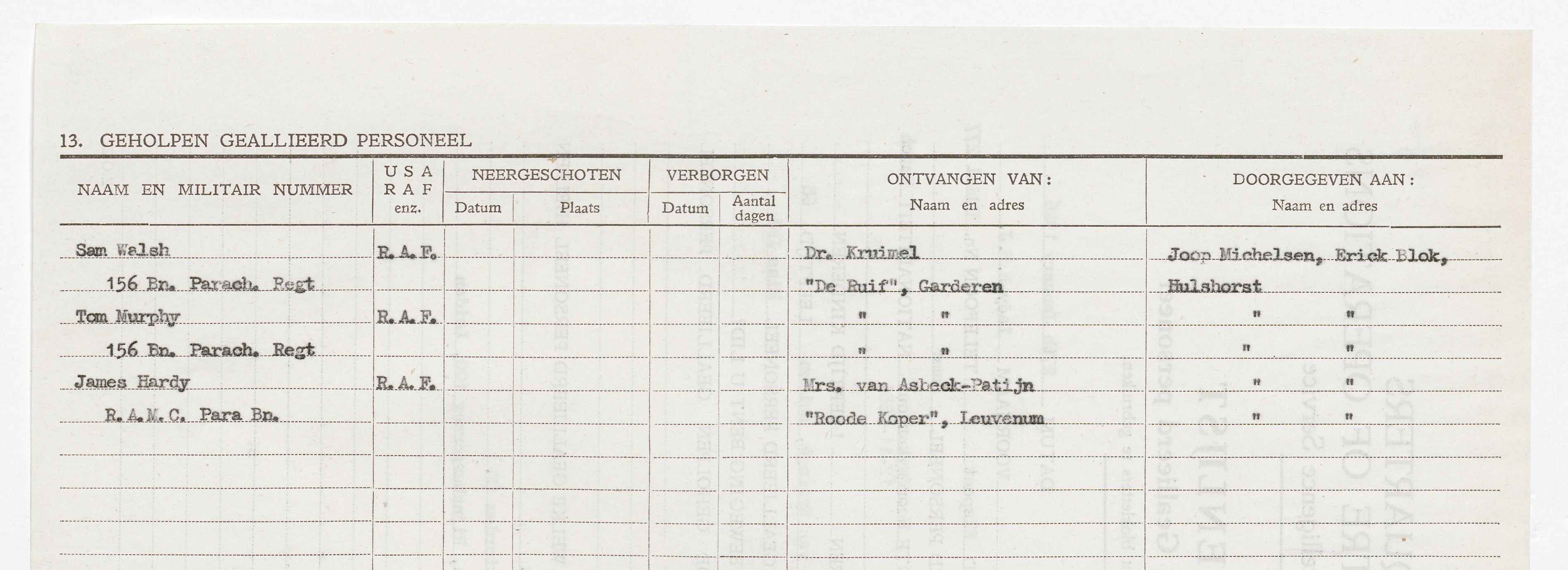
Link to the section Her form for the AmericansOn 27 January 1946 the Americans' form was made out in her name (it is typed): Krommesteeg 40, Elspeet; born at Noordwijkerhout; known to the Allied men as "Miss IMA"; no underground organisation named. In section 11 three names are ringed in pencil, "Dr. Kruimel, Biltstraat, Utrecht", "H. de Jongh, Sparrendaal 47, Rotterdam (Z.)" and "Sir (Baronet) Mr. D. van Eysinga, Rijnsburgerweg 100, Leiden", that is Huib de Jongh and Dirk, and "de Jongh" is pencilled at the top right (form, p. 2, image-checked). On the back she listed three men: "Sam Walsh, 156 Bn. Parach. Regt" and "Tom Murphy, 156 Bn. Parach. Regt", received from "Dr. Kruimel "De Ruif", Garderen", and "James Hardy, R.A.M.C. Para Bn.", from "Mrs. van Asbeck-Patijn "Roode Koper", Leuvenum", all passed on to "Joop Michelsen, Erick Blok, Hulshorst" (Joop Migchelsen and Eric Blok); the date columns are blank (p. 3). Liesbeth Verweij's form, of the same day, lists the same three men. The folder cover has "Grade 5. Conf 50. 13/5/46", the abbreviation not explained (p. 1).
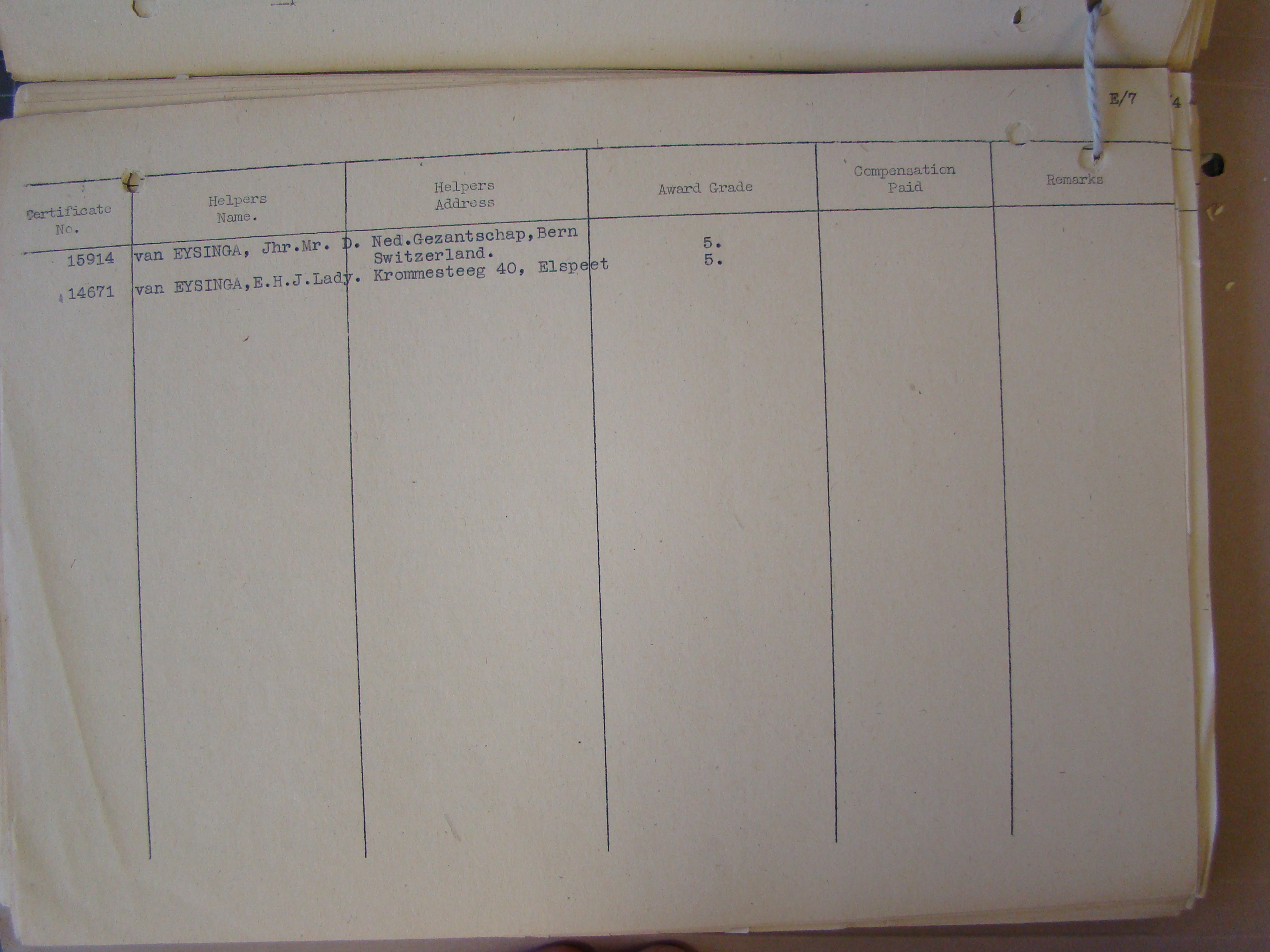
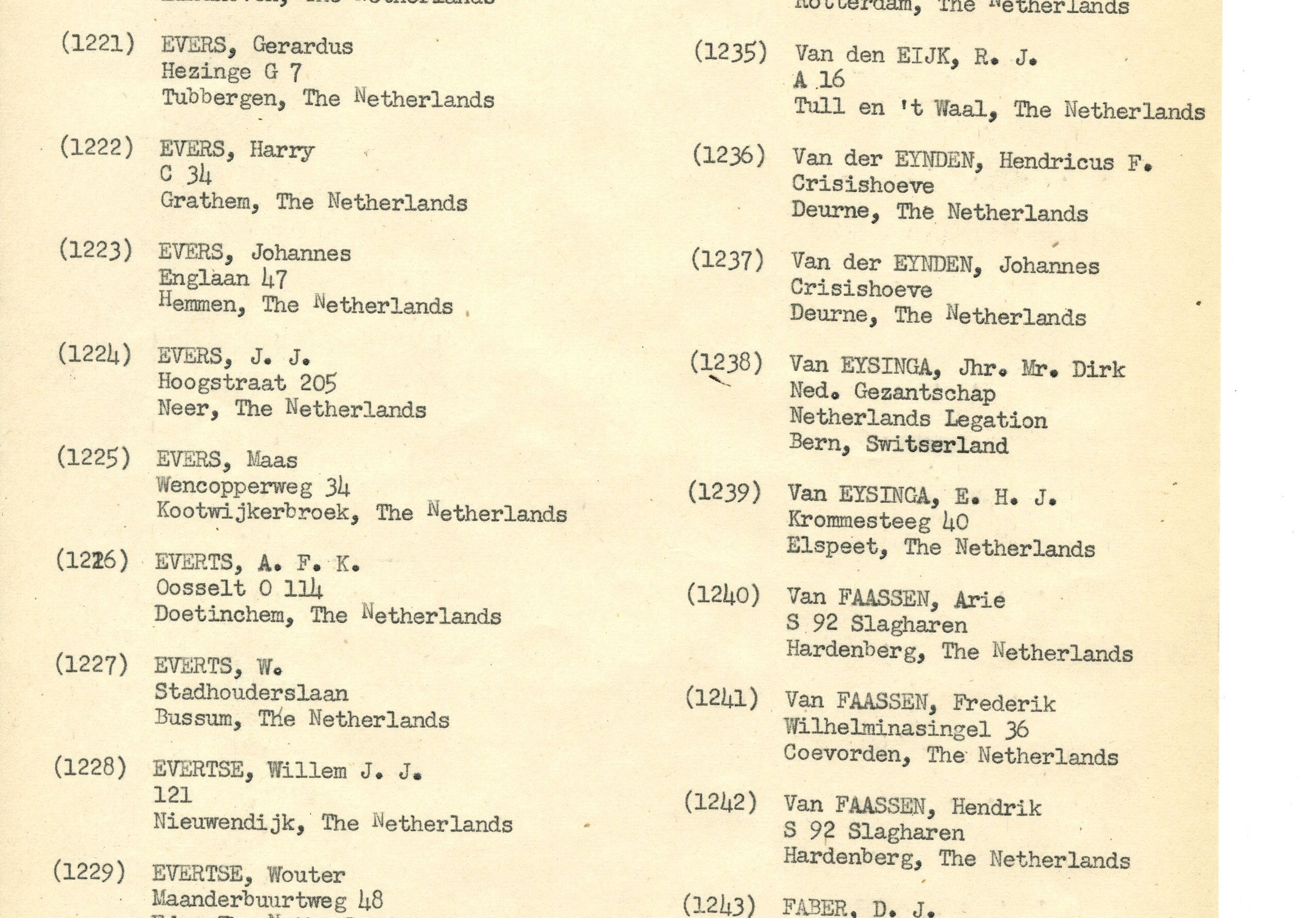
✓ Her grade. The British index of Dutch helpers has "van EYSINGA, E.H.J.Lady.", Krommesteeg 40, Elspeet, certificate 14671, award grade 5, on the line below Dirk's (sheet E/7, read on the image). The Americans' list of Grade 5 (Eisenhower) certificates has "(1239) Van EYSINGA, E. H. J., Krommesteeg 40, Elspeet", next to her nephew's, (1238) (the list, p. 49, image-checked). An earlier British letter thought her Grade 6 (see the disagreements).
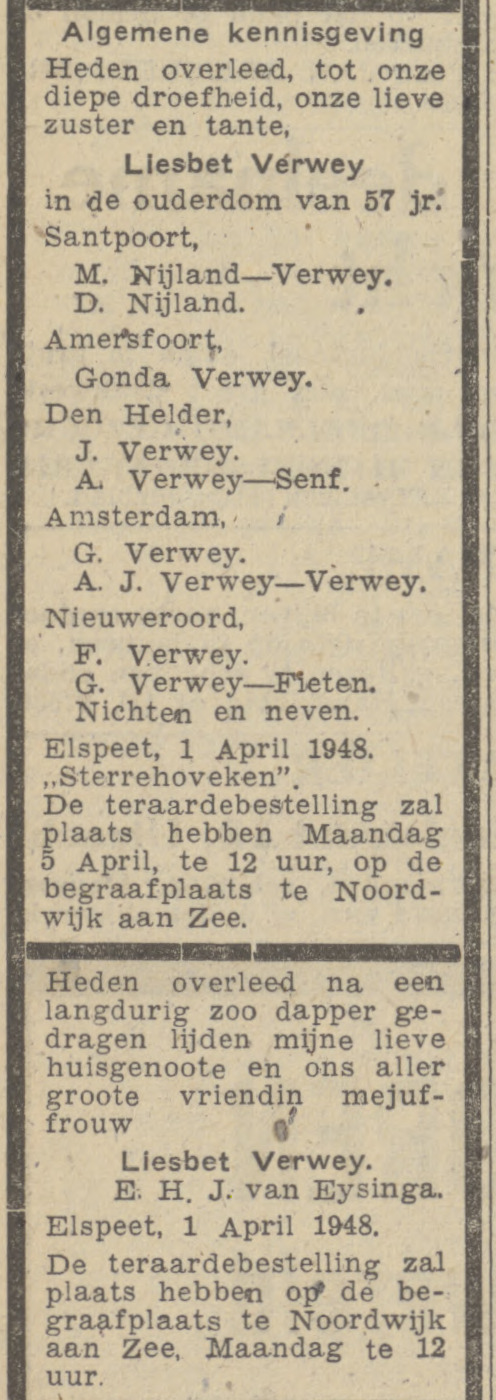
✓ Liesbeth Verweij's death, 1948. The Algemeen Handelsblad of 2 April 1948 carries two notices of the death of Liesbet Verwey on 1 April, aged 57, both dated Elspeet: one from her brothers, sisters and their families, and one signed "E. H. J. van Eysinga", "mijne lieve huisgenoote en ons aller groote vriendin" (my dear housemate and the great friend of us all), after "een langdurig zoo dapper gedragen lijden" (a long illness so bravely borne), the burial set for Noordwijk aan Zee on Monday 5 April at 12 (the notices, image-checked).
✓ The Nils Holgersson watercolours, 1956. In February 1956 the Centraal Museum at Utrecht held a lecture by A. G. Ballintijn on "de aquarellen die freule Ima van Eysinga maakte ter illustratie van Selma Lagerlöffs, „Nils Holgerssons wonderbare reizen”" (the watercolours freule Ima van Eysinga made to illustrate Selma Lagerlöf's Nils Holgersson) (Nieuw Utrechtsch Dagblad, 28 January 1956), and Queen Juliana came to hear it (Nieuwe Tilburgsche Courant, 28 February 1956). Het Vaderland calls her "de bejaarde, sinds haar [k]inderjaren dove schilderes" (the old painter, deaf since childhood), to whom the Queen gave flowers (28 February 1956; OCR only, which reads "dnderjaren"), and the Nieuw Utrechtsch Dagblad has the "75-jarige Jonkvrouwe Ima van Eysinga" (28 February). At The Hague's Gemeentemuseum a lecture by Miss Ballintijn on the same watercolours was announced for Thursday 23 February 1956, four days before the one at Utrecht (the day's listing in Het Binnenhof, 22 February 1956, image-checked).
◐ The Lagerlöf commission. De Telegraaf of 29 February 1956: "Lang geleden heeft zij van de bekende Zweedse schrijfster SELMA LAGERLÖFF opdracht gekregen aquarellen te vervaardigen naar haar bekende werk „Niels Holgersons Wonderbare Reizen”" (long ago she was commissioned by the well-known Swedish writer Selma Lagerlöff to make watercolours of her well-known work Niels Holgersons Wonderbare Reizen), and she showed lantern slides of them in the writer's home and promised to keep the story alive (De Telegraaf, 29 February 1956, page 7, checked on the image). The Nieuw Utrechtsch Dagblad has them made "in opdracht van Selma Lagerlöff", and Het Vaderland "in opdracht van de schrijfster".
✓ The Hague exhibition, June 1956. The Gemeentemuseum opened an exhibition of "de vijfenzeventigjarige schilderes Ima van Eysinga" (the seventy-five-year-old painter) on Thursday 7 June, opened by "C. J. baron van Asbeck" (Het Binnenhof, 6 June 1956, checked on the image; De Gooi- en Eemlander, 9 June 1956, also with Niels Holgersson); 75 in 1956 fits her death at 77 in June 1958. ◐ Carel Johan baron van Asbeck, of the family that signed her mother's notice in 1931 (above), had those initials (his death notice, 1962); the papers do not say who the C. J. baron van Asbeck who opened it was. The Hague review of June says she lost her hearing young through scarlet fever (Het Vaderland, 26 June 1956; OCR only), and De Maasbode reviewed the show as "Ima van Eysinga, in 1881 in Noordwijkerhout geboren" (4 July 1956).
◐ Needlework shows, 1957 and 1958. In November and December 1957 she was in the art-needlework exhibition at the Centraal Noordbrabants Museum at 's-Hertogenbosch, until 15 December: "Ima van Eysinga's groot gehouden en teerkleurige borduurwerken met zwanen en pauwen vol gratie" (Ima van Eysinga's large, soft-coloured embroideries of swans and peacocks, full of grace) (De Tijd, 11 November 1957); "het prachtig-dekoratieve, op scherpe natuurobservatie gebouwde werk van Ima van Eysinga" (Nieuwsblad van het Zuiden, 16 November); and "Ima van Eysinga met haar gracieuse twee zwanen" (Het Binnenhof, 28 December). In January 1958, at the Bisschoppelijk Museum at Haarlem, "Een ander hoogtepunt is de „Twee zwanen” van Irma van Eysinga" (another high point is Irma van Eysinga's Two swans) (Algemeen Handelsblad, 9 January 1958). An announcement of August 1957 puts her in a planned needlework show at the Van Abbe Museum, Eindhoven; it does not say it took place (Eindhovensch Dagblad, 8 August 1957). These items are read from the KB's OCR.
✓ Her death, 1958. She died at Elspeet on 28 June 1958: a notice from Koufurderrige, in Friesland, has "Heden overleed te Elspeet onze hooggeachte landvrouw" (today died at Elspeet our highly esteemed landvrouw, the lady of the land), E. H. J. van Eysinga (Friese Koerier, 1 July 1958, image-checked). Her family's notice gives her age as 77, is dated "Elspeet, 28 juni 1958. "Sterrehoveke"", and sets her burial for 1 July at Eik en Duinen in The Hague; one of its signers is A. G. Ballintijn of Elspeet (Algemeen Handelsblad, 30 June 1958, checked on the image). ◐ Koufurderrige lay in the municipality of Doniawerstal until 1984, and the village's own history says the strip along the Koevordermeer belonged in parts to Langweer, Dijken and Teroele until it became a village in 1951 (Woudsend Online; a local-history site, so ◐ rather than ✓). That is the municipality whose deeds above name property at Langweer and Follega, so a landvrouw's notice from there is plausible; no source held says her land lay at Koufurderrige itself.
◐ Remembered. Nearly nine years after her death, in April 1967, the Princessehof at Leeuwarden showed "een groot naaldwerk uit 1938" of hers, which the paper calls the work of the "doofstomme Friese borduurster" (the deaf-mute Frisian embroiderer) (Leeuwarder Courant, 22 April 1967). In 1992 Klaas Roodenburg's listing of the artists of the north-west Veluwe, 1880 to 1930, with a book and a double exhibition at Harderwijk and Nunspeet, brought back "'de freule' … jonkvrouw Irma van Eysinga", who had painted the Englishwoman Miss Blanche Douglas Hamilton (Nederlands Dagblad, 25 November 1992; OCR only; the article does not give the book's title, and the book has not been read).
Where the sources disagree
Link to the section Where the sources disagree- What she learned at Berlin and Dresden.
- The 1941 profile has her taking "schilder- en teekenlessen" (painting and drawing lessons) at Berlin and Dresden (Leeuwarder Courant, 12 February 1941).
- The 1951 notice has "privaatlessen in liplezen" (private lessons in lip-reading) at Berlin, Dresden and The Hague from 1885 to 1891, when she was four to ten, and puts the drawing lessons with Van Hoytema in 1894 to 1899 (Leeuwarder Courant, 10 February 1951, image-checked).
- ◐ A deaf child of four to ten fits lip-reading lessons better than painting lessons, but that is our inference, and both papers are summarising; neither is a first-hand record.
- Her birthday. Her own form has 12-11-1881 (p. 2); the newspapers of 11 and 12 February 1941 have her sixtieth birthday on 12 February (Leeuwarder Courant). ✓ The Adelsboek of 1941 has "12 Feb. 1881" (p. 361, page image read), and her death notice's 77 years on 28 June 1958 fits only a February birth, so the 11 on her form is ◐ very likely a typing slip.
- The day her mother died. Her own family's notice and the Adelsboek have 3 May 1931 (Nieuwsblad van Friesland; p. 361); the Van Asbecks' notice, "Heden overleed" (died today), is dated 4 May 1931 (Algemeen Handelsblad, 5 May 1931). ◐ The family's own notice and the Adelsboek agree on 3 May.
- How the Nils Holgersson watercolours came about. Her brother's speech of 1951 has her following Nils Holgersson's journey in Sweden and showing the result to Selma Lagerlöf (Nieuw Utrechtsch Dagblad, 27 August 1951); three papers of 1956 have them made on Lagerlöf's commission (De Telegraaf, the Nieuw Utrechtsch Dagblad and Het Vaderland, above). They could both be true; neither gives a date or a contract.
- Her grade. The British I.S.9 office's letter of 7 May 1946 to MIS-X lists "van EYSINGA, Lady E.H.J." among cases "considered to be Grade 6" and asks for confirmation (the letter, p. 43, image-checked). ✓ The Americans' folder cover has Grade 5 and "Conf 50" with 13/5/46, and both the Eisenhower list and the British index have her at Grade 5 (above).
- "Great-aunt" or aunt. Hardy calls her Derek's great-aunt (Hardy). ✓ The Adelsboek has her and Dirk's father, Willem Jan Mari, as brother and sister, so she was Dirk's aunt (p. 361), as the Dutch sources say.
- How long Hardy stayed. About ten days in Verweij's account, when the warning of the search came (Noordman, p. 302); Hardy's own dates, 19 to 26 October, make about a week (Hardy).
- Who walked the men to Kijkuit. Hardy has "DEREK and his aunt going ahead pushing their bikes" (Hardy); Verweij has the men take leave of Ima at the house and follow "Dirk en mij" (Dirk and me), and does not mention bicycles (Noordman, p. 303). ◐ By Verweij's account Hardy's "aunt" that night was Verweij, whom he had called the niece, not Ima.
- "Ima" or "Irma". The Adelsboek and her own form give Ephraima and Ima (p. 361; form, p. 2); several newspapers (1904, 1922, 1927, 1958), Airborne Magazine and a 2017 title in the Tresoar catalogue have "Irma". ✓ Her own form has Ima.