Piet Oosterbroek
Heerhugowaard 5 Aug 1900 ◐ – Meppel 29 Dec 1971 ◐
Pieter "Piet" Oosterbroek of Wilhelminalaan 1, Putten, born at Heerhugowaard (his helper's form, 1946)
About: A resistance man of Putten, in the RVV, who took in Tex Banwell after the prisoner train in September 1944 and was with him in the attack at the Oldenallerbrug that brought on the Razzia van Putten. Shot and taken by the SD in December 1944, he came home paralysed, and after the war sat for the Communist Party (CPN).
Unit or role: The Putten group of the RVV (Raad van Verzet), its leader by several accounts (below); helper of Allied soldiers, grade 5 on the British index of Dutch helpers (the index, page O/3, certificate 9995); after the war a CPN member of the Provincial States of Gelderland and of Putten's council (below). A farmer (landbouwer) in 1926–1929 and 1949, a market gardener (tuinder) in 1939 (the records; Arnhemsche courant, 1949).
Where: Heerhugowaard; ◐ Nieuwe Niedorp, about 1924–1926; Best, at the settlement De Ploeg, 1926–1929; Nederhorst den Berg from 1929; Putten, at Veenhuizerveld E 180 in 1944 and Wilhelminalaan 1 by 1946; he died at Meppel.
Evidence: ◐ his helper's form for the Americans, 1946; ✓ the helpers' forms that name him (Livestro, Van Donkersgoed, Pouw, Schimmel); his own account, Trouw, 4 October 1969; ◐ L. de Jong, Het Koninkrijk, deel 10b, pp. 47–49, 55–56, 61, 546 (the volume; extracts); ◐ Boeree, Kroniek van Ede (1947), pp. 225–227; ✓ De Tijd, 10 July 1945 and Arnhemsche courant, 9 July 1949; Banwell's account in Het Vrije Volk, 26 September 1988; Leo Heaps, The Grey Goose of Arnhem (1976), pp. 125–126; ◐ Vrij Nederland, 14 January 1978; ◐ civil records, index summaries.
- Birth. A Pieter Oosterbroek was born at Heerhugowaard on 5 August 1900 (birth register, index), the son of Mannis Oosterbroek, a transport worker in 1939, and Aaltje Wijtman (marriage, 1939; death, 1971).
- ◐ That he is the Putten man: the form of 1946 gives the same name, Heerhugowaard as his birthplace and Nelly Schuitemaker as his next of kin (the form, checked on the image), and this Pieter married Nellie Schuitemaker in 1939 and was described at his death as her former husband (the records). The records are index summaries; no deed image was read.
- 1920.
- He was in the militia draw of 1920 at Noord-Scharwoude, "05-08-1900", Heerhugowaard (militia register, index).
- ◐ In July 1920 De vrije socialist listed a Piet Oosterbroek among the conscientious objectors (oorlogsdienstweigeraars) held in the provost prison at Scheveningen, and printed word that, "in tegenstelling met geruchten, zich goed houdt en niet, zooals […], de wapenen der barbaren weer opnam" (contrary to rumours, he was holding firm and had not, like […], taken up arms again; the man's name is left out here), and that he had sent in a detailed list about "Scheveningen" (De vrije socialist, 24 July 1920, checked on the image).
- ◐ De Arbeider of 4 December 1920 has "Piet Oosterbroek (in de lijst stond Oosterhoek) is ook ontslagen" (Piet Oosterbroek, who stood in the list as Oosterhoek, has also been released), with no date for his release (4 December 1920, OCR only).
- That this objector is the man born in 1900 is our reading, from the name and the year of his draw; neither paper gives his age or home.
- Nieuwe Niedorp and Best, 1924–1929.
- ◐ In 1924 the youth paper De Moker gave "[N]ieuwe Niedorp: Piet Oosterbroek Kolonie" as a local contact address (the OCR reads "-'leuwe Niedorp"; the archived text notes that the issue of 1 January 1925 has the entry in full), and De Arbeider had him stand in for the speaker at lantern-slide evenings in North Holland (De Moker, 1 November 1924; De Arbeider, 15 November 1924; both OCR only, the scans served in the KB's reading room only).
- ✓ The population register of Best has Pieter Oosterbroek, born at Heerhugowaard on 5 August 1900, a farmer, unmarried, arriving from Nieuwe Niedorp on 17 February 1926 and leaving for Nederhorst den Berg on 9 January 1929 (the register, index). ◐ That this man is the Putten man rests on the same chain as the first bullet above, the name and the birth.
- ◐ On 17 August 1926 a Piet Oosterbroek, Arie Mantel and Karel Veth, "allen landbouwers, wonende te Best" (all farmers living at Best), founded the cooperative farm "Alla Novaj Tempo" ("naar den Nieuwen Tijd", towards the new age) at Best (deed no. 8449, the opening checked on the image); by the OCR of the rest of the deed, Mantel and Oosterbroek were its first secretariat.
- ◐ De Arbeider of 1925 has him hoping to come and work at "De Ploeg", the settlement at Best, and a notice of February 1928 is signed "LIEN VAN BUUREN en PIET OOSTERBROEK", of De Ploeg, Best (31 October 1925; 25 February 1928; OCR only).
- Marriage. ◐ Pieter Oosterbroek, 38, a market gardener (tuinder), born at Heerhugowaard, married Nellie Schuitemaker, 41, born at Gorssel, at Amsterdam on 8 February 1939 (marriage, index). No source we hold says when he came to Putten. In September 1944 he lived at Veenhuizerveld E 180 (Livestro's form; Van Donkersgoed's).
- The Putten group.
- ◐ De Jong has two small resistance groups at Putten in September 1944, one of them, with "de Puttenaar Piet Oosterbroek" and Piet Dankaart, an Amsterdammer in hiding, of "een uitgesproken communistisch karakter (het was aangesloten bij de Raad van Verzet)" (an outspokenly communist character; it was affiliated to the Raad van Verzet); Berend Dijkman joined the two and put them under Ab Witvoet, a police sergeant (De Jong, deel 10b, p. 47, checked on the image).
- ⚠︎ Vrij Nederland in 1978 has the group active since at least 1942, in sabotage and in taking in weapons drops, with Oosterbroek its leader for years, and Dankaart calling him "communist en een zeer bekwaam organisator" (a communist and a very able organiser); messages that Kirschen ("Captain King") sent to London "kwamen onder andere van de groep van Piet Oosterbroek" (came, among others, from Piet Oosterbroek's group) (Vrij Nederland; OCR only, no image available).
- ⚠︎ Leo Heaps wrote in 1976 that "Some weeks ago the Germans had shot Oosterbroek in the back when he escaped from a routine roundup of Dutchmen in a nearby village", and that he limped (Heaps, p. 125). No other source we hold mentions a wound before December 1944.
With Murphy
Link to the section With MurphyNo source puts him with Murphy. His part in the story is through Tex Banwell, whom he took in after the train in September 1944 (below). On 29 October Banwell joined Murphy and James Hardy, and the other paratrooper Hardy does not name (Sam Walsh), at the house in the woods that Hardy places at Leuvenum and calls "BRUMMAGER's house", Kijkuit in Noordman's account, and was with Murphy on the run in November (Hardy's report); ◐ in the firefight of the crossing of 2/3 January 1945 Roger Schjelderup lost "Capt. NOBLE, Sgt. TEX (?) [BANWELL], Pte. MURPHY" (Schjelderup's MI9 report, a transcript with that bracket in it; the Kew original not seen).
Banwell, Heaps and Kettley, September 1944
Link to the section Banwell, Heaps and Kettley, September 1944In 1988 Banwell told Harry van der Ploeg that after he, Heaps and Kettley had jumped from the train, a farmer's wife gathering wood sent her son, who fetched "een man van de ondergrondse, genaamd Piet Oosterbroek" (a man of the underground called Piet Oosterbroek): "Oosterbroek nam ons mee naar zijn boerderij. Zijn vrouw en zijn zuster gaven ons voedsel en ze wasten onze kleren" (Oosterbroek took us to his farm. His wife and his sister gave us food and washed our clothes). The next day they went on to Enny's Hoeve near Voorthuizen (Het Vrije Volk, 26 September 1988). Pegasus Archive's page on Banwell has him as "a member of the Dutch Resistance" who sheltered the three in the hay loft of his own farm "close to the village of Putten" (Banwell). ◐ That page names no published source (it thanks Bob Hilton and John Howes "for this account" and elsewhere cites Banwell's "own account"), and its telling (the old lady who took them for German deserters, the fried eggs, the hay loft, the ride by motorcycle to a chicken coop) largely follows Heaps's of 1976 below, incident by incident, except that it has the ride "on the following morning" where Heaps has it in the dark; we do not treat it as a separate account.
- ⚠︎ Heaps's account (1976).
- Oosterbroek came to the house where they were eating, "nodded, shook our hands in turn and said he had known of our presence since dawn"; "A dedicated member of the Communist Party", he took them to his farmhouse outside Putten, where "the charming Mrs. Oosterbroek" fed them and hid them in the hayloft.
- In the night she led them across the fields to two men on motorcycles, "One was Oosterbroek, the other a local policeman named Witvoet", who took them to Henk Pouw's chicken coop at Enny's Hoeve (Heaps, pp. 125–126).
- ◐ The "Mrs. Oosterbroek" of 1944 is very probably Nellie Schuitemaker, his wife since 1939 (marriage); Heaps does not name her.
- ✓ The helpers' forms. The forms of four Putten helpers, 1945–1946, put the three men through his hands:
- Hendrik Livestro had "Luiten Heaps, Sgt. Banwell, Sgt. Kettley" for a day at the end of September, "picked up, in the woods", and passed them to "P. Oosterbroek, formerly living Veenhuizerveld E 180, address now: Wilhelminalaan 1, Putten (G)." (Livestro, p. 3, checked on the image).
- Steven van Donkersgoed had the same three for one day, "from the woods", and passed them to "P. Oosterbroek E 180 Putten" (Van Donkersgoed, p. 3, checked on the image).
- Hendrik Pouw of Enny's Hoeve received "Keith D. Banwell (m.m.)", "jumped out of train", from "P. Oosterbroek", with on the line below "Pl. Emdent Putten.", legible on the image but not explained by anything we hold, and "Jaques" at its right (◐ the alias Boeree gives him, below); he received Heaps and Kettley from Oosterbroek too and passed them to "Schimmel" of "Boesschoten" (Pouw, p. 3, read on the image).
- Melis Schimmel hid the three "for some days", received from "H. Pouw and P. Oosterbroek." (Schimmel, p. 3, checked on the image).
- ✓ Heaps to Kirschen. On p. 546, image-checked, De Jong has Heaps "in Putten terechtgekomen bij Piet Oosterbroek, lid van de RVV-brigade Veluwe" (ended up in Putten with Piet Oosterbroek, member of the RVV's Veluwe brigade), who took him through Dijkman, the brigade's commander, to Kirschen, "Captain King", hidden in a chicken coop fitted out as a dwelling on a farmyard near Scherpenzeel; Heaps crossed the Waal on 5 October (p. 546).
His form for the Americans, 1946
Link to the section His form for the Americans, 1946◐ A helper's form of 6 February 1946 for Pieter Oosterbroek of Wilhelminalaan 1, Putten, born at Heerhugowaard, married with two children aged 25 and 22, next of kin "Nelly Schuitemaker", known to Allied personnel as "48", a member of the R.V.V., is very probably his: the same name, the same town and movement, and the same three men. It says he "Helped to escape 3 members of the Airborne landing Troops, who had fled in Oosterbeek" and "Provided 2 pilots who had landed on Norden near Putten", and among the people he knew who helped Allied men it names the Donkersgoed family of Putten and H. Pauw of Enny's Hoeve, Hunnenweg, Voorthuizen (his form, p. 2; checked on the image). The table on the back lists "Lt. Heaps", Canadian, "Sergt. Kettley" and "Sergt. K.D. Banwell", of London, Airborne troops from Oosterbeek, hidden at the end of September 1944 for one day, received from "Family v. Donkersgoed, Veenhuizerweld, Putten" and passed on to a man he did not know, "(Piet v.d. Veluwe, code-name) His name was Dijkman, was policeman and was living in Ermelo" (p. 3; checked on the image). ◐ The forms differ on where he sent them: his own passes the three to Dijkman, while Pouw's has Pouw receiving them from "P. Oosterbroek" at Enny's Hoeve (above). ✓ The three names agree with Banwell's own account of being taken in by him after the train (Het Vrije Volk), and Enny's Hoeve is the farm Banwell names. The form does not mention the attack at the Oldenallerbrug.
- Steven van Donkersgoed's own form of the same weeks says what his son found and to whom the three men went on: three paratroopers who had come down at Arnhem, been taken prisoner and escaped were found by his son in the wood and given clothes and food at the house; box 12 goes on, "Then the commander of the underground movement was informed, who brought them to a hiding-place".
- ✓ His table passes the three, after one day, to "P. Oosterbroek E 180 Putten" (p. 3, checked on the image).
- Among the persons he knew to have helped Allied personnel (box 11) he lists "P.Oosterbroek, commander of the underground movement at Putten and vicinitiy" (Van Donkersgoed, p. 4, checked on the image).
- The form does not say when he held that rank, and box 12 does not name the commander who took the three men away. ◐ That the commander of box 12 was Oosterbroek in September 1944 is our reading; on who led the group, see below.
- ◐ A form made out for a young woman of Arnhem, who gave two airmen a night's shelter and took them from Putten to Apeldoorn, lists among the people she knew to have helped Allied men "Fam. Thijssen, Garderense weg, Putten", "P. Oosterbroek, Wilhelminalaan 1, Putten" and "Fam. Pauw 'Enny's Hoeve', Voorthuizen".
- It lists him as one of the people she knew who helped Allied men, beside the Pauws of the same Enny's Hoeve (the form, p. 2, checked on the image; she is not named here); it does not say he helped her two airmen, or whether they are the "2 pilots who had landed on Norden near Putten" of his own form.
- ✓ The British index of Dutch helpers has "OOSTERBROEK, Pieter", "Wilhelminalaan 1,Putten", certificate 9995, grade 5 (page O/3, read on the image).
The Putten group in 1944, as Trouw printed it
Link to the section The Putten group in 1944, as Trouw printed it◐ In Trouw of 4 October 1969, twenty-five years after the raid and under the headline "Oosterbeek vertelt" (sic) and "Leider van Puttens verzet nam de benen" (the leader of Putten's resistance ran away), Ben van der Velden prints Oosterbroek's account. It is the reporter's telling: only what is in quotation marks is Oosterbroek's own wording, and the rest, marked as the reporter's below, is the reporter's narration of what he said. The headline's first letters are lost in the page gutter, and the line beginnings of the narrow left-hand column curve into it, but all three columns read (the article; every passage quoted here checked on the page image).
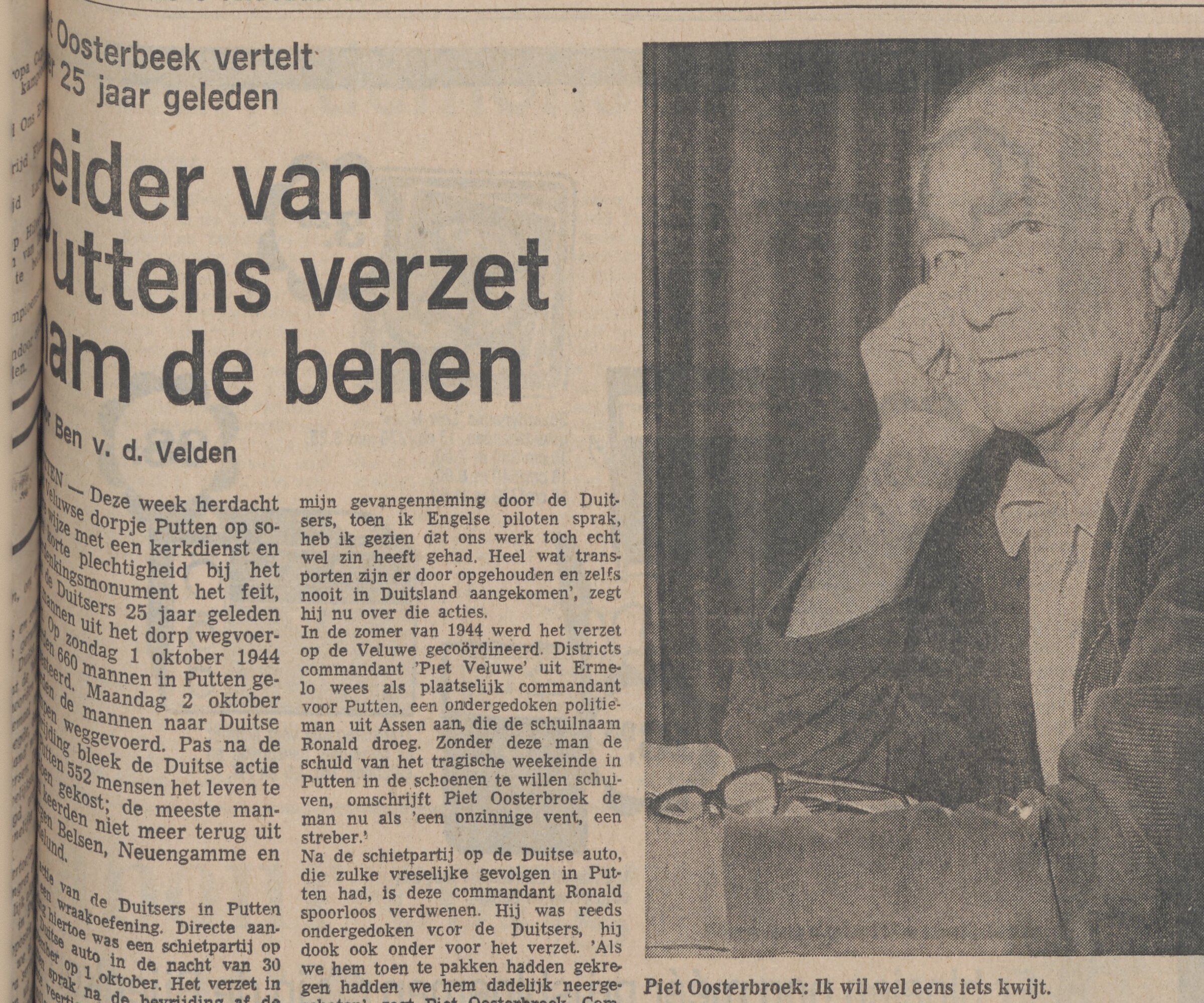
- The commander. In the summer of 1944, Ben van der Velden writes, the district commander "Piet Veluwe" of Ermelo appointed as Putten's local commander "een ondergedoken politieman uit Assen" (a policeman in hiding from Assen) with the hiding name "Ronald". What follows about "Ronald" is about the man the article calls that; whether he is Witvoet is the next bullet, graded ⚠︎.
- The reporter's narration, not in quotation marks: "Zonder deze man de schuld van het tragische weekeinde in Putten in de schoenen te willen schuiven" (without wishing to put the blame for the tragic weekend on this man), Oosterbroek describes him now as, in quotation marks and so in his own words, "een onzinnige vent, een streber" (a senseless fellow, a pusher).
- The reporter, again: after the shooting at the German car the commander, "Ronald", was "spoorloos verdwenen" (vanished without trace), "Hij was reeds ondergedoken vcor [sic] de Duitsers, hij dook ook onder voor het verzet" (he had already gone into hiding from the Germans, he went into hiding from the resistance too), and he is the only person whose conduct Oosterbroek can still get "flink kwaad" (properly angry) about.
- Oosterbroek's own words, in quotation marks: "Als we hem toen te pakken hadden gekregen hadden we hem dadelijk neergeschoten" (if we had got hold of him then, we would have shot him on the spot).
- ⚠︎ Who "Ronald" is. Vrij Nederland in 1978 names him: "Ab Witvoet, alias Ronald", and has "Ronald" "die in werkelijkheid Ab Witvoet heet" (who in reality is called Ab Witvoet) (Vrij Nederland, OCR only, no page image held, no source given for the identification).
- Trouw has a policeman "uit Assen"; in De Jong, Witvoet was a police sergeant (opperwachtmeester) posted at Genemuiden, then Putten, then Limburg, with no Assen (De Jong, p. 47).
- The Rademakersbroek biography of Hendrik van Geen has "de ondergedoken politieman Ab Witvoet" taking the Putten group over in September 1944, and the Volkskrant of 1994 calls Witvoet the group's commander, "de hervormde ex-politieman"; neither uses "Ronald". De Jong has Witvoet as its leader and does not use the name either (De 46 van Rademakersbroek; Volkskrant; De Jong, p. 48).
- So the identification rests on one OCR-only article that names no source, and stays ⚠︎. Against it: Trouw's "uit Assen" and Witvoet in De Jong, who has no Assen. Oosterbroek himself does not use the name Witvoet.
- Every critical line below about "Ronald" is Oosterbroek's about "Ronald" as Trouw names him; it is not a source's charge against Witvoet. What other accounts say of Witvoet that night is under whether the commander ran away.
-
The earlier work. In the days of the fighting at Arnhem, the paper says, orders from the district commander (who had them from someone Oosterbroek did not know) made watching German troop movements "één van de belangrijkste taken" (one of the most important tasks) of the Putten group.
-
On the dispatch riders he is quoted:
We stretched a steel wire between two trees on either side of the road. The dispatch rider rode into it. It was dreadful; mostly he had lost his head. We only checked the papers and took the steel wire away. The Germans later thought the man had smashed himself against a tree.
Dutch originalWe spanden tussen twee bomen aan weerszijden van de weg een staaldraad. De motorordonnans reed daar op. Het was wel verschrikkelijk, meest al was hij zijn hoofd kwijt. Wij controleerden alleen de papieren en haalden de staaldraad weg. De Duitsers dachten dan later, dat de man zich te pletter had gereden tegen een boom.
— Piet Oosterbroek, as quoted by Ben van der Velden · Trouw · 4 October 1969 · the article
-
By that account the wire mostly cost the riders their heads ("meest al"), and the Germans were left to take it for a crash.
- The night before. On 29 September a German car was to be shot up on the Nijkerkerstraat: the commander placed "Dikke Ben" (a former marine) behind the Bren gun, and himself at a farm across the road; the six men decided to disregard an order that would have had the gun cover the farmer's bedroom, and told Ronald they would not. The article describes no shooting that night.
- 30 September. After midnight, the reporter writes, "weer een achttal mannen" (again about eight men) went out under Ronald, about five kilometres from Putten.
- Oosterbroek is quoted: "De volgende dag, bij de mislukte schietpartij, nam commandant Ronald tot twee keer toe de benen" (the next day, at the failed shooting, Commander Ronald ran away twice), once fetched back from the meadow by the men. By the article's own dating that is the attack itself: its opening puts the shooting at the German car "in de nacht van 30 [september] op 1 oktober" (in the night of 30 September to 1 October; the month is partly lost in the gutter).
- "Tex, een Engelse parachutist, was deze keer brenschutter. … Tex wilde gaan schieten, maar de bren weigerde. Even later, maar net te laat deed de bren het toch" (Tex, an English parachutist, was the Bren gunner this time. Tex wanted to fire, but the Bren refused; a little later, just too late, it fired after all).
- In the reporter's narration the group waited for orders from a commander who had fled into the meadow, was fetched back, and later vanished in the dark; one of their own men was badly wounded and died the next day.
- Two of the car's four occupants got away to Harderwijk and a third died the next day. The fourth, lightly wounded, was taken along and put, bandaged, on a cart at a farmer's door early on the Monday, with a note.
- Giving themselves up. "Twee mannen wilden zich gaan melden, maar zij hebben van het verzet geen toestemming gekregen. Wanneer zij zouden doorslaan, zou een groot deel van het Veluwse verzet opgerold worden" (two men wanted to give themselves up, but the resistance gave them no leave; if they cracked, a large part of the Veluwe resistance would be rolled up), Oosterbroek is quoted as saying. The article names no one.
- ◐ De Jong has one man, Hora Siccama (✓ named in full on p. 47), who thought the Germans' demands should be met, and Oosterbroek forbidding him, "er daarbij op wijzend dat de martelmethoden van de SD het risico inhielden dat hij, eenmaal in Duitse handen, gegevens zou moeten prijsgeven die de levens van talrijke andere illegale werkers in gevaar zouden brengen" (pointing out that the SD's torture methods risked his having to give away, once in German hands, details that would endanger the lives of many other illegal workers) (De Jong, p. 56; Rengers Hora Siccama).
- Neither source says whether Trouw's "two men" include Hora Siccama, or who the other was.
- His own group. The narrow left-hand column has him saying that a resistance group arose of which he "automatisch, zoals hij zegt" (automatically, as he puts it) took the lead, "vanwege zijn contacten met Gerben […]genaar, de man van het communistische verzet in Amsterdam" (because of his contacts with Gerben […]genaar, the man of the communist resistance in Amsterdam; the middle of the name is lost in the gutter).
- ◐ Gerben Wagenaar is our reading of it: Vrij Nederland of 1978 names Gerben Wagenaar as one of the RVV's great leaders, a communist and later chairman of the CPN (Vrij Nederland, OCR only).
- The text goes on that the group had specialised, among other things, in blowing up railway lines.
- His silence. The article says Oosterbroek, one of the men closely involved in the action, will now talk about the Putten resistance, although he does not wish to break free entirely from the agreement made after the war: "'Ik wil wel eens iets kwijt', zegt hij. Een keer wil ik nog eens precies vertellen, maar dat kan nog niet." (I would like to get something off my chest, he says. Once I want to tell it again precisely, but that cannot be done yet.)
- Vrij Nederland of 1978 quotes the same sentence as "Eén keer wil ik alles nog eens precies vertellen", with "alles" (all); no such word is legible in Trouw's print, where the line begins in the gutter.
- His own arrest. "Maar na mijn gevangenneming door de Duitsers, toen ik Engelse piloten sprak, heb ik gezien dat ons werk toch echt wel zin heeft gehad" (but after my arrest by the Germans, when I spoke with English pilots, I saw that our work really had been worth something). The article does not give the date or place of his arrest.
- The reprisal. In the left column the Germans, according to him, took their revenge "niet alleen vanwege de schietpartij" (not only because of the shooting): "In Harderwijk zeiden de Duitsers al lang: Verdammte Putten" (in Harderwijk the Germans had long been saying: "damn Putten"). To the Germans, he says, the shooting was "een aanleiding … om … eens iets tegen Putten te ondernemen" (an occasion … to do something against Putten for once; a word before "eens" is lost in the gutter).
-
De Jong's Putten chapter
Link to the section De Jong's Putten chapter◐ Deel 10b of De Jong's history has him in the group at the Oldenallerbrug (the volume, pp. 47–49 and 61 checked on the page images; extracts).
- The first night. On the night of 29 to 30 September Witvoet sent six men to lay the ambush, Oosterbroek, Dankaart, Helsdingen, Van Heessen, Hora Siccama and Slotboom, while he waited in a house nearby; they found that the Bren, set up to his directions, would fire straight through a farmhouse, and gave the plan up (p. 48).
- The attack. On the night of 30 September to 1 October Witvoet, Oosterbroek and Hora Siccama picked Banwell up in a lorry that Oosterbroek drove; the lorry, with the Bren mounted on the cab, was set at the Oldenallerbrug (p. 48; Banwell in 1988 denied a vehicle, below). De Jong says Witvoet "bleef nu bij zijn mannen; die waren ditmaal zeven in getal" (stayed with his men this time; they were seven, Banwell among them) and that "de overige vier" came by bicycle; ◐ counted from his sentences, that is Witvoet and seven men, eight at the road.
- Slotboom. Frans Slotboom, one of the lookouts, was found shot in the stomach: "Oosterbroek trachtte in Putten voor Slotboom nog medische hulp te vinden maar slaagde daar niet in" (Oosterbroek tried to find medical help for Slotboom in Putten but did not succeed); Slotboom died early in the morning and was buried at Enny's Hoeve (p. 49).
- The Sunday. Oosterbroek, Dankaart, Helsdingen, Hora Siccama and Banwell were together at Enny's Hoeve, and Oosterbroek, who had taken the leadership of the little group in Witvoet's absence, forbade Hora Siccama to give himself up; Oberleutnant Eggert, the German officer the group had carried off from the car, was freed (pp. 55–56; p. 56 image-checked).
- Afterwards. The five left Enny's Hoeve, "ten zeerste gebeten op Witvoet" (extremely angry with Witvoet), and "Oosterbroek bracht rapport uit aan Berend Dijkman" (Oosterbroek reported to Berend Dijkman); Dijkman was soon told more "door Oosterbroek of een van de andere deelnemers" (by Oosterbroek or one of the other men in the attack), including about the German document found (p. 61).
His arrest and wounding, December 1944
Link to the section His arrest and wounding, December 1944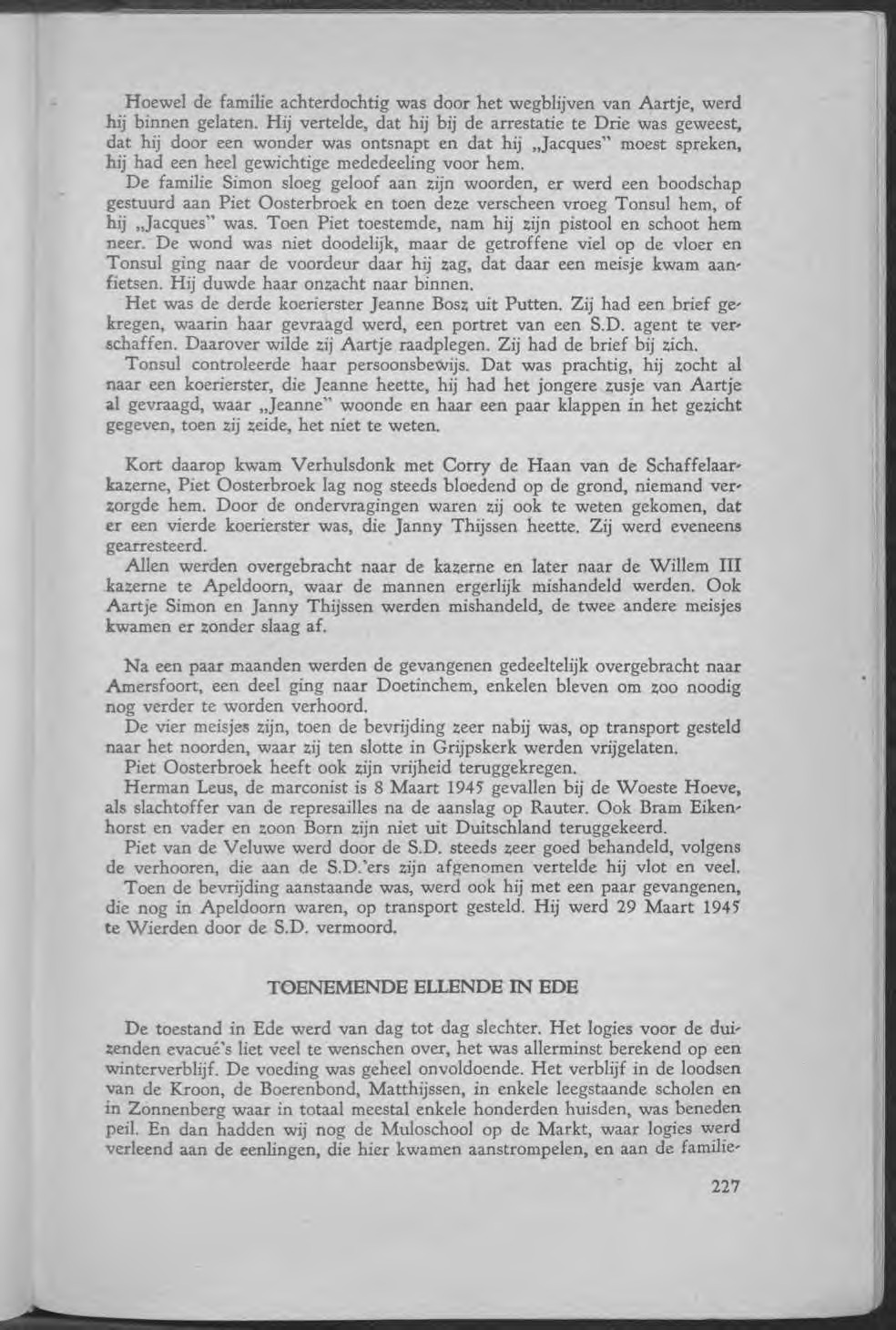
- ◐ Th. A. Boeree's Kroniek van Ede (1947) has a "Piet Oosterbroek" shot and arrested at Putten after the SD raid at the bunker at Drie on 13 December 1944. Boeree gives no address, no age and no description of him beyond "the communist Jacques", so the identification with this Oosterbroek rests on the name, Putten, the communism and what the SD was after; Pouw's form gives "Jaques" beside his name (above), and the newspaper reports of 1945 and 1949 below name the Putten man as the one shot.
- What the SD wanted. At the bunker at Drie the SD thought "de moord op een Duitsch officier in Putten" (the murder of a German officer at Putten) and the attacks on the Amersfoort–Zwolle railway might be the work of communists, and "hoopten daar twee personen te vinden" (hoped to find two people there) with the aliases Jacques and Ben (Boeree, p. 225, checked on the page image).
- ◐ That this officer is one of the Oldenallerbrug attack above is our reading: Boeree names no officer and no place in Putten, and De Jong has Leutnant Sommer dying in the hospital at Ermelo on the Monday (De Jong, p. 56).
- Who he was in Boeree. At the bunker the SD took the wireless operator Herman Leus, alias Jacques, "niet te verwarren met den communist Jacques, die in werkelijkheid Piet Oosterbroek heette" (not to be confused with the communist Jacques, who was really called Piet Oosterbroek); the SD, still "zochten naar den anderen Jacques" (looking for the other Jacques) after its interrogations, sent Tonny Tonsul, the Rexist, to the Simon house at Putten (p. 226, checked on the page image).
- The shooting. Tonsul had told the family he was at the arrest at Drie and had an important message for "Jacques". A message was sent to Piet Oosterbroek, and "toen deze verscheen vroeg Tonsul hem, of hij 'Jacques' was. Toen Piet toestemde, nam hij zijn pistool en schoot hem neer. De wond was niet doodelijk" (when he appeared Tonsul asked whether he was "Jacques"; Piet said yes; Tonsul shot him; the wound was not fatal). He lay bleeding on the floor, untended, when the SD's Verhulsdonk came (p. 227, checked on the page image).
- Held, then freed. All those taken were moved to the barracks and later to the Willem III barracks at Apeldoorn, "waar de mannen ergerlijk mishandeld werden" (where the men were abominably ill-treated), and after a few months some went to Amersfoort and some to Doetinchem; "Piet Oosterbroek heeft ook zijn vrijheid teruggekregen" (Piet Oosterbroek also got his freedom back), with no date or place (same page).
- ◐ Boeree's date is only the section's, 13 December 1944; the shooting came after the interrogations that followed, with no day given. The Trouw interview of 1969 does not give the date or place of his arrest; it fits his remark there that after his arrest he spoke with English pilots (Trouw).
- ◐ The Biografisch Woordenboek Gelderland's life of Dijkman has the raid at Drie lead, by way of a courier of the Putten group, to "de arrestatie van de nieuwe commandant van de Puttense verzetsgroep" (the arrest of the new commander of the Putten resistance group), P. Oosterbroek, "die zwaargewond werd in een vuurgevecht" (who was badly wounded in a firefight); "In totaal vielen die dag veertien arrestaties" (in all there were fourteen arrests that day) (the biography, read as a web page).
- ✓ At the trial of the SD agent Antoine Tousseul, 28, of Breda, at the Arnhem Special Court in July 1949, the prosecutor demanded the death penalty; among the charges:
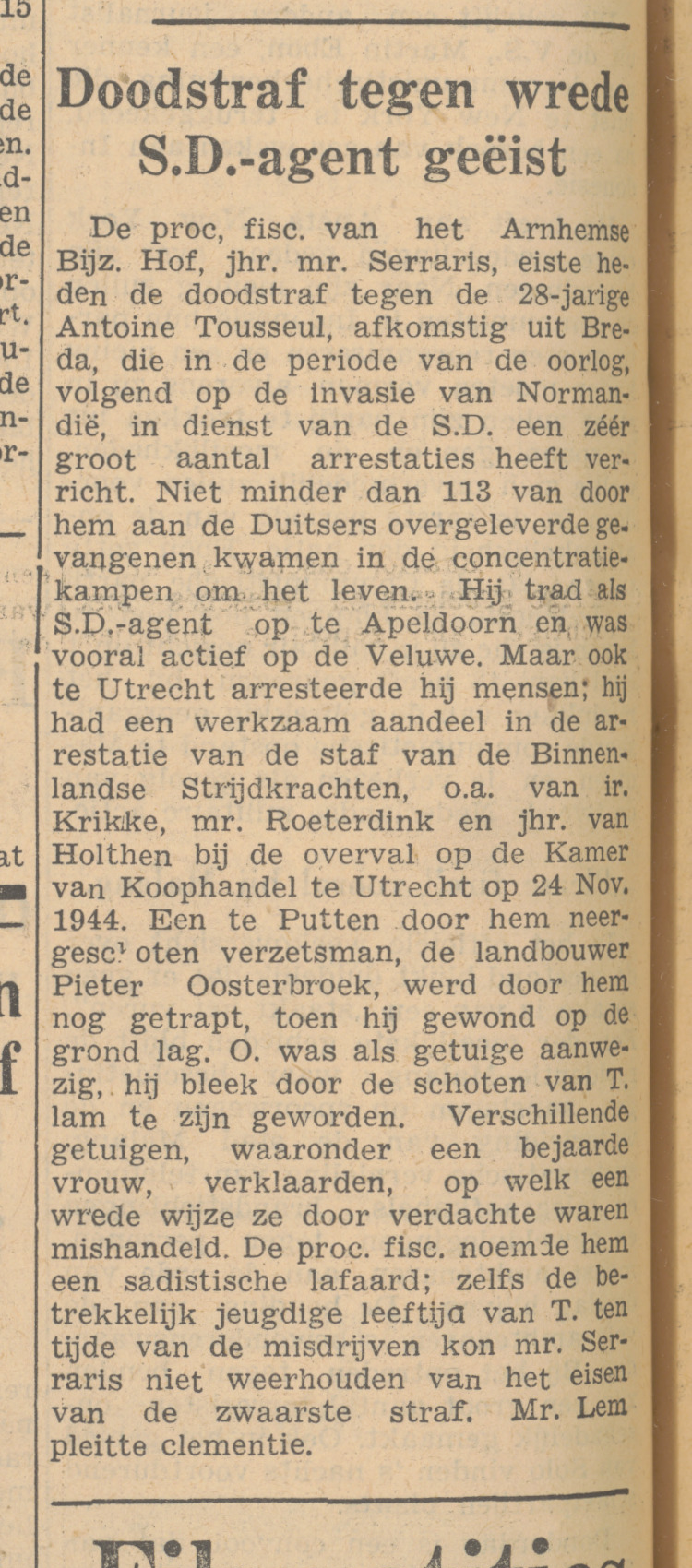
A resistance man he shot at Putten, the farmer Pieter Oosterbroek, was kicked by him as he lay wounded on the ground. O. was present as a witness; he had been paralysed by T.'s shots.
Dutch originalEen te Putten door hem neergeschoten verzetsman, de landbouwer Pieter Oosterbroek, werd door hem nog getrapt, toen hij gewond op de grond lag. O. was als getuige aanwezig, hij bleek door de schoten van T. lam te zijn geworden.
— Arnhemsche courant · 9 July 1949 · the article, read on the page image
◐ Boeree's "Tonny Tonsul" and the paper's "Antoine Tousseul" are very probably one man, by the act and the place; the spelling is the paper's. The article does not give the court's verdict. ◐ That its farmer Pieter Oosterbroek is the Putten helper of the forms is our reading, from the name, Putten and the shooting; the paper gives no age or address.
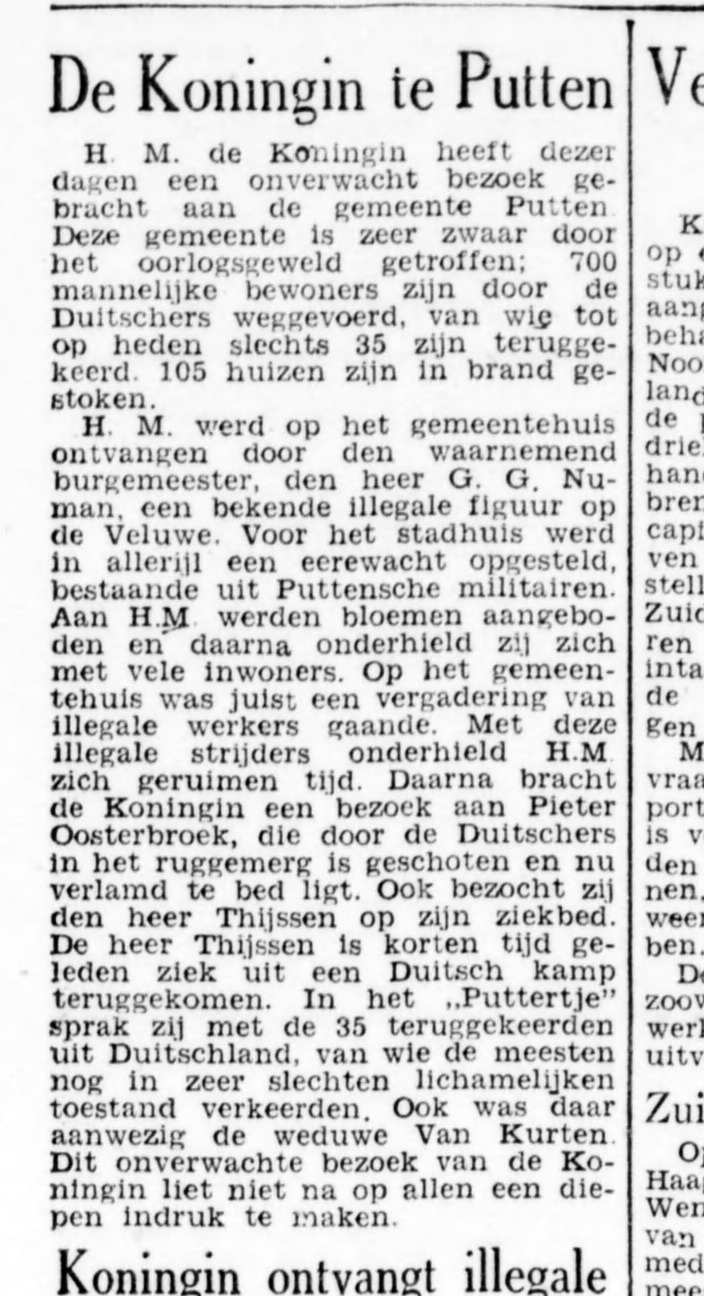
- ✓ Queen Wilhelmina's visit, July 1945. On an unannounced visit to Putten the Queen met resistance workers at the town hall, "Daarna bracht de Koningin een bezoek aan Pieter Oosterbroek, die door de Duitschers in het ruggemerg is geschoten en nu verlamd te bed ligt" (then the Queen visited Pieter Oosterbroek, who was shot in the spinal cord by the Germans and now lies paralysed in bed) (De Tijd, 10 July 1945, checked on the image). The paper says the visit was "dezer dagen" (in the last few days) and gives no date.
- ◐ That this Pieter Oosterbroek is the Putten helper of the forms is our reading, from the name and the place, with Boeree's shooting at Putten (above); the paper gives no age or address.
- ⚠︎ Vrij Nederland in 1978 adds that she honoured him at home as a resistance fighter (Vrij Nederland, OCR only).
- The Americans' form, February 1946: see above.
- ⚠︎ His statement for the RIOD. Vrij Nederland has Oosterbroek and Dankaart giving statements on the attack to the Rijksinstituut voor Oorlogsdocumentatie in 1946 and 1947, to stay secret for fifty years on a condition Oosterbroek set (Vrij Nederland, OCR only). We have not seen the statements.
- ✓ The Provincial States, 1946. "P. Oosterbroek, Putten" was elected to the Provincial States of Gelderland for the Communist Party in 1946, one of its three members (Zutphensch dagblad, 31 May 1946, checked on the image), and "De heer Oosterbroek te Putten (Comm. Partij) werd beëedigd als lid der Staten" (Mr Oosterbroek of Putten, Communist Party, was sworn in as a member of the States) in July (Nijmeegsch dagblad, 13 July 1946, checked on the image). ◐ That he is this Oosterbroek is our reading, from the name, Putten and the party.
- ◐ Putten's council. The Volkskrant of 1994 calls him "het latere CPN-raadslid Piet Oosterbroek" (the later CPN councillor Piet Oosterbroek) (Volkskrant), and Vrij Nederland in 1978 has him a communist after the occupation and for some years the CPN's member of Putten's council (Vrij Nederland, OCR only). No source we hold gives the years.
- ◐ Nellie. In 1953 a summer cottage by a farm at Putten was advertised to let by "N. Oosterbroek—Schuitemaker, E 180, Putten" (De Waarheid, 15 August 1953, checked on the image), the Veenhuizerveld number of 1944. Nellie Schuitemaker died at Harderwijk on 27 March 1966, aged 68; the death register names Pieter Oosterbroek as a former or current partner (death, index).
- 1969. He gave Trouw his account of the attack (above). Vrij Nederland in 1978 says he told the paper then that the time had not yet come to tell everything, and that a few years later he was dead, without having told it (Vrij Nederland, OCR only).
- ◐ Death. Pieter Oosterbroek, born at Heerhugowaard on 5 August 1900, died at Meppel on 29 December 1971; the register names a wife and records that he had been married to Nellie Schuitemaker, so he had married again (death, index). The Volkskrant of 1994 says that of the seven men in the attack only Banwell was still alive (Volkskrant).
- ⚠︎ Friso's charge, 1994. The paper reported the Putten amateur historian K. Friso as saying he had the proof that "de twee communisten in de verzetsgroep, het latere CPN-raadslid Piet Oosterbroek en Piet Dankaart" (the two communists in the resistance group, the later Communist councillor Piet Oosterbroek and Piet Dankaart) had squared their statements with each other, with Witvoet the victim of it; the words are the reporter's indirect speech, not a quotation of Friso (de Volkskrant, 1 October 1994). The article does not give his proof, and we have not seen the statements of 1946–1947 he may mean (above).
Where the sources disagree
Link to the section Where the sources disagreeWho led the Putten group
Link to the section Who led the Putten group- Oosterbroek in 1969: a local commander "Ronald", appointed by the district commander in the summer of 1944; and, in his own telling, a group of which he himself "automatisch, zoals hij zegt, de leiding kreeg" (automatically, as he puts it, took the lead), through his contacts with the communist resistance in Amsterdam (Trouw).
- Steven van Donkersgoed in 1946: Oosterbroek, "commander of the underground movement at Putten and vicinitiy" (his form, p. 4).
- De Jong: Dijkman put the two Putten groups under Witvoet; Oosterbroek took over the leadership in Witvoet's absence on 1 October (pp. 47, 56). In 1974 Witvoet said Dijkman had told him he had instructions from Amsterdam "om de linkse invloeden te elimineren" (to eliminate the left-wing influences); De Jong adds "(elk bewijs ontbreekt)" (there is no proof of it) (p. 48, image-checked).
- The Rademakersbroek biography of Hendrik van Geen has two groups at Putten in 1944, a communist one and another to which Van Geen belonged: "In de zomer van 1944 krijgt Henri de leiding. In september neemt de ondergedoken politieman Ab Witvoet het roer over." (In the summer of 1944 Henri takes the lead. In September the policeman in hiding, Ab Witvoet, takes over.) It does not say which group, and it does not name Oosterbroek, so it may describe the other group (De 46 van Rademakersbroek).
- The Biografisch Woordenboek Gelderland: Dijkman put the local RVV and LO/LKP men under "brigadecommandant A. Witvoet" on 23 September, and straight after the raid replaced the group's commander, "die hij betichtte van gebrek aan leiderschap bij de aanslag" (whom he accused of lack of leadership in the attack); Oosterbroek was the "nieuwe commandant" by December (the biography).
- Vrij Nederland in 1978: Oosterbroek had been the group's leader for years, and Witvoet, alias Ronald, was a new leader pushed on it from outside (Vrij Nederland, OCR only). Heaps (1976) makes Dankaart ("Denkaart"), "Dikke Ben", the leader at the bridge (Heaps, p. 131).
- ◐ What is left: Witvoet commanded the merged group from late September; Oosterbroek led the RVV part before and the group after the raid.
Who ordered the attack
Link to the section Who ordered the attack- Trouw, 1969: the district commander's orders, which he had from someone Oosterbroek did not know, made watching German troop movements one of the group's most important tasks; the order for the action of 29 September was brought by "Ronald", "een order die hij van hogerhand gekregen zou hebben" (an order he is said to have had from above), and the article does not say from whom (Trouw).
- Vrij Nederland in 1978 reads this as orders from the district commander, who had them from an unknown, and quotes Witvoet's interview of 1974: "Eind september kregen we de opdracht van het hoofdkwartier van de Binnenlandse Strijdkrachten" (at the end of September we were given the order by the headquarters of the Binnenlandse Strijdkrachten) to get hold of German cars and lone dispatch riders (Vrij Nederland, OCR only).
- Dijkman, following Thijssen's orders, by De Jong (p. 48) and the Biografisch Woordenboek, which has his written order (the biography).
- ◐ A later book, Partizanen (1999), has the RVV brigade act on "een algemeen bevel van 'Lange Jan'" (a general order of "Lange Jan", Jan Thijssen), giving no source (p. 229).
Whether the commander ran away
Link to the section Whether the commander ran away⚠︎ The charge is Oosterbroek's, about "Ronald" as Trouw names him (above); that "Ronald" is Witvoet rests on one article (⚠︎, above). The other accounts of Witvoet that night:
- Oosterbroek in 1969, of "Ronald": "De volgende dag, bij de mislukte schietpartij, nam commandant Ronald tot twee keer toe de benen. Een keer is hij door de mannen uit het weiland teruggehaald" (the next day, at the failed shooting, Commander Ronald ran away twice; once the men fetched him back from the meadow) (Trouw).
- De Jong's account of Witvoet (De Jong, pp. 48–49, image-checked):
- On the first night he withdrew to a house nearby, "waar hem, zo zei hij, na de actie rapport moest worden uitgebracht" (where, he said, a report was to be made to him after the action), and the six, giving up their plan, found him "in een toestand van grote nervositeit" (in a state of great nervousness).
- On the second night the group fell into confusion, "in paniek", as Dankaart said later, and "Witvoet bleek verdwenen te zijn (hij had zich bij een boer in de omgeving verborgen)" (Witvoet turned out to have disappeared; he had hidden at a farmer's nearby). Dankaart too had first withdrawn.
- De Jong's footnote cites Dankaart for the panic and gives no source for the parenthesis.
-
Banwell in 1988, as Het Vrije Volk prints him (OCR only):
It has also been said that the commander of the group, Witvoet, fled, but I do not know that. I do not want to accuse a man of something I am not sure of. I never saw Witvoet again after that attack.
Dutch originalEr is ook gezegd dat de commandant van de groep, Witvoet, is gevlucht, maar dat weet ik niet. Ik wil een man niet beschuldigen van iets waarvan ik niet zeker ben. Ik heb Witvoet na die aanslag nooit meer gezien.
— Keith "Tex" Banwell · interview by Harry van der Ploeg, Het Vrije Volk · 26 September 1988 · the article
-
Banwell in 1988, in the same article (OCR only), puts the panic on the group as a whole:
There was confusion and panic among the resistance men immediately after the shots, although I did not dare to say so aloud. Later the men, as far as they survived the war, admitted that panic too.
Dutch originalEr onstond direct na de schoten wel verwarring en paniek onder de verzetsmensen, al durfde ik dat niet hardop te zeggen. Later hebben de mannen, voorzover ze de oorlog overleefden, die paniek ook toegegeven.
— Keith "Tex" Banwell · interview by Harry van der Ploeg, Het Vrije Volk · 26 September 1988 · the article
-
Heaps (1976) writes of the attack that Banwell "saw several Resistance men fleeing in panic", naming none of them (Heaps, p. 132).
- Vrij Nederland in 1978, in the journalist's own voice: "Witvoet dus, een politieman uit de gereformeerde hoek, die, dat lijkt nu wel vast te staan, op het moment van de aanslag in paniek raakte en de benen nam" (Witvoet, then, a policeman from the Reformed side, who, it now seems certain, panicked at the moment of the attack and ran); no source is named for it (Vrij Nederland, OCR only).
- Friso, as the Volkskrant reported him in 1994 (the paper's indirect speech, "zou … zijn afgeschilderd"): Witvoet was wrongly ("ten onrechte") painted as "een melkmuil die geen bevelen kon geven" (a milksop who could not give orders), and as a sergeant in 1940 is said to have behaved "bijzonder heldhaftig" (with particular heroism); the paper gives his proof for neither (Volkskrant, OCR only).
- ◐ Oosterbroek has "Ronald" leaving the scene and De Jong has Witvoet doing so, without saying whose account he follows; Vrij Nederland concludes it; Banwell, who was there, declines to say it; Friso denies the picture. The statements of 1946–1947 that might bear on it are not seen.
The attack
Link to the section The attack- How many men. Eight in most of the accounts, seven in two, depending on whether Witvoet is counted:
- "een achttal" (about eight) in Trouw, and "een acht man tellende groep" (a group of eight men) in the reporter's words in Het Vrije Volk of 1988 (Trouw; Het Vrije Volk).
- Eight by Heaps, who lists Witvoet among them and gives the night as 2 October (Heaps, p. 131).
- Seven by De Jong for Witvoet's men, which with Witvoet is eight (De Jong, p. 48), and "zeven mannen die de aanslag uitvoerden" (seven men who carried out the attack) in the Volkskrant of 1994, which does not say whether it counts Witvoet (Volkskrant).
- ◐ The counts agree on eight if Witvoet is included.
- The night. He has an order of 29 September to shoot at a car on the Nijkerkerstraat, which the six refused to carry out, and the failed shooting itself after midnight on 30 September (his opening dates it to the night of 30 September to 1 October); De Jong has the first attempt, given up, on the night of 29 to 30 September and the attack in the night of 30 September to 1 October, shortly after midnight (Trouw; De Jong, p. 48).
- ◐ The same attack. Heaps's 2 October is days late, as is his 5 October for the start of the reprisal, which the Volkskrant dates 1 October (Heaps, pp. 131–132).
- What went wrong at the Oldenallerbrug.
- Oosterbroek in 1969 has the Bren refuse at first and fire a moment too late, and the commander run into the meadow (Trouw)
- Heaps has the gun jam and Banwell clear it (Heaps, p. 132)
- Banwell in 1988 denied that his Bren jammed, and asked whether, as a book had it, the gun stood on a car: "We hebben nooit een auto gehad!" (we never had a car), against the lorry with the Bren on its cab in De Jong above (Het Vrije Volk, OCR only)
- Friso, as the paper reports him, blamed neither the gun nor Witvoet, and said the two communists had agreed their statements (de Volkskrant).
- The fuller dispute is on Tex Banwell's page.
His wounds
Link to the section His wounds- Before September 1944. ⚠︎ Heaps alone has him shot in the back weeks before, escaping a round-up, and limping (Heaps, p. 125).
- December 1944. Boeree: shot by Tonsul at the Simon house when he said he was "Jacques", the wound not fatal (p. 227); the Biografisch Woordenboek: badly wounded "in een vuurgevecht" (in a firefight) (the biography); the Arnhemsche courant: shot at Putten by Tousseul, kicked as he lay wounded, and paralysed by the shots (1949). De Tijd in July 1945 has him shot in the spinal cord and paralysed (1945).
Not him
Link to the section Not him- ✓ Jan Oosterbroek of Wencopperweg 14, born at Ede on 14 July 1894, who sheltered five Allied airmen for ten days (his file, p. 3), is another man; the British index lists the two on successive lines (page O/3). He is on the pages of Harry Bonekat and Sidney Willig.