Maj. John Coke
1910 or 1911 – near Ede 18 Nov 1944 ◐
Maj. John Sacheverell A'Deane Coke (52602)
About: A temporary major of the 7th (Airborne) Battalion, King's Own Scottish Borderers, wounded and taken at Arnhem, who broke out of the hospital at Paleis Het Loo in October 1944 and commanded the rearguard of Pegasus II under Hugh Maguire. He was killed on Pegasus II, by the Ede accounts at the quarters of a German battery at the Hindekamp near Ede in the night of 17/18 November 1944 (the night is not settled, see The day), and is buried at Arnhem Oosterbeek War Cemetery.
Unit or role: Major (temporary), 52602, 7th (Airborne) Bn, King's Own Scottish Borderers (KOSB), 1st Airborne Division (CWGC; London Gazette).
Where: The Arnhem perimeter (◐ the White House, Hotel Dreijeroord), Paleis Het Loo, Uddel, Achterveld and De Glind, the Wolfswinkel barns at Lunteren, the Hindekamp near Ede; buried at Oosterbeek.
Evidence: ✓ CWGC casualty page and six archive scans, read on the images; ✓ London Gazette 20 September 1945, p. 4684, read on the image; ✓ the helper forms of Zegers, Van Dorssen and Hogeweg, read on the images; ✓ Warrack, Travel by Dark (pp. 144–149, 165; page images 144, 145, 147, 149, 165); ✓ Boeree's Kroniek van Ede (pp. 179, 183, 188, 190, 196), read on the page images; ◐ ParaData, from a history of his battalion we do not hold.
He appears in Operation Pegasus II.
Who he was
Link to the section Who he was- ✓ The name. John Sacheverell A'Deane Coke, as the CWGC has it. The helper forms and the Gazette give "J.S.A.D." and "J. S. A'D."; ParaData misspells the middle name "Sacherevell". The service number 52602 is on every one of them (CWGC; Zegers).
- ✓ His family. The CWGC has him the son of Brigadier-General E. S. D'Ewes Coke, C.M.G., D.S.O., and of Helen Maud Coke (née A'Deane), of Kensington, London, and adds that his brother Edward Fitzgerald D'Ewes Coke "also fell" (CWGC). The printed register puts the brother on the same page: Maj. Edward Fitzgerald d'Ewes Coke, 66152, Sherwood Foresters attached 6th Bn KOSB, died 27 September 1944, aged 29 (register, p. 14).
- ✓ His age. 33 at death (CWGC; Kew's index, WO 416/71/286), so born in 1910 or 1911. We have no birth date. No wife is named in anything we hold.
- ◐ Captain, 1939. The London Gazette of 29 August 1939 has, under K.O.S.B., "The undermentioned Lts. to be Capts. 27th Aug. 1939:—J. S. A'D. Coke." (p. 5918). Initials only, with no number; the initials and the regiment are his.
- ◐ The battalion. ParaData, from R. Sigmond's history of the 7th (Galloway) Battalion, Off at Last (2009), has him join the 1st Battalion KOSB as second-in-command on 27 January 1943 and, when the battalion was made airborne, help its commanding officer weed out the men unfit for the new role; its service list gives 1943 with the 1st Battalion and 1944 with the 7th. Lt Charles Doig, who served under him, called him a firebrand and "extremely brave and courageous" (ParaData).
Arnhem and Het Loo
Link to the section Arnhem and Het Loo- ◐ Arnhem. ParaData: the battalion helped secure the drop zone at Ginkel Heath, after the Monday afternoon's landings he reconnoitred the route to the battalion's next positions, stayed "in the thick of" its actions, and was wounded at the White House (Hotel Dreijeroord) and taken. After treatment in an Arnhem hospital he went to the Royal Palace Het Loo at Apeldoorn (ParaData). ✓ Hogeweg, who sheltered him, wrote that he "came down near ARNHEM in a glider on 17 Sep 44" and "was wounded" (Hogeweg, p. 2).
- ◐ Taken with the walking wounded. Middlebrook: when the KOSB gave up the hotel, after the badly wounded had gone by jeep, "the MO, Captain B. Devlin, set off with the walking wounded, including Major John Coke, the second-in-command; but this party was intercepted by the Germans and taken prisoner, though both Devlin and Coke escaped later" (Martin Middlebrook, Arnhem 1944, 1994, p. 348; the text, read through the Internet Archive's search, not on the page).
- ◐ On the road with the wounded. Urquhart (1958) has the KOSB's second-in-command, "a major named Coke", oozing assurance after a skirmish ("'Gone,' Coke replied. 'They've cleared off.'", p. 99), and, with the walking wounded "told to proceed down the road leading into the heart of German-held territory", meeting "two German tanks moving towards the front. Imperiously Coke stood in the middle of the road and held up his hand"; the rest of that passage was not recovered (p. 137; the text, read through the Internet Archive's search, not on the page).
- ✓ At Het Loo, 29 September. Warrack's diary, ◐ near-contemporary (no source says it was written the same day), has Warrack go round the hospitals with Herford and the German medical chief, Zingelinck, and at 12.30 reach Het Loo, with "about 600 beds in it, of which 30 are BRITISH": "Found COKE of PEYTON's lot there." Warrack adds, as hearsay with no source named, "Apparently one or two of the chaps had escaped all right, but things were a little more difficult now" (Warrack's diary, p. 32; typed transcript of about 1982, Wellcome Collection RAMC/1584).
- The transcript's list of the other officers mentioned in the diary, not part of Warrack's own key, has "Maj J COKE, Coy Comd 7 KOSB" (the officers' list, p. 49).
- ◐ "PEYTON" is very probably Payton-Reid, whom Middlebrook has decide that the KOSB's hotel could no longer be defended (Middlebrook).
- ◐ Herford's account, through Hall. Matthew Hall's life of Lt-Col Martin Herford, written from Herford's diaries, has "Herford was approached by a Captain Coke who told him that he and several others had established contact with the Dutch underground and that everything was arranged for four of them to make their escape that night"; Coke "had a wounded thigh and had sent a message to the Dutch requesting them to make a signal with a flashlight if they felt unable to risk him coming with them with the burden of his injury".
- The escape the Germans reported four days later was "another party, but several days later Coke did escape with several others" (Hall, A Doctor at War, p. 182).
- ◐ Very probably him: Hall gives no first name or unit and calls him a captain, but has him wounded and escaping with others, as the forms do. Hall does not say where they talked; Herford's own report has him at Het Loo with Warrack and Zingerlin on 3 October, "and talked to wounded" (p. 297).
- ✓ The escape. From the hospital at Paleis Het Loo, where the Arnhem wounded were taken.
- Zegers: Coke and two sergeant glider pilots, P. J. D. Mahoney and E. J. Freeman, "escaped from there in the night of 10 to 11 Oct. '44" (Zegers, p. 3).
- Warrack, in the wood on the day of the march (17 November by the Ede manuscript and Boeree): before the Underground picked Coke up he had been in Het Loo, where the Germans had taken the prisoners' boots, and he and another man broke out and walked 15 miles on bare feet; "That was five weeks ago, and his feet had only just healed" (Warrack, p. 147; page image).
- ◐ ParaData has the escape on Saturday 14 October, with Freeman and Mahoney, "using a strong curtain cord" (ParaData). See Where the sources disagree.
October, in hiding
Link to the section October, in hidingThe helpers' forms follow him and the two sergeants from house to house; the days overlap and do not agree, and the Dijkstra pages hold the detail (Boke Dijkstra; Jan Dijkstra).
- ✓ Uddel. Willem Zegers of Uddel had the three men for "4" days from 11 October, "I gave him civil clothes", and passed them on to B. Dijkstra, Postweg 35, Glinden, by Achterveld (Zegers, p. 4; p. 3). C. A. van Dorssen of Uddel has the same three for 4 days from 16 October, from "'t Loo, Apeldoorn", passed to W. v.d. Mast at Nieuw-Milligen (Van Dorssen, p. 4).
- ✓ Achterveld. Gerrit Hogeweg, whose form gives Rudolphlaan 6, Barneveld, with Achterveld as the post address and no place for the lodging: "In Oct 44 Major COKE lodged during a few days with Mr. HOGEWEG", brought by Jhr. O. R. A. van Valkenburg, treated for his wound by Dr Renkens of Scherpenzeel; "he was taken away by Jan DYKSTRA for the Germans came to Mr. HOGEWEG's house", and Jan took him "to his father" (Hogeweg, p. 2).
- ◐ The Dijkstras. Zegers: the two sergeants reached England, "but the Major stayed behind in Glinden with fever caused by wounds" (Zegers, p. 3); Van Dorssen: "Two Sergeants arrived safely at NIJMEGEN" (p. 3). ParaData has the sergeants go back in Pegasus I (22/23 October) and Coke, "too badly injured", stay behind with Jan Dijkstra's family for about six weeks (ParaData).
- ◐ Garderen. In 1946 Major P. J. S. Windham-Wright listed "Major Coke" among about twenty British Airborne evaders whom Lambertus Huber of Garderen sheltered after Het Loo, "mainly for short periods up to a week" (his memo). No other source puts Coke at Huber's.
- ◐ Jan Dijkstra's memory. ParaData quotes Jan, whose father was the laundryman at the Rudolphstichting (ParaData).
- He remembers Coke "very well": the evening walks to exercise his injured foot past the Germans quartered in the girls' pavilion, the Major at the window turning away when patrols passed, and being upset that he was not allowed to join the first escape.
- Coke was advised not to join the second "but he insisted".
- On a Saturday Jan cycled him to the rendezvous (see Where the sources disagree), Coke on the back of the bicycle, his brother Fokke accompanying them and another resistance man 100 yards ahead as a lookout. Between Barneveld and Lunteren they met others of the Resistance and said goodbye.
- Coke gave Jan a piece of "Royal Curtain Cord", used the rest to tie up his trousers, and gave Jan and Fokke a ten-guilder note.
With Murphy
Link to the section With MurphyNo source puts Coke and Murphy together. Pegasus II was the crossing Murphy's party set out for on the evening of 17 November; ✓ Hardy's party of six lost its guides at a fork and never joined the main column, of which Coke commanded the rearguard (Operation Pegasus II; Hardy). A private of Murphy's own battalion, Thomas Lorne, was in "our party, under Major Coke" (ParaData).
Pegasus II
Link to the section Pegasus II- ✓ Assembly, 16 November. At the barns of the Wolfswinkel family near Lunteren (Liberation Route). Warrack: "At 11 o'clock I joined Hugh Maguire; with him was Major John Coke of the KOSB." The party was to have four groups, the last "an Airborne party to act as rearguard" (Warrack, p. 144; page image). Coke introduced him to Lt John Low, the American airman who was in the column (p. 145; page image; Hugh Maguire).
- ✓ Warrack and Coke. On the afternoon in the wood (17 November by the Ede manuscript and Boeree), on the plateau where the column spent the day (Boeree, pp. 179–180), they talked about "his education, his regiment, the KOSB" and "his friends who had been killed". Warrack: "I enjoyed his company and I hope he enjoyed mine; he was killed that night" (Warrack, p. 147; page image).
- ✓ The order of march. In Maguire's order Coke had "een achterhoede" (a rearguard), "de 'fighting groop'", which had 44 of the Sten guns; the vanguard had 6 and the main body none.
- Boeree has Lipmann Kessel with the rearguard, carrying the records (Boeree, p. 179, image-checked); ⚠︎ the same page also has "de Zuid-Afrikaansche kapitein" walking behind Maguire at the head, and Kessel's own book has him at the front as interpreter (Kessel, pp. 129–132).
- The Ede manuscript: the rear guard was "de parachutisten onder commando van majoor Coke" (the parachutists under Major Coke) (p. 45).
- ◐ Ramlow, a lieutenant in the column, had the paratroopers last in the order, against his own advice (Ramlow, pp. 4–5; the Americans' summary of his report).
- ◐ Pte Thomas Lorne. A private of Murphy's battalion, 156 Para Bn, who was in "our party, under Major Coke" when it was challenged and fired on, is on his own page (Pte Thomas Lorne).
- ✓ The first challenge. At the narrow path on the second night the column froze at a sentry's call and some of it went into the bushes. Warrack: "John Coke came back from the front of the column. 'What is all this bloody noise about?'" and told him to "Get them out quick. We must go on" (Warrack, p. 149; page image).
The night of 17/18 November
Link to the section The night of 17/18 November- ✓ From the Dutch side. Boeree, from the Ede survivors (p. 183, image-checked):
- In the Heibloemlaan Maguire counted thirty of eighty men and went back with two others to look for the rest. Coke, "de commandant van de achterhoede" (the commander of the rearguard), had come forward, took the interpreter Thieme for a German and went for him with a knife.
- Maguire stopped him, told him where the vanguard lay and ordered him to close up within ten minutes.
- A few paces away a voice called "Werda" again; Coke answered "Yes", then "in zijn beste Duitsch: 'Freund'" (in his best German, "Freund"), and when no reply followed two men fired wildly towards Maguire.
- Boeree: Coke "was verdwaald" (had lost his way) and "hoopte op een bevriende boerderij inlichtingen te krijgen" (hoped to learn something at a friendly farm), reached the house of Schriek Sr., "het stafkwartier van de batterij" (the battery's staff quarters), and was shot dead in a struggle.
- The Ede manuscript is shorter: he "raakte hier dan ook prompt in een vuurgevecht" (promptly got into a firefight) with German soldiers and was killed (p. 47).
- ✓ From the German side. Boeree gives the German battery's version, built from its telephone reports ("Geleidelijk komen de telefonische meldingen binnen"): Lt Raaff and a Wachtmeister, walking up to the battery, met about 25 men with Sten guns, challenged them, got "Freund", fired into the dark, and about fifteen prisoners were taken, none of whom had fired. Coke is named only in the last lines, buried "die Zondagmiddag" in Schriek's garden (Boeree, p. 196, image-checked). The Liberation Route: the rearguard leader "in the confusion ended up at the German command post and was killed there" (account).
- ◐ Wim. A Dutchman called Wim of the R.V.V., who passed himself off to the Germans as an English flight sergeant, marched "in de onmiddellijke nabijheid van Coke" (in the immediate neighbourhood of Coke) and was hit behind the knee when the fire began. The next morning a German patrol found him, and he was taken to the battery's quarters and shown Coke's body (Boeree, p. 190, image-checked).
- The German side names a wounded man found at Schriek's on the Sunday morning, van Hoorn Alkema, and takes him on to Hoenderloo (p. 196).
- ◐ Our notes take him to be Wim, whose story ends on p. 191: both are wounded men found by the Germans and taken to Hoenderloo, and the Ede manuscript names Van Hoorn-Alkema among those who kept up the role of English soldier, "de laatste was gewond" (the latter was wounded) (p. 47).
- Against it: Wim is found at first light by a patrol and taken to Coke's body, where the German side has the wounded man found on the Sunday morning.
- ✓ What was found. Boeree has the SD tell Zuster den Hartog in December that her notebook "was gevonden bij den gesneuvelden majoor Coke" (had been found with the fallen Major Coke) (p. 188); the German side has a discarded English notebook found by a patrol a few days later, which told them of the preparations (p. 196). ◐ The German officer Schreieder, writing for the Dutch inquiry of 1950, says that Maquire was accompanied, "auch beim Crossing, ... Major Coke" and that a case of espionage material was found in a bush (Enquêtecommissie, Bijlage 16, p. 33).
- ✓ Word of his death. Warrack heard in hiding, days later, that "John Coke had been killed" (p. 165; page image). Heaps: "Major John Coke of the King's Own Scottish Borderers was killed and buried in the garden of the house of Schriek not far from Bennekom" (Heaps, p. 195).
- ✓ Buried in Schriek's garden. Boeree, in Wim's story: after Wim was shown the body, "Deze is daarop in de hof van Schriek onder de noteboom begraven" (he was then buried in Schriek's garden under the walnut tree) (p. 190, image-checked); the battery's account has the burial in Schriek's garden "die Zondagmiddag" (that Sunday afternoon) (p. 196).
- ✓ First grave. The graves registration unit's field form of 23 September 1945 has serial 2, "K.O.S.B. 7BN", 52602, "Coke. J S A", Maj., date of death "U/K", plot XXIII, row B, grave 17, reburied on 22 September 1945, previous location "In garden of house", map reference 624854 on sheet 388 (field form). The typed concentration form of 27 November 1945 has the same entry, the date of death "Unk" typed with "18.11.44." added above it in red (typed form).
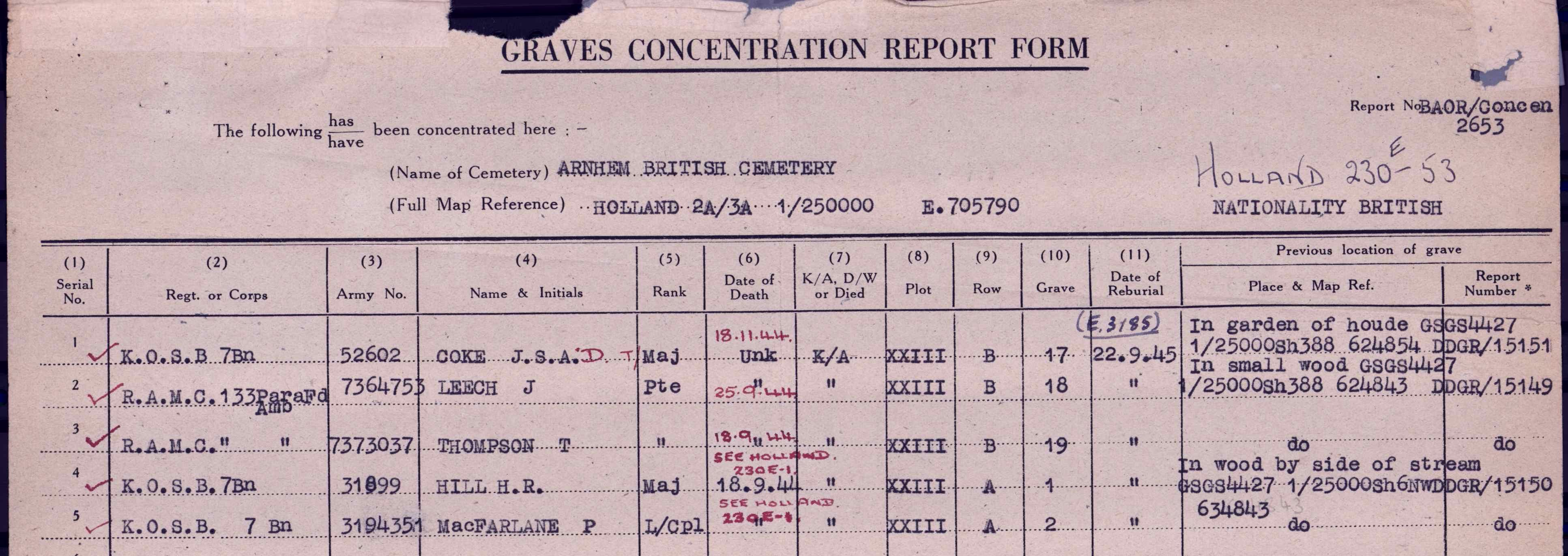
- ✓ The grave. Arnhem Oosterbeek War Cemetery, plot XXIII, row B, grave 17, with an unknown Dorsetshire soldier in grave 16 and Pte J. Leech of 133 Parachute Field Ambulance in grave 18 (registration form of 10 October 1956; headstone schedule, p. 77, "XXIII.B.17 ... 18th November 1944 Age 33"; printed register, p. 14). The inscription, from the CWGC: "FAITHFUL UNTO DEATH". ◐ Middlebrook (1994) notes that his brother Edward lies in Plot 21, Row C, "brought here to be near" him (p. 470; the text, read through the Internet Archive's search, not on the page).
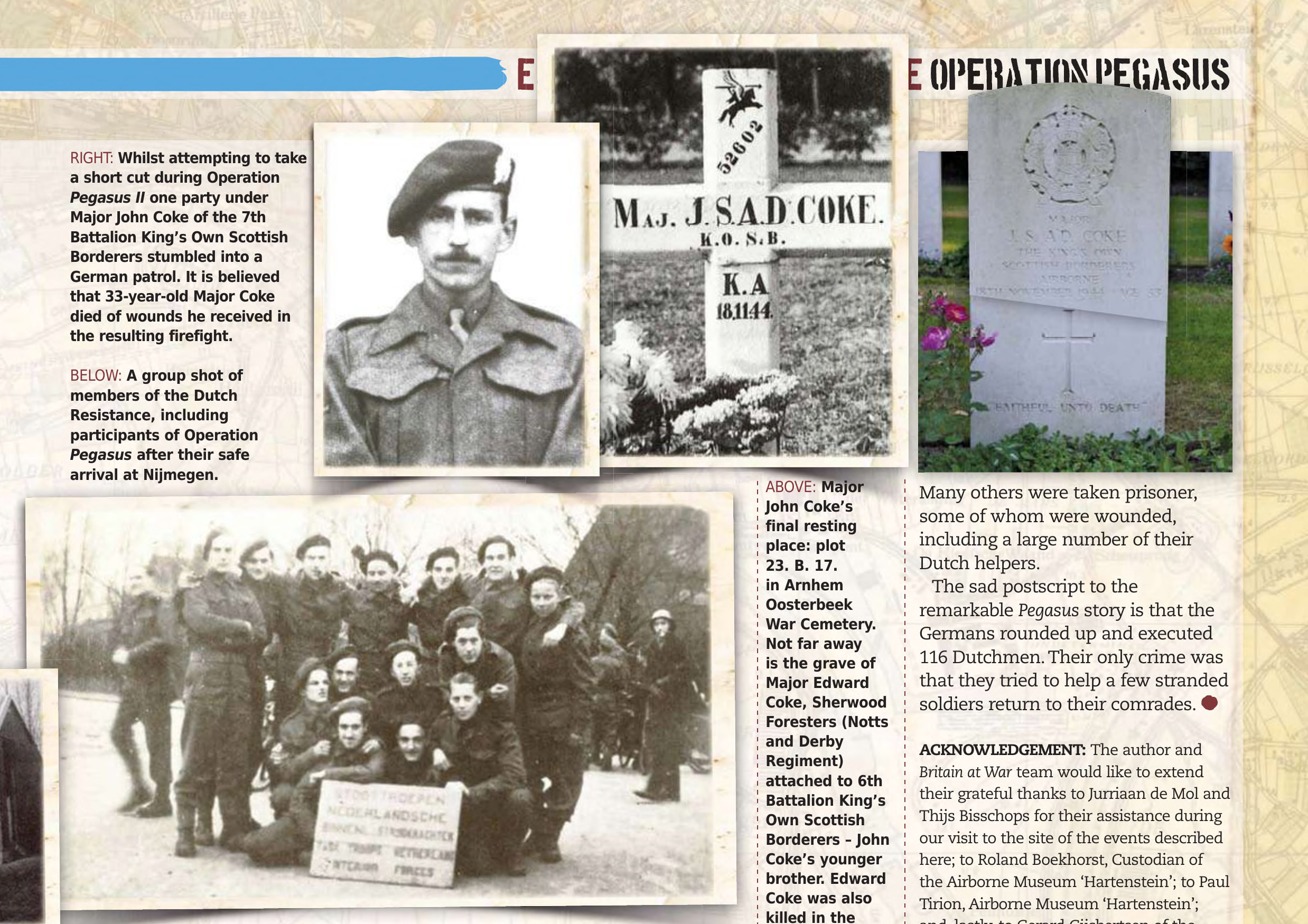
- ◐ A cross and a photograph. A 2014 Britain at War special on Arnhem prints, beside its caption on Coke and Pegasus II, a portrait photograph of a man in uniform and a photograph of a wooden cross lettered "52602 / MAJ. J.S.A.D. COKE. / K.O.S.B. / K.A / 18.11.44"; the caption does not say whom the photograph shows or where the cross stood, and no picture is credited (the leaf).
- ✓ Mention in Despatches. The London Gazette of 20 September 1945 prints "Maj. (temp.) J. S. A'D. COKE (52602) (killed in action)" under K.O.S.B. in the list "Mentioned in recognition of gallant and distinguished services at Arnhem" (supplement 37274, p. 4684, read on the image).
- ✓ Kew. His entry in the index of German prisoner-of-war cards: Major, KOSB, 52602, age 33, no capture date or camp, "Date of Death: 18 November 1944", two cards (WO 416/71/286; not digitised).
Where the sources disagree
Link to the section Where the sources disagree- How he died. ✓ All agree he was killed on Pegasus II; Boeree, the Ede manuscript and the Liberation Route put it at the German battery's quarters at the Hindekamp. How is told five ways.
- Boeree's Dutch-side account has him shot in a struggle at Schriek's house (p. 183); the Ede manuscript, a firefight; the Liberation Route, at "the German command post".
- Hogeweg wrote that he was shot "in trying to pass the German lines" and Van Dorssen that he was "killed while attempting to cross the Rhine". Both wrote in 1945 from hearsay, and the Rhine was not reached (Hogeweg; Van Dorssen).
- ⚠︎ The 2014 Britain at War caption: "It is believed that 33-year-old Major Coke died of wounds he received in the resulting firefight", with no source (the leaf). No earlier source here has him die of wounds; Boeree has him shot dead.
- Zegers wrote in 1945 that the Major, left behind with fever, "unfortunately he he met with a German patrol. Nothing has been heard from him since" (Zegers, item 12).
- ◐ Lorne's party was fired on after answering "friend"; he does not say he saw Coke killed (Pte Thomas Lorne).
- ◐ Middlebrook (1994) has Pegasus II meet a German patrol and "The officer leading it, Major John Coke of the KOSB, and one man with him and a Dutch guide were all killed" (p. 438), and Coke "killed leading a party of evaders" (p. 470); he was the rearguard's commander, not the leader of the whole crossing (the text).
- The day.
- ✓ The CWGC, the 1956 registration form, the headstone and Kew say 18 November 1944. No source we hold says where the CWGC's date comes from: the field form has "U/K", and "18.11.44." was added in red on the typed form. The wooden cross in the 2014 magazine also reads "18.11.44", undated itself.
- ⚠︎ Boeree's German-side account puts the evening at the battery on "Zaterdagavond" (Saturday evening), in the passage that opens "op die avond van 17 November", which was a Friday (Boeree, p. 194, PDF page 198, read on the image; not archived as a separate page), with the burial "die Zondagmiddag" (that Sunday afternoon) on p. 196.
- The Dutch accounts put the fight in the night of Friday 17 to Saturday 18. If Boeree's Saturday is right the fight was on the 18th into the 19th and the burial on the 19th. Kew's German card for Lorne, taken in the same fight, also has 19 November (Pte Thomas Lorne).
- Which Saturday Jan took him to the rendezvous. ◐ ParaData's Jan has "during one of the next Saturdays we took the Major to a rendezvous point" (ParaData). The assembly at the Wolfswinkel barns was Thursday 16 November (Liberation Route; Hugh Maguire), so the Saturdays either side are 11 and 18 November; Jan does not date it, and the page leaves it as his.
- When he left Het Loo. ✓ Zegers: the night of 10/11 October; Warrack, in the wood, "five weeks ago". ◐ ParaData: Saturday 14 October. Warrack's talk with Coke was on 17 November by the Ede accounts, 4 weeks 6 days after 14 October and 5 weeks 2 days after 11 October; if the day in the wood was the 18th (see The day) it was 5 weeks 0 days and 5 weeks 3 days. His "five weeks" fits either date on either day.
- Where he spent October, and for how long. ◐ Zegers has 4 days at Uddel from 11 October and then Glinden; Van Dorssen 4 days from 16 October; Hogeweg "a few days" at Achterveld; ParaData about six weeks with the Dijkstras. The forms are of one chain from two houses and do not agree on days or order (Boke Dijkstra).
- His post. Middlebrook and Urquhart have him the KOSB's second-in-command (Middlebrook; Urquhart); the transcript's list of the other officers mentioned in Warrack's diary has "Coy Comd 7 KOSB", a company commander (the officers' list, p. 49). ◐ That list is not Warrack's own post-war key, and like the two books it gives no source.
- His battalion. ✓ The CWGC, the Gazette and the Ede manuscript say the 7th; ParaData has him second-in-command of the 1st in 1943 and in the 7th in 1944. The 7th is the battalion he died in.
- What was found with him. ⚠︎ Boeree (p. 188): the notebook the SD said was found with Coke, read out to Zuster den Hartog; (p. 196): a discarded English notebook found by a patrol a few days later; Schreieder: a case in a bush. Three accounts of what the Germans found; nothing ties them.