Jhr W.J.H.D. Rengers Hora Siccama, “Eduard”
Düsseldorf 15 Mar 1916 – Apeldoorn 1 Feb 1945
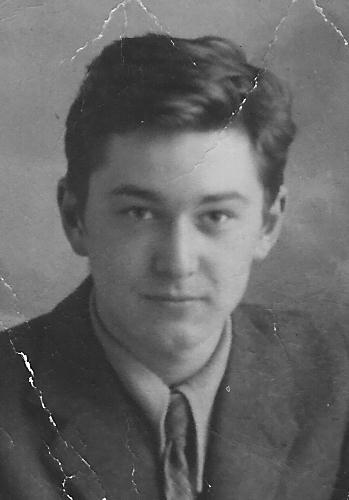
About: Wiardus Rengers Hora Siccama, a Utrecht jonkheer and reserve officer of hussars, was in the Putten resistance and ◐ the "Eduard" whose name is in the De Ruif guestbook facing Murphy's poem. Arrested in November 1944, he died at Apeldoorn on 1 February 1945.
Unit or role: A lawyer (jurist) and reserve second lieutenant of hussars, "Ned. Binnenlandsche Strijdkrachten" (Interior Forces) on the Foundation's grave form (Nationaal Archief 2.19.255.01, 126495A, scan 4); ◐ "Eduard" was, probably, his hiding name (it rests on Kruimel's margin note and Noordman's reading, below).
Where: Utrecht (Nieuwegracht 12, his father's house); Putten, in the autumn of 1944; Kamp Amersfoort, ◐ prisoner 9237 (the photograph filed under his name), until the transport to Apeldoorn.
Evidence: ✓ Noordman, pp. 292–293; ✓ his death deed, Utrecht 1945, no. 3301; ✓ the War Graves Foundation's file on him, from an index card of 1946 to a letter of 1978 in the scans seen (Nationaal Archief 2.19.255.01, 126495A; the Foundation's page); ✓ the 1940 officers' list; ◐ the photograph filed under his name and Amersfoort prisoner number 9237; ✓ the Utrecht Student Corps's almanac for 1946, In Memoriam, p. 121 (checked on the page image); ◐ Nederland's Adelsboek 1935, 1939 and 1951 (OCR only); ✓ L. de Jong, Het Koninkrijk, deel 10b, p. 47, where he is "de jurist jhr. mr. W. J. H. D. Rengers Hora Siccama" (read on the page image), and pp. 48, 55–56, 61, where he is "Hora Siccama" (the volume; extracts); ◐ De 46 van Rademakersbroek; ✓ the Tweede Kamer's roll of honour of the fallen (folio 1014): born 15-3-1916 at Düsseldorf, Jurist, died 01-02-1945 at Apeldoorn (the record; index only). The Foundation also holds a second dossier on him, inv. 126495B, 1995–2016, not seen (the index entry).
✓ He was born at Düsseldorf on 15 March 1916, the only child of Prof. Jhr. Mr. Duco Gerold Rengers Hora Siccama, born at The Hague on 2 December 1876, a professor, of Nieuwe Gracht 12, Utrecht, who died on 7 June 1962, and, by the Foundation's forms, Maria Dora Elfriede Nielböck, born at Düsseldorf on 1 December 1891 (scan 2; scan 6; scan 28). ✓ His parents' marriage was dissolved by the Utrecht district court on 6 August 1930, as the Staatscourant announced and the family's own entry in Nederland's Adelsboek has it (the announcement, 13 September 1930; Adelsboek 1935; both OCR only); the Foundation's file has her moving to Zeist on 2 December 1943, "already divorced" (scan 20). ✓ His mother was Maria Dora Elfriede Nielböck: the Adelsboek's first wife of his father, born at Düsseldorf on 1 December 1891, married there on 6 April 1915, with "Uit het eerste huwelijk: Jhr. Wiardus Jacob Hendrik Duco Rengers Hora Siccama, geb. Düsseldorf 15 Maart 1916" (Adelsboek 1935; the 1939 volume repeats it with "jur. cand.", Adelsboek 1939). The Baroness Jacqueline Adriène Justine van Nagell whom his death deed names as his mother (the deed) is his stepmother: the same entry has his father marry her at Utrecht on 26 May 1932, she born at Laren (Gelderland) on 3 September 1882 and divorced from a Baron van Boetzelaer, and De Avondpost of 27 May 1932 prints the marriage (the notice; OCR only). The Foundation's file has Utrecht naming a stepson of the father, born in 1920, among his relatives in 1966 (scan 6). The Foundation's "Nielböck" is spelt "Nielbock" in the Staatscourant and "Nielbeck" in the Adelsboek.
His Christian names are Wiardus Jacob Hendrik in the death deed, and Wiardus Jacob Hendrik Duco in the Adelsboek, the 1935 family card and the Foundation's page; the Foundation's typed forms have Wierdus and Wierda, and its index spells the surname "Siccema" (scan 4; scan 2). The Rademakersbroek biography of his friend calls him "Wiete" (De 46 van Rademakersbroek); ✓ that was his name among friends, for the Student Corps's almanac of 1946 heads its In Memoriam "Jhr. W. J. H. D. Rengers Hora Siccama" and later in it says "In Wiete verliezen wij een dier zeldzame strijders" (the almanac, p. 121).
✓ School and university. In July 1933 the Utrecht Stedelijk Gymnasium's list of pupils promoted at the end of the year has "W. J. H. D. Rengers Hora Siecama" (the OCR's "Siecama") going "van klasse V naar klasse VI" (Utrechtsche courant, 14 July 1933; OCR only, no page image served). A year later Het Volk printed that "voor het eindexamen van het stedelijk gymnasium alhier", Utrecht, passed in group IIa "voor dipl. A" the names "mej. M. A. Kan, W. J. H. D. Rengers Hora Siccama, J. Verheus, ...", so the 1933 entry is his and he left school at eighteen in June 1934 (Het Volk, 13 June 1934; OCR only, not checked against the page image). In September 1934 he is on the list of new students, "Jur. (Utrecht), Korte Nieuwstraat 23" (Vox Studiosorum, 17 September 1934). ✓ Utrecht's population register has him at that address as a lodger: on the family card of the Bisschop household at Korte Nieuwstraat 23, he is entered as not related to the head ("n.v."), unmarried, Nederlands Hervormd, with no occupation, registered there on 15 June 1935 from Maliebaan 11, with no date of leaving; ◐ Vox of 17 September 1934, above, already gives him at Korte Nieuwstraat 23 nine months before the registration, and the card does not explain the gap (the card, read on the scan; the scan). He passed the candidate's examination in law on 8 October 1938 (the Corps's almanac for 1940). ✓ The Christelijk sociaal dagblad of 10 October 1938 printed it among the Utrecht results, "Geslaagd voor het cand. ex. rechten" (passed the candidate's examination in law) with two names, the second "W. Rengers Hora Siccama", read on the page image, and the faculty paper of 21 October 1938 lists it under 8 October (the newspaper, its crop; the Utrechtsch faculteitenblad, OCR only). And the Adelsboek of 1939 has him "jur. cand." (Adelsboek 1939). He belonged to the Utrecht Student Corps: on 1 November 1938 he was installed as Praeses, chairman, of its law faculty section, and the Corps's list for 1938–39 has him chairman of the editorial board of the student weekly Vox Studiosorum too (the almanac for 1940; the U.V.S.V. almanac for 1939; all OCR only, not checked against the page images). The Corps's own almanac of 1946 counts him among its dead (below). The Adelsboek of 1951 prints him as "Jhr. Mr." (Adelsboek 1951) and a press report of 1946 calls him an "afgestudeerde jurist" (a graduated lawyer; Eindhovensch dagblad, 5 November 1946; OCR only); L. de Jong calls him "de jurist jhr. mr." (deel 10b, p. 47), and the file name of his Kamp Amersfoort photograph has "jhr mr" (below); the death deed has no occupation, and no record of a degree is held here.
✓ He was a reserve second lieutenant of cavalry: the army's 1940 list of officers has "Jhr. W.J.H.D. Rengers Hora Siccama" as a reserve second lieutenant, regiment "4.", with seniority from 1 December 1939, a conscript, the entry placed at Soest (the records). ✓ The regiment is the 4th Hussars: royal decree no. 30 of 21 November 1939, printed in the Staatscourant of 22 November, appointed "bij het 4de regiment huzaren, de kornetten E. van Ogtrop, jhr. W. J. H. D. Rengers Hora Siccama, G. van Rijn en G. J. L. Maduro" reserve second lieutenants from 1 December 1939, so he was a kornet (cornet, an officer cadet) of the regiment before (the Staatscourant; OCR only, not checked against the page image). The Foundation's grave form has "Res. 2e Luit. Huzaren", a lieutenant of hussars, and calls him a jurist (scan 4). His officer's service record is still held by the Ministry of Defence at Kerkrade, according to the Nationaal Archief's index of officers' stamboeken ("Berust nog bij het Ministerie van Defensie in Kerkrade"; the index entry); not seen. ◐ A visitor's contribution on the Foundation's page (Bert-Jan Dierink, 18 November 2020), citing the Rademakersbroek biography and a TracesOfWar article that we have not read, adds that he read law at Utrecht; took the 20th course of the School voor Reserve Officieren Cavalerie in 1936–37 with George Maduro; served with the 4th Half-Regiment of Hussars at Deventer; became second lieutenant on 1 December 1939, the day the officers' list gives; was in the 4th Squadron of the 5th Hussars, whose garrison town was Harderwijk, in the mobilisation; and on the night of 9 to 10 May 1940 was ordered to take position at Putten, then to guard the harbour at Nijkerk, and on 12 May to fall back on the castle of Haarzuilens (the Foundation's page).
In the Corps and the faculty, 1936 to 1940
Link to the section In the Corps and the faculty, 1936 to 1940✓ The Corps's almanacs for 1939 and 1941 (published in December 1938 and December 1940), six issues of Vox Studiosorum and the Utrecht and Leiden student papers of 1939 and 1940, all read on the page images, cut from the issues' PDFs. ◐ Five earlier issues of Vox, of 1936 to 1938, and two of the faculty paper of 1938 are read in the OCR only, since the KB serves their page images only in its reading room. They add offices and addresses to the Praeses of the law faculty and editor of Vox above; none of them says anything of his politics.
- The Zotskroon ball, 1936. Vox of 17 January 1936 names him, fourth of five, on the "organisatie-commissie" (organising committee) of the costume ball the Zotskroon society gave for the Corps's members on 18 February (the issue, OCR only).
- Editor, then chairman, of Vox.
- Vox of 29 October 1937: "Zijn geïnstalleerd tot Redacteuren: W. J. H. D. Rengers Hora Siccama. …" (installed as editors), and its masthead lists him on the editorial board; the board met "ten huize van W. J. H. D, Rengers Hora Siccama, Nieuwe Gracht 10" on Wednesday 3 November (the issue, OCR only). The masthead of 25 February 1938 still has him (the issue).
- Vox of 21 October 1938: "Is geïnstalleerd tot Praeses: W. J. H. D. Rengers Hora Siccama", its masthead now opens with him as Praeses, and the board met at his room, Nieuwe Gracht 10, on Wednesday 26 October; Vox of 25 November 1938 has the same masthead and a meeting there on 30 November (21 October; 25 November; OCR only). The installation fits the Corps's list for 1938–39 above; he resigned from the board in October 1939 (below).
- Law-faculty praeses. The list of faculty boards in the almanac for 1939 has him praeses, and the Rector installed him with five others as the new board on 1 November (the list, p. 146; the installation, p. 230, both in the extract).
- The faculty paper of 4 November 1938, on the law faculty's board: "… heeft zich als volgt geconstitueerd: W. J. H. D. Rengers Hora Siccama, Praeses" (has constituted itself as follows), so the installation was in 1938 (the Utrechtsch faculteitenblad, OCR only).
- The almanac for 1941 has that board step down "op 4 October", J. J. Bredius installed in his place (p. 222). ◐ The volume is of December 1940, so the day is 4 October 1940; the page does not print the year.
- The riding club. The almanac for 1939 has him vice-praeses of the student riding club Bellerophon when the board constituted itself on 17 February (p. 406); Vox of 25 February 1938 prints the same board, "W. J. H. D. Rengers Hora Siccama, Vice-Praeses", so the year is 1938 (the issue, OCR only); a team of three that included him came third of five universities in a cross-country ride for the Pegasusbeker (almanac p. 406).
- Debating and letters. The almanac for 1939 has him praeses of the Algemeene Debating-Club (p. 387); the one for 1941 has him praeses of it again, with the same five names, and of the society Utile Dulci for letters and speaking (pp. 131, 135). ◐ The club's list of 1941 may be carried over from 1939.
- Student weekly and councils. Vox of 13 October 1939 has him resign from the editorial board and become honorary member (the notice). The Leidsch Universiteitsblad of 19 May 1939 prints a letter to the minister signed for the Council of Dutch Student Faculties (R.N.S.F.) by its praeses and by him as "h. t. ab-actis" (the signature).
- Addresses.
- The almanac for 1939 has his room at Nieuwegracht 10, with "Vree" after it (◐ the landlady), and, on the almanac's second line, the one for parents, Maliebaan 11, telephone 11728, which the same volume gives as the professor's own address; his parents had been divorced since 1930 (above), so it is his father's household, with his stepmother (p. 487). Vox announces its editorial meetings "ten huize van den Heer W. J. H. D. Rengers Hora Siccama, Nieuwe Gracht 10" on 8 and 13 February and 1 May 1939 (3 February; 10 February; 28 April).
- The almanac for 1941 has only Nieuwe Gracht 12, telephone 11728 (p. 415): ◐ the number of the Maliebaan house in 1938, so his father's household, which the Foundation's file places at Nieuwe Gracht 12, had moved by December 1940.
- The faculty paper's lists of address changes have him at Klinkenbergerweg 24a, Ede on 10 November 1939 and at Bakenbergscheweg 160, Arnhem on 8 March 1940 (10 November 1939; 8 March 1940). Other entries in those lists are barracks and army units (Breda, Veldleger), so ◐ these are probably billets of his mobilised weeks, between the kornet of November 1939 and the posting of May 1940 above; neither says which unit, and the Ede and Arnhem addresses do not match the Harderwijk garrison the Foundation's visitor gives.
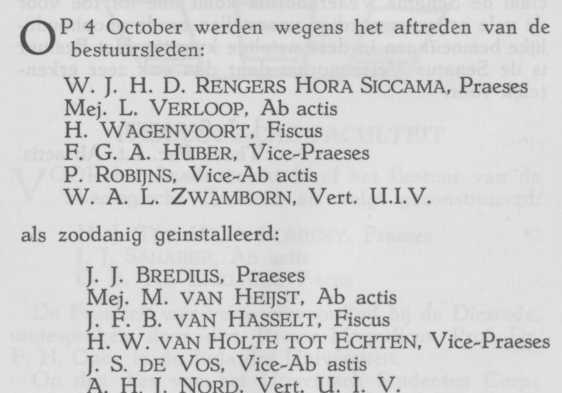

Two Utrecht papers of 1940 and 1941
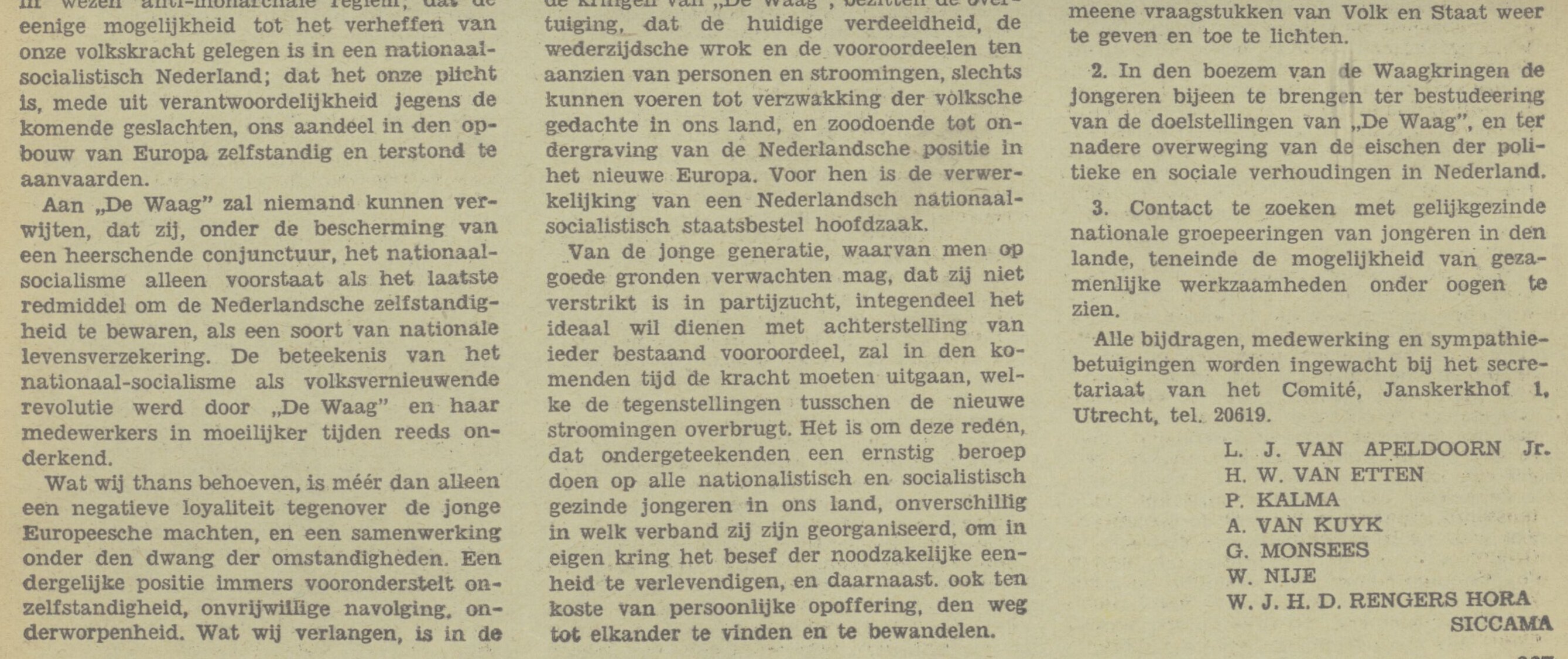
Link to the section Two Utrecht papers of 1940 and 1941A man of exactly his name appears in two issues of the weekly De Waag. The Student Corps's own almanac of 1946 makes it very probable that he is the same man: it says he was at first under the influence of the occupiers' ideas, though it names neither paper (below the pictures). What the two papers show, and what is not shown:
- ✓ Shown, 12 December 1940. De Waag prints a manifesto, “De Nederlandsche jongeren en het streven van ‘De Waag’”, from a "Comité van Waag-jongeren" of seven young people (jongeren), signed last "W. J. H. D. RENGERS HORA SICCAMA".
- It asks all "nationalistisch en socialistisch gezinde jongeren" (young people of nationalist and socialist leanings) to find the way to each other, and says that for the signers the realisation of "een Nederlandsch nationaalsocialistisch staatsbestel" (a Dutch national-socialist state order) is the main thing.
- The committee's secretariat was at Janskerkhof 1, Utrecht (the article; image-checked, the signature and the text).
- ✓ Shown, 6 March 1941. The editorial board of the weekly De Branding, which the same group ran, is given as the five members of the paper's Organisation Council (G. Monsees, A. van Kuyk, W. Nije, C. A. den Tex, H. J. van der Wiel) and four others: L. J. van Apeldoorn Jr., W. Beernink, P. Kalma and "Jhr. W. J. H. D. Rengers Hora Siccama", so one of nine, editorial address Van Asch van Wijckskade 29, Utrecht (the article; image-checked, the board line).
- The statement of the paper's aims printed on the same page just before it, which we have not tied to the committee, asks the young to unite "ongeacht politieke organisatie, godsdienst of klasse" and lists among its points "de instelling van een autoritaire regeering" and "een corporatieve staatsopbouw" (read from the page crop).
- ◐ Our man, very probably. The same four initials, the rare surname and the title Jhr., in Utrecht, where he studied (above); the Corps's In Memoriam of 1946 says he leaned towards the occupiers' ideas at first (below), which fits, but it does not name De Waag or De Branding. No source in the papers themselves names him beyond the signature.
- Not shown. That he wrote the text (it is a joint statement); what exactly he held in 1940 and 1941; how long he stayed with the paper; that the Eduard of the guestbook is the same man beyond Kruimel's note (below). Nothing in the Putten, guestbook or Foundation sources mentions it. The Ministry of Justice's stamp of 25 August 1953 in the Foundation's file finds no political act of his that led to a penalty from the special courts (scan 3), which says nothing about opinions.
✓ The Corps's account. The Utrecht Student Corps's almanac for 1946 prints an In Memoriam for each member who died, and the page for "Jhr. W. J. H. D. RENGERS HORA SICCAMA, Febr. 1945" is signed "A. W." and written in the Corps's voice ("wij", we). It says that after the war of 1940 he came under the influence of German ideas, saw that it was the wrong road, and withdrew from it, in "the winter of '42" (the almanac does not say which winter); the resistance follows "after a few months":
In the war of '40 he served his country as an officer of the cavalry. After that the hardest time of his life began: he came under the influence of the ideas of the German oppressors and so became estranged from his old friends. He was an honest man, it could not be otherwise than that he saw he was on the wrong road. He had the courage to admit it, but his proud spirit kept him from going back to his old friends: he decided to prove his changed view to himself and to the world by deeds. So it happened that in the winter of '42 he withdrew. He gave no heed to the German call to reserve officers. After a few months he began, in earnest and of his own free choice, to take part in the resistance. He was taken into a sabotage group and led many operations [...]
Dutch originalIn den oorlog van '40 diende hij zijn Land als officier der Cavalerie. Daarna brak voor hem de moeilijkste tijd van zijn leven aan: hij kwam onder den invloed van de denkbeelden der Duitsche overheerschers en vervreemde zich daardoor van zijn oude vrienden. Hij was een zuiver mensch, het kon niet anders of hij zag dat hij op den verkeerden weg was. Hij had den moed dit te erkennen maar zijn trotsche geest belette hem naar zijn oude vrienden terug te gaan: hij besloot door daden zijn veranderd inzicht aan zichzelf en de wereld waar te maken. Zoo gebeurde het dat hij in den winter van '42 zich terugtrok. Hij gaf geen gehoor aan den Duitschen oproep der reserve officieren. Na enkele maanden begon hij daadwerkelijk en uit vrije verkiezing aan het verzet mee te doen. Hij werd opgenomen in een sabotage groep en leidde vele operaties [...]
— Utrechtsch Studenten Corps · Utrechtsche studenten almanak voor het jaar 1946, In Memoriam Corpsleden, p. 121, signed A. W. · the page, checked on the image
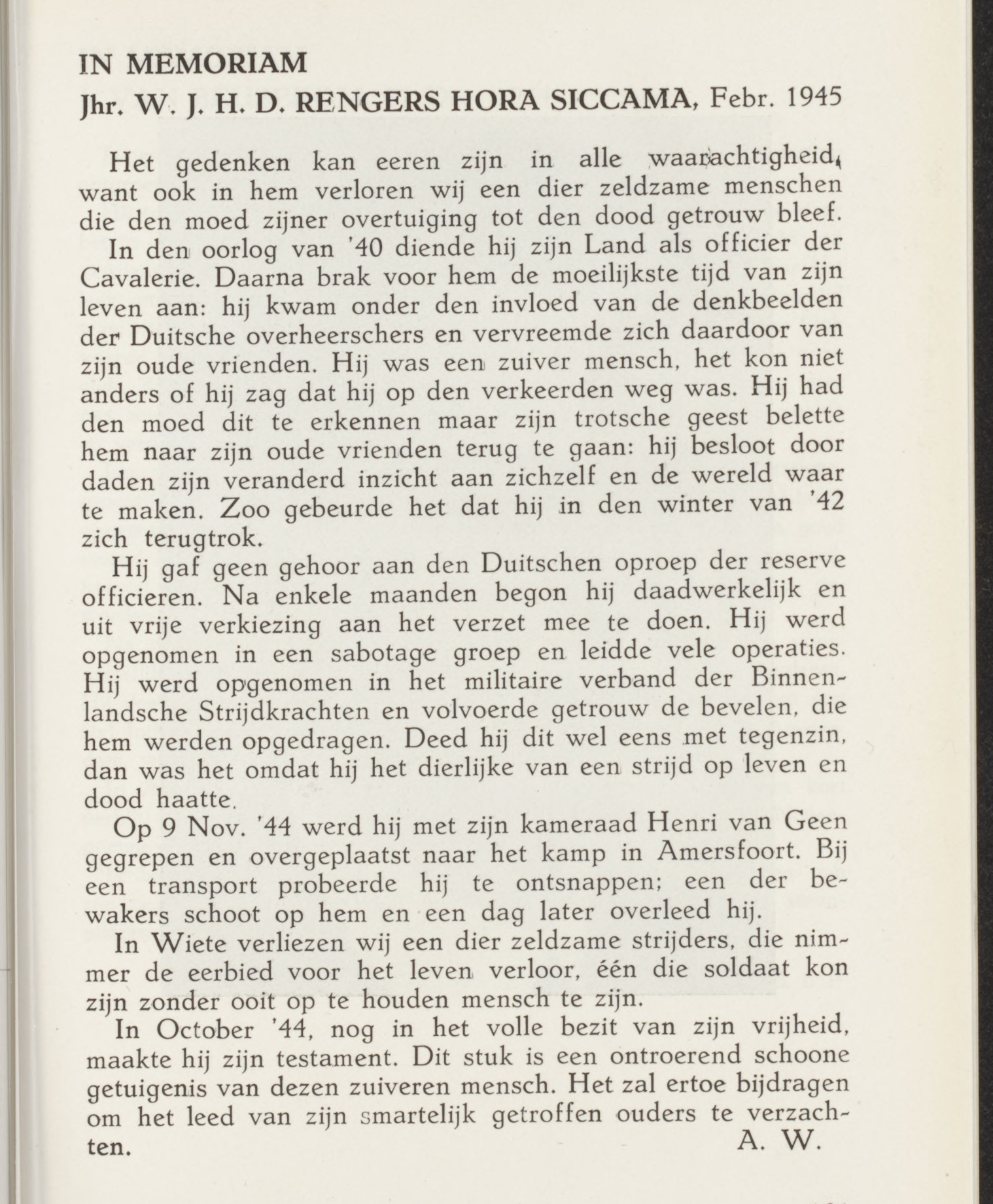
◐ Our man, very probably; the obituary does not settle it. The obituary names no paper and no committee, so the link is made by us, on the four initials, the title Jhr. and Utrecht. It is consistent with that: a young Utrecht officer of the cavalry reserve who, after May 1940, came under German influence and turned back from it. It is a memorial written for the Corps in 1946, not a record, and it gives no full date before "9 Nov. '44" (only "the winter of '42" for his withdrawal and October 1944 for his will), so it dates nothing before then except his withdrawal, which it places in an unspecified "winter of '42", and neither confirms nor excludes a signature of December 1940.
His father in the occupation years
Link to the section His father in the occupation years✓ As the papers report it: his father, Prof. Jhr. Mr. Duco Gerold Rengers Hora Siccama (above), spoke to the Waagkring at Arnhem on 5 October 1940 on "Wat is Nederlandsch?" (De Waag, 10 October 1940, p. 4, read on the page, which prints the initials "D. C."; Delftsche courant, 12 October 1940), and on 24 October 1942 lectured to the Arnhem branch of the Nederlandsch-Duitsche Kultuurgemeenschap (Dutch-German Cultural Community) (Keesings, 2 November 1942). He was dismissed as professor at Utrecht on 26 February 1946 on the purge committee's advice; the Eindhovensch dagblad, reporting it, set against his first years that he refused German honours and let Jews go into hiding, and added that he had "een dapper zoon had, die dadelijk in de illegaliteit dook" (a brave son who went into the resistance at once) (5 November 1946; on "at once", see when he joined the resistance). In May 1950 his Order of the Netherlands Lion was withdrawn, as one "die een leidende rol heeft gespeeld in de Nederlands-Duitse Cultuurgemeenschap" (De Volkskrant, 11 May 1950; Arnhemsche courant, 11 May 1950). No statement by the professor himself about any of it is held; the press texts are OCR only except De Waag.
With Murphy
Link to the section With MurphyHis part in Murphy's story is told on October on the Veluwe.
Putten, September and October 1944. ✓ L. de Jong's history names him in full. Of two resistance groups formed at Putten, one, with Piet Oosterbroek and Piet Dankaart, was attached to the Raad van Verzet; the other worked with the Apeldoorn knokploeg, and in it were, among others, the farm labourer Helsdingen, "de jurist jhr. mr. W. J. H. D. Rengers Hora Siccama" and two students in hiding, Van Heessen and Slotboom. Berend Dijkman merged the two under Ab Witvoet, and Tex Banwell, one of the airborne men helped out of a prisoner transport, joined Witvoet's men (De Jong, deel 10b, pp. 47–48; p. 47 read on the page image). On the night of Friday 29 to Saturday 30 September Witvoet named six for the first ambush, "Oosterbroek, Dankaart, Helsdingen, van Heessen, Hora Siccama en Slotboom"; they found that the Bren gun, set up as Witvoet had told them, would fire straight through a farm, gave the plan up and went to report to him (p. 48). On the night of 30 September to 1 October Witvoet, Oosterbroek and Hora Siccama fetched Banwell in a lorry Oosterbroek drove, for the second ambush at the Oldenallerbrug, where the lorry stood shortly after midnight; Witvoet and seven men took part, Banwell among them (◐ counted from De Jong's sentences) (De Jong, deel 10b, p. 48; image-checked). The next day, Sunday 1 October, they were at Enny's Hoeve while Putten was being rounded up. The Germans had let it be known that no reprisals would follow if the men who made the attack gave themselves up and handed over Oberleutnant Eggert unharmed:
Hora Siccama was the only one who thought both German demands should be met, but Oosterbroek, who had taken over the leadership of the group in Witvoet's absence, forbade him to give himself up to the Germans, pointing out that the SD's torture methods risked his having to give away, once in German hands, details that would endanger the lives of many other illegal workers. It was decided to release Oberleutnant Eggert.
Dutch originalHora Siccama was de enige die vond dat men beide Duitse eisen moest inwilligen, maar Oosterbroek die in afwezigheid van Witvoet de leiding van het groepje op zich had genomen, verbood hem, zich aan de Duitsers over te geven, er daarbij op wijzend dat de martelmethoden van de SD het risico inhielden dat hij, eenmaal in Duitse handen, gegevens zou moeten prijsgeven die de levens van talrijke andere illegale werkers in gevaar zouden brengen. Besloten werd, Oberleutnant Eggert in vrijheid te stellen
— L. de Jong, Het Koninkrijk der Nederlanden in de Tweede Wereldoorlog, deel 10b (first half), p. 56 · extracts; the torture clause from the volume's text layer
After Eggert was freed on the Monday morning, Oosterbroek, Dankaart, Helsdingen, Hora Siccama and Banwell left Enny's Hoeve "ten zeerste gebeten op Witvoet" (extremely angry with Witvoet) (p. 61, text layer only). The Trouw report of 1969 on Oosterbroek's account has the same Monday (the reporter's narrative: "op maandagmorgen in alle vroegte") and the same refusal without a name, in Oosterbroek's own words: "Twee mannen wilden zich gaan melden, maar zij hebben van het verzet geen toestemming gekregen" (two men wanted to give themselves up, but the resistance gave them no leave) (Trouw, 4 October 1969; image-checked). ◐ He is not named in it, and it is not shown that he was one of the two. De Jong's "Hora Siccama" of pp. 48–61 is the man he names in full on p. 47. His friend Van Geen, whose sister he was engaged to, lived at Huize Bijstein at Putten (De 46 van Rademakersbroek), and the visitor's contribution on the Foundation's page has him ordered to Putten in May 1940 as a lieutenant of hussars (the Foundation's page). The Foundation's own form names the friend on the transport as "Jhr. H.G. van Geen", ◐ Hendrik Gerard van Geen, and a "Jhr. M. [L.?] van Geen, Huize Bijstein, Putten" as next of kin, ◐ his father, the burgomaster (scan 4; the initials are partly doubtful). The Rademakersbroek biography has Van Geen's group carrying out the Putten actions under Berend Dijkman and, in September, under Witvoet "de ondergedoken politieman", but has the attack of 30 September done "zonder Van Geen" (without Van Geen); it does not name Rengers Hora Siccama there (De 46 van Rademakersbroek). The visitor's contribution on the Foundation's page has him in Putten on 30 September "met 7 andere verzetsmannen" (with seven other resistance men), and Oosterbroek has "een achttal" (about eight) that night; Heaps (1976) names eight, "Rengers Sikkama" among them with Witvoet, and puts the night on "October 2"; De Jong has seven men with Witvoet, eight in all, and the Volkskrant of 1994 has "zeven mannen die de aanslag uitvoerden" (seven men who carried out the attack), without saying whether it counts Witvoet (the Foundation's page; Trouw; Heaps, p. 131; De Jong; Volkskrant; Piet Oosterbroek).
⚠︎ Leo Heaps's telling. Heaps, who had jumped from the prisoner train with Banwell and Kettley, wrote in 1976 that two men on motorcycles took the three to Henk Pouw's chicken coop at Enny's Hoeve, where a slim man in golfing trousers "introduced himself as Rengers Hora Sikkama, a Dutch baronet who came from an old family in Frisia": once a cavalry officer, he had gone into hiding at Putten and joined the Resistance when his fellow officers became prisoners in 1940, and had not seen his father for four years. In Heaps's telling he had a Bren gun from an RAF drop, which Banwell stripped and put together again, and late that night "Sikkama took me aside and asked if it might be possible for Banwell to remain and fight with them"; on the morning of 1 October Heaps and Kettley went south and Banwell stayed (Heaps, pp. 126–127). Heaps also writes that "His father, a professor at Utrecht University and married to a German woman, was pro-German" (p. 126). It is Heaps's account, written thirty-two years later. ◐ He presents the details of the family as what Sikkama told him on introducing himself, so the likely source is Sikkama's own telling, recalled all those years on; he cites nothing else. Against its detail: he was a jonkheer, not a baronet; his German-born mother had been divorced from his father since 1930, and his father's wife from 1932 was the Baroness van Nagell, born at Laren in Gelderland (above); and the Corps's In Memoriam has him join the resistance only some months after the winter of 1942 (below). On the father, the papers held are his lecture of 1942 to the Nederlandsch-Duitsche Kultuurgemeenschap, his dismissal as professor in 1946 and the withdrawal of his Order in 1950, set out in His father in the occupation years.
The guestbook, 9 October 1944. A week later, at De Ruif, Dr Kruimel's house at Garderen, Banwell wrote his poem "The Parachutist's Lament" on 8 October; up the margin of the page, in another hand, is "Eduard 9/10/44" as a signature, with a note beneath it:
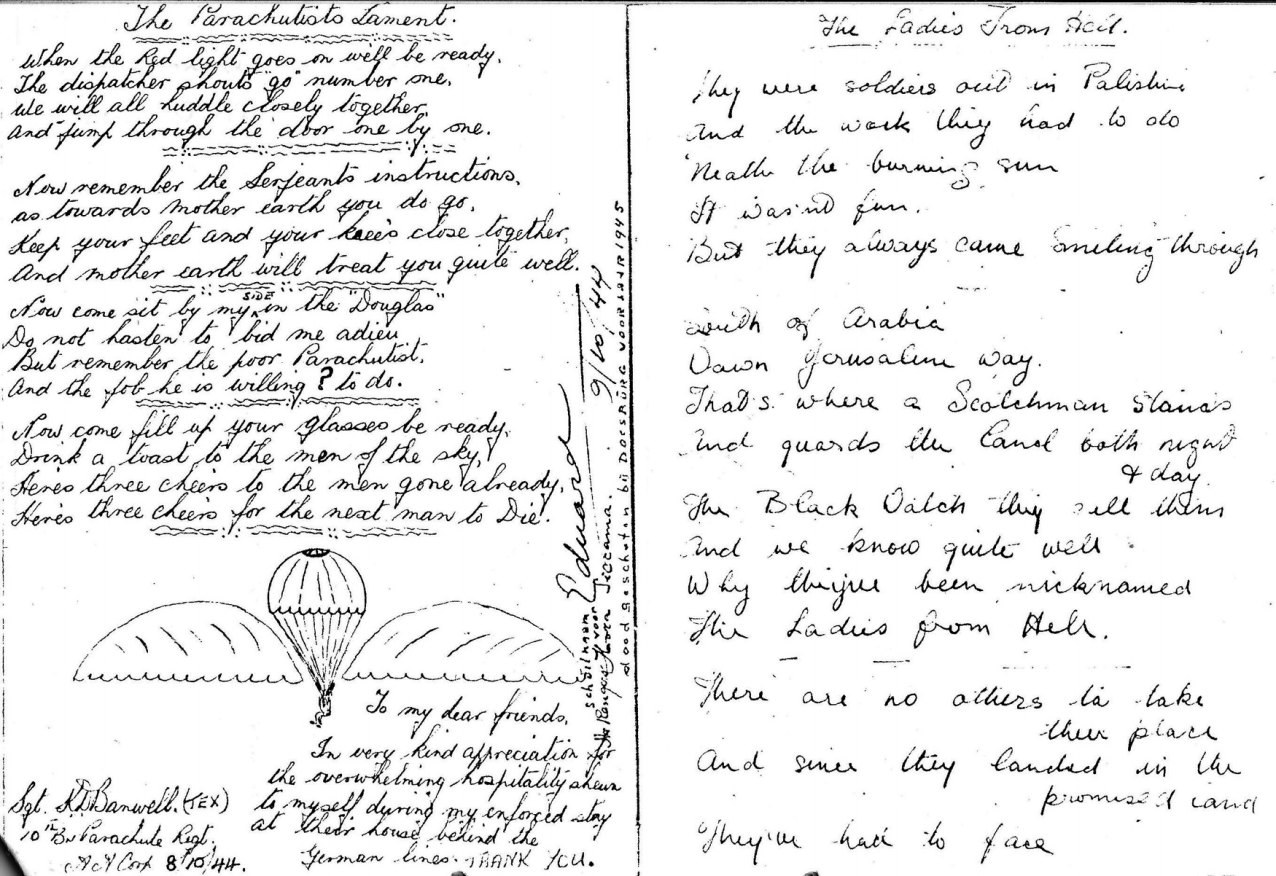
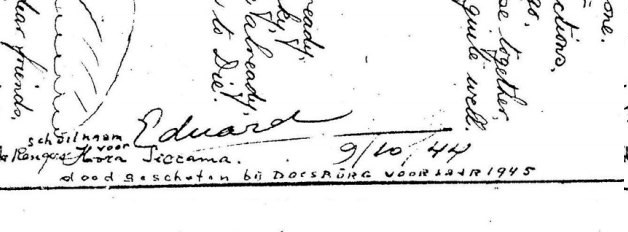
The note reads, as far as the margin is legible: "schuilnaam voor … Rengers Hora Siccama. dood geschoten bij Doesburg voorjaar 1945" (hiding name for Rengers Hora Siccama, shot dead near Doesburg, spring 1945). Noordman says the hiding name Eduard and the date are in his own hand ("zijn eigenhandig geschreven schuilnaam Eduard en de datum 9 oktober 1944") and the additions, the note, are Kruimel's, gives the man's full name as Wiardus Jacob Hendrik Duco Rengers Hora Siccama, a lawyer in the resistance, and takes it that he was concerned in moving Banwell, who wrote his farewell on 8 October (Noordman, p. 292). ◐ Banwell left Enny's Hoeve with Hora Siccama after Eggert's release on 2 October, by De Jong, and was at De Ruif by 8 October, so that fits; it is Noordman's reading, and the identification of the guestbook's "Eduard" with this man rests on Kruimel's note, written afterwards, whose death place is wrong (below). ◐ That "Eduard" is in his own hand is Noordman's statement alone; the reproduction cannot show whose hand it is, and the note beneath it, which does name him, is Kruimel's, by Noordman's account. Murphy's poem on the facing page is the first half of "The Ladies from Hell"; he is not known to have met Hora Siccama.
✓ Of his arrest the Foundation's file has nothing. ◐ The Rademakersbroek biography of Van Geen says: on 9 November 1944 Van Geen and his friend Wiete Rengers Hora Siccama, engaged to Van Geen's sister, were arrested because they had not reported for the Arbeitseinsatz; they were held at Kamp Amersfoort, and on 31 January 1945 were fetched back together to the Willem III barracks at Apeldoorn for interrogation, because the SD had learned from a resistance man of Ermelo who talked, Luther Kortlang, that airmen had hidden at Huize Bijstein and that the two had more on their conscience than first thought. On the way the two tried to escape from the car; there was a fight with the SD guards in which Wiete was badly wounded, and he died the next day (De 46 van Rademakersbroek). The visitor's contribution on the Foundation's page, which names that biography as its source, has "overleed na aankomst in het ziekenhuis van Apeldoorn" (died after arriving at the hospital in Apeldoorn) and a first burial "op 6 februari te Ugchelen" (the Foundation's page). The Foundation's own grave form tells it in outline too, in worn handwriting (◐ our reading of the image; words in square brackets are doubtful):
On a transport with [word not read] Jhr. H.G. van Geen by the SD from Amersfoort [to the] Willem III [barracks] Apeldoorn, in an attempt to escape, in which he was fatally wounded. The next day, in the Kriegslazarett at Apeldoorn, from the wound received.
Dutch originalBij transport met [...] Jhr. H.G. van Geen v. S.D. Amersfoort [naar] Willem III [kazerne] Apeldoorn bij poging tot ontvluchten, waarbij doodelijk verwond. Hierop volgenden dag in Kriegs-lazarett te Apeldoorn aan bekomen verwonding.
— Oorlogsgravenstichting · grave-registration form, answer 16 · Nationaal Archief 2.19.255.01, 126495A, scan 4 · transcript
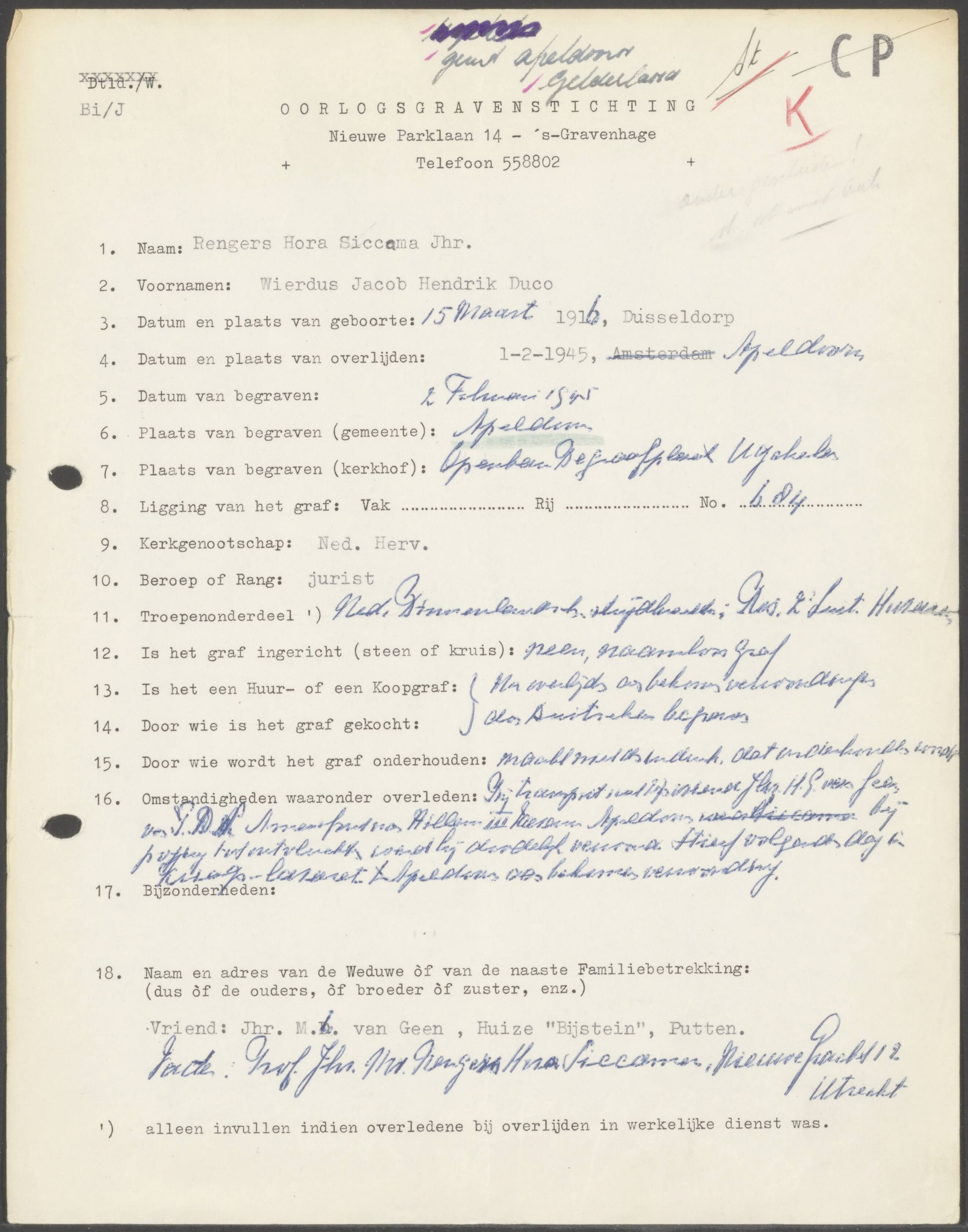
◐ Answers 13 and 14 of the same form, written across both lines, read "Na overlijden aan bekomen verwondingen door Duitschers begraven" (after death from wounds received, buried by Germans).
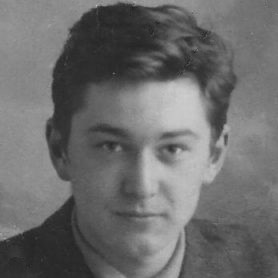
◐ Kamp Amersfoort, prisoner 9237. The camp memorial's site of prisoners' photographs, Geef gevangenen een gezicht, has a photograph filed as "Rengers-Hora-Siccama-jhr-mr-Wiardus-Jacob-Hendrik-Duco-15-3-1916-9237": his full name, the title mr that the Adelsboek of 1951 also gives him, his birth date, and the prisoner number 9237. It agrees with the Rademakersbroek biography and the Corps's almanac that he was held at Amersfoort; the site gives no date of arrival and says nothing of where or when the photograph was taken (the file; the search result).
✓ Three printed accounts of the first years after the war agree with that outline. The Student Corps's almanac of 1946 has "Op 9 Nov. '44 werd hij met zijn kameraad Henri van Geen gegrepen en overgeplaatst naar het kamp in Amersfoort"; on a transport he tried to escape, a guard shot at him, and "een dag later overleed hij"; in October 1944, "nog in het volle bezit van zijn vrijheid" (still in full possession of his freedom), he had made his will (the almanac, p. 121, checked on the image). The Adelsboek of 1951, in its list of the nobility's war dead, has him "Gevangen genomen te Putten op 9 November 1944 samen met zijn vriend Jhr. H. G. van Geen", both driven in January 1945 by German car to the SD prison at Apeldoorn, where, though handcuffed, they tried to overpower the soldiers; he was "door een schot van een der bewakers zwaar gewond" and died "een dag later, op 2 Februari 1945, te Apeldoorn" (Adelsboek 1951; ◐ a family-supplied entry, OCR only; for the day see below). A press report of 5 November 1946 has him, "res. luitenant der huzaren", in Amersfoort camp in 1944 and in February 1945 on transport to the SS court at Apeldoorn with "den jongen jhr. Hans van Geen", the two throwing themselves on the German guarding them, and "Siccama kreeg een schot in de lenden waaraan hij later is overleden" (Eindhovensch dagblad, 5 November 1946; OCR only; it also says he went underground "dadelijk", at once, which the almanac and the manifesto above do not bear out). The Utrecht students counted him among their dead early: his name is in the black-bordered In Memoriam list of the student weekly of 1 July 1945, and, ◐ by the names round his, in what looks like the list of Utrecht's student dead in the 1946 book Studenten onder de bezetting, whose heading is not in the text held here (Vox Studiosorum, 1 July 1945; Blase, Studenten onder de bezetting, 1946; both OCR windows only).
⚠︎ Held at Nijkerk. G. A. Vermeulen, the town clerk (secretaris) of Nijkerk, listed among the "illegal" acts of his memorandum, signed at Nijkerk on 24 September 1945, "Hulp verleend bij verzorging van Jhr. H. van Geen en Jhr. Siccama tijdens hun arrest in het gemeentehuis te Nijkerk" (help given in caring for Jhr. H. van Geen and Jhr. Siccama during their arrest in the town hall at Nijkerk), between an attempt to free Nijkerk men taken at Putten and the forced labour of November 1944 (the memorandum, p. 19, checked on the image; its title; the dated signature, p. 20, read on the image). It names no first names or date for the arrest, but pairs "Jhr. H. van Geen" with Siccama, and it puts the two in Nijkerk's town hall after their arrest, which the Foundation's file and the Rademakersbroek biography (Kamp Amersfoort, then Apeldoorn) do not mention; the Adelsboek's entry for Van Geen has both held "na een verblijf in verschillende gevangenissen" (after a stay in various prisons) before the January transport, naming none (Adelsboek 1951). ⚠︎ It is Vermeulen's own account. It sits in his NARA helper file, whose first page is the Bureau Nationale Veiligheid's inquiry into his reliability, begun on 2 August 1946, where a Nijkerk detective is recorded calling him "een zeer geraffineerden intrigant" (a very refined intriguer) who managed his principles. The same page goes on: the P.R.A. had arrested and interned him, "Op 22 Augustus 1945 werd hij vrijgelaten bij gebrek aan bewijs" (on 22 August 1945 he was released for lack of evidence), and "De Heer Vermeulen heeft zich op een voor de P.R.A. afdoende wijze kunnen verantwoorden" (Mr Vermeulen was able to account for himself to the P.R.A.'s satisfaction). So it is evidence of the arrest and not of his help (the file's first page, OCR only).
◐ Thijs Foppen of Staverden, whose form of 27 June 1945 says he "Sheltered 4 Jews" and whose page 3 lists four Allied men he helped (Glinchey, McDonald, Binks and Banwell; p. 3), listed among the people he knew had helped Allied personnel "Jhr. Henri van Geen, Putten" and "E. Hora Siccama, Utrecht" (typed "Hore", with a red handwritten mark over the e, and a tick in the margin; read on the page image; the form, p. 2). The "E." fits his hiding name Eduard, and the pairing with Van Geen fits the arrest; the surname is the only other thing it gives.
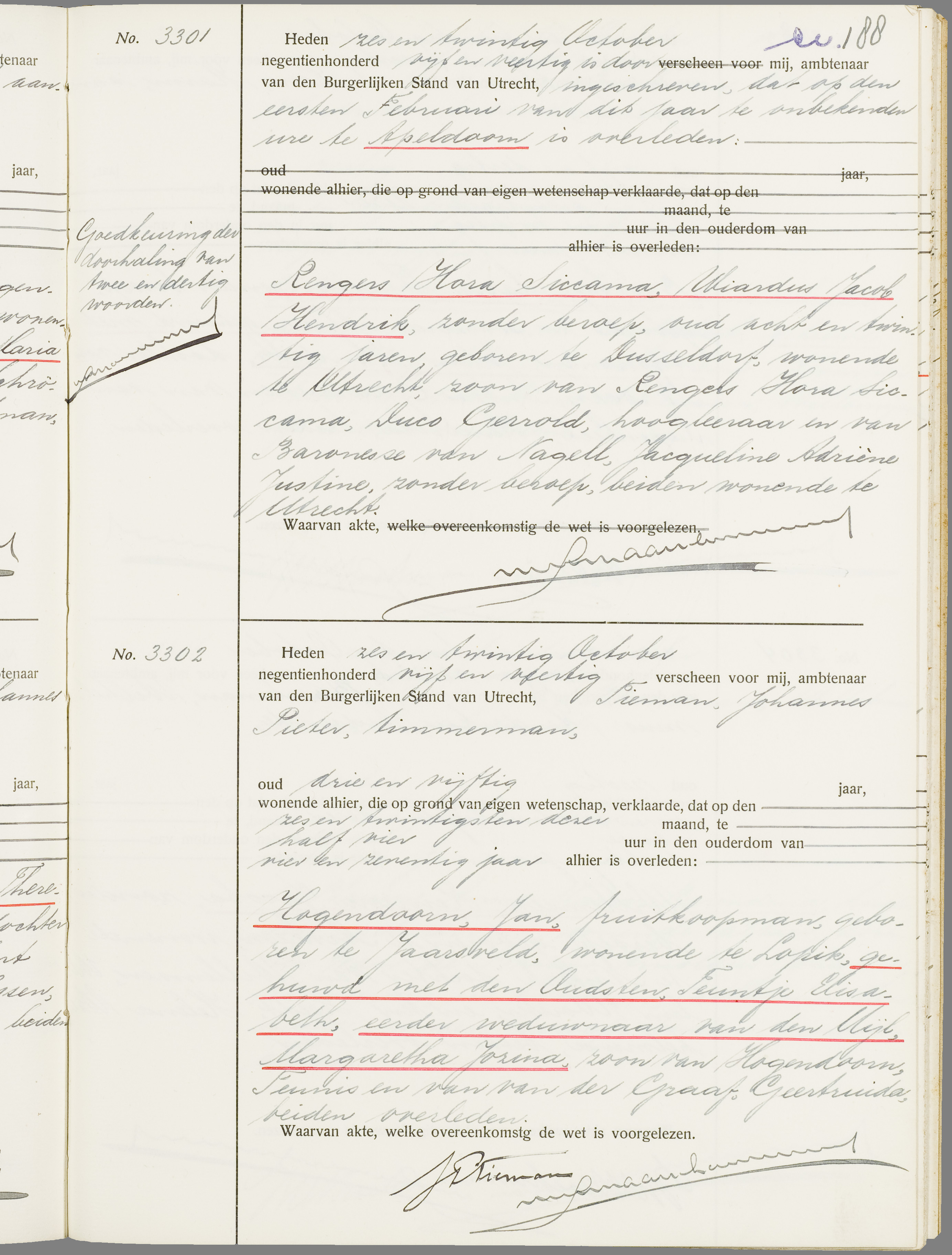
✓ The death. Utrecht entered his death on 26 October 1945: he died "op den eersten Februari van dit jaar te onbekenden ure te Apeldoorn", on 1 February of that year at an unknown hour at Apeldoorn, aged 28, without occupation (the deed; image-checked). Apeldoorn, where he died, had made its own deed a week before, no. 1440 of 19 October 1945, which its index gives with the same age, birthplace, date and parents (the index entry, Gelders Archief, no scan served). The Foundation's exhumation list of 1976 has "neergeschoten" (shot) as the cause, and an age of 29, which is a year out (scan 9).
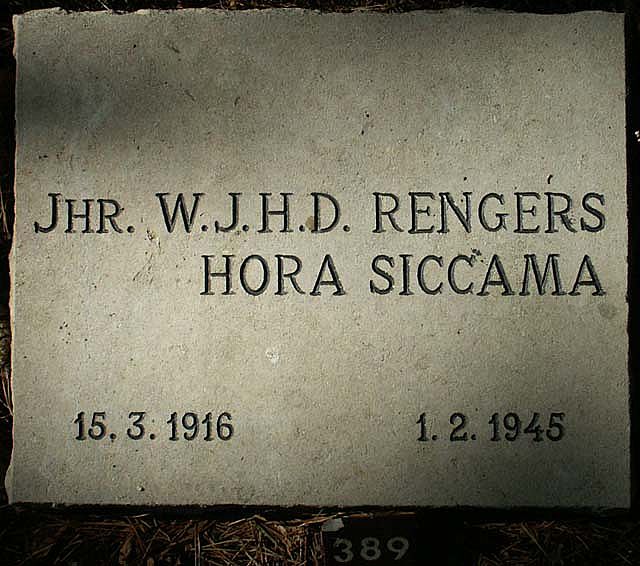
The grave. He was buried in an unmarked grave in the public cemetery "Heidehof" at Ugchelen, class 4, no. 684: the Foundation's form says on 2 February 1945, the burgomaster of Apeldoorn's decision of 1976 on 6 February (scan 4; scan 12). His father wrote on 5 March 1951 that his son had died and been buried "zonder dat er mij kennis van gegeven is" (without my being told), and that he learned of it only long afterwards; he agreed that the grave should be a "stichtingsgraf" never to be cleared, "daar mijn zoon mijn eenig kind was" (since my son was my only child) (scan 28; scan 29). The Foundation told him in July 1952 that a stone had been placed on the grave (the letter, OCR only), and in a letter dated 13 January 1976 (sent 14 January) proposed to his mother that he be moved to the Ereveld at Loenen (scan 16); the consent form of 22 January 1976 is signed for her by Mr S.H. Krabshuis, her zaakwaarnemer (agent) (scan 15; signature read on the image); the burgomaster of Apeldoorn gave leave to exhume in June 1976 (scan 12); and the Foundation's letter of 21 September 1976 to Krabshuis says he had been moved to Loenen, plot D, no. 389 (scan 11); the letters of 1976 are typed copies, OCR only). The Foundation's page also lists him on the monument to the fallen of the cavalry at Amersfoort (the Foundation's page).
Where the sources disagree
Link to the section Where the sources disagree- His Utrecht address. ✓ Two houses on the Nieuwe Gracht, 10 and 12.
- The almanac for 1939 has the son's own room at Nieuwegracht 10 and the professor at Maliebaan 11, and Vox repeats number 10 three times in 1939 and three times in 1937 and 1938 (above), so the number is not a misreading. Number 10 was his student room (with "Vree").
- The Foundation's file gives his father at Nieuwe Gracht 12 (above), and the almanac for 1941 has Nieuwe Gracht 12 for him (p. 415): the family house.
- Where and when he was shot. ✗ The note in the guestbook has him "dood geschoten bij Doesburg voorjaar 1945" (shot dead near Doesburg, spring 1945). Nothing supports it: the death deed has him dying at Apeldoorn on 1 February 1945, the Foundation's forms say the same, and Noordman's text has Apeldoorn (the deed; scan 4; Noordman, p. 292). The note is Kruimel's, written afterwards, and is the only source for Doesburg.
- How he died. Wounded in an escape attempt on the SD transport to Apeldoorn, and dead there a day later or "later", in every source that says how. What each adds differs:
- Rademakersbroek: a fight with the SD guards, death the next day, no hospital named (De 46 van Rademakersbroek).
- The visitor's contribution: death after arriving at the hospital in Apeldoorn (the Foundation's page).
- ◐ The grave form: "doodelijk verwond" (fatally wounded), and next day in the Kriegslazarett at Apeldoorn, from the wound received (answer 16, above).
- The Corps's almanac: a guard shot at him, and he died a day later; the Adelsboek: "zwaar gewond" by a shot from a guard, died a day later; the Eindhovensch dagblad: a shot in the loins, from which he "later" died.
- The Foundation's exhumation list of 1976: cause "neergeschoten" (scan 9).
- ⚠︎ No source says who fired, or that he was hit in the car.
- The day of the burial. 2 February 1945 (the Foundation's form) or 6 February (the burgomaster of Apeldoorn, 1976; the visitor's contribution also has 6 February, without saying where it has it from). ⚠︎ Not settled; none is a burial register.
- His mother. Maria Dora Elfriede Nielböck (the Foundation) or Baroness van Nagell (the death deed). ✓ Nielböck: the Adelsboek of 1935 has his father's first wife with her birth date, the Foundation's date, the divorce of 6 August 1930 and the baroness as his father's second wife from 26 May 1932, so the baroness is his stepmother (above). A Utrecht newspaper of 29 October 1935 has a "Mevr. J. Rengers, Hora Siccama—Baronesse van Nagell" on a ladies' committee (Utrechtsche courant; OCR only), which fits: she was already Mrs Rengers Hora Siccama when he was nineteen.
- The day he died. 1 February 1945 in the death deed, the Foundation's forms and the Tweede Kamer's roll of honour; 2 February in the Adelsboek of 1951 ("een dag later, op 2 Februari 1945") (the deed; Adelsboek 1951). ✓ 1 February stands: three official records against one family-supplied entry printed six years later. The Corps's almanac of 1946 gives only "Febr. 1945".
- The month of the transport. 31 January 1945 in the Rademakersbroek biography; January in the Adelsboek, which also has him dying "een dag later, op 2 Februari", so its own two statements cannot both hold (a day after a January transport is at most 1 February); February in the Eindhovensch dagblad of 1946 (the Adelsboek; the press report). ◐ The deed's 1 February and the biography's 31 January fit each other and the Adelsboek's January, not its 2 February; the newspaper is a short report and is the odd one out.
- When he joined the resistance. "Dadelijk", at once, in the Eindhovensch dagblad of 1946; after he withdrew in "the winter of '42", and "na enkele maanden" after that, in the Corps's almanac of the same year, signed A. W. (the press report; the almanac). ◐ The almanac is the circumstantial account, and the manifesto of December 1940 and the editorial board of March 1941 above make "at once" hard to hold; neither dates his first act.
- His age. 28 on 1 February 1945 by his birth date, and by the deed; 29 on the Foundation's list of 1976. ✓ 28.
- The Eduard of the guestbook. Kruimel's note names a Rengers Hora Siccama; Noordman supplies the full name and the fate. ◐ Probable, since the name is rare and, by De Jong, he was with Banwell the week before, but the note is wrong about the place and time of his death and gives no initials. Noordman adds that the name "Eduard" is in his own hand (p. 292); that is his statement, not checkable from the reproduction.
- The man of De Waag. ◐ Very probably him: the initials, the title and Utrecht, with the Corps's In Memoriam of 1946 consistent with it (above); the papers themselves give only the signature and the board line.