Maj. Hugh Maguire
Formby 29 Nov 1911 – ?
Maj. Hugh Pownall Maguire (130962)
About: The 1st Airborne Division's intelligence officer, who commanded Pegasus II, by the Ede accounts on 17/18 November 1944 (the night is not settled, see Where the sources disagree), the crossing Murphy's party set out with and lost. He was taken prisoner early on 18 November by those accounts and sent to Germany.
Unit or role: Major, 130962; GSO2 (Intelligence), Headquarters 1st Airborne Division; commissioned in the Royal Ulster Rifles (Kew, WO 416/243/368)
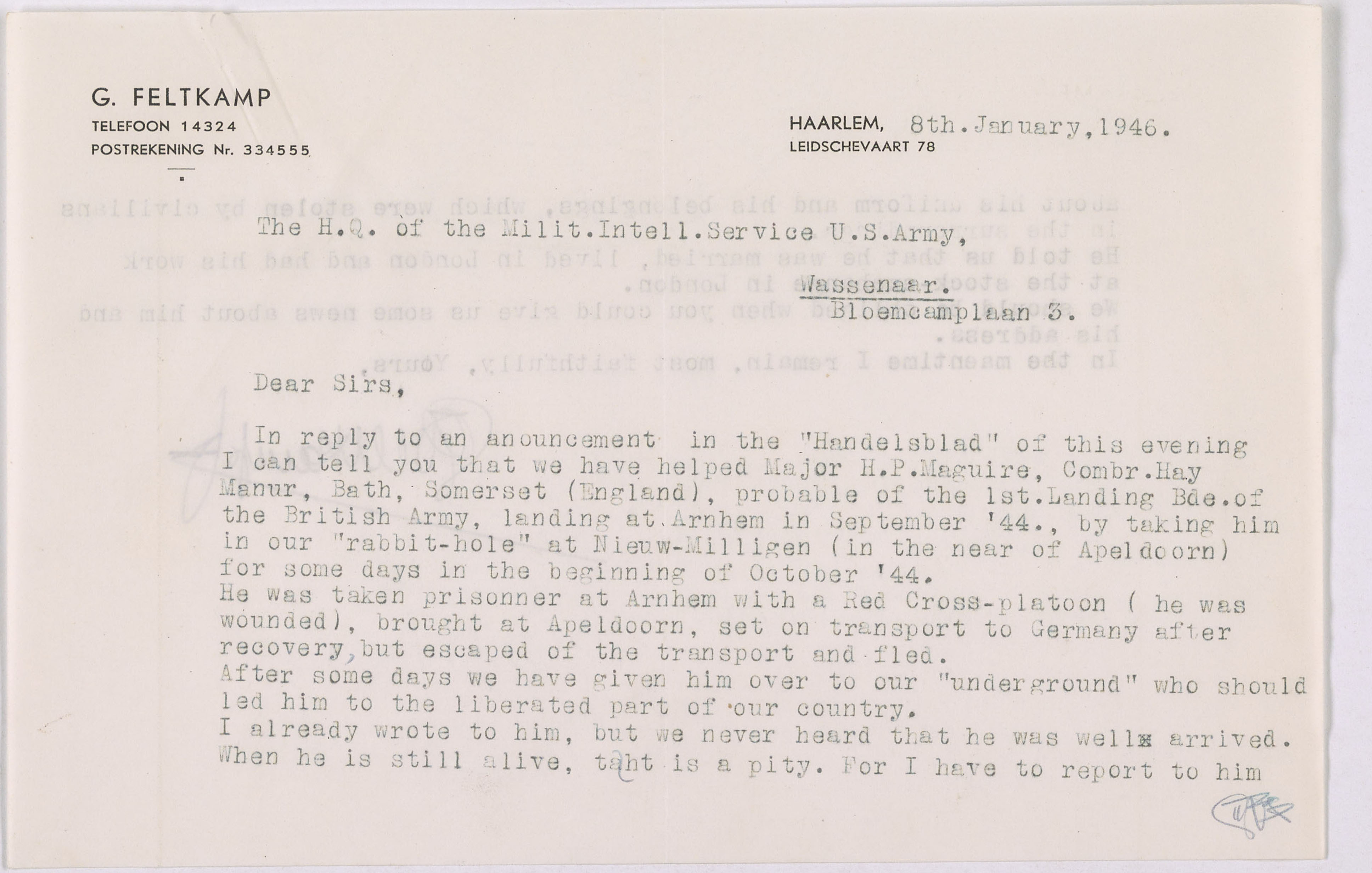
Where: Combe Hay Manor, near Bath, in January 1946, as Feltkamp typed it; his letter adds that he had written to Maguire "but we never heard that he was well arrived", so in January 1946 Feltkamp did not know whether Maguire had survived (Feltkamp's letter, p. 4)
Evidence: ✓ Kew's German POW card index entry; ✓ London Gazette, 31 May 1940, p. 3265; ✓ Heaps, The Grey Goose of Arnhem (pp. 36, 193); ✓ the escape reports of Hardy and McNaught; ✓ Ede's wartime history (p. 45) and Boeree's Kroniek van Ede (1947, pp. 179–184), read on the page images; ✓ the Dutch helpers' questionnaires in the US National Archives, read from the page images (below); ✓ three reports on Pegasus II, Hackett, Ramlow and Low, read from the page images. Warrack, Kessel and Heaps are quoted from the Archive's text layer of the printed books, not from page images.
Who he is
Link to the section Who he is✓ The number ties the records together. The Gazette of 31 May 1940 lists "Hugh Pownall MAGUIRE (130962)" among the new second lieutenants of the Royal Ulster Rifles (London Gazette, p. 3265), ◐ one of a run of cadets from the Officer Cadet Training Units whom the heading on page 3261 makes second lieutenants from 25 May 1940. Kew's index of German prisoner-of-war cards has "Hugh P Maguire", born 29 November 1911 at Formby, Major, Royal Ulster Rifles, service number 130962, in "Oflag XIIB Had" (◐ Hadamar, as the catalogue abbreviates it) as prisoner 642 (the entry). The Pegasus Archive's bracketed notes in the reports of Hardy and McNaught give the same number to the Arnhem man: "130962. Maj. Hugh Pownall Maguire. GSO II (Int), 1st Airborne Division Headquarters" (McNaught; Hardy). Heaps, whom he sent to the bridge on 18 September, calls him "the GSO2 Intelligence, Major Hugh P. Maguire" (Heaps, p. 36). The reports print only "McGUIRE"; the number is the Pegasus Archive editors' addition, whose basis we have not seen.
◐ His family, from the papers:
- ◐ In 1936 The Times announced the engagement of "Hugh Pownall Maguire, only son of Mr. and Mrs. W. R. Maguire, of 10, Chepstow Mansions, W.2" to Elizabeth Marion, only daughter of Mr. and Mrs. David Robertson of Chew Magna, Somerset (the hits; read in the Archive's full-text index, not on the page).
- ◐ A birth notice in The Times of 31 July 1940, from the same index, reads in its OCR "MAGUIRE.—On July 28, 1940, at Chesterficld Nursing Home, Bristol, to Exrrvasern, wife of HUGH Macurmr", with "Present address : Combe Hay Manor" (the hit; the longer passage); the mother's first name and the child's sex are garbled past reading, so ⚠︎ "Elizabeth" is a guess until the page image is read. The Times of 14 May 2002 has the Robertson family buying the manor in 1939. The two Maguires are one man by the name and the Somerset address.
- ◐ Feltkamp, who sheltered him in 1944, wrote that "He told us that he was married, lived in London and had his work at the stock-exchange in London" (Feltkamp's letter, p. 5).
- ◐ A notice of 16 August 1949 under the Trustee Act for William Robert Maguire, retired tea planter, of Eastbourne, died 17 May 1949, names among the personal representatives Hugh Pownall Maguire (London Gazette, p. 3998). The father is "W. R." in 1936 and the son's three names are distinctive, but nothing says they are father and son.
- ✓ He was the division's GSO2 (Intelligence) at Oosterbeek. On the morning of 18 September he gave Leo Heaps the job of taking a jeep of ammunition, food and a wireless set to Frost at the bridge, spread out a map, handed him a bullet-proof vest, and said "When you reach the bridge, don't forget to let me know" (Heaps, pp. 36–37).
- ✓ Col. Graeme Warrack, the division's senior medical officer, sent him with about thirty walking wounded to a cottage across the road from his own area; it was there on the morning of 23 September (Warrack, pp. 38–39; page images 38, 39; Graeme Warrack). Warrack's words are "I sent Hugh Maguire and about thirty walking wounded, including two Germans, to a small cottage on the other side of the road" (p. 38).
- ✓ An earlier passage (p. 35): Warrack left three of his staff at Div. HQ "to help run the RAP", then left himself, "taking as many of the casualties as I could to the dressing station. They included Hugh Maguire, the G 2 (Intelligence), and Graham Roberts, the ADC." Warrack counts Maguire among the casualties he took to the dressing station; the page does not say what his injury was.
- ✓ On the morning of 25 September he told Sgt Tex Banwell of the withdrawal across the Rhine that night (Heaps, p. 61; Pegasus Archive; Tex Banwell).
- ◐ Where and when he was taken prisoner is not in what we hold. Feltkamp's letter has him "taken prisonner at Arnhem with a Red Cross-platoon (he was wounded)" (Feltkamp's letter, p. 4), which fits Warrack's walking wounded, and Warrack has the Germans marching away the walking wounded of his area at 3 pm "except for Hugh Maguire's lot" (Warrack, p. 45). Warrack's p. 35 passage above calls him one of "the casualties"; Feltkamp is the only source that says in so many words that he was wounded.
Apeldoorn and the hiding places
Link to the section Apeldoorn and the hiding placesHe was held in the Willem III barracks in Apeldoorn, where Murphy was held until his escape on 6 October: Warrack has Maguire's escape from the barracks through the straw at the incinerator (below, pp. 75–76: 75, 76), and Hardy, held there with Murphy, has an escape committee "at the barracks" (below; Lionel Bryson; Apeldoorn).
- ◐ Hardy, who was held there with Murphy, says of the barracks hospital: "There was an Escape Committee at the barracks in charge of which, I think, was Major. McGUIRE" (Hardy). He is unsure, and nothing we hold puts Maguire and Murphy in contact.
-
✓ Warrack describes Maguire's own escape:
- He hid in a bundle of straw taken out to an incinerator beyond the sentries; the first night the sentries stood round the fire for hours and he came back "dishevelled and very cold", and the next night Sergeant Major Bryson piled so much straw on him that he nearly could not crawl out, but "in the end he wriggled through and got away" (Warrack, pp. 75–76: 75, 76).
- ✓ Warrack gives no unit for the sergeant major here, but on p. 62 he puts "Bryson as sergeant major" of the hospital and on p. 27 calls "(Lofty) Bryson" RSM of the 181st Field Ambulance, so he is Lionel Bryson, RSM of 181 Airlanding Field Ambulance (p. 62; p. 27).
-
✓ Warrack's diary. The diary Warrack wrote in the barracks (◐ near-contemporary; no source says each entry was written the same day) names him "HUGH", which Warrack's own key gives as "Maj H MAGUIRE", GSO 2 (Int) at Division (the officers' list, p. 48; Warrack's diary, typed transcript of about 1982, Wellcome Collection RAMC/1584; page numbers are the transcript's).
- On 2 October the Germans paraded the lightly wounded for the cattle-truck train to Germany (pp. 35–36). The next morning, 3 October, "HUGH [MAGUIRE] appeared" (the bracket is the editors'): "He disappeared from the parade of walking wounded yesterday as he means to make a break for it", and Warrack gave him "my blessing" (p. 37). ◐ That the parade was the train party's is our reading: it is the only parade the entry of 2 October records.
- On 4 October he had not been seen "for the past day or two", and "He appeared one morning having spent 24 hours under a pile of straw - with the guard about 18 ins from his nose the whole night" (p. 39). ◐ That may be the straw of Warrack's book, but the diary does not say the straw was how he got out, and the 24 hours may be the stretch before he "appeared" on 3 October rather than after the blessing; it has him unseen by the 4th and nothing more.
- ◐ Hardy's escape committee: the diary names none while Maguire was there; on 14 October it has a "Meeting of entertainments committee [discussing escaping]", the bracket a later addition (p. 46).
After the escape the Dutch helpers' questionnaires follow him from house to house, with dates that overlap by a few days:
- ✓ Nieuw-Milligen, near Apeldoorn, early October. G. Feltkamp of Haarlem hid him in a "rabbit-hole" there "for some days in the beginning of October '44" (Feltkamp's letter, p. 4). His questionnaire has "H.P. Magnore, Major", October 1944, two days, from Mrs Philips of Apeldoorn, passed to the Underground and to Zeegers at Nieuw-Milligen (Feltkamp's questionnaire, p. 7).
- ✓ Soest and Appel, from 6 October. Reinder Hogeboom of Soest fetched "Maj. Macquire, 1st Airb. Div" himself, from "Pellilaan" as the form has it (◐ the P. Pellicaan of Nijkerk on Zandbergen's form) (Hogeboom's file, p. 3).
- Hendrik Jan Zandbergen of Appel, by Nijkerk, has "H.P. Maquire, 1e Airb. Div." for four days from 6/10/44, from Hogeboom, passed to Mrs van der Woerd at Barneveld (Zandbergen's file, p. 6). ◐ His summary adds that Zandbergen sheltered two evaders, a Frenchman of the Special Air Forces and "an Irish Major of an Infantry Regiment who had escaped from a train", naming neither (the summary, p. 7).
- ✓ Barneveld, October. Mrs J. van der Woerd-Moll of Stationsweg 169 has "Maquire, 1 Air. Div.", seven days, from Zandbergen, passed to the Frans Hals organisation (her file, p. 4). A. van Veldhuizen of Barneveld lists "Major Maguire" among some twenty-five pilots and officers he helped (his file, p. 5), ◐ the surname only.
- ✓ A farm at Kootwijkerbroek, to about 11 November. McNaught found "Major. McGUIRE" living with the family when he arrived at "ESVHEILT's", and Maguire then joined him in the haystack room; on about 11 November he left them, saying that a large party was being prepared (McNaught; ◐ the family is Heimen van Esveld's, by the spelling and the haystack hide). McNaught was told on 23 October by Dick and Joop that "the operation that WOOD and MERS (?) had gone on had been carried out successfully", ◐ Pegasus I by the date (Dick Kragt; Joop Piller).
- ✓ Barneveld, from 8 November, with the Frans Hals organisation. Jacob Bol of Barneveld lists "H.P. Maquire", 8/11/44, 8 days, received from and passed to "Frans Hals" (Bol's form, p. 5); his second typed copy has "Maj. H.P. McGuire", 8-11-44, 8 d., received from "Joop en Dick" (p. 17): Dick Kragt and Joop Piller. Eight days from 8 November end on the 16th, the day Wildeboer gathered the column.
- ◐ Known to Kay and Piller. Karel Niermans, a Frans Hals courier, lists "major H.P.Mequire" among the men "known to capt. D Kay and capt. J. Piller" (his form, p. 5); no dates.
Maguire was still in hiding after Pegasus I (22/23 October). ◐ The IS9 report of Maj. J. S. Hibbert, dated 23 October 1944, lists "Major Maguire" among the names mentioned (the catalogue entry); the report itself is not digitised and we have not seen it.
With Murphy
Link to the section With MurphyMurphy was not in Maguire's column. ✓ Hardy's party lost its guides at a fork on the evening of the 17th and never joined the main body: "BANWELL, BRENTFORD, MURPHY & I took the wrong fork and lost the rest of the party" (Hardy). No source says what Murphy knew of Maguire, or that they met (Operation Pegasus II; James Hardy; Sam Walsh).
Pegasus II
Link to the section Pegasus II✓ He was put in command. In Neave's words, from the Archive's index: "This message was passed to Major Hugh Maguire, the intelligence staff officer of the division, who was in command of the second party of about 140 men" (Neave, Saturday at M.I.9; ◐ index snippet, the book's own index puts him at p. 295). Warrack met him in the barn at the assembly point, and was told:
At 11 o'clock I joined Hugh Maguire; with him was Major John Coke of the KOSB. Hugh told me that the Underground, who were in touch by telephone with the Second Army, had decided to get as many Allied escapers and evaders as possible over to our lines on the following night. The operation was to be known as Pegasus 2, and Hugh was in command.
— Graeme Warrack · Travel by Dark: After Arnhem · 1963, p. 144 · page image · the text
- Assembly, 16 November.
- ✓ D. Wildeboer, the Ede organiser, wrote in 1946 that on the 16th he "concentreerde ... 85 man Geallieerd personeel onder leiding van Major, H.P. Marquire, in twee kippenhokken" (gathered 85 Allied men under Major H. P. Marquire in two chicken houses) at the Wolfswinkels' in Lunteren (Wildeboer's letter, p. 10).
- ✓ Maguire registered every man, and the Dutch guides were given English names and army numbers in case they were taken (same page). Boeree gives the names and papers to a different man: "De staf-sergeant Allan voorzag de Nederlanders van een Engelsche naam, legernummer en bijbehoorende papieren" (the staff sergeant Allan gave the Dutch an English name, army number and papers to match) (Boeree, p. 179).
- ◐ A typed account headed "Hulp van Drikus" (help from Drikus), the enclosure to Henk van de Pol's letter of 30 November 1946 and so ◐ his own, "Drikus" being short for Hendrikus, has its writer, with Bill, Jo Kelderman and Henk Koudijs, leading "de groep onder Maj. Macquire" (the group under Maj. Macquire) over the Goudsberg towards Wekerom (van de Pol's file, p. 23).
- ✓ Boeree's order of march. In Boeree's chronicle of Ede, the English commander came to the barns, and "Bill" went over the route with him and the guides (Boeree, p. 179, read on the image). "Maquire had het volgende bepaald" (Maguire had laid down the following): a vanguard "waarover hij zelf het commando nam" (which he commanded himself) with 6 Sten guns, a main body of airmen and hospital staff under the doctors Longland and Allenby, unarmed, and a rearguard under Major Coke, the "fighting groop", with 44 (same).
- The arms followed his principle "dat men zonder vechten de rivier moest bereiken" (that the river had to be reached without fighting), the rearguard to hold off the Germans if they pressed until the covering barrage began (same).
- He walked at the head with Bill and the two guides, with Thieme, who spoke fluent English, as interpreter (same).
- ✓ The briefing. Kessel, arriving at the barn, met "a harassed-looking officer wearing a major's crown ... 'I'm McGuire — Hugh McGuire'", and later wrote that he was "very much the regular officer, giving orders with as little fuss as if it were a peace-time twenty-four-hour stunt among the pines and heather near Camberley" (Kessel, pp. 123, 129; Lipmann Kessel).
- Warrack has him tell the party they might meet a patrol and that they "must try and avoid having a shooting match with the enemy" (Warrack, p. 145).
- He asked Kessel to act as interpreter to the Dutch guide at the front: "Keep in constant touch with me at H.Q., which will be somewhere near the middle of the column" (Kessel, p. 129).
- ◐ The start, 17 November. Boeree: before they set out there was a discussion, in the rain, whether to stay another day in the chicken houses and cover the route in one night; "Maquire, die zeer nerveus was en bang dat hij te laat aan de Rijn zou komen, durfde niet afwijken van het opgemaakte schema" (Maguire, who was very nervous and afraid of reaching the Rhine too late, did not dare depart from the plan that had been drawn up) (Boeree, pp. 179–180, read on the images). Boeree's words; he does not say who told him.
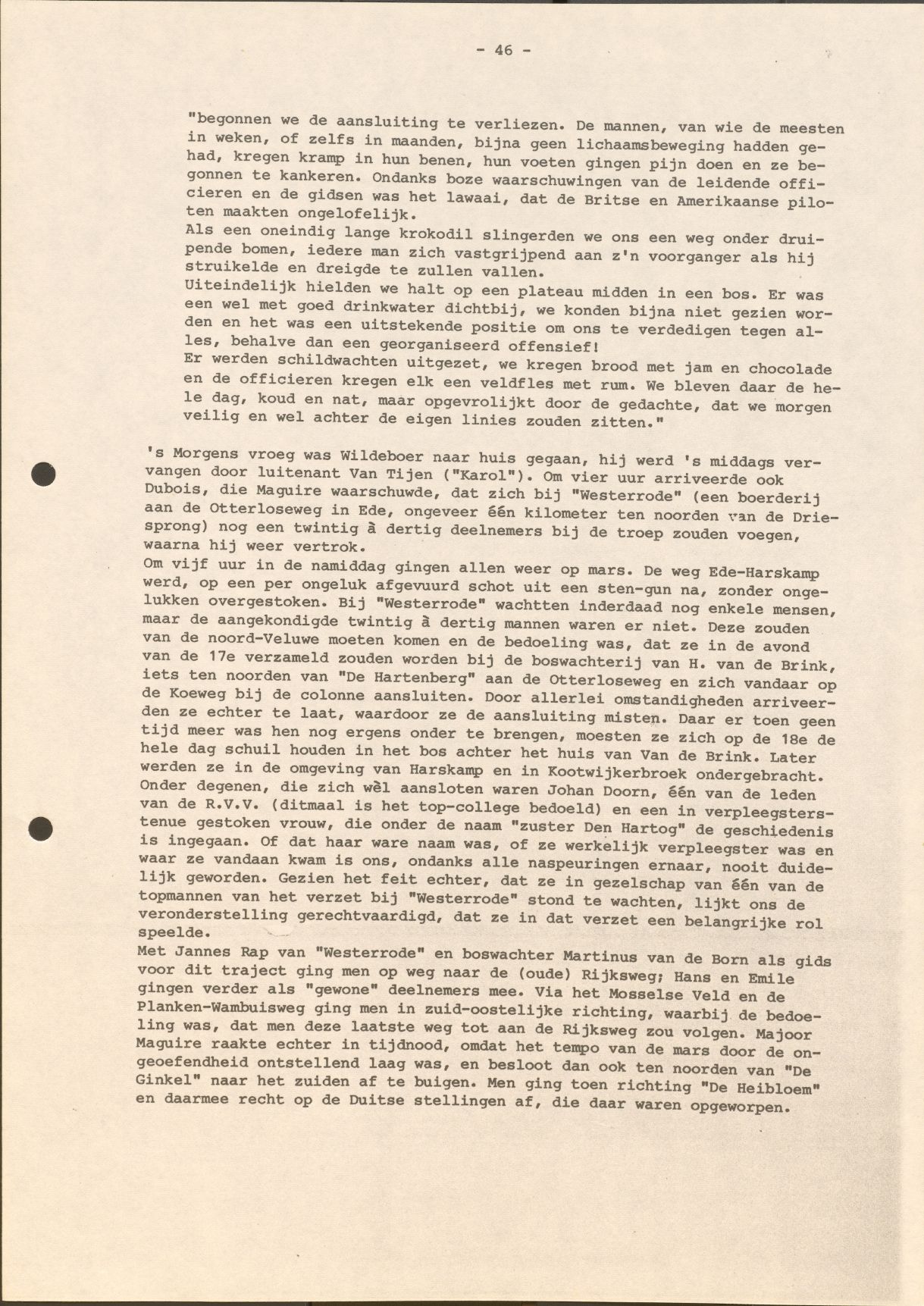
- ✓ The first march. At 3 am on the 17th, in pouring rain, the column went to the Wekeromse Zand, "Majoor Maguire ging met de gidsen voor dit eerste traject, … en Wildeboer voorop" (Major Maguire went in front with the guides for this first stretch, … and Wildeboer), the cut naming the brothers Hans and Emile Kerkhoven, whose father owned the estate; the main body was airmen, medical staff and civilians, and the rear guard paratroops under Maj. Coke (Ede manuscript, p. 45).
- ✓ The day in the wood. In the wood on the plateau, Boeree has him drill the eighty men round the hill in losing and restoring contact and crossing a road, and order them to hide when English aircraft flew low, so as not to be taken for German troops (Boeree, p. 180); Kessel: "that afternoon he decided to run an exercise", crossing "imaginary Autobahns running through the woods" (Kessel, p. 129).
- Westerrode and the shorter route.
- ✓ At 4 pm on the 17th Dubois warned Maguire that twenty or thirty more men would join at Westerrode; they did not come (Ede manuscript, p. 46; Abraham du Bois).
- ✓ From there "Majoor Maguire raakte echter in tijdnood, omdat het tempo van de mars door de ongeoefendheid ontstellend laag was, en besloot dan ook ten noorden van 'De Ginkel' naar het zuiden af te buigen" (Major Maguire ran short of time, because the pace was appallingly slow, and decided to turn south north of De Ginkel), straight on to the German positions at the Heibloem (same page).
- ✓ The Liberation Route says the same and adds that he did it "despite protests from the guides" (Liberation Route); ◐ so does Waddy (the hit, index snippet).
- ✓ Boeree: on the beech avenue a shorter way came up; the guide Rap protested, "maar Maquire hakte de knoop door" (but Maguire cut the knot), and the column turned right towards the Heibloem, straight at the German positions (Boeree, p. 183, read on the image).
- ✓ Kessel, at the head, has the guides argue at a fork and Maguire whisper "We're late as it is"; when a shot cracked behind them, "'Sounds like a Sten,' McGuire snapped. 'Probably one of the Yanks.'" (Kessel, p. 130). Boeree has an American's Sten go off by accident on the march, and the man made to hand his weapon to another (p. 181, read on the image).
- The challenge and the split.
- ✓ At the sentry's "Halt" the column went to ground and broke up. Warrack: Maguire came back with two airborne privates as a guard, said "I'm going back to find the rest of the party", returned after a quarter of an hour to say the others would go on independently, and "That was the last thing I was to hear Hugh say" (Warrack, pp. 149–151; page images 150, 151).
- ✓ Kessel, at the head as interpreter, was told that "McGuire had gone to arrange for the rear party to advance to the river independently" (Kessel, p. 132). The fork and the quarrel between the guides are in Operation Pegasus II.
- ✓ Boeree's account of the split. After a first "Werda" the column froze and only the leading men followed him on; in the Heibloemlaan he called a roll and found 30 of the 80; he went back with van den Born and Thieme to look for the rest, stopped Coke, who had taken Thieme for a German, and told him to close up within ten minutes; then came a second challenge and shots. "Maquire ging met dertig man op pad" (Maguire set off with thirty men) (Boeree, p. 183; John Coke).
- ✓ Wildeboer's account of the march. Wildeboer: "Major Marquier met ongeveer 120 manschappen verder trok in de richting van de Rivier" (Major Marquier went on towards the river with about 120 men), after 32 more had joined at the first halt (Wildeboer's letter, p. 11).
The capture, 18 November
Link to the section The capture, 18 NovemberThe vanguard got over the Ede–Arnhem road under machine-gun fire, and Boeree tells what became of it (p. 184, read on the image):
Of the vanguard about 17 men were still together. They were Maquire, van den Born, Streefland, Thieme, Harry Jansen, a Frenchman who was a flyer in English service, the staff sergeant Allan, the privates Smith and Duke and some others unknown. … Maquire took fright; he explained that they were in no man's land and that the Germans shot anyone caught there with weapons. The six Sten guns had to be buried. Without the help of a guide they went on, until Maquire decided to halt and wait for the first light of morning.
Dutch originalVan de voorhoede waren nog ongeveer 17 man bijeen. Het waren Maquire, van den Born, Streefland, Thieme, Harry Jansen, een Franschman, die als vlieger in Engelsche dienst was, de staff sergeant Allan, de soldaten Smith en Duke en enkele andere onbekenden. … Maquire werd bang, hij legde uit, dat men in Niemandsland zat en dat de Duitschers ieder neerschoten, die daar met wapens werd gegrepen. De zes stenguns moesten worden begraven. Zonder steun van den gids ging men verder, tot Maquire besloot halt te houden en het eerste ochtendlicht af te wachten.
— Th. A. Boeree · Kroniek van Ede gedurende de bezettingstijd · 1947, p. 184 · the page
✓ They hid in a bomb crater in a thicket, not knowing they were close to a German artillery position; in the early morning a German soldier who had heard a rustle looked over the rim, found "de 17 ongewapende mannen" (the 17 unarmed men), called an NCO and had them march to the hut by the railway (same page). ◐ "Maquire werd bang" (Maguire took fright) is Boeree's word; he does not say who told him, and no other source we hold says it.
The Liberation Route tells the same end:
Of the vanguard, seventeen men were still assembled, including Major Maguire. They passed the under construction State Highway 12 (now A12) and stopped along the railroad tracks. There they were captured in the early morning of November 18, 1944.
— Liberation Route Europe · Operation Pegasus II · the page
✓ Heaps has him seeing "the red tracers from the Bofors about two miles south" before light on the 18th, and being unable to do anything about it (Heaps, p. 194). ◐ Hogeboom's questionnaire says "Major Macquire (H.Q. 1st Airborne Div) and Lt. Jean Des Courtis were again arrested when they tried to cross" (Hogeboom's file, p. 2); des Courtis is the French lieutenant Zandbergen and Pellicaan helped, Ede's list of the column has a Frenchman in it, and Boeree has "een Franschman" among the seventeen taken with Maguire (p. 184), but no source we hold names des Courtis on the night.
✓ Boeree has Thieme taken with the other British prisoners to Amersfoort, "waar de volgende dag ook Maquire en Allenby verschenen" (where Maguire and Allenby also turned up the next day), and the prisoners sent on to Germany by way of Enschede (Boeree, p. 188, read on the image).
What others wrote of his command
Link to the section What others wrote of his command- ◐ Bernard Haller, the glider pilot of Murphy's party, who dropped out of the march with dysentery, defended him in 1984: "Waarom zou ik harde kritiek leveren op een dapper man?" (Why should I criticise a brave man harshly?), because he had "verbood wapens bij ons te dragen" (forbidden us to carry weapons), since they were escaped prisoners bound by the Geneva Convention (Dekkers and Vroemen, pp. 229–230).
- ◐ Menno de Nooy, second in command of the Ede resistance by the Americans' card (Dick Kragt), in the same book, called the column "een ongeorganiseerde bende, waarop Maguire helemaal geen greep had" (a disorganised mob that Maguire had no grip on) (Dekkers and Vroemen, p. 228).
- ◐ Lt John L. Low Jr., one of the seventeen Americans in the column (Low's report, p. 11), is reported by the Americans' summary of his debriefing as stating "in his opinion this operator [operation] was a failure because the officer in command did not have enough experience in infantry tactics" (p. 9). The summary's words, not Low's own, and the officer is not named.
- ◐ Lt Charles Ramlow of the same party, in the Americans' summary of his report (pp. 4–5; p. 5); the summary writer's third-person words, and Ramlow is the only one to say it:
- He "did not think this a felicitous choice as that Major had shown himself rather difficult during his residence in HOLLAND in his attempts to preserve the distinction between officers and enlisted men among the evaders".
- At the rendezvous near Otterlo the Major's order was that "under no circumstances was there to be any firing", and the march order put "the general staff" at the head, then the Dutch, the RAF men, the Americans and last the paratroopers; Ramlow argued the paratroopers should lead, "But the Major overruled him, deciding that by silence they would avoid the risk of capture".
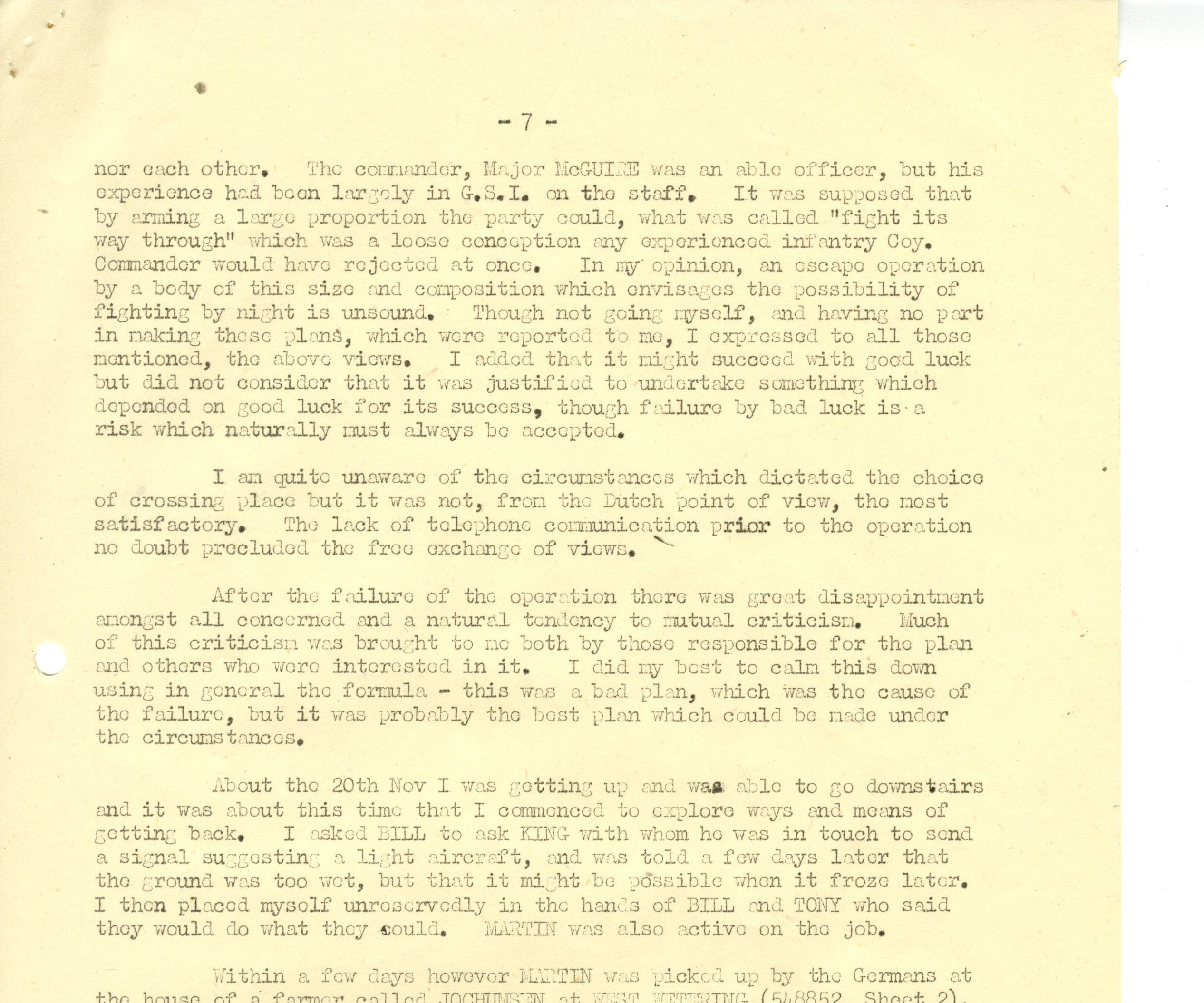
- ◐ Brig. John Hackett was at Ede from 8 October by his Kew citation (WO 373/64/307, p. 2). He wrote in his escape report of 7 February 1945, "Though not going myself", of plans "which were reported to me", and gave his view of the leader:
The commander, Major McGUIRE was an able officer, but his experience had been largely in G.S.I. on the staff. It was supposed that by arming a large proportion the party could, what was called "fight its way through" which was a loose conception any experienced infantry Coy. Commander would have rejected at once. In my opinion, an escape operation by a body of this size and composition which envisages the possibility of fighting by night is unsound.
— Brig. J. W. Hackett · escape report, I.S.9/WEA/1/274/2366, interviewed 7 February 1945, p. 7 · US National Archives, RG 498, RAMP Reports · the page
◐ The divisional commander's account. Urquhart, who recalls that "during the evening I talked things over with my chief intelligence officer, Hugh Maguire" (p. 18), wrote that "Major Hugh Maguire led a second attempt", with "about a hundred people in the party including British and American airmen and Dutch doctors and nurses, John Coke, who was killed in the attempt, and Graeme Warrack"; they faced "two major roads, a side road and a railway line", were intercepted by German patrols, "several of the party were [kill]ed and others were recaptured. Only seven got clear" (R. E. Urquhart, Arnhem, the Internet Archive scan arnhem0000urqu, which the Archive dates 1977 (the source file's header says Cassell, 1958), so the page numbers are the scan's, pp. 199–200; the text, read through the Internet Archive's search, not on the page). His "about a hundred" sits among the other counts on this page (How many set out, under Where the sources disagree).
- ✓ Taken on the morning of 18 November. Ede's history of the war: "Majoor Maguire, majoor Longland en kapitein Allenby werden gevangen genomen en later als krijgsgevangenen naar Duitsland gevoerd" (Major Maguire, Major Longland and Captain Allenby were taken prisoner and later brought to Germany as prisoners of war) (Ede manuscript, p. 47). Heaps: "Allenby and Maguire were caught and sent to Germany" (Heaps, p. 195; Cedric Longland; Peter Allenby).
- ✓ The camp. Kew's entry for his German card has "Oflag XIIB Had" (◐ Hadamar), prisoner 642, two cards, not digitised (the entry). The Pegasus Archive's note has "POW, Of 79, 642" (McNaught). The number matches, the camp does not.
- Where and when he was freed, and whether the camp changed, are not recorded in anything we hold. His own liberation questionnaire, if one survives, would be in WO 344, which the Kew catalogue does not index by name; no MI9 report of his is catalogued (searched by name, rank and number in WO 208, WO 344, WO 361 and WO 373).
- ✓ No award is catalogued for him: WO 373 has no Maguire of his regiment, and a search of the Gazette by name and number finds only the postings below and the 1949 notice above.
- After the war, by the Gazette:
- ✓ He moved from the Royal Ulster Rifles to the Intelligence Corps, a "War Subs. Capt.", to be major from 1 May 1947 (8 July 1947, p. 3116).
- ✓ In 1952 he was "Maj. ... from Int. Corps, T.A., to be Lt., 7th Feb. 1952, with seniority 25th May 1948" in a Royal Ulster Rifles short-service commission (6 May 1952, p. 2434), and captain from 23 May 1952 (p. 2776).
- ✓ He went on the Regular Army Reserve of Officers on 7 February 1957 (p. 869) and gave up the commission on 7 February 1960, keeping the rank of captain (p. 4725).
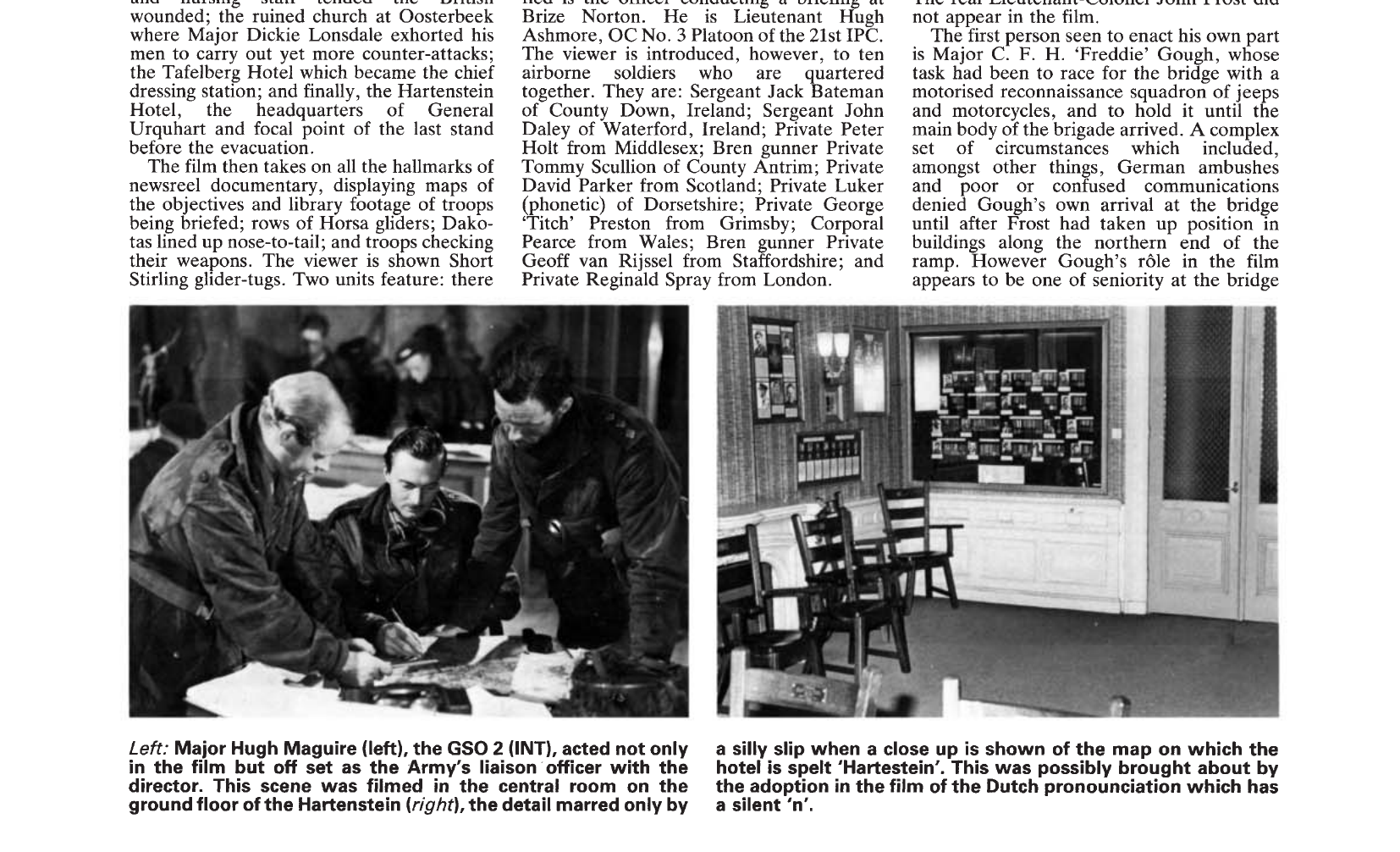
- ✓ Warrack, in 1963: "Hugh Maguire is in films" (Warrack, p. 254).
- ✓ After the Battle No. 58 (1987), in its article on the making of the 1946 Rank film of Arnhem, Theirs is the Glory, directed by Brian Desmond Hurst with men who had fought there, captions a still: "Major Hugh Maguire (left), the GSO 2 (INT), acted not only in the film but off set as the Army's liaison officer with the director" (p. 32, read on the page image); the scene was filmed in the Hartenstein.
- ✓ The same article: "Hurst and his liaison officer Major Hugh Maguire went to inspect what had been Major-General Urquhart's HQ", and a radio message Urquhart recorded "was dubbed over a shot of Major Gough with his back to camera and facing Major Maguire" (p. 34, same file).
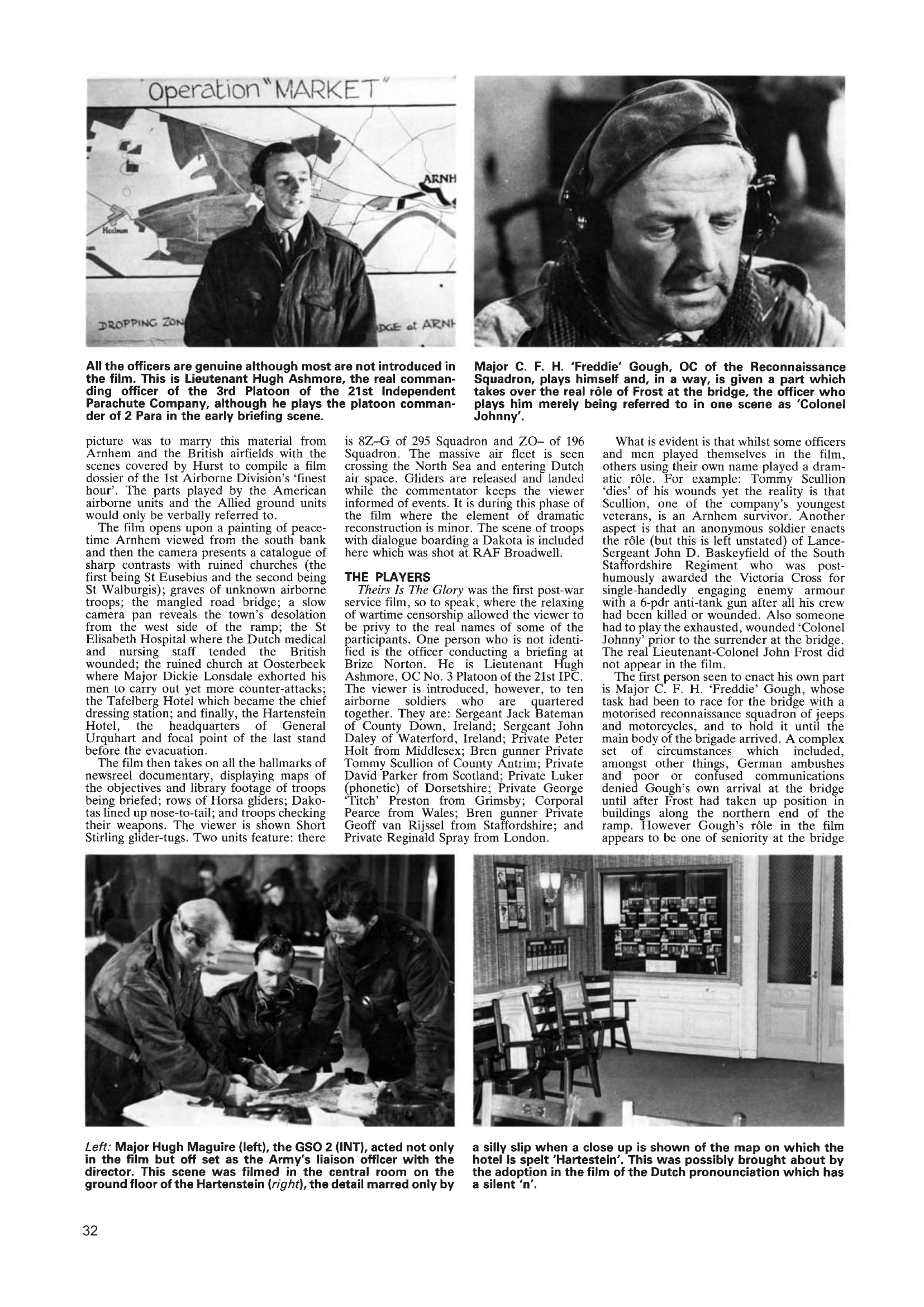
- His death is not found (no date, place or obituary).
Where the sources disagree
Link to the section Where the sources disagree- How he got out of Apeldoorn. Warrack has him escape through the straw at the incinerator in the barracks (Warrack, pp. 75–76: 75, 76). Feltkamp has him "set on transport to Germany after recovery, but escaped of the transport" (Feltkamp's letter, p. 4), and Zandbergen's summary has an unnamed Irish major "who had escaped from a train" (the summary, p. 7). Both helpers were writing in 1945–46 from what a visitor told them or from hearsay.
- The night of the march to the Wekeromse Zand.
- Ede has the men moving off at 3 am on the 17th (Ede manuscript, p. 45); Boeree has them up at 3 and away at 4 ("Om vier uur gingen zij op pad", p. 179); the Liberation Route has them set out "on the night of 16 to 17 November" (Liberation Route).
- Wildeboer wrote that on the morning of the 18th he took Maguire and his men to the Wekeromse Zand to wait until six in the evening (Wildeboer's letter, p. 10), and Kerkhoven's own form has the party "18.11 1944" (the form, p. 3).
- McNaught, who joined the barn party from the Kootwijkerbroek farm, has Dick come "At about 1730 hrs on 17 Nov", a walk of about 45 minutes to a shed where "a party of about 30 E & E's" including Capt. Kessel waited, and that they "were briefed for the journey by Major. McGUIRE" (McNaught): the briefing on the evening of the 17th, a day later than the Ede manuscript and Boeree have the start.
- Low's summary has "On 18 November a party of 100 Allied soldiers tried to cross" (Low, p. 9; "On 18 Nov 44", p. 11).
- The date question for the whole operation is on Operation Pegasus II.
- Weapons. Haller says Maguire forbade weapons (above).
- Ramlow's summary has "a few sten guns" and battle dress issued at the rendezvous but no firing allowed (Ramlow, p. 4).
- Warrack has Sten guns in the barn and Maguire's order to avoid "a shooting match with the enemy" (Warrack, pp. 143, 145).
- Kessel has ammunition issued "to those of us who were armed", Stens, "a few rifles and revolvers", and one of the revolvers for himself as a doctor (Kessel, p. 126).
- Haller was not on the march. Boeree has six Stens with Maguire's vanguard and 44 with the rearguard, and the six buried before the vanguard was taken, unarmed (pp. 179, 184).
- What went wrong. The Ede history, the Liberation Route and Waddy blame the shorter route into the German positions; Bentley has Maguire "not only became lost, but the column was ambushed at its crossing site" (the hit (the longer passage), ◐ index snippet); De Nooy says there was no ambush, and that the head of the column walked into a patrol (Dekkers and Vroemen, p. 228).
- ◐ Foot and Langley's history of MI9 (1979) calls Pegasus II "a shambles", has the parties "scattered, recaptured or killed. (Maguire was recaptured.)", and lays the blame on "the London journalist" who "interviewed some of the evaders on Pegasus I"; they date it "23/24 November", which ✗ is six days out (the fragments, pp. 249–250, from the Internet Archive's search, not read on the page).
- Ramlow's summary, from the rear group, has the RAF section challenged, the men scatter, and then, after "A British medical Major from the paratroopers leading the column paused before replying in English: 'We are your friends'", "machine guns and Schmeissers opened fire on them all along the path" (Ramlow, p. 5): an ambush by his account.
- Where he walked.
- Boeree has him at the head with "Bill" and the two guides (p. 179), and the Ede manuscript has him in front with the guides on the first stretch, "voorop" (p. 45); Kessel, whom he sent to the front as interpreter, has him say his headquarters would be "somewhere near the middle of the column", and goes back to him to report (Kessel, pp. 129–130).
- Ramlow's summary places "the Major and other planning people whom he called 'the general staff' at the head of the column" (p. 5).
- McNaught was "one of the five paratroopers at the head of the column with major. McGUIRE" (McNaught).
- Boeree puts "de Zuid-Afrikaansche kapitein" (the South African captain, Kessel) behind Maguire at the head, and a few sentences later has "Bij de achterhoede was ook kapitein Lipmann Kessel" (Captain Lipmann Kessel was also with the rearguard) (p. 179).
- Where he was from 8 to 16 November. Bol's form has him at Barneveld from 8 November for eight days; McNaught has him at the Kootwijkerbroek farm until about 11 November (McNaught). Both are from memory, one typed in 1945; ◐ he may have moved on the 11th and Bol counted to the 16th.
- How many set out. ◐ Urquhart (1958) has "about a hundred" (the text, p. 199); the others run from Boeree's 75 on the evening of the 16th (the eighty in the wood on the 17th) and Wildeboer's 85 gathered in the huts, through Warrack's 110 assembled with another 30 expected (p. 144), Waddy's "about 130", Wildeboer's "about 120" going on to the river and Neave's "about 140", to Heaps's "160 men" (p. 193); the Liberation Route has 84 gathered, 90 on the second night and a vanguard of 40, and Low's report has "a party of 100" (Low, p. 9).
- His camp. "Oflag XIIB Had" (Kew) or Oflag 79 (the Pegasus Archive's note); see After.
- His name. Kessel and the Pegasus Archive's reports have McGuire; the Dutch helpers typed Maguire, Maquire, Macquire, Magnore, Marquire and Marquier. Anyone searching a Dutch archive for him needs all of them.