Berend Dijkman, "Piet van de Veluwe"
Assen 14 Oct 1904 – Wierden 29 Mar 1945
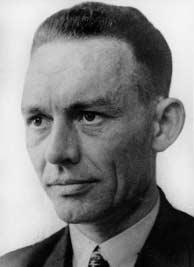
About: A former Marechaussee sergeant at Ermelo who led the Raad van Verzet (RVV) on the Veluwe as "Piet van de Veluwe". The SD took him, his headquarters and his whole archive at Ermelo on 15 November 1944, two or three days before the Pegasus II crossing Murphy's party missed, and shot him at Wierden on 29 March 1945.
Unit or role: Commander of the RVV's brigade Veluwe (the districts of Ede, Kampen and Apeldoorn, at first Hilversum and 't Gooi too) to September 1944; then BS commander for the Veluwe, of its western half after the split in October, in the RVV chain under Jan Thijssen, whom the Biografisch Woordenboek has relieved of his command at the end of October 1944 and arrested a week later, on 8 November (◐ 9 November in two papers of 1955, with an RVV dismissal letter of 7 November: Thijssen's page; the Biografisch Woordenboek). In the Marechaussee's roll of its dead, "wmr." (wachtmeester, sergeant) of the "Brig. Harderwijk" (the Oorlogsgravenstichting's file, scan 12).
Where: Ermelo, in a room behind the bakery of H. G. Drost, Stationsstraat 40 (the Biografisch Woordenboek); "Ermelo. Stationsstraat 40" in his family's letter to the Americans of 8 June 1946 (US National Archives 286650906, p. 3). His grave is at Huizum, Leeuwarden, section 3 A, row 12, no. 24 (the Oorlogsgravenstichting's file, scan 2).
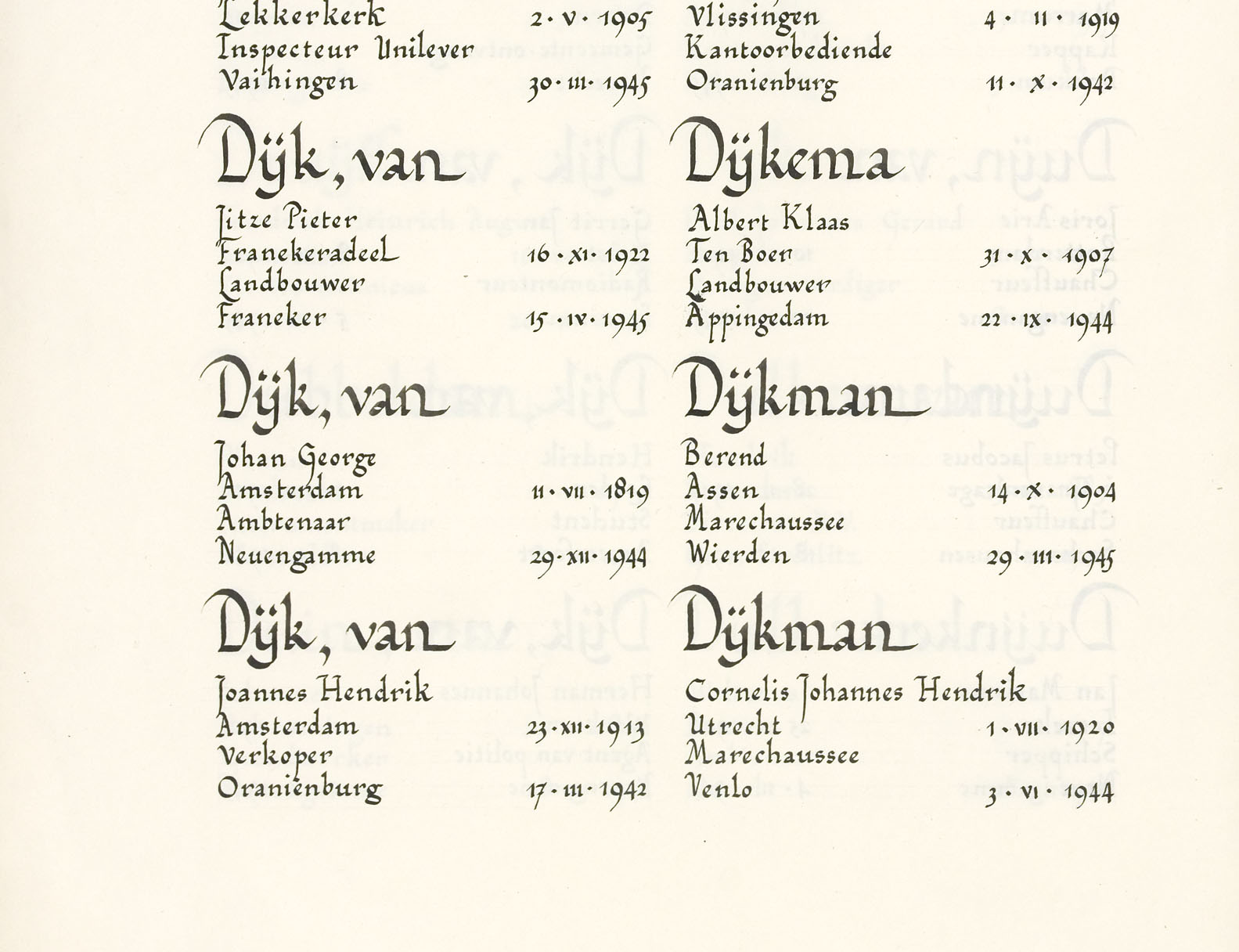
Evidence: ✓ M. de Keizer's entry in the Biografisch Woordenboek Gelderland; ✓ Boeree, Kroniek van Ede (1947), pp. 88, 95–96, 204–206, 214, 218, 223, 225, 227 (checked on the page images); ✓ L. de Jong, Het Koninkrijk, deel 10a pp. 122, 331, 420–421 and deel 10b pp. 61–64 and deel 10b pp. 47–49, 531, 546, 701 (checked on the page images); ✓ the Oorlogsgravenstichting's file on him, 1946–1988 (Nationaal Archief 2.19.255.01, 37891A); ✓ his family's letter to the Americans, 1946; ✓ the civil death record; ✓ the Erelijst, folio 468; ✓ Leeuwarder koerier, 2 April 1946; ✓ Trouw, 30 March 1946; ◐ Brig. Hackett's escape report, February 1945 (RAMP Reports, p. 223).
- ✓ He was the youngest son of the rijksveldwachter Adolf Dijkman and Arentien Smit, born at Assen on 14 October 1904 (the death record, which names both parents; the Assen register; the Biografisch Woordenboek). He had an elder brother, Evert (the Biografisch Woordenboek; a brother, "de heer E. Dijkman", spoke at the reburial, Leeuwarder koerier).
- ✓ The form the Oorlogsgravenstichting sent round the town halls in November 1953 gives his father as Adolf Dijkman, born at Eelde on 9 November [18]74, a retired police constable, and his mother as Arentien Smit, born at Assen on 22 December [18]75, with the parents' address given as Harlingerstraat 14, Leeuwarden; Assen added that the family left its register for Veenhuizen, in Norg, and Norg that they left for Leeuwarden on 1 July 1913 (the file, scan 5, checked on the image).
- ✓ He was an office clerk at Leeuwarden, joined the Rijksveldwacht in 1931 and was posted to Amsterdam in June 1932, moved to Ermelo in 1935, was made opperwachtmeester in 1939 and went over to the Marechaussee in 1941 (the Biografisch Woordenboek).
- ⚠︎ The town halls' entries on the 1953 form give other moves: to Amsterdam on 6 July 1932, to Avereest on 15 March 1933, to Nijkerk on 24 August 1933, and off Nijkerk's register for "Ermelo, Stationstraat A.C.44" on 6 January 1936. ⚠︎ Ermelo's own stamp of January 1954 sits under a boxed note whose last words read "zijn niet te Ermelo opgenomen geweest" (were not entered at Ermelo), and Leeuwarderadeel has "onbekend" (scan 6, checked on the image; below).
- ✓ From 1935 he lived in what the Biografisch Woordenboek calls a free marriage with an Amsterdam teacher, Clara Elisabeth van de Graaf (1897–1981); the relationship went bad in the war years and he went on supporting her.
- ✓ On 27 March 1942, after saying at a party that there should be more sabotage of the post and the railways, he was arrested; at Utrecht on 26 August 1942 he was convicted of black-market dealing in meat and anti-German remarks and sent to the prison at Rheinbach, and with six months off for good behaviour he was home at Christmas 1943.
- The police had dismissed him on 7 October 1942 for sabotage; he worked half a year at the distribution office at Nijkerk, then went fully into the illegal work (the Biografisch Woordenboek; his German court file survives, his police file does not).
- ✓ Boeree's chapter on him tells the arrest differently: before the war a young policeman at Ermelo, lodging with the baker Drost, who after the occupation did all he could to sabotage German measures, helped with clandestine slaughtering at fair prices and, with a young crisis controller, Townsend, kept grain from being handed in at threshing; both were arrested, Townsend never came back from Germany, and Dijkman "overleefde de 21 maanden gevangenisstraf en kwam in Ermelo terug" (survived the 21 months in prison and came back to Ermelo).
- With the police he was not taken back, so he moved into his old room at Drost's "en wijdde zich volledig aan het verzetswerk" (and devoted himself wholly to the resistance), with "de krachtige steun van Dr. Kruimel, Dr. Eskes, van Thijssen en anderen" (Boeree, p. 204, checked on the page image; the doctors are Johannes Kruimel and Dirk Eskes).
- ✓ From 1943 he belonged to the top of the RVV and often went to meetings in Amsterdam; he commanded the RVV's brigade Veluwe, hence his cover name (the Biografisch Woordenboek). Boeree has him "de ziel van het verzet" (the soul of the resistance), liked by all who worked with him, and "geen man van klein formaat", with districts under him: Kampen, Harderwijk, Voorthuizen, Ede (under "Bill", Wildeboer) and Apeldoorn (under "Splinter", Joop Balk) (p. 205, checked on the page image).
- ✓ The BS command. De Jong has the Veluwe (Gewest 6) as the only region where an RVV man was made commander of the Binnenlandse Strijdkrachten: Dijkman was accepted by Koot and the Delta-Centrum, "Met grote aarzeling!" (with great hesitation), since Koot and Six doubted whether a former Marechaussee sergeant had enough military knowledge; he was to have an experienced officer from the OD as chief of staff, who had not been found when he was arrested (deel 10b, p. 701, checked on the image).
With Murphy
Link to the section With MurphyDijkman is not shown meeting Murphy, and his arrest came two or three days before the crossing. ◐ Murphy's helpers touch his organisation in three places: Dove Jan, who hid Murphy and Walsh, has "R.v.V. (Later B.S.)" as his movement on the questionnaire made out for him, signed "R. van Ginkel" (p. 5); and Dirk Eskes and Johannes Kruimel, the two doctors that Dove Jan's list ("Dr. Eskens N.Milligen (Alex)", p. 4) and Hoekstra's ("Dr Kruimel, de Ruif Garderen", p. 9) have Murphy and Walsh passed on to, are among the men Boeree names as backing Dijkman (above); Eskes ("Dr Alex") was at the Wester Wetering meeting too.
- ✓ The Ede group. After D-Day Boeree's friends at Ede arranged a meeting at the Wester Wetering with Dr Alex (Eskes), Piet van de Veluwe and Peter van Scherpenzeel; there it was decided to found a resistance group at Ede, and Piet, who Boeree says was "erg voorbarig" (very premature), told them the whole movement was under Prince Bernhard's orders. "Bill" joined after hearing the group had contact with England (Boeree, pp. 88, 95–96, checked on the page images).
- ✓ September 1944.
- On 5 September he wrote that he and four helpers had spent two nights unpacking and listing an airdrop near Vaassen and had no way to move it (De Jong, 10a p. 122). On the night of 14/15 September his brigade received Capt. Kirschen ("King") and his three men, whom Thijssen had warned him of, and put them up at a farm at Scherpenzeel (10a p. 331; 10b p. 531).
- On the evening of 23 September he called about a hundred young men to a camping centre at Putten to form an armed group, promising weapons from the air that night; seventy went home at once and the other thirty gave up when nothing dropped (10a pp. 420–421). De Jong adds that Thijssen wrote of him on 8 October as "een uitstekende organisator en leider" (an excellent organiser and leader), while others thought him far too impulsive, and that the Putten evening was grist to their mill (10b p. 47, checked on the image).
- ✓ Putten, 30 September to 1 October.
- De Jong has him join the two small resistance groups at Putten, one RVV and communist, the other working with the Apeldoorn knokploeg, under a police sergeant, Ab Witvoet (10b p. 47). ⚠︎ Witvoet said in a newspaper interview of 1974 that Dijkman told him, on appointing him, that he had instructions from Amsterdam "om de linkse invloeden te elimineren" (to eliminate the left-wing influences); De Jong adds "elk bewijs ontbreekt" (all proof is lacking) that such an instruction was given (p. 48, checked on the image).
- The Biografisch Woordenboek has him put the Putten group under A. Witvoet on 23 September and give it a written order to attack a German car or courier on the Amersfoort–Harderwijk road; De Jong has the order given at the end of September, in line with Thijssen's orders, to ambush German passenger cars and lone motorcycle dispatch riders (stafauto's is the Biografisch Woordenboek's word), and Dijkman and Witvoet first thinking of a cable or chain across the Nijkerk–Harderwijk road before settling on a Bren gun from one of the RVV's drops (p. 48).
- After the failed attack at the Oldenallerbrug, in which Tex Banwell took part, Piet Oosterbroek reported to Dijkman; on the Sunday Dijkman was himself caught in the cordon round Putten, was let out because his papers said he was a Marechaussee sergeant, and was taken to Ermelo; he had not known that the ambush was the action he had ordered (De Jong 10b p. 61, checked on the image).
- The Biografisch Woordenboek has him, straight after the round-up, replace the commander of the Putten group, "die hij betichtte van gebrek aan leiderschap bij de aanslag" (whom he accused of lack of leadership in the attack). Trouw's report of an interview with Oosterbroek in 1969 (the reporter's narration, not in quotation marks) has the district commander "Piet Veluwe" of Ermelo appoint as Putten's local commander "een ondergedoken politieman uit Assen" (a policeman in hiding from Assen), "Ronald", in the summer of 1944 (Trouw, 4 October 1969, checked on the image; Piet Oosterbroek).
- ◐ Oosterbroek's own form for the Americans has Leo Heaps, the Canadian taken to Kirschen (below), "Not known to me, went to Ouver (?) (Piet v.d. Veluwe, code-name) His name was Dijkman, was policeman and was living in Ermelo" in its "passed on to" column: he gives Dijkman as the code-name's real name. That can be read as Heaps going to Piet van de Veluwe, which fits De Jong's Heaps taken "via Dijkman" to Kirschen (below) (his file, p. 3, checked on the image).
- ✓ Heaps and Kirschen.
- De Jong has the Canadian Leo Heaps, who had jumped from a prisoner train and come to Oosterbroek at Putten, taken by Oosterbroek "via Dijkman" to Kirschen, "die door Dijkman in een als woning ingericht kippenhok op een boerenerf bij Scherpenzeel was ondergebracht" (whom Dijkman had lodged in a chicken-house fitted out as a dwelling on a farmyard near Scherpenzeel); Heaps crossed the Waal on 5 October (10b p. 546, checked on the image).
- On 18 October, by Kirschen's account in De Jong's note, Dijkman told him that his brigade, with "een paar nog uit Arnhem afkomstige Engelse parachutisten" (a couple of English parachutists still from Arnhem), had wrecked a German car from an ambush and copied a paper found on the officers (p. 49, note 2; Gilbert Kirschen).
- ✓ October.
- On 11 October he offered Thijssen his resignation, saying he was working himself to death with nothing to show; Thijssen refused, gave him two weeks' sick leave, and on 18 October Dijkman said he would resume (De Jong 10b p. 63).
- De Jong: "Kennelijk besefte Thijssen niet dat Dijkman die op de Veluwe rusteloos in touw was geweest, aan het einde was van zijn psychische krachten" (evidently Thijssen did not realise that Dijkman, who had been working restlessly on the Veluwe, was at the end of his mental strength) (p. 63).
- He then planned, with a deserted German officer, an armed raid on the camp at Amersfoort to free its prisoners (De Jong 10b p. 63; Boeree p. 205, who has the officer as Hauptmann Dr Helmuth Blümcke).
- The Veluwe was split in two, the east under "Piet van Arnhem" and the west under Piet van de Veluwe, and a bunker was built for him at Drie to move to on 8 November; he stayed at Drost's, saying the comings and goings would show more in the loneliness of Drie (Boeree pp. 205–206).
- ✓ The raid.
- On 14 November there was a meeting at Drost's with Joop Balk and Blümcke, both just escaped from Amersfoort, and Peter van Scherpenzeel; for it the whole archive had been fetched from its hiding place, the swimming pool at Ermelo, and in the pouring rain was not put back. Next morning Dijkman was to go to Amsterdam and take Balk and Blümcke with him (Boeree p. 206, checked on the image).
- At seven that morning four men of the Apeldoorn SD came in; Dijkman, the German, Drost, Drost's wife and Balk were arrested, Drost's pregnant wife let go, the house looted and burned, and the prisoners taken to the Willem III barracks at Apeldoorn (the Biografisch Woordenboek), the barracks where Murphy had been held until 6 October (Apeldoorn and the escape).
- ◐ De Jong puts the raid down to one of the members of his brigade having talked ("als gevolg van het 'doorslaan' van een van de leden van zijn brigade") and names no one (10b p. 63, checked on the image).
- ✓ The archive. De Jong has the SD find "Dijkmans volledige archief", which in breach of the usual rules he kept in his own lodging: Boeree's list is the latest orders from above, reports from lower commanders, spy reports, papers on sabotage, dropping grounds, contact with the English front, telephone and courier links and a sealed envelope with a code for the transmitter (De Jong 10b p. 64, quoting Boeree's p. 216 of the 1947 book).
- ✓ The night of the crossing.
- Boeree, from Ede, on 17 November: Pegasus II's last preparations done, "Bill" went home, "Er dreigde gevaar, nu Piet van de Veluwe was gevangen genomen" (there was a danger now that Piet van de Veluwe had been taken), for nobody knew what papers he had kept or what he would say (p. 223, checked on the image).
- On the same 17 November, two prisoners brought into a room saw Piet sitting in a comfortable chair opposite a German in Luftwaffe uniform, smoking quietly, being questioned in a very friendly way; he was not beaten or threatened, "hij vertelde veel en vlot" (he told much and freely) (p. 218).
- Boeree narrates the scene with the prisoners Felix Oostendorp and Ansems in the room; ◐ that Oostendorp was his informant is our reading.
- A note found in the archive from the Ede leadership, recalling a meeting at the Wester Wetering, was copied to the SD at Lunteren (p. 218, top).
- Not about Dijkman, but on the page just above his chapter: "Bill" (Wildeboer) heard only on 21 November, via Capt. King, that just nine men had got safely over the river, and about 60 had stayed on this side (Boeree p. 204, top, checked on the image).
- ◐ What followed on the Veluwe.
- Boeree and De Jong both trace the arrests of the next weeks to the archive and his interrogations: at Ede the Thomassen farm (raided on a day Boeree does not date on p. 218), Weimar on 21 November and the Boonzaaijers after that (Boeree pp. 218, 220–221, from the book's text layer). De Jong: "Talloze gegevens gaf hij prijs en daar vloeiden arrestaties uit voort waarbij hij soms ook zelf aanwezig was" (he gave away countless details, and arrests followed, at some of which he was himself present) (10b p. 64).
- Twelve of those arrested were shot at Apeldoorn in early December (De Jong 10b p. 64); Boeree p. 225 has 13 men shot on the football field of the Willem III barracks on 2 December, with Balk, Drost and the courier Ansems.
- On 13 December the SD, with Dijkman present, ambushed the new transmitter site at Drie (the Biografisch Woordenboek's wording; Boeree's account of the raid, pp. 225–226, does not put him there). The Biografisch Woordenboek has it lead on to the arrest of Piet Oosterbroek, with fourteen arrests "die dag" in all; Boeree has Oosterbroek shot and taken at the Simon house at Putten after the raid, on a day he does not give (p. 227).
- The SD also questioned him about the English radio operator "Henderson", who was Raymond Holvoet (Boeree p. 225). De Jong thinks the SD knew of Banwell's part "wellicht" (perhaps) because Dijkman's papers had fallen to them (deel 10b p. 553, the extract).
- De Jong has the OD on the Veluwe left wholly disorganised, partly "door arrestaties welke gebaseerd waren op de gegevens die de SD bij Dijkman had gevonden" (by arrests based on the data the SD had found at Dijkman's) (10b p. 701).
In the helpers' forms for the Americans
Link to the section In the helpers' forms for the AmericansThree men who filled in the Americans' helper questionnaires in 1945–46 name him as the man they worked under or with. None of the three says anything about Murphy.
- Wouter Albert Hulstyn: "In 1942 I became a member of the R.V.V. In February 1944 B. Dykman (Piet van de Veluwe) Ermelo, asked me to find a dropping field."; and "From April 44 till Sept. 44 they transmitted 4 times in my house to England by Piet van de Veluwe and others" (his report, p. 3, checked on the image).
- Anthonie Meuzelaar, Leuvenumseweg 9, Ermelo, of the RVV and the NBS, by his form of 7 June 1946: "I cann't give you any names because I always worked togetheer with Dykman and N. Rambonet." He lists "Berend Dykman 29-3-1945 SHOT at Ermelo." first among the people he knew who helped Allied men, and adds "Capt. King was always in contact with Berend Dykman Piet Veluwe." (his form, p. 2, checked on the image). ◐ "Capt. King" is very probably Kirschen, "Captain King" in De Jong (above). ⚠︎ He was shot at Wierden, not Ermelo (below).
- Cornelis Adrianus Stoove, who went into hiding at Beekbergen with his family, worked with "Martien, especially dropped from "overseas" to gather the parachutists", "Bill at EDE", "Piet van de Veluwe", "Piet de KRUYFF or Paul" and "Alex HARTMAN", and "Also they made use of Capt. KING's sender" (his enclosure of 24 July 1945, p. 5, checked on the image).
- ✓ He was kept alive: "de SD had hem nog nodig" (the SD still needed him), being "telkens geraadpleegd over het gevonden archief" (consulted again and again about the archive) (De Jong 10b p. 64, quoting Boeree p. 225).
- Boeree's later page has him treated well throughout, telling much and freely in the questioning ("volgens de verhooren, die aan de S.D.'ers zijn afgenomen": from the post-war questioning of SD men), and put on a transport with a few prisoners from Apeldoorn when liberation drew near; "Hij werd 29 Maart 1945 te Wierden door de S.D. vermoord" (p. 227, checked on the image).
- ✓ The Biografisch Woordenboek gives the reason: General Friedrich Christiansen, the Wehrmacht commander in the Netherlands, demanded twenty men be shot as a reprisal for the deaths of some Wehrmacht men near Almelo; Dijkman was one, shot on the heath near Wierden on 29 March 1945 and buried there in a mass grave.
- His death is in the civil registers at Wierden (age 40, wachtmeester bij de marechaussee, entered 26 March 1946) and Ermelo (Open Archieven), in the national roll of honour as Marechaussee, group Verzet (resistance; the website's record), with the same dates (the Erelijst, folio 468), and in the Tubantia's list of the twenty on the 20th anniversary (29 March 1965, checked on the image).
- The Marechaussee's own roll of its dead, a copy of which is in the Oorlogsgravenstichting's file, says that as commander of the "N-Veluwe Brigade van de RVV" he was "actief met spionage, droppings en pilotenhulp en onderhield radiocontact met Engeland" (active in espionage, droppings and help to pilots, and kept radio contact with England), was arrested at Ermelo on 15.11.1944, held in the Willem III barracks at Apeldoorn and shot, Wierden 29.3.1945 (the file, scan 12, checked on the image).
The notices and the reburial, 1946
Link to the section The notices and the reburial, 1946- ✓ His family had the certainty only in March 1946: "Eerst heden ontvingen wij de droeve zekerheid" (only today did we receive the sad certainty), says the notice signed A. Dijkman of 27 March 1946 (Leeuwarder koerier, 28 March 1946, checked on the image).
-
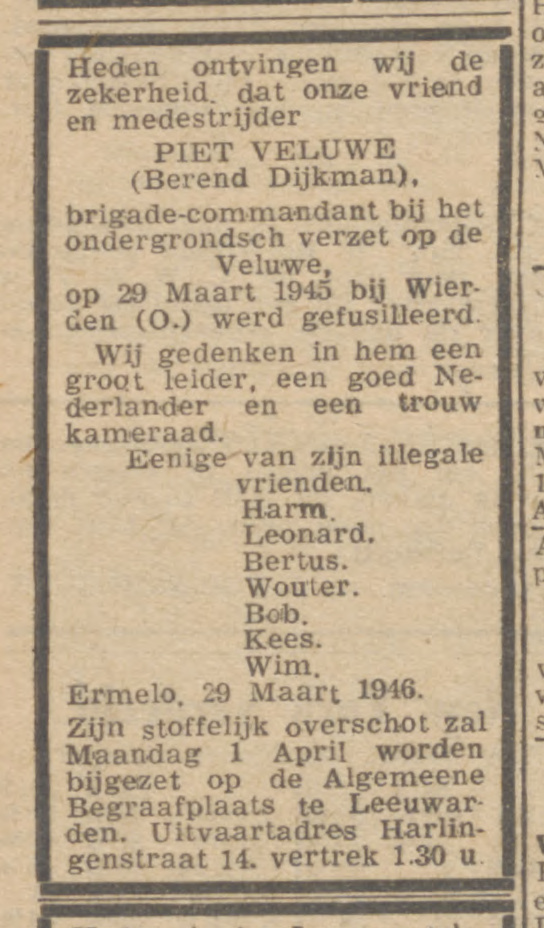
✓ His resistance friends at Ermelo put their own notice in Trouw, signed with seven first names:
Today we received the certainty that our friend and fellow fighter PIET VELUWE (Berend Dijkman), brigade commander in the underground resistance on the Veluwe, was shot on 29 March 1945 near Wierden (O.). We remember in him a great leader, a good Dutchman and a loyal comrade.
Dutch originalHeden ontvingen wij de zekerheid, dat onze vriend en medestrijder PIET VELUWE (Berend Dijkman), brigade-commandant bij het ondergrondsch verzet op de Veluwe, op 29 Maart 1945 bij Wierden (O.) werd gefusilleerd. Wij gedenken in hem een groot leider, een goed Nederlander en een trouw kameraad.
— "Eenige van zijn illegale vrienden", Ermelo, 29 March 1946 · Trouw, 30 March 1946, p. 4 · the notice
-
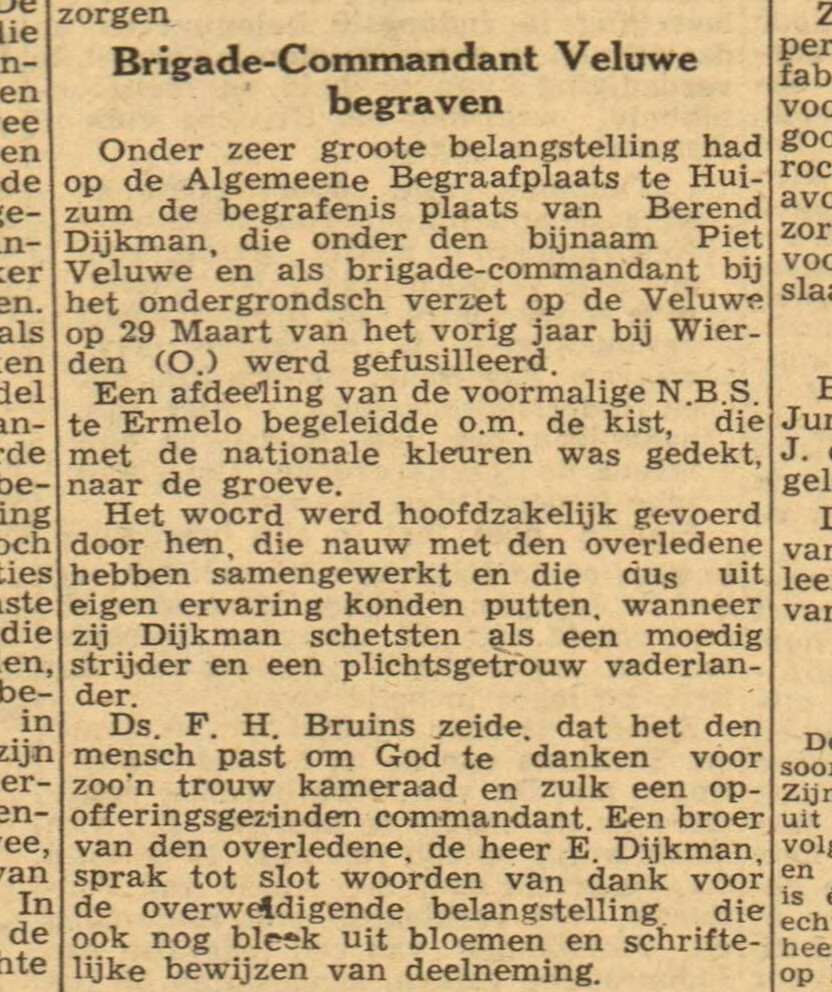
✓ The notice set the funeral for Monday 1 April at Leeuwarden, from Harlingenstraat 14 as Trouw prints it (the family's own notice has Harlingerstraat 14, Leeuwarder koerier, 28 March 1946). He was reburied that Monday at the Algemene Begraafplaats at Huizum, Leeuwarden (the "Alg. begraafplaats v/h N.H." of the 1987 report, the N.H. cemetery of the card below), where his parents lived, with a detachment of the former BS from Ermelo escorting the coffin (Leeuwarder koerier, 2 April 1946, checked on the image; the Biografisch Woordenboek).
- The Oorlogsgravenstichting's card has him reburied on 1-4-1946 in the N.H. cemetery at Huizum, a bought grave for two, section 3 A, row 12, no. 24, cause of death "gefusilleerd" (the file, scan 2, checked on the image).
His file with the Americans
Link to the section His file with the Americans-
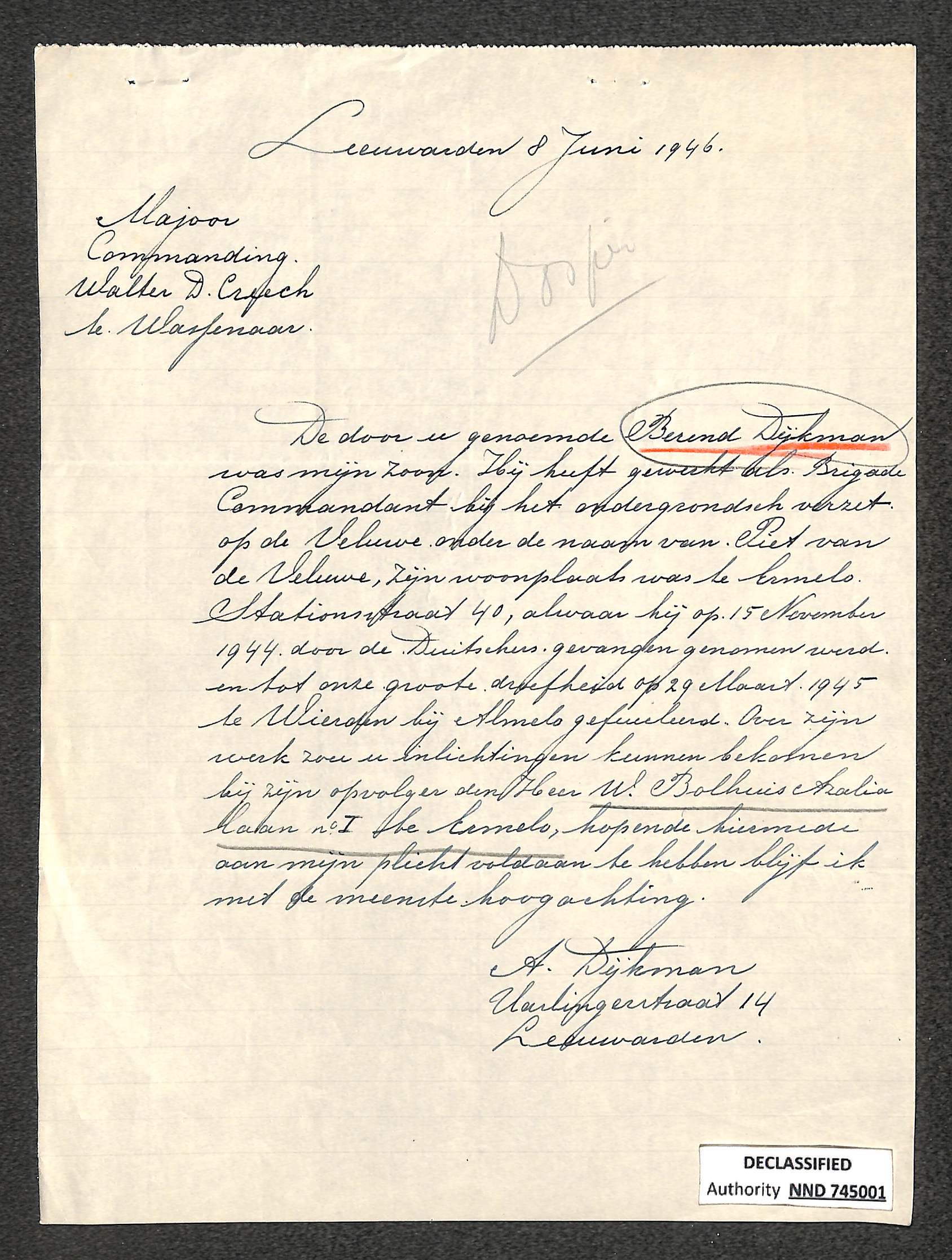
✓ The Americans' office at Wassenaar, which was tracing helpers of Allied airmen, wrote to the family about him. A. Dijkman of Harlingerstraat 14, Leeuwarden, the parents' address, answered on 8 June 1946 (◐ the letter says "mijn zoon", my son, so a parent; the initial fits either Adolf or Arentien):
The Berend Dijkman you name was my son. He worked as brigade commander in the underground resistance on the Veluwe under the name of Piet van de Veluwe; he lived at Ermelo, Stationsstraat 40, where on 15 November 1944 he was taken prisoner by the Germans and, to our great sorrow, shot on 29 March 1945 at Wierden near Almelo. You could get information about his work from his successor, Mr W. Bolhuis, Azalialaan no. I at Ermelo …
Dutch originalDe door u genoemde Berend Dijkman was mijn zoon. Hij heeft gewerkt als Brigade Commandant bij het ondergrondsch verzet. op de Veluwe onder de naam van Piet van de Veluwe, zijn woonplaats was te Ermelo. Stationsstraat 40, alwaar hij op 15 November 1944. door de Duitschers gevangen genomen werd. en tot onze groote droefheid op 29 Maart. 1945 te Wierden bij Almelo gefusilleerd. Over zijn werk zou u inlichtingen kunnen bekomen bij zijn opvolger den Heer W. Bolhuis Azalialaan no I te Ermelo …
— A. Dijkman, Leeuwarden · letter to Major Walter D. Creech, Wassenaar · 8 June 1946 · US National Archives 286650906, p. 3
-
✓ The Americans wrote to Willem Bolhuis on 13 June 1946 that "De familie van Berend Dijkman, Harlingerstraat 14 te Leeuwarden, heeft mij naar U verwezen" (the family of Berend Dijkman has referred me to you) about the help Dijkman gave Allied airmen and enclosed a questionnaire for him to fill in for Dijkman (Bolhuis's file, p. 8, checked on the image). The file on Dijkman holds only the letter and two cover sheets: it was closed on 26 January 1948 "without complete processing", with "Questionnaire to be sent" written on it (p. 2, checked on the image).
The grave
Link to the section The grave- ✓ The Oorlogsgravenstichting wrote to his brother E. Dijkman in January 1981, and to his sister-in-law in December 1987, that the grave at Huizum showed "tekenen van verval" (signs of decay), and offered to move him to its field of honour at Loenen (the file, scans 26, 29–31; the inspector's report of June 1987 has the letters on the stone illegible).
- ✓ A relative writing for the family, after consulting it, answered on 28 December 1987 (scan 24, checked on the image; the letter says "oom Berend" and does not say whether the writer is a nephew or a niece): his grandparents had always wished Berend to lie beside them, so he should not be moved. The foundation's page on him still gives the grave as Huizum, 3 A/12/24 (the README).
The "affaire-Dijkman"
Link to the section The "affaire-Dijkman"- ◐ After the war. The Biografisch Woordenboek: many valued him as a leader, others asked why so many fell after his arrest, and some accused him outright of betraying his helpers; he got the name of being careless, chiefly because the archive was not kept safe (the Biografisch Woordenboek).
-
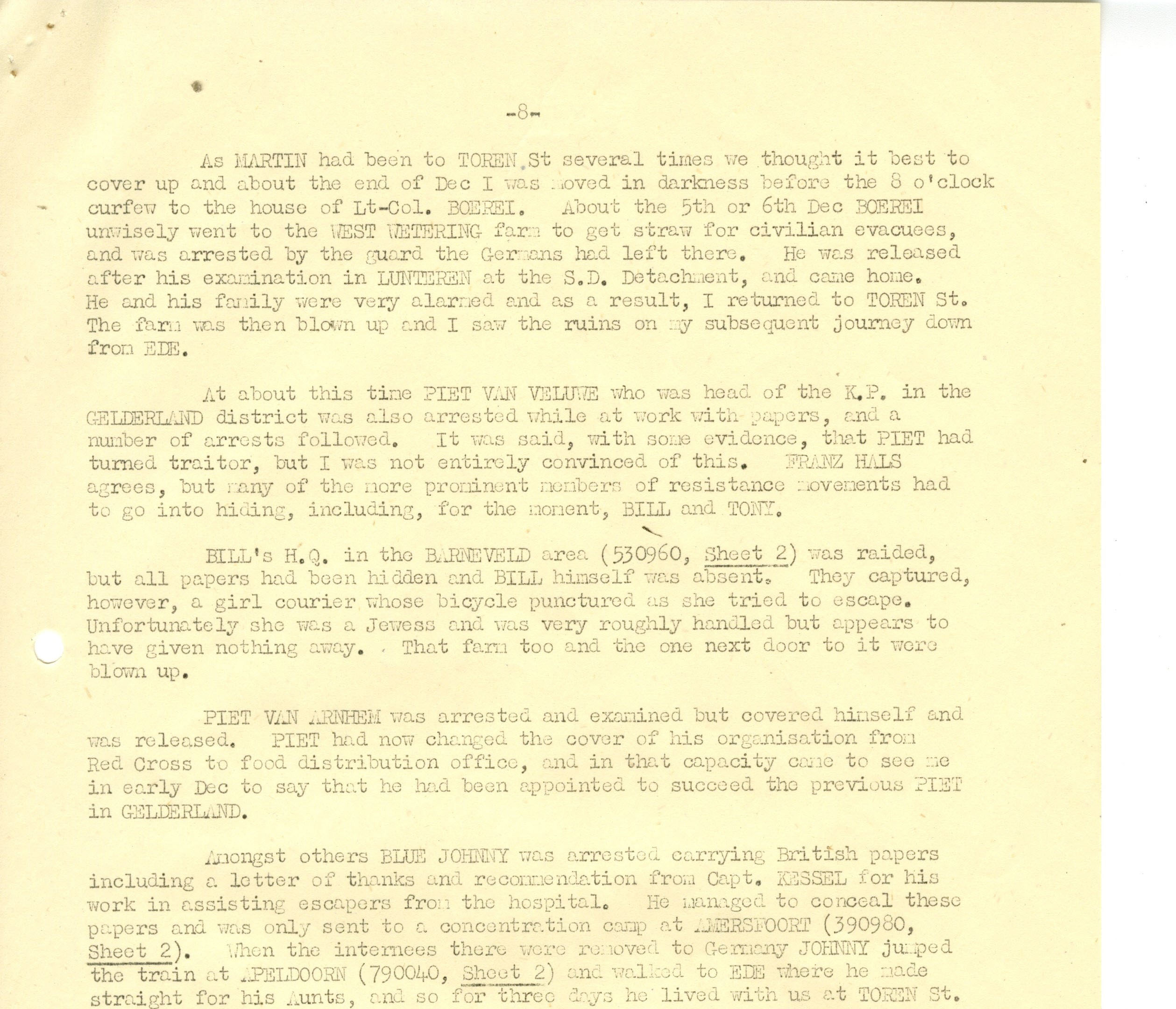
◐ Hackett's report, February 1945. Brig. John Hackett, hidden in Ede, gave the rumour of the time to the British in his escape report:
At about this time PIET VAN VELUWE who was head of the K.P. in the GELDERLAND district was also arrested while at work with papers, and a number of arrests followed. It was said, with some evidence, that PIET had turned traitor, but I was not entirely convinced of this. FRANZ HALS agrees, but many of the more prominent members of resistance movements had to go into hiding, including, for the moment, BILL and TONY.
— Brig. J. W. Hackett · escape report, Appendix C, p. 8 · I.S.9 (W.E.A.), 7 February 1945 · RAMP Reports, p. 223
- "Franz Hals" is Dick Kragt. Hackett's "at about this time" follows his account of Lt-Col. Boeree's arrest "About the 5th or 6th Dec", about three weeks after the 15 November every other source gives, and he calls Piet head of the K.P., where he led the RVV (John Hackett).
- ◐ Boeree. Boeree, his "biographer" and the Ede BS commander, called him a brave man and a pleasant comrade but had no good word for his leadership: he should have delegated, kept discipline in the ranks and been disciplined towards his superiors (the Biografisch Woordenboek, citing Boeree's manuscripts of 1950).
- Boeree judged that after his arrest Dijkman was so broken that he gave the SD every help and urged others to confess. The Biografisch Woordenboek adds, in its own voice, that after the war only his part in the arrests at Drie was known.
- A post-war judgement; the Biografisch Woordenboek says Boeree had seen that "de feiten tegen Dijkman, maar de medewerkers van Dijkman voor hem getuigden": the facts spoke against him, his colleagues for him.
- ◐ In print.
- An unsigned account by a Hattem BS man, of June 1945, speaks of "het verraad van 'Piet van de Veluwe'" after which the SD struck in practically all the neighbouring districts (Het Ware Nieuws, 11 June 1945, the passage checked on the image).
- In December 1977, when Putten's council complained of a television documentary on the Putten tragedy, a veteran objected that it laid the attack "bij de verkeerde man, de doodgeschoten Berend Dijkman alias Piet van de Veluwe" (on the wrong man, the shot Berend Dijkman alias Piet van de Veluwe), and that there had been no treachery ("Van verraad, van een directe opdracht uit Londen en van de liquidatie van iemand die te veel wist is, zoals hij zegt, geen sprake geweest"; Trouw, 15 December 1977, OCR only).
- ⚠︎ A relative's letter of 1987. The relative's letter of 28 December 1987 (scan 24, above) adds "daarnaast bereikten ons berichten, dat niet iedereen het onverdeeld eens is/was met de rol van oom Berend als verzetsman in de oorlogsjaren" (besides, reports reached us that not everyone is or was wholly in agreement with uncle Berend's role as a resistance man in the war years), as a second reason not to move him.
- ✓ The letter says that; what the reports were, who made them or what they alleged is not said, so they are hearsay.
- Someone at the foundation wrote in the margin in ink "komt wel voor op lijst RIOD" (he does appear on the RIOD list; which list is not said) (scan 24). What speaks against them is in the next bullet and above.
- What the records say.
- De Jong's own account: the archive was where it should not have been, "Talloze gegevens gaf hij prijs" under questioning, and the raid itself followed another brigade member's talking (10b pp. 63–64, above).
- On the Oorlogsgravenstichting's form of 1953 the typed answer to question 9, on the back, with no municipality named, says he "kan zeer zeker als politiek betrouwbaar worden aangemerkt" (can certainly be regarded as politically reliable), and the Ministry of Justice stamped it on 25 March 1954 that its archives did not show he had been guilty of political acts leading to any penalty or measure by the special courts (the file, scan 6, checked on the image).
- A veteran in Trouw of December 1977 says blaming Dijkman is wrong and that there was no betrayal (above); that is his statement alone, OCR only.
- His friends' notice of 1946 is above.
- The Gemeentearchief Ede has a file on him in Plekkringa's collection (toegang 139, no. 23) and one in the Ede 1940–1945 collection (no. 310, the inventory), with a letter of 22 April 1991 enclosing a photograph of his grave (no. 1163): catalogue entries only, none digitised. The NIOD holds a "Dossier Berend Dijkman (Piet van de Veluwe)" of 1947 among Boeree's articles on Putten (Oorlogsbronnen; a catalogue entry, no scan).
- Kew's catalogue and the other Open Archieven records were searched on 15 October 2026 and hold nothing else of his; the Nationaal Archief's CABR file on G. A. G. van der Wal, which the Biografisch Woordenboek lists among its sources, was not seen. He was looked for on the British index of Dutch helpers and not found there (the index's notes); that index was read by OCR, which misses entries, so it is not proof.
Where the sources disagree
Link to the section Where the sources disagree- When he was arrested.
- The morning of 15 November 1944 (De Jong 10b p. 63; the Biografisch Woordenboek; his family's letter of 1946; the Marechaussee's roll; Boeree p. 206 has the meeting on the 14th and the plan for the next morning, not the arrest itself). ⚠︎ A Dutch Red Cross tracing request of March 1947 for a "Dijkman, Berend, born 14-10-1901 at Assen", sent to the offices of the French occupation zone, from which every answer held is negative, has him "Arrêté à APELDOORN le 14.II.44 ?" (14-2-1944 on the first copy) (Arolsen 6.3.1.1, checked on the images).
- The name, the birthplace, the day and month and the arrest at Apeldoorn make it possibly him; the year of birth, the date and the question mark do not match (◐ unless the typist's "II" is an 11, which would make it 14 November 1944, a day before the raid), and it was filed nearly a year after his family's notice of 27 March 1946, so it may be another man or a careless form. It proves nothing either way.
- Hackett's report has the arrest "At about this time", after the arrest of Lt-Col. Boeree, which it dates "About the 5th or 6th Dec" (p. 223); he was in hiding at Ede and does not say how he heard.
- Where he was shot. Wierden, by the civil record, the Erelijst, his family and his friends; Meuzelaar's form has "SHOT at Ermelo" (p. 2).
- His moves before Ermelo. The Biografisch Woordenboek: Amsterdam from June 1932, Ermelo from 1935. The town halls on the 1953 form: Amsterdam 6 July 1932, Avereest 15 March 1933, Nijkerk 24 August 1933, struck off at Nijkerk for Ermelo on 6 January 1936.
- ⚠︎ Ermelo's stamp of January 1954 sits under a boxed note whose last words read "zijn niet te Ermelo opgenomen geweest" (were not entered at Ermelo), and Leeuwarderadeel has "onbekend", against Nijkerk's "afgeschreven naar Ermelo" of 6 January 1936 and the Biografisch Woordenboek's 1935 (the file, scan 6, checked on the image; the note's first word is not clearly read).
- His successor. His family's letter of 1946 names W. Bolhuis of Ermelo as "zijn opvolger" (p. 3); De Jong has ir. P. C. Kruijff appointed in his place as BS commander (10b p. 701); Hackett has Piet van Arnhem tell him in early December "that he had been appointed to succeed the previous PIET in GELDERLAND" (p. 223). Successor in which post each means is not said; they need not conflict.
- His sentence. The Biografisch Woordenboek has 21 months in its opening paragraph and "anderhalf jaar" (eighteen months) less six months' remission in its text; Boeree has 21 months. ◐ The Biografisch Woordenboek's own figures disagree: eighteen months less six is twelve, which from the arrest of 27 March 1942 would end about March 1943, not at its Christmas 1943. Only Boeree's 21 months runs from 27 March 1942 to Christmas 1943.
- Why he was jailed. Boeree: sabotage, clandestine slaughtering and hiding grain; the Biografisch Woordenboek: black-market meat and anti-German remarks at a party. The second notes that his German court file survives.
- How many were shot on 2 December. Twelve of the arrested (De Jong); Boeree's list names 13, including an American airman. The lists need not be the same set.
- The German's name. Blümcke in Boeree's pages (the text layer misreads it "Bliimcke"); Blüncke in Wikipedia's article, which also calls Dijkman "Piet van Veluwe" (Dutch Wikipedia, a secondary source built on Haverhoek's Get'em out and the Biografisch Woordenboek).