Boke Dijkstra
Midwolde 25 Nov 1890 – Arnhem 29 Oct 1969
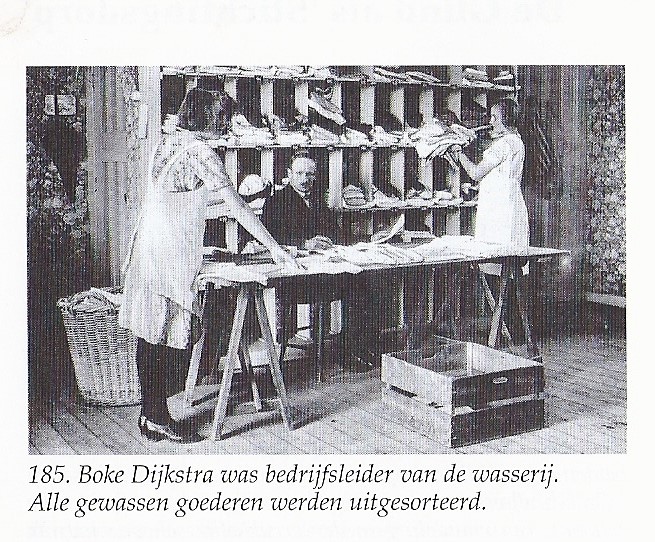
Boke DIJKSTRA, wasbaas of the Rudolphstichting at De Glind (his son Jan's account)
About: The head of the laundry at the Rudolphstichting children's village at De Glind, next to Achterveld, whose house hid Major John Coke in 1944 and, by the Americans' file, 13 Allied men in all. Father of the courier Fokke and of Jan, who met Murphy that November.
Unit or role: Wasbaas, head of the laundry ("baas van de wasserij"); "bedrijfsleider" (manager) on his son's marriage deed of 1945; no underground organisation, by his own form; a helper of grade 5 to the British and the Americans.
Where: Postweg 35, De Glind ("De Glindhorst"), municipality of Barneveld, post address Achterveld, from 1924; later the Lunterseweg at Barneveld; Houtmanstraat 3, Arnhem, from January 1969.
Evidence: ◐ his son Jan's account, 2014 (the text); ✓ Zegers's table, p. 4, and Hogeweg's form (Major Coke); ✓ his own American helper file and the Grade 5 list; ✓ the British index of Dutch helpers, sheet D/13; ✓ the Chancery's card for his medal, 1961; ✓ the Ede population card, his birth and his death record, 1969 (index records); ✓ his son's marriage deed, 1945; ✓ Trouw, 30 October 1969; ◐ Jan's memory as ParaData prints it; ◐ Davison's memoir; ◐ Noble's report
Groningen, Otterlo and Utrecht
Link to the section Groningen, Otterlo and Utrecht✓ He was born at Midwolde, in the municipality of Leek in Groningen, on 25 November 1890, the son of Kornelis Dijkstra, a farmer (landbouwer) of 45, and Aaltje Duursma (the birth record, Leek deed 139, index record; his death record). The Chancery's card of 1961 has the same place and day, "Leek (Gr.), 25 november 1890" (the card).
✓ In 1913 the municipality of Ede registered him, Gereformeerd ("GerK"), as a "cursus-leerling Ned Heide Mij" (a course pupil of the Ned. Heide Mij., ◐ the Nederlandsche Heidemaatschappij, the heathland reclamation company): he came from Grootegast to Otterlo 5a on 31 May 1913 and left for Vlagtwedde on 17 October 1913 (the Ede card, read on the scan).
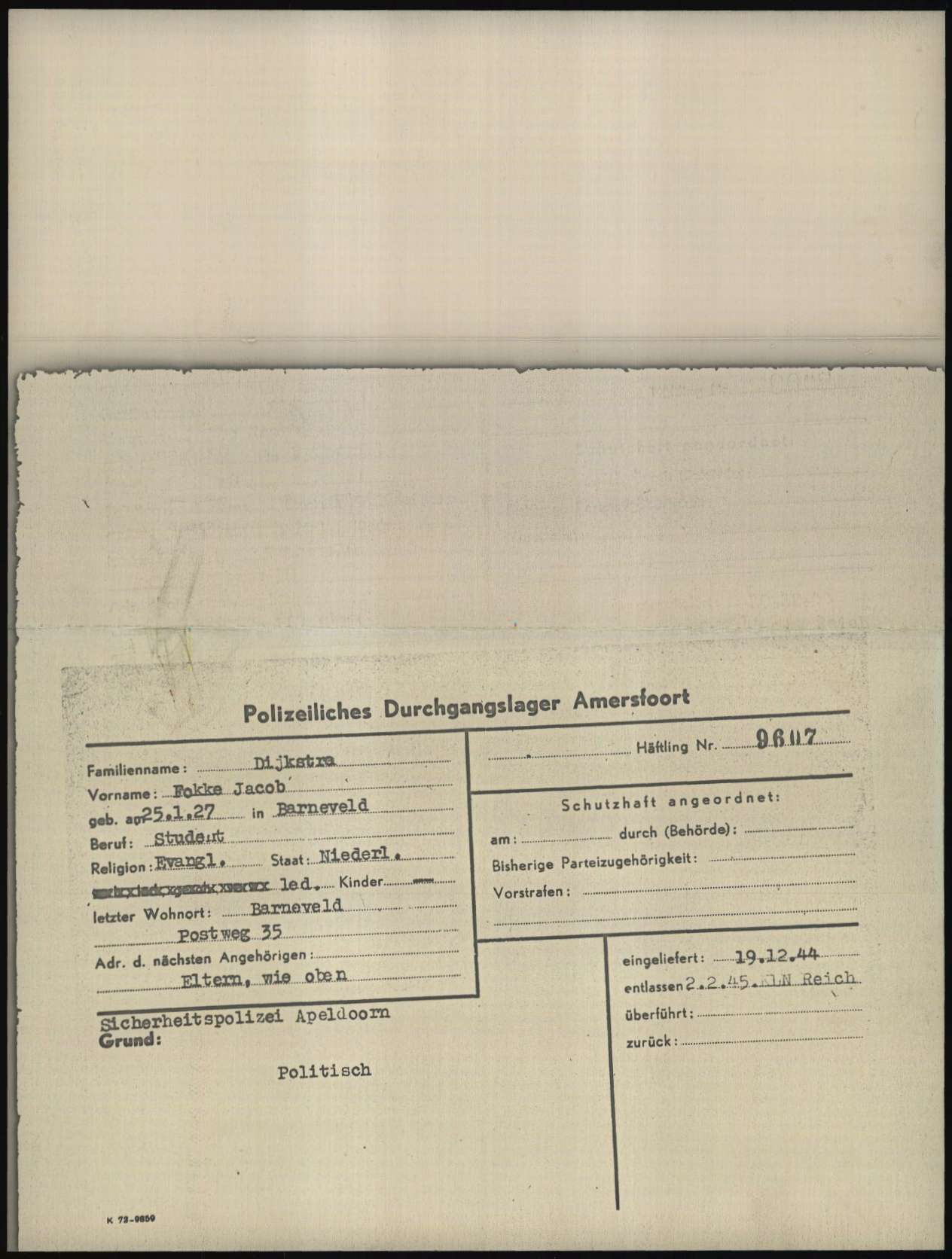
✓ His wife was Trijntje Kroese, born at Urk on 13 October 1891 (the War Graves Foundation's questionnaire). Their son Kornelis was born at Utrecht on 27 July 1917 (the birth record, Utrecht deed 2141, index record), Jan on 6 October 1921 (Jan's account, p. 1), and Fokke at Barneveld on 25 January 1927 (Fokke's camp card). His form of July 1945 gives four children, aged 28, 23, 18 and 13 (his form, p. 4): ◐ Kornelis (27 on 3 July, 28 from the 27th, by his birth record), Jan and Fokke, and a younger son: Arnhem's answer to the War Graves Foundation in 1969 lists four children, the same three and one more son, removed from the register on 12 November 1953 for Polsbroek (the Foundation's file, scan 3, read on the image; the youngest son is not named here).
The laundry at De Glind, 1924–1957
Link to the section The laundry at De Glind, 1924–1957✓ Jan wrote in 2014: "In 1924 kwamen wij er wonen. Mijn vader werd aangesteld als baas van de wasserij. Hij heeft daar gewoond tot 1957" (we came to live there in 1924. My father was appointed head of the laundry. He lived there until 1957). The Rudolphstichting, a children's village founded in 1914, was then still called De Glindhorst. The family's house stood next to Nico Geleijnse's, with the laundry just behind it; ◐ the Geleijnse family's house is the director's house (directiewoning), "de mooiste villa van de Rudolphstichting" (the finest villa of the Rudolphstichting), where Jan was often; his wife worked in the linen room; the family always had foster children from the Stichting in the house, and one of the village schoolmistresses lodged with them (Jan's account, p. 1). In Jan's memory as ParaData prints it, "My father was a laundryman at Rudolfstichting, and we lived in the annex of the laundry and bathing building" (ParaData).
The war
Link to the section The warJan, who worked at Amersfoort for a Jewish butcher until the man was taken, wrote:
In the end I came to a Jewish butcher. De Wolf was his name. I worked in his kosher butcher's shop until he was taken away. My father had offered that he could hide with us when the Germans started taking people away, but he did not dare to.
Dutch originalUiteindelijk kwam ik bij een Joodse slager terecht. De Wolf was zijn naam. In zijn koosjere slagerij heb ik gewerkt tot hij werd opgepakt. Mijn vader had aangeboden dat hij bij ons kon onderduiken als de Duitsers mensen op gingen pakken, maar dat durfde hij niet.
— Jan Dijkstra, Jan Dijkstra, de zoon van Boke Dijkstra, de wasbaas, 1924–1962, published on the Rudolphstichting's centenary site, 2014, p. 2 · the text
◐ ParaData's version of Jan's memory has "In the fourth year of the war we hid several Jews and Allied pilots who needed a place to stay overnight on their journey to safety" (ParaData). By Jan's 2014 account German soldiers were quartered in the girls' pavilion opposite the house, next to the laundry, and "In de wasserij kwamen de Duitsers niet zomaar, alleen eens per week om zich te douchen" (the Germans did not just come into the laundry, only once a week to shower); towards the end of the war "de Duitsers kwamen bij ons te zitten" (the Germans came to be quartered with us) (his account, p. 3). His sons Jan and Fokke were in the resistance (Jan of himself: "Ikzelf zat in de oorlog meteen bij de ondergrondse", Jan's account, p. 2; Fokke a courier, per Huurdeman); ◐ in September 1944 a diary, as printed in 1994, puts a Jan and a Fokke Dijkstra in a team of the Binnenlandse Strijdkrachten, very probably his sons (Fokke Dijkstra).
With Murphy
Link to the section With MurphyNo source puts Murphy in his house. It sheltered men of the operations Murphy was part of, Pegasus II among them, in the weeks Murphy was hidden nearby, and his sons Jan and Fokke worked the same lines.
Major Coke, October 1944
Link to the section Major Coke, October 1944His house took in a wounded Arnhem officer in October; ◐ in Jan's memory he stayed until Pegasus II, the crossing of 17/18 November that Murphy's party set out for, a week before Murphy reached Achterveld on 25 November, and he died on it.
- ✓ The address. Willem Zegers of Uddel hid Maj. J. S. A'D. Coke (52602) with Sgts P. J. D. Mahoney and E. J. Freeman for 4 days from 11 October 1944, after their escape from Paleis Het Loo, and passed all three on to "B. Dijkstra, Postweg 35, Glinden, Post Achterveld, Prov. Utrecht" (Zegers's table, p. 4; image-checked). Postweg 35 is the address on Boke's own form and on Fokke's camp card, so the B. Dijkstra is Boke (his form, p. 4; Fokke's card).
- ◐ The glider pilots. Jan's account of 2014 has "Freeman die later dat boek geschreven heeft, kwam bij ons samen met Davidson" (Freeman, who later wrote the book, came to us together with Davidson), and the two crossed on Pegasus I (his account, p. 3); Zegers's companion for Freeman is Mahoney, and which name Jan meant is discussed on his page.
- ◐ Coke stays. Zegers: the two sergeants reached England, "but the Major stayed behind in Glinden with fever caused by wounds. Nothing has been heard from him since" (his form, p. 3). C. A. van Dorssen of Uddel: "The Major was killed while attempting to cross the Rhine. Details known to B. DIJKSTRA, Postweg 35, de GLIND, near BARNEVELD" (his form, p. 3; image-checked).
- ✓ Jan brings him.
- Gerrit Hogeweg's form has Coke lodge with him a few days in October, until "He was taken away by Jan DYKSTRA for the Germans came to Mr. HOGEWEG's house. Jan DYKSTRA took the Major to his father" (Hogeweg, p. 2).
- Jan's account of 2014: "Ik weet nog dat bovenmeester Hogeweg naar ons toe kwam om te vragen of majoor Coke nog een poosje bij ons kon blijven, want bij hem kwamen de Duitsers te dichtbij" (I still remember headmaster Hogeweg coming over to ask whether Major Coke could stay with us a while longer, because the Germans were coming too close at his place).
- The family moved an onderduiker to one of the Stichting's farms, at De Haan's, "om ruimte te maken voor majoor Coke die bij ons in huis zat" (to make room for Major Coke, who was in our house) (Jan's account, p. 3).
- ◐ About six weeks. In Jan's memory as ParaData prints it, Coke "stayed for about six weeks", sat by the window by day, and walked with Jan after supper past the Germans in the girls' pavilion; when he left for the second crossing, "He said goodbye to my parents", and Jan took him on his bicycle, with Fokke going along, to meet the resistance between Barneveld and Lunteren (ParaData).
- ✓ The end. Coke told Graeme Warrack, in the wood on the afternoon before the march, that he had broken out of Het Loo and walked for 15 miles on bare feet, "That was five weeks ago, and his feet had only just healed"; Warrack adds "he was killed that night" (Warrack, Travel by Dark, p. 147; page image). The London Gazette has him mentioned "(killed in action)" (London Gazette 37274, p. 4684). More on Maj. John Coke's page.
Leslie Davison, November 1944
Link to the section Leslie Davison, November 1944◐ Leslie Davison, who rode with Murphy and James Hardy towards Achterveld on 25 November 1944 and left them there with two of the guides (Hardy), stayed about ten days with a family he named after the war as the Dijkstras:
I found myself constantly amazed at these brave people, especially when I discovered that there was a small contingent of German soldiers billeted only a few doors away. The head of the family was the manager of the local public baths and consequently had frequent dealings with the "Moffen" (derogatory slang for Germans). In fact some of the German noncommissioned officers would come in for coffee in the mornings while I would sit in the living room, in civilian clothes and pretend to be the "deaf and dumb cousins from Amsterdam".
— Pte L. Davison, his memoir · Pegasus Archive
The family, in the memoir, "consisted of Ma and Pa, four sons and a maid"; the two sons who gave their names, "Jan and Faulkner" (◐ Fokke), were the only ones in the underground; the household said grace before meals and read the Bible after them, and went to church on the Sunday, leaving Davison at home with the eldest son (Davison). ◐ "Four sons" fits the four sons Arnhem listed for the War Graves Foundation in 1969 (scan 3). The memoir brings Davison to the house from a cow barn after Pegasus II, not from the ride with Murphy (Leslie Davison).
Charles Noble, December 1944
Link to the section Charles Noble, December 1944◐ Charles Noble, the doctor later taken with Murphy, was passed by Dries Klooster's household at Barneveld to the "Rüdolfstichting" (Klooster's file, p. 3), and wrote that he was taken "to ACHTERVELD nearby, to the house of the manager of the penal settlement bath-house (name unknown)", where one son brought him, and after three days "another son of the bath-house manager" took him on to a farm near Scherpenzeel (Noble). ◐ That is very probably Boke's house, about 3 to 6 December by Noble's own figures; ⚠︎ no source names the Dijkstras as Noble's hosts. The son he says was "arrested the following week" is ◐ very probably Fokke (Fokke Dijkstra).
⚠︎ Noble's own later account (unpublished private papers, shared with us privately), told long after the war, does not name Achterveld or the bath-house. Between Barneveld and Scherpenzeel it has "about five days in another farm which was used as a collection point for the British agents who had been dropped and had radio communication with London", where his report has three days; it names no son and no arrest. ◐ That it is the same stay rests on its place in his route.
Thirteen men, from Piet Veenendaal
Link to the section Thirteen men, from Piet VeenendaalHis own file at the US National Archives has a questionnaire of 3 July 1945: Postweg 35, De Glindhorst; born 25-12-1890; married, four children; next of kin "wife R. Kroese", 54 (sic: the initial is not hers, and Trijntje was 53 on 3 July 1945, as the deed of 10 July has it); no military rank and no underground organisation; nothing in the sections for the men helped, and the table on its back blank (the questionnaire, p. 4, image-checked). A typed slip pinned to it says more:
Dijkstra sheltered a total amount of 13 Allied men. The duration of the lodging varies between 2 months and 3 days. He recieved them from P. Veenendaal . The latter also attended to the sending on. Dijkstra gave several clothes and shoes. It is considered that he should recieve a suit and shoes. 1 pair of shoes.
— US National Archives · RG 498, helper file of B. Dijkstra · typed slip, undated · the slip, p. 3 (image-checked; the line on the suit is typed twice over itself, and the P. is faint)
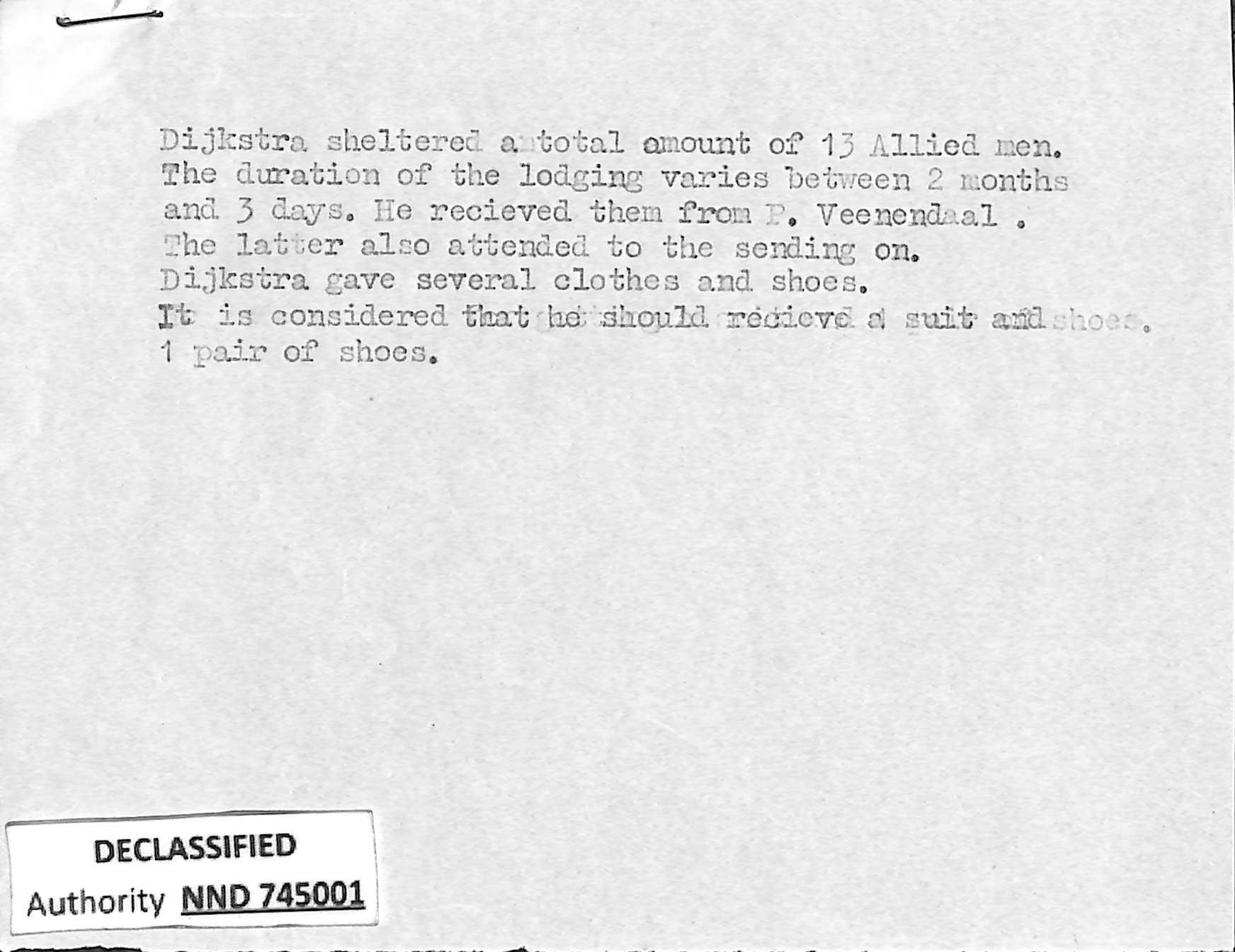
The "P. Veenendaal" is ◐ Piet Veenendaal of Scherpenzeel, the resistance leader whose farm the SD raided on 15 December 1944, taking Fokke. The summary sheet, with "Lt van LOENEN" and 8 February 1946 where the investigating officer goes (◐ which brother, Hendrik van Loenen or Herman Lucas, the sheet does not say), typed 4 March, has "His house was used as transient house for 13 allied personnel who stayed from 3 days to 2 months. Names are not known but case authenticated", grade 5 (the summary, p. 2; the cover has "Grade 5" and "Conf 31/ 8-2-46", p. 1). ◐ No file names the 13 men, so the file cannot say whether Major Coke, who came by Zegers's chain, or Davison and Noble were among them.
His son Fokke, 1944–1945
Link to the section His son Fokke, 1944–1945His son Fokke, seventeen, a courier, was taken in or near the SD's raid on Piet Veenendaal's farm at Scherpenzeel on 15 December 1944 and beaten, held at Apeldoorn and at Kamp Amersfoort from 19 December, and sent on to Neuengamme on 2 February 1945 (Huurdeman; the camp files). His camp card gives his next of kin as "Eltern, wie oben" (parents, as above), at Postweg 35 (the card). When Boke filled in his own questionnaire in July 1945 Fokke was still missing: the questionnaire made out in Fokke's name two days later gives "B. Dijkstra", 55, as next of kin (Fokke's questionnaire, p. 3), and a slip in Fokke's file says "till now no message is received from him" (p. 2). The Red Cross notified Barneveld in 1947 that he had died in Germany between 16 March and 19 April 1945, as a prisoner of Neuengamme; his death was registered at Barneveld in 1952, with Boke and Trijntje as his parents (the Red Cross notice; his death record). The War Graves Foundation wrote to Boke's municipality for his address in 1962 and 1969 (the Foundation's file, scans 2–4). The rest is on Fokke Dijkstra's page.
His certificates
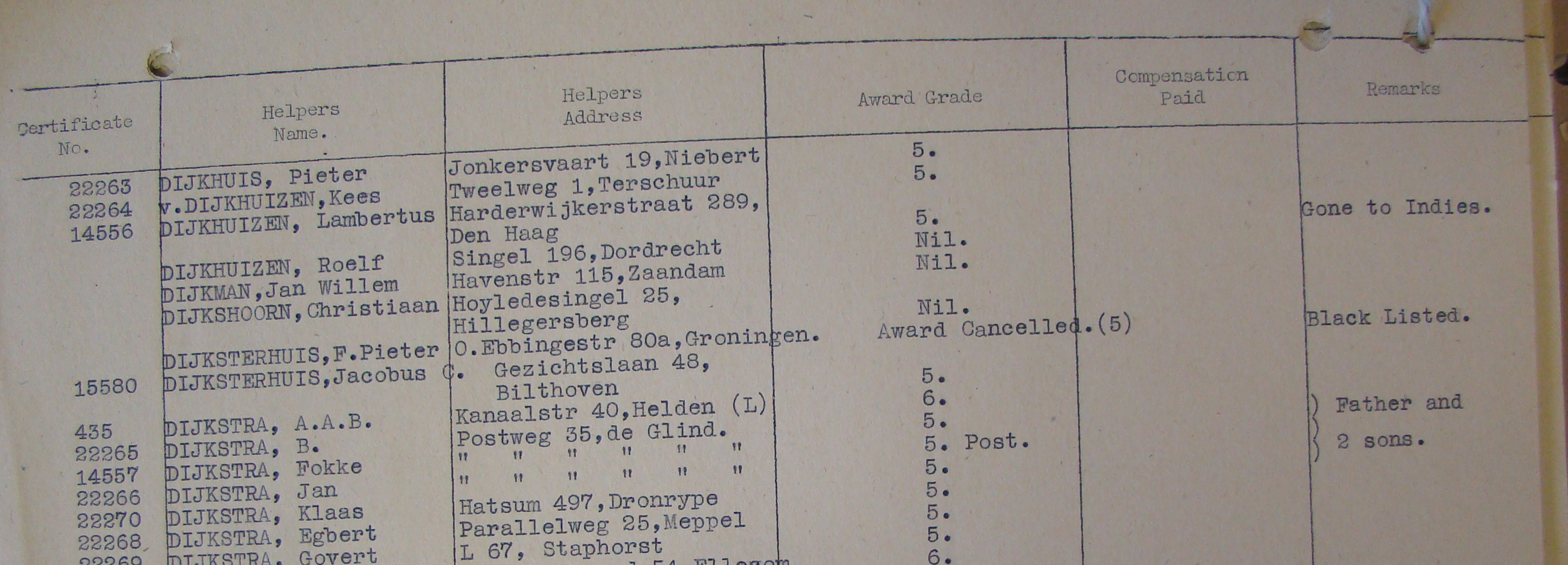
Link to the section His certificates- ✓ The British index. Sheet D/13 of the British index of Dutch helpers has "DIJKSTRA, B.", certificate 22265, at "Postweg 35, de Glind.", with his sons Fokke (14557) and Jan (22266) on the next lines under ditto marks, and the remark "Father and 2 sons." (sheet D/13, read on the image; the index's notes).
- The address and grade columns run up to a line above the names. Counted row by row, the sheet has 22 names, 22 addresses and 22 grades; every Nil or cancelled award falls on a row with no certificate number, and the three grade-6 rows carry the low numbers 435, 1828 and 436. His own grade is 5.
- So "5. Post.", printed beside his line, is on Fokke's row, the next one down. It agrees with the British list's "(POST)" for him and the Americans' "Posthumous", and Boke lived until 1969.
- ✓ The American list. The Americans' list of Grade 5 (Eisenhower) certificates has "(1107) DIJKSTRA, B., Postweg 35, De Glinshorst, The Netherlands", and on the next page "(1109) DIJKSTRA, Fokke J. (Posthumous), c/o Postweg 35" (the list, p. 44; p. 45; image-checked).
His son Kornelis, and Mrs Dijkstra-Padding
Link to the section His son Kornelis, and Mrs Dijkstra-Padding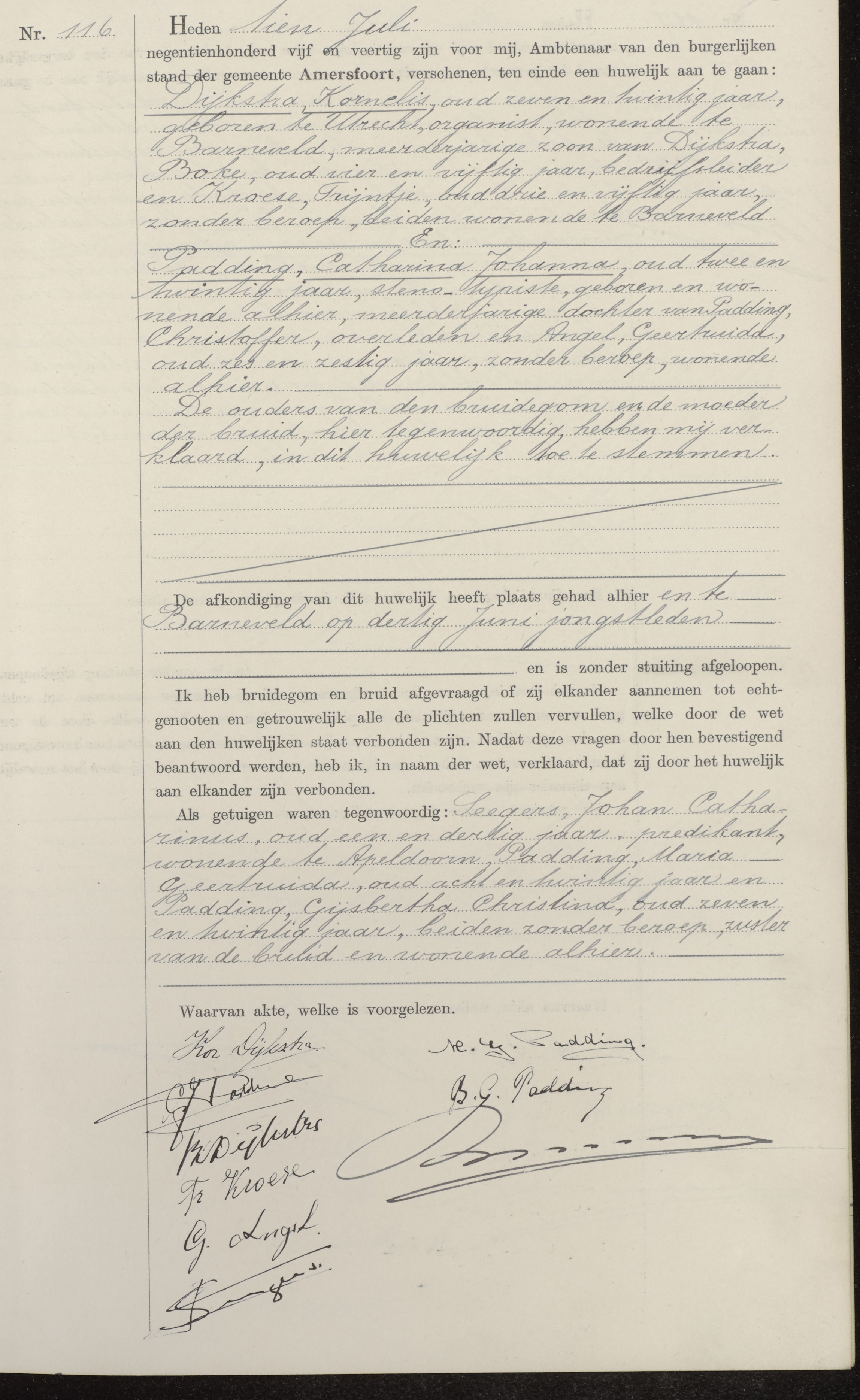
✓ Kornelis married at Amersfoort on 10 July 1945. The deed, read on the register's scan, has Kornelis Dijkstra, 27, born at Utrecht, an organist (organist) living at Barneveld, the adult son of "Dijkstra, Boke, oud vier en vijftig jaar, bedrijfsleider" (aged 54, a business manager) and Trijntje Kroese, 53, without occupation, both of Barneveld, who were present and gave their consent. The bride was Catharina Johanna Padding, 22, a shorthand typist (steno-typiste), born and living at Amersfoort, the daughter of the late Christoffer Padding; the banns were published at Amersfoort and Barneveld on 30 June (the deed; the index record).
The bride has a helper file of her own at the Americans. ◐ C. J. Padding, born 10-1-1923, of Amersfoortschestraat 107, Barneveld, filled in the questionnaire on 5 July 1945: married, no children, a member of the R.V.V., next of kin "K. Dijkstra", aged 27, with nothing in the sections for the men she helped and the table on the back blank (the form, p. 4; p. 5; image-checked). ◐ She is the bride on the grounds of the initials, a birth date that makes her 22 on 10 July 1945, and a next of kin of the groom's name and age; no page of the file names both. The Americans' summary sheet, typed on 14 January 1946 from Mr van den Born's report of 8 December 1945, has "Served as courier and guide for allied personnel. Sheltered some. Names not known but case authenticated", graded 5 (p. 2; the cover has "Grade 5" and "Conf 20 | 8-12-45" in pencil, p. 1). A typed slip pinned to it adds, in the married name:
Mers. Dijkstra-Padding has done a lot of work as a courier. She too has been active all the time for the assistance and sheltering of the Allied under difficult circumstances. It is considered that he should receive some tires.
— US National Archives · RG 498, helper file of C. J. Padding · typed slip, undated · the slip, p. 3
The slip is typed "Mers." for "Mrs." and says "he" where it means her (image-checked). ⚠︎ Her file names no man she helped and no one she worked with, so it does not put her in Boke's house or chain, only in the family her marriage joined; nothing held says she and Boke worked together.
The medal, 1961
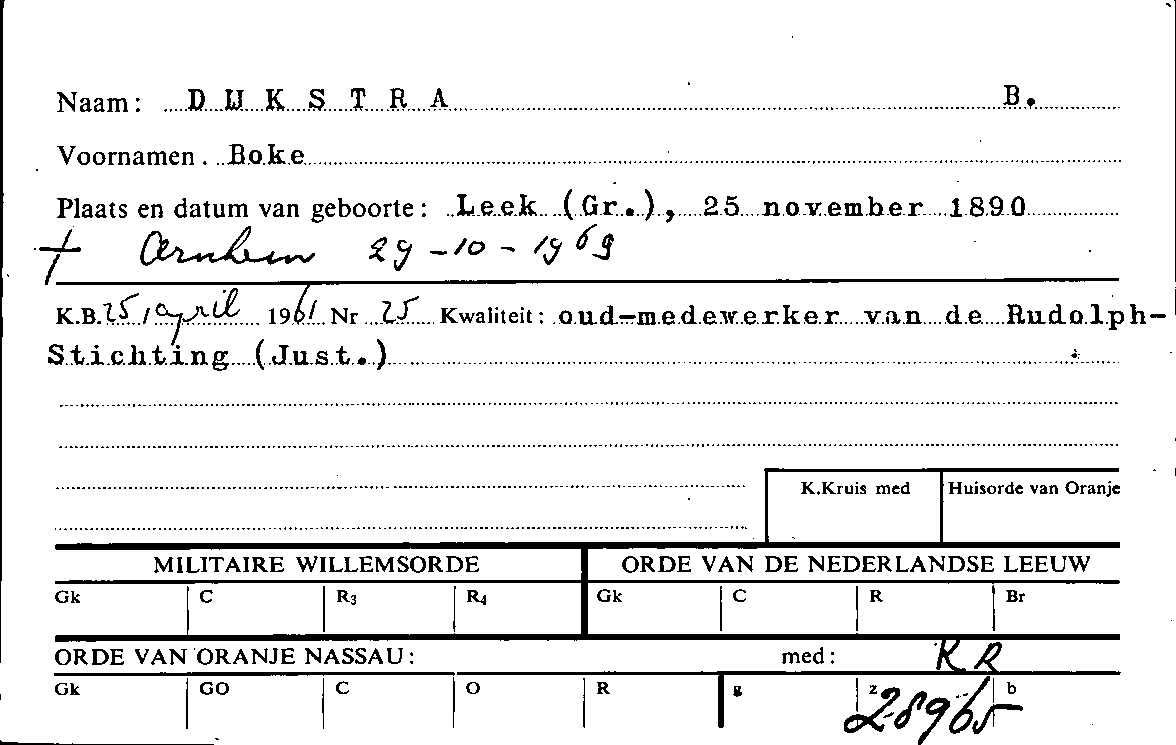
Link to the section The medal, 1961✓ By Royal Decree of 25 April 1961, no. 25, he was given the silver medal of honour of the Order of Orange-Nassau as "oud-medewerker van de Rudolph-Stichting (Just.)" (former employee of the Rudolph-Stichting); the back of the card notes "vr. Just. 12-4-61", ◐ the Ministry of Justice's proposal of 12 April. The Chancery's card gives his birth at Leek on 25 November 1890 and his address on the Lunterseweg at Barneveld (the house number overwritten), changed in pen to Arnhem, Houtmanstraat 3, from 20 January 1969; it records his death at Arnhem on 29 October 1969 and the insignia returned on 13 November 1969 (the card and its reading; the index). The number 28965 is written in the medal row's z (zilver, silver) column, which is the index's "Graad Zilver".
Arnhem, and his death
Link to the section Arnhem, and his deathJan wrote that his father lived at the Stichting until 1957 (his account, p. 1). In 1962 Barneveld answered the War Graves Foundation in the margin: "Boke Dijkstra, geb 25 nov 90 te Leek, wonende Lunterseweg 47 Barneveld" (scan 4, read on the image). In 1969 the Foundation wrote again to Barneveld at the address it held, and Barneveld noted in pen that "B. Dijkstra en echtgenote" (B. Dijkstra and wife) had been taken off its register on 20 January 1969 for Arnhem, Houtmanstraat 3 (scan 2, read on the image).
✓ He died at Arnhem on 29 October 1969, aged 78 and without occupation, the son of Kornelis Dijkstra and Aaltje Duursma, with Trijntje Kroese as his partner; the death was registered on 30 October (the record, Gelders Archief, deed 1236; index record only, no scan). The family's notice in Trouw the next day, read on the page:
In Jesus fell asleep our beloved Husband, Father and Grandfather Boke Dijkstra, knight in the order of Orange Nassau, at the age of almost 79. Romans 7: 24-25.
Dutch originalIn Jezus ontslapen onze geliefde Man, Vader en Grootvader Boke Dijkstra ridder in de orde van Oranje Nassau, op de leeftijd van bijna 79 jaar. Romeinen 7 : 24-25.
— Trouw, 30 October 1969, p. 9 · the notice
It is dated "Arnhem, 29 oktober 1969. de Houtmanstraat 3", and set the funeral service for Saturday 1 November at the Bethaniëkerk, followed by the burial at the general cemetery "Moscowa"; the notice is what was planned, and no record of the burial is held. ⚠︎ "Ridder" (knight) is the notice's word; the Chancery's card has the silver medal (Where the sources disagree). In January 1970 "T. DIJKSTRA-Kroese" thanked everyone who had shown sympathy "tijdens de ziekte en het overlijden van mijn Man en onze Vader" (during the illness and death of my husband and our father) (Trouw, 17 January 1970, read on the page).
✓ Trijntje outlived him: Trouw of 31 January 1977 prints the notice of "Trijntje Kroese weduwe van Boke Dijkstra", who "is 85 jaar geworden" (reached 85), dated "Arnhem, 29 januari 1977, Gereformeerd Bejaardencentrum, Laan van Presikhaaf. 7" (the notice, read on the page; the relatives it lists are not copied here). At 85 she fits the Urk birth of October 1891.
Where the sources disagree
Link to the section Where the sources disagree- His birthday. ✓ 25 November 1890: the birth record (Leek deed 139, index record), the Ede card of 1913, Barneveld's answer to the War Graves Foundation in 1957 and the Chancery's card (the birth record; the Ede card; the Foundation's questionnaire; the card). His own American form has "25-12-1890", and so does the summary typed from it (his form, p. 4; p. 2), ◐ a slip of the month. Barneveld wrote the village "Mildwolde".
- A knight, or the medal. The death notice of 1969 calls him "ridder in de orde van Oranje Nassau" (Trouw); the Chancery's own card and index have the medal of the Order in silver (the card). ◐ The front of the card has an unread handwritten mark beside "med:" in the Order of Orange-Nassau row (read as "KR" or similar, not settled), so the card alone does not exclude a later knighthood; it shows none. ✓ The Chancery's record is the official one for what it shows.
- Which helper next, and when. Zegers has Coke at his house in Uddel from 11 October, 4 days, then at Boke's. Van Dorssen's table has the same three men from 16 October, 4 days, received from "'t Loo, APELDOORN" and passed to "W. v.d. MAST, NIEUW MILLIGEN" (p. 4); Hogeweg has Coke lodge with him "a few days" in October before Jan took him to his father (Hogeweg); ParaData's Jan has about six weeks with the Dijkstras (ParaData). ⚠︎ The forms are of one chain from two houses and do not agree on days or order.
- Where Coke died. Hogeweg: shot "in trying to pass the German lines"; Van Dorssen: killed "while attempting to cross the Rhine"; Zegers: nothing heard; Jan, 2014: "Hij is later gesneuveld bij Renkum" (he was later killed near Renkum) (his account, p. 3). ✓ Warrack has him killed that night, the night of Pegasus II, and the Gazette has him killed in action; the place and night are on Maj. John Coke's page.
- Mrs Dijkstra-Padding's marriage and address. ⚠︎ Her form of 5 July 1945 has "gehuwd" (married) yes, five days before the deed of 10 July, and Amersfoortschestraat 107 at Barneveld, where the deed has her "geboren en wonende alhier" (born and living at Amersfoort) (her form, p. 4; the deed). The banns were published on 30 June, so she may have written it in expectation; nothing held says.