Lt-Col William Alford
3 Mar 1913 – 4 Mar 1990
About: William Carson Alford, known as Bill, a Scottish doctor, commanded 133 (Parachute) Field Ambulance at Arnhem, ran its dressing stations at Oosterbeek until the Germans took the wounded to Apeldoorn, and there, under Col. Graeme Warrack, was in charge of the hospital's professional wing (ParaData's article calls it the medical wing) in the Willem III barracks, where Private Thomas Murphy was held until his escape on 6 October 1944; whether Alford was still there that day is not shown. He was a prisoner for the rest of the war, and afterwards a country doctor at Lairg in Sutherland for nearly 38 years.
Unit or role: Lt-Col (temporary), RAMC, service number 88813; CO 133 (Parachute) Field Ambulance, 4th Parachute Brigade, 1st Airborne Division; head of the professional wing (ParaData: the medical wing) of the Airborne hospital at Apeldoorn.
Where: Born at Rutherglen, Lanarkshire (Glasgow in the BMJ, see below); the Pietersberg dressing station at Oosterbeek, 20–26 September 1944; the Willem III barracks at Apeldoorn; a prisoner in Germany, mostly at Wolfenbüttel by the BMJ's account; a country doctor at Lairg, Sutherland, from 1946, living at Muirlands, Lairg in 1965.
Evidence: ✓ London Gazette, 24 August 1944, p. 3917 (the OBE) and 20 September 1945, p. 4684 (the Arnhem awards); ✓ Warrack, Travel by Dark (1963), pp. 19, 24, 26, 36, 40, 62, 77 and 254, all read on the page images (19, 24, 26, 36, 40, 62, 77, 254); ✓ ParaData's record of him, with his own report on the battle and the BMJ obituary of 1990; Kew WO 416/4/187.
- ✓ Born on 3 March 1913, the middle son of Robert Alford (1877–1966) and Mary Carson (1878–1935), at Rutherglen, Lanarkshire (ParaData; the Kew card); educated at Rutherglen Academy and Glasgow University, MB ChB in 1938 (BMJ, 26 May 1990, search snippet and ParaData's quotation).
- ✓ Commissioned lieutenant in the Territorial Army's RAMC on 9 May 1939 (London Gazette, 6 June 1939, p. 3787, checked on the image) and mobilised on 24 August 1939; captain a year later.
- ◐ He served in France, the Middle East and the Western Desert (1942–43), joined 133 Field Ambulance in 1941, and took command of it in April–May 1943 in Palestine when its CO, Lt-Col Scriven, broke an ankle on a jump (ParaData; BMJ).
- He did the parachute course at Ramat David, 29 March to 7 April 1943, having strained a leg muscle on the second descent of the course at Kabrit, 4 to 12 March, and not finished it (ParaData; BMJ).
- ◐ The unit became 133 (Parachute) Field Ambulance at Palestine in January 1943 (Wikipedia, a secondary source).
- He went on to Tunisia and Italy, where he won the OBE: "Major (temporary Lieutenant-Colonel) William Carson Alford, M.B. (88813), Royal Army Medical Corps (Rutherglen, Lanarkshire)", in the list of the Additional Officers of the Military Division gazetted on 24 August 1944 "in recognition of gallant and distinguished services in Italy" (the Gazette, checked on the image; the recommendation, WO 373/71/523, below).
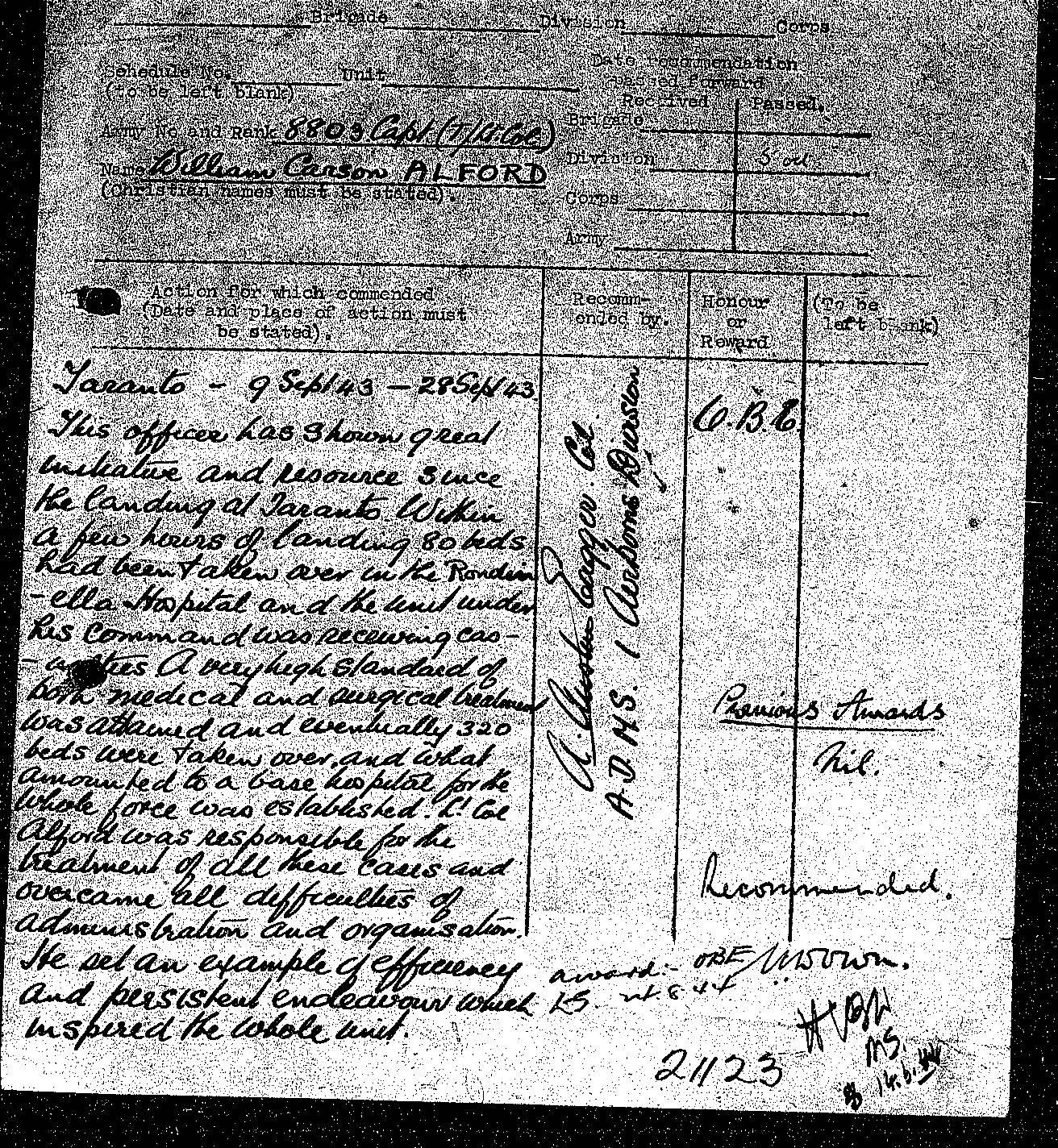
- ✓ The recommendation (WO 373/71/523). A handwritten form for "Taranto - 9 Sep/43 - 28 Sep/43":
- "This officer has shown great initiative and resource since the landing at Taranto": within a few hours 80 beds were taken over in the Rondinella Hospital, eventually 320, and "what amounted to a base hospital for the whole force was established", with "a very high standard of both medical and surgical treatment".
- Put up by "A. Austin Eagger [?], Col., A.D.M.S. 1 Airborne Division", for the O.B.E., with "Previous Awards Nil"; the margin has "Recommended award:- OBE" and a further word and initials that are not legible.
- The form gives him as "Capt. (T/Lt.Col.)", where the Gazette has "Major (temporary Lieutenant-Colonel)"; see below.
- ParaData dates it to his service in Italy from September to November 1943 and has a Mention in Despatches for the same period on 29 August 1944; Honour to the Airborne has both on 24.8.44 (snippets).
- ✓ The same Gazette supplement of 24 August 1944 has "Maj. (temp. Lt.-Col.) W. C. Alford (88813)" in a list of RAMC names on p. 3935 (the page).
- ◐ We hold the supplement's heading page (p. 3926: "Mentioned in recognition of gallant and distinguished services in Italy"; the page) but not pp. 3932–3934, where the lists run on to this one, so that p. 3935 is the mention in despatches is our reading, from Honour to the Airborne's date.
- ◐ The Lancet of 2 September 1944 has "OBE Lieut.-Colonel W. C. ALFORD, MB GLASG., RAMC" (the search hits, the Archive's full-text snippets, not read on the pages).
- ◐ His own report on the battle (as ParaData prints it): dropped at 1350 hours on 18 September, collected 50 casualties on the dropping zone in three hours, and reached the sanatorium near Oosterbeek around midnight, taking over from Capt Doyle of 181 Airlanding Field Ambulance. On the 19th his surgical teams opened a resuscitation and operating theatre in two houses to relieve the main dressing station.
- On 20 September a German tank shelled the two houses, infantry took them at noon, machine-gunned the windows and threw a grenade into the resuscitation room; he persuaded the enemy to let him stay with the wounded. That night the remnants of the 10th Battalion cleared the building, and the next day he decided to evacuate the 50 seriously wounded, which was done with stretcher-bearers from 181's main dressing station.
- On Warrack's order he opened a new dressing station in the Pietersberg house facing the river, ordered at about 2000 hours and "prepared during the early hours of 21st September" (the report's own order of the 20th and 21st is not clear), with Capts Hudleston and Flockhart and about ten orderlies; the theatre there did the urgent cases for five days; on 25 September, with 160 wounded, no water and the building hit several times, "the enemy entered the dressing station", and on 26 September "all casualties [were] evacuated by enemy to Apeldoorn".
- ✓ Warrack, from his side, has him turn up at the dressing station at 8 o'clock on the evening of the 18th (p. 24) and report at Division on the night of Tuesday the 19th with "a surgical team and a woefully small number of officers and other ranks", set up "in a house some 100 yards from the Schoonoord Hotel" (p. 26).
- Later "Bill Alford of the 133rd (Parachute) Field Ambulance appeared with the woefully small remnant of his unit" and was sent to the Pietersberg (p. 36); at dusk Warrack found him and his small unit "doing an excellent job" (p. 36, bottom), and he went down to the Pietersberg "in the afternoon to see Bill Alford and his party" (p. 40).
- ✓ Warrack's diary, 25 and 26 September. Warrack's diary, written up in the barracks from memory after he arrived on the evening of 26 September (by his foreword, "while they were still fresh in my memory"), calls him Bill, and three times "BILL ALFORD" on 25 and 26 September and 6 October (Warrack's diary, typed transcript, Wellcome Collection RAMC/1584).
- At 16.00 on the 25th Warrack asked Division to hold its fire "while I clear BILL ALFORD's house, as the wood he is in is getting a very hot time", and at 18.30 his bearers brought back "a message from BILL that he was going to stay where he was with his casualties. He didn't know that Div were moving out that night!" (p. 23).
- On the morning of the 26th Warrack "fetched up at PETERSBERG where I found BILL safe and sound, evacuating his casualties straight into ambulances", and at 11.30 "sent BILL ALFORD and his party along to APELDOORN to prepare the way" (pp. 25–26).
- ◐ James Hardy's account.
- James Hardy, a 16 Field Ambulance orderly who was later held at Apeldoorn with Murphy, put in an account of the first week that "Col. Alford, who was in charge of the R.A.P. had constantly asked the Germans to supply water" until on the afternoon of Sunday 24 September they brought some and a stock of tinned plum juice (the Pegasus Archive's page for him; Noordman's translation, which has "Kolonel Alford"; James Hardy). The Pegasus Archive's gloss, which is not Hardy's, puts the post at the Pietersberg.
- Hardy's own MI9 escape report, WO 208/5414/21 (the interview was on 13 January 1945, Kew's catalogue date is 14 January; not digitised), lists "Colonel Alford" and "Colonel Marrables" among the names it mentions (the catalogue entry).
With Murphy
Link to the section With Murphy-
✓ The professional wing. At Apeldoorn Warrack split the hospital into an administrative wing and a professional one, and put his two lieutenant colonels over them (Arthur Marrable the first, Alford the second):
I put Marrable in charge of the former, with Bryson as sergeant major, and Alford in charge of the latter—it would be his job to settle the doctors' duty rosters, and theatre staff, and to deal with the wounded.
— Graeme Warrack · Travel by Dark, p. 62 · 1963 · text layer · page image
- The Airborne Museum's article on the hospital has the same posts: Warrack in command, Martin Herford second, Marrable the administrative wing, Alford the medical wing (ParaData); and Matthew Hall's life of Herford has the hospital "arranged startlingly quickly" with "the medical wing by Lt Colonel Alford, under whom were highly efficient teams of doctors and orderlies" (Hall, p. 184, the reader's text layer). Murphy and Sam Walsh escaped from this hospital on 6 October (Apeldoorn and the escape).
- ✓ Warrack's diary has the arrangement made on the evening of 26 September: "The hospital is to be run with two sides: the adm under ARTHUR and the medical under BILL" (Warrack's diary, p. 27).
- ✓ The 500 wounded. When the Germans announced that 500 wounded were to go to Germany at once, Warrack, having talked with Marrable and Alford about whether the senior officers should stay or escape, "detailed Alford to take charge" (p. 77). The book gives no date for it.
- ParaData has two drafts of nearly 500: on 26 September "nearly 500 walking wounded" marched to the station, and "another of nearly 500 men" on 5 October, the day before Murphy's escape (ParaData).
- ✓ Warrack's diary dates it. At 10.00 on 5 October the Germans asked for 496 patients, ten doctors and 64 orderlies, and Warrack decided "to send BILL as OC Train and all officers and ORs of the Para Bdes to accompany him"; at 19.30, with the loading done, "I am awfully sorry to lose BILL and his chaps as they have done very well indeed" (pp. 39–40).
- The train did not go. On the afternoon of 6 October Warrack took "a walk along the train with BILL" in Apeldoorn station, where the line was "busted" and there was no engine, and that evening "Finally officers on the train are: BILL ALFORD, PETE SMITH, IAN HUDDLESTON, REDMAN, LAWSON and RANDALL" (pp. 40–41). On the morning of the 7th it had "failed to get away even yet", and on the morning of the 8th it was "Reported that train has left" (pp. 41–42).
- ◐ The roll does not match that list of officers: it marks Huddleston and Lawson (a), "Ambulance train 2 Oct 44", and Smith, Redman, Randall and Alford (c), 6 Oct, while on 2 October Warrack had picked Keesey, a Lawson and Simmons for the first train (p. 36).
- ◐ Held evidence points to one Lawson: Derek Ridler tells Kessel that Lawson jumped the first train and got away (Kessel, p. 123), the roll marks Capt J Lawson, Ridler and Simmonds all (a), and the diary's list of officers has one Lawson, "Capt J LAWSON, RMO 1 Para Bde" (p. 49), whom the diary calls "JOCK LAWSON" on 27 September (p. 28) and "JACK LAWSON" on 2 October (p. 36). So the odd entry is the "LAWSON" in the 6 October list (p. 41), not the roll. Huddleston's (a) is still unexplained.
- ✓ Herford's report has the same train from his side (Lt-Col Martin Herford's report, Journal of the RAMC, vol. 98 (1952), pp. 251, 298–299, read on the page images; Martin Herford):
- 26 September: "During the day casualties poured in and Lt.-Col. Alford and other M.Os. arrived".
- 5 October: "The Hospital Train for 500 was announced, and loading started at once", with "Medical personnel were also sent, with Lt.-Col. Alford in charge"; Herford and Warrack "were allowed down to supervise loading".
- 6 to 8 October: the train "still awaited an engine" beside a flak train on the 6th, was "still awaiting engine" on the 7th, and "had left during the night for the Hanover region" by the 8th.
- By the 12th to 14th, "The personnel of 16 and 133 had gone in previous trains".
- So on 6 October, the night Murphy and Walsh went, he was on the hospital train in the station, not in the barracks. The diary's roll of the medical staff has "88813 Lt Col W C ALFORD OBE" with the note (c), "Proceeded to GERMANY on Ambulance train 6 Oct 44" (the roll, pp. 51, 55).
- ✓ He was in the Arnhem awards of 20 September 1945, listed under the Royal Army Medical Corps as "Lt.-Col. (temp.) W. C. ALFORD, O.B.E., M.B. (88813)" (London Gazette, p. 4684, checked on the image); ParaData reads it as a second Mention in Despatches, for 18–25 September 1944.
- ◐ Reported a prisoner. The BMJ of 27 January 1945 lists "Prisoners of war.—Lieut.-Col. W. C. Alford, O.B.E., R.A.M.C.", and the Journal of the RAMC's 1944 list "Lt.-Col. W. C. Alford, N.W. Europe" under "Prisoners of War" (the search hits, the Archive's full-text snippets, not read on the pages).
- ◐ In captivity: the BMJ says he elected to stay with his wounded when the rest of the division withdrew across the Rhine, and then spent seven months as a prisoner in Germany, "during most of that time he had sole responsibility for treating British and American sick and wounded in Wolfenbuttel Hospital" (BMJ, quoted whole by ParaData). Kew's German POW card has him as "Surgeon", RAMC, captured in the Netherlands on 29 September 1944, Stalag XI-B Fallingbostel, prisoner of war number 1674, with two photographs and one set of fingerprints; the card itself is not digitised (the catalogue entry).
- ◐ The 133rd was reformed and he was given it again after his release; it landed at Stavanger on 1 May 1945 on Operation Doomsday, the disarming of the German forces in Norway (Wikipedia, secondary).
- ✓ He resigned his commission in the Territorial Army Reserve of Officers on 31 March 1967, "retaining the hon. rank of Lt.-Col.": "Maj. (Hon. Lt.-Col.) W. C. ALFORD, O.B.E., M.B. (88813)" (Gazette supplement of 22 August 1967, p. 9272).
- ✓ Lairg.
- "Bill Alford went to Lairg in 1946 after six years of eventful war service; he then spent the rest of his career in a singlehanded practice there, retiring in 1983", served ten years on the Scottish Medical Practice Committee, chaired the Sutherland hospital board for a time, fished and played golf, and was captain and then president of Royal Dornoch Golf Club (BMJ obituary, first paragraphs checked in the Archive's text search; the rest as ParaData quotes it).
- He was made a Deputy Lieutenant of Sutherland on 4 January 1965: "Major (Honorary Lieutenant-Colonel) William Carson Alford, O.B.E., M.B., of Muirlands, Lairg" (London Gazette, 8 January 1965, p. 283, checked on the image). Warrack's last chapter of 1963 has "Bill Alford is in Sutherland" (p. 254).
- ✓ He died on 4 March 1990, aged 77, survived by his wife, a son and two daughters; "Bill was a modest man, and many of his friends knew little of his war record" (BMJ, 26 May 1990). The obituary adds that his stand with the wounded at Arnhem was recreated in the film A Bridge Too Far; that claim is the obituary's and nothing here bears it out.
Where the sources disagree
Link to the section Where the sources disagree- Where he was born. Rutherglen, Lanarkshire (ParaData; the Kew card; the Gazette's OBE entry has "Rutherglen, Lanarkshire" as his address); "Born Glasgow, 3 March 1913" in the BMJ's closing line.
- When he was captured and where he was held. Kew's card has 29 September 1944 and Stalag XI-B Fallingbostel; his own report has the wounded of the Pietersberg evacuated by the enemy to Apeldoorn on 26 September, and the BMJ has seven months, mostly at Wolfenbüttel. The card's date may be the date of its entry, and the camp and the hospital need not exclude each other; none of the three says so.
- Warrack's diary has him at the Pietersberg on the morning of 26 September and sent on to Apeldoorn that day, and on the hospital train that left Apeldoorn between the mornings of 7 and 8 October (Warrack's diary, pp. 25–26, 39–42); its roll dates that train "6 Oct 44" (the roll, p. 55).
- ⚠︎ The first report in Part I of "All in the Day's Work" (Journal of the RAMC, 1952), printed under Col. E. I. B. Harvey's name, which the journal disowned as his in an apology (pp. 350–351), and whose author is not known, has "On 26 Sept. certain medical personnel, including Lt.-Cols. Alford and Marrable, were apparently released to work in the D.S. at Osterbeek" (p. 248). It says it was compiled from returned men and two letters. Herford's own report has Alford arrive at the barracks on the 26th (above).
- His service number. 88813 in the Gazette and on the Kew card; ⚠︎ 8803 on the OBE recommendation itself, in the form's ink entry, and so in the catalogue's entry for it, which copies the form (the form; the entry). The form has a digit missing.
- His rank in 1943 and 1944. The form of 1943 has "Capt. (T/Lt.Col.)" and Kew's entry "Captain"; the Gazette of 24 August 1944 has "Major (temporary Lieutenant-Colonel)" and the Arnhem list "Lt.-Col. (temp.)". ◐ He may have been promoted major between the form and the Gazette; no source here says when.
- The date of the Mention in Despatches. 29 August 1944 (ParaData), 24 August (Honour to the Airborne).