Hendrik van Loenen
Zeist 1 Sep 1915 – Leiden 8 Jun 1997
About: A Zeist-born resistance man, imprisoned in 1942, who crossed the lines with evaders in October 1944, trained in England as an MI9 agent, code name CAWTON, and was dropped back at the end of December to run the Rhine crossings and an intelligence network round Amerongen, where Murphy was then hidden. One of the four men he lost probing the front was Koen Esveld, ◐ the younger son of the household that hid Murphy.
Unit or role: MI9 agent, mission CAWTON, code name BOB, S-phone operator (Kluiters); "Code name: CAWTON" on the British index of Dutch helpers (page L/19); "Capt." to the Americans (Doornebosch, p. 18; Wildeboer, p. 48) and to himself in July 1946 (p. 4), "Capt. H.Q. I.S.9" as his own occupation (p. 38), and "le Lt. L.S.K. le Reg. Luchtv.Troepen" (1st Lt, air force, 1st regiment of airborne troops) on his letter of 28 August 1946 (p. 35); before that the resistance, ◐ round The Hague and then at Rhenen (his statement, p. 22).
Where: Zeist (born there; Kersbergenlaan 4B in 1946); ◐ The Hague area, 1940–41 (by his helpers' addresses); Rhenen from about September 1941; the prisons at Utrecht and Scheveningen, 1942; England for his training; Renswoude and Lunteren, where he was dropped; Amerongen and the Rijnstreek.
Evidence: ✓ His helper file with the Americans, US National Archives 286708477 (recommendation, his statement, his letters of 1946, pp. 28, 35–37); ✓ his own Dutch report, "Rapport van Cawton", held in another helper's file (pp. 13–14 of the Cornelisse-van Brink file); ✓ Kluiters; ✓ Boeree's Kroniek van Ede on his drop (pp. 243–244); ✓ the British index of Dutch helpers (page L/19) and his King's Medal and SOE file in the Kew catalogue; ✓ his Dutch award card; ✓ his birth and marriage (Utrecht Archives index).
He was born at Zeist on 1 September 1915, the son of H. L. van Loenen, and died at Leiden on 8 June 1997 (Kluiters; the recommendation, p. 16, has "1.9.1915, Zeist"). ✓ Zeist's birth register has it: 1 September 1915, the son of Herman Lucas van Loenen and Jenneke Ruimerman (the birth, index only). He married Johanna Baams, born at Zeist, at Zeist on 21 November 1940, when he was 25 and she 24 (the marriage, index only); ◐ the Zeist register printed in the Utrechts volksblad of 25 November 1940 has a "Hendrik van Loenen, 25 j." married to "Johanna Maams, 24 j.", with no date or parents, so that it is this marriage, and "Maams" a misprint of Baams, is our reading from the names, ages, place and week (the column, read on the page image). In 1946 he gave her, "vrouw Johanna Baams", as his next of kin (p. 38). The Americans summed up his war:
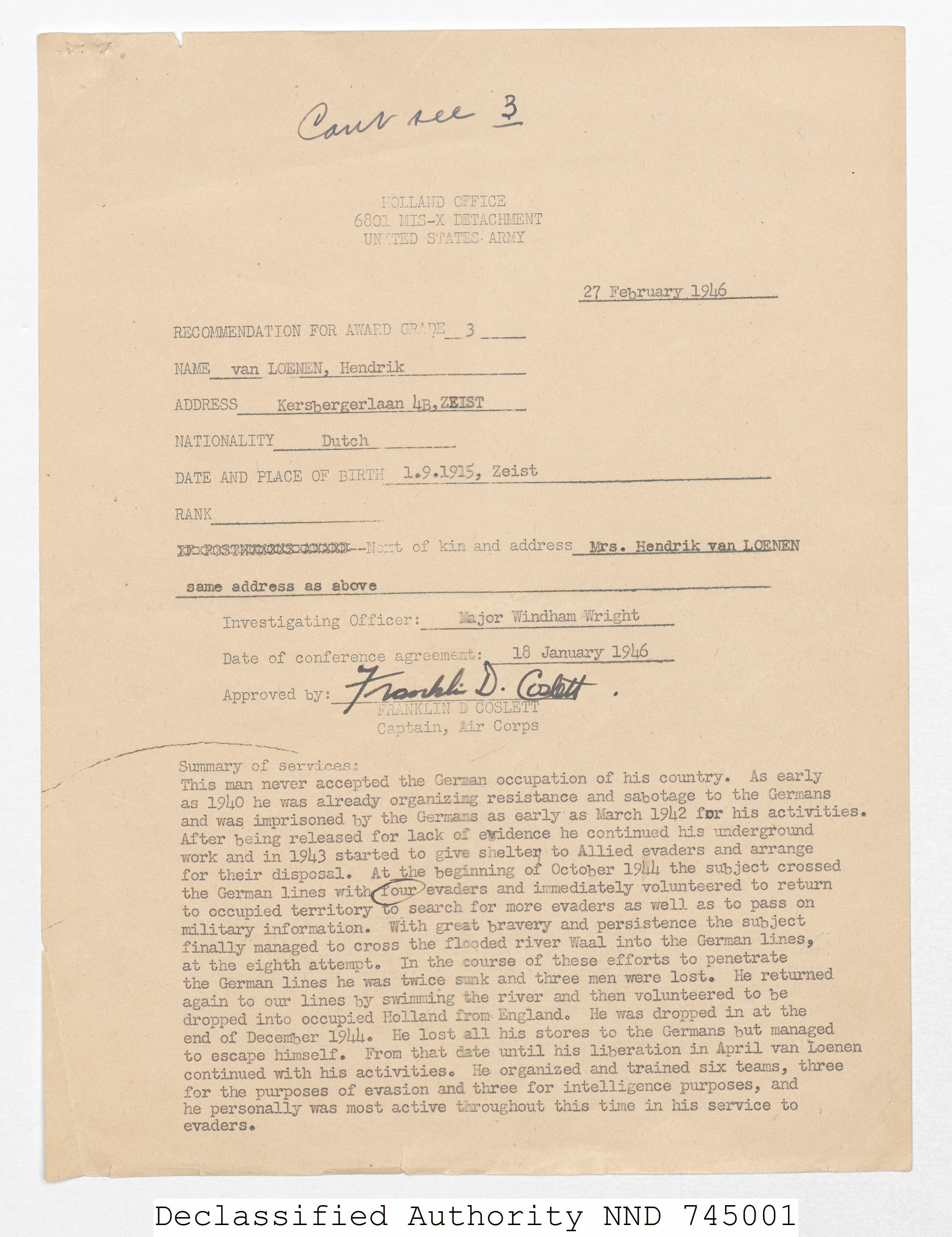
This man never accepted the German occupation of his country. As early as 1940 he was already organizing resistance and sabotage to the Germans and was imprisoned by the Germans as early as March 1942 for his activities. After being released for lack of evidence he continued his underground work and in 1943 started to give shelter to Allied evaders and arrange for their disposal.
— US National Archives · RG 498, helper file of Hendrik van Loenen · recommendation for award, grade 3, 27 February 1946 · the archive's copy
His own statement fills it in (p. 22). In 1940–41, ◐ round The Hague (the statement names no place for himself, only his helpers' addresses at The Hague, Wassenaar and Voorburg, and he married at Zeist in November 1940), he worked with a small group finding, repairing and distributing weapons, and organised men in the gas, electricity, telephone and water works for sabotage. After the Gestapo searched his house in about September 1941 he moved to Rhenen. Betrayed over a transport of some 600 carbines, machine-guns and revolvers from Deventer to The Hague, he was arrested by the Grüne Polizei on 13 March 1942, held about a month in the prison at Utrecht ("Ganzemarkt" in his statement) and then at Scheveningen, and released in August 1942 for want of evidence. ◐ The Utrecht Archives' index of prisoners' inscriptions for October 1941 to May 1942 has a "Hendrik van Loenen" born at Zeist on 1 September 1915, with "Overtreding" (an offence) and "Ter beschikk." (at the disposal of); name, birth date and place agree with his, and the dates cover the month he says he was held in Utrecht, but the index gives no date of entry and the register itself was not seen (the entry). He went on hiding Jews and onderduikers (men in hiding), with his brother Herman Lucas, who was in hiding at his house, and the K.P. at Rhenen, and organised a small group to look after airmen who had been shot down.
The same statement records two episodes of killing, three men in all, in his own words. The 1940–41 list in it has "Executed 2 men of the "Rappard" party, who tried to penetrate into the organization. Sentence passed by bullet", the bodies afterwards put "into the water at the port at Voorburg", and "Names unknown, only pseudonym, Roelofs and de Vries". ⚠︎ His word only: the two men are known only by those pseudonyms, and no other source here records it. A Jewish man from Amsterdam whom he had sheltered, Edo de Klerk, was arrested in the street and sent by way of Westerbork to Poland: "He did NOT betray the address." In the spring of 1944 he took in a Jewish married couple:
Afterwards it appeared he was Gestapo-agent; had betrayed very many divers, committed black mailing etc. After taking thought determined to execute the jew. Whitsuntide 44 passed sentence by drowning in the river Rhine near Rhenen. Body found after 3 days. Was being raised from bed afterwards by detective from Amsterdam (chief inspector Achterberg). After thought and explaining hushed up the case. Shall give explanation later on to the tribunal.
— Hendrik van Loenen, his statement for the Americans · US National Archives · RG 498, helper file of Hendrik van Loenen · p. 22 (the archive's copy)
⚠︎ His word only: the man is not named, and no tribunal record of it has been found.
Across the lines and back, October to December 1944
Link to the section Across the lines and back, October to December 1944He told this twice: in English in his statement for the Americans, which is in his own file and copied into the Cornelisse-van Brink file (pp. 22–23; pp. 15–16 there), and in Dutch in a report headed "Rapport van Cawton", copied into that file and into Wilhelm van Hernen's (pp. 13–14; van Hernen, p. 7). Where the two differ, both are given under Where the sources disagree.
- Out with four evaders. At the beginning of October he crossed the German lines, called by a post at Nijmegen.
- The Dutch report has him go "samen met mijn broer" (together with my brother) "nabij Tiel" (near Tiel), "met medenemen van 4 evaders" (taking 4 evaders with us), and the crossing "gelukte uitstekend" (went off very well) (p. 13); the American summary has him cross "with four evaders" (p. 16).
- At Nijmegen he gave information to the B.I., remarked on the "badly shooting of the allied artillery" and offered to direct its fire by radio (pp. 22–23); by the Dutch report he and "Hilda" (mej. Bergsma) were trained on the S-phone by a Major Briand (p. 13).
- The Waal. His first attempt to cross back capsized and lost all the equipment. His brother went over to prepare the far side, with a weapons transport, was surrounded by Germans and got out with Sten guns; the English statement has "One man dead, and house burnt down where they had been given shelter", the Dutch report "1 burger gefusileerd en zijn huis verbrand" (one civilian executed on the spot for it, and his house burnt). He tried six more times and could find no one to help on the other side (p. 23; p. 13).
- The Rhine. A new attempt, over the Rhine in the Betuwe near Rhenen, with two Dutch helpers and three Canadians, crossed by rubber boat under a full moon, and was caught by machine-gun fire from three sides "80 m voor de dijk" (80 m short of the dyke): "Canadians lost by first salvo". He crawled back to the river, waited a quarter of an hour for any wounded, swam, lost consciousness in midstream and was washed ashore by a whirlpool (p. 23; p. 13).
- England. He asked to be dropped in untrained, was refused, and was sent to England to train as a parachutist; there he was first held about a week in a camp, and he visited works to learn the S-phone (p. 23; p. 14).
The drop
Link to the section The dropHis statement has him dropped at the end of December by a Stirling near Renswoude "with 32 parachutes of baggage", from too great a height, so that the Germans found the drop; he slipped through their lines and all the baggage was lost (p. 23). Kluiters dates it 28/29 December 1944, near Renswoude (Kluiters); Boeree has him come down on the road from Lunteren to Ederveen (below). Boeree's chronicle of Ede has the reception party, waiting by the Schans at Lunteren, in the evening two days after a failed attempt on Christmas eve (p. 242), which ◐ makes 26 or 27 December (two days counted from the evening of the 24th or from the morning of the 25th, when the men went home), though it calls it later "de dropping van 28 December" (p. 259):
One parachute was dropped, that was to be the "body"; it was Capt. Henk van Loenen, nicknamed Bob. The normal height for a drop is 100 to 150 m., but the pilot flew at 500 m. at least. The result was that Bob floated off towards the horizon and came down on the road from Lunteren to Ederveen, close by the N.S.D.A.P. barracks.
Dutch originalEr werd één parachute geworpen, dat moest de „body" zijn, het was Capt. Henk van Loenen, bijgenaamd Bob. De normale hoogte waarop het afwerpen geschiedt is 100 à 150 m., maar de piloot vloog op minstens 500 m. Het gevolg was, dat Bob wegzweefde naar de horizon en aan de weg van Lunteren naar Ederveen terecht kwam, vlak bij de kazerne van de N.S.D.A.P.
— Th. A. Boeree, Kroniek van Ede gedurende de bezettingstijd (1947), p. 243 · the book, read on the page image
The aircraft then dropped "een geheele inventaris voor King" (a whole kit for King), a new transmitter and weapons, for Gilbert Kirschen (p. 243). Barend, of the reception party, saw him walking towards Steenbeek's farm with Wim, ◐ the courier Wim van der Mheen whom King had sent out to call the reception party (p. 242), and opened with the usual "How do you do", to which he answered "Ook goeien avond" (good evening to you too); Wim took him on to the address given for him, and soon after the party heard German commands and shooting (p. 244, read on the page image).
With Murphy
Link to the section With MurphyNo document puts him with Murphy. He was dropped at the end of December 1944: near Renswoude on the night Kluiters gives as 28/29 December, on the road from Lunteren to Ederveen by Boeree (Kluiters; Boeree, p. 243), and his statement has him, "After arrival", conducting the "crossing of evaders in Rijnstrook district" (p. 23). Murphy was then hidden at Mrs Esveld's in Amerongen, from 23 or 24 December (Hardy has the 23rd, she the 24th) until his party set out for the Rhine on 2 January (Hardy; Mrs Esveld's statement, p. 5; Noble; more on Amerongen and the last night). His report says he made the crossings his job by agreement with "Frans Hals", Dick Kragt, and engaged Nico Hoogland of Amerongen, "Jan O.K.", to run them (p. 14; the Hoogland family), whose household had, by Maljers's statement, sheltered six Canadians that December (Maljers, p. 18). Neither source dates the agreement, so ◐ whether it came before or after Murphy's crossing of 2 January is not known.
Of the four men he lost "by trying to discover opening in front", one was "Koen Esveld from Amerongen" (p. 23): ◐ very probably Gerrit Herman Esveld, called Koen, the younger son of Mrs Esveld, and one of the guides on the night Murphy's party set out (Leendert Cornelisse's statement, p. 6, ties "Koen ESVELD" to her household; Hardy has the garage proprietor Esveld's two sons as "KOEN (?)" and "BEENT (?)"; Caspers, p. 175, names Coen among the guides; Coen Esveld). More on the four under CAWTON.
◐ A Lt van Loenen is named, where the investigating officer goes, on the Americans' papers for the household that hid Murphy: the Holland Office's summary sheet for Mrs G. H. Esveld-Strubbe, dated 28 November 1945, carries "Lt. van LOENEN" and "20 November 1945", and lists among the men she housed "Lt. Tom Merphy, England" (her file, p. 2); the printed labels did not transfer to the carbon, so the place of the name is our reading. ◐ Which van Loenen that was is not settled (below).
CAWTON, January to April 1945
Link to the section CAWTON, January to April 1945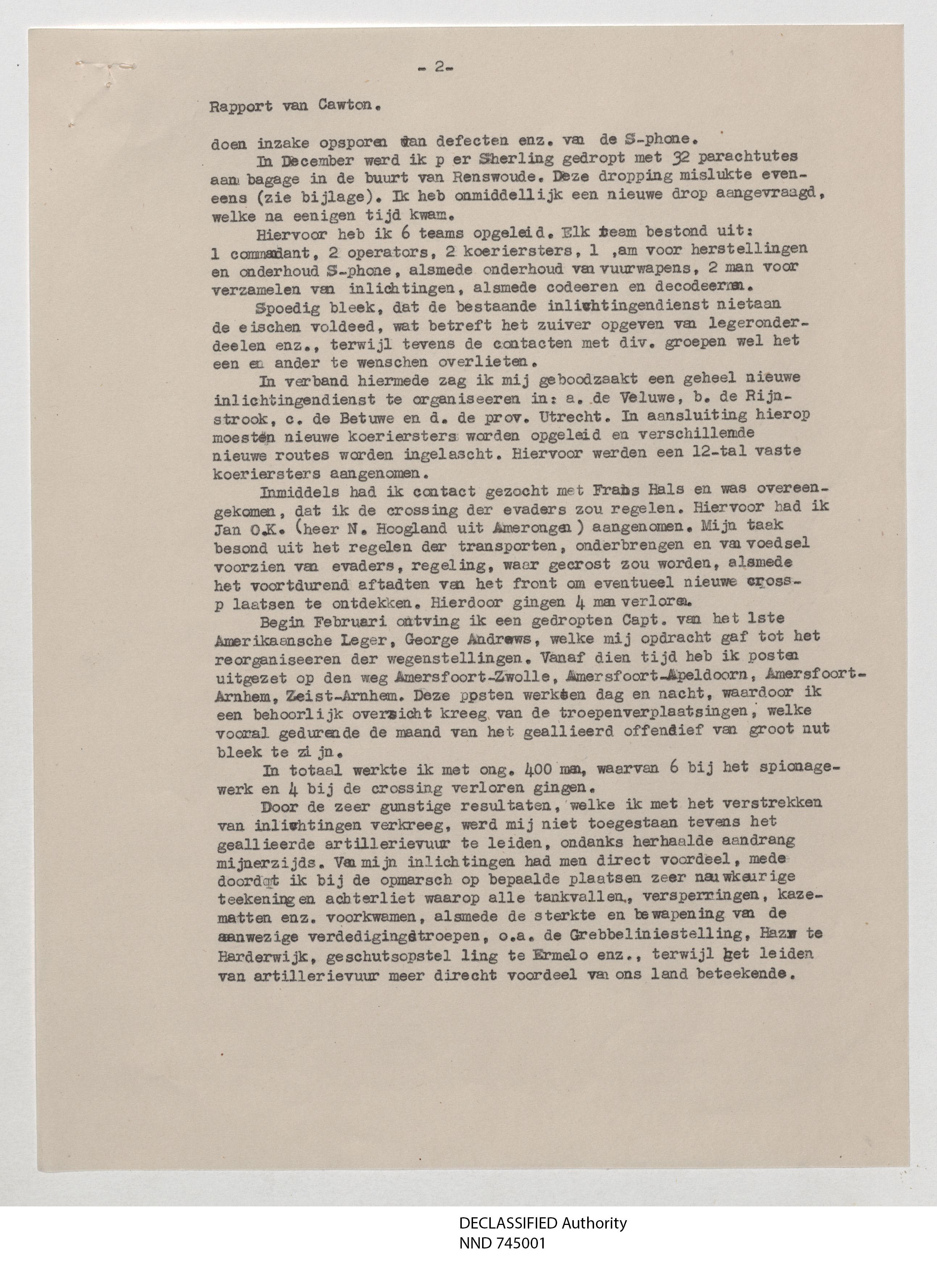
His Dutch report sets out the winter (p. 14):
- The drop again, and six teams. He asked at once for a new drop, which came after some time, and trained six teams, each of a commander, two operators, two women couriers, a man for the S-phone and the weapons, and two for gathering intelligence and coding. His English statement has the teams "to lead the fire", with "Receiver however but 3 senders" (p. 23); the American summary has three for evasion and three for intelligence (p. 16).
- An intelligence service. Finding the existing one not good enough, he built a new one over the Veluwe, the Rijnstrook, the Betuwe and the province of Utrecht, with about twelve permanent couriers. His statement adds a radio set "from Capt. King (Fabiau)" (p. 23): ✓ Capt. King is Gilbert Kirschen (Kluiters lists "KING, captain" as Kirschen, team FABIAN: Kluiters; Boeree has "G. S. Kirschen" in his chapter headed "CAPTAIN KING", pp. 157–160), and ◐ "Fabiau" is read here as a slip for the name of his team, FABIAN.
- The crossings. "Inmiddels had ik contact gezocht met Frans Hals en was overeengekomen, dat ik de crossing der evaders zou regelen" (meanwhile I had sought contact with Frans Hals and agreed that I would arrange the crossing of the evaders), engaging "Jan O.K. (heer N. Hoogland uit Amerongen)". His task was transport, lodging and food for the evaders, where to cross, and probing the front for new crossing places: "Hierdoor gingen 4 man verloren" (through this 4 men were lost).
- The road posts. At the beginning of February he received "een gedropten Capt. van het 1ste Amerikaansche Leger, George Andrews" (a dropped captain of the 1st American Army), who had him reorganise the watch on the roads; he set posts day and night on the roads Amersfoort–Zwolle, Amersfoort–Apeldoorn, Amersfoort–Arnhem and Zeist–Arnhem.
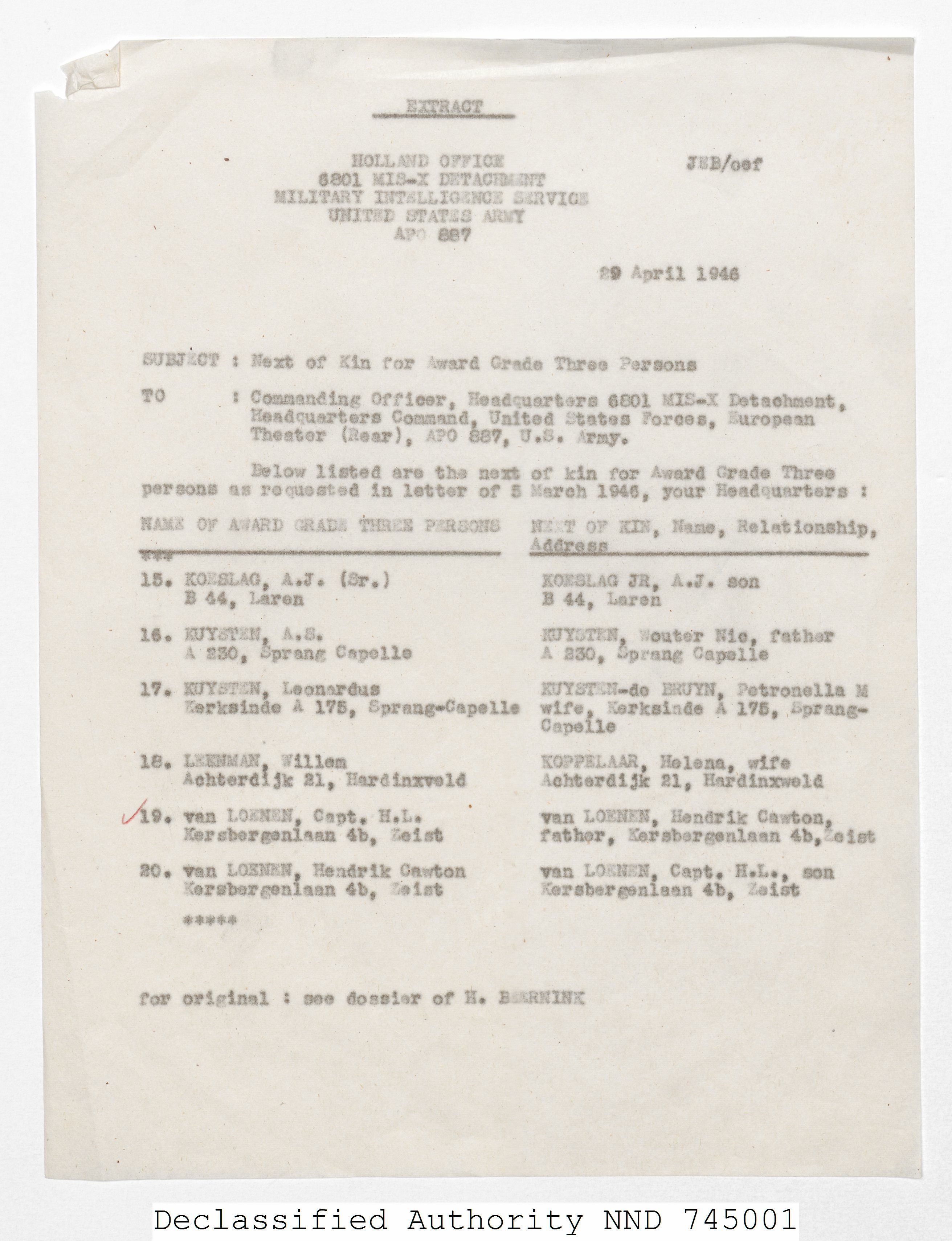
- How many he worked with: the English statement has "about 100 men completed with 300 men" (p. 23); the Dutch report "ong. 400 man, waarvan 6 bij het spionagewerk en 4 bij de crossing verloren gingen" (about 400 men, of whom 6 were lost in the spying and 4 at the crossing).
- The guns. He was not allowed to direct the artillery, because his intelligence was worth more; he says he left drawings of tank traps, obstacles and casemates for the advance, among them the Grebbe line and gun positions at Ermelo.
The four lost. His English statement names them: "Wim and Henk van de Meent from Renswoude, Koen Esveld from Amerongen, George Andrews" (p. 23; the copy in the Cornelisse-van Brink file, p. 16). ◐ "Wim and Henk van de Meent" are very probably the brothers Wim and Henk van der Mheen of Lunteren, whose questionnaires for the Americans, made out for the brothers (next of kin: their mother), say "capt. van Loenen (Bob)" sent them over the Rhine on 28 January 1945 (Henk's, p. 13; Willem's, p. 14); the spelling "van de Meent" and the place Renswoude are his alone, ◐ very likely a misspelling. ◐ Where Berend "Flip" Esveld has G.H. Esveld crossing after the middle of February with "Captain" George Mikol and "Wim and Henk from BARNEVELD", van Loenen has Koen (Flip's file, p. 7): the strongest tie between the two names (Coen Esveld, George Andrews, George Mikol). ✓ The Dodewaard police report of 29 June 1945, as noted on Henk's identification card, has the brothers, who had been hiding with the garage owner Esveld at Amerongen, go into the Betuwe by the Ingen ferry on 27 January "met gevieren met een Engelsch spion en een Amerikaan (Medicus)" (four of them, with an English spy and an American, a doctor), missing since 28 January; it names neither foreigner (the note). ⚠︎ Whether they were Mikol and Andrews, or one man, is not settled (George Andrews). ✓ The municipality of Dodewaard wrote in 1953 that Gerrit Herman Esveld, ◐ the Koen of this page (above), left with three companions probably on 27 January, and that they were all found dead there on 29 June 1945 (the letter); ⚠︎ that date fits Willem but not Henk, buried as an unknown person at Dodewaard at the end of January (Henk van der Mheen). ◐ That the three were van Loenen's other three is our match, and his Andrews arriving "begin Februari" does not fit a departure in January (How and when he died).
On others' forms. The Cawton men and their hosts name him:
- ✓ Gerardus Schoots of Elst: "His house was used as shelter for Lt van Loenen, dropped agent of the British, and for members of his group"; the house "was attacked by SS troopers while dropped agents were there. This occured in 1944." (the summary, p. 3, read on the image); his form lists "H. van Loenen (Bob)" among the Cawton people his house sheltered (p. 7).
- ✓ The Americans' summary on Joop Doornebosch of Leersum calls him an active cooperator of "Lt. Dick Kragt … and Capt. B. van Loenen" (p. 18); Maria Verloop of The Hague lists "Jan Oke' & Bob van Loenen, Amerongen" (her form, p. 2); the summary on Dirk Wildeboer of Ede names "Capt van Loenen" among the dropped agents who knew him (p. 48).
- ✓ Adriaan Maljers, December 1945: "The other day Henk van Loenen promised me everything but so far he did not fulfil his promise", which he gave as the reason he came to Wassenaar for an interview, "and that more for the other helpers than for me" (Maljers, p. 18; Adriaan Maljers).
- ✓ The Americans' sheet on Leendert Cornelisse says he "Served as courier for Cawton group" (his file, p. 2); the sheet carries "Lt. van LOENEN" where the investigating officer goes (see the cards), and nothing on it says he recommended him. Nico Hoogland gave his own group as "CAWTON Group and Intelligence Service" (his form, p. 2; the Hoogland family).
- ✓ Jacoba van der Mheen of Lunteren, the mother of Henk and Wim, lists "William Gordon", "Par. R.", hidden from 25 October 1944 for 60 days, received from J. Evers and passed on to "Amerongen, capt. H. v. Loenen." (her file, p. 4).
- ◐ The captain is very probably this page's, by the initial and the place. The man is Pte William Gordon of 156 Para, whose own report has the van der Mheen brothers take him to a garage owner at Amerongen about 8 January 1945 and does not name van Loenen.
- ◐ Wim, very probably one of those brothers, is the courier who met van Loenen at his drop (above). No source says what van Loenen did for Gordon.
- ✓ Of G. Henken he wrote in July 1946 that Henken had helped no pilot, "alleen heb ik persoonlijk met een zendteam gedurende enkele maanden bij hem thuis geopereerd" (only I personally operated with a transmitter team at his home for some months) (p. 4); the Holland Office's letter of 3 July 1946 asking Henken, of Middelbuurt 56, Veenendaal, for his questionnaire is on p. 7, pencilled "No help" (the scan).
⚠︎ By his own statement he was "In April liberated by the allies at Veenendaal" (p. 23); the recommendation has "his liberation in April" (p. 16). Neither gives a day, and no source here dates the liberation of Veenendaal: Boeree, who has Ede freed on 17 April, has Veenendaal and its surroundings still in German hands a week later (pp. 314, 316).
His brother Herman Lucas, "Alex"
Link to the section His brother Herman Lucas, "Alex"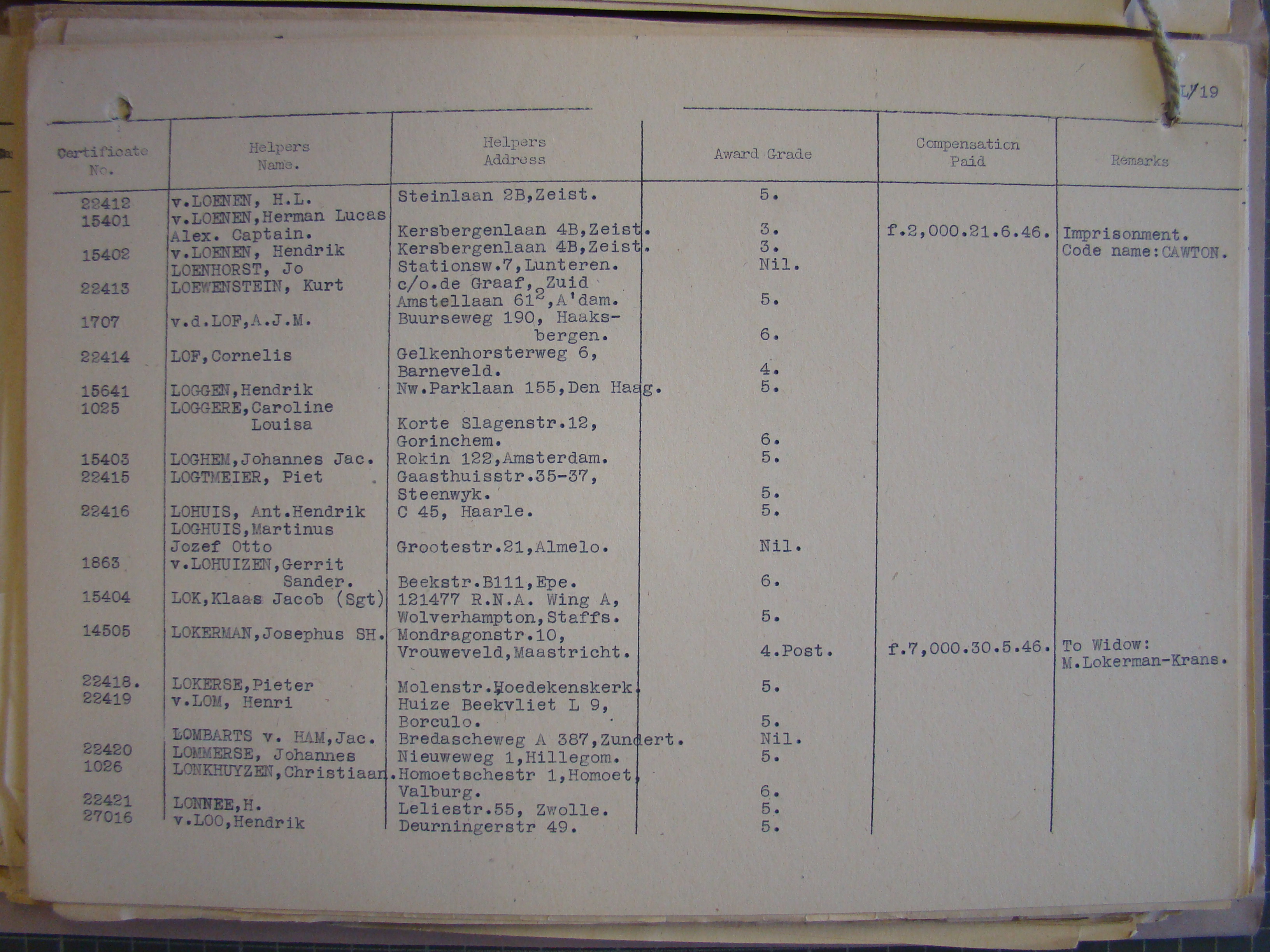
His statement calls Herman Lucas his brother, in hiding at his house (p. 22), and a letter of 1946 "mijn broer H.L. van Loenen (Alex)" (p. 36); ◐ the brother who went over the Waal ahead of him in October is not named, and is very probably the same man (p. 23). What the papers give of him:
- ✓ The British index has "v.LOENEN, Herman Lucas / Alex. Captain.", at Hendrik's address, grade 3, with "f.2,000.21.6.46." paid and "Imprisonment."; Hendrik's line, below it, has "Code name:CAWTON.". A third line above them has "v.LOENEN, H.L." of "Steinlaan 2B, Zeist", grade 5, ◐ a different man by the address, whom no source here names further (page L/19, read on the image).
- ✓ Kew's catalogue has Herman Lucas van Loenen, born at Zeist on 10 February 1917, King's Medal for Courage in the Cause of Freedom, 1941 to 1945 (the catalogue entries, WO 208/5456/28, WO 208/5275/2491), and the Americans gave the Medal of Freedom with bronze palm to "Herman L. van Loenen, Jr., Dutch Civilian -- 7 December 1941 to May, 1945" (General Orders of 4 September 1946; the order, in Klaas Dekker's file, p. 10).
- ◐ To the helpers he was, by our reading, "Luuk" or "Luck": none of these forms gives Luuk a first name, and the link is Kluiters's list of field names, which has both 'ALEX' and 'LUUK' as "LOENEN, van, H.L." (Kluiters).
- Adriaan Maljers "practically never worked together" with "Luuk van Loenen" but once took pilots "from Luuk's house accross [sic] the river" (p. 18).
- A Langbroek courier's form has "Luck [sic] van Loenen, toen in Amerongen, thans te Zeist" (then in Amerongen, now at Zeist) (p. 4).
- A. A. Copier's and Annie de Klerk's forms say Jan Oké (Hoogland of Amerongen) worked with him, "met Bob en Luck van Loenen" (with Bob and Luck van Loenen), and de Klerk's reads "Buck" (Copier, p. 2; de Klerk, p. 4; the Hoogland family).
- ◐ After the war he seems to have worked with the Americans' office, by inference from two forms: A. M. V. Stapper lists "L. van Loenen, M.I.S. Kersbergenlaan, Zeist (Luuk)" among the people known to him who helped Allied personnel (p. 2), and Adrianus van Wijnen of Kesteren wrote in May 1946 that he had made "ample reports on the request of Luuc van Loenen at Zeist months ago", and that "Due to the illness of Luuc" his cases would rest with Coslett (p. 5).
- ✓ Hendrik wrote in August 1946 that the Americans had paid f. 2000 for Alex's "herstellingskosten" (costs of recovery) and that his cure in Switzerland had to run at least three months more; his address was the "Nederland Sanatorium, Davos - Horlauben". On 31 October he wrote that Alex, there since January, had "een gat in zijn linker longtop" (a hole in the top of his left lung) and that the costs had passed f. 4000 (p. 36; p. 35; p. 28).
The Lt van Loenen of the Americans' cards
Link to the section The Lt van Loenen of the Americans' cardsFrom October 1945 to February 1946 the Holland Office's summary sheets in many helpers' files carry "Lt. van LOENEN" and a date, in the place where Hendrik's own sheet has its investigating officer (his own, p. 16). Among those that touch Murphy's story: Mrs Esveld-Strubbe and Freerk Stob, 20 November 1945 (her p. 2; his p. 5); Leendert Cornelisse, the same day (p. 2); E. Cornelisse-van Brink, 18 October 1945 (p. 20); B. Dijkstra, 8 February 1946 (p. 2). On 30 October 1945 bicycles were handed to helpers on receipts naming "H.L. van Loenen Lt." as issuing officer (Berend Esveld's receipt, p. 2; Joop Doornebosch's, p. 24), after Capt. Franklin D. Coslett had asked them to come on 6 October to "den Heer H. van Loenen, Kersbergenlaan 4b te Zeist" (Rakers's letter; Berend Esveld's, p. 16; Joop Doornebosch's, p. 23, which has "Kerbergenlaan"). Earlier, on 14 July 1945, Cornelis Dieckmann, writing from Renswoude, addressed his report on the evaders' pistols and binoculars to "Captain I.S. H. van Loenen, van Kersbergenlaan 4b" (◐ "4b" on a faint carbon), Zeist (p. 8); the initial fits either brother.
◐ The cards give no first name. Three things point away from Hendrik: he wrote on 26 August 1946 that "Tijdens de uitdeeling hier in Zeist was ik in Indie" (during the hand-out here in Zeist I was in the Indies) (p. 36), though the letter does not date that hand-out, so it may not be the one of 30 October 1945; the receipts name H.L., and Stapper's and van Wijnen's forms put "Luuk" at the M.I.S. taking reports (above). Three point to him: the same letter says that "Bij de afwikkeling bij I.S.9" (in the winding-up at I.S.9) he handed out cloth parcels and bicycles to all the helpers who qualified, he gave his own occupation as "Capt. H.Q. I.S.9" (p. 38), and Paula Dussenbroek of Utrecht wrote on 20 December 1945 that "Capt.van Loenen I.S.9Headqart. came and he promised me" help if she ever needed it (her letter, misfiled in the Ebbens-Smit file, pp. 10–11). The brother was in Switzerland from January 1946 (p. 28), and three of the cards held are dated February 1946: B. Dijkstra's, 8 February (above), Dirk Poelgeest's and Zegert van der Vlist's, both 5 February (Poelgeest, p. 4; v.d. Vlist, p. 4). So ◐ both brothers may have done this work, and no card can yet be given to either.
The Americans' verdict on his winter:
He displayed the greatest courage and persistence in his efforts to relieve the desperate situation in which many of the surviving evaders from Arnhem found themselves in the Winter of 1944-45, and many of these men owed their freedom to his untiring activities on their behalf.
— US National Archives · RG 498, helper file of Hendrik van Loenen · recommendation for award, 27 February 1946 · the archive's copy
The recommendation was investigated by Major Windham Wright and approved by Capt. Franklin D. Coslett of the MIS-X Holland office (p. 16). A later note in his file says that he and Leonard Wilkens "should definitely remain Grade 111" (p. 13). He received the Medal of Freedom with bronze palm for "January, 1943 to April, 1945" (General Orders 277, 4 October 1946; p. 24). In August 1946 he thanked the Americans for an invitation to a ceremony for himself and his brother, and asked them to fly his brother over from Switzerland for it (p. 35). The medals were presented at the Indisch Instituut in Amsterdam on 21 November 1946; the list printed next day names "H. L. van Loenen Zeist" and "Hendr. van Loenen, Zeist" among those who received it (De Nieuwe Nederlander, 22 November 1946).
The British gave him the King's Medal for Courage in the Cause of Freedom, "approx 2 years" of service (WO 208/5454/16, 27 March 1946; WO 208/5275/2490, BM/3187), and Kew also holds his SOE personnel file, "Hendrik VAN LOENEN aka TERBORG aka Bob DE VRIES" (HS 9/1507/4) (the catalogue entries). The British index has him as certificate 15402, grade 3 (page L/19).
✓ The Netherlands gave him the Bronze Lion by royal decree of 8 June 1946, no. 34, "als zodanig tijdelijk benoemd Res. 1e luit. van algemenen dienst" (as such temporarily appointed a reserve first lieutenant of the general service), on the War Ministry's proposal; its register number is 460. The card gives his birth as 1 September 1915, ◐ at Zeist, the place name cramped (his award card, Nationaal Archief 2.02.32). It carries no citation. ✓ The published register of holders of the Resistance Memorial Cross (Verzetsherdenkingskruis) has "Loenen, Hendrik van 01-09-1915" on p. 162 (the register, read on the page image; entries give name and birth date only).
His letters to the Americans in 1946 (pp. 28–37):
- His own share. On 26 August he asked for two sets of bicycle tyres for himself and his wife: his house at Rhenen had been hit by bombs and they had lost practically everything, and he had taken the position "in de eerste plaats voor anderen te zorgen en voor mijzelf niets te vragen" (to look after others first and ask nothing for myself) (pp. 36–37).
- The group. On 12 September he asked for an interview "In verband met verschillende moeilijkheden met enkele leden van de groep "CAWTON"" (in connection with various difficulties with some members of the group "CAWTON"); the letter does not say what they were (p. 31).
- For the helpers. On 31 October he wrote that people were still asking him for bicycles and tyres, and that several who were to have a certificate had not had one (p. 28).
He died at Leiden on 8 June 1997 (Kluiters).
Where the sources disagree
Link to the section Where the sources disagree- Where he crossed in October. By his Dutch report, near Tiel, with his brother (p. 13); across the Biesbosch, in Kluiters (Kluiters); his English statement gives no place (p. 22).
- Which river on the way back. The American summary has him crossing back "the flooded river Waal … at the eighth attempt" and returning by swimming the river (p. 16); both his own accounts have the Waal attempts fail and the last attempt made over the Rhine near Rhenen (p. 23; p. 13).
- How many were lost. His statement has the three Canadians lost to the first burst on the Rhine (p. 23); the American summary says he was "twice sunk and three men were lost" over the eight attempts (p. 16).
- His brother's crossing. "Two days afterwards" and "One man dead" in English (p. 23); "1 dag later" (1 day later) and "1 burger gefusileerd" (one civilian executed on the spot for it) in Dutch (p. 13).
- The six teams. Three for evasion and three for intelligence in the American summary (p. 16); "6 teams to lead the fire", artillery spotting, in his statement (p. 23); in his Dutch report each team has operators, couriers and two men for intelligence (p. 14).
- When he was dropped. The dates differ:
- "At the end of Dec." in his statement (p. 23); 28/29 December in Kluiters (Kluiters).
- 28 December in Boeree (p. 259), whose own narrative puts it two days after the failed Christmas eve attempt, so ◐ on 26 or 27 December, by our count (p. 242).
- ⚠︎ Ede's manuscript history of the resistance has it "In de nacht van 27 op 28 november" (in the night of 27 to 28 November), with Henk van Loenen, code name Bob, landing near the garden of "De Mariënhof" on the Klomperweg (pp. 53–54, PDF pages 52–53, read on the image); every other source has December.
- Where he came down. In his statement (p. 23) and in Kluiters, near Renswoude; in Boeree, on the road from Lunteren to Ederveen, close by the N.S.D.A.P. barracks, in Boeree (p. 243). Not reconciled.
- Andrews's arrival. He received George Andrews "begin Februari" (p. 14) and lists him among the four lost with Koen Esveld; Dodewaard has Koen leaving probably on 27 January (the letter), the police report has the van der Mheen brothers leave that day with an English spy and an American (the note), and the questionnaires made out for the brothers (next of kin: their mother) have him send them on 28 January (p. 13). Set out on George Andrews.
- His family.
- The Americans' list of next of kin of 29 April 1946 has "van LOENEN, Capt. H.L." with next of kin "van LOENEN, Hendrik Cawton, father", and "van LOENEN, Hendrik Cawton" with "van LOENEN, Capt. H.L., son" (p. 5), and the draft recommendation gives his nearest relative as "HENDRIK CAWTON VAN LOENEN (father)" (p. 9).
- ✗ The two brothers made father and son: his own statement and letters call H.L. his brother, and he named his wife as his next of kin (p. 22; p. 36; p. 38).
- ◐ The lists' "Hendrik Cawton" is most likely his code name written as a middle name; no source says so.
- Which brother is Boeree's "Bob". Boeree's p. 243 text has the man dropped as "Capt. Henk van Loenen, bijgenaamd Bob" (nicknamed Bob) (p. 243); ⚠︎ the Ede archive's index to the book, in the archive's own OCR, has the line "Loenen Her.Lk v. (:Bob) 243", which reads as Herman Lucas (the index). A later index set against the book's own text and every other source here, which give Bob to Hendrik, so weak; it is recorded because it is the one place the nickname goes to the brother.
- His brother's dates. ⚠︎ Kluiters gives the MI9 agent Herman Lucas van Loenen, code names ALEX and LUUK, as born at Apeldoorn on 15 August 1889 and died at Zeist on 7 June 1977, and Hendrik as "son of H.L. van Loenen" (Kluiters); Kew has Herman Lucas born at Zeist on 10 February 1917 (the catalogue entries), and the American order calls him "Jr." (p. 10). ◐ Their father was also Herman Lucas (Hendrik's birth), so Kluiters's dates are probably the father's; no birth or death record of either Herman Lucas has been read.