George Andrews
About: A captain "of the 1st American Army" whom Hendrik van Loenen says was dropped to him at the beginning of February 1945, and whom he lists among the four men he lost probing the front, with Koen Esveld, ◐ the younger son of the Amerongen household that hid Murphy. ⚠︎ Whether he is the "Captain" George Mikol the Esvelds hid, or the "Amerikaan" of the party that left Amerongen on 27 January 1945, is not settled.
Unit or role: "dropped capt. of the first Ameri[c]an Army, George Andrews (staff at that time at Brussels)", in van Loenen's statement (p. 23); no other source gives him a unit.
Where: By van Loenen, at the beginning of February 1945 with his network on the roads out of Amersfoort and Zeist; lost near the front.
Evidence: ✓ Hendrik van Loenen's Dutch report, "Rapport van Cawton" (p. 14 of the Cornelisse-van Brink file), and his English statement (his file, p. 23; the copy in the Cornelisse-van Brink file, p. 16); ◐ for the party of 27 January, the note attached to Hendrik van der Mheen's identification card (Nationaal Archief 2.19.255.01, 104012A, scan 8) and the Gemeente Dodewaard's letter of 1953 (41478A, scan 7).
In van Loenen's papers
Link to the section In van Loenen's papers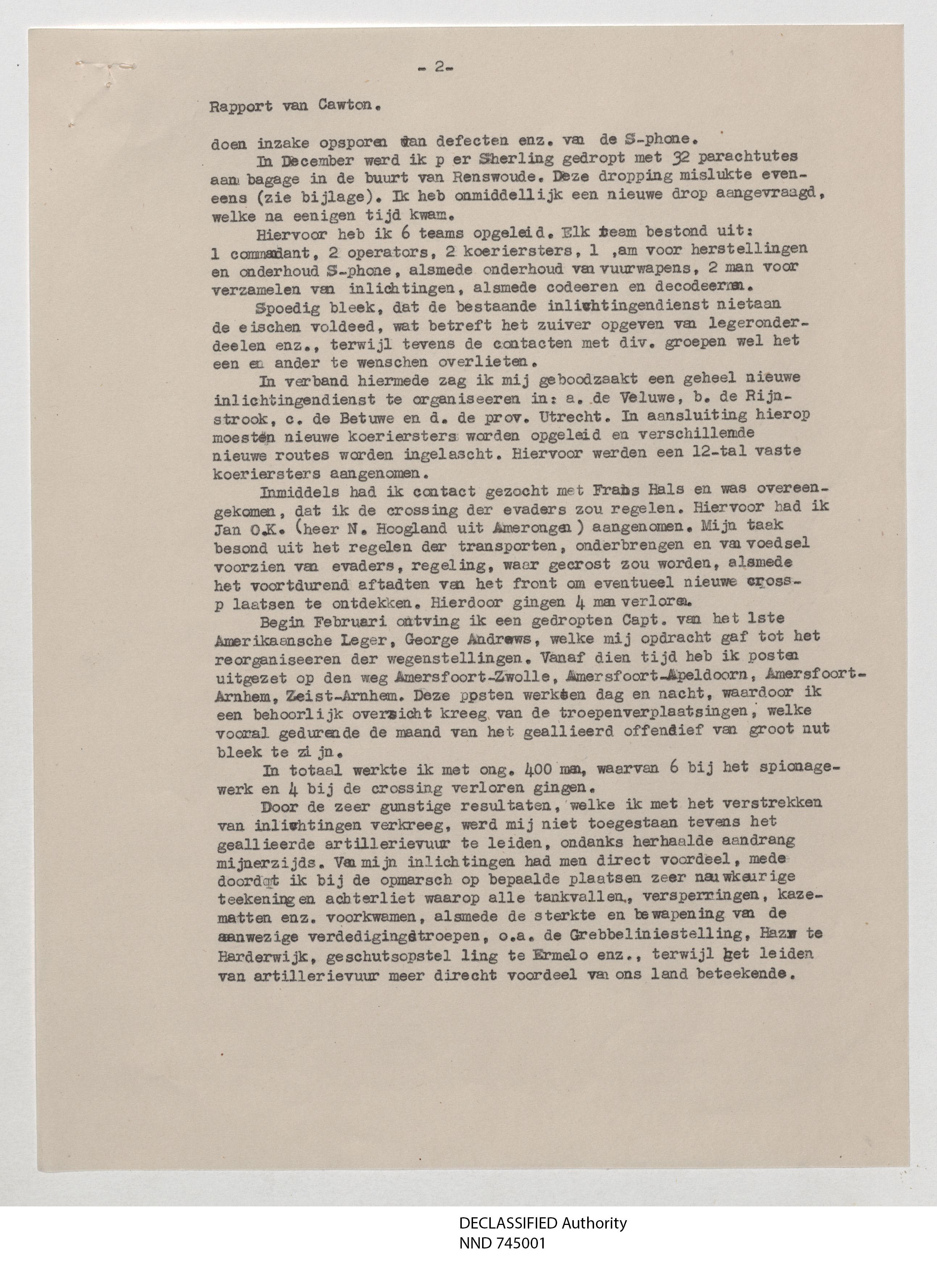
Only Hendrik van Loenen names him, in a Dutch report copied into two helper files (this one and Wilhelm van Hernen's, p. 7, which has his name) and an English statement held in two (his own and this one): copies of the same two documents, so no extra weight. In his Dutch report, headed "Rapport van Cawton", he says he had agreed to arrange the crossing of the evaders, engaging Mr N. Hoogland of Amerongen for it (p. 14). The same page says:
At the beginning of February I received a dropped Capt. of the 1st American Army, George Andrews, who instructed me to reorganise the road posts. From that time I set out posts on the road Amersfoort-Zwolle, Amersfoort-Apeldoorn, Amersfoort-Arnhem, Zeist-Arnhem. These posts worked day and night, which gave me a fair view of the troop movements …
Dutch originalBegin Februari ontving ik een gedropten Capt. van het 1ste Amerikaansche Leger, George Andrews, welke mij opdracht gaf tot het reorganiseeren der wegenstellingen. Vanaf dien tijd heb ik posten uitgezet op den weg Amersfoort-Zwolle, Amersfoort-Apeldoorn, Amersfoort-Arnhem, Zeist-Arnhem. Deze p[o]sten werkten dag en nacht, waardoor ik een behoorlijk overzicht kreeg van de troepenverplaatsingen …
— Hendrik van Loenen · "Rapport van Cawton", p. 2 · US National Archives, helper file of E. Cornelisse-van Brink, p. 14 · the transcript
His English statement has the same in short: "Beginning Febr. by request of dropped capt. of the first Ameri[c]an Army, George Andrews (staff at that time at Brussels), organized counting traffic along the roads" (his file, p. 23). The Dutch word is wegenstellingen, which we render "road posts" (a stelling is a position or post); the English says "counting traffic", so the two do not say quite the same.
The four lost. The English statement goes on: "Lost 4 men by trying to discover opening in front. Names were: Wim and Henk van de Meent from Renswoude, Koen Esveld from Amerongen, George Andrews" (same page; the copy in the Cornelisse-van Brink file, p. 16). The Dutch report names nobody. It puts the loss in its paragraph on the crossings, before the paragraph on Andrews: his task included "het voortdurend aftasten [typed "aftadten"] van het front om eventueel nieuwe crossplaatsen te ontdekken. Hierdoor gingen 4 man verloren" (continually probing the front to find new crossing places; through this 4 men were lost). Its total keeps the crossing apart from the intelligence work: "In totaal werkte ik met ong. 400 man, waarvan 6 bij het spionagewerk en 4 bij de crossing verloren gingen" (in all I worked with about 400 men, of whom 6 were lost in the spying work and 4 at the crossing) (p. 14). ◐ That the four of the English list are the four of the Dutch count is our reading of the matching number; if so, van Loenen counts Andrews among those lost at the crossing, not among the six lost in the spying.
With Murphy
Link to the section With MurphyNo source puts him with Murphy, who left the Esvelds' house at Amerongen on 2 January 1945 for a crossing "which did not succeed" (Mrs Esveld's statement, p. 5), a month before van Loenen says he received Andrews. What ties him to Murphy's story is the man van Loenen lost with him: "Koen Esveld from Amerongen", ◐ Gerrit Herman "Coen" Esveld, the younger son of that household, which hid Murphy from 23 or 24 December 1944 (Hardy has the evening of the 23rd, Mrs Esveld the 24th) to 2 January 1945 (Hardy; her statement, p. 5), and, ◐ if Hardy's "KOEN" is he, one of the two who took Murphy and Hardy out: "At 1300 hours we left on bicycles with KOEN and KEEK (?)" for the Rhine ferry on 2 January (Hardy; Mrs Esveld has "Louis and Kik"). A snippet of Caspers also has Coen among the guides of Murphy's party (Caspers, p. 175). More on Coen Esveld and on Amerongen and the last night.
The party of 27 January 1945
Link to the section The party of 27 January 1945Three sources tell of a journey that left Amerongen at the end of January 1945. ◐ That the police report's party is Coen Esveld's is our match, by the dates and by the Dodewaard deeds, where Willem van der Mheen's deed 14 sits beside Coen's deed 13 (the index records). None of them names a George Andrews.
The Gemeente Dodewaard, 1953. ✓ Answering the War Graves Foundation on 17 August 1953, the municipality wrote that an inquiry made at the time had shown that Coen left "in gezelschap van 3 personen, vermoedelijk op 27 Januari 1945, naar de Betuwe" (in the company of 3 persons, probably on 27 January 1945, for the Betuwe) "teneinde een Engelse boodschap over te brengen" (to carry an English message), and that "De toen in gezelschap van Esveld zijnde personen zijn allen op 29 Juni 1945 in Dodewaard overleden bevonden" (the persons then with Esveld were all found dead at Dodewaard on 29 June 1945) (the letter). It names none of the three.
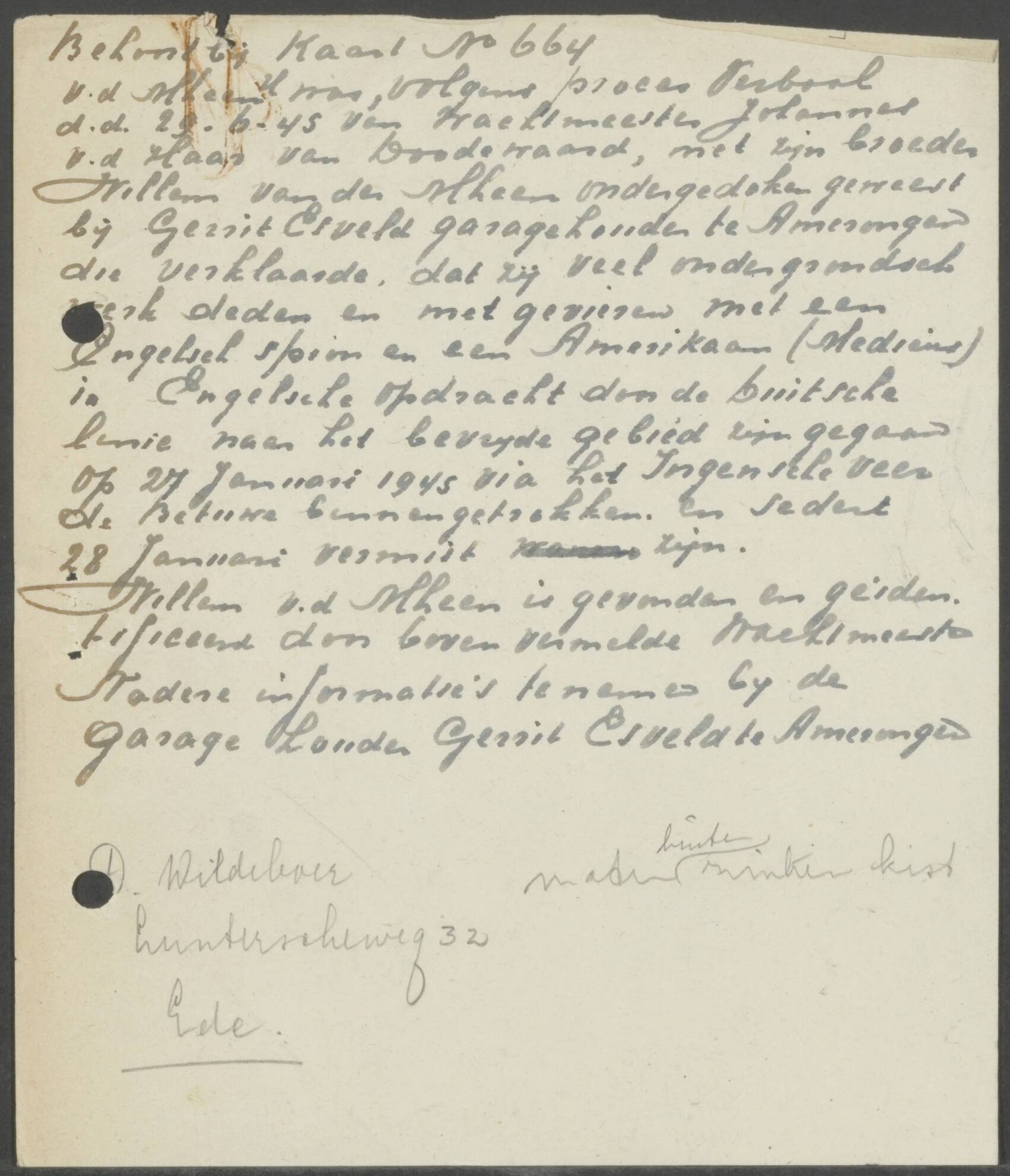
The police report of 29 June 1945, as noted for the identification service. ✓ The War Graves Foundation's file on Hendrik van der Mheen of Lunteren holds a handwritten note attached to his identification card, No. 664, summarising a report by the Dodewaard policeman who found his brother:
According to the official report of 29-6-45 by Wachtmeester Johannes v.d. Haas of Doodewaard, H. v.d. Mheen had been in hiding with his brother Willem van der Mheen at the house of Gerrit Esveld, garage owner at Amerongen, who declared that they did a great deal of underground work and, four of them, with an English spy and an American (doctor), went on an English mission through the German line to the liberated area. On 27 January 1945 they went into the Betuwe by the Ingen ferry, and have been missing since 28 January.
Dutch originalv.d Mheen H was, volgens proces Verbaal d.d. 29-6-45 van Wachtmeester Johannes v.d Haas van Doodewaard, met zijn broeder Willem van der Mheen ondergedoken geweest bij Gerrit Esveld garagehouder te Amerongen die verklaarde, dat zij veel ondergrondsch werk deden en met gevieren met een Engelsch spion en een Amerikaan (Medicus) in Engelsche Opdracht door de Duitsche linie naar het bevrijde gebied zijn gegaan Op 27 Januari 1945 via het Ingensche Veer de Betuwe binnengetrokken. en sedert 28 Januari vermist zijn.
— Note attached to card No. 664 of the Dienst Identificatie en Berging · Nationaal Archief 2.19.255.01, inv. 104012A, scan 8 · the transcript
The note reads Haas; the last letter is not certain, and Haar is the other reading. It goes on: "Willem v.d Mheen is gevonden en geïdentificeerd door bovenvermelde Wachtmeester" (Willem v.d. Mheen has been found and identified by the policeman named above), and ends "Nadere informatie's te nemen bij de Garage Houder Gerrit Esveld te Amerongen" (further information to be had from the garage owner Gerrit Esveld at Amerongen). The note is undated; the card it belongs to records Hendrik's exhumation on 30 July 1946 (scan 6). What it gives:
- Who declared it. "Gerrit Esveld garagehouder", ◐ the father, Gerald (Gerrit Hendrik) Esveld, whom Coen's death deed calls garagehouder, where Coen himself is monteur (Amerongen 1945, Nr. 48). The note names no Esveld among those who went.
- Who went. The brothers, "met gevieren met een Engelsch spion en een Amerikaan (Medicus)": four of them, with an English spy and an American, a doctor. Neither the spy nor the American is named. ◐ Met gevieren is literally "as a party of four", and the note does not say who the four are, so it does not settle the count:
- When. Into the Betuwe by the Ingen ferry on 27 January 1945, missing since 28 January, the same two days as Dodewaard's letter. ◐ That this police report is the inquiry "destijds" (at the time) the letter rests on is our reading of the matching dates.
Who the brothers were. ✓ The two Dutchmen of the note are Willem and Hendrik van der Mheen of Lunteren, who had been hiding with the garage owner Esveld at Amerongen (the note). They are very probably the "Wim and Henk" of the other sources:
- ✓ Pte William Gordon of the 156th Battalion, hidden at a blacksmith's between Barneveld and Lunteren, wrote that on 8 January, "or thereabouts, the two brothers of VAN DER MHEEN - HANK and WILHELM - took me by cycle to AMERONGEN", to the garage owner there (Gordon). He also writes that the blacksmith who hid him was named VAN DER MHEEN, and Willem is recorded as a smith (below); whether the blacksmith was Willem or another of the family, his text does not say.
- ◐ Mrs Esveld has her "Bill, parachutist, Scotland" brought on 9 January by "Henk and Wim" from the "de MEENT family at 't Woud, near BARNEVELD" (her statement, p. 5), and Flip Esveld has "Bill" arrive at his house in mid-January "with Wim and Henk from BARNEVELD" (Flip's file, p. 7). That Bill is Gordon is our match, by the date and the escort.
- ◐ Flip's own list of 26 April 1946 has "Bill Paratrooper from "Arnhem Landing"" received from "v. d. Mheen. Lunteren" and hidden 42 days (p. 13; typed copy, p. 10). That ties the "Wim and Henk from BARNEVELD" who brought Bill to the van der Mheens of Lunteren by Flip's own list, not only by the date and the escort.
- ◐ Van Loenen's "Wim and Henk van de Meent from Renswoude" are very probably the same pair (the questionnaires made out for the brothers for the Americans (next of kin: their mother) have van Loenen, "Bob", send the two brothers over the Rhine on 28 January: Henk's, p. 13; Willem's, p. 14) (Wim, Henk).
What the death records say. ✓ Willem van der Mheen, 22, smith, born at Ede, is recorded dead at Dodewaard on 29 June 1945, in the Dodewaard register's deed 14 of 3 July 1945; deed 13 of the same day is Coen Esveld's (the index records). ✓ Hendrik van der Mheen, 20, clerk, is recorded dead at Dodewaard on 28 January 1945, in a deed of 12 August 1946 (same). ✓ Hendrik's card from the identification service has him exhumed on 30 July 1946 from the front garden of a house at Hien, Dodewaard, under a cross reading "Unknown Civilian Killed in Action 28-1-45", and reburied at Ede (scan 6); the Foundation's form has him buried on 30 or 31 January 1945 "als onbekend persoon te Dodewaard" (as an unknown person at Dodewaard) (scan 4). ⚠︎ The same form gives his death as 29-1-1945, a day later than the deed and the cross, and his birth as 22 October 1925 at Ede, where his identification card has 14 July 1924 at Lunteren (scan 6); the deed's age of 20 on 28 January 1945 fits 1924, not 1925, and the index has Ede as his birthplace; ◐ the form is the only source for a burial at the end of January, so that date rests on a form that is wrong or doubtful on two other points. If it is right, Hendrik was buried at the end of January, where Dodewaard's letter has all of Coen's companions found on 29 June; if it is wrong, the letter's date may stand for all of them. No death record held names the spy or the American, and the Open Archieven index has none of Dodewaard's deeds 15 to 20 of 1945, so the index cannot rule out an unnamed death recorded there (the search).
Caspers. ◐ Elsa Caspers, a courier of the resistance on the Utrechtse Heuvelrug, wrote fifty years on that "On 29 January 1945 Coen made one more attempt to find an escape route. He went with two other Dutch boys and a South African soldier", and that their bodies were found in June "in grazing land", after they had crossed no-man's-land: "they were killed by a V-1 'doodle-bug' explosion" (To Save a Life, p. 66). She names none of them. ⚠︎ Her 29 January is two days after the 27 January of the note and Dodewaard's letter, and neither of them mentions a V-1; a V-1 does appear in the questionnaire made out for Willem ("probably killed by a V 1 during his work", p. 14) and in Boeree, who has the brothers perhaps killed by a V 1 that went off too soon (p. 245).
Where the sources disagree
Link to the section Where the sources disagreeOne man or two. ⚠︎ Not settled. Van Loenen's four lost (Wim, Henk, Koen Esveld and George Andrews) and Berend "Flip" Esveld's crossing party ("Captain" George Mikol, G.H. Esveld, "Wim and Henk from BARNEVELD") share, on our matching of the names, three men; the fourth in each is a captain called George (van Loenen, p. 23; Flip's file, p. 7).
- For one man. ◐ Three of four names match, if Flip's "G.H. Esveld" is Koen Esveld (our match) and the "Wim and Henk" of Barneveld are those of Renswoude (our match), and each list has one captain named George.
- For two. The police report's party has both "een Engelsch spion" and "een Amerikaan (Medicus)" (the note). Mikol is "Captain - spy" to Flip (p. 7), "English spy" on Flip's list of 1946 (p. 13) and "agent of the English" to Mrs Rolandus Hagedoorn (her file, p. 4); Andrews is "capt. of the first Ameri[c]an Army" to van Loenen. ◐ That would make Mikol the spy and Andrews the American, which is our match; the note's American is "(Medicus)", and nothing in van Loenen's papers says Andrews was a doctor.
- Against both readings. ◐ If the note's four leave Coen outside the count, Dodewaard's letter has Coen and three others, the police report the brothers and two foreigners with no Esveld named: Coen and both captains would make five. If the four include Coen, the letter's "Coen and 3" would fit Coen, the brothers and one foreigner, which favours one man, but the note names two. The note does not settle which. Caspers has a South African soldier and no American.
When he came, and when the party left. ⚠︎ Not settled.
- Caspers has Coen's last attempt on 29 January, two days after the 27 January of the note and the letter (p. 66).
- Van Loenen received him "Begin Februari" (at the beginning of February) (p. 14).
- Flip has Mikol at his house "From end January to mid February", then crossing with G.H. Esveld and Wim and Henk (p. 7).
- The police report has the brothers leave on 27 January and missing from 28 January (the note); Hendrik was buried on 30 or 31 January (scan 4); Dodewaard has Coen leave probably on 27 January (the letter).
- The questionnaires made out for the brothers for the Americans (next of kin: their mother) have van Loenen, "Bob", send them over the Rhine on 28 January (Henk's, p. 13; Willem's, p. 14); Boeree has them go to the Betuwe on 29 January (p. 245).
- A man received at the beginning of February could not have left with them on 27 January. Either van Loenen's month is out, or Andrews was not in that party and was lost on another attempt.
His army. "1ste Amerikaansche Leger" and "first Ameri[c]an Army" (van Loenen), against "agent of the English" (Mrs Rolandus Hagedoorn), "spy" (Flip, 1945) and "English spy" (Flip's list of 26 April 1946, p. 13), if he and Mikol are one man.
Searches so far
Link to the section Searches so far- Kew. ✓ The WO 208 catalogue of MI9 and IS9 escape and liberation reports has no entry for a George Andrews or a Mikol (WO 208/3324–3354, 5405–5436 and the card index 5275, checked 15 October 2026: the catalogue search).
- A namesake, found by the 17 October sweep of Kew's catalogue, is WO 208/4239/15: Pte George Andrews, 2nd Battalion South African Police, captured at Tobruk on 21 June 1942, escaped from PG 146 Mortara on 10 September 1943, arrived in Switzerland (the catalogue dates the entry 12 July 1944) (the sweep).
- Caspers has a "South African soldier" in Coen's party, but nothing ties this man to the Netherlands or to Amerongen: considered, not tied.
- The war dead. ✓ The name sweep of 17 October 2026 found no George Andrews among the Oorlogsgravenstichting's war dead in the Netherlands; its four hits under "Andrews" are other men, and none of Open Archieven's hits for "George Andrews" (mostly American death records from the 1960s on) fits a man lost in 1945 (the sweep).