Robert Bailey
28 Jan 1921 – after 1962
About: A Mosquito night-fighter pilot of 239 Squadron shot down on 27/28 May 1944, hidden at Renswoude and Stroe before Murphy's time, who went down the escape line with the American Bill Lalley and was taken at Antwerp on 11 August 1944. He was a prisoner at Stalag Luft III, Sagan, was freed near Lübeck on 2 May 1945, and stayed in the RAF until 1962.
Unit or role: Mosquito pilot, RAF, officer number 49730 (a corporal, 570936, until commissioned in 1942: Gazette); 239 Squadron, West Raynham, by Bowman's Mosquito Mayhem (the extracts, p. 73).
Where: Renswoude, Stroe (Eskes house), Breda, Antwerp; Stalag Luft III at Sagan; Lübeck. Home addresses: Burscough, Lancashire, on Mrs Eskes-Buis's form; Portadown, Northern Ireland, on three Dutch tables (see below).
Evidence: ✓ Kew's catalogue entries; ✓ the London Gazette notices of 1942 to 1962 (under After); ✓ Airborne Magazine; Jeane van Galen's file, p. 3; ✓ the Renswoude helpers' own forms (Kees Lagerwey's, Sander Lagerwey's); ✓ Arie Zanen's form for Breda and the crossing; Noordman, Schuilplaats de Veluwe, pp. 162–170; Bowman's Mosquito Mayhem (2010), pp. 73–78, from Bailey's own article in The Mossie (August 1997).
Born and commissioned. ✓ Kew's catalogue entry for the duplicate of his report gives his birth as 28 January 1921 (WO 208/3333/1202). The London Gazette of 24 November 1942 has "570936 Robert Kerr BAILEY (49730)", a corporal, among the airmen to be Pilot Officers on probation (emergency) in the General Duties Branch, from 17 September 1942; 49730 is his officer's number (issue 35795, p. 5101; the heading on p. 5100). He was 21 when he was commissioned. The promotions that follow, to Flying Officer on probation from 17 March 1943 and to Flight Lieutenant (war substantive) from 17 September 1944, are in the Gazette of 8 June 1943 and 19 December 1944; the second was printed while he was a prisoner, and the Dutch helpers' forms call him a pilot officer, a flying officer, a flight lieutenant or a captain, and Mrs Eskes-Buis a first lieutenant.
Where he was hidden. Nelly Eskes-Buis, who hid him, gave the Americans his name and address as "Robert Kerr Bailey (Mosquito pilot, 1st Lt) 54 Lord's gate Lane, Burscough, Lancashire", number 49730, "shot down at night (at the end of May 1944) near Ede" (her file, p. 7). Kew's catalogue has him evading "in Holland and Belgium, 27 May - 11 Aug 1944" (the catalogue entries).
In hiding
Link to the section In hidingHis own account, which Martin Bowman prints in Mosquito Mayhem (2010) from Bailey's article in The Mossie, vol. 17, August 1997 (the extracts; pp. 75–77 were checked against the page images when they were made, the rest read from the text layer), tells it in a different order from Mrs Eskes-Buis's, and the two are set side by side under Where the sources disagree. It runs as follows.
- Shot down.
- ✓ F/O R. K. Bailey and his navigator, F/O J. F. M. White, of 239 Squadron at West Raynham, did not return on the night of 27/28 May 1944, one of six night-fighter crews sent to Leeuwarden (p. 73; Bowman's German Night Fighters, p. 89, has "eight Mosquitoes").
- He shot down an Me 110 near Leeuwarden at 11,000 ft, lost both engines and baled out; he came down with a sprained ankle and a wound in the face and at about 1.45 a.m. knocked at a farmhouse "using the Morse 'V'" (p. 74).
- ⚠︎ Bowman's other books disagree about that Me 110, the Bf 110 of 7./NJG 1 that crashed at Spannum in Friesland that night: see Where the sources disagree.
- The date fits Kew's "27 May" (the catalogue entries); Mrs Eskes-Buis's "near Ede" is not in his account.
- Renswoude.
- He was "in a small village, Renswoude, in the province of Utrecht, under the care of the family Largereeij. The boy's Christian name was Kees", a boy of about fifteen who hid him in "a hollowed-out haystack at his father's farm" (p. 75). ✓ The family is the Lagerwey household of Renswoude, and the father is Sander Lagerwey (see Renswoude, the family below).
- On 6 June Kees brought news of the invasion; a few days later district resistance leaders said he could not be moved south yet.
- They then took him, armed with a hand-gun, on a raid on a post office in a neighbouring village for ration cards and money, in which one of the workers "slumped to the floor" after two shots (pp. 75–76, text layer only).
- Stroe and the Eskes house.
- Two men came to the farm: "Mr Van Den Topp from Stroe in Gelderland and 'Dick', a British agent", who questioned him "for some time to establish that I was an evading RAF pilot" (p. 76). ◐ "Dick" is very probably Dick Kragt, though Bowman does not say so.
- Noordman's Dutch text adds that Dick "werkte al een jaar in deze regio" (had been working in this region for a year) and puts the visit "aan het einde van de derde week in de hooiberg" (at the end of the third week in the haystack), not the day of the post-office raid (p. 165).
- He was taken to Van den Top's house to meet an American pilot, "Bill Lalley, a Fortress pilot from Lowell, Michigan".
- "Alas, my good fortune did not last more than two days": a young Jewish girl was visiting, and he went on to "Dr Dirk Eskes and his wife in a small house in wooded country not far from Stroe", where at dusk he was "lowered into a hiding-place like a grave" (p. 76).
- G. J. van den Top's own table has "Bob BAILEY Capt. Mosquito R.A.F. June '44 8 days collected by himself", and the Americans' summary "Bob Baily, RAF, 8 days" (his table, p. 3; the summary, p. 4, image-checked).
- Jacobus Spruyt of Veenendaal ("Jaap", Local Organisation) lists "Robert Kerr Bailey, RAF, May 44, Renswoude" and writes "I did not shelter these people myself, but nevertheless provided them with lodgings, clothes, money, coupons, papers, tabacco etc.", and "I also transported these people"; he does not say which of the men he moved (his table, his remarks, both read from the images).
- ◐ Dignus Kragt, writing of the line's last weeks, has "a new line with Bill Lalley and Bol Bailey [?] in August 1944" (Kragt, p. 43; p. 34), the misspelling of Bob, and Noordman prints the same sentence from him as "de vliegers Lalley en Bailey in augustus 1944" (Noordman, p. 116).
- Two men came to the farm: "Mr Van Den Topp from Stroe in Gelderland and 'Dick', a British agent", who questioned him "for some time to establish that I was an evading RAF pilot" (p. 76). ◐ "Dick" is very probably Dick Kragt, though Bowman does not say so.
- The journey out.
- "About mid-July" word came from Stroe that papers were ready and he was to collect Bill Lalley; his travelling papers made him "a deaf and dumb basket maker" (p. 76).
- The two rode a tandem behind a lone cyclist, spent a night in separate houses, and next day went by train with two guides, waiting in Arnhem "in the station-master's private apartment", to Breda, where he was taken to "the home of Gerry and Arie Zanen at 8 Artillery Straat" (p. 77). The guides are not named; Mrs Eskes-Buis's file has "Joop", ◐ Dr Kruimel.
- ◐ Noordman prints what reads as the same account in Dutch, but says its source is not The Mossie: "gedeeltelijk gebaseerd … op zijn verklaringen direct na de oorlog, maar voornamelijk op een briefwisseling met Lalley in 1995" (partly based on his statements just after the war, but mainly on a correspondence with Lalley in 1995; p. 162).
- It has the day Bowman leaves out: they left Stroe on a tandem on 24 July 1944, and at Breda Bailey stayed fourteen days with "Gerry en Arie Zanen" at no. 8 in the "Artilleriestraat (oorspronkelijk Irenestraat)", while Lalley went to "J.W. Loose aan het Pastoor Pottersplein" (Noordman, pp. 167–168; Bill Lalley). That is why Bowman's "Artillery Straat" and the Irenestraat of Zanen's own form are one street.
- ✓ Arie Zanen's form has Bailey with him from 26 July to 9 August 1944, 14 days, "received from" and passed to "Nico", then "Nico and Mr. Millenaar" (his table, checked on the image); "Nico" is "Jaap Teekens, Rotterdam" on the first row of that table (◐ the same Nico on Bailey's row).
- ◐ Noordman reads the "Hollandse familie" in a house by a pond at Baarle-Nassau, where Bailey, Lalley and Connell spent a night, as the Hondsdonk estate and its tenant farmer Janus Vermeeren, and the two "Hollandse politieagenten" who took them on to Turnhout as the marechaussees Lems and Monnier, "waarschijnlijk" (pp. 168–169).
- Lems's own report says he and Monnier took about 40 pilots from Breda or Chaam to Baarle-Nassau or straight to Belgium, to "Sjefke of the White Brigade", who "took them straight to Antwerp" (p. 3), and his list of the men has "30. Pilot-officer Robert K. BAILEY", "31 … Vivian CONNEL" and "32. Pilot-officer William J. LALLEY" (p. 5, both pages checked on the images; it calls Bailey's aircraft a Lancaster, which was a Mosquito).
- A. H. Vermeeren of Ulvenhout (his form says only "290a Ulvenhout"; ◐ Hondsdonk is Noordman's guess, above) lists Lalley, Connell and "Flying/Officer Robert K. BAILY" with "All transport by LEMS" (his table, checked on the image).
- After about two weeks they went by Turnhout to Antwerp; the Lancaster navigator Viv Connell joined them on the way, "ergens tussen Breda en Turnhout" (somewhere between Breda and Turnhout) in Noordman's Dutch text (p. 168; Lalley has him join as they left Breda), and on the evening of 10 August a young woman guide took them to a flat (Bowman, pp. 76–77).
- Taken at Antwerp.
- At a "large office" a man who called himself a Belgian Resistance leader asked for his helpers' names and addresses; when Bailey stalled he was told he was "in the hands of the Gestapo", captured in plain clothes with false papers, "a saboteur or a spy, not an airman" (p. 77).
- He and Lalley were bundled down the stairs to a car and held in the Antwerp jail, cell 42, with Connell, for three weeks of bed bugs and threats of being shot (pp. 77–78, text layer only).
- Bowman's note: Lalley was co-pilot of B-17 42-3513 of the 326th Bomb Squadron, shot down on 29 April on the Berlin mission and crashed at Millingen (note 22, p. 83).
- ◐ This is the arrest that Kew's report below records as his capture at Antwerp, and it fits Kew's "11 Aug" for the end of his evasion: the German papers have Lalley admitted to the Antwerp prison at 20.40 on 11 August 1944 (Lalley's page), the day after Bowman's evening of 10 August at the flat. No German paper for Bailey himself is held.
- Lalley, in his own account of the same hours, names the young woman who brought them to the flat and says the two men who took them to the German premises were about thirty; he suspects the man with the American accent was the Belgian traitor Prosper Dezitter (Lalley's page, ⚠︎ his identification, from memory). Bailey's account names neither.
- ✓ In the Dutch text Noordman prints, Bailey puts the jail at about two weeks (Bowman's version has three), then, handed to the Luftwaffe at Brussels, held in St Gillis prison, Red Cross forms on 25 August, Dulag Luft at Frankfurt the next day, and Stalag Luft III at Sagan two days after that, where he shared a room with ten others, five of them from Northern Ireland; "on 2 May 1945" British troops freed him (Noordman, p. 170). Zanen's form and Kew put the liberation at Lübeck (Zanen, p. 4; Kew's report, below).
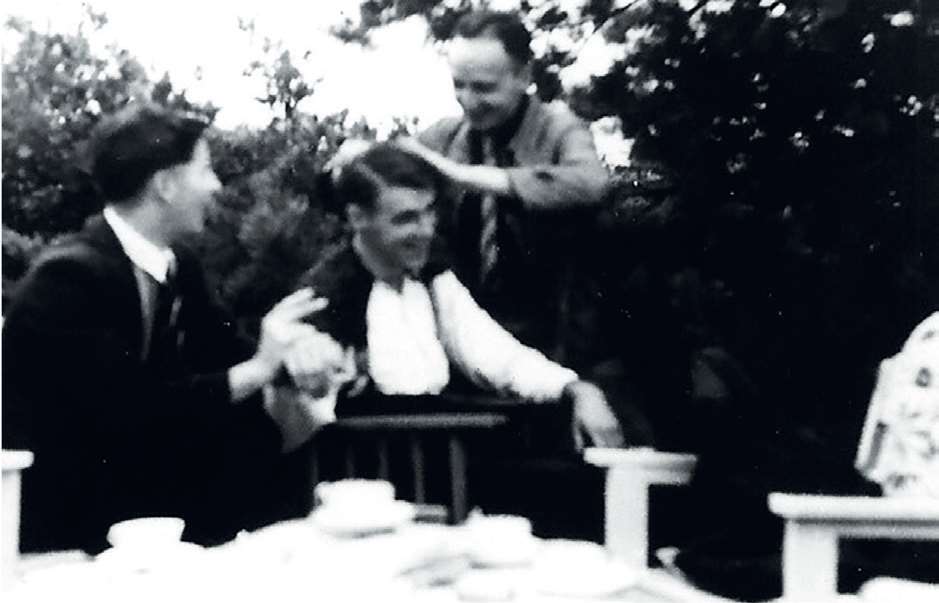
By Mrs Eskes-Buis's letter, the farm Groot Overeem at Renswoude hid him from the end of May to 24 June 1944; he was then with the Eskes household until 25 July, and a week with G. J. van den Top at Stroe, "then he left together with William John Lalley", with "Joop", ◐ Dr Kruimel, as their guide (her file, p. 7). Her list of 1 January 1946 gives his stay as 23 June to 24 July (p. 12). Boeree's chronicle of Ede has a further stop, told from the Ede end:
In August Barend brought a new guest, an RAF airman, an Irishman called Robert K. Bailey, who had landed near Renswoude and had been housed for a time with Lagerweij. He stayed only three days and was passed to Capt. Dick Kay, nicknamed Frans Hals, who was registering and collecting the pilots.
Dutch originalIn Augustus bracht Barend een nieuwe gast, het was een vlieger van de R.A.F., hij was Ier en heette Robert K. Bailey, hij was bij Renswoude geland en was een tijd gehuisvest geweest bij Lagerweij. Hij bleef maar drie dagen en werd doorgegeven aan Capt. Dick Kay, bijgenaamd Frans Hals, die bezig was de piloten te registreeren en te verzamelen.
— Th. A. Boeree · Kroniek van Ede, p. 88 · 1947 · checked on the image
◐ "Barend" is one of the Ede pair "Barend en Henk" who hid airmen at "Max's" farm on the Wester-Wetering; Kees Lagerwey's table passes Bailey to "Oom Henk and Oom Barend, Betterkamperpad, Ede" (the table) and Sander's to "Barend-Henk I", so these are the men. ◐ "Dick Kay" is Dick Kragt ("Frans Hals"), who on Bailey's own account was the "Dick" who came to Renswoude. The stay is undated apart from "August", which cannot be right (below). The same paragraph adds that Bailey's wife was expecting a baby: "De vrouw van Bailey verwachtte in die dagen een baby en haar man was kinderlijk gelukkig, toen hij haar door de radio-zender kon berichten dat hij veilig was" (Bailey's wife was expecting a baby in those days, and he was overjoyed when he could send her word by the radio transmitter that he was safe).
A. M. Jochemsen of Ede (Rijksweg 31), of Bill Wildeboer's group, had three evaders in his house "in July and August of 1944": "E. J. Slisynski", "W. C. O'Barr" and "R. K. Bailey, F/O, RAF" (Jochemsen's file, p. 16). ◐ These are very probably Boeree's three guests at "Max's" farm "aan de rijksweg" (on the national road), where Boeree has "E. J. Slisynski", the same misspelling, and "William C. O. Bar" for fourteen days and then Bailey for three, so Max is very probably Jochemsen; Boeree's dating differs from Jochemsen's (see When he was at Ede).
Renswoude: the Lagerwey family and the farm.
- ✓ The household is the Lagerweys of Renswoude, B 69. Kees Lagerwey's form of April 1946 says he "sheltered one English pilot, who came down from a burning plane. After 3 weeks he left for England, arrived on V.E. Day", "supplied civilian clothes and gave him food", and a handwritten line adds "Sheltered Bailey 3 weeks" (his form). His table has "Rob. K. Baily Fl/Lt", RAF, down on 28-5-44 at Renswoude, 25 days, passed on to "Oom Henk and Oom Barend, Betterkamperpad, Ede" (the table).
- The British index card for him reads "BAILEY. Supplied civilian clothes, rendered considerable assistance upon Source's landing and contacted the Resistance Movement: May - Jun 44" (the card); all three pages read from the images.
- ✓ His father Sander Lagerwey ("Uncle Sander") wrote "Sheltered one flyer for 3 1/2 weeks. F/O Robert K. Bailey RAF" (his summary); his table has Bailey down "12/13 May '44" at Renswoude, passed on to "Barend-Henk I" (the table).
- A typed Dutch slip says Sander, born at Renswoude on 16 January 1898, "15 Maart 1945 te Neuengamme in concentratiekamp aan ziekte overleden", having given shelter to "illegale werkers en Engelsche piloot" (the slip); the Americans graded him posthumously 4 (British) and 5 (American) (the action report).
- Noordman has the Feldpolizei raid of 16 December 1944 on Sander's brother Gerard's farm, where Sander happened to be visiting, and Sander dying at Neuengamme on 11 March 1945 (pp. 164–165).
- ✓ The farm is Groot Overeem: Noordman's photograph is captioned "Boerderij 'Groot Overeem' van de familie Sander Lagerweij, Renswoude", and the text round it prints Bailey's account of the "familie Lagerweij" and the son Kees (Noordman, pp. 164–165). Mrs Eskes-Buis's "Groot Overeem" and Bowman's "Largereeij" are one household.
Prisoner. He did not get out: Kew holds his report as a liberated prisoner of war (WO 208/3339/1202, S/P.G/LIB/1202; the catalogue entries). ✓ The catalogue entry for the duplicate of that report, WO 208/3333/1202, gives the particulars: Flight Lieutenant, number 49730, born 28 January 1921, captured at Antwerp on 11 August 1944, liberated from Lübeck on 2 May 1945 (the same file). His own account of the Antwerp arrest, in Bowman's Mosquito Mayhem from The Mossie of August 1997, is under In hiding above: the two men were taken together by men posing as the Belgian Resistance and handed to the Gestapo.
- ✓ Bowman's Mosquitopanik! (2004) tells it in a few lines: Bailey, "an American Fortress pilot by the name of Bill Lalley from Lowell, Michigan and Viv Connell, a RAAF Lancaster navigator from Broken Hill, NSW, were taken prisoner" (p. 45). The same words are note 61 of his German Night Fighters versus Bomber Command (2016), which names Confounding the Reich (Bowman and Cushing) as its source (p. 111), ◐ so the books are very probably one account, not two, an inference from the identical text.
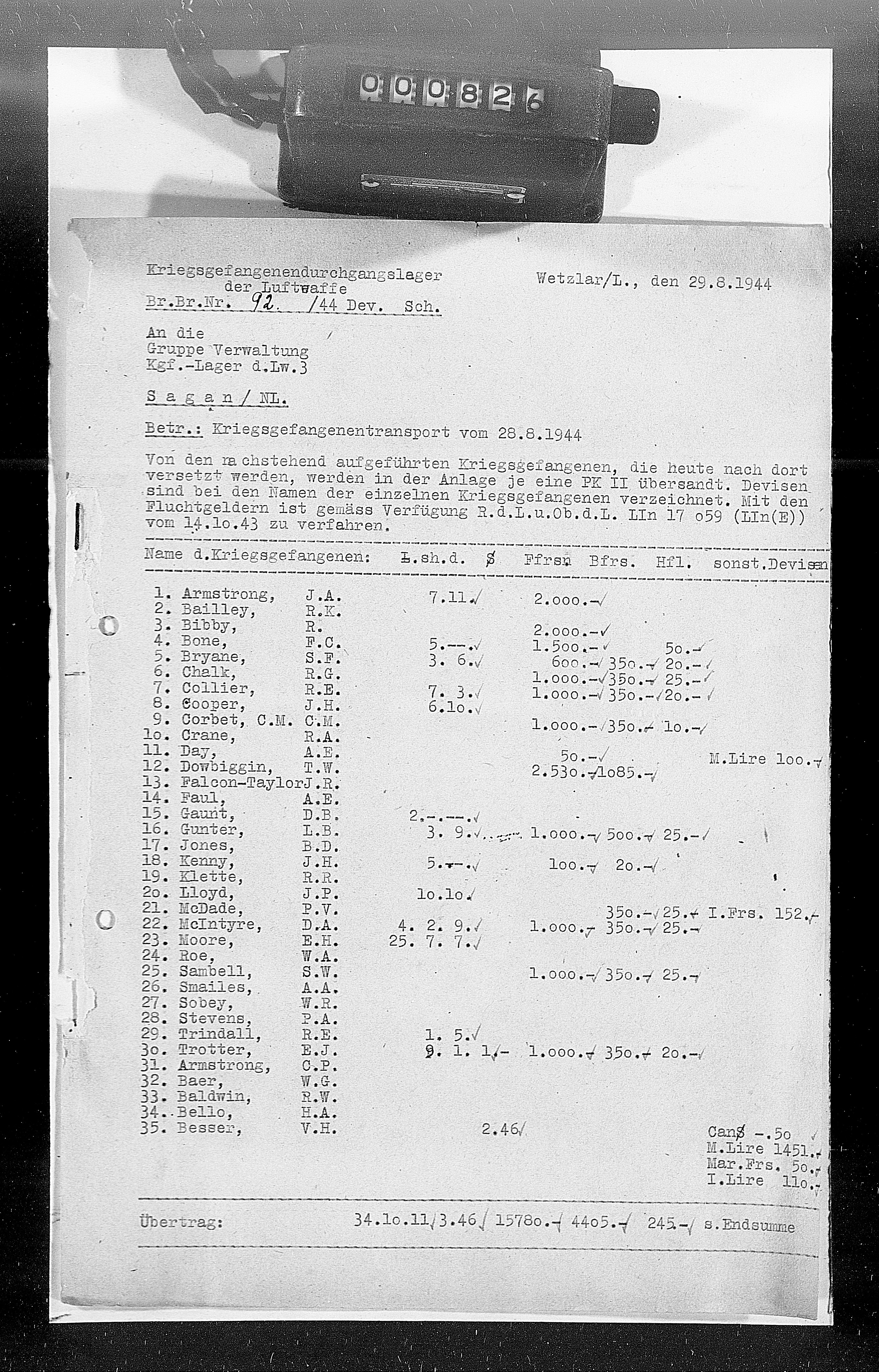
- ◐ The Dulag Luft at Wetzlar has "2. Bailley, R.K." second in its list of the prisoners sent to Stalag Luft III at Sagan on 28 August 1944 (the list is dated 29 August), and "59. Lalley, W.J." further down (frames 833–834 of T84 roll 376). Initials only. It fits the dates in Noordman's printing of his account: Red Cross forms on 25 August, Dulag Luft at Frankfurt on 26 August, Sagan two days later (Noordman, p. 170).
Back in the RAF. The London Gazette follows his number 49730 to the end of his service:
- ✓ Extended service as a Flying Officer, seniority from 17 September 1943, on 3 April 1947 (issue 37970, p. 2479); "Flight Lieutenant (war subs.) to Flight Lieutenant", 4 April 1947, seniority 17 March 1946 (issue 38009, p. 3120).
- ✓ A permanent commission as Flight Lieutenant from 16 November 1948 (issue 38566, p. 1437, 22 March 1949).
- ✓ Flight Lieutenant to Squadron Leader from 1 October 1954 (issue 40289, p. 5553; Flight, 15 October 1954, p. 600).
- ✓ Retired as a Squadron Leader at his own request on 25 July 1962 (issue 42755, p. 6419).
- ⚠︎ Two published items call a night-fighter commander "S/L R. K. Bailey" before that promotion: Bowman's Mosquitopanik! has "Squadron Leader R. K. Bailey and his navigator" failing to return in May 1944 (p. 44), and Flight of 2 January 1953 has "The Meteor unit, commanded by S/L. R. K. Bailey" at Coltishall (p. 5). ◐ The first is the later rank, put on the 1944 man; the second is either an acting rank or another officer with the same initials, since the Gazette has him a Squadron Leader only from 1 October 1954. Neither is used for his career here.
Later.
Years later Bill Lalley, tracing him through a Canadian researcher, was put in touch by LeBlanc with "his wife", who wrote that Bailey had had "a successful career in the RAF, and commercial aviation before succumbing to M.S."; he was sorry not to have found him sooner and never met him again (One Way Ticket to Berlin, p. 126; Noordman, p. 160, in Dutch, "een succesrijke carrière bij de RAF en de commerciële luchtvaart", the book). ◐ Both texts say "LeBlanc put me in touch with his wife"; "his" is read here as Bailey's, the natural reading of a wife writing about his career and illness. The wording is Lalley's account of her letter, not the letter.
Where the sources disagree
Link to the section Where the sources disagreeThe family at Renswoude. Mrs Eskes-Buis has the farm "Groot Overeem" (p. 7); Bailey, in Bowman, has "the family Largereeij" and a boy Kees (p. 75). ✓ Settled: both are the household of Sander Lagerwey, whose own and whose son Kees's helper forms name Bailey, and whose farm Noordman's photograph captions "Groot Overeem" (above).
The date he came down, and how long he stayed at Renswoude. Bowman and Noordman have the night of 27/28 May (Bowman, p. 73); Kees Lagerwey's table has "28-5-44" and 25 days, Zanen's "28.5.44" (Kees, p. 3; Zanen, p. 4). ⚠︎ Sander Lagerwey's table has "12/13 May '44" (p. 3), two weeks early and against everyone else, so ◐ a slip of his or of whoever filled the form in July 1945. The stay is three weeks (Bailey, Kees's form), 3½ weeks (Sander's) or 25 days (Kees's table), and Mrs Eskes-Buis has the end of May to 24 June.
How long he stayed with Van den Top, and in what order. Mrs Eskes-Buis's letter has Groot Overeem, then her household until 25 July, then, in her words, "stayed with G.J. van den Top, for another week" (p. 7); Bailey has Van den Top first, "not more than two days", then Dr Dirk Eskes, then, "about mid-July", word from Stroe, and back to collect Lalley (Bowman, p. 76). Van den Top's own table gives Bailey "8 days" (p. 3), a third figure. ⚠︎ The extra week and the 25 July departure are hers. Noordman's printing of Bailey's account has the tandem ride from Stroe on 24 July 1944 (p. 167) and Zanen's table has him at Breda from 26 July (p. 6), which fits the end date of her list of 1 January 1946 (24 July), not her letter's further week at Van den Top's after 25 July, and not Bowman's "about mid-July". ◐ So he left Stroe on 24 July on Bailey's dated account; the length of the stay at Van den Top's and at the Eskes house is still three different figures.
Where Noordman's text comes from. Noordman says his version of Bailey's story rests mainly on a correspondence with Lalley in 1995 (p. 162); Lalley's own words are that LeBlanc put him in touch only with Bailey's wife and that he never met Bailey again (p. 160). ⚠︎ Not settled: whether Bailey wrote to Lalley in 1995 or the text is Lalley's reworking of Bailey's earlier statements; the matching wording with Bowman's The Mossie text is why it is read as one account here.
The jail at Antwerp. Bowman's text has "three weeks" in the Antwerp jail (pp. 77–78); Noordman's printing of the same account has "twee weken" (p. 170), and Lalley, in the same book, "ongeveer drie weken" (p. 153). ⚠︎ Not settled; both of them were moved to Brussels and Frankfurt by 26 August on Bailey's dates.
When he was at Ede. Boeree has Barend bring him to Ede "in August" and pass him to Dick Kay after three days (p. 88). ⚠︎ By Bailey's own dated account (Noordman, p. 167) he left Stroe on 24 July; Zanen has him at Breda from 26 July to 9 August, crossing into Belgium on 9 August, and Antwerp on 11 August (above), so August at Ede is out of the question on those dates. Jochemsen's file, by contrast, has him in the Ede house in "July and August of 1944" (above). ◐ Boeree's baby line points to June: Bowman and Noordman have Jean eight months pregnant on 29 May (Bowman, p. 75; Noordman, p. 165), so the baby was due about late June. Three days at Ede would fit the gap between Renswoude (Kees Lagerwey's table passes him on to Ede) and Van den Top's collecting him in June, but nothing dates them, and Mrs Eskes-Buis and Van den Top do not mention Ede. Bailey's own account has no Ede stop.
His home address and Sander Lagerwey's death. Mrs Eskes-Buis has Bailey's address at Burscough, Lancashire (p. 7); Sander Lagerwey's table, Lems's list and Vermeeren's table have 7 Eden Avenue, Portadown, Northern Ireland, and Noordman has five of his Sagan roommates from Northern Ireland (Lems, p. 5; Vermeeren, p. 3). The American slip has Sander dying at Neuengamme on 15 March 1945 and Noordman on 11 March (the slip; Noordman, p. 164); ⚠︎ not settled.
The order of his hiding places. Mrs Eskes-Buis's letter has him come to her from Groot Overeem and go on to van den Top (p. 7); her table has him "received from" van den Top, on 23 June, for 30 days, and passed to "J. Kruimel" (p. 15).
The Bf 110 at Spannum, and who was taken when. Bowman's German Night Fighters versus Bomber Command has, on p. 89:
One was flown by Flying Officers R. K. Bailey and J. F. M. White who shot down a Bf 110G-4 (140042) of 7./NJG1 piloted by Unteroffizier Joachim Tank who was injured in the crash one kilometre west of Spannum before the Mosquito men also crashed, near Renswonda [sic] (Utrecht). Bailey and White were taken prisoner.
— Martin W. Bowman · German Night Fighters versus Bomber Command 1943–1945 · 2016 · p. 89
Bailey's own words about the sortie follow it. On p. 90 of the same book the Spannum crash at 01.15 and the injured Tank are credited to Squadron Leader Neil Reeves and Pilot Officer A. A. O'Leary of 239 Squadron, and Mosquitopanik! (p. 44) gives the same crash, as Bf 110 140032 G9+CR, to Reeves and O'Leary, then Bailey's "failed to return" (p. 90; Mosquitopanik!, p. 44). ⚠︎ Not settled: the books give the Spannum aircraft two serials and two crews, and say he was taken prisoner on the night (p. 89) and in August after three months with the Dutch (note 61, p. 111; Mosquitopanik!, p. 45). No German record of the Bf 110 has been read; Bailey's own words say only that he shot down an Me 110 near Leeuwarden.
His rank in 1944. Flying Officer in Bowman's Mosquito Mayhem (p. 73) and German Night Fighters (p. 89); "Squadron Leader" in Mosquitopanik! (p. 44); in the Gazette a flying officer from 17 March 1943 and a flight lieutenant from 17 September 1944, the later promotion falling after his evasion began (issue 36051; issue 36852). ◐ So he was a flying officer when he was shot down; "Squadron Leader" is the rank he reached later.