Johan van Oldenbarneveld, “Dove Jan”
Arnhem 29 Apr 1895 – Warnsveld 6 Jun 1972
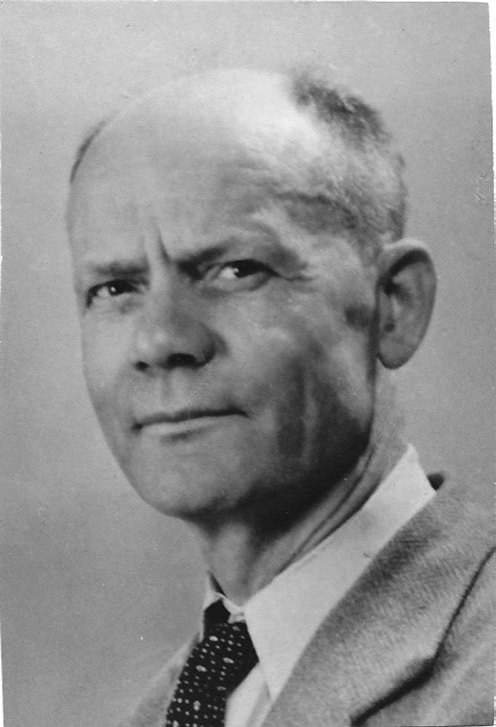
Johan Anne Cornelis VAN OLDENBARNEVELD genaamd Tullingh (the full surname), "Dove Jan", Deaf Jan, in the local resistance (Noordman, p. 139); "v.OLDENBARNEVELD, JAC.", Kootwijk 2, Assel, in the British helper index, certificate 15940, grade 5.
About: The deaf poultry farmer on the Westerwoudt estate by Assel who, with his wife, hid Murphy and Walsh from 7 to 14 October 1944. Through 1944 he sheltered American airmen and British paratroopers there, fetching most of them himself.
Unit or role: The Raad van Verzet, on his own form of 1946; "R.v.V. (Later B.S.)" on the questionnaire made out for him in July 1945 and signed by R. van Ginkel; "Sgt." on both; known to the Allied men as "Johan and G.K." (his form, p. 3; the questionnaire, p. 5).
Where: Kootwijk 2, Assel (the British index); "Assel (near Blokpost 74)" (the second file, p. 2); "Kootwyk, post Kootwykerbroek" in 1946 (his form, p. 3).
Evidence: ✓ his helper files with the Americans, US National Archives 286709438 (his list, p. 4) and 286709446 (p. 2); ✓ Walsh's MI9 report; ✓ Noordman, pp. 138–141, 182–183, 192, 299; ◐ a letter of 15 April 1946 signed J. van Oldenbarneveld, in Arnoldus van Zelst's file; ✓ Nelly Eskes-Buis's letter and table (her file, pp. 7, 15); ✓ civil records.
He was born at Arnhem on 29 April 1895, the son of Johan Isaak Hermanus van Oldenbarneveld and Hermina Venneman (birth record, Arnhem births 1895 no. 623); his questionnaire has "Arnhem. 29-4-95" (p. 3). ✓ His father's parents were Cornelis van Oldebarneveld and Sara Margaretha de Munck, who are the groom's parents on his father's marriage record (Arnhem, 7 September 1894, the groom 25 and born at Veghel); she died at Delft on 16 July 1918, "weduwe van J. A. C. van Oldenbarneveld, geuaamd Tuliingh, Papenstraat" (widow of J. A. C. van Oldenbarneveld, called Tullingh; the notice as the OCR has it, "geuaamd Tuliingh" evidently for "genaamd Tullingh"), born at Veghel and the daughter of Isaak Hermanus de Munck and Willemina Barbelina Royer (the marriage; the death; Delftsche Courant, 17 July 1918, OCR only). ⚠︎ The two records give her husband as Cornelis and as J. A. C.; the death index has "Johan Anna Cornelis van Olden Barneveld (genaamd Tullingh)", the initials of Dove Jan's own names. ◐ The paper gives her age as 68, which would make her about 19 at his father's birth; the death index gives no age, and the scan was not seen.
At 25 he was "Betaalmeester scheepvaartver." (paymaster at something shipping-related, the last word abbreviated in the record) when he married Dina Liske Houtzager at Kruiningen on 30 December 1920 (the marriage); the Rotterdam court dissolved the marriage on 25 July 1934; the notice of 30 August gives him as a paymaster ("betaalmeester") living at Overschie (Staatscourant, 30 August 1934; the divorce). On 17 October 1934 he married C.J.A. Plak at Rotterdam, he 39 and she 30 (the marriage).
✓ Two sons were born lifeless at Schiedam on 10 May 1935, one at ten in the morning and the other minutes later, to him, an office clerk ("kantoorbediende"), and his wife Cornelia Plak, both living at Schiedam; the deeds do not say twins (deed 200 and deed 201, Schiedam register of deaths, 13 May 1935, read on the scans). Three sons were born to the couple in 1937, 1940 and 1942, their births registered at Apeldoorn (Nieuwe Apeldoornsche Courant); they may be living and are not named here.
A fascist circular, 1933
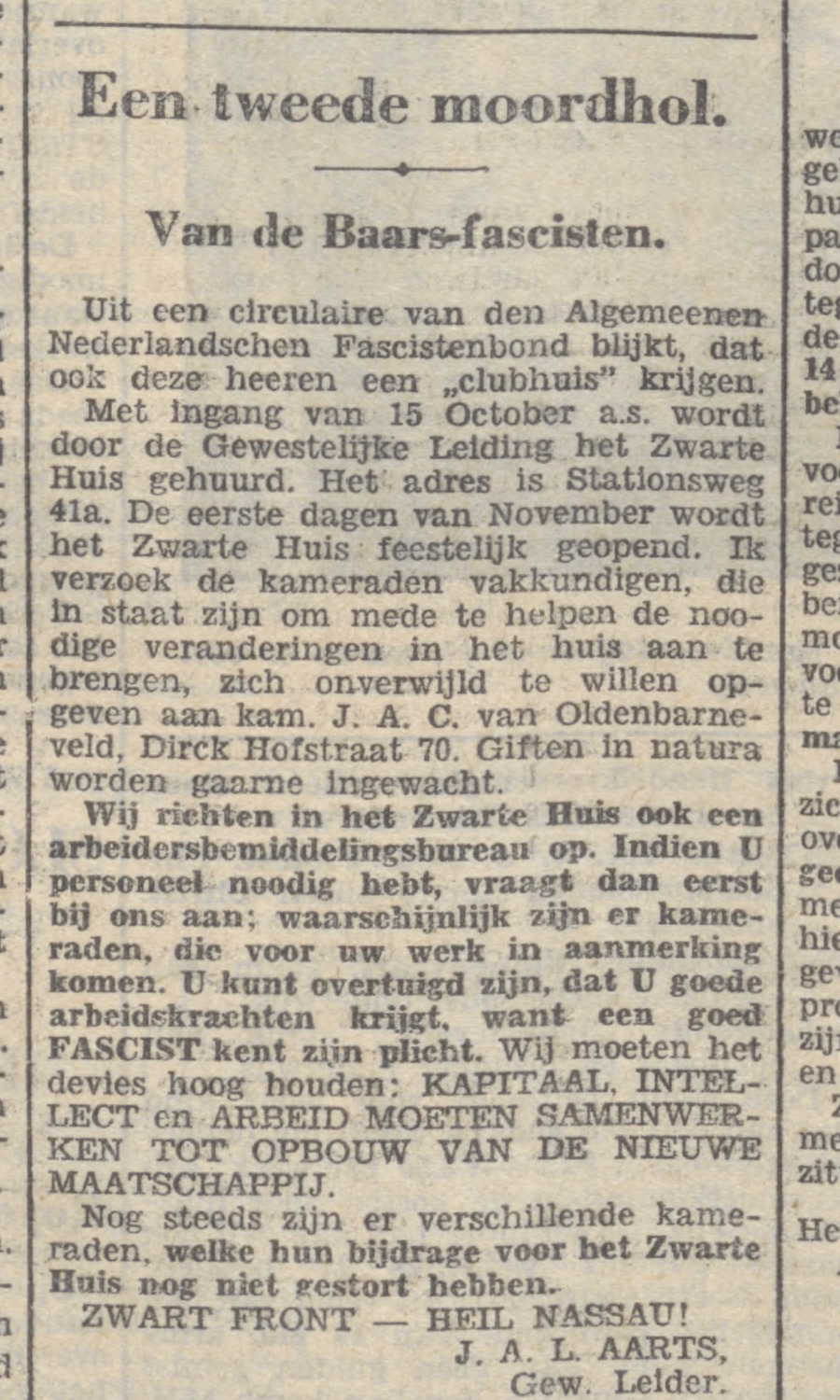
Link to the section A fascist circular, 1933On 18 October 1933 De Tribune printed on page 4, under the headline "Een tweede moordhol. Van de Baars-fascisten." (a second murder den; from the Baars fascists), a piece that opens "Uit een circulaire van den Algemeenen Nederlandschen Fascistenbond blijkt, dat ook deze heeren een „clubhuis" krijgen." (from a circular of the Algemeene Nederlandsche Fascistenbond it appears that these gentlemen too are getting a "clubhouse"). The archived Delpher list of newspapers has the paper as "De tribune : soc. dem. weekblad", 19 October 1907 to 17 April 1937 (the catalogue's title for the whole run, not a description of the paper in 1933) (the list). ✓ The circular, as the paper prints it, says that from 15 October the regional leadership ("de Gewestelijke Leiding") was renting "het Zwarte Huis" (the black house), "Het adres is Stationsweg 41a", to be opened in the first days of November, and goes on:
I ask the skilled comrades who are able to help with the necessary alterations to the house to report without delay to comrade J. A. C. van Oldenbarneveld, Dirck Hofstraat 70.
Dutch originalIk verzoek de kameraden vakkundigen, die in staat zijn om mede te helpen de noodige veranderingen in het huis aan te brengen, zich onverwijld te willen opgeven aan kam. J. A. C. van Oldenbarneveld, Dirck Hofstraat 70.
— circular signed "Zwart Front" (the paper: of the Algemeene Nederlandsche Fascistenbond), as printed in De Tribune · 18 October 1933, p. 4 · the page
It is signed "ZWART FRONT — HEIL NASSAU! J. A. L. AARTS, Gew. Leider." The circular names him only there, as the person to report to; it gives him no role, and neither it nor the article names a city. The paper ends the piece with its own line: "Versterking van de anti-fascistische actie en van den Strijdbond moet het antwoord van alle klassebewuste arbeiders zijn!" (strengthening of the anti-fascist action and of the Strijdbond must be the answer of all class-conscious workers!) (De Tribune, 18 October 1933, p. 4, read on the page image, where the OCR has "Holstraat"; the picture below stops at the signature, and the closing line is on the page beneath it, the article at Delpher). We hold the circular only as this paper printed it.
✓ The man is the same, by his full name and initials, the index showing no other J. A. C. van Oldenbarneveld at Rotterdam, and his Rotterdam family card (Stadsarchief Rotterdam 494-03 inv. 851-353), for Johan Anne Cornelis, born at Arnhem on 29 April 1895, an office clerk ("kantoorbed."), registered at Rotterdam from October 1927 and leaving for Overschie on 13 August 1934, has both streets: "Dirck Hoffstraat" and, last and not struck through, "Stationsweg 41a", ◐ very probably the Zwarte Huis, since the circular gives that street and number but no city. Each address on the card is struck through in turn with a date beside it: 1/4/30, 6/9/1930, 29/?/1932, and "1/3/'34" beside Dirck Hoffstraat. The card does not say whether a date is when he left or when he arrived. ◐ If it is the date he left, he lived at Dirck Hoffstraat from 1932 until 1 March 1934, so was there on 18 October 1933, and at Stationsweg 41a from 1 March to 13 August 1934. ◐ If it is the date he arrived, the card does not put him at Dirck Hoffstraat on 18 October 1933. The house number after Dirck Hoffstraat is cramped and was not certain to read 70 on the viewer images, which are screenshots, not the Stadsarchief's own image (the card, with a transcript). No source we hold says what part he had in the movement, if any beyond this notice, or for how long.
Kootwijk
Link to the section Kootwijk◐ In July 1937 the Apeldoorn register had "J. A. van Oldenbarneveld genaamd Tullingh, van Canada naar Kootwijk 2" (from Canada to Kootwijk 2) (Nieuwe Apeldoornsche Courant, 20 July 1937; OCR only). The initials there are J. A., without the C, and the Overschie cards have the couple at Kleiweg 187 from 1934 until they left for Rotterdam on 3 January 1935 (card 4505), and at Burg. Wijnaendtslaan 68 from 29 April ◐ 1935 (the card's year is unclear; the Rotterdam card has them leave for that address on 26 April 1935) until they left on 2 October 1936 for Broersvest 72, Schiedam (card 4506; the transcript); nothing we hold says where he was between then and the notice. ◐ The Apeldoorn population register for 1927–1939 has "Johan A.C. Tullingh", born at Arnhem on 29 April 1895, with "Cornelia J.A. Plak" (the index entry; index only). By the war he was on "een boerderijtje op het landgoed van de familie Westerwoudt" (a small farm on the Westerwoudt family's estate) (Noordman, p. 139). Maria Westerwoudt's daughter, in her recollections as Noordman prints them, has her mother a courier for the underground "en haar contactpersoon was Johan van Oldenbarneveld" (and her contact was Johan van Oldenbarneveld) (p. 192).
The airmen of spring 1944
Link to the section The airmen of spring 1944The questionnaire made out for him in July 1945 says he "lodged 6 men. 2 Americans from April until June 1944 (crashed down near Kootwijk)", and that "Mrs. Westerwoudt brought a co-pilot and a gunner" (p. 5). ◐ The two are Eugene Glisynski, a gunner, and Walter Mallard, a co-pilot, by every other source:
- Glisynski.
- A B-17 gunner shot down on 29 April 1944, he came down near Assel station, hid in a ditch and was taken in by a farmer; after talking with Austin Schaeffer (Noordman's "Austin"; August on his own form below) it was decided "dat hij zou worden ondergebracht bij Johan van Oldenbarneveld die onder de schuilnaam Dove Jan lid was van het lokale verzet" (that he would be lodged with Johan van Oldenbarneveld, who was in the local resistance under the cover name Dove Jan), where he stayed about four weeks (Noordman, pp. 137–139).
- Dove Jan's own list has "Eugene Glyzinski sergt. gunner / Chicago", USA, down at Assel on 29.4.44, hidden from that day for 32 days, "fetched in the woods", and passed to "G. J. Top manufacturer Stroe" (p. 4, checked on the image).
- Dr August Schaeffer's list has him five days, "in het bosch gevonden" (found in the wood), passed to "J.C. v. Oldenbarneveld, Kootwyk 2 en "Alex" (Dr. Eskes)" (Schaeffer's list, p. 5).
- Mallard.
- Noordman has Walter W. Mallard, an American airman who had landed on 19 May, join Glisynski there (p. 139).
- Maria Westerwoudt's daughter remembered finding him by Assel station, and her mother taking him that evening to "de boerderij van Johan van Oldenbarneveld" (Johan van Oldenbarneveld's farm), where "een joodse familie en een andere Amerikaanse vlieger, genaamd Gene Glisynski" (a Jewish family and another American airman, Gene Glisynski) were already lodged (pp. 182–183).
- Nelly Eskes-Buis wrote to the Americans that Mallard, Fisher's co-pilot, had hurt his ankle landing, and "Johan van Oldenbarneveldt, Assel, post Kootwijkerbroek, found him and lodged him till the sixth of June, it was dangerous there then and he came over to our house" (her letter, p. 7); her table has him received on 6 June 1944 from "J. van Oldenbarneveld, Assel" (p. 15).
- Dove Jan's list has "W. Mallard Lt.", down at Nieuw-Milligen, hidden from 1 May for 30 days, "fetched him at the railway line", and passed to "Dr.Eskens N'Milligen (Alex)", ◐ Dirk Eskes (p. 4).
The raid. At the end of May the Germans raided the farm; "Terwijl die via de voordeur naar binnen stormden, vluchtten Glisynski en Mallard via de achterdeur het bos in" (while they stormed in at the front door, Glisynski and Mallard fled by the back door into the wood) (Noordman, p. 139). Maria Westerwoudt's daughter:
It must have been around the end of May, when there was a German raid at Johan van Oldenbarneveld's by day. He, his family and the airmen managed to escape. What happened to the Jewish family, I don't know.
Dutch originalHet moet omstreeks eind mei geweest zijn, toen er overdag een Duitse inval geweest is bij Johan van Oldenbarneveld. Hij, zijn familie en de vliegers wisten te ontsnappen. Wat er met de joodse familie is gebeurd, weet ik niet.
— Maria Westerwoudt's daughter, in Noordman, Schuilplaats de Veluwe, p. 140
In her account she and her mother found the two airmen, took them across the railway after dark and hid them in the chapel her grandfather had built at Assel, and on 6 June Dirk Eskes ("Alex") fetched them (pp. 140–141). ⚠︎ Mallard's own letter after the war, written in English and printed by Noordman in Dutch, has "Nadat mevrouw ons naar 'Alex' gebracht had" (after the lady had taken us to 'Alex'), then about two weeks with Alex (p. 183): there it is an unnamed lady who brings them to Alex, which does not say whether Alex fetched them (Maria Westerwoudt). G. J. van den Top's table at Stroe has "Eugene GEZINSKI" and "Conny O'BAR, Capt. THUNDERBOLT", an American pilot down at Kampen, five days each in June 1944, received from "Alex and van Oldenbarnevelt" and passed to "Joop and Dick" (Van den Top's table, p. 3, checked on the image); Nelly Eskes-Buis has Glisynski staying "with Johan van Oldenbarneveldt and at another address, known to G.J. van den Top" (p. 7). Her own list of helpers puts "J. van Oldenbarnevelt gen. Tuyling Assel" second, after Kruimel (p. 14).
Dr Kruimel's note on him for the Americans, ◐ by the name "Kruimel" written at the top of the form:
Often under very difficult circumstances v. Oldenbarneveldt and his wife collected and sheltered several times crashed pilots. He was not very well off, but he always helped disinterested. He deserves a financial reward and a decoration because of his bravity when his house, in which 4 pilots were sheltered, was surrounded by the Gestapo.
— US National Archives · RG 498, helper file of Johan v. Oldenbarneveldt · questionnaire of 25 July 1945 · the form
Nol Burger, who moved men on from him, wrote in March 1946:
Joh. van OLDENBARNEVELDT sheltered pilots and parachutists contineously [sic]; he lived very isolated and collected them most of the time himself. With Hoekstra and Huber I fetched sometimes parachutists from there, whom we took generally after a fewdays [sic] to Zandbergen
— US National Archives · RG 498, helper file of Arnoldus Burger · his letter, Garderen, 8 March 1946 · the letter, p. 4
His own form of 6 May 1946 says that "because the SD searched my house two times , all details were lost", and that his central point for delivering pilots was mostly Kootwijkerbroek, "by Brunekreeft , shop keeper", with daily contact with "the comm. of Barneveld etc. Mr. R. van Ginkel (PETER)" (p. 3).
With Murphy
Link to the section With MurphyMurphy and Walsh escaped from the hospital in the Willem III barracks at Apeldoorn at dusk on 6 October 1944, walked west across country, and after about five miles, at daylight on 7 October, were taken in by a farmer and his wife in the Kootwijk area, who held them until 09.00, when a friend who passed every morning came by (Walsh). The friend was Dove Jan:
The man who came to see us was a member of the Underground, though I do not know his name. He spoke English and questioned us as to our identity, but we had little difficulty in satisfying him. He then took us to his home, a poultry farm, situated also in the KOOTWIJK area. He was very deaf, married, with three sons aged 3, 5 and 6 approx. His wife also spoke good English. We stayed here one week during which time we were very well fed and cared for. As the house was situated fairly close to the APLEDOORN (Sheet 2, 790040) - AMERSFOORT (Sheet 2, 390975) railway line it was not considered very safe, so our friend arranged with the Underground to find new billets and on 14 Oct after dark we moved to GARDEREN (Sheet 2, 620060).
— MI9 · Pte S. P. Walsh · report of 7 March 1945 · the report
✓ Noordman: "De man van de ondergrondse met een eendenfokkerij was J.A.G. van Oldenbarneveld, genaamd Tullingh, in Assel/Kootwijkerbroek. Hij woonde zeer afgelegen" (the underground man with a duck farm was J.A.G. [sic] van Oldenbarneveld, called Tullingh, in Assel/Kootwijkerbroek; he lived very remotely), and "'Dove Jan' heeft meer vliegers en para's opgevangen, onder anderen Tom Murhpy [sic] en Sam Walsh" ('Deaf Jan' took in more airmen and paras, among them Tom Murphy and Sam Walsh) (Noordman, pp. 139, 299). ✓ His own list for the Americans has the two as "Murphy Kelly Schotland / and a friend of his / mechanical.", paratroopers, "Arnhem" in the column for where they came down, six days each in "Oct. 45", met "on the road. Escaped out of hospital palace 't Loo. Both wounded on head.", and passed to "Dr. Eskens N.Milligen (Alex)" (p. 4, checked on the image). ◐ "Kelly" is Kelty, Murphy's home town, heard by a Dutchman (Migchelsen's statement has his address as "91 Centre street Kelty Fifeshire", Migchelsen's file, p. 3), and ◐ "mechanical" fits Walsh, an apprentice engineer by his own report (Walsh). The questionnaire signed by R. van Ginkel has "2 Eng. parachutists, escaped from the hospital 't Loo, picked up by v. O. near Kootwijk" (p. 5).
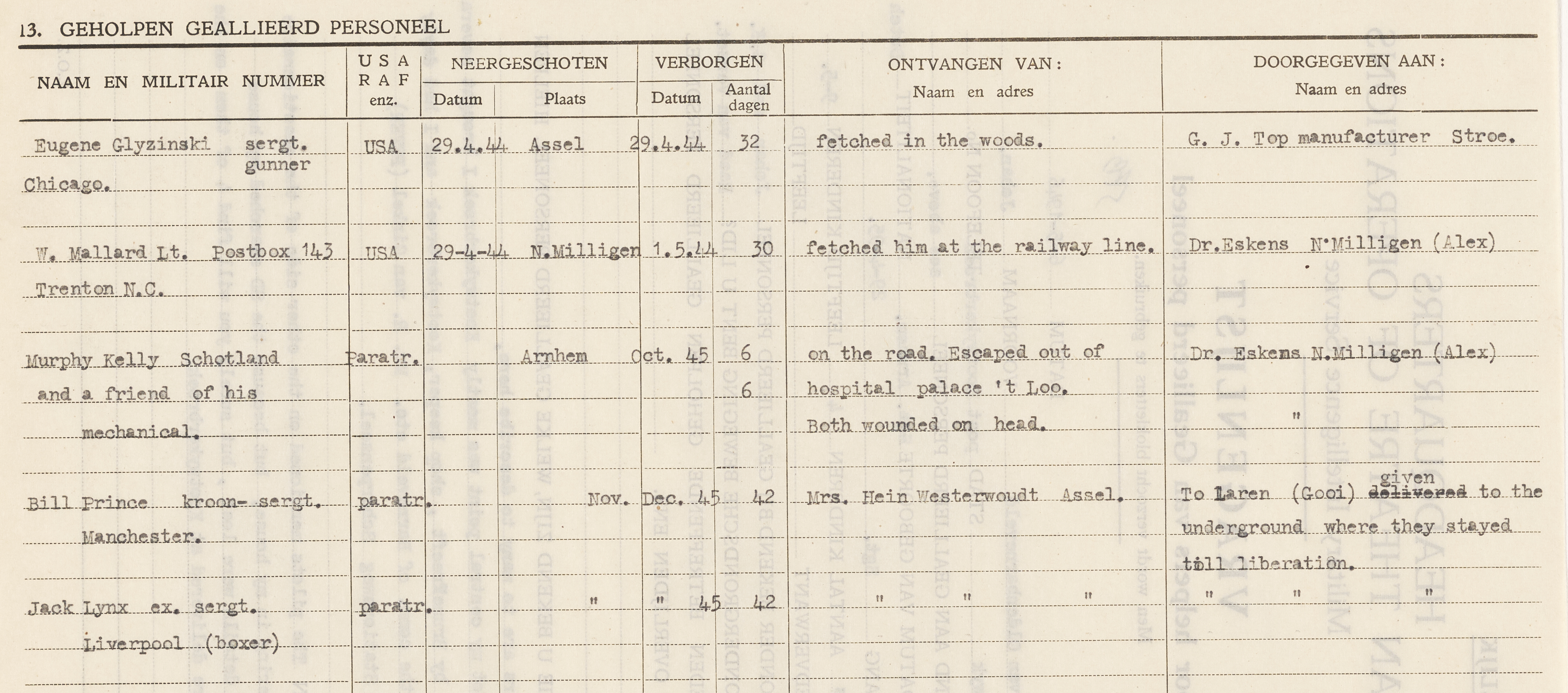
Who took them on. Dove Jan's list sends them to "Dr. Eskens" ("Alex"), ◐ Dirk Eskes (p. 4). ⚠︎ Pieter Hoekstra of Garderen listed by hand two privates of the First Airborne, "Spud" and "Tom", received about 16 October 1944 from "Johan v Oldenbarnevelt" and handed to "Dr Kruimel, de Ruif Garderen" (his list, p. 9); a note at the foot of that page says that the names and addresses of the farmer between Voorthuizen and Terschuur and of Johan van Oldenbarnevelt "kan ik door navraag te weten komen" (I can find out by inquiry), so it gives no address for him. ◐ "Spud" was Murphy's army nickname and the Dutch who hid him wrote "Tom" (Murphy's page), so the pair is very probably Murphy and Walsh, with "Tom" set against the wrong man; Hoekstra was writing from memory in 1946 and his date carries a "±". On the form's page 8, among the helpers he knew, he gives "'Johan van Oldenbarnevelt' (Schuilnaam) p/a A.J. Burger" (a cover name, care of A. J. Burger) (p. 8). ◐ It is Dove Jan's own name, so very probably him all the same; the two forms disagree on who moved the pair.
Prince and Lynch, November–December 1944
Link to the section Prince and Lynch, November–December 1944William Prince and Jack Lynch of 156 Para Bn, Murphy's battalion, taken after the failed Pegasus II crossing, jumped from a prisoner train with three others on the morning of 23 November 1944 and made for a farm near Apeldoorn (Prince's report). The questionnaire of July 1945 has "2 other English parachutists, jumped out from the train and picked up by v.O. himself", and "2 Other Englishmen went by bicycles of v. O. to O.D. in Laren N.H." (p. 5).
His own account of the escapers is a letter of 15 April 1946, answering the Americans' question about Arnoldus van Zelst, who had said he handed an airman over to him (the Americans' letter of 9 April 1946, p. 7, signed by Capt. Franklin D. Coslett):
At the end of October 1944 5 allied P/W's escaped out of a train going to Germany. Two Americans, one Canadian and two English paratroopers. This happened at night.
The evaders asked for help at a small farm where A. van Zelst was staying. Van Zelst then asked some people of whom he knew that they had sheltered pilots before if they would take these evaders. Their answer was yes and A. van Zelst took the evaders to them.
— J. van Oldenbarneveld, Kootwijk 3, Kootwijkerbroek · letter to the Holland Office, 6801 MIS-X Detachment, 15 April 1946 (typed copy) · Van Zelst's file, p. 17
◐ The writer is very probably Dove Jan: the Americans' letter is addressed to "Den Heer J. van Oldenbarneveld, Kootwijk Nr. 3, Post Kootwijkerbroek", the post town of his own form of the next month, though his house elsewhere is Kootwijk 2 (p. 7). Van Zelst's own form has "5 unknown. (2 English, 2 Canadians and one American)", who "Came to his house after jumping from train.", hidden from 3 November 1944, and passed to "J. P. Soet via Jac. van Oldenbarneveld."; his list of helpers has "Jac. van Oldenbarneveld, Kootwijk 3, Kootwijkerbroek (Gld)" (his table, p. 5; his form, p. 4; both read on the images).
The Assel helpers' forms carry the next stage:
- Schaeffer. Dr August Schaeffer Edler von Wienwald of Assel 6, "Gus", of the R.V.V., listed Sgt W. Prince and Pte J. Lynch of "156 Reg.", "escaped P.o.W.", from 23.11.1944 for 14 days, with Braun, Gelfand and McElroy on the lines above, received from "Arnold v. Zelst, Assel/Apeld." and passed to "J.C. v. Oldenbarneveld, Kootwyk 2" (his list, p. 5, 18 January 1946).
- Westerwoudt. Maria Westerwoudt's table has "William Prince sgt. parach. 1st Airb. Div. / Manchester" and "Jack Lynch sold. Liverpool", Nov. '44, 14 days each, passed to "van Oldenbarneveld" (her table, p. 3).
- His own list. "Bill Prince kroon- sergt. / Manchester" and "Jack Lynx ex. sergt. / Liverpool (boxer)", paratroopers, "Nov. Dec. 45", 42 days each, from "Mrs. Hein Westerwoudt Assel.", and "To Laren (Gooi) given to the underground where they stayed till liberation." (p. 4, checked on the image).
- Laren. Prince's report has the two at the farm near Apeldoorn until 23 December, then "by bicycle with two ladies" to a house in Laren (Prince's report). ✓ Mrs D. J. Faber of Laren has "Lynch" and "Prince", both entered under RAF, hidden "Dec. 44, + 60" (the transcript reads the 60 as days): Lynch's row has them received from "van Oldenbarnevelt Kootwyk" and passed to "de Jong Rahoes 4"; Prince's has ditto marks in the other columns and "Blaricum." in the last, which may be a further stage or a slip (her table, p. 3, checked on the image).
On 23 November 1945 he received "one used service bicycle", on a receipt form headed "FOODPARCEL SUIT & OVERCOAT MATERIAL" with the issuing officer given as "van Ginkel" and the signature read as "J. v. Oldenbarneveld", with a query (p. 2). Both his files are marked Grade 5, on 17 June and 16 July 1946 (p. 1; the second file, p. 1), and the British index has him as certificate 15940, grade 5 (the index). A blank filing sheet headed "TULLINGH, JOHAN, A.C." sits in the American file of Fokko Boelens of Hoogezand, with nothing else in that file about him (Boelens's file, p. 2).
In 1949 he and his wife were running the Pension-Restaurant "Berkendel" near Kootwijk, where the Nieuwe Apeldoornsche Courant wrote up his descent, from a family tree he showed the paper, from the old Veluwe family of the seventeenth-century statesman of the same name (Nieuwe Apeldoornsche Courant, 10 August 1949, OCR). ◐ In January 1952 Madjoe, the journal of the association of former Dutch East Indies army NCOs, listing new members, has "J. H. Visser, p/a J. A. C. van Oldenbarneveld, Kootwijk, post Kootwijkerbroek" (care of J. A. C. van Oldenbarneveld): the initials and the place fit him (1 January 1952, p. 3; OCR only).
By order of 8 July 1971 the Zutphen court placed him under guardianship; he was then living at Bathmen and being cared for at Het Groot Graffel at Zutphen, with his wife as his guardian (De Telegraaf, 17 July 1971, OCR). He died at Warnsveld on 6 June 1972, "zonder beroep" (of no occupation), the record naming Cornelia Johanna Adriana Plak as his (ex-)partner (the death record, index).
Where the sources disagree
Link to the section Where the sources disagree- Who took Murphy and Walsh on: Dove Jan's list has Eskes, Hoekstra's has Hoekstra himself to Kruimel (above).
- How long Murphy and Walsh stayed: one week, 7 to 14 October, by Walsh's report; six days each on Dove Jan's list (Walsh; p. 4).
- His children: five on the questionnaire of July 1945, aged 24, 8, 7, 5 and 2 (p. 5); four, aged "9-5", on his own of May 1946 (p. 3); Walsh remembered three sons of about 3, 5 and 6 (Walsh); the Apeldoorn birth notices give three sons born in 1937, 1940 and 1942, about 7, 4 and 2 that October (the notices).
- Mallard's dates: down at Nieuw-Milligen on 29 April 1944 and hidden from 1 May on Dove Jan's list, the same day as Glisynski (p. 4); landed on 19 May by Noordman (p. 139); shot down at Garderen on 23 May by Nelly Eskes-Buis (p. 15); "Mei '44 Meerveld" on Schaeffer's list (p. 5).
- Glisynski's stay: 32 days from 29 April on Dove Jan's list, then to Van den Top; five days from Dove Jan and Eskes on Van den Top's table, with O'Bar, whom Dove Jan's list does not have (p. 4; Van den Top, p. 3).
- The train escapers: ⚠︎ his letter has five, "Two Americans, one Canadian and two English paratroopers", at the end of October 1944; Van Zelst has two English, two Canadians and an American, hidden from 3 November; Prince's report has the escape on 23 November, and Schaeffer's list has them hidden from that day, with Braun (American), Gelfand and McElroy (Canadians), Prince and Lynch (above).
- Who brought Prince and Lynch to him: his list has Maria Westerwoudt; the questionnaire of July 1945 has them "picked up by v.O. himself"; Schaeffer's list passes them to him (above).
- How long Prince and Lynch were with him: 42 days on his list cannot fit between the train on 23 November and Laren on 23 December by Prince's report; Westerwoudt and Schaeffer each give 14 days of that month at Assel; Mrs D. J. Faber's table at Laren has them hidden "Dec. 44, + 60" (above).
- Which Laren. Prince's report places it "17 kms S. of DEVENTER" (Laren in Gelderland); Dove Jan's list has "Laren (Gooi)", the questionnaire of July 1945 "Laren N.H.", and Prince went on to Hilversum. ◐ The distance is very probably the interviewer's gloss (Prince's page).
- How they left: "by bicycles of v. O." in the questionnaire; "by bicycle with two ladies" in Prince's report (above).
- How many men he lodged: the questionnaire of July 1945 says "lodged 6 men", but its remarks then list two Americans, two paratroopers from the hospital, two from the train, two Americans and two Englishmen "transported through Joop and Dick", and two Englishmen who went by bicycle; it does not say whether the last pair are the train pair (p. 5).
- The dates on his list: October and November–December are typed "45" for 1944 (p. 4).
- His name and number: J.A.C. on his bicycle receipt and in the 1952 Madjoe; "JAC." in the British index and "Jac." in Van Zelst's form, both with no stops, so possibly an abbreviated first name, not initials; Noordman's text has "J.A.G." (p. 299); Schaeffer writes "J.C."; his house is Kootwijk 2 in the British index and on the questionnaire of 1945, Kootwijk 3 in the Americans' letter and in Van Zelst's form (above).
- Another "Deaf Jan." The helper file of Johannes Rombout of Dordrecht lists "JAN de LANDGRAAF (DEAF JAN), v.d.Houte Willemsplein 5, Sliedrecht", who "Brought pilots down to Lage-Zwaluwe" (Rombout's list, p. 21, read on the image). He is a different man, not Dove Jan of Assel.