Hermannus Rakers
Wedde 11 Aug 1909 – Hilversum 4 Aug 1945
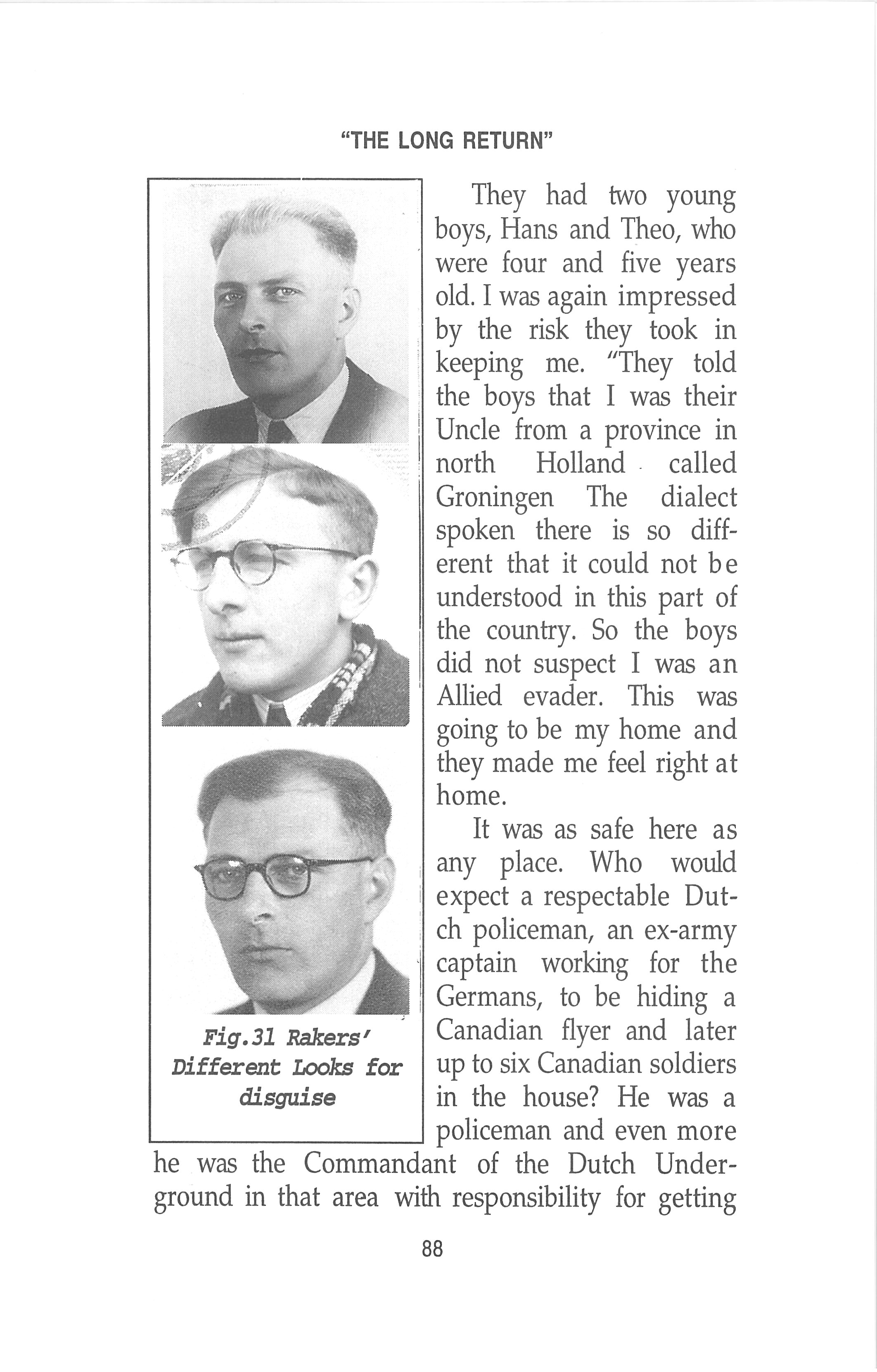
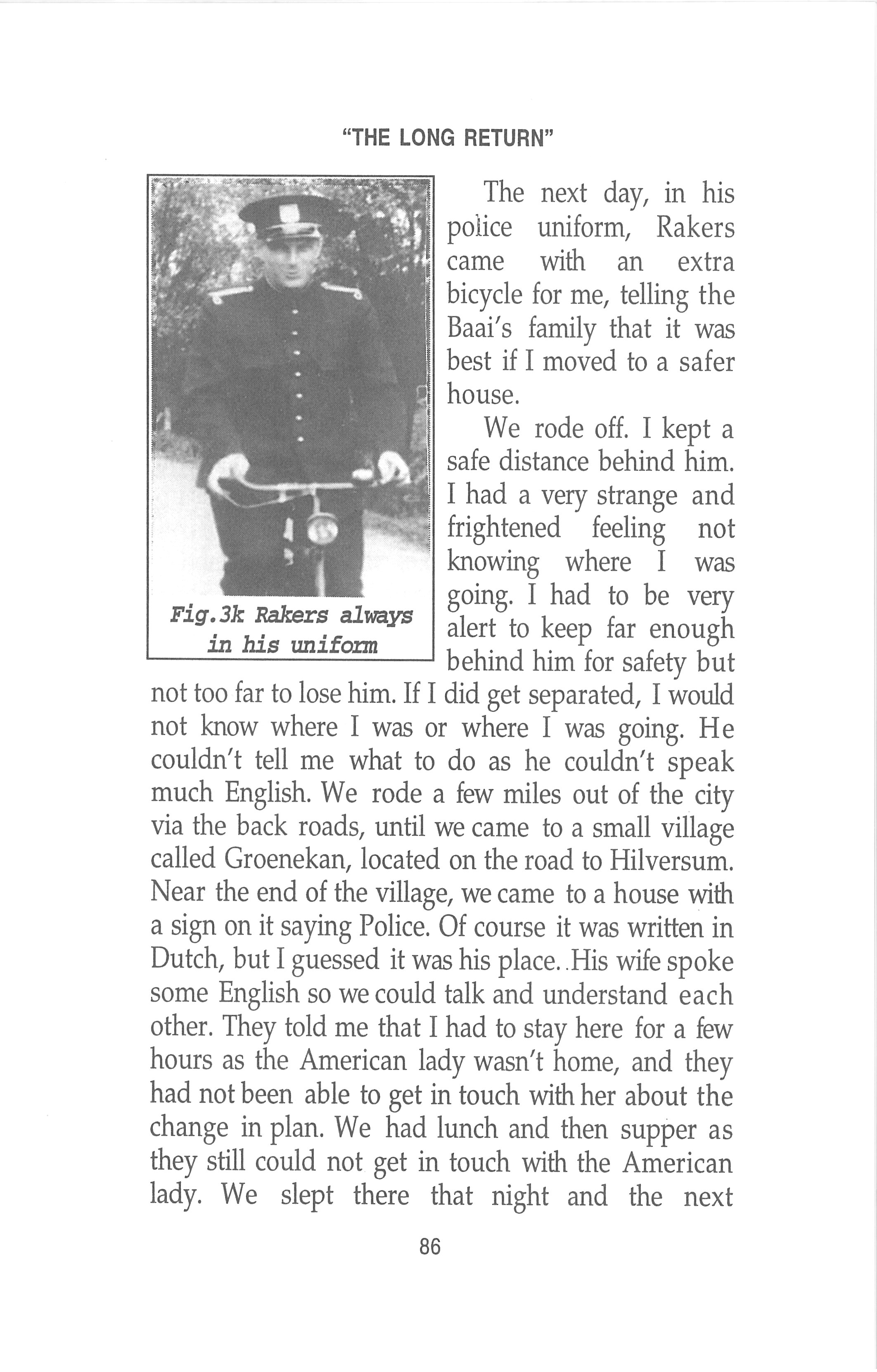
About: "Papa Rakers", the policeman at Groenekan and local commander of the resistance's Interior Forces, who hid the airman Bob Porter, Captain Schjelderup, Marcel Briere and Wilfred Berry in 1944, men who set out with Murphy's party from Amerongen on 2 January 1945. He died in a road accident on 4 August 1945.
Unit or role: ◐ Opperwachtmeester der Marechaussee (chief sergeant of the Royal Military Constabulary) on his death deed, which records it on the declaration of Jan van Velzen, an aanspreker (undertaker's man), not on any police record (Hilversum deed 1055; the copy in Maartensdijk's register). The helpers' forms call him the Maartensdijk police: "Gemeente Veldwachter, Maartensdijk" (municipal field constable) on Baay's form, "fieldconstable" on Ponssen's, "sergeant of police" in Schjelderup's report, and "A Policeman and District Chief of the Dutch underground" in Berry's. Tj. Holwerda of Maartensdijk calls him the leader of the underground in Groenekan, as he was himself in Maartensdijk and Hollandsche Rading: "mij collega H.RAKERS dit was in Groenekan" (my colleague H. Rakers was that in Groenekan; "mij" as typed) (Holwerda's file, p. 8; p. 11). ✓ In the resistance he was the local commander of the Binnenlandsche Strijdkrachten (B.S., the Interior Forces): the death notice that the B.S. section at Maartensdijk put in Het Parool names "onzen plaatselijk Commandant der B.S. den Heer Hermannus Rakers in de illegale kringen beter bekend als Brouwer" (our local commander of the B.S., Mr Hermannus Rakers, in illegal circles better known as Brouwer) (Het Parool, 7 August 1945, p. 2, read on the scan), and W. J. Wassink of Arnhem lists "Rakers, Groenekan near Utrecht, commandant of BS locally" (Wassink, p. 2). His widow's letter of 1946 has him tied to "de Landelijke Organisatie van het ondergrondsche verzet" (the national organisation of the underground resistance) (her letter, p. 8). The Americans' report on the household is "Cawton 49" (Mrs Rakers's file, p. 7; Buisman's form, p. 3, has "RAKERS (Cawton 49)"), and on the British index he is certificate 27036, Grade 5, posthumous.
Where: Utrechtscheweg 365, Groenekan, in Maartensdijk municipality (his form, p. 2; the British index). Schjelderup's report has "393 Groenekaneweg", and his widow's form of 18 September 1945 (p. 8) gives 393 as the address "known to Allied personnel"; the Americans wrote to him at 365 in June 1946 (their letter). His widow later lived at Zutphen (Fowler, note 13).
Evidence: ✓ his death deed and its copy (Hilversum, Nr. 1055, 7 August 1945); ✓ the form his widow filled in for him, 26 April 1946 (US National Archives 286682289); ✓ her own file (US National Archives 286682274); ✓ Schjelderup's MI9 report and Berry's Appendix A; ✓ the British helper index, sheet R/1 and the American Grade 5 list, p. 128; ✓ the two death notices in Het Parool, 7 August 1945; ✓ his widow's letter about Bob Porter in the file of J. H. C. Heitinga, 1946; the forms of the families who worked with him (Holwerda, Bakker, Ponssen, Van Brenk, Hopma, ter Beek, Westerbeek, Schilt, Buddingh, van Dijck, Wassink); ⚠︎ Bob Porter, The Long Return (1997), the only account from inside his house, written fifty years on; T. Robert Fowler, "Profiles of Valour: Roger Schjelderup" (1996), partly from Mrs Rakers's letter of March 1996.
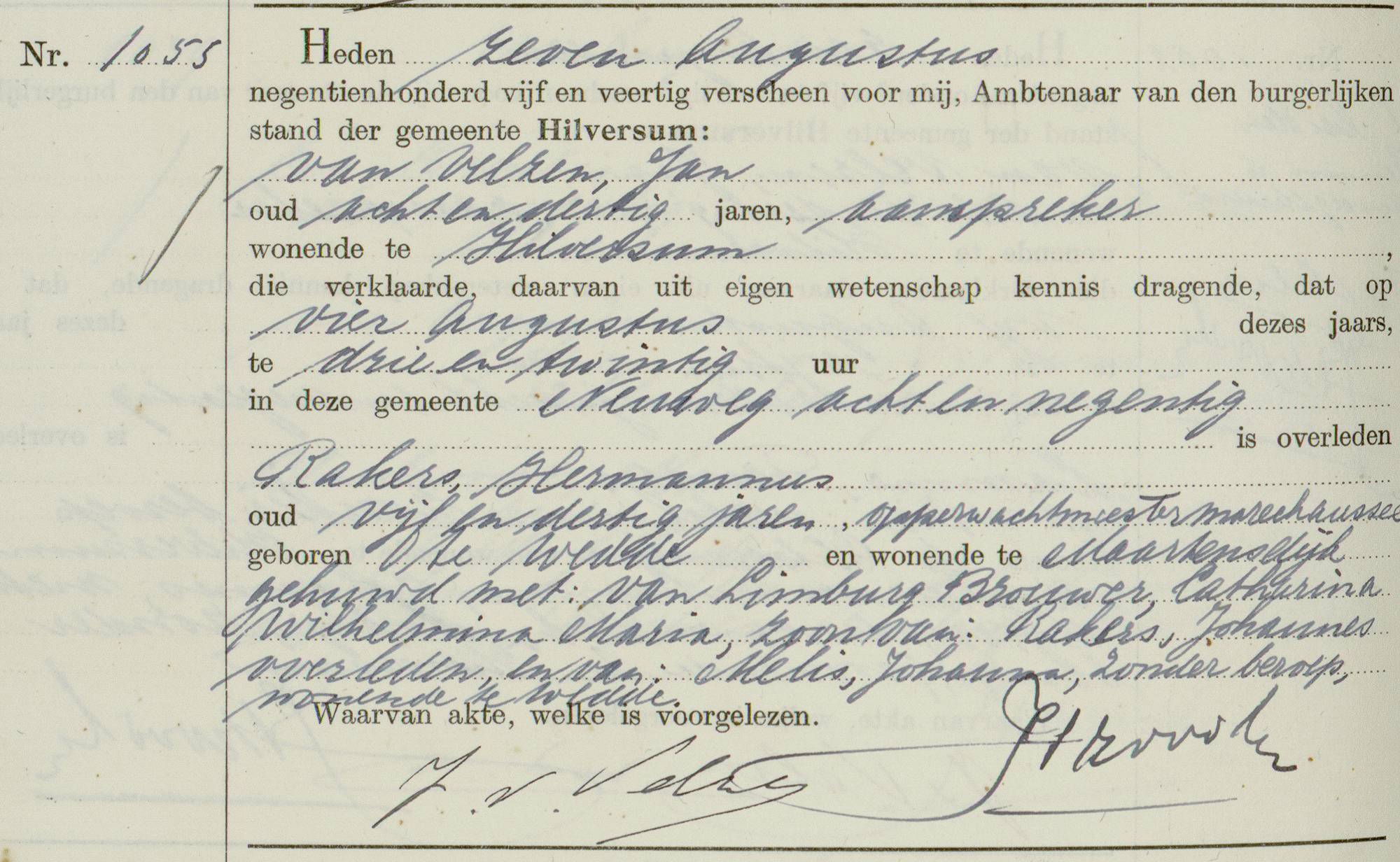
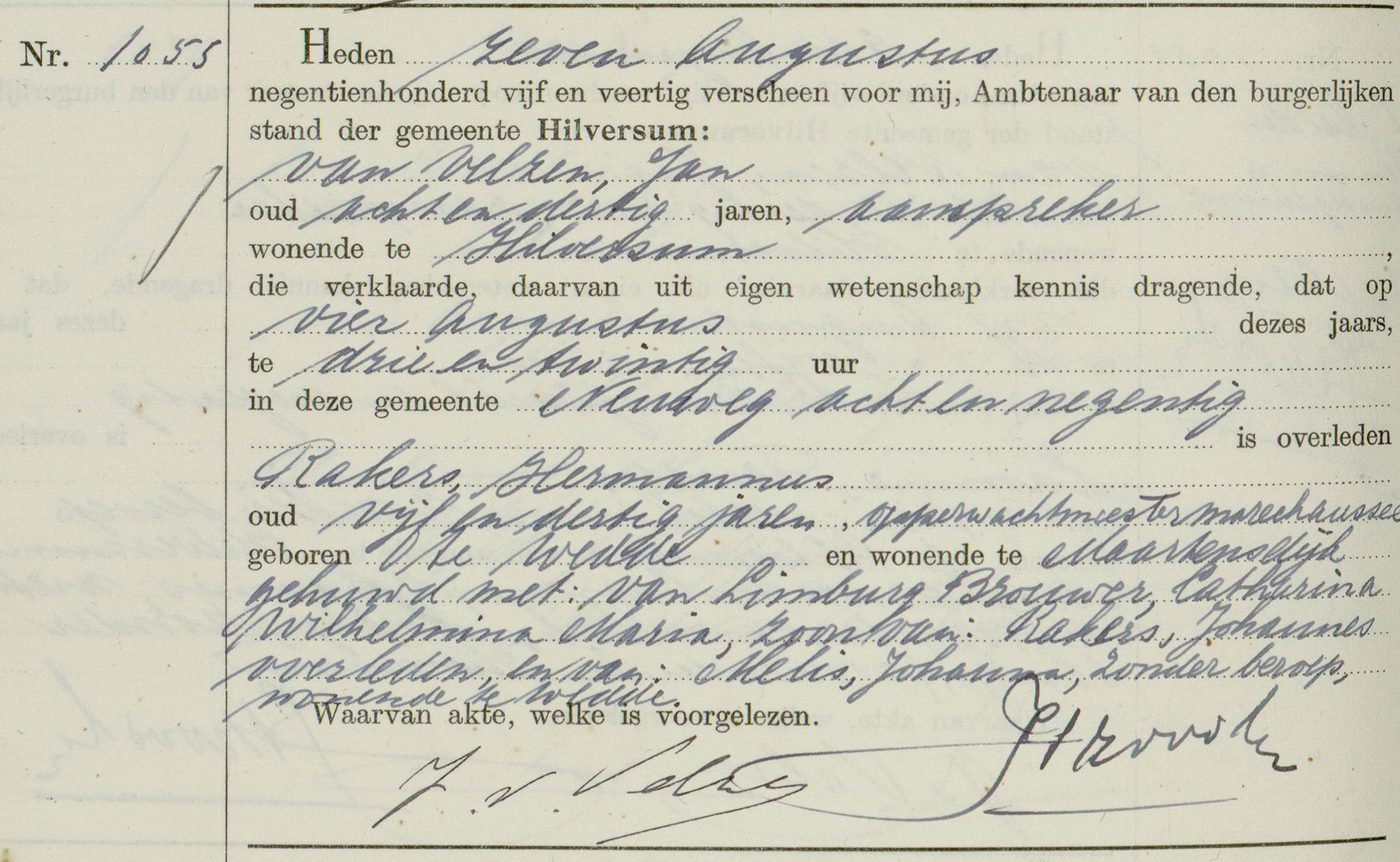
✓ He was born at Wedde, in Groningen province, the son of Johannes Rakers and Johanna Melis. The Hilversum deed of his death, in August 1945, has him 35 years old, born at Wedde and living at Maartensdijk, married to Catharina Wilhelmina Maria van Limburg Brouwer, his mother then living at Wedde and his father dead (the deed, read on the image). The marriage index has him marrying her at Soest on 2 August 1933, "Hermanus Rakers", 23, born at Wedde, with the same parents (the index record, index only). She was born at Soest on 13 May 1911, the day and place on her own form of 1945 (her birth; her form, p. 8). ✓ The Soest population register of 1900 to 1915 has her on her parents' sheet, entered on 13 May 1911, the day of her birth: her father Gerard Theodoor van Limburg Brouwer, born at Batavia on 12 April 1871, who came to Soest from Amsterdam on 3 August 1908; her mother Johanna Geertruida Maria van Klooster, born on 19 January 1877; a brother, Izaak Johannes, born at Soest on 30 June 1909; and a sister, Cornelia Johanna Antonia, born there on 26 October 1913 (the index record; the sheet, sheet 246, read on the scan). The parents are the ones the marriage index names. The register is not a birth deed, so it does not add a second record of the birth. They had two young children, who are not named here.
✓ His birth date. His widow's form for him has "Wedde, 11.8.09" (p. 2, read on the image). The register of bearers of the Resistance Memorial Cross (Verzetsherdenkingskruis) has one Rakers in all, "Rakers, Hermannus 11-08-1909", p. 192 (the register, page image read; entries give name and birth date only), ◐ very probably the same man. No birth record has been found. The date fits the 35 years on the death deed (he would have turned 36 a week later) and the 23 of the marriage index.
⚠︎ What he was before the war. Porter describes him as "an ex-army captain" as well as a policeman (p. 88). No Dutch record found gives an army rank: the death deed has the Marechaussee rank above, and the military rank on the form for him reads "Conscr; Sold.", which looks like a conscript soldier (p. 2, read on the image). Holwerda writes of "sgt. Rakers" and "Wachtmeester RAKERS" (p. 7; p. 12).
His work in the underground, by Porter. ⚠︎ Porter, who lived in the house from the summer of 1944, wrote:
He was a policeman and even more he was the Commandant of the Dutch Underground in that area with responsibility for getting ration cards for Jewish people in hiding, Divers and people like myself. He frequently collected food from farmers and distributed it around. He helped to look after and feed almost two hundred people.
— Bob Porter, The Long Return (1997), pp. 88–89 · chapter 3
The rest of what Porter gives comes from one pair of eyes fifty years on. He has Rakers in charge of a raid on a ration office with a spare key to the safe (p. 95); carrying twenty-six revolvers on a train to Amsterdam under his coat (pp. 106–107); placing explosives on the railway lines round Utrecht and then, as policeman, taking the Mayor's call about the damage (pp. 109–111); organising a raid on a farmer's stores for people in hiding and then investigating it, steering the Germans the wrong way (pp. 127–129); and making "diphtheria sandwiches" to get prisoners into hospital (p. 162) (chapter 4, chapter 5, chapter 6). Porter's "I had seen Rakers do it before" is the only word on the last. None of it has a second source here, except that Holwerda says railway attacks were "committed by us" some days before a German search of a house at Maartensdijk (Holwerda, p. 7) and Briere that on 15 November the underground blew up the railway through Utrecht province (Briere, p. 2), neither naming Rakers. Holwerda, who worked with him, gives the plainer account: "Als er dus iets te doen was, dan ging of hij of ik er op af" (when something had to be done, either he or I went) (Holwerda, p. 11). His widow's form has "F. 800.- for the care of the evaders from Eddy (by way of Bart)" (her form, p. 8); "from the underground" is a pencil note in English at the foot of her letter of 8 October 1946, "Got f800 from the underground for housing pilots" (p. 4).
Others who name him. Their forms of 1945–46 add a line each, none of them dated:
- Buddingh of Groenekan (his first name, Simon, is read from a heading too faint to confirm), who forged papers for evaders, "did all the work by himself (not together with Rakers, but Rakers did come to him for Papers)" (Buddingh, p. 2).
- Theodorus van Dijck of Soest, head of cattle supply under the provincial food commissioner at Utrecht, gave meat, clothes and food when the underground needed supplies for pilots: "As far as I know there were three groups. Rakers; Klosster and one at Soest." (van Dijck, p. 2).
- H. W. Schilt of the Lindenlaan, Groenekan: "The son of Mr. and Mrs. SCHILT also helped with the transport of the evaders, together with RAKERS (Cawton 49)." (Schilt, p. 4).
With Murphy
Link to the section With MurphyNo source puts Murphy at Groenekan, and none shows Rakers knew of him. The link is the Canadians: Schjelderup's nominal list for 2 January 1945 has twelve entries, one of them "A Polish soldier", and seven of the others (Schjelderup, Porter, Berry, Briere, Trainor, Swartz and Gri) had been hidden in or round Groenekan and Maartensdijk by Rakers and the families he worked with; they set out from Amerongen with Murphy, Hardy, Noble and Banwell (Schjelderup's report; The crossing and recapture). Hardy met Schjelderup, Berry and another Canadian Scottish private at Amerongen on the afternoon of 23 December, and after dark he and Murphy were taken to the Esvelds (Hardy; James Hardy).
The men he hid
Link to the section The men he hidEach man's own page tells his story; this is the household's side.
- Bob Porter, June to December 1944. The airman was shot down on the night of 16 June (Porter, p. 89).
- Rakers's table has him from "16-6" to "24-12", 27 weeks, received from K. Middelkoop of Driebergen (the table, p. 3).
- His widow's form has Rakers and H. H. Copyn fetching him from A. Baay's house in Utrecht in mid-June (her form, p. 8); Copyn's own form has the two of them going to Driebergen in June to fetch him (Copyn's); Baay's form has him from 22 June to 9 July, from "Mr. Raakers" and back to him (Baay's form).
- Porter has a policeman in uniform, Rakers, meet him on a street corner he does not name, offer him a cigarette and put him in a car driven by Copyn, "about a half an hour to the city of Utrecht", to Mrs De Baai's house, and a week or so later bring him to Groenekan by bicycle (pp. 81–86, chapter 3). Porter's page sets out the disagreement on the first weeks. By every account he stayed until the party left in December.
- His widow wrote in 1946 that they had "van Juni tot Dec '44 een Canadeesch vlieger in huis" (a Canadian airman in the house from June to December 1944) (her letter, p. 8). Her letter answers the Americans' of 4 June 1946, addressed to "den Heer Rakus, Utrechtseweg 365" [sic] ten months after his death (p. 11).
- On the word of J. den Broesterd, who came to the house often, they took Bob to the Heitinga family in Utrecht for a week, since Mrs Heitinga and her daughters spoke English; "Na een week was Bob volgens afspraak weer terug" (after a week Bob was back, as agreed) (pp. 8–9).
- "Tusschen 5 Dec en 20 Dec '44 is Bob nog 4 à 5 dagen te „logeeren” geweest bij de fam H." (between 5 and 20 December 1944 Bob stayed another four or five days with the H. family) (p. 9).
- Heitinga's own table has "Zeist" in the column for where Porter was shot down, the same slip as on Rakers's table, and "aug.44 and dec.44" for the time hidden, received from "Rakus, Groenekan" [sic] (p. 5).
- Schjelderup and Trainor, 25 October. ✓ Two soldiers came to the farm of G. van Brenk at about four in the morning of 25 October; he fed them and sent for Rakers.
- "Mr. Rakers took those two soldiers with him"; he put them in Fort Ruigenhoek, where its guard F. H. Ponssen sheltered them, and fetched Porter, who was staying at his house, to question them (Van Brenk, p. 3; Ponssen, p. 4). Porter, who has Rakers stand by during the questioning "with his hand on the gun in his pocket", dates the morning 26 October (p. 116).
- Schjelderup, wounded and ill, was taken to Rakers's house, by his own report that evening, and stayed until December: pneumonia in Ponssen's statement and Briere's report, pleurisy on the widow's form. Trainor spent a night there and then went to the neighbouring Westerbeek and Koele families (his widow's form, p. 8; Ponssen, p. 4; Briere, p. 2; Bakker's; Koele's). More is on Schjelderup's page and Trainor's.
- Briere and Berry, from the end of November.
- His widow's form has Briere arriving in the last week of November from Palestrinalaan, Bilthoven, with Berry a week later after a first stay at "ODYK", and Rakers fetching them himself; the table has both from 28 November to 24 December, 25 days (her form, p. 8; the table, p. 3).
- Mrs Schuppert-Wolfert of Bilthoven, who had the two for a fortnight in her house and another fortnight in an empty house nearby, says "They were fetched by Mr. Rakers"; H. H. Copyn had Berry for five days in December, after which Berry went for a week to Oosthoek, a country house near De Bilt, and from there back to Rakers (Schuppert-Wolfert, p. 3; Copyn).
- Their other Bilthoven helpers tell the same hand-over.
- H. M. Hopma has the two at Mrs Schuppert's, then in an empty house in the Obrechtlaan after sabotage on the railway nearby, "From there they were transported to Groenekan, to Mr. Rakers, who took care of their further transport to the Liberated Southern part of Holland", and his table has both "Nov. 44", 28 days, passed to "Rakers, Groenekan" (Hopma, p. 2; p. 3).
- The Americans' note on P. J. ter Beek, shot in November 1944, has them about a month with "Mrs. Schuppers-Wolfert, Palestinalaan 12" and then "taken over again for further transport by the policeman RAKERS, who recently dies in a motor-accident" (ter Beek, p. 8).
- Mrs Rakers wrote in 1946 that "Ongeveer 2 weken later" (about two weeks after Porter's first week with the Heitingas) her husband found two more Canadians, for whom they borrowed a bed from the Heitingas, and that "Toen wij later 4 Canadezen in huis hadden, hadden ze voldoende aanspraak aan elkaar" (when we later had four Canadians in the house, they had company enough in each other) (her letter, pp. 9–10).
- C. Westerbeek of Groenekan has Berry lodging with Sj. Scheepvaart: "He came to him via RAKERS and went away by way of Sj. SCHEEPVAART too", in the paragraph on 22 to 24 December (Westerbeek, p. 4).
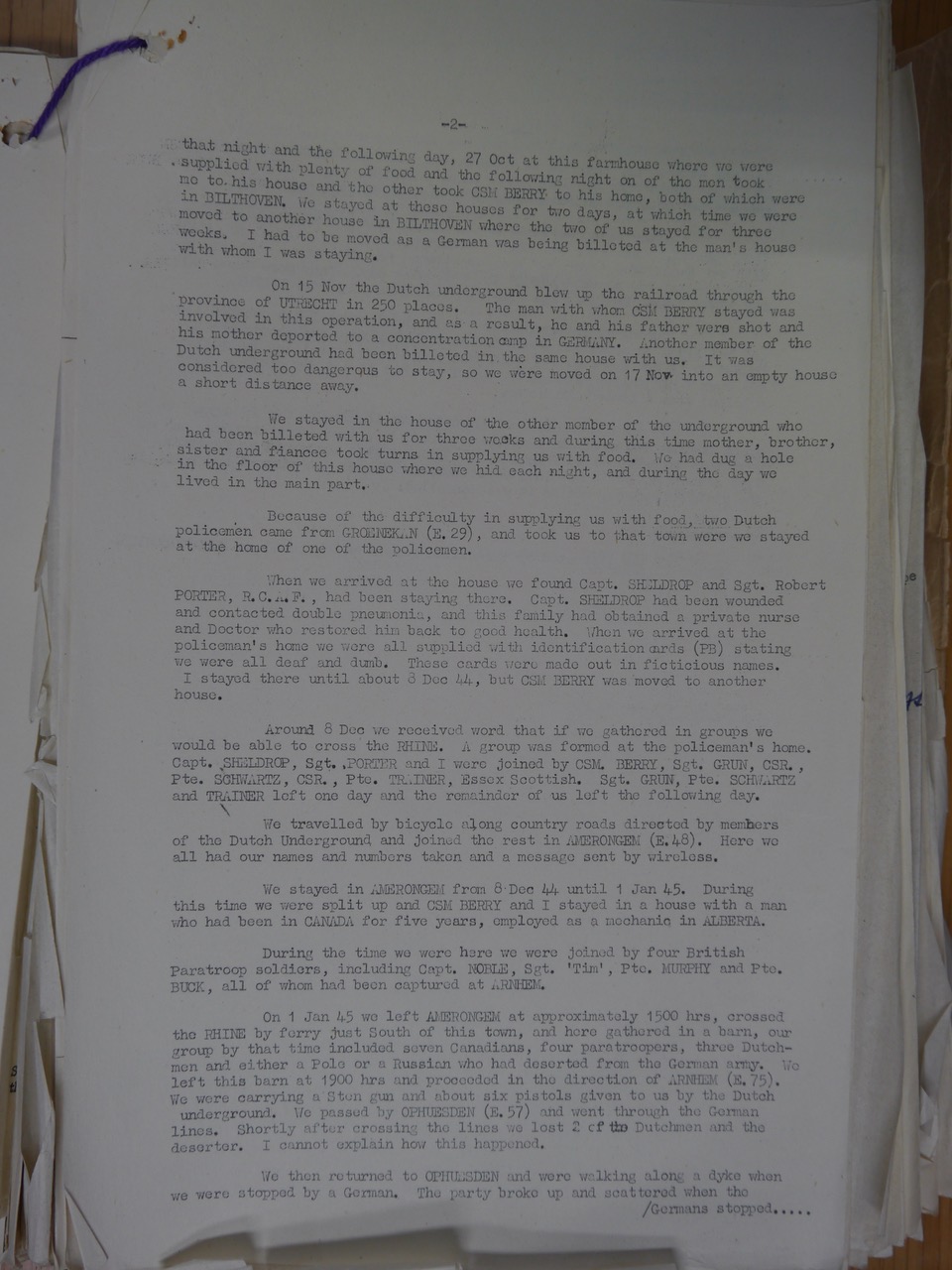
- Berry's own report has Rakers from 1 to 24 December, "A Policeman and District Chief of the Dutch underground. Food, shelter, and clothing" (Appendix A). See Wilfred Berry and Marcel Briere.
- Swartz and Gri, placed by others. They were found in a haystack at Hollandsche Rading and sheltered by Holwerda's circle, not at Rakers's; the table lists them as placed with the Scheepvaart and Kanning families (the table, p. 3; Holwerda, p. 7). See Harvey Swartz and A. Gri.
Schjelderup says that while he lay in the house he learned that six other men of his party had jumped from the train, that "RAKER personally saw that all of them had billets", and that he "at one time had 4 Canadians in his house" (his report). The Americans' action report has "Housed 5 evaders ... for periods up to 6 months", and the form for him of 1946, "We housed 4 pilots for a considerable time and found shelter at other addresses for some other pilots" (action report; his form, p. 2). The Fowler article has Mrs Rakers care for Schjelderup with Porter, and quotes her letter of March 1996 on the Christmas that followed:
We had a tree and a rabbit in the barn. That Christmas was the saddest of my life. Only the rabbit was lucky because we didn't eat him. That empty house was terrible.
— Mrs H. Rakers, Zutphen, to T. Robert Fowler, March 1996, quoted in Fowler, "Profiles of Valour: Roger Schjelderup", Canadian Military History 5(2), 1996, pp. 102–103 · the article, note 13
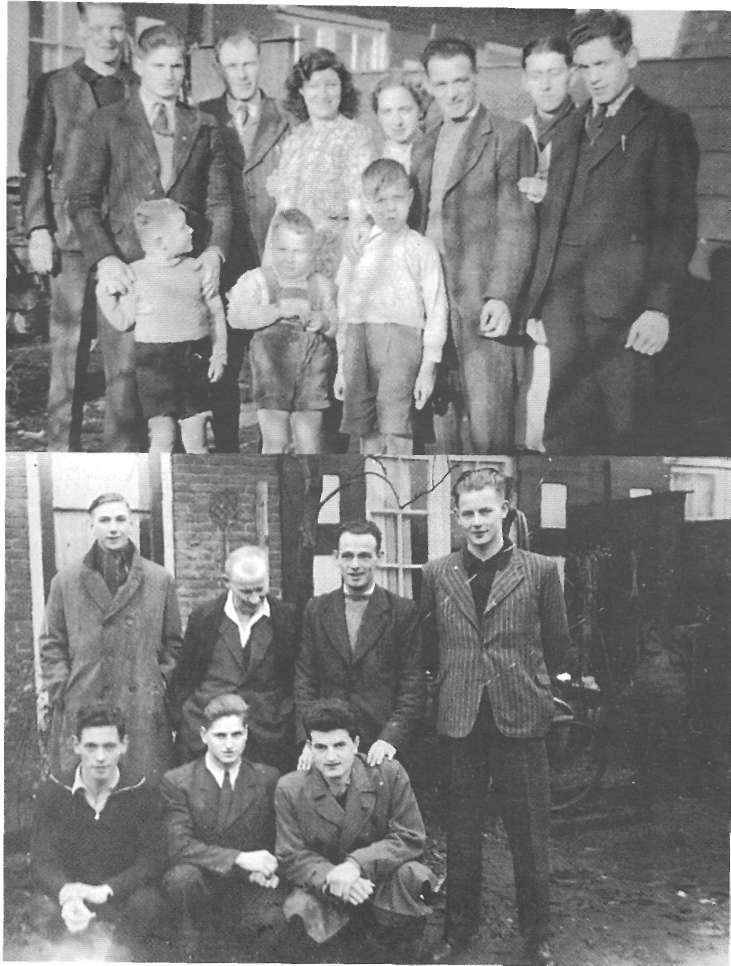
Leaving, December 1944
Link to the section Leaving, December 1944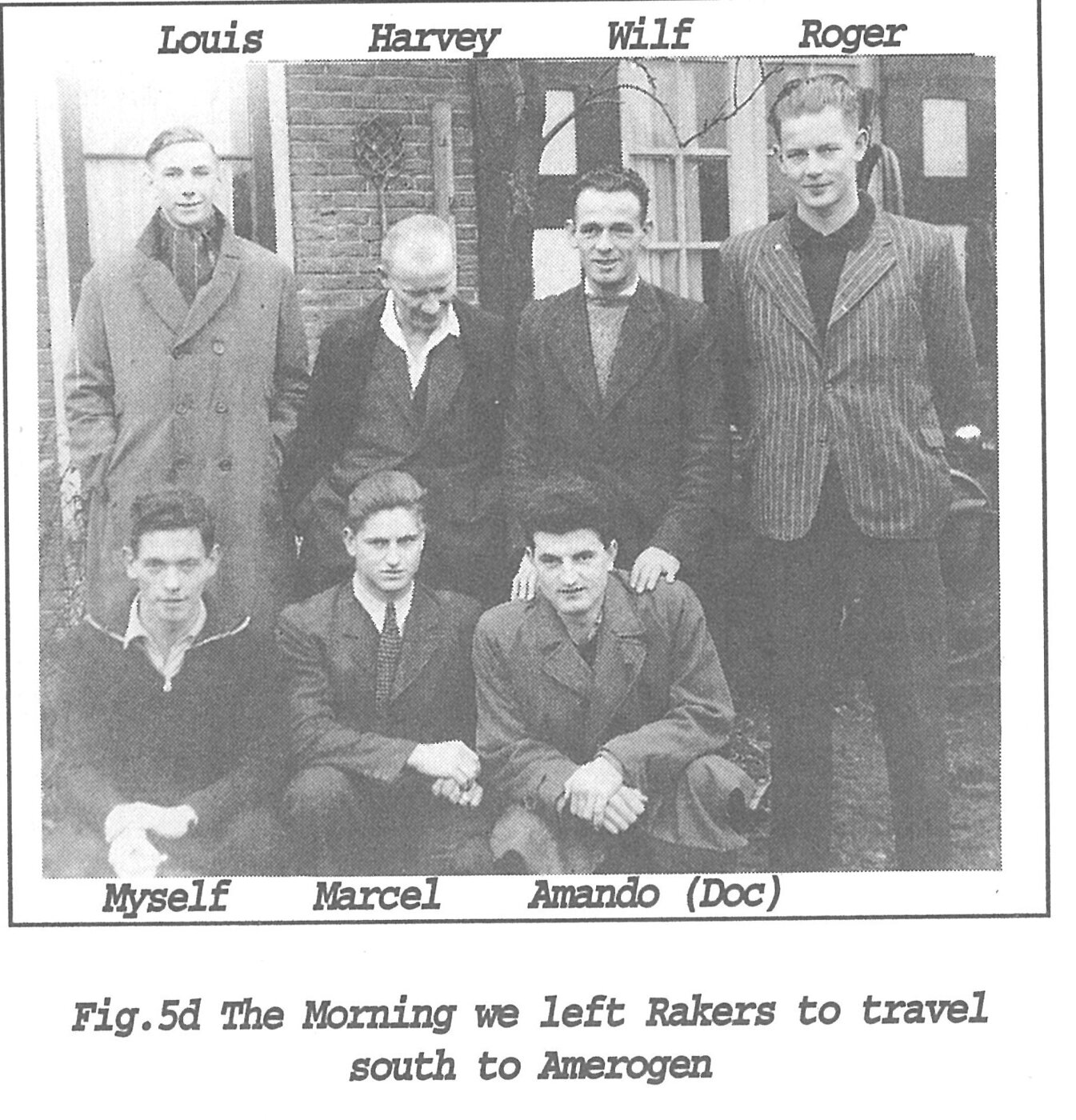
By Fowler, a courier brought word on 19 December that the Canadians were to leave, and early on 23 December five other Canadians from the train were brought to Rakers's house, given bicycles and started off with two Dutch guides for Amerongen; "Hermannus and his wife regretted their departure", believing the group too large to get through (Fowler, p. 102). Porter has the same: Rakers "still didn't like the idea of us going", and the party rode out in pairs, "a couple of telephone poles between each pair" (p. 133, chapter 5). W. R. Kaars Sypesteyn of Groenekan helped move the men from Groenekan to Amerongen "on 22 and 23 Dec 44", Schjelderup and Porter among them (his form, p. 3). Hans Hellendoorn has all of them handed to "Dirk" at Amerongen on the Friday and Saturday before Christmas, which are 22 and 23 December 1944 (his table, p. 5; Adriaan Maljers).
The table on the form for him (filled in by his widow, April 1946), her note and Berry's report give a later day, 24 December (the table, p. 3; her note, p. 2; Berry's Appendix A); see the last section.
A cousin or nephew of Mrs Rakers, "Harmannus Rakers, Schrassersstr. 21a te Arnhem", is named in her letter of 19 July 1946 as someone she forgot to list: "na de battle of Arnhem bij mij geëvacueerd ... gedurende twee dagen dienst gedaan als geleider der jongens door hen per fiets van Groenekan naar Amerongen te geleiden" (evacuated to her after the battle of Arnhem, and for two days acting as guide of the boys, taking them by bicycle from Groenekan to Amerongen) (her letter, p. 5). She writes neef, which is nephew or cousin. ◐ He may be the "Manse", Rakers's cousin from Amsterdam, who with his wife and small son lived in the house with Porter in the autumn (Porter, p. 125); Porter has him from Amsterdam, she from Arnhem.
✓ He died at 23:00 on 4 August 1945 at Hilversum, at an address in the Neuweg (the handwriting reads number 98), aged 35. The death was declared at Hilversum on 7 August by Jan van Velzen, an aanspreker (undertaker's man) of Hilversum, and entered in Maartensdijk's register on 21 August (the deed; the copy). The deed gives no cause.
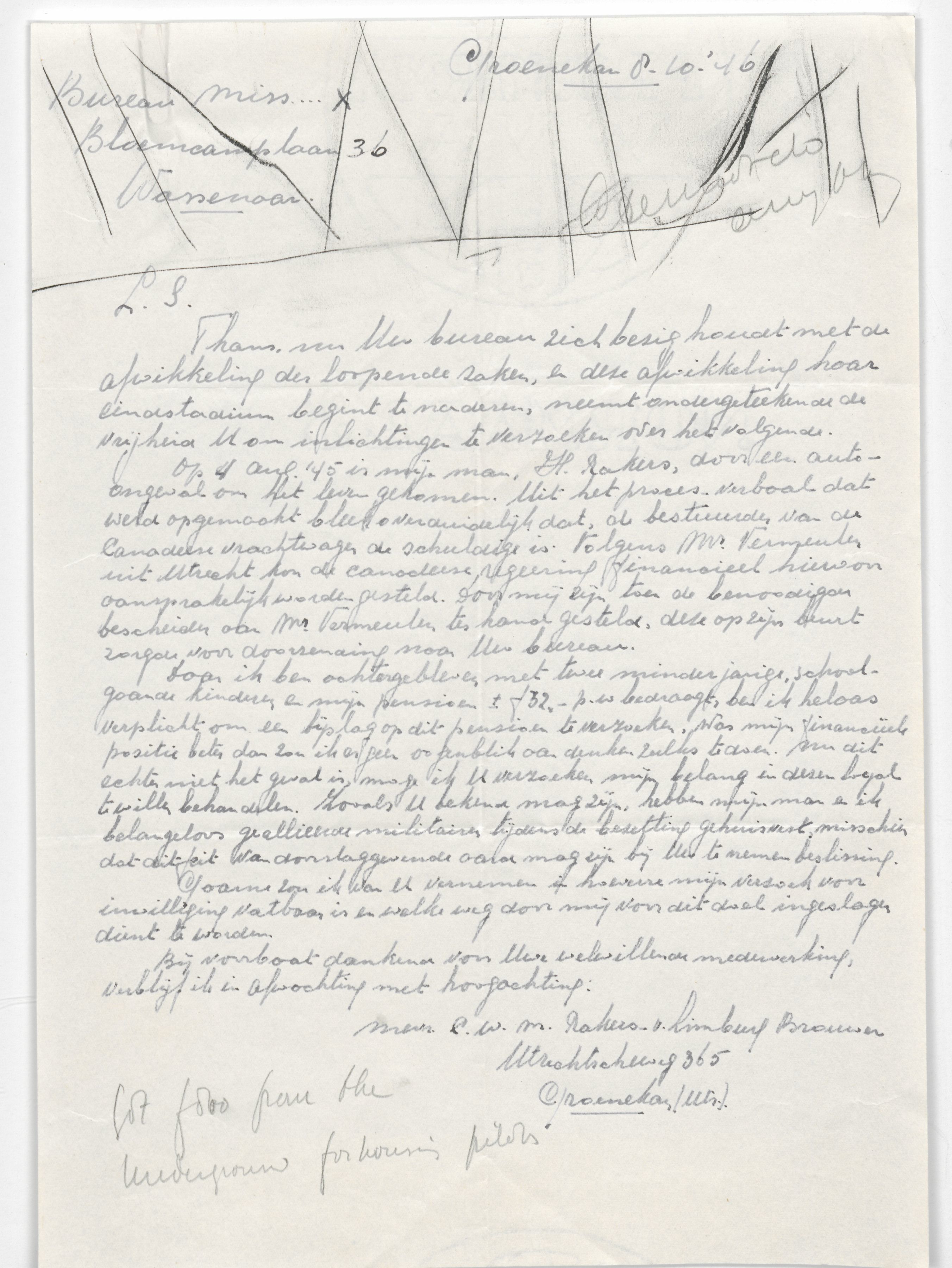
His widow gave the cause. Writing on 8 October 1946, she says that "Op 4 Aug. '45 is mijn man, H. Rakers, door een auto-ongeval om het leven gekomen", that the police report showed the driver of the Canadian lorry to blame, and that she was left with two schoolchildren and a pension of about 32 guilders a week; she asked the Americans' office for a supplement, since "mijn man en ik belangeloos geallieerde militairen tijdens de bezetting gehuisvest" (my husband and I housed Allied soldiers without payment during the occupation). The reply of 15 October 1946, from Lt Felix Bilgrey, was that the office could not pay her, since payments were made "slechts in bepaalde gevallen" (only in certain cases) and hers was not one; on 25 October she asked for her documents back, to take them to the Canadian Embassy, and was told the office did not hold them (her letter, p. 4; the reply, p. 3; pp. 12–13). An office note on file asks "Can a claim be given to Mrs. RAKERS?" (p. 7). The claim, the pension and the police report are from her letters alone. Porter, who had a "very sad letter from Dicky" in early August, has Rakers "collided with a Canadian Army vehicle" (pp. 239–240, chapter 12), ◐ probably her account relayed; nothing else found says where on the road it was.
The funeral. Porter, who was in Canada, had a "very sad letter from Dicky" in the first part of August (p. 239); he does not say what he drew his account of the funeral from, and writes: "Rakers was given full recognition with a 21 gun salute. Roger was a Captain then and represented the Canadian Army at the funeral. He spoke over the grave." (p. 241, chapter 12). He prints three photographs captioned as the funeral (pp. 240–241); the account is one man's from afar.
The family's notice in Het Parool of 7 August 1945, from his wife and their two children, set the funeral for Wednesday 8 August 1945 at 10.30 in the morning at the Algemene Begraafplaats (general cemetery) at Soest, leaving at 10 from Steenhofstraat 14, Soest, with the body lying in the Aula, Melkpad 21A, Hilversum; it has him dead "plotseling, tengevolge van een noodlottig ongeval" (suddenly, as the result of a fatal accident), aged almost 36 (Het Parool, 7 August 1945, p. 2). ◐ A notice sets a funeral and does not record one; no burial record has been found. Steenhoffstraat 14, Soest (spelled Steenhofstraat in the notice), is the address on the form of Theodorus van Dijck, whose next of kin is "Mrs.C.van Dijck vanLimburg-Brouwer", aged 33 on 6 May 1946 (van Dijck, p. 2); no source held says how she was related to Mrs Rakers. ◐ Very probably her sister Cornelia Johanna Antonia, born 26 October 1913 (the Soest register sheet above): the same maiden name, a "C." and an age within a year, and the funeral left from that house; this is our inference.
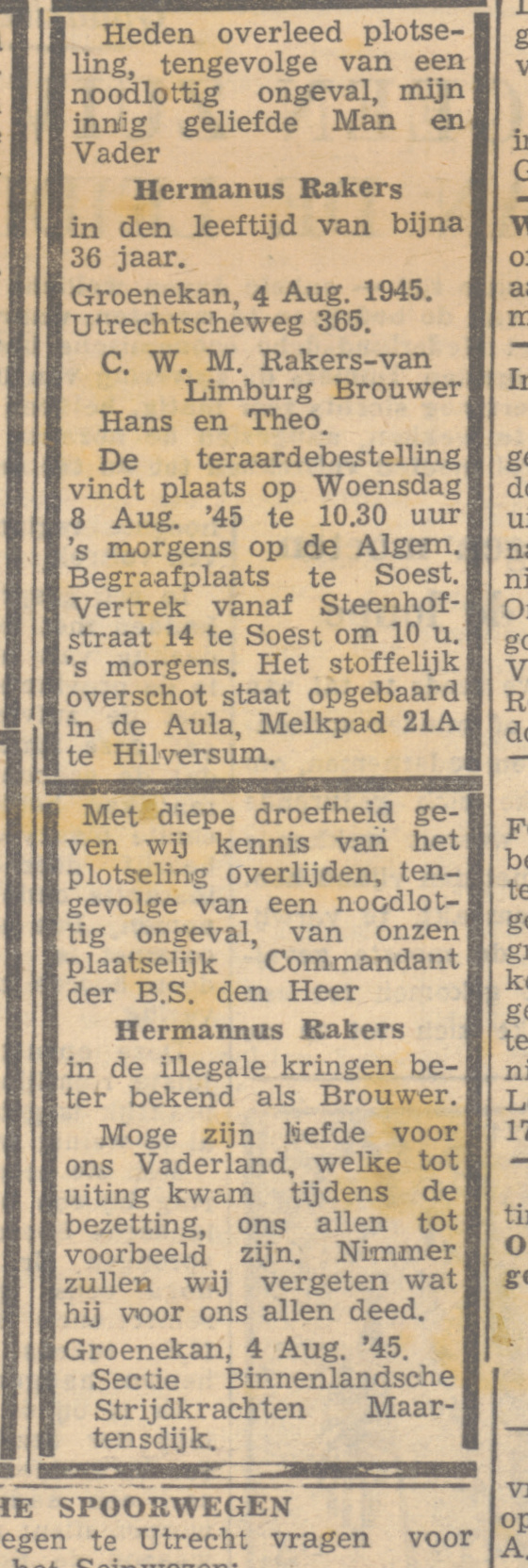
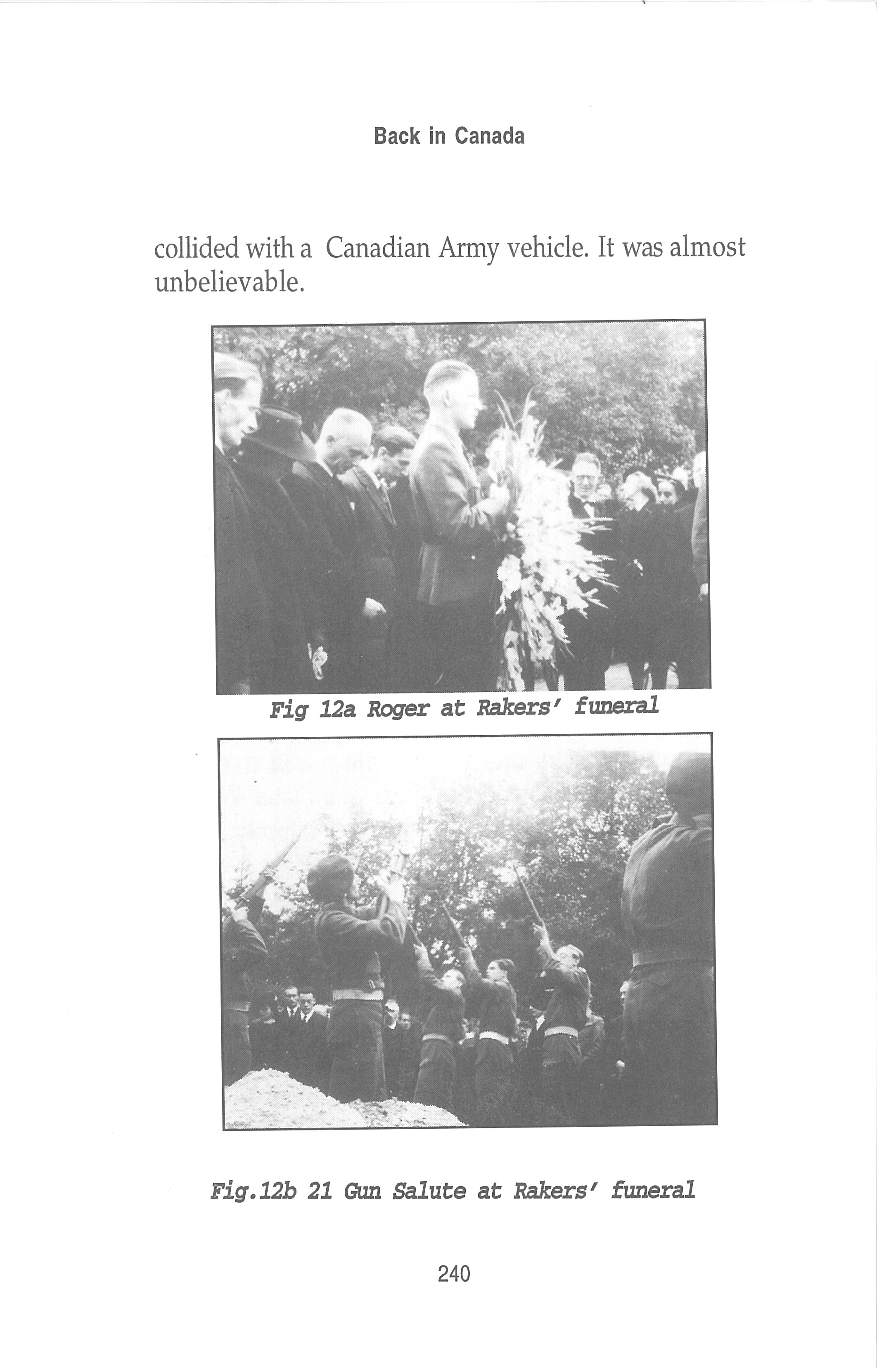
What was awarded.
- ✓ The Americans graded her file Grade 5 on 22 October 1945, "Housed 5 evaders whose names are contained in the report for periods up to 6 months" (the action report; the summary). A letter of 2 October 1945 from Captain Franklin D. Coslett asked Mrs Rakers to collect a bicycle on 6 October at H. van Loenen's house at Zeist, "voor Uw hulp aan geallieerde vliegers" (for your help to Allied airmen) (the letter).
- ✓ The British index has two lines: "27036 RAKERS, Hermannus, Utrechtscheweg 365, Maartensdijk, 5. Post." and "22534 RAKERS-v.LIMBURG BROUWER, C.W.M.", same address, Grade 5 (sheet R/1, read on the image).
- ✓ The American Grade 5 list has three entries: "(3395) RAKERS, Hermanus (Posthumous), Utrechtscheweg 365, Groenekan", "(3396) RAKERS, Hermanus, Utrechtscheweg 365, Maartensdijk" and "(3397) RAKERS-van LIMBURG BROUWER, C. W.", same address, Groenekan (p. 128, read on the image). ◐ The two entries for him, one posthumous at Groenekan and one at Maartensdijk with no note, look like a double listing of the same man (same name and house number; Groenekan lies in Maartensdijk); the list does not explain it.
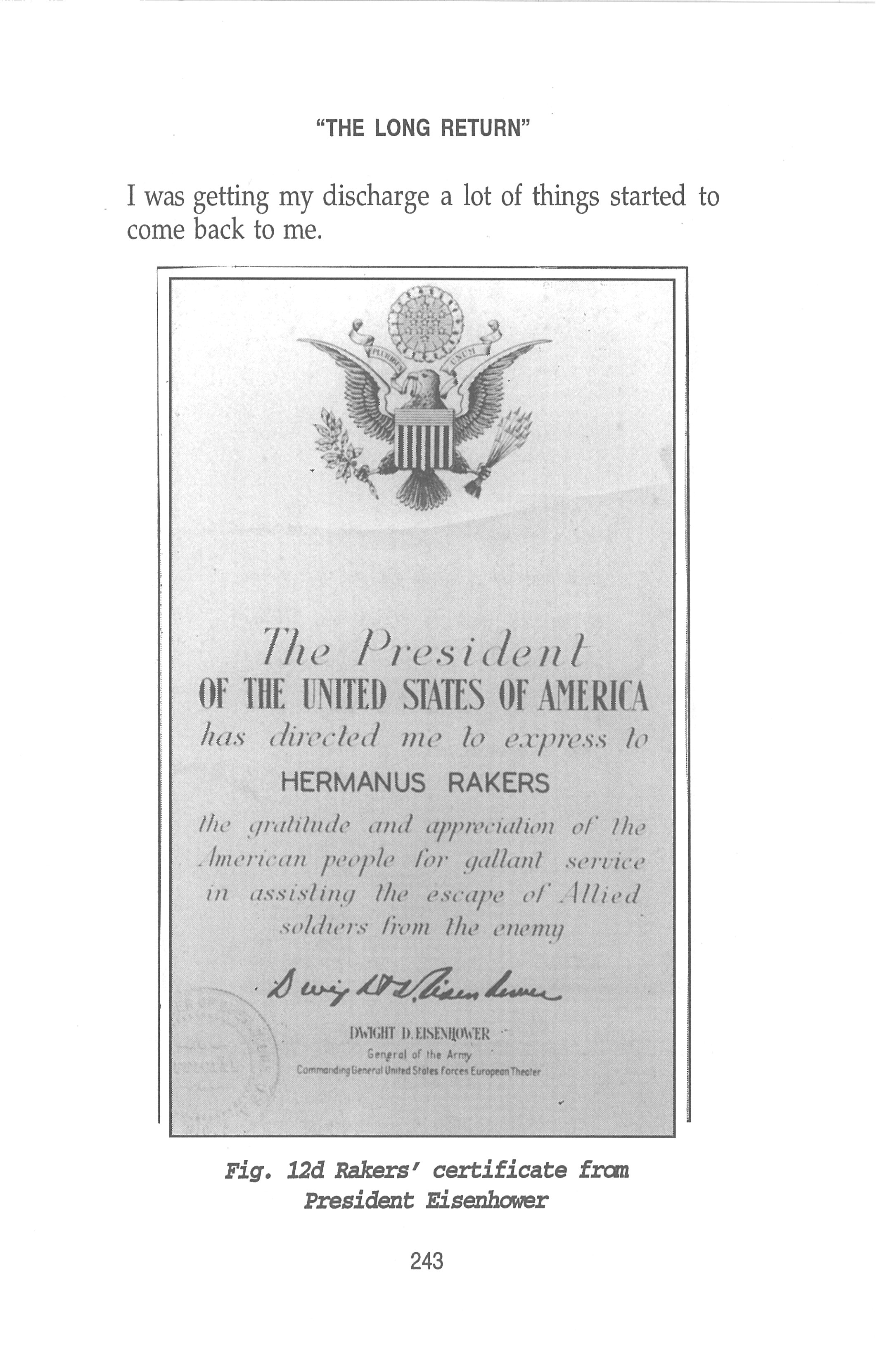
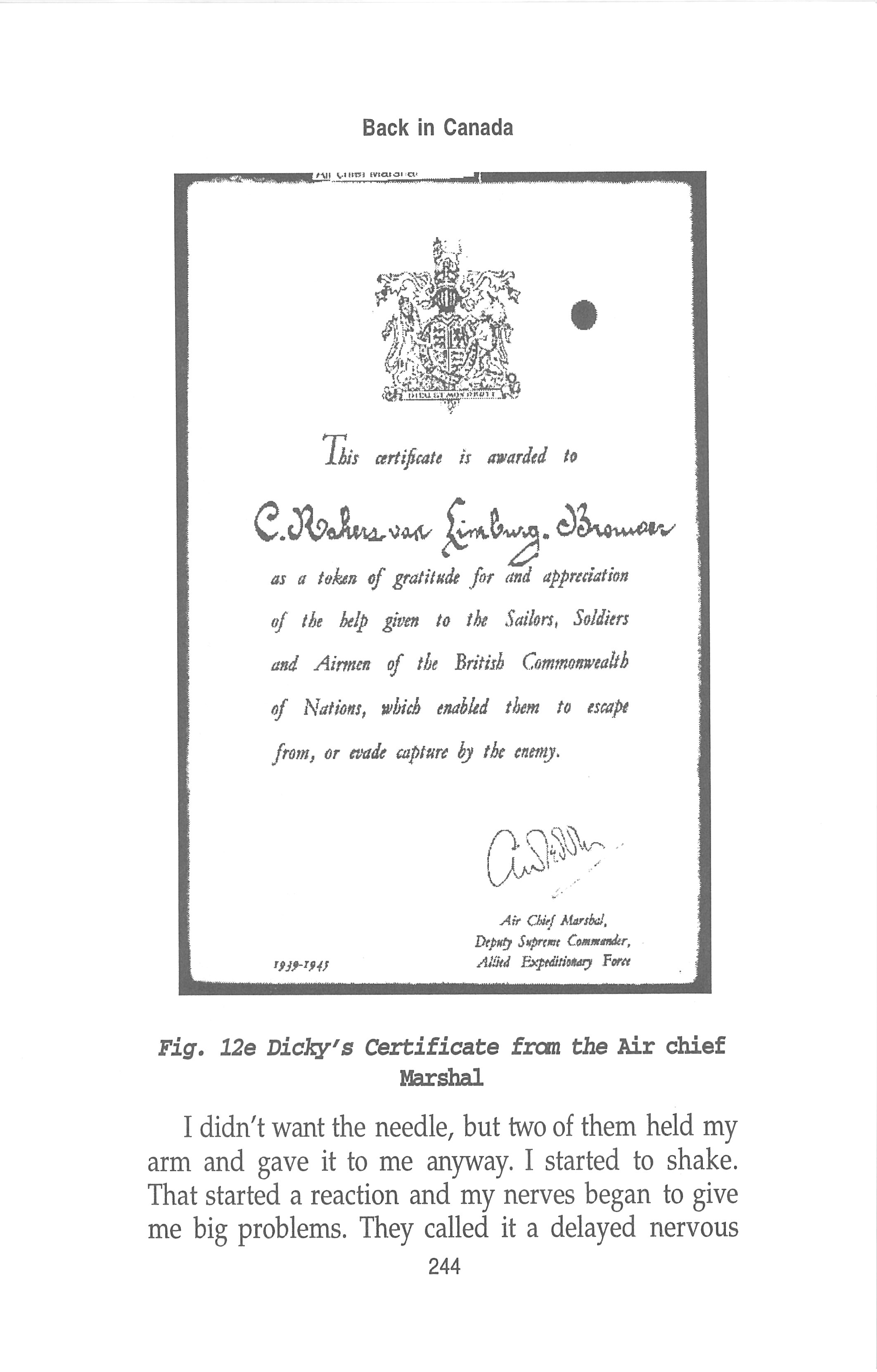
- ✓ Porter prints the Eisenhower certificate "to express to HERMANUS RAKERS the gratitude and appreciation of the American people for gallant service in assisting the escape of Allied soldiers from the enemy", and his widow's certificate from the Air Chief Marshal, Deputy Supreme Commander, Allied Expeditionary Force, made out to "C. Rakers-van Limburg-Brouwer" (pp. 243–244).
- ◐ The register of bearers of the Resistance Memorial Cross (above).
His widow. Catharina Wilhelmina Maria van Limburg Brouwer, "Dicky" Rakers, "Mamma" to Porter. She went on filling in the Americans' forms for him, wrote to Porter for twenty-five years, and in 1996 wrote to Fowler from Zutphen (Porter, p. 249; Fowler, note 13). Porter's book is dedicated "For Dicky (Mamma) Rakers", and its dedication page names "DICKY (MAMMA) RAKERS" and "HERMANUS (PAPA) RAKERS (He was killed in an automobile accident in August 1945)" (front matter). Writing in 1997 he gives her age as eighty-six, with a photograph of her captioned May 1997; that fits her birth in 1911 (Porter, p. 256, chapter 13). Her own file is the form of 18 September 1945 and her letters of 1946 (above).
Where the sources disagree
Link to the section Where the sources disagree- What he was. Marechaussee chief sergeant on the death deed; municipal field constable on Baay's form; "sgt." and "Wachtmeester" in Holwerda; "sergeant of police" in Schjelderup's report; "the local chief of police in the village of Groenikan" in Fowler (p. 101); an "ex-army captain" in Porter.
- ◐ The deed gives the Marechaussee rank on the declaration of Jan van Velzen, an aanspreker, and the Maartensdijk entry copies the deed.
- Against it, Holwerda, who worked with him, calls him "Wachtmeester RAKERS", writes of "Marechaussee J.BAKKER" as a separate man, and signs himself "De wachtmeester van Rijkspolitie" (p. 12; p. 11).
- ⚠︎ How a Marechaussee sergeant and a municipal veldwachter come to be one man is not explained in any source found.
- His first name. Hermannus on his death deed and in Fowler's article; Hermanus in the marriage index, in the family's notice in Het Parool of 7 August 1945, on Porter's dedication page and on Eisenhower's certificate, and Hermannus in the notice from the B.S. on the same page; typed Harmannus on the form his widow filled in for him (p. 2). The same spelling is the first name of the Arnhem relative in her letter of 19 July 1946 (above).
- His house number. 365 on his own form, his widow's letters, Holwerda's ("Fam. Rekers, Utr. weg 365", p. 2), the British index, the American Grade 5 list, the family's death notice of August 1945 and the Americans' letter of June 1946; 393 in Schjelderup's report and the "known to Allied personnel" box of his widow's 1945 form (Grade 5 list, p. 128; Het Parool; the letter). ◐ 365 was the number in use in 1945–46; whether it was 393 in 1944 is not settled.
- ✓ 393 was his post when he came to Groenekan: De Gooi- en Eemlander of 31 January 1935 has the newly appointed municipal constable H. Rakers stationed at Groenekan "(Utrechtscheweg 393)" (the notice, read on the page); ◐ that H. Rakers is he, by the appointment of "H. Rakers, agent van politie te Soest" as Maartensdijk's constable from 1 February 1935 (Utrechtsche courant, 26 January 1935).
- ✓ In the war 365 was not his address: in May 1942 it was the Groenekan office of the Nederlandsch Arbeidsfront (Utrechtsche courant, 6 May 1942, read on the page), and in October 1945 the former address of another man, whose property the Beheersinstituut had taken into administration (Nederlandsche staatscourant, 24 October 1945).
- ◐ So the family very probably moved from 393 to 365 after the liberation; that is our inference, since no source says it, and none places him at 393 in 1944 itself. His mother's death notice of November 1946 still has his widow at Groenekan (Winschoter courant, 29 November 1946).
- When the Canadians left. Not settled between 24 December and the 22nd and 23rd, and ◐ the later date reads as the day the forms count to, not the day the men left.
- ⚠︎ 24 December: the table, his widow's note and Berry's Appendix A (interview of 21 May 1945).
- ◐ 22 and 23 December: Schjelderup's Appendix A has "25 Oct – 22 Dec 44" at Rakers's and "23 Dec 44 – 2 Jan 45" at Cornelissen's; Kaars Sypesteyn and Hellendoorn have 22 and 23 December; Mrs Rakers's letter of 19 July 1946 has a relative guide the boys by bicycle from Groenekan to Amerongen "gedurende twee dagen" (for two days) (p. 5); Fowler's text and his caption to Porter's picture have the morning of 23 December, while Porter's own caption ("The Morning we left Rakers") and text ("just a couple of days before Christmas", p. 130) give no date.
- Hardy met Schjelderup and Berry at Amerongen on the afternoon of the 23rd (Hardy), so ◐ those two were gone from Groenekan by the 24th; Hardy names no one else, and the Canadian Scottish private he mentions is not named.
- The day Schjelderup and Trainor came, and the day they reached Rakers's house. 25 October by Van Brenk, Schjelderup's report, Rakers's table and Mrs Rakers's form, the house that evening by Schjelderup, "in the night of the second day" by Holwerda (p. 7; Dutch, p. 12); "26 October" in Porter (p. 116), "about mid-October" in Holwerda (p. 7), "middle of September 1944" in Ponssen (marked "[sic]" in our transcript of his statement, as the other accounts give 25 October).
- How Porter came. Six versions, set out on Porter's page: the table has him shot down on "8-6" (Porter gives the night of 16 June) and in the house from 16 June received from Middelkoop of Driebergen, his widow's form has Rakers and Copyn fetching him from Baay, and Baay has him only from 22 June to 9 July; Bos, v.d. Haak and Copyn each tell it again, Copyn having gone with Rakers to Driebergen in June to fetch him.
- When Briere and Berry came, and when they left. ⚠︎ Not settled. Rakers's table and his widow's form have both from 28 November to 24 December (above).
- Briere's own report has two Groenekan policemen taking him to the home of one of them, where he stayed "until about [8?] Dec 44" (the digit's top is faint on the scan; ◐ 8, since the next paragraph has him "in AMERONGEM from 8 Dec 44 until 1 Jan 45"); his Appendix A has "M. ROCKERS (A policeman)", Groenekan, December 1944, "Food and shelter for about a fortnight. Identity cards." (report, p. 2; Appendix A).
- Flip Esveld's statement has Briere brought to Flip "at the beginning of December 1944" (p. 7; Berend Esveld).
- Holwerda has Berry and Briere at Rakers's "from medio November until Xmas" (p. 7), and his table has Berry "23-12-44", received from the Rakers family and passed to B. Esveld (p. 23).
- Koele has Berry lodging with them for a few days "in the middle of December" (p. 3), and Copyn has him for five days, then a week at Oosthoek before he went back to Rakers (above).
- Hopma's table has both "Nov. 44", 28 days, with him, passed to Rakers; ter Beek's note has them about a month at Mrs Schuppert-Wolfert's, then taken over by Rakers (Hopma, p. 3; ter Beek, p. 8). From 1 November (Mrs Schuppert-Wolfert's date) a month runs to about 1 December (our arithmetic).
- Mrs Rakers's letter of 1946 has the two Canadians found by her husband "Ongeveer 2 weken later" than Porter's first week with the Heitingas, which it does not date (her letter, p. 9).
- Mrs Cornelisse's Dutch version has Porter brought from Zeist to Amerongen "ongeveer 18 Dec." (about 18 December) (p. 11; Mr and Mrs Cornelissen): ⚠︎ earlier than any other source puts Porter at Amerongen, where Schjelderup's report has 23 December.
- Porter's stays with the Heitingas. ⚠︎ Not settled; she and Heitinga agree on a second stay in December.
- His widow's letter of 1946 has one week, dated only relative to the two Canadians her husband found about two weeks after it, and four or five days "Tusschen 5 Dec en 20 Dec '44" (her letter, p. 9).
- Heitinga's table has "aug.44 and dec.44" for the time hidden, and "Zeist" in its shot-down column, as on Rakers's table (Heitinga, p. 5).
- Porter's book has a few weeks with the Heitingas from the third week of November until Rakers fetched him back (Porter, chapter 5, pp. 125–126).
- The children's ages. Porter's ages for them in 1944 (p. 88) do not match the ages the forms give for the same time; neither is repeated here.
- His wife's age. Porter has her 32 in 1944 (p. 87); the birth index and her own form give 13 May 1911, which makes her 33 from May 1944.