Frank Coslett
9 May 1915 – before 15 Feb 1992 ◐
About: An American navigator shot down on 29 April 1944, hidden in Gelderland, Overijssel and Amsterdam until the SD took him on 24 December 1944, then held at Velp, De Kruisberg and Assen, condemned to death but not shot, until 13 April 1945; in the prisons he met two of the Dutch helpers of Murphy's road. ✓ After the liberation he was the Capt. Franklin D. Coslett who headed the American MIS-X Holland Office and signed many of the helper files this site uses.
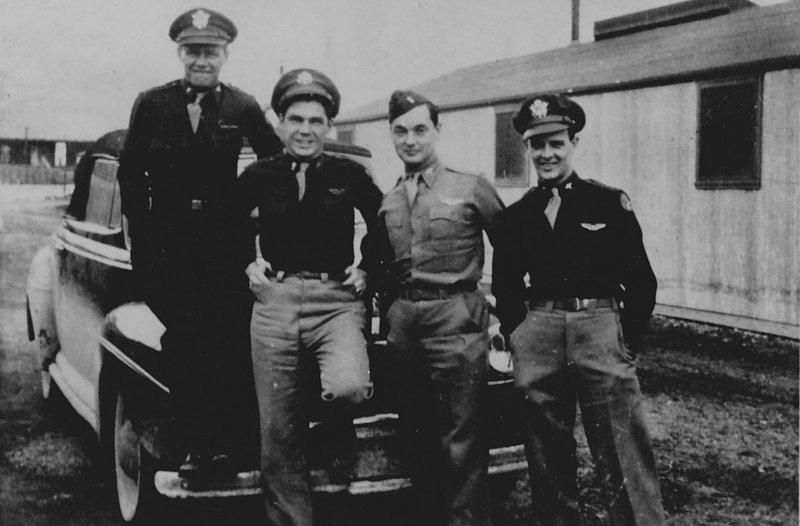
Unit or role: ✓ USAAF, 1st Lt, 0-801361, navigator, 788th Bomb Squadron, 467th Bomb Group; "Franklin Dent Coslett" on the certificate in his escape report, born 9 May 1915 by the form in it, a radio announcer before the war, of Wilkes-Barre, Pennsylvania (E&E 2968, PDF pp. 5, 12 and 21; the OCR, which misreads the date on p. 12 as 1919); a flying officer by Kauffeld's account. After the liberation he joined the 6801 MIS-X Detachment's Holland Office, Bloemcamplaan 36, Wassenaar, on 1 July 1945 and, promoted Captain, Air Corps, was its officer in charge, by the office's own history (the History, PDF p. 2; Scheepstra's file, p. 3, 29 August 1945; Hendrik van Loenen's file, p. 16); he left for the United States in April 1946 (below).
Where: Wilkes-Barre, Pennsylvania. Shot down near Vierhouten, 29 April 1944; hidden at Nunspeet, Doornspijk, Ommen, Dalfsen, Zwolle, Harderwijk, Amsterdam and Hoenderloo, and passed to Groenekan; held at Velp, De Kruisberg at Doetinchem and Assen; after the war Wassenaar and Zwolle.
Evidence: ✓ E&E 2968, his own report; ✓ the History of the Holland Office, 10 June 1946; ✓ Doetinchem Herdenkt; ✓ Kauffeld's file, p. 4; ✓ Maljers's statement, p. 17; ✓ H. J. Snel's file, p. 3; ✓ his own declaration of 13 November 1945, pp. 34 and 35; ✓ his letter of 20 February 1946, p. 3; ✓ Koeslag's letter, p. 25; ✓ his wartime notices as a radio man and cadet and ◐ the later broadcasting and Air Reserve notices.
✓ A radio man, then a cadet. The Variety Radio Directory of 1937–38 has, in the entry for WBRE, Wilkes-Barre, Franklin D. Coslett as program and publicity director (p. 615), and among its people in radio the entry "COSLETT, FRANKLIN D.", announcer and program director at WBRE, Wilkes-Barre, in radio since 1934, with local shows, a master of ceremonies in theatres and earlier a newspaper reporter (p. 921); Broadcasting of 15 January 1938 names him among the station's officials as program director (p. 22). That is the "Radio Announcer" of Wilkes-Barre in his escape report. Motion Picture Daily lists "Franklin D. Coslett, Army Air Corps, Maxwell Field" among the radio and theatre men in the services on 21 July 1942 (p. 7) and "Franklin D. Coslett, WBRE, Army Aviation Cadet, Maxwell Field, Ala." on 9 December 1942 (p. 12); on 20 April 1943 it has "Navigation Cadet Franklin D. Coslett, former program director of Station WBRE in Wilkes-Barre, Pa." made a cadet flight lieutenant at the advanced navigation school at Selman Field, Monroe, Louisiana (p. 8; Boxoffice, 24 April 1943, p. 40). The Monroe Morning World of 2 May 1943 has him among the flight commanders who took the packets of diplomas for their flights at the school's graduation (leaf n34), and Boxoffice of 29 May 1943 reads "Lieut. Franklin D. Coslett, former program manager at WBRE, has been commissioned a navigator in the army air force at Monroe, La." (p. 34-C).
◐ The Army and Navy Journal of 3 June 1944 has "1st Lt. F. D. Coslett" in the Army's list of airmen missing in the European area, continued on its p. 1181 (the page): initials and rank only, a month after 29 April; ◐ the same list has "1st Lt. J. L. Low, jr.", whom E&E 2968 (PDF p. 11) has as the crew's assistant navigator, which supports it.
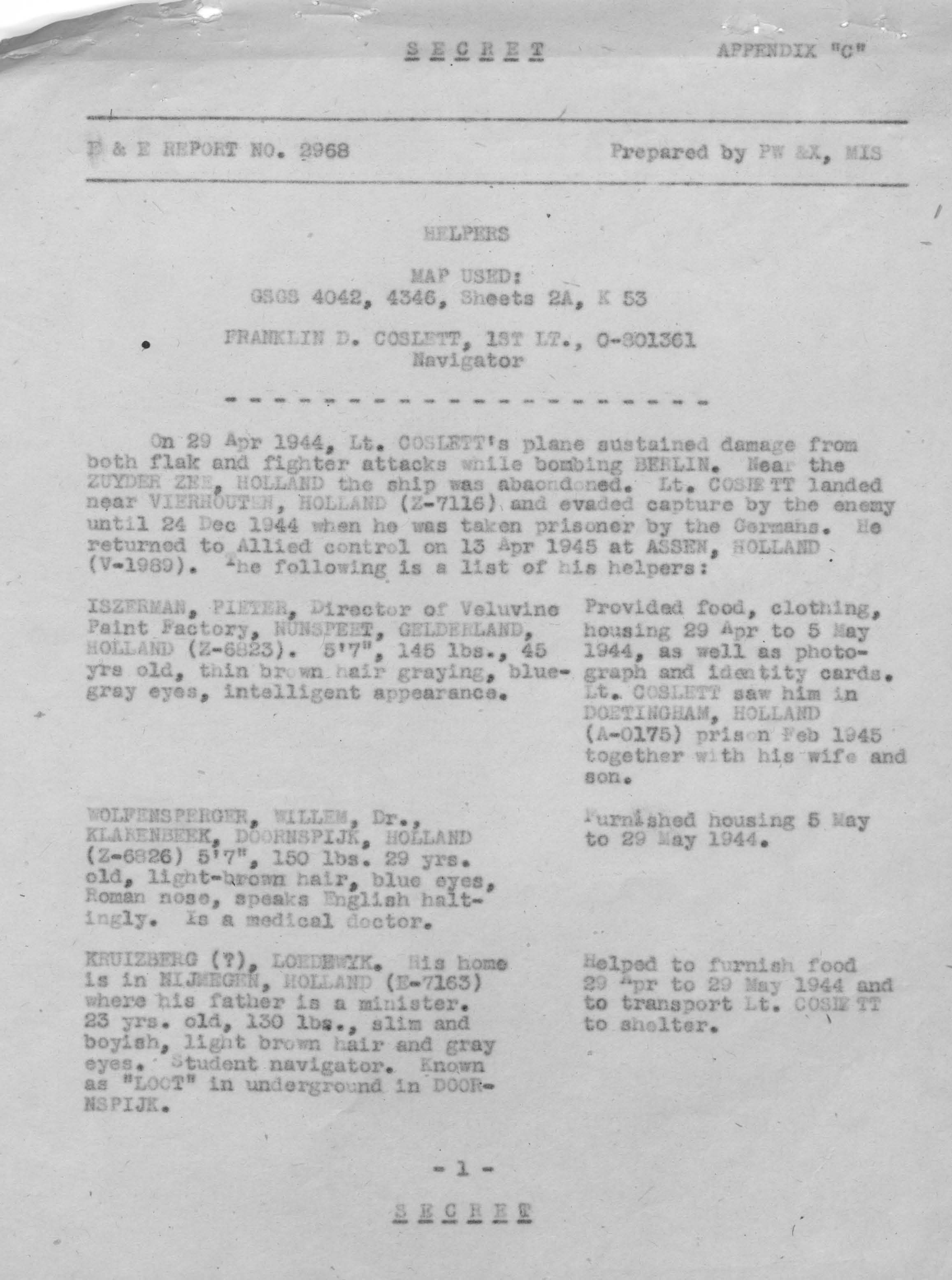
✓ His own report. E&E 2968 says his plane was hit by flak and fighters over Berlin on 29 April 1944 and abandoned near the Zuider Zee, that he landed near Vierhouten and "evaded capture by the enemy until 24 Dec 1944", and that he came back to Allied control on 13 April 1945 at Assen. The file holds two reports with separate helper lists: the MIS-X report written up on 18 April 1945 and a British I.S.9 (WEA) report, no. IS9WEA/1/384/3001, from an interview on 16 April 1945 (PDF pp. 22–24), which gives some dates differently (see Where the sources disagree). The MIS-X list gives his helpers with the dates he gave (E&E 2968, pp. 2 to 4 of the report as typed, written up on 18 April 1945; the OCR):
- IJzerman at Nunspeet, 29 April to 5 May 1944, with photographs and identity cards; Dr Wolffensperger and the student Kruizberg ("Loot") at Doornspijk, 5 to 29 May; Jan Seigers of Wolfskuil 10, Ommen, 29 May to 29 June, whom the report says was captured on 29 June with two companions and "may have been executed".
- Willem "Degroene" (Henk), a Zwolle station master, 29 June to 15 July; Hendrik Jan van Poelgeest, a Harderwijk baker, 15 July to 30 August, and H. J. Kok at Harderwijk, 15 July to 27 August, who ran a duck farm.
- Dr van Dijk, "alias Dr. DEJONGE, alias Mr. ZWART", who gave him food cards and transport cards after 30 August; Hendrik Jan Schryver in Amsterdam, 30 August to 5 November; Harry Scheepstra, 5 to 20 November; Mrs Viroly in Michelangelostraat, 20 November to 6 December; Jan Albert Scholl at Hoenderloo, 9 to 24 December 1944; and Dr H. R. Tas, "alias Dr. DICK HOYTIMA" of Rotterdam, who gave medical attention "while a fellow prisoner".
✓ Other helpers' forms put him in the same places. Dr Wolffensperger housed "8 evaders from 18 to 79 days", among them "F.D. COSLETT USA" with Walter Kilgore, Werner Braun and Carroll Stearns (his file, p. 12). Albertus Dercksen of Nunspeet has "Franklin Cosselet ?", shot down "29-4-44 Vierhouten", about 3 days from 2 May, passed to Creutzberg at Doornspijk (his file, p. 14). Johannes Plomp of Hellendoorn wrote that "Jan Sijgers, Ds. Vogelaar and Franklin D. Coslett can confirm" his work, "the latter was in Jan Sijgers house himself" (his form, p. 2), and Jan Seigers of Ommen lists him first, "Franklin D. Coslett USA", with Brand, Whittaker, Cook and Kilgore, 45 days from "15/5" (his table, p. 32). Hendrika Beernink-de Riet's table has him "29-4, Ommen, 3 weeks in a boat", received from "Koosje (Ommen)" and passed to H. Poelgeest at Harderwijk (her table, p. 5).
✓ Doornspijk: the house was called Klarenbeek. His hostess for the weeks of 5 to 29 May was Dr Wolffensperger's wife, Clasina Wolffensperger-von Baumhauer, born at Amsterdam on 4 September 1923. Her own form, from "Klarenbeek", Doornspijk, lists him first, "F.D. COSLETT, 1st. Lt.", among eight evaders housed "from 18 to 79 days" (her form, p. 13). As Captain he wrote for her on 20 February 1946 that she "was my hostess for more than three weeks time", hiding "my two comrades and myself" (his letter, p. 3; the office's note of the same day, p. 2). ✓ The house name explains Gerrit Wiessenberg's form, which has Braun, Kilgore and Coslett "sheltered in the Klarenbeek Dok", brought by Creutzberg and later taken south by a group from Apeldoorn, with "Wolfensperger, Klarenbeek Dsk" as the source (Wiessenberg's form, p. 3): it is this house at Doornspijk, not the village of Klarenbeek near Apeldoorn and not a new stage: E&E 2968 lists the doctor as "WOLFENSPERGER, WILLEM, Dr., KLARENBEEK, DOORNSPIJK, HOLLAND" (PDF pp. 2 and 8), and his own summary gives "Klarenbeek, Doornspijk" (his file, p. 12).
✓ Nunspeet, Ommen, Lemelerveld, Harderwijk. Elisabeth IJzerman-van Waveren of Nunspeet lists "Franklin D. Coslett USAAF 3 days" with Braun and Kilgore, on a summary headed with Coslett's own name and the date 14 December 1945, where the summaries of other files carry the officer who took them (her form, p. 2). The two tables of the Nunspeet evaders' camp, A. M. Lenstra's and D. D. Bakker's, carry the same row for him: "29-4-44, Vierhouten", from "2-5" for about 3 days, "catched from the air", passed to Creutzberg at Doornspijk (Lenstra, p. 15; Bakker, p. 9). Gerrit Mazier of Nunspeet's summary says he took Coslett, Braun, Kilgore and Duncliffe to the "evaders camp at Nunspeet" (p. 6). ◐ So he passed through the camp's helpers for a few days in early May, but nothing puts him in the woods: the man "picked up in the wood" on the camp tables, for 120 days, is the RAF man Duncliffe. Siemen Bakker of Den Ham took care of "4 pilots (F.D. Coslett, Walter Killgore, Werner Brown, Jeslow Oberdak) at Ommen", of Jan Seigers's group, and moved them on foot to Wubs at Dalfsen after Seigers's arrest (his form, p. 2; the scan is faint). The Rev. A. J. W. Vogelaar of Lemelerveld, who "helped with transport", lists him with Kilgore and four other Americans (his summary, p. 8), and Dirk Poelgeest of Harderwijk lists "Franklin D. Coslett, USA - 4 months" (his summary, p. 4). B. G. Meijerman of Doetinchem, a reserve major, lists "Franklin D. Coslett. USA" and the Pole Oberdak, "for a couple of days", with no date or place of the hiding (his summary, p. 2): ◐ nothing says when. Oberdak's "15-5, Dalmsholte" on Timmerman's table is his own date and place (Seigers has "20/5"); Coslett was at Doornspijk until 29 May by his report, so they joined up later, at Ommen.
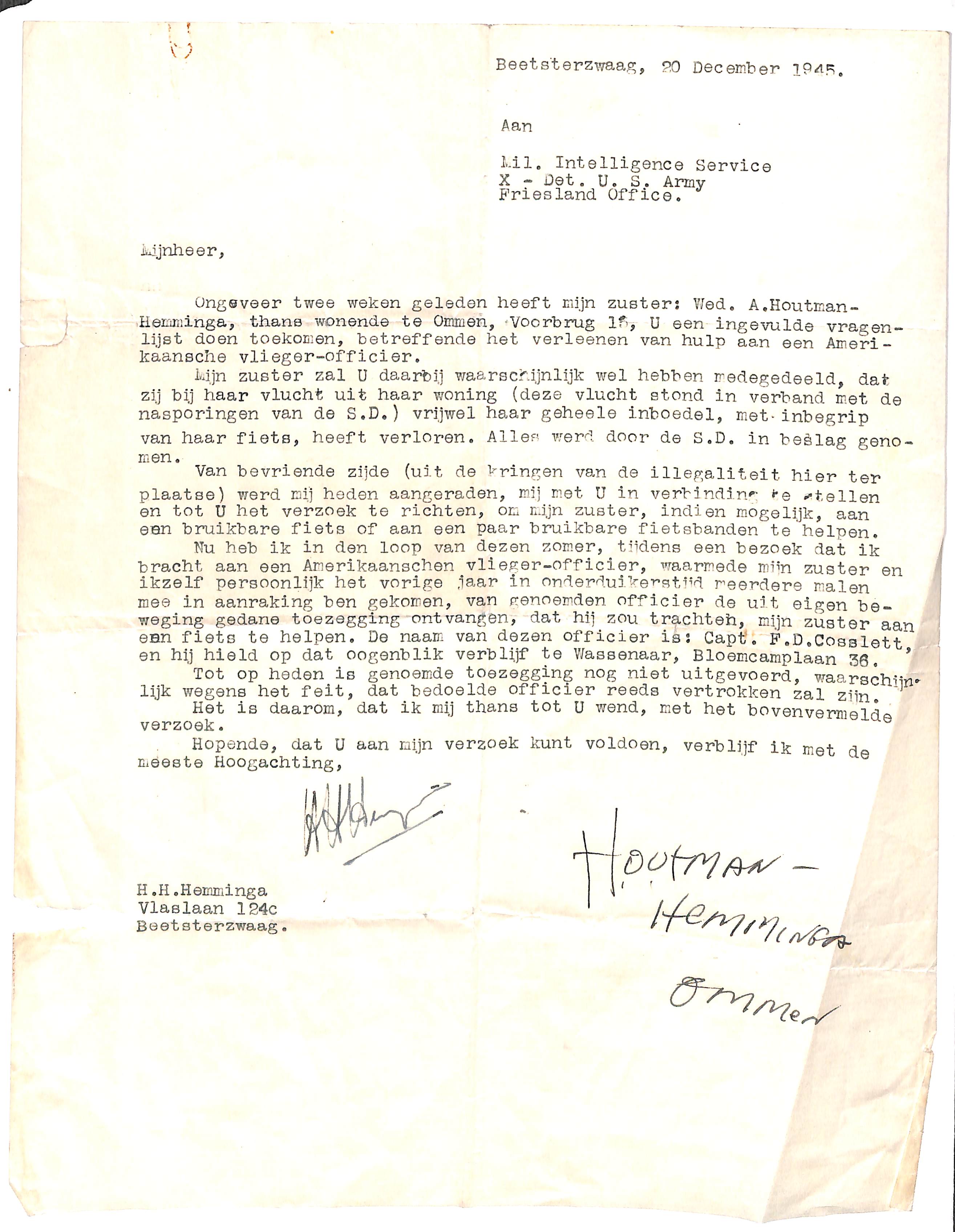
✓ Hemminga, Ommen. On 20 December 1945 H. H. Hemminga of Beetsterzwaag wrote to the American MIS-X Friesland Office about his sister, the widow A. Houtman-Hemminga of Ommen, who had lost her bicycle and nearly all she had when she fled the SD's inquiries, and asked for a bicycle or tyres for her. He added that on a visit that summer to "een Amerikaanschen vlieger-officier, waarmede mijn zuster en ikzelf persoonlijk het vorige jaar in onderduikerstijd meerdere malen mee in aanraking ben gekomen" (an American flying officer with whom my sister and I personally came into contact several times last year in the time of hiding) he had had from him the unprompted promise to try to find his sister a bicycle, and gave the officer's name as "Capt. F.D.Cosslett", then at Wassenaar, Bloemcamplaan 36 (the letter, p. 9, checked on the image). His sister's own questionnaire of 5 December 1945 is about another airman, Harry Williams, for two days from 29 June 1944, and says her brother was in hiding with them at Ommen then (pp. 5–8). ◐ Nothing says where in 1944 the four met; Jan Seigers's house, Wolfskuil 10, Ommen, where Coslett's report has him from 29 May to 29 June, is in the same street as the family's.
◐ A driver from Genemuiden. R. K. Heijs of Groningen wrote to the office on 11 June 1946 that the driver who had taken him and a companion to Dedemsvaart had "also transported Captain Coslett, who was at Wassenaar before you", with a pencilled margin note "Check whether we have him" (the letter, p. 28). ✓ Heijs's own papers date that trip to Saturday 13 November 1943, when he and the wireless operator Nicholas Mandell were taken to Dedemsvaart in "the motor-car of Bertus Breman at Genemuiden", and name the driver: "Bertus Breman, chauffeur, Langestraat 43 Genemuiden, who lent us his car … he transported various times allied airpersonnel for Dr. Provo Kluit from Genemuiden" (Heijs's account, p. 11; his form, p. 21, OCR). ⚠︎ The remark about Coslett is second-hand and undated; no other source puts Coslett at Genemuiden.
✓ The Dalfsen to Harderwijk chain. Eight forms of the Zwolle, Harderwijk and Staphorst helpers carry the same block, or part of it: Coslett, W. G. Brand, J. R. Whittaker, James D. Cook and W. T. Kilgore, USA, "29-4", Harderwijk, received from "Farmer Timmerman, Dalfsen" and passed to "H.J. Poelgeest, Harderwijk", and Oberdak, a Pole, on 15 May at Dalmsholte. They are the files of J. Graver (p. 8, his summary of 12 February 1946: "Provided transportation … Franklin D. Coslett USA 0-801361 May 1944"), P. L. Stil (p. 5), E. J. J. Aan't Rot (p. 9), J. C. Peters (p. 3), W. Alink (p. 4), E. J. H. Keilholz (p. 3), M. Noach-Meijer (p. 19) and G. J. Beyjer (p. 3), and Leo Gooy's has "Franklin D. Coslett en 5 anderen o.a. Walter Kilgore" (p. 11). The block shows who moved with him; the helpers of the Nijverdal side, James Branford and Warren, are on the same tables.
◐ A police letter naming his report. On 28 February 1947 the Almelo police wrote to the MIS-X office that E. B. Brune, held in the Almelo house of detention "verdacht van verraad van illegale werkers en Airborns" (suspected of betrayal of illegal workers and Airborns), had in his papers a list of airmen: no. 1 "1st Lt. Franklin D. Coslett 0-801361, Liberator", with a pencilled "E&E 2968" beside it, and then Braun, Whittaker, Oberdak, Cook and Kilgore, and, in a Stirling crew, James Branford (the letter, p. 4). ⚠︎ It is a police suspicion about Brune and an inventory of his papers; nothing on the page says how Coslett was taken in December 1944. The Holland Office's reply of 18 March 1947 says Coslett had been "eenigen tijd Commanding Officer van dit Bureau" and "wel in Nederland geruimen tijd gevangen gezeten ook ten gevolge van verraad" (a long time in prison in the Netherlands, also as a result of betrayal), that he had never named Brune, and that it did not know what part Brune played (the reply, p. 3). ◐ The office itself held that he had been betrayed; it did not tie Brune to it.
Herm Jan Snel of the Hasselterdijk, Zwollerkerspel, a man of the group "de Groene", listed "Franklin D.Coslett USA … Ohio" among the men he hid "early June/early August" 1944, at the same time as the RAF bomb-aimer James Branford and the Canadian John Warren (Snel's file, p. 3; his questionnaire, p. 2). Hendrik Jan Rigter of Zwolle, "Henk of Pijl", of the same group, listed "Franklin D. Coslett", USA, as received from Boer Timmerman at Dalfsen and passed on to H. J. Poelgeest at Harderwijk, with four Americans on ditto marks below him; the same list has Branford and Warren further down (his list, p. 3; his form, p. 2, 17 July 1945). ◐ The Americans' reviewer noted that Rigter knew of and sanctioned the work, but that it was done under the direction of "Willem de Groene" — Henk Beernink. ◐ The "Willem "Degroene" (Henk)" of E&E 2968, the Zwolle station master who sheltered him from 29 June to 15 July, is very probably this Henk Beernink, executed: Snel's form has "Received pilots from "de Groene" (H.D.J.Beernink, executed)" (p. 2), and Lonnee's table puts the Zwolle stop at "Beernink, Herculostr. 6, Zwolle" (below).
✓ His crew. S/Sgt James R. Anslow, the radio operator, listed the 788th Squadron crew in his own E&E report: the command pilot Robert L. Salzarulo, the pilot Bill F. Moore, the co-pilot Edgar Powell, "NAVIGATOR FRANKLIN D. COSLETT", the bombardier Edward Verbosky and, as waist gunners, Walter Kilgore and Werner G. Braun, the two men who travel with Coslett in the helpers' forms above (E&E 1838, p. 2 of the PDF; the transcript). ◐ Coslett's own I.S.9 crew list has S/Sgt W. Kilgore as top turret gunner, S/Sgt W. Braun as ball turret gunner and T/Sgt Watts as right waist gunner, and the MIS-X casualty list in the same file has Watts at the top turret and "KILGARE, WALTER" and "BROWN, GEORGE W." as waist gunners, so the lists disagree on positions (E&E 2968, PDF pp. 22 and 11). Anslow's plane crashed at about 13:30 on 29 April in a forest near Harderwijk, and he went his own way, by Apeldoorn, Deventer, Zwolle and Ommen to Enschede, where the page read here ends; of the rest of the crew he wrote that he did not know what had happened to them (pp. 2 and 5). Nothing in his report is about Coslett's own movements.
✓ His pilot. His crew list has the pilot as "1/Lt Bill F. MOORE", with the note "See War Crimes Appendix attached" (E&E 2968, PDF p. 21). The appendix, headed with Coslett's name and number, says:
I have been informed, and place a 35% estimate of accuracy upon the report, that Lt MOORE was executed by the enemy. He had evidently been evading capture in civilian clothing for a long time, but was captured in NOVEMBER and was imprisoned at APELDOORN charged with terrorism. One morning 30 persons were executed in reprisal for a terrorist act. He was allegedly a member of this group.
— Franklin D. Coslett · War Crimes Appendix to I.S.9 (WEA) report IS9WEA/1/384/3001, filed with E&E 2968 · interview of 16 April 1945 · E&E 2968, PDF p. 23
He gave his source as a young woman who had the next cell to Moore's, whom he met while she and he were being transported from Doetinchem prison to "WESTERBOERG Concentration Camp" (same page). Aircrew Remembered, a secondary page, has Moore captured on 1 October 1944 and executed by the SD on 2 December 1944, and Geroux, citing it, writes of "the subsequent execution of his pilot, Lt. Bill Moore" (Aircrew Remembered; Geroux, p. 329). ⚠︎ Coslett's "November" and the page's 1 October do not agree. ◐ The MIS-X casualty report in the same file (Appendix D, PDF p. 11, struck through with a cross) has Moore "May have been executed Dec 1944 by Germans, APELDOORN", which agrees with Aircrew Remembered's 2 December 1944 for the execution; the two disagree only about when he was captured. Anslow, in his own report, was told by "a Dutch patriot just after the first contact that I made" that Moore "was safely in the hands of the patriots" (E&E 1838).
✓ His own date for the pick-up. Coslett wrote on 20 November 1945 to Willem (Wim) Mazier of Nunspeet (Mazier's file, p. 7; the typed name is spelt "COSIETT"):
I very well remember the 29th of April 1944 when I first came out of the air with a parachute and met you and your father. I have thought of you many times since that and have always hoped that you and all members of the family are well and happy.
— Franklin D. Coslett, Captain, AC · letter to Willem Mazier, Holland Office, 6801 MIS-X Detachment · 20 November 1945 · the letter, p. 7
He gave Mazier the addresses of Braun (Coldwater, Ohio) and Kilgore (McRoberts, Kentucky), "both now back in America". Wim Mazier's own table lists Kilgore and Braun at Nunspeet from "29-4-44", 4½ and 4 days, and the RAF man Duncliffe from 12 June, all passed to A. M. Lenstra, and has no row for Coslett (p. 3); his summary of 4 March 1946 names Coslett among four pilots he and his father took to the evaders' camp, but dates it "March 1944" (p. 6), the same slip as Gerrit Mazier's summary (see below).
✓ Doornspijk: who else names him. Dr D. J. Bruins of Doornspijk, replying on 29 April 1946 to the father of Loed Creutzberg, gave five airmen he could recall: James R. Wilson of Waterloo, Iowa, Thomas P. Reilly of Brooklyn, Braun, Kilgore and "Capt. Franklin D. Coslett, America", and two Englishmen, Eric and Derek (the typed translation, p. 9; the table of the same five names is on p. 3). A typed note in the same file, unsigned and with a pencil signature that cannot be read, says that "Before he left Cpt. Coslett asked me to send a qr. to the family of Loud Greutzberg", who might be recommended for grade 5 (p. 6). ◐ The writer is not named, so it is not clear who "me" is. ◐ Creutzberg is the "Loot" of E&E 2968 (the report spells him Kruizberg); his father's form of May 1946 gives his full name as Loed (L. G. Th.) Creutzberg, born at Nijmegen on 18 December 1920, and says that near the liberation he and his helpers had an underground shelter near Nunspeet where some 96 Jews and pilots were hidden (p. 2).
✓ Doornspijk to Zwolle and Ommen, by car at night. Pieter Wolffensperger of Zwolle, who was not in any underground group, wrote on his form of 23 March 1946 (his file, p. 2; the driver was H. van Marle of Zwolle, because Wolffensperger could not manage the charcoal-burner):
The persons mentioned on reverse-side were transported by car ( N.S.B.car) by me from Doornspijk via Zwolle to Ommen The transport took place in June 1944 at night. Left Doornspijk 9.15 hours P.M., arrived Zwolle 9;45 P.M., arrived Ommen 10.15 P.M. Two Dutch persons escorted us. I was called by telephone to come soon if possible.
— Pieter Wolffensperger · helper questionnaire, Zwolle · 23 March 1946 · the form, p. 2
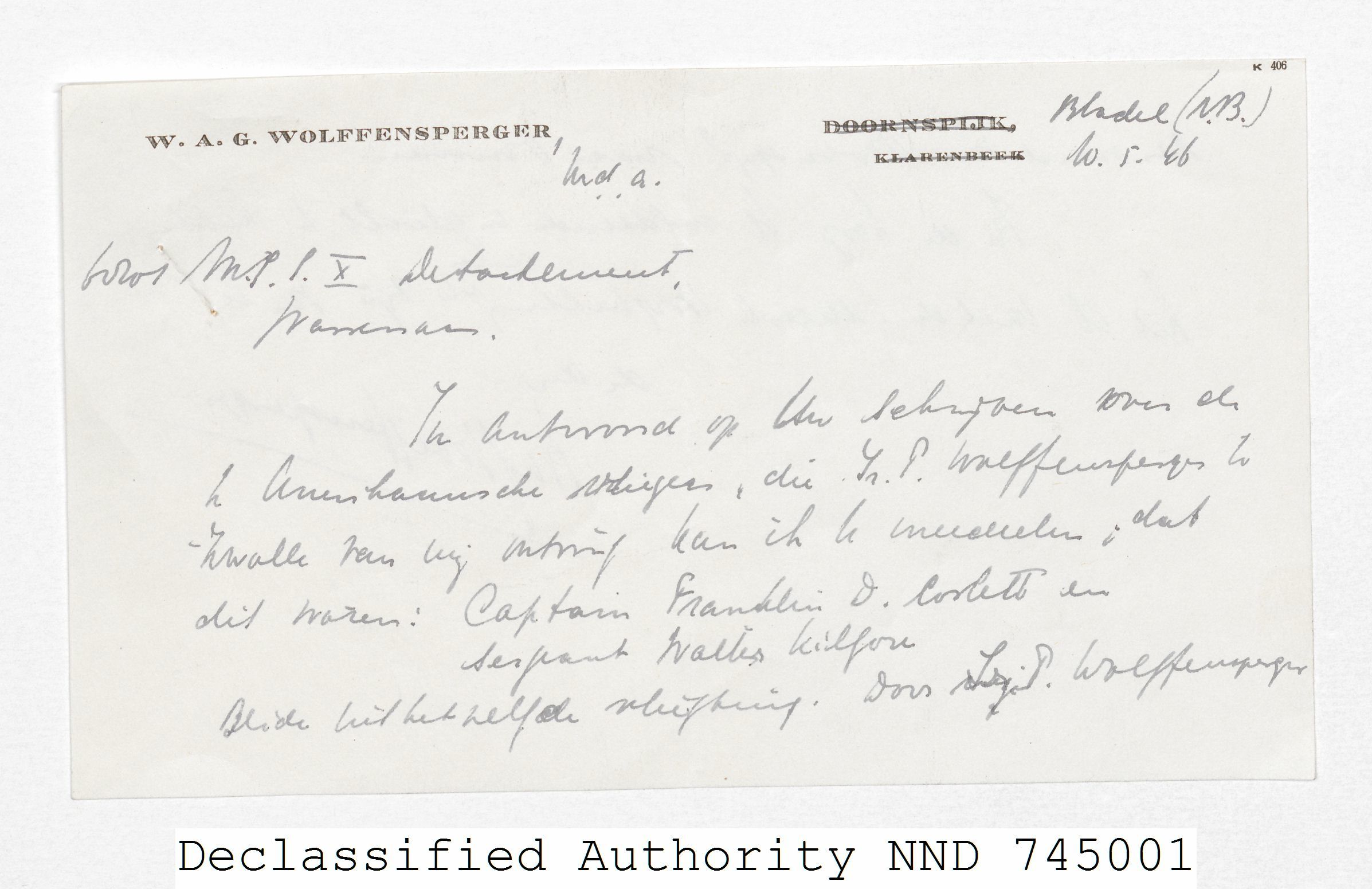
His table has "Franklin D. Coslett (no E.&.E.)", received from W. A. G. Wolffensperger at Doornspijk and passed to "Ommen, South of station on road to Den Ham", with Kilgore; the reviewing officer added that Kilgore did not mention Pieter Wolffensperger and that Dr Wolffensperger did not either (p. 3). The office wrote to the doctor on 4 May 1946, "Captain Coslett naar Amerika terug is" (Captain Coslett has gone back to America) (p. 6), and on 10 May he answered by hand, on a letterhead with Doornspijk struck out and Klarenbeek left, that the two American airmen whom Pieter Wolffensperger of Zwolle had had from him were "Captain Franklin D. Coslett en Sergeant Walter Kilgore" (Captain Franklin D. Coslett and Sergeant Walter Kilgore), both from the same aircraft (p. 4). Wate Metz, a transport agent of Jan Seigers's group, also took "Coslett & Kilson" (◐ Kilgore) "by auto from Doornspyk to Zwolle" (his form, p. 7).
✓ Ommen to Dalfsen on foot, and Timmerman's own table. Metz also wrote that he took "Coslett, Kilson, Bram and Oberdak - walking - from Ommen to Dalfsen when Seigers house was attacked" (p. 7); his table has Coslett, Braun and Kilgore at Vierhouten on "29 Apr 1944", from Dr Wolffensperger, passed to "Police at Dalfsen", and Oberdak at Dalfsen on "30 May 1944" (p. 8). Another table in his file puts "Franklin D. Coslett and the 5 others" above Leslie and Dick (USA, August 1944, Dalfsen), and the line that "the last 2 fliers" lived six weeks in the wood and then went to Dr Veldhuis at Lemelerveld (p. 6); ◐ that line reads as being about Leslie and Dick, not Coslett. Cornelis Timmerman of Rechteren, the "farmer Timmerman" of the forms above, has in his own table Coslett (0-801361) "29-4", Harderwijk, hidden from "29-6", received from "SEIGERS, Ommen" and passed to Group "de Groene", Zwolle, with Brand, Whittaker, Cook, Kilgore and Oberdak ("15-5", Dalmsholte) on the same rows (p. 9; his remark, p. 8: that he "received and housed pilots and fliers" and sent them on to de Groene). Wessel Wubs of Zwolle has "Franklin D. Coslett en de 6 anderen waaronder C. Oberdak (Polen) en Walter Kilgore" with no date or place (p. 3), and in the office's summary "Looked after and transported … Franklin D. Coslett + 6 others" (p. 7).
✓ Zwolle. Gerrit Bomhof of the Zwolle group "de Groene" has "Franklin D.Coslett en de 5 anderen" and, in the office's summary, "Transported 6 fliers from Dalfsen to Zwolle", which his Dutch form says he did in his sailing boat (table, p. 7; summary, p. 8); no date is given. Nanny Alink, whose address known to airmen was Harculostraat 6, Zwolle, lists "Franklin D. Cosslett" after two RAF men she dates "Jul 44 near Zwolle", without a date of his own (p. 7). Hendrik Lonnee of Zwolle dates the next move: his table has Oberdak "31-8-44", from "Beernink, Herculostr. 6, Zwolle" to H. J. Schrijver, Willem Royaardsstraat 18, Amsterdam, with Coslett on the next line and ditto marks (p. 3), and the office's summary says "Transported Czeslav Oberdak, and Franklin D. Coslett. U.S.A. from Zwolle to Amsterdam. 31.8.44." (p. 4).
✓ Zwolle to Amsterdam: Dr Vermeer. Dr Dirk J. Vermeer, a dermatologist of the Binnengasthuis, Bachstraat 21, Amsterdam, wrote to "Mr. Cosslet" after reading of the appeal in the paper (his letter is undated): "I am the doctor who took you from Zwolle to Mrs and Mr. Schrijver at Amsterdam" (Vermeer's file, p. 2). His own form says he "escorted Captain Coslett and an other pilot from Zwolle to Amsterdam by train" (p. 12); its table has Coslett received from the Zwolle organisation, escorted by Vermeer, Mink and Mrs van Delden, passed to the Schrijver family, with "Oberdale" in "same transport as captain Coslett" (p. 13). Coslett answered on 17 January 1946 as "Dear Dr. ver Meer-- Dr. de Jong-- Mr Zwart" (p. 11). ◐ So the "Dr. VAN DIJK, alias Dr. DEJONGE, alias Mr. ZWART" of E&E 2968, who gave food and transport cards after 30 August 1944 and, the report adds, "Appeared to be interested in aiding Lt. COSLETT only in hope of recruiting him for guerilla fighting in AMSTERDAM" (E&E 2968, p. 3 of the PDF), is very probably Vermeer: two of the three names are the same.
Amsterdam, 31 August to December 1944. The helpers' forms add stops and dates to E&E 2968's three addresses (Schryver, Scheepstra, Viroly; its I.S.9 list adds Penning, for Oberdak), and some stops those reports leave out:
- ✓ Scheepstra and Viruly. Harm Scheepstra's table has Coslett "Apr 44 NUNSPEET", hidden "Oct 44", 60 days, from "Schryver - Van den BERG, Willem Reynards 18" and passed to "Mrs. VIRULY, Michelangelo Straat 36" (p. 6); the office's summary, dated 11 December 1945 and carrying Coslett's name and "6 December 1945" as the reviewing officer, says he "Furnished housing, food and clothing to 1st Lt Franklin D Coslett, USAAF, for a period of 60 days" (p. 4).
- ◐ A British agent, "Swordfish". Coslett's I.S.9 list has "Paul POTTER (?) - British agent "SWORDFISH" - whose real name I do not know - Gave me money and guide service from AMSTERDAM South" (E&E 2968, PDF p. 24).
- Dina Viruly-van Hattum's handwritten table has "Dick van Rysewyk (z woordvis?)", "Holland ENG. AGENT", Sept '44 to Dec '44 and 6 March to 1 May '45 (p. 6), and "zwaardvis" is Dutch for swordfish.
- ⚠︎ Possibly one man with the Breda son Adam van Rijsewijk, to whose family Coslett wrote in March 1946 (see Leaving for America); a lead, not settled: the first names differ (Dick, Adriaan, Adam) and the "z woordvis?" is queried.
- ✓ Dina Viruly-van Hattum of Koninglaan 14 has "Franklin D Coslett USA" with Oberdak, "left for own lines", received from Scheepstra (typed table, p. 4), and "3 weeks" in a handwritten one (p. 6); the summary says she "Provided food, shelter and clothing" (p. 2).
- ✓ The house at Michelangelostraat 36. Five helpers who lived or worked there list him. Fritz Kahlenberg, leader of the hidden-camera group "Nederland Archief", names as his own helpers Smedts (the Engeland route), Oorthuis (passport photographs) and Penning (housing) (p. 6); the office's summary of him is "Gave shelter and food to pilots" Coslett and Oberdak (p. 5).
- ✓ Claude Uriot's summary has "Provided food, clothing and shelter" for Oberdak ("1 Month"), Coslett, Daniel Redd, Chr. Smith and Capt. Merril Olson (p. 5); his table has Coslett (0-801361) passed with Oberdak to S. Budding, Vyverlaan 6, Groenekan (Utrecht), and gives "Nov 1944 to 5 Dec 1944" on Oberdak's line, from "Hr. Claus - Comm.N.B.S." of Amsterdam-Zuid (p. 7).
- ✓ Hermine Salomonson-Keezer's Dutch form lists "1st.Lt. Fr.D.Ceslett (0-801361 American)" passed idem, to Budding at Groenekan (p. 7). Hilde Wallheimer-Freund's table has "Cosslett, Franklin D." hidden "Nov.44", from "Claus, Comm. B.S.", to "Buddingh, Groenekan" (p. 10); her summary says food and money "for 35 days" to three flyers, Coslett, Oberdak and Olson (p. 7), and the 35 days are not tied to one of them.
- ✓ Ingeborg Wallheimed (Uriot to Penning), Jeanne Ledeboer, Robert van Delden and the barber Christiaan Smink list his name without dates (Wallheimed, Ledeboer, van Delden, Smink); Smink's remark is that he served the two airmen "both in his shop and in the underground hiding places", with Oberdak and "Lt. Franklin D. COSLETT 0-801361".
- ✓ Penning and van Lier. Coslett's I.S.9 list names "Mr and Mrs Allen PENNING, at SURINAME STRAAT 9" for "food and lodging for F/O OBERDAK … who was later executed by the Germans" (E&E 2968, PDF p. 24); the MIS-X list has no Penning.
- Allan Penning's table has Coslett from "24" November, 3 days, received from Kahlenberg, and then "Went back to Previous address", while the line above it, "Went to Mrs B van Lier," sits with Oberdak (p. 4); his wife's has Coslett "24/26-11 1944", 2 days, "back to old address", and Oberdak passed to Mrs van Lier (p. 3).
- Ivy van Lier's table, though, has Coslett "1 day in December 1944", received from Kahlenberg and then "left" (p. 4; her summary, p. 2).
✓ Hoenderloo, and 24 December 1944. His report puts him with Jan Albert Scholl at Hoenderloo from 9 to 24 December 1944 (E&E 2968, PDF p. 10), and his declaration of 13 November 1945 has him a prisoner of the SD from 24 December (Wildeboer's file, p. 34). ◐ Aircrew Remembered, a secondary page, has him sheltering in the woods at Hoenderloo on the morning of 24 December with F/O Oberdak and three others when "quite by accident they were discovered", three escaping and Coslett and Oberdak being taken to the SD at Velp, tried there "illegally" and sentenced to death for terrorism and espionage (the page). His certificate gives his time as an evader as seven months and 25 days (handwritten), which is 29 April to 24 December (E&E 2968, PDF p. 5), and his medical examination "in the field" on 17 April 1945 gives his age as 29, which fits a birth on 9 May 1915 (PDF p. 18).
With Murphy
Link to the section With MurphyNo source puts him with Murphy, but he was in the prisons that Murphy's captured companions passed through. He is one of the Allied names on the Doetinchem memorial foundation's list of Allied prisoners of De Kruisberg (Doetinchem Herdenkt). ⚠︎ Swartz's report has him and Oberdac join Swartz's group there (Swartz's page); Noble's later account (unpublished private papers, shared with us privately) has the Canadians next to his cell "with two Americans and one Pole", naming none. He was not from Murphy's party. His part is told on Captivity and home.
A. E. Kauffeld, the Otterlo helper arrested after Pegasus II, met him in the SD prison at Velp (Mr Kauffeld):
In the S.D. prison in Velp I met Frank Coslett, flying officer living in Pensylvania, civilian profession radio-fitter. He was condemned to death but not yet executed when I was released
— A. E. Kauffeld · US National Archives · RG 498, helper file of A. E. Kauffeld · typed slip · Kauffeld's file, p. 4
Adriaan Maljers, the guide of Murphy's party on 2 January 1945, sent from Velp and Utrecht to De Kruisberg, wrote: "I met there with Captain Coslett … I met with Captain Coslett and I secretly changed a few words with him now and again" (Maljers's statement, p. 17; Adriaan Maljers).
✓ Oberdak, who was with him from Ommen on, was executed. Snel's form has "Czeslaw-Oberdak … (was executed)" (p. 3), Coslett's own I.S.9 list says he was "later executed by the Germans" (E&E 2968, PDF p. 24), and Doetinchem Herdenkt lists "Czeslaw (C.) Oberdak (23 jaar) uit Polen" among the 25 men shot at the Woeste Hoeve with 92 others on 8 March 1945 (Doetinchem Herdenkt).
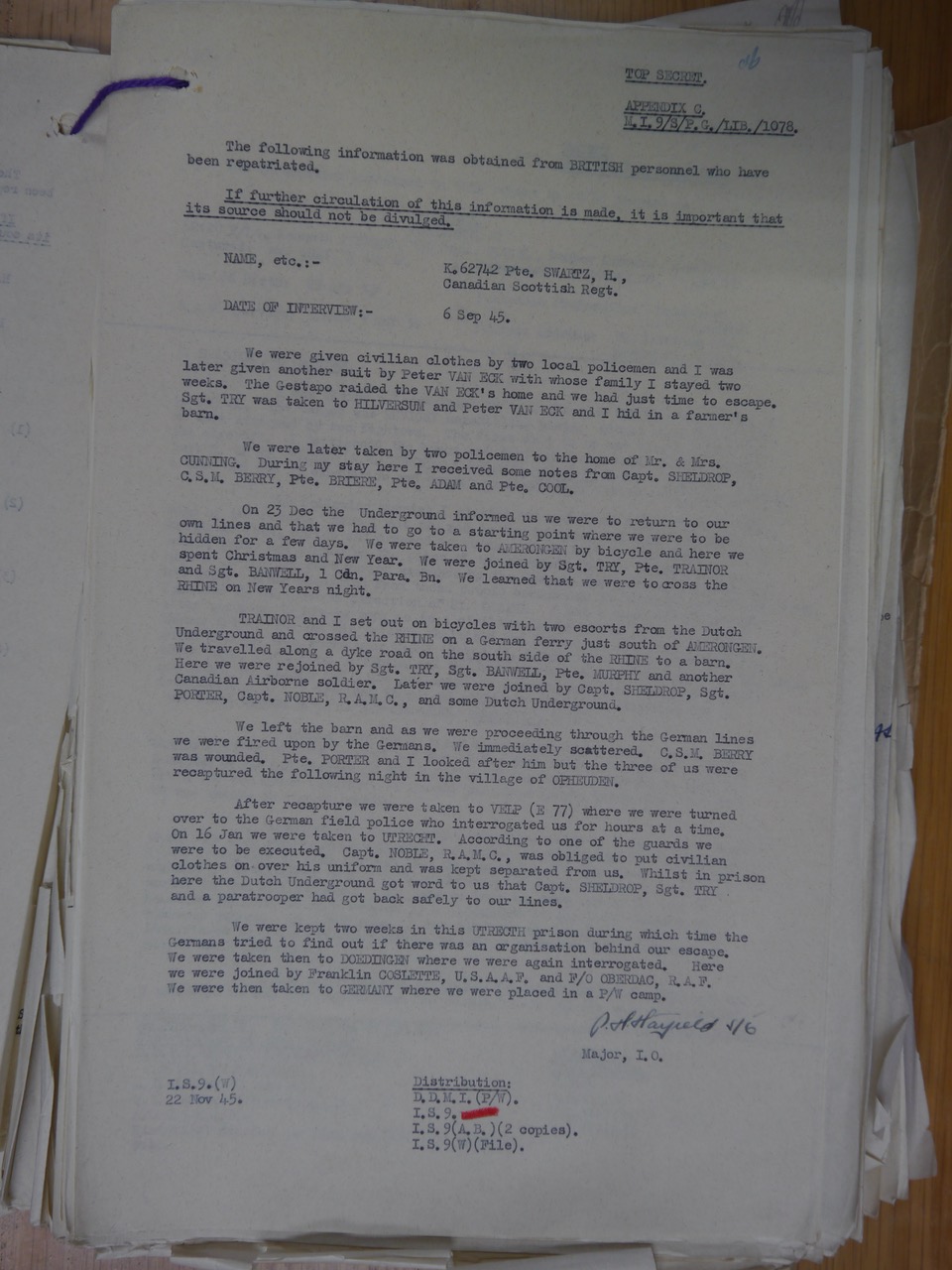
✓ One of the Canadians from that party, Pte Harvey Swartz, says the same, after two weeks in the Utrecht prison:
We were taken then to DOEDINGEN where we were again interrogated. Here we were joined by Franklin COSLETTE, U.S.A.A.F. and F/O OBERDAC, R.A.F.
— Pte H. Swartz, Canadian Scottish · MI9 liberation report, Appendix C · 1945, photographed at Kew by the late John Howes, who passed it to Lisan Koppenol, and she sent it on · the photograph
✓ Charles J. Fr. M. Verbruggen of Bennekom, writing on 21 January 1946 in answer to an article on help to Allied pilots, asked that his letter be handed to Capt. Coslett, whose name is pencilled beside the address:
Please, hand this letter over at Capt. Franklin D. Coslett, who lives at your same address. He was with me in the cellar of the prison in the Rotterdam Bank [sic] at Velp with Det. Gerritgen [?] and Instr. Kauffeld, van der Vemde etc.
— Charles J. Fr. M. Verbruggen · letter, Bennekom, 21 January 1946 · the letter, p. 9
That makes the Velp prisoner and the Captain one man on the word of a third party, and puts Coslett in the cellar with Mr Kauffeld and J. van Vemde. His report adds, of his Nunspeet helper Pieter IJzerman, that "Lt. COSLETT saw him in DOETINCHAM … Prison Feb 1945, together with his wife and son" (a handwritten map reference stands in the gap) (E&E 2968, PDF p. 8). ✓ On 16 August, by the file's other papers in 1945, Albertus Dercksen of Nunspeet wrote from The Hague to "Dear Franklin" that Mrs IJzerman had told him Coslett had written to her "that you spoke with her husband for the last time in the prison at Apeldoorn", adding that he had heard from Joop Migchelsen that Coslett was at Hulshorst and that Migchelsen had told Coslett that Mr IJzerman, his son and "Opa Bakker" had been shot by the Germans (Dercksen's file, p. 6, headed "Aug. 16th", the year not on the page; Joop Migchelsen). ⚠︎ Doetinchem in his report, Apeldoorn in what Mrs IJzerman reported of his letter; not settled.
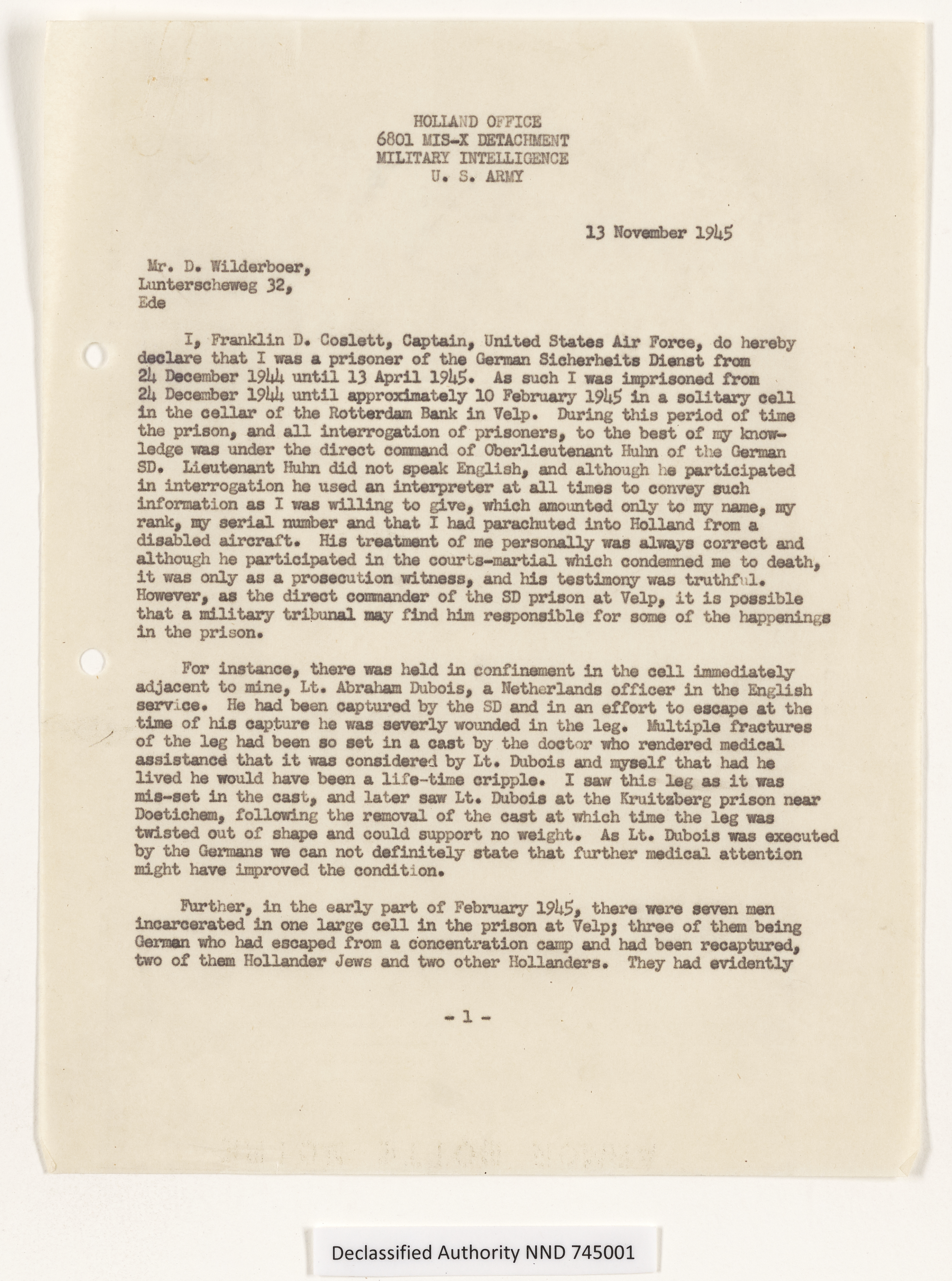
✓ His own declaration of 13 November 1945. The same man says it himself. On the Holland Office's paper, as Captain, he made a signed declaration addressed to Mr D. Wildeboer of Ede (Wildeboer's file, pp. 34 and 35; checked on both page images):
I was a prisoner of the German Sicherheits Dienst from 24 December 1944 until 13 April 1945. As such I was imprisoned from 24 December 1944 until approximately 10 February 1945 in a solitary cell in the cellar of the Rotterdam Bank in Velp.
— Franklin D. Coslett, Captain · declaration for D. Wildeboer, Holland Office, 6801 MIS-X Detachment · 13 November 1945 · the declaration, p. 34
- Who ran the prison. To the best of his knowledge it, and all interrogation of prisoners, was under Oberlieutenant Huhn of the German SD, who spoke no English and used an interpreter; Coslett gave only his name, rank and number and that he had parachuted from a disabled aircraft (p. 34).
- Huhn's treatment of him was always correct, and at the courts-martial "which condemned me to death", Coslett wrote, "it was only as a prosecution witness" that Huhn took part, and his testimony "was truthful".
- But as the commander of the prison, Coslett wrote, a tribunal might hold him responsible for some of what happened there.
- Abraham du Bois, in the next cell. "… there was held in confinement in the cell immediately adjacent to mine, Lt. Abraham Dubois, a Netherlands officer in the English service." (p. 34)
- He had been wounded in the leg trying to escape when the SD took him; the fractures had been set in a cast so that Du Bois and Coslett both thought he would have been a cripple for life if he had lived.
- Coslett saw the leg "as it was mis-set in the cast", and saw Du Bois again at the "Kruitzberg prison near Doetichem" after the cast was removed, the leg twisted out of shape and unable to bear weight. Du Bois was executed, so he could not say whether further treatment would have helped.
- Seven men in one cell. In the early part of February 1945 seven men were held in one large cell at Velp: three Germans who had escaped from a concentration camp and been recaptured, two Dutch Jews and two other Dutchmen (p. 35).
- They had been sawing their way out with a sharp instrument when a guard found them at about one in the afternoon. One of the Wehrmacht guards told Coslett and others that the men were made to stand with their hands over their heads until ten at night and beaten when their arms dropped.
- After sunrise the next morning they were shot by a firing squad under Lt. Engelhardt of the Green Police, made up of the prison's guards. Two of the guards, one Ernst, a French-Czech, and a certain August Koch, told him how sick they were at having to do it. He ends: "Of these incidents I can vouch for as the absolute truth."
So the airman, the Velp prisoner and the Captain are one man by his own hand; and the 24 December 1944 of his E&E report is the day the SD took him, not the day he reached Doetinchem. ◐ The declaration says about 10 February for the move from the cellar; Boeree has Du Bois and Sister Den Hartog moved to the Kruisberg on 6 February (Abraham du Bois), which is a few days off.
✓ Assen. The Kruisberg was not the last prison. A. J. Koeslag Sr, a farmer of Laren (Gelderland), wrote to him on 13 March 1946: "I thought at once this must be the Coslett with whom I was imprisoned at Assen. And indeed, such was the case." They had not said goodbye at Assen, "it all happened so quickly"; Koeslag and a fellow prisoner called Wink got bicycles there and rode home, Mosselman and Hamming walked, and Koeslag got home on Saturday night, 14 April 1945 (Koeslag's file, p. 25, the office's English translation; image-checked). In his own letter of 29 January 1946 about "Julik Granat, met wien ik in de gevangenis te Assen heb gezeten" (with whom I was in prison at Assen), Coslett says Granat went back to his unit "na de bevrijding op 13 April 1945", and that he himself had at once reported to the American army (the letter, p. 23; the scan is faint and a few words are struck through). So the liberation of 13 April 1945, which E&E 2968 places at Assen, was at the prison there, where he was held with at least Koeslag, Granat and three more men (Wink, Mosselman and Hamming, whose nationality Koeslag does not give). ⚠︎ Wehl's W. A. M. Bruning's form records instead, in the third person, that he "heard that captain Coslett was at the same time imprisoned at Westerbork as Granat" (his form, p. 3); Westerbork is in the same province, and Coslett's and Koeslag's own letters say Assen. ◐ His own War Crimes Appendix has him and the young woman "being transported to WESTERBOERG Concentration Camp from DOETINCHEM Prison" (E&E 2968, PDF p. 23, quoted above), so the way out of Doetinchem led to Westerbork; Bruning's "Westerbork" may be that, and no source here says on which side of the move Assen came.
✓ Dr Gerritzen. On 27 December 1945 Coslett wrote to Dr Frits Gerritzen, of Lunteren: "I remember well how we shared imprisonment on the last Christmas Day" (the letter, p. 10; image-checked). ◐ The Christmas Day of 1944 was the day after the SD took Coslett, and the doctor is probably the "Det. Gerritgen [?]" of Verbruggen's letter, in the same cellar.
✓ The office, by its own history. The History of the Holland Office of 6801 MIS-X Detachment, dated 10 June 1946, says the unit opened with two officers and two enlisted men: 1st Lt Floris D. Hartog and Sgt Lux H. Ewald, who arrived at Wassenaar on 21 June 1945, and "Franklin D. Coslett, 1st Lt., O-801361, and Cpl. Robert H. Mitchel", who joined them on 1 July. It goes on:
Franklin D. Coslett, promoted from 1st Lt. to Captain after assignment, was the officer in charge of the unit, and was especially suited to this assignment, having himself been an evader following the forced landing of his plane in Holland in the Spring of 1944.
— Headquarters Holland Office, 6801 MIS-X Detachment · History of the Holland Office, section 2 · 10 June 1946 · PDF p. 2
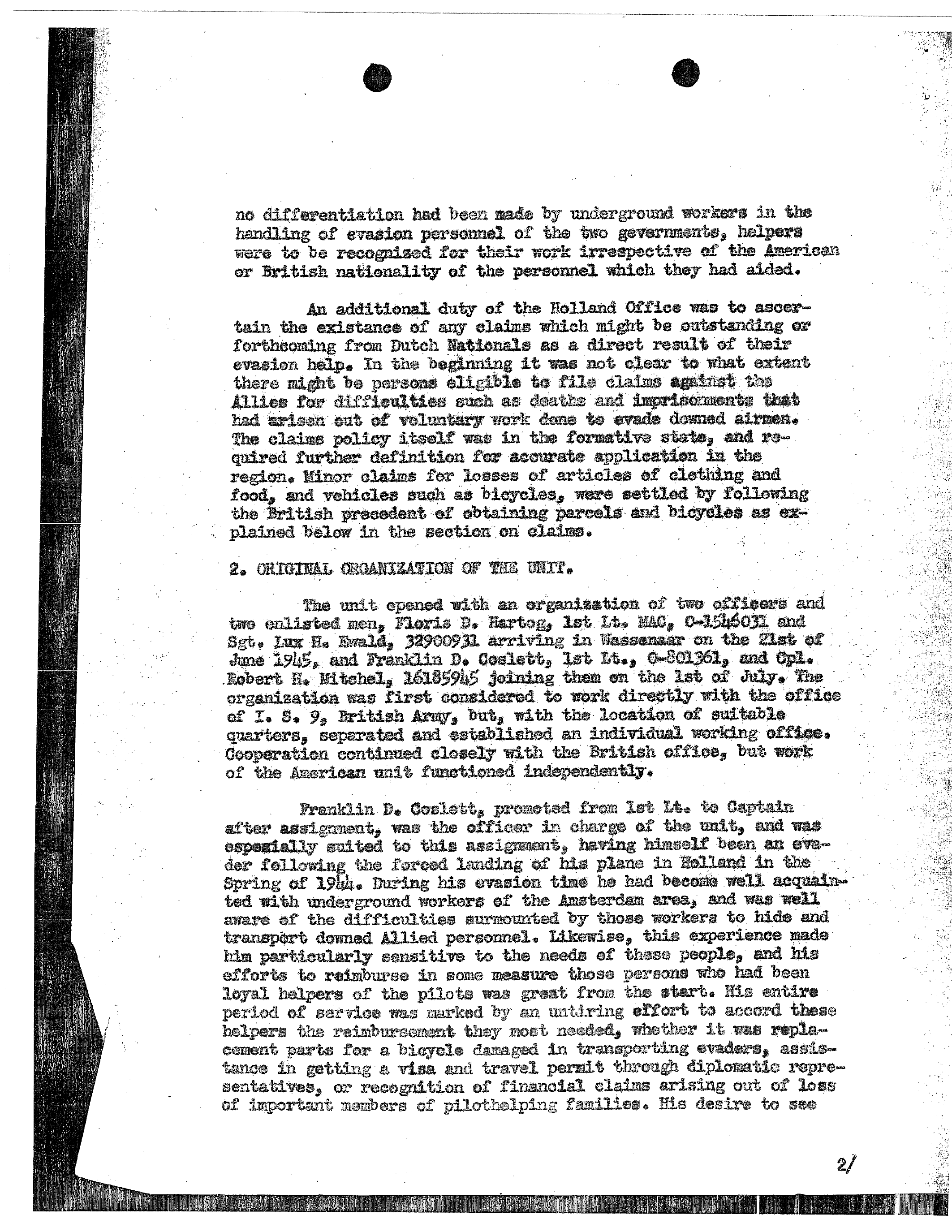
It has him begin the field work by retracing his own route and renewing the contacts he made in hiding at Amsterdam and Zwolle, and set up an office and quarters at Zwolle, shared with the British I.S.9, where "Coslett had benefited in these arrangements from his personal contacts of his own evasion days, and effected interviews in both Zwolle and Ommen himself" (PDF pp. 8–9; machine-read text in the OCR). ◐ It puts him "shot down in the Zwolle area", where his report has Vierhouten (p. 8), and says he "remained for some months in hiding at many addresses in that district doing active work in the local underground group" (OCR, same page); Geroux, too, calls him the airman "who went to work for the Dutch underground after he was shot down" (p. 329). Of April 1946 it says that he "was called away from the office on the 25th of April for emergency redeployment to the States" (PDF p. 18); it has Major Walter D. Creech as officer in charge, with Lt Joseph Burke as administrative officer, both redeployed early in June, when Lt Bilgrey was named officer in charge (PDF pp. 18–19). ⚠︎ The letter of 13 April 1946 below has him already gone on 11 April; see Where the sources disagree.
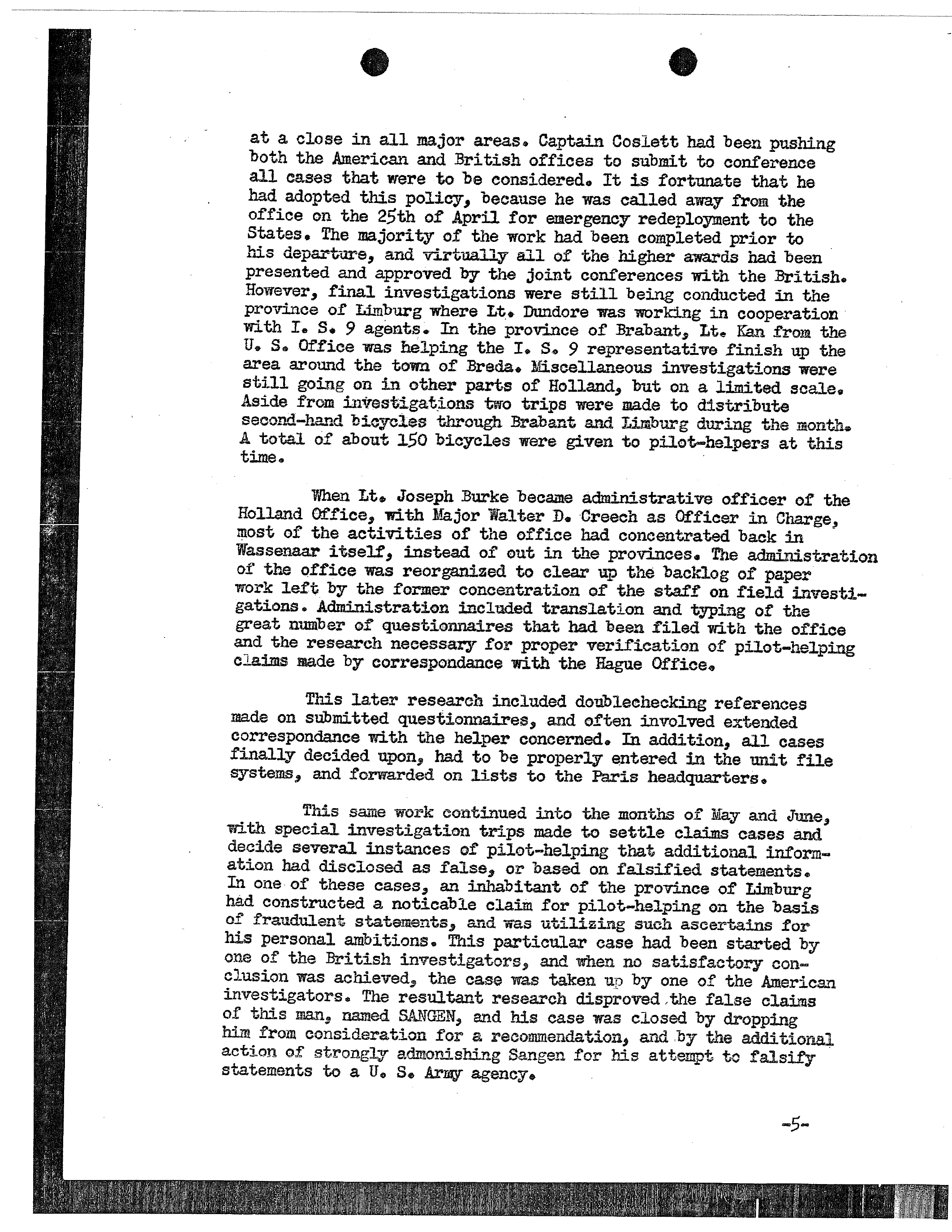
✓ After the liberation Capt. Franklin D. Coslett, Air Corps, ran the Holland Office of the American 6801 MIS-X Detachment's work on Dutch helpers: he approved award recommendations, among them Hendrik van Loenen's (p. 16); wrote to helpers for their forms, among them Dick Kragt (Kragt's file, p. 5) and the Cornelisses (p. 8); and is named as the issuing officer on the receipt for the bicycle given to Chris Cornelisse, whose signature line is blank (p. 27). Kauffeld wrote to him at the office, "Dear Frank", on 6 August 1945 (Kauffeld's file, p. 10). That the airman and the captain are one man is settled by his own words. His declaration of 13 November 1945, signed as Captain, is the Velp prisoner's (above), and in a letter of recommendation of 20 February 1946, to the Ministry of Education, he writes as "now commanding the United States Military Intelligence Service in Holland":
… was, during the time of war, an aviator with the Eighth Army Air Force. On April 29, 1944, the aircraft, of which I was a member, was disabled by enemy fighter aircraft and my comrades and myself parachuted into Holland. Approximately half of the crew of the aircraft were almost immediately rendered assistance by members of the Dutch Resistance Movement and lived for a long time with these people …
— Franklin D. Coslett, Captain, Air Corps · letter of recommendation for Miss C. E. A. von Baumhauer · Holland Office, Wassenaar, 20 February 1946 · the letter, p. 3
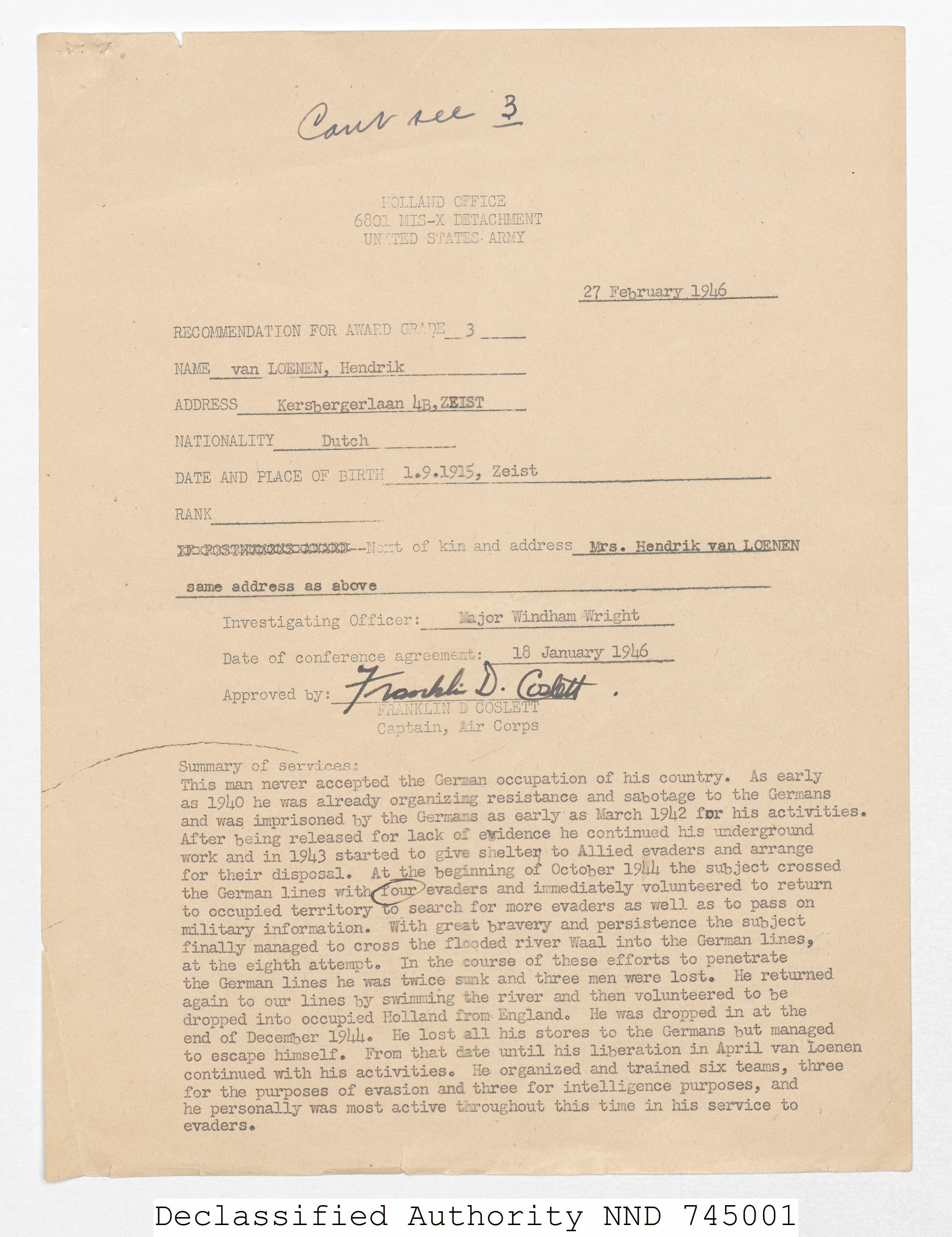
Before those two papers it rested on the name, on Maljers's calling his fellow prisoner "Captain Coslett", on Kauffeld's writing on first-name terms to the office address of the man he had asked after, and on Verbruggen's letter (above). The earliest paper held here that has him as Captain is his letter of 29 August 1945, signed "Captain, Air Corps, Commanding" (Scheepstra's file, p. 3); on a form of 14 July 1945 he signed without a rank (van Ligten's file, p. 12). The History has the promotion after his assignment to the office on 1 July 1945 (above); no paper held here dates it. The office's own note of the same day about her says that housing eight English and American fliers "was done at risk to her life", with "the writer, himself, having been one of the fliers so concerned" (p. 2).
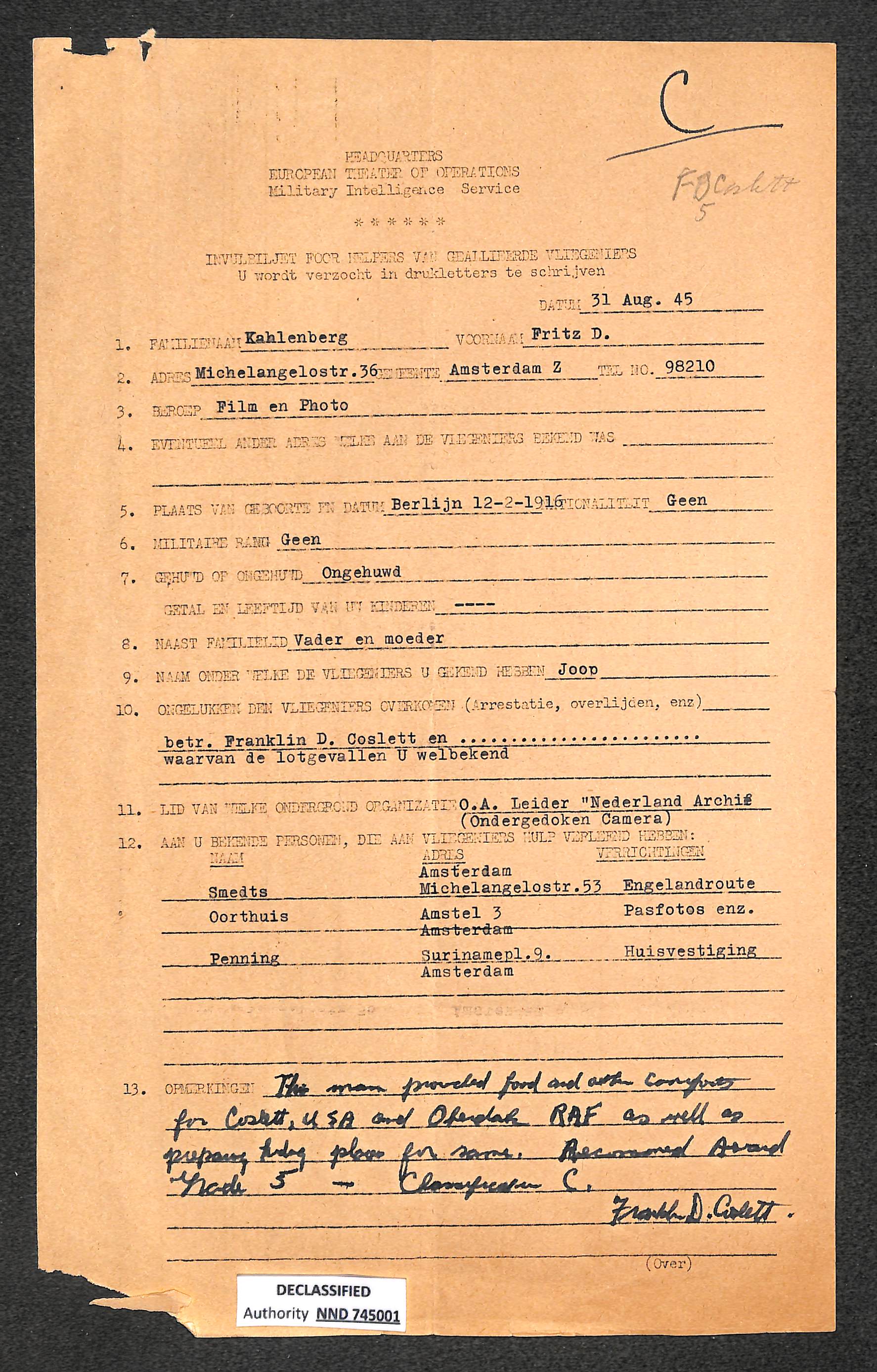
✓ Judging his own helpers. Several of the people who sheltered him were put forward for awards on forms that Coslett's office reviewed, and his name is on the papers. The summary of Hilde Wallheimer-Freund's file carries "Capt. F.D.COSLETT 24th September 1945" (p. 7); Harm Scheepstra's carries "Capt COSLETT 6 December 1945" (p. 4); those of Claude Uriot and Dina Viruly-van Hattum carry "Capt Coslett" and "18 January 1946" (Uriot, p. 5; Viruly, p. 2); Elisabeth IJzerman-van Waveren's carries "Capt Coslett" and 14 December 1945 (above), and Hendrik Lonnee's "Capt. Coslett, 5.2.46" (p. 4). On Fritz Kahlenberg's Dutch-language form of 31 August 1945 the remark in section 13 is in his own hand and signed, "The man provided food and other comforts for Coslett, USA and Oberdak RAF as well as preparing hiding place for same. Recommend Award Grade 5 - Classification C." (p. 6), and he wrote on 10 November 1945 that Kahlenberg "has been of inestimable help to the Allied cause … by rendering assistance to a number of Allied fliers, including the writer" (p. 2).
✓ To the American Consul General in Amsterdam he wrote on 8 January 1946, as "Captain, Air Corps, Commanding", for Hermine Salomonson-Keezer, who wanted a visit to relatives in America:
During the time of German occupation, the subject rendered innumerable services to evading American military personnel, including the writer. This, naturally, was done at great risk of her life.
— Franklin D. Coslett, Captain, Air Corps, Commanding · letter to the American Consul General, Amsterdam · 8 January 1946 · the letter, p. 3
He also wrote, in a friendlier tone, to "Dear Blackie" (Hilde Wallheimer-Freund) on 17 January 1946 about her lost bicycle and a radio of hers that he promised to return before the office left (p. 8); to Nanny Alink on 19 January 1946 that he could not get Dutch-size bicycle tyres (p. 2); and on 17 January 1946 to Dr Vermeer, above. For Jan van Ligten's form of 14 July 1945 he signed the remark that van Ligten had "provided food, housing, certain items of clothing and provided convoy to Utrecht" for other airmen, and that "I personally knew him and his work in Amsterdam" (p. 12); that form shows his name without a rank.
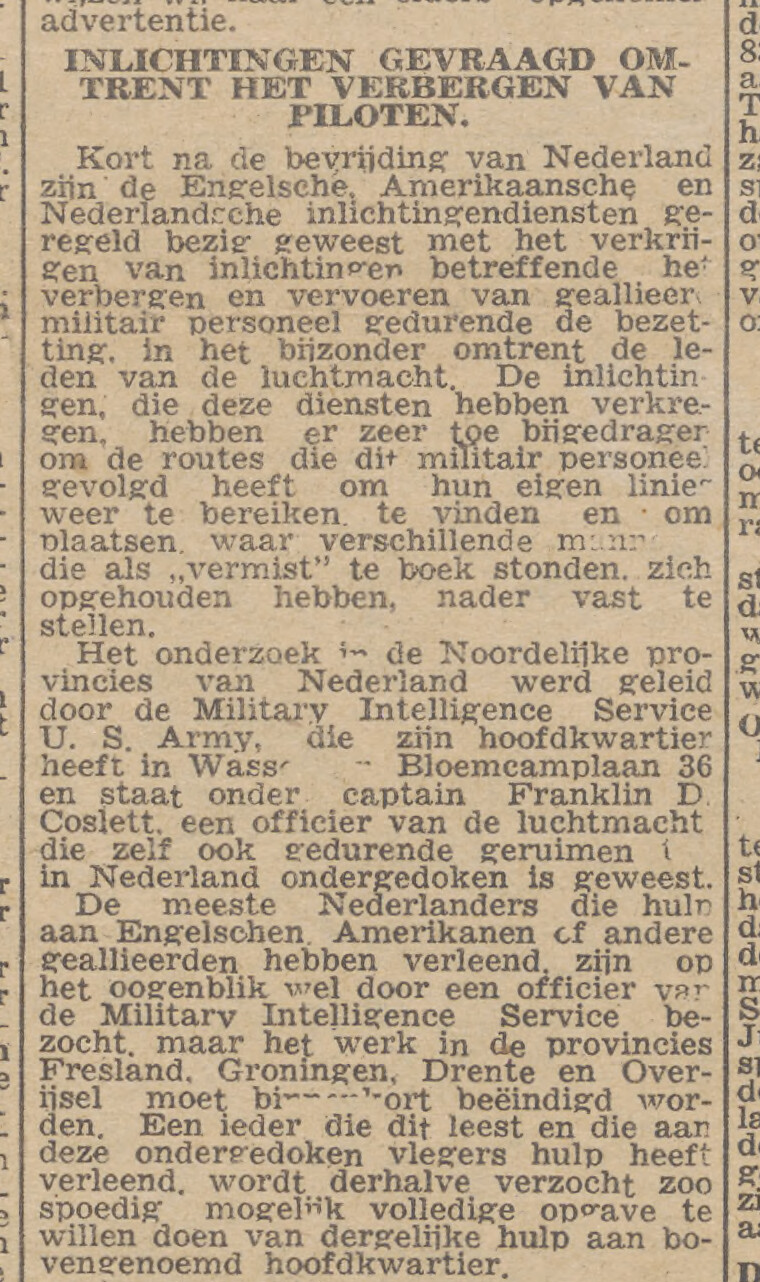
✓ In the press, January 1946. The Friesch dagblad of 5 January 1946 and the Winschoter courant of 7 January printed the office's appeal for information on helpers in Friesland, Groningen, Drenthe and Overijssel, which they said was led by the Military Intelligence Service at Bloemcamplaan 36, the Winschoter courant adding "onder captain Franklin D. Coslett" (under Captain Franklin D. Coslett; the Friesch dagblad has "Franklin d' Coslett"). The Winschoter courant adds "een officier van de luchtmacht die zelf ook gedurende geruimen [tijd] in Nederland ondergedoken is geweest" (an air force officer who had himself also been in hiding in the Netherlands for a long time), the office's own statement, in print, that the head of the office had been an evader (the two papers print the appeal in nearly the same words, so it is one press notice) (Winschoter courant, p. 2; Friesch dagblad, p. 1; a word in the Winschoter line is damaged in the scan).
✓ Leaving for America, April 1946. On 29 March 1946 he wrote in Dutch to the van Rijsewijk family of Breda that their son, there called Adriaan, had done fine work in the war: "In den tijd dat hij in Nederland werkte kwam ik met hem in contact en wij werden al snel goede vrienden. Wij beraamden een ontsnappingsplan, hetwelk gelukkig resultaten heeft gehad" (while he worked in the Netherlands I came into contact with him and we soon became good friends; we devised an escape plan which fortunately had results), that the son was now in the East Indies, and "ik ga spoedig terug naar Amerika" (I am going back to America soon) (van Rijsewijk's file, p. 6); the family's questionnaire of 2 April 1946 gives the son as Adam Andreas Marie and asks for Captain Coslett's private address in America (p. 2). On 13 April 1946 Peter H. Luiten, an agent of the US Intelligence Service, wrote from the Holland Office to an RAF police sergeant that "Captain Coslett suddenly left for the United States, two days ago", and that the detachment would finish in about another month (Luyten's file, p. 6). So he left on or about 11 April 1946 (the History has him called away on 25 April: see Where the sources disagree); on 4 May 1946 the office itself wrote that he had gone back (p. 6). Jan de Groot, the Zwolle stamp dealer of the "de Groene" group, wrote on 18 April 1946 to ask whether Coslett would come back and, if not, for his home address, "uit de tijd dat hij nog "terrorist" was" (from the time when he was still a "terrorist"); the copy has that paragraph struck through with a cross (Lam's file, p. 6).
⚠︎ Still named, August 1946. Trouw of 15 August 1946 reported that "Franklin D. Coslett, Captain van het Air Corps Commanding" had sent a letter of thanks to the head of the political detective service at Emmen, for the work of his detectives after the murder of an American airman near Ter Apel; the paper gives no date for the letter (Trouw, p. 2). It was either written before he left in April or the paper used the name of the office's commander after he had gone. By the office's own History other officers were in charge from the spring (PDF pp. 18–19).
Later life in Wilkes-Barre
Link to the section Later life in Wilkes-Barre✓ The airman and the Wilkes-Barre radio man are one: Boxoffice of 29 May 1943 has the former WBRE program manager commissioned a navigator (Before, above), and his escape report has a radio announcer of Wilkes-Barre. ◐ The notices that follow carry the name, the station and the Air Force, and are his on that; Geroux, whose information on Coslett comes "from several sources, including his statements to the War Crimes Office in RG 153" (The Fifteen, p. 329), says he was "best known in his community as a longtime news anchorman for WBRE-TV in Wilkes-Barre" (The Fifteen, p. 330).
- Radio and television. The Radio Annual of 1955 has him as program director of WBRE, Wilkes-Barre, and, in the television section, of WBRE-TV (p. 590; p. 946); Television Age of December 1955 has The Regional News Roundup with Franklin D. Coslett on WBRE-TV six evenings a week, and "Coslett directs operations for the station" (p. 81); the Pennsylvania School Journal of September 1956 announces him as the news commentator of the WBRE television station, Wilkes-Barre, speaking at a convention at Stroudsburg (p. 27).
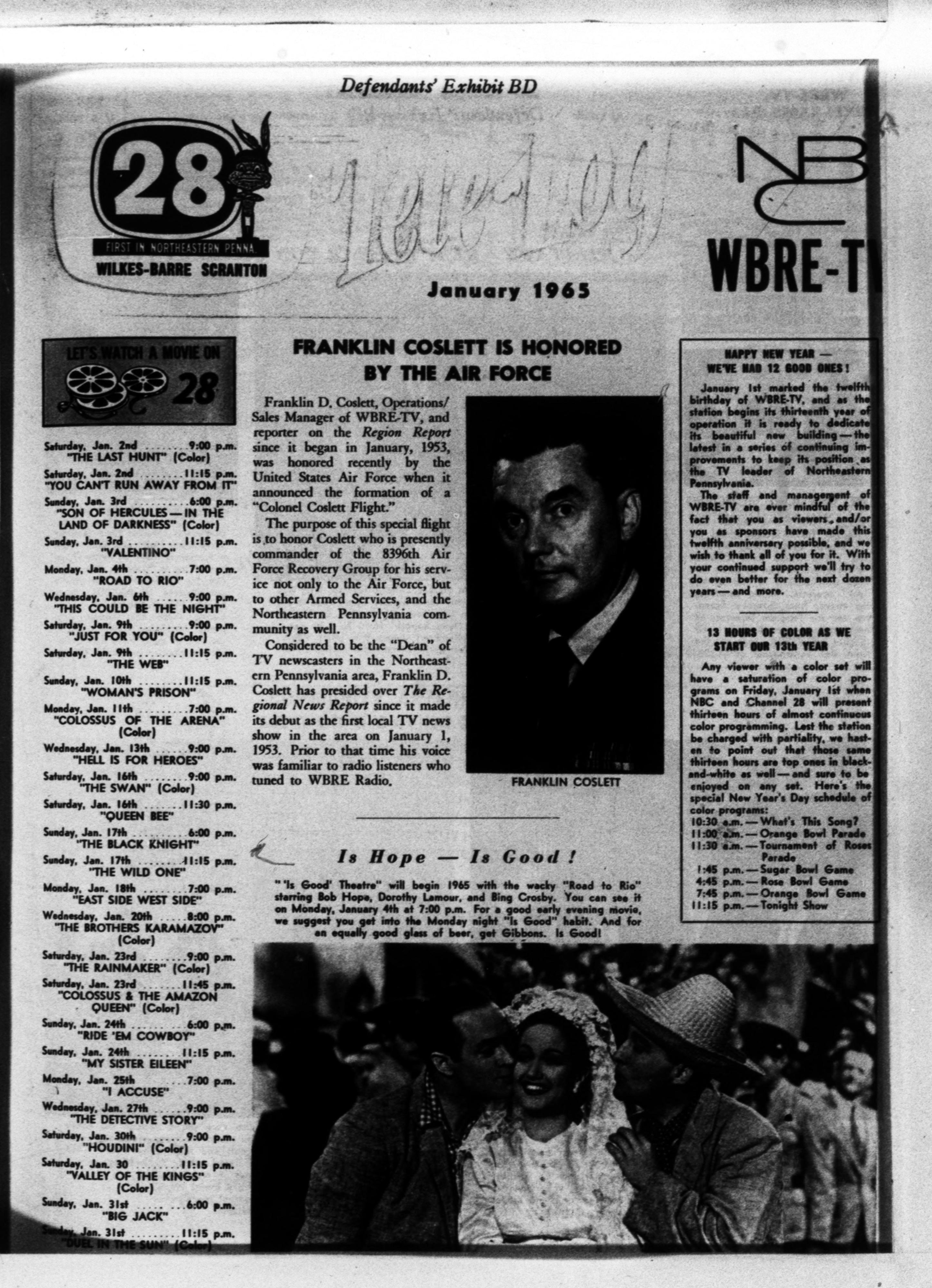
- 1965. The station's own Tele-Log of January 1965 calls him Operations/Sales Manager of WBRE-TV and reporter on the Region Report since it began in January 1953, "the 'Dean' of TV newscasters in the Northeastern Pennsylvania area", whose voice before that was familiar to listeners of WBRE Radio (the page; the picture above).
- The Air Force Reserve.
- The Air Reservist of 1957 has "Maj. F. D. Coslett, cmdr 9101st ARGp" among the party on a tour of a mine arranged by the Air Reserve centre at Wilkes-Barre (leaf n137); the Congressional Record of May 1958 has "Maj. Franklin D. Coslett, commander of the 9101st Air Reserve Group, Wilkes-Barre" at a presentation (Appendix, leaf n862).
- The Bloomsburg Alumni Quarterly of 1960–62 has the 8369th Air Force Reserve Recovery Group, Wyoming, "under the command Lt. Colonel Franklin D. Coslett" (p. 14), and the volume of 1963–65 has "Col. Franklin D. Coslett, Wilkes-Barre, group commander" (leaf n198); the Stroudsburg Daily Record of 23 May 1962 has "Lt. Col. Franklin D. Coslett" presenting trophies to a squadron's air policemen (leaf n13).
- The Tele-Log of 1965 says the Air Force announced a "Colonel Coslett Flight" to honour him as commander of the 8396th Air Force Recovery Group.
- Death. Geroux's notes cite two obituaries of 14 February 1992, in the Wilkes-Barre Times-Leader, "End of an Era: Veteran Broadcaster Franklin D. Coslett Dies at 76", and in the Citizens' Voice, "Franklin D. Coslett, WBRE Newsman for 28 Years, Dies", and say that he "appears to have kept his harrowing war experiences largely to himself" and that the author found no surviving family or close friends (Geroux, p. 330). ◐ Nine May 1915 to a death on or before 14 February 1992 makes him 76, as the headline says; neither obituary is held here.
Ruled out: the Pennsylvania state representative
Link to the section Ruled out: the Pennsylvania state representative✗ A Frank Coslett who turns up first in a search of Pennsylvania is not our man, and nobody should chase him. The Pennsylvania Manual 1984-85 has State Representative Frank Coslett (R), 120th District, Luzerne County, born 20 October 1921 at Kingston, "the son of Job and Margaret Cox Coslett", who attended Wilkes College and served in the "U.S. Navy (USCG), 1942-45" (the hits (the longer passage)). A Coast Guardsman for the whole of 1942 to 1945 cannot be the USAAF officer hidden in Overijssel in the summer of 1944 and held in the SD prison at Velp and De Kruisberg until the liberation. ◐ From the full-text index of the Internet Archive, not read on the page; the quoted phrases were confirmed by further queries. The same Pennsylvania county is why the name came up, nothing more.
✓ His own report settles what the search could not: born 9 May 1915, a radio announcer, of Wilkes-Barre (E&E 2968, PDF pp. 12 and 21), not the Coast Guardsman born in 1921. The WBRE items of the same sweep are read above.
Where the sources disagree
Link to the section Where the sources disagree- His home. Wilkes-Barre, Pennsylvania in his own report and Pennsylvania in Kauffeld's account (p. 4); Ohio on Snel's list (p. 3).
- His middle initial. "Franklin D." on Snel's list and on the office's own papers; "Frank B." on Kauffeld's letter of 1945 (p. 10).
- His rank. 1st Lt in his own report and on the helpers' forms of 1945, "flying officer" to Kauffeld, "Captain" to Maljers and in his own signature from 29 August 1945 (Scheepstra's file, p. 3); his name is on a form of 14 July 1945 without a rank.
- His trade. A radio announcer in his own report; a "radio-fitter" in Kauffeld's.
- How long he was at Ommen. 29 May to 29 June 1944 in his report; "15/5", 45 days, on Seigers's own table (p. 32); "3 weeks in a boat" on Beernink-de Riet's table. His report adds that Seigers "may have been executed" after 29 June 1944; Seigers's own form of 20 July 1945 is by a man who was held in German camps and came back (p. 33).
- How long he was at Zwolle. With Willem "Degroene" 29 June to 15 July in his report; early June to early August on Snel's list (above); 30 June to 21 July on the I.S.9 list of the same file.
- How long at Harderwijk. 15 July to 30 August 1944 in his report (21 July to 30 August on the I.S.9 list); "4 months" on Dirk Poelgeest's summary of 23 February 1946 ("Lt van LOENEN", 5 February, in the investigating officer's place, ◐ which brother, Hendrik van Loenen or Herman Lucas, the sheet does not say), which also has Kilgore, Braun, Cook and Whittaker at 6 months (p. 4). ◐ The summary gives "in 1944" for all of them and looks like a total of the whole stay of the group, not his.
- Who in Harderwijk. "Hendrik Jan van Poelgeest", a baker, in his report, and "H.J. Poelgeest" on the Dalfsen to Harderwijk forms; "Dirk Poelgeest, 6 Hondegardstraat", born 1888, on the summary above. Nothing held here says whether these are one man or two.
- How long at Nunspeet. 29 April to 5 May in his report, with IJzerman; "3 days" from "2-5" on the camp tables and on Elisabeth IJzerman-van Waveren's form (p. 2).
- When he was picked up. "March 1944" on Gerrit Mazier's summary (p. 6) and on Wim Mazier's (p. 6), against 29 April 1944 in his report, on his own letter of 20 February 1946, on the camp tables and in Wim Mazier's own table for Kilgore and Braun. ✓ His letter to Wim Mazier of 20 November 1945 (above) has "the 29th of April 1944": the "March" in both summaries is a slip made two years on, since the aircraft is the one of 29 April.
- Where the last prison was. Assen in his own letter of 29 January 1946 and in Koeslag's of 13 March 1946; "Westerbork" on Bruning's form (above).
- When he left the Velp cellar. "Approximately 10 February 1945" in his declaration; Boeree has Du Bois and Sister Den Hartog moved to the Kruisberg on 6 February (Abraham du Bois).
- Who passed him on from Dalfsen.
- Eight forms (above) have him received from "Farmer Timmerman, Dalfsen" and passed to H. J. Poelgeest at Harderwijk.
- Timmerman's own table has him received from Seigers at Ommen and passed to the group "de Groene" at Zwolle, with "Harderwijk" in the column for where he was shot down (p. 9); Bomhof, Wubs and Metz carry him on towards Zwolle (above).
- ◐ Harderwijk is where Anslow's aircraft came down (E&E 1838, p. 5 of the PDF), so Timmerman's column may be the crash area; Coslett's report puts his Harderwijk stay at 15 July to 30 August.
- How he got from Doornspijk to Ommen. "29 May" to Seigers at Ommen in his report; by car at night, via Zwolle, in "June 1944" on Pieter Wolffensperger's form (p. 2); "by auto from Doornspyk to Zwolle" on Metz's. ◐ These can be one journey, with the month wrong on one of the forms; nothing held here settles it.
- When he left Zwolle. At Harderwijk until 30 August in his report, with Schryver in Amsterdam from 30 August; from Zwolle to Amsterdam on "31.8.44" in Lonnee's summary (p. 4). Dr Vermeer's table has him shot down in "June 44" and hidden from "July 44" (p. 13), which is wrong against the report and every other form.
- How long in Amsterdam, and where.
- E&E 2968 has Schryver 30 August to 5 November, Scheepstra 5 to 20 November, Viroly 20 November to 6 December; its I.S.9 list has Schryver to 15 November, Scheepstra 15 to 22 November, Viroly 22 November to 6 December.
- Scheepstra's table has "Oct 44" and 60 days; Viruly's has "3 weeks"; Allan Penning's and Florence Penning-Hall's have 24 to 26 November; Ivy van Lier's has "1 day in December 1944"; Uriot's has "Nov 1944 to 5 Dec 1944" on Oberdak's line, ending with Budding at Groenekan.
- ◐ Scheepstra's 60 days from October fits the three Amsterdam addresses together rather than his own house. The Penning stop appears in his report only as lodging for Oberdak (I.S.9 list), and the van Lier stop not at all (a day or two each, from Kahlenberg); which night each fell on is open.
- Whether he was still commanding in August 1946. He left on or about 11 April 1946 (Luyten's file, p. 6), but Trouw of 15 August 1946 has him sending a letter of thanks as "Captain van het Air Corps Commanding" (Trouw). ⚠︎ Unsettled: the letter's date is not given.
- How Loed Creutzberg died. "Killed in a car-accident at Bredgeworth on the 28 July 1945" on his father's form of May 1946 (p. 2); "killed in action", on a notice of 3 August 1945 from his parents saying the Dutch air force in London had told them (p. 13). ⚠︎ The two are not reconciled here; he was a trainee pilot with the RAF and a helper of Coslett's at Doornspijk.
- His job in the crew. Navigator in his own report (PDF pp. 12 and 21), in the cadet notices of 1943 (Boxoffice, 29 May 1943) and in Aircrew Remembered's crew list; "the army air forces bombardier" in Geroux's note (p. 329). ◐ Geroux's is the slip; the crew list in his own report has Edward Verbosky as bombardier.
- Where he came down. Near Vierhouten in his report and on the Atkinson List, which has "314. Franklin D. Coslett 29-4-1944 Vierhouten Hollande" (the list's image; the page that carries it, whose typed index has "Coslett, Franklin D. (314), no E&E report": his report is E&E 2968, so the index is wrong there); "shot down in the Zwolle area" in the History of the Holland Office (PDF p. 8); ◐ the History's "Zwolle area" is a loose summary of his months of hiding there.
- When he left the Netherlands. On or about 11 April 1946 by the letter of 13 April 1946 (Luyten's file, p. 6, checked on the image); called away "on the 25th of April" by the History of 10 June 1946 (PDF p. 18). ⚠︎ The contemporary letter and the later summary differ by two weeks; the letters of 29 March, 18 April and 4 May 1946 (above) fit either.
- His Reserve group. The 8369th Air Force Reserve Recovery Group in the Bloomsburg Alumni Quarterly and the 8396th Air Force Recovery Group in the 1965 Tele-Log (the Quarterly; the Tele-Log). ◐ One is a transposition.