Marie Visser-Derksen
About: An evacuee of the autumn of 1944 whose own account puts her at Jacob Veerman's farm on 24 February 1945, the day the Germans were taking his horses: she was searched, given bread by the woman of the house and let go, and heard afterwards that Jacob and his daughter Jopie had been taken. Murphy had been hidden on that farm until 23 December 1944 (Hardy).
Unit or role: Evacuee.
Where: From the autumn of 1944 with the De Gooijer family, Bielderweg 1, Terschuur, near Achterveld (her own text, p. 111). ◐ Her home was probably Huissen, which is an inference (below).
Evidence: ⚠︎ Her own account of that day, the only source that puts her at the farm and set down some sixty-five years later, in Oorlogsverhalen om nooit te vergeten (Achterveld, 2025), pp. 111–112 (the booklet); the text that follows on pp. 112–113 is not relied on, because it is not shown to be hers (After). It speaks of a visit "Twee jaar geleden (2008)" (two years ago, 2008), so it was set down in about 2010.
Her account begins with the bombing of her family's house on 2 October 1944: they got out of the cellar once the sandbags had been cleared away, and took shelter in a ditch. They were evacuated the same day with the Visser family and others from the neighbourhood; on 3 October, she remembers, the Meeuwsens' house "bij ons in de Korte Loostraat" (in our street, the Korte Loostraat) was hit. After some nights in the polder they walked "via Arnhem de brug over richting Barneveld" (by way of Arnhem, over the bridge, towards Barneveld), only her mother riding on the cart, and on the bridge she gave her arm to two old women who could hardly go on. They had coffee and a roll at Otterlo, went on to Barneveld the next day, were taken on to Achterveld, and from there came to the De Gooijer family at Bielderweg 1, Terschuur, "en daar zijn we gebleven" (and there we stayed) (the booklet, p. 111).
◐ Her account names no town for her home, only the Korte Loostraat. Huissen is an inference from the booklet itself: the Achterveld parish priest's war notes have refugees from Huissen, "dat door een bombardement was verwoest" (which had been destroyed by a bombing), reaching Achterveld some weeks after the battle for the Arnhem bridge (p. 9); the evacuees' section her account sits in opens with a picture headed "Exodus Monument Huissen" (p. 89); and the unattributed run after her page (pp. 112–113), which names the Korte Loostraat as she does, has its narrator go back "naar Huissen" (After). None of the three names her, and the last is not shown to be hers (the booklet).
With Murphy
Link to the section With MurphyNo source puts her with Murphy. By her own account she was at the farm where he had been hidden, two months after he left it, on 24 February 1945, the day Jacob Veerman was taken; no other source has her there.
She had learnt to spin at the Van Wieringens' in Achterveld, and was spinning there when someone came in to say "de Duitsers zijn de paarden aan het vorderen van boer Jacob Veerman. Het was 24 februari 1945" (the Germans are requisitioning farmer Jacob Veerman's horses. It was 24 February 1945). The horses were said to be very fine, and she cycled over to see (the booklet, p. 111):
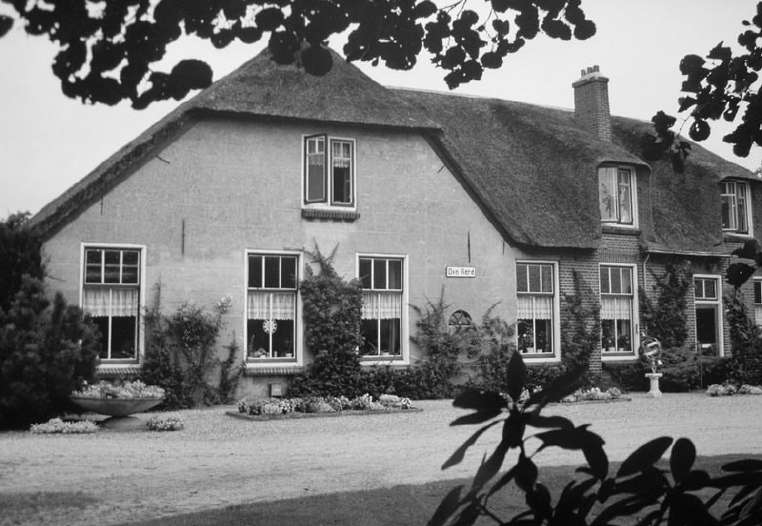
I got on my bike and went to the farm, and I ride in there and at once I was searched by the Germans. I had to take off my shoes and put the bike in the scullery, and they asked what I was doing here. So I made something up and said: we've been bombed out and I've lost my parents and I'm evacuated in Amersfoort and I'm hungry. The woman of the house went to the corner cupboard, took a slice of rye bread and spread some lard on it with sugar. Then the Germans let me go.
Dutch originalIk stapte op de fiets en ging naar die boerderij en ik kom daar binnenrijden en direct werd ik door de Duitsers gefouilleerd. Ik moest de schoenen uittrekken en de fiets in de bijkeuken neerzetten en ze vroegen wat ik hier moest doen. Toen heb ik maar wat verzonnen en zei: we zijn gebombardeerd en ik ben mijn ouders verloren en ik ben geëvacueerd in Amersfoort en ik heb honger. De vrouw des huizes ging naar de hoekkast en pakte een snee roggebrood en smeerde er wat smout op met suiker. Toen mocht ik gaan van de Duitsers.
— Marie Visser-Derksen, in Oorlogsverhalen om nooit te vergeten (Achterveld, 2025), p. 111 · the booklet
◐ The woman of the house was very probably Jacob's wife, Aaltje Veerman. Marie was badly frightened, and rode about for a long time afterwards, thinking that if they caught her and found out she had lied, "dan zou het wel eens afgelopen kunnen zijn met mij" (it might well have been all over with me) (pp. 111–112). What she heard was that the Germans took "boer Jacob Veerman en de dochter Jopie" (farmer Jacob Veerman and the daughter Jopie), and later that the daughter came back and he did not (p. 112). ⚠︎ Huurdeman, who dates the arrest 24 January, has Jopie in hiding at Ede; her sister Alie says the SS asked where Jopie was and that she reported herself after their father was taken; her son's account (October 2026) has her in hiding at Ede (Jopie Veerman).
She was still in touch with the family at Terschuur when she wrote, and they had visited in 2008 (p. 112).
⚠︎ After the photograph and without a new heading, the booklet goes on with memories of an evacuation: a horse trip to Jaarsveld for farmer Woudenberg, then going back early to Huissen and working in the Dominican convent there (pp. 112–113). They are not used on this page, because they are not shown to be hers: the narrator speaks of "Mariet Visser" in the third person and of her "evacuatieadres" with farmer Woudenberg, where the booklet puts the family of Mariet Willemsen-Visser (p. 110), while Marie's own text puts her with the De Gooijers at Terschuur (p. 111). Against that, the run names the Korte Loostraat, which Marie's text does too. ◐ And p. 110 puts about 25 people at Woudenberg's, "o.a. de fam. Bartray en de fam. Grad Derksen" (among others the Bartray family and the Grad Derksen family); Derksen is Marie's maiden name, so that family may be hers, and the run names a Bernd van Bartray and a Gerrit (p. 111 has a Gerrit Derksen). That is our reading of a surname.
Where the sources disagree
Link to the section Where the sources disagree- The date. Her account has 24 February 1945, as do the Veerman family's form for the Americans of May 1946, the L.O.-L.K.P. form of February 1946 and the burgemeester of Barneveld in 1950 (the booklet, p. 111; the family's form, p. 4; the L.O.-L.K.P. form; war graves file, scan 20). José Huurdeman's history of the local resistance has 24 January (Neuengamme online memorial).
- Whether Jopie was taken with her father. Marie heard that she was (p. 112). Huurdeman has the SD coming for Jopie, who was hiding at Ede, and taking her father instead until she gave herself up (Neuengamme online memorial); her sister Alie: "Nadat vader was opgepakt melde Jopie zich om haar vader vrij te krijgen" (after father was taken Jopie reported herself to get him freed) (the booklet, p. 83). More on Jopie Veerman's page.
- Who came. "De Duitsers" (the Germans) in her account; Alie remembered "Nederlandse SS'ers" (Dutch SS men) in a lorry on the yard (p. 83); the Leusder Krant of 2 April 1970 has "De Grüne Polizei wacht Jacob op" (the Grüne Polizei lie in wait for Jacob) (p. 8).
- Whose pp. 112–113 are. The booklet's contents list has her entry start on p. 111 and the next on p. 115, and the pages print no heading before the horse trip. The text there has an evacuation address at farmer Woudenberg's (where p. 110 puts Mariet Willemsen-Visser's family, "fam. Grad Derksen" among them) and speaks of "Mariet Visser" in the third person; Marie's text on p. 111 has her at the De Gooijers', Terschuur. Both could be Marie's at different times, or the pages could be another evacuee's; the booklet does not say.
- The horses. The Germans requisitioning Jacob's horses, as her account has it, appears in no other source held here; the others have a raid for Jopie, and Alie has the SS lorry, her father tied up on the floor for about an hour and each child questioned separately (p. 83). Her scene and Alie's may be different moments of the same day.