Private Edward C. Bradford
"Private Edward C. Bradford, 1st Battalion, The Border Regiment", one of six names in the Gelders Archief's catalogue entry for a banknote in the Airborne Museum's collection (the catalogue entry)
About: One of the six names the Gelders Archief's catalogue reads on a one-guilder note in the Airborne Museum's collection, signed by six British soldiers hidden on the Veluwe; the other five are Murphy's party. ⚠︎ Every other source has the RAF officer James Branford in that place, and the note itself has not been seen.
Unit or role: "1st Battalion, The Border Regiment", as the catalogue gives it.
Where: In hiding on the Veluwe, "in een hol in de grond" (in a hole in the ground), as the catalogue gives it.
Evidence: ⚠︎ The catalogue entry only, the note itself not seen; against it, ✓ Zegert van der Vlist's letter of 3 January 1947, p. 9, setting out six signatures with "James Branford" among them, and ✓ the Kew catalogue entry for a real Pte Edward C. Bradford of the Border Regiment, captured on 21 September 1944.
With Murphy
Link to the section With MurphyThe banknote the six signed
Link to the section The banknote the six signedThe Airborne Museum's archive, catalogued at the Gelders Archief, holds a one-guilder note of 1943 signed by six British soldiers, and the catalogue gives their names:
Six paras in a hole on the Veluwe. The late husband of the donor … lived, or was in hiding, on the Veluwe as a young man in the last years of the war, and was involved in the resistance. He supplied these six men with food and so on in the months after the battle, when they were hiding in the woods of the Veluwe, in a hole in the ground. … The "six men in a hole" were: Sergeant Keith D. (Tex) Banwell, 10th Battalion, The Parachute Regiment; Private Thomas Murphy, 156 Battalion, The Parachute Regiment; Corporal James Haidy, Royal Army Medical Corps; Private Edward C. Bradford, 1st Battalion, The Border Regiment; Sergeant John Haller, The Glider Pilot Regiment; Private S. (Sammy) Walsh, 156 Battalion, The Parachute Regiment.
Dutch originalZes para's in een hol op de Veluwe. Wijlen de echtgenoot van de schenkster … heeft als jongeman tijdens de laatste oorlogsjaren op de Veluwe gewoond dan wel ondergedoken gezeten. Daarbij was hij betrokken bij het Verzet. Hij heeft deze zes mannen van voedsel e.d. voorzien in de maanden na de Slag toen zij in de bossen van de Veluwe zaten ondergedoken, in een hol in de grond. … De 'Zes mannen in een hol' waren: Sergeant Keith D. (Tex) Banwell, 10th Battalion, The Parachute Regiment; Private Thomas Murphy, 156 Battalion, The Parachute Regiment; Corporal James Haidy, Royal Army Medical Corps; Private Edward C. Bradford, 1st Battalion, The Border Regiment; Sergeant John Haller, The Glider Pilot Regiment; Private S. (Sammy) Walsh,156 Battalion, The Parachute Regiment.
— Gelders Archief · Airborne Museum collection, toegang 1604, item 350 · catalogue entry
The entry names the donor, the widow of the man who fed the six; her name is left out here. It goes on: "Over Bradford, Murphy, Haller en Walsh zijn geen nadere bijzonderheden bekend" (nothing more is known of Bradford, Murphy, Haller and Walsh). It dates the item "1943-1944", gives Putten as its place name, and ties the six to Pegasus II, the failed crossing of November 1944 (the catalogue entry, copied 26 September 2026). The note is not digitised; the archive scans on request.
The five other names are Murphy's party: Tex Banwell, Thomas Murphy, ◐ "Haidy" (James Hardy), ◐ "John Haller" (Bernard Haller; Migchelsen's statement has "HALLER, Bernard John Frderik", p. 3, and Van der Vlist writes "B.J.F. Haller", so John reads as a second forename) and Sam Walsh. When the note was signed is not stated. The note and the six are told on Kijkuit and Harskamp.
Zegert van der Vlist's guilder
Link to the section Zegert van der Vlist's guilder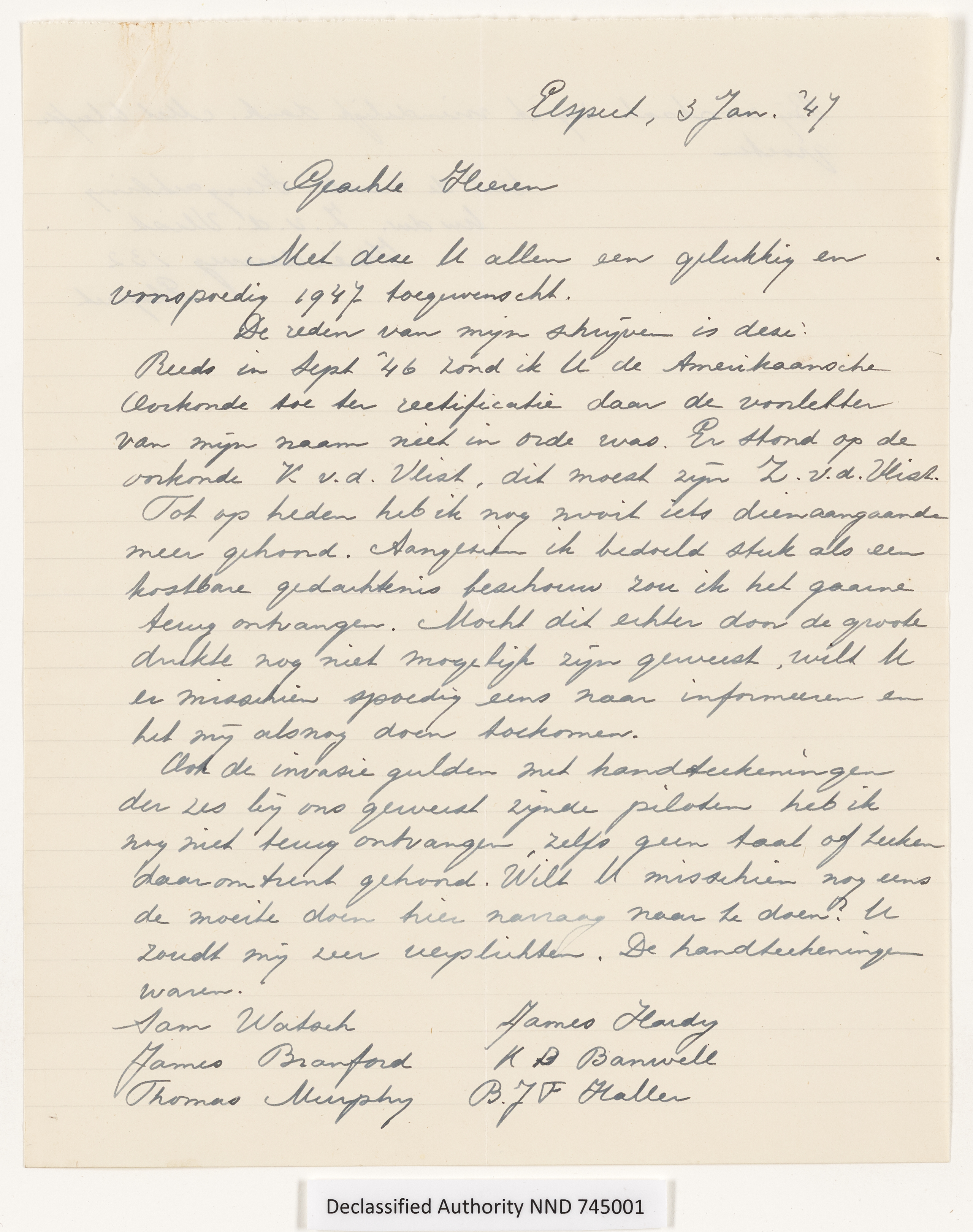
Van der Vlist's letters in the American files set out six signatures from a guilder of his own, and they have no Bradford on them. Zegert van der Vlist of Elspeet, whose family lived in one half of a double house at Hierderweg 132, Hulshorst (◐ Kijkuit), with the six men in the other (Migchelsen's statement, p. 3), wrote to the American office on 17 September 1946 about "een invasiegulden met zes handteekeningen van de piloten die hier vertoefden" (an invasion guilder with six signatures of the pilots who stayed here), sent to Wassenaar about November 1945 by a "Heer v. Hattem [?] wonende te Elspeet, Nunspeeterweg" (his letter, p. 13). The office answered on 23 September 1946 that it had passed the guilder to the British bureau I.S.9 (the reply, p. 11). He had not had it back by 3 January 1947, when he wrote again and set the signatures out:
Also the invasion guilder with the signatures of the six pilots who were with us I have still not had back … The signatures were: Sam Watsch [sic, for Walsh], James Hardy, James Branford, K D Banwell, Thomas Murphy, B.J.F. Haller
Dutch originalOok de invasie gulden met handteekeningen der zes bij ons geweest zijnde piloten heb ik nog niet terug ontvangen … De handteekeningen waren. Sam Watsch [sic, for Walsh], James Hardy, James Branford, K D Banwell, Thomas Murphy, B.J.F. Haller
— Z. van der Vlist to the American office, Elspeet, 3 January 1947 · US National Archives, RG 498 · his helper file, p. 9
The office's reply of 6 January 1947 speaks of his certificate, and says his letter of 17 September had already been answered on 23 September; it is the last letter in the file by date (the reply, p. 8).
◐ Whether this guilder is the museum's is not settled. Both are guilders signed by six men of the same party, which fits one note. Against it, Van der Vlist's went to I.S.9 and had not come back by January 1947, and the museum's came from the widow of the man who fed the six in their hole in the ground, which the catalogue does not place at Kijkuit. Either way, the names Van der Vlist wrote out from a guilder he had held have "James Branford" in the place where the catalogue has Bradford.
Where the sources disagree
Link to the section Where the sources disagreeWhether a Bradford was one of the six
Link to the section Whether a Bradford was one of the six✓ A real Private Edward C. Bradford of the Border Regiment was in the Netherlands in September 1944. Kew's catalogue entry for his German prisoner-of-war card (initial in brackets) reads "Name: Edward [C] Bradford. Date of Birth: 26/3/1913. Place of Birth: Bristol.", private, the Border Regiment, number 5181293, "Date of Capture: 21 September 1944. Theatre of Capture: The Netherlands", held at Stalag XI-B, Fallingbostel, as prisoner 117690 (Kew, WO 416/39/28, the catalogue entry; the card itself is not digitised and has not been seen).
- ◐ A man registered as a prisoner at Stalag XI-B (number 117690) is unlikely to be one of six men hiding in the woods of the Veluwe in the months after the battle; Kew gives no date for the registration. Capture alone would not show it: four of the six had been captured and escaped from the hospital at Apeldoorn (Banwell, Hardy, Haller and Walsh, Migchelsen's statement, p. 3). No other source puts Bradford with them.
- The catalogue's name, rank and regiment are the ones in Kew's catalogue entry for the card, which brackets the initial ("Edward [C]"); its "1st Battalion" is not on the Kew entry. How the cataloguer came by them is not stated.
- The museum's own catalogue says nothing more is known of him (above).
"Bradford" for Branford
Link to the section "Bradford" for BranfordThe catalogue's Bradford stands where every other source on the six has the RAF officer James Branford: Van der Vlist's letter (above), and the reports of Hardy and Walsh, both with "P/O. BRENTFORD" (Hardy; Walsh). Of the two papers in the helper files of Houten helpers that write his surname with a d, one is a table that its author also typed out with Branford, and ◐ the other is very probably copied from it:
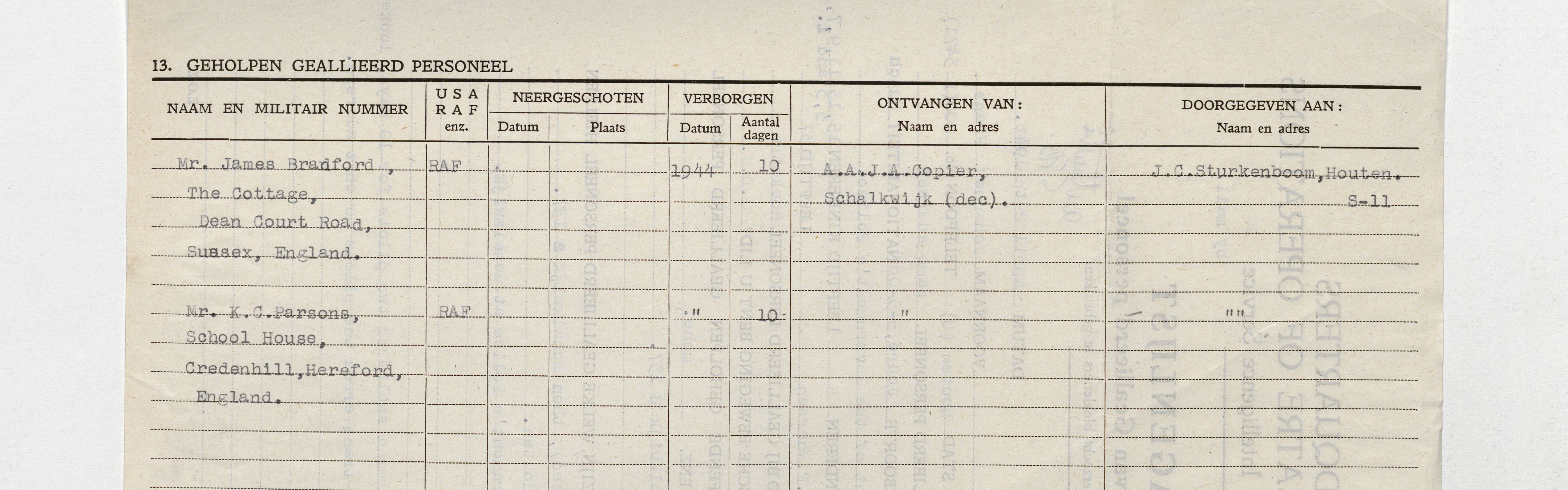
- ✓ Johannes Hoekstra of Houten typed his table of helped airmen twice, in English on p. 3 and in Dutch on p. 5, the pages of his form dated 29 April 1946 (p. 4):
- The English copy has "Mr. James Bradford, The Cottage, Dean Court Road, Sussex, England", RAF, hidden in 1944 for 10 days (Copier's enclosure and Sturkenboom's form below put it in February and March 1945), received from A.A.J.A. Copier of Schalkwijk "(dec.)" and passed to J.C. Sturkenboom of Houten. The fourth letter of the surname is a d and an n typed one over the other, so this copy has both spellings, and which was typed last cannot be told (p. 3, read on an enlarged crop of the image).
- The Dutch copy has "Mr. James Branford", typed cleanly with nothing over it, and the same row otherwise, with "thans overleden" (now dead) after Copier (p. 5, read on the image).
- ✓ The same man: Parsons, The Cottage and Dean Court Road, Sussex agree. A list given by Copier's son to the interviewer, in the enclosure to the file of A. P. Copier of Schalkwijk, has "Mr. James Branford. "the Cottage". Deancourtroad. Rottingdean Sussex." among five evaders who "stayed at Schalkwijk from 20 Febr. - 8 March" 1945 (Copier's file, p. 6).
- ◐ The A.A.J.A. Copier of Hoekstra's table is the son, Joep, not A. P. Copier:
- A. A. Copier's form gives the forenames "Assueres Arcadius Johannes Anthonius", born 12 January 1922, known to the Allies as "Joep" (p. 2). A second form in his file, at the same address, is also "Joep", born 12 January 1922, with "A. Copier (father)" as next of kin (p. 8, read on the image). Treating the two forms as one man is our step.
- A. P. Copier was born in 1887 (p. 2), and his enclosure says he once received 50 guilders "from his son Joep" (p. 6, above).
- Hoekstra's form of 29 April 1946 lists "A.A.J.A. Copier, 23 jaar, voorheen wonende A.137,a te Schalkwijk, thans overleden" (formerly of that address, now dead) (p. 4, read on the image).
- ◐ The A.A.J.A. Copier of Hoekstra's table is the son, Joep, not A. P. Copier:
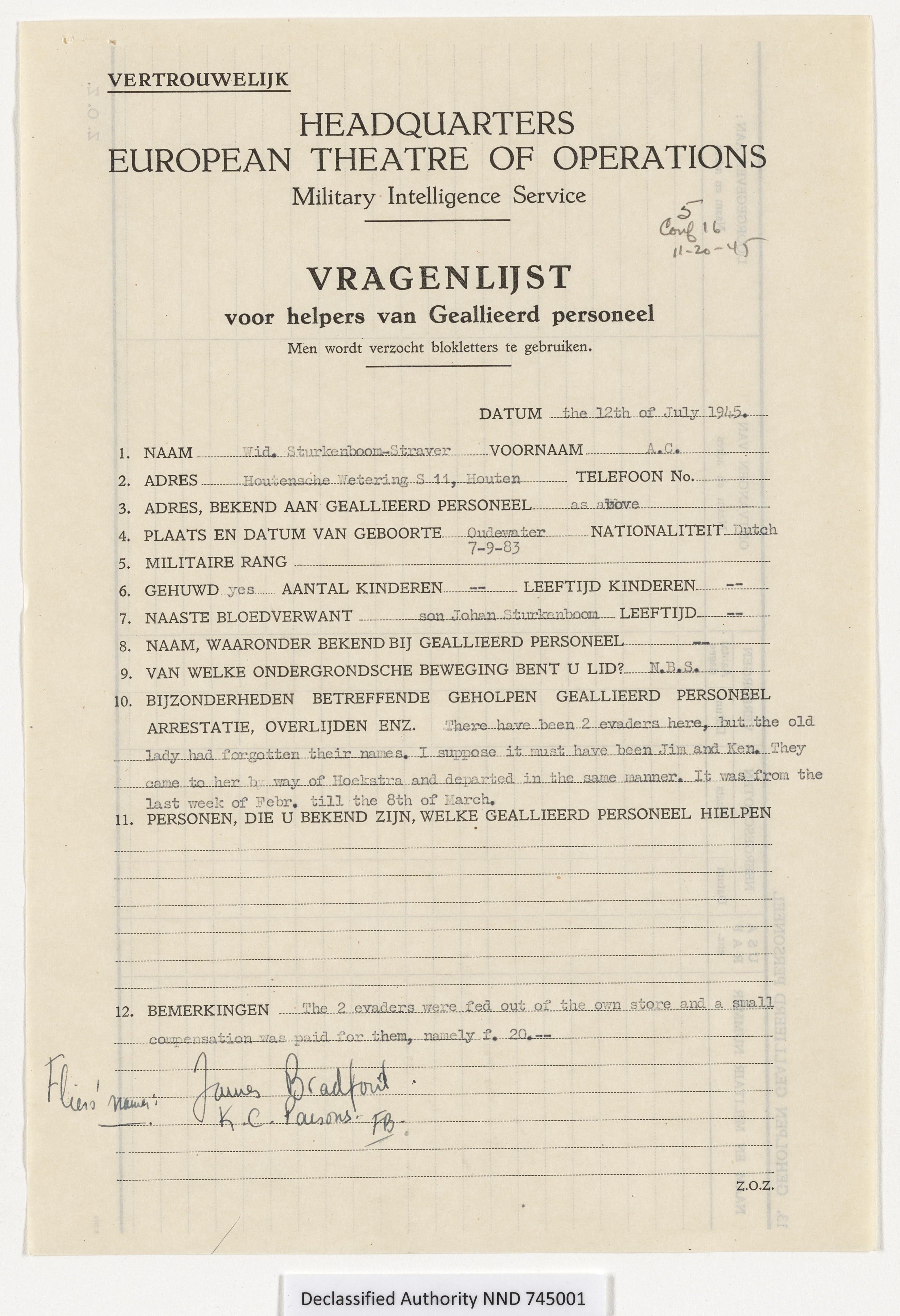
- ✓ The widow Sturkenboom-Straver of Houten. Her questionnaire of 12 July 1945, typed by someone writing of her as "the old lady", says she had forgotten the two evaders' names, and the interviewer adds "I suppose it must have been Jim and Ken"; the evaders came to her "by way of Hoekstra". At the foot, in another hand, initialled FB, is "Fliers' names: James Bradford, K.C. Parsons": the same two names in the same order as Hoekstra's table, ◐ very probably taken from it, so the two papers are one source for the spelling (her form, p. 4).
◐ So Branford's surname is written with a d in one copy of Hoekstra's table (over an n; his other copy has Branford) and, probably copied from it, in a clerk's note on a form that says the evaders came by way of Hoekstra. That is one overtyped letter and a note, which leaves it open that the catalogue's "Bradford" is a reading of his signature rather than a different man. The first name "Edward C." is not explained by anything here, and only the note itself can settle it: the Gelders Archief scans item 350 on request (Prioritised actions).