Kelty, Fife · born 11 November 1920
Tom Murphy
Tom to his family. Spud to the army.
Thomas Murphy was a British paratrooper, wounded at Arnhem and taken prisoner. He escaped from the prisoners' hospital at Apeldoorn, run by captured British medical staff, on 6 October 1944 and spent eighty-eight days moving through the occupied Netherlands before crossing the Rhine by ferry on 2 January 1945; he was recaptured that night. He survived the war.
He survived it because at least eleven Dutch households sheltered him in that time. Most of them can be named. One of the people who fed him, Jacob Veerman of Achterveld, was dead within five months of him leaving the house.
His story, in eight places
Link to the section His story, in eight places- 1ArnhemSeptember 1944
- 2Apeldoorn and the escapeSeptember to 6 October 1944
- 3October on the Veluwe7 to 26 October 1944
- 4Kijkuit and Harskamp26 October to 17 November 1944
- 5Pegasus II and Roekel17 to 25 November 1944
- 6Achterveld25 November to 23 December 1944
- 7Amerongen and the last night23 December 1944 to 3 January 1945
- 8Captivity and homeJanuary to April 1945
The route on a map
Link to the section The route on a map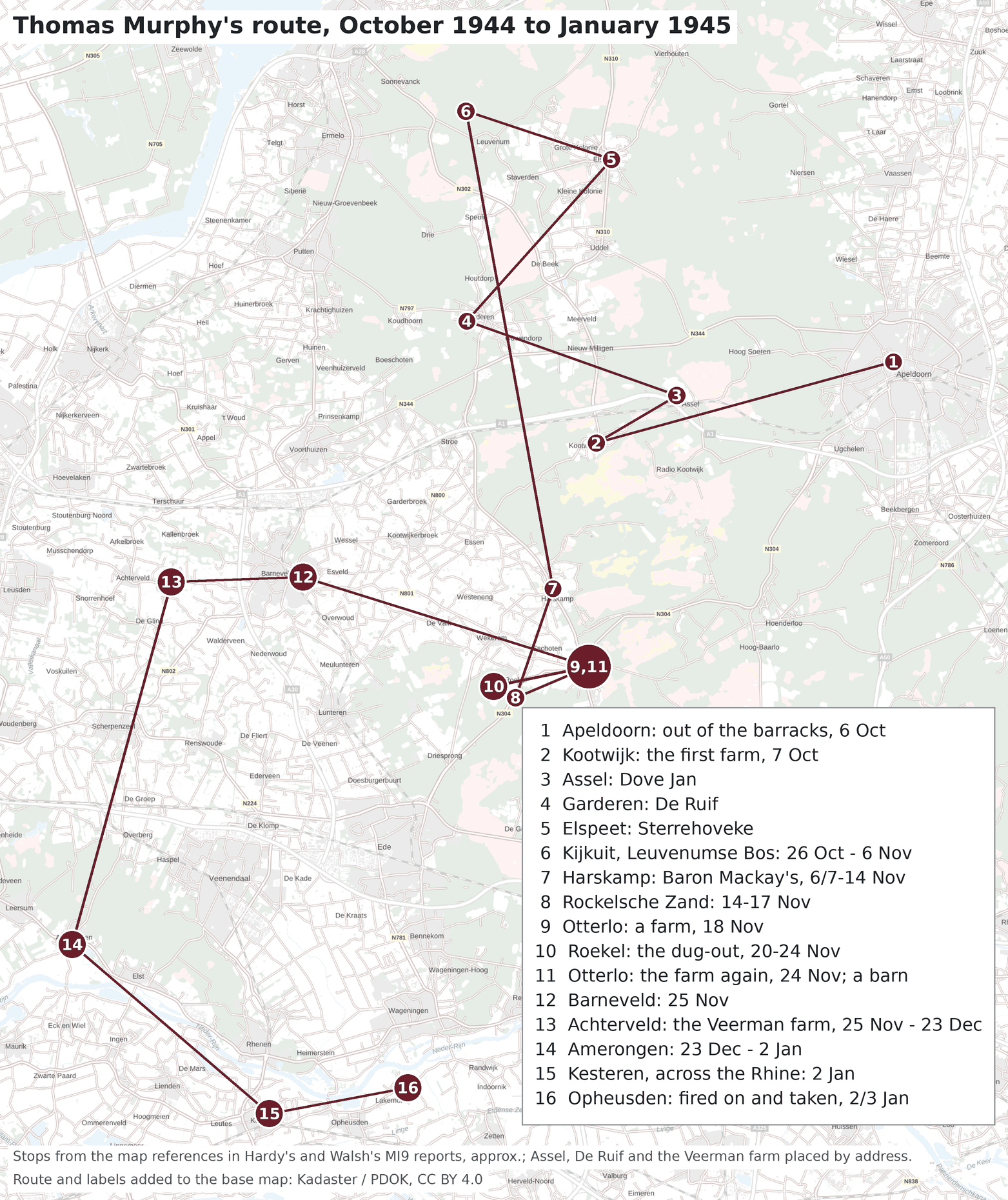
Subject
Link to the section Subject2756457 Pte Thomas Murphy, Army Air Corps · 156 Parachute Battalion, 4th Parachute Brigade, 1st Airborne Division · formerly 2nd Battalion, The Black Watch (Royal Highland Regiment) · born 11 November 1920, Kelty, Fife.
| Field | Detail | Source |
|---|---|---|
| Name | Thomas Murphy | Record Office letter |
| Known as | Tom; "Spud" in the army | ParaData (nickname); the Dutch who hid him wrote "Tom" (Noordman, p. 301) |
| Born | 11 November 1920, Millers Buildings, Kelty (the building: his page and family knowledge) ⚠︎ ParaData says 1921, see Date of birth. ◐ A Thomas Murphy's birth was registered at Kelty in 1920 (ScotlandsPeople index, 410/2/293; the searches); the entry itself, which names the parents, is unseen | Service list ("D.O.B. 11/11/1920"); boyhood page; TNA WO 422/38420; his own "78 on 11th November 1998" (p.5) |
| Birthplace | Kelty, Fife | ParaData. The family address in 1945 was 91 Centre Street, Kelty (letter) |
| Parents | John Murphy, a coal miner, born at Fauldhouse on 16 August 1883, of 91 Centre Street, Kelty, in 1945; he died at the West Fife Hospital, Dunfermline, on 4 or 5 April 1964 (the two family accounts differ by a day). ◐ By Liz Moore's account he fought in the First World War and was wounded in Belgium, and by 1916 had been discharged from the army because of the injury. Catherine Murphy, née Brannan, born at Stevenston on 22 January 1886; they married at Kelty in 1908, and she died in January 1969. Dates and places are family knowledge, from his niece Liz Moore's family tree | Letter (father, address); ParaData (mother); family knowledge |
| Brothers and sisters | Ten children were born to John and Catherine, Tom the seventh; all are now dead. In order (family knowledge, from Liz Moore's family tree, with the births and deaths found in the ScotlandsPeople indexes marked ◐ where only the index is seen, the searches): Cecilia ("Aunty Cissy"), born at Kelty on 2 October 1909, who (⚠︎ by the family tree alone) had been a nun, married William Andrew Devine at St Joseph's, Kelty, in 1941, and died in 1994; Martin, born at Kelty in 1911, who died in 1925 aged 13, of influenza and encephalitis (◐ the death is in the index; the family story is that he was brushed by a tram and then headed a football); Michael, born at Lumphinnans on 17 May 1913, who served with the Black Watch in Burma, went to Australia as a "ten pound Pom", came back to Cowdenbeath and never married; Catherine, born at Kelty on 29 September 1914, who married Anthony Lyons at Kelty in 1938 (◐ the index) and was Mrs Lyons, of 12 Montague Street, Edinburgh, in 1944–45: with their parents she asked in the Edinburgh Evening News for news of Tom when he went missing, and announced there that he was a prisoner; Patrick, born at Kelty on 29 July 1916, Liz Moore's father, who died in 1984; Mary Helen, born in June 1919, who died at 20 Millars Buildings, Kelty, on 13 February 1921, aged 20 months, of whooping cough; Thomas, born 11 November 1920; John, born on 19 September 1923, who settled in London, never married, and died at Willesden; Jane, born on 1 December 1924, who died in 2014 aged 89; and Christopher, the youngest, born on 21 April 1926 (◐ the index), who served with the British Army in Germany and married a German woman; he died at Burghfield Common, near Reading, in 1987 (✓ the England and Wales index has his death registered in July to September 1987 in the Reading and Wokingham district, with the same date of birth: the index). ◐ The 1921 census index has the family's Kelty page: John, 34, Catherine, 33, Cecelia, 11, Martin, 9, Michael, 8, Catherine, 6, Patrick, 4, and Thomas, under a year. ⚠︎ The children's ages fit the births above, but the parents' do not: John at 34 and Catherine at 33 in June 1921 would put their births in 1886–87 and 1887–88, against the family tree's 1883 and 1886 (37 and 35); the index is not the image, and which is right is not settled. ⚠︎ Michael: the family's text on Tom's ParaData page says the two joined the Black Watch together; ◐ Michael's service number is not in Tom's block, so not at the same desk on the same day (Still open, no. 13). None of them has a page of their own | Tom's ParaData page, supplied by Liz Moore (Michael); Edinburgh Evening News, 24 October 1944 and 15 February 1945 (Mrs Lyons); family knowledge |
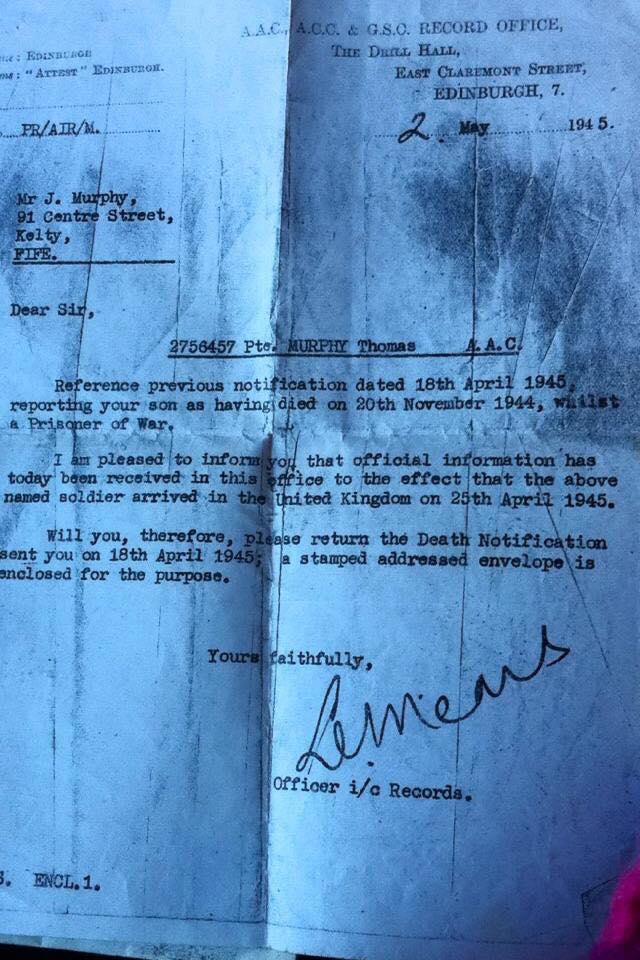
| Service number | 2756457 | Record Office letter |
| Rank, corps | Private, Army Air Corps (A.A.C.) | Letter |
| Enlisted | 1939, at Cowdenbeath, into The Black Watch. ⚠︎ The family papers give different dates: the service list 1 March 1939 (scan); his own memoir "Joined Army 1-8-1939 (Cowdenbeath)" (p.1), which the typed transcript follows. ParaData says Dundee. Still open | Family papers |
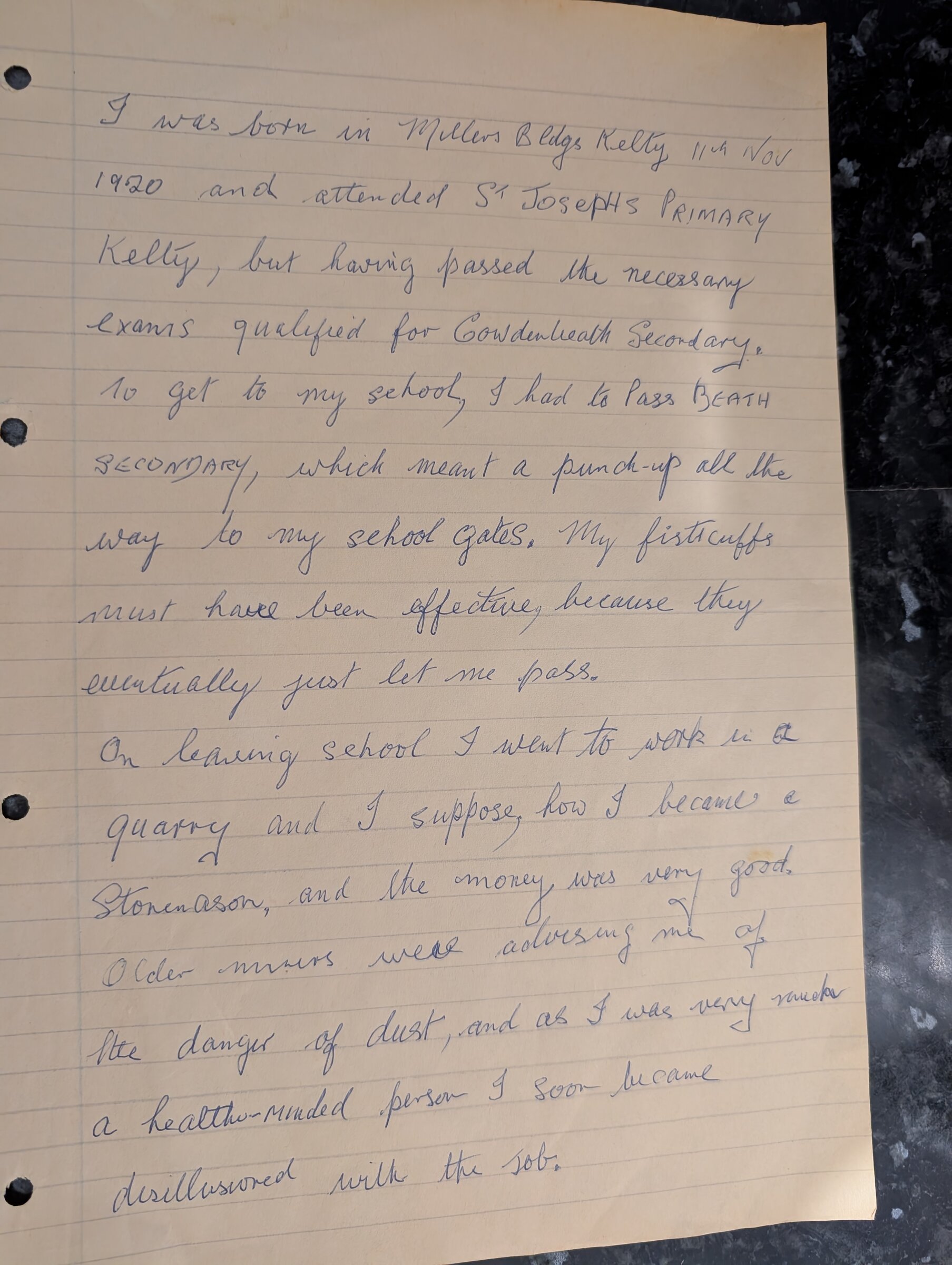
| Before the army | St Joseph's Primary, Kelty; Cowdenbeath Secondary; then a quarry, "how I became a Stonemason", left over the dust | Boyhood page; family knowledge |
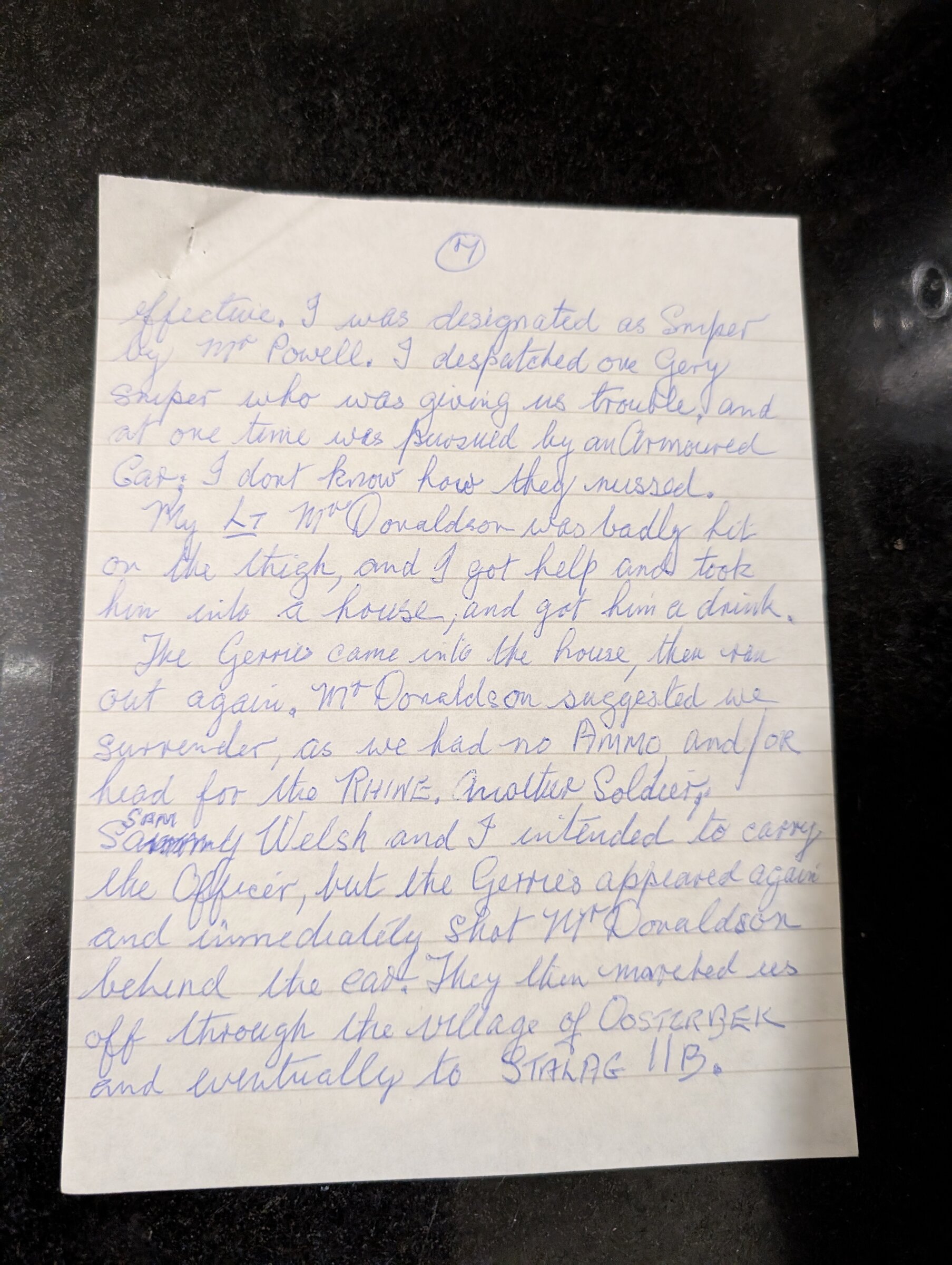
| Unit at Arnhem | 156 Parachute Battalion, C Company, ◐ 11 Platoon. Schjelderup's nominal list and Hardy's text both give "156 Para Bn" (Hardy). The platoon follows from his own memoir: "My Lt. Mr Donaldson", and "I was designated as Sniper by Mr Powell" (p.7). Walsh's report names Lt Donaldson as "my Platoon C.O.", 11 Platoon, C Company (Walsh), and Powell commanded C Company (Powell). The "Mortar Platoon" was Italy, 1943: "I was transferred to the Mortar Platoon; we had a field day in Taranto" (p.5) | Settled |
| Earlier service | 2nd Bn Black Watch: Palestine, Aden, Crete, Egypt/Tobruk; then 151 → 156 Parachute Bn via India and the Middle East. The war before Arnhem | Service list |
| Medals | 1939–45 Star · Italy Star · France and Germany Star · Defence Medal · War Medal 1939–45. ⚠︎ That is ParaData's list, and it has no Africa Star, although the star was given for one day's operational service in North Africa or Egypt between June 1940 and May 1943 (gov.uk), and the service list has him in Egypt from June 1941 to March 1942, the months that took in the Tobruk breakout (The war before Arnhem). His service record would settle it | ParaData |
| Reported died | 20 November 1944, whilst a prisoner of war, notified 18 April 1945, withdrawn 2 May 1945 | Letter |
| Liberated | 16 April 1945, Fallingbostel ⚠︎ camp is his own word | His typed notes (camp); Wikipedia (date and unit) |
| Arrived UK | 25 April 1945 | Letter, service list agrees |
| Discharged | 17 November 1946 | Service list |
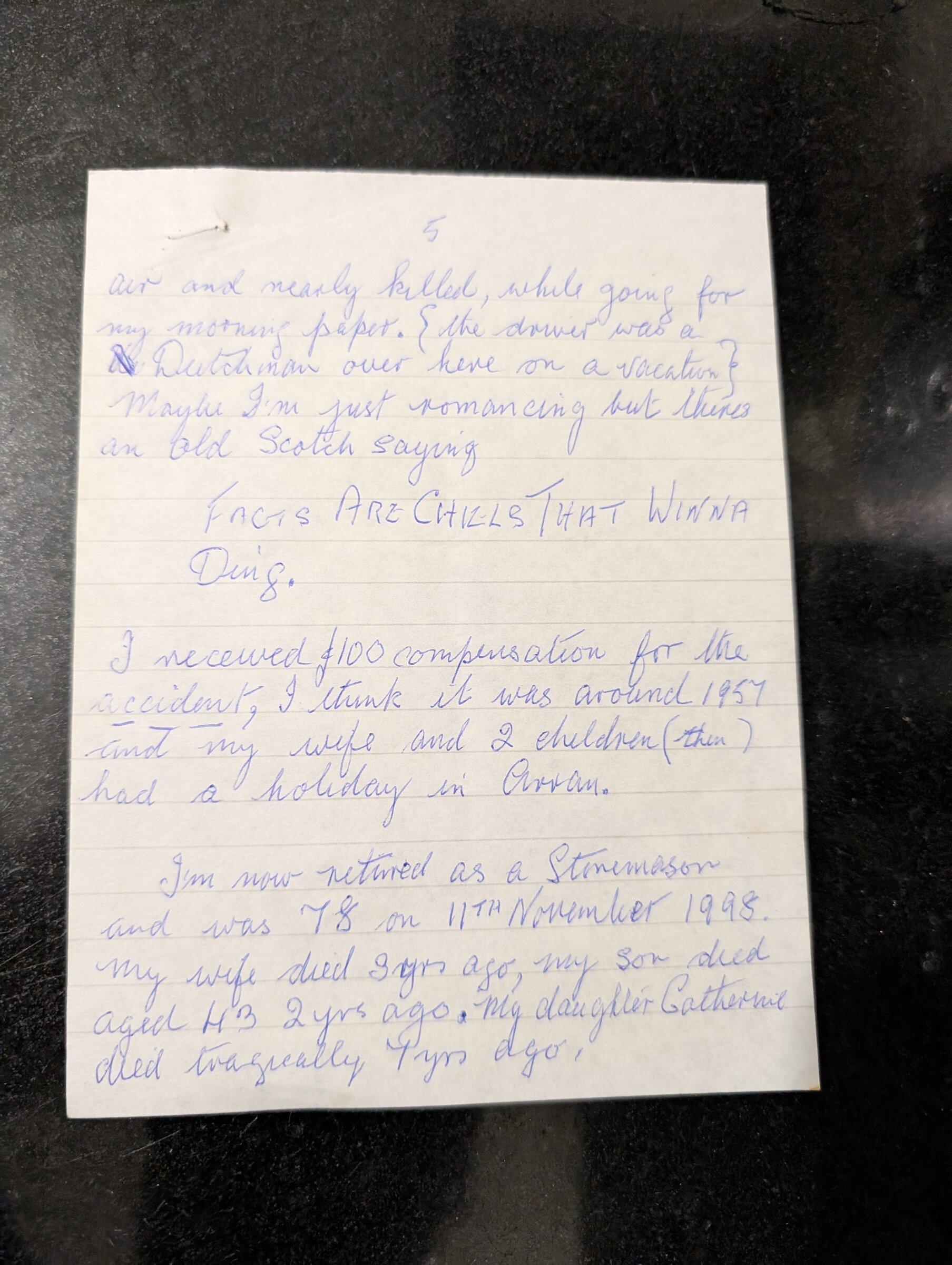
| Later life | Stonemason. Married Joan Stewart in July 1948; she died in December 1995 (family knowledge). ✗ The Daily Express of 25 July 1974 calls her "Joanna" (After the war). Four children, Frances, Catherine, Martin and Mary, and seven grandchildren, Adam, Paul, Cathy, Stewart, Kenny, Stephen and Joanne. He outlived three of them: Catherine, who died in May 1985, Martin, who died in March 1997 aged 42, and Frances. Mary is the one of the four still with us (family). Wrote his memoirs c.1998, aged 78, in the care home where he was living. He died at Glasgow Royal Infirmary on 1 August 2001, aged 80 (family knowledge) | p.5; Musselburgh page |
His family
Link to the section His family
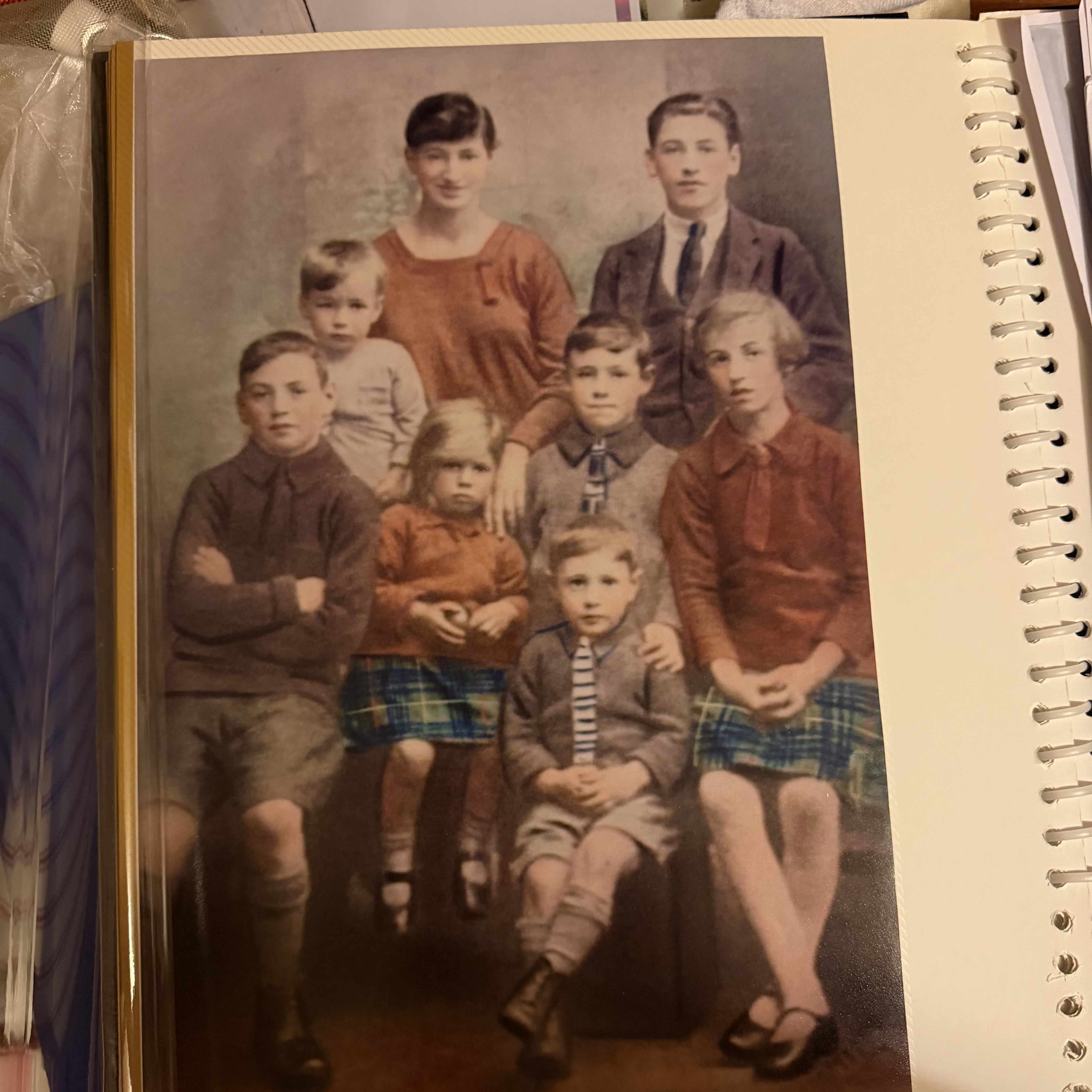
From the Black Watch to the paras
Link to the section From the Black Watch to the paras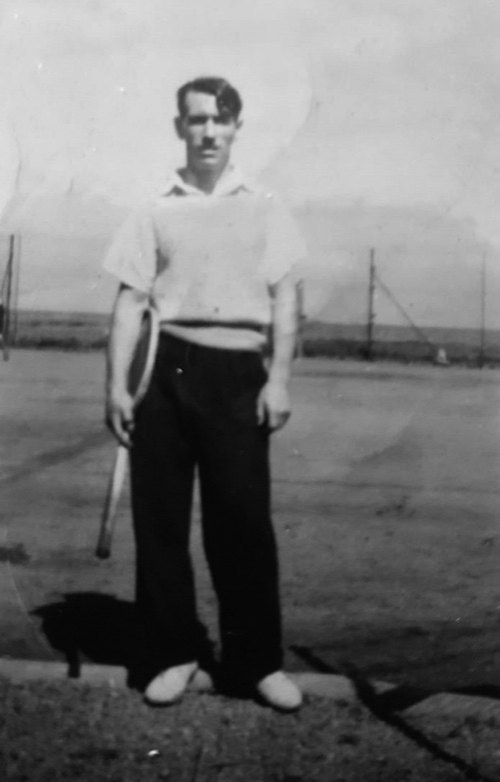
The Black Watch is an infantry regiment: foot soldiers, no parachutes. He joined it as one, and it took him through Palestine, Somaliland, Crete (where he was on the receiving end of the German airborne invasion of May 1941) and the siege of Tobruk (Black Watch Museum). In 1942 the 2nd Battalion was sent to India, and there the Army was raising its first parachute battalion, the 151st, at Delhi, from British Army volunteers. He volunteered for airborne forces while serving in India, and left the Black Watch for good. The 151st was renamed 156 Parachute Battalion in November 1942 and joined 4th Parachute Brigade at Kabrit, Egypt, in 1943 (ParaData, 156 Bn; ParaData, 151 Bn). The family service list has him leaving India on 3 November 1942, the month of the renaming. By 1945 the Record Office addressed him as A.A.C. (Army Air Corps, the Parachute Regiment's parent), while his service number stayed the one the Black Watch had given him in 1939 (letter).
Why. ⚠︎ Family account only, but it is how his memoir opens: his brother Michael, in the same battalion, argued that two brothers in one unit was dangerous, if one were hit the other would go to him and both could be lost. Tom took the parachute transfer; Michael stayed (ParaData, supplied by his niece Liz Moore).
The war before Arnhem
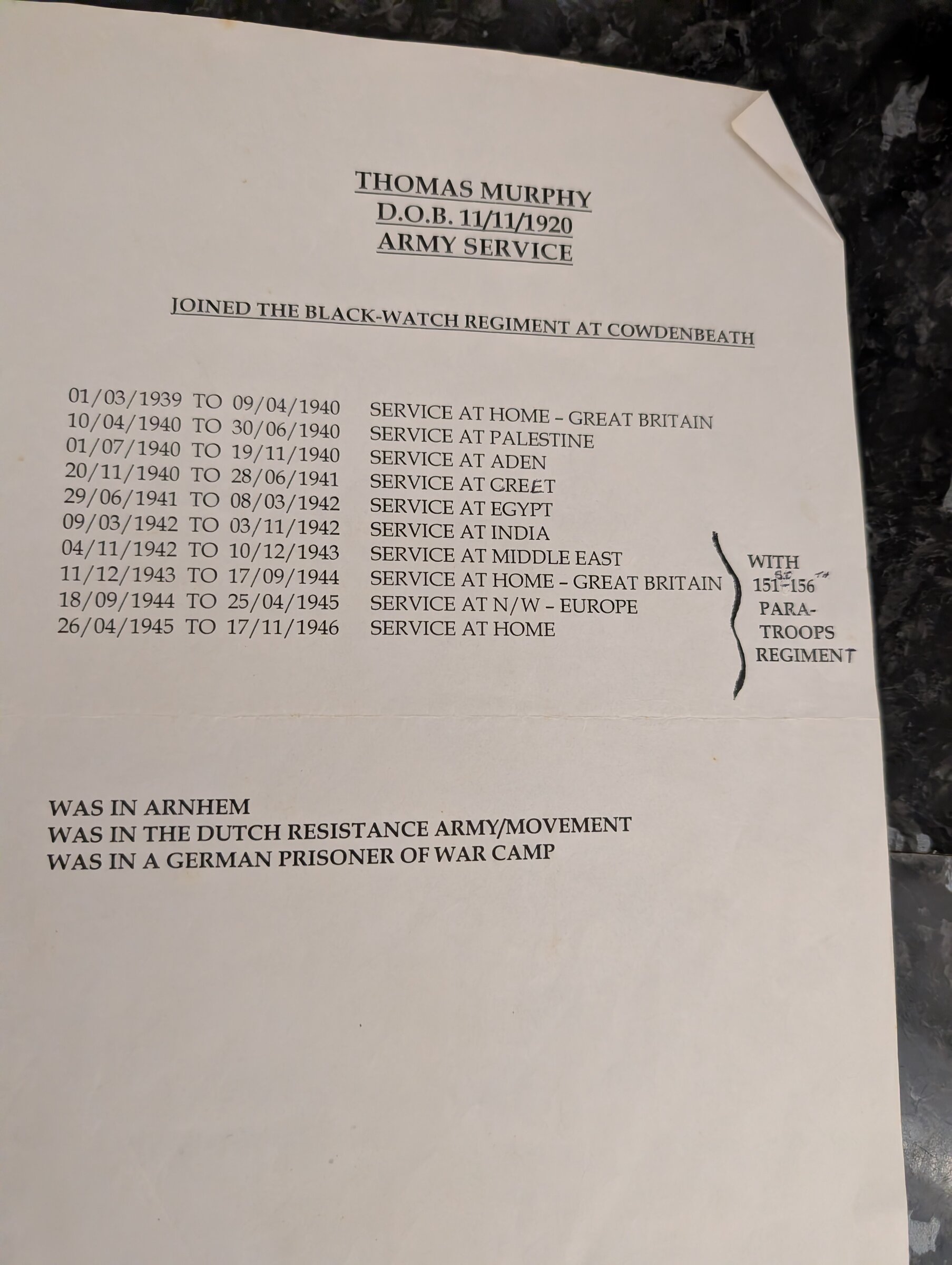
Link to the section The war before ArnhemThe family's typed army service list (scan) is the only source for this period, and everything in it checks against the regimental record. A bracket beside the last four rows reads "with 151st–156th Para-Troops Regiment", the ordinals added in pencil.
| From | To | Theatre | Checks against |
|---|---|---|---|
| 01/03/1939 | 09/04/1940 | Home: Great Britain | ⚠︎ His own memoir gives the enlistment as 1-8-1939 (Still open) |
| 10/04/1940 | 30/06/1940 | Palestine | 2nd Bn was in Palestine 1939–40 (Black Watch Museum) |
| 01/07/1940 | 19/11/1940 | Aden | 2nd Bn fought a rearguard action in British Somaliland in July 1940 (same) |
| 20/11/1940 | 28/06/1941 | Crete | 2nd Bn at Heraklion; the German airborne assault of May 1941 was "most effectively repulsed" locally but the garrison was withdrawn (same) |
| 29/06/1941 | 08/03/1942 | Egypt | Tobruk: the November 1941 breakout, "within one hour over 300 men had become casualties" (same) |
| 09/03/1942 | 03/11/1942 | India | 151 Para Bn raised at Delhi; renamed 156 in November 1942 (ParaData) |
| 04/11/1942 | 10/12/1943 | Middle East | 4 Para Bde at Kabrit; landed in Italy September 1943, "spearheaded the advance from Taranto to Bari", left Italy November 1943 (ParaData); sailed from Bizerta 8 September, Taranto unopposed, took Gioia (Wikipedia). This is where the Italy Star was earned |
| 11/12/1943 | 17/09/1944 | Home: Great Britain | |
| 18/09/1944 | 25/04/1945 | N/W Europe | Start date is the 4th Para Bde lift (Arnhem); arrival date matches the Record Office letter exactly |
| 26/04/1945 | 17/11/1946 | Home |
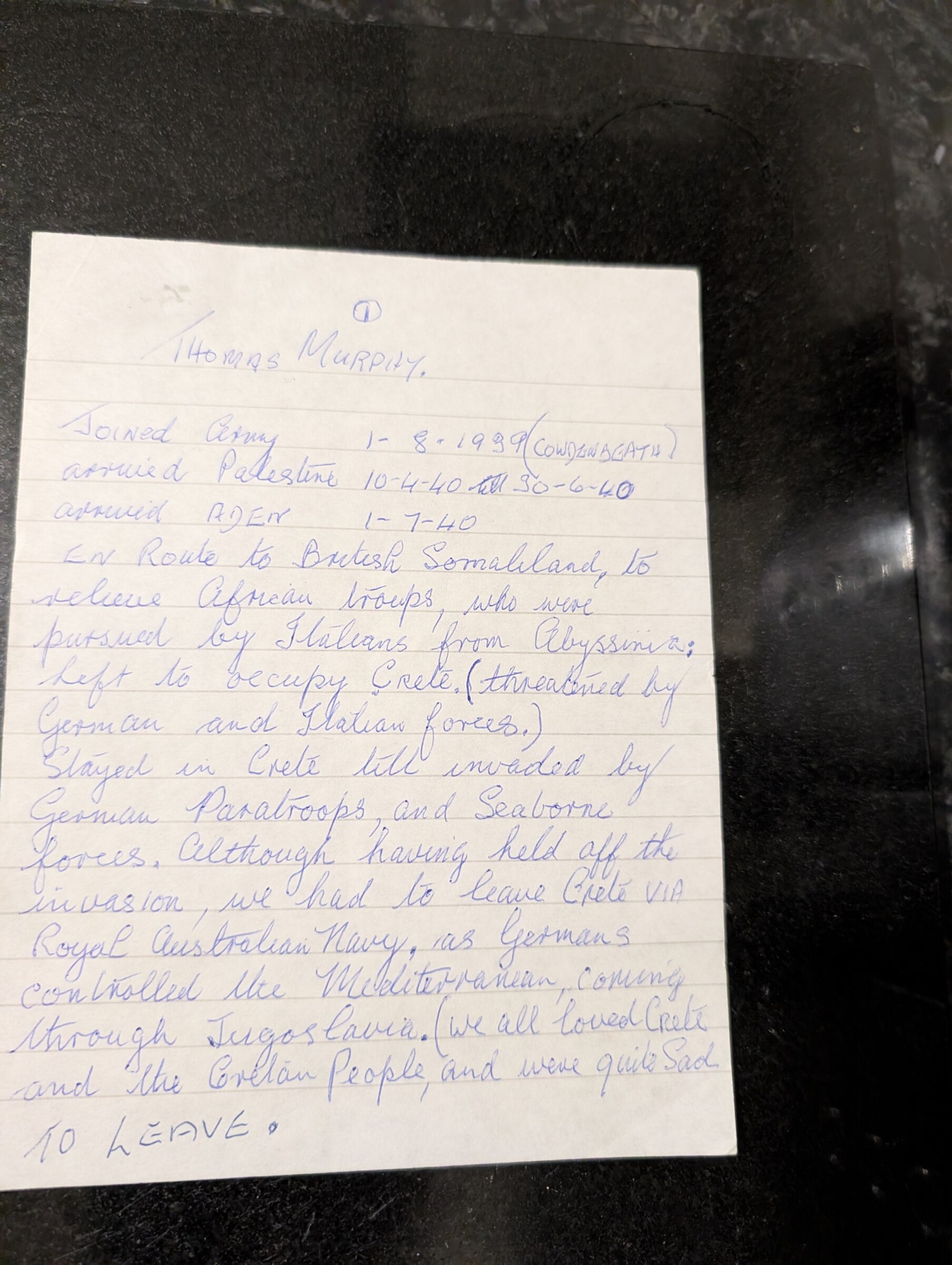
His own memoir opens with three dates in his hand, "arrived Palestine 10-4-40 till 30-6-40, arrived Aden 1-7-40" (p.1), which are the service list's second and third rows to the day; so either the list was typed from something he held, or he wrote from it. The narrative then fills the first half in:
- British Somaliland, en route, "to relieve African troops who were pursued by Italians from Abyssinia", then on to occupy Crete. ✓ Black Watch Museum.
- Crete, held until the German airborne and seaborne invasion, then taken off "via Royal Australian Navy" to Alexandria under continuous dive-bombing, "over 60 killed and buried at sea". He records that German High Command concluded it would never mount such an operation again. ✓ The Heraklion garrison and the withdrawal are documented (same); ⚠︎ which navy took them off, the "over 60" and the High Command remark are his own.
- Tobruk, relieved the Australians, shelled by "Bardia Bill", "pushed out on 21st November", "our losses were quite heavy".
- ✓ "Bardia Bill" was the troops' real name for the Italian gun used against the forces besieged in Tobruk (Australian War Memorial); the breakout and its 300 casualties in an hour are in the regimental history (Black Watch Museum).
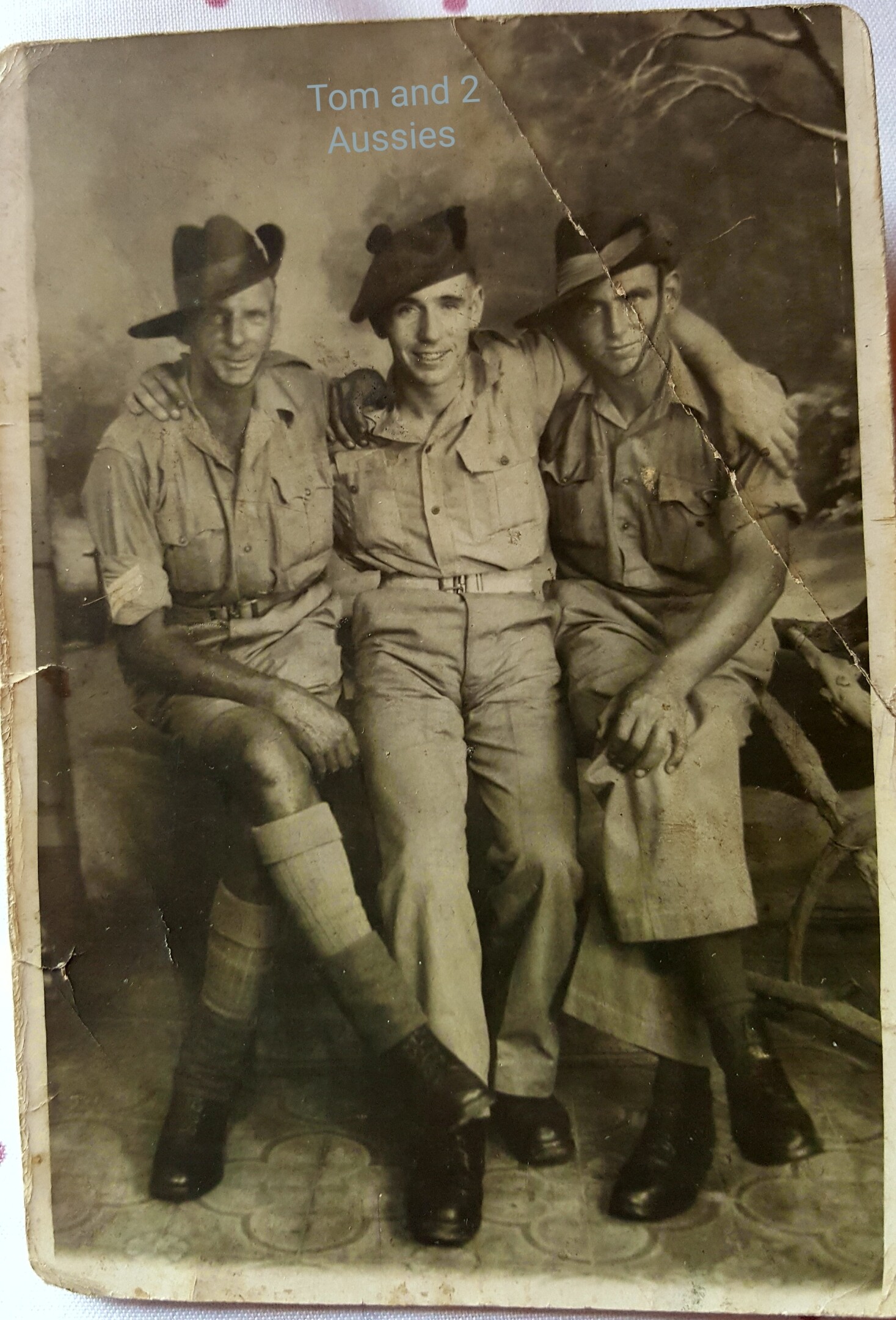
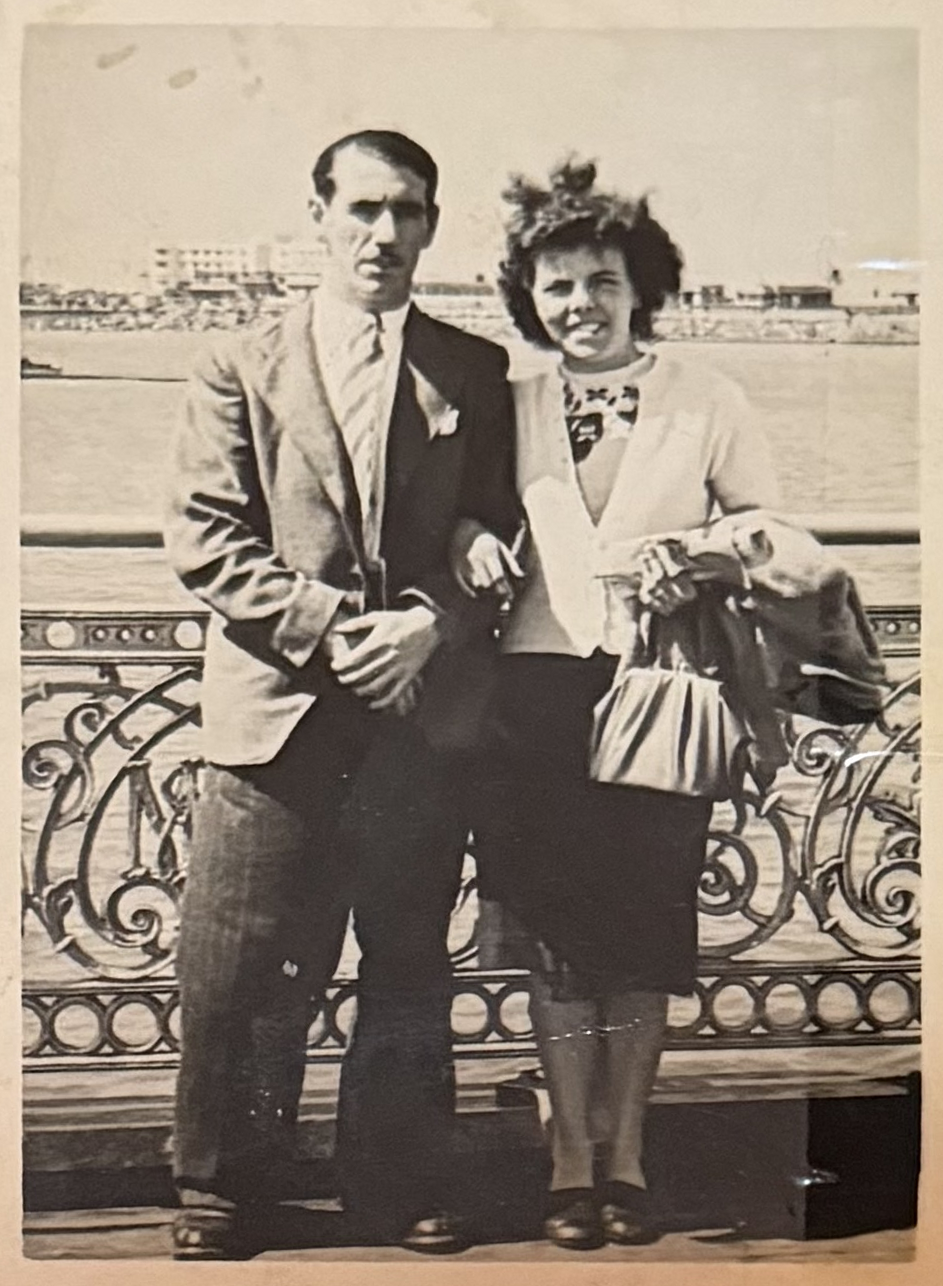
- The photograph at the top of this page, which the family labelled "Tom and 2 Aussies", may belong to these years; ◐ it is undated, and it is a studio portrait, painted backdrop and tiled floor, so it was taken in a town behind the lines rather than in besieged Tobruk, and if the two are Australians they fit the year the battalion relieved them there, 1941.
- ⚠︎ By his niece Liz Moore's account the two men with him were of 156 Battalion, which would put it in India in 1942 or 1943 (the papers).
- Noordman prints the same photograph as fig. 191 and captions it "Tom Murphy (midden) met twee militairen, Cairo 1940" (Tom Murphy, centre, with two soldiers, Cairo 1940), credited to the same lender as the tennis photograph (Noordman, p. 298).
- ◐ Cairo fits a studio behind the lines. ⚠︎ 1940 does not fit the service list, which has no Egypt before June 1941, unless he passed through on the way between Palestine, Aden and Crete.
- The back of the print, sent by Liz Moore in October 2026, reads "Cairo" and "Egypt" in ink across the middle, "1940" in the top corner with its own underline, "Thomas Murphy" double-underlined, and "2 Aussies" in pencil (the back). It is where "Cairo 1940" comes from; it does not say who wrote it or when, and the year still sits against the service list.
He wrote out a poem on the 2nd Battalion's years in the Middle East, "The Ladies from Hell", in the guestbook at De Ruif in October 1944: "They were soldiers out in Palestine … South of Arabia / Down Jerusalem way. / That's where a Scotchman stands / And guards the Canal both night & day. / The Black Watch they call them" (Garderen).
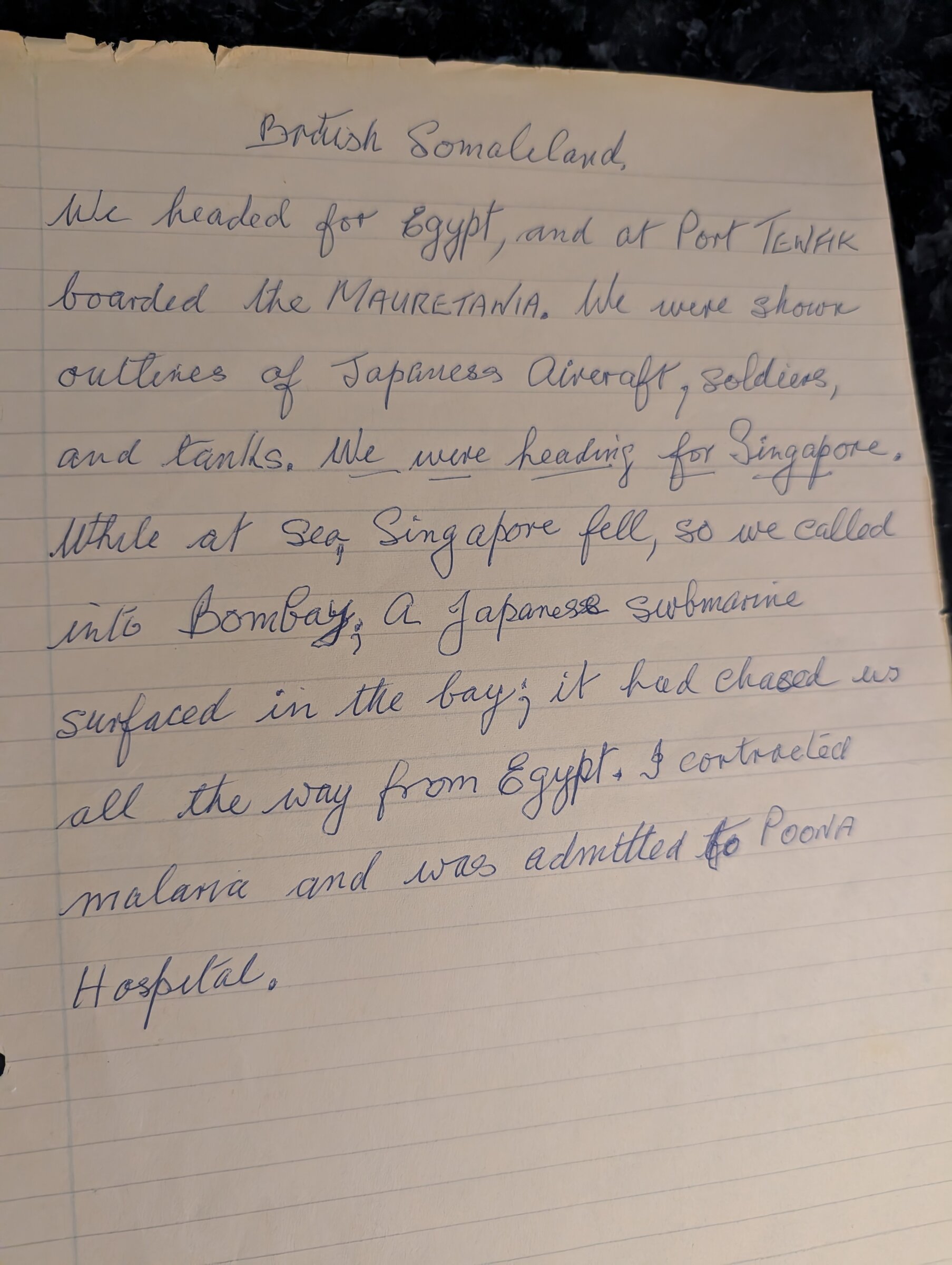
A handwritten page headed "British Somaliland" carries the move to India:
We headed for Egypt, and at Port Tewfik boarded the Mauretania. We were shown outlines of Japanese aircraft, soldiers, and tanks. We were heading for Singapore. While at sea, Singapore fell, so we called into Bombay; a Japanese submarine surfaced in the bay; it had chased us all the way from Egypt. I contracted malaria and was admitted to Poona Hospital.
— Tom Murphy, a loose handwritten page (scan)
⚠︎ His word for all of it; no source is archived for the Mauretania's movements or the submarine. It fits the service list, which ends Egypt on 8 March 1942 and starts India on the 9th, three weeks after Singapore fell on 15 February. The heading is the heading on the page; the text is about the voyage, not Somaliland.
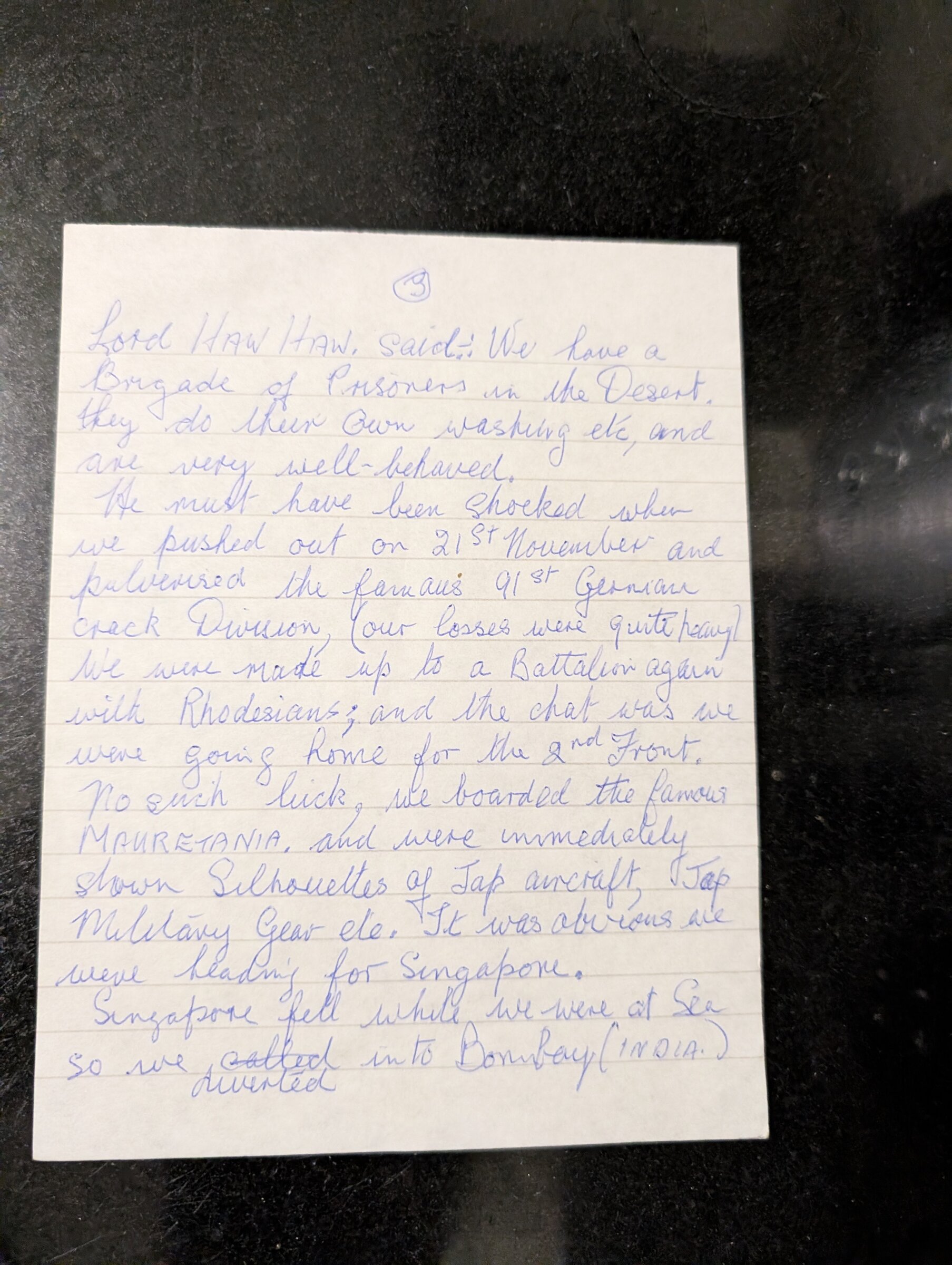
The twelve-page memoir (pp.3–5) carries the rest of the road to Arnhem, all ⚠︎ his word unless marked:
-
Tobruk: Lord Haw-Haw on the "Brigade of Prisoners in the Desert"; the breakout of 21 November; "pulverised the famous 91st German crack Division (our losses were quite heavy)"; "made up to a Battalion again with Rhodesians". ✓ The breakout and the losses are regimental history (Black Watch Museum); the division's number is his.
-
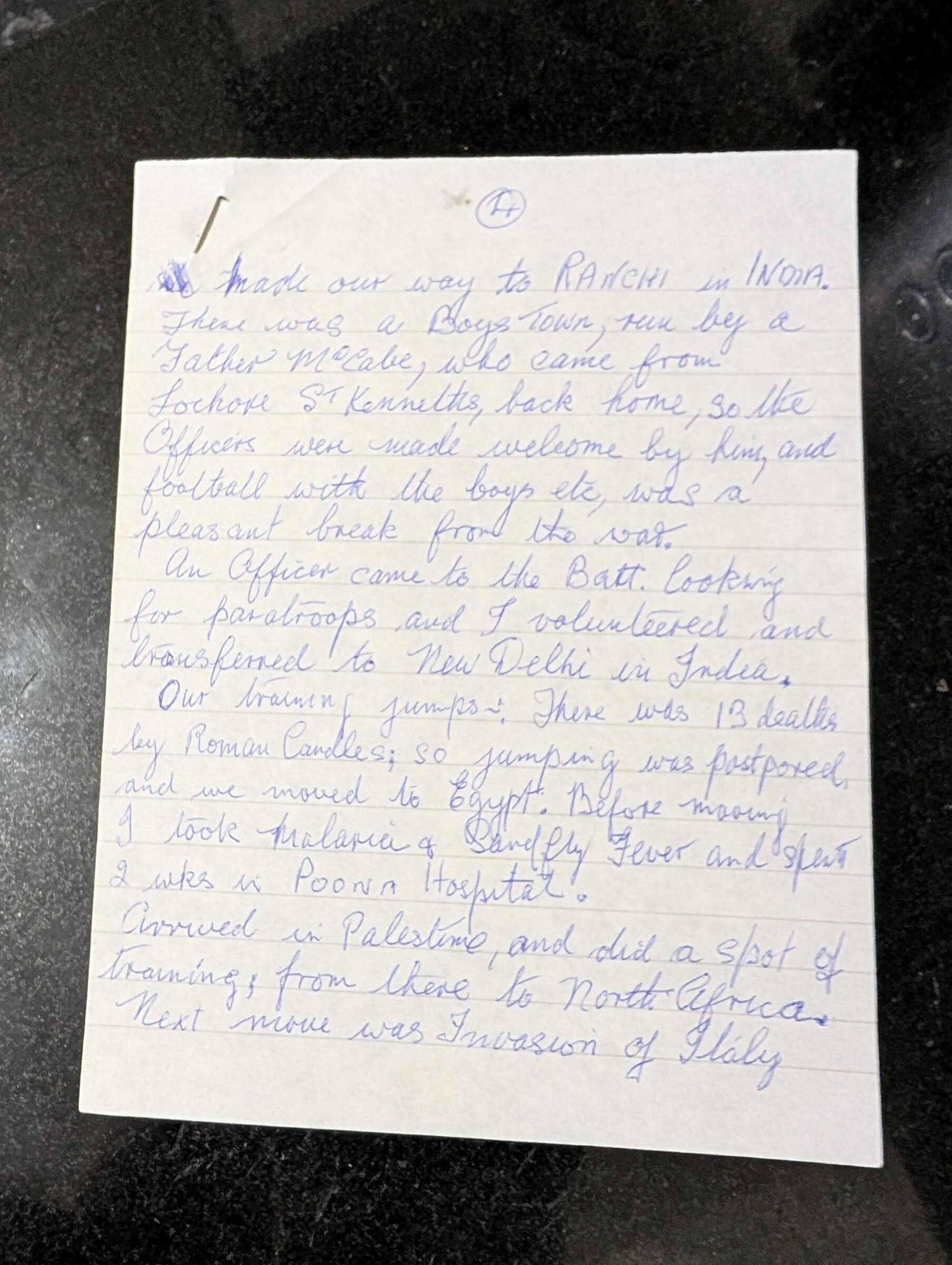
India: Bombay, then Ranchi, where "a Boys Town, run by a Father McCabe, who came from Lochore St Kenneths, back home" made the officers welcome, and "football with the boys etc, was a pleasant break from the war". "An officer came to the Batt. looking for paratroops and I volunteered and transferred to New Delhi" (p.4). ✓ 151 Para Bn was raised at Delhi from volunteers in the infantry battalions in India (ParaData).
-
Training:
there was 13 deaths by Roman Candles, so jumping was postponed, and we moved to Egypt. Before moving I took malaria and sandfly fever and spent 2 weeks in Poona hospital.
— Tom Murphy, his memoir, p. 4 (the page)
Palestine, "a spot of training", then North Africa.
-
Italy:
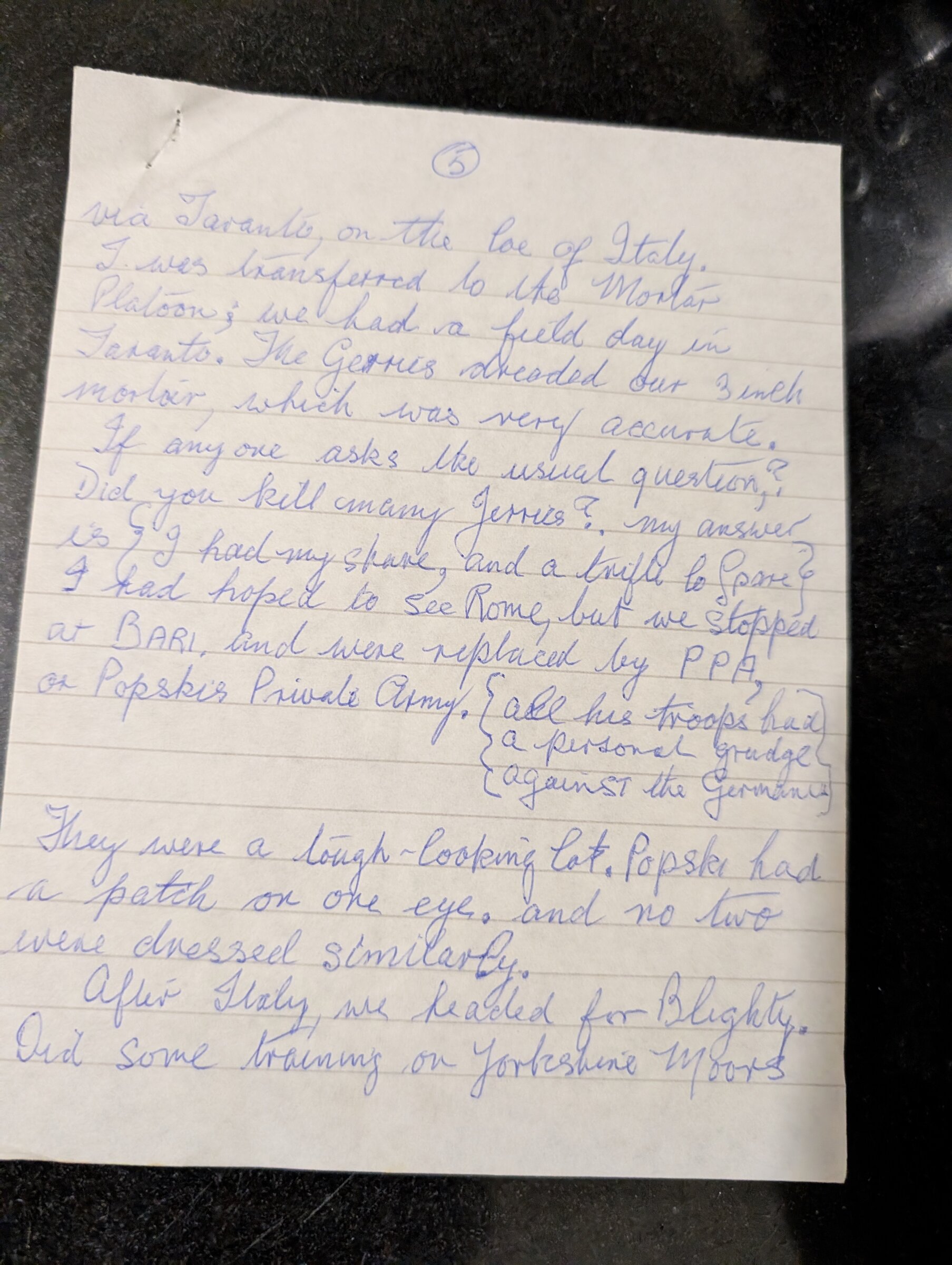
Invasion of Italy via Taranto, on the toe of Italy. I was transferred to the Mortar Platoon; we had a field day in Taranto. The Gerries dreaded our 3 inch mortar, which was very accurate.
— Tom Murphy, his memoir, p. 5 (the page)
Hoped to see Rome, "but we stopped at Bari, and were replaced by PPA, or Popski's Private Army … Popski had a patch on one eye, and no two were dressed similarly" (p.5). ✓ Taranto to Bari is the battalion's documented route (ParaData).
-
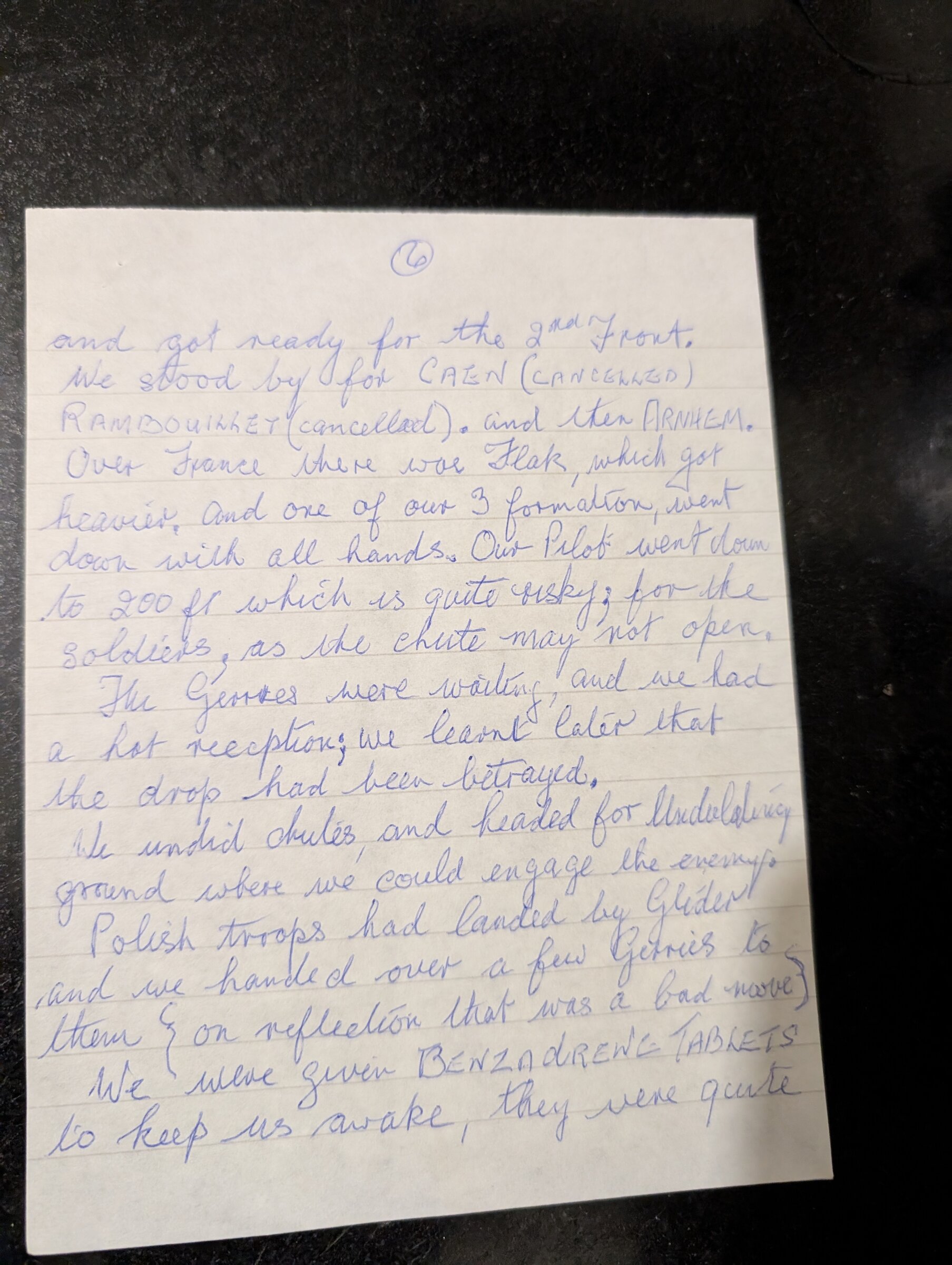
Home: "did some training on Yorkshire Moors and got ready for the 2nd Front. We stood by for Caen (cancelled), Rambouillet (cancelled), and then Arnhem" (p.6).
-
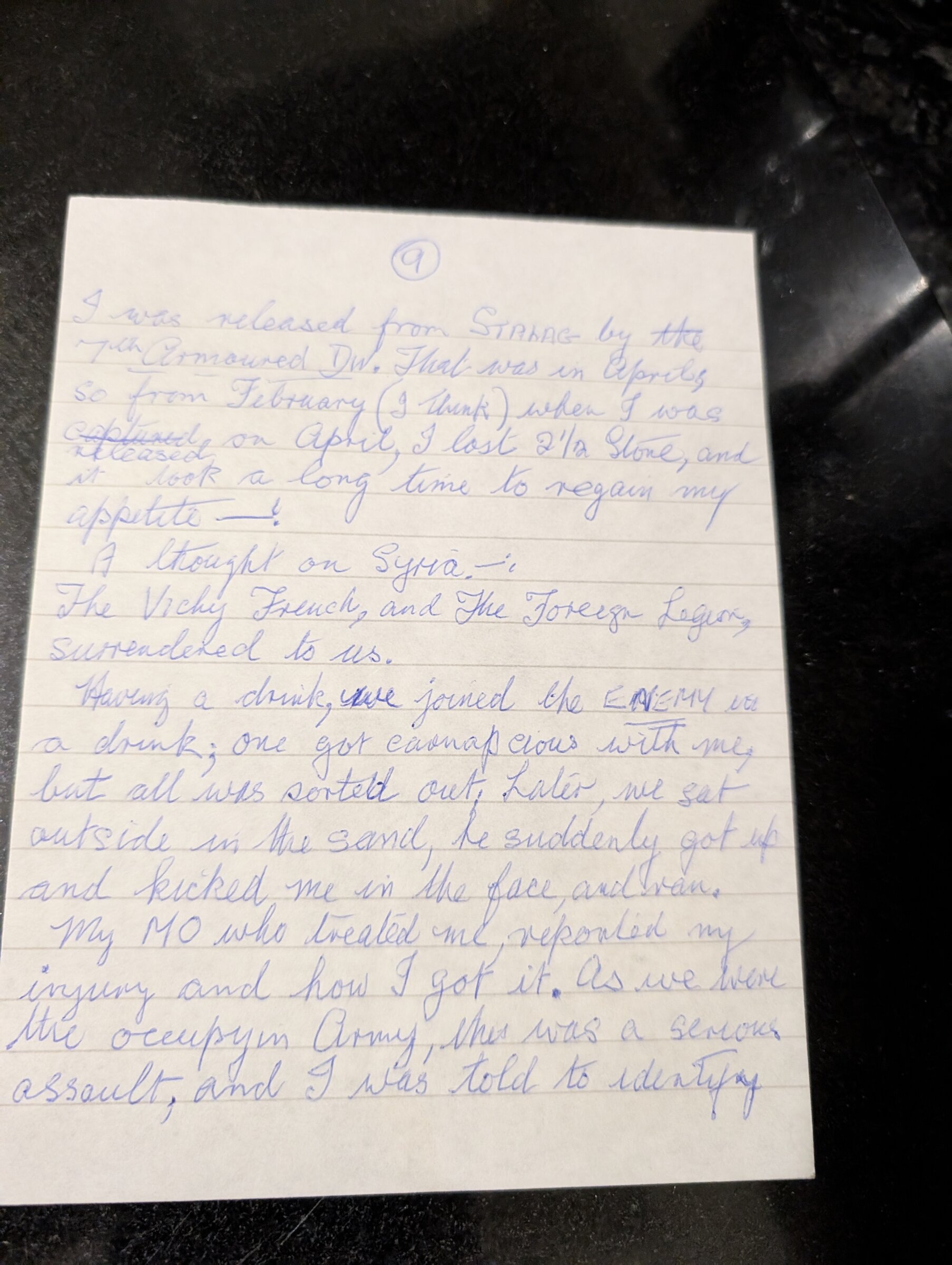
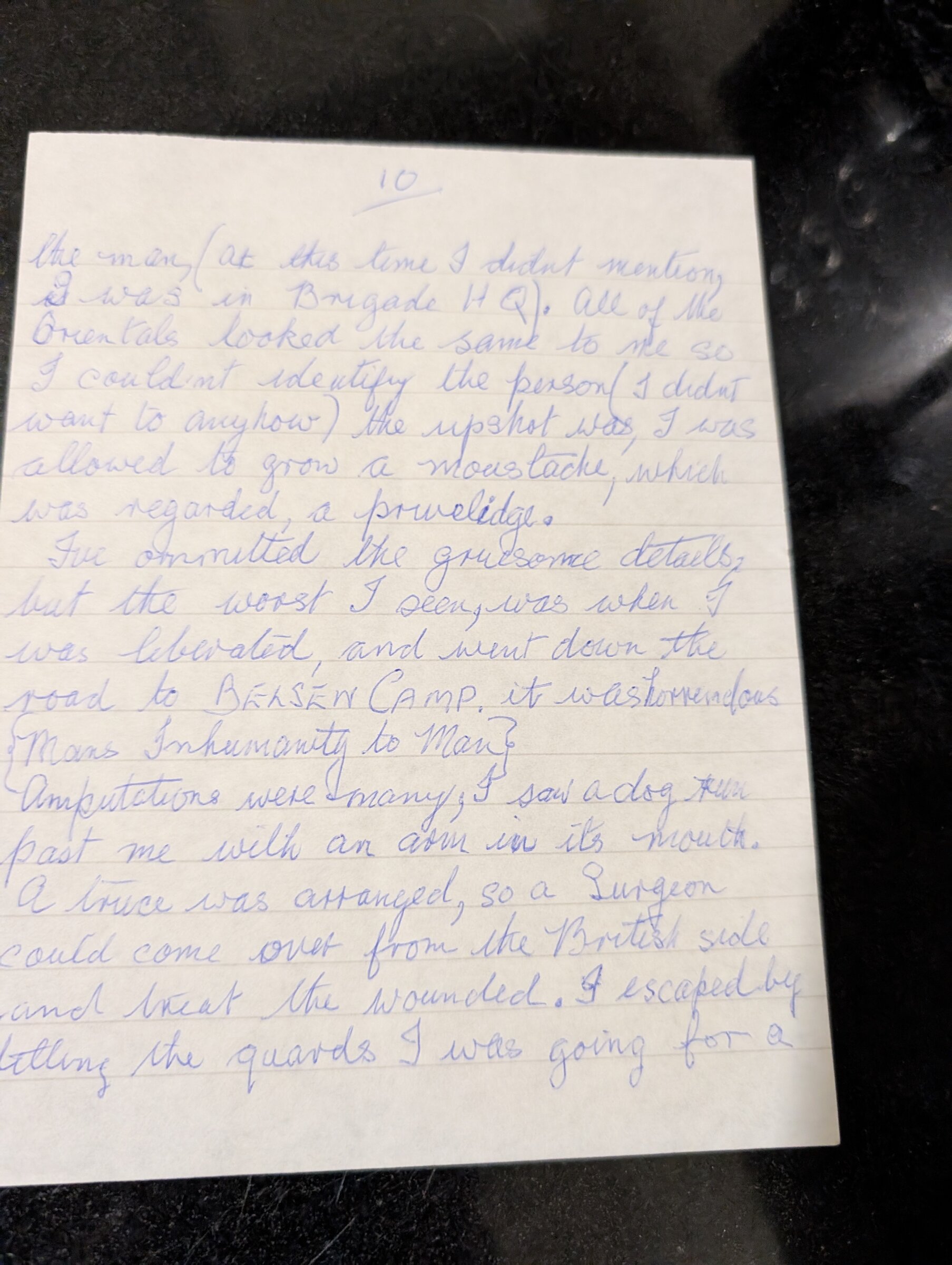
⚠︎ Unplaced: "A thought on Syria. The Vichy French and the Foreign Legion surrendered to us" (p.9), followed by a drink with the enemy, a kick in the face, an MO's report, Brigade HQ and permission to grow a moustache. Syria surrendered in July 1941, when the service list has him on Crete or in Egypt; the 4th Parachute Brigade's Middle East period was 1943. Which visit this was, if either, is not known.
Why a moustache was a privilege. From the Crimean War until 1916 a British soldier was forbidden to shave his upper lip: the regulations made the moustache part of the uniform. An Army Order of October 1916 made it optional, and the Adjutant-General who signed it, Sir Nevil Macready, "dropped into a barber's shop and set the example that evening" (Wikipedia; Macready). By Tom's time the rule, paragraph 978 of King's Regulations, let a soldier shave or grow one, but "it is obviously within the discretion of the commanding officer to order the removal of a moustache which presents an unsoldierly appearance", and men were punished over it: in 1936 a guardsman got ten days' confinement to barracks for refusing to remove his or grow it "in a proper manner" (Hansard, 5 March 1936). So a moustache was in his officers' gift, which is how he could be "allowed to grow a moustache, which was regarded, a privelidge" (p.10).
After the war
Link to the section After the war-
⚠︎ Coming home, April 1945.
- A Book of Fife Heroes, a Fife community book of 1998, has an entry headed "Thomas Murphy. Paratrooper. Home town. Kelty. Fife." Who wrote it is not known: it is indexed under his name but tells his story in the third person (p. 49).
- It says that "On his return home from the war, Thomas had received no answer from his Mother's house and traced her to the local co-op where he found out he had been listed as dead in the list of war deceased" (p. 49).
- The Sunday Post of that week has his parents meeting him in Edinburgh and bringing him home (Killed on paper), so the Co-op, if it happened, was another day.
- The same entry gets the war wrong (he escaped from a prison hospital and was recaptured, where it has him escaping a POW camp and making his way home), so it is family memory written down fifty years on.
-
Discharged 17 November 1946 (service list).
-
Stonemason (p.5; family knowledge), the trade he had started in a quarry before the war (boyhood page).
-
⚠︎ c.1957 by his reckoning (◐ about 1955 by his own "wife and 2 children (then)", with the second born in 1954 and the third in April 1956), knocked down and nearly killed going for his morning paper by a car driven by a Dutchman on holiday; £100 compensation; a family holiday in Arran (p.5; his own word). He later wondered whether it was a coincidence (his own account).
-
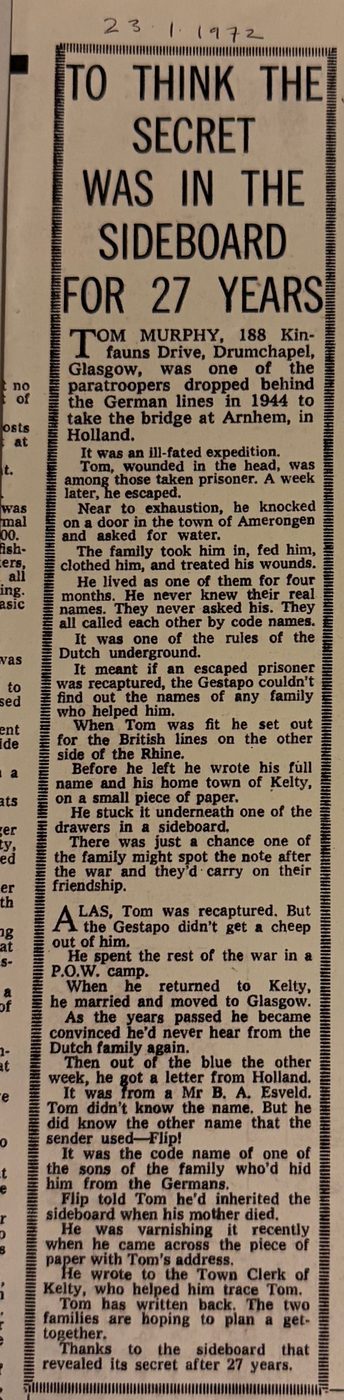
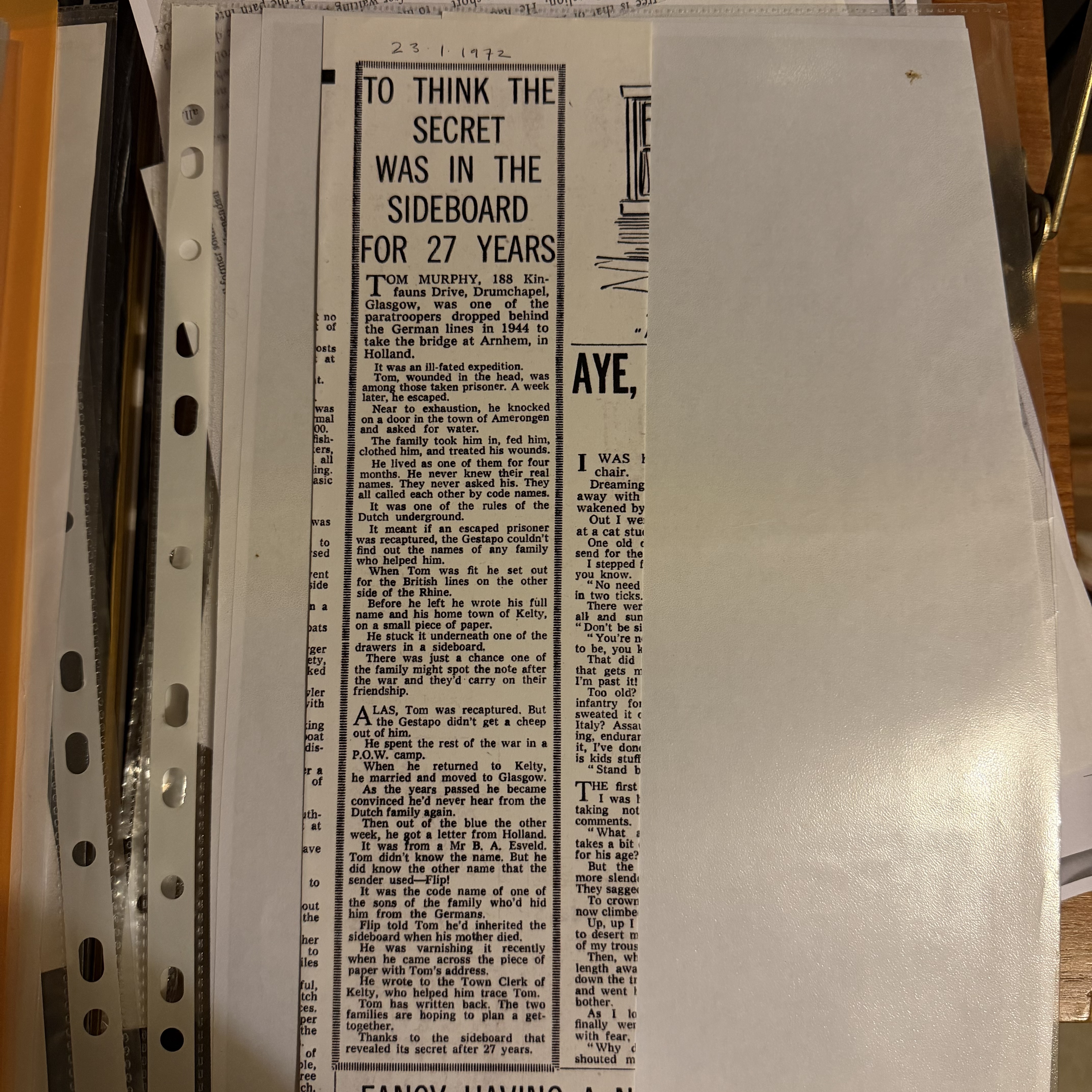
"To think the secret was in the sideboard for 27 years", the Sunday Post, 23 January 1972: a cutting kept by Tom's niece Liz Moore, who says which paper it is, photographed for us in October 2026 (the whole photograph). January 1972: Flip Esveld found him.
- The Sunday Post, by Liz Moore's account (◐ the masthead is not on the cutting; 23 January 1972, the date written on it, was a Sunday), told how "the other week" Tom had had a letter from Holland, from "a Mr B. A. Esveld". He did not know the name, "But he did know the other name that the sender used—Flip!": Berend "Flip" Esveld, elder son of the Amerongen family who hid him over Christmas 1944.
- By the paper, before he left them Tom wrote his full name and home town, Kelty, on a small piece of paper and stuck it underneath one of the drawers of a sideboard. Flip "inherited the sideboard when his mother died" (Mrs Esveld died in June 1966), found the paper while varnishing it, and wrote to the Town Clerk of Kelty, "who helped him trace Tom", then at 188 Kinfauns Drive, Drumchapel. "The two families are hoping to plan a get-together."
- ⚠︎ Who put the note there is not known: the paper's is the only account. ◐ The families who hid him kept the men's names and addresses for after the war; the Van Nispens wrote his down for the Americans in 1945 (their list, p. 3), and the Veermans had his name and number on a list (p. 5).
- ⚠︎ The paper has him knock on the Esvelds' door himself and live with them four months; he came to them by the escape line and stayed about ten days (Amerongen).
-
24 July 1974: Jo Veerman found him again.
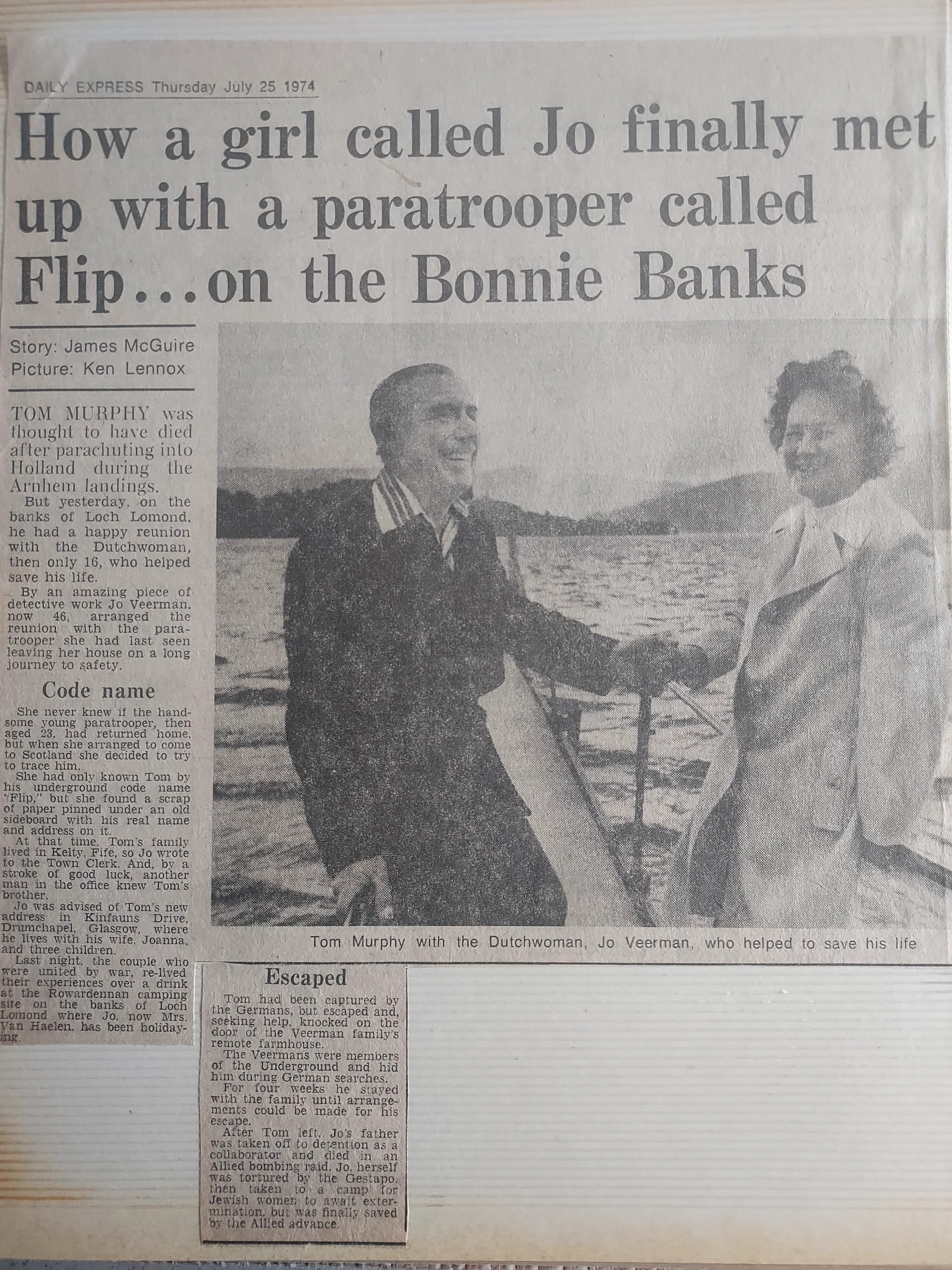
- The Daily Express reported it the next morning under "How a girl called Jo finally met up with a paratrooper called Flip… on the Bonnie Banks", with a photograph of the two of them (Daily Express, 25 July 1974, by James McGuire, a cutting kept by Jo Veerman's family and sent to us in October 2026).
- The paper has her knowing him "only … by his underground code name 'Flip,'" (✗ wrong, see below) and finding "a scrap of paper pinned under an old sideboard with his real name and address on it".
- His family had lived in Kelty, so she wrote to the Town Clerk, "and, by a stroke of good luck, another man in the office knew Tom's brother", and she was given his address in Kinfauns Drive, Drumchapel, "where he lives with his wife, Joanna, and three children" (✗ she was Joan; ⚠︎ they had four children, so the paper may mean the three still at home: Subject, "Later life").
- She was 46 and holidaying in Scotland (with her husband, by Murphy's notes; he was Jean-Baptiste Vanhaelen, of Belgium, by her death notice), and the two old friends "re-lived their experiences over a drink at the Rowardennan camping site on the banks of Loch Lomond".
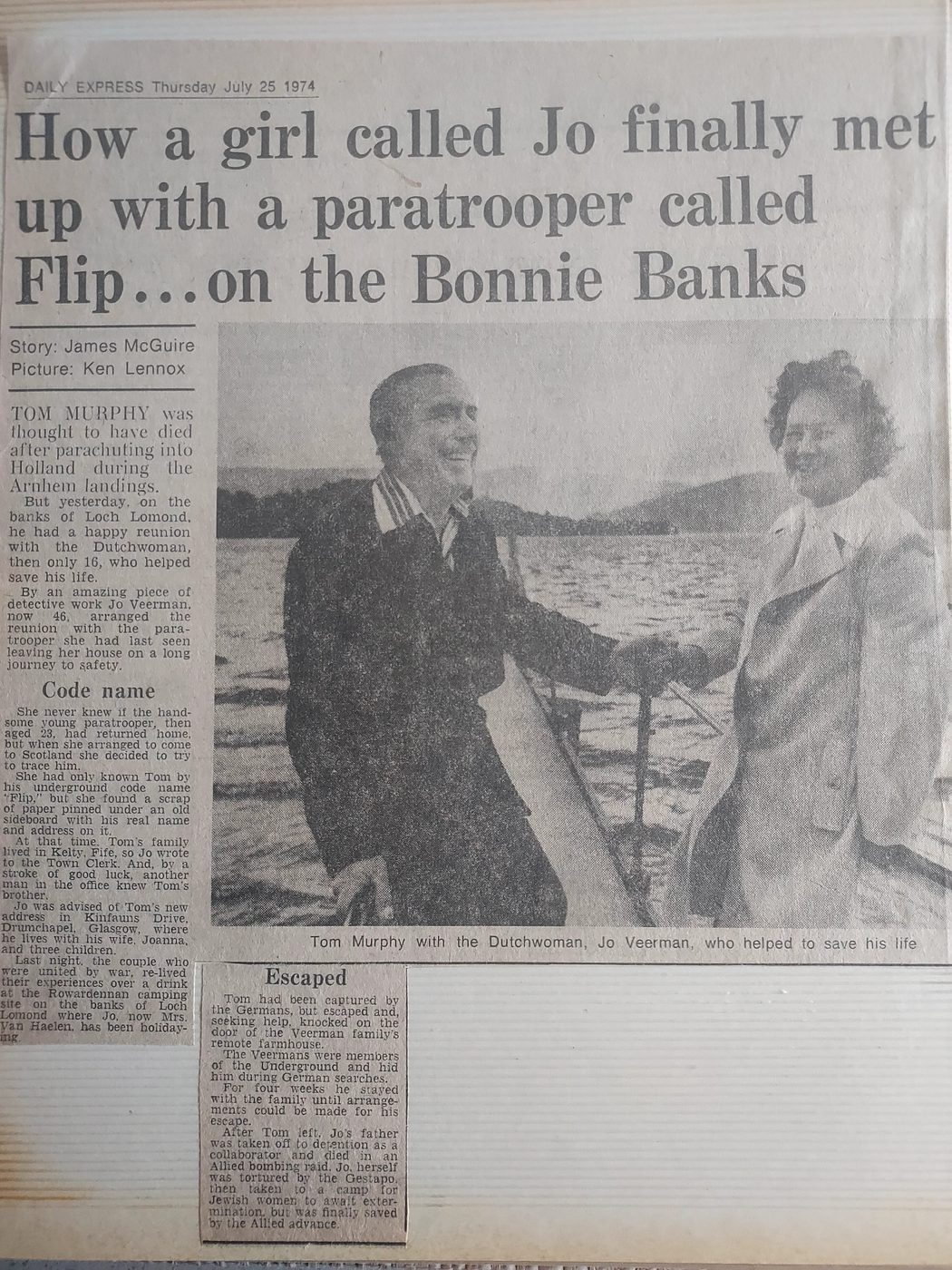
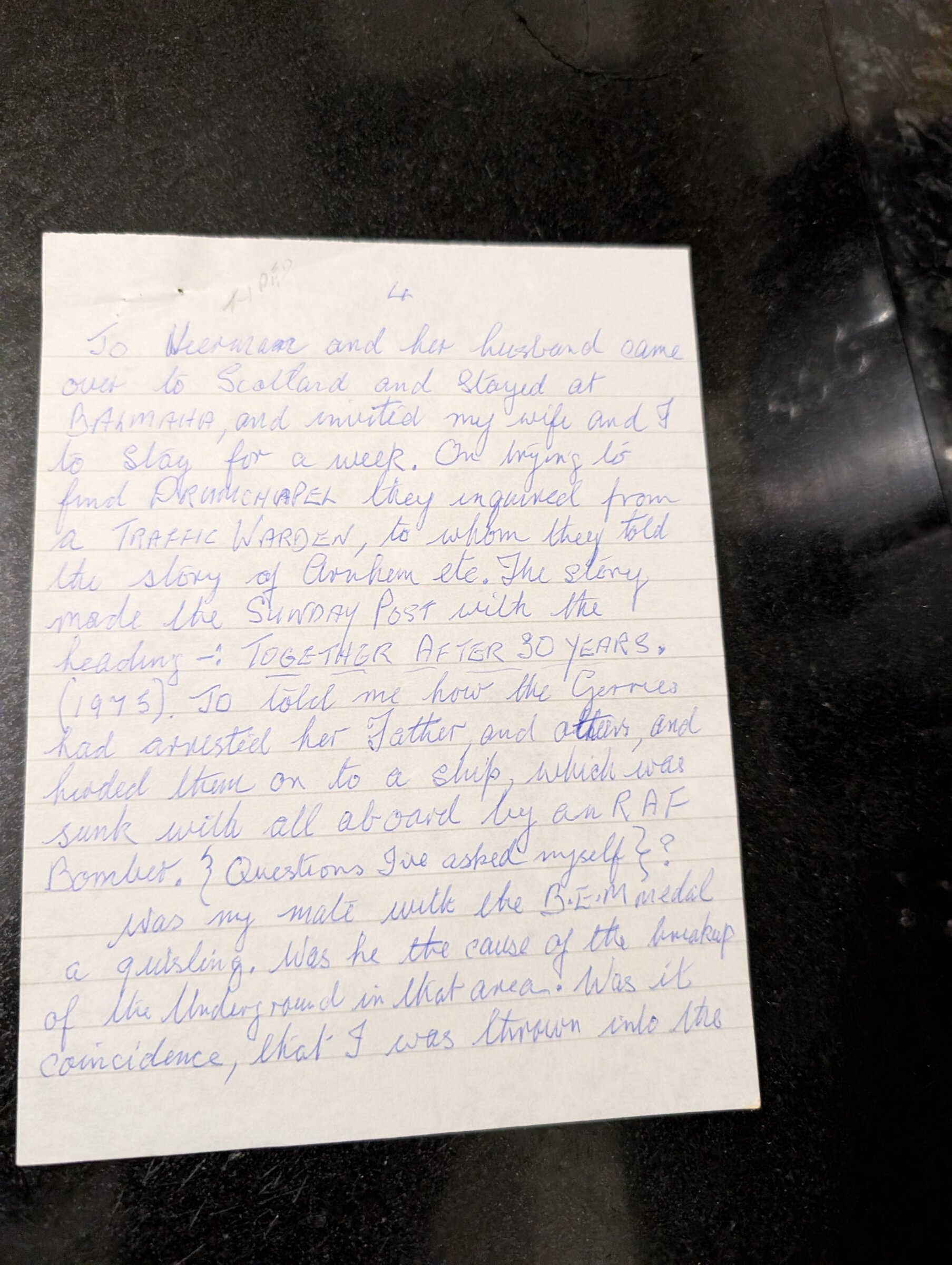
Daily Express, Thursday 25 July 1974: story James McGuire, picture Ken Lennox. A cutting kept by Jo Veerman's family, photographed for us by Jopie's son, Jacques Vanhaelen (full size). His own notes put the visit in 1975, with Jo and her husband staying at Balmaha, a few miles down the same shore, and inviting the Murphys to stay a week with them (p.4); the paper, dated the morning after, settles the year, and Jo's son Jacques Vanhaelen, who was at the campsite, is certain of it: "in 1975 I got married" (his email, October 2026). A Book of Fife Heroes (1998) has the same kind of beginning without saying who found it: "An address he left in a chest of drawers was discovered years later by a member of the family who had safeguarded him and a reunion took place" (p. 49). He did leave his address with the families who hid him: the Van Nispens wrote it down for the Americans in 1945 (their list, p. 3; Van Nispen's page). His notes add that, looking for Drumchapel, Jo and her husband asked a traffic warden the way and told him the Arnhem story, and that it "made the SUNDAY POST with the heading - TOGETHER AFTER 30 YEARS" (p.4). Thirty years on from 1944 is 1974. No copy of that one has been found yet (The newspaper articles of 1972 and 1974). If you have one, please use the "Get in touch" box at the foot of this page. ⚠︎ The traffic warden is his word (p.4).
✗ "Flip" was not Tom's code name: in the American files it is Berend Esveld's, of Amerongen, one of the last households to hide him before the crossing in January 1945 (Berend Esveld), and it was Flip who wrote to Tom in 1972 (January 1972, above). The two papers tell much the same story of a note under a sideboard and a letter to the Town Clerk of Kelty, the 1972 one of Flip and the 1974 one of Jo. Nothing found says Jo did not do the same two years later, so both stand as their papers tell them. The same article gets her own story wrong: her father was not "taken off to detention as a collaborator", and she was not taken to "a camp for Jewish women to await extermination": she was held at Westerbork in 1945 with the women of the Vrouwenmars (Jopie: Westerbork and the Vrouwenmars).
On the same page, after the visit, he writes: "Jo told me how the Gerries had arrested her Father, and others, and herded them on to a ship, which was sunk with all aboard by an RAF Bomber" (p.4); he does not say when she told him, or name the ship. The Dutch record bears her out: her father died when the Cap Arcona, full of Neuengamme prisoners, was sunk by British aircraft on 3 May 1945 (Digitaal Monument Neuengamme, the Dutch Vriendenkring Neuengamme's online memorial; Jacob Veerman).
Jacques remembers the evening at the campsite:
He had a hip flask of whiskey in his inner pocket and liked to wash it down with a beer. He'd had too much to drink that evening and ended up spending the night in our tent. In the middle of the night, he needed the toilet, but it was too far away, so he just filled the empty beer cans with his urine. It was certainly something you never forget.
— Jacques Vanhaelen, Jopie Veerman's son, who was at the campsite · by email, October 2026
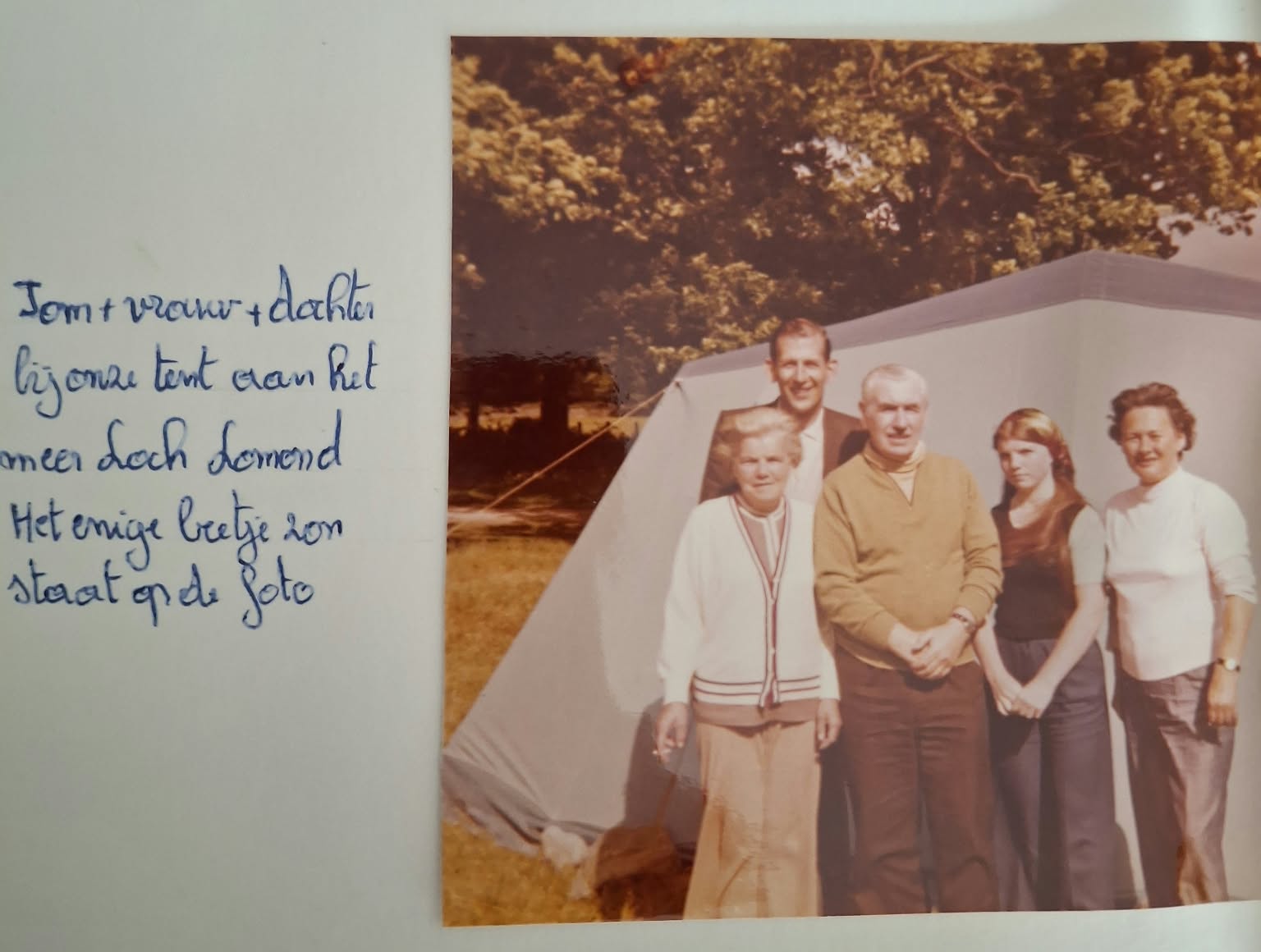
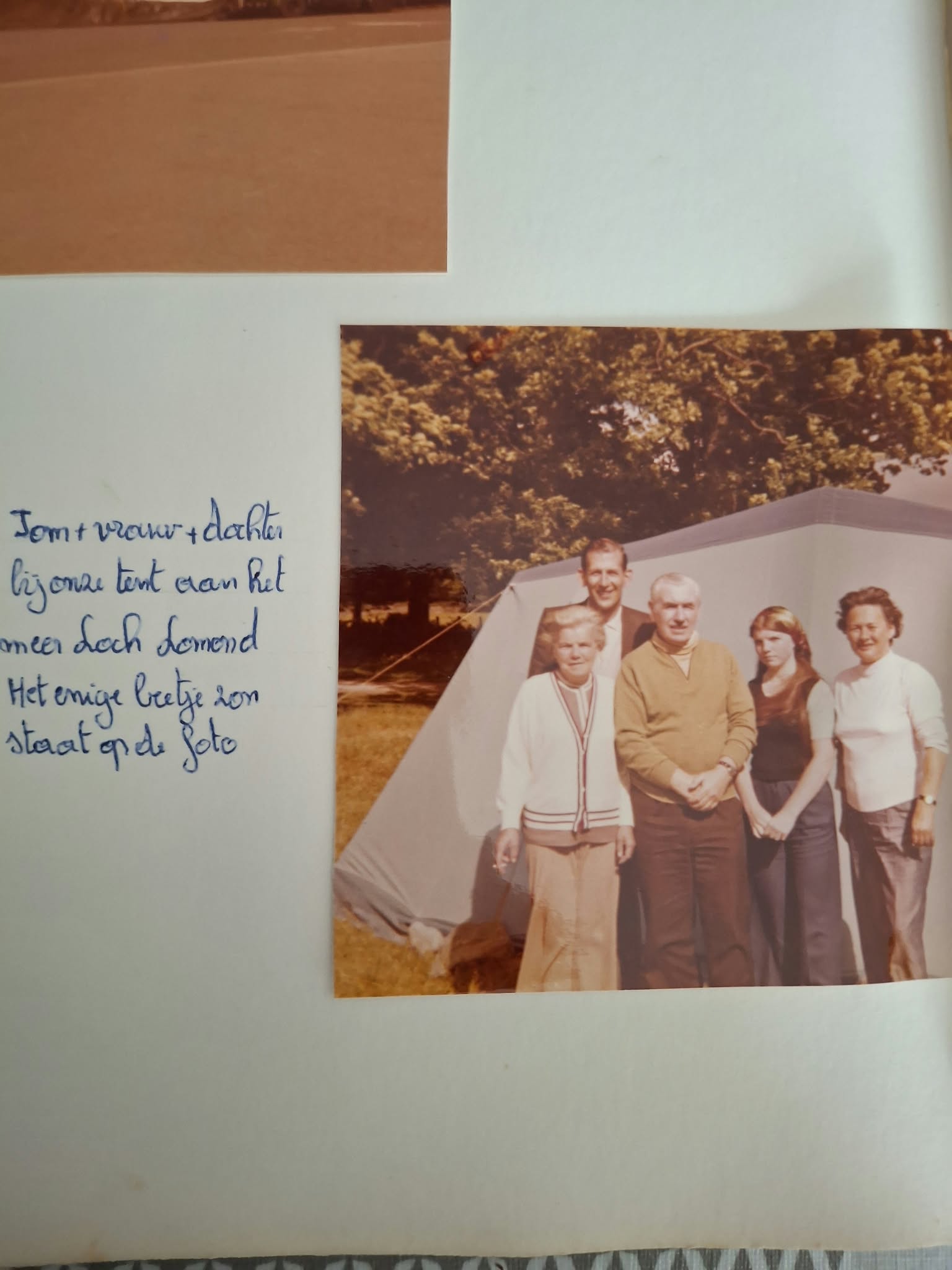
From the Vanhaelen family album: "Tom + vrouw + dochter bij onze tent aan het meer Loch Lomond. Het enige beetje zon staat op de foto" (Tom, his wife and their daughter by our tent at Loch Lomond; the only bit of sun is in the photo). July 1974. Sent by Jopie's son, Jacques Vanhaelen, October 2026. -
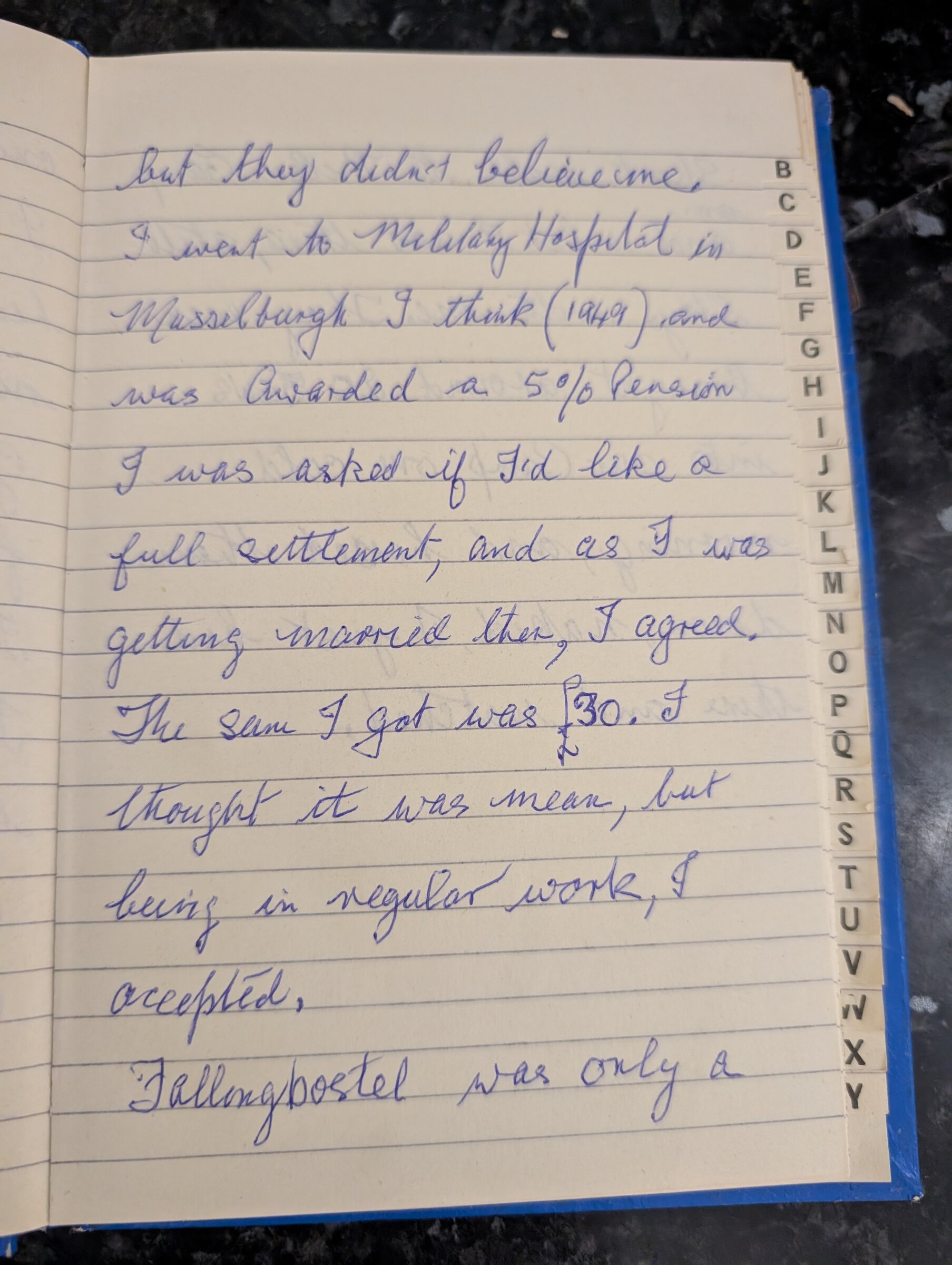
⚠︎ The pension.
But they didn't believe me. I went to Military Hospital in Musselburgh, I think (1949), and was awarded a 5% pension. I was asked if I'd like a full settlement, and as I was getting married then, I agreed. The sum I got was £30. I thought it was mean, but being in regular work, I accepted
— Tom Murphy, his notebook (the page)
His word.
-
⚠︎ Why he left the Airborne behind.
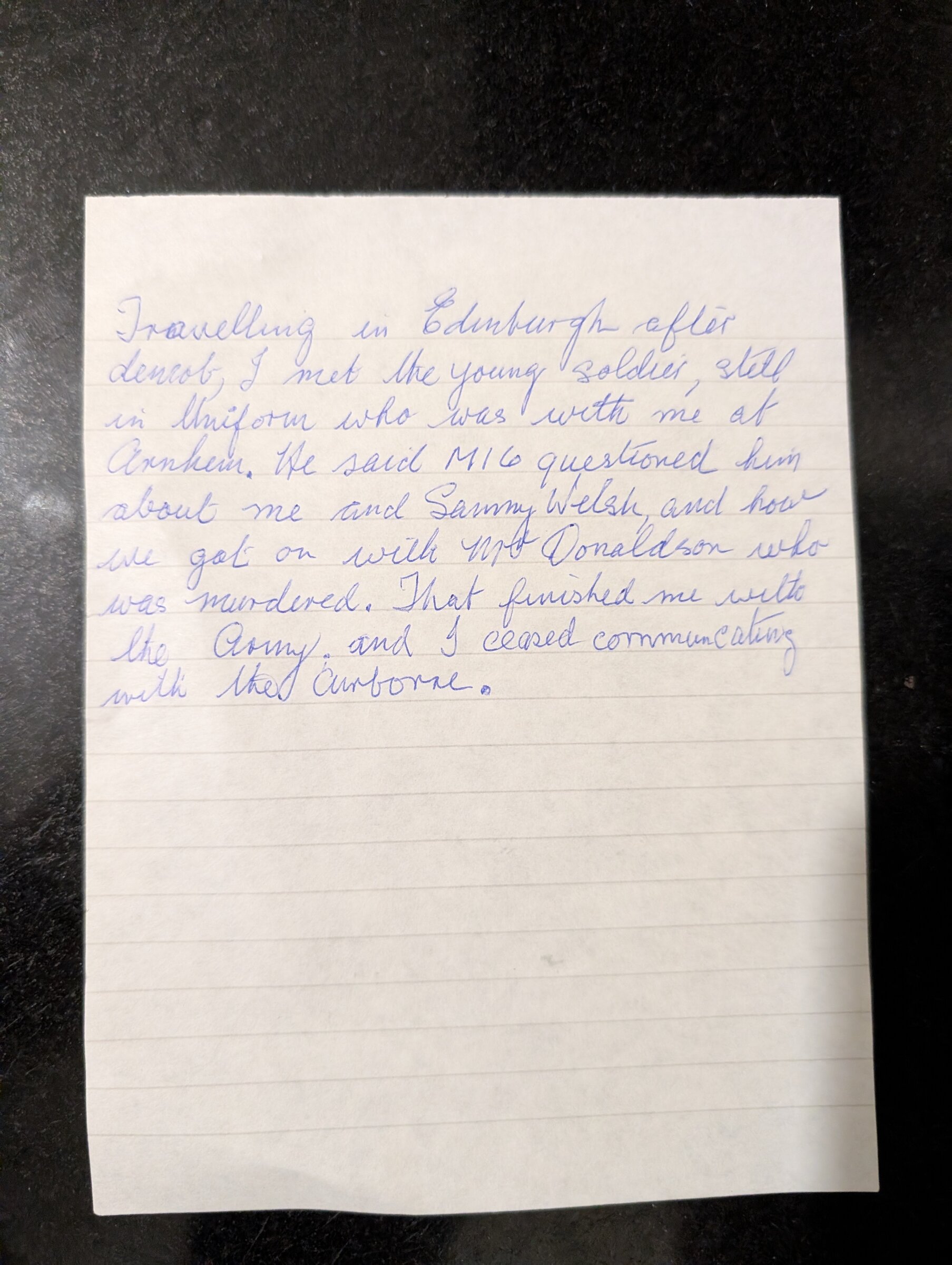
Travelling in Edinburgh after demob, I met the young soldier, still in uniform, who was with me at Arnhem. He said MI6 questioned him about me and Sammy Welsh, and how we got on with Mr Donaldson who was murdered. That finished me with the Army, and I ceased communicating with the Airborne
— Tom Murphy, his second set of handwritten pages (page)
His word; the soldier is not named. It is the only explanation in the papers for why a man with this record never joined the reunions. That he never did, and never wanted to talk about the war, the family knows.
-
His family after the war:
- His wife Joan died in December 1995 (family knowledge; his notes of 1998 say "3 yrs ago", p.5).
- He and his wife had four children, Frances, Catherine, Martin and Mary, and seven grandchildren, Adam, Paul, Cathy, Stewart, Kenny, Stephen and Joanne (family knowledge).
- He buried three of them: Catherine in May 1985 and Martin in March 1997, aged 42 (family knowledge; his notes, written late in 1998, have his son "aged 43 2 yrs ago" and Catherine "7 yrs ago", p.5), and Frances.
- Mary is the one of the four still with us, and the grandchildren are who these pages are for.
The family papers
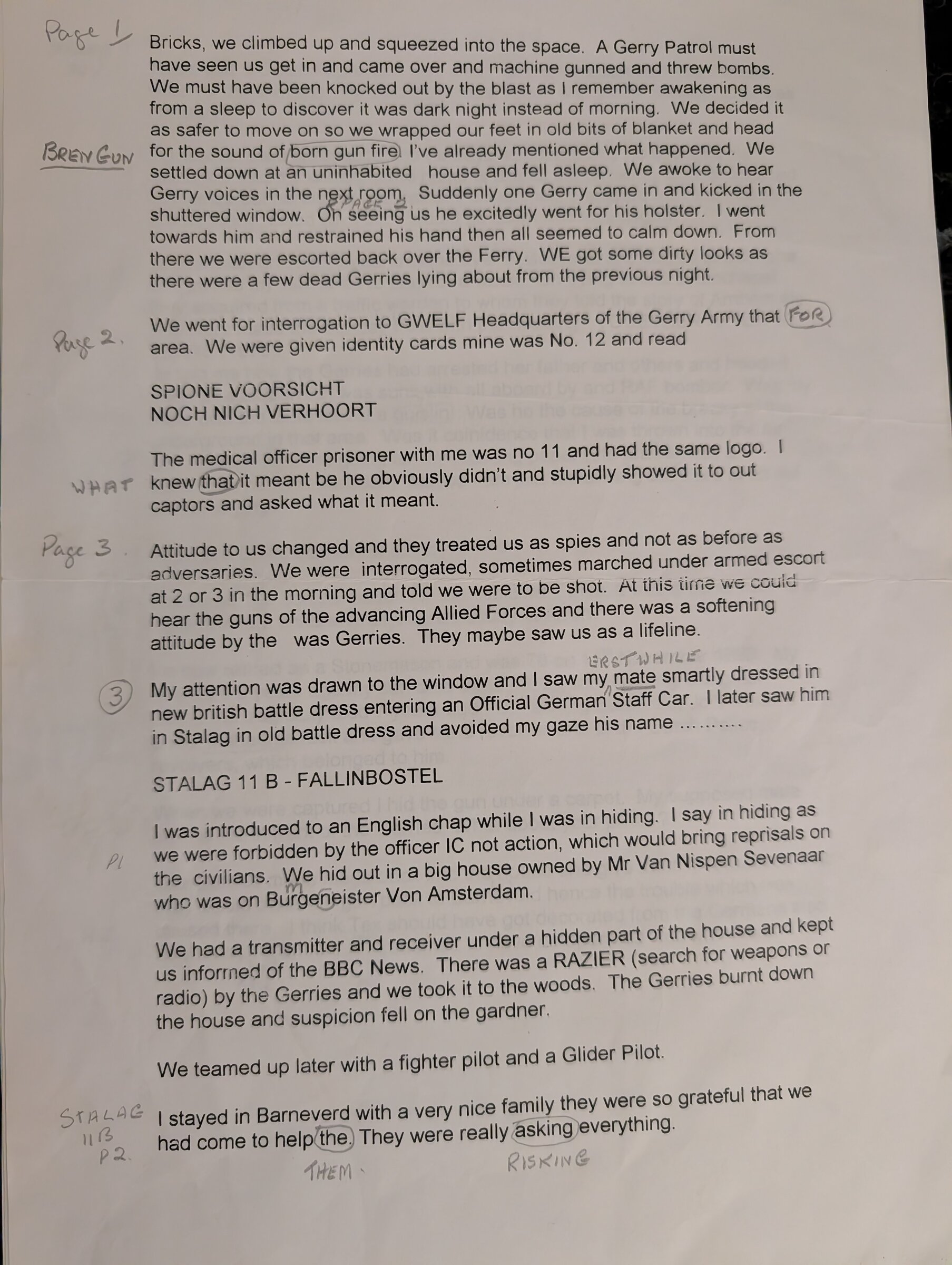
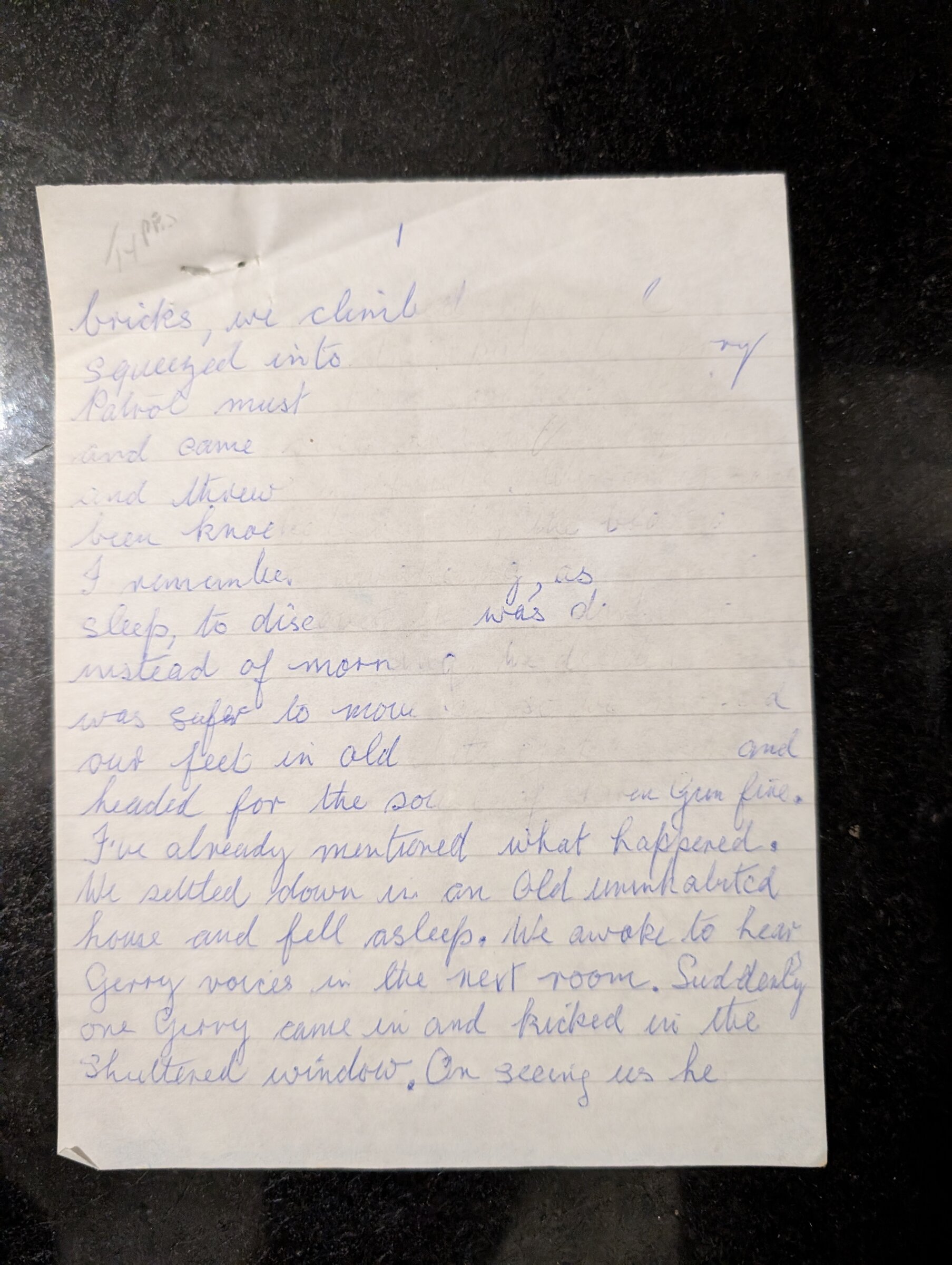
Link to the section The family papersEvery page is reproduced, with a description, on the papers page, and the set is downloadable there as one PDF. Thirty-seven photographs: the 1945 cutting and letter, the service list, the twelve-page memoir and its typed transcript, the second set on captivity with its typed transcript, the typed notes, and six loose or notebook pages. Everything he wrote is here; there is no more.
He wrote the memoirs in the care home where he was living in his late seventies, and was keen to get it down; his carer there typed the handwritten pages up for him (family knowledge). The typed pages carry pencil corrections in another hand, made against the handwritten original: "drawer" to driver, "dingo" to ding, "kille" to killed, "Te" to the, and, in the Banwell paragraph, "We seemed to have co-operated well with them" to "He". On typed pages 1–3 the same hand marks the page breaks of the handwritten original ("Page 1", "Page 2", "Page 3"), writes "Bren gun" against the typist's "born gun fire", inserts "erstwhile" before "my mate" in the staff-car sentence, and corrects "the" to "them" and "asking" to "risking" in the Barneveld line; on the memoir transcript it corrects "for the evening" to "the enemy". Where the typed and handwritten versions differ, this site quotes the handwritten one.
Most of the first page of the captivity set is lost (scan); the typed transcript is the only full text of it.
Things he said
Link to the section Things he saidNot everything he told the family was written down. He rarely spoke of the war at all; the family's word for what he would talk about instead was trifle. What follows is what he did say, remembered by the person he said it to, set down here so it is not lost, and marked ⚠︎ like anything else that rests on one memory of one conversation.
- The sniper, and no mercy.
- Told to his grandson Stewart in his last years, unprompted and out of character.
- He and his mates were pinned down by a German sniper and could not move. He worked out where the man was and had a clear shot at his head, but something held him back and he put the round into a leg or an arm instead.
- It did not stop the sniper: wounded, the man fired again and killed the soldier beside Tom. That, as his grandson understood it, was the moment he learned there was no mercy in it.
- ◐ The memoir has the bones of the story without the lesson: "I was designated as Sniper by Mr Powell. I despatched one Gerry sniper who was giving us trouble" (p.7), which puts it at Arnhem, under Powell, in September 1944. The spoken version is what the written one left out.
- ⚠︎ Who the man beside him was, he did not say.